The Folder Between Them
Part I — The Hand on the Folder
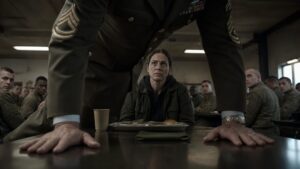
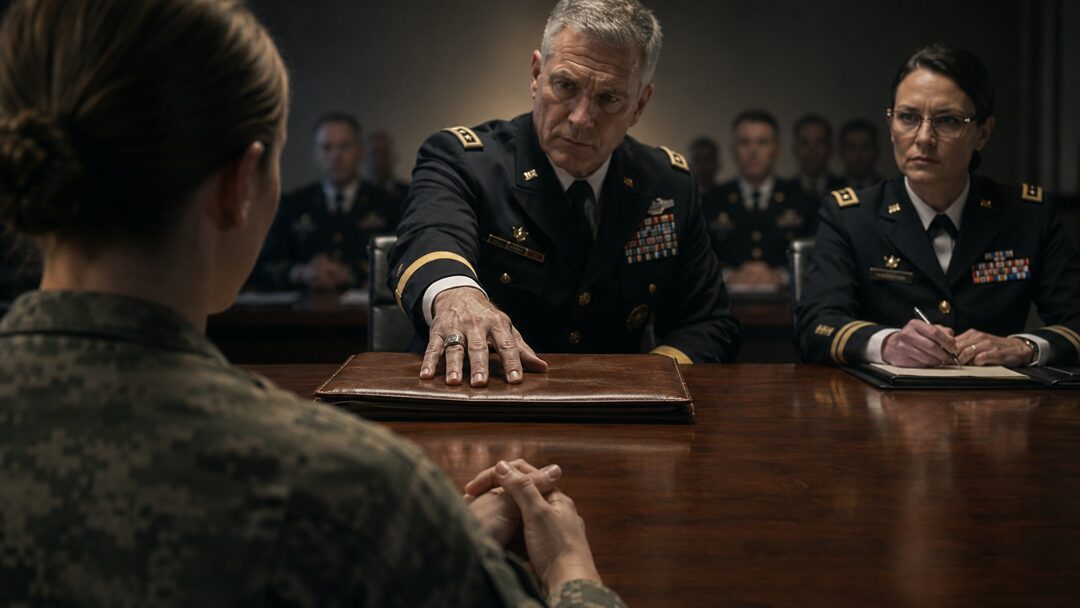
Colonel Robert Hayes placed the brown leather folder in the center of the table and rested his hand on it like he had already won.
Emily Carter watched his fingers flatten against the worn cover. His class ring caught the ceiling light. His ribbons sat in perfect rows across his dark dress uniform. Behind him, two officers sat along the wall, both pretending not to study her face.
Hayes smiled.
“Specialist Carter,” he said, “do you understand what happens to people who confuse guilt with duty?”
Emily kept her hands folded on the table.
She had learned to keep them still.
The room had no windows. The air conditioner clicked every few seconds above the door. Someone had cleaned the table with a lemon disinfectant strong enough to sting. Everything in the room looked official, temporary, and tired.
Major Susan Bennett sat to Hayes’s left with a notebook open in front of her. Her pen lay exactly parallel to the edge of the paper. She had the controlled look of someone who believed order could still save a room from becoming cruel.
Captain Mark Reynolds sat farther back, shoulders loose, one ankle crossed over the other. His mouth held the beginning of a smirk.
Emily knew that look.
She had seen men wear it when a woman was about to be corrected in public.
Hayes tapped the folder once.
“This review does not need to be difficult,” he said. “You filed a dissenting addendum to an after-action report that has already been reviewed by command.”
Emily said nothing.
Hayes leaned forward.
“You alleged that the loss during Operation Glass Harbor was not the result of enemy interference alone.”
Bennett’s pen moved.
Reynolds looked down, but not before Emily saw the small lift at the corner of his mouth.
Hayes continued, voice smooth. “Your refusal to endorse the official report has delayed commendations, delayed final notifications, and delayed closure for several families who have earned better from us.”
Closure.
Emily felt the word land in the center of her chest.
She did not look at the folder again. Not yet.
“Yes, sir,” she said.
Hayes’s smile widened as if she had agreed with him.
“Yes, sir,” he repeated softly. “That is all?”
Emily met his eyes.
“That is what you said.”
The room changed by one degree.
Not enough to save her. Enough to warn him.
Hayes opened the folder just an inch, angled toward himself, and glanced down as if the pages inside bored him. He did not turn it toward Bennett. He did not turn it toward Emily.
“This is not a trial,” he said. “This is a review of judgment. Your judgment.”
Emily heard Daniel Price’s voice in memory, low and dry over a dead radio channel.
They’ll call it judgment when they mean obedience.
She pushed the memory back.
Hayes lifted a page.
“Your evaluation notes difficulty sleeping, intrusive recall, attachment to personnel lost in the operation, and resistance to the command narrative.”
He paused after the last phrase.
Reynolds gave a breath through his nose that might have passed for a laugh.
Emily kept her hands folded.
Hayes looked up. “Would you describe yourself as objective, Specialist?”
“No, sir.”
Bennett’s pen stopped.
Hayes blinked, amused. “No?”
“No one who was there is objective. That is why records matter.”
Reynolds stopped smiling for half a second.
Hayes closed the folder with two fingers.
“Careful.”
Emily looked at the leather cover.
Then she looked back at him.
“Yes, sir.”
Hayes studied her. The smile returned, thinner now.
“You were close to Sergeant Daniel Price.”
Emily felt Bennett’s eyes rise from the notebook.
She did not answer quickly.
Every answer in that room had weight. Every silence could be made into evidence.
“I served with Sergeant Price,” Emily said.
“That is not what I asked.”
“No, sir. But it is what I can answer here.”
Reynolds shifted in his chair.
Hayes chuckled once, a small sound meant for the room more than for her.
“You see, Major Bennett? This is precisely the problem. Specialist Carter believes precision is the same as honesty.”
Emily looked at Bennett then.
“Was the full radio transcript included in the packet?”
The pen stopped again.
Hayes’s hand tightened on the folder.
For the first time, he did not smile.
Part II — What She Would Not Sign
The official report had been twelve pages long.
Emily remembered the weight of it in her hands two weeks earlier, the paper still warm from the printer. She had read it once standing beside the copier, then again sitting on the floor of the records room with her back against a cabinet.
By the third reading, she understood what had been removed.
Not corrected.
Not clarified.
Removed.
Operation Glass Harbor had become clean on paper. Too clean. A dust storm. A broken drone feed. Hostile interference. A compromised extraction path. Sergeant Daniel Price separated from formation after disobeying a hold order. Losses regrettable but unavoidable.
There were no children in the report.
There was no open-channel call.
There was no timestamp for the revised route.
There was no mention of the three minutes between Emily’s map confirmation and Hayes’s command override.
There was only Daniel, turned into a brave mistake.
When they slid the report across her desk and asked for her endorsement, Emily had stared at the signature line until the letters blurred.
She had signed many things since joining.
Inventory forms. Clearance logs. Watch rotations. Incident corrections. Leave requests she never used.
But not that.
Not a clean story built over Daniel’s last transmission.
So she filed the addendum.
After that, people stopped meeting her eyes in the hallway.
Now Colonel Hayes sat across from her, one hand on the folder that held pieces of what she had refused to bury.
“Specialist Carter,” Bennett said, her voice calm but sharpened, “please repeat your question.”
Emily did.
“Was the full radio transcript included in the packet?”
Hayes answered before Bennett could turn to him.
“The panel has all relevant materials.”
“That was not my question, sir.”
His eyes moved over her face.
Hayes had the kind of stare that had probably ended arguments in larger rooms than this. A field commander’s stare. A father’s stare, maybe. A man used to people mistaking volume for burden.
“Relevant material,” he said, “is determined above your level.”
Emily nodded once.
“Then my addendum stands.”
Reynolds made a soft sound, not quite disbelief.
Hayes opened the folder again and pulled out a page. This time he lifted it higher, just long enough for Emily to recognize the format.
Her psychological evaluation.
Not the mission log.
Not the channel transcript.
Not the map.
Hayes read aloud.
“Subject displays fixation on unverified auditory material and persistent belief that operational sequence was improperly recorded.”
He looked up.
“Unverified auditory material,” he repeated. “That is a careful phrase.”
Emily said, “It was verified.”
“By you.”
“By the backup recorder.”
“Which captured partial distortion.”
“At 2217 hours and thirty-two seconds.”
The room went still.
Bennett wrote the timestamp down.
Hayes noticed.
Emily saw it happen: the brief turn of his eyes, the tightening around his mouth.
He did not like that Bennett had written it.
“That timestamp,” Hayes said, “has been reviewed.”
“No, sir. It has been summarized.”
Bennett looked at Hayes.
Reynolds uncrossed his ankle.
Emily felt the air conditioner click off. The silence after it was worse.
Hayes lowered the evaluation page onto the folder.
“You are a talented analyst,” he said. “No one here disputes that. But talent becomes dangerous when it convinces a person that grief is evidence.”
There it was.
Not the first blow, but the one he had been saving.
Emily held his gaze.
On the last night before Glass Harbor, Daniel had sat on an overturned crate outside the communications tent, cleaning dust out of the buttons on his radio with a toothpick. He had looked up when Emily brought him the updated terrain overlay.
“Carter,” he had said, “you ever get tired of being right in rooms where nobody wants you to be?”
She had said, “Every day.”
He had grinned.
“Good. Stay annoying.”
That was the memory Hayes wanted to turn into a weakness.
Emily did not give it to him.
“Sergeant Price is not the reason the report is incomplete,” she said.
Hayes leaned back.
“And yet his name appears six times in your addendum.”
“Because he was the one blamed for the gap.”
“He broke the hold order.”
“He moved after the route was changed.”
“He moved before he received clearance.”
“He moved after the open-channel call.”
Hayes’s hand came down on the folder hard enough to make Bennett’s pen jump.
“There was no confirmed call.”
Emily’s throat tightened.
She let herself breathe once.
“Then why was it removed?”
No one moved.
Not Bennett.
Not Reynolds.
Not Hayes.
The question sat on the polished table beside the folder, plain and dangerous.
Hayes smiled again, but this time it arrived late.
“You are very confident for someone whose career is being reviewed.”
Emily looked at his hand.
“Confidence is not the issue, sir.”
“What is?”
“The sequence.”
Part III — The Missing Minute
Hayes had controlled briefings the way other men controlled doors.
Emily had watched him do it after Operation Glass Harbor, standing before maps with redacted sections and clean arrows, his voice low and steady while exhausted soldiers stared at folding chairs.
He had a gift for arranging facts until they looked like mercy.
The first time he said “closure for the families,” people nodded.
The second time, someone cried.
By the third, the phrase had become part of the official air.
Emily had sat in the back with the mission audio still repeating in her head.
Static.
A child’s voice.
Daniel saying, Carter, confirm that.
Her own voice, too calm, because training had made calmness automatic.
Map still shows heat signatures east of the clinic.
Then Hayes on command frequency.
Disregard. Feed is compromised. Shift extraction to Route Blue.
Daniel again, lower now.
That clinic is not clear.
After that, the night broke into fragments.
Now Hayes looked at Bennett as if inviting her to end this.
“Major,” he said, “with respect, we are allowing this review to drift into operational relitigation.”
Bennett’s pen moved once across the page.
“Specialist Carter asked whether the full transcript was included.”
“All relevant sections were.”
Emily said, “At 2217 hours and thirty-two seconds, an open-channel distress call came through on the shared band. At 2218, Sergeant Price requested confirmation from my station. At 2218 and forty-eight seconds, I confirmed unresolved signatures near the clinic. At 2219 and ten seconds, Colonel Hayes ordered extraction shifted to Route Blue and marked the clinic area compromised.”
Reynolds looked at her now without any trace of amusement.
Hayes said, “You memorized that.”
“Yes, sir.”
“Convenient.”
“No, sir. Necessary.”
Bennett looked from Emily to Hayes.
“Colonel, is the route change timestamp in the packet?”
Hayes’s jaw shifted.
“It is contained in the operational summary.”
“That is not what I asked.”
Emily heard the echo of her own words and knew Hayes did too.
For the first time, a flush rose above his collar.
He opened the folder, slowly. His ring scraped faintly against the leather.
“The packet includes sensitive operational material,” he said. “Specialist Carter is not cleared to review every page in this room.”
Emily almost smiled.
Not because anything was funny.
Because he had finally stepped where she needed him.
“Sir,” she said, “may I read one page from that folder?”
“No.”
The word came too quickly.
Bennett looked at him.
Hayes corrected himself. “Not without authorization.”
Emily turned to Bennett.
“Every page in that folder came from my field terminal.”
The room lost sound.
Even the fluorescent lights seemed to pause.
Reynolds sat forward.
Bennett took off her glasses.
“Colonel Hayes,” she said, “is that accurate?”
Hayes did not answer immediately.
His hand remained on the folder, but it no longer looked like ownership.
It looked like pressure.
“The raw material originated from several sources,” he said.
Emily said, “The pages I’m asking about came from my terminal.”
Bennett’s voice cooled. “Colonel.”
Hayes closed the folder.
“Yes. Some of the materials originated from Specialist Carter’s station.”
Some.
Emily let the word pass.
Bennett put her glasses back on.
“Then I see no procedural reason she cannot identify the page she believes is relevant.”
Hayes turned his head slightly toward her.
“Major, with respect—”
“I did not ask for respect, Colonel. I asked for the packet to be handled properly.”
Reynolds looked down at his hands.
Emily felt something shift under her ribs. Not relief. Relief was too soft.
It was the first inch of a locked door moving.
Hayes lifted the folder, then set it back down, squared to himself. He opened it with more care now, as if the pages inside had become unstable.
“Identify the page,” Bennett said.
Hayes flipped past the evaluation. Past the summary. Past the map extracts.
Emily watched without blinking.
He expected her to ask for the transcript.
He expected a technical fight.
That was why his fingers were ready at the middle tab.
Emily said, “It’s not in the front section.”
Hayes stopped.
Bennett looked at her.
Emily’s voice stayed low.
“It’s sealed inside the back flap.”
Hayes’s hand froze.
Reynolds looked up.
For one second, the room showed Emily everything.
Bennett’s confusion.
Reynolds’s sudden attention.
Hayes’s fear, small but real, gone almost as soon as it appeared.
He had not known she knew.
Part IV — The Back Flap
Hayes closed the folder.
“That material is not relevant to this proceeding.”
Bennett’s eyes narrowed.
“You just asked her to identify the page.”
“She identified personal material.”
Emily said, “Sergeant Price wrote it during the blackout before his last movement.”
Reynolds whispered, “Jesus.”
Bennett shot him a look. He straightened.
Hayes’s face hardened.
“We are not going to use a dead man’s private words to advance an accusation he is not here to support.”
Emily felt the sentence hit exactly where he meant it to.
Private words.
Dead man.
Accusation.
He knew how to arrange grief into a wall.
She pressed her thumb against the side of her index finger beneath the table. Once. Hard.
Daniel had given her the note because the blackout had killed the internal messaging system for eleven minutes. He had torn the page from a field notebook and folded it twice before handing it to a runner.
Emily had not received it until after.
After the clinic.
After the route change.
After the stretcher team came back with only two of the four they had carried out.
After Daniel’s radio went quiet.
The note was not a confession.
It was worse.
It was trust.
Hayes said, “Sergeant Price disobeyed a hold order. That is established.”
Emily looked at him.
“He moved toward the clinic.”
“Against command.”
“Toward voices on the open channel.”
“Unconfirmed voices.”
“Children.”
The word changed the room more than any timestamp had.
Bennett’s pen stopped again.
Reynolds looked away.
Hayes did not.
His face held, but something behind it tightened.
“You do not know that,” he said.
Emily’s voice did not rise.
“You heard the same recording.”
“The feed was compromised.”
“The voices were not from the feed. They were on the shared band.”
“Distorted.”
“Clear enough for Sergeant Price to ask me to confirm heat signatures.”
“Specialist—”
“Clear enough for me to answer.”
Hayes leaned forward.
“And your answer sent him there.”
There it was.
The sentence she had known he would find.
The one she had spoken to herself on nights when sleep came close and then turned away.
Bennett looked at Emily sharply.
Reynolds looked at the table.
Emily felt the room tilt for half a second.
Daniel had asked.
She had answered.
The map had been right.
But right had not brought him back.
Hayes saw the flicker on her face. His expression softened in a way that almost looked kind.
Almost.
“You think I don’t understand guilt?” he said. “I have written more letters than you have years in uniform. I have stood with families who wanted reasons the world could not give them. Sometimes the kindest thing we can do is not hand them a mess and call it truth.”
Emily’s hands loosened.
For one moment, she saw the man he might have been before rank taught him to polish every wound. A man who had maybe once cared and still did, in some warped, guarded way. A man who had mistaken control for mercy so many times that he no longer knew the difference.
Then he touched the folder again.
And the moment passed.
“Closure,” Emily said.
Hayes blinked.
“That’s what you called it.”
“It is what they deserve.”
“No, sir.” Her voice almost broke, but did not. “They deserve not to be comforted with something false.”
Bennett looked at her for a long time.
“Specialist Carter,” she said, “what exactly is in the back flap?”
Emily swallowed.
“A handwritten note from Sergeant Price. And the first page of the raw timestamp index.”
Hayes snapped, “Which she had no authorization to retain.”
Emily looked at him.
“I did not retain it. He sent it through the chain before he moved.”
“That is not possible.”
“It is in the folder.”
Hayes did not move.
Bennett’s voice became very quiet.
“Open it.”
Hayes turned to her.
“Major Bennett, I strongly advise—”
“Open it.”
The room shrank around the folder.
Hayes held Bennett’s stare for two seconds too long.
Then he opened the folder.
He moved through the front pages slowly, buying time from paper. Evaluation. Summary. Map. Route log. Redacted transcript. His fingers reached the back cover.
Emily saw his thumb find the flap.
He hesitated.
Reynolds leaned forward without meaning to.
Hayes unsealed it.
Inside was a folded sheet lined with dirt at the crease and a printout with a terminal header Emily recognized as if it were her own name.
Hayes did not lift them.
Bennett did.
She unfolded the note first.
Her eyes moved across the page.
Whatever she saw there changed her posture.
Not dramatically.
Only enough for Emily to know Daniel had entered the room.
Part V — The Page He Left
Hayes said, “That should not be read aloud.”
Bennett kept looking at the page.
“Why?”
“Because it is personal.”
Emily said, “He wrote it for the record.”
Hayes turned on her.
“He wrote your name.”
Emily did not answer.
There were things a person could say in a room like that and things the room would ruin by hearing them.
Bennett looked up.
“Specialist Carter, did Sergeant Price ask you to preserve this?”
Emily’s throat tightened.
The answer was not simple.
Daniel had not stood before her and made a formal request. He had not known there would be a review, or a folder, or Hayes’s ring pressed into the leather like a seal.
He had said it three nights before the operation, half joking, half not, while she updated grid overlays under a lamp that flickered with every generator cough.
“If I do something stupid,” he said, “don’t let them make me sound noble.”
Emily had looked at him over the tablet.
“You planning to do something stupid?”
“Everybody is, eventually.”
“That’s comforting.”
“I mean it.” His smile had faded then. “If it goes wrong, they’ll clean it up. They always do. Don’t let them polish my words into something that makes everybody feel better.”
She had said, “Then don’t leave me your words.”
He had said, “Carter, you’re the only person I know mean enough to keep them honest.”
She had laughed.
That was the part that hurt now.
She had laughed because she thought there would be time to be angry with him later.
Emily looked at Bennett.
“Yes, ma’am,” she said. “He asked me not to let his words be polished into something clean.”
Hayes breathed out through his nose.
“Convenient memory.”
Emily turned to him.
“You’ve used his name all morning.”
The words came out softer than she expected.
That made them worse.
Hayes’s face stilled.
Emily continued, “You used his name to question my judgment. You used his name to protect the report. You used his name to ask for silence. You don’t get to call him private only when he disagrees with you.”
Reynolds stared at the table.
Bennett looked at Hayes.
For once, Hayes had no immediate sentence ready.
Bennett slid the note toward Emily.
“Read it.”
Hayes stood halfway.
“Major—”
“Sit down, Colonel.”
It was not loud.
It did not need to be.
Hayes remained standing for one second, long enough to remind everyone what he was used to being.
Then he sat.
Emily picked up Daniel’s note.
The paper felt thinner than she remembered.
His handwriting slanted hard to the right. He always wrote like he was trying to outrun the end of the line.
She began.
“If this gets logged, put it with Carter’s map. Clinic is not clear. Repeat, not clear. Feed dropped but east wall still reads warm. Someone changed route after blackout and I don’t know why.”
Her voice held.
Barely.
“Open channel picked up voices. Not interference. Not ours. Small voices. If I don’t come back, don’t call this confusion.”
The room had no air now.
Emily kept reading.
“Tell Carter the map was right. Tell her I heard them too.”
The last word thinned in her mouth.
Too.
That was the word that had kept her awake.
Not because it proved she was right.
Because it proved Daniel had not gone alone into a mistake.
He had gone carrying the same sound she heard. The same impossible choice. The same refusal to let a clean map erase living voices.
Emily placed the note on the table.
Then she took the timestamp index from Bennett’s hand.
Her fingers shook once before she steadied them.
“At 2217 and thirty-two seconds,” she said, “open-channel audio begins. At 2218, Sergeant Price requests confirmation. At 2218 and forty-eight seconds, my terminal logs unresolved signatures. At 2219 and ten seconds, extraction is shifted to Route Blue by command authority.”
She laid the printout beside Daniel’s note.
“The official report begins the sequence at 2220.”
Bennett looked down.
Reynolds closed his eyes.
Hayes stared at the two pages as if they had moved there by themselves.
Emily looked at him.
“Why was the open-channel call removed?”
Hayes’s jaw worked.
No answer came.
The silence was not empty.
It was full of everything he had arranged around that missing minute.
His medals.
His summaries.
His careful phrases.
His closure.
Bennett spoke first.
“Colonel Hayes?”
Hayes looked older than he had ten minutes before.
He did not confess.
He did not apologize.
He did not say Daniel’s name.
He only looked at the folder, then at the note, then at Emily.
For the first time all morning, his face held no performance.
That was not justice.
But it was the first honest thing he had given the room.
Part VI — Entered Whole
Major Bennett closed the folder herself.
Not quickly. Not ceremonially.
Carefully.
She gathered Daniel’s note, the timestamp index, the partial transcript, the evaluation pages, and the official summary into one stack. Nothing was removed. Nothing was separated into a cleaner pile.
Hayes watched her do it.
His hand stayed on his side of the table.
“The review is suspended,” Bennett said. “The packet will be entered whole pending formal investigation.”
Reynolds looked up at that.
Hayes said nothing.
Bennett placed both palms on the folder for a moment. Then she slid it across the table to Emily.
It stopped inches from her folded hands.
“This will be logged properly,” Bennett said.
Emily looked at the folder.
All morning, it had belonged to Hayes because everyone in the room let it. His hand had made it a threat. His voice had made it an accusation. His silence had made it a wall.
Now it was just leather, paper, and weight.
Emily touched the edge.
Not to claim it.
To confirm it was real.
Hayes stood.
The chair legs made a sharp sound against the floor.
For a second, Emily thought he would say something to her. Something polished. Something cold. Something about process, or honor, or not understanding command.
But he only buttoned his uniform jacket.
His ring flashed once.
Then he left the room.
Reynolds rose next. He paused near the door.
Emily expected him to avoid her eyes.
He did not.
He looked at her as if he wanted to speak and had just discovered that wanting was not the same as courage.
“I didn’t know,” he said.
Emily did not help him with that.
After a moment, he nodded to no one and walked out.
Bennett remained.
She removed her glasses and rubbed the bridge of her nose. Without them, she looked more tired than strict.
“Specialist Carter,” she said, “this may not become easier from here.”
Emily almost smiled.
“No, ma’am.”
“It may become harder.”
“Yes, ma’am.”
Bennett looked at the folder.
“You understand what you’ve started.”
Emily thought of Daniel’s handwriting. The word too. The way Hayes had said closure as if grief were a door that could be shut from the outside.
“I understand what I didn’t sign.”
Bennett held her gaze.
Then she nodded once.
Outside the conference room, the corridor was too bright.
Soldiers passed with folders, coffee, radios, jokes, ordinary irritation. A printer jammed somewhere down the hall. Someone laughed near the vending machines. A young private hurried by with one bootlace untied.
The world had not changed its pace.
Emily sat on the bench across from the door and set the folder on her lap.
For a moment, she did nothing.
Then she opened it.
Daniel’s note lay on top now. Bennett had placed it there.
Emily unfolded it again, but she did not read the whole thing. She did not need to.
Her eyes went straight to the last line.
Tell Carter the map was right. Tell her I heard them too.
She took the timestamp index and slid it behind the note. Then the transcript. Then the official report. Not separate. Not hidden. Not clean.
Together.
Her hands were steady now, but the steadiness felt different.
Before, it had been armor.
Now it was something heavier.
A way to carry what could not be fixed.
She closed the folder and held it against her chest for one breath, just one, where no one from the room could see.
Then she lowered it.
Across the hall, a soldier held the door open for someone carrying too many files. Neither of them looked at her. Neither of them knew that a minute had been put back where it belonged.
Emily stood.
She did not feel victorious.
Victory was too bright a word for a room Daniel would never walk into.
But when she stepped into the corridor, she felt the truth move with her.
Not clean.
Not easy.
Whole.