The Names in the Room
Part I — The Hand at the Rope
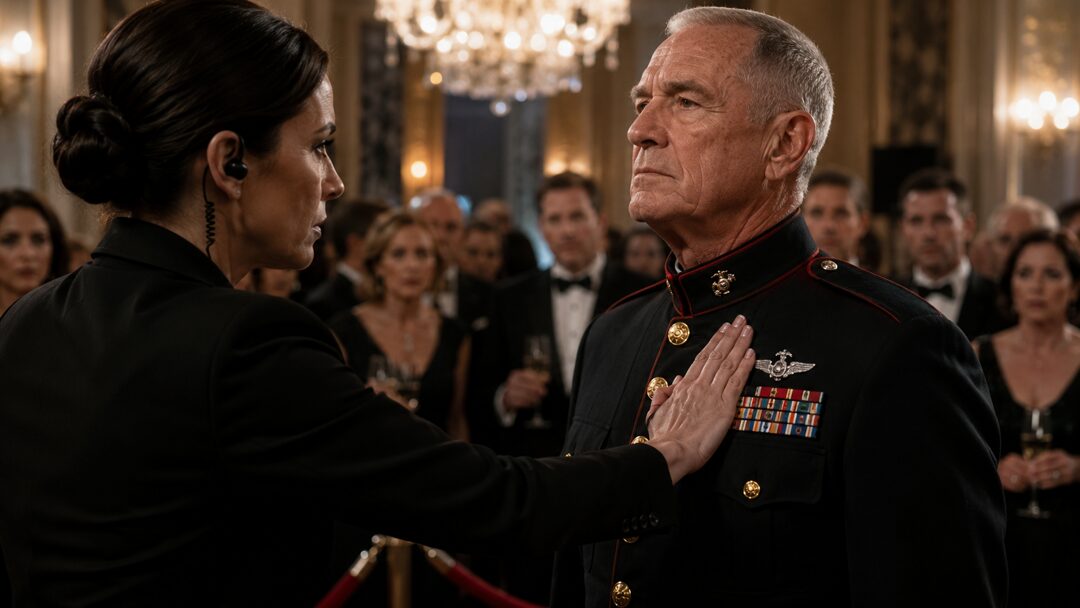
Jennifer Cole stopped the old man with one hand.
Not hard. Not violently. Just a flat palm against the center of his chest, firm enough to keep him from crossing the velvet rope, public enough for everyone near the Meridian Hotel ballroom to see it happen.
The old man looked down at her hand.
Then he looked at her.
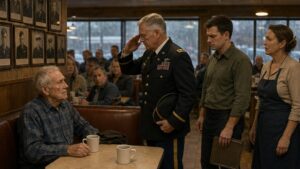
He wore an old Army dress uniform that seemed to belong to another decade. The medals were polished with almost painful care, but the sleeves had frayed at the cuffs. His shoulders were broad, though age had pulled them slightly forward. His shoes shone. His face did not.
“Sir,” Jennifer said, keeping her voice low, “this reception is private.”
Behind her, the donor room glowed under chandeliers. White tablecloths. Gold-rimmed glasses. Men in tuxedos laughing softly near a wall of commemorative photographs. A string quartet had just switched from something classical to something expensive-sounding and forgettable.
The old man did not step back.
“I was invited,” he said.
His voice was quiet enough that Jennifer almost wished he had shouted. A scene would have been easier to manage than dignity.
“Do you have your credential?”
He looked toward the check-in table, then back at her. “No.”
Several guests turned.
Jennifer felt the room notice her noticing him.
That was always when mistakes became dangerous: not when they happened, but when important people began watching to see how you handled them.
She smiled the way she smiled for donors who asked rude questions with generous checks in their pockets.
“Then I’m afraid I can’t let you in.”
The old man’s gaze shifted over her shoulder. For a second, Jennifer thought he was looking for someone to rescue him from embarrassment.
But he was looking past the donors, past the bar, past the stage.
At the display.
Thirty Years Since Lantern Ridge: Honoring Courage, Service, and Rescue.
The title stretched across a blue-and-silver backdrop near the podium. Beneath it hung a large framed photograph of young men in desert camouflage, sunburned and hollow-eyed, standing beside a transport truck under a white sky.
The old man stared at that photograph as if someone in it had called his name.
Jennifer took half a step sideways, blocking his line of sight.
“Sir,” she said again.
He brought his eyes back to her.
There was no confusion in them.
That was the first thing that unsettled her.
The second was that he had not moved her hand.
Part II — The Missing Credential
“Michael,” Jennifer said without turning around.
Michael Grant appeared at her side with a tablet in one hand and a radio clipped to his belt. His tie was already loosened, though the reception had barely started. He took in the old uniform, Jennifer’s hand, and the widening circle of attention.
“What’s the name?” he asked.
“Robert Hayes,” the old man said.
Michael typed quickly. Jennifer finally lowered her hand.
The absence of it seemed louder than the touch.
Robert Hayes stood exactly where she had stopped him.
“No Hayes under general reception,” Michael murmured. “No Hayes under family representatives. No Hayes under honorees.”
Jennifer’s expression stayed calm. Inside, a familiar pressure tightened behind her ribs.
This gala had taken fourteen months, three board fights, two sponsor withdrawals, and one senator’s fragile patience to assemble. The foundation had nearly collapsed before Jennifer came in. Now the Meridian ballroom was full of people who could fund clinics, scholarships, and housing grants for years.
A man in an unverified uniform at the rope line could become a story before dessert.
Michael scrolled again. “There’s one placeholder. ‘Special Representative — Operation Lantern Ridge Survivors.’ No individual name attached.”
Jennifer looked at Robert.
“Who invited you?”
“Thomas Walker.”
Michael stopped typing.
Jennifer knew that name. Everyone connected to the foundation knew that name. General Thomas Walker had chaired the original Lantern Ridge review board and spent the last years of his life pushing for the anniversary event.
“He passed away two weeks ago,” Jennifer said.
“I know.”
Robert said it like a door closing.
Jennifer waited for him to offer more. He did not.
From inside the reception, a woman in pearls glanced over, whispered to her husband, and then pretended not to be staring. Near the bar, a young man lifted his phone just low enough to pretend he was checking a message.
Jennifer saw it.
Robert saw it too.
His face did not change.
“I’m sorry,” Jennifer said, “but without a credential or a confirmed entry, I need you to wait outside the reception area.”
“I can wait.”
“You may need to wait in the lobby.”
“No.”
It was not loud. It was not rude. It was simply immovable.
Jennifer’s smile thinned. “Sir, this event includes honorees, major donors, and families. We’ve had issues recently with people misrepresenting service records at public events. I have a responsibility to protect the integrity of the honorees.”
A few people nearby became very still.
The accusation was wrapped in professional language, but it landed bare.
Robert looked at her for a long moment.
Then he said, “That’s a good responsibility.”
His right hand rose to his chest.
Not to push her away. Not to point at his medals. His fingers touched a small silver insignia above his ribbons, almost absently, as though checking that it was still pinned there.
Jennifer expected him to defend himself.
He did not.
That bothered her more than a denial would have.
Michael leaned closer to her. “His uniform looks authentic.”
“Authenticity is exactly why we have to be careful,” Jennifer said.
Robert’s eyes moved again to the photograph by the stage.
Jennifer followed his gaze this time.
“What is it?” she asked.
Robert did not answer immediately.
In the framed image, the young men had been cropped tightly around the center group. It was the version Jennifer had approved because the original file was too wide for the display panels. At least, that was what the design team had told her.
Robert’s jaw tightened.
“Bad crop,” he said.
That was all.
But the way he said it made the photograph feel suddenly unfinished.
Part III — Unidentified
Jennifer placed Robert near a side corridor where he could see the stage but not interrupt the reception flow. It felt like a compromise until she saw him standing half-hidden behind a towering arrangement of white flowers, a security guard posted just far enough away to be insulting.
He did not complain.
That was becoming the worst part.
Inside the ballroom, Senator Charles Whitman laughed with two board members beneath the Lantern Ridge banner. His silver hair caught the chandelier light. His tuxedo fit perfectly. His American flag lapel pin was exactly the right size to be noticed without looking needy.
Whitman had been a young State Department aide during Lantern Ridge. His survival had become part of his public mythology: the boyish diplomat pulled out of chaos, the man who devoted his career to service afterward, the senator who never forgot those who brought him home.
Jennifer had built half the evening around him.
“Five minutes to opening remarks,” Michael said.
“Keep checking,” Jennifer told him.
“For Hayes?”
“For Walker’s office, the liaison list, anything. Quietly.”
Michael nodded and moved off.
Jennifer looked back at Robert.
He stood alone.
For a moment, she saw her father at the kitchen sink when she was twelve, washing a glass that had already been clean for ten minutes. He had come home from service with a silence that filled rooms. Jennifer had built her career around men like him because she had never known how to reach the one in her own house.
Then Robert turned his head, and the memory vanished.
The lights dimmed.
A soft musical swell filled the ballroom. Guests took their seats. Jennifer stood near the wall with her headset tucked behind one ear, one hand resting on the program folder against her hip.
The tribute video began.
Images appeared across the screen: maps softened into graphics, archival footage cleaned and color-corrected, smiling families, flags, helicopters, men shaking hands. A narrator’s voice spoke of courage, coordinated evacuation, coalition resolve, and the enduring bond between service and citizenship.
Robert watched from the side corridor.
Jennifer watched Robert.
Then the screen changed to a grainy still from Lantern Ridge.
A younger Robert stood in the background of the photograph, face leaner, eyes darker, one arm looped under another man’s shoulder. The image flashed for barely a second.
The caption below him read:
Unidentified enlisted personnel assisting evacuation.
Robert’s face changed.
Not anger.
Something worse.
Recognition without surprise.
Jennifer felt it before she understood it. The old man had not discovered the insult. He had expected it.
She crossed to him before she could talk herself out of it.
“Mr. Hayes.”
He kept his eyes on the screen.
“Who are you?”
The question came out softer than she intended.
Robert watched the video cut away from his younger face.
“Someone who was there,” he said.
“That isn’t enough for me to change access.”
“No.”
“Why don’t you have the credential General Walker arranged?”
“Because the man who sent it died before he could mail the second envelope.”
Jennifer stared at him.
“What second envelope?”
Robert finally looked at her.
“The one with what he couldn’t put in an email.”
The ballroom applauded as the video ended.
Jennifer heard none of it cleanly.
Before she could ask another question, Michael returned, his face different now. He held the tablet against his chest like it had grown heavier.
“Jennifer,” he said quietly. “You need to see this.”
She stepped aside with him.
Michael angled the screen away from nearby guests.
“I called Karen at the liaison office. Off the record. There’s a restricted public citation match. Staff Sergeant Robert Hayes. Silver Star. Lantern Ridge.”
Jennifer’s throat tightened.
Michael scrolled.
“Most of the citation is redacted. But there’s another notation.”
“What?”
Michael looked past her, toward Robert.
“He was listed as presumed deceased for six days.”
Jennifer did not move.
The words rearranged the room around her.
The frayed cuffs. The polished shoes. The missing credential. The way he had looked at the photograph. The way he had touched the insignia instead of defending himself.
She turned back to Robert.
For the first time since she had placed her hand on his chest, she felt exactly where her palm had been.
Part IV — What the Room Preferred
Jennifer opened her mouth to apologize.
Then Senator Whitman saw Robert.
It happened across forty feet of expensive carpet and soft lighting.
Whitman had just stepped away from a board member when his eyes landed on the side corridor. His practiced smile paused in place. For one second, something unguarded moved through his face.
Fear, maybe.
Or shame wearing a familiar suit.
Robert saw him too.
Neither man lifted a hand.
Whitman turned sharply to an aide and said something Jennifer could not hear. The aide moved toward the stage manager. The program music rose.
“Keep it moving,” Michael muttered. “That’s what he said. I’m almost sure.”
Jennifer’s body went cold in small places.
She crossed the ballroom before she could lose nerve.
“Senator,” she said.
Whitman’s smile returned, but it did not reach his eyes. “Jennifer. Wonderful turnout.”
“I need a moment.”
“I’m due at the podium.”
“It concerns Robert Hayes.”
The name changed him again. Less visibly this time. Politicians were trained against visible change.
Whitman guided her toward a side alcove near the service doors.
“Where did he come from?” he asked.
“General Walker invited him.”
Whitman shut his eyes for half a second. “Of course he did.”
“You know him.”
“I know of him.”
“That is not what I asked.”
Whitman looked toward the ballroom, where guests were settling in for his speech.
“Jennifer, there were many men involved in Lantern Ridge.”
“He received the Silver Star.”
“A number of commendations came out of that operation.”
“He was listed presumed deceased.”
Whitman’s voice tightened. “It was a confused week.”
Jennifer waited.
Whitman lowered his tone. “Listen to me carefully. Whatever he thinks he remembers, whatever Walker encouraged him to revisit, tonight is not the place.”
“What does he remember?”
“Old battlefield confusion.”
The phrase sounded prepared. Too clean. Too useful.
Jennifer’s hand curled around the program folder.
“He asked for names to be read.”
Whitman’s eyes sharpened. “What names?”
“The ones missing from the speeches.”
He stepped closer, no longer smiling.
“This foundation has done extraordinary work because it has stayed focused on service, not controversy. The official record is the official record for a reason.”
“What reason?”
“Classified details. Family considerations. Diplomatic fallout. Do you really want to reopen all that in a room full of donors and cameras?”
Jennifer looked through the alcove opening.
Robert stood beside the corridor. He was close enough that she wondered what he had heard. From the stillness in his face, she thought: enough.
Whitman followed her gaze.
“He should not have come.”
“He was invited.”
“Then Walker made a mistake.”
For the first time all evening, Robert moved.
Not toward them.
Away.
He stepped out from behind the flowers, past the security guard, and toward the display table beneath the banner.
Jennifer almost called after him.
Whitman touched her arm. “Do not derail this event.”
His fingers were light. Polite.
She remembered her own hand on Robert’s chest.
The similarity made her pull away.
“Senator,” the stage manager whispered from behind them, “we’re ready.”
Whitman adjusted his cuffs. The smile returned, perfectly fitted.
“Protect the work, Jennifer,” he said. “That’s what matters.”
He walked to the podium to applause.
Jennifer stood in the alcove, holding a program she no longer trusted.
Across the room, Robert stopped in front of the cropped photograph.
He looked at it for a long time.
Then he reached inside his jacket.
Part V — The Full Photograph
Senator Whitman began with gratitude.
He thanked the foundation, the board, the families, the donors, the men and women who served. He spoke with the smooth gravity of someone who knew how to make a room feel noble for listening.
Robert unfolded a photograph.
Jennifer saw the creases from across the room.
It was the same image as the one on the display, but wider. Rougher. Unpolished. The sky was too white, the truck too dusty, the young faces too tired to look heroic.
The gala version held five men.
Robert’s version held nine.
He placed it beside the framed display.
No announcement. No raised voice. Just paper against linen.
Then his fingers touched the silver insignia above his ribbons.
This time Jennifer understood.
It was not proof.
It was not pride.
It was a salute to people the room had decorated itself for forgetting.
Whitman was saying, “Lantern Ridge reminds us that coordinated courage can prevail even in the most uncertain moments—”
Robert turned toward the exit.
Something inside Jennifer broke its neat shape.
Not loudly.
Not dramatically.
It simply stopped obeying the old instruction.
Protect the work.
She walked toward the stage.
Michael saw her moving and stepped into her path. “Jennifer?”
“Do you have a microphone channel open?”
His eyes flicked to Whitman, then to Robert at the doorway.
“Yes.”
“I need the names.”
Michael did not ask which names.
He hurried to the display table, lifted the uncropped photograph carefully, and turned it over. His face changed as he read the handwriting on the back.
He brought it to Jennifer.
The names were written in block letters, old ink pressed deep into the paper.
Jennifer climbed the two steps to the stage.
Whitman saw her coming.
For a moment, his speech faltered.
Jennifer did not take the microphone from him. She stepped to the second stand beside the podium, the one reserved for award announcements, and switched it on.
The room gave a small uncertain murmur.
Whitman covered it with a practiced chuckle. “Our executive director, Jennifer Cole. I believe she’s keeping me on schedule.”
Jennifer looked at him.
Then she looked at the room.
“I need to correct the program.”
Silence spread faster than sound.
Whitman’s smile held, but his eyes hardened.
Jennifer’s hands shook once. She pressed the photograph against the podium so no one would see.
“The record we displayed tonight is incomplete,” she said. “The photograph beside the stage was cropped. The memorial list was incomplete.”
A board member stood halfway from his chair.
Jennifer kept going.
“These names should have been read before any speech.”
She looked down.
Her voice did not become grand. It became clearer.
“Daniel Price.”
Near the back of the room, Robert stopped.
“Matthew Reed.”
Whitman’s hand tightened around the podium.
“Joseph Alvarez.”
A woman at table six put her hand over her mouth.
“Andrew Miller.”
Michael stood below the stage, tablet hanging at his side.
“Samuel Brooks.”
Jennifer swallowed.
“David Turner.”
Robert did not turn around yet.
“Christopher Lane.”
Someone whispered, “Who are they?”
Jennifer looked at the last two names.
The handwriting beside them was darker, as if the pen had paused there.
“Mark Evans,” she said. “Medic. He carried Charles Whitman through the riverbed when the convoy turned back.”
The room did not breathe.
Whitman stared straight ahead.
Jennifer read the final name.
“Paul Bennett. Radio operator. He sent the false retreat confirmation that gave the rescue team nine minutes.”
She lowered the photograph.
“These men were part of Lantern Ridge. Their names belong in this room.”
No one applauded.
That was better.
Applause would have made it too easy.
The silence made everyone carry it.
At the doorway, Robert finally turned.
He looked at Jennifer, but not like a man receiving justice. More like a man watching a door open long after the people waiting outside had gone.
Whitman stepped back from the podium.
He could have corrected her. He could have laughed it off. He could have called it old confusion.
But to stop her, he would have had to explain why.
So he said nothing.
For once, the room preferred silence and got the wrong kind.
Part VI — The Card Written by Hand
Afterward, people gathered around the uncropped photograph as if closeness could excuse delay.
Some leaned in to read the names. Some whispered. A few took pictures and then seemed ashamed of themselves for doing it. Senator Whitman disappeared behind two aides and did not return to the donor floor.
Jennifer did not follow him.
She found Robert outside near the valet stand, beyond the glass doors, where the city air was cool and the hotel lights made everything look cleaner than it was.
He had removed nothing. The old uniform, the medals, the frayed sleeves—all of it remained exactly as it had been when she stopped him.
For a moment, Jennifer could not speak.
Then she said, “Mr. Hayes.”
He looked at the traffic moving beyond the hotel awning.
“I’m sorry,” she said.
The words felt too small. She knew it as soon as they left her mouth.
Robert did not make them larger for her.
“You were not the first person to mistake quiet for absence,” he said.
Jennifer took that without defending herself.
Inside the ballroom, through the glass, guests still surrounded the photograph. For once, the display was not background.
Jennifer followed his gaze.
“Did it help?” she asked. “Reading them?”
Robert watched the room.
“It helped them,” he said. “That’s something.”
It was not forgiveness.
It was not cruelty.
It was a measurement.
Michael came through the revolving doors with an envelope in his hand. His tie was fully undone now, his face pale with the aftershock of having done something that could not be undone.
“I found it,” he said.
Jennifer turned.
Michael held the envelope out to Robert. “Walker’s office sent over a box last week. It was in the foundation files. Misrouted. I should have checked earlier.”
Robert accepted it.
On the front, in careful handwriting, was his name.
Robert Hayes.
He opened the envelope slowly.
Inside was the original invitation, a folded note, and another copy of the photograph. Behind it was a typed request from General Thomas Walker asking that Robert decide whether the full image should finally be displayed.
Robert read the note once.
His face stayed steady, but his thumb pressed into the paper.
Jennifer did not ask what Walker had written.
Some things did not become truer because a room heard them.
Robert folded the note and placed it inside his jacket, close to the insignia. Then he handed Jennifer the photograph.
“This belongs where people can see it,” he said.
She took it with both hands.
“I’ll make sure they do.”
He looked at her then. Not warmly. Not coldly.
“Make sure the names stay with it.”
Jennifer nodded.
Robert stepped away from the valet stand before anyone inside could think to come out and thank him too loudly.
“Mr. Hayes,” Michael said.
Robert paused.
Michael seemed to search for something useful and found only honesty.
“I’m glad you came.”
Robert looked back toward the ballroom one last time.
“I promised I would.”
Then he walked down the hotel steps into the Washington night, old shoes shining under the awning lights, shoulders slightly bent, uniform carrying more than the room had known how to hold.
Jennifer stood there until he reached the sidewalk.
Then she went back inside.
The display team had already removed the framed gala photograph from its stand, unsure what to do with it. Jennifer took the printed label beneath it—the polished one with “Unidentified enlisted personnel” and the approved paragraph about coordinated courage—and slid it free.
She turned it over.
On the blank back, with a black marker from Michael’s tablet case, she wrote all nine names by hand.
Not perfectly. Not ceremonially. The letters crowded near the bottom because she misjudged the space.
She placed the card beneath the uncropped photograph.
Guests watched her do it.
No speech followed.
No music rose.
Jennifer stepped back and looked at the old image, now widened into its full discomfort.
Nine young men stood under a white sky.
This time, no one had been cut away.