The Name He Kept Near the Corners Until Everyone Finally Looked
Part I — The Wet Floor
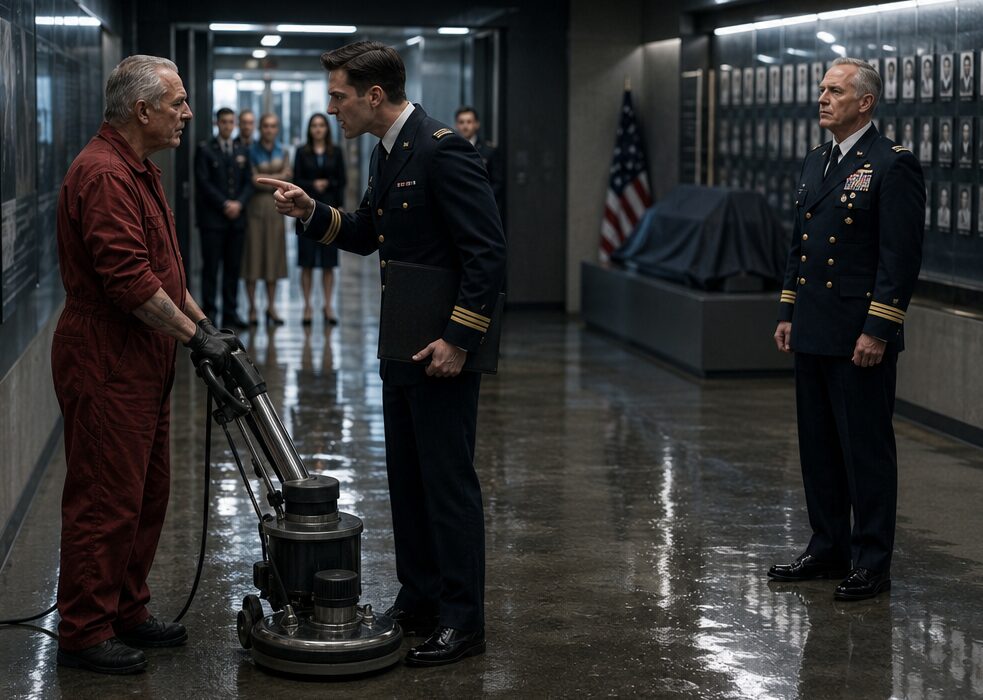
The old man in red coveralls had just warned him the floor was wet when Lieutenant Mark stepped closer, pointed a finger at his chest, and said, “Then move faster.”
The floor buffer hummed under Jack’s hands.
He was seventy-two, gray at the temples, bent slightly in the shoulders, with latex gloves pulled tight over thick fingers. The machine in front of him was old, heavy, and loud enough to make most people raise their voices.
Mark did not need the noise to sound disrespectful.
He had coffee in one hand, a folder under his arm, and the kind of spotless dark uniform that made young officers walk as if the hallway had been built around them. His shoes had a mirror shine. His jaw was clean. His watch flashed when he pointed.
Behind him, cadets slowed.
Two civilian guests looked away.
Jack kept both hands on the buffer handle.
“Floor’s still wet, Lieutenant,” he said again.
Mark gave a short laugh. Not amused. Annoyed.
“You people always pick the worst time to be in the way.”
Jack looked at the coffee first.
Then at the finger.
Then at the polished corridor stretching behind Mark, lined with framed photographs, old citations, and a covered memorial plaque waiting under dark blue cloth.
He did not look at the faces gathering near the doors.
He did not explain that he had started before sunrise.
He did not say he had cleaned this corridor for nineteen years.
He did not say he came in personally every year on this date.
He only shifted the buffer an inch to the side.
Mark stepped with him, blocking him again.
“I said move faster.”
Something tightened in Jack’s right hand. The rubber glove creaked against the handle.
A faded tattoo showed above his sleeve where the glove ended. Most people mistook it for a biker mark or an old mechanic’s symbol. A wing, a bridge, and a number so worn it looked more like a bruise in the skin than ink.
Mark’s eyes flicked to it.
He smirked.
“This isn’t a garage.”
Jack’s face did not change.
That bothered Mark more than anger would have.
The old man should have looked embarrassed. He should have apologized quickly, pushed the machine away, lowered his head, made room for the rank standing in front of him.
Instead, he stood still.
Not proud.
Not afraid.
Still.
As if he had learned long ago that some storms passed faster when you did not offer them anything to break.
Mark leaned in just enough for the insult to become private and public at once.
“I have a ceremony to keep on schedule,” he said. “Try not to make yourself the problem.”
The hallway changed before Jack answered.
No one called attention.
No command was shouted.
But the cadets stopped whispering.
The civilian guests straightened.
Mark saw their faces first, then followed their attention to the far end of the corridor.
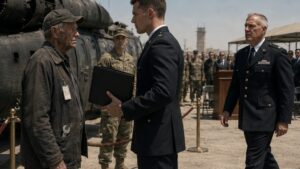
General Stephen stood there in dress uniform, silver at his temples, ribbons across his chest, expression still enough to make the hallway feel smaller.
Mark dropped his hand.
Too late.
The general had seen it.
Jack saw him too, then lowered his eyes to the wet floor.
Not from fear.
Because there were some men you did not want to recognize you in front of witnesses.
Especially not on a day built for memory.
Part II — The Man in the Photograph
“Lieutenant,” General Stephen said.
Mark pulled himself into shape so fast his coffee trembled.
“Sir.”
Stephen walked toward them without hurry. He glanced once at Jack, and that glance stayed too long.
Recognition moved across his face before he could stop it.
Jack looked down at the buffer cord.
Mark tried to recover the room.
“Sir, maintenance is operating in the west corridor during guest arrival. I was only advising him that—”
“I heard what you were advising him.”
Mark’s mouth closed.
The buffer clicked softly as Jack eased the power switch off. The sudden quiet made the hallway more uncomfortable.
Stephen turned to him.
“Jack.”
It was not a question.
The old man’s eyes lifted.
“General.”
Mark’s face changed. Just a flicker, but enough.
He had expected “sir” from the worker. He had not expected the general to know his name.
Stephen held out his hand.
Jack looked at it for a second before taking it. Not because he was overwhelmed. Because he seemed to be deciding whether accepting the gesture would make the morning worse.
Their handshake was brief.
“Apologize,” Stephen said.
Mark swallowed.
“To you, sir?”
Stephen did not blink.
“To him.”
The cadets by the doorway stared hard at the floor.
Mark turned to Jack.
“My apologies,” he said, voice clipped. “I didn’t mean any disrespect.”
It was an apology built from the outside in. Uniform first. Man last.
Jack nodded once.
“Accepted.”
The word had no warmth in it, and somehow that made it worse.
Mark felt it. His ears reddened. His eyes darted to the guests, to the cadets, to the general, to the red coveralls.
He tried again to stand on procedure.
“Sir, does maintenance have clearance in this corridor during a command event?”
Stephen looked at Jack.
“Badge.”
Jack pulled a plastic ID from the pocket of his coveralls and handed it over.
Stephen gave it to Mark.
The card read: FACILITIES SERVICES. JACK. NINETEEN YEARS.
Mark read it and gave a stiff little nod.
“Nineteen years waxing floors doesn’t make him part of command.”
The line landed harder than the first insult.
Jack’s hand closed around the buffer handle.
For the first time, his face moved.
Not much.
Just a small tightening near the mouth, the kind a man makes when a room has stepped on a place in him no one can see.
Stephen saw it.
So did Mark, though he did not yet know what he had touched.
“Nineteen years,” Stephen said quietly, “is longer than you’ve been wearing that uniform.”
Mark held still.
Stephen looked down the corridor, past the covered memorial plaque, past the framed photographs prepared for the ceremony.
“Lieutenant, you’ll remain with Jack until this floor is finished.”
Mark blinked.
“Sir?”
“You wanted the corridor ready. Make sure it is.”
A few people looked away too quickly.
The humiliation had changed owners.
Jack switched the buffer back on.
The machine roared awake, and the old man guided it forward with patient, practiced pressure. Mark stepped behind him, jaw tight, carrying his coffee like it had become evidence of something childish.
They moved slowly.
Too slowly for Mark.
Exactly right for Jack.
At the first corner, Jack eased the machine wide, then pulled it back with a careful half-circle.
Mark exhaled through his nose.
Jack did not turn around.
“You rush the corners,” he said, “you leave what everybody notices later.”
Mark said nothing.
At the end of the hall, the covered plaque waited beneath its cloth.
Jack did not look at it directly.
But every pass of the buffer drew him nearer.
And every step behind him made Mark more aware that the old man knew the corridor in a way no visitor, officer, or ceremony planner did.
He knew where the floor dipped.
Where the brass trim caught lint.
Where the wall photographs hung slightly uneven.
Where people left fingerprints before pretending not to touch history.
When they reached the memorial display, Jack stopped the buffer again.
One photograph on the temporary panel was crooked.
Mark said, “Don’t touch that.”
Jack reached up anyway.
His gloved fingers adjusted the frame with a gentleness that looked almost like apology.
Mark moved closer, irritated.
Then he saw the picture.
The photograph was old and grainy. A damaged transport truck stood behind a group of exhausted men. Smoke blurred the background. One of the men in the image was young, mud on his face, one arm around someone who could barely stand.
The young man had Jack’s eyes.
Mark looked from the photograph to the old worker in red coveralls.
The hallway seemed to tilt.
“That’s you,” he said.
Jack did not answer.
Stephen had returned without either of them hearing him.
“Yes,” the general said.
Mark turned.
Stephen’s gaze stayed on the photograph.
“Staff Sergeant Jack,” he said. “Logistics recovery unit. Operation Night Bridge.”
The words changed the air.
Mark stared at Jack.
The old man’s face remained closed, but his hand had gone still on the frame.
Mark heard himself ask, softer now, “Why didn’t you tell anyone?”
Jack lowered his arm.
“Because the men who needed to know were gone.”
Part III — The Corners
The ceremony was scheduled for eleven.
By ten-fifteen, Fort Adams Command Center had begun filling with people who spoke softly because the building seemed to ask it of them. Officers in dress uniforms. Cadets with nervous posture. Families in dark clothes. A few reporters waiting near the rope line.
The west corridor shone so brightly that guests glanced down before stepping.
Jack watched their shoes.
Not their faces.
Faces asked too much.
Shoes told the truth. Who hesitated. Who hurried. Who belonged. Who felt they did not.
Across the corridor, a woman in a plain dark dress stood near the display with an old envelope pressed against her chest. She was about forty-five, with practical shoes and tired eyes.
Jack saw her before anyone introduced her.
Nicole.
He knew her from a smaller face in an old photograph. A child on a porch, holding up a paper star for a father who never came back to take it from her hand.
She did not look at him.
That was fair.
Mark followed Jack’s gaze.
“Who is she?”
Jack pushed the buffer forward.
“Guest.”
“That’s not what I asked.”
“No.”
Mark waited.
Jack said nothing else.
The machine filled the silence.
At the next corner, Stephen stepped beside Jack.
“Why do you still come in personally for this hallway?” he asked. “You have a whole crew now.”
Jack leaned his weight into the buffer, guiding it away from the wall.
“They miss the corners.”
Mark almost rolled his eyes.
Then he looked at the corner Jack had just finished.
No streaks. No dullness. No place where dust could gather and wait for morning light.
Stephen looked at Jack for a long moment.
“That all?”
Jack kept moving.
“That’s enough.”
It was not enough.
They all knew it.
The covered plaque stood at the end of the corridor, hidden until the ceremony. Everyone called it new, but the names beneath the cloth were old. Command names. Officer names. Official names.
Captain Michael would be on it.
Stephen’s father.
Jack had polished the floor below that name for nineteen years, though most years it had only existed on paper, in temporary displays, in speeches, in the old framed citation near the stairs.
Captain Michael had survived Operation Night Bridge.
That was the version Fort Adams liked.
He had survived because discipline held, because command decisions were made under impossible pressure, because brave men followed orders in difficult conditions.
Jack knew another version.
Smoke so thick he could not see the road.
A truck door bent inward.
A medic shouting that there were still men behind the wall.
Captain Michael ordering withdrawal because the convoy was collapsing and the road was closing.
Sergeant Gary saying, “Then go.”
Jack remembered that more clearly than any explosion, any medal, any report.
Then go.
Gary had not said it like defiance.
He had said it like permission.
Jack had driven away with men in the back screaming for water, for mothers, for air. Then he had turned the truck around before anyone ordered him to.
He remembered the steering wheel slick under his hands.
He remembered Gary dragging Captain Michael by the straps of his vest.
He remembered Gary refusing to climb in until the last wounded man was loaded.
And he remembered the smoke folding shut.
The report later called it a maintenance convoy delay.
A phrase clean enough to survive filing.
Dirty enough to bury men.
Mark’s voice cut through the memory.
“Sir,” he said to Stephen, holding one of the exhibit folders, “this says Night Bridge was a command success under impossible conditions.”
Stephen did not answer.
Mark looked down the page.
“It also says casualties increased because of a delay in support movement.”
Jack stopped the buffer.
The machine hummed beneath his palms.
Mark read another line, and his confidence faded.
“Maintenance convoy delay,” he said.
The words sounded different now that he had to say them near Jack.
Nicole turned her head from across the corridor.
Jack did not look at her.
Stephen took the folder from Mark’s hand.
“That’s the public summary.”
Mark stared at him.
“The public summary blamed his unit?”
Stephen’s jaw tightened.
“It simplified the event.”
Jack gave a dry, quiet sound that was not a laugh.
“Men died in the simplification.”
Nicole stepped closer.
Her envelope bent slightly in her grip.
“Did my father?” she asked.
The hallway went still again.
Mark looked from her to Jack.
Stephen closed the folder.
Jack finally turned toward her.
Nicole’s face was composed in the way only exhausted anger can be composed.
“You remember me?” she asked.
Jack nodded once.
“You were six.”
Her mouth trembled, but her voice did not.
“And you still never said his name.”
That struck deeper than Mark’s finger ever had.
Jack took off one glove slowly.
His hand underneath was pale, creased, and shaking.
“I said it,” he told her. “Just not where anyone could hear.”
Nicole’s eyes hardened.
“That helped you. Not him.”
No one moved.
Jack folded the glove once, then again.
“You’re right.”
It was the first time all morning his voice sounded old.
Part IV — What the Report Left Clean
Stephen asked for a private room.
Jack refused.
“Nothing private ever fixed this.”
So they stood in the corridor, near the covered plaque, while guests gathered beyond the rope line and staff pretended not to listen.
Mark should have left.
He did not.
The folder was still in his hand, and the phrase inside it had hooked into him.
Maintenance convoy delay.
His father had once been dismissed from service for “failure to adapt to command discipline.” Mark had spent half his life trying to become the kind of man no one could dismiss. Perfect uniform. Perfect salute. Perfect reports. No loose edges. No stain of failure.
Now he was looking at an old man in coveralls who had been reduced to a phrase.
And he had helped reduce him again.
Stephen spoke first.
“Jack, I can add remarks.”
Jack looked at him.
“Remarks?”
“I can acknowledge your unit.”
“My unit doesn’t need a sentence.”
Nicole’s eyes stayed on Jack.
“My father needed one.”
Stephen’s face shifted.
“Sergeant Gary’s actions were complicated by the withdrawal order.”
Jack turned on him then.
The old force in him appeared so suddenly that Mark took one step back.
“No,” Jack said. “The paperwork was complicated. Gary was clear.”
Stephen accepted the blow without answering.
Jack reached into the inside pocket of his coveralls.
For a moment, Mark thought he was pulling out a note.
Instead, Jack removed a small piece of wax paper, folded and refolded until the creases were soft as cloth.
Nicole’s breath caught.
Jack did not open it.
Not yet.
“I carried this too long,” he said.
Stephen looked at the folded paper as if he already knew what was inside.
“Jack.”
The old man shook his head.
“You knew enough.”
The sentence was quiet, but it cut clean.
Stephen’s shoulders sank a fraction.
Mark watched the general, the man every junior officer feared disappointing, stand in front of a maintenance worker and look ashamed.
That was the first real lesson of the morning.
Not that old men might have once been important.
That important men might have failed them.
Stephen said, “My father told me about you.”
Jack’s mouth tightened.
“He told you about Gary?”
Stephen did not answer quickly enough.
Nicole made a small sound.
There it was.
The missing space.
Stephen looked toward the covered plaque.
“He told me pieces,” he said. “He said a medic stayed behind. He said a driver came back when he shouldn’t have.”
“Not shouldn’t,” Jack said.
Mark heard the correction.
Not couldn’t.
Not wouldn’t.
Shouldn’t.
The whole room seemed to rest on that word.
Jack went on. “Your father gave the order because he thought command meant choosing who had to be left. Gary thought duty meant checking whether the left-behind were still breathing.”
Stephen’s eyes lowered.
“And you?” Mark asked before he could stop himself.
Jack looked at him.
The answer came after a long pause.
“I drove away.”
Nicole’s face changed.
Jack opened the wax paper.
Inside was a small metal name strip, dulled with age.
SGT. GARY.
No shine. No ribbon. No official frame.
Just a name.
“I drove away,” Jack said again. “Then I turned back.”
Nicole stared at the strip.
“Was he alive when you left?”
Jack’s hand closed around the metal.
The question had waited twenty-eight years and still arrived sharp.
“Yes.”
Nicole’s eyes filled.
“Was he alive when you came back?”
Jack looked at her.
“No.”
The corridor did not soften the answer.
It held it.
Nicole nodded once, as if accepting a package too heavy to carry but addressed to her all the same.
“Thank you for not lying,” she said.
Jack’s face folded for half a second.
Then he wrapped the name again.
From the ceremony area, a staff member called for General Stephen.
Five minutes.
The guests were seated. The cloth was ready to be lifted. The speeches were printed. The version of history that could fit on polished brass was waiting.
Stephen looked at Jack.
“I can name him today.”
Jack slipped the wax paper back into his pocket.
“Can you name him right?”
Stephen had no quick answer.
Jack picked up his gloves.
“That’s what I thought.”
He turned toward the service doorway.
Mark heard himself speak.
“Don’t leave.”
Jack stopped.
Mark had not meant to say it so plainly.
The old man looked back.
Mark’s throat felt tight.
“When I said nineteen years didn’t make you part of command,” he said, “I was wrong.”
Jack studied him.
“That was true before you said it.”
The words landed without anger.
That made them worse.
Jack walked toward the service doorway.
For one terrible second, Mark thought that would be the end.
Then Nicole stepped into his path.
Not blocking him.
Just standing where he would have to choose to pass.
“My father’s name is not a disturbance,” she said.
Jack closed his eyes.
When he opened them, he looked older.
And steadier.
“No,” he said. “It isn’t.”
Part V — The Name Near the Stone
General Stephen began with the printed speech.
Everyone could tell.
His voice had that formal steadiness people use when words have already been approved by someone else.
“Today, we gather to honor the courage, discipline, and sacrifice represented by Operation Night Bridge…”
Jack stood near the back in red coveralls, folded gloves in one hand.
He had been told twice he could go home.
He had nodded both times and stayed.
Mark stood near the aisle, assigned to escort visiting families toward the memorial after the unveiling. His coffee was gone. He had thrown it away without finishing it.
Nicole sat in the second row, envelope in her lap, hands folded over it so tightly her knuckles showed.
The cloth over the plaque seemed heavier than fabric should be.
Stephen continued.
He spoke of difficult decisions.
Of impossible conditions.
Of those who returned and those who did not.
Jack listened until the words began arranging themselves into the same clean room they always built.
No smoke.
No shouting.
No truck.
No Gary.
Stephen paused before the unveiling.
That was when Jack moved.
At first, only Mark saw him.
The old man stepped out from the back row, not fast, not dramatic, crossing the polished floor he had finished less than an hour before.
A cadet shifted as if to stop him.
Mark moved first.
Habit almost made him reach for Jack.
Then he remembered the finger at the old man’s chest.
He lowered his hand and stepped aside.
More than aside.
He opened the path.
Jack passed him without looking.
The room noticed then.
Dress uniforms turned.
Families looked up.
Stephen stopped speaking.
Jack walked to the base of the covered memorial, reached into his pocket, and took out the folded wax paper.
No one spoke.
The kind of silence that follows disrespect is sharp.
This silence was different.
It was afraid of what it had missed.
Jack unfolded the paper carefully. His fingers shook once, then steadied.
He placed the small metal strip at the base of the memorial.
SGT. GARY.
Nicole covered her mouth.
Jack straightened slowly.
“This belongs here,” he said. “Whether the paperwork caught up or not.”
No speech followed.
No explanation rushed in to make everyone comfortable.
Jack turned as if to leave.
Stephen stepped away from the podium.
For a moment, Mark thought the general would correct him, contain the moment, fold it back into the ceremony with careful language.
Instead, Stephen removed the printed remarks from the podium and set them aside.
The paper made a soft sound.
Everyone heard it.
“My prepared remarks,” Stephen said, “are incomplete.”
Jack stopped.
Stephen’s voice changed. Not louder. Less protected.
“Operation Night Bridge has been remembered in this building for years as a command achievement under impossible conditions. That is not false. But it is not whole.”
The room did not move.
Stephen looked at the metal strip.
“My father, Captain Michael, survived that day because a medic named Gary refused to leave wounded men behind, and because Staff Sergeant Jack drove back through smoke after withdrawal had been ordered.”
A murmur moved through the room.
Jack stared at the floor.
Stephen continued.
“The official summaries did not name them fully. Some records made their unit sound like a delay. Some language protected command more than truth.”
Mark felt the words enter him and rearrange something.
Stephen looked at Jack.
“Private respect was not enough.”
Jack’s jaw tightened.
Nicole began to cry without making a sound.
Stephen faced the room again.
“Today, before this plaque is unveiled, we will say the names that should have been said with it.”
He said Gary’s name first.
Then Jack’s.
Then the names of the convoy men whose work had lived in footnotes, summaries, and half-sentences.
Jack stood at the front in red coveralls while dress uniforms listened.
No one applauded at first.
That was the mercy of it.
Applause would have made it too easy.
Nicole rose from her seat and walked to the memorial. She knelt, touched the metal strip with two fingers, and bowed her head.
Jack looked at her.
“I’m sorry,” he said.
She kept her fingers on the name.
“I know.”
It was not forgiveness.
Not entirely.
It was something more honest.
Stephen lifted the cloth from the plaque.
The brass underneath shone clean and incomplete.
But at its base, on the stone, rested the missing name.
For that moment, it was enough.
Part VI — Slow Near the Corners
Afterward, people approached Jack carefully.
Not all at once.
A cadet shook his hand and could not find words.
An older officer touched his shoulder and said, “Staff Sergeant,” then stepped back before the title could become performance.
Nicole stood near him for a while without speaking.
Finally, she handed him the envelope.
Inside were copies of letters from Gary, the paper soft at the folds.
“He wrote about a driver,” she said. “He never used your name. Just said, ‘There’s one man who checks the road behind us even when everyone else is looking ahead.’”
Jack looked at the envelope but did not take it.
Nicole pressed it into his hand.
“He meant you.”
Jack’s eyes closed.
When they opened, they were wet but steady.
“I should have come to you sooner.”
“Yes,” she said.
No cruelty. No comfort.
Just truth.
Then she touched the metal strip one more time and walked away.
Stephen stayed near the memorial long after the crowd thinned. Men stopped to speak to him, but he answered briefly. His eyes kept returning to the name at the base of the plaque.
When he finally passed Jack in the corridor, he removed his cap.
Jack did not salute.
Stephen did not seem to expect it.
“I’ll start the formal correction,” Stephen said.
Jack gave a tired half-smile.
“Paperwork finally catching up.”
Stephen looked at him.
“It should not have needed you to carry it in your pocket.”
Jack folded the wax paper, now empty, and slipped it back into his coveralls.
“No,” he said. “It shouldn’t have.”
That was all.
The hallway emptied.
The ceremony programs were collected. The rope lines came down. The framed photographs remained. The floor, stepped on by officers, guests, cadets, and memory, had dulled near the corners.
Jack plugged the buffer back in.
Mark found him there.
The young lieutenant stood a few feet away, no coffee, no folder, no finger raised.
For once, he did not seem to know where to put his hands.
“Jack,” he said.
The old man looked at him.
“Sir,” Mark corrected himself, then stopped. “I don’t know what to call you.”
Jack turned the machine upright.
“Jack works.”
Mark nodded.
A long silence passed between them.
“I was wrong,” Mark said.
Jack waited.
“I thought rank meant I had already earned the room.”
The old man looked down the hallway.
“Rank gets you through the door,” he said. “It doesn’t teach you what the room cost.”
Mark absorbed that.
Then he looked at the buffer.
“Can I finish this section?”
Jack studied him.
Not suspiciously.
Carefully.
As if the offer was another floor that might be wet.
Finally, he stepped aside and handed Mark the handle.
The machine was heavier than Mark expected.
It pulled when he pushed. It drifted when he tried to force it. The shine did not come from strength. It came from pressure held steady, from correcting before the mistake showed, from feeling the uneven places through your hands.
Jack walked beside him.
“Slow near the corners,” he said.
Mark eased the machine back.
This time, he listened.
At the far end of the corridor, Stephen stood beside the memorial. The new plaque caught the light. The small metal name strip rested below it, not official yet, not fixed in place, but no longer hidden.
Stephen removed his cap again as he passed.
Jack saw it.
He said nothing.
Mark guided the buffer along the wall, slower now.
The old man in red coveralls walked beside him, not behind him, his empty wax paper folded in his pocket, his hands finally free of the name he had carried too long.
The floor shone where they had been.
Near the corners, it shone most of all.