The Line He Remembered
Part I — The Red Boundary
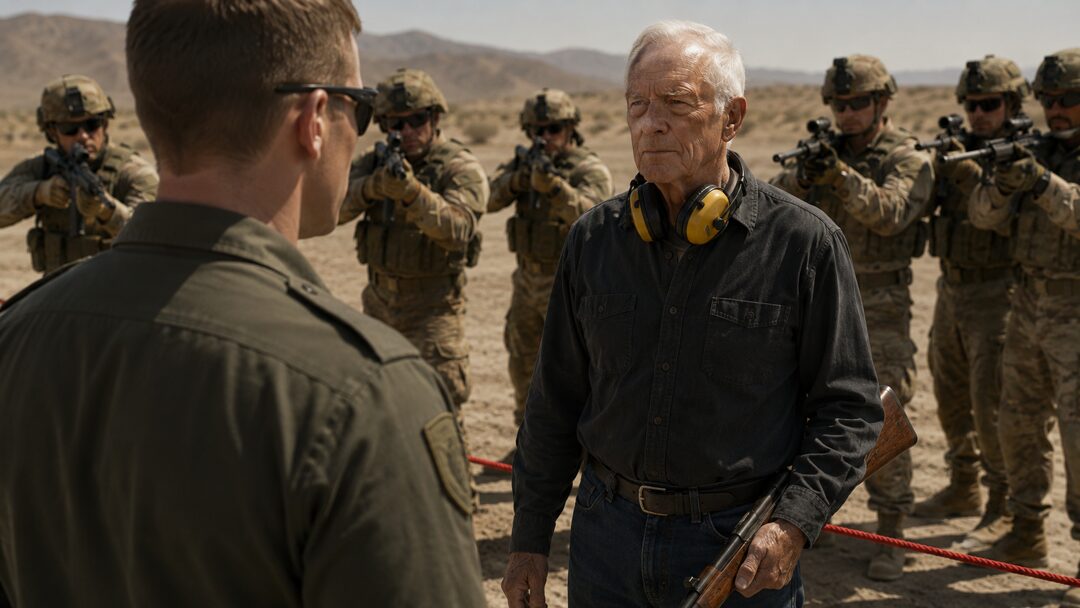
The old man crossed the red boundary rope while the range was still active, carrying a polished wooden rifle like he had been invited.
For half a second, nobody moved.
Then Lieutenant Ryan Miller saw him.
“Hold fire!” Ryan shouted, his voice cracking across the desert heat. “Weapons up!”
Eight soldiers turned at once.
The old man stopped in the dust with the sun on his white hair, one hand around the rifle’s stock, the other open at his side. He wore a faded dark work shirt, jeans, worn brown boots, and yellow ear protection hanging loose around his neck. He looked like someone’s grandfather who had taken a wrong turn off the county road.
Except he was inside a restricted firing range.
Except the line was hot.
Except he was holding a rifle.
“Drop it!” Ryan ordered.
The old man looked at the young lieutenant through the shimmer rising off the sand.
He did not drop it.
He did not raise it either.
That was the part Ryan would remember later. Not the rifle. Not the sun. Not even the silence that fell over the squad.
He would remember how still the old man stood.
Stillness was supposed to mean fear. Confusion. Shock.
This was none of those.
“Sir,” Sergeant Lisa Carter said from Ryan’s left, low enough that only he could hear, “we need to get him off the lane.”
“I see him, Sergeant.”
Ryan kept his own weapon trained low but ready. His sunglasses hid his eyes, and he was grateful for that. Major Andrew Hayes was watching from the tower. The evaluation was already behind schedule. Command wanted the readiness check completed before the afternoon wind picked up.
And now an unidentified civilian had walked onto his range holding an old rifle.
Ryan could already hear the report in his head.
Failure to secure perimeter.
Failure to control range.
Failure to command under pressure.
“Sir!” Ryan called again. “Set the rifle down and step away from it.”
The old man shifted his weight. Dust moved around his boots.
“You’re standing on the wrong line, Lieutenant.”
A few of the soldiers exchanged looks.
Ryan felt the words hit him harder than they should have. The old man had not said it loudly. He had said it the way a teacher corrects a child at a chalkboard.
“Do not test me,” Ryan said. “You are inside a restricted area.”
“So are you,” the old man said.
The squad went tighter.
Private Mark Evans, nineteen and nervous enough to swallow twice before every order, had his rifle pointed too high. Carter saw it and touched his elbow down without looking away from the old man.
Ryan stepped forward.
“Identify yourself.”
The old man’s eyes stayed on his.
“Dawson.”
“First name.”
The old man did not answer.
Ryan heard a crackle in his earpiece.
“Lieutenant Miller,” Major Hayes said from the tower. “Report.”
Ryan pressed his radio. “Civilian breach on Lane Three. Armed. Noncompliant but not actively threatening.”
A pause.
“Secure him. Do not interrupt the evaluation any longer than necessary.”
Ryan looked at the old man again.
The evaluation.
That was what mattered to Hayes. The schedule, the observers, the report, the clean line of check marks beside Ryan’s name if he did everything right.
Ryan raised his voice.
“Private Evans. Secure the rifle.”
Mark blinked. “Sir?”
“Now.”
The old man turned his head slightly toward Mark.
For the first time, something in his face changed.
Not fear.
Warning.
Mark approached with careful steps, boots sliding in the dust. The old man did not resist. He lifted the rifle a few inches, horizontal now, offering it without surrendering the meaning of it.
“Both hands,” the old man said.
Mark froze.
Ryan snapped, “Take it.”
The old man’s voice stayed level.
“It’s carried more than you have.”
Mark swallowed again and took the rifle with both hands.
The moment his fingers closed around the polished wood, his expression changed. The rifle was heavier than he expected. Older too. Not neglected. Not ceremonial. Cared for. The wood had been oiled so often it held a dull glow under the desert sun. The metal was dark and worn where hands had touched it for years.
Mark looked down.
Ryan saw him stop breathing.
“Evans,” Ryan said.
Mark did not answer.
Sergeant Carter stepped closer, and something in her face tightened before she spoke.
“Lieutenant,” she said, “you need to see this.”
Part II — Both Hands
Ryan wanted to tell Carter he did not need to see anything.
He needed the old man detained.
He needed the range cleared.
He needed Major Hayes not to have another reason to write that Ryan Miller hesitated under pressure.
Instead, he walked to Mark.
The old rifle lay across the private’s palms. Under the receiver, fixed into the worn metal, was a small plate Ryan had missed from a distance. Age had darkened it, but the engraving was still sharp enough to read.
CAPTAIN WILLIAM DAWSON
ECHO RIDGE, 1991
Ryan read it once.
Then again.
The old man stood ten feet away, hands empty now, shoulders square, face turned toward the far berm.
Captain.
The word moved through the squad without anyone saying it.
Carter removed her sunglasses slowly.
“Dawson,” she said.
The old man’s eyes flicked toward her.
“You know the name?” Ryan asked.
Carter hesitated, and that hesitation bothered him more than an answer would have.
“Old range story,” she said. “Before my time.”
“What story?”
She looked at the rifle again.
“Captain walked through a live lane to pull people out after an accident. Echo Ridge. Nineteen ninety-one.”
The desert seemed to go quiet around the date.
Ryan looked from Carter to Dawson. The man still had not asked for the rifle back. He still had not said who he was.
Ryan felt heat crawl up his neck.
He had ordered rifles raised on a retired captain.
A decorated one, maybe.
A man whose name other soldiers had whispered into legend while Ryan had not known it at all.
Ryan turned toward Dawson.
“Captain Dawson?”
Dawson did not correct him.
That was answer enough.
Ryan lowered his weapon fully. So did Carter. One by one, the squad followed.
The movement should have relieved the tension. It did not.
It only changed its shape.
Now the danger was not that someone might fire.
Now the danger was that everyone had seen the mistake.
Ryan forced himself forward.
“Sir,” he said, “I need you to understand you entered an active range with a firearm.”
Dawson looked at him then.
“I understood before you were born.”
The line landed softly. That made it worse.
Ryan heard Hayes again in his earpiece, sharper now.
“Lieutenant. Status.”
Ryan pressed the radio. “Civilian identified as retired Captain William Dawson.”
There was a pause long enough to mean something.
When Hayes answered, his voice had changed.
“Hold position. I’m coming down.”
Ryan glanced toward the tower.
Carter did too.
The old man looked only at the ground.
Ryan saw then that Dawson’s hands were not completely steady. Not when they hung at his sides. Not when no rifle gave them purpose. The tremor was small. Almost invisible. But it was there.
Ryan stepped closer.
“Sir, if you’re here for the range dedication, it isn’t scheduled until this afternoon. We can escort you—”
“I’m not here for a dedication.”
“Then why are you here?”
Dawson turned slowly and looked toward the far side of Lane Three.
At first Ryan saw only sand, brush, heat shimmer, and the brown curve of the berm.
Then he noticed the stone.
It was half buried near the edge of the lane, so worn and dust-colored it looked like part of the ground. A marker. Old, low, and almost hidden behind a leaning post.
Dawson pointed to it.
“That’s why.”
Ryan followed the direction of his finger.
Carter’s clipboard lowered an inch.
“That marker shouldn’t be inside the active lane,” she said.
“It wasn’t,” Dawson replied.
Ryan looked at her. “What does that mean?”
Carter did not answer immediately. Her eyes moved across the lane markers, the target stands, the wind flag, the berm.
She had the look of someone seeing a familiar room with the furniture moved half an inch.
“Lieutenant,” she said quietly, “I want to recheck the lane map.”
“We don’t have time for—”
“Recheck it,” Dawson said.
Ryan turned on him.
The old man did not flinch.
“You gave up the right to issue orders here a long time ago,” Ryan said before he could stop himself.
The squad heard it.
Carter heard it.
Dawson heard it.
The old captain’s face did not change, but Ryan felt the line turn sour the moment it left his mouth.
Dawson looked past him toward the marker.
“You’d be surprised what a man can still be responsible for.”
Part III — The Nameplate
Major Andrew Hayes arrived in a vehicle that raised a pale tail of dust behind it.
He got out before the engine fully settled. His uniform was clean. His jaw was set. He had the kind of command presence that made younger officers stand straighter before they knew they were doing it.
Ryan stood straighter.
Dawson did not.
Hayes walked toward them, saw the old rifle in Mark’s hands, saw the marker in the distance, and then looked at Dawson with recognition he tried to bury before anyone else could catch it.
He failed.
“Captain Dawson,” Hayes said.
There it was.
Not sir.
Not Mr. Dawson.
Captain.
The squad heard that too.
Dawson gave him a small nod. “Andrew.”
Ryan felt Carter look at him, but he kept his eyes on Hayes.
Hayes turned to Ryan.
“Lieutenant, this man served here a long time ago. He has a history with the installation. We’ll handle it.”
Dawson said, “That’s what you said last time.”
Hayes’s face tightened by the width of a thread.
Ryan noticed.
So did Carter.
Hayes kept his voice calm. “Captain, the incident you’re referring to was investigated. Thoroughly.”
“Was it?”
“This is not the place.”
Dawson looked around at the hot range, the young soldiers, the old marker disappearing under dirt.
“It’s the only place.”
Hayes stepped closer, lowering his voice as if privacy could still be manufactured in front of a squad.
“You shouldn’t be out here.”
“No,” Dawson said. “Thomas Reed shouldn’t be out here. But you put him here anyway.”
No one moved.
The name Thomas Reed had not been spoken like information.
It had been spoken like a door opening.
Ryan looked toward Carter.
She was already unfolding the lane map from her clipboard.
Hayes saw it.
“Sergeant Carter, stop.”
Carter froze.
Ryan felt the command land in the space between rank and responsibility.
Hayes looked at Ryan. “Lieutenant, your evaluation resumes in seven minutes. Clear the civilian from the range.”
Ryan’s mouth went dry.
Civilian.
A minute ago Hayes had called him Captain.
Dawson watched Hayes without anger.
That was what made him difficult to face. Not rage. Not accusation. Just the terrible patience of someone who had waited so long he no longer expected decency to hurry.
Ryan said, “Sir, Sergeant Carter has a safety concern.”
Hayes did not look pleased.
“The range was inspected this morning.”
“By map or by ground?” Dawson asked.
Hayes turned back to him. “Enough.”
“No,” Dawson said. “Enough was when they wrote his name out of the report.”
Hayes took one sharp breath through his nose.
Ryan watched the major then. Really watched him. Not as the officer in the tower. Not as the man whose evaluation could shape Ryan’s next two years.
As a man trying not to remember.
Dawson’s eyes shifted to the rifle in Mark’s hands.
“That was Reed’s,” he said.
Mark almost dropped it.
Carter looked up from the map.
Ryan felt the story change again.
Not Dawson’s rifle.
Reed’s.
Dawson continued, voice low. “His father gave it to him before he shipped out. Couldn’t bring it overseas. He left it with me for safekeeping. Said he wanted it back when he came home.”
He stopped there.
No one asked why Reed never got it back.
They already knew enough.
Hayes said, “Captain.”
Dawson’s face hardened for the first time.
“Don’t use the rank if you’re going to hide the reason I earned it.”
The desert held the sentence.
Ryan looked away first.
Carter spread the map across the hood of the range vehicle. Her finger traced the lanes. Her lips tightened.
“Lieutenant,” she said.
Hayes snapped, “Sergeant.”
Carter did not move.
Ryan walked to her.
On the map, Lane Three ran clean and legal, angled away from the old berm. On the ground, the new markers shifted it several yards east.
Toward the stone.
Toward a shallow ricochet zone Carter had warned about during setup but had been told was inside tolerance.
Ryan’s heart began to beat harder.
“Show me,” he said.
Carter pointed from map to range.
“Lane post is wrong. Wind flag is wrong. The target stand is too far right. If they fire through this course in the afternoon wind, I can’t guarantee where the fragments go.”
Hayes was beside them now.
“That is not your determination to make in the middle of an evaluation.”
Carter’s jaw flexed.
“No, sir,” she said. “It’s my job to make it before someone gets hurt.”
Ryan looked at Dawson.
The old man had not moved. He had not smiled. He had not claimed victory.
He only looked tired.
Part IV — What the Ground Kept
Ryan had joined the service because he trusted rules.
Rules were clean. Rules did not panic. Rules did not care if you were tired, scared, proud, or trying to impress someone who outranked you.
But standing in that heat, with Dawson silent and Hayes watching him, Ryan understood something he did not want to understand.
Rules could be used like walls.
And walls could hide things.
His radio crackled.
“Tower to Miller. Evaluation window closing.”
Hayes held out a hand.
“Lieutenant, return to the lane.”
Ryan did not answer.
Dawson looked at Hayes. “Do you remember who ordered it cleared?”
Hayes’s face went still.
Carter looked between them.
Ryan did too.
Hayes said, “That question has no bearing on today.”
“It has every bearing.”
“Captain, you are not in command here.”
“No,” Dawson said. “That’s the first true thing you’ve said.”
The sentence should have sounded bitter. It didn’t. It sounded empty.
That made it worse.
Hayes stepped closer to him. “You came onto an active range with a firearm. Do you understand what could have happened?”
Dawson looked at the squad who had aimed at him.
“Yes.”
“And you did it anyway?”
Dawson’s eyes returned to the marker.
“I got a letter from Mary Reed last week.”
Hayes blinked.
“Reed’s mother?” Carter asked softly.
“Widow,” Dawson said. “He married her daughter two months before deployment. Mary’s gone now. The daughter too. Their boy found a box in the attic. Papers. My old letters. The ceremony notice.”
Ryan listened, not because Dawson spoke loudly, but because every word seemed to cost him.
“He asked me why his father’s name wasn’t in the dedication program.”
No one answered.
Dawson’s hand shook again at his side.
“He asked me if his father had done something wrong.”
The wind lifted dust against Ryan’s boots.
Dawson looked at Hayes.
“What was I supposed to tell him?”
Hayes’s mouth tightened. For one second, Ryan saw the younger man inside the major—the officer who had once been nearby, who had heard the reports, who had accepted the clean version because the dirty one would not help the dead and might bury the living.
Then Hayes closed that door.
“The official record stands.”
Dawson nodded once, as if he had expected nothing else.
“That’s why I came before the speech.”
Ryan looked toward the tower, the neat rows of equipment, the soldiers waiting for orders. The whole morning had been built to measure readiness.
Now readiness meant something else.
Ryan turned to Carter.
“Can this lane run safely?”
Carter did not look at Hayes.
“No, sir.”
Hayes said, “Sergeant, think carefully.”
Carter’s voice stayed flat.
“I am.”
Ryan felt every soldier looking at him. Mark still held the rifle with both hands. His knuckles were pale now, not from fear of Dawson but from understanding that he had been carrying something heavier than wood and metal.
Hayes lowered his voice.
“Miller, you are very close to turning a manageable disruption into a formal failure.”
Ryan knew that.
He knew exactly what a failed evaluation could mean. Delayed promotion. A note in a file. Whispered doubt. The kind of invisible stain that followed a young officer from post to post.
Then he looked at the old marker.
Half buried.
Almost gone.
He thought of Dawson standing alone in the heat because nobody else had come.
He thought of Thomas Reed, nineteen, blamed into silence.
He thought of Mark Evans, also nineteen, holding Reed’s rifle like he finally understood that youth was not protection from history.
Ryan took off his sunglasses.
The world looked harsher without them.
Good, he thought.
It should.
Part V — The Order That Changed
Ryan reached for the rifle.
Mark handed it over carefully.
The old wood was warm from the sun. Ryan expected it to feel like evidence. It felt, instead, like trust he had not earned.
He turned toward the lane.
“Range control, this is Miller.”
Hayes said, “Lieutenant.”
Ryan keyed the radio.
“Ceasefire. Range cold. Lane Three is suspended pending safety review.”
The tower came back immediately.
“Confirm, Miller?”
Ryan looked at Carter.
She gave the smallest nod.
He looked at Dawson.
The old man looked at nothing but the marker.
Ryan said, “Confirmed. Range cold.”
Hayes’s voice cut through the radio and the air at the same time.
“Lieutenant Miller, stand down from that order.”
Ryan faced him.
“No, sir.”
The two words were quiet.
They were also irreversible.
The squad went silent in a way Ryan had never heard before. Not confusion. Not fear.
Witness.
Hayes stepped toward him. “You understand what you are doing?”
“Yes, sir.”
“You are compromising an installation evaluation because of an old grievance.”
Ryan felt the rifle in his hands.
He had never been more aware of weight.
“No, sir,” he said. “I’m stopping an unsafe lane.”
Hayes’s eyes hardened.
“And after that?”
Ryan looked toward the half-buried stone.
“After that, we uncover the marker.”
“That is not your authority.”
“It’s my range until relieved.”
Hayes stared at him.
Ryan heard his own pulse.
Then he said the sentence that would follow him longer than any evaluation score.
“A range built over a lie is not mission-ready.”
No one moved.
Not Hayes.
Not Carter.
Not Dawson.
Then Carter turned to the squad.
“You heard the lieutenant. Clear weapons. Evans, grab two entrenching tools from the truck. Johnson, tape off Lane Three. Nobody crosses the post line until I say.”
The squad moved.
That was the moment Ryan understood command was not always a loud thing.
Sometimes it was one order people were relieved to obey.
Hayes watched them, his face unreadable.
“You’ll answer for this,” he said.
Ryan nodded. “Yes, sir.”
Dawson finally turned.
He looked at Ryan as if seeing him for the first time—not as a young officer, not as the man who had aimed weapons at him, but as someone standing at the edge of a choice and not stepping away.
Ryan held out the rifle.
Dawson did not take it immediately.
His eyes went to the engraving.
“Captain William Dawson,” Ryan said quietly.
Dawson’s mouth moved once, but no sound came.
Then he said, “It shouldn’t have my name first.”
Ryan did not know what to say.
So he said nothing.
That was better.
Carter and Mark reached the old marker. Sand had packed hard around it. The first scrape of metal against earth sounded louder than it should have.
Dawson flinched.
Ryan saw it.
Just once.
A young soldier’s name emerged slowly from beneath years of dust.
THOMAS REED
The letters were faint, but they were there.
Dawson took one step forward. Then another.
The squad parted without being told.
The old captain knelt with difficulty. For a second Ryan thought he might fall, but Dawson steadied himself with one hand on the ground.
He touched the letters.
Not dramatically.
Not like a man performing grief for strangers.
Like someone checking whether a person was still there.
“Thomas Reed,” Dawson said.
The name entered the air.
No speech followed it.
No patriotic line.
No polished tribute.
Just the name.
And somehow that was enough to make every soldier lower their eyes.
Hayes looked away.
Part VI — What Remained
By the time Dawson stood again, the heat had deepened and the official schedule had broken beyond repair.
No one talked about the evaluation.
Carter had Lane Three taped off. Mark stood near the uncovered marker, dust on his gloves, his young face older than it had been an hour before. The rest of the squad waited in a loose line, no longer watching Dawson as a threat, no longer watching Ryan for orders alone.
They were watching the ground.
Ryan walked to Dawson with the rifle held across both palms.
This time, no one had to tell him how to carry it.
Dawson looked at the gesture before he looked at Ryan.
“I owe you an apology,” Ryan said.
Dawson’s expression did not soften exactly.
But it let him finish.
“I treated you like a problem to remove,” Ryan said. “I should have asked why you were here.”
Dawson took the rifle.
For a moment their hands shared its weight.
Then the old man pulled it gently to his chest.
“You had a range to protect,” he said.
“I protected the wrong thing first.”
Dawson looked past him to the marker.
“So did I once.”
Ryan wanted to ask what happened in 1991. He wanted the full story. He wanted dates, orders, names, blame. Some part of him wanted enough detail to make the whole morning clear.
But looking at Dawson, he understood clarity was not the same as peace.
Some stories did not become cleaner when told.
They only became harder to ignore.
Ryan asked the only question that felt small enough and large enough at once.
“Was Reed a good soldier?”
Dawson looked at him for a long time.
Then he turned toward the open desert, where the heat made the far berm waver like memory.
“He was nineteen,” Dawson said. “That should have been enough for us to be careful.”
Ryan felt the sentence settle into him.
Not as accusation.
As inheritance.
Dawson put the yellow ear protection back around his neck, though there would be no more firing that morning. He tucked the rifle under one arm and started toward the red boundary rope.
No one stopped him.
The soldiers made room.
Hayes stood near the vehicle, silent. He looked smaller outside the tower, less like command and more like a man who had spent years standing beside a closed door.
Dawson passed him.
For a moment Ryan thought Hayes might speak.
He did not.
Maybe that was his answer.
Maybe silence had always been.
Dawson reached the red boundary and stepped over it slowly. On the other side, he was just an old man again in jeans and dusty boots, carrying a rifle that no longer looked like a threat.
Ryan watched him walk into the heat shimmer.
Carter came to stand beside him.
“What now, sir?” she asked.
Ryan looked back at the marker.
The name was visible now, but barely. The stone needed cleaning. The lane needed closing. Reports needed writing. Hayes would make calls. So would Ryan.
Consequences were coming.
That did not make the order wrong.
“Photograph the marker,” Ryan said. “Flag the lane. Pull the old maps. I want every range boundary checked against the ground, not just the paperwork.”
Carter nodded.
Then Ryan added, “And get a brush. We’re not leaving his name half covered.”
Carter looked at him then, and for the first time all morning, her face loosened.
“Yes, sir.”
Behind them, Mark Evans knelt beside the stone with a brush in one hand and dust on both knees.
He worked carefully.
Letter by letter.
Ryan stayed until the full name could be read without bending close.
Then he looked once more toward the place where Dawson had disappeared.
The old captain was gone.
But the line he had remembered remained.