The Number He Carried
Part I — The Ball at His Feet
The ball rolled across the gym floor like it had been sent with a message.
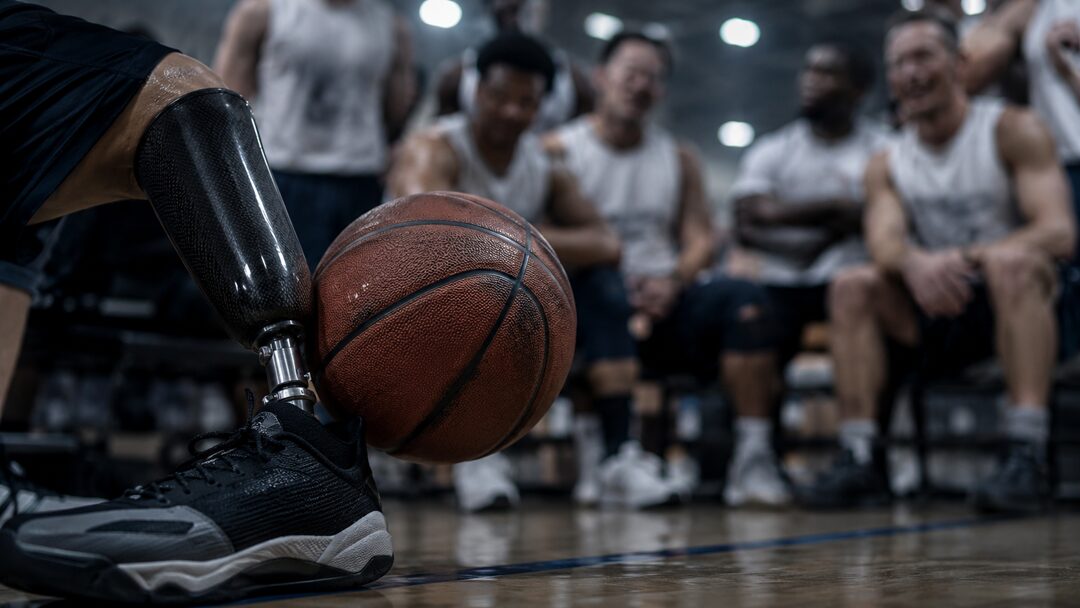
It came hard from midcourt, skipping once over the painted line, spinning through the shine of the polished wood, and tapping Daniel Price’s prosthetic shin with a hollow sound that was somehow louder than the scoreboard buzzer, louder than the sneakers, louder than the laughter that followed.
A few of the younger guys clapped.
One of them called, “Come on, Price. Check in.”
Daniel did not move.
He sat at the far end of the bench in a dark practice jersey with a cracked white number 4 on the front. His shoulders were bent forward, elbows on his knees, hands loose between them. The prosthetic below his left knee caught the gym lights in a flat, dull strip. He looked at the ball near his foot as if it belonged to somebody else’s life.
Around him, the rehabilitation center had been dressed up for celebration. Folding chairs lined one side of the court. Families stood with paper cups and phones. A banner hung crooked over the bleachers. Music bumped weakly through the speakers between whistles.
Everyone had come for the welcome-home exhibition game.
Everyone had come to see recovery turned into something cheerful.
Daniel had come because refusing would have made more noise than sitting still.
On the court, Mark Ellis laughed as if the whole thing had been harmless.
“Don’t scare him,” Mark called to the players near him. “He’s thinking about it.”
A ripple went through the crowd. Not real laughter. The kind people made when they were trying to decide whether a joke was safe.
Daniel kept his head down.
He could feel Sarah Miller watching from near the scorer’s table. She had been his physical therapist for four months, which meant she knew the difference between tired and cornered. She also knew he hated being treated as either.
The ball rested against his prosthetic foot.
Still, he did not touch it.
Mark jogged over in his white practice jersey, broad shoulders shining with sweat, smile bright enough for the families in the bleachers. The number on his chest was 14.
Daniel saw it without looking straight at it.
He always saw it.
Mark crouched in front of him, one knee bent, one hand on the ball. To the crowd, it looked like encouragement. A decorated man reaching down to include the quiet one. A leader making room.
Only Daniel was close enough to hear the real voice.
“Still waiting for someone else to move first?”
Daniel’s fingers closed around the edge of the bench.
For one second, the gym vanished.
Dust. Radio static. A voice shouting over another voice. A hand slipping from his grip.
Then the gym came back: lights, whistles, varnished wood, Mark’s smile.
Daniel loosened his hand.
Mark stood, taking the ball with him.
“There he is,” Mark said loudly, turning back to the others. “Stone cold. Nothing rattles Staff Sergeant Price.”
The crowd accepted the safer version. They smiled. Some nodded. A few clapped like Daniel had been honored instead of pinned.
Sarah crossed the sideline before anyone could stop her.
“That’s enough,” she said.
She did not raise her voice. She never had to. The people who knew her stepped out of her way.
Mark lifted both hands, still smiling. “Just trying to get him in the game.”
“He said no.”
“I didn’t hear him say anything.”
Sarah’s face tightened.
Daniel felt that worse than the laughter. Her defense landed on him like a blanket he had not asked for.
“I’m fine,” he said.
It was the first thing he had said since arriving.
Sarah turned toward him. “Daniel—”
“I said I’m fine.”
Her mouth closed. The hurt in her eyes was quick, then gone behind the calm she used for work.
Mark saw it. Of course he did.
He patted Daniel once on the shoulder. Not hard. Not gentle.
“See?” Mark said. “He’s fine.”
Then he jogged back onto the court, number 14 flashing under the lights.
Daniel watched the ball leave with him.
He had learned there were many ways to be left behind while still sitting in the room.
Part II — Number Four
The game went on because games always did.
A whistle blew. Somebody missed an easy layup and cursed under his breath. A child near the bleachers asked her mother why the man on the bench had a metal leg. The mother whispered something soft and urgent, and the child stopped looking.
Daniel preferred the ones who stared openly.
Pity was quieter, but it stayed longer.
Mark controlled the court with the easy confidence of a man used to being obeyed. He called for screens, pointed men into corners, slapped backs after mistakes. Every movement told the room he belonged at the center.
The younger soldiers loved him.
The officers respected him.
The families knew his name from the program.
Daniel’s name was in the program too, printed under a small section called Honored Guests. He had seen it when Sarah handed him the folded page that morning. He had seen the phrase beside it: injured during the same operation.
The same operation.
That was how people cleaned a thing until no one could smell what had happened.
Mark drove to the basket and scored. Applause slapped against the walls.
His white jersey shifted as he turned.
Daniel looked away too late.
Behind sandbags months ago, before the dust and radio static and the hand slipping loose, number 14 had belonged to Anthony Reed. Anthony had written it on tape and stuck it to the back of his shirt during pickup games in the heat because he said every great player needed branding.
He had been terrible at basketball.
He had also been the only man Daniel knew who could make homesickness sound funny.
“You ever notice,” Anthony once said, dribbling a half-flat ball between rocks, “that every place we get sent looks like somebody forgot to finish building it?”
Then he threw the ball at Daniel’s chest and grinned.
“Pick and ghost, Danny. You stand there looking innocent, I do something stupid, everybody wins.”
Everybody did not win.
Daniel pressed his thumb into the cracked edge of the number on his own jersey. The number 4 had peeled so badly it looked unfinished. A piece of something larger. A remainder.
He had not chosen it. The staff had handed it to him that morning from a laundry cart.
Still, when he put it on, he had almost taken it off.
Across the court, Mark stole a lazy pass and coasted in for another layup. The crowd cheered.
Daniel heard a young voice beside him.
“Staff Sergeant Price?”
He turned slightly.
Ryan Cooper stood there with a towel folded too tightly in both hands. Twenty-two, maybe. Buzz cut. Oversized warmup jacket. The kind of nervous energy that made him look like he was always waiting for someone to correct his posture.
“Just Daniel,” Daniel said.
Ryan swallowed. “Right. Sorry.”
Daniel looked back at the court.
Ryan sat on the bench, leaving more space between them than necessary.
For half a minute, neither spoke.
Then Ryan said, “I got assigned records support last month.”
Daniel’s hand stopped moving on the jersey.
Ryan stared at the towel. “Old files. Body cams. Incident packets. Stuff they’re moving into the new system.”
Daniel said nothing.
“I wasn’t looking for anything,” Ryan said quickly. “I mean, not like that. They just gave me a batch.”
The ball hit the rim and bounced high. Mark shouted for the rebound.
Ryan lowered his voice. “I saw part of yours.”
Daniel felt the gym narrow.
“Then forget it,” he said.
“I tried.”
“That’s an order?”
Ryan gave a small, helpless laugh that wasn’t a laugh. “You’re not in my chain anymore.”
Daniel turned his head then. Ryan looked pale.
“Why didn’t you correct the report?” Ryan asked.
The question hung between them, too young to know better and too honest to pretend.
Daniel looked at Mark, who had one arm around a younger player’s shoulders, explaining something with a coach’s patience.
“Because the dead don’t get promoted,” Daniel said. “The living do.”
Ryan stopped breathing for a moment.
Daniel regretted saying it as soon as it left his mouth. Not because it was false. Because truth, once loosened, had a way of asking for more.
Ryan whispered, “He knows you know.”
Daniel’s eyes stayed on the court.
“Yes.”
“And he still—”
“Yes.”
Ryan folded the towel harder until his knuckles showed.
Daniel almost told him to walk away. To stay clean. To not confuse conscience with courage. Courage was costly, and the bill always found the youngest person in the room.
Instead, Daniel said, “Don’t make this yours.”
Ryan looked at him.
“It already feels like it is.”
The whistle blew for timeout.
Mark turned toward the bench, smiling again.
Daniel lowered his head before Mark could see what Ryan had just changed.
Part III — The Hallway
Sarah found Daniel in the equipment hallway five minutes later.
He had gone there because the gym had become too bright, too loud, too full of people pretending the day was simple. The hallway smelled like rubber mats, floor cleaner, and old canvas. Basketballs sat in wire carts. Folded chairs leaned against one wall.
Daniel stood with one hand on the shelf beside him, breathing through the ache where his leg ended and the rest of him kept remembering.
Sarah stopped a few feet away.
“You shouldn’t have to hide in a storage hall during your own event,” she said.
“It’s not my event.”
“You’re in the program.”
“That’s not the same thing.”
She studied him, practical ponytail, rolled sleeves, faded badge clipped to her shirt. Sarah had spent years around pain and had never learned to decorate it. That was why Daniel trusted her more than he wanted to.
“You need to stop letting him use you,” she said.
Daniel gave a dry smile. “That your clinical recommendation?”
“My human one.”
He looked toward the gym doors. The crowd roared at something. Mark, probably. Mark knew how to make a room feel safe while he held a knife no one else could see.
Sarah stepped closer. “Daniel, I know enough.”
“No, you don’t.”
“I know he brings you into rooms so he can look generous. I know he says things that make you shut down. I know every time someone calls him a hero, you look like you’re swallowing glass.”
Daniel’s jaw tightened.
“Careful.”
“That’s what you always want,” she said. “Everyone careful. Everyone quiet. Everyone stepping around the thing in the middle.”
He turned on her then.
“You don’t know what it means to be the last man dragged out alive.”
The words came sharper than he intended. They struck the hallway and stayed there.
Sarah did not flinch.
“No,” she said. “I don’t.”
Daniel looked away.
“But I zipped enough bags to know survival can feel like theft.”
That reached him.
Not loudly. Not gently. It went under the armor because she had not asked permission.
His hand loosened on the shelf.
From the gym, Mark’s voice rose through the doorway, laughing with someone near the microphone.
Daniel said, “Anthony was behind me.”
Sarah’s eyes did not move.
Daniel had never said the name to her.
“He was always behind somebody,” he continued, quieter. “He joked that he was backup for people who didn’t deserve backup.”
A ball thudded somewhere inside the gym. The sound moved through Daniel’s chest.
“Report says I froze,” he said.
Sarah waited.
“That I hesitated when Ellis gave the order. That he made the hard call. That I had to be pulled away.”
“And?”
Daniel looked at her.
The rest came in fragments because that was how he owned it.
Dust. Static. Mark shouting retreat. Anthony pinned behind a broken wall. Daniel moving toward him. Mark’s hand on Daniel’s vest. Another shout. Not enough time. Never enough time when someone powerful had already decided what the truth would need to be.
“I had him,” Daniel said. “For a second.”
Sarah’s face changed, but she did not interrupt.
“I had his wrist.”
His throat closed.
He saw it again: Anthony’s fingers slick with dust, not blood in memory, never blood, because Daniel’s mind protected him from the color and punished him with the grip.
Then Mark’s order.
Then bodies moving backward.
Then Daniel on the ground, his leg wrong beneath him, still trying to crawl toward the last place Anthony had been.
Sarah’s voice was low. “Why let the report stand?”
Daniel laughed once, almost silently.
“Because if I opened my mouth, it wouldn’t bring him back. It would just turn him into evidence.”
“That isn’t all.”
No. It wasn’t.
Daniel looked at the floor.
“Because part of me believed it anyway.”
Sarah waited.
“If I had been stronger, faster, louder—”
“Daniel.”
“If I had not let go—”
“You didn’t choose that.”
He looked at her then, angry because she had said the thing he could not afford to believe.
“Neither did Anthony.”
The gym doors opened. Noise spilled into the hallway.
Ryan appeared, saw them, and froze. In his hand was a dark blue sweatband, old and stretched, with a faded white 14 stitched into it.
Daniel went still.
Ryan looked from Sarah to Daniel.
“I found it in the old gear trunk,” he said. “They had some of the unit stuff for the display table.”
Daniel could not speak.
Ryan held it out, but Daniel did not take it.
Not yet.
From inside the gym, someone called for everyone to gather at halftime.
Mark’s voice came next, smooth through the microphone.
“Before we start the second half, I just want to say a few words.”
Sarah’s face hardened.
Daniel stared at the sweatband.
There were some things the dead left behind that weighed more than metal.
Part IV — What the Room Heard
Mark knew how to stand in front of people.
He did not fidget. He did not search for words. He held the microphone like it had been handed to him by history.
Daniel returned to the bench because staying in the hallway would have made Sarah right and Mark satisfied. Ryan followed a few steps behind. The sweatband was still in his hand.
Families settled. Players rested hands on hips. The commander stood near the scorer’s table with his polite event smile.
Mark stood at center court in jersey 14.
“I look around this room,” he said, “and I see what people mean when they talk about resilience.”
A few heads nodded.
Daniel sat at the end of the bench. His dark jersey felt too thin.
Mark went on. “Some of us come back ready to run. Some of us come back needing help to stand. But the important thing is we move forward.”
Applause began softly.
Sarah stood near the sideline with her arms folded.
Mark turned just enough for the room to follow his gaze toward Daniel.
“And some men,” he said, smile still in place, “need a little more time on the bench.”
The laugh came late.
It came awkward.
It came because people did not know what else to do.
Daniel lifted his eyes.
Across the court, Mark’s smile stayed fixed, but something behind it waited to see whether Daniel would finally break in a way that could be dismissed.
Daniel did not.
Ryan sat beside him without asking. His face had gone pale again.
He placed the sweatband on the bench between them.
Daniel looked down.
The old 14 stared up at him.
Not Mark’s clean white number under the lights. Anthony’s number. Frayed. Stretched. Carried through heat and dust and stupid jokes behind sandbags.
Daniel heard Anthony’s voice so clearly that for one breath the gym disappeared.
Pick and ghost, Danny.
He touched the sweatband with two fingers.
The crowd clapped for Mark.
Mark dipped his head with practiced humility.
Daniel thought of the report. Official words in clean lines. Hesitation. Confusion. Extraction under compromised conditions. Sergeant Ellis assumed command and made the necessary decision.
Necessary.
That was the word men used when they wanted a choice to sound like weather.
The second half began.
Mark came out harder than before. He drove through two defenders, scored, and shouted with the kind of joy that dared others to call it arrogance. The white jerseys fed off him. The crowd recovered its comfort.
Daniel stayed seated.
The ball changed hands. Shoes squealed. A whistle blew.
Then Mark caught the ball near midcourt, looked straight at Daniel, and stopped.
The room seemed to notice all at once.
Sarah did too.
Ryan’s hands curled around his knees.
Mark bounced the ball once. Twice.
Then he rolled it.
Not a pass. Not an accident.
A slow, hard line across the court.
The ball crossed the painted stripe, passed the water cooler, and came straight for Daniel. This time the gym went quiet before it laughed.
It hit his prosthetic shin harder than before.
The hollow tap cracked through the room.
No one clapped.
For a long second, the ball stayed there.
Daniel stared at it.
He could feel Sarah looking at him. She did not move.
He could feel Ryan beside him, barely breathing. He did not speak.
He could feel Mark at midcourt, waiting.
Everyone was waiting.
That was the part Daniel understood at last.
His silence had become a room where other men stored their stories.
His shame had become useful.
His grief had become furniture.
Daniel looked at the ball. Then at the sweatband. Then at the number on his chest, the broken 4, the unfinished thing.
His hands tightened into fists.
Then released.
He bent down and picked up the ball.
No one cheered.
Daniel placed his right hand on the bench and pushed himself up.
The first step hurt. It always did. Not sharply. More like a reminder that his body now kept records even when paper lied.
He stepped onto the court.
Mark’s smile flickered.
“Hey,” Mark called, forcing a laugh. “Look at that.”
Daniel held the ball at his hip.
The commander shifted near the table. “Price—”
“One possession,” Daniel said.
His voice was not loud.
It carried because the room had stopped protecting itself with noise.
The commander looked uncomfortable. Mark opened his mouth, probably to turn it into a joke, but someone in the bleachers clapped once.
Then another.
Then the younger soldiers started calling, “Let him play.”
Mark’s jaw worked.
He spread his hands.
“Sure,” he said. “One possession.”
He stepped close enough that only Daniel could see the warning in his face.
“Don’t embarrass yourself,” Mark said.
Daniel looked at the number on Mark’s chest.
“You already did.”
For the first time all day, Mark stopped smiling.
Part V — One Possession
Ryan was waved onto the court because Daniel pointed at him.
The kid looked terrified, which made Daniel trust him more.
Sarah remained on the sideline. Her hands were at her sides now. No rescue. No warning. No step forward.
Daniel saw that.
He nodded once.
She nodded back.
Mark took a defensive stance in front of him, still playing for the room, knees bent, palms out, grin returning in pieces.
“All right,” Mark said. “Show us.”
Daniel bounced the ball once.
The sound hit the floor and came back as another court, another day, another terrible game played with a half-flat ball and too much heat.
Anthony laughing.
Pick and ghost, Danny.
Daniel lifted his left hand and called the play.
“Fourteen ghost.”
Mark’s face changed so fast most of the room missed it.
Ryan didn’t.
Sarah didn’t.
Daniel saw Mark hear the dead man’s voice inside the words.
“That’s not—” Mark started.
Daniel bounced the ball again.
The gym held its breath.
It was a simple play. Almost stupidly simple. Anthony had invented it because he hated running proper screens. Daniel would drift left and look like the pass was meant for him. Anthony would slip behind the defender, vanish for one second, then reappear where nobody expected him.
Pick and ghost.
A joke play for bad basketball players in a place where jokes were sometimes the only proof they were still human.
Daniel moved left.
Mark followed too quickly.
That was the first mistake.
For all his polish, Mark still expected Daniel to make the moment about proving himself. A shot. A drive. A desperate attempt to turn pity into applause.
Daniel gave him that expectation and took one more step.
Ryan cut behind them.
Daniel passed.
Not hard. Not flashy. A clean chest pass into Ryan’s hands.
Ryan almost fumbled it, then caught himself, took one step, and laid the ball in.
The ball kissed the backboard and dropped through.
For half a second, nobody understood why it mattered.
Then Ryan turned, breathing hard, eyes wide with the knowledge that he had just been handed more than a pass.
The gym erupted because people knew how to cheer a basket even when they did not understand a reckoning.
Mark did not look at the hoop.
He looked at Daniel.
His face had gone empty around the edges.
Daniel walked toward him. Not fast. Not dramatic. Each step cost him something visible enough that the room quieted again.
Mark said through his teeth, “You don’t want to do this here.”
Daniel stopped close enough to smell the mint on his breath.
“I didn’t want to do it anywhere.”
Mark’s eyes flicked toward the commander, toward the crowd, toward the exits that were suddenly too far away.
Daniel saw the fear then.
Not fear of punishment. Not yet.
Fear of being seen without the story that had held him upright.
“Price,” Mark said quietly. “Think.”
Daniel almost laughed.
He had thought for months. In hospital beds. In therapy rooms. In the dark while the stump of his leg burned with nerves that refused to understand absence. He had thought through every version of mercy and every version of cowardice until they wore the same face.
He had thought until silence became another wound.
Daniel turned slightly, enough that his voice reached beyond Mark.
“I moved when you ordered us to leave him.”
The sentence did not echo.
It landed.
There was no gasp like in movies. No instant uproar. No dramatic collapse.
Just a room losing its shape.
The commander’s event smile disappeared.
Sarah closed her eyes for one second, not in relief exactly. More like grief had finally been given its right name.
Ryan stood beneath the basket, ball tucked against his side, looking younger than before and older than he had been minutes ago.
Mark’s face flushed.
“That is not what happened,” he said.
But he said it too quickly.
Daniel did not answer.
He had said the sentence. He would not decorate it. He would not turn Anthony into a speech.
Mark looked around for the crowd that had always come back to him.
It did not.
The younger soldiers stared at the floor, at Daniel, at the number 14 on Mark’s chest. The families held still. Someone lowered a phone.
Mark stepped back.
Then he walked off the court.
No one blocked him.
No one followed.
The gym doors closed behind him with a soft metal click.
It sounded nothing like victory.
Part VI — The Number Made Whole
The game did not end so much as remember it was supposed to continue.
A captain spoke quietly to the commander. The commander nodded without looking at Daniel. Players drifted, unsure whether to stand, sit, apologize, pretend. The ball remained in Ryan’s hands until he finally set it down like it might break.
Daniel returned to the bench.
Not because he had been put there.
Because he chose to sit.
That made all the difference.
His breathing shook. His leg ached. His hands trembled once, then settled on his knees.
Sarah came over after a moment, slowly enough that he could refuse her if he needed to.
He did not.
She sat beside him without touching his shoulder, without asking if he was okay, without saying she was proud of him.
That was why the space between them felt kind.
Across the court, the commander had begun speaking to two officers in low tones. Their faces were serious in the useless way official faces became serious after the truth had already done its work.
Daniel did not watch them long.
He looked instead at the door Mark had used.
Part of him expected Mark to come back with anger, denial, rank, polished sentences. Part of him knew Mark would find those things later. Men like Mark did not run out of words forever. They only lost them in rooms where the wrong person finally stood up.
Ryan approached the bench.
He still looked nervous, but something in his shoulders had changed. He held the old sweatband in both hands.
“I didn’t know if I should,” Ryan said.
Daniel looked at the faded 14.
“Neither did I.”
Ryan gave him a small, broken smile.
Then he knelt in front of Daniel, not like Mark had, not to perform kindness for an audience, but because the bench was low and the gesture needed care.
He stretched the sweatband gently over the front of Daniel’s jersey, across the cracked number 4.
For a second, the old white 14 covered the broken number beneath it.
Not perfectly.
The edges didn’t line up. The fabric was stretched thin. The color was wrong.
Still, the number was whole enough to hurt.
Daniel pressed his fingers over it.
He thought of Anthony behind sandbags, grinning with dust in his teeth.
You stand there looking innocent, I do something stupid, everybody wins.
Daniel’s throat tightened.
“You were terrible at basketball,” he whispered.
Sarah heard him. She looked away so he could keep the moment private.
On the court, someone bounced the ball.
Once.
Twice.
The sound moved through the gym, smaller now. Human again.
Ryan stood. “You want me to tell them what I saw in the files?”
Daniel looked at him.
The old answer rose first: Don’t make this yours.
But Ryan had already taken the pass. Some choices could not be handed back.
“Tell the truth,” Daniel said. “Only what you know.”
Ryan nodded.
That was enough.
The game resumed unevenly, without Mark, without music, without anyone quite knowing how to cheer. The ball moved from hand to hand. A young soldier missed an easy shot, cursed, and then laughed at himself. The laugh was nervous but real.
Daniel watched from the bench.
Upright.
Breathing hard.
Still carrying what he had carried into the room, but no longer carrying it alone.
After a while, Sarah said, “You stood.”
Daniel kept his eyes on the court.
“No,” he said. “I stopped staying down.”
She did not answer.
She did not need to.
The ball bounced back into play, and Daniel watched it go.