The Room Went Quiet When He Asked About the Compass
Part I — The Number Over His Heart
The young man stopped beside Richard’s wheelchair at lunch, looked down at the number tattooed over the old man’s heart, and said, “So that’s what you kept. Not their names. Just the number.”
Forks slowed.
A plastic cup tipped in someone’s hand and clicked against a tray.
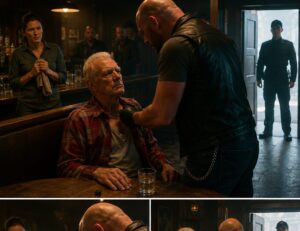
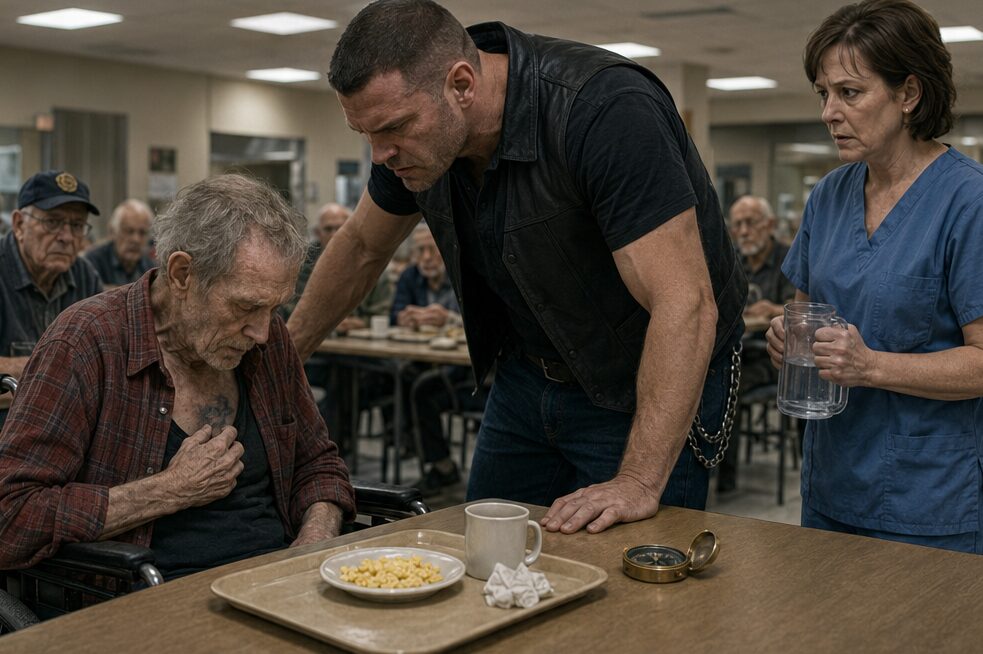
Richard sat with his red plaid shirt half-open because Margaret had changed the dressing near his collarbone ten minutes earlier and forgotten to button him all the way. Under the shirt, his black undershirt sagged loose against his thin chest.
The number was there, blue-black and old.
The young man saw it before Richard could cover it.
He was tall, close-cropped, built like someone who had never had to ask twice. He wore a dark shirt under a black vest, and a chain hung from his belt. In one hand, he held a crumpled napkin. His other hand rested on the back of Richard’s wheelchair, not pushing, just claiming the space.
Richard kept his eyes on the scrambled eggs cooling on his tray.
The white mug beside the plate gave off a weak steam. He had not touched it.
“Look at me,” the young man said.
Richard did not.
Margaret froze near the serving station with a pitcher of water in her hand. She had been a nurse at the facility long enough to know when a room changed shape. This was one of those moments. The dining hall had all its normal sounds—chairs scraping, television weather murmuring from the corner, spoons tapping bowls—but underneath it, something had gone still.
The young man leaned closer.
“You lived long enough to become harmless. Is that the trick?”
Richard’s hand moved toward his shirt.
The young man caught the motion with his eyes and smiled without warmth.
“No. Don’t hide it now.”
Margaret set the pitcher down too hard. Water sloshed over the rim.
“Sir,” she said, crossing the room. “You need to step back.”
The young man did not look at her. “I’m speaking to him.”
“He’s a resident here.”
“He was a lot of things before he was a resident.”
Richard finally lifted his eyes, but only halfway.
The young man wiped his palm with the napkin, slowly, as if the chair had left something on his skin. Then he dropped the napkin onto Richard’s tray, beside the eggs.
A few residents looked away. A few leaned in.
Richard looked at the napkin.
He had been called difficult at breakfast, uncooperative at therapy, withdrawn in the evening notes. He had been called worse in rooms with better lighting. Names did not surprise him anymore.
But this young man’s voice did.
It had arrived carrying someone else’s grief.
“Who are you?” Margaret demanded.
The young man reached into the inside pocket of his vest and took out a folded paper. He did not show it to her. He held it where Richard could see the worn creases.
“My name is Justin Miller,” he said. “My grandfather was Stephen Miller.”
Richard’s fingers stopped at his shirt.
Only for a second.
But Justin saw it.
“There,” Justin said. “You do remember.”
Margaret looked from one man to the other. “Mr. Carter?”
Richard was not named Carter anymore in any practical sense. Around the facility he was Room 214, soft diet, two-person transfer on bad mornings, refuses group activities. But on the file, in the locked cabinet, he was Richard Carter.
He had not heard the other name in years.
Justin unfolded the paper.
“Staff Sergeant Richard Carter,” he read. “Unauthorized deviation during extraction. Failed to return with six assigned personnel. Declined full statement.”
His voice sharpened.
“My grandmother waited forty-two years for somebody to tell her why her husband didn’t come home. Do you know what she got? Two paragraphs and a flag folded by strangers.”
Richard stared at the eggs.
Someone at the next table whispered, “What’s he talking about?”
Another resident, a broad old man named no one remembered unless he was shouting, muttered, “Always knew Carter had something wrong behind the eyes.”
Margaret heard it and turned. “Enough.”
Justin heard it too. It fed something in him.
“He’s right,” Justin said. “Something was wrong. Men like him don’t hide for no reason.”
Richard’s hand reached again for the edge of his shirt. This time he pulled it closed over the number.
Justin’s mouth tightened.
“That’s guilt.”
Margaret stepped between them as much as she could. “This conversation is over.”
Richard’s voice came out so quietly that the room almost missed it.
“Let him finish.”
Margaret turned back. “Richard—”
He lifted one shaking hand from the tray and set it on the wheel of his chair.
“Let him finish,” he said again.
Justin looked down at him for a long second.
The old man’s eyes were not empty after all. They were tired, yes. Sunken. Clouded at the edges. But somewhere inside them, behind the weakness and the age and the long habit of silence, something had recognized the shape of the day.
Justin’s grip tightened around the report.
“Good,” he said. “Then listen.”
Part II — The Paper on the Tray
Justin placed the photocopied report beside the white mug.
It landed partly in the spilled water from the pitcher, and the bottom corner darkened.
Margaret reached to move it.
Richard stopped her with two fingers against her wrist.
Not hard. Not even strong.
Enough.
Justin watched that, too.
“My grandfather died during Operation Linebreak,” Justin said. “You were the last man assigned to his group. You came back breathing. He didn’t.”
Richard’s eyelids flickered.
“Don’t do that,” Justin snapped. “Don’t sit there like the room is too bright. You had forty-two years to get used to the truth.”
A woman near the window covered her mouth. The television weather shifted to a commercial no one heard.
Richard looked at the report.
He did not need to read it. He knew the spacing of the paragraphs. He knew the phrases chosen by men who had slept indoors that night.
Unauthorized deviation.
Failed to return.
Declined full statement.
The report had never lied completely. That was the trouble with it. A clean lie could be fought. A partial truth could live longer than the people it harmed.
Justin tapped the page.
“My grandmother had this in a box with his tags and a compass. She used to polish that compass every Sunday. Said it was the only thing of his that came back warm.”
Richard’s face changed.
Not much.
But Margaret, who had watched him through fevers, bad dreams, and silent birthdays, saw it.
The old man’s mouth tightened as though a wire had been pulled behind it.
Justin leaned closer.
“You know about that, too?”
Richard did not answer.
“Say his name,” Justin demanded.
Margaret shifted again. “You’re done.”
“No,” Richard said.
The word scraped out of him.
Justin’s eyes narrowed. “Then say it.”
Richard looked up fully for the first time.
“Stephen had a scar under his left eye,” he said.
Justin went still.
Richard’s voice remained low. “Not from combat. From laughing too hard during a stove drill. He slipped. Hit the pipe. Bled all over his shirt and told everyone he’d fought the stove and lost.”
The dining hall held its breath.
Justin’s anger cracked, then sealed over.
“You don’t get to do that.”
Richard blinked. “Do what?”
“Make him sound alive.”
The words struck harder than the accusation.
Richard lowered his eyes again, but this time it did not look like surrender. It looked like he had been struck in an old place and chose not to strike back.
Margaret spoke carefully. “Justin, is it?”
He ignored her.
She continued anyway. “Whatever you came here for, this isn’t the way.”
Justin laughed once, without humor. “There was a way? Should I have written a polite letter? Asked if he had time between pudding and blood pressure checks to explain why my family grew up around an empty chair?”
Richard’s thumb rubbed the edge of his tray.
Once.
Twice.
Then he rolled the chair backward half an inch and pressed the brake down with the side of his palm.
The click was small.
In that room, it sounded like a decision.
Justin heard it.
Margaret heard it.
Even the residents who had been pretending not to listen looked back.
Richard’s shoulders were narrow under the plaid shirt. The shirt had faded at the elbows. His chest rose with effort. The number was hidden now, but everyone remembered where it was.
“Ask what you came to ask,” Richard said.
Justin stared at him. “Why did you leave him?”
Richard looked at the report.
Then at the young man.
“We were told the ridge was empty.”
Justin waited.
“It wasn’t.”
“That’s not an answer.”
“No.”
“Then answer.”
Richard’s fingers trembled on the wheel.
“Command wanted numbers,” he said. “Not names.”
Justin’s jaw flexed.
Richard swallowed. “One-eighty-two was the call sign after midnight.”
Margaret’s face tightened. She had heard that phrase before.
Not like this. Not in a sentence.
She had heard it at 3:12 a.m. from Room 214, when Richard woke with his hands clawing at the blanket and whispered, One-eighty-two, lower tunnel, don’t close it.
She had written it once in his chart as possible night confusion.
Now the phrase stood up in the dining hall like a person.
Justin pointed at the hidden tattoo beneath Richard’s shirt.
“So you branded yourself with the call sign?”
Richard said nothing.
“You think that makes it holy?”
Margaret stepped closer. “Careful.”
Justin turned toward her for the first time. “Do you know he refuses every veteran group that comes through here? Every ceremony? Every flag pin? My unit came last month. He wouldn’t even open his door.”
Margaret’s anger softened into something more complicated.
“That’s true,” she said. “He doesn’t attend.”
Justin looked back at Richard. “Because cowards avoid flags.”
Richard flinched.
It was small. Smaller than the tremor in his hand.
But it was the first thing Justin had said that truly hurt him.
The room felt it.
Richard lifted his eyes again, and there was something in them now that made Justin hesitate.
“Did your grandmother receive a compass?” Richard asked.
Justin’s face changed.
The anger did not leave. It became frightened of what might be underneath it.
“Yes,” he said. “She did.”
Richard nodded once.
“Good,” he said. “Then he got home.”
Part III — The Compass
Justin stood so still that Margaret thought he might hit him.
Instead, he reached into the pocket of his vest and took out a small brass compass.
It was old enough that its shine had become soft. The lid bore shallow scratches from years of handling. Justin held it like proof, like inheritance, like a stone he had been carrying in his chest.
“My grandmother kept this beside her bed,” he said. “She said he would’ve wanted me to have it when I joined.”
Richard stared at it.
The dining hall disappeared from his face.
For one second, he was not seventy-eight. He was not in a wheelchair. He was somewhere cold, wet, and dark, with someone breathing through pain against his shoulder.
Justin placed the compass on Richard’s tray.
Not gently.
It slid through the spilled water and stopped against the white mug.
“Look at it,” Justin said.
Richard did.
His hand rose, stopped halfway, then settled beside it without touching.
Justin flipped the lid open.
Inside, scratched into the brass, were three names and a number.
Miller / Carter / 182.
The room shifted.
It was not loud. No one gasped. No one said anything foolish.
But the judgment that had been pointed at Richard wavered.
Justin saw it and hated it.
“My grandfather didn’t write your name in there because you were friends,” he said. “He wrote it because he knew who to blame.”
Richard looked at the inscription.
“No,” he said.
Justin’s voice rose. “No?”
“Stephen gave it to me after I carried him through the canal.”
Justin’s face went blank.
Richard’s hand finally touched the compass. His fingers did not close around it. They rested on the lid as if greeting a face through glass.
“He told me to return it to Angela,” Richard said.
Justin’s throat moved.
That had been his grandmother’s name.
Nobody in the facility knew it.
“You don’t get to say her name either,” Justin whispered.
Richard nodded, as if accepting that rule.
“He asked me to tell her he saw the river,” Richard said. “There was no river. He was fevered. But he said it twice, so I told her.”
Justin took one step back.
His certainty had been a wall. Now there was a crack in it, and behind the crack was not forgiveness. It was fear.
The fear that the story he had inherited was not large enough.
Angela Fields, the facility director, arrived in the dining hall in a gray blazer and practical shoes, her glasses still in one hand. She was the sort of woman who could turn a crisis into paperwork before anyone raised their voice. But even she stopped when she saw the compass on the tray.
“What is happening here?” she asked.
Margaret answered without taking her eyes off Richard. “Something old.”
Angela looked at Justin. “Sir, you cannot confront residents in the dining hall.”
Justin pointed to the report. “He’s not just a resident.”
Angela’s face hardened. “In this building, he is.”
Richard gave a dry, almost soundless laugh.
Everyone looked at him.
He was not amused.
“In this building,” he said, “they write everything down.”
Angela heard the accusation beneath the words. She glanced at the report, the compass, the untouched eggs, the old man with his shirt half-closed.
Then she looked at Margaret.
Margaret said quietly, “He’s been saying some of these words at night for years.”
Justin turned sharply. “What words?”
Margaret hesitated.
Richard said, “Tell him.”
Margaret swallowed. “Lower tunnel. Don’t close it. One-eighty-two. Three lines.”
Justin looked at Richard again.
“Three lines?”
Richard’s fingers tightened against the compass.
“Not yet,” he said.
Justin almost laughed. “You still think you control this?”
Richard lifted his eyes.
“No,” he said. “That was the problem.”
The room went colder.
Justin leaned forward again, but the angle had changed. Before, he had loomed. Now he was trying to get closer to an answer.
“What happened in that tunnel?”
Richard looked past him, toward the windows where late afternoon light hit the linoleum floor.
He spoke as if every word had to be carried separately.
“Linebreak was supposed to move twelve out before morning. Assets. Wounded. Two field officers. A radio man who couldn’t stand. Your grandfather was assigned to the lower group.”
Justin did not interrupt.
For once.
“They told us the ridge was clear,” Richard said. “It wasn’t. We got hit from both sides. The upper passage collapsed. The lower tunnel still had men inside.”
Angela’s posture changed. Not softer. More attentive.
Richard continued.
“Command said the lower tunnel was nonviable.”
Justin’s eyes narrowed. “Meaning?”
“Meaning they had already decided who counted.”
The line landed hard.
Margaret looked down.
Richard’s thumb moved along the compass lid.
“I took two men and went back.”
Justin shook his head. “That’s not in the report.”
“No.”
“Why?”
“Because reports are written by whoever gets the last dry chair.”
No one spoke.
Richard’s breathing had grown shallow, but his gaze stayed steady.
“I found Stephen under a broken support beam. Alive. Laughing.”
Justin’s eyes flashed. “Laughing?”
“Said if he died under bad carpentry, he’d haunt the engineer.”
A sound escaped Justin. Not a laugh. Not quite a sob.
Richard looked at him with a strange gentleness and did not spare him.
“I got him through the canal. Not far enough.”
Justin’s face closed.
“There it is,” he said. “Not far enough.”
“No,” Richard said. “Not far enough.”
Part IV — The Weight in the Drawer
The dining hall had stopped pretending.
Trays sat untouched. Coffee cooled in paper cups. The television in the corner flashed smiling faces no one watched.
Justin’s voice came out lower now.
“How many did you leave?”
Margaret winced.
Richard did not.
“Six.”
The word was flat. Practiced. Not because it had become easy, but because it had been spoken inside him so many times it no longer needed breath.
Justin stared at him. “So the report was true.”
“Partly.”
“You failed to return with six assigned personnel.”
“Yes.”
“You refused to provide a full statement.”
“Yes.”
“You expect me to hear that and call you misunderstood?”
Richard’s mouth tightened.
“No.”
That answer did more damage than denial would have.
Justin had wanted excuses. Excuses could be broken. Richard gave him facts and left them standing.
“Then why didn’t you tell the truth?” Justin demanded.
Angela answered before Richard could. “Classified operations can remain sealed for decades.”
Richard shook his head once.
“That wasn’t why.”
Angela looked at him.
Richard’s eyes stayed on Justin.
“The officer who gave the order had a son in the lower tunnel,” he said. “One of the six.”
Justin’s face shifted.
Richard went on.
“If I named him, the inquiry would drag every rescued man back through it. Every family would get a different wound. And Stephen—”
He stopped.
His hand moved to his chest, pressing against the shirt where 182 waited beneath the fabric.
Justin leaned in. “Stephen what?”
Richard’s voice roughened.
“Stephen asked me not to let them turn the trapped men into acceptable losses.”
Justin’s anger came back, but now it had nowhere clean to stand.
“So you made yourself look guilty because it was noble?”
Richard’s answer came quick, almost sharp.
“No. Because I was tired. Because I was ashamed. Because some truths don’t bring men back.”
The room absorbed that.
Even Angela did not move.
Justin looked down at the compass, then at the report.
“You had proof?”
Richard did not answer.
Margaret did.
“There’s an envelope.”
Richard closed his eyes.
Angela turned to her. “Margaret.”
Margaret’s face paled, but she did not retreat. “He asked for it once during a fever. Called it Miller’s last weight.”
Justin snapped his head toward Richard.
“What envelope?”
Richard opened his eyes. He looked suddenly older than he had all morning.
Angela said, “Residents’ personal effects are private.”
Justin’s voice hardened. “If it’s about my grandfather—”
“It is still his,” Angela said, nodding toward Richard.
For the first time, Justin had to wait.
The old man in the chair, the one he had come to corner, held the room.
Richard stared at the compass.
A long time passed in a few seconds.
Then he nodded.
Angela did not move right away. “Richard, are you sure?”
“No,” he said.
That was all.
Angela left.
The room stayed still while she was gone.
Justin no longer stood with his hand on the wheelchair. He had stepped away without realizing it. His arms hung at his sides. He looked too large for the space now, not powerful. Just exposed.
Richard’s hand slipped from the compass.
Margaret came close and bent down.
“You don’t have to do this,” she said.
Richard looked at her.
“For years,” he said, “you thought I scratched cups because my mind was going.”
Her eyes filled, but she held herself steady.
“I didn’t know.”
“No,” Richard said. “You didn’t ask.”
The words were not cruel.
That made them worse.
Angela returned with a brown envelope sealed in clear plastic. It had Richard’s name written across it in old ink. Beneath the name, in smaller letters, someone had written: destroy if no next of kin.
Justin stared at it.
Richard stared at it longer.
Angela cut the plastic sleeve open but did not break the envelope seal.
She placed it on the tray beside the compass and the report.
“Only if you say,” she told Richard.
The dining hall waited.
Richard’s fingers trembled. The tremor moved up his arm into his shoulder. For a second, Margaret thought he might collapse into himself.
Instead, he reached forward and tapped the envelope once.
“Open it.”
Angela broke the seal.
Inside was a folded letter, yellowed at the edges. The handwriting was tight, uneven, but readable.
Justin reached for it.
Angela held it back.
Richard said, “Let him.”
Justin took the letter.
His face was still hard when he unfolded it.
It did not stay that way.
Part V — What Stephen Asked For
The letter began with a name.
Angela.
Justin stopped breathing for a moment.
Not because the handwriting was familiar. It wasn’t. It was Richard’s handwriting, thin and cramped and old even when it had been young.
But the voice was not Richard’s.
Justin felt it before he understood it.
Angela, if this reaches you, then Carter kept walking when I could not.
His eyes moved quickly, then slower, as if each line changed the weight of the paper.
Do not let them tell you we were numbers. We were cold, scared, stupid, brave, and loud. I was loudest. Carter came back when ordered not to. If you need someone to hate, let it be me for going back down after I was told to wait. Not him. He came when ordered not to.
Justin’s hand shook.
Richard watched him without asking for mercy.
The room had gone so quiet that the fluorescent lights seemed loud.
Justin read further, silently at first.
Then his lips parted on one sentence.
He did not say it aloud.
Richard did.
“He asked me to go home.”
Justin looked up.
Richard nodded toward the letter. “That part.”
Justin’s eyes dropped back to the page.
Tell her I saw the river, even if I didn’t. Tell her I thought of the blue dress. Tell her not to let our boy grow up thinking I was brave every minute. I wasn’t. I was scared at the end. But Carter stayed until I was not alone.
Justin’s face broke then.
Not fully. He fought it. His jaw clenched, his eyes hardened, his breath caught.
But the story he had brought into the room—the one where his grandfather was pure absence and Richard was the shape of blame—could not hold that sentence.
He looked at Richard as if seeing him through two generations of grief.
“You wrote this.”
Richard nodded.
“So how do I know?”
Richard did not defend himself.
That angered Justin all over again.
“How do I know you didn’t write whatever made you look better?”
Richard waited until the question emptied itself.
Then he said, “Look under the lid.”
Justin looked at the compass.
Richard’s voice lowered. “Not the names. Under them.”
Justin picked it up.
His hands were not steady now. He tilted the brass lid toward the light.
Beneath the scratched names, almost hidden by years of polishing, were three short notches.
Tiny. Uneven. Deliberate.
Justin frowned. “What are these?”
“Stephen cut one for each man pulled out before the roof went.”
Justin’s hand closed around the compass.
“Three?”
Richard nodded.
“Only three?”
“Three lived.”
Justin’s mouth trembled.
Margaret whispered, almost to herself, “Three lines.”
Richard looked at her.
She covered her mouth.
“All those paper cups,” she said.
Richard did not smile.
“When they started giving me pills in cups,” he said, “I scratched three lines before I threw them away.”
Margaret’s eyes shone. “We thought—”
“I know.”
She looked down, ashamed.
Richard’s gaze moved around the dining hall.
A few residents lowered their eyes. The man who had muttered earlier stared at his tray as if it had accused him.
Justin still held the compass.
His voice was hoarse. “Why tattoo the number?”
Richard pulled his shirt open with slow, deliberate fingers.
The number appeared again over his heart.
This time no one looked away quickly.
“I did it after the inquiry,” Richard said. “Not during.”
“Why?”
“So when they washed me, buried me, or forgot me, somebody would ask.”
His eyes moved across the room.
“Took long enough.”
The sentence landed without anger.
That made it unbearable.
Justin’s lips parted. “I’m—”
Richard lifted one hand.
“No.”
Justin stopped.
Richard’s eyes were clear now. Tired, but clear.
“If you’re going to apologize,” Richard said, “don’t do it for the room.”
Justin swallowed.
Richard nodded toward the letter.
“Read it.”
Justin looked at him.
“For them?” Justin asked.
“For Stephen.”
The name changed the air.
Justin stared at the letter in his hand. All morning he had used his grandfather like evidence. Now he was being asked to give him back his voice.
He tried to begin.
Couldn’t.
Richard reached for the compass and pushed it gently toward him.
Justin took it with both hands.
Then he lowered himself.
Not dramatically. Not like a man performing humility. He simply could not keep standing over Richard anymore.
He knelt beside the tray.
Angela, after a moment, pulled out a chair and sat.
Margaret removed the cold eggs, the wet napkin, and the stained report from Richard’s tray. She did not hurry. She cleared the space as if preparing a table for something sacred without calling it sacred.
Justin read.
His voice broke on Angela’s name.
He started again.
He read about cold water, bad jokes, fear, the blue dress, the men in the lower tunnel, the order not to return, and Richard coming back anyway.
He read the line about hatred.
If my family needs someone to hate, let it be me for going back down. Not Carter. He came when ordered not to.
No one interrupted.
No one corrected.
No one applauded.
That would have ruined it.
The letter did not make Richard innocent. It did not bring back the six men. It did not turn the operation into a clean story with a clean ending.
But it did one thing the report had refused to do.
It used names.
When Justin finished, he kept looking at the page.
Richard sat with his shirt still open, his breathing thin, his hand resting near the number.
The room had not forgiven him.
It had finally seen him.
Part VI — The Food Made Warm Again
That evening, Justin wheeled Richard into the courtyard without asking anyone else to do it.
The air had cooled. The facility’s windows reflected a pale sky. Somewhere inside, dinner trays rattled down the hall.
Neither man spoke for a while.
Justin parked the wheelchair near a planter where rosemary grew badly but stubbornly. He stood behind Richard with both hands on the chair handles, then seemed to realize the posture and came around to face him.
“I came here wanting you to suffer,” Justin said.
Richard looked at the fading light.
“You came carrying your grandmother’s grief,” he said. “That’s different.”
Justin sat on the low concrete wall across from him. The compass rested in his palm.
“She polished this every Sunday,” he said. “I used to think she was keeping him alive.”
“She was.”
Justin’s eyes lifted.
Richard’s voice was quiet. “Just not all of him.”
That hurt. Justin let it.
After a while, he held out the compass.
“You should have it.”
Richard shook his head.
“No.”
“It has your name in it.”
“It found who it needed.”
Justin looked down at the brass lid. The three notches caught the last light only when he tilted it.
“What do I tell my family?”
Richard’s gaze stayed on the courtyard.
“Tell them he was scared,” he said. “Tell them he was funny. Tell them he asked for home.”
Justin listened as if each instruction had weight.
Richard turned his head slightly.
“Don’t make him a statue. He hated standing still.”
For the first time all day, something almost like a smile moved across Justin’s face. It did not last. It did not need to.
“I’m sorry,” he said.
Richard did not stop him this time.
But he did not accept it the way Justin expected.
“For what you did today?” Richard asked.
Justin nodded.
Richard looked down at his own hands.
“I let them write it wrong for forty-two years,” he said. “You weren’t the only one who came late.”
Justin had no answer.
That was the right answer.
When Margaret came looking for them, she found Justin standing beside the wheelchair, not behind it. Richard’s shirt was still open enough for the number to show, but it no longer looked like something accidentally exposed.
It looked chosen.
Margaret paused at the courtyard door.
“Coffee?” she asked.
Richard looked at her.
For years, he had refused small offerings as if they were traps. Extra blankets. Birthday cake. Warm milk. Fresh socks. He had accepted care because his body required it, not because he wanted any part of living softened.
Now he nodded.
“In the white mug,” he said.
Margaret smiled through the ache in her face. “I know.”
She turned to go.
“Margaret.”
She stopped.
Richard looked embarrassed by the effort of asking.
“Could you warm the eggs?”
Her face changed.
It was such a small request. Almost nothing. A plate reheated. A meal returned. An old man deciding, after all that had been opened, that he might still eat.
“I’ll bring them,” she said.
Justin looked away.
Not because he was ashamed to see the moment.
Because some dignity deserved privacy, even when witnessed.
When Margaret left, Richard sat quietly beneath the cooling sky. The number over his heart rose and fell with his breathing.
Justin closed the compass and held it carefully.
Inside the facility, the dining hall would be cleaned. The report would dry with a water stain at the corner. The residents would tell the story wrong by tomorrow, then less wrong by next week. Angela would file an incident note that would fail, like all official notes, to hold the weight of what had happened.
But somewhere, a family would hear a letter read in a younger man’s voice.
Somewhere, a grandmother’s polished compass would stop being only a relic of absence.
And in Room 214, later that night, Richard Carter would scratch no new lines into his paper cup.
Three were enough.
Margaret returned with coffee in the white mug and a plate warmed just past comfort.
Richard took the fork slowly.
His hand still trembled.
The eggs were ordinary. Soft. Yellow. Almost tasteless.
He ate them anyway.