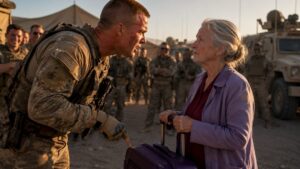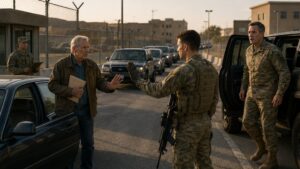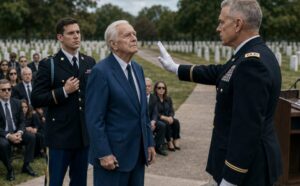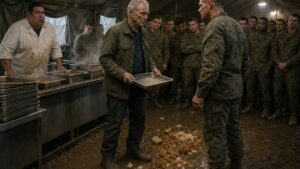
The Room With No Picture
Part I — The First Voice
The first sound on the recording was not an explosion.
It was a man breathing like he had just realized no one was coming.
Michael stopped the playback with one finger still hovering over the keyboard. The archive room hummed around him, cold and windowless, six floors beneath a building where people used words like accountability only when someone else was already bleeding for it.
The screen in front of him was black.
Not paused black. Not loading black.
Empty black.
No visual stream. No timestamped feed. No helmet-camera footage. No drone overlay. No thermal capture. No clean record of where the unit had been when everything went wrong.
Only audio.
A file name. A mission number. Eleven minutes and forty-two seconds of chaos.
Michael pressed play again.
Static cracked open.
A voice shouted, “Where are we? I need coordinates!”
Another voice, lower and closer to the mic, said, “Hold position. Hold—”
Then came a burst of distant fire, hard and flat, followed by someone yelling for Rebecca.
Michael wrote the name down.
Rebecca. Medic.
He had already read the official report twice.
According to the report, the field commander, James, had broken formation, ignored extraction timing, and moved his unit early. His decision created confusion, separated two teams, and caused a failed withdrawal.
Clean words.
Orderly words.
Words that made the disaster look like one man’s impatience.
Michael had written reports like that before. He knew how language could lower the temperature of a room. He knew how to turn panic into “unexpected pressure,” fear into “limited visibility,” and a wrong decision into “procedural deviation.”
But this file was different.
Because the file had no picture.
And without the picture, every sound seemed guilty.
The door opened behind him.
Michael did not turn around.
“Tell me you can work with it,” said Colonel Harris.
Michael looked at the black screen. “There’s no video.”
“We know.”
“Was it corrupted?”
“That’s what we need you to determine.”
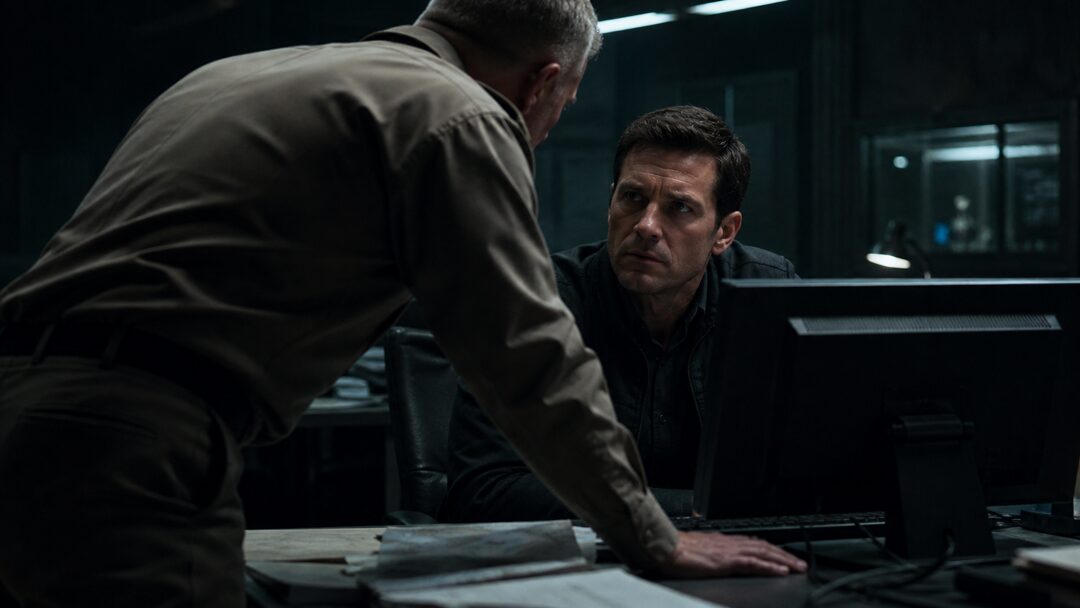
Michael turned then. Harris stood in the doorway with his sleeves rolled once, tie loosened, face composed in the way senior men trained themselves to look composed. He held a folder under one arm but did not offer it.
“You’re asking me to reconstruct an operation from audio only,” Michael said.
“I’m asking you to reconstruct the truth.”
That word again.
Michael almost smiled.
Instead, he glanced back at the waveform on his monitor, jagged and uneven like a heartbeat fighting the machine.
“Why me?”
Harris stepped inside and shut the door.
“Because you’re precise,” he said. “Because you don’t dramatize. And because you knew James.”
Michael felt the name before he answered.
James.
Weathered face. Calm hands. A voice that never rose unless someone needed to move faster than fear. A man Michael had argued with in briefing rooms and trusted in places where trust became a kind of currency.
“I knew his record,” Michael said.
“That’s enough.”
“It isn’t.”
Harris placed the folder on the table.
The label on top read: INTERNAL REVIEW — LIMITED DISTRIBUTION.
“James made himself difficult to defend,” Harris said. “This file may explain why.”
Michael heard what was not being said.
Or it may help us stop trying.
On the recording, someone screamed in the background.
Michael reached for the keyboard again.
Harris remained by the door.
“By Friday,” he said. “We need a conclusive finding.”
Michael looked at the black screen.
“There may not be one.”
Harris opened the door.
“There has to be.”
When he left, the archive room seemed smaller.
Michael played the recording from the beginning one more time.
The man breathing.
Static.
A woman’s voice: “I need coordinates!”
Then James, close enough to the microphone to sound as if he were speaking into Michael’s ear.
“Do not wait for permission.”
Michael’s pen stopped moving.
The official report had not quoted that line.
Part II — The Shape of Noise
By midnight, Michael had listened to the first two minutes seventeen times.
Each time, the file changed.
Not the audio itself. The meaning.
The first time, James sounded reckless.
The third time, urgent.
The ninth time, afraid.
By the seventeenth, Michael no longer trusted his own ears.
He spread the printed report across the table and marked each contradiction in red.
Report: Team maintained position until command signal.
Audio: movement before signal.
Report: James broke extraction timing without cause.
Audio: James says, “They’re not where command thinks they are.”
Report: Medic requested coordinates due to signal disruption.
Audio: Rebecca says, “These coordinates are wrong.”
That line had been buried beneath static and another man shouting. Michael nearly missed it.
He replayed it.
“These coordinates are wrong.”
Not lost.
Wrong.
There was a difference.
Lost meant chaos.
Wrong meant someone had given them a map that failed them.
At 1:12 a.m., Michael called up the voice-tagging software and began isolating speakers.
James was easy. Controlled. Low. Hard on consonants.
Rebecca was sharp, breathless, professionally terrified.
Two other voices appeared often: Mark, a communications specialist, and Anthony, a younger operator whose fear came through in the way he repeated questions no one answered.
But there was a fifth voice.
It came in only twice during the first six minutes.
Distorted.
Flattened by compression.
Possibly remote command. Possibly field relay. Possibly someone close enough to be picked up through open channel interference.
“Delay extraction,” the voice said.
Michael leaned closer.
He replayed it.
“Delay extraction.”
Then James, immediate: “Negative.”
Then the voice again, swallowed by static.
“Stand by.”
Michael sat back.
There were phrases that could ruin a man depending on where they were placed.
Negative.
Do not wait.
Move now.
In isolation, they looked like defiance.
In context, they could be the only sane response in the room.
But context was exactly what the missing footage had stolen.
At 2:03 a.m., Michael opened James’s personnel file.
He knew better.
It was not necessary yet.
He opened it anyway.
James had been decorated twice and formally reprimanded three times. Commendations for composure under pressure. Reprimands for unauthorized adjustments to field timing. One note described him as “operationally effective but resistant to delayed authorization in rapidly changing environments.”
Michael remembered that briefing.
Three years earlier. A narrow room. Bad coffee. James standing at the end of the table with dirt still under his nails from a training rotation.
“You can’t ask men to wait inside a burning house while five people approve the fire exit,” James had said.
Michael had answered without looking up from his tablet.
“That is not what the protocol does.”
James had looked at him then, not angry. Worse. Disappointed.
“Then you’ve never been inside the house.”
Michael had hated him for that.
Because James was wrong.
Because James was right.
Both truths had lived in Michael for years without speaking to each other.
Now James’s voice filled the archive room.
“Do not wait for permission.”
Michael played the next section.
Rebecca again.
“James, if we move, we split from second team.”
“I know.”
“Then say it.”
A pause.
The kind of pause that sounded like a man choosing which guilt he could survive.
James said, “We move.”
Michael stopped the file.
The black screen stared back.
In every investigation, there was a moment when evidence stopped being information and became accusation.
Michael had reached it sooner than he wanted.
Part III — What Rebecca Remembered
Rebecca arrived the next morning wearing civilian clothes that did not make her look civilian.
Gray sweater. Dark jeans. Hair tied too tightly. Hands folded in her lap as if waiting for inspection.
She sat across from Michael in a conference room above ground, where sunlight came through tinted glass and made everything look less honest.
“I already gave a statement,” she said.
“I read it.”
“Then why am I here?”
“Because the audio doesn’t match it.”
Her eyes moved once, quickly, to the recorder on the table.
Michael noticed.
People always looked at the machine when they were deciding how much truth a room could hold.
“I don’t remember all of it clearly,” Rebecca said.
“That’s normal.”
“No,” she said. “It’s convenient.”
Michael let that sit.
He had learned not to rescue silence too quickly. People filled it with things they had not planned to say.
Rebecca rubbed one thumb over the other.
“In my statement, I said James moved us too early.”
“You still believe that?”
“I believe he moved us.”
“That wasn’t the question.”
Her mouth tightened.
“I don’t know what early means anymore.”
There it was. A crack.
Michael opened the folder but did not read from it.
“On the recording, you say the coordinates are wrong.”
Rebecca closed her eyes.
For a second, she was not in the conference room.
She was back inside the sound.
“I said that?”
“Yes.”
“I remember thinking it.”
“You said it.”
She inhaled slowly.
“The map had us east of the dry canal. We weren’t. I could feel the grade under my boots. We were lower than we should’ve been.” She gave a small, humorless laugh. “That sounds stupid.”
“It doesn’t.”
“It does if you’ve never had to trust dirt more than a screen.”
Michael looked down.
Trust dirt more than a screen.
James would have said something like that.
“Did James know?”
“James always knew where he was,” Rebecca said.
The sentence came out too quickly.
Not admiration. Not exactly.
Something heavier.
Michael turned a page.
“Command ordered delay.”
Rebecca stared at him.
“Who told you that?”
“The recording.”
She leaned back as if the room had moved.
“No.”
“You don’t remember it?”
“I remember waiting. I remember him looking at Mark. I remember Mark saying the channel was dirty. I remember James asking for confirmation.” Her eyes sharpened. “I remember him listening.”
“To what?”
Rebecca did not answer.
Michael waited.
Finally, she said, “There was a sound before he made the call.”
“What sound?”
She pressed her lips together.
“Engines.”
Michael glanced at the transcript.
No engines were marked.
“Vehicles?”
“I don’t know.”
“You didn’t mention that in your statement.”
“I didn’t know if I imagined it.”
“Did anyone else hear it?”
“James did.”
“How do you know?”
“Because after that, he stopped asking permission.”
Michael felt the line land.
Outside the glass, two officers passed with paper cups and easy laughter. The ordinary world had terrible timing.
Rebecca looked at Michael.
“You’re going to make him the reason, aren’t you?”
“I’m trying to find the reason.”
“No,” she said. “You’re trying to make it fit inside a report.”
The words struck harder because they were not shouted.
Michael closed the folder.
“James’s choice separated the unit.”
“Yes.”
“And that caused loss of control.”
“Yes.”
“Then why are you defending him?”
Rebecca’s face changed.
Not anger.
Exhaustion.
“Because I’m alive.”
Neither of them spoke.
A clean report could not hold that sentence.
When she left, Michael remained in the conference room with the recorder still running.
For the first time since receiving the file, he did not want more evidence.
He wanted less responsibility.
Part IV — The Voice Under the Static
The fifth voice was buried at minute six.
Michael found it after filtering out the wind, Mark’s broken transmission, and the sharp percussion of distant impacts he was not supposed to identify in the final report.
The first cleaned layer produced only two words.
“Hold them.”
Michael replayed it.
“Hold them.”
Not hold position.
Not hold extraction.
Hold them.
He checked the communication log from command.
At 14:07, headquarters issued a delayed extraction instruction due to “uncertain route clearance.”
At 14:09, James moved.
At 14:11, second team reported pressure from the north.
At 14:13, all visual feeds dropped.
Dropped.
That word bothered him.
Feeds failed. Feeds cut. Feeds corrupted.
Dropped sounded passive.
He requested the raw system integrity report.
Access denied.
He requested again under review authority.
Pending.
At 5:40 p.m., Harris appeared in Michael’s doorway.
“You’re spending too much time on the feed loss,” Harris said.
Michael looked up from the waveform. “The missing video is central.”
“The report concerns field decision-making.”
“The field decision may have been shaped by bad information from command.”
Harris’s expression did not change, but something in the room tightened.
“Careful.”
“With what?”
“With confusing ambiguity for evidence.”
Michael almost laughed.
“That is exactly what you asked me to sort out.”
“I asked you to reconstruct the truth.”
“You asked me to confirm a shape.”
Harris stepped inside and shut the door.
For several seconds, neither man spoke.
Then Harris said, “James had a history.”
“So does every institution.”
“That sounds personal.”
“It is becoming personal.”
“It shouldn’t.”
Michael leaned back.
“Then you shouldn’t have given me a file involving a man I knew.”
Harris placed both hands on the back of the chair opposite him but did not sit.
“You knew him well enough to understand his pattern. That was useful.”
“To whom?”
Harris’s jaw shifted.
“Submit what the evidence supports.”
“The evidence supports uncertainty.”
“The review board does not need poetry.”
“No,” Michael said. “It needs a body it can carry.”
The word hung there.
Harris’s eyes cooled.
“You have until Friday,” he said.
After he left, Michael sat very still.
He had crossed a line. He knew it.
Worse, he knew why.
He pulled up the authorization history for the operation. Dry forms. Time stamps. Approvals. Delays. Names nested under departments and codes.
His own name appeared on the routing chain three days before the mission.
Michael felt his chest tighten.
He remembered the request.
A procedural review. Extraction timing protocols. Weather interference. Route clearance conditions. He had approved a delay threshold update because the model recommended reducing exposure risk by holding teams until confirmation from overhead assets.
It had taken him less than two minutes.
He had been eating a sandwich at his desk.
He stared at the authorization line.
MICHAEL A. GRANT — REVIEWED / APPROVED.
His name looked too clean.
He opened the audio again.
Minute six.
The distorted voice: “Delay extraction.”
James: “Negative.”
The voice: “Stand by.”
Rebecca: “James—”
Then, beneath static, almost swallowed:
“Engines.”
Michael froze.
Not spoken by Rebecca.
Spoken by James.
Quietly.
As if to himself.
He enhanced the layer.
James again, closer now: “They’re early.”
Then Mark: “Command says wait.”
James: “Command isn’t here.”
Michael stopped the playback.
There were sentences a person said when they wanted to win an argument.
And there were sentences a person said when the argument was already over.
Command isn’t here.
Michael sat in the archive room long after the building above him emptied.
He replayed the phrase until it stopped sounding like defiance.
It sounded like loneliness.
Part V — The Report They Wanted
On Friday morning, Michael found a draft report waiting in his secure folder.
He had not written it.
The file was titled: PROPOSED FINDING.
He opened it with a coldness spreading through his hands.
The language was elegant.
“Field Commander James made an unauthorized timing decision inconsistent with approved extraction procedure.”
“Available audio supports the conclusion that deviation occurred prior to confirmed clearance.”
“Loss of visual data prevents further reconstruction of environmental triggers.”
“Responsibility for operational breakdown is therefore assessed at field-command level.”
Michael read the final sentence twice.
Field-command level.
That was how a system washed its hands: not with lies, but with framing.
Harris called three minutes later.
“You saw it,” he said.
“Yes.”
“It gives you a structure.”
“It gives me a conclusion.”
“A defensible conclusion.”
“Defensible to whom?”
A pause.
Then Harris said, “You are tired.”
Michael looked at the black monitor beside the draft.
“I am awake.”
“That is not always better.”
After the call, Michael walked down to the archive room with the printed draft in one hand.
He did not sit immediately.
He stood in front of the workstation and listened to the room.
No voices. No static. No one asking for coordinates.
Just ventilation. Fluorescent hum. The clean indifference of a building designed to make consequence feel manageable.
He loaded the final cleaned audio layer.
The technician had sent it at 6:12 a.m. with a note: Best possible separation. Visual unrecoverable.
Visual unrecoverable.
There it was again.
The missing witness.
Michael pressed play.
Minute eight began with Rebecca shouting, “If we move now, second team can’t see us.”
James answered, “They don’t need to see us. They need to follow the sound.”
Then Mark: “That’s not protocol.”
James: “No.”
A pause.
Then James again.
“It’s a flare without light.”
Michael leaned forward.
A flare without light.
The official report had called James’s movement a break in formation.
But James had been making noise on purpose.
Drawing attention.
Pulling pressure toward his team and away from second team.
The audio that made him look reckless had been the method.
The chaos had been the signal.
Michael played the next section.
Rebecca: “James, you’re pulling them onto us.”
James: “I know.”
“Then why?”
Another pause.
Longer this time.
When James spoke again, his voice was quieter than before.
“Because they’re already behind them.”
Michael did not move.
There was the larger ambush.
Not visible. Not confirmed by footage. Not marked cleanly in the report.
But it was there in the logic of the sound.
Engines early.
Wrong coordinates.
Command delay.
James moving before permission.
His team becoming noise so the others could understand danger in time.
Michael listened to the rest.
It did not become heroic.
No music rose. No certainty arrived. No clean image appeared of James standing against the impossible.
There were only voices.
Mark cursing through broken transmission.
Anthony saying, “I can’t see you.”
Rebecca repeating, “Stay with me, stay with me,” to someone who never answered.
James breathing hard.
Then James, at the end of the usable file:
“Tell them we moved because waiting was going to cost more.”
Static swallowed the rest.
Michael sat back.
The truth had not become clear.
It had become heavier.
At noon, Harris entered without knocking.
“The board convenes at two.”
“I know.”
“Do you have the final?”
Michael did not answer immediately.
On his desk lay two reports.
The proposed finding, clean and narrow.
His own, unfinished and ugly.
Harris saw both.
“Michael.”
There was warning in his voice now. Not anger. A kind of tired appeal.
“We cannot submit speculation.”
Michael looked at him.
“Then we should stop pretending certainty is different.”
Harris’s face tightened.
“The board requires a finding.”
“I’ll give them one.”
“Good.”
“Not yours.”
Harris exhaled slowly.
“You are putting yourself in this.”
“I was already in it.”
That stopped him.
Michael slid the authorization record across the desk.
Harris looked down.
For the first time, his expression broke.
Only slightly.
Enough.
“You approved a procedural standard,” Harris said.
“I approved a delay threshold that matched the order James refused.”
“That is not the same as causing what happened.”
“No,” Michael said. “It’s not clean enough to be that merciful.”
Harris looked at the report Michael had written.
“What does yours say?”
Michael picked it up.
“It says the audio supports multiple interpretations. It says James violated timing procedure. It says the violation may have prevented a wider loss. It says command delay contributed to field uncertainty. It says the absence of visual data is not a neutral gap.”
Harris’s voice lowered.
“That will satisfy no one.”
Michael stood.
“Then it might be close to true.”
For a moment, Harris looked older than Michael had ever seen him.
Then he said, “Truth without conclusion is a dangerous habit.”
Michael walked past him toward the door.
“No,” he said. “Conclusion without truth is.”
Part VI — What Remained
The boardroom had too much light.
Michael had always disliked rooms designed for judgment. They pretended to be neutral, but every chair knew who had power before anyone sat down.
Three officers. Two legal advisors. Harris at the far end. Michael alone with his report.
They asked precise questions.
He gave precise answers.
Yes, James moved before confirmed extraction clearance.
No, the video data could not be recovered.
Yes, the audio confirmed a command delay.
No, the distorted voice could not be identified beyond the relay channel.
Yes, Rebecca’s statement differed from the recording.
No, that did not make her dishonest.
Yes, Michael’s prior procedural approval matched the delay pattern.
No, he had not included that to perform guilt.
He had included it because omission was also a decision.
One advisor leaned forward.
“Are you stating that James’s unauthorized movement prevented a larger operational failure?”
Michael looked at the transcript before him.
“I am stating the audio supports that possibility.”
“That is not a finding.”
“It is a finding about the limits of the evidence.”
The room disliked that.
He could feel it.
People who built careers on conclusions did not like being handed a boundary.
Another officer said, “Then who is responsible?”
There it was.
The question every system eventually asked.
Not what happened.
Not what did we fail to understand.
Who can carry this away from us?
Michael thought of James saying, Command isn’t here.
He thought of Rebecca’s hands folded too tightly in her lap.
He thought of his own name on a form he had barely remembered approving.
Then he said, “Responsibility is distributed across field decision, command delay, procedural design, and failed situational awareness. Reducing it to one person would make the report cleaner. It would not make it more accurate.”
Silence settled over the room.
Harris did not look at him.
The board accepted the report for review.
That was the official phrase.
Accepted for review.
Not approved. Not rejected. Not welcomed.
A document could survive while the person who wrote it did not.
By evening, Michael’s access to two systems had been suspended pending reassignment. No one called it punishment. Punishment was another word institutions avoided when they wanted to seem civilized.
Rebecca found him outside the archive level, holding a cardboard box that contained less of his life than he expected.
“You submitted it,” she said.
He nodded.
“What did it say?”
“The truth.”
Her eyes searched his face.
“All of it?”
“No.”
For a second, something like disappointment crossed her expression.
Then Michael said, “As much as could survive being written down.”
Rebecca looked away.
That answer seemed to hurt her less than a cleaner one would have.
“He wasn’t easy,” she said.
“No.”
“He scared people.”
“Yes.”
“He saved people too.”
Michael nodded.
“Yes.”
Rebecca swallowed.
“I keep trying to remember his face at the end,” she said. “But I only remember his voice.”
Michael looked at the box in his hands.
“Maybe that’s enough.”
She gave a small, broken smile.
“No,” she said. “But it’s what we have.”
Later, after the building thinned into evening silence, Michael returned to the archive room one last time.
His access still worked there.
Maybe someone had forgotten.
Maybe someone had allowed it.
He sat at the workstation and loaded the file.
The black screen filled the monitor.
For weeks, he had hated that absence. He had treated it like an enemy. A missing witness. A locked door. A failure that kept truth just out of reach.
Now he let it stay black.
He did not open the transcript.
He did not mark contradictions.
He did not isolate channels or clean frequencies or chase the fifth voice under static.
He pressed play.
The man breathing.
Rebecca calling for coordinates.
Mark saying the channel was dirty.
Anthony asking where James was.
James saying, “Do not wait for permission.”
Michael closed his eyes.
For the first time, he did not try to see the scene.
He listened to the people inside it.
Not evidence.
People.
Voices making choices in the dark, carrying fear, loyalty, anger, and the unbearable burden of seconds that would be judged later by people with chairs and water glasses and working lights.
Near the end, James’s voice returned.
“Tell them we moved because waiting was going to cost more.”
Then static.
Then nothing.
Michael sat in the silence after the file ended.
He wanted forgiveness, but no one in the room had the authority to give it.
He wanted certainty, but certainty had been one of the things missing from the start.
So he saved the report, removed his headphones, and left the black screen behind him.
The room stayed lit after he was gone.
No picture ever appeared.