The Woman in the Old Jacket Waited Until the Room Went Quiet
Part I — The Finger on Her Sleeve
Captain Jason Miller noticed the woman because she did not belong to the shine of the room.
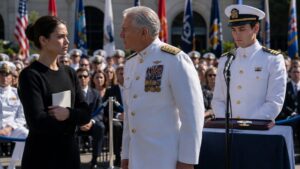
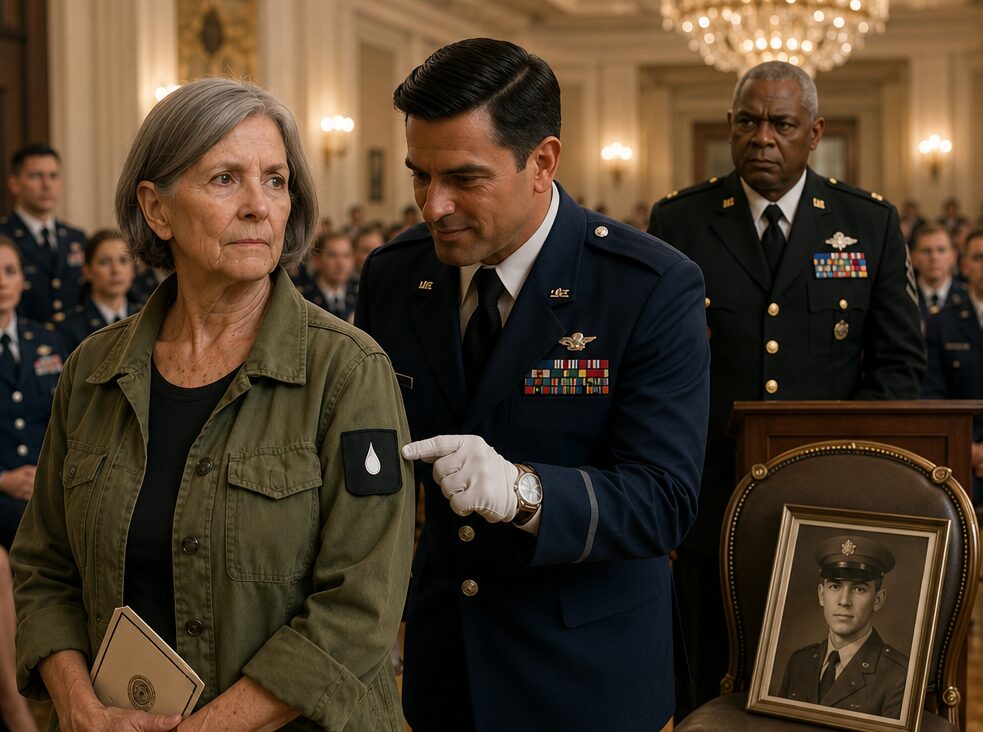
Everyone else in the ballroom looked polished enough to reflect the chandeliers: dark dress uniforms, ribbons in perfect rows, shoes black as piano keys, white gloves folded or clasped with practiced care. She stood near the family seats in an old olive field jacket, gray hair pinned low, one hand resting over a folded program.
On her left sleeve was a black patch.
A single white drop had been stitched inside a rough circle.
Jason saw it, frowned, and stepped toward her before the ceremony coordinator could stop him.
“Ma’am,” he said, lowering his voice in the way officers did when they wanted correction to sound like kindness. “Unauthorized insignia are not appropriate at a colonel’s retirement ceremony.”
The woman did not move.
Jason smiled, not warmly. He lifted one white-gloved hand and tapped the air just beside the patch, close enough that she could feel the intention without being touched.
“This,” he said, “may cause some confusion.”
Her eyes stayed forward.
Not frightened. Not offended in any visible way.
Just still.
That made him more certain she had not understood.
“Do you know this is a formal ceremony?” he asked.
A few heads turned.
The woman looked at his glove, then at his face. She was seventy-two, perhaps older in the hard light under the chandeliers. Her face had the kind of quiet that did not ask permission to remain quiet.
“I was invited,” she said.
Jason blinked.
“Family, press, or catering?”
The question came out before he could polish it.
Now more people turned.
The woman’s fingers tightened once on the program. Once, and no more.
“Invited,” she repeated.
Jason’s jaw set. He was thirty-one, but in his dress uniform he looked older from a distance and younger up close. The white gloves helped. The medals helped. The clean lines helped most of all. He had built himself out of regulation because regulation was the one thing that never laughed at where he came from.
“May I have your name, ma’am?”
Before she answered, the coordinator hissed from the aisle, “Captain Miller. Formation.”
Jason held the woman’s gaze for half a second longer than courtesy allowed, then stepped back.
He did not apologize.
The woman lowered herself into the front row beside an empty reserved chair. On that chair sat a framed photograph of Colonel James Whitaker.
In the photograph, James was young enough to still believe sleep could wait. He stood beside a aircraft hangar in flight gear, one hand on a helmet, his eyes serious in that old way of men who had learned to smile only when no one expected it.
The woman set the folded program on her lap.
Her name was Kathleen Whitaker.
And for forty-three years, no one in a room like this had asked her the right question.
They had asked whether she was comfortable.
Whether she needed help with her coat.
Whether she was proud of James.
Whether it must be hard, after all this time, to come back here.
No one had ever looked at the patch and asked why a woman would keep wearing a promise that had outlived nearly everyone who understood it.
Jason returned to his place near the aisle. He told himself the interaction was finished.
But when he looked back, the patch was still there.
And the old woman had not covered it.
Part II — The Empty Seat
The ceremony began with a bell.
Not a church bell, though the room went silent as if it were. A small ceremonial chime near the podium, struck once by a young airman whose gloves were whiter than Jason’s.
General Paul Harris stepped to the microphone.
He was tall, silver at the temples, steady enough that even his pauses sounded intentional. When he looked across the ballroom, the officers straightened without being ordered. That was the difference between rank worn well and rank worn loudly.
“Today,” Paul began, “we gather to place Colonel James Whitaker’s name where many of us believe it should have been placed years ago.”
Kathleen looked at the photograph in the empty chair.
James had hated ceremonies.
Not honor. Never honor.
He had hated the way ceremony could make hard things smooth.
Paul continued, “Colonel Whitaker’s record speaks of discipline, courage, and a refusal to leave difficult work unfinished.”
Kathleen’s thumb pressed into the program.
Difficult work.
That was one way to say it.
In the printed booklet, James’s service had been arranged into clean paragraphs. Dates. Commands. Citations. One line mentioned a classified evacuation near a closed border corridor, phrased so carefully it said almost nothing at all.
The official version had always known how to stand upright.
The truth had crawled.
Jason moved along the side aisle, escorting late dignitaries into their seats. He passed behind Kathleen and slowed just enough to speak to another officer.
“Someone should have handled the costume issue before doors opened,” he murmured.
He did not say it loudly.
He also did not say it quietly enough.
Kathleen heard him.
Her face did not change.
That bothered Jason more than if she had snapped at him. Anger was easy. Anger gave him rank, procedure, response. But her silence made him feel as if he had saluted the wrong flag and only she knew.
The other officer whispered, “That’s the widow, isn’t it?”
Jason glanced at the program in Kathleen’s lap.
Then at the empty chair.
Then at the framed photograph.
A small heat rose under his collar. He kept his posture perfect.
Widow, then.
Still not exempt from protocol.
That was the sentence he chose because it was safer than shame.
At the podium, Paul spoke of James’s squadron, his command, his “decisive role in the extraction of stranded personnel during the last hours of Corridor Nine.”
Kathleen’s gaze dropped to the black patch.
Corridor Nine.
They had given it a number because numbers had no mothers.
Paul said, “The men who came home because someone held that corridor open—”
Kathleen’s hand closed around the program so quickly the paper bent.
Jason saw it.
So did Paul.
For the first time, the general’s eyes moved from the photograph to the woman in the old jacket.
He paused for less than a second.
Not enough for the room to notice.
Enough for Kathleen to know he had noticed something.
Paul returned to his prepared remarks. “—carried Colonel Whitaker’s name with them long after the reports were sealed.”
Reports.
Sealed.
Kathleen almost smiled.
Not with amusement. With the thin exhaustion of hearing the wrong words used politely.
A ceremony aide approached Jason and whispered, “Photography after remarks. The front row needs to be clean. Command wants no confusion in archival images.”
Jason’s eyes went to the patch.
The aide followed his look. “Can you ask her?”
“Now?”
“Before the plaque presentation.”
Jason adjusted his gloves.
He wished someone else had been assigned to it. Then he disliked himself for wishing that. He was not afraid of old women. He was not afraid of widows. He was afraid of being seen mishandling a moment everyone else understood.
He approached Kathleen again, slower this time.
“Mrs. Whitaker.”
She looked up.
So he had found the name.
That did not make his voice kinder.
“First, my apologies for the earlier confusion,” he said. “I wasn’t aware who you were.”
Kathleen waited.
That was all. She waited as if the rest of the sentence had already stepped into the room and was only pretending it had not.
Jason cleared his throat.
“For the official photograph, command is requesting that all visible items be standard to the event. If you’d be willing to remove the jacket, we can have it held for you safely.”
“No.”
The answer was so calm several people nearby missed it.
Jason leaned a little closer. “Ma’am, this is just for the photograph.”
“No.”
His smile tightened.
“Mrs. Whitaker, this is not optional.”
Kathleen turned her head fully then.
For the first time, Jason saw how dark her eyes were, and how awake.
“It was never optional,” she said.
The words entered him with no explanation attached.
He had no regulation for them.
At the podium, Paul had stopped reading.
This time the whole room felt it.
A shift so small it might have been mistaken for a draft.
The general was looking at Kathleen’s sleeve.
Not at the jacket.
Not at the impropriety.
At the patch.
The black circle. The white drop.
His mouth opened once, then closed.
Kathleen saw recognition strike him.
For one sharp second, she wished he had looked away.
Part III — The Question No One Asked
General Paul Harris stepped away from the podium.
The ballroom did not understand at first. Programs rustled. A photographer lowered his camera. The aide beside the plaque table froze with both hands on the bronze frame.
Paul descended the small stage and walked toward the front row.
Jason straightened so fast his heel clicked against the floor.
“General?” he said.
Paul did not look at him.
Kathleen’s fingers loosened around the program.
It had been forty-three years since anyone had looked at the patch with fear instead of confusion.
Paul stopped three feet from her.
His voice was not loud, but the microphone near the podium was still live enough to catch the edge of it.
“Where did you get that mark?”
The room went quiet in layers.
First the front row.
Then the officers standing near the walls.
Then the people in the back who did not know why they were quiet but understood that rank had changed the weather.
Jason’s first thought was that he had been right.
Unauthorized.
Something improper.
Something that had finally been noticed by someone with the authority to say so.
Kathleen did not answer.
Paul’s expression changed. The sternness did not leave; something older came underneath it.
“Ma’am,” he said, softer now. “Please.”
Kathleen looked down at the patch.
The white drop had been sewn by a nineteen-year-old with shaking hands and no talent for circles. The edges had never been even. She had repaired the stitching twice, always from the back, never over the front. She would not improve what had been given to her imperfectly.
She heard a boy’s voice, dry from smoke.
Don’t let them call me missing.
Not now. Not here.
Paul said, “I have only seen that once before.”
Kathleen lifted her eyes.
“That’s not true,” she said.
Paul’s face stilled.
“You saw it on six sleeves before anyone wrote the report.”
The room held its breath, though most of them did not know why.
Jason looked between them.
He had the awful sensation of standing inside a conversation that had begun decades before he was born.
Paul’s voice lowered. “Who are you?”
Kathleen’s answer came after a silence long enough to make every uniform in the room feel too bright.
“From the last man I could not carry.”
No one moved.
Jason felt his earlier words return to him.
Family, press, or catering?
He wished suddenly and uselessly that language could be recalled before it reached another person.
Paul turned toward the ceremony coordinator.
“Hold the program.”
The coordinator nodded though no one had explained what was happening.
Paul looked back at Kathleen. “Would you step outside with me?”
Kathleen’s hand moved to the framed photograph beside her.
For a moment, she touched the edge, not the face.
Then she rose.
No one helped her.
Not because no one wanted to, but because something in her posture warned them that assistance offered too soon could become another kind of insult.
Jason stepped aside.
Kathleen passed him without looking at him.
The patch passed at the level of his chest.
For the first time, he did not look at it as a problem to be corrected.
He looked at it as a door he had tried to shut.
Paul led Kathleen into the side corridor, where the ballroom’s music thinned into muffled brass and air-conditioning hum. Jason followed only because Paul glanced back and said, “Captain Miller. Stay close.”
Jason obeyed.
He wished he had not been invited into whatever came next.
The corridor smelled faintly of waxed floors and old photographs. Along the wall hung framed portraits of commanders, each face preserved at the height of certainty.
Paul stopped beneath one of them and turned to Kathleen.
“I heard rumors,” he said. “When I was a junior officer. Corridor Nine. An unnamed nurse stayed behind after the medical unit withdrew.”
Kathleen’s expression hardened.
“The unit did not withdraw.”
Paul did not interrupt.
“The record says that because the record needed clean hands,” she said. “The order changed after the window closed. The ward was still full. The medical team was told the corridor was secure until it wasn’t. Then they were told the wounded had already been moved.”
Jason stood very still.
Kathleen looked at him for the briefest moment, as if deciding whether he deserved the burden of hearing it.
Then she looked back to Paul.
“They had not been moved.”
Paul’s eyes lowered.
“James went back?”
“James refused the closing order,” Kathleen said. “He knew what it meant. I knew what it meant. We went anyway.”
Jason tried not to imagine it and failed.
Not the kind of imagining that belonged in training videos or documentaries. Something worse. A hallway with smoke low enough to breathe above. Men on stretchers. Someone counting morphine ampules with a hand that would not stop trembling. The knowledge that a door could close and make a person official before they were gone.
Paul’s voice was careful. “The white drop.”
Kathleen touched the patch.
“It meant no one bleeding would be left unnamed.”
Jason swallowed.
The word bleeding seemed too raw for the corridor, too human for the glass frames and polished plaques.
Kathleen continued, “It was not a unit. Not officially. Six of them tore cloth from supply sacks and marked their sleeves so we would know who had already gone back through smoke. One drop meant one life you were responsible for naming if the body could not speak.”
Paul closed his eyes briefly.
Jason had never seen a general look ashamed.
“What happened to the record?” Paul asked.
Kathleen’s mouth tightened.
“What always happens when panic outranks truth. It was corrected into something easier to honor.”
From the ballroom came a faint cough, then silence again.
Everyone was waiting.
That waiting pressed into the corridor.
Paul said, “Mrs. Whitaker, if I name this publicly, it may reopen—”
“Do not make this about what it may reopen,” Kathleen said.
The words were quiet.
They still landed like a command.
Paul accepted them.
Jason surprised himself by speaking.
“Mrs. Whitaker,” he said, “you don’t have to be forced into an uncomfortable disclosure. We can simply continue the ceremony and handle the correction privately.”
He meant it as help.
Even as he said it, he heard the shape of himself in it.
Handle.
Privately.
Correction.
Kathleen turned to him.
This time she looked at him fully, without anger and without mercy.
“You were willing to correct me in public,” she said. “Let the truth be corrected in public too.”
Jason’s face went hot.
Paul looked at Kathleen, then toward the ballroom doors.
“Only what you choose,” he said.
Kathleen folded the program once along its bent crease.
For forty-three years, she had believed silence was the only honest grave she could give the ones who had not come home cleanly.
But silence had not protected them.
It had only made room for other people to decide what their lives were allowed to mean.
She looked toward the closed doors.
“Then ask me to stand,” she said. “Do not order me.”
Paul nodded.
“I understand.”
Kathleen almost told him he did not.
Instead, she walked back toward the room.
Part IV — The Room Makes Space
When the ballroom doors opened, every head turned.
Kathleen entered first.
That mattered.
Paul followed a step behind her. Jason came last, carrying his shame so carefully it might have been breakable.
No one clapped. No one whispered. The room had entered that strange ceremonial state where people were waiting to be told what kind of silence they were in.
Paul returned to the podium.
He did not pick up the prepared remarks.
He looked at Kathleen in the front row, where she had taken her seat beside James’s photograph.
“Mrs. Whitaker,” he said, his voice carrying cleanly now, “would you be willing to stand?”
Kathleen did not move.
Not at first.
Jason, beside the aisle, thought she might refuse. He would not blame her. The room had taken so much from her already and was now asking, with better manners, for more.
Kathleen looked at the framed photograph.
James had once told her the worst thing about surviving was that people expected gratitude to be simple.
She had been younger then. Angry enough to think grief could stay sharp forever.
It had not stayed sharp.
It had become weight.
She set the program on the empty chair beside the photograph.
Then she stood.
It was not graceful. Her knees took a moment. Her hand brushed the chair back, not for drama, just balance. But once she was upright, she did not look fragile.
She looked like someone who had been standing for years where no one could see.
The room saw her old jacket.
The gray hair.
The black patch.
The white drop.
Paul began.
“Earlier today, Captain Miller questioned the insignia on Mrs. Whitaker’s sleeve.”
Jason’s throat tightened.
Paul glanced at him once, not cruelly.
“The captain acted from protocol. But protocol is not memory. And today, memory has interrupted us.”
No one moved.
Paul turned slightly toward Kathleen.
“The mark on her sleeve is not unauthorized decoration. It belonged to a corridor team formed during the final hours of a classified evacuation many of us have only known through sealed summaries and approved language.”
A woman in the second row pressed a hand to her mouth.
Paul continued, “That team moved wounded personnel after the extraction window had been declared closed. The reports credited command structure. They credited aircraft scheduling. They credited Colonel James Whitaker’s planning.”
His voice tightened.
“They did not credit the people who went back after the plan ended.”
Kathleen closed her eyes.
For a moment, the ballroom was gone.
She was twenty-nine again, and her hands were slick inside gloves that had split at the thumb. James was shouting her name over the metal groan of a door being forced open. A boy on the floor kept apologizing because he could not stand. Someone had written numbers on tape and stuck them to coats, to stretchers, to sleeves, as if numbers could hold a person together until names returned.
A hand had caught her wrist.
Not James’s.
A boy’s.
His face had been too young for the dirt on it.
Patrick.
Private Patrick Carter.
Nineteen.
From Ohio, he had said, though maybe it was Idaho. She had never trusted that memory. Smoke had made liars of sound.
He had torn the patch from his own sleeve because he knew he was becoming too heavy to move.
Tell my mother I wasn’t afraid.
He had been afraid.
Kathleen had loved him for lying.
At the podium, Paul said, “Mrs. Whitaker served as a nurse attached to that evacuation. She refused transport until every living man in her ward had been accounted for.”
A low sound moved through the room.
Not applause.
Recognition before people knew what to do with it.
Paul continued, “It is my duty to say today that her name should have been in the record beside Colonel Whitaker’s from the beginning.”
Kathleen opened her eyes.
“No.”
One word.
But it stopped him.
Paul turned.
Kathleen’s voice was not strong in volume. It did not need to be.
“Do not make me cleaner than I was.”
Paul stepped back from the microphone.
Kathleen looked at the room.
So many uniforms. So many young faces trained into stillness. So many older faces suddenly afraid of what their own medals might have failed to notice.
“I did not save everyone,” she said.
No one breathed loudly.
“The last man who wore this mark was Private Patrick Carter. He was nineteen. He had a torn sleeve and a bad joke for every pain he couldn’t hide. He gave me this patch when he understood I could not carry him through the corridor.”
Jason’s eyes lowered.
Kathleen continued, “He asked me to tell his mother he had not been afraid.”
Her fingers touched the white drop.
“I never found her.”
The room changed.
Not dramatically.
Not loudly.
But something polished cracked.
Kathleen looked at James’s photograph.
“James and I told ourselves the sealed report protected families. Protected command. Protected the men who did come home. Maybe part of that was true. But truth does not disappear because it is inconvenient. It waits in someone’s body.”
She looked back at Paul.
“I wore this today because James’s name is entering the hall. I would not let it enter alone.”
The sentence did what applause could not have done.
It made the silence kneel.
Jason stood with his gloved hands at his sides, unable to hide behind posture now. He remembered tapping near the patch. He remembered the small, controlled sentence: I was invited.
He understood, with a shame that did not ask for comfort, that Kathleen had not needed permission to enter the room.
The room had needed permission to understand her.
Paul faced her fully.
“Mrs. Whitaker,” he said, “what would you have us correct?”
Kathleen’s answer came after a long breath.
“Start with his name.”
Paul nodded.
“Private Patrick Carter.”
“And the team,” Kathleen said. “Not as a decoration. Not as a myth. As people.”
Paul looked toward the plaque table.
The bronze plaque for James rested there, covered in dark cloth. Beside it sat a small stack of blank place cards for seating.
Paul removed one.
He took a pen from inside his jacket.
For a moment, all the careful machinery of the ceremony waited while a general wrote by hand.
Kathleen Whitaker
Corridor Nurse
White Drop Team
He placed the card beside James’s covered plaque.
Temporary.
Imperfect.
Visible.
Kathleen stared at it for a long time.
Her name looked strange outside her own handwriting.
Then three officers in the front row stood.
Not quickly.
Not like a performance.
One by one, others followed. Some remained seated because they did not know whether standing would honor her or turn her into a display. Kathleen did not judge either choice.
Jason did not stand.
He was already standing.
But he removed his right glove.
Slowly.
Not because anyone had told him.
Because his hand had no right to remain ceremonial now.
Part V — Learn Before You Point
The ceremony finished differently than it had been planned.
No one returned to the prepared order.
Paul spoke briefly of James, but not as a statue. He spoke of him as a man who had made a choice that broke a rule and saved lives. He spoke of records as things made by people, and therefore things people were responsible for correcting.
He did not say everything.
Kathleen had not given him everything.
That was her right.
When the plaque was unveiled, James’s bronze name caught the chandelier light.
Kathleen did not cry.
She stepped forward only when Paul asked, “Would you like to?”
She placed two fingers on James’s name.
Then two fingers on the handwritten card beside it.
For one small moment, the living and the dead were held under the same hand.
Jason watched from the aisle.
He wanted to apologize then, immediately, loudly enough to prove he knew what he had done.
But some apologies are just another demand if offered too soon.
So he waited.
After the formal guests began to disperse, after the photographer lowered his camera without asking Kathleen to remove anything, after Paul quietly told an aide to begin a record review that would not be simple or clean, Kathleen returned to the front row for her program.
The paper was still bent where her hand had crushed it.
Jason approached without his glove.
He stopped at a respectful distance.
“Mrs. Whitaker.”
She looked at his bare hand first.
Then his face.
His voice had lost its polished edge.
“I owe you an apology.”
Kathleen said nothing.
Jason swallowed.
“I treated you like you were out of place because I thought the room belonged to people who looked like they belonged in it.”
Kathleen’s expression did not soften, but it sharpened less.
“I was wrong,” he said.
“Yes,” she replied.
The word struck cleanly.
He accepted it.
“I’m sorry.”
She studied him for a moment.
Not to punish him.
To decide whether his shame had become useful yet.
“Learn before you point,” she said.
Jason nodded once.
“I will.”
Kathleen picked up the program and tucked it under her arm.
Paul approached them then, carrying the handwritten card carefully between two fingers, though it had already been replaced beside the plaque by a temporary printed label an aide had made in a hurry.
“I’ll make sure this is entered properly,” he told Kathleen. “It may take time.”
Kathleen looked at him.
“Time is what records always ask from the people they forgot.”
Paul did not defend himself.
“No excuse,” he said.
That was better than any promise.
Kathleen looked once more at James’s photograph. For forty-three years she had feared that telling the truth would make his honor smaller. Standing in that room, she understood what James had probably known before she did.
Truth did not shrink the worthy.
It only made room around them.
She touched the patch again.
Patrick Carter’s uneven white drop held.
Still crooked.
Still stubborn.
Still there.
Outside the ballroom, the hallway was cooler. Voices murmured behind her, already reshaping the afternoon into versions people could carry home. Some would say they had witnessed history. Some would say it was overdue. Some would reduce it to a lesson about assumptions, because lessons were easier than names.
Kathleen walked slowly toward the exit.
Jason reached the door before her and held it open.
He did not salute.
Not at first.
Kathleen stepped into the late afternoon light. The base lawn stretched beyond the walkway, neat and green and indifferent. The sky was pale, the kind of pale that made distance look gentle.
She turned back.
Jason stood in the doorway, one glove tucked under his arm, one bare hand raised now in salute.
This time, there was no smile.
No correction.
No performance.
Kathleen did not return it like an officer.
She had never needed to.
She gave him one small nod.
Then she looked past him, through the open doorway, to the room where her name sat beside James’s, temporary but visible.
It was not enough.
It was more than there had been that morning.
Kathleen walked on with the old jacket still on her shoulders, carrying the patch into the light as if she had finally delivered part of the message.
Not all of it.
But part.