What the Old Man Carried Back to the Gate That Morning
Part I — The Sign at the Wall
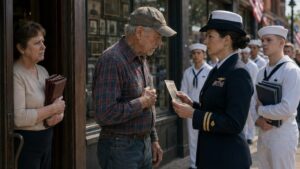
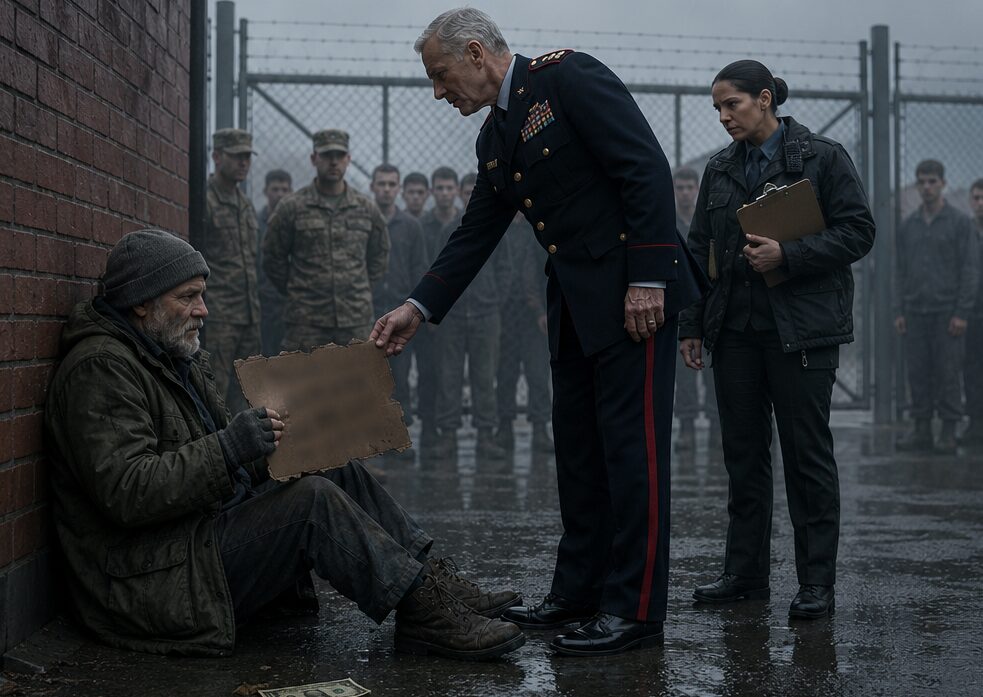
The old man was sitting against the brick wall outside Fort Mason’s east gate when the first young men in uniform began laughing at him.
He did not look up.
Fog hung low over the road. It softened the black staff cars, the steel fencing, the polished gate sign, the white breath of the sentries. It turned the morning into something unfinished. The old man sat in the unfinished part, knees drawn up, shoulders tucked inside a faded green coat that had lost its shape years ago.
In his fingerless gloves, he held a torn piece of cardboard.
Four words had been written across it in thick black marker.
I kept the map.
One recruit slowed as he passed.
He was young enough to still enjoy the shine on his boots. Young enough to think old age was a kind of failure that happened to other people. He glanced at the sign, smirked, and dropped a dollar near the old man’s shoe.
“Wrong gate, old man.”
The coin bounced once. The bill folded against the curb in the damp.
The old man’s hand tightened around the cardboard.
He did not take the money.
Another recruit laughed under his breath. A third looked away quickly, embarrassed but not enough to stop. They moved through the gate in a cluster, shoulders squared, voices low, already forgetting him.
The old man remembered all three faces.
Not because they mattered.
Because remembering had become the only thing he still did perfectly.
A black staff car rolled up to the curb.
The gate guards straightened.
The rear door opened, and General Richard Hayes stepped out in full dress uniform, silver at his temples, medals pinned with perfect care, his face shaped by years of command. He was tall in the way certain men become tall before they even stand fully upright. People made space for him without being asked.
He saw the old man.
Then he saw the sign.
His jaw changed first.
“Who cleared this?” he snapped.
A guard opened his mouth. “Sir, we were just—”
“Beside a secured gate?” Richard said. “On ceremony day?”
The old man lifted his eyes.
They were pale, steady, and tired in a way that did not ask for pity.
Richard strode toward him. The damp morning made the ribbons on his chest look too bright. Behind him, Captain Emma Bennett came quickly with a clipboard tucked beneath one arm and a radio clipped high on her vest.
Richard stopped close enough that his polished shoes nearly touched the old man’s boots.
He bent down and pointed at the cardboard.
“You think this is funny?”
The old man looked from the finger to the medals, then back to the finger.
“No, sir.”
His voice was rough, but not weak.
Richard’s face hardened at the “sir.” It sounded less like respect than memory.
“Then explain why you’re sitting outside my gate with that.”
The old man did not answer right away. He glanced at the dollar near his boot, then at the recruits who had stopped just inside the fence to watch.
Only then did he speak.
“I didn’t come for money.”
Richard’s eyes went to the torn coat, the gloves, the gray beard, the boots with split seams. His expression said he had already decided what kind of man sat on cold pavement with cardboard.
“Captain,” he said without looking away, “remove him.”
Emma stepped forward, careful and professional. “Sir.”
She crouched slightly, not as low as Richard had, but enough to bring her voice closer to the old man’s height.
“What’s your name?”
The old man’s fingers pressed into the cardboard until it bowed.
“Frank Miller.”
Emma wrote it down.
Richard’s irritation sharpened. “Captain, I said remove him.”
Emma kept her voice even. “Mr. Miller, do you have identification?”
Frank looked at Richard.
Then he said the words that changed the air.
“Third Platoon. Operation Night Compass.”
Nobody laughed after that.
The gate seemed to hold its breath.
Emma’s pen paused over the clipboard.
Richard did not move for half a second, but the color went out of something behind his eyes. It was quick. Too quick for most people. Frank saw it anyway.
Richard straightened slowly.
“Where did you hear that?”
Frank tapped the cardboard with one gloved finger.
“Turn it over.”
Richard stared at him.
“Turn it over,” Frank repeated. “Then decide if I’m funny.”
The guards looked at Richard. The recruits inside the gate had gone still.
Richard reached down, snatched the cardboard from Frank’s hands, and flipped it.
On the back, drawn in fading marker, was a grid of lines, numbers, and crooked arrows. Not art. Not nonsense.
A route.
Emma stepped closer.
Richard held the cardboard as if it had become something dirty and dangerous.
Frank looked up at him from the pavement.
“I kept the map,” he said. “Just like I was told.”
Part II — The Name Nobody Wanted Said
Emma lifted the radio from her vest.
“Records, this is Captain Bennett at east gate,” she said. Her voice stayed calm, but her eyes had changed. “I need an archive check. Name: Frank Miller. Possible former service. Related term: Operation Night Compass.”
Richard turned sharply. “Use an internal line.”
“Yes, sir.” Emma lowered the radio slightly, but she did not cancel the request.
Frank watched that too.
The smallest refusals mattered. A delayed order. A question asked before permission died. A young officer deciding procedure was not the same as obedience.
Richard leaned down again, but this time he did not point at the sign.
“Who sent you?”
“No one.”
“Who gave you that phrase?”
Frank’s mouth twitched. Not quite a smile.
“You already know who.”
Richard’s face went still.
Inside the fence, the young recruits looked at one another. One of them, the one who had dropped the dollar, stared at the ground.
Emma said quietly, “Sir, should we move this inside?”
Richard did not answer her.
Frank shifted, bracing one palm against the cold pavement. His knees did not want to cooperate. He had walked three miles before sunrise because the bus stop near the base had been moved six blocks the year before, and the shelter had turned on the lights at four-thirty. The cold had gone into his bones and stayed there.
But he had made it to the gate.
That had been the first promise of the day.
“Is John Hayes buried here?” Frank asked.
The name struck Richard harder than the operation had.
This time everyone saw it.
His shoulders pulled back. His jaw locked. His eyes moved once, toward the old east side of the base where low buildings stood half-veiled in fog.
Emma’s hand tightened around the clipboard.
Richard’s voice dropped.
“You don’t get to say his name.”
Frank nodded once, as if he had expected that.
“Your brother gave me the map.”
Richard’s expression became colder than the pavement.
“My brother died because men like you ran.”
Frank absorbed the words without flinching.
There were insults that landed on the skin. There were others that found old rooms and opened them.
This one had lived inside him for thirty-eight years.
He looked at the young recruit standing behind the fence, the one who had dropped the dollar. The boy looked smaller now.
Frank turned back to Richard.
“Your brother gave me the map because he knew officers would be searched first.”
Richard stared at him.
Frank added, “He was right.”
Emma’s radio crackled.
“Captain Bennett, preliminary archive match. Miller, Frank. Former enlisted. Attached to Third Platoon, Night Compass file. Discharge status flagged. Classified inquiry reference attached.”
Richard held out his hand.
Emma hesitated, then handed him the radio.
“Send it to outer security,” Richard said. “Now.”
The voice on the radio paused. “Sir, that file is restricted.”
“I know what it is.”
Frank pushed one hand against the wall and tried to stand.
His knees shook.
Emma reached toward him.
He pulled away.
“I can walk.”
Richard watched him with a hard expression, but something like uncertainty had begun to work underneath it.
“You’ll come inside,” Richard said.
Frank looked at the base gate, then at the line of soldiers beyond it. He had not been inside Fort Mason in twenty-seven years. The last time, a corporal at the visitor desk had told him there was no public archive access, no one by that operation name available, and no reason for a discharged man to keep returning.
The first time had been worse.
The first time he had still owned a suit.
Frank bent slowly and picked up the dollar from the curb.
The recruit’s face reddened.
Frank held the bill out to him.
The boy stepped forward and took it without a word.
“Keep your money,” Frank said. “You might need it someday.”
No one laughed.
Then Frank tucked the cardboard under one arm and walked through the gate.
He did not walk well. His left foot dragged when the pavement sloped. His breath came short. Twice, Emma moved as if to help him, and twice he refused without looking at her.
Richard walked ahead.
Not fast.
Not slow.
Just far enough in front that no one could mistake who still controlled the morning.
Part III — What the Record Needed
The outer security building smelled of coffee, wet wool, and floor polish.
Frank hated it immediately.
Not because it was unpleasant. Because it was familiar.
There were rooms that could take a man’s name from him without ever raising a voice. Rooms with flags in the corners and clocks that made every silence feel official. Rooms where people said “for the record” before deciding what could never be recorded.
Emma set him in a chair near the conference table.
Frank remained standing.
Richard noticed. “Sit down.”
“No.”
“You can barely walk.”
“I walked here.”
“That wasn’t a request.”
Frank met his eyes.
It was the first time he had fully done so.
Richard looked away first, but only to open the file Emma had just printed from the archive terminal.
The file was thin.
Too thin.
Emma saw it too.
For an operation that had ended with multiple casualties and a sealed inquiry, the paper trail looked like someone had trimmed it with a knife.
Richard read silently.
Then aloud.
“Frank Miller. Enlisted route specialist. Third Platoon. Discharged after closed inquiry for refusal to provide complete testimony, abandonment of radio equipment, destruction of field navigation materials, contradictory statements.”
He looked up.
“The Army already heard your story.”
Frank’s hands rested on the back of the chair. His fingers were bent at the knuckles from cold and age and years of holding things too tightly.
“No,” he said. “The Army heard what it needed.”
Richard shut the folder.
Emma looked between them.
Frank could feel her wanting to ask the next question. He could feel Richard wanting to forbid it.
She asked anyway.
“What did it need?”
Frank’s gaze moved to the window. Through the fogged glass, the old east barracks stood beyond a strip of grass and a line of cones. A demolition crew had parked beside it. Yellow tape flapped in the wind.
He had dreamed of that building for almost four decades.
Not every night.
Only the nights that mattered.
“It needed the route to be wrong,” Frank said.
Richard’s mouth tightened. “The route was wrong.”
Frank nodded. “The official one.”
Richard stepped closer to the table. “Careful.”
Frank turned his eyes back to him. “I have been careful since I was twenty-eight years old.”
The room went quiet.
Emma’s radio hissed again.
“Captain Bennett, supplemental archive packet found. Sealed casualty addendum. Authorization required.”
Richard reached for the handset.
Emma did not give it to him.
It was a small thing.
But everyone in the room felt it.
“Sir,” she said, “with respect, the demolition ceremony starts in ninety minutes. If this relates to the east barracks—”
“It does not relate to anything until I say it does.”
Frank laughed once.
Not loudly.
Not kindly.
Richard turned on him. “Something funny now?”
Frank shook his head. “No. Just familiar.”
Richard’s face hardened again, but the file in his hand had begun to tremble.
Emma requested the addendum.
The minutes that followed felt longer than they were.
The printer woke in the corner and spat out four pages.
Emma took them first.
Her eyes moved down the first page.
Then stopped.
“General.”
Richard held out his hand.
She gave him the pages.
Frank watched Richard read the addendum. He watched the anger rise first. Then confusion. Then something worse than both.
Recognition.
There was a partial field sketch attached to the addendum. The lines were cleaner than the ones on Frank’s cardboard, but the structure was the same: corridor, drainage cut, north ridge, civilian quarter, extraction alternate.
Beside it was a note in handwriting Frank had not seen in decades.
Richard read it once.
Then again.
His voice was almost gone when he spoke.
“‘If Miller comes back, believe him.’”
Frank closed his eyes.
For one second, he was not in the security building.
He was twenty-eight, crouched under a collapsed staircase, mud up to his elbows, John Hayes pressing a map pouch into his hands with blood on his sleeve and smoke turning the sky brown.
If you make it back, they’ll ask for a clean version.
Don’t give them one.
Frank opened his eyes.
Richard was staring at him as if Frank had stolen something from the grave and brought it to the table.
“Why now?” Richard demanded. “Why wait all this time?”
Frank looked toward the old barracks again.
“I came before.”
“When?”
“After the inquiry. They told me the file was closed.”
Richard said nothing.
“After my wife died,” Frank continued. “I still had my discharge papers then. A coat with buttons. A motel address. They told me there was no one left authorized to receive classified materials from a disgraced former enlisted man.”
Emma’s eyes lowered.
Frank’s voice stayed level.
“This morning, I heard they were taking down the east barracks.”
Richard followed his gaze.
The demolition crew outside moved like shadows through the fog.
Frank said, “The original pouch is under the third floorboard from the furnace room wall. Your brother told me to hide it if extraction failed.”
Richard stared at the barracks.
Frank watched him begin to understand the shape of the choice.
Not the fact of it.
The burden.
Emma spoke carefully. “Sir, I can delay demolition.”
“No,” Richard said.
Emma blinked.
Richard turned back toward Frank. “No search. Not yet.”
Frank looked at him for a long moment.
Then he said the sentence that found the weakest place in the general’s armor.
“You want him to have died clean.”
Richard stepped forward so fast Emma moved between them without thinking.
But Frank did not move.
He had been smaller than powerful men before.
He had been poorer. Hungrier. Easier to dismiss.
He had also outlived most of them.
Richard’s voice came low. “You know nothing about what I want.”
Frank nodded toward the addendum.
“I know what you’re afraid to read.”
Part IV — Beneath the Floorboard
Emma halted the demolition with one radio call.
She did it while Richard stood at the window and said nothing.
“Hold all activity at east barracks,” she said. “Command review pending.”
The answer came back annoyed, then confused, then obedient.
Outside, machinery stilled.
The fog did not.
Richard finally turned.
“You are not entering that building,” he said to Frank.
Frank’s mouth flattened. “I know where the floorboard is.”
“You can tell them.”
“I can show them.”
“You can barely stand.”
“I stood longer than this when people were shooting at us.”
The room went still.
Frank regretted the sentence as soon as he said it. Not because it was untrue. Because it sounded like a boast, and he had spent too long refusing to make pain into currency.
Richard looked away first.
Emma said, “We’ll go together. Facilities can clear the floor. Two engineers, one archive tech, myself. General, you should be present.”
Richard took in her words.
“You’re very confident this is still your assignment, Captain.”
Her face stayed composed, but her throat moved once.
“No, sir,” she said. “I’m very aware it may not be after today.”
Frank looked at her then.
Really looked.
She was young, but not as young as the recruits. Old enough to know what rules cost. Not old enough yet to know which ones she would regret keeping.
They crossed the grass toward the old barracks.
Frank held the cardboard in one hand like a pass.
Nobody offered him the wheelchair again.
The old building had already been stripped of plaques, fixtures, and anything the base considered worth preserving. Inside, the air was colder than outside. Dust lay along the walls. The floorboards complained beneath every step.
Frank moved slowly, but not uncertainly.
That was what Richard noticed.
The old man’s body faltered. His memory did not.
“Left,” Frank said at the first junction.
An engineer looked to Emma. Emma nodded.
“Past the second doorway.”
They followed.
“Furnace room.”
The room was small, empty except for rust stains on the concrete and a square of shadow where machinery had once stood.
Frank stopped at the far wall.
He did not kneel. He could not.
He pointed.
“Third board.”
The engineer pried up the first.
Nothing.
The second.
Dust.
The third came loose with a splintering groan.
For a second, there was only darkness beneath it.
Then the engineer reached in and pulled out a rotted canvas pouch bound with brittle cord.
Richard did not breathe.
Emma whispered, “Archive gloves.”
The tech stepped forward, hands shaking slightly as he opened the pouch.
Inside lay a folded map, stained at the edges, a metal field tag, and a list written on waterproof paper.
Richard reached for the tag.
Emma caught his wrist.
“Sir.”
He stopped.
She let go immediately.
The archive tech lifted the tag and read the stamped name.
“Hayes, John.”
Richard closed his eyes.
No one spoke for several seconds.
Frank leaned against the wall.
He was suddenly more tired than he had allowed himself to be. The pouch existed. The map had survived. The promise had a body now. It was no longer trapped behind his teeth.
Emma unfolded the list.
Names.
Not unit names. Not ranks. Not casualty labels.
Civilian names.
Thirty-one of them.
Some written in John’s hand. Some in Frank’s.
Richard stared at the paper.
Frank could see him trying to fit it into the story he already knew. Trying to make room without breaking anything.
But some truths did not enter a room politely.
They rearranged the furniture.
Richard said, “Explain.”
Frank looked at the list.
“Your brother disobeyed the withdrawal route.”
Richard’s eyes lifted.
“He redirected us through the drainage corridor because the village quarter was still full. Families. Interpreters. Two schoolteachers. A mechanic who had fixed our trucks for six months. People command had already counted as gone.”
Richard’s voice was tight. “That was not in the report.”
“No.”
“Why?”
Frank’s face changed.
Not dramatically.
Just enough.
“Because if it had been in the report, they would have had to admit the official route left them there.”
The words sat between them.
Emma looked down at the map again.
Frank continued. “John gave me the pouch when the corridor collapsed behind us. He told me officers would be searched first if we were taken. He told me to memorize the drainage route and destroy the field copy if I had to.”
Richard swallowed.
“And the inquiry?”
“They wanted to know why we missed extraction. They wanted someone to say your brother panicked. Or that the route specialist got confused. Or that communications failed before command could redirect us.”
“You refused.”
“I refused to make it clean.”
Richard looked at him then.
Frank saw the brother before he saw the general.
It lasted only a second, but it was enough to hurt.
Frank said, “I would not blame him. I would not expose the civilians. And I would not sign their lie.”
“What did that cost you?”
Frank almost answered.
Benefits. Marriage. Work. Rooms with locks. Doctors who asked for insurance cards. His wife, Pamela, crying over envelopes he would not open because every letter from an office looked like another hearing.
But the full list felt too much like begging.
So he only said, “Enough.”
Richard looked down at the paper in Emma’s hands.
The names waited.
Emma’s radio crackled.
“Captain Bennett, ceremony assembly is complete. Local officials are asking if the delay affects the program.”
Richard opened his eyes.
The old general returned slowly.
The one with medals.
The one with a speech waiting outside.
He said, “We handle this privately.”
Frank looked at him.
Richard continued quickly, as if speed could make mercy out of fear. “Medical care. Temporary housing. Full review of your file. I’ll personally ensure—”
“No.”
Richard stopped.
Frank pushed himself away from the wall. “No.”
“This is more than enough for one morning.”
“For you,” Frank said.
Emma looked down.
Richard’s voice hardened. “Do not mistake my restraint for permission to dictate command decisions.”
Frank stepped closer to him, each movement painful, each word clear.
“I don’t want your medal. I don’t want your room. I don’t want your apology folded into a file where nobody has to hear it.”
Richard’s face tightened.
Frank pointed to the list.
“I want their names read.”
Outside, beyond the fogged windows, a crowd waited for a ceremony built on the old version of events.
Richard looked toward the sound of it.
A microphone being tested.
Chairs scraping.
Flags shifting in the wind.
Emma said quietly, “Sir, the program begins in twelve minutes.”
Frank held Richard’s gaze.
“You can bury it again,” he said. “But this time you’ll know where you put it.”
Part V — The Names
The ceremony began late.
People noticed.
They always noticed disorder when order had been promised.
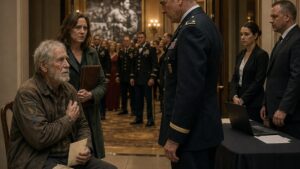
Families sat beneath a white canopy near the east barracks. Local officials stood in dark coats. Soldiers formed clean lines along the walkway. The recruits from the gate stood in the second row, their faces carefully blank.
Frank remained near the side, still in his worn coat, still holding the cardboard sign.
No one had cleaned him up.
He had refused that too.
Richard stood at the podium with the prepared speech in front of him.
The paper was heavy stock. Official crest. Perfect margins.
Frank could see the first line from where he stood.
Today we honor the established record of sacrifice and service…
Richard looked at it for a long time.
Then he looked at the old barracks.
Then at Frank.
Emma stood near the front with the map pouch held flat against her clipboard. Her radio was quiet now.
Richard began.
“Thank you for your patience.”
His voice carried easily. It was a voice built for rooms larger than this, for men who needed to be steadied, for ceremonies that required grief to behave.
“Today, we gathered to mark the closing of the east barracks and to honor those connected to Operation Night Compass.”
Frank’s fingers tightened around the cardboard.
Richard looked down at the prepared speech again.
He read two more lines.
Stopped.
The fog moved through the edge of the canopy.
Richard lifted the speech from the podium.
For one strange second, everyone watched a man decide what kind of history he could live with.
Then he folded the paper in half.
Once.
Twice.
The sound was small.
It reached Frank anyway.
Richard placed the folded speech beside the microphone.
“The official record,” he said, “is incomplete.”
A murmur moved through the chairs.
Richard did not raise his voice.
“That incompleteness is not clerical. It is not harmless. It has carried a cost.”
He turned.
“Frank Miller.”
The old name moved through the crowd like something unexpected entering a formal room.
Frank did not move at first.
Not because he was afraid.
Because he had imagined being called many things at Fort Mason. Liar. Disgraced. Disturbance. Trespasser. Unstable. Problem.
He had not imagined his name being called into a microphone.
Emma stepped toward him.
Frank shook his head.
He walked alone.
Every step hurt.
The crowd watched the old man cross the space between the side of the ceremony and the podium. It was not far. It took long enough for discomfort to become respect.
Near the second row, the recruit who had dropped the dollar lowered his eyes.
Richard moved aside when Frank reached the podium.
Not behind him.
Aside.
That mattered.
Richard faced the crowd.
“Mr. Miller carried a route no archive preserved, a field pouch no one searched for, and a list of names this institution failed to honor. He did so for thirty-eight years after we failed to hear him.”
He paused.
“I will not improve that truth by making it sound cleaner than it is.”
Frank looked down at the list Emma placed before him.
Thirty-one names.
Paper did not weigh much.
This one did.
Richard leaned slightly toward him, but not close enough to take over.
“You asked me to read them,” he said.
Frank kept his eyes on the page.
“I know.”
“Do you still want that?”
Frank touched the first name with one crooked finger.
“No.”
Richard went still.
Frank lifted the list.
“I’ll do it.”
His voice was not made for crowds anymore. It cracked on the first three names. Strength returned on the fourth. By the seventh, the rows had gone silent in a way Frank recognized.
Not ceremony silence.
Witness silence.
He read the names slowly. He gave each one room.
Some were hard to pronounce after all those years. One he corrected under his breath before saying it aloud. Another made him close his eyes.
Then came the child’s name.
Frank stopped.
The paper trembled.
He remembered small hands around his neck in the drainage corridor. Remembered a cheek pressed against his collar. Remembered John shouting for everyone to keep moving while the approved route burned behind them. Remembered the child’s shoe slipping off in the water and being left behind because there had been no time even for grief.
Frank swallowed.
Said the name.
His voice broke once.
Only once.
Nobody moved.
Then, somewhere in the line of soldiers, boots shifted.
A young recruit straightened.
Then another.
Then the whole row stood at attention.
No command had been given.
That was why it mattered.
Frank finished the list.
When he lowered the paper, his hand was shaking badly.
Richard did not reach for it.
He let Frank hold it until Frank chose to place it on the podium himself.
For a moment, the old man and the general stood beside each other in front of the east barracks, and the difference between them was still visible: medals and torn coat, polished shoes and split boots, public authority and a life spent outside locked doors.
But the distance had changed.
It no longer belonged entirely to Richard.
Frank picked up his cardboard sign from where he had leaned it against the podium.
The front still said: I kept the map.
He turned it over, looked at the grid, and then held it against his chest.
Richard said into the microphone, “The record will be corrected with Mr. Miller’s testimony attached in full.”
Frank looked at him.
Richard did not look away.
“And the civilian names,” Frank said, quietly but close enough for the microphone to catch.
Richard nodded.
“And the civilian names.”
Part VI — What Remained at the Gate
After the ceremony, people wanted to approach Frank.
He let three of them.
An older woman who had lost her husband in the official account took his hand with both of hers and said nothing, which he preferred.
A local official tried to thank him in a way that sounded like a speech beginning. Frank looked so tired that the man stopped after one sentence.
The young recruit from the gate came last.
He stood in front of Frank, pale with shame.
“I’m sorry,” he said.
Frank looked at him for a while.
Then he said, “Remember longer next time.”
The boy nodded as if he had been given an order.
Frank walked back to the brick wall near the east gate when the crowd began to thin. He did not know why he wanted to sit there again until he lowered himself carefully to the curb and felt the wall behind him.
Same brick.
Same cold.
Different morning.
Emma came first.
She carried the map pouch in both hands.
“The archive will take a preservation copy,” she said. “But General Hayes said the original remains with you until your statement is recorded. In your words.”
Frank accepted the pouch.
For a moment, he looked younger only because his face had lost the effort of holding one thing alone.
“Your career going to survive today?” he asked.
Emma almost smiled.
“I don’t know.”
“Good answer.”
She crouched beside him, the way she had at the beginning. But this time she did not ask him to move.
She took the cardboard from where it rested beside his knee.
“May I?”
Frank nodded.
On the back, beneath the hand-drawn grid, Emma wrote the date.
Then, after a pause, she added one line in small block letters:
Record received.
She handed it back.
Frank read the words.
His mouth pressed into a thin line.
For years, he had wanted someone to say they were sorry. Then he had lived long enough to understand that apology was smaller than record. Smaller than names. Smaller than a door opening after everyone had insisted there was no door.
Richard came after Emma left.
He did not bring aides.
He did not bring a photographer.
He stood in front of Frank for a moment, and the old shape of the scene almost returned: the decorated man above, the worn man below, the gate watching them both.
Then Richard lowered himself to the curb.
It took him a second. His uniform did not make sitting on damp concrete graceful.
Frank glanced at him.
“Careful,” he said. “Someone might think you’re trespassing.”
Richard gave a quiet breath that was almost a laugh.
They sat without speaking for a while.
Through the gate, the east barracks waited for demolition. It looked smaller now that the truth had left it.
Richard looked at the pouch in Frank’s lap.
“My brother would have hated that speech,” he said.
Frank nodded. “Yes.”
Richard turned to him.
Frank kept looking ahead.
“He would have hated the attention,” Frank said. “Loved the names.”
Richard’s eyes reddened, but he did not let anything fall.
Frank respected that.
Some men cried easily. Some men had to learn how after a lifetime of standing straight. Some never did, and grief found other ways out.
“I believed he was abandoned,” Richard said.
Frank’s hands rested on the pouch.
“I know.”
“I built a life around that.”
“I know that too.”
Richard looked at him sharply.
Frank’s voice stayed tired and even.
“You think you’re the only man who lived inside the wrong version?”
The words did not accuse.
That made them worse.
Richard bowed his head.
Frank watched a staff car pass slowly beyond the fog. Watched the young recruit from earlier stop near the gate and look back at him, not with pity this time, but with recognition he did not yet know how to carry.
Richard said, “There will be housing arranged.”
Frank made a small sound.
“Medical care.”
Another small sound.
“A formal review.”
Frank looked at him. “Do what you need to do, General.”
“What do you need?”
Frank thought of Pamela. Of the first time he had come to the gate with polished shoes and hope. Of the second time, after the funeral, when he had carried the pouch’s location in his head because it was the only inheritance he trusted himself to keep. Of all the mornings when remembering had been a punishment and the one morning it had finally become a task completed.
He looked down at the cardboard sign.
“I needed them read.”
Richard nodded slowly.
Frank pushed himself up from the curb. Richard moved to help, then stopped before touching him.
Frank noticed.
He appreciated it.
Standing took effort. Everything took effort now. But he had not come this far to be lifted through the final step.
He tucked the map pouch under one arm.
Then he placed the cardboard sign against the brick wall beside the gate.
Front side out.
I kept the map.
A few people passing by slowed to read it.
Frank turned it over.
The grid showed. The date showed. Emma’s line showed.
Record received.
Frank left it that way.
Not a plea.
Not proof for someone who doubted him.
A marker.
Richard stood beside him now, not in front.
“Where will you go?” he asked.
Frank looked down the road beyond Fort Mason. The fog had begun to lift, but not all at once. It never did.
“Breakfast,” he said.
Richard blinked.
Frank’s mouth moved, tired and small.
“Then we’ll see.”
He walked away with the pouch under his arm, his steps uneven, his coat too thin, his name finally placed somewhere that would outlast the weather.
Behind him, no one called him back.
No one ordered him to stop.
At the gate, the cardboard leaned against the brick wall, carrying the words that had been mistaken for madness that morning.
By afternoon, soldiers passing through slowed when they saw it.
Some read the front.
Some turned it carefully and read the back.
And for once, the old man did not have to be there for the truth to remain.