What He Brought Into The Room
Part I — The Coin on the Counter
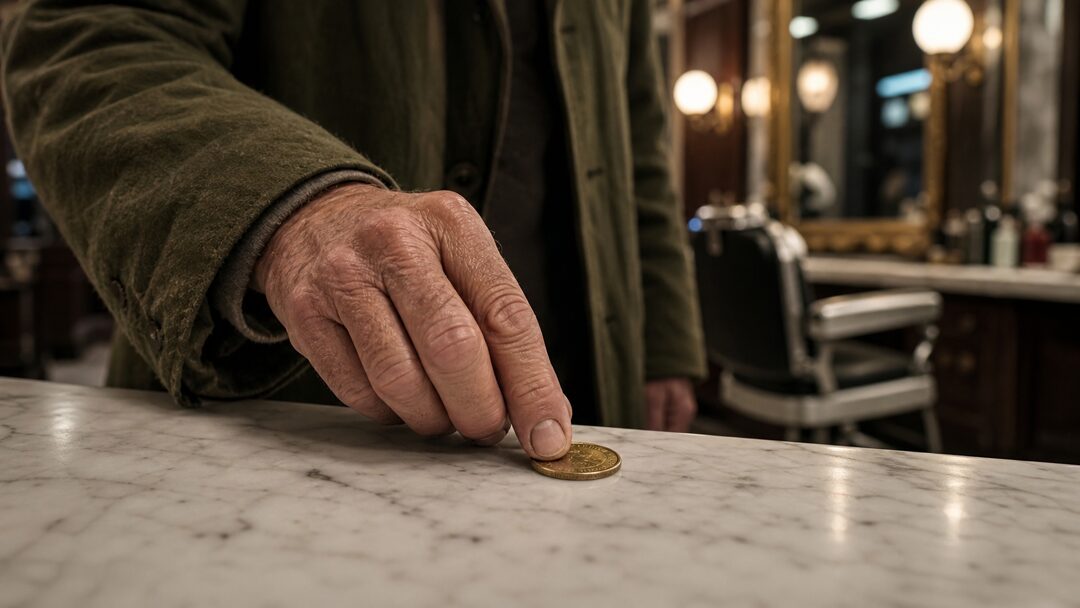
Robert Hayes placed the gold coin on the white marble counter with two fingers, as if it might break if he let it fall.
“I need to look like somebody who deserves to stand there,” he said.
Michael Reed, who had been wiping down his station for the eleven o’clock appointment, stopped with the towel in his hand.
The man in front of him looked like he had slept in doorways and apologized to them afterward. His gray hair hung in uneven ropes over his collar. His beard had grown in patches, white at the chin, yellowed near the corners of his mouth. He wore an old green field coat with one missing button and sleeves polished thin at the elbows.
But he stood straight.
That was the strange part.
His shoes were cracked. His hands shook. His face had the tired, hollow look of a man who had been ignored so long he had become careful not to take up space.
Still, he stood like someone waiting for inspection.
Michael looked down at the coin.
It was tarnished, heavy-looking, gold under the grime. Not money. Not exactly. There was an insignia stamped into it, worn nearly smooth by years of thumb and pocket.
“Sir,” Michael said carefully, “we take cards, cash, or—”
Jennifer Cole appeared from the back before he could finish.
She wore black, like she always did. Black blouse, black slacks, silver watch, hair pinned tight enough to say she had opened the shop before sunrise and did not intend to lose control of the day.
Her eyes went to Robert.
Then to the coin.
Then back to Robert.
Michael saw the change in her face. It lasted less than a second, but he caught it.
Recognition.
Not surprise. Not pity.
Recognition.
Jennifer placed one hand lightly on the counter.
“Michael,” she said, “your chair is open.”
Robert’s jaw tightened. “I can pay.”
“Nobody said you couldn’t,” Jennifer replied.
The old man looked at her as if he was deciding whether she had insulted him.
Michael stepped aside. “Right this way, sir.”
Robert did not move.
He touched the coin again.
“It’s worth more than it looks,” he said.
Jennifer’s voice softened only slightly. “I believe you.”
That answer seemed to trouble him more than doubt would have.
Outside, traffic moved past the shop windows. People in pressed shirts crossed toward the memorial plaza two blocks away. It was late morning, bright and clean, the kind of day the city liked to use when it wanted grief to look official.
Robert noticed Michael looking out.
“One hour,” he said. “That’s all I’ve got.”
Michael nodded. “Then we won’t waste it.”
The old man finally stepped away from the counter.
But he left the coin behind.
Part II — A Clean Cut
When Robert sat in Michael’s chair, he did it slowly, as if every hinge in him had to ask permission.
The leather gave under his weight. The mirror caught him whole.
He looked away immediately.
Michael noticed.
Barbers notice the small things. The way a man touches his chin before asking for a shave. The way he pretends not to care while watching every inch fall. The way shame makes people either talk too much or not at all.
Robert did not talk.
Michael fastened the cape around his neck, leaving it loose enough not to choke him.
“Too tight?”
“No.”
“Any style in mind?”
Robert stared at the floor. “Regulation.”
Michael paused.
Jennifer, still near the counter, did not look up from the appointment book she was pretending to read.
“Short on the sides?” Michael asked.
“Clean,” Robert said. “Not fancy.”
“I can do clean.”
Robert’s eyes lifted to the mirror for half a second. “Don’t make me look like I’m trying.”
That one hit Michael somewhere he did not expect.
He had joined at twenty-one and come home before he ever went anywhere. Training injury. Knee ruined. Papers signed. Everybody had called him lucky.
Lucky was a hard word when it sounded like dismissal.
He picked up the comb.
The first pass through Robert’s hair caught hard.
Robert flinched, then caught himself. “Sorry.”
“You’re good,” Michael said.
He sprayed water gently. The gray strands darkened and settled. Under the grime and uneven growth, Michael could see the shape of a man who had once been precise. The hairline was still strong. The cheekbones sharp. The posture disciplined even now.
Jennifer came closer.
“Coffee?” she asked.
Robert shook his head. “No, ma’am.”
“Water?”
Another shake.
Jennifer studied him. “You’re going to the ceremony.”
Robert’s eyes sharpened in the mirror.
Michael kept cutting.
“What ceremony?” he asked, though he knew there was one at the memorial. Flags had gone up that morning. The street barriers were already in place.
Robert swallowed.
“A name,” he said. “They’re adding a name.”
Jennifer’s fingers tightened around the appointment book.
Michael trimmed around Robert’s ear. “Someone you knew?”
Robert gave a dry sound that was not a laugh.
“Knew,” he said. “That’s a small word.”
No one spoke for a while.
Hair slid down the cape in damp gray pieces. Michael worked slowly, not because the cut was complicated, but because rushing felt wrong. Robert’s hands rested on his knees, both fists closed.
Then Michael saw what he was holding.
A folded program.
The paper was creased nearly through. The printed words faced inward, but one name showed at the edge.
Thomas.
Robert caught him looking and tucked the paper deeper into his coat.
Michael pretended not to notice.
Jennifer did not.
“Thomas Miller?” she asked.
Robert went still.
The scissors stopped.
For the first time since entering, Robert looked directly at Jennifer in the mirror.
“You know that name?”
Jennifer took a breath through her nose.
“My father did.”
Robert’s face changed so quickly Michael almost missed it. Fear first. Then suspicion. Then something older than both.
“What was your father’s name?”
“Charles Cole.”
The silence that followed did not feel empty.
It felt crowded.
Robert closed his eyes.
“Charlie,” he said.
Jennifer’s mouth trembled once before she controlled it. “You knew him.”
Robert opened his eyes again, but he did not look at her.
“I carried him.”
Michael lowered the scissors.
The shop suddenly felt too bright.
Part III — The Man in the Chair
Jennifer came around the chair and stood where Robert could see her without turning.
“My father used to say that,” she said. “Not often. Almost never. But when he had bad nights, he’d say, ‘If Hayes hadn’t carried us out, none of us would have made morning.’”
Robert’s mouth tightened.
“He shouldn’t have said that.”
“He meant it.”
“He didn’t know what I left behind.”
Jennifer looked at the coin on the counter.
Then Robert did too.
Michael followed their gaze.
The coin sat in the sunlight, small and stubborn.
Michael had seen challenge coins before. Men showed them off at bars. Some kept them behind glass. Some slapped them on tables with loud stories and louder pride.
This one did not look displayed.
It looked carried.
Robert’s voice went rough. “Night Bridge wasn’t supposed to have a name.”
Jennifer did not move.
“My father never told me much,” she said.
“Good.”
“He said there was rain.”
Robert’s eyes closed.
Michael wanted to keep cutting, to give the man somewhere to put his attention, but his hands had gone still.
Robert spoke anyway.
Not like a man telling a story. Like a man losing his grip on silence.
“There was rain,” he said. “There was mud up to the knees. Orders changed three times before midnight. We were told to pull six men from a ridge that didn’t exist on any map they’d admit to.”
Jennifer listened without interrupting.
Michael went back to the haircut because Robert’s reflection looked less cornered when the scissors moved.
Snip.
Snip.
Snip.
Robert’s breathing evened a little.
“Thomas had the coin,” he said. “He was younger than me. Always flipping it. Drove everybody crazy. Said it was lucky.”
His voice thinned.
“It wasn’t.”
Jennifer lowered her eyes.
Michael trimmed the beard now, careful around the jaw. With every line cleaned, Robert looked less like a man the street had swallowed and more like someone the world had misplaced.
That seemed to frighten him.
He stared at himself in the mirror and whispered, “Don’t.”
Michael stopped. “Don’t what?”
“Make him look back.”
Michael understood then.
Not fully. Maybe no one could fully understand another man’s private weather.
But enough.
He set the clippers down.
“You want me to stop?”
Robert’s hand rose, then fell.
“No,” he said. “I came in.”
That was all.
But it sounded like a decision.
Jennifer stepped to the counter and picked up the coin. She held it carefully, not turning it over yet.
Robert saw and tensed.
“I didn’t steal it,” he said.
“I didn’t think you did.”
“He gave it to me.”
Jennifer turned the coin.
On the back, nearly rubbed away, were two initials.
T.M.
Robert looked at them as if they were alive.
“He pressed it into my hand when the order came,” Robert said. “Told me to give it back when we were clear.”
Jennifer’s voice was barely above a whisper. “And you weren’t clear.”
Robert’s face hardened.
“I was ordered to move. Charlie was bleeding. Two others couldn’t walk. Thomas was pinned and laughing like a fool, telling me to go. So I went.”
The word dropped between them.
Went.
Not ran. Not abandoned. Not betrayed.
Went.
But Robert heard all those other words inside it.
Michael brushed hair from Robert’s collar.
“You saved them,” he said.
Robert looked at him sharply. “Don’t make it clean.”
Michael took the blow without answering.
Robert’s hands shook harder now.
“I can still hear him,” Robert said. “Not calling for help. That would’ve been easier. He was telling jokes. You understand that? He was making Charlie laugh while I dragged him away.”
Jennifer pressed the coin between both hands.
Her father had never told her that part.
Her father had sat in the garage some nights after she was supposed to be asleep, holding a glass he did not drink from, staring at the lawn mower, the Christmas boxes, the normal life he had somehow been allowed to enter.
She had hated him for his silences when she was young.
Now she wondered how many names had lived inside them.
“He looked for you,” she said.
Robert went still.
Jennifer looked up. “My father. For years.”
Robert shook his head once. “No.”
“He did.”
“No.”
“He kept a folder.”
Robert turned in the chair. The cape pulled at his neck.
Michael caught it before it slipped.
Jennifer kept going because stopping would be crueler.
“Old contacts. Letters returned. A photo with your name written on the back. He didn’t know where you went after the hospital discharge. He asked people. He called numbers. He thought you were dead.”
Robert’s face drained of what little color it had.
“He shouldn’t have looked.”
“He wanted to thank you.”
Robert’s eyes flashed.
“For what?” he said. “For choosing who got morning?”
Jennifer did not flinch.
“For carrying him when he couldn’t carry himself.”
The shop door opened.
A man in a navy suit stepped halfway in, phone in hand. He looked at Robert, then at Michael, then at Jennifer.
“I have an eleven-fifteen,” he said.
Jennifer turned.
“We’re closed for the next hour.”
The man frowned. “Your sign says—”
Jennifer walked to the door and locked it.
“Not today,” she said.
The man stared at her through the glass.
Jennifer flipped the sign.
Closed.
When she turned back, Robert was staring at the floor.
“You shouldn’t do that for me,” he said.
Jennifer returned to him. “I didn’t.”
He looked up.
“I did it for my father,” she said. “And for Thomas. And maybe for the man who carried them both longer than anyone knew.”
Robert’s face broke for one second.
Then he put it back together.
But Michael had seen it.
So had Jennifer.
Part IV — The Mirror
The haircut took thirty-eight minutes.
Michael knew because the clock above the door became another person in the room.
Every five minutes, Robert looked at it.
Every time, his jaw set harder.
Michael cleaned the neckline. Trimmed the beard close. Shaped the sideburns. Used a warm towel because Robert’s skin was thin and nicked easily.
Robert did not relax.
But he stopped apologizing.
That mattered.
Jennifer found a clean dress shirt in the back closet, one left by a groom months earlier before a wedding party cut. White. Still wrapped in plastic. Too broad in the shoulders, but better than what Robert had under his coat.
When she brought it out, Robert’s eyes narrowed.
“No.”
“It’s not charity.”
“It’s a shirt.”
“It’s a loan.”
“I won’t bring it back.”
“Then it’s a long loan.”
His mouth almost moved toward a smile. Almost.
“No tie,” he said.
“No tie,” Jennifer agreed.
Michael turned the chair toward the mirror.
Robert looked up.
And there he was.
Not young. Not whole. Not fixed.
But visible.
His hair was short and neat, silver against his weathered skin. His beard was trimmed clean. The old field coat looked even older over the white shirt, but somehow less like a costume of ruin and more like a thing a man had chosen to keep.
Robert stared.
His eyes moved over his own face like he was reading a letter from someone he had stopped expecting to hear from.
Michael removed the cape.
Hair fell to the floor around the chair.
Robert did not stand.
Jennifer held out the coin.
He took it.
For a moment, all three of them looked at the mirror.
Michael behind the chair, one hand still resting lightly on the leather.
Jennifer beside the counter, controlled but pale.
Robert seated between them, clean now, and somehow more exposed than before.
Then Robert shook his head.
“I can’t go.”
Michael felt the room tilt.
Jennifer closed her eyes briefly.
Robert gripped the coin until his knuckles whitened.
“I thought if I looked right, maybe I could stand there. But clean hair doesn’t change what happened.”
“No,” Jennifer said. “It doesn’t.”
The honesty startled him.
She stepped closer.
“But hiding didn’t change it either.”
Robert looked down.
“I left him.”
Jennifer’s voice grew firm. “You obeyed an order.”
“I lived.”
“So did my father.”
Robert turned toward her. “You think that makes it balance?”
“No.”
The answer stopped him.
Jennifer’s eyes shone now, but her voice stayed steady.
“I think nothing balances. I think my father got forty more years and still carried that night into every room. I think Thomas didn’t get those years. I think you saved men and lost yourself anyway.”
Robert swallowed.
“I don’t know how to stand there.”
Michael spoke before he could stop himself.
“Then don’t stand there like a hero.”
Robert looked at him.
Michael’s face burned, but he kept going.
“Stand there like somebody who showed up.”
The room held its breath.
Michael thought he had gone too far.
Then Robert said, “You ever serve?”
The question hit exactly where Michael feared it would.
He could have lied by omission. Could have mentioned enlistment and let the rest blur.
Instead he said, “I tried.”
Robert waited.
“Knee gave out before I earned anything.”
Robert studied him.
Michael forced himself not to look away.
“I used to think that meant I had no right to say anything to men who did,” Michael said. “Maybe I still don’t.”
Robert looked at him for a long time.
Then he said, “Trying counts for more than people let it.”
Michael’s throat tightened.
Robert looked back at the mirror.
His hand closed over the coin again.
“I hear him when it rains,” he said.
No one answered.
“I hear him laughing.”
Jennifer reached for the folded ceremony program sticking from his coat pocket.
Robert let her take it.
She opened it.
The ceremony began in sixteen minutes.
Thomas Miller’s name was printed near the bottom, under a heading about delayed recognition and recovered records.
Robert stared at the page.
“Maybe it’s not about changing it,” Michael said quietly. “Maybe it’s about not letting him stand there alone.”
Robert did not move.
Outside, a bell began to ring from the plaza.
Once.
Then again.
Robert stood.
His knees wavered, but he stood.
Jennifer unlocked the door.
Michael took off his apron.
Robert noticed. “Where are you going?”
Michael grabbed his jacket from the hook.
“Shop’s closed for the next hour.”
Robert looked at Jennifer.
She gave him the smallest nod.
He stepped toward the door, then stopped at the counter.
The marble was clean again.
Too clean.
He placed the coin there one last time, only for a second, like checking whether the past still had weight.
Then he picked it up and walked out.
Part V — Where He Stood
The memorial plaza was already crowded.
People stood in rows under the hard noon light. Some wore suits. Some held programs. Some had medals pinned to jackets that no longer fit. A few leaned on canes. A few stood with the stiff backs of people who had spent a lifetime not leaning on anyone.
Robert slowed at the edge.
Michael stayed behind him, far enough not to push.
Jennifer stood at Robert’s right, close enough to catch him if pride failed before his legs did.
A speaker’s voice carried over the crowd, polished and solemn.
Robert heard almost none of it.
He heard rain.
He heard Thomas laughing.
He felt mud pulling at his boots, Charlie’s weight over his shoulder, the coin shoved into his palm.
Give it back when we’re clear.
The crowd shifted.
Jennifer looked at him.
Robert’s breathing had gone shallow.
“You don’t have to speak,” she whispered.
“I know.”
“You don’t have to explain.”
That almost undid him.
Because explanation had been the trap for fifty years.
Explain why he lived.
Explain why Thomas did not.
Explain why orders sounded different when a man you loved was the cost of obeying them.
Explain why he vanished after discharge, why he drank through winters, why he stopped opening mail, why he stopped letting mirrors keep his face.
There was no explanation that could carry all of it.
The speaker lifted a paper.
“Today, we add the name of Thomas Miller.”
Robert’s hand closed around the coin.
Jennifer’s fingers brushed his sleeve.
Not holding him.
Just there.
The name rang out across the plaza.
Thomas Miller.
For one second, Robert was back in the chair, staring at his own cleaned face.
Then he stepped forward.
The movement was small. No one announced him. No music swelled. No one knew, at first, why an old man in a borrowed white shirt and faded green coat was crossing the open space.
A staff member moved to stop him.
Jennifer stepped forward too.
“My father was Charles Cole,” she said quietly.
The staff member froze.
Robert kept walking.
The wall waited.
Thomas’s name had already been uncovered, new and bright among older names.
Robert stopped before it.
His hand shook so badly he needed both hands to lift the coin.
For a moment, he held it against his chest.
Then he bent, slowly, carefully, and placed it beneath the name.
Gold against stone.
A small thing.
A heavy thing.
He straightened.
His salute was not perfect. His shoulder had stiffened. His fingers trembled. Time had taken precision from him.
But it had not taken meaning.
No one spoke.
Michael watched from the back of the crowd with his hands in his jacket pockets, eyes fixed on the old man he had almost treated like an inconvenience.
Jennifer stood behind Robert, tears now running freely, her control finally unnecessary.
Robert held the salute until his arm began to shake.
Then he lowered it.
He did not say goodbye.
He had been saying goodbye for fifty years.
This time, he only stood.
And for the first time in a very long while, he did not stand alone.
Part VI — What Remained
They returned to the shop after the crowd thinned.
No one spoke much on the walk back.
Robert carried himself differently, but not lighter exactly. Michael noticed that. Some burdens did not lift. They changed shape. They stopped covering the face.
Inside, the shop smelled faintly of aftershave and coffee gone cold.
The chair still had a few gray hairs caught in the seam.
Jennifer went to the counter and placed the coin on the marble.
Robert looked at it.
“You forgot this,” she said.
He shook his head.
“No.”
“Robert.”
He looked startled at his own name.
Jennifer pushed the coin toward him. “It’s yours.”
“It was Thomas’s.”
“Then you carried it for him.”
Robert touched the edge.
For a moment, Michael thought he would take it.
Instead, Robert picked up one of the shop’s small appointment cards and borrowed a pen from the counter.
His hand shook as he wrote.
Not much.
Just one sentence.
He folded the card once and set it beside the coin.
Then he picked up the coin and placed both into the glass tip jar near Michael’s station.
Michael looked at him. “Sir, I can’t take that.”
Robert’s eyes met his in the mirror.
“You’re not.”
Jennifer read the card through the glass.
For the next man who needs to look like he can face the day.
No one moved.
Outside, the city had gone back to itself. Traffic. Footsteps. Phones. Someone laughing too loudly on the sidewalk. The ordinary world, demanding ordinary things.
Robert adjusted the cuffs of the borrowed shirt.
“I’ll bring this back,” he said.
Jennifer shook her head. “Long loan.”
This time, he almost smiled.
Michael opened the door for him, but Robert paused before stepping out.
He looked back at the chair.
Then at the mirror.
Then at the coin in the jar.
“I still hear him,” Robert said.
Jennifer nodded.
Michael did too.
Robert seemed relieved that neither of them tried to fix that.
He stepped outside into the afternoon.
He did not look like a man made new.
He looked like a man still carrying the past.
But now, for one hour, in one bright room, someone had helped him carry it where it needed to go.