The Day Everyone Learned What Silence Had Been Protecting
Part I — The Man on the Pavement
Mark was already on the pavement when the battalion learned not to look at him.
His cheek scraped against the concrete. One sleeve of his dark dress jacket had torn at the elbow. He could taste dust and copper at the back of his mouth, though he had not yet checked whether the copper belonged to him.
Above him stood Colonel Donald Hayes in a spotless white ceremonial uniform.
The colonel’s medals caught the morning light. His black boots shone like glass. One of them rested so close to Mark’s ribs that the message did not need a voice.
Stay down.
Behind them, rows of Marines stood at attention across the parade ground, eyes fixed ahead, jaws locked, hands pinned to seams.
No one moved.
That was the first thing Mark noticed.
Not the pain. Not the heat lifting off the pavement. Not the colonel’s shadow cutting across his face.
The silence.
It had weight.
Colonel Hayes looked down at him as if Mark were not a man, but a mistake that needed correcting in public.
“Stand up,” Hayes said.
Mark tried to push himself onto one elbow. Pain ran up his arm. He swallowed it and stayed halfway raised.
“Stand up,” Hayes repeated, louder this time, so every line could hear. “And apologize.”
The word moved through the formation without anyone saying it.
Apologize.
Mark looked past the colonel’s boot, past the white fabric and gold trim, toward the first rank of Marines.
Some of them had been on Range Six three nights ago.
Some had seen the lights change.
Some had heard Brandon’s voice in the dark.
But every face in front of Mark had become stone.
Colonel Hayes leaned forward. His gray hair was cut close, his face broad and severe, his body still powerful enough to make younger men flinch before he touched them.
“You disgraced this command,” Hayes said. “You endangered a recruit. You lied after the fact. Now you will apologize to this battalion.”
Mark’s breath hitched.
The parade ground seemed to tilt. For half a second he was back under the training towers, smoke crawling low across the ground, Brandon’s voice cracking through the radio: The lights changed. Sergeant, the lights changed.
Then the memory snapped shut.
Mark lifted his head.
“Not for what I didn’t do.”
A pulse of discomfort moved through the line. No one shifted. No one blinked. But Mark felt it.
Hayes did too.
The colonel’s face did not change. That was what made him dangerous. Anger made ordinary men sloppy. Hayes carried it like ceremony.
“You want them to hear you refuse responsibility?” Hayes asked.
Mark forced himself to sit higher.
“I want them to remember what they heard.”
For the first time, the colonel’s boot moved.
Not away.
Closer.
Part II — The Official Story
Colonel Hayes turned from Mark to the battalion, giving them the clean version.
“Three nights ago,” he said, voice carrying easily across the parade ground, “during a supervised live-fire training exercise, Lance Corporal Mark disregarded a safety command, misdirected Recruit Brandon into a restricted lane, then attempted to shift blame when confronted.”
Mark closed his eyes.
There it was.
Neat. Complete. Easy to file.
A story with one careless man, one injured recruit, one commander restoring order.
Hayes kept speaking.
“Recruit Brandon remains under medical care because one Marine decided his judgment mattered more than protocol.”
At the edge of the formation, Nicole stood with the corpsmen.
She was small, steady, sleeves exact, hair pinned so tightly it made her face look sharper than it was. Her medical bag hung from one shoulder, worn at the corners from years of being grabbed in doorways, trucks, tents, and training fields.
Mark found her without meaning to.
Nicole was staring straight ahead.
Only her hand betrayed her.
Her fingers were curled around the strap of the bag so tightly that her knuckles had gone pale.
Hayes followed Mark’s glance and smiled without warmth.
“Do not look for rescue,” he said quietly, only for Mark. Then louder: “There is no confusion here. There is only failure.”
Mark wanted to laugh.
Not because anything was funny.
Because confusion was the word they had chosen. It was the word Hayes’s executive officer used outside the infirmary while Brandon lay sedated and bandaged.
Trauma creates confusion.
That was what they said when Brandon woke long enough to whisper that the lights had changed after the exercise began.
Pain confuses memory.
That was what they said when Nicole wrote it down anyway.
Young men want someone to blame.
That was what they said when Mark asked why the lane markers had been moved before investigators arrived.
Hayes looked back down at him.
“On your feet.”
Mark did not move.
The colonel’s voice hardened.
“You will apologize to the Marines who trusted you. You will apologize to the recruit whose future you may have altered. And you will apologize to this command for dragging its name through your cowardice.”
That word found him.
Cowardice.
It landed harder than the pavement had.
Mark saw Brandon again, nineteen and trying not to look nineteen, grinning through nerves before the exercise began.
“Sergeant,” Brandon had said, though Mark had told him twice not to call him that. “Do you ever stop feeling like everyone knows you don’t belong?”
Mark had checked the kid’s vest straps, tugged once, then twice.
“No,” he said. “You just get better at moving anyway.”
Brandon had smiled at that like it was a gift.
Later, after the smoke and alarms and shouting, Brandon had grabbed Mark’s wrist in the infirmary with fingers that shook too hard to hold on.
“Did I mess up?” he whispered.
Mark had bent close.
“No,” he said. “Command will get this right.”
That was the sentence that would not leave him.
Not the explosion of light.
Not the medevac siren.
Not the blood on his own hands when he helped carry Brandon out.
That sentence.
Command will get this right.
Mark opened his eyes and looked at Hayes.
“Ask them why the lane markers were moved.”
The formation changed.
Not visibly. Not enough for Hayes to punish.
But breath caught in more than one chest.
Hayes went still.
“What did you say?”
Mark pushed himself higher, the torn elbow burning.
“I said ask them why the lane markers were moved.”
A Marine in the second row lowered his eyes.
Another stared harder at the horizon.
Nicole’s grip tightened on her bag.
Hayes stepped closer until his white trouser leg nearly brushed Mark’s knee.
“You are confused,” the colonel said.
“No, sir.”
“You are ashamed.”
“Yes, sir,” Mark said. “But not of that.”
The silence went sharp.
Part III — What Nicole Wrote Down
Nicole had written the words at 0217 because time mattered.
She had learned that early. Pain made people vague. Command made them careful. Memory became easier to reshape once daylight touched it.
So she wrote things down.
Pulse. Pressure. Response. Pupils. Medication. Words spoken before sedation.
Brandon had been on the infirmary bed with bandages over his eyes and both hands wrapped. His face looked too young without expression. Without the nervous grin. Without the stubborn effort to prove he was fine.
Mark stood near the sink, still in his field gear, shaking so violently he had to grip the counter.
Not crying.
Not panicking.
Shaking like a man trying to keep his body from running back into a place his mind knew was gone.
Brandon turned his head toward Mark’s breathing.
“Did I cross wrong?” he asked.
Mark stepped forward at once.
“No.”
“The lights changed.”
Nicole paused with her pen above the intake form.
Brandon swallowed. His voice was raw. “Green was left. Then it wasn’t. I followed green.”
Mark looked at Nicole.
For one second, neither of them spoke.
Then Nicole wrote it down.
Patient states lane signal changed after exercise began.
It was only one line.
A small line.
The kind people lost.
The next afternoon, Major Gregory pulled Nicole aside outside the records room. He was Hayes’s executive officer, a narrow man with calm hands and a voice that made threats sound like scheduling problems.
“You recorded statements made under trauma,” he said.
“I recorded patient statements.”
“Same thing, in this case.”
“No,” Nicole said. “Not always.”
Gregory smiled like she had disappointed him.
“Confusion after trauma won’t hold against the colonel’s report. You know that. Better for everyone if the paperwork stays clean until review.”
“Better for whom?”
His smile disappeared.
“For the recruit. For his benefits. For your career. For anyone who wants this handled without turning one bad night into a circus.”
Nicole had kept the carbon copy.
She told herself she kept it because good corpsmen kept records.
Then she told herself she had not reported it because reporting it too early would let them bury it properly.
Then she told herself Mark was reckless for forcing the issue in formation.
But when she saw him on the pavement, with Hayes’s boot near his ribs and the battalion pretending not to see, every excuse she had made became smaller.
Not false.
Small.
Hayes had built the perfect place to crush him.
Public enough to shame.
Formal enough to control.
Silent enough to erase.
And Mark had chosen it anyway.
Nicole understood then what frightened her most.
Mark was not trying to survive the morning.
He was trying to make sure the morning had witnesses.
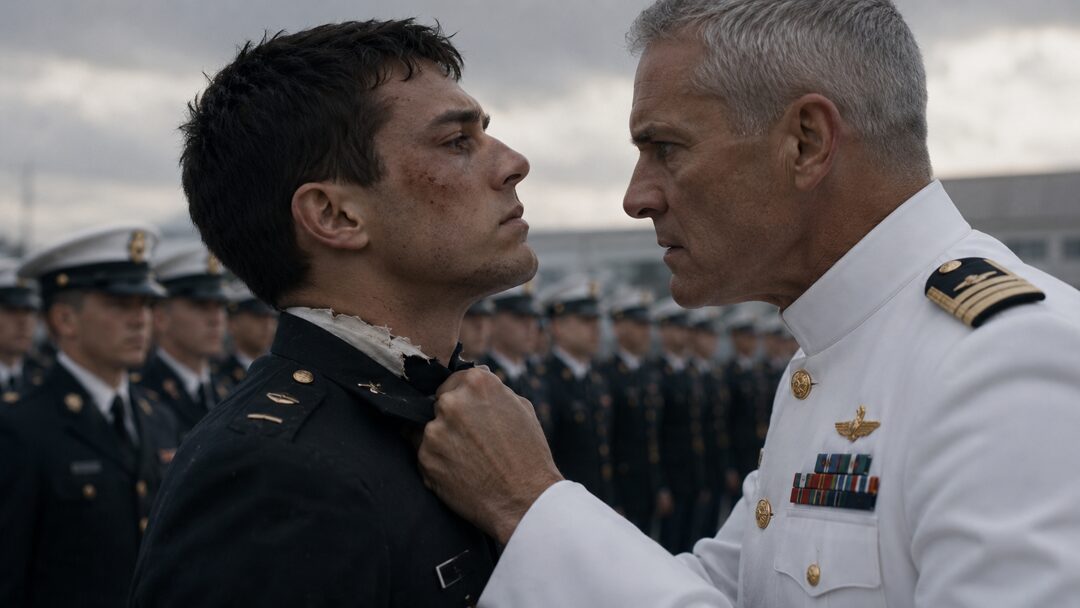
Colonel Hayes bent, grabbed the front of Mark’s dark jacket, and hauled him to his feet.
The motion was fast enough that Mark’s shoes scraped against the pavement before he found balance. The torn elbow pulled. His face tightened, but he did not make a sound.
Hayes kept one fist locked in his collar.
Up close, the two men looked like a poster split down the middle.
White and dark.
Polished and damaged.
Authority and accusation.
“Listen to me carefully,” Hayes said, too low for the battalion but loud enough for Mark. “Brandon’s family has already been briefed.”
Mark’s eyes changed.
Hayes saw it and pressed harder.
“They know whose name is in the report. If you force a review, everything pauses. Care. Benefits. Transport. All of it gets held while people decide whether the injured boy lied under medication.”
Mark’s throat moved against the colonel’s fist.
“You’d do that?”
“I would protect this command from a desperate man trying to save himself.”
Mark almost answered.
Then he saw Nicole.
She was still in line. Still frozen. Still holding the strap.
Hayes followed his gaze again.
“No one is stepping out for you,” he whispered. “That is the part you do not understand.”
Mark understood too much.
That was the problem.
He understood that Brandon might wake to a room full of adults telling him his own memory could not be trusted.
He understood that Nicole could lose more than a clean conscience.
He understood that every Marine in formation had a mortgage, a child, a transfer request, a promotion board, a fear.
He understood why silence survived.
It always had something to offer.
Safety. Time. Plausible deniability.
A way to keep eating dinner after watching someone else take the fall.
Hayes tightened his grip.
“Apologize.”
Mark looked at the battalion.
Then he looked back at Hayes.
“Yes, sir.”
Part IV — The Apology
The colonel’s mouth softened into victory.
It was brief. Almost invisible.
But Mark saw it.
So did Nicole.
Hayes turned Mark by the collar until he faced the rows of Marines. The battalion remained rigid in the sun, but attention had changed. Earlier they had been watching because they were ordered to.
Now they were listening because they were afraid of what might come next.
Hayes released the collar by one inch.
“Speak clearly,” he said. “No excuses.”
Mark took a breath.
His ribs hurt. His elbow pulsed. His cheek burned where the pavement had opened it. The collar of his jacket sat crooked now, one button strained at the thread.
He could feel the morning pressing on him from every direction.
Hayes behind him.
The battalion in front.
Nicole at the edge.
Brandon somewhere beyond the gates, sleeping under white sheets, still waiting for adults to tell the truth.
Mark lifted his chin.
“I’m sorry Brandon believed the lights.”
A ripple moved through the first rank.
Hayes’s hand clamped down again.
Mark kept going.
“I’m sorry I told him command would protect him.”
“Careful,” Hayes said.
Mark’s voice did not rise. That made it carry farther.
“I’m sorry I didn’t understand what kind of men move markers after dark.”
For one full second, the parade ground stopped being a place of discipline.
It became a place where every person heard his own breathing.
Hayes spun him around.
“Take it back.”
Mark looked at him.
“No, sir.”
“You will take it back.”
“No, sir.”
The colonel’s face changed then.
Not much.
Only enough to show that the uniform had been holding something in.
The polished ceremony cracked, and underneath it was not honor. It was fear with rank on it.
Hayes shoved Mark back a step, still gripping his jacket.
“You think this makes you brave?”
“No.”
“You think one ugly accusation outweighs a lifetime of service?”
Mark’s jaw tightened.
“I think Brandon shouldn’t wake up believing he failed.”
That line reached Nicole before she was ready for it.
It crossed the empty space between her and Mark and took the last excuse out of her hand.
Because she had heard Brandon ask.
She had heard the fear under his question.
She had watched Mark lie to him kindly because at the time, both of them still wanted to believe kindness and truth would end up in the same place.
Nicole stepped forward.
The motion was small.
One boot out of line.
Every corpsman near her felt it.
The Marine beside her turned his head a fraction.
Hayes did not see her at first. He was too focused on Mark, too deep inside the humiliation he had designed.
Nicole took another step.
Her voice almost failed.
Then she remembered the time written at the top of the form.
She remembered the sentence.
Patient states lane signal changed after exercise began.
She made herself louder.
“I wrote down what Brandon said.”
Hayes turned.
The whole formation seemed to turn with him, though no one moved.
Nicole stood alone now, medical bag against her hip, one hand still around the strap.
The colonel stared at her as if she had spoken a language he had forbidden.
“What did you say, Petty Officer?”
She swallowed.
“I wrote down what Brandon said when he came in.”
“Return to formation.”
“He said the lights changed.”
Hayes’s expression emptied.
That was worse than anger.
Nicole could feel her career narrowing in front of her. Reports. Meetings. Questions delivered with smiles. Transfers that sounded routine. Her name becoming inconvenient in rooms she would never enter.
She spoke anyway.
“He said he followed green.”
Mark closed his eyes for half a second.
Not relief.
Not exactly.
Something smaller. More painful.
He was no longer the only one carrying it.
A Marine in the second row lowered his gaze.
Then another.
Then, from the third rank, someone whispered, barely loud enough to exist, “I saw them moving cones after.”
No one acknowledged it.
But everyone heard.
Hayes heard.
His hand returned to Mark’s collar.
This time, it was not controlled.
“Enough.”
Mark did not resist.
That made Hayes look worse.
“Enough,” the colonel said again, but the word had lost command and become request.
Nicole stood where she was.
The battalion stayed silent.
But the silence had changed sides.
Part V — What the Line Repeated
Hayes struck Mark across the face.
The sound was flat and ugly.
Mark’s head snapped sideways. His body followed half a step, but he did not fall. For a moment his eyes were shut, his mouth open slightly, his breath caught between pain and balance.
No one moved.
The morning held the image in place.
The colonel in white, spotless beneath the sun.
Mark in dark blue, jacket torn, collar twisted, mouth marked red.
Rows of witnesses pretending they were not witnesses, because pretending had been the first order they learned without hearing it.
Hayes’s hand remained lifted for a fraction too long.
Long enough for everyone to understand that discipline had ended and something else had shown itself.
Mark turned back slowly.
Blood touched the corner of his mouth. He did not wipe it away.
His eyes found Hayes first.
Then Nicole.
Then the first rank.
When he spoke, his voice was quiet. Too quiet for the whole battalion.
“Now write that in the report too.”
The nearest Marine heard it.
His lips parted.
For a second, he did nothing.
Then he repeated it, low.
“Now write that in the report too.”
The words moved awkwardly at first, not as a chant, not as rebellion, but as men passing something fragile hand to hand because no one wanted to be the one who dropped it.
“Now write that in the report too.”
“Write that in the report.”
“Put that in the report.”
Hayes looked around.
For the first time that morning, he seemed to notice how many people were there.
Not bodies.
People.
People with eyes. People with memory. People who had seen his hand move.
Mark stood still. His cheek throbbed. His ribs hurt. Every instinct in his body wanted him to lower his head, to make himself smaller, to become survivable.
He did not.
Nicole crossed the space between the corpsmen and the center line.
No one ordered her back this time.
She stopped beside Mark, not touching him, not making a scene of care. Just close enough that no one could pretend he stood alone.
Hayes stared at her.
“You are making a serious mistake.”
Nicole looked afraid.
That mattered.
Courage without fear could be mistaken for ignorance. Nicole’s fear was clean and visible.
“Yes, sir,” she said.
Then she reached into her medical bag and removed a folded carbon copy.
Her hand trembled once.
Only once.
“I have the intake note.”
Hayes looked at the paper as if it were a blade.
Mark almost laughed again, but pain caught the sound.
A piece of paper. A line written at 0217. A wounded recruit’s words before sedation. It was not enough to fix everything.
But it was enough to make the lie work harder.
That was where truth began sometimes.
Not as victory.
As inconvenience.
Major Gregory appeared at the edge of the parade ground, moving quickly now, face pale with calculation. Behind him, two base security officers approached with careful, official steps.
Not running.
No one ran in places like this unless the emergency could not be renamed.
Hayes released Mark’s collar.
The fabric stayed wrinkled where his fist had been.
“Dismiss them,” Hayes said to Gregory.
Gregory did not answer immediately.
That pause was small.
But the battalion felt it.
Hayes turned on him. “Dismiss them.”
Gregory looked at the Marines, at Nicole’s paper, at Mark’s face, at the two officers drawing nearer.
Then he said, “Sir, I think we need statements first.”
The words did not sound heroic.
They sounded bureaucratic.
That made them more dangerous.
Hayes’s jaw worked once.
Mark finally wiped his mouth with the back of his hand. When he looked at the smear, his expression did not change.
He had thought the worst thing would be the blow.
It wasn’t.
The worst thing was realizing how many people had needed one person to remain standing before they remembered they could speak.
Part VI — The Names People Gave
By evening, the base had grown quiet in the way places grow quiet when everyone is talking behind doors.
Mark sat on a curb outside the medical building with an ice pack wrapped in a towel against his cheek. His dress jacket was folded beside him, torn sleeve up, collar ruined. Without it, he looked younger.
Nicole sat to his left, not close enough for comfort to look soft, not far enough for silence to look like distance.
Across the street, headquarters glowed with office lights.
People kept entering.
People kept not coming out.
Two security officers had collected statements first from the Marines nearest the front rank. Then from the corpsmen. Then from the range staff. Then, slowly, from men who remembered seeing cones moved but had convinced themselves someone else would mention it.
Someone else.
That was the safest person in any command.
Someone else would report it.
Someone else would challenge it.
Someone else would stand up.
Mark watched the doors.
“Did you give them the note?” he asked.
Nicole nodded.
“Copy or original?”
“Copy.”
He almost smiled.
“Good corpsman.”
She looked at him then, and the almost-smile disappeared.
“You should have told me what you were going to do.”
“You would have told me not to.”
“I would have told you not to do it alone.”
Mark looked down at his hands.
His knuckles were scraped from the pavement, though he had not thrown a single punch.
“I thought if you stepped in, they’d come after you.”
“They will.”
He turned toward her.
Nicole’s face was calm again, but not untouched. Fear still lived there. So did something steadier.
“Then why did you?”
She watched the headquarters doors.
“Because he said no one was stepping out for you.”
Mark looked away.
That was the line that almost undid him.
Not the strike. Not the accusation. Not the pain in his ribs.
That.
Nicole let the silence sit.
Then she said, “Brandon woke up for a few minutes.”
Mark stopped moving.
“When?”
“About an hour ago.”
“What did he say?”
Nicole shifted the medical bag on her lap. The strap was creased where her hand had held it all morning.
“He asked if you were in trouble.”
Mark exhaled, something between a laugh and a broken breath.
“Of course he did.”
“I told him people were figuring out what happened.”
“That’s not an answer.”
“No,” Nicole said. “But it wasn’t a lie.”
Mark stared at the hospital entrance.
Through the glass, he could see a nurse at the desk, a vending machine humming beside a row of plastic chairs, a hallway too bright for the hour.
“Does he know?” Mark asked.
“Not all of it.”
“Good.”
“Mark.”
He closed his eyes.
Nicole’s voice softened, but only slightly.
“You don’t get to protect him from the truth by carrying the wrong part alone.”
He opened his eyes again.
For a long time, he said nothing.
Then, quietly, “I told him command would get it right.”
Nicole did not rush to comfort him.
That was why he trusted her.
She knew some guilt did not leave just because it had been assigned to the wrong person.
“You told him what you needed to believe,” she said.
Mark looked at headquarters again.
A Marine came out of the building and stood under the light by the door. He was from the second row. The one who had lowered his eyes when Mark mentioned the markers.
He saw Mark and froze.
Then he crossed the street.
Not fast. Not confidently.
But he came.
When he reached the curb, he stood in front of Mark with his cover in both hands.
“I gave a statement,” he said.
Mark nodded once.
The Marine looked at Nicole, then back at Mark.
“I should have said something sooner.”
Mark wanted to say it was fine.
It wasn’t.
He wanted to say he understood.
He did.
Neither answer felt clean enough.
So he said, “Say it right now when they ask again.”
The Marine swallowed.
“Yes.”
He returned to headquarters.
Another came out ten minutes later.
Then two more went in.
The night did not become just.
Colonel Donald Hayes was not led away in disgrace while the battalion cheered. Mark was not cleared before sunset. Nicole was not promised protection. Brandon was not suddenly healed by the truth he had been too weak to defend.
But the lie was no longer traveling alone.
That had to count for something.
Inside the medical building, Brandon slept under white sheets, bandages covering what the accident had taken for now. His family would arrive in the morning. There would be questions. There would be forms. There would be men in clean offices using careful words.
Mark stood, slowly.
Nicole rose with him.
“You going in?” she asked.
He looked at the doors.
“I don’t know what to say to him.”
“Start with his name.”
Mark nodded.
It sounded too simple.
It was probably the only honest place left to begin.
He took one step toward the entrance, then stopped and looked back at headquarters.
The building’s lights shone hard against the dark.
Behind those walls, people were writing down what they had seen. Not all of it. Maybe not bravely. Maybe not even cleanly.
But enough to make silence answer for itself.
Mark touched the torn collar of his jacket where Hayes’s fist had held him.
Then he let it go.
Nicole opened the door for him, and together they walked into the bright hallway where Brandon was waiting, still alive, still owed the truth, still innocent of the story other men had tried to give him.
Mark did not feel redeemed.
He did not feel safe.
But for the first time since Range Six went dark, he did not feel alone with the memory.
And outside, across the street, one more Marine stepped into headquarters and gave his name.