What the Room Remembered
Part I — The Wrong One
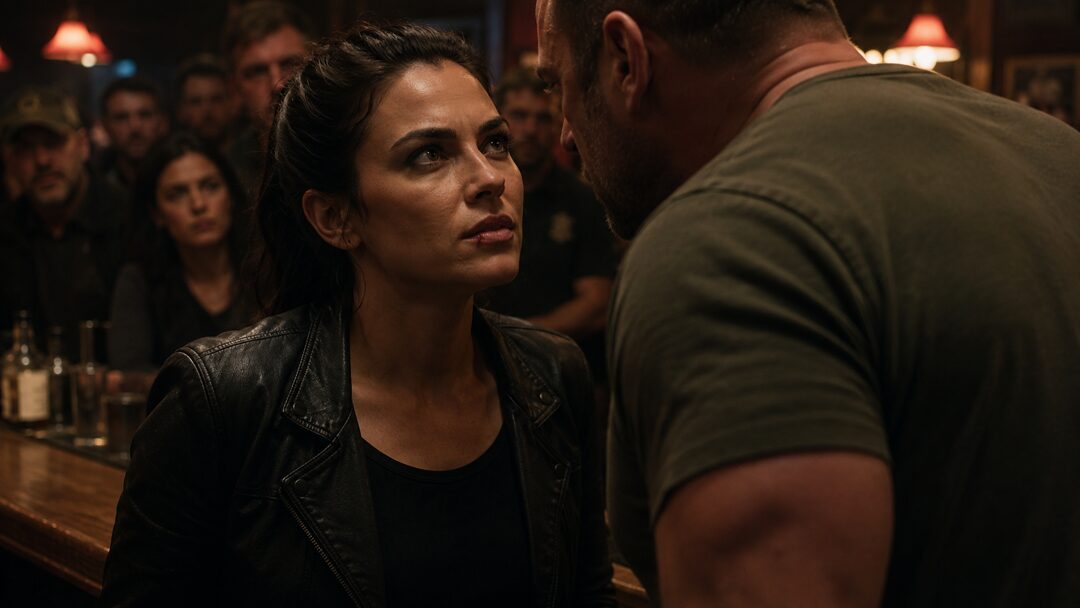
Michael hit Elizabeth hard enough to make the glasses behind the bar tremble.
For one full second, the whole room forgot how to breathe.
The jukebox kept playing low in the corner. Someone’s beer slipped against a coaster. A chair leg scraped the floor, then stopped, as if even the chair had thought better of moving.
Elizabeth stood with one hand braced against the polished wood, her dark hair pulled tight at the back of her head, her black leather jacket half-open over a plain shirt. A thin line of red moved from the corner of her mouth down toward her chin.
Michael loomed over her in an olive-green T-shirt stretched across his shoulders, his jaw tight, his eyes bright with the kind of anger that expected an audience to make room for it.
“I said,” he growled, “give me the coins.”
Elizabeth lifted her fingers to her split lip.
The room watched her touch the blood.
Then she looked up at him and smiled.
Not bravely.
Not shakily.
Like something had finally gone exactly the way she needed it to go.
“Thank God,” she said softly, “you just put your hands on the wrong one.”
Michael’s expression twitched.
It was small. Most people missed it.
Robert did not.
Behind the bar, Robert’s hand froze around a towel. He had been polishing the same glass for ten minutes, pretending not to study the woman in the black jacket, pretending not to know why she had chosen his bar, on this night, with those people in the room.
He knew now.
The Taproom was packed wall to wall with men who spoke too loudly when they wanted not to remember and too softly when they wanted to be believed. It sat just far enough from Fort Bragg to be private and close enough to be claimed. Reunion nights filled the place with old unit shirts, unit rings, memorial tattoos, and stories trimmed clean enough to survive repeating.
Michael had owned the room since eight o’clock.
He had slapped backs. Bought rounds. Let younger men call him a legend. He had stood near the center table under the framed flag and told the same story twice, changing only the laugh lines.
Then Elizabeth had walked in alone.
She did not ask for anyone.
She sat at the bar, ordered club soda, and placed two old challenge coins beside her glass.
One was gold, bright even under the amber lights.
The other was blackened at the edges, warped by heat, its engraving nearly swallowed in soot.
Robert saw the dark one and nearly dropped the bottle he was holding.
Michael saw it ten minutes later.
Now Elizabeth straightened slowly. She did not wipe her mouth. She did not step back. Her eyes stayed on Michael as if his size had become irrelevant.
He looked from her face to the room, searching for the old rhythm: someone to laugh, someone to say easy, brother, someone to turn what he had done into a misunderstanding.
No one moved fast enough.
So he made the first move himself.
“She’s crazy,” Michael said, forcing a laugh. “Some woman walks in here with stolen memorabilia and starts running her mouth.”
Elizabeth reached into the inside pocket of her jacket.
Several men shifted.
Michael’s hands curled.
She pulled out nothing but a folded napkin.
Calmly, she wiped her fingers. Not her mouth. Her fingers.
Then she set the napkin down, picked up the two coins, and placed them in the center of the bar with a clear, deliberate tap.
Gold.
Black.
The sound cut through the room better than a shout.
Robert’s face went pale.
Elizabeth noticed.
Michael noticed her noticing.
“That one,” she said, touching the blackened coin with one clean fingertip, “was found thirty-seven yards east of the dry canal outside Sahrin. Not at the convoy marker. Not at the extraction point.”
Michael’s laugh died halfway out of his mouth.
Elizabeth turned the gold coin so the emblem caught the light.
“Task Force Iron Gate,” she said. “Second rotation. May through September. Operation Glass Harbor.”
Several men at the center table stopped looking at her like she was a stranger.
Now they looked at her like she had opened a door that was supposed to stay painted shut.
Robert set the glass down too hard.
It cracked.
Elizabeth did not turn toward him.
Not yet.
Michael leaned closer. “You don’t know what you’re talking about.”
She smiled again, smaller this time.
“I know exactly where the report lied.”
Part II — The Two Coins
The Taproom had been built for forgetting.
That was what Robert used to tell himself when men came in carrying stories they had sanded smooth enough to drink beside. Forgetting was not the same as lying, he had decided. Forgetting was a mercy with poor timing.
But the blackened coin on his bar was not merciful.
It dragged everything back with it.
Michael pointed at Elizabeth’s face. “You all saw her. She came in here trying to start something.”
“No,” Elizabeth said. “I came in here hoping you wouldn’t.”
That landed badly for him.
A few heads turned.
Michael felt it. Elizabeth saw him feel it.
He widened his stance. “You think because you memorized a few names off a forum, you can walk into a room full of men who were actually there?”
Elizabeth looked around the bar.
Some men looked down.
Some looked back at her with warning in their eyes.
A few stared at the coins.
“I was there,” she said.
Michael snorted. “Where? Behind a screen?”
“Yes.”
The answer was so clean that it took the air out of his insult.
Elizabeth picked up the gold coin and held it between two fingers. “I was attached to Glass Harbor as intelligence support. I listened to your radio traffic. I flagged route changes. I watched your convoy drift off approved movement twice before the feed cut.”
Michael’s eyes hardened.
There it was.
Not confusion. Recognition.
“You don’t get to say you were there,” he said. His voice dropped. “You didn’t carry anyone. You didn’t smell the road. You didn’t hear men screaming.”
Robert’s hand moved before he meant it to. He reached beneath the bar where he kept the phone.
Then he stopped.
Elizabeth turned her head just enough to see him.
“Robert,” she said.
His name in her mouth sounded like a summons.
Michael looked sharply at him. “You know her?”
Robert swallowed.
“No,” he said.
Elizabeth’s expression did not change, but something behind her eyes cooled.
“That’s the first lie you’ve told tonight,” she said. “Don’t make it your last.”
The men near the center table shifted again.
Robert leaned forward, voice low. “Lady, whatever you came here to do, do it somewhere else.”
“Why?”
“Because this room isn’t a courtroom.”
“No,” Elizabeth said. “It’s better.”
That got a reaction.
A bitter laugh from someone in the back. A muttered curse near the door. Michael’s mouth tightening.
Elizabeth let the room settle before she spoke again.
“This is where he gets believed.”
Michael’s face flushed.
“Watch yourself,” he said.
“I did that for six years.”
She placed the gold coin back down.
Then she turned the blackened coin.
A burned edge caught against the wood.
Robert’s eyes fell to it despite himself.
Elizabeth saw that too.
“You recognize it,” she said.
Robert wiped both hands on the towel. “A lot of coins look alike after heat.”
“No, they don’t.”
Michael stepped in between them slightly, trying to block the line of sight. “Enough.”
Elizabeth looked at him as though he had become background noise.
“This one has a nick through the upper right star,” she said. “Daniel made that nick trying to open a crate with it because he said issued tools were just suggestions with handles.”
Robert closed his eyes.
Only for a second.
But the room saw.
Michael saw.
And Elizabeth, who had built this night out of seconds, let that one sit.
“Daniel?” someone at the center table said.
The name moved strangely through the room. Not loudly. Not as gossip.
As memory.
Michael’s jaw worked.
Elizabeth’s voice stayed steady. “Staff Sergeant Daniel Hayes.”
One of the younger men frowned. “Hayes died at the canal.”
“No,” Elizabeth said. “That’s what the report needed him to do.”
Michael slammed his palm on the bar.
Glasses jumped.
“Shut your mouth.”
Elizabeth looked down at his hand. Then at her own open palm, still resting beside the coins.
“You already tried that,” she said. “It didn’t work.”
Part III — The Name Under the Story
Daniel had given Elizabeth the gold coin in a parking lot three days before he deployed.
He had been twenty-nine, sunburned, grinning, and pretending not to be nervous. She had been wearing a government badge on a lanyard and pretending not to count the ways she could lose him.
“Don’t look at me like that,” he had said.
“Like what?”
“Like you’re reading the weather.”
“I am reading the weather.”
He laughed and put the coin in her palm. It was heavier than she expected.
Task Force Iron Gate.
A raised emblem.
A bright edge.
“For your desk,” he said. “So when some colonel tries to tell you field guys are the only ones doing real work, you can throw that at his head.”
“I don’t throw evidence.”
“You should start.”
She had turned it over. Nothing on the back then. No engraving. Just a blank circle waiting for meaning.
He had closed her fingers around it.
“Bring me home twice,” he said.
“What does that mean?”
“First, physically. Second, when I start telling stupid stories about how brave I was.”
She had smiled then.
She did not smile now.
In the Taproom, the old memory disappeared as quickly as it came. Elizabeth had learned not to live inside memories too long. They were rooms with no exits.
Michael pointed at her. “There it is. That’s what this is. Grief.”
He turned to the men around him, finding his audience again. “She’s his sister. That’s all this is. Daniel’s sister couldn’t accept what happened, so now she comes in here years later with a burned coin and a story.”
A few faces softened.
Elizabeth felt the room tilt.
Not much.
Enough.
Michael knew how to use pity. He knew how to make a woman’s grief look like a malfunction.
“She lost her brother,” he said, voice lowering into something almost kind. “That’s sad. It is. But sad doesn’t make you right.”
Elizabeth did not look at the men.
She looked at Robert.
He looked away.
That hurt more than Michael’s hand.
Michael kept going. “You think classified operations are neat little boxes? You think everything fits because you read coordinates off a screen? People die in ugly places. Reports get simplified. Families get told what they can survive hearing.”
Elizabeth turned back to him.
“And what did you think I could survive hearing?”
Michael’s eyes flickered.
She leaned closer, blood drying at the edge of her mouth.
“That he died while you tried to save him? That he was already gone? That the route change was necessary? That the comms failure made verification impossible?”
Michael said nothing.
Elizabeth nodded once.
“Those were good lies. Clean ones.”
The word clean made Robert flinch.
Elizabeth took the blackened coin between her fingers.
“This was mailed to me six months ago,” she said. “No return address. No note. Just this.”
She set it down.
“It was not found at the canal. It was found east of it. Near the service road you were not supposed to take.”
Michael’s face changed again.
For most of the room, it was anger.
For Elizabeth, it was math.
A tightening under the left eye. A breath held half a second too long. A man hearing a locked drawer open.
“You don’t know who sent that,” Michael said.
“No.”
“You don’t know where it came from.”
“I know exactly where it came from.”
“Because you want to.”
“Because Daniel had it in his hand.”
Silence came down differently this time.
Not shock.
Fear.
Robert’s lips parted.
Michael snapped his head toward him. “Don’t.”
One word.
Too fast.
Too naked.
Elizabeth turned toward Robert fully now.
The bartender looked older than he had ten minutes ago. His beard seemed to drag his whole face downward. Under his rolled sleeve, the edge of an old unit tattoo showed near his wrist, faded blue-green in the bar light.
“You were medic on third truck,” Elizabeth said.
Robert gripped the bar.
“Don’t do this,” he whispered.
“I didn’t start this with you.”
“Yes,” he said, and his voice cracked just enough to reveal the truth underneath. “You did.”
Michael grabbed for the blackened coin.
Elizabeth moved faster.
She slid it back under her palm.
Michael’s fingers closed on empty wood.
For the first time, she saw his confidence become hunger.
Not rage.
Need.
He needed that coin gone.
And the whole room saw him need it.
Part IV — The Man Who Stayed Quiet
Robert came around the end of the bar like he had forgotten how legs worked.
“Office,” he said to Elizabeth.
Michael barked a laugh. “No. Anything you say, say it here.”
Robert looked at him.
The look was small, but something in it made Michael stop smiling.
Elizabeth picked up both coins and followed Robert to the narrow hallway near the stockroom. She kept the door open. She was not leaving the room completely. Not with Michael in it.
Robert stood under a buzzing light, both hands pressed flat to the wall.
For a moment, he said nothing.
Elizabeth waited.
She was good at waiting. Waiting had been most of the last six years. Waiting for records. Waiting for names. Waiting for someone with a conscience to become more afraid of silence than consequence.
Finally Robert said, “He was alive.”
Elizabeth did not move.
If she moved, she thought she might break.
“Say it again,” she said.
Robert turned around. His eyes were wet, but no tears fell.
“Daniel was alive after the first blast.”
The hallway narrowed around her.
The bar noise faded. Somewhere behind them, Michael was saying something too loudly to the others. Trying to retake the room.
Elizabeth focused on the cracked tile under Robert’s shoes.
“How long?”
Robert swallowed. “Long enough.”
“Don’t do that.”
“I don’t know exact minutes.”
“Don’t make it softer for yourself.”
That hit him.
He looked down.
“Long enough to call twice,” he said. “Long enough for me to hear him.”
Elizabeth’s breath came in once, sharp and quiet.
Robert covered his face with one hand.
“He said he had one man with him. He said they could move if we came back with a litter. Michael said the canal was compromised. He said going back would put everyone in the open.”
“Was that true?”
Robert did not answer quickly enough.
Elizabeth nodded. “Was that true?”
“No.”
The word barely made sound.
“Why didn’t you go?”
Robert looked toward the open doorway, toward the room he had built and protected and filled with men who trusted him to pour drinks over their worst memories.
“Because Michael had taken us off route,” he said. “Unauthorized. He thought there was a cache near the service road. Wanted the find. Wanted the credit. When the blast hit, we weren’t where the report said we were supposed to be.”
Elizabeth’s hand tightened around the coins.
Robert saw it and looked ashamed to be alive.
“If we went back for Daniel,” he said, “everyone would know why he was there.”
“Everyone?”
“Command. Investigators. Families.”
“My family,” Elizabeth said.
Robert closed his eyes.
“Yes.”
There were things Elizabeth had imagined in the dark that were worse than this.
There were things she had prayed were worse than this.
Because worse, sometimes, meant chaos. Confusion. Fog. Impossible choices. The kind of truth that at least allowed mercy to stand nearby.
This was smaller.
That made it crueler.
One man wanted credit.
Another obeyed him.
Her brother paid for both.
Robert said, “I should have gone.”
Elizabeth looked at him.
“Yes.”
He nodded as if he had been waiting years for someone to refuse him comfort.
“I hear him,” Robert said. “Every time the glass bin drops too loud. Every time someone says my name from another room. I hear him.”
Elizabeth’s face did not soften.
But her voice changed.
“Then stop making him ask.”
Robert stared at her.
From the bar, Michael’s voice rose.
“She’s got him back there feeding her lines now. You all see this, right?”
The room murmured.
Elizabeth stepped away from Robert.
He grabbed her wrist lightly.
She looked down at his hand.
He let go as if burned.
“If I say it,” he whispered, “it doesn’t bring him back.”
“No,” she said. “But it stops leaving him there.”
She walked back into the bar before he could answer.
Michael had taken center again. He stood near the coins’ empty place at the bar, one hand lifted, telling the room the version of Elizabeth that would be easiest to believe.
Unstable.
Grieving.
Obsessed.
Not wrong, exactly. Just broken enough to dismiss.
He turned as she entered.
“There she is,” he said. “You done coaching the bartender?”
Elizabeth came back to her place at the bar.
She placed the gold coin down.
Then the black one.
Michael’s eyes dropped to it instantly.
This time, half the room saw.
Part V — Bring Him Home Twice
Michael smiled for the crowd.
It was a good smile.
A practiced one.
The kind that had survived ceremonies, speeches, handshakes, and late-night retellings when men needed him to be brave so they could be proud of knowing him.
“Let me tell you what happened,” he said.
Elizabeth rested her open palm beside the coins.
“No,” she said. “You’ve done that enough.”
A murmur moved through the room.
Michael’s smile thinned. “You walk in here with stolen property, accuse people of things you don’t understand, and expect everyone to clap because you took a hit without crying?”
Elizabeth tilted her head.
“There it is.”
“What?”
“The part where you confuse not crying with not feeling.”
His face hardened.
Good, she thought.
Anger made men careless when pride was driving.
Michael turned to the room. “Her brother died a hero. I made sure he was written up that way. I sat with the family. I spoke at the memorial. I carried that story because some of us understand mercy.”
Elizabeth felt the words move through her like cold water.
He had spoken at the memorial.
He had stood in a dark suit under a white tent while her mother shook so badly Elizabeth had to hold her upright. He had handed them a folded flag with his eyes wet and his voice steady.
He had said Daniel did not suffer.
Elizabeth had believed that sentence for three days.
Then she had stopped believing anything.
“You carried the story,” she said. “That part is true.”
Michael stepped closer.
“Careful.”
She looked at his hands.
He followed her gaze, then lowered them with a bitter laugh.
“Oh, now she’s scared.”
Elizabeth leaned in, just enough for him to hear without raising her voice.
“No. I’m giving you a chance to stop using your hands before they tell on you again.”
The laugh from the back of the room was small and nervous.
Michael heard it.
His eyes flashed.
Elizabeth picked up the gold coin.
“Do you know what Daniel gave me before he left?” she asked.
Michael said nothing.
“This.”
She turned it over.
The back looked blank.
Michael snorted. “That proves nothing.”
Elizabeth pressed her thumbnail under the raised rim and twisted.
A thin inner plate shifted.
Not enough for anyone far away to see.
Enough for Michael.
Enough for Robert, standing in the hallway.
On the hidden inner face, four words had been engraved in small, careful letters.
Bring him home twice.
Michael went still.
Not angry.
Not loud.
Still.
Elizabeth held the coin out in her open palm.
“Put your hand beside mine,” she said.
His eyes lifted to hers.
“If I’m lying, put your hand on this bar and say you never heard those words before.”
Michael’s throat moved.
Someone whispered, “What words?”
Elizabeth did not answer them.
She watched Michael.
He was not looking at the room now. He was looking at the coin as if it had begun speaking in Daniel’s voice.
“Say it,” Elizabeth said.
Michael’s lips parted.
Nothing came out.
Robert moved one step closer.
Elizabeth kept her palm open.
“Daniel said it over the radio,” she said. “Before the line cut. Didn’t he?”
Michael’s eyes snapped to Robert.
There it was again.
Don’t.
The same word without sound.
Robert stood between the hallway and the bar, shoulders rounded, hands loose at his sides. He looked less like a bartender now and more like the young medic he had once been, waiting for an order and hating himself for needing one.
Michael found his voice.
“She’s twisting things.”
Elizabeth’s hand did not move.
“Then untwist them.”
“You don’t get it,” Michael said. “You people never get it. You sit in clean rooms and judge men who had seconds to choose.”
“My brother had seconds too.”
“He was gone.”
Robert’s voice cut through the room.
“No, he wasn’t.”
No one moved.
Michael turned slowly.
Robert’s face had gone gray, but he did not look away.
“Shut up,” Michael said.
Robert took another step.
His voice shook, but it carried.
“Daniel was alive after the first blast.”
The room changed.
It did not gasp. It tightened.
Michael laughed once, sharp and ugly. “You’re drunk.”
“I haven’t had a drink in nine years.”
“You don’t remember.”
“I remember everything.”
Robert’s eyes moved to Elizabeth.
He looked terrified.
She did not rescue him from it.
So he kept going.
“We were off route. Michael took us east toward the service road. He said there was a cache. He wanted the find before Fourth Platoon got there.”
Michael moved toward him. “That is enough.”
“No,” Robert said, and the word seemed to surprise him. “It isn’t.”
Michael’s hand shot toward the coins.
Elizabeth saw it coming.
So did Robert.
Robert caught Michael’s wrist over the bar.
Not hard. Not heroic. Not like a fight.
Like a medic stopping a man from tearing open a wound.
Michael froze.
Robert looked at his own hand around Michael’s wrist, then at the room.
“We left him,” Robert said.
The sentence did what the strike had not.
It broke the room.
A chair scraped backward. Someone cursed under his breath. A man near the flag covered his mouth.
Robert’s grip loosened, but Michael did not move.
“We heard him call,” Robert said. “Twice. He had one wounded man with him. He asked for a litter. Michael said we could not go back because the canal was compromised.”
He swallowed.
“It wasn’t.”
Michael’s face had gone red, then pale under the red.
Robert’s voice steadied in the worst way.
“The report was falsified. The route was falsified. The timeline was falsified. Daniel Hayes died waiting for men who could hear him.”
Elizabeth closed her eyes for one second.
Only one.
If she kept them closed longer, she would see Daniel in the parking lot, grinning, pressing gold into her palm.
Bring me home twice.
When she opened them, Michael was staring at the room.
At the phones now lifted.
At the men who would not meet his eyes.
At the younger ones watching him like a statue had cracked and something smaller had crawled out.
“You don’t understand,” Michael said.
It was not denial.
It was worse.
It was pleading for a world where explanation could still outrun fact.
Elizabeth waited.
Michael looked at her. “I saved the rest of them.”
Robert said quietly, “You saved your report.”
Michael shoved him.
Robert stumbled back into the bar shelves. Bottles rattled but did not fall.
Elizabeth did not move.
Michael turned on her then, wild-eyed, reaching for the coins again.
This time she let him get close enough to see the dried blood at the corner of her mouth.
Then she stepped aside.
He grabbed empty air.
The coins stayed under her palm.
Michael’s hand hit the bar where hers had been.
The room saw it.
All of it.
Elizabeth looked at him with a calm so complete it made him look louder than ever.
“You keep reaching for the wrong thing,” she said.
Part VI — What Remained
The first person to call for help was not Elizabeth.
It was one of Michael’s old friends, a man who had laughed at his stories an hour earlier and now held his phone like it weighed too much.
Michael stood in the middle of the Taproom, breathing hard, staring at faces that had once arranged themselves around his version of the past.
No one arranged themselves for him now.
That was the first consequence.
Not sirens.
Not charges.
Not paperwork.
Just the terrible quiet of men deciding not to protect him with their eyes.
Robert leaned against the shelves behind the bar. His wrist was shaking. He looked at Elizabeth once, then away. There was no relief in him. Only a kind of collapse that had finally found the floor.
“I’m sorry,” he said.
Elizabeth heard it.
She did not answer.
Not because she wanted to punish him.
Because some sentences were too small for what they tried to carry.
The door opened twenty minutes later, letting in cold air and two officers whose questions sounded too ordinary for a room that had just changed shape. People pointed. Phones were shown. Statements began and stopped and began again.
Michael tried once to speak over everyone.
Nobody followed him.
That was the second consequence.
A man who had lived on being believed discovered that silence could turn around.
Elizabeth stood at the bar while it happened.
Her lip had stopped bleeding. The cut had tightened into a dark line. Robert slid a clean towel toward her without looking up.
She took it.
For the first time all night, her hands trembled.
Not much.
Enough that the blackened coin clicked softly against the gold one.
Robert heard it and flinched.
Elizabeth looked down at the two coins.
For six years, the gold one had lived in a box at the back of her closet. She had taken it out only when documents arrived, when names surfaced, when another request for records returned with half the page blacked out.
For six months, the burned one had lived beside it.
One coin from before.
One from after.
Neither had given her Daniel back.
Across the room, Michael was being guided toward the door. His face was blank now. Not humble. Not sorry. Just emptied of the audience that had kept him standing.
As he passed Elizabeth, he stopped.
For a second, she thought he might apologize.
Instead he looked at the blackened coin and said, “You don’t know what it was like.”
Elizabeth met his eyes.
“No,” she said. “I know what you made it cost.”
He had no answer for that.
Outside, the cold air took him.
The door closed.
The room did not relax.
Robert came around the bar slowly. He stopped a few feet from Elizabeth, close enough to speak, far enough not to ask forgiveness with his body.
“He said it,” Robert murmured.
Elizabeth looked at him.
“Daniel. On the radio.” Robert’s eyes dropped to the gold coin. “He said, ‘Bring him home twice.’ I thought he was talking to us.”
Elizabeth touched the coin’s edge.
“He was.”
Robert’s face folded, but he held himself together.
“What do I do now?” he asked.
Elizabeth wanted to say something clean.
Tell the truth.
Live with it.
Start there.
But the room was full of men who had survived easy slogans and hard orders. She had no use for clean sentences anymore.
So she said, “When they ask, don’t make him smaller.”
Robert nodded.
That was all.
Elizabeth picked up the blackened coin first.
It left a faint dark mark on her palm.
Then she picked up the gold one.
For a moment she held them both together, their edges touching: bright and burned, before and after, promise and proof.
Daniel’s smile came back to her, not as a vision, not as comfort, but as memory with weight.
Don’t look at me like that.
She almost smiled.
Almost.
Then she set the gold coin on the bar.
Robert looked at it.
“That’s his,” Elizabeth said.
No one asked who she meant.
Everyone knew.
She closed her fingers around the blackened coin.
It was rough against her skin. Damaged. Real.
The bar that had gone silent for Michael stayed silent now for Daniel, and this time the silence did not protect a lie.
Elizabeth walked toward the door.
No one stopped her.
No one thanked her.
No one called her brave.
She did not need the room to name what had happened.
Outside, the night air touched the dried blood at the corner of her mouth. The pain was small. The coin in her fist was not.
Behind her, through the glass, Robert stood alone at the bar with the gold coin between his hands.
Elizabeth looked once, then turned away.
Some people were not waiting to be rescued.
Some were waiting for the room to remember.