The Line He Kept
Part I — What Fell
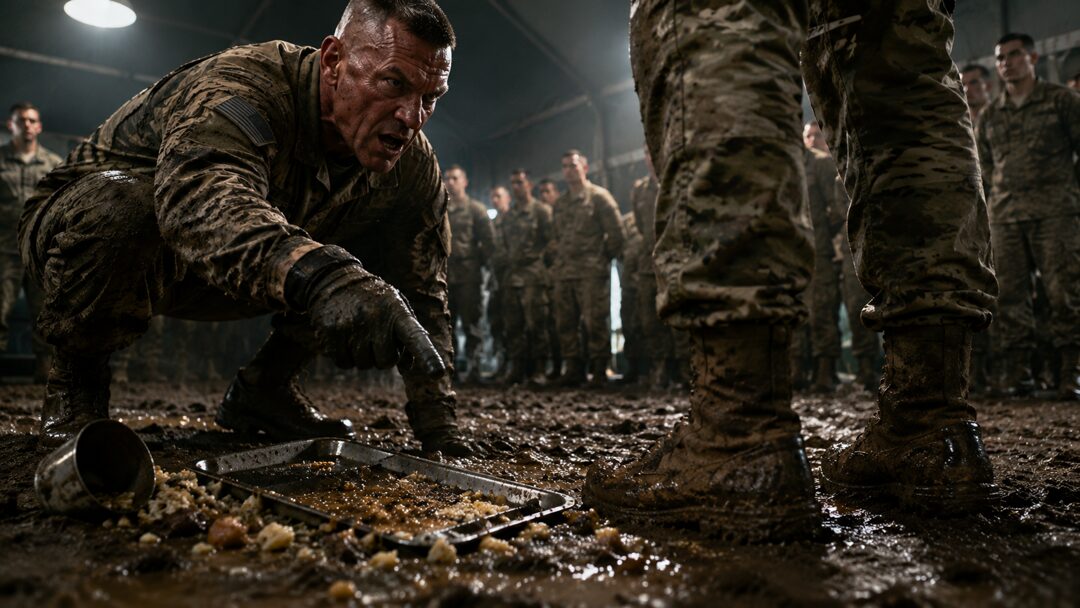
Staff Sergeant Brian Cole crouched over the spilled tray like the dirt itself had given him permission.
The food lay in the mud at his boots: pale slices of potato, clumps of rice, a strip of meat half-buried in grit, and a metal cup tipped on its side with water leaking into the brown floor of the tent. Behind him, twenty recruits stood in two silent rows beneath hanging industrial lights.
Cole pointed at the mess.
“You eat what I say.”
Recruit Joshua Miller did not move.
That was the first mistake.
Or maybe it was the first honest thing he had done all morning.
The field tent smelled like damp canvas, smoke, sweat, and reheated food. Outside, rain tapped against the fabric roof, soft enough to hear only because nobody inside dared breathe loudly. Mud had been tracked everywhere. It clung to boots, knees, elbows, tray corners, cuffs.
Joshua stood at attention in front of the overturned meal, eyes lowered but not closed. He had a buzz cut, a square jaw still too young for the exhaustion in it, and a small unauthorized-looking patch sewn flat over his left chest: a square skull-and-emblem design faded from washing.
Cole had noticed it the first day.
Cole noticed everything that could be used later.
The sergeant was built like a locked door. High-and-tight hair. Thick neck. Mud streaked across his sleeve. His face had the weathered hardness of a man who had confused surviving cruelty with being improved by it.
He rose slowly now, unfolding to full height.
The tray remained between them.
The recruits behind Joshua stayed still.
Anthony Brooks, standing two bodies to Joshua’s right, stared at the mud with his hands locked behind his back. Anthony had been shaking since breakfast formation. Everyone had seen it. Nobody had named it. Naming fear in Cole’s tent was like bleeding into water.
Cole stepped close enough that Joshua could see dried mud cracking on his boots.
“Clean it.”
Joshua’s eyes stayed down.
His throat moved once.
He still did not kneel.
Cole tilted his head.
The whole tent felt it.
The small pause before a storm.
“Recruit Miller.”
“Yes, Sergeant.”
Joshua’s voice came out steady.
That made Cole’s eyes sharpen.
“I gave you an order.”
“Yes, Sergeant.”
“Then why is my floor still dirty?”
The other recruits did not look at Joshua. They looked through him, past him, around him, anywhere except directly at the man being reduced in front of them.
That was how public shame worked.
It made witnesses pretend they were furniture.
Cole crouched again, picked up one slice of potato between two fingers, and held it out, mud clinging to one edge.
“Food is food when I say it is.”
Joshua’s hands flexed at his sides.
A small movement.
Cole saw it.
He smiled.
Not wide. Not obvious. Enough.
“You got delicate standards, Miller?”
“No, Sergeant.”
“You too clean for dirt?”
“No, Sergeant.”
“You too good for what the rest of us learned?”
Joshua lifted his eyes a fraction.
Cole leaned in.
“There he is.”
The rain hit the tent harder.
A light flickered above them.
Cole dropped the muddy potato back onto the tray.
“Don’t make me repeat myself.”
Joshua stared at the mess.
And in the mud, for half a second, he saw his brother’s hand.
Not as it was now, unsteady around coffee mugs and door frames.
As it had been years before: strong, scarred, pressing a small patch into Joshua’s palm.
“If they ever make you choose,” Mark Miller had said, “know what you’re choosing.”
Joshua had laughed then. He had been nineteen. Mark had looked older than thirty already.
“Choose what?”
Mark had closed Joshua’s fingers around the patch.
“Discipline or surrender.”
Now the patch sat against Joshua’s chest beneath Cole’s stare.
And the food stayed in the dirt.
Part II — The Shape of Obedience
Cole liked the field tent because it did not forgive softness.
The floor was mud. The air was damp. The lights buzzed. Everything smelled used. Nothing shined unless someone had worked for it.
He believed in places like this.
He believed dry rooms and clean floors lied to young men. He believed comfort taught them to trust the world, which was the first mistake any soldier could make.
So when Recruit Miller stood frozen in front of the spilled tray, Cole told himself he was not angry.
He was correcting a flaw.
“You think this is about lunch?” Cole asked.
“No, Sergeant.”
“Good. Because lunch is done.”
A few recruits swallowed.
Nobody laughed.
Cole turned so everyone could see his face.
“This is about whether you understand conditions. You don’t pick the weather. You don’t pick the ground. You don’t pick when you’re hungry. You don’t pick when you’re tired. You don’t pick what stays clean.”
He turned back to Joshua.
“You eat what I say because someday your comfort won’t matter.”
Joshua knew the speech.
Not the exact words, but the shape of it. Mark had warned him about speeches like that. Not because all of them were false. That was the dangerous part.
Some of it was true.
Hardship did teach.
Cold taught. Hunger taught. Exhaustion taught. Mud taught. Silence taught.
But humiliation taught something else.
Humiliation taught men to hide.
That was what Mark had said after the discharge, sitting in their mother’s garage with the door halfway open because he could not stand closed spaces anymore.
He had rubbed the pale raised line across his wrist, not from combat, not from glory, but from training.
“Hardship teaches,” Mark said. “Humiliation feeds the wrong man.”
Joshua had not understood then.
He understood now.
Cole stepped closer.
“You dropped that tray.”
Joshua did not answer.
Cole’s voice hardened.
“Did you drop that tray?”
“No, Sergeant.”
The tent changed.
Not much.
Enough.
Anthony’s eyes flicked up.
Cole’s smile disappeared.
“You calling me a liar?”
“No, Sergeant.”
“Then who dropped it?”
Joshua looked at the tray.
Cole had knocked it out of his hands.
Everyone had seen it.
Cole had passed too close, shoulder slamming Joshua’s tray as if by accident. The metal had hit the mud with a bright crack that made every recruit turn. Cole had crouched immediately, almost theatrically, as if the tray itself had offended him.
The trap had been built in front of them.
And still Joshua knew the rules.
The wrong answer was always the answer that told the truth too early.
“Doesn’t matter, Sergeant,” Joshua said.
Cole’s eyes narrowed.
“What matters?”
Joshua’s jaw tightened.
“The order.”
Cole studied him.
For a second, something like approval moved across his face. Then it vanished.
“Then follow it.”
Joshua stayed still.
Cole lowered his voice.
“You want to be special because of that patch?”
Joshua’s eyes snapped up before he could stop them.
Cole saw it.
There it was.
The pressure point.
Cole reached forward and tapped the small square emblem on Joshua’s chest.
“Cute little souvenir.”
Joshua’s breathing changed.
The patch had been regulation-shaped but not regulation-issued. Mark had warned him not to wear it.
“They’ll notice.”
“Good.”
“You don’t need my trouble.”
“I need to remember it.”
Mark had laughed once at that, but it had broken halfway through.
Now Cole tapped the patch again.
“Where’d you get it?”
Joshua said nothing.
Cole leaned closer.
“I asked a question.”
“My brother, Sergeant.”
“What’s his name?”
Joshua hesitated.
Cole’s eyes sharpened.
“What’s his name?”
“Mark Miller.”
The name landed.
Cole knew it.
Joshua saw that at once.
A recognition, quick and ugly.
Cole stepped back, looking Joshua up and down as if the young recruit had become a file he had misplaced.
“Mark Miller,” he repeated.
Joshua said nothing.
Cole gave a short laugh.
“Well. That explains the posture.”
Anthony looked at Joshua now.
So did three others.
Cole circled slowly, letting everyone feel the name before explaining it.
“Your brother was a promising man,” Cole said. “For a while.”
Joshua’s hands curled.
Cole came around behind him.
“Strong. Fast. Good instincts.”
Cole stopped near Joshua’s shoulder.
“Then he learned a soldier can’t file his way out of being weak.”
The words struck the tent.
Joshua’s eyes stayed forward.
Inside his chest, something hot and old opened.
Mark had filed one complaint.
One.
After a training cycle where a sergeant made exhausted recruits crawl through standing water after two had already gone down shaking. One recruit ended up in emergency care. Another quietly transferred. Mark put his name on the report because no one else would.
Six months later, Mark was gone.
Not officially because of the complaint.
Never officially.
Officially, he lacked adaptability.
Officially, he failed to meet the evolving demands of the unit.
Officially, nothing wrong had happened.
Cole leaned near Joshua’s ear.
“Tell me, Miller. Are you here to serve? Or are you here to inherit your brother’s excuses?”
That was the second mistake.
Not Cole’s.
Joshua’s.
Because for the first time, his face changed.
Part III — The Patch
Cole saw the crack and pushed harder.
That was what he did. That was how he had been trained. Find the place that hurt, press until the man either folded or hardened.
He believed the difference mattered.
He did not wonder often enough who benefited when a man folded.
“You wearing that patch for him?” Cole asked.
Joshua said nothing.
“Answer.”
“Yes, Sergeant.”
“You think it makes you strong?”
“No, Sergeant.”
“Then why wear it?”
Joshua could feel all the eyes on his chest.
The patch was small. Faded black and gray. A skull shape inside a square border, almost hidden against the pattern of his uniform. To everyone else, it looked like a symbol. To Joshua, it was the last thing Mark had given him before he stopped talking about the service in complete sentences.
“Promise,” Mark had said.
“To do what?”
“To know the difference.”
Joshua had rolled his eyes back then. “You always talk like I’m walking into a sermon.”
Mark had smiled, tired but real.
“No. You’re walking into men. That’s harder.”
Cole’s finger hooked under the patch edge.
Joshua’s whole body tightened.
“There it is,” Cole said softly. “Not the food. This.”
Joshua’s eyes dropped to Cole’s hand.
Cole noticed.
The tent noticed.
“Maybe I should take it,” Cole said. “If it’s distracting you from orders.”
Joshua’s voice came out before he measured it.
“Don’t.”
The word was low.
Not loud.
But it was the first word in the tent that did not sound like obedience.
Cole froze.
Anthony’s mouth parted slightly, then closed.
Cole turned back toward Joshua with slow satisfaction.
“Don’t?”
Joshua swallowed.
Cole stepped in front of him.
“Recruit, did you just give me an order?”
“No, Sergeant.”
“Sounded like one.”
“No, Sergeant.”
“Say it again.”
Joshua stayed silent.
Cole’s face hardened.
“You think this is dignity? Standing there like a statue while everyone waits on you?”
Joshua’s eyes moved to the tray.
The food had mixed deeper into the mud now. Water from the tipped cup had made a thin brown stream through the rice.
It looked small.
That was what made it dangerous.
People expected moral lines to look grand from a distance. Flags. speeches. doors slammed. names shouted.
Sometimes it was a tray in the dirt and a room full of men waiting to see if you would become smaller.
Cole followed his gaze.
“You can clean that in ten seconds.”
“Yes, Sergeant.”
“You can pick it up in five.”
“Yes, Sergeant.”
“You can put one bite in your mouth and this is over.”
Joshua looked at the mud.
Over.
That was how they sold surrender.
A quick end. A shorter punishment. Less attention. Less trouble. Less risk.
Mark had known that too.
“They’ll tell you dignity is expensive,” Mark had said. “They won’t tell you what it costs to sell it cheap.”
Cole straightened.
“I’m going to make this very simple.”
The recruits seemed to lean in without moving.
Cole pointed at the tray.
“Pick it up.”
Joshua did not.
Cole’s voice dropped.
“Pick it up.”
Still nothing.
Cole took one step closer, close enough for Joshua to smell coffee on his breath.
“Pick. It. Up.”
Joshua lifted his eyes.
This time, he did not look at Cole’s boots. He did not look at the tray. He did not look at the patch.
He looked straight ahead.
“No, Sergeant.”
The tent stopped breathing.
Cole’s face went still.
“What did you say?”
Joshua’s heart was hammering now. He could feel it in his throat, wrists, ribs. His fear was not gone. That was the strange part. Courage had not arrived like rescue.
The fear was there.
He spoke through it.
“I’ll clean the floor,” Joshua said. “I won’t eat from it.”
Anthony looked up fully.
So did the others.
Cole’s authority remained where it had always been: in his rank, his voice, his power to punish, his ability to ruin a day or a career or a body if the system let him.
But something else had entered the tent.
A line.
Visible now.
Part IV — Don’t Repeat It
Cole did not shout right away.
That was worse.
He stepped back, wiped a hand over his mouth, and looked at Joshua like he was deciding what kind of example to make of him.
The rain tapped harder above them.
A drop found a seam in the canvas and fell near the tray.
Nobody looked at it.
Cole turned to the recruits.
“You all hear that?”
No one answered.
“Recruit Miller has decided which orders count.”
Joshua stayed rigid.
Cole faced him again.
“You think you’re the first man with principles?”
“No, Sergeant.”
“You think this institution runs on your feelings?”
“No, Sergeant.”
“You think your brother’s little grievance makes you wise?”
Joshua’s eyes narrowed.
Cole saw it and smiled.
“Ah. There he is again.”
Joshua said nothing.
Cole moved close again, but slower this time. He wanted the room to watch every inch.
“I can remove you from this evaluation.”
“Yes, Sergeant.”
“I can write you up before dinner.”
“Yes, Sergeant.”
“I can make sure every instructor after me knows you’re the recruit who chooses which orders taste good.”
Joshua’s mouth tightened.
“Yes, Sergeant.”
Cole’s voice cut low.
“Then repeat yourself.”
Joshua did not answer immediately.
He knew the trap.
Repeating refusal made it formal. Formal made it punishable. Punishable made it real in a way silence was not.
Mark had warned him about that too, without meaning to.
“They’ll let you survive a thought,” Mark said once. “They punish sentences.”
Cole leaned in.
“Repeat yourself.”
Joshua looked at the tray.
Then at the recruits.
Not long. Just enough to see Anthony staring at him like Joshua had become a door he did not know could open.
Joshua returned his eyes to Cole.
“I’ll clean what fell,” he said. “I won’t pretend dirt is a meal.”
The sentence changed the room.
It was not rebellion the way Cole wanted it to be. It was too controlled for that. Too precise. It did not reject the work. It rejected the degradation.
Cole’s jaw tightened.
For the first time, he had to choose whether to punish discipline because it had refused humiliation.
That hesitation lasted half a second.
But everyone saw it.
Cole covered it with motion.
He shoved the empty metal cup farther into the mud with his boot.
It rolled and stopped near Joshua’s foot.
“Then clean it.”
Joshua knew what came next mattered more than the words.
If he stood there, it became pride.
If he attacked the order, it became defiance.
If he obeyed all of it, it became surrender.
So he took one breath.
Then he kneeled.
The mud soaked into one knee of his uniform immediately.
Cole watched from above.
Joshua reached for the tray.
Not the food first.
The tray.
He picked it up by the edge, careful not to fling mud. He set it upright beside the mess. Then he lifted the cup, shook the muddy water from it, and placed it on the tray.
The recruits watched him.
Joshua gathered what could be gathered and separated it from what could not. Food on one side. Mud on the other. His hands became filthy. His uniform darkened at the knees. He did not hurry.
Cole’s voice came down from above.
“You making a ceremony out of it?”
“No, Sergeant.”
“Then move faster.”
Joshua did.
But he still did not put anything in his mouth.
Cole’s fists flexed.
Anthony watched Joshua’s hands.
Not his face.
His hands.
The same hands that had been trembling earlier behind Anthony’s back slowly unclenched.
Joshua scraped the last clump of rice from the mud and placed it on the tray with the rest of the ruined food.
Then he stood.
Slowly.
He met Cole’s eyes.
The tray sat between them, dirty but upright.
Joshua’s voice was calm.
“Floor is clean enough for inspection, Sergeant.”
Cole stared at him.
No one moved.
The hanging light buzzed above them.
Outside, thunder rolled low and distant.
Cole should have won.
That was the shape of the scene. He had the rank. He had the voice. He had the tent. He had twenty witnesses.
But the witnesses were the problem now.
They had seen Joshua kneel.
They had seen him obey.
They had also seen him refuse.
Cole still had authority.
But the room had learned it was not the same thing as being right.
Part V — Extra Duty
Cole assigned him extra duty before dismissing the formation.
Of course he did.
He could not let the moment end clean. Clean endings belonged to people without rank to protect.
“Miller,” Cole said, voice flat now, “you’ll scrub equipment trays after evening chow. Alone.”
Joshua said, “Yes, Sergeant.”
Cole looked at the rest of them.
“Anyone else interested in philosophy?”
No one answered.
“Good. Formation dismissed.”
The recruits moved out in silence.
Not fast.
Not slow.
Carefully.
They avoided looking at Joshua too directly, but their avoidance had changed. Before, it had been fear of sharing his shame. Now it was something else. Respect, maybe. Or discomfort. Or the first terrible recognition that watching a thing happen did not mean you had nothing to do with it.
Anthony was the last to leave.
He looked at Joshua once.
Then at the tray.
Then away.
Cole noticed but said nothing.
For the rest of the day, Joshua waited for the punishment to become worse.
It did not.
That almost made it heavier.
Cole kept him in formation. Corrected him twice. Ignored him three times. Never mentioned Mark again. But Joshua could feel the sergeant’s attention like a hand at the back of his neck.
At evening chow, nobody dropped anything.
Nobody joked about it.
When the line cleared and the tent emptied, Joshua reported to the wash station behind the supply tent. A stack of metal trays waited beside a dented tub of cold water.
The mud on his knee had dried stiff.
His hands still smelled faintly of dirt.
He started scrubbing.
One tray.
Then another.
Then another.
The work was simple. Cold water. Rag. Pressure. Rinse. Stack.
The simplicity helped.
He did not feel victorious.
That would have been too easy, and not true. His future had not become safer. Cole had not apologized. No one had stood up in the tent and declared him right. The system had not shifted its weight because one recruit refused one bite.
But something had remained inside him.
That mattered.
He was on the ninth tray when Anthony appeared at the edge of the light.
Joshua looked up.
Anthony held a second rag.
For a second, neither of them spoke.
“You’ll get in trouble,” Joshua said.
Anthony glanced back toward the tents.
“Probably.”
Joshua kept scrubbing.
Anthony stepped closer.
“Need help?”
Joshua studied him.
Anthony’s narrow face looked nervous even now, but his eyes stayed up.
Joshua nodded once.
Anthony knelt on the other side of the tub and picked up a tray.
They worked in silence for a while.
The rain had stopped. Water dripped from the tent edges in slow, uneven taps. Somewhere farther off, men laughed in another part of camp, but the sound felt distant, like it belonged to a different day.
Anthony scrubbed one tray too hard, metal whining under the rag.
“You meant it?” he asked.
Joshua did not look up.
“What?”
“That line.”
Joshua knew which one.
He rinsed mud from the tray and stacked it clean.
“Yeah.”
Anthony nodded.
“My hands were shaking this morning,” he said.
“I saw.”
“Everybody saw.”
Joshua did not lie.
“Yeah.”
Anthony swallowed.
“I thought that meant I didn’t belong.”
Joshua looked at him then.
The right answer would have been easy if he wanted to sound strong.
Don’t be weak.
Toughen up.
Everyone shakes.
Instead, he remembered Mark in the garage, patch in hand, saying the service was full of men who mistook silence for proof.
“Fear isn’t the problem,” Joshua said.
Anthony waited.
Joshua picked up another tray.
“Letting someone use it to own you is.”
Anthony looked down at the water.
Then he nodded.
They finished the stack together.
When the last tray was clean, Anthony wrung out his rag and left without ceremony. No handshake. No speech. No dramatic promise.
Just one recruit walking back into the dark a little less alone than before.
Joshua stayed behind.
He wiped the table. Rinsed the tub. Hung the rag over a line.
Then, only when no one was close enough to see, he opened the top button of his uniform and touched the hidden seam behind the square patch.
The fabric was damp with sweat.
The patch was still there.
He thought of Mark’s hand closing his fingers around it.
Discipline or surrender.
For years, Joshua had thought the difference would announce itself.
It didn’t.
Sometimes it arrived as a meal in the dirt, a man towering over you, and a room waiting to see whether you would confuse obedience with becoming less than yourself.
A shadow moved near the supply tent.
Joshua looked up.
Staff Sergeant Cole stood at the edge of the light.
He had been watching.
His face was unreadable.
Joshua straightened, hands at his sides.
Cole looked at the clean trays.
Then at the mud still dried on Joshua’s knee.
Then at the patch.
For one long second, neither man said anything.
Cole could have added another punishment.
He could have ordered Joshua back to work.
He could have made the silence bend.
Instead, he turned and walked away.
Not defeated.
Not changed enough to trust.
But quieter.
Joshua watched him go.
Then he buttoned his uniform, lifted the stack of trays, and carried them inside.
The weight was awkward, cold against his palms.
He carried it anyway.