What the Room Remembered
Part I — The Floor Between Them
The tray hit the floor so hard that every fork in the dining facility seemed to pause in midair.
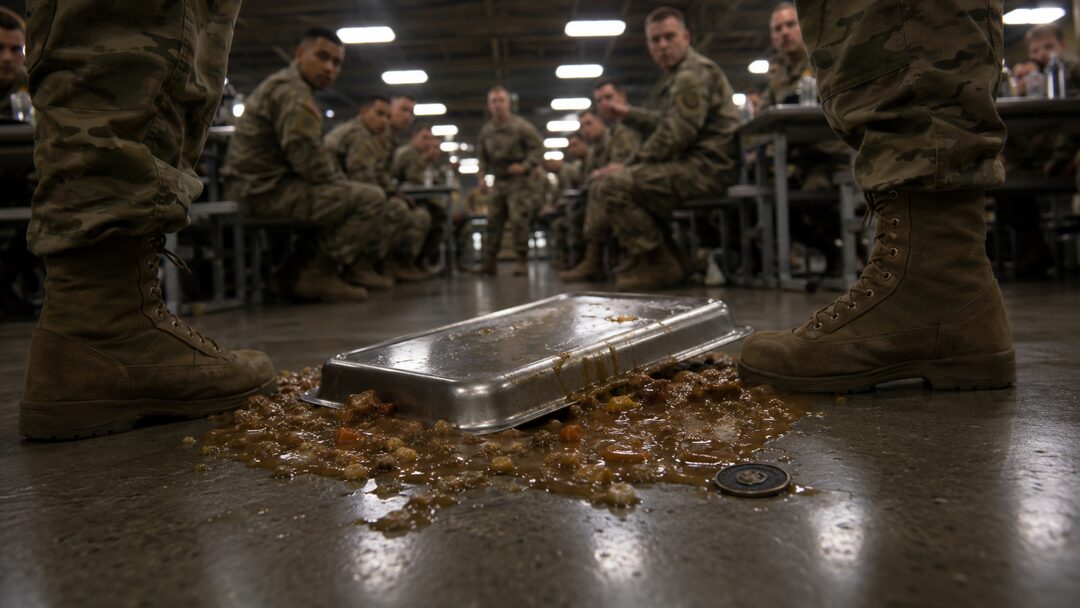
Brown stew spread across the polished concrete. Rice scattered under boots. A metal tray spun once, clanged, and settled upside down between Sergeant Emily Carter and Captain Michael Hayes.
For one second, nobody moved.
Then Hayes looked down at the mess, looked up at Emily, and said, loud enough for three long tables to hear, “Watch where you’re going. Clean it up right now. Pick it up.”
Emily did not bend.
The overhead lights made everything too sharp: the shine on the floor, the steam rising from the spilled food, the stiff set of Hayes’s jaw. Emily stood with her blonde hair pulled tight, sleeves rolled with exact precision, black gloves at her sides. Her face was calm in the way a locked door was calm.
Hayes towered just enough to make the room feel it.
“Sergeant,” he said.
Around them, soldiers in OCP uniforms pretended not to stare. They failed badly. One private froze with a fork halfway to his mouth. Another lowered his head but kept his eyes raised. At the far table, Staff Sergeant Robert Kane sat with his back to the wall, broad shoulders hunched, his hand still around a plastic cup.
He saw Emily.
He saw Hayes.
And he did not stand.
Hayes’s voice dropped. That made it worse.
“Pick it up, Sergeant.”
Emily’s eyes stayed on him.
She had heard that tone before. Not in the DFAC. Not under fluorescent lights with trays and ketchup packets and men pretending lunch had not become a formation.
She had heard it through static.
Hold position.
Do not light that section.
Wait for extraction.
Three weeks ago, that tone had crossed a radio and turned one man’s life into a calculation.
Her gaze flicked down.
Not to the stew.
Not to the rice.
To the small thing that had slid from beneath the overturned tray and come to rest near Hayes’s left boot.
A round coin. Worn at the edges. Mud-dark in the grooves. Unit crest on one side.
And in one narrow line along the rim, something old and brown that no amount of wiping had removed.
Hayes saw it too.
His anger changed shape before he could stop it. It was quick—half a second, less than a breath—but Emily caught it. Fear passed behind his eyes and vanished into command face.
He knew that coin.
The room was too quiet now.
Someone at the serving line whispered, “What is that?”
Hayes heard it. His hand twitched at his side.
“Everyone back to your meals,” he said without turning.
A few soldiers looked down. Nobody started eating.
Emily bent slowly.
Hayes’s mouth tightened, as if he had won.
But she did not touch the tray. She did not gather rice into a napkin or reach for the stew.
She picked up the coin.
A murmur traveled along the tables.
Hayes leaned close enough that only she could hear him.
“Outside. Now.”
Emily closed her gloved fingers around the coin.
Then she looked back at the mess on the floor, the mess he had ordered her to clean, and left it there.
Part II — The Coin in Her Hand
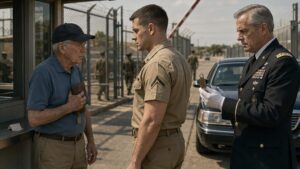
Outside, the air was hard and dry. The sun hit the gravel yard beyond the DFAC with the flat brightness of noon, but Emily felt cold under her uniform.
Hayes walked ahead of her until they reached the side of the building where the noise from inside became muffled. Then he turned.
“Where did you get that?”
Emily opened her hand.
The coin sat in her palm, darker than it should have been. Daniel Moore had carried it in his left chest pocket because he said it made him feel official. He had been twenty-two and embarrassed by how proud he was of it.
“His mother mailed it back,” Emily said.
Hayes’s face barely moved.
“Whose mother?”
Emily almost laughed.
That was the thing about official stories. Once people signed them, they expected the dead to obey too.
“Sarah Moore,” Emily said. “Daniel’s mother.”
Hayes looked toward the yard, then back to her. “Personal effects go through processing. If she had a question, there are channels.”
“She used them. No one answered.”
“That coin shouldn’t be with you.”
“No,” Emily said. “It shouldn’t have been missing from the inventory either.”
Hayes lowered his voice. “You need to be very careful.”
Emily stepped closer.
There it was again. Command dressed as concern. Threat dressed as discipline.
“She asked where it was found,” Emily said.
Hayes did not answer.
“She asked why it wasn’t listed. She asked why it looked like someone tried to clean it and gave up.”
“Enough.”
“Was he already gone when you wrote the report?”
Hayes stared at her.
For a second, everything outside the DFAC seemed to thin. The base noise, the generators, the distant call of a vehicle reversing. All of it pulled back until only the question remained.
Hayes said, “Private Moore died during the ambush.”
Emily nodded once, almost politely.
“That’s the sentence,” she said. “I know the sentence.”
“That is the record.”
“No. That’s the version you could stand to sign.”
His jaw worked once.
She had expected anger. She wanted it, maybe. Anger was clean. Anger could be met.
But Hayes looked tired in a way that made her hate him more.
“You were pinned down,” he said. “Your section was bleeding out. We had one extraction window.”
“Daniel was alive.”
“We did not have positive confirmation.”
“You had my confirmation.”
“You were concussed.”
“I knew his voice.”
Hayes looked away.
That was the first crack.
Emily felt it and pushed before she could stop herself.
“I heard him call twice. Then once. Then nothing.”
Hayes’s eyes came back to hers. “If I lit his position, the bird would have taken fire. If the bird waved off, we lost eight more.”
“Then say that.”
His silence hit harder than denial.
“Say you chose eight,” Emily said. “Say you left one. Say his mother got a folded flag and a sentence because the truth made the math ugly.”
A muscle jumped in Hayes’s cheek.
“You think I don’t know what I chose?”
“I think you made sure no one else had to.”
The door behind them opened.
Robert stepped out.
He stopped when he saw the coin in Emily’s hand.
For one moment, he looked older than thirty-three. His broad body seemed too heavy for him. The burn scar along his wrist caught the light when he removed his cap and put it back on for no reason.
Hayes’s eyes cut to him. “Staff Sergeant.”
Robert gave the smallest nod.
“Sir.”
Emily waited for him to say something. Anything.
Robert looked at her, then at the coin, then at the ground.
Hayes said, “This conversation is over.”
Emily closed her hand again.
“No,” she said. “It just finally started.”
Hayes stepped past her and walked away.
Robert stayed.
For a few seconds, neither of them spoke.
Then Robert said, “You shouldn’t have done it in there.”
Emily turned on him. “That’s what bothers you?”
“What bothers me,” Robert said, keeping his voice low, “is that you brought his mother’s grief into a room full of hungry men and gave them something they can’t unknow.”
“Good.”
“No,” Robert said. His eyes sharpened. “Not good. Dangerous.”
Emily stared at him.
Robert had carried two men out of a burning vehicle with one functioning hand. Robert had sat awake beside Emily in the aid tent when she couldn’t remember whether Daniel’s last call had been real. Robert had taught younger soldiers how to laugh again without apologizing for it.
Now he looked at the coin like it might split the base open.
“You signed it,” Emily said.
He flinched.
Not much. Enough.
“You signed the statement.”
“So did six others.”
“I didn’t.”
“You were in medical hold.”
“I would have refused.”
“You think that makes you cleaner?”
The words landed too hard.
Emily’s fingers tightened around the coin until the edge bit through the glove.
Robert’s voice softened, which somehow made it worse.
“We were exhausted. We were stitched up. Command came in with papers and phrases and said it would keep Daniel’s family from hearing things they didn’t need to hear.”
“They needed the truth.”
“We needed to keep breathing.”
Emily said nothing.
Robert looked toward the DFAC wall. Inside, trays scraped again. The room had resumed its noise because rooms always did. People could eat around almost anything if no one made them look directly at it.
“He was gone, Em,” Robert said.
“You don’t know that.”
His face folded.
“No,” he said. “I don’t.”
That was the first honest thing anyone had said in three weeks.
And it did not help.
Part III — The Version They Could Carry
The memorial meal was scheduled for Friday.
The notice appeared on the board outside the DFAC in neat block letters. Private Daniel Moore. Unit remembrance. Family joining by video call. Attendance expected.
Expected.
Emily stood before the notice for nearly a full minute.
Robert came up beside her and said, “Don’t.”
She did not look at him. “You don’t know what I’m going to do.”
“I know your face.”
“That’s unfortunate for both of us.”
He exhaled through his nose, not quite a laugh.
The base moved around them. Soldiers passed with laundry bags. Someone cursed at a jammed vending machine. Life had a cruel talent for continuing at normal volume.
Robert lowered his voice. “Hayes requested a correction.”
Emily turned then.
“What?”
“After we got back.”
She searched his face for a lie.
Robert looked like he wished he had one.
“He wrote up an amendment. Timeline, contact report, extraction decision. Not all of it, but enough.”
Emily’s throat tightened. “Then why didn’t it go through?”
Robert rubbed his wrist, thumb passing over the burn scar again and again.
“Because higher asked what kind of inquiry he was inviting. Asked if he wanted the convoy reviewed. Asked if he wanted awards delayed. Benefits questioned. Deployment extended while they sorted blame.”
Emily felt the ground shift under a truth she had built too neatly.
Hayes had tried.
Not enough. Too late. Then not at all.
But tried.
“That doesn’t absolve him,” she said.
“No.”
“It doesn’t change Daniel.”
“No.”
“It doesn’t change what he signed.”
Robert looked at her. “It changes whether he’s the only coward in the story.”
Emily hated him for saying it. She hated him more because she knew he had included himself.
That night, she sat on the edge of her cot with Daniel’s coin on her knee.
The room was narrow. Her locker stood open. Inside, her uniforms were lined up with punishing neatness. She could not control memory, so she controlled everything cloth and metal.
The coin had arrived two days earlier inside a padded envelope addressed to the unit.
Sarah Moore had written a note in blue ink.
I know this was my son’s because he showed it to me on video. He said he kept it with him. It was returned separately by someone whose name I was not given. Can you please tell me where it was found?
That was all.
No accusation.
No screaming.
Just a mother asking for the location of the last thing her son had touched.
Emily had read the note once. Then again. Then she had put the coin beneath her tray before walking into the DFAC, telling herself she only wanted Hayes to see it.
She had not planned to drop the tray.
Not exactly.
She had seen him step into her path, tray in hand, watch on his left wrist, face shaved almost clean except for the stubble he never got rid of. She had seen the room part for rank without thinking.
And something in her had refused to step aside.
The trays collided.
Food fell.
The coin surfaced.
Maybe accidents were just decisions people had not admitted to yet.
A knock came at the open door.
Robert stood there.
“You’re going to the memorial,” he said.
“Yes.”
“With the coin.”
“Yes.”
He leaned against the frame. “If you turn that room into a fight, Daniel’s mother will remember us as the people who used her son to tear each other apart.”
Emily picked up the coin.
“What do you want me to do?”
“I want you to think past the first punch.”
“I’m not punching anyone.”
“You are when you speak without caring who bleeds.”
Emily looked at him.
He held her gaze this time.
That was new.
Robert said, “I signed because I was scared. Not of prison. Not of losing rank. I was scared Daniel’s mother would ask me if he knew we were leaving him, and I would have to say yes.”
Emily’s anger lost its balance.
Robert’s voice went rough.
“I was scared the boys would look at each other and think, I am alive because he isn’t. And I was scared I’d think it too.”
Emily closed her hand over the coin.
“You already do.”
Robert nodded once.
“Yes.”
He left after that.
No apology. No request. Just the truth, placed down and left between them.
Emily did not sleep.
By morning, she knew only one thing.
If she spoke, she could not do it to punish Hayes.
Punishment would make the room choose sides.
Daniel deserved better than becoming a side.
Part IV — The Clean Table
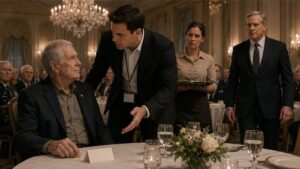
On Friday, the DFAC looked too clean.
The floor had been polished until the lights reflected in long white bars. The tables were lined straight. Someone had placed a framed photo of Daniel Moore beside a folded cloth and a unit mug near the serving area.
In the photo, Daniel grinned like someone had just said something stupid and he had decided to enjoy it anyway.
Emily stood in line with the coin in her pocket.
It felt heavier than metal.
Across the room, Hayes held a printed page. His face was composed. His uniform was exact. The watch on his left wrist caught the light each time he adjusted the paper.
Robert sat at the same table as before.
Back to the wall.
Hands flat.
When the video screen came on, Sarah Moore appeared in a small square of light.
She wore a soft gray cardigan over a black blouse. Her brown hair, streaked with gray, was tucked behind one ear. She looked tired but careful, as if grief had taught her that people became uncomfortable when it was too visible.
The base commander spoke first.
He said Daniel’s name with weight. He said service. He said honor. He said sacrifice.
All true words.
All insufficient.
Sarah listened with a polite stillness that hurt to watch. Her eyes moved from face to face on the screen, searching for the part no one had written down.
Then Hayes stepped forward.
The room settled.
He unfolded his paper.
“Private Daniel Moore represented the best of this unit,” he began. “He served with courage, loyalty, and distinction. On the day of the convoy incident, he—”
Emily stood.
Every head turned.
The room went back to the first day.
Forks stopped. Shoulders tightened. Someone breathed in and did not let it out.
Hayes looked at her.
His eyes dropped to her hand.
She had the coin.
For one second, he was back by the spilled tray. The same fear crossed his face. This time, he did not hide it quickly enough.
Robert stared at the table.
Emily walked forward.
Not fast. Not dramatic. Her boots made small sounds on the clean floor.
The base commander said, “Sergeant Carter?”
Emily did not answer him.
She stopped in front of Hayes and placed the coin on the table beside Daniel’s photo.
The little sound it made was almost nothing.
But everyone heard it.
Emily looked from Hayes to the screen.
Then she said, “His mother asked where this was found.”
Sarah’s face changed.
Not much.
Enough.
Hayes looked at the coin.
The paper in his hand trembled once.
The commander said, sharper now, “Captain Hayes.”
Hayes did not look at him.
Emily waited.
She had imagined this moment a hundred times with more anger in it. She had imagined accusation. She had imagined Hayes cornered and pale. She had imagined the room turning on him.
But now Daniel’s mother was watching.
And Emily understood Robert’s warning.
If she made the truth a weapon, everyone would defend themselves from it.
Hayes set the paper down.
He took a breath.
Then another.
When he spoke, his voice was lower than before.
“Mrs. Moore,” he said, “your son was alive longer than the official report states.”
Nobody moved.
Sarah’s hand rose to her mouth, but she did not interrupt.
Hayes looked down at the printed tribute he would not read.
“During extraction, I made the decision not to illuminate his last known position. I believed doing so would risk the aircraft and the remaining wounded. That decision may have saved lives.”
His throat worked.
“It also left your son without recovery while he may still have been alive.”
Emily felt the room absorb it badly. Like the words had entered everyone at different speeds.
Hayes continued, each sentence costing him more.
“I signed a report that made that decision cleaner than it was. I wrote a version I could survive reading. That was not the same as the truth.”
The base commander’s face had gone still in a dangerous way.
Hayes did not look at him.
“I am sorry,” Hayes said to Sarah. “Not because that fixes anything. It does not. But because you should not have had to ask where your son was found.”
Sarah closed her eyes.
On the screen, her image blurred for a second, then steadied. Maybe it was the connection. Maybe it was tears. Nobody in the room seemed brave enough to decide.
Then a chair scraped.
Robert stood.
Emily turned.
His broad hands were curled at his sides. His face looked stripped bare.
“I signed it too,” Robert said.
The room shifted.
Robert looked at Sarah through the screen.
“I was there. I heard him. I let the report say less than I knew because I wanted the rest of us to keep standing. Ma’am, that was wrong.”
A young soldier at the back looked down.
Another pressed both palms against the table like he might be sick.
Sarah said nothing for several seconds.
When she finally spoke, her voice was quiet enough that everyone leaned toward it.
“Did he know you heard him?”
No one answered.
That was answer enough.
Hayes lowered his head.
Robert shut his eyes.
Emily gripped the edge of the table until her glove creaked.
Sarah nodded once, slowly, as if she had received a package she had been expecting and dreading.
“Thank you,” she said.
The words did not absolve anyone.
They only ended the lie.
Part V — After the Room Emptied
By evening, everything had consequences.
Emily was ordered to report for review at 0800.
Hayes was relieved pending inquiry.
Robert sat outside the barracks with two soldiers from the convoy who stood ten feet away from him and could not decide whether to approach.
The base did not explode. That almost made it worse.
Dinner was served.
Reports were filed.
People spoke in low voices and stopped when Emily passed.
That was how truth moved at first: not like thunder, but like a draft under doors.
Emily kept Daniel’s coin until she was told to surrender it as evidence. The officer who gave the instruction would not meet her eyes. He held out a clear envelope.
She placed the coin inside.
Before she let go, her gloved hand rested over it.
Just once.
Then she released it.
At 2300, unable to sleep, Emily found a mop and bucket in the supply closet beside the laundry room.
No one stopped her.
The DFAC was nearly dark when she entered. Only the low security lights remained, turning the polished floor dull and gray. The long tables were empty. Chairs sat upside down on some of them. The serving line was covered.
The morning’s mess was gone, of course.
Someone had cleaned it after she walked out.
But near the place where the tray had fallen, a faint dull patch remained. Maybe residue. Maybe her imagination. Maybe the floor remembered what people wanted erased.
Emily pushed the bucket toward it.
Then she stopped.
Hayes was already there.
Not in uniform. Gray PT shirt. Dark pants. No rank on his chest. No paper in his hand. He held a rag and a spray bottle, crouched beside the faint mark.
For a moment, neither of them spoke.
The first confrontation stood between them, but altered.
No watching soldiers.
No order.
No tray.
No coin.
Just the floor.
Hayes looked older without the uniform doing some of the work for him. His stubble had darkened. His watch was still on his left wrist.
Emily set the bucket down.
He looked at it, then at her.
“You shouldn’t have to clean that,” he said.
His voice was quiet. Not command. Not apology, exactly.
Emily picked up the mop.
“Neither should he.”
Hayes looked away first.
That mattered less than she thought it would.
For a while, they worked in silence. He scrubbed the place where the stew had dried near the seam in the concrete. She mopped the wider circle around it. The bucket water turned cloudy. The floor slowly lost its dullness.
Emily had imagined hating him forever as a form of loyalty.
Now she understood that hate was too simple to hold everything.
Daniel was still gone.
Sarah had her answer and no comfort.
Robert had stood, but he would carry the weeks he had not.
Hayes had told the truth after failing to tell it sooner.
And Emily had survived a choice she could not forgive.
When the floor was clean, Hayes stood. He did not offer his hand. She was grateful.
At the door, he paused.
“Sergeant,” he said.
Emily looked at him.
For a second, she heard the old tone and braced against it.
But Hayes only said, “You were right not to pick it up.”
Then he left.
Emily stayed in the dim DFAC with the mop in her hands, surrounded by tables where everyone had once pretended not to watch.
The floor shone again.
That did not make it innocent.
Emily wrung out the mop, emptied the bucket, and turned off the last light.
Outside, the night air met her face, cool and dry.
Somewhere on base, a generator hummed. Somewhere, men were trying to sleep with a new version of themselves. Somewhere far away, Sarah Moore knew one more unbearable thing about her son and one fewer false one.
Emily stood there until her breathing steadied.
Then she walked back across the gravel, hands empty, shoulders straight, carrying nothing anyone could see.