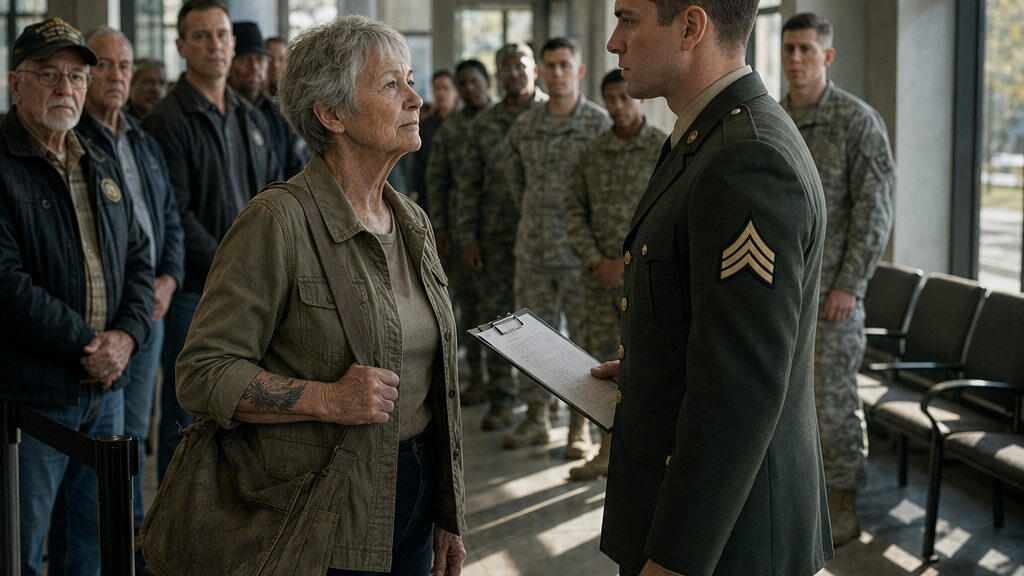
The Young Sergeant Thought Carolyn Was Just Waiting in Line Until He Learned Why She Returned to the Base Every Month
Chapter 1: The Woman Steven Wanted Removed From the Line
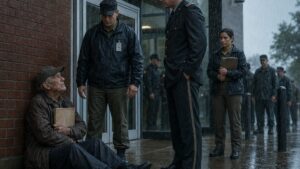
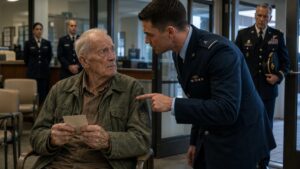
“Ma’am, if you don’t have an appointment, you need to step out of the line.”
The words cut through the lobby loudly enough that several people turned their heads.
Carolyn Harris did not move.
She stood with both hands resting on the handle of a worn canvas bag. The morning crowd shuffled around her. Veterans waited for paperwork. Soldiers crossed the polished floor carrying folders and coffee cups. A television mounted near the ceiling played silent news.
The woman in front of Carolyn glanced back nervously.
The man behind her looked away.
Only Carolyn remained still.
“Ma’am,” the young sergeant said again.
His name tag read LEWIS.
He looked no older than thirty.
“I’ve explained this twice already.”
Carolyn lifted her eyes to him.
“Then I heard you twice.”
A few people exchanged looks.
Steven Lewis felt irritation rise in his chest.
The morning had already been difficult. Two staff members were out sick. A computer system had frozen for nearly an hour. The line stretched halfway across the lobby.
And every month, without fail, the same older woman appeared.
Nobody seemed to know exactly why.
She never caused a scene.
Never complained.
Never raised her voice.
But she always requested access to records she wasn’t authorized to view and always refused to explain herself beyond the same simple statement.
I’m here for my monthly visit.
Nothing more.
Steven had inherited the problem from the sergeant before him.
Now it was his problem.
“You can’t stay in line if we can’t process your request,” he said.
“I understand.”
“Then why are you standing here?”
“Because it’s the first step.”
The answer made several people quietly smile.
Steven did not.
“This isn’t how military administration works.”
Carolyn nodded.
“No. It rarely is.”
The response landed oddly.
Not sarcastic.
Not hostile.
Just calm.
Almost tired.
Steven noticed something then.
The sleeve of her light jacket had shifted slightly.
Part of a faded winged tattoo appeared near her shoulder.
Old ink.
Military style.
But plenty of former service members had tattoos.
It didn’t mean anything.
“Ma’am, I’m asking you to move aside.”
The room grew quieter.
A junior soldier near the entrance slowed his pace.
Another paused beside a vending machine.
Everyone sensed the tension.
Carolyn looked toward the front desk.
The clerk avoided eye contact.
The clerk knew her.
Most people on staff did.
Not well.
Just enough to recognize her face.
Enough to know she appeared every month.
Enough to know nobody had ever solved the mystery.
“Are you refusing?” Steven asked.
Carolyn studied him for a moment.
He looked exhausted.
His uniform was neat.
His jaw was tight.
She had known men like him her entire life.
Good people who confused control with responsibility.
“No,” she said softly.
Then she stepped out of line.
Just like that.
No argument.
No complaint.
No appeal.
The sudden surrender made Steven feel strangely dissatisfied.
The people watching slowly returned to their business.
A few disappointed expressions suggested they had expected something more dramatic.
Carolyn carried her canvas bag toward a row of chairs.
She sat.
Folded her hands.
Waited.
Steven stared at her for a moment.
Then forced himself back to work.
The morning continued.
Names were called.
Documents stamped.
Questions answered.
Yet every time Steven glanced toward the seating area, Carolyn was still there.
Watching.
Waiting.
Never impatient.
Never demanding.
Near noon, Matthew Wilson approached the counter.
The young soldier lowered his voice.
“Sergeant?”
“What?”
“Who’s the lady?”
Steven sighed.
“No idea.”
“She comes here often?”
“Apparently.”
Matthew looked toward Carolyn.
“She doesn’t seem confused.”
“I didn’t say she was.”
“People are talking.”
“People always talk.”
Matthew hesitated.
“Still seems kind of rough.”
Steven looked up sharply.
“You think I enjoy this?”
“No, Sergeant.”
“Then get back to work.”
Matthew left.
But the conversation lingered.
Because Steven knew what the younger soldier meant.
The entire lobby had watched.
The older woman had looked less like a problem and more like someone being sent away.
By midafternoon, Carolyn finally stood.
She walked toward the exit.
Steven expected another request.
Another attempt.
Instead she stopped beside the front desk.
The clerk handed her a small envelope.
Carolyn thanked her.
Nothing else.
No records.
No special treatment.
Just an envelope.
Then she left.
Steven frowned.
“What was that?”
The clerk shrugged.
“The usual.”
“What usual?”
“She picks it up every month.”
“What’s inside?”
“I don’t know.”
“You’ve never asked?”
The clerk laughed.
“She never offers.”
The answer bothered him more than it should have.
After closing time, the lobby emptied.
The building settled into evening silence.
Steven remained behind finishing reports.
The front desk clerk gathered her things.
“Before you go,” he said.
“Yeah?”
“That woman. Carolyn.”
The clerk stopped.
“You really don’t know?”
“Know what?”
She pointed toward a nearby records terminal.
“Look her up.”
“Why?”
“Because everybody eventually does.”
The clerk left.
Curiosity finally won.
Steven logged into the visitor system.
He entered Carolyn Harris.
A file appeared.
Then another.
And another.
The screen filled with entries.
Steven leaned closer.
His eyes narrowed.
The records stretched back year after year.
Month after month.
No gaps.
No interruptions.
Twenty-three years.
Twenty-three years of monthly visits.
Always the same building.
Always signed in.
Always signed out.
Always Carolyn Harris.
Steven sat back slowly.
Outside, the last sunlight faded across the parking lot.
Inside the empty office, the visitor log glowed on the screen.
Twenty-three years.
For what?
Chapter 2: A Name Written in Every Month
Steven arrived earlier than usual the next morning.
The visitor log was still on his mind.
Twenty-three years.
The number felt impossible.
People transferred.
Buildings changed.
Administrators retired.
Policies came and went.
Yet somehow Carolyn Harris had continued returning month after month through all of it.
He logged into the records system before taking off his jacket.
The same entries appeared.
Neat.
Consistent.
Unremarkable.
That was what made them remarkable.
There was no dramatic note attached.
No special authorization.
No explanation.
Just signatures.
Dates.
Times.
An ordinary record of an apparently ordinary visit.
Steven opened older files.
The entries continued.
Different clerks.
Different security officers.
Different command staff.
Always Carolyn.
Always present.
A knock interrupted him.
Melissa Anderson stepped inside carrying coffee.
“You look like you slept here.”
“Feels like it.”
She set a cup on his desk.
“You found the visitor log.”
Steven looked up.
“You knew?”
“Everybody knows.”
“Then why does nobody explain it?”
Melissa shrugged.
“Because nobody has an explanation.”
“That doesn’t make sense.”
“Not everything does.”
She left before he could ask more.
Steven stared again at the screen.
Eventually he opened archived visitor requests.
Most were routine.
A few contained notes.
Several mentioned Carolyn.
Always brief.
Cooperative.
Polite.
Returns monthly.
No issues.
Nothing else.
No answers.
Only repetition.
By midmorning the mystery had become personal.
When Carolyn entered the building shortly before noon, Steven noticed immediately.
She wore the same jacket.
The same canvas bag.
The same calm expression.
She signed in.
Then took a seat.
Not even approaching the counter.
As if she already knew what would happen.
Steven watched for nearly ten minutes before finally crossing the lobby.
“Ms. Harris.”
She looked up.
“Sergeant.”
“Can I ask you something?”
“You usually do.”
A hint of amusement touched her eyes.
Not mockery.
Something gentler.
Steven sat across from her.
“You’ve been coming here for twenty-three years.”
She was silent.
“So that’s true.”
“Yes.”
“Why?”
Carolyn looked toward the window.
Outside, a flag moved slowly in the breeze.
“Because I said I would.”
“That doesn’t explain anything.”
“It explains enough.”
“Enough for who?”
“For me.”
Steven fought back frustration.
“You know how strange this looks?”
“Probably.”
“People think you’re here for benefits.”
“No.”
“They think you’re filing complaints.”
“No.”
“Some think you’re confused.”
Carolyn smiled faintly.
“That one never lasts long.”
Steven almost smiled despite himself.
Almost.
“What are you actually doing here?”
Her gaze settled on him.
For the first time he noticed how steady it was.
Not defensive.
Not evasive.
Simply unwilling.
“I made a promise.”
“To who?”
“I don’t discuss that.”
“Why?”
“Because it wasn’t made to you.”
The answer ended the conversation.
Not harshly.
Just completely.
Steven sat there a moment longer.
Then stood.
“Fine.”
Carolyn nodded.
“Fine.”
Yet as he walked away, he felt less certain than before.
Because confused people usually wanted attention.
Entitled people wanted exceptions.
Manipulative people wanted leverage.
Carolyn wanted none of those things.
That afternoon he began looking elsewhere.
Personnel archives.
Historical base records.
Memorial programs.
Nothing obvious connected to her.
The only unusual detail he found was a repeated authorization code attached to several of her visits years ago.
The code was long inactive.
Its purpose had been deleted from modern systems.
Another dead end.
Near closing time Matthew appeared again.
“You still working on that?”
Steven looked up.
“Working on what?”
“The mystery woman.”
Steven snorted.
“That’s what people are calling her now?”
“Pretty much.”
Matthew hesitated.
“Can I tell you something?”
“Depends.”
“When you asked her to leave the line yesterday…”
Steven waited.
“She didn’t look embarrassed.”
“No?”
“She looked sorry.”
The comment lingered after Matthew left.
Sorry.
Not angry.
Not hurt.
Sorry.
As if she understood something nobody else did.
Near sunset Carolyn rose from her chair.
She approached the front desk.
The clerk handed her another envelope.
Carolyn thanked her.
Then turned toward the exit.
Steven stepped into her path.
Not aggressively.
Just enough to stop her.
“Ms. Harris.”
She waited.
“If I find the answer myself, will you tell me if I’m right?”
Carolyn considered him.
“You might.”
“Might?”
“If you find the right question first.”
Before he could respond, she walked past him.
Out the doors.
Into the fading evening light.
Steven watched until she disappeared.
Then he looked back toward the visitor records office.
For the first time, the mystery no longer felt like a problem.
It felt like a story.
And somewhere inside it, he was beginning to suspect there was a person everyone had overlooked.
Including him.
Chapter 3: The Promise Nobody Asked About
The memorial grounds were nearly empty.
Carolyn preferred them that way.
The crowds came during ceremonies.
On holidays.
On anniversaries.
She came on ordinary mornings.
When the wind moved through the trees without interruption.
When names could exist without speeches.
She followed the familiar path between stone markers.
The winged tattoo beneath her sleeve ached slightly as it often did when rain was coming.
Age had a way of turning old injuries into weather reports.
She stopped before a particular section of the memorial.
For several moments she said nothing.
She never did.
The conversations happened inside her.
The same way they had for years.
Twenty-three years.
Long enough for buildings to change.
Long enough for children to become parents.
Long enough for grief to become something quieter but never smaller.
She lowered herself onto a nearby bench.
The canvas bag rested beside her.
Inside were documents, letters, and photographs she almost never showed anyone.
Not because they were secret.
Because they belonged to promises.
And promises changed when too many people touched them.
A group of younger soldiers passed nearby.
None recognized her.
That was fine.
Recognition had never been the point.
She watched them disappear around a corner.
Then her thoughts drifted backward.
Not all the way.
Just enough.
A dusty road.
A transport convoy.
A voice laughing at something she could no longer remember.
A young service member making her promise something ridiculous.
If anything ever happens, don’t let them forget the families.
At the time it had sounded unnecessary.
Life always sounded permanent when people were young.
Then one day it wasn’t.
Carolyn closed her eyes.
The memory faded.
Leaving only the promise behind.
That was what remained after twenty-three years.
Not heroics.
Not glory.
Not rank.
Just responsibility.
A responsibility nobody had assigned.
A responsibility she had accepted anyway.
Footsteps approached.
Carolyn opened her eyes.
A woman stood a few yards away.
Middle-aged.
Dark hair touched with gray.
Holding flowers.
For a moment neither spoke.
Then the woman smiled.
“Carolyn.”
Carolyn’s expression softened.
“Elizabeth.”
Elizabeth Ramirez walked closer.
“You came early.”
“So did you.”
They sat together on the bench.
Comfortable silence settled between them.
The kind earned through years rather than conversation.
After several minutes Elizabeth spoke.
“I heard there was trouble at the administration building.”
Carolyn sighed.
“News travels.”
“It always does.”
“They’ll forget.”
Elizabeth shook her head.
“No. They won’t.”
Carolyn looked toward the memorial.
“Maybe that’s for the best.”
Elizabeth studied her.
“You still won’t tell them?”
“There’s nothing to tell.”
“There is.”
“No.”
Elizabeth smiled sadly.
“That’s the problem. You still believe that.”
The flowers rested across Elizabeth’s lap.
She brushed a thumb across one of the stems.
“My son would’ve argued with you.”
Carolyn looked away.
The words still hurt after all these years.
Not sharply anymore.
Just steadily.
Like an old scar.
“Your son argued with everybody.”
That earned a small laugh.
“Yes. He did.”
Silence returned.
The wind moved through the trees.
Somewhere in the distance, a flag rope tapped gently against a pole.
Elizabeth finally spoke again.
“Twenty-three years is a long time.”
Carolyn nodded.
“Yes.”
“You kept your promise.”
“I tried.”
“You did more than try.”
Carolyn didn’t answer.
Because she wasn’t sure she agreed.
Promises were difficult things.
No matter how much you gave them, they always seemed to ask for more.
Elizabeth reached into her purse.
She removed a folded envelope.
“For you.”
Carolyn frowned.
“What is it?”
“Something I’ve been meaning to write.”
“I don’t need it.”
“I know.”
Elizabeth placed it into Carolyn’s canvas bag anyway.
“Take it home.”
Carolyn looked at the envelope but didn’t remove it.
Not yet.
Not here.
Elizabeth stood.
“I should go.”
Carolyn rose with her.
The two women embraced briefly.
Years of shared grief passed silently between them.
Then Elizabeth stepped back.
“They’ll figure it out eventually.”
“Maybe.”
“And when they do?”
Carolyn looked across the memorial grounds.
Toward the names.
Toward the past.
Toward everything that remained unfinished.
“I hope they’re kind to themselves when they do.”
Elizabeth’s eyes softened.
“That sounds like you.”
After she left, Carolyn remained standing alone.
The wind tugged lightly at her jacket sleeve.
The edge of the winged tattoo appeared again.
A faded mark from another life.
A life that had led, somehow, to this promise.
To these monthly visits.
To twenty-three years of showing up.
And far across the base, without knowing it, Steven Lewis had just begun asking questions whose answers would change the way he saw her forever.
Chapter 4: What Melissa Noticed First
Melissa Anderson had worked at the administration building for eleven years.
That was long enough to recognize patterns.
Long enough to know which veterans needed extra assistance, which officers forgot paperwork, and which soldiers waited until the last possible minute to solve problems.
It was also long enough to know when everyone around her had decided something without evidence.
The story about Carolyn Harris had settled into the building like dust.
People spoke about her as if they knew her.
The lonely veteran.
The confused veteran.
The woman who couldn’t let go of the past.
Nobody ever said those things cruelly.
That almost bothered Melissa more.
The assumptions sounded reasonable.
Comfortable.
Easy.
And easy stories were usually wrong.
Three days after Carolyn’s visit to the memorial grounds, Melissa sat alone in a records room reviewing archived correspondence.
A routine audit had uncovered several storage boxes that needed sorting.
Most contained old administrative paperwork.
Requests.
Transfers.
Retirements.
Forms nobody would ever read again.
Melissa opened another box.
Inside sat dozens of envelopes secured with rubber bands.
Most were addressed to families.
Some had military return addresses.
Others had none.
She began sorting them.
Then stopped.
A familiar name appeared.
Carolyn Harris.
Melissa pulled out the envelope.
The date made her blink.
Nearly twenty years old.
She opened the attached administrative note.
The document wasn’t confidential.
Just forgotten.
It described assistance provided to the surviving family of a deceased service member.
Melissa continued reading.
Carolyn’s name appeared repeatedly.
Not as a recipient.
Not as a complainant.
As a volunteer contact.
She opened another file.
Then another.
The pattern repeated.
Family support.
Benefit navigation.
Memorial coordination.
Housing referrals.
Travel assistance.
Always different families.
Always different situations.
Always Carolyn.
Yet nowhere did her name appear on official staff rosters.
She wasn’t employed by the base.
Hadn’t been for years.
Melissa sat back slowly.
The room felt quieter.
A knock sounded at the doorway.
Matthew Wilson stepped inside carrying folders.
“You hiding from people?”
“Thinking.”
“Dangerous hobby.”
Melissa handed him one of the files.
“Read this.”
Matthew scanned a page.
Then another.
His expression changed.
“Wait.”
“Exactly.”
“I thought she just came here every month.”
“So did everyone else.”
Matthew flipped through more pages.
“How many families are these?”
“I don’t know yet.”
“But it’s a lot.”
Melissa nodded.
“A lot.”
Matthew looked toward the ceiling as if searching for an explanation.
“Why would she do all this?”
“Maybe somebody needed to.”
The answer lingered.
Because neither of them could find a better one.
Later that afternoon Melissa approached Steven’s office.
He sat behind his desk surrounded by open files.
The mystery had clearly become an obsession.
“You need a break.”
“I need answers.”
Melissa placed several folders in front of him.
His eyes narrowed.
“What are these?”
“Something I found.”
Steven opened the first folder.
Silence followed.
Then another folder.
Then another.
His expression slowly changed.
“This can’t be everything.”
“No.”
“What is it?”
“Families.”
Steven continued reading.
Widows.
Parents.
Children.
Dozens of cases spread across years.
Every file contained evidence of quiet help.
Phone calls.
Letters.
Directions.
Referrals.
Small acts buried inside paperwork.
“Why isn’t she listed anywhere?” he asked.
Melissa shrugged.
“Maybe she never wanted to be.”
Steven leaned back.
The image he had built of Carolyn was beginning to crack.
Not collapse.
Just weaken.
Because the files answered some questions but created others.
Why keep returning?
Why continue for decades?
Why never mention any of it?
“She could’ve told me,” he said.
Melissa looked at him.
“Would you have listened?”
The question landed harder than she intended.
Steven said nothing.
Melissa immediately regretted the sharpness.
But she didn’t take it back.
Because she wasn’t entirely wrong.
After a moment Steven returned to the folders.
“What am I missing?”
“I think we’re all missing something.”
That evening, after most employees left, Steven remained alone.
The files covered his desk.
Outside his office window, the administration building settled into silence.
He opened another folder.
Inside sat a photocopy of a handwritten note.
The original had long since disappeared.
The writing was faded.
The signature barely readable.
Yet one sentence remained clear.
If you need anything, Carolyn knows how to find me.
Steven frowned.
The note was signed by a service member killed decades ago.
The date preceded Carolyn’s first visitor log entry by only a few months.
His pulse quickened.
He searched the attached documents.
There was very little.
Just fragments.
Pieces.
Names.
References.
One recurring family name.
Ramirez.
The same surname appeared repeatedly.
Steven stared at it.
Then remembered something.
Elizabeth Ramirez.
The woman Carolyn had met at the memorial grounds.
The name appeared again.
And again.
Not everywhere.
Just enough.
Enough to suggest a connection.
Enough to suggest the answer might not be hidden in official records at all.
Steven slowly closed the folder.
For the first time, the mystery felt less like administration and more like grief.
And grief rarely fit neatly inside a file cabinet.
Before leaving for the night, he gathered the documents into a stack.
One folded letter slipped free and landed on the floor.
Steven picked it up.
The envelope had never been opened.
Across the front was written a simple instruction.
For Carolyn, if she ever decides she’s done.
Steven stared at the words.
Then carefully placed the envelope back on his desk.
For the first time since this began, he wasn’t eager to know the answer.
He was afraid of what it might cost.
Chapter 5: The Weight of Twenty-Three Years
Carolyn kept the letter from Elizabeth unopened for four days.
It remained on her kitchen table.
A silent presence beside her morning coffee.
Beside the newspaper.
Beside evenings spent staring through the window at a neighborhood that had changed around her.
Eventually she opened it.
Not because she was ready.
Because she had run out of reasons not to.
The letter was only three pages long.
Elizabeth’s handwriting leaned slightly to the right.
The first page made Carolyn smile.
The second made her laugh quietly.
The third left her staring at the table long after sunset.
You kept a promise that belonged to a young man who never got the chance.
But somewhere along the way, you forgot that the promise was never supposed to cost your whole life.
Carolyn folded the letter.
Then unfolded it again.
The words followed her into sleep.
Into memory.
Into places she rarely allowed herself to revisit.
Years earlier, before the gray hair and aching joints and monthly visitor logs, she had been standing beside a transport vehicle in a foreign country.
The air had been hot.
Dust clung to everything.
A young service member named Ramirez had been sitting on a crate pretending not to be nervous.
Nobody had believed him.
Least of all Carolyn.
“You keep checking your watch,” she had told him.
“Maybe I like knowing the time.”
“You checked it six times.”
“Seven.”
He grinned.
She remembered that grin more clearly than his voice.
Perhaps because it had disappeared too soon.
He had shown her a photograph that day.
His wife.
His infant son.
A life waiting somewhere far away.
“Promise me something,” he had said.
“No.”
“You didn’t even hear it.”
“That’s usually how I know it’s a bad idea.”
He laughed.
Then became serious.
A rare thing.
“If anything happens, don’t let people forget the families.”
Carolyn remembered rolling her eyes.
“Nothing’s happening.”
“Still.”
“You ask everybody this?”
“No.”
“Why me?”
He had shrugged.
“Because you’ll actually do it.”
At the time it felt ridiculous.
A conversation born from nerves.
The kind people forgot.
Then came the message.
The folded notification.
The impossible reality.
One day Ramirez existed.
The next he existed only in photographs, letters, and memory.
Carolyn spent weeks angry.
Months exhausted.
Years carrying something she never intended to carry.
At first she helped Elizabeth because she didn’t know what else to do.
Paperwork.
Benefits.
Phone calls.
Appointments.
A few practical tasks.
Then another family needed help.
Then another.
And another.
The work expanded quietly.
No organization.
No recognition.
Just people helping people.
The administration building became a meeting place.
A place where records could be found.
Questions answered.
Names remembered.
The monthly visits began naturally.
One month became two.
Two became ten.
Ten became twenty-three years.
Carolyn had never planned any of it.
She simply never stopped.
The following week she sat alone near the memorial grounds again.
The canvas bag rested beside her.
The winged tattoo showed briefly beneath her sleeve.
Its meaning had changed over the years.
Once it symbolized belonging.
Then survival.
Eventually responsibility.
Now she wasn’t sure.
Perhaps it symbolized memory itself.
Footsteps approached.
She expected Elizabeth.
Instead she found Steven Lewis standing awkwardly a few feet away.
“Sorry,” he said immediately.
“I wasn’t trying to interrupt.”
“You already have.”
His shoulders tightened.
Then Carolyn smiled slightly.
The tension eased.
“A little joke,” she said.
“Oh.”
Steven almost laughed.
Almost.
Neither spoke for several moments.
The memorial grounds encouraged silence.
Finally Steven looked toward the names carved into stone.
“I found some files.”
Carolyn nodded.
“I assumed you would.”
“You knew?”
“You’re curious.”
“That obvious?”
“Yes.”
He looked down.
Embarrassment flickered across his face.
“I think I owe you something.”
“No.”
“I do.”
Carolyn shook her head.
“You owe yourself an explanation. That’s different.”
The words unsettled him.
Because they felt true.
Steven studied the woman beside him.
For the first time he wasn’t looking for hidden status.
Or secret accomplishments.
Or dramatic revelations.
He was simply looking at her.
An older veteran carrying decades of responsibility nobody had required her to carry.
“How long have you been doing it?” he asked quietly.
Carolyn looked toward the memorial.
“A little too long.”
The answer wasn’t really an answer.
Yet it contained enough truth to matter.
Steven understood that.
More importantly, he understood she had chosen to tell him even that much.
It felt like trust.
A small one.
But real.
As he walked away later, another thought followed him.
For weeks he had searched for the moment that explained Carolyn Harris.
Now he suspected there wasn’t one moment.
There were thousands.
Thousands of quiet decisions made over twenty-three years.
And he had judged her after a single morning.
Chapter 6: The Conversation No Audience Heard
The following month arrived with rain.
Water streaked the administration building windows.
The lobby felt quieter than usual.
People spoke softly.
Boots tracked damp footprints across the floor.
Steven stood near the entrance watching the clock.
He knew exactly what day it was.
Carolyn’s day.
At ten o’clock she entered the building.
The same jacket.
The same canvas bag.
The same measured pace.
Only one thing had changed.
This time nobody stopped her.
The front desk clerk greeted her warmly.
Matthew nodded from across the lobby.
Several employees recognized her.
Not because of rumors.
Because Steven had spent the past month correcting assumptions whenever he heard them.
Not dramatically.
Simply refusing to repeat them.
Carolyn signed the visitor log.
The familiar motion seemed almost ceremonial now.
Steven waited until she finished.
“Ms. Harris.”
“Sergeant.”
“Would you come with me?”
She raised an eyebrow.
“That sounds official.”
“It isn’t.”
“Good.”
He led her toward a small office overlooking the parade grounds.
Two chairs sat beside the window.
A folder rested on the desk.
Carolyn noticed it immediately.
“So that’s what this is.”
Steven nodded.
“I found more files.”
“I imagined you might.”
He sat across from her.
For a moment he struggled to find words.
The apology he had rehearsed suddenly felt inadequate.
Too small.
Too polished.
Finally he abandoned it.
“When I first saw you, I thought you were causing problems.”
Carolyn waited.
“I thought you expected special treatment.”
Still she said nothing.
“I thought a lot of things.”
Rain tapped softly against the glass.
Steven looked down at his hands.
“I never asked why before deciding who you were.”
Carolyn studied him.
The young sergeant looked uncomfortable.
Not because he had been caught.
Because he genuinely wished he had done better.
That mattered.
“You weren’t the first,” she said.
He looked up.
“And probably not the last?”
“Probably not.”
Steven laughed quietly.
The tension broke.
Then he slid the folder across the desk.
“I found this too.”
Carolyn opened it.
Inside sat copies of letters.
Notes.
Records.
Evidence of years spent helping military families.
Most had never been intended for anyone else to see.
She closed the folder gently.
“You worked hard.”
“I wanted to understand.”
“Do you?”
Steven considered the question.
“More than I did.”
The answer pleased her.
Not because it was complete.
Because it was honest.
“You know,” he said, “people should know what you’ve done.”
Carolyn immediately shook her head.
“No.”
“Why not?”
“Because that’s not why I did it.”
Steven expected that answer.
Yet hearing it still affected him.
Most people wanted credit eventually.
Recognition.
Validation.
Something.
Carolyn seemed almost allergic to the idea.
“You spent twenty-three years helping people.”
“Yes.”
“You changed lives.”
“Probably.”
“And you don’t want anyone to know.”
She looked out the rain-streaked window.
“I wanted the families to know.”
The simplicity of the statement silenced him.
Outside, soldiers crossed the wet parade grounds.
Inside, the office felt removed from everything.
A place where misunderstandings finally ran out of room.
Steven leaned back.
“What happens now?”
Carolyn smiled faintly.
“Now?”
“Yes.”
“You go back to work.”
He laughed.
“I deserved that.”
“Probably.”
For the first time since they met, the conversation felt easy.
Not because all questions had been answered.
Because the important ones had.
Eventually Carolyn rose to leave.
Steven stood as well.
At the door she paused.
“There is one thing.”
“What?”
She glanced toward the visitor log visible through the lobby window below.
A long silence followed.
Then she said quietly,
“I may not be signing it much longer.”
Steven felt something tighten unexpectedly inside his chest.
“Why?”
Carolyn looked away.
Toward the rain.
Toward the years behind her.
“I think the promise might finally be finished.”
And for the first time, Steven realized the monthly visits were not something she was holding onto.
They were something she was learning how to let go of.
Chapter 7: The Last Time She Signed the Visitor Log
The next month arrived warmer.
Spring had begun to push winter aside. The trees around the base showed hints of green, and sunlight lingered longer in the evenings.
Carolyn parked in the same visitor lot she had used for years.
For a while she remained inside her car.
The engine was off.
Her hands rested on the steering wheel.
Nothing dramatic held her there.
No final speech.
No sudden fear.
Just the strange feeling of standing at the edge of a routine that had quietly become part of her life.
Twenty-three years.
She could measure entire chapters of her existence by those monthly visits.
Eventually she stepped out.
The canvas bag hung from her shoulder.
The winged tattoo remained hidden beneath her sleeve.
The administration building looked exactly as it always had.
That somehow made the moment harder.
Inside, the lobby carried its familiar sounds.
Printers humming.
Phones ringing.
Boots crossing polished floors.
Conversations beginning and ending.
Ordinary life continuing.
Carolyn entered without ceremony.
The front desk clerk smiled when she saw her.
“Good morning.”
“Morning.”
The clerk slid the visitor log across the counter.
For years Carolyn had signed it without thinking.
Today she paused.
The page waited.
Blank except for several earlier entries.
Her hand moved slowly.
Carolyn Harris.
The same signature.
The same careful strokes.
Yet this time she lingered after writing it.
The clerk noticed.
“Everything okay?”
Carolyn looked down at the page.
“Yes.”
Then after a moment:
“I think this might be the last one.”
The clerk blinked.
“What?”
Carolyn only smiled.
The clerk didn’t press.
Word traveled surprisingly fast.
Not through gossip.
Through concern.
By the time Carolyn reached the waiting area, Matthew Wilson had already heard.
He found Steven near his office.
“She’s here.”
Steven looked up.
“I know.”
Matthew hesitated.
“She said something.”
“What?”
“She thinks it’s her last visit.”
For a moment Steven said nothing.
Then he stood.
The words landed with unexpected weight.
Over the past weeks Carolyn had become something unusual inside the building.
Not an attraction.
Not a legend.
Simply a familiar presence people respected.
Many still didn’t know the full story.
Carolyn had never wanted that.
But they knew enough.
Enough to understand she mattered.
Steven crossed the lobby.
Carolyn sat near the window.
Sunlight touched the edge of her jacket.
The canvas bag rested beside her chair.
“You came.”
She smiled.
“I usually do.”
Steven laughed softly.
“Fair point.”
He sat beside her.
Neither spoke immediately.
The silence felt comfortable now.
Different from the silence that had existed between them months earlier.
That silence had been built from assumptions.
This one came from understanding.
At least as much understanding as another person could earn.
“You really think this is the last visit?” he asked.
“I do.”
“You sure?”
“No.”
The answer made him smile.
“That sounds more honest.”
“It usually is.”
For a while they watched people move through the lobby.
A young family approached the front desk.
An older veteran asked for directions.
A clerk carried folders down a hallway.
Life continued.
Steven finally asked the question he had avoided for weeks.
“Why now?”
Carolyn looked toward the visitor log desk.
“Because promises have endings.”
He waited.
She continued.
“For a long time I thought keeping the promise meant showing up forever.”
The words came slowly.
Not because she was reluctant.
Because she was choosing them carefully.
“Then one day I realized something.”
“What?”
“The people I was worried about forgetting never forgot.”
Steven remained silent.
Carolyn’s gaze drifted toward the windows.
“Elizabeth didn’t forget.”
“No.”
“The families didn’t forget.”
“No.”
“The children grew up.”
She smiled.
“Some of them have children of their own now.”
The years sat quietly between her words.
“So maybe,” she said, “the promise stopped being mine a long time ago.”
Steven thought about that.
Outside, a breeze moved the flag near the parade grounds.
Inside, the building continued its ordinary rhythm.
“You know,” he said, “I spent weeks trying to figure out what made you special.”
Carolyn groaned softly.
“That sounds terrible already.”
“It probably is.”
She laughed.
The sound surprised both of them.
Not because she never laughed.
Because it happened so rarely in the building.
“You want to know what I figured out?” Steven asked.
“Not particularly.”
“Too bad.”
She shook her head.
“Go ahead.”
“You aren’t special because of what you did.”
Carolyn raised an eyebrow.
“That’s your big insight?”
“Let me finish.”
She gestured for him to continue.
“You’re special because you never thought it made you special.”
The words settled between them.
Carolyn looked away.
For several moments she said nothing.
Then:
“I think that’s one of the nicest things anyone’s ever said to me.”
Steven felt unexpectedly relieved.
Because he had worried the comment sounded foolish.
Maybe it still did.
But it was true.
A short time later Elizabeth Ramirez arrived.
She spotted Carolyn immediately.
The two women embraced near the waiting area.
No audience gathered.
No dramatic scene unfolded.
Just two people whose lives had remained connected for decades.
Steven stepped back and let them talk.
Elizabeth eventually sat beside Carolyn.
“Ready?”
Carolyn smiled.
“Not at all.”
“Good.”
“Good?”
“Means you’re paying attention.”
The women laughed.
Steven watched from a respectful distance.
Months earlier he would have seen only an elderly veteran sitting with a friend.
Now he saw history.
Commitment.
Grief carried with dignity.
Not because somebody had explained it to him.
Because he had finally taken time to learn.
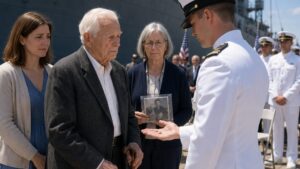
After a while Elizabeth opened her purse.
She removed a photograph.
The edges were worn.
Carolyn stared at it.
Steven couldn’t see the image clearly.
But he knew.
Ramirez.
The young service member whose promise had changed everything.
Carolyn touched the corner of the photograph.
Not with sadness.
Not exactly.
With affection.
With memory.
With peace.
“Still carrying him around,” Elizabeth said.
“Somebody has to.”
“You can put him down once in a while.”
Carolyn smiled.
“Maybe.”
The conversation continued quietly.
Years condensed into small remarks.
Shared memories.
Names.
Stories.
Ordinary words carrying extraordinary weight.
Near noon Carolyn stood.
The canvas bag hung from her shoulder.
The photograph rested safely inside.
She walked one final time toward the front desk.
The visitor log remained where it always had.
The clerk looked up.
“Need anything?”
“No.”
Carolyn rested her hand lightly on the counter.
For a moment she looked at the book.
At the rows of signatures.
At the space where her name had appeared month after month for twenty-three years.
The winged tattoo showed briefly as her sleeve shifted.
Steven noticed it.
So did Matthew.
For the first time neither wondered what it meant.
Some things no longer required explanation.
Carolyn turned away from the log.
She did not sign it again.
She simply looked at it one last time.
Then she walked toward the exit.
Steven followed.
Not to stop her.
Only to accompany her part of the way.
At the doors she paused.
Sunlight filled the entrance.
“You’ll be back to visit?” he asked.
“Probably.”
“Good.”
“But not for the promise.”
The distinction mattered.
Steven nodded.
“Okay.”
Carolyn looked out across the base.
The same buildings.
The same roads.
The same flag moving in the distance.
Yet somehow everything felt different.
Lighter.
Not because the past had disappeared.
Because she no longer carried it alone.
She turned toward Steven.
“Take care of people.”
“I’ll try.”
“Trying counts.”
Then she stepped outside.
Steven remained at the doorway watching her walk toward the parking lot.
No crowd gathered.
No announcement followed.
No applause echoed through the lobby.
People simply continued with their day.
Yet something had changed.
Not only for Carolyn.
For him.
For others.
A misunderstanding had become understanding.
A routine had become a story.
And respect had arrived not through revelation or status, but through patience.
Carolyn reached her car.
Before getting inside, she looked back once.
The administration building stood exactly where it always had.
For twenty-three years it had been part of a promise.
Today it became something else.
A place where the promise ended.
And where peace finally began.
The story has ended.