The Officers Thought Carolyn Was A Confused Old Woman Until The Radio Revealed Why The City Still Owed Her Everything
Chapter 1: The Woman Standing Alone In The Rain
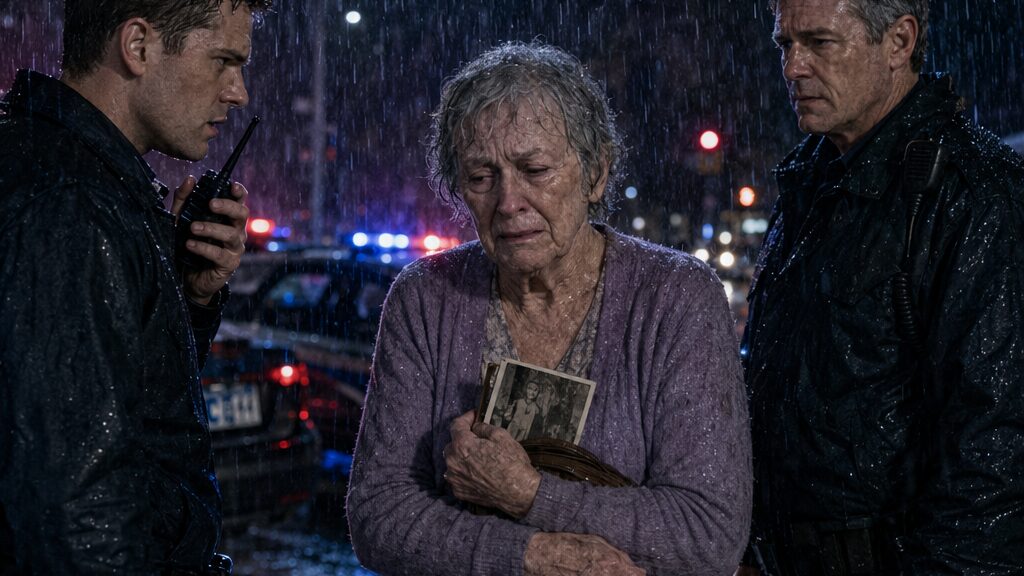
The woman appeared out of the rain as if she had been standing inside it for hours.
Officer Ryan Adams noticed her only because the headlights swept across the intersection and caught the pale lavender of her cardigan. For a moment she looked less like a person and more like a forgotten figure left behind by the storm.
The call had come in as a welfare check.
Elderly female. Alone. Possible confusion.
Ryan had already spent most of his shift dealing with flooded streets, stalled vehicles, and residents ignoring evacuation advisories. The rain had been falling since afternoon, and now the city glowed beneath a constant wash of red taillights and reflected emergency lights.
He pulled the patrol car to the curb.
The woman stood beside a bus shelter.
She wasn’t trying to get out of the rain.
That struck him immediately.
Most people huddled beneath cover.
She remained exposed to the weather as if she barely noticed it.
Ryan stepped out.
“Ma’am?”
The woman turned slowly.
Her gray hair was soaked.
Rainwater ran down her cheeks.
For an instant he thought she had been crying.
Then he realized he couldn’t tell.
“You okay?”
She looked at him with tired eyes.
Not confused eyes.
Not frightened eyes.
Just tired.
“I suppose that depends on what you mean by okay.”
Ryan approached cautiously.
“You out here alone?”
“Yes.”
“Do you have somewhere you’re supposed to be?”
She looked beyond him toward the distant glow of downtown.
“Yes.”
“Where?”
“A memorial.”
Ryan glanced at the storm.
“Tonight?”
She nodded.
The answer made little sense.
The city memorial dedication wasn’t until tomorrow.
Everyone knew that.
Traffic advisories had been posted all week.
Ryan frowned.
“Ma’am, what memorial?”
The woman hesitated.
Then she simply said, “The one by the river.”
Ryan exchanged a look with another officer arriving nearby.
The river memorial.
That was tomorrow’s event.
A major city ceremony.
Politicians.
Emergency services.
Families.
The whole thing.
The woman clearly wasn’t headed there tonight.
Not in this weather.
Not on foot.
“Do you have identification?”
She reached slowly into her purse.
The leather looked decades old.
Worn smooth by time.
Inside, she searched carefully before producing her driver’s license.
Ryan shined his flashlight.
CAROLYN MITCHELL.
Age seventy-four.
Address valid.
Nothing unusual.
At first.
Then something slipped from the purse and landed on the wet pavement.
A photograph.
Ryan bent down before the rain could carry it toward the gutter.
The image had already begun absorbing water.
He stared at it.
A black-and-white photograph.
A command center.
Rows of radios.
Maps pinned to walls.
Men and women standing around a long table.
In the center stood a younger woman.
Confident.
Focused.
Giving instructions.
The image was old.
Very old.
Ryan handed it back.
“You don’t want to lose this.”
Carolyn accepted it carefully.
Her fingers lingered on the edge.
“No.”
Something in her voice made him stop asking questions.
She slid it into her purse.
Ryan glanced toward the road.
“Do you have family nearby?”
“No.”
“Anyone expecting you?”
A pause.
“Not anymore.”
The answer sat strangely between them.
Not defensive.
Not dramatic.
Just true.
Rain hammered against the patrol car roof.
Another vehicle arrived.
Sergeant Gregory Brown stepped out.
Older.
More experienced.
Less impatient than Ryan.
Gregory approached.
“What do we have?”
Ryan lowered his voice.
“Older female. Alone. Says she’s going to tomorrow’s memorial.”
Gregory studied Carolyn.
She met his gaze calmly.
“Evening, ma’am.”
“Good evening.”
“You know the event isn’t until tomorrow?”
“I know.”
“Then why are you out here tonight?”
Carolyn looked toward the river again.
For a long moment she didn’t answer.
When she finally spoke, her voice carried a weight Ryan couldn’t place.
“Because thirty years ago tonight, the storm started.”
Neither officer responded.
They didn’t know what she meant.
Gregory softened slightly.
“Can we help you get somewhere warm?”
Carolyn shook her head.
“I just need to be there tomorrow.”
Ryan exchanged another look with Gregory.
This was beginning to sound like grief.
Or memory loss.
Or both.
Gregory nodded toward the patrol car.
“Let’s get out of the rain for a minute.”
Carolyn didn’t argue.
Inside the vehicle, the heater hummed quietly.
She sat in the rear seat.
Not handcuffed.
Not detained.
Just sheltered.
Ryan ran her name through dispatch.
Routine.
Nothing more.
The response came back clean.
Then Gregory asked him to run it again.
Full verification.
Past employment.
Emergency contacts.
Whatever records existed.
Ryan sighed inwardly.
The storm had already overloaded dispatch.
Still, he complied.
Minutes passed.
Carolyn sat silently.
Watching rain race across the window.
Her hands rested atop the purse.
Protecting it.
Gregory eventually turned.
“That photograph. Someone important?”
Carolyn looked down.
“No.”
The answer surprised him.
“You looked at it like it mattered.”
“It does.”
“Who is the woman in the picture?”
Carolyn’s eyes moved toward the rain.
“Someone who made decisions.”
Gregory waited.
She offered nothing else.
The radio crackled.
Dispatch returning.
Ryan grabbed the microphone.
“Go ahead.”
Static.
Typing sounds.
Then the dispatcher’s voice changed.
Not dramatically.
Just enough.
“Officer Adams… can you confirm the spelling?”
Ryan frowned.
He repeated the name.
Another pause followed.
Longer this time.
Gregory noticed.
Carolyn did too.
The dispatcher spoke again.
“Stand by.”
Ryan stared at the radio.
“Stand by for what?”
No answer.
The line disconnected.
Minutes later it reopened.
The dispatcher’s tone sounded uncertain.
Almost careful.
“Sergeant Brown available?”
Gregory leaned forward immediately.
“This is Brown.”
Another pause.
Then:
“Sergeant, I think you’ll want to verify these records personally.”
Ryan looked up.
Gregory’s expression shifted.
“What records?”
“We found historical state files attached to her name.”
“Historical files?”
“Yes, sir.”
Silence.
Rain struck the windshield.
Carolyn remained still.
Looking out into the darkness.
The dispatcher continued.
“There’s also a note connected to tomorrow’s memorial event.”
Ryan felt confusion building.
“What kind of note?”
Another pause.
The dispatcher lowered her voice.
“I think you’d better come see it.”
Gregory slowly turned toward Carolyn.
For the first time all night, uncertainty entered his face.
Carolyn met his eyes.
Calm.
Patient.
As if she had seen this moment happen before.
Neither officer spoke.
The radio hissed softly in the silence.
Finally Gregory picked up the microphone.
“We’re coming in.”
Then he looked at Ryan.
“Drive.”
Outside, rain continued pouring across the city.
Inside the patrol car, a question settled over all three of them.
Who exactly was Carolyn Mitchell?
Chapter 2: A Name Buried In Old Records
The rain never stopped.
By the time they reached the precinct, water streamed from every gutter and pooled along the sidewalks outside the building.
Ryan expected the mystery to disappear once they entered.
Most mysteries did.
Paperwork usually turned strange situations into ordinary ones.
Instead, the mystery grew.
Dispatch had already prepared a workstation.
A civilian employee waited beside it.
Several files sat open across the desk.
Gregory approached first.
Ryan stayed beside Carolyn.
She remained seated quietly in the lobby.
No complaints.
No demands.
No questions.
Just patience.
The dispatcher pointed toward the monitor.
“Here.”
Gregory leaned closer.
His eyes narrowed.
Ryan watched his expression change.
The same way it had changed beside the patrol car.
Concern.
Confusion.
Then something else.
Recognition.
Not complete recognition.
Just enough to know he had misunderstood something.
“What is this?” Gregory asked.
The dispatcher pointed.
“State Emergency Authority records.”
Gregory scrolled.
The documents stretched back decades.
Disaster response operations.
Evacuation orders.
Emergency planning directives.
Command authorizations.
All attached to one name.
Carolyn Mitchell.
Ryan stepped closer.
“No way.”
The dispatcher nodded.
“That’s what I thought.”
Gregory kept reading.
Former Director.
State Disaster Coordination Authority.
Retired.
Decorated for public service.
Lead coordinator during the River Flood Emergency.
Ryan looked toward the lobby.
The elderly woman sat exactly where they’d left her.
Holding her purse.
Watching the rain outside.
She looked nothing like the person described in the records.
Then again, maybe that was the problem.
Gregory continued reading.
“What was the river emergency?”
The dispatcher opened another file.
The room became quieter.
Thirty years earlier, a storm system had overwhelmed the region.
Floodwaters had threatened entire neighborhoods.
Thousands evacuated.
Hundreds rescued.
Several lives lost.
The disaster remained one of the largest emergency operations in city history.
Ryan had learned about it briefly during academy training.
Everyone had.
But nobody talked much about who coordinated it.
The names had faded.
The event remained.
The people didn’t.
“She ran this?” Ryan asked.
“According to these records.”
Gregory rubbed his jaw.
“What about the memorial?”
The dispatcher opened another screen.
That answer changed everything.
Tomorrow’s ceremony was connected directly to the flood.
The city had built a new memorial honoring responders and victims.
The dedication marked the thirtieth anniversary.
Ryan stared.
Carolyn hadn’t been wandering.
She had been going exactly where she claimed.
The dispatcher enlarged a document.
An invitation list.
Several names appeared.
Then one stood near the top.
Carolyn Mitchell.
Special Guest.
Personally Invited.
Ryan exhaled slowly.
Nobody spoke for several seconds.
Gregory finally broke the silence.
“Does she know any of this is still here?”
The dispatcher shrugged.
“Looks like she never attended previous anniversaries.”
Gregory glanced toward the lobby.
“Why now?”
No one knew.
He walked out to speak with her.
Ryan followed.
Carolyn looked up when they approached.
Gregory sat beside her.
The change in his tone was subtle.
Respectful.
Careful.
Not because he fully understood.
Because he understood he didn’t.
“Ms. Mitchell.”
She smiled faintly.
“Yes, Sergeant?”
“I think we found the memorial invitation.”
She nodded.
“I assumed you would.”
Ryan noticed she didn’t sound surprised.
Gregory studied her.
“You could have told us who you were.”
Carolyn looked toward the rain.
For a moment she seemed almost amused.
“I did.”
Neither officer answered.
She continued.
“I gave you my name.”
The simplicity of the statement made Ryan uncomfortable.
Because she was right.
She had told them.
They simply hadn’t known what it meant.
Gregory folded his hands.
“Why are you really here tonight?”
Carolyn’s eyes remained fixed outside.
“Tomorrow marks thirty years.”
“Thirty years since the flood?”
“Yes.”
The answer came quietly.
Almost too quietly.
Gregory waited.
Eventually she spoke again.
“There were people I couldn’t save.”
The room fell silent.
Not because of the words.
Because of the way she said them.
No self-pity.
No drama.
Only memory.
Ryan looked away first.
Gregory cleared his throat.
“We can arrange transportation tomorrow.”
“No.”
“We’d be happy to.”
Carolyn shook her head.
“I can manage.”
The conversation ended there.
Not rudely.
Simply because Carolyn had decided it was finished.
Gregory stood.
As he walked away, the dispatcher called from across the room.
“Sergeant.”
He turned.
“What?”
She pointed at another file she’d just opened.
A recently scanned archive.
Gregory crossed the room.
Ryan followed.
At the top appeared the city seal.
Below it:
Memorial Dedication Program.
Guest Speaker: Pending Confirmation.
Special Recognition Segment.
Historical Leadership Honorees.
The list contained several names.
Most were deceased.
One was not.
Carolyn Mitchell.
Gregory stared.
Ryan looked toward the lobby again.
The elderly woman remained seated alone beneath the fluorescent lights.
Waiting.
As if none of this mattered.
As if she had come for reasons entirely different from recognition.
Outside, rain continued falling across the sleeping city.
Tomorrow suddenly felt much bigger than a memorial.
Chapter 3: The Invitation Nobody Believed
By morning the storm had weakened.
The city remained gray.
Wet sidewalks reflected low clouds.
Carolyn arrived at the memorial hall carrying the same purse and wearing the same lavender cardigan she had worn the night before.
She had refused every offer of assistance.
The ride.
The escort.
The special arrangements.
All declined.
She arrived alone.
Exactly as she intended.
The memorial hall overlooked the river.
Large glass windows faced the water.
Workers moved through the building preparing displays and seating charts.
Photographs lined temporary walls.
Historical exhibits documented the flood.
Carolyn paused near the entrance.
For a moment she simply looked.
Thirty years vanished.
She could almost hear radios again.
Almost smell wet concrete and diesel generators.
Almost feel the weight of decisions no one wanted to make.
A volunteer approached.
“Can I help you?”
Carolyn smiled.
“I have an invitation.”
The volunteer accepted the card.
Looked at it.
Then frowned.
“One moment.”
Carolyn nodded.
The volunteer disappeared behind a registration desk.
Two staff members examined the invitation.
A third joined them.
Carolyn watched quietly.
The pattern felt familiar.
People looking at her.
Then the card.
Then her.
Trying to make the pieces fit.
Eventually one staff member approached.
“You received this personally?”
“Yes.”
The woman forced a polite smile.
“This invitation appears unusual.”
“How so?”
“It lists access credentials we don’t normally use.”
Carolyn said nothing.
The woman looked uncomfortable.
“Do you have another form of registration?”
“No.”
The staff member hesitated.
“Would you mind waiting?”
Carolyn glanced toward the river.
“No.”
She stepped aside.
Minutes passed.
Guests arrived.
Families entered.
Retired firefighters.
Former emergency workers.
Local officials.
Nobody recognized her.
Or if they did, they said nothing.
She sat alone near a window.
The invitation resting in her lap.
A little later she overheard two staff members talking.
“…probably sent by mistake.”
“…old records issue…”
“…doesn’t appear on the current VIP list…”
Carolyn closed her eyes briefly.
Not from anger.
From exhaustion.
The city remembered the flood.
But memory had gaps.
Large ones.
A woman hurried into the hall carrying folders.
Elizabeth Rivera.
Memorial coordinator.
She immediately sensed something wrong.
Questions from volunteers reached her before she reached her desk.
She listened.
Accepted the invitation.
Read the name.
Then stopped.
“Where is she?”
The volunteer pointed toward the window.
Elizabeth looked across the room.
At first she saw only an elderly woman sitting alone.
Then something tugged at her memory.
Not recognition.
Curiosity.
She approached.
“Ms. Mitchell?”
Carolyn stood.
“Yes.”
Elizabeth looked at the invitation again.
“I’m sorry for the confusion.”
“It happens.”
The answer carried no bitterness.
That somehow made Elizabeth feel worse.
She examined the card more closely.
The paper looked old.
Not recently printed.
One corner contained an archive reference number.
Elizabeth frowned.
She knew that numbering system.
It hadn’t been used for years.
“Would you mind waiting a little longer?”
Carolyn smiled gently.
“I have waited longer than that.”
Elizabeth nodded.
Then hurried away.
Something about the invitation bothered her.
Not because it seemed fake.
Because it seemed real.
Too real.
She entered a restricted records room.
Opened archive databases.
Cross-referenced the number.
Several files appeared.
Most had never been digitized properly.
Elizabeth opened the first.
Then the second.
Her eyes widened.
Photographs.
Emergency operation logs.
Planning documents.
And one name repeated throughout them all.
Carolyn Mitchell.
Elizabeth sat down slowly.
Outside the records room, preparations for the ceremony continued.
Inside, a different story waited.
A story the city seemed to have forgotten.
Elizabeth reached for another file.
And realized she needed to know everything before anyone asked Carolyn Mitchell to leave.
Chapter 4: What The City Forgot
Elizabeth Rivera spent the next two hours buried in records that should never have been forgotten.
The archive room occupied a quiet corner beneath the memorial hall. Dust clung to metal shelving. Old storage boxes lined the walls. Most of the documents had survived only because no one had bothered throwing them away.
The city remembered the flood.
The city had forgotten the people who carried it.
Elizabeth sat before a monitor surrounded by open files.
Every document seemed to lead back to Carolyn Mitchell.
Operations plans.
Emergency declarations.
Evacuation maps.
Communication logs.
Funding approvals.
The deeper Elizabeth searched, the more impossible the situation became.
One photograph stopped her.
The image showed a temporary command center assembled inside a high school gymnasium. Folding tables held radios and maps. Exhausted workers filled the room.
At the center stood Carolyn.
Thirty years younger.
One hand braced against a table.
The other pointed toward a flood map.
Everyone else appeared to be listening.
Elizabeth enlarged the image.
The face was unmistakable.
Older now.
Softer.
But unmistakable.
A retired firefighter assisting with event preparation entered the archive room.
“What are you looking at?”
Elizabeth turned the monitor.
The firefighter studied the image.
His expression shifted.
“I know her.”
“You do?”
“Not personally.”
He leaned closer.
“But I know who she is.”
Elizabeth waited.
The firefighter pointed at the photograph.
“During the flood, she was everywhere.”
He laughed quietly.
“At least that’s what people said.”
“What do you mean?”
“Nobody ever saw her resting.”
The man folded his arms.
“My father worked river rescue. He used to say she remembered every shelter, every hospital, every evacuation route.”
Elizabeth looked back at the screen.
The firefighter shook his head.
“Funny.”
“What?”
“People remember the flood. Nobody remembers her.”
After he left, Elizabeth continued searching.
The pattern became impossible to ignore.
Every major decision carried Carolyn’s signature.
Yet almost every public article focused on elected officials, agency announcements, or institutional achievements.
The individual responsible for coordinating much of the response had gradually disappeared from public memory.
Elizabeth opened another file.
This one contained internal correspondence.
One letter caught her attention.
The author praised Carolyn’s leadership during the crisis.
Another criticized her.
A third blamed her for evacuation delays that had cost lives.
Elizabeth sat back.
For the first time, Carolyn stopped feeling like a forgotten hero.
She became something more complicated.
Someone who had carried responsibility.
Someone who had been blamed.
Someone who had survived.
The discovery made her more human.
Not less.
Hours later Elizabeth found the archive reference number printed on Carolyn’s invitation.
The number linked to an older planning committee.
She opened the file.
Inside was a recommendation written years earlier when the memorial project first began.
The final paragraph froze her.
The memorial exists because Director Carolyn Mitchell insisted that every victim’s name be preserved.
Elizabeth reread the sentence.
Again.
Then once more.
The entire event had been built around an idea Carolyn herself had fought to protect.
Yet nobody organizing the ceremony seemed aware of it anymore.
The irony left Elizabeth speechless.
A knock interrupted her thoughts.
A city worker stepped inside.
“We need final confirmation on tomorrow’s historical presentation.”
Elizabeth looked up.
“Actually, I think we’re missing something.”
The worker frowned.
“What?”
Elizabeth turned the monitor.
The worker studied the photograph.
Then the documents.
Then the name.
His expression mirrored everyone else’s.
Confusion.
Recognition.
Disbelief.
Elizabeth reached for the phone.
“Do we still have contact information for Stephen Robinson?”
The worker nodded.
“I think so.”
“Good.”
“Why?”
Elizabeth looked once more at Carolyn’s photograph.
Because someone who had been there needed to tell the story.
Not the archives.
Not the ceremony program.
Someone who remembered.
By sunset she had found a number.
She dialed.
After several rings a man answered.
“Hello?”
“Mr. Robinson?”
“Speaking.”
“My name is Elizabeth Rivera. I’m calling about Carolyn Mitchell.”
Silence.
A long silence.
Then a completely different voice emerged.
“You found Carolyn?”
Elizabeth stared at the receiver.
Found.
Not know.
Not remember.
Found.
As though someone important had been missing.
“Yes.”
The man exhaled slowly.
For the first time all day, Elizabeth felt certain she was standing near the center of a story much larger than she understood.
Chapter 5: The Voice From The Command Center
Stephen Robinson arrived before dusk.
The memorial hall had emptied temporarily while staff prepared for the evening rehearsal. Chairs stood arranged in careful rows. Audio technicians tested microphones. Screens displayed historical images from the flood.
Stephen entered carrying a weathered briefcase.
His hair had turned white.
His shoulders stooped slightly with age.
But his eyes remained sharp.
Elizabeth met him near the stage.
“Mr. Robinson?”
“Stephen is fine.”
She introduced herself.
Then pointed toward a display table where several archived photographs had been arranged.
Stephen stopped immediately.
His gaze settled on one image.
The command center.
Carolyn standing over the map.
He smiled.
Not broadly.
Sadly.
Like someone seeing an old friend after decades.
“That’s her.”
Elizabeth nodded.
“You worked with her?”
“For eight years.”
The answer came without hesitation.
“What was she like?”
Stephen laughed quietly.
“Impossible question.”
He walked toward the photograph.
“You don’t lead an operation like that by being simple.”
Elizabeth followed.
Stephen rested his fingers lightly against the table.
“People think leadership is confidence.”
He shook his head.
“During disasters, leadership is carrying decisions you’ll regret for the rest of your life.”
Neither spoke for a moment.
Finally Elizabeth asked, “Was she really as important as these records suggest?”
Stephen looked at her.
Then toward the empty stage.
“More.”
The word landed heavily.
Elizabeth waited.
Stephen continued.
“When the flood came, communication systems collapsed. Roads disappeared. Entire neighborhoods were cut off.”
He pointed toward the photograph.
“Everyone wanted certainty.”
“Was there any?”
“No.”
He smiled sadly.
“Carolyn had to make decisions without enough information. Sometimes she was right.”
The smile faded.
“Sometimes she wasn’t.”
Elizabeth understood immediately.
“The lives she couldn’t save.”
Stephen nodded.
“She never stopped carrying them.”
The rehearsal coordinator approached.
“We’re updating tomorrow’s presentation.”
Stephen introduced himself.
The coordinator’s eyes widened when he learned who he was.
Soon several staff members gathered nearby.
Questions followed.
Most of them shared the same theme.
Who exactly was Carolyn Mitchell?
Stephen answered carefully.
Never exaggerating.
Never turning her into a legend.
Instead he described a woman who worked longer than everyone else.
A woman who remembered names.
A woman who accepted blame when things went wrong.
A woman who disappeared from public attention after retirement because she wanted to.
Eventually Elizabeth showed him Carolyn’s invitation.
Stephen studied it.
Then laughed softly.
“Of course.”
“What?”
“She still has it.”
“You knew about this invitation?”
“I helped write the recommendation.”
Elizabeth blinked.
“You did?”
Stephen nodded.
“The committee wanted political speakers.”
“And?”
“I told them there wouldn’t be a memorial without Carolyn.”
The room grew quiet.
Stephen looked around.
Only then did he seem to realize how little the organizers knew.
A technician asked cautiously, “If she was so important, why isn’t she speaking tomorrow?”
Stephen smiled.
“Have you met her?”
“No.”
“Then you’ll understand when you do.”
The conversation shifted toward archived materials.
Stephen opened his briefcase.
Inside sat several recordings.
Old emergency transmissions.
Digitized years earlier.
One label carried a date from the flood.
The room fell silent as technicians loaded the file.
Static filled the speakers.
Then voices.
Urgent.
Tired.
Coordinating rescues.
Tracking water levels.
Requesting supplies.
Elizabeth listened carefully.
Several minutes passed before another voice appeared.
Calm.
Measured.
Precise.
Carolyn.
No hesitation.
No panic.
Just steady direction in the middle of chaos.
The room listened.
Nobody moved.
The recording ended.
For several seconds no one spoke.
The voice from thirty years ago still carried authority.
Not because it sounded powerful.
Because it sounded responsible.
The rehearsal coordinator slowly lowered his head.
“We nearly turned her away this morning.”
Nobody answered.
Because everyone knew it was true.
The realization hung over the room.
Stephen closed the briefcase.
“She wouldn’t hold it against you.”
The coordinator looked uncomfortable.
“That doesn’t make it better.”
“No.”
Stephen agreed.
“It doesn’t.”
As the evening darkened outside the hall windows, preparations resumed.
But the atmosphere had changed.
The photographs no longer felt like decorations.
The names on the memorial walls no longer felt distant.
Everything seemed connected to a person quietly sitting somewhere in the city.
A person most attendees would walk past without noticing.
Elizabeth finally asked the question that had been bothering her all day.
“Where is Carolyn now?”
Stephen smiled.
“Probably trying to avoid all of this.”
The answer proved correct.
Because at that very moment Carolyn was declining a reserved seat assignment.
Refusing a private entrance.
And quietly insisting she would attend the ceremony exactly like everyone else.
Which left Elizabeth with one unsettling realization.
The woman everyone was suddenly desperate to honor still seemed far less interested in recognition than anyone else in the building.
Chapter 6: The Room Goes Silent
The memorial auditorium filled slowly.
Families arrived carrying photographs.
Retired responders greeted old colleagues.
City officials occupied reserved seating near the front.
Outside, clouds still lingered over the river, though the rain had finally stopped.
Inside, anticipation settled over the room.
Carolyn entered through the main doors.
Alone.
No escort.
No announcement.
Most people paid her little attention.
She preferred it that way.
The volunteer who had questioned her invitation the previous morning noticed her first.
Embarrassment flashed across the young woman’s face.
Carolyn simply smiled and continued walking.
Elizabeth met her halfway down the aisle.
“Ms. Mitchell.”
Carolyn sighed softly.
“You found quite a lot, didn’t you?”
Elizabeth smiled.
“A little.”
Carolyn glanced toward the stage.
“A little is usually enough.”
Elizabeth offered her a reserved seat near the front.
Carolyn accepted only after realizing arguing would create more attention.
She sat quietly.
Her purse rested in her lap.
The old photograph remained inside.
Around her, conversations continued.
Most attendees still didn’t recognize her.
The ceremony began.
Names of flood victims appeared across large screens.
Families watched in silence.
Historical footage followed.
News clips.
Rescue operations.
Shelters.
Flooded streets.
The city remembered tragedy.
The city remembered survival.
Then the presentation shifted.
A narrator began describing the emergency response effort.
Photographs appeared one after another.
Volunteers.
Firefighters.
Medical teams.
National Guard units.
The audience watched respectfully.
Then a familiar image filled the screen.
The command center photograph.
Carolyn froze.
Thirty years vanished again.
The younger version of herself stood over a map surrounded by exhausted staff.
A murmur moved through the auditorium.
People studied the image.
Then looked around.
Then looked back.
Because another camera angle appeared.
And another.
The same woman.
The same face.
Younger.
But unmistakable.
Elizabeth watched the audience realize it simultaneously.
Heads turned.
Eyes searched.
Recognition spread row by row.
Not fame.
Recognition.
The narrator continued.
“During the flood response, operational command was coordinated by Director Carolyn Mitchell.”
The room became still.
Completely still.
Carolyn lowered her eyes.
She had never enjoyed this part.
The narrator spoke again.
“Many of the systems now used during regional emergencies originated from decisions made during that operation.”
Silence deepened.
Then a new voice came through the speakers.
An archived recording.
Carolyn’s voice.
The same recording Stephen had brought.
Calm.
Measured.
Directing resources.
Assigning rescue priorities.
Trying to save people she could not see.
The contrast stunned the audience.
The voice from the speakers.
The elderly woman seated quietly among them.
The connection became undeniable.
Several attendees slowly turned toward Carolyn.
No one spoke.
No one needed to.
Near the back of the auditorium, Ryan Adams stood beside Gregory Brown.
Both had been invited after Elizabeth shared the story.
Ryan stared.
The woman from the rain.
The woman he had assumed was confused.
The woman who had simply asked him to check the name again.
Gregory folded his arms.
Neither man looked away.
On stage, the presentation continued.
A final image appeared.
A photograph taken months after the flood.
Officials standing together beside river reconstruction plans.
Carolyn stood among them.
Younger.
Tired.
Smiling only slightly.
The caption beneath the image read:
For leadership during the River Flood Emergency.
The narrator paused.
Then delivered the final revelation.
“The memorial project itself began after Director Mitchell insisted that every victim’s name remain visible to future generations.”
A collective breath seemed to leave the room.
That single statement changed the ceremony.
The people gathered there realized they were sitting inside a memorial that existed partly because of her.
Not because she wanted recognition.
Because she refused to let others be forgotten.
The presentation ended.
No applause came immediately.
Only silence.
A long, thoughtful silence.
The kind created when people discover they have misunderstood something important.
Then Elizabeth stepped onto the stage.
She looked toward Carolyn.
“Ms. Mitchell.”
Every eye followed.
Carolyn closed her eyes briefly.
She had hoped this would not happen.
Yet she knew it was unavoidable now.
Elizabeth gestured toward the podium.
The room waited.
Carolyn rose slowly.
The auditorium remained silent as she walked down the aisle.
Not because of rank.
Not because of authority.
Because everyone suddenly understood they were watching someone who had carried responsibilities most of them could barely imagine.
When Carolyn reached the stage, she paused beside the podium.
The old photograph rested inside her purse.
The flood remained inside her memory.
And for the first time in thirty years, she prepared to speak.
Chapter 7: The Reason She Never Mentioned Her Rank
Carolyn stood behind the podium and looked out across the auditorium.
Faces filled the room.
Families.
Former responders.
City officials.
People who had lost someone.
People who had survived.
People who had arrived expecting a ceremony and found themselves confronting a forgotten piece of their own history.
The microphone waited.
The silence waited.
Carolyn rested both hands lightly on the podium.
For a moment she said nothing.
Then she smiled faintly.
“I was hoping to sit quietly in the back.”
A soft ripple of laughter moved through the audience.
The tension eased.
Only slightly.
Carolyn glanced toward Elizabeth.
Then toward Stephen.
Finally toward the large screen where the old command center photograph remained displayed.
“You’ve all spent the evening hearing about things that happened thirty years ago.”
Her voice carried easily through the room.
Age had softened it.
Not weakened it.
“I appreciate the kindness behind that.”
She paused.
“But history can be a dangerous thing.”
Several people looked puzzled.
Carolyn continued.
“It has a habit of simplifying people.”
The auditorium remained silent.
“It turns complicated lives into short descriptions.”
Her eyes drifted toward the photograph.
“Leader.”
A pause.
“Victim.”
Another pause.
“Hero.”
She shook her head gently.
“Real life is usually messier than that.”
No one moved.
Carolyn looked down briefly before continuing.
“The flood was the largest disaster our city had faced in generations.”
The room listened.
“There were days when information changed every hour.”
Her fingers tightened slightly against the podium.
“There were nights when nobody slept.”
She stopped.
A memory had crossed her face.
One visible enough that even those in the back rows could see it.
“When people tell stories about those events now, they often focus on what went right.”
Her gaze moved through the audience.
“I understand why.”
Another pause.
“But I remember what didn’t.”
The room became still.
Carolyn had not raised her voice.
She didn’t need to.
“I remember the names we couldn’t save.”
Nobody looked away.
“I remember families waiting for news we couldn’t give them.”
The silence deepened.
“I remember making decisions without knowing whether they were correct.”
Her eyes lowered.
“And I remember living with those decisions afterward.”
For the first time all evening, emotion entered her voice.
Not dramatically.
Just enough.
The kind that comes from carrying something too long.
Stephen looked down.
Elizabeth blinked rapidly.
Near the back, Ryan felt his chest tighten.
The woman standing at the podium was not speaking like someone proud of authority.
She was speaking like someone who remembered its cost.
Carolyn drew a slow breath.
“When I retired, people occasionally asked why I stopped attending public events.”
A faint smile appeared.
“I usually changed the subject.”
A few quiet laughs followed.
Then the smile faded.
“The truth is simple.”
She looked toward the memorial wall.
The names displayed there glowed softly beneath the auditorium lights.
“I never felt comfortable being thanked for a tragedy.”
The room absorbed the sentence.
Nobody applauded.
Nobody interrupted.
Carolyn continued.
“The people honored here tonight are not names because of me.”
She gestured toward the wall.
“They are remembered because their families refused to forget them.”
Another pause.
“Because survivors refused to forget them.”
She turned slightly.
“And because this city eventually chose not to forget them.”
Several audience members lowered their heads.
Carolyn looked toward the front row.
Toward the volunteer who had doubted her invitation.
Toward the staff who had almost sent her away.
Toward the officials now sitting quietly.
Then her eyes moved farther back.
Toward Ryan.
Their gaze met briefly.
Ryan felt his stomach tighten.
She had every reason to embarrass him.
Every reason to mention the misunderstanding.
She didn’t.
Instead she said something else.
“Over the last two days, a number of people have apologized to me.”
Ryan swallowed.
Carolyn smiled gently.
“I don’t need those apologies.”
The room listened carefully.
“Not because what happened was acceptable.”
She let the words settle.
“But because the lesson isn’t really about me.”
No one moved.
Carolyn’s voice softened.
“The lesson is that respect should never depend on discovering someone’s title.”
A silence followed.
Heavy.
Thoughtful.
“If kindness arrives only after importance is confirmed, then it isn’t really kindness.”
The words spread through the room.
Not as a rebuke.
As a truth.
Ryan lowered his eyes.
Gregory nodded slowly beside him.
At the front, the volunteer began quietly crying.
Carolyn saw her.
Her expression softened further.
Then she stepped away from the podium for a moment.
Reached into her purse.
And removed the photograph.
The same photograph that had fallen onto the wet pavement during the storm.
The same photograph Ryan had picked up.
The audience watched.
Carolyn held it carefully.
“There is a reason I carried this yesterday.”
She looked down at it.
The younger version of herself stared back from the faded paper.
Surrounded by radios and maps.
Surrounded by responsibility.
“People assume I keep this because I’m proud of it.”
A small smile crossed her face.
“I’m not.”
The room remained silent.
“I carry it because it reminds me of everyone else in the picture.”
Her finger touched several faces.
“Most of them never received public recognition.”
Another face.
“Some are gone.”
Another.
“Some sacrificed more than I did.”
She lowered the photograph.
“They deserve remembering too.”
The audience understood.
The photograph was not proof.
It was a promise.
One she had never abandoned.
Carolyn returned it to her purse.
The movement felt strangely final.
Like setting down a burden.
Or perhaps sharing it.
She stepped back to the microphone.
“I came here this year because I realized something.”
She paused.
“For thirty years I thought staying away honored the people we lost.”
The room waited.
“But I was wrong.”
Her eyes moved across the audience.
“Remembering them requires showing up.”
A quiet breath seemed to move through the auditorium.
“Not for praise.”
She shook her head.
“Not for recognition.”
Her voice softened.
“But because memory belongs to all of us.”
No one applauded when she finished.
Not immediately.
The room remained silent.
The same silence that had followed the reveal.
Only now it felt different.
Not shocked.
Reflective.
Then slowly, people rose.
Not all at once.
One row.
Then another.
Then another.
Families.
Responders.
Officials.
Ordinary citizens.
Standing not for rank.
Not for authority.
But for what she had carried.
Carolyn looked almost embarrassed.
She smiled awkwardly.
Then laughed quietly to herself.
The standing ovation lasted only a short time.
Just long enough.
When it ended, the ceremony concluded.
People approached.
Some thanked her.
Some shared memories.
Others simply shook her hand.
Carolyn accepted each interaction graciously.
But she seemed relieved when the crowd finally began to disperse.
Outside the auditorium, night had returned.
Clouds drifted above the river.
As Carolyn stepped onto the front steps, she heard footsteps behind her.
Ryan.
He stopped a respectful distance away.
For a moment neither spoke.
Then Ryan cleared his throat.
“I owe you an apology.”
Carolyn looked at him.
The young officer appeared far more nervous than he had on the night of the storm.
She smiled.
“You already learned the lesson.”
Ryan hesitated.
“Still.”
Carolyn considered him for a moment.
Then nodded.
“Then thank you.”
Nothing more.
No speech.
No humiliation.
No dramatic forgiveness.
Just a simple acknowledgment.
Ryan smiled weakly.
It was enough.
After he left, Gregory approached briefly.
Then Elizabeth.
Then Stephen.
Eventually they departed as well.
Leaving Carolyn alone beside the river.
Exactly where she had wanted to be from the beginning.
The city lights reflected across the water.
The memorial hall glowed softly behind her.
For a long time she stood in silence.
Thinking about names.
Faces.
Voices.
The people who had survived.
The people who had not.
The people who had been remembered.
And the people still worth remembering.
A light rain began to fall.
Not a storm.
Just a gentle rain.
Carolyn smiled.
Thirty years earlier, rain had carried disaster.
Tonight it carried something else.
Not closure.
Some wounds never closed completely.
But acceptance.
At last.
She pulled her cardigan tighter around her shoulders and began walking down the river path.
The same old purse hung at her side.
The same photograph rested inside.
Nothing about her appearance had changed.
She still looked like an ordinary elderly woman.
And perhaps that was the point.
Because she had never needed rank to deserve respect.
Only humanity.
The city had finally remembered her.
More importantly, it had remembered why.
Carolyn continued walking beside the river until her figure disappeared into the soft rain and the evening lights beyond.
The story has ended.