The Perfect Score That Silenced the Officer Who Tried to Remove Him From the Range
Chapter 1: The Soldier Beside the Restricted Woodland Range
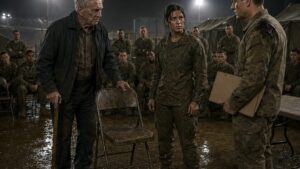
The Military Police sergeant stopped directly in front of James Wilson before James had even reached the registration tent.
For a moment, several cadets nearby turned to look.
The sergeant’s expression remained neutral. “Identification.”
James handed over his military ID without comment.
The sergeant studied it, glanced at a clipboard, then returned it.
“Proceed.”
Nothing unusual. Routine security.
Yet the attention lingered.
The cadets watched him longer than they should have.
James adjusted the strap of the worn green gear bag hanging from his shoulder and continued toward the demonstration grounds.
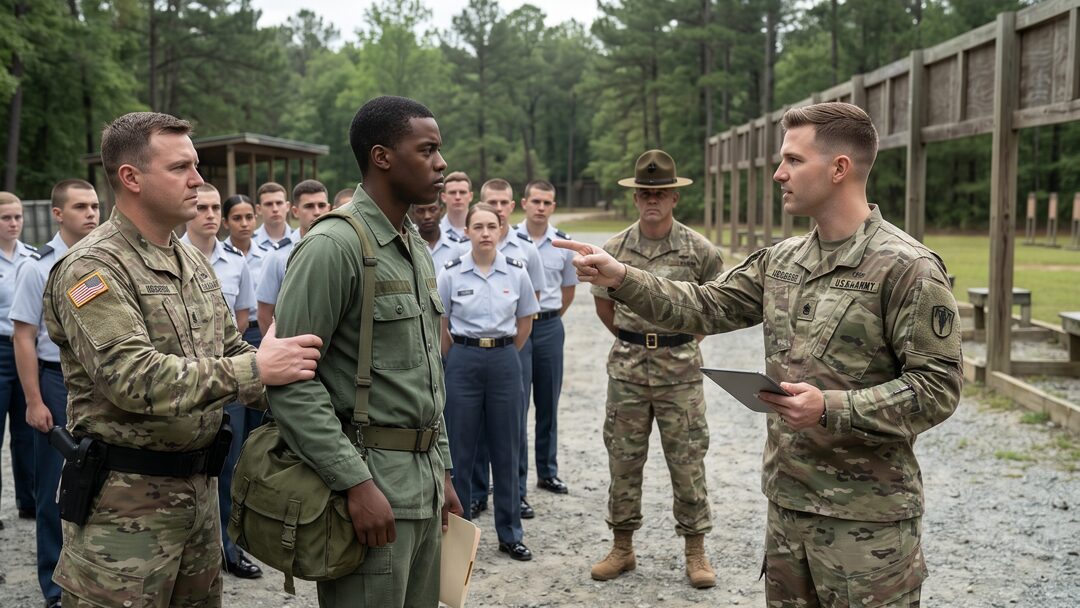
The academy’s woodland qualification range stretched beyond a line of warning signs and fencing. Beyond that, dense trees concealed firing lanes, observation towers, and target systems.
Today’s event had drawn instructors, recruits, administrators, and visitors from multiple units.
Everyone seemed eager.
Everyone except James.
He wasn’t here to impress anyone.
He had spent most of the morning inside a support office signing deployment-injury paperwork.
The folder remained tucked beneath his arm.
His knee ached slightly from the walk.
Nothing unusual.
Nothing new.
But paperwork had a way of making old injuries feel larger than they really were.
As he approached the assembly area, he spotted Christopher.
His younger brother stood among a formation of academy recruits.
Christopher’s uniform was crisp.
His posture was straight.
His confidence wasn’t.
Even from a distance, James noticed it.
The slight tension in his shoulders.
The careful way he avoided eye contact.
The effort it took to look like he belonged.
A group of recruits nearby laughed at something.
Christopher forced a smile.
James recognized that smile immediately.
It was the smile people used when they wanted to appear unaffected.
The smile that never fooled anyone.
James considered walking over.
Then decided against it.
Christopher needed room to find his own footing.
Not a protective older brother standing beside him.
A loud voice interrupted the morning.
“Everyone gather up.”
The speaker stood near a display table covered with advanced equipment.
Tablet-linked optics.
Range-monitoring systems.
Training software.
Electronic scoring displays.
The man introducing everything wore the insignia of a logistics officer.
Stephen Davis.
He moved with the confidence of someone accustomed to attention.
Every gesture looked practiced.
Every sentence sounded prepared.
“The future of military readiness isn’t guesswork,” Davis said. “It’s measurable.”
Several recruits nodded.
Davis smiled.
He enjoyed having an audience.
James continued walking toward a shaded area near the range boundary.
As he passed, his gear bag brushed against a folding table.
One of the recruits glanced at it.
The bag looked old.
Faded fabric.
Repaired seams.
Years of use visible in every stitch.
The recruit smirked.
Another recruit noticed.
Soon two more were looking.
James ignored them.
He had carried the same bag through training exercises, deployments, and transfers.
Its appearance never mattered much.
What mattered was what worked.
Near the formation, Christopher finally noticed him.
Their eyes met briefly.
Christopher’s expression brightened.
Then immediately tightened again.
Two recruits beside him followed his gaze.
One looked James up and down.
The other noticed the paperwork folder.
“That’s your brother?” one recruit asked.
Christopher hesitated.
The pause lasted less than a second.
But James saw it.
“Yeah,” Christopher said.
The recruit studied the old bag.
“The injured one?”
Christopher looked uncomfortable.
James pretended not to hear.
The conversation died quickly, but the damage lingered.
A few moments later, the demonstration officially began.
Groups moved between equipment stations.
Instructors answered questions.
Range personnel prepared the qualification lanes.
James stayed mostly out of the way.
That was when Stephen Davis finally noticed him.
The officer’s gaze settled first on the gear bag.
Then the folder.
Then the faint stiffness in James’s walk.
Davis frowned.
He approached.
“What unit are you with?”
James answered calmly.
Davis’s eyebrows lifted slightly.
“Active duty?”
“Yes, sir.”
Davis glanced at the paperwork.
“Medical processing?”
“Administrative follow-up.”
The officer extended a hand.
Not a request.
An expectation.
James handed over the folder.
Davis skimmed the top page.
His expression changed.
Not concern.
Assessment.
The kind someone used when evaluating a problem.
“You have a deployment-related injury.”
“Yes, sir.”
“Still being monitored?”
“Yes, sir.”
Davis handed the folder back.
Around them, several recruits had begun paying attention.
James noticed.
So did Davis.
Neither acknowledged it.
“What exactly are you doing here today?” Davis asked.
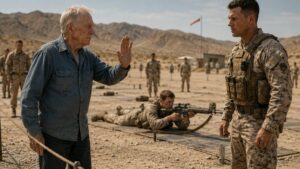
James looked toward the woodland course.
“Observing.”
The answer seemed to irritate him.
“Observing?”
“Yes, sir.”
Davis folded his arms.
His eyes moved again to the gear bag.
The old fabric.
The worn straps.
The visible repairs.
Everything about it contrasted sharply with the polished technology surrounding them.
For reasons James couldn’t quite understand, that seemed to bother the officer.
Nearby, Christopher shifted uneasily.
He could feel attention building.
The same way everyone else could.
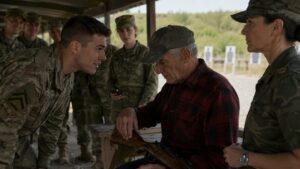
Steven Thompson, the senior drill instructor overseeing the event, stepped into view from across the range.
His eyes briefly met James’s.
A nod.
Nothing more.
But it was acknowledgment.
Professional to professional.
Davis noticed that too.
And for the first time, something sharpened behind his expression.
Not hostility.
Not yet.
Curiosity.
The kind that often became something worse.
He looked back at James.
Then at the recruits.
Then toward the restricted woodland lanes.
Finally he asked, loudly enough for several nearby people to hear:
“Why exactly is someone in your condition standing near an active qualification range?”
Chapter 2: The Commander Must Be Embarrassed
The question hung in the air longer than it should have.
Several nearby recruits stopped talking.
Christopher felt their attention shift from the demonstration to his brother.
James answered calmly.
“I’m authorized to be here, sir.”
Stephen Davis gave a thin smile.
“Authorized and qualified aren’t always the same thing.”
A few recruits chuckled.
Not loudly.
Just enough.
James remained still.
That seemed to frustrate Davis more than any argument could have.
The officer stepped closer and looked at the worn gear bag again.
“What exactly are you carrying in there?”
James glanced down.
“Equipment.”
More laughter.
Davis nodded as if proving a point.
“Judging by the age of that thing, I’d guess most of it belongs in storage.”
He reached out before James could respond and lifted the bag slightly by one strap.
The fabric sagged with use.
Scuffed edges showed years of wear.
A repaired section near the side pocket caught the attention of several recruits.
One whispered something.
Another laughed.
Davis turned toward the group.
“See this?”
He raised the bag slightly higher.
“People think experience means refusing to move forward.”
James felt dozens of eyes on him.
The old instinct returned.
Stay quiet.
Let it pass.
Don’t turn a moment into a conflict.
The instinct had served him well in deployment.
It served him less well in public.
Christopher stood frozen in formation.
His face had reddened.
He wanted to say something.
James could see it.
But Christopher remained silent.
The recruits around him were watching too closely.
Davis set the bag back down.
Then he gestured toward the nearby equipment displays.
Bright screens.
Modern optics.
Digital targeting software.
Real-time scoring systems.
“Today’s military isn’t built around guesswork anymore.”
Several cadets nodded.
“We have tools that tell us exactly where we’re strong and exactly where we’re weak.”
His gaze returned to James.
“And those tools don’t care about nostalgia.”
James said nothing.
The officer seemed determined to fill the silence himself.
“Let me ask you something.”
No answer was required.
Davis continued anyway.
“When was the last time you actually qualified on a modern course?”
James met his eyes.
“A while.”
“A while.”
The officer repeated the words loudly.
“As in before these recruits were in uniform?”
A few laughs spread through the crowd.
Christopher looked down.
For the first time all morning, that hurt James more than the insults.
Not because Christopher agreed.
Because he looked ashamed.
Steven Thompson emerged from a nearby observation point.
The senior drill instructor had clearly noticed the gathering crowd.
“What seems to be the issue?” he asked.
Davis turned.
“Just discussing readiness.”
Thompson’s eyes moved between them.
His gaze settled briefly on James.
Then on the folder under his arm.
“Looks more like you’re conducting a public trial.”
A few recruits shifted awkwardly.
Davis laughed.
“Nothing like that.”
But he didn’t step away.
Instead he walked toward one of the demonstration stations and activated a tablet.
A digital range display appeared.
Maps.
Target data.
Performance metrics.
Numbers moved across the screen.
“This system tracks every movement on the qualification course.”
He addressed the recruits again.
“It removes human error.”
He paused.
“It also removes excuses.”
The words landed exactly where he intended.
James understood that.
So did Thompson.
The drill instructor crossed his arms but remained silent.
Watching.
Evaluating.
The officer’s confidence grew.
“You know what gets people hurt?” Davis asked the group.
“Thinking old habits are enough.”
He pointed toward the woodland range.
“The battlefield changes.”
Then he glanced at James.
“Some people don’t.”
The recruits laughed again.
This time more openly.
Christopher didn’t join them.
But he didn’t stop them either.
James noticed.
And that hurt too.
Not anger.
Disappointment.
The younger brother he had spent years protecting seemed trapped between loyalty and acceptance.
The silence stretched.
Finally Thompson spoke.
“You’ve made your point.”
Davis smiled.
“Have I?”
His eyes drifted toward James’s paperwork.
“Actually, I don’t think I have.”
He turned back toward the crowd.
“Tell me something.”
Nobody answered.
The officer looked directly at James.
“Does your commander know you’re standing here carrying active injury paperwork?”
The question was designed for spectators.
Not for information.
James recognized the tactic.
He had seen similar personalities throughout his career.
People who needed an audience.
People who confused visibility with authority.
“Yes,” James said.
“And they’re comfortable with that?”
“Yes.”
Davis tilted his head.
For a brief second something flashed behind his expression.
Not certainty.
Doubt.
He had expected hesitation.
Maybe embarrassment.
Instead he found neither.
So he pressed harder.
“Interesting.”
He folded his arms.
“Because if one of my personnel showed up looking unprepared, carrying medical documentation, and dragging around outdated gear, I’d be embarrassed.”
The crowd reacted immediately.
Some gasped.
Others laughed.
A recruit muttered, “Wow.”
Christopher looked as if he wanted to disappear.
James felt the words hit.
Not because they were true.
Because they had been delivered publicly.
Designed to leave a mark.
Still he said nothing.
The silence irritated Davis again.
The officer looked toward the security checkpoint.
Then raised a hand.
The Military Police sergeant noticed.
A moment later he started walking toward them.
The crowd fell quiet.
Even the recruits recognized what that might mean.
Thompson’s expression hardened.
“What are you doing?”
“Being responsible.”
Davis didn’t look away from James.
“If there’s any doubt about qualification or safety, procedures exist.”
The MP sergeant arrived.
“You called, sir?”
Davis nodded.
“Possibly.”
The sergeant looked between them.
Then toward James.
Then toward the paperwork.
The atmosphere changed instantly.
This was no longer a conversation.
It was becoming official.
Christopher stared in disbelief.
For the first time all morning, fear crossed his face.
James remained motionless.
But something inside him shifted.
Because he suddenly understood that this wasn’t about safety.
It wasn’t about regulations.
It wasn’t even about him.
Stephen Davis needed everyone watching to believe he was right.
And now he was willing to make an example of someone to prove it.
The MP sergeant opened a small administrative tablet.
“What’s the concern, sir?”
Davis pointed directly at James.
“I think we need to determine whether he belongs on this range at all.”
Chapter 3: One Lane and Nothing More
The MP sergeant began entering information before anyone else could speak.
Names.
Unit identification.
Administrative notes.
Routine procedures.
Yet each tap on the screen felt heavier than it should have.
Around them, the demonstration had nearly stopped.
People pretended to focus on equipment displays.
Nobody actually was.
Everyone was watching.
James stood quietly while the sergeant reviewed the information available to him.
Stephen Davis seemed increasingly confident.
The public nature of the moment worked in his favor.
The larger the audience became, the more certain he appeared.
Christopher looked trapped.
Part of him wanted to move toward his brother.
The other part feared drawing more attention.
The conflict showed plainly on his face.
“Current status?” the MP sergeant asked.
James answered.
“Active duty.”
“Medical restrictions?”
“None preventing range qualification.”
The sergeant nodded.
Davis immediately stepped in.
“That’s not the full picture.”
The sergeant looked up.
Davis pointed toward the paperwork folder.
“He is processing deployment-injury documentation.”
“Administrative review,” James said.
“Still relevant.”
The officer’s tone sharpened.
“Especially during a live-fire demonstration.”
The MP sergeant hesitated.
He wasn’t eager to make a mistake.
James could see that.
The man wasn’t hostile.
Just cautious.
Which made the situation worse.
Cautious people followed procedures.
Procedures could remove him from the range whether the accusations were fair or not.
Thompson finally stepped forward.
“Enough.”
The crowd quieted instantly.
The drill instructor’s voice carried weight.
“Has he violated a rule?”
Nobody answered.
“Has he failed a qualification?”
Silence again.
Davis crossed his arms.
“That’s impossible to know.”
“Exactly.”
Thompson looked directly at him.
“We don’t know.”
For a moment it seemed the situation might end there.
Then Davis made a mistake.
Or perhaps revealed more than he intended.
He gestured toward the digital displays around the range.
“We’ve spent years improving these programs.”
His voice carried across the crowd.
“We finally have systems that identify capability accurately.”
He pointed toward James.
“And now we’re supposed to ignore obvious indicators because someone carried a rifle years ago?”
The statement landed badly.
Not because everyone disagreed.
Because it sounded personal.
Thompson noticed immediately.
“So that’s what this is.”
Davis frowned.
“What does that mean?”
“It means you’ve already decided what the result should be.”
The officer didn’t answer.
And that silence answered enough.
James watched the exchange carefully.
For the first time he understood the deeper issue.
Davis wasn’t merely concerned about safety.
The demonstration mattered to him.
His reputation mattered.
The technology mattered.
A soldier carrying old equipment and old habits succeeding today would undermine part of the story he wanted people to believe.
The realization surprised James.
Not because it explained everything.
Because it made the humiliation feel less personal.
The target wasn’t really him.
He was simply standing in the wrong place.
A range assistant approached Thompson and spoke quietly.
The drill instructor listened.
Then glanced toward the woodland lanes.
One of the qualification tracks had just become available.
A cancellation.
An unexpected opening.
The assistant walked away.
Thompson remained thoughtful.
Then he looked at James.
“Do you want to run the course?”
The question caught everyone off guard.
Even James.
His first instinct was immediate.
No.
Leave.
Finish the paperwork.
Avoid the spectacle.
The day had already become something he never wanted.
He could walk away right now.
The thought lingered longer than it should have.
Maybe Davis was wrong.
Maybe he wasn’t.
It had been years.
The injury still flared unexpectedly.
Technology had changed.
Training had changed.
The military had changed.
Maybe he no longer belonged in environments like this.
The doubt arrived quietly.
Which made it dangerous.
Then he looked across the formation.
Christopher was staring at him.
Not embarrassed now.
Not ashamed.
Just waiting.
Waiting to see what happened next.
James remembered being eighteen.
Remembered watching older soldiers.
Studying how they handled pressure.
Learning far more from their actions than their words.
Christopher wasn’t watching a qualification dispute.
He was watching what a professional did when publicly challenged.
James exhaled slowly.
The decision became simple.
Not easy.
Simple.
“Yes,” he said.
The answer echoed through the gathering.
Thompson nodded.
Davis looked irritated.
“One lane.”
The drill instructor’s voice cut through every reaction.
“One attempt.”
The officer opened his mouth.
Thompson stopped him with a look.
“One lane. That’s all.”
Nobody argued.
Not even Davis.
Because refusing now would look worse than allowing it.
The MP sergeant lowered his tablet.
The immediate removal process halted.
The tension remained.
But the threat had changed shape.
Now everything depended on performance.
The crowd slowly moved toward the observation area overlooking the woodland course.
James stepped away from them.
Toward a preparation bench near the start posi
Chapter 4: The Weight Inside the Old Bag
A small metal compass slid into James’s hand as he checked his equipment.
For a second he simply stared at it.
The edges were worn smooth from years of use.
The glass carried a faint scratch across one corner.
Nobody else would have noticed.
He noticed immediately.
The compass had been with him during a deployment years earlier, long before digital navigation became standard across every unit.
It wasn’t necessary anymore.
He carried it anyway.
Not because he distrusted technology.
Because he trusted preparation.
Around him, observers gathered along the viewing area overlooking the woodland course.
The qualification lane cut through dense trees, disappearing from sight after the first hundred yards.
Beyond that, only scattered camera feeds and electronic sensors would track progress.
James returned the compass to the bag.
The motion felt strangely heavier than it should have.
The range loudspeaker crackled.
“Lane Three preparing.”
A few recruits shifted closer to the railings.
Others opened scoring applications on their tablets.
Most expected entertainment.
Some expected failure.
Stephen Davis clearly expected confirmation.
The officer stood near the command station speaking quietly with staff.
Every few moments his eyes drifted toward James.
As if waiting for reality to validate an assumption.
James ignored him.
He knelt beside the bag.
Checked each piece of equipment.
Not hurried.
Not dramatic.
Just methodical.
Years of repetition made the process automatic.
Magazine placement.
Sling adjustment.
Eye protection.
Gloves.
Everything exactly where it belonged.
A voice interrupted him.
“You still carry that?”
Christopher stood a few feet away.
James looked up.
His younger brother’s attention remained fixed on the compass.
“Sometimes.”
Christopher frowned.
“We have navigation systems for everything now.”
James nodded.
“We do.”
“Then why keep it?”
James considered the question.
“Because batteries fail.”
Christopher almost smiled.
Almost.
The answer sounded simple.
Yet something about it stayed with him.
Before he could say more, a range official called him back toward the recruit formation.
Christopher hesitated.
Then turned away.
As he left, James noticed something different.
The embarrassment from earlier wasn’t completely gone.
But curiosity had replaced part of it.
That was enough.
James returned his attention to the gear bag.
Beneath the compass sat other items carrying similar histories.
A field notebook.
A repaired flashlight.
A weathered multitool.
Nothing expensive.
Nothing impressive.
Each had survived because it remained useful.
The same standard he had always applied to people.
The thought brought an unexpected sting.
Because lately he wasn’t entirely sure he still met that standard himself.
The injury paperwork folded inside his pocket seemed heavier than any equipment.
Years earlier, he had never questioned his place.
Now he sometimes did.
Not every day.
Not constantly.
Just enough.
Enough to wonder whether the military still valued what had shaped him.
Enough to remain silent when challenged.
Enough to avoid proving otherwise.
The start area began filling with activity.
Officials checked lane status.
Camera feeds activated.
Digital scoring systems synchronized.
The demonstration had become increasingly focused on one soldier.
James disliked that.
Qualifications were supposed to measure performance.
Not settle arguments.
A voice from the observation area carried farther than intended.
“Watch his first movement.”
Stephen Davis.
“He’ll compensate for the knee.”
A few recruits nodded.
One wrote something down.
James pretended not to hear.
Inside, irritation flickered briefly.
Not because the officer might be right.
Because he was turning evaluation into prediction.
The outcome already existed in his mind.
Everyone else merely needed to catch up.
Steven Thompson approached.
The senior instructor stopped beside the bench.
For several seconds neither man spoke.
Finally Thompson looked toward the bag.
“Old equipment.”
“Still works.”
Thompson nodded.
“Usually does.”
The instructor’s gaze lingered on the compass.
Recognition flashed across his face.
Not of the object.
Of what it represented.
“You deployed with that?”
“Yes.”
Thompson grunted softly.
Then he surprised James.
“You know why I gave you the lane?”
James expected a comment about fairness.
Or regulations.
Instead Thompson said, “Because you never tried to convince anyone.”
James looked at him.
The instructor shrugged.
“People desperate to prove something usually tell you.”
He glanced toward Davis.
“The people who actually know tend to stay quiet.”
Before James could answer, Thompson walked away.
The words lingered.
Part compliment.
Part warning.
Because silence had brought him here too.
Silence had allowed other people to define him.
A sudden burst of laughter erupted from the observation area.
James looked up.
Davis was speaking again.
This time loudly enough for everyone nearby to hear.
“At least the scoring system will be objective.”
A few recruits chuckled.
The officer continued.
“If he finishes.”
The remark landed exactly as intended.
Christopher heard it too.
James saw his younger brother stiffen.
Saw the anger flash across his face.
But Christopher remained silent.
The same choice James would have made.
The same mistake.
For a brief moment, James understood something clearly.
This qualification wasn’t about winning an argument.
It wasn’t about humiliating Davis.
It wasn’t even about his own pride.
Christopher was watching.
Learning.
Drawing conclusions.
If James walked away from the challenge because of doubt, Christopher would remember that.
If James allowed other people to define professionalism, Christopher would remember that too.
The realization settled quietly into place.
The fear remained.
The uncertainty remained.
The knee still hurt.
None of that disappeared.
But purpose replaced hesitation.
The loudspeaker crackled again.
“Lane Three. Final readiness check.”
James stood.
Lifted the gear bag.
The familiar weight settled against his shoulder.
Not a burden.
An anchor.
A reminder.
As he approached the start position, range personnel completed final inspections.
The woodland course stretched ahead through shadows and sunlight.
Targets hidden.
Distances unknown.
Pressure unavoidable.
Exactly the way real qualification should be.
A range official handed him hearing protection and stepped aside.
The timer waited.
The observation deck fell silent.
Even Davis stopped talking.
Everyone wanted the same answer now.
The question had become impossible to ignore.
Could the soldier they had mocked actually do this?
James settled into position.
Hands steady.
Breathing controlled.
The years between past and present narrowed.
The loudspeaker counted down.
Three.
Two.
One.
The start signal sounded through the trees.
Chapter 5: Fundamentals in the Trees
The first shot broke the silence.
A sharp crack echoed through the woodland lane.
The target dropped instantly.
No hesitation.
No adjustment.
No wasted movement.
Several recruits looked up from their tablets.
The speed surprised them.
James was already moving.
The course wound through trees and uneven terrain designed to force constant adaptation.
Sensors tracked movement.
Cameras monitored positioning.
Every action carried a score.
James focused on none of it.
His attention remained where it always belonged.
The next position.
The next target.
The next task.
Nothing else.
A second target appeared between two trees.
He dropped to a knee.
Controlled breath.
Single shot.
Hit.
The indicator light flashed green.
Observers exchanged glances.
At the command station, a score appeared.
Perfect.
Still early.
Still insignificant.
Yet the reaction was immediate.
The laughter that had followed him all morning disappeared.
Christopher leaned forward slightly.
The recruits beside him stopped talking.
Stephen Davis folded his arms tighter.
The course continued.
James moved through the first section with the rhythm of long-practiced habits.
Each motion flowed naturally into the next.
Not fast for the sake of speed.
Efficient.
The distinction mattered.
A camera feed displayed his progress on several monitors.
One recruit pointed at the screen.
“He barely looks at the targets.”
Another answered.
“He already knows where they’re supposed to be.”
Steven Thompson shook his head.
“No.”
The recruits looked toward him.
The instructor’s eyes never left the monitor.
“He’s reading the terrain.”
Nobody spoke after that.
On the screen, James approached a narrow firing position partially blocked by brush.
Several earlier participants had lost points there.
The angle was awkward.
Visibility poor.
A mistake waited for anyone rushing.
James slowed.
Adjusted.
Fired.
Green indicator.
Perfect again.
The scoreboard updated.
Still flawless.
For the first time, uncertainty appeared among the spectators.
Not about James.
About their assumptions.
Halfway through the course, the terrain steepened.
The injured knee protested immediately.
A sharp pulse of pain climbed through the joint.
James felt it.
Acknowledged it.
Moved anyway.
Not ignoring the problem.
Managing it.
The distinction had kept him functioning for years.
At the observation area, Christopher saw the slight limp return.
His stomach tightened.
The recruits nearby noticed too.
One whispered, “There it is.”
Davis nodded as if expecting confirmation.
For several seconds the course disappeared beneath tree cover.
The monitors showed only partial camera angles.
No targets.
No score updates.
No indication of progress.
The uncertainty spread through the crowd.
Then another result appeared.
Perfect.
Then another.
Perfect again.
A recruit checked the statistics screen.
“That’s impossible.”
“It isn’t impossible,” Thompson replied.
“It just isn’t common.”
The instructor sounded almost irritated by the surprise.
As if the spectators should have known better.
Deep within the course, James reached a transition point requiring equipment movement.
He opened the old gear bag briefly.
Retrieved exactly what he needed.
Nothing more.
Everything sat where his hands expected it.
Years of organization paid off in seconds.
The movement saved time.
Saved effort.
Saved points.
The bag everyone mocked became part of the performance.
Another target appeared.
Then another.
Hits.
Clean.
Controlled.
Precise.
The course continued demanding answers.
James continued providing them.
At the command station, officials began paying closer attention.
What started as curiosity became scrutiny.
Not suspicion.
Verification.
People wanted to know whether the score was real.
Every update said it was.
Davis stopped making comments.
That silence alone drew attention.
Christopher noticed it first.
The officer no longer looked confident.
He looked concerned.
The distinction mattered.
A difficult section waited near the end of the course.
Moving targets.
Changing positions.
Strict timing requirements.
The area where most scores collapsed.
James entered it without hesitation.
The first moving target crossed.
Hit.
Second.
Hit.
Third.
Hit.
The electronic display flashed green repeatedly.
Observers stared.
No laughter remained anywhere.
Only concentration.
Only disbelief.
Only the growing possibility that everyone had misjudged the wrong man.
The final portion of the course approached.
One stage remained beyond a dense section of woodland.
The hardest stage.
The score remained perfect.
For now.
But perfection was fragile.
One mistake could erase everything.
James disappeared into the trees toward the last challenge.
Behind him, every eye followed the scoreboard.
Waiting to see whether the flawless run could survive what came next.
Chapter 6: The Scoreboard Refuses to Lie
The final shot echoed through the trees.
Then silence returned.
No immediate score appeared.
No confirmation.
No failure.
Nothing.
Every screen at the command station froze on the same number.
Processing.
The word sat beneath James’s score like a challenge.
A murmur spread through the observation area.
People shifted positions.
Leaning closer.
Trying to see what happened.
James emerged from the woodland course carrying the gear bag over one shoulder.
His breathing remained controlled.
His expression revealed nothing.
The hardest part was over.
Now the machines had to decide what they believed.
Stephen Davis stepped closer to the scoring station.
“What is taking so long?”
A technician checked multiple screens.
“Verification cycle.”
“Verification of what?”
“Perfect scores trigger additional review.”
The answer silenced several people at once.
Perfect scores.
Plural.
Meaning the system considered it possible.
Christopher stared at the monitor.
His pulse hammered harder than it had during the qualification itself.
James approached the designated finish area and waited.
No celebration.
No reaction.
Just patience.
The same patience that had irritated Davis from the beginning.
The officer folded his arms.
Then unfolded them.
Then folded them again.
For the first time all day, he looked uncomfortable.
A second technician joined the first.
They reviewed camera footage.
Sensor logs.
Target records.
Time stamps.
Everything matched.
Still the review continued.
The delay created its own tension.
A recruit finally whispered, “Maybe there was a malfunction.”
The suggestion spread quickly.
People wanted an explanation.
Any explanation.
Something easier than admitting they might have been wrong.
Davis seized the opening immediately.
“That’s possible.”
His voice carried farther than intended.
“Systems aren’t infallible.”
Thompson turned toward him.
An eyebrow lifted slightly.
The irony hung in the air.
Earlier Davis had praised the technology as objective truth.
Now he questioned it.
The officer realized the problem instantly.
His jaw tightened.
But he continued.
“We should be thorough.”
Nobody argued with that.
Yet the shift had already been noticed.
Christopher certainly noticed.
So did the recruits.
The technology suddenly mattered less than whether it agreed with expectations.
James remained silent.
He watched the scoreboard.
Nothing else.
The delay gave him too much time to think.
About the injury.
About the years since deployment.
About the moments he had wondered whether his skills still mattered.
The doubt had followed him onto the range.
It had followed him through every stage.
Even now it lingered.
Not because of the score.
Because scores eventually faded.
The deeper question remained.
Who was he becoming after everything that had happened?
A technician suddenly sat back.
“All right.”
Every conversation stopped.
The command station went silent.
The technician entered a final authorization code.
Several displays refreshed simultaneously.
Steven Thompson stepped forward.
His eyes moved across the results.
Slowly.
Carefully.
Then he looked toward James.
The expression on the instructor’s face changed.
Not surprise.
Recognition.
As if something he suspected had finally been confirmed.
Davis stepped closer.
“What is it?”
The instructor didn’t answer immediately.
The pause felt endless.
Then the central scoreboard updated.
The numbers appeared in bright digital lettering visible across the entire range.
PERFECT OPERATOR QUALIFICATION RATING.
For one second nobody reacted.
The result was too simple.
Too final.
Too absolute.
Then silence settled over the range like a physical thing.
No laughter.
No whispers.
No excuses.
Only the scoreboard.
Only the truth it displayed.
And for the first time all day, nobody could explain it away.
Chapter 7: What Professionalism Actually Looks Like
Nobody moved.
The scoreboard continued to glow above the range.
PERFECT OPERATOR QUALIFICATION RATING.
The words seemed almost unreal after everything that had happened.
A recruit near the back slowly lowered his tablet.
Another looked toward James.
Then toward Stephen Davis.
Then back again.
The comparison was unavoidable.
For most of the day, the officer had controlled the conversation.
Now the scoreboard controlled it.
And it wasn’t interested in opinions.
James stood where he was.
His hands rested naturally on the strap of the worn gear bag.
No victory pose.
No celebration.
No attempt to enjoy anyone else’s discomfort.
The silence around him felt larger than the score itself.
A technician cleared his throat.
“Verification complete.”
Nobody responded.
The statement changed nothing.
The proof had already been accepted.
Steven Thompson finally stepped away from the command station and walked toward James.
Several recruits instinctively followed him with their eyes.
The senior instructor stopped a few feet away.
For a moment he simply looked at the younger soldier.
Then he nodded once.
Professional to professional.
Nothing more.
Yet somehow it carried more weight than applause.
“Good work,” Thompson said.
“Thank you, sir.”
The instructor glanced toward the woodland course.
“You didn’t waste a single movement.”
James shrugged slightly.
“Course gives you enough problems already.”
A faint smile appeared on Thompson’s face.
Then disappeared.
He turned and walked away.
The exchange lasted less than thirty seconds.
Yet several recruits continued staring.
Because they understood what they had just witnessed.
Respect.
Not granted by rank.
Earned.
Near the observation area, Christopher finally started moving.
The hesitation that had followed him all day seemed to fall away with every step.
He crossed the distance between them quickly.
Then stopped.
The words he had probably rehearsed refused to come.
For a few seconds neither brother spoke.
Christopher looked down.
“I should’ve said something.”
James knew immediately what he meant.
Earlier.
During the humiliation.
During the laughter.
During all of it.
“You didn’t.”
Christopher winced.
“I know.”
The answer wasn’t defensive.
It sounded disappointed.
Mostly in himself.
James studied him.
The younger recruit looked exhausted.
Not physically.
Emotionally.
The kind of exhaustion that came from learning something uncomfortable about yourself.
“You wanted them to like you,” James said.
Christopher’s eyes widened slightly.
Then he nodded.
“Yeah.”
The honesty surprised both of them.
James adjusted the strap of the gear bag.
“That’s normal.”
Christopher frowned.
“It doesn’t feel normal.”
“No.”
James looked toward the scoreboard.
“It usually doesn’t.”
Nearby conversations gradually resumed.
Not loudly.
People seemed careful now.
As if speaking too loudly might break whatever lesson the afternoon had delivered.
Christopher followed James’s gaze.
“Did you know you’d do that?”
The question came quietly.
James laughed once.
A short breath of amusement.
“No.”
“You looked like you knew.”
“I looked calm.”
“Same thing.”
James shook his head.
“It’s not.”
Christopher waited.
James considered the answer.
Then gave him the truth.
“I was worried the whole time.”
The younger man’s eyes narrowed.
“Seriously?”
“Seriously.”
Christopher stared.
For the first time all day, he looked more confused than embarrassed.
“You didn’t seem worried.”
“That’s because being worried and quitting aren’t the same thing.”
The words settled between them.
Simple.
Not dramatic.
Yet Christopher visibly absorbed them.
Across the range, Stephen Davis remained near the command station.
Several people approached him.
A few asked questions.
Others simply walked past.
The officer answered when required.
His confidence had not disappeared.
But something else had.
Certainty.
For most of the day he had treated the outcome as obvious.
The score had taken that away.
James noticed him looking toward the woodland course.
Not toward the scoreboard.
Toward the course itself.
As if replaying everything that happened there.
After a long moment, Davis began walking in their direction.
Christopher immediately stiffened.
James remained still.
The officer stopped several feet away.
Close enough to speak.
Far enough to leave.
For a second nobody said anything.
Davis looked older than he had that morning.
Not physically.
Just tired.
Finally he exhaled.
“That was an impressive run.”
James nodded.
“Thank you, sir.”
The response seemed to surprise him.
Perhaps he expected bitterness.
Or satisfaction.
Instead he received professionalism.
Again.
The officer glanced at the gear bag.
The same bag he had mocked hours earlier.
“How long have you had that thing?”
James looked down.
“A while.”
Davis almost smiled.
The answer sounded familiar.
For a moment he stared at the worn fabric.
The repaired seams.
The faded material.
Then he shook his head.
“I thought I understood what I was looking at.”
James didn’t answer.
Because there wasn’t much to say.
The officer looked toward the recruits.
Many of them were still watching.
Including Christopher.
Especially Christopher.
Davis noticed that too.
His expression tightened.
Not from embarrassment.
From recognition.
He finally understood who else had been standing inside the blast radius of his comments.
Not just James.
Everyone learning from the example.
“I was focused on proving a point,” he said quietly.
The admission seemed difficult.
“I know.”
The officer looked surprised again.
Then he nodded once.
There was no dramatic apology.
No speech.
No public confession.
Just an uncomfortable truth acknowledged between two professionals.
A few seconds later he turned and walked away.
Christopher watched him leave.
“That’s it?”
James looked at him.
“What did you expect?”
“I don’t know.”
Neither did Christopher.
Maybe some huge moment.
Some public reversal.
Some humiliation equal to what James endured.
Instead there was only reality.
People learning.
Or refusing to.
One decision at a time.
The range gradually returned to normal activity.
Equipment crews began shutting down stations.
Observers dispersed.
The crowd moved on.
As crowds always did.
The scoreboard remained visible above the command post.
Yet James found himself paying less attention to it.
The number mattered.
The lesson mattered more.
Christopher walked beside him toward the edge of the range.
For a while neither spoke.
Eventually the younger recruit broke the silence.
“When you were standing there earlier…”
He hesitated.
“When everyone was laughing.”
James waited.
“Were you angry?”
The question felt important.
Not because of the answer.
Because of why Christopher asked it.
James thought carefully.
“A little.”
“Why didn’t you say anything?”
The question finally reached the center of everything.
The reason silence had helped him.
And hurt him.
The reason today’s events happened at all.
James adjusted the gear bag.
“I spent a long time thinking professionalism meant staying quiet no matter what.”
Christopher listened closely.
“And now?”
James looked toward the trees bordering the qualification course.
The same trees he had walked through only an hour earlier.
“Now I think professionalism means knowing what matters.”
Christopher waited.
“The score mattered.”
“The argument didn’t.”
The younger recruit nodded slowly.
Understanding arrived piece by piece.
Not all at once.
The way real lessons usually did.
They reached the edge of the range.
Vehicles waited beyond the fencing.
The afternoon sun stretched long shadows across the ground.
James paused.
Christopher looked at him.
One final question remained.
The one he had carried since the morning.
“Were you ever afraid after the injury?”
James smiled slightly.
There it was.
The real question.
Not about shooting.
Not about scores.
Not about embarrassment.
About fear.
“Yes.”
Christopher blinked.
The answer came too quickly to be rehearsed.
Too honestly to be comforting.
“All the time?”
“No.”
James looked down at the gear bag.
The compass.
The notebook.
The flashlight.
The small pieces of a life carried forward.
“Just enough.”
“Enough for what?”
“Enough to decide what kind of person you’re going to be.”
Christopher absorbed that in silence.
No easy answer followed.
No perfect lesson.
Just the truth.
After a moment, James started walking.
Christopher followed.
Behind them, the scoreboard still glowed above the range.
Ahead of them, the road disappeared between the trees.
James carried the old gear bag over one shoulder.
The same bag people had mocked.
The same bag people now understood.
He never looked back at the score.
He didn’t need to.
The story has ended.