The Names She Carried Were Waiting at the Edge of the Desert
Part I — The Circle
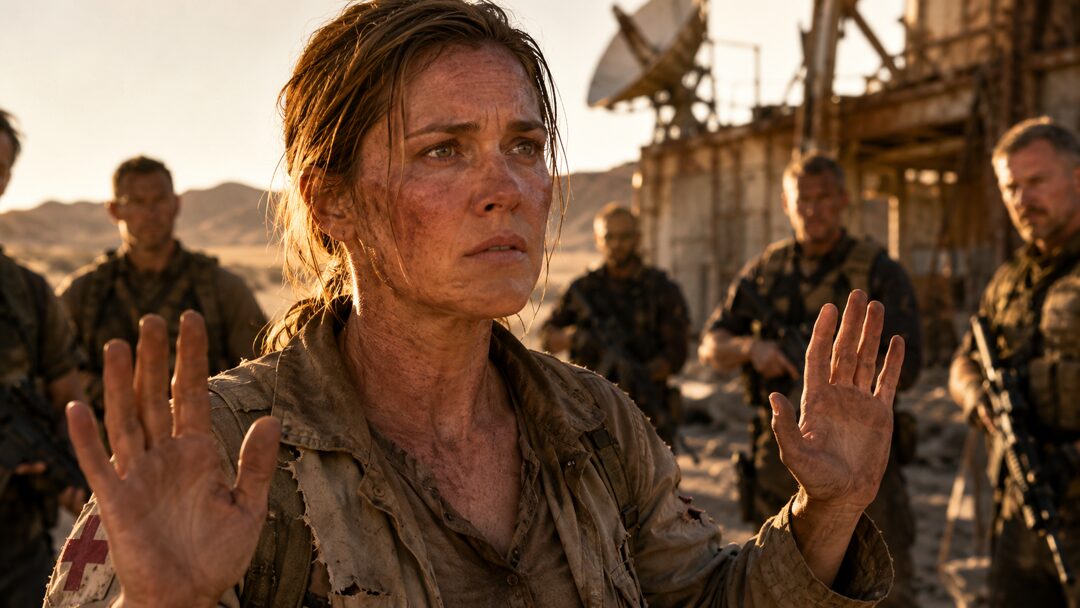
Six men aimed at Sarah Walker in the desert, and Captain Robert Hayes smiled like he had already decided how her story would end.
Her medic’s jacket hung open at one shoulder. Dust had turned the dark fabric gray. One sleeve was stiff with old blood, most of it not hers. Her lips were split from heat. Her hands were raised, but not high enough to look surrendered.
Hayes noticed that.
He noticed everything he thought mattered.
“Where is it?” he asked.
Sarah blinked against the sun. Behind him, the relay station sat burned and gutted, its metal ribs bent upward like something picked clean. The desert around it was empty except for the men, the vehicles, the long shadows, and a rusted antenna leaning toward the rocks.
“I don’t have it,” she said.
One of Hayes’s men shifted his grip. Another took half a step to the side, widening the circle. Their rifles followed her ribs, her throat, her face.
Hayes walked slowly around her. He wore clean tactical gear, too clean for a man who claimed he had been chasing her through the desert all morning. His gray beard was trimmed close. His sunglasses hid his eyes until he stopped in front of her and removed them with a kind of patience that felt worse than anger.
“You ran twelve miles through open heat,” he said. “You crossed a dry wash with a bad ankle. You circled back to a dead relay station with no water, no transport, no backup, and no plan.” He tilted his head. “Don’t insult me by pretending you did all that empty-handed.”
Sarah swallowed. Her throat clicked.
The youngest man in the circle heard it. He was maybe twenty-four, sunburned under the helmet line, nervous eyes, rifle held correctly but too tight. His name patch said Miller. Jason Miller, if Hayes’s barked orders from the chase had been real.
Sarah filed that away.
Hayes followed her glance.
“Eyes on me, Walker.”
She looked back at him.
He smiled again, smaller this time. “There she is.”
The wind dragged sand across the cracked concrete. Somewhere inside the relay station, a loose strip of metal tapped once, then again, as if something old was trying to speak.
Hayes turned to his men. “Lower them.”
The rifles dipped.
Not enough.
Sarah almost laughed. It came out as a dry breath.
Hayes heard that too. “You find this funny?”
“No.”
“Good. Humor gets people careless.”
“So does confidence,” Sarah said.
For the first time, his smile disappeared.
Jason Miller’s rifle twitched half an inch.
Hayes did not look at him. He did not need to. “Medic Walker has had a difficult day,” he said to the men, voice smooth again. “She is tired. Possibly concussed. Definitely confused about the difference between conscience and chain of command.”
Sarah kept still.
“You were assigned to recover personnel, not evidence,” Hayes continued. “You don’t get to decide what becomes official. You don’t get to decide what matters. Soldiers follow orders. Medics keep people alive.”
Sarah looked at Jason again.
There it was.
A blink. A hesitation. Not rebellion. Not yet.
Just a crack.
Hayes stepped closer. “Where is the drive?”
Sarah could feel sweat sliding down her back under the jacket. She could feel the wrapped shape pressed under her waistband, not the drive, not exactly, but close enough to death to feel warm.
She said, “I told you.”
Hayes leaned in.
“No,” he said. “You told me the first lie you thought of.”
The men waited.
The desert waited.
Sarah had been trained to stop bleeding, clear airways, count breaths, make her hands move even when the world came apart. No one had trained her for this: to stand still while six guns held her in place and the man responsible for the worst day of her life asked her to hand him the last thing Daniel Brooks had ever trusted to anyone.
Hayes studied her face.
“You’re not built for this,” he said softly.
Sarah’s fingers trembled.
Hayes saw that and mistook it for the beginning of surrender.
That was his first mistake.
Part II — The Version That Needed Her Silent
“They told you what was on it?” Hayes asked.
Sarah said nothing.
“The drive,” he said. “The one Sergeant Brooks stole before he died. The one you took from his body.”
Her jaw tightened before she could stop it.
Hayes nodded, satisfied. “There he is.”
The name hit harder than the heat.
Daniel Brooks had not looked like a name when Sarah last saw him. He had looked like dust and torn fabric and one hand pressed to his side, trying to keep himself together until she reached him. He had looked at her with eyes too awake for a dying man.
Not now.
She forced the memory down.
Hayes turned slightly, making sure the others could hear. “Operation Sandglass was classified recovery. Private asset protection. Route security. Communications support. That drive contains proprietary operational logs belonging to my company.”
“Your company,” Sarah repeated.
He smiled without warmth. “You have a problem with ownership?”
“Twelve service members and two interpreters died.”
One of the men looked away.
Hayes did not.
“People die in bad terrain,” he said. “They die when convoys break formation. They die when junior officers panic and local guides give bad routes.”
Sarah felt the sun vanish for half a second behind her memory.
A vehicle door hanging open.
A radio spitting static.
Daniel’s hand closing around her wrist with shocking strength.
Don’t let them bury the second convoy twice.
At the time, she had thought pain had scrambled him. There had only been one convoy left by then, torn apart along the wash, smoke bending sideways in the wind. She had pressed gauze where it did nothing and told him to stay with her because that was what she told everyone until she could not anymore.
Now she understood.
The first burial had happened in the desert.
The second had been typed into the report.
Hayes took another step closer.
“The people who died at Sandglass died because they left the assigned route,” he said. “That is the version that keeps families from asking questions they cannot survive answers to.”
Sarah looked up at him. “That’s not mercy.”
“No,” Hayes said. “It’s management.”
Jason Miller’s mouth tightened.
Hayes finally noticed him. “Something to add?”
Jason straightened so quickly his gear clicked. “No, sir.”
“Then look useful.”
Jason looked back at Sarah instead.
She did not plead with him. Pleading would make him choose Hayes faster.
A person like Jason had been trained to fear softness in himself. He would not step toward pity.
But doubt was different.
Doubt could stand upright.
Hayes walked behind Sarah. She heard his boots scrape against concrete, heard the faint crunch of glass under one heel. The men moved their rifles to track him and her at once.
“You know what people like you never understand?” Hayes asked.
Sarah kept her eyes on Jason.
“What?”
“Truth is not clean,” Hayes said. “It never has been. People back home want clean villains and clean heroes. They want a file they can open and a person they can hate. Out here, decisions happen fast. You save what can still be saved.”
Sarah’s chest tightened.
He sounded almost sincere.
That was the worst part.
Hayes was not a man who thought of himself as cruel. He thought cruelty was what weaker people called decisions they did not have the stomach to make. That made him more dangerous than a man who knew he was lying.
“You redirected them,” Sarah said.
The words landed too directly.
Hayes stopped moving.
The rifles stayed still.
Jason looked at Hayes.
Sarah saw it. Hayes saw her seeing it.
“Careful,” Hayes said.
“You sent the convoy off the route.”
“I adjusted a route based on available intelligence.”
“To protect your extraction lane.”
Hayes laughed once, not because anything was funny. “You have no idea what you’re repeating.”
“I heard the calls.”
“You heard fragments.”
“I heard Channel Four go dead first.”
Hayes’s face changed.
Only slightly.
Only for one second.
But Sarah caught it, and so did Jason.
A man who did not know the truth would have asked what Channel Four meant.
Hayes did not ask.
He said, “You were busy treating casualties. Don’t pretend you understood command traffic.”
Sarah’s pulse beat hard against the place where Daniel’s field beacon pressed into her skin.
She had not understood it then.
She understood enough now.
Hayes moved back in front of her. “You are tired,” he said. “You are grieving. You saw a man die and built a story around it because grief needs a shape.”
Sarah nearly closed her eyes.
Daniel’s hand around hers.
The tiny black drive slick with dust.
The cracked beacon under it, its casing split, its light flickering like a heartbeat that did not know it was ending.
“Walker,” Daniel had whispered.
“I’m here.”
“Not them.”
“Don’t talk.”
“Promise me.”
“Daniel, save your breath.”
His fingers had tightened until she looked at him.
“Don’t let them bury the second convoy twice.”
Then his grip had gone loose.
In the present, Hayes lowered his voice.
“If you give me the coordinates, I can help you,” he said. “I can tell them you were injured. Disoriented. Manipulated by trauma. Nobody has to know you made it worse.”
Sarah stared at him.
There it was.
The offer.
Not freedom. Not mercy.
A cleaner cage.
“You can still be remembered as someone who tried to help,” Hayes said.
That almost broke her.
Not because she believed him.
Because some exhausted part of her wanted permission to stop.
She had carried Daniel’s last request through heat, static, and fear. She had run until her legs shook. She had hidden, doubled back, cut her palm on the relay station panel, wired old parts with hands that would not stop trembling.
And still, she did not know if it had worked.
Maybe nothing had gone through.
Maybe Hayes would kill her here and find nothing and the report would stay clean.
Maybe Daniel had given his final words to the wrong person.
Sarah let her shoulders drop.
Hayes saw it and stepped closer.
“That’s right,” he said.
Jason looked down.
Sarah whispered, “It’s not on me.”
Hayes went very still.
Then he smiled.
Part III — The Crack in the Circle
Hayes believed her because he wanted to.
That was his second mistake.
He snapped his fingers. “Search the station. Full sweep. Back wall, storage pit, antenna housing, rock line. She didn’t come here for the view.”
Four men broke from the circle.
For the first time since Sarah had stopped running, the pressure around her shifted. The rifles were still there, but not all of them. The space widened. The ruined station swallowed men through its black doorway. Boots scraped metal. Someone cursed at the heat inside.
Jason stayed nearest to her.
Hayes stayed in front.
“See?” Hayes said. “Cooperation feels better.”
Sarah breathed through her nose. Slow. Measured.
She could not look toward the western rock line. Not yet.
The backup antenna was half-buried there, barely visible beneath scrub and sand. If Hayes had brought a real technical team, they might have noticed the fresh wire. But he had brought men trained to scare people and retrieve objects fast.
That was not the same thing as seeing.
Jason shifted his weight.
Sarah spoke without moving her mouth much. “Were you at Sandglass?”
Jason’s eyes flicked toward Hayes.
Hayes was watching the station entrance.
Jason said, “No.”
“Then ask him why he knows which radio channel died first.”
Jason did not answer.
Sarah kept her gaze forward. “Ask him why Channel Four matters.”
His voice dropped. “Stop.”
“Or ask him why the report says the convoy left route before the first call failed.”
Jason’s jaw worked.
Hayes looked at him.
“What did she say?”
Jason froze.
Sarah answered before he could. “I asked if he was there.”
Hayes’s expression cooled. “He wasn’t.”
“No,” Sarah said. “That’s the point.”
Jason looked at Hayes now. Really looked.
Hayes stepped toward him. “Miller.”
“Sir,” Jason said.
“Do you understand what she is doing?”
Jason swallowed. “She said Channel Four went down first.”
Hayes’s face did not move, but the air around him changed.
Sarah felt it like weather.
“She is repeating pieces of stolen material,” Hayes said. “That’s what compromised witnesses do. They take fragments and build accusations.”
Jason’s rifle lowered another inch.
Not much.
Enough.
“What was Channel Four?” Jason asked.
Hayes stared at him.
The station clanged behind them. One of the searchers shouted, “Nothing in the front room!”
Hayes did not turn. “Miller, you are paid to secure recovery operations, not litigate them.”
“I know that, sir.”
“Then secure.”
Jason’s fingers tightened.
Hayes moved closer, his voice cutting lower. “You want to go back to security work at strip malls? You want to tell recruiters you became morally overwhelmed by a medic with heatstroke?”
Jason flushed.
Sarah watched shame land exactly where Hayes aimed it.
Hayes knew how to make men obey themselves before they obeyed him.
“You don’t know her,” Hayes said. “You don’t know what she took. You don’t know what happens if that drive reaches people who will use half a story to burn an entire operation.”
Jason glanced at Sarah.
She said nothing.
If she asked him to believe her, Hayes would win.
Belief was too much to demand from a stranger with a rifle.
Doubt was enough.
From inside the relay station, another man called, “Storage pit’s clear!”
Hayes turned toward the sound. “Check the rear panels.”
Sarah’s heart kicked once.
The rear panels were where she wanted them to go.
Not because the drive was there.
Because the old system still had power in one buried line, and every careless movement in that room increased the chance of noise, feedback, proof of life. She had patched Daniel’s cracked beacon into a dead emergency transmitter with torn wire and hope. She had not known if the signal could carry.
She still did not.
A hiss cut faintly through her damaged radio.
So faint she thought it might be inside her head.
Jason heard it too.
His eyes dropped to the radio clipped near her belt, cracked casing packed with dust.
Hayes followed his gaze.
Sarah stopped breathing.
The radio hissed again.
Then a voice, broken and far away, surfaced under the static.
“—identify station—repeat—”
Jason’s face drained.
Hayes moved fast.
He grabbed the radio and tore it from her belt. Static screamed once before he crushed it under his boot.
Silence slammed back into the desert.
For one second, nobody moved.
Then Hayes looked at Sarah.
Not calm now.
Not smiling.
“What did you do?”
Sarah’s fear rose so hard she almost swayed.
Because the radio was not the transmitter.
Because he did not know that.
Because he had heard enough to know there was something to fear.
“I told you,” Sarah said. “I don’t have the drive.”
Hayes stepped close enough that she could see dust caught in the lines beside his eyes.
“What did you do?”
Sarah looked past him, toward the broken station, toward the men searching the wrong places, toward the rock line where the real signal might still be crawling through heat and distance.
She did not answer.
Hayes raised his voice. “Out. Now.”
The men emerged from the station, confused, sweating, empty-handed.
Hayes pointed at Sarah without looking away from her face. “She patched something. Find it.”
One man ran toward the vehicles. Another toward the antenna housing. Two spread along the rocks.
Jason remained where he was.
Hayes saw that.
“Miller,” he said.
Jason straightened.
“Restrain her.”
Sarah’s hands were still raised.
Jason did not move.
The desert became very large around them.
Part IV — The Hand on Her Shoulder
Hayes walked to Sarah slowly this time.
No wasted motion. No visible panic.
That was what made him frightening again.
He stopped behind her and placed his hand on her shoulder.
The weight was not heavy. That was the point. He did not need force to remind everyone he could use it. His palm pressed into the torn seam of her jacket, fingers resting near the side of her neck.
The same hand, Sarah thought, had probably signed the clean version.
The version where men died by their own mistake.
The version where two interpreters became an omitted detail.
The version where Daniel Brooks was remembered as part of a failed convoy instead of a man who had tried, at the end, to tell the truth.
Hayes leaned close.
“You think this makes you brave?” he said.
Sarah’s skin crawled beneath his hand.
“I think it makes you scared,” he said. “And grief makes scared people reckless.”
Jason watched them.
The other men moved through the heat, searching too wide, too quickly. One had reached the rock line but was looking at the wrong slope.
Hayes followed Sarah’s eyes.
She pulled them back too late.
He smiled.
“There,” he said.
Sarah’s stomach dropped.
“North ridge,” Hayes called. “Check the low scrub. Anything wired, cut it.”
A man changed direction.
Sarah’s pulse roared.
Hayes’s hand tightened just enough.
“You should have stayed a medic,” he said softly.
Sarah’s voice came out rough. “Daniel said something before he died.”
Hayes leaned closer. “Daniel died scared.”
Her face almost broke.
Hayes felt it. She knew he did.
“He died confused,” Hayes continued. “Men say all kinds of things at the end. They reach for meaning. They reach for mothers, wives, gods, nonsense. He should have stayed quiet.”
Sarah turned her head slowly.
His hand was still on her shoulder.
The rifles were still there.
The man near the ridge was twenty yards from the scrub.
And Daniel’s voice was suddenly so clear in her memory that the desert disappeared.
Don’t let them bury the second convoy twice.
Sarah had thought she failed him because she could not stop the bleeding.
But Daniel had not asked her to save him.
He had asked her to carry what he could not.
She looked at Hayes.
“You still think I ran here because I was lost,” she said.
His eyes narrowed.
The faintest sound rose from the direction of the relay station.
Not her broken radio.
Not the crushed one under Hayes’s boot.
A speaker inside the burned-out wall, dead for years until an hour ago, gave a weak pop.
Then a voice cracked through.
“—receiving partial traffic—source relay—hold signal—”
Every man heard it.
Jason turned toward the station.
Hayes’s hand left Sarah’s shoulder.
The man near the ridge stopped.
Sarah did not smile. She was too afraid for that.
Hayes stared at the burned-out doorway as if it had betrayed him personally.
The speaker popped again. Static. Then another clipped voice.
“—investigation channel—repeat, hold transmission—”
Hayes moved.
“Cut it!” he shouted.
The man at the ridge dropped to his knees and began tearing through the scrub.
Sarah flinched.
Hayes saw.
“Found it!” the man yelled.
He pulled up a length of wire.
Daniel’s cracked field beacon came with it, half-wrapped in torn cloth, its small light flickering weakly under dust.
Hayes turned back to Sarah.
His face was no longer controlled.
“You used his beacon.”
Sarah said nothing.
“You used a dead man’s equipment to stage a transmission.”
She finally answered. “He gave it to me.”
Hayes stepped toward her. “He gave you company property and a fractured story.”
“He gave me names.”
“He gave you guilt.”
Sarah’s hands shook harder now. She let them.
The speaker inside the relay station hissed.
Jason looked from the station to Hayes to Sarah.
“What was on the channel?” he asked.
Hayes ignored him.
Jason raised his voice. “What was on Channel Four?”
Hayes spun. “Enough.”
The word cracked across the circle.
Jason took one step back.
Hayes pointed at Sarah. “She is not a witness. She is a liability.”
Sarah looked at Jason.
Not begging.
Just there.
Still standing.
Still afraid.
Still not silent.
Hayes raised his weapon.
“Restrain her,” he said.
Jason did not move.
Hayes’s voice became colder. “That is an order.”
Jason’s eyes were wide now. Young. Terrified. Alive to the fact that his life had reached a doorway and he could not unknow it.
Sarah spoke before Hayes could break him.
“Sergeant Daniel Brooks,” she said.
Hayes turned back.
Sarah’s voice shook, but it carried.
“Lieutenant Mark Ellis. Corporal Andrew Lee. Specialist David Harris. Sergeant Anthony Price.”
“Stop,” Hayes said.
She did not.
“Private First Class Joseph Carter. Corporal William Reed. Specialist Matthew Green. Sergeant James Collins.”
Jason’s rifle lowered by inches.
The other men had stopped searching.
Sarah kept going.
“Thomas Nguyen. Christopher Bell. Paul Ramirez.”
Her throat tightened.
She swallowed until the last two names came through.
“Samir Haddad. Nabil Qasem.”
The desert went silent around the omitted names.
Hayes looked at his men and saw something leave their faces.
Not loyalty.
Something smaller but more dangerous.
Permission.
Sarah looked at Hayes.
“They were in the report as local assets,” she said. “No names. No families. No count.”
Hayes’s jaw clenched. “You don’t understand the scale of what you’re interfering with.”
“I understand the size of a person when everyone else makes them smaller.”
That landed.
Not loudly.
But it landed.
Hayes grabbed her by the collar and pulled her close.
Jason raised his rifle again by instinct, then stopped when he realized it was pointed toward both of them.
Hayes spoke through his teeth. “You think this ends with someone thanking you?”
Sarah’s breath hitched. His grip hurt. Her ankle throbbed. The sun burned. The beacon light was dying in the dust.
She was still afraid.
That mattered.
Courage without fear was only posture.
She looked straight at Hayes and said, “I wasn’t running from you.”
His grip tightened.
“I was bringing you back to them.”
Behind him, the speaker inside the relay station crackled one more time.
This time, the voice was clearer.
“Relay source confirmed. Units inbound.”
Hayes let go as if she had burned him.
Part V — Enough of It Did
The first vehicle appeared as a shimmer.
Then another.
Small dark shapes moving at the edge of the desert, slow at first, then real.
Hayes looked toward them, then at his men. He could still give an order. Everyone knew it. The circle had not vanished. The weapons had not turned into flowers. The desert had not forgiven anyone.
But something had changed that no command could reverse.
Jason lowered his rifle until the barrel pointed at the ground.
One of the older contractors swore under his breath and did the same.
Then another.
Hayes saw each movement like a door closing.
“Miller,” he said.
Jason’s face was pale under the sunburn. “No, sir.”
Two words.
Small ones.
But they made the whole desert tilt.
Hayes stared at him as if betrayal had a shape and Jason had just stepped into it.
“You don’t know what you’re doing,” Hayes said.
Jason’s voice cracked. “That’s the first true thing you’ve said today.”
No one laughed.
No one breathed easy.
The vehicles came closer. Dust rose behind them in a long, low wall.
Sarah’s knees weakened. She forced them straight. She would not collapse in front of Hayes. Not because she wanted to look strong. Because if she fell now, part of him would think he had done it.
Hayes looked at the beacon lying in the dirt.
Its light flickered once.
Twice.
Then went dark.
Sarah stepped toward it.
No one stopped her.
She bent slowly, pain flashing through her ankle, and picked it up. The casing was cracked wider now, one edge bent from where the man had ripped it free. It was useless. Just a dead piece of equipment. Just plastic and wire and dust.
But Daniel’s hand had closed around it.
So Sarah closed hers.
The vehicles arrived with hard brakes and shouted orders. Men and women in official gear moved fast, but the sound came to Sarah as if from underwater. Hayes lifted his hands before anyone told him to. His face had rebuilt itself into something calm and offended.
Of course it had.
Men like Hayes always had another version ready.
Sarah sat down because her body chose it before she did.
A woman knelt beside her, checking her pupils, her pulse, the tear in her sleeve. “Walker? Sarah Walker?”
Sarah nodded.
“You’re safe now.”
Sarah looked at Hayes.
He was speaking already, controlled and firm, giving names, titles, objections. Safe was not the word.
The woman followed her gaze and softened her voice. “You’re out of the circle.”
That was closer.
Jason stood ten yards away, no longer holding his rifle. His hands hung awkwardly at his sides, empty in a way that made him look younger. He tried once to meet Sarah’s eyes and failed.
She did not forgive him.
She did not hate him either.
There were some things the desert did not decide in one afternoon.
A man with investigator’s tabs crouched in front of her. He had kind eyes and the careful manner of someone trained not to promise what institutions might later refuse.
“Walker,” he said. “Can you understand me?”
“Yes.”
“Did you initiate the relay transmission?”
Sarah’s fingers tightened around the beacon. “Did it go through?”
He paused.
That pause nearly undid her.
She had carried Daniel’s last request through heat, fear, and the sound of rifles being raised. She had stood under Hayes’s hand. She had said the names. But if the signal had failed, then all of it would become another story men like Hayes could edit.
The investigator looked toward the station, then back at her.
“Enough of it did,” he said.
Sarah closed her eyes.
Not relief.
Not exactly.
Relief was lighter than this.
This was a door opening inside a house that had already burned.
The medic wrapped her arm. The pressure made Sarah wince. No one told her to be brave. She was grateful for that.
A few yards away, Jason spoke to another investigator in a low voice. He kept his head down. Once, he looked toward the ridge where the beacon had been hidden, then toward Hayes, then toward Sarah.
This time, she let him see her looking back.
He did not nod.
Neither did she.
But he did not look away.
That was the beginning of whatever his truth would cost him.
They helped Sarah into the back of a vehicle. The seat was hard. The shade felt unreal. Someone gave her water, and she drank too fast, coughed, then drank again.
The relay station stood outside the open door, burned black against the sinking sun. Hayes had been moved to another vehicle. He was still talking.
Sarah wondered if he would keep talking all the way back.
Probably.
Some men mistook words for control until the last possible second.
She opened her hand.
Daniel’s beacon sat in her palm, dead and cracked and full of sand.
For a moment, she saw him again. Not the worst part. Not the final breath. Something before that. Daniel in the convoy shade, turning his wedding ring on its chain and telling her his wife said he worried like an old man.
Sarah had told him that old men lived longer.
He had laughed.
She had forgotten that until now.
The memory hurt differently from the others. Cleaner. Crueler. A proof that he had been more than the way he died.
The vehicle started moving.
Sarah looked back at the relay station until dust blurred it.
She had not saved Daniel Brooks.
She had not saved the twelve.
She had not saved Samir Haddad or Nabil Qasem from becoming omitted lines in a report written by men who liked clean endings.
But she had carried their names to the edge of the desert.
And when the time came, she had not put them down.