The Young Airman Laughed At His Faded ID Before The Base Remembered His Name
Chapter 1: The Old Man At The Glass Window
The manila envelope was bent at one corner, held together by a thin red string Raymond Thompson had tied twice before leaving home.
He noticed the young airman looking at it before he looked at Raymond’s face.
That was the first small warning.
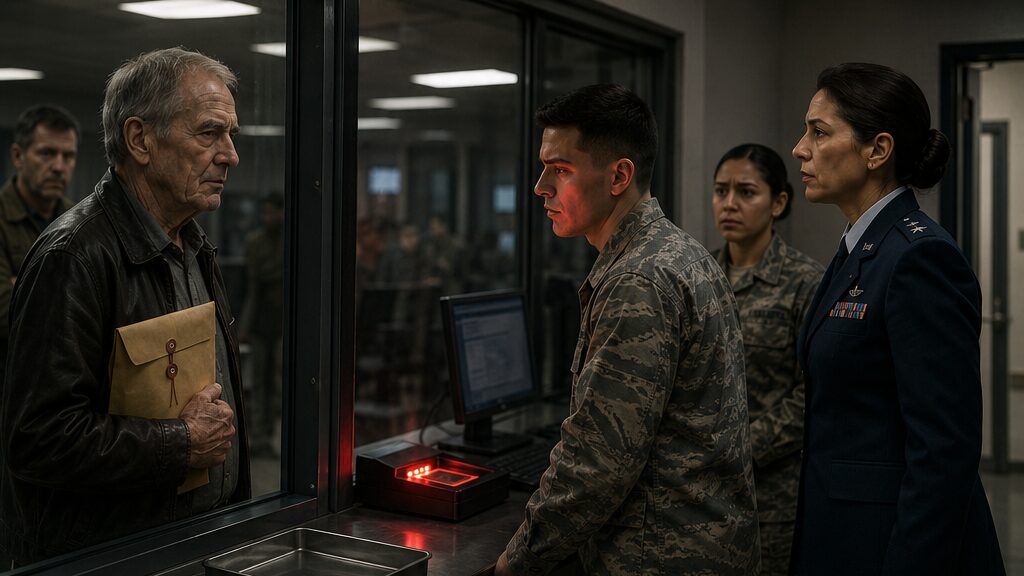
The visitor control office sat just outside the main gate, a low concrete building with reinforced glass, metal trays, a mounted camera in each corner, and the dry smell of printer heat and floor wax. Beyond the windows, morning sun struck the flagpoles and the long road leading deeper into the base. Banners had been fixed along the fence for the day’s dedication ceremony. Blue cloth, white letters, polished emblems. Raymond had seen one from the taxi window before the driver left him at the curb.
HONORING THE LEGACY OF OPERATION NIGHT HARBOR.
He had not looked at it for long.
Now he stood at the glass window in a worn dark leather jacket, gray shirt buttoned to the collar, dark pants pressed years ago by habit more than vanity. His shoes were clean but old. His hands were steady around the envelope, though his left thumb rested over the red string as if keeping something inside from breathing.
The young airman behind the glass glanced from Raymond to the identification card lying in the tray.
“You here for a delivery?” the airman asked.
Raymond looked through the glass at his name tape.
Perez.
“No,” Raymond said. “I was invited.”
Airman Mark Perez did not reach for the card yet. He leaned back in his chair and looked past Raymond toward the small line forming behind him. A civilian contractor shifted from one foot to the other. Another visitor checked his watch. The office was too quiet for how public it felt.
“Invited to what?”
“The dedication.”
Mark’s eyes moved to the envelope again. “With that?”
Raymond did not answer immediately. He had spent enough of his life learning that a pause could do more than a raised voice. The young man’s tone was not cruel yet. It was careless, which could become cruel if fed by an audience.
“Yes,” Raymond said.
Behind Mark, a young woman in uniform paused at another desk. Her name tape read Rivera. She watched with the half-smile of someone not yet involved.
Mark picked up the identification card at last. He held it between two fingers, not gently. The plastic was faded around the edges, the old laminate clouded from years in a wallet, the photograph worn pale in the corners. Raymond’s face in it was younger by decades but already lined around the eyes.
Mark turned it toward the ceiling light.
“This thing still scans?”
“It should.”
“You know we don’t take souvenir cards at this gate.”
The contractor behind Raymond gave a short breath, almost a laugh, then pretended to cough.
Raymond kept his eyes on the airman, not the man behind him. “It is not a souvenir.”
Mark gave Karen Rivera a look. She lowered her eyes to her screen, but her mouth twitched once.
Raymond remembered other windows. Sand scratched into the edges of armored glass. A boy with blood on his sleeve asking whether his mother’s name was on a list. A radio operator waiting for a final code that did not arrive when it should have. He had been younger then, but the waiting had felt older than this room.
Mark tapped the card with one finger. “This photo is ancient.”
“So am I,” Raymond said.
Karen made a small sound before catching herself.
Mark smiled as if Raymond had made the joke for him. “Sir, we have a lot going on today. VIP traffic, families, command staff, press clearance. If you’re lost, I can have someone call the veterans’ desk.”
“I’m not lost.”
“You sure?”
Raymond looked toward the banners beyond the far window. “Yes.”
Mark’s chair creaked as he leaned forward. “Then where’s your current base pass?”
Raymond placed the folded invitation into the tray. It had softened along the creases. The ink on one corner had blurred slightly where his fingers had held it too long during the taxi ride.
Mark pulled it through and unfolded it with the careful impatience of someone expecting nonsense. His eyes crossed the print. The invitation bore the base seal, the date, the dedication title, and a formal line requesting Raymond Thompson’s attendance. The lower corner had been damaged. The signature was partly unreadable.
“This is old,” Mark said.
“It is for today.”
“The paper is old.”
“The paper was mailed late.”
Mark looked at him through the glass. “By who?”
Raymond did not say Elizabeth Torres’s office. He did not say the Office of Command History. He did not say that two calls had come to his house, both unanswered until a staff member left a message with a voice too bright for the subject. He did not say he had ignored the first invitation and then taken the second from the mailbox after standing in his kitchen for nearly a minute, listening to the refrigerator hum like distant equipment.
He said, “The base.”
Mark gave him a flat look. “The base is a big place.”
“Yes.”
The line behind Raymond had grown to four. Someone sighed. The sound pressed against the back of his neck, but he did not turn.
Mark tapped the manila envelope through the glass. “What’s in there?”
“Records.”
“What kind of records?”
“Records for the archive.”
“You have an appointment with archives?”
“I have an invitation to the ceremony.”
“That’s not what I asked.”
Raymond felt the envelope bend under his fingers. He loosened his grip. A small ache opened in his knuckles. For a moment he saw another hand over the same kind of envelope. Younger. Darker with dust. Shaking not from fear but from urgency.
General, if the code doesn’t go through, they won’t know who stayed.
Raymond blinked once. The glass returned. Mark returned. The office returned.
“I was told to bring them,” Raymond said.
“By who?”
Raymond did not answer.
Mark’s expression hardened, not because he understood anything, but because silence gave him room to feel challenged. He set the invitation beside the card and looked toward Karen.
“Rivera, you seeing this?”
Karen stepped closer. She was young enough that her uniform still seemed to sit on her as something newly earned. Her eyes moved over Raymond’s jacket, his envelope, the old card.
“Maybe call the ceremony desk?” she said, but without conviction.
Mark shook his head. “Ceremony desk is already slammed. People show up on dedication days with old paperwork all the time. Last month a guy tried to get through with a reunion badge from 1998.”
Raymond heard the visitor behind him mutter, “Come on.”
Mark heard it too. It fed him. He straightened in his chair.
“Sir,” he said, making the word sound less like respect than procedure, “I need you to step aside until we verify this.”
Raymond looked at the narrow space beside the window. There was a plastic chair there, low and pale from use. He imagined sitting with the envelope on his knees while the ceremony began without the name he had come to restore. He imagined someone reading the official program exactly as printed.
He stayed where he was.
“I have waited in worse places,” Raymond said quietly. “But the hour matters.”
Mark’s face changed. The small smile went away. “The hour matters for everybody.”
“Yes,” Raymond said. “That is why you should check the name.”
Mark picked up the ID again. He looked at it as if the card itself had insulted him.
“The name is Raymond Thompson,” he read. “No rank listed on the front.”
“No.”
“Convenient.”
Raymond’s eyes lifted to his. “Rank is not required for an appointment.”
“It is when people try to walk into restricted areas.”
“I am not trying to walk. I am asking to be cleared.”
“With an old card and a damaged invitation.”
Raymond said nothing.
Mark held the card higher, angling it toward Karen. “Look at this. The laminate’s separating.”
Karen’s smile returned for half a second and vanished when Raymond’s gaze shifted to her. It was not angry. That seemed to unsettle her more.
The contractor behind Raymond said, “Some of us actually have valid passes.”
Mark nodded as if the room had given him permission.
Raymond drew one slow breath. He thought of the taxi pulling away. The long walk from curb to door. The banners announcing legacy in bright new cloth. He had not wanted a staff car. He had not wanted a greeting party. He had wanted one hour with the archive officer and then a seat in the back.
He had wanted to disturb as little as possible.
Mark slid open a lower slot. “Sir, place the envelope in the tray.”
“No.”
The answer was not loud, but it stopped Karen’s movement behind him.
Mark stared. “Excuse me?”
“The envelope goes to the archive.”
“You don’t decide that at my gate.”
Raymond’s thumb moved over the red string. “No,” he said. “But I decide whether it leaves my hand.”
Mark’s jaw tightened. “Then we have a problem.”
Raymond looked at the young man’s face and saw not only arrogance. There was strain in it. A need to be seen doing the job hard enough that no one could accuse him of being soft. Raymond had known officers like that. Some grew out of it. Some built entire careers inside it.
“You can check the name again,” Raymond said.
Mark looked down at the faded card, then at the scanner mounted beside the desk. His smile returned, sharper this time, meant for Karen, the waiting visitors, and himself.
“All right,” he said. “The system will settle it.”
He placed Raymond’s ID onto the scanner tray and pushed it under the red-lit reader.
Chapter 2: When The Scanner Turned Red
Mark Perez expected the scanner to reject the card.
He expected a dull beep, a yellow error box, maybe a message about expired credentials or unreadable laminate. He expected the old man on the other side of the glass to lower his eyes, gather his envelope, and shuffle toward the plastic chair where problem visitors belonged until someone else had time for them.
Instead, the scanner went silent.
That was worse than a beep.
Mark frowned and tapped the edge of the reader. The ID card sat beneath the glass plate, washed in the ordinary white light of the first pass. He saw the faded photograph, the old seal, the scratched name line. Raymond Thompson stood beyond the window with his hands folded over the manila envelope.
A progress bar crawled across Mark’s screen.
Karen Rivera had stopped pretending to work. “What’s it doing?”
“Reading,” Mark said.
“It usually reads faster.”
“I know what it usually does.”
The progress bar reached the end. For half a second nothing happened.
Then the scanner light turned red.
Not soft red. Not the little warning strip that showed a mismatch. The whole glass plate glowed from underneath, deep and sudden, staining the old ID like a coal beneath ice.
Mark sat back.
On his monitor, a black dialogue box opened over the visitor-control system.
LEGACY COMMAND RECORD
RESTRICTED ACCESS NODE
MANUAL COMMAND VERIFICATION REQUIRED
Below that, in smaller letters:
DO NOT DISCARD CREDENTIAL.
DO NOT REMOVE HOLDER FROM SITE.
NOTIFY COMMAND OFFICE.
Mark read it twice. The second time, the words did not improve.
Karen came close enough that her sleeve brushed the chair behind him. “What is that?”
“I don’t know.”
“You’ve never seen that?”
“No.”
Behind the glass, Raymond looked at the red glow but not with surprise. That was what Mark noticed first. The old man did not lean forward. Did not ask what it meant. Did not smile. He simply watched the scanner as if it had spoken a name both of them already knew.
Mark clicked the verification tab. A second box appeared, asking for supervisor authentication.
He entered his code. Denied.
He entered it again, slower. Denied.
Karen whispered, “Maybe call the supervisor.”
Mark did not want to call anyone yet. Not with the contractor still behind the old man, watching. Not with Karen’s eyes widening at the screen. Not with the old man standing there in the worn jacket like a question Mark had answered too quickly.
He clicked the ID image. The monitor opened a partial profile. Most of it was blocked behind gray bars. The visible fields were few.
NAME: THOMPSON, RAYMOND
STATUS: RETIRED
RECORD CLASS: LEGACY COMMAND
BASE HISTORY FLAG: ACTIVE
ARCHIVE CROSS-REFERENCE: NIGHT HARBOR
Mark felt heat climb his neck.
Night Harbor. The words were on every banner outside. Operation Night Harbor. The dedication ceremony that had made his morning miserable before sunrise. The ceremony that had brought command staff, families, press liaisons, security changes, and three separate reminders from the supervisor that no one embarrassing got through the gate.
Mark looked through the glass.
“Mr. Thompson,” he said, and heard the difference in his own voice.
Raymond’s eyes stayed steady. “Yes.”
“Do you know why your card is doing that?”
Karen looked at him quickly, as if the question itself was a mistake.
Raymond said, “It has been a long time since I used it.”
“That’s not what I asked.”
“No,” Raymond said. “It isn’t.”
The words did not sound defiant. That irritated Mark more than defiance would have. He did not know where to put calm.
The contractor behind Raymond leaned toward the glass. “Is there a problem?”
Mark snapped, “Step back, please.”
The contractor raised both hands and stepped back.
Karen reached for the desk phone. “I’m calling command office.”
“Wait,” Mark said.
“For what?”
He did not have an answer. He looked again at the screen, at the red border pulsing around Raymond’s name. The system had rules, and he trusted rules. Rules did not care how old someone looked. Rules did not care if an invitation was creased or if a leather jacket had seen too many winters.
But he had been so sure before the rules spoke.
Mark lowered his voice. “Sir, I need to ask you to confirm your purpose on base.”
Raymond glanced down at the envelope. “Archive first. Memorial hall after that, if there is still time.”
“You’re here for the ceremony?”
“I am here because of it.”
“Are you on the VIP list?”
Raymond’s mouth moved slightly, not quite a smile. “I asked not to be.”
Mark looked back at the screen. A new notice appeared.
COMMAND OFFICE ACKNOWLEDGED.
HOLD POSITION.
Hold position.
He had told the old man to step aside. The system told him not to remove him.
Karen saw it too. Her face changed, her earlier amusement draining into something more careful. She moved half a step away from Mark, as if distance could separate her from what had already happened.
The red light continued to burn under the ID.
Mark’s hand hovered over the card. The warning box flashed.
DO NOT DISCARD CREDENTIAL.
He withdrew his hand.
Raymond watched that small movement. Mark hated that he had seen it.
“Sir,” Karen said through the glass, softer than before, “would you like to sit while we wait?”
Raymond turned his eyes to her. “No, thank you.”
“There’s a chair.”
“I saw it.”
The answer was gentle. It still landed.
Mark stood, partly because sitting made him feel trapped beneath the old man’s calm. “I need to secure the item.”
Raymond’s hand tightened once around the envelope. “The envelope stays with me.”
“I meant the card.”
“The card is yours to verify.”
“The envelope may be relevant.”
“It is.”
“Then I need to inspect it.”
Raymond looked at him for a long moment. “No.”
Mark heard Karen inhale.
He lowered his voice. “Sir, refusing inspection at a restricted gate is serious.”
“Yes,” Raymond said.
“You understand that?”
“I do.”
“And you still refuse?”
Raymond’s face did not change, but something behind his eyes seemed to move away from the room. “Some papers are not opened at a window.”
Mark stared at him.
The old man was not acting confused. That was the trouble. He was not acting guilty either. He was acting like someone who understood precisely where he stood, how far the glass reached, and what authority Mark did and did not have.
The door behind the office opened.
Not the visitor door. The interior command door.
A senior officer in a dark blue service uniform entered fast enough that the two junior airmen near the back wall straightened without thinking. Mark turned and saw the silver hair first, then the command badge, then the controlled expression that made the room sharpen around her.
Colonel Elizabeth Torres did not look at Mark first.
She looked through the glass.
Her steps slowed.
Raymond shifted the envelope to his left hand.
For one second, no one spoke. Even the scanner seemed quieter, though the red light still filled the tray.
Elizabeth came to the window. She looked at the ID beneath the scanner glass, then at the man beyond it. Mark saw recognition arrive not all at once but in layers: disbelief, memory, correction, respect.
She removed her cover from under her arm and set it against her side.
Then she saluted.
The movement was formal, clean, and immediate.
Mark froze.
Karen’s shoulders stiffened.
Behind the glass, Raymond Thompson straightened with the effort of a man whose body remembered before his joints agreed. He lifted his right hand and returned the salute.
“General Thompson,” Elizabeth said.
The title moved through the small office like a door opening onto a much larger room.
Mark felt the blood leave his face.
Raymond lowered his hand first. “Colonel Torres.”
Elizabeth’s expression softened by a fraction. “Sir, we were told you declined escort.”
“I did.”
“We would have sent a car.”
“I know.”
Her eyes flicked briefly to the red scanner, then to Mark. She did not raise her voice. She did not need to.
“Airman Perez,” she said, “return the general’s card.”
Mark moved too quickly. His fingers struck the edge of the scanner tray before he lifted the ID. The red light shut off the moment the card left the glass, but the color remained in his vision.
He slid the card through the tray.
Raymond picked it up carefully, wiped one edge with his thumb, and placed it inside his wallet.
Mark swallowed. “Sir, I—”
Raymond looked at him.
Whatever apology Mark had prepared fell apart under that quiet attention. Not because Raymond seemed angry. Because he did not.
Elizabeth stepped toward the visitor door. “Please open the access door.”
Mark pressed the release. The lock clicked.
Raymond entered the secure side still holding the manila envelope. He stood only a few feet from Mark now. Without the glass, he seemed smaller and more tired, which somehow made the title harder to bear.
Elizabeth saluted again, this time from closer range.
Raymond returned it once.
“Welcome back to the base, General Thompson,” she said.
Raymond looked past her toward the corridor leading inside. “I’m not sure I came back for welcome.”
Elizabeth studied him. “Then what did you come for, sir?”
Raymond’s thumb rested over the red string on the envelope.
“The archive,” he said. “Before the ceremony begins.”
Chapter 3: The Name The Base Still Remembered
Elizabeth Torres had studied Raymond Thompson’s signature before she had ever seen his face.
It was printed in old doctrine manuals, scanned command summaries, a framed evacuation order in the academy hall where young officers learned how a failing perimeter had become a corridor of escape. His name appeared in footnotes attached to phrases like operational restraint, civilian priority, and command responsibility under collapse. For years, she had known him as a figure in typed history.
The man walking beside her through the security corridor looked like he had arrived for a clinic appointment and taken a wrong turn.
His jacket creaked faintly at the elbows. He walked without a cane but not without effort. The manila envelope stayed under his left arm, pressed close to his ribs. His right hand hung free, fingers slightly curled, the same hand that had returned her salute.
Behind them, Mark Perez remained at the checkpoint with his mouth closed for the first time since Elizabeth had entered. Karen Rivera stood near the desk, eyes lowered to the visitor log.
Elizabeth did not correct them in front of Raymond. That could wait. Public correction, when poorly timed, became another form of performance.
“Sir,” she said as the corridor door shut behind them, “I apologize for the delay.”
Raymond looked at the polished floor ahead. “The delay was not the worst part.”
“No, sir.”
He gave a small nod, accepting the difference.
The hallway walls displayed photographs from the base’s long history: aircraft on wet tarmac, medics unloading stretchers, commanders shaking hands beside maps, units gathered beneath flags. Newer frames had been added for the dedication. Operation Night Harbor appeared in careful captions, all clean now, all declassified into words that could fit beneath glass.
Raymond did not turn his head toward them.
Elizabeth slowed near one display, uncertain whether to avoid it or acknowledge it. A photograph showed a younger Raymond Thompson in field uniform, standing beside a temporary command table under a canvas roof. His face was leaner, darker from sun and stress, eyes fixed somewhere beyond the photographer.
He passed it without looking.
“I was told you weren’t attending,” Elizabeth said.
“I wasn’t.”
“What changed?”
His hand moved slightly against the envelope. “The program.”
Elizabeth waited.
He did not continue.
That, she thought, was the first real answer.
They reached the inner security desk. The airman there looked up, saw Elizabeth, and stood. His gaze shifted to Raymond with professional curiosity, not recognition.
“Archive access,” Elizabeth said. “Priority.”
“Yes, ma’am.”
He reached for the visitor badge printer.
Raymond stopped.
“No badge,” he said.
The airman froze.
Elizabeth turned to him. “Sir?”
Raymond reached into his wallet and drew out the faded ID card. Up close, Elizabeth could see the laminate clouding at the edges, the old photograph nearly silvered by age. It should have looked obsolete. Instead, after what the scanner had done, it looked like something the base had failed to keep up with.
“This will do,” Raymond said.
The airman glanced at Elizabeth. She nodded.
“Yes, sir,” the airman said, though he did not yet know why.
They moved on.
Elizabeth had expected ceremony staff to call. She had expected parking problems, seating problems, a missing wreath, maybe a media question about old classification limits. She had not expected Raymond Thompson to arrive alone in a taxi with a damaged invitation and an envelope he would not surrender.
Her office waited at the end of the hall, but Raymond stopped before the door.
“I don’t need your office.”
“You may want privacy.”
“I have had privacy for years.”
The sentence was not bitter. It was worse than bitter. It was worn smooth.
Elizabeth opened the office anyway. “Five minutes, sir. Then I’ll take you to archives myself.”
He considered refusing, then entered.
The room had been arranged for the day: a ceremony program on the desk, a folded seating chart, a printed schedule, two calls blinking on the secure phone. Through the window, the memorial hall was visible across the courtyard, its doors propped open, staff moving in and out with floral stands and rolled carpets.
Raymond stood near the chair but did not sit.
Elizabeth closed the door.
“I need to know whether there is a security concern,” she said.
“There isn’t.”
“The scanner flagged a legacy command record.”
“It should have been retired.”
“It was still active.”
“That surprises me.”
“Does it?”
Raymond looked at her then, and for a moment she saw the commander from the photograph. Not in posture. In attention. Complete, quiet attention.
“No,” he said. “Not entirely.”
Elizabeth picked up the ceremony program from her desk. The cover bore the operation title and the dedication seal. She had approved the final proof herself three days earlier. The program listed speakers, honored units, families, and the memorial inscription. Raymond Thompson’s name appeared near the bottom as an invited senior guest, though he had asked not to be placed on the platform.
“I was told you declined the honored seat,” she said.
“I did.”
“You were the commanding general.”
“I was one name in a long chain.”
“With respect, sir, that is not how the institution remembers it.”
Raymond looked toward the window, where sunlight flashed over the memorial hall’s glass doors. “Institutions remember what records allow them to remember.”
Elizabeth felt the words settle uneasily. She looked at the envelope.
“Is that why you came?”
“Yes.”
“What’s inside?”
Raymond rested the envelope on the edge of her desk but kept his fingers on it. The red string crossed the flap twice.
“Correction.”
“To what?”
“The dedication.”
Elizabeth looked down at the program in her hand. A thin, cold line of concern moved through her.
“The ceremony begins in less than three hours.”
“I know.”
“Sir, if there is an omission, we can review it after—”
“No.”
The word was quiet. It ended the sentence more completely than a raised voice could have.
Elizabeth studied him. She had been a commander long enough to recognize refusal shaped by guilt. She had also been a commander long enough to know that old guilt could distort memory. That was the difficulty. Reverence was not verification.
“General Thompson,” she said carefully, “I want to help. But if we alter a memorial program on the morning of dedication, I need documentation.”
Raymond pushed the envelope a fraction of an inch forward.
“Then take me to the archive.”
“Who is the correction for?”
His hand stilled on the envelope.
Outside, through the window, a group of visitors crossed the courtyard toward the memorial hall. Some were elderly. Some wore service caps. Some held photographs against their chests. Families of the remembered, Elizabeth thought. Families of the named.
Raymond looked at them for a long time.
Then he said, “A man who did not leave enough behind for history to keep him safe.”
Elizabeth waited, but he did not give the name.
She set the program down beside the envelope. “Is he listed here?”
“No.”
“Was he assigned to Operation Night Harbor?”
“Yes.”
“Was he under your command?”
Raymond’s face remained controlled. Only his thumb moved, pressing once into the envelope flap.
“They all were.”
Elizabeth heard the weight under it. Not pride. Not distance. The old burden of command, stripped of ceremony.
She reached for her phone and called the archive office.
“Daniel Smith,” she said when the line opened. “Clear your table. I’m bringing General Raymond Thompson to you.”
There was silence on the other end long enough that she almost repeated herself.
Then Daniel said, “General Thompson is on base?”
“He is.”
Another pause. “For the dedication?”
Elizabeth looked at Raymond.
“For the record,” she said.
She ended the call and lifted the program again. The names printed inside suddenly looked less complete than they had ten minutes earlier.
Raymond picked up the envelope.
At the door, Elizabeth stopped. “Sir. Before we go down there, I need to ask plainly.”
He waited.
“What name is missing?”
For the first time since she had met him, Raymond’s eyes showed something close to pain before discipline covered it again.
He opened the office door.
“Let the file answer first,” he said.
Chapter 4: The Envelope No One Wanted Opened
The archive room was colder than the rest of the base.
Raymond felt it in the bones of his hands before the door finished closing behind him. The air had that particular dry chill kept for paper, film, and things no one wanted damaged after the people who understood them were gone. Metal shelves rose in tight rows under white lights. Gray boxes sat behind coded labels. A long table occupied the center of the room, bare except for cotton gloves, a flatbed scanner, and a lamp with a green shade that looked older than half the building.
Daniel Smith was waiting beside the table with two folders already open.
He was a narrow man with careful shoulders and a face that had learned to be respectful around old records before it learned to be respectful around old soldiers. When Elizabeth entered, he straightened. When Raymond followed, carrying the envelope under his arm, Daniel’s eyes moved from the worn jacket to Raymond’s face, then stopped.
For a moment he forgot to speak.
“General Thompson,” he said finally.
Raymond nodded. “Mr. Smith.”
Daniel glanced at Elizabeth, as if to confirm the impossible had not walked in alone from the visitor gate.
Elizabeth closed the door. “You said you had a table ready.”
“Yes, ma’am.” Daniel gathered himself and tapped the first folder. “I pulled the public Night Harbor collection and the restricted index references that were already declassified for today’s dedication. Anything deeper will require command authorization.”
Elizabeth looked at Raymond. “You have it.”
Daniel hesitated. “For access, yes. For alteration of memorial language, that’s different.”
Raymond placed the manila envelope on the table.
The red string lay across the flap, old and ordinary. In this room, under archival light, it looked less like office stationery and more like a sealed wound.
“I did not come to alter language,” Raymond said. “I came to correct a name.”
Daniel’s mouth tightened. Not with disrespect. With fear of process.
“Sir, the final inscription has already been approved. The program has been printed. Families are arriving now. Any change this late would require review from the memorial board, command history, casualty affairs, and—”
“And the truth?” Raymond asked.
Daniel stopped.
Elizabeth did not move.
Raymond rested one hand on the envelope. “Where does that fall in the routing chain?”
Daniel looked down at the folders. “Sir, I’m not trying to prevent truth.”
“No. You’re trying to protect a ceremony from it.”
The words were quiet enough that Daniel could have pretended not to hear. He did not.
Elizabeth stepped closer to the table. “Daniel, pull the operational casualty ledger.”
Daniel moved to the terminal at the side desk. His fingers worked quickly, but his face carried reluctance. “The ledger attached to the public file lists confirmed losses and command-recognized support personnel. That is what the dedication language was built from.”
“Pull it,” Elizabeth said.
Raymond looked at the metal shelves while the printer woke with a low mechanical sound. He had not been in this archive when he commanded the base. Back then, the records had been scattered in tents, locked cases, field drives, wet notebooks. History had smelled like diesel and sweat, not climate control.
Daniel returned with a thin stack of pages. He placed them on the table and turned them toward Raymond.
Raymond did not reach for them at first.
Names marched down the page in clean type. Rank, unit, status, confirmation date. Each life compressed into columns precise enough to feel merciless.
His eyes moved down the list once.
Then again.
The missing space was not visible. That was the cruelty of omission. A name absent from a page made no sound.
Elizabeth watched him. “Who are we looking for?”
Raymond untied the red string.
His fingers were slower than they used to be. The knot resisted him. For a second, he nearly pulled it apart by force, then stopped and worked the string loose properly. He had tied it himself. He would open it himself.
Inside the envelope was another envelope, smaller, marked with an old classification stamp now crossed through in black ink. Beneath it lay a single folded memorandum, a photocopy of a field transmission, and a faded carbon sheet with Raymond’s own signature at the bottom.
Daniel leaned forward despite himself.
Raymond placed the memorandum on the table but kept two fingers over the lower half.
“The name is Brian Lopez,” he said.
Daniel looked back to the casualty ledger. His finger moved down the list. Once. Twice.
“He’s not here.”
“I know.”
“Was he assigned under a different unit?”
“He was attached under emergency authority.”
Daniel moved to the terminal. “Spelling?”
“Brian Lopez.”
Keys clicked. The room waited.
“No primary record,” Daniel said. “There are three Lopez entries in unrelated support files, but no Brian Lopez attached to Night Harbor.”
Raymond unfolded the carbon sheet and slid it across the table.
Daniel did not touch it immediately. He bent over it, reading.
Elizabeth stood beside him. Raymond watched her eyes move across the old words.
Emergency relay authority. Civilian corridor. Final transmission. Evacuation code verified. Attached operator: Lopez, Brian. Status: remained at relay station after final movement.
At the bottom was Raymond’s signature.
Daniel looked up. “Sir, this is a field correction draft.”
“Yes.”
“Was it filed?”
“It was supposed to be.”
“By whom?”
Raymond’s hand closed once on the envelope. “By me.”
The silence that followed was not empty. It filled with machines humming, paper settling, distant footsteps beyond the archive door. Elizabeth looked at Raymond with a new kind of caution.
He did not look away.
“The operation was collapsing into fragments,” he said. “We were moving civilians through three broken corridors. Communications failed twice. A relay station stayed open six minutes longer than ordered. Because of that, the last convoy received the final route correction.”
Daniel looked at the paper again. “Brian Lopez was at that station?”
“Yes.”
“Military?”
“Temporary attachment. Signal-trained, civilian contractor status first, then emergency attached. It was irregular. Many things were.”
Elizabeth’s voice was low. “And he died there?”
Raymond’s jaw moved once before he answered. “He did not come out.”
Daniel looked at the casualty ledger, then back at the memorandum. “Why wasn’t he confirmed?”
“Because the station was gone before recovery. Because his attachment was temporary. Because the field file was separated. Because command reports prefer lines that close.”
The last sentence came out harder than he intended.
Elizabeth heard it.
Daniel picked up the photocopied transmission with gloved fingers. “This identifies the final route code.”
“Yes.”
“And this note—” He looked to the bottom. “It says the correction should be appended to the casualty recognition file.”
Raymond nodded.
“But there’s no archive accession number.”
“No.”
Daniel’s face tightened again. “Then from a records standpoint—”
Raymond looked at him.
Daniel stopped, then started again, more carefully. “From a records standpoint, we need corroboration. Your signature matters, sir, but a draft alone may not be enough to alter the ceremony today.”
Elizabeth turned toward him. “What would be enough?”
“A matching order. A radio log. Any linked index entry. Something entered into the system at the time, even if classified under a different file.”
Raymond reached into the envelope and removed one more slip of paper. This one was smaller, brittle at the fold, with numbers written in black pencil.
“I copied this from the relay board before we left the command tent,” he said. “I kept it because I thought someone would ask.”
Daniel took it carefully.
Elizabeth saw the old guilt in Raymond’s hand after he released the paper. Not shaking. Empty.
Daniel studied the numbers, then went back to his terminal. He typed the sequence once, frowned, and typed it again in a different field.
A file path opened.
He went still.
“What is it?” Elizabeth asked.
Daniel’s eyes stayed on the screen. “Restricted operational fragment. It wasn’t indexed under casualty affairs. It was sealed under route integrity.”
“Open it.”
“I need command approval.”
“You have it.”
“And historical release justification.”
Elizabeth’s voice sharpened. “Daniel.”
He looked at Raymond, then at the envelope, then at the program lying on the corner of the table where Elizabeth had set it down. Its cover shone with the clean certainty of finished history.
Daniel entered his authorization. Elizabeth entered hers. The system paused long enough to make the room feel smaller.
Then the file opened.
A scanned order appeared on the monitor, gray and grainy, marked by old transmission lines. Raymond did not need to step closer. He knew the shape of it before the words cleared.
Daniel read softly. “Command relay station to remain active until final code receipt. Emergency attached operator…” He stopped. “The name is blacked out.”
Raymond closed his eyes once.
Daniel scrolled. “Signature at bottom.” His voice changed. “Raymond Thompson.”
Elizabeth looked from the screen to Raymond.
“Can the redaction be lifted?” she asked.
Daniel swallowed. “Maybe. If the related key is in the same package.”
He searched. The printer clicked again, though no one had touched it. Somewhere in the system, old paper became new evidence.
Raymond stood very still while Daniel worked. He thought of six minutes. The length of a coffee cooling. The length of a young man choosing not to abandon a radio station because voices were still trying to live on the other end.
At last Daniel’s screen refreshed.
Another page opened.
This one bore the same order. The black bar remained, but beneath it was a handwritten routing note in the margin, missed by whoever had redacted the typed line.
Operator Lopez held relay through final call.
Daniel did not speak for a long moment.
Then he said, “There it is.”
Elizabeth let out a breath she had been holding.
Raymond opened his eyes.
Daniel printed the page. When it emerged, he did not lift it right away. He looked ashamed, though he had not caused the omission. Perhaps the room itself had made him feel responsible.
“Sir,” he said, “this should have been cross-referenced.”
“Yes.”
“I can prepare an emergency correction packet, but I can’t promise the memorial board will accept a same-day change.”
Raymond gathered the memorandum, the copied transmission, and the printed order into one neat stack.
“I am not asking them to accept it because I carried it,” he said. “I am asking them to read it because he stayed.”
Daniel looked down.
Elizabeth picked up the ceremony program. The schedule inside had the first speaker beginning in less than an hour.
“We take it to the hall,” she said.
Daniel hesitated. “Ma’am, if this is presented publicly without review—”
Raymond placed his old ID on the table beside the newly printed order.
The faded plastic lay next to the proof like two pieces of the same delayed truth.
“Review it now,” he said.
Daniel looked from the ID to the order.
Then he turned back to the terminal and searched the file again.
A minute later, his face changed.
He printed one more page and held it in both hands.
Elizabeth stepped beside him. “What did you find?”
Daniel’s voice was quieter than before.
“A matching order,” he said. “Same operation. Same relay sequence. General Thompson’s signature.” He looked at Raymond. “And another name blacked out.”
Chapter 5: The Ceremony Built On A Missing Name
Karen Rivera stood at the back of the memorial hall with a stack of programs in her hands and could not stop seeing the old man through the glass.
Not General Thompson. Not yet. In her mind he was still the elderly visitor in the worn leather jacket, standing under the flat checkpoint lights while Mark held up his faded ID as if age itself were evidence against him.
She had smiled.
Only for a second. Barely even that.
But she had smiled.
Now the memorial hall filled with guests, and every program she handed out felt heavier than the one before. Families entered in pressed clothes, some with polished shoes, some with walkers, some with framed photographs held against their chests. Uniformed personnel moved along the walls. A pair of junior airmen adjusted the flag stands near the front. The platform had five chairs, though one remained empty with a small RESERVED card placed on the seat.
Karen knew who it was for now.
He was not sitting there.
She had seen him fifteen minutes earlier when Colonel Torres brought him through a side door with Daniel Smith and the envelope. Staff had turned as they passed. Some recognized the colonel. A few recognized the old man slowly, in the way people recognized a photograph before they trusted their own eyes.
Raymond Thompson had looked at none of them for long.
He had chosen a chair near the back aisle, three rows from where Karen stood, close enough to leave without crossing the whole room. The manila envelope rested on his lap. His faded ID card lay beside the folded program on the chair next to him, where Elizabeth had placed it after returning from the archive table. He had not put it away.
The program cover read Operation Night Harbor Memorial Dedication.
Karen glanced down at the top copy in her stack. The paper was thick, cream-colored, official. Inside, the names were printed in even columns. She had helped place some of these programs on chairs before sunrise. She had not wondered who might be missing.
A woman with silver hair approached with a photograph in a wooden frame. Karen handed her a program.
“Thank you,” the woman said.
“Yes, ma’am.”
The woman moved toward the family seating. Karen watched her fingers tighten around the frame when she saw the memorial wall at the front. There were names already carved into dark stone beneath a covered plaque waiting to be unveiled.
Names, Karen thought, were supposed to be the easiest part of honor. You either kept them or you lost them.
Across the hall, Mark Perez stood near the side display with his dress cap tucked under his arm. He was supposed to assist with late arrivals from the checkpoint after being pulled forward for ceremony support. He looked smaller in the big room than he had behind the glass.
Karen did not know whether to feel sorry for him.
She watched him avoid looking toward Raymond.
A memorial staff member hurried past carrying a corrected seating list. “Rivera, if any late family groups arrive, send them to the left section. Press stays behind the rope.”
“Yes, ma’am.”
The staff member lowered her voice. “And if anyone asks about changes to the program, send them to Colonel Torres.”
“Changes?”
The staff member gave her a look that said not here, then moved on.
Karen turned another program over in her hand. The list inside had not changed. It had been printed yesterday, boxed at dawn, handed out by people who trusted paper because paper looked finished.
Near the back row, Raymond opened his copy.
He did not flip through it quickly. He turned the first page as if each movement had weight. When he reached the names, he stopped.
Karen saw his thumb pause at the bottom of the column.
He did not bow his head. He did not close the program. He simply looked at the page with the stillness of a man standing before a door he had opened too late.
Her throat tightened.
Mark had called his ID old. She had laughed at the laminate.
She had not seen the envelope as anything but an inconvenience.
The hall lights dimmed slightly, signaling that the ceremony would begin soon. Conversations softened. Guests took seats. A low instrumental piece started through the speakers, the kind used for solemn occasions because silence made people nervous.
Karen stepped away from the entrance and carried the remaining programs to the back table.
Mark was there, staring at a wall display.
“Perez,” she said.
He did not answer.
She followed his gaze.
Behind a glass case containing an old folded flag, a row of photographs showed the operation’s command staff. One image had been enlarged for the dedication: a field command post under canvas, men and women bent over maps, radio cables running through mud. At the center stood a younger Raymond Thompson in uniform, one hand on the table, his face turned toward someone outside the frame. The caption beneath it read:
Major General Raymond Thompson, Night Harbor Command Authority.
Karen felt the same cold she had felt when the scanner turned red.
Mark’s eyes moved from the photograph to the back row where Raymond sat, then back again.
“He was a major general then,” Mark said.
His voice sounded rough.
Karen looked at the caption. “Then?”
Mark swallowed. “Colonel Torres called him General Thompson. Four stars on his old file. I saw part of the screen.”
Karen said nothing.
Mark’s face tightened. “I thought he was trying to pull something.”
“You didn’t just think that.”
He looked at her.
She did not soften it. Not because she wanted to hurt him, but because she had been there too.
“We both laughed,” she said.
Mark’s eyes dropped.
At the front of the hall, Elizabeth Torres appeared near the podium, speaking quietly with Daniel Smith. Daniel held a folder against his chest. The folder was not part of the printed ceremony packet. Karen could tell by the way Elizabeth kept looking toward Raymond, then toward the covered plaque.
Raymond remained in the back.
That was what unsettled Karen most. If he had wanted power, the whole room would have given it to him now. The reserved chair waited on the platform. Senior officers had begun whispering. Staff had adjusted their posture around him. But he sat behind two rows of families, his old jacket creased at the shoulders, the envelope on his lap like a burden he had carried too long to hand over carelessly.
A child in the family section turned around and looked at him. Raymond noticed and gave the child a small nod. The child turned back.
Nothing in that nod looked like rank.
Karen picked up a discarded program from a chair and opened to the names again. She searched without knowing what she was searching for. Every name printed there had someone in the room, or someone who had once waited for a letter, or someone who still touched a photograph before important days.
A missing name would have no chair.
No family section.
No one told where to sit.
The music faded.
Elizabeth stepped to the podium. The room quieted fully.
“Good afternoon,” she began. “On behalf of the command, thank you for joining us to dedicate this memorial to those who served, sacrificed, and carried others through Operation Night Harbor.”
Karen watched Raymond.
He looked at Elizabeth, but not like a man waiting to be praised. He looked like a man waiting for judgment.
Elizabeth continued, her voice steady. “This operation has lived for years in fragments. Some public, some classified, some preserved in memory better than in record.”
A few people shifted. Daniel Smith stood at the side of the platform, folder in hand, his face pale.
Mark moved closer to the side display, almost without realizing it. His hand lifted toward the glass case, not touching, just hovering near the old photograph.
Karen saw the moment his face changed.
He leaned closer to the enlarged image.
“What?” she whispered.
Mark did not answer. He pointed, barely.
Karen stepped beside him.
In the photograph, near the edge of the command table, was a younger man seated at a radio set, half turned away from the camera. His face was partly shadowed by equipment. His sleeve bore no standard unit patch. A strip of tape marked the radio board near his hand.
The caption did not name him.
But beneath the photograph, in the reflection of the glass, Karen saw Mark looking from the young radio operator to the program in his other hand, then toward the old envelope on Raymond’s lap.
Elizabeth’s voice carried across the room.
“Before we unveil the memorial, there is a matter of record we must address.”
The hall became completely still.
Mark looked again at the photograph. His lips parted as if he had finally understood what absence looked like.
Chapter 6: The Photograph Behind The Flag Case
Mark Perez could not stop staring at the unnamed man in the photograph.
The young radio operator sat half outside history, shoulder turned, face caught in the dull light under the command tent. Everyone else in the image had been labeled by rank, role, or later title. The man at the radio had become part of the background, a body near equipment, a shape beside wires.
Mark had seen hundreds of official photographs like it. He had walked past them in training halls and headquarters corridors without thinking about the people at the edges.
Now the edge was the only place he could look.
At the back of the hall, Raymond Thompson sat with the envelope on his lap, his old ID card beside a printed program that did not contain the name Elizabeth Torres had not yet spoken.
Mark felt the weight of the scanner again. The red light. The warning box. The old card beneath his hand.
Do not remove holder from site.
He had wanted the system to prove the old man wrong. Instead it had remembered what Mark had never learned.
Elizabeth stood at the podium. Her hands rested on either side of the folder Daniel Smith had placed before her. She did not open it right away.
“We gather today,” she said, “to dedicate a memorial. But memorials depend on records, and records depend on the courage of those willing to correct them.”
The room shifted. Not loudly. A ripple of attention passed through uniforms and family rows.
Mark looked toward Raymond.
The general did not move.
Elizabeth continued. “This morning, a correction was brought to this base by someone with direct command responsibility for Operation Night Harbor. That correction has been reviewed against archived operational material.”
Daniel stood near the covered plaque, holding the newly printed pages. His eyes moved once to Raymond.
A senior officer in the front row leaned toward another, whispering. A family member clutched a photograph tighter. The memorial staff member at the side entrance looked alarmed but did not interrupt.
Mark’s throat had gone dry.
He wanted to leave the side display. He wanted to stand somewhere less visible. Instead he stayed where he was, trapped between the photograph and the ceremony, between who he had been at the window and who the room was now discovering Raymond had always been.
Elizabeth opened the folder.
“The public record of Operation Night Harbor has long recognized the command staff, evacuation teams, medical crews, security units, and confirmed casualties attached to the final civilian corridor. Those names remain honored here.”
She paused.
“One name was not included.”
The silence changed. It became personal before anyone knew why.
Raymond lowered his eyes to the envelope.
Elizabeth looked toward him. “General Thompson, with your permission.”
Every head turned.
Mark felt it happen like wind across a field. The old man at the back of the room, the one he had almost moved to a plastic chair, was suddenly the center of a hall built around history.
Raymond did not rise immediately.
For a second, Mark thought he might refuse. The general’s fingers rested on the envelope string. Then he stood.
Not quickly. Not dramatically. His chair made a small sound against the floor. He picked up the envelope, left the program on the seat, and walked down the aisle.
No one applauded. It would have felt wrong. The room gave him something quieter and harder to earn.
Space.
As Raymond passed, people turned in their seats. Some recognized him from the program. Some from the old photograph. Some only from the way Elizabeth Torres stepped back from the podium when he approached.
Mark remained near the flag case.
Raymond reached the front and stopped beside Elizabeth. She offered the podium. He shook his head once.
Daniel handed him the folder.
Raymond took it, opened it, and removed the old memorandum. The paper had been copied and recopied, but he handled it like an original.
His voice, when he spoke, was not large. The microphone carried it anyway.
“Brian Lopez was attached to the final relay station during Operation Night Harbor,” he said. “His assignment was temporary. His paperwork was irregular. His station was lost before recovery. Because of those things, his name did not follow the others into the record.”
No one moved.
Raymond looked down at the page, then up at the covered memorial.
“Those are explanations,” he said. “They are not excuses.”
Mark felt the words land where no reprimand had reached.
Raymond turned slightly toward the side display. For a moment, his eyes met Mark’s. There was no accusation in them. That made it worse.
Elizabeth nodded to Daniel.
Daniel stepped to a small screen beside the memorial wall and connected the archive feed. The enlarged photograph appeared above the covered plaque: command tent, map table, cables, younger Raymond, and the radio operator at the edge.
Daniel used a pointer to circle the radio station.
“This image was part of the declassified display collection,” he said. His voice was careful but steadier than it had been in the archive. “The operator was unnamed in the public caption. The related command order, recovered today from a sealed route-integrity file, identifies the final relay sequence and includes a handwritten note: Operator Lopez held relay through final call.”
The screen changed.
A scanned order appeared, gray and worn. Raymond’s younger signature marked the bottom. A blacked-out line cut across the typed name, but the handwritten margin remained visible.
Operator Lopez held relay through final call.
A woman in the second row covered her mouth. Somewhere else, someone whispered a prayer.
Mark looked back at the side photograph. The unnamed man’s hand rested near the radio board. Ordinary hand. Ordinary posture. No salute, no platform, no title.
Without him, the final convoy would not have received the route.
Without the final route, families in this room might have been names on another wall.
Elizabeth spoke again. “The command office has accepted the emergency correction into the ceremony record. The permanent memorial process will be amended through formal channels, beginning today.”
The memorial staff member hurried forward with a single sheet. Not a new program, not yet, but a correction page printed on base letterhead. Daniel took it, reviewed it, and handed it to Elizabeth.
Raymond watched without expression.
Mark expected him to seem relieved. He did not. Relief, Mark understood then, was for burdens finished. This was a burden set down where others could finally see it.
Elizabeth turned to Raymond. “Sir, the dedication was prepared to honor your command.”
Raymond’s face tightened faintly.
“I know,” he said.
“The platform seat is yours.”
Raymond looked toward the empty reserved chair. Then he looked at the families, at the photographs held in laps, at the program in his own seat near the back.
“No,” he said.
Elizabeth waited.
Raymond placed the memorandum on the podium. “The first name spoken after the unveiling should be Brian Lopez.”
A stir moved through the hall.
A senior officer in the front row stood slowly, then remained standing. Others followed, uncertain at first, then with intention. Not applause. Not spectacle. A standing silence.
Raymond did not look at them.
Mark did.
He saw Karen near the back, her eyes wet though she did not wipe them. He saw Daniel holding the corrected page like it might tear if his fingers tightened. He saw Elizabeth Torres standing beside Raymond with the formal composure of command and the human strain beneath it.
And he saw, in the glass of the flag case, his own reflection beside the old photograph.
Uniform pressed. Face young. Mouth closed.
He remembered holding the faded ID between two fingers.
Look at this. The laminate’s separating.
His stomach turned.
At the podium, Elizabeth nodded to the memorial staff member. The covering was removed from the plaque. The original engraved names appeared, clean and bright under the hall lights. Beside the plaque, temporarily fixed until the permanent correction could be made, was the printed page.
BRIAN LOPEZ
ATTACHED RELAY OPERATOR
OPERATION NIGHT HARBOR
HELD FINAL CALL
No one spoke for several seconds.
Then Raymond stepped toward the microphone again.
“I carried the correction too long,” he said.
Elizabeth looked at him, but he did not turn.
“When command fails to finish a record, silence can begin to look like peace. It is not.”
Mark felt the words pass through him and go further, into the room, into the stone, into places no ceremony could reach cleanly.
Raymond closed the folder.
Then he turned to Elizabeth, not to the audience, not to the senior officers, not to the people now watching him with the recognition Mark had denied at the window.
“One change,” he said.
Elizabeth leaned closer.
Raymond’s voice was low, but Mark heard it.
“Before anyone speaks my name,” he said, “speak his.”
Chapter 7: Do Not Apologize Because I Was A General
Elizabeth Torres spoke Brian Lopez’s name first.
She did not rush it. She did not bury it inside the sentence as if it were an administrative correction. She let the name stand alone in the hall, carried by the microphone, received by the stone, heard by the families, officers, staff, and by the young airman who had mocked an old card before understanding what paper could hold.
“Brian Lopez,” she said.
Raymond stood beside the podium with the opened envelope in his left hand.
For years, he had imagined the correction as a private act: a file amended, a letter sent, a record fixed somewhere inside the machinery of government. He had not imagined a hall full of people turning toward an absence. He had not imagined the name spoken beneath flags and lights. He had certainly not imagined himself standing there in the same worn jacket he had put on that morning because it was the only one that still felt like his.
Elizabeth continued, her voice steady. “Attached relay operator. Operation Night Harbor. Held final call.”
The words were simple enough to fit on a page. They were not large enough for what they carried.
A correction sheet had been placed beside the plaque until the permanent engraving could be approved. Daniel Smith stood near it, hands clasped behind his back, his eyes fixed not on the senior officers but on the added page. The memorial staff member had stopped trying to hide her concern. Somewhere in the front rows, a family member quietly wept for reasons that might have belonged to one name or to all of them.
Raymond looked at the plaque.
So many names. So much certainty carved into stone after years of confusion. For a long time, he had told himself that the missing name was a failure of process, of classification, of collapsed communications and broken routing chains. All true things. None sufficient.
Elizabeth stepped aside. “General Thompson.”
The room seemed to prepare itself to honor him.
Raymond felt it happen. The slight shift in posture. The anticipation. The desire to make the old man at the back of the room into the center of the ceremony. It came from respect, and still it troubled him.
He placed the empty manila envelope on the podium.
Its red string hung loose now.
“I was invited here,” he said, “to sit in a reserved chair.”
His voice did not fill the hall by force. The microphone carried it gently, almost reluctantly.
He looked toward the empty chair on the platform. “I declined because I believed the ceremony would be cleaner without me.”
No one moved.
“That was pride dressed as humility.”
Elizabeth’s eyes shifted to him.
Raymond continued. “When a commander says he carries responsibility, he must be careful not to turn that into another kind of silence. Silence can protect secrets. It can protect families. It can protect missions. But it can also protect mistakes.”
He looked at the correction page beside the plaque.
“Brian Lopez stayed at a relay station after the evacuation order had already given him permission to leave. He did not stay because a general ordered him to die. He stayed because there were still people moving in the dark, and the final route had not reached them.”
His hand rested on the podium edge. The wood was smooth beneath his palm.
“I signed the correction. I believed it would follow the file. It did not. When I learned it had not, I told myself the record would be repaired through channels. Then years passed. Channels are useful things, but they are not conscience.”
Mark Perez stood at the side wall beneath the display photograph, his face pale. Karen Rivera was near the rear aisle, holding a program flat against her chest.
Raymond saw them both.
He did not need to humiliate them. Shame had already found them without his assistance.
“This memorial is not weakened by correction,” Raymond said. “It is weakened only when correction is refused.”
He stepped back.
For a moment the hall stayed silent. Then Elizabeth nodded to the memorial staff member, who moved forward with careful hands and straightened the temporary correction page beside the plaque. The gesture was small. It had no music under it. No one took a photograph. It mattered more that way.
Elizabeth returned to the microphone.
“By command authority and pending permanent inscription review, Brian Lopez is entered into today’s dedication record.”
This time, people stood not with sudden drama but with quiet understanding. Chairs creaked. A cane tapped once against the floor. Uniforms straightened. Family members rose. Officers rose. Karen rose where she stood. Mark rose last, though he had already been standing; something in him changed, as if he had only then understood what standing meant.
Raymond remained still.
He did not bow his head until the room had gone fully quiet again.
After the ceremony, people came toward him in restrained waves. Senior officers first, then staff, then family members who did not know whether to thank him or simply touch his sleeve. Raymond accepted their words with nods. He did not let any conversation become long. When someone called him a hero, he answered, “Not today.” When someone said the base was honored by his presence, he said, “Honor the record.”
Daniel approached with the folder held carefully in both hands.
“The correction packet has been logged,” Daniel said. “I’ll send the full file before close of business.”
Raymond looked at him. “Do not send it only to people who already know how to read it.”
Daniel understood. “I’ll prepare a public summary.”
“And the original?”
“Preserved under controlled handling.”
Raymond nodded. “Good.”
Daniel hesitated. “Sir, I should have searched wider when Colonel Torres called.”
“You searched when the truth arrived at your table.”
“That may not be enough.”
“No,” Raymond said. “But it is where enough begins.”
Daniel lowered his eyes, then stepped away.
Elizabeth walked Raymond toward the side exit rather than through the crowded center aisle. The manila envelope was empty now, folded once under Raymond’s arm. Without the papers inside, it looked strangely fragile.
“You should have told us sooner,” Elizabeth said.
“Yes.”
She had not expected him to agree so plainly.
“Why didn’t you?”
Raymond paused beside the display case. In the glass, his older face hovered over the younger one in the photograph. For a moment the two men shared the same eyes.
“Because I thought bearing it quietly was the last duty left to me,” he said. “I was wrong.”
Elizabeth accepted that without softening it.
At the hallway outside the memorial hall, Mark Perez waited.
He had removed his cap. He held it with both hands, brim pressed between his fingers. Karen stood a few steps behind him, not as witness this time, but not hiding either.
Elizabeth stopped. “Airman Perez.”
Mark’s throat moved. “Ma’am.”
Raymond looked at him. Up close, the young man seemed younger than he had behind the glass. That did not excuse him. It explained something.
Mark faced Raymond. “Sir, I owe you an apology.”
Raymond waited.
“I was disrespectful at the gate. I judged your card, your clothes, your age. I acted like procedure gave me permission to treat you like you were wasting my time.” His voice tightened, but he kept it steady. “I’m sorry, General Thompson.”
Raymond watched him for a long moment.
Then he said, “Do not apologize because I was a general.”
Mark’s face changed.
Raymond’s voice remained even. “Apologize because you believed a man who looked unimportant could be handled without respect.”
Mark lowered his eyes.
“Yes, sir,” he said, quieter.
Raymond did not let him retreat into shame. “Look at me.”
Mark did.
“Rules matter,” Raymond said. “Gates matter. Questions matter. A uniform gives you duties other people do not have. It does not give you permission to make someone smaller so you can feel larger.”
Karen swallowed behind him.
Mark nodded once. “Yes, sir.”
Raymond turned slightly toward Karen. “Silence can join in.”
Her eyes filled, though she held herself still. “I know, sir.”
“I hope you remember that before it costs more than embarrassment.”
“Yes, sir.”
Elizabeth stood beside them without interrupting. Raymond appreciated that. Command sometimes meant allowing a lesson to finish without adding rank to it.
Mark looked toward the memorial hall doors. “Is there anything I can do?”
Raymond glanced back through the open doorway. Families still lingered near the plaque. The temporary correction page had been fixed straight beside the stone. Brian Lopez’s name would hold there until the permanent work was done.
“Yes,” Raymond said.
Mark straightened.
“There will be late arrivals,” Raymond said. “Some will be old. Some will have the wrong paperwork. Some will be confused. Some may be exactly where they belong and unable to prove it quickly.”
Mark’s face tightened with understanding.
Raymond handed him the folded, emptied envelope.
“Start with respect. Then verify.”
Mark took the envelope as if it still contained orders.
“Yes, sir.”
Raymond reached into his wallet and drew out the faded ID. He looked at it once before placing it in Mark’s other hand.
Mark froze. “Sir?”
“Return it to me at the gate.”
“I don’t understand.”
“You will walk me out the way I came in.”
Elizabeth looked at Raymond, then at Mark. She said nothing.
The walk back to visitor control was quieter than the walk in. Karen returned to her post ahead of them. Elizabeth was called aside by a staff member near the corridor entrance, but Raymond told her he did not need escort for the final few yards.
Mark walked beside him, holding the faded ID in one hand and the empty envelope in the other.
At the checkpoint, the afternoon light had shifted. The glass still divided the room. The scanner sat where it had been, ordinary again, as if it had not burned red with memory only hours before. A different visitor waited near the window, an elderly man with a service cap in his hand and a folded paper that trembled slightly between his fingers.
Karen stood behind the desk.
She saw Raymond and Mark enter. Her posture changed, not stiffening this time, but settling into attention.
The elderly visitor looked confused by which window to approach.
Mark stepped forward.
“Sir,” he said gently, “I can help you right here.”
The visitor blinked. “I’m not sure I have the right form.”
“That’s all right,” Mark said. “We’ll check it together.”
Raymond watched from beside the interior door.
Mark set Raymond’s faded ID and the empty envelope on the counter for a moment while he helped the visitor unfold his paper without tearing it. He did not smile at it. He did not hold it up for anyone else to judge. He read the name, asked one clear question, and looked toward Karen.
“Rivera, can you call the ceremony desk and verify this gentleman’s seating?”
“Already dialing,” Karen said.
Raymond felt something in his chest ease, not enough to erase the day, but enough to mark a beginning.
Mark returned to him with the ID.
“General Thompson,” he said.
Raymond took the card and slid it back into his wallet. “Mr. Thompson is fine at the gate.”
Mark absorbed the correction.
“Yes, sir. Mr. Thompson.”
Raymond tucked the empty envelope under his arm. Outside, the banners still moved in the wind. Operation Night Harbor. Legacy. Honor. Words that had been too clean in the morning felt less false now, because someone had allowed them to be corrected.
At the door, Mark stopped. “Sir?”
Raymond turned.
Mark stood behind the glass no longer. He stood on the same side as the man he had misjudged.
“Thank you,” Mark said.
Raymond studied him. “For what?”
Mark looked back at the elderly visitor, then at the scanner, then at the worn wallet in Raymond’s hand.
“For not making the lesson only about me.”
Raymond nodded once.
“That is how you keep it useful.”
He stepped out into the afternoon.
No escort waited. No car with flags. No crowd following him from the hall. Just the road to the gate, the sound of distant ceremony staff taking down chairs, and the old jacket creasing at his shoulders as he walked.
Behind him, through the glass, Mark Perez bent over the next visitor’s paperwork with care.
Raymond did not look back again until he reached the outer door.
When he did, he saw Karen holding the phone, Mark listening, the elderly visitor seated now in the chair that had once waited as a place of dismissal. Someone had moved it closer to the desk.
That was small.
It was not enough.
It was where enough began.
Raymond placed one hand over his wallet, feeling the edge of the faded ID through the leather. Then he touched the empty envelope under his arm and walked through the gate carrying less than he had brought.
The story has ended.