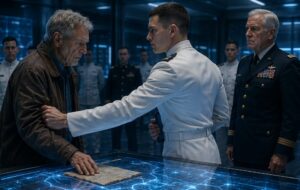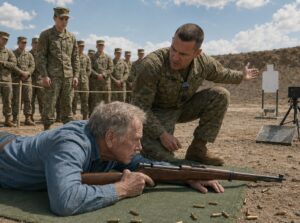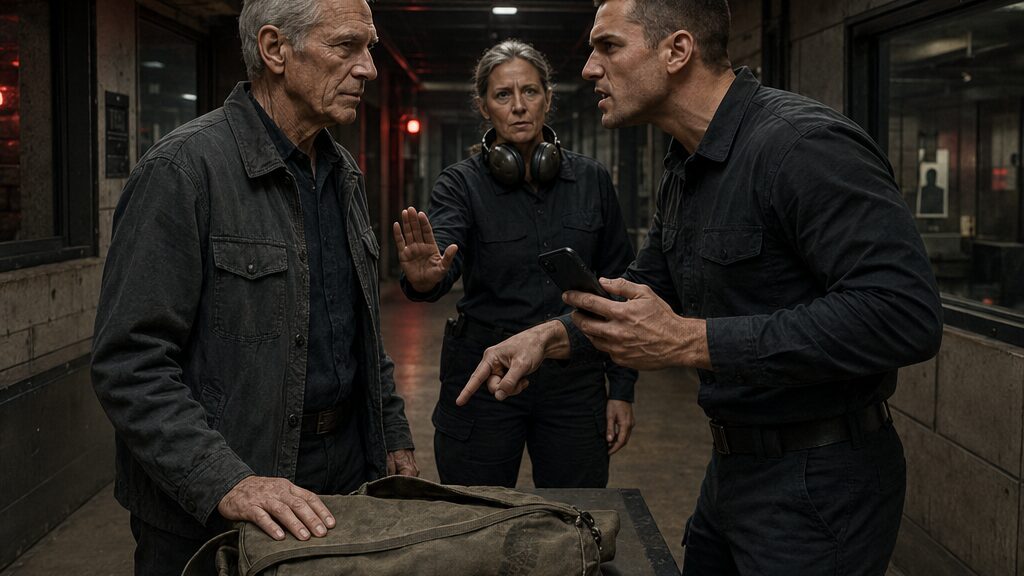
They Mocked the Old General’s Scarred Carbine Until He Revealed What Their Training Had Forgotten
Chapter 1: The Private Hour Behind the Reinforced Door
Alexander Lewis stopped beneath the first reinforced doorway and pressed two fingers against a pale ridge hidden under the fresh gray paint.
“This wall was rebuilt incorrectly.”
Margaret Wilson had already walked three steps into the room. She turned, one hand resting near the control tablet clipped to her belt.
The old man stood beneath the red safety light with a weathered canvas gun bag hanging from his right hand. His faded jacket made him look smaller than he was. The slight bend in his left leg became more visible when he stopped moving, as though stillness gave the old injury permission to speak.
Margaret looked from his fingers to the wall.
“That section passed inspection last spring.”
“It would.”
Alexander tapped the painted ridge once. The sound was duller than the surrounding panels.
“The reinforcement ends short of the frame.”
Margaret studied him. His reservation identified him only as Alexander Lewis. No title. No organization. He had paid for the entire shoot-house from eight until nine and requested no staff beyond a safety officer.
“You can tell that through paint?”
“I can tell because the old impact mark is still underneath it.”
He lifted his hand.
A shallow crescent showed where his fingertip had disturbed a trace of dust. Margaret had worked at the facility for eleven years. She had never noticed it.
“You’ve trained here before?”
Alexander’s eyes remained on the doorway.
“A long time ago.”
He carried the bag to the staging bench and set it down with more care than most customers gave new rifles. The canvas had faded from olive to a tired brown-green. One corner had been repaired by hand with darker thread. He placed his printed reservation card beside it, squared the card with the edge of the bench, and opened the safety log.
Margaret watched him enter the time, lane, ammunition count, and condition of the room in neat block letters.
Most experienced shooters rushed paperwork. Beginners overthought it. Alexander did neither.
“You requested the original target sequence,” she said.
“Yes.”
“We updated the software.”
“I know.”
“The new sequence is faster.”
“That is why I requested the original one.”
He closed the log and looked through the first doorway. Beyond it waited a narrow artificial corridor with movable partitions, pressure sensors, and paper targets hidden behind black panels. Overhead cameras watched every angle. The room was designed to punish hesitation.
Alexander appeared to study everything except the targets.
He checked the ceiling corners, the hinges, the floor tape, the light above the second threshold. Then he touched the zipper of the canvas bag but did not open it.
Margaret handed him an unloaded blue training carbine.
“Dry run first.”
He accepted it, checked the chamber anyway, and entered.
His movements were slow enough to frustrate anyone expecting drama. At the first corner, he stopped. He shifted his weight off the injured leg, lowered his breathing, and leaned just far enough to inspect the next sector.
The first target snapped up.
He did not raise the training carbine.
Margaret glanced at the clock. Three seconds gone.
Alexander advanced one measured step. His muzzle tracked the empty doorway before moving toward the target. He waited until the corridor behind it was visible.
Only then did he press the inert trigger.
The target dropped.
At the second threshold, he paused again.
Margaret folded her arms. “You’ll lose points at that pace.”
“I’m not keeping score.”
A panel opened to his left. He pivoted, verified, pressed the trigger, and continued.
The sensor for the next room activated before both his feet had cleared the threshold.
A target sprang from behind the far partition.
Alexander froze.
The floor sensor clicked again. A second target rose behind him, inside the sector the system had already marked clear.
Margaret stared at the control tablet.
“That shouldn’t happen.”
“No.”
The second target remained exposed for less than a second before sinking back into the floor.
Alexander lowered the training weapon.
Margaret entered the room and replayed the sequence. The system showed a clean progression. No warning. No fault.
“I saw it,” she said.
“So did the camera.”
“The software says the room was clear.”
“The software assumes the threshold closes the previous sector.”
“That’s how the new timing works.”
Alexander looked through the doorway where the second target had appeared.
“A threshold is not a wall.”
His voice was quiet, but something in the sentence made Margaret stop touching the tablet.
She opened the maintenance menu. The old sequence allowed nearly twice as long before the previous sector locked out. The updated program rewarded forward momentum and treated backward threats as resolved once the shooter crossed a line.
“This passed military certification,” she said.
Alexander returned the blue carbine to the bench.
“Certification proves someone completed the test.”
He signed the safety log again, noting the premature activation and exact room position. His handwriting did not change.
A buzzer sounded at reception.
Margaret checked the wall clock. Eight fourteen.
“They’re early.”
“Who?”
“A military group. They have the facility after you.”
Alexander’s hand rested on the bag zipper.
“They were told nine.”
“They were.”
The buzzer sounded again, followed by the muffled thump of several people entering the outer lobby.
Margaret stepped into the observation corridor. Through the glass she saw three uniformed soldiers and two civilians carrying camera cases. Anthony Hill led them, already talking toward a phone held at arm’s length. He wore a fitted tactical shirt beneath his open field jacket, and every piece of equipment on him looked selected to be seen.
Emily Baker followed with a compact camera rig. She noticed Margaret first and lowered it.
Anthony did not.
“There she is,” he said. “Tell me the house is ready.”
“Your booking starts at nine.”
His smile held for the phone, but his eyes changed.
“We were told we could set up early.”
“You can set up in the classroom.”
“We’re filming the full prep.”
“The shoot-house is occupied.”
Anthony turned the phone toward the observation glass.
Alexander stood alone at the staging bench, reading the safety log. The old canvas bag lay beside him.
“Occupied by who?”
“A private customer.”
Anthony moved closer to the glass.
Alexander felt the attention before he looked up. For a moment, his reflection and Anthony’s face occupied the same pane—one still, one leaning forward for a better angle.
Anthony laughed.
“You closed the elite house for that?”
Margaret stepped between him and the door.
“He paid for a private hour.”
Anthony glanced at his viewers’ comments, then back at the old man.
“We’ve got an evaluation coming. Active infantry should take priority over somebody doing retirement laps.”
Margaret’s jaw tightened.
“Classroom. Now.”
Anthony raised his phone toward the glass again.
“Emily,” he said, “start recording. Someone let a museum exhibit into our shoot-house.”
Alexander’s fingers closed over the worn zipper.
Chapter 2: The Men Who Mistook Speed for Readiness
Anthony placed his phone directly beside Alexander’s reservation card and aimed the camera so both the printed name and the old canvas bag appeared in frame.
“Eight twenty in the morning,” he told the livestream, “and an active infantry training block is being held up for a retired hobbyist.”
Margaret reached across the counter and turned the phone facedown.
“You do not film private customers without permission.”
Anthony turned it back over.
“We’re filming facility management.”
“You’re filming a warning.”
Behind him, Emily adjusted the strap of her camera but did not raise it. The two other soldiers watched the comments climbing on Anthony’s screen.
Alexander remained on the far side of the observation glass.
He had resumed the dry sequence.
This time he moved without the blue training carbine, tracing angles with his empty hands. At each threshold he touched the zipper of the canvas bag where it rested against his hip, then stepped through only after checking the space behind the target panel.
Anthony followed the movement with narrowed eyes.
“Look at that. He’s walking the course like he’s checking for loose change.”
“He found a sequencing fault,” Margaret said.
Anthony smiled toward the phone.
“Apparently we’re all unsafe now.”
Margaret pulled the printed reservation from beneath his hand.
“It is signed. It is paid. It ends at nine.”
“We deploy on short notice.”
“Then you understand schedules.”
“We also understand readiness.”
His tone sharpened because the viewers were listening. Without the phone, Margaret suspected he might have complained and stopped. With it, every reply became a position he had to defend.
“Our unit evaluation is Monday,” he continued. “We booked this house to show a full-speed close-quarters run. People are expecting that footage today.”
“People online are not part of the booking.”
“They’re part of why your facility gets military groups.”
That landed where he intended.
The facility had lost two agency contracts during the previous year. Anthony’s channel had brought private classes, equipment vendors, and enough visibility to keep the advanced bays busy. Margaret disliked the arrangement, but she knew what the monthly figures looked like.
Anthony saw the hesitation.
“Give him a standard lane,” he said. “We’ll take the house.”
“No.”
“Then refund his hour.”
“No.”
“Ask him.”
Margaret looked through the glass.
Alexander was standing at the second doorway, facing away from them. He leaned just far enough to inspect the return angle, then stepped back instead of forward.
Emily’s attention sharpened.
She moved nearer the glass.
“What?” Anthony asked.
“That sequence.”
“What about it?”
“I’ve seen it.”
Anthony looked again. “Everybody’s seen a corner check.”
“No. The pause after the second threshold.”
Emily removed a folded manual from her equipment pouch. It was thin, heavily marked, and printed with their unit’s training insignia. She turned pages quickly.
“There.”
She held the book where Anthony could see.
A warning paragraph near the bottom described visual fixation after crossing a threshold. The shooter was instructed to verify that the previous sector could not reactivate before committing to the next room.
Anthony skimmed it.
“That edition is old.”
“It’s still issued.”
“It’s an advisory, not the scored procedure.”
Emily looked through the glass as Alexander repeated the exact movement described in the paragraph.
“How would he know it?”
Anthony shut the manual with two fingers.
“He’s probably taken a class.”
Margaret heard the answer and knew Anthony did not believe it.
The old man returned to the staging bench. He opened the safety log, wrote another note, and checked the bag zipper again. The repetition no longer looked nervous. Each touch confirmed the bag remained closed, undisturbed, and exactly where he had left it.
Anthony picked up his phone.
“Let’s ask him.”
Margaret blocked the safety door.
“You will stay out of the live area.”
“I’m not entering. I’m talking through the intercom.”
He pressed the wall button before she could stop him.
His voice carried into the staging bay.
“Sir, some of us have real training scheduled. Any chance you can speed this up?”
Alexander looked toward the speaker.
He did not answer.
Comments rolled across Anthony’s screen. He read one aloud.
“Somebody says he forgot where he parked.”
One of the soldiers laughed.
Emily did not.
Margaret released the intercom button.
“That is your second warning.”
“Second? What was the first?”
“When I told you not to film him.”
“You warned me about filming. Now you’re inventing a safety issue because your customer is embarrassed.”
Alexander came through the inner door carrying the blue training carbine with its muzzle down. Margaret unlocked the final barrier and took it from him.
Anthony raised his phone.
Alexander’s eyes flicked to the lens, then away.
“You rented the whole place?” Anthony asked.
Alexander picked up his reservation card.
“Yes.”
“For that pace?”
Alexander slid the card into his jacket pocket.
Anthony waited for more. When none came, he laughed softly.
“We need this facility for deployment training.”
“Your hour begins at nine.”
“You heard all that?”
“The speaker carries.”
“Then you heard why this matters.”
Alexander opened the safety log.
Anthony moved closer to the glass separating them.
“Some of us don’t get to train whenever we feel nostalgic.”
Margaret stepped toward him. “Enough.”
Alexander wrote the end time of his dry run.
Anthony turned his phone to show the viewer count.
“This isn’t personal. It’s priorities. He can use a normal range. We need the room.”
Alexander closed the log.
The restraint in his face irritated Anthony more than an argument would have. An angry old man could be mocked. A silent one left too much empty space.
Anthony addressed the livestream again.
“We asked respectfully. Management chose one slow private shooter over active readiness.”
Margaret reached for the phone.
He pulled it away.
“You want me to tell them this place doesn’t support soldiers?”
“I want you to stop using your audience as a weapon.”
The lobby went still.
For one second, Anthony looked less offended than exposed.
Then his expression reset.
“You want to talk weapons? He’s the one wasting a tactical facility.”
Alexander lifted the canvas bag. His left leg resisted when he turned, forcing him to catch the edge of the bench. The movement was small, but Anthony saw it.
So did the camera.
The comments accelerated.
Anthony angled the screen toward his companions, and one of them muttered something about liability.
Alexander’s mouth tightened. Not at the insult. At the sight of Margaret standing between the group and the safety door while he remained behind the glass.
He had allowed her to carry the argument because he did not want his name spoken. He had told himself that was restraint.
Margaret’s flushed face suggested another word.
Avoidance.
Alexander set the bag down and opened the staging door.
The corridor quieted.
He looked at Margaret, not Anthony.
“The third-room timing,” he said, “has been shortened below the original safety standard.”
Anthony lowered the phone slightly.
Margaret stared at him.
“How could you know the original standard?”
Alexander’s gaze returned to the red light over the reinforced door.
“Because the interval was written for a reason.”
Chapter 3: Pack Up the Museum Piece and Go Home
Anthony slipped through the safety door before Margaret could engage the lock.
The warning light flashed red over his shoulder.
“Stop.”
Margaret’s command struck the corridor hard, but Anthony had already crossed into the staging bay. He stopped inches from Alexander, close enough that the old man could smell coffee and mint on his breath.
Emily remained outside with the camera lowered, caught between obedience and the fear of losing what was happening.
Anthony held his phone near his chest.
“Explain the reason.”
Alexander looked past him toward Margaret.
“Clear the live area.”
“There’s no loaded weapon out.”
“That does not make this your lane.”
Anthony smiled without warmth.
“You keep saying things like you own the place.”
“For eight more minutes, I do.”
The two soldiers behind the glass reacted with surprised laughter. Anthony heard it and stiffened.
He pointed at Alexander’s left leg.
“You can barely cross a doorway without stopping.”
Alexander did not move.
“You’re holding an elite house hostage to prove you remember how rooms work.”
“The room has a fault.”
“The room has a timer you don’t like.”
Margaret entered the first barrier but kept distance from both men.
“Anthony, step back through the door. Now.”
He glanced at his viewer count.
“We’re documenting a safety dispute.”
“You are creating one.”
Anthony’s face colored.
He turned toward the bench. The weathered bag lay beneath the hard overhead light, faded, patched, and narrow enough to belong to another era.
“This is what we shut down for?”
His boot struck the side of the bag.
It moved six inches across the concrete.
The zipper parted near the top.
A worn buttstock appeared through the opening, its surface gray at the edges from years of use. A deep scar crossed one side. Beneath it, the canvas had been repaired with irregular dark stitches.
Alexander did not look at Anthony.
He looked at the bag.
For an instant, the shoot-house disappeared beneath another ceiling—a cracked one, leaking dust into smoke. A corridor leaned sideways. Someone was calling from behind a door that should have stayed secured. Alexander remembered dragging weight over broken concrete while fabric tore beneath his hands. He remembered wrapping what he could with a strip cut from a field bag. He remembered giving the order before he remembered hearing the warning.
The present returned with the electric hum of the safety light.
Anthony nudged the bag again.
“Pack up the museum piece and go home.”
Margaret seized his arm.
“That is enough.”
He pulled free, not violently, but with the offended force of someone unused to being handled.
“I’m telling him what everyone here is thinking.”
“No,” Emily said from behind the glass. “You’re telling the camera.”
Anthony turned toward her.
The moment of divided attention was enough for Alexander to bend and lift the bag. His left leg trembled. He set the bag on the bench and opened it fully.
The CAR-15 inside looked older than Anthony’s confidence expected.
The finish had worn thin around the receiver. The handguard carried heat discoloration. The buttstock bore scratches too deep to polish out. Nothing decorative remained on it. No oversized optic, no bright controls, no accessory placed for appearance.
Yet every moving part shone with care.
Anthony leaned in.
“That thing is still configured like that?”
Alexander checked the chamber.
The motion was precise, almost gentle.
“You brought a relic into a modern house.”
Alexander examined the safety selector, then the magazine well.
Anthony reached toward the scarred stock.
His wrist stopped in Alexander’s hand.
No warning preceded it. One moment Anthony’s fingers were moving; the next, Alexander held him motionless.
The old man had not shifted his feet.
His grip was not crushing. It simply allowed no further travel.
“Never reach for another person’s weapon,” Alexander said.
The room changed.
Anthony looked down at the hand around his wrist. Margaret saw the surprise in his face before pride covered it.
Alexander released him.
Anthony stepped back on his own.
Behind the glass, nobody laughed.
Margaret hit the emergency control. A low alarm sounded through the building, and the red lights locked solid.
“Full cease-fire,” she announced. “All lanes closed.”
Anthony lifted his phone again.
“You see that?” he told the viewers. “He grabbed me.”
“You entered a restricted live-fire area after two warnings,” Margaret said. “You interfered with secured equipment. Your group is done for today.”
“You can’t cancel our block because he lost his temper.”
Alexander seated the carbine in the open bag.
“I did not lose anything.”
Anthony pointed the camera at him.
The live comments had already formed their own story. Some praised Anthony for confronting unsafe management. Others mocked the old man’s limp. A few replayed the moment Alexander caught his wrist and called it a cheap trick.
Anthony read the favorable ones aloud.
“People can see what this is. You’re hiding behind rules because you can’t perform.”
Emily finally raised her camera—not toward Alexander, but toward Anthony’s phone.
“Turn it off.”
Anthony stared at her.
“We need the full record.”
“You already have it.”
“We need what happens next.”
Margaret reached for the control panel to terminate the building’s network connection.
Alexander spoke before she did.
“One target.”
Everyone looked at him.
Margaret shook her head. “The session is suspended.”
“One paper target. Close range. Manual carrier.”
“No reactive system?”
“No timing program.”
Anthony’s smile returned cautiously.
“You want another try?”
Alexander lifted the CAR-15 from the bag and held it muzzle-down.
“I want the argument to end.”
Margaret studied him. She had seen anger expressed through speed, noise, and carelessness. Alexander showed none of those things. But his eyes were no longer distant. The bag had opened something he could not simply zip shut again.
“A demonstration won’t fix what he did,” she said.
“No.”
“It may make the filming worse.”
“Yes.”
“Then why?”
Alexander looked through the first doorway toward the third room.
Because he had spent years believing silence kept the dead from being turned into decoration. Because he had refused interviews, ceremonies, training invitations, and rooms filled with young soldiers asking for the fastest answer. Because every time his name was spoken, the story became the rescue and not the order that made rescue necessary.
And now a young man had entered a live area believing speed itself was proof.
Alexander inserted a magazine, then removed it and counted the rounds.
“Half,” he said.
Margaret watched his hands.
No tremor.
She looked through the glass at Emily, then at Anthony and the others. “Phones remain behind the safety line.”
Anthony opened his mouth.
“That is not negotiable.”
He held up his phone. “Then no one knows whether you altered the target.”
Emily spoke quietly.
“My camera can stay on the muzzle.”
Alexander looked at her for the first time.
“Only the muzzle.”
She nodded.
Margaret considered the locked control panel, the paper-target rail, and the man standing beside the damaged bag.
Then she reset one manual target in the primary lane.
The carrier motor began to hum.
A clean silhouette moved into position.
Anthony stepped behind the line, still wearing the expression of someone certain he could explain whatever came next.
Alexander closed the bag around everything except the carbine. He checked the chamber, the selector, the magazine, and the lane. Each action took exactly as long as it required.
Margaret cleared the room.
Emily raised her camera and framed only the scarred weapon.
Alexander took his place at the firing mark.
The slight tremor returned to his injured leg, then disappeared as his stance settled.
Anthony folded his arms.
Alexander looked once at the target, once at the empty sectors around it, and once at the doorway behind him.
Then he said, “Let them see what speed was supposed to serve.”
Chapter 4: One Ragged Hole in the Silence
Alexander loaded fifteen rounds into the magazine and placed the remaining ammunition in a straight line on the bench.
Emily adjusted her camera.
“Keep my face out of it,” he said.
She lowered the lens until only the scarred carbine and the firing lane filled the frame.
Anthony stood behind the safety line with his arms folded. His phone remained in his hand despite Margaret’s order, though the screen had gone dark after she disabled the facility network.
“You want proof without showing who did it?” he asked.
“I want the muzzle shown.”
“That convenient?”
Alexander inserted the magazine.
The metal clicked into place.
“No,” he said. “Necessary.”
Margaret checked the lane herself. The reactive system was offline. One paper silhouette waited at close range on the manual carrier, its center marked by a small black square. No movement behind it. No secondary target. No software deciding what counted as clear.
She returned to the control line.
“Range is live.”
Alexander raised the CAR-15.
The weathered buttstock locked into his shoulder. The old scar in its surface disappeared beneath his jacket. His injured leg settled half a step behind the other, no longer trembling.
He did not aim immediately.
His eyes moved across the room.
Left partition. Right threshold. Ceiling camera. Empty return lane. Door behind the safety line.
Only after every sector had been accounted for did his cheek settle against the stock.
Anthony made a small impatient sound.
Alexander heard it.
He also heard a voice from another corridor, years earlier, urging speed through dust and radio static. He remembered answering too quickly. He remembered believing momentum could correct uncertainty.
His finger rested outside the trigger guard.
“Ready,” Margaret said.
Alexander moved the selector.
The first click sounded unnaturally loud.
Then the carbine erupted.
The burst did not climb.
There was no wandering arc, no desperate correction, no visible struggle against recoil. The barrel remained fixed on the black square while the weapon thundered through half the magazine in one smooth mechanical breath.
The final casing struck the floor and spun against the concrete.
Silence followed.
Not ordinary silence. The compressed, ringing vacancy left after controlled violence had filled a small room.
Smoke curled from the muzzle.
Alexander held his position for another second, eyes still on the target. Then he lowered the carbine, removed the magazine, locked the action open, and checked the chamber.
Margaret watched the procedure before looking downrange.
Anthony looked first.
The silhouette seemed untouched from where he stood.
“There,” he said. “Nothing.”
The target carrier began to move.
Its motor rattled through the room, dragging the paper toward them.
Emily lowered the camera by an inch, then raised it again.
As the target approached, the black center square resolved into torn paper. Fifteen rounds had passed through one ragged opening scarcely wider than a coin.
No second hole marked the chest.
No round had broken the outer edge of the square.
Margaret stopped the carrier at the line.
One of Anthony’s companions exhaled a wordless breath.
Emily zoomed in.
Anthony stepped closer.
His face lost color, but only briefly. His eyes went from the target to the carbine, searching for an explanation that preserved the man he had been five seconds earlier.
“That weapon’s modified.”
Alexander placed the cleared carbine on the bench.
“Yes.”
Anthony seized on the answer.
“So it’s tuned. Reduced recoil, special trigger, maybe the target was—”
“The weapon did not verify the room,” Alexander said.
Anthony’s mouth closed.
Alexander indicated the target with one finger.
“That is speed after certainty. Not instead of it.”
Margaret removed the paper from the carrier. The hole at its center was warm and blackened around the edges.
Emily kept filming.
Anthony noticed.
“Turn that off.”
She looked at him over the camera.
“You wanted the full record.”
“That’s enough.”
“You said we needed what happened next.”
The words landed without force, which made them harder to resist.
Anthony reached for the target.
Margaret moved it behind her.
“Evidence stays with the facility.”
“Evidence of what? A demonstration?”
“Evidence of the sequence following your unauthorized entry.”
“You’re building a case because he embarrassed me.”
“You built it.”
Anthony looked toward the observation glass. His reflection showed a younger man dressed for authority with no audience left to convince.
He pointed at the target.
“There could have been a backing plate. He could have pre-shot it. The camera only showed the muzzle.”
Emily’s expression changed.
“You watched Margaret send the clean target down.”
“I watched it from behind glass.”
“You were standing beside me.”
“That doesn’t mean the carrier wasn’t altered.”
Margaret stared at him.
Alexander did not.
He was examining the canvas bag.
Anthony’s boot had left a gray smear across the repaired section. Alexander rubbed it once with his thumb. The mark lightened but did not disappear.
The grouping had proved exactly what he intended, and the result left him emptier than before.
Years ago, he had been able to place rounds just as tightly. He had been faster then. Stronger. Certain of the weight others placed on his decisions.
None of it had stopped a door from closing at the wrong time.
None of it had brought back the man behind it.
The outer entrance opened.
Bootsteps crossed the reception floor with measured urgency.
Margaret glanced toward the corridor. “I locked the facility.”
“I called the unit office before you killed the network,” one of Anthony’s companions admitted. “I thought we needed someone to settle this.”
Anthony straightened.
The sealed door opened, and Benjamin Garcia entered in uniform.
He took in the red safety lights, Margaret holding the target, Emily’s raised camera, Anthony inside the restricted zone, and Alexander beside the weathered bag.
His attention stopped there.
For a moment, Benjamin did not move.
Recognition stripped the command from his face and replaced it with something older.
He stepped fully into the room.
His heels came together.
His spine straightened.
Benjamin raised his hand in a rigid salute.
“General Lewis,” he said. “It’s an honor, sir.”
Anthony stared at Alexander.
Emily’s camera dipped.
Margaret looked from Benjamin’s salute to the old man’s scarred carbine.
Alexander remained still.
He did not raise his hand.
Benjamin held the salute as the silence lengthened.
At last Alexander said, “Lower it.”
Benjamin’s arm did not move.
“Sir—”
“A salute cannot make that room safe.”
Chapter 5: The Salute That Solved the Wrong Question
Benjamin lowered his hand slowly.
Anthony stood behind him, pale beneath the harsh lights.
“General?” he said.
Alexander closed the canvas bag halfway, leaving the cleared carbine visible.
“Retired.”
Benjamin turned toward Anthony.
The change in him was immediate. The younger recognition disappeared behind command authority.
“Outside the live area.”
Anthony obeyed before pride could interfere.
Benjamin waited until every soldier had crossed the safety line. Then he looked at Margaret.
“Secure their equipment.”
“I already closed the facility network.”
“Phones too.”
Anthony tightened his grip on his.
Benjamin held out his hand.
“That is an order.”
Anthony surrendered the phone.
Emily placed her camera on the counter without being asked.
Benjamin returned his attention to Alexander.
“Sir, I apologize for their conduct.”
Alexander opened the action of the carbine again, checked the empty chamber, and placed a safety flag through it.
“You arrived after the conduct.”
“I’ll handle it.”
“That is what concerns me.”
Benjamin’s jaw shifted.
Margaret removed the target from the room and led them into the sealed briefing area beside the control booth. It held a narrow metal table, six chairs, a wall monitor, and a cabinet of incident forms. The red range lights reflected through the observation glass.
Alexander brought the canvas bag with him.
Anthony and the others remained standing until Benjamin told them to sit.
No one chose the chair nearest Alexander.
Benjamin placed Anthony’s phone and Emily’s camera on the table.
“Private Hill entered a restricted area, interfered with a customer’s equipment, and ignored a range officer.”
“He insulted a decorated General,” one of the soldiers added, trying to help.
Alexander looked at him.
“That is not the offense.”
The soldier lowered his eyes.
Benjamin said, “It makes the disrespect worse.”
“No. It makes it easier for you to care.”
Benjamin went still.
Margaret opened an incident form. Her pen hovered over the first line.
Alexander nodded toward the observation window.
“If I had been an unknown seventy-year-old man, would this room be less unsafe?”
“No, sir.”
“Then stop using my rank to simplify what happened.”
Anthony stared at the table.
Benjamin drew a chair back but did not sit.
“I trained under your program,” he said. “I know what you built.”
“You know what remains.”
The words carried no accusation, yet Benjamin heard one.
Margaret connected Emily’s camera to the wall monitor.
“I need the original footage.”
Emily looked at Anthony.
He avoided her eyes.
She entered the access code.
The video began before the group’s arrival. It showed Anthony outside the observation glass, the phone lifted, the comments feeding his impatience. It captured Margaret’s first warning about filming. Then the second. It showed the signed reservation card.
Anthony’s face tightened as his own voice filled the room.
Active infantry should take priority.
The recording continued.
He entered the safety door.
Margaret ordered him out.
He stepped into Alexander’s space.
Then his boot struck the canvas bag.
No angle softened it. No edited caption changed the motion.
Emily stopped the video.
Benjamin’s voice was flat.
“You knew you were ordered back.”
“Yes, sir.”
“You entered anyway.”
“Yes, sir.”
“You touched secured equipment.”
“With my boot.”
“That distinction does not help you.”
Emily spoke before Benjamin could continue.
“I kept filming.”
Everyone looked at her.
She clasped her hands under the table.
“I knew he was crossing the line. I heard both warnings. I could have stopped recording, but I thought if something happened, the footage would matter.”
Margaret’s pen remained still.
“Did you think it would matter as evidence,” she asked, “or as content?”
Emily looked at the dark monitor.
“Both.”
The answer altered the room more than a denial would have.
Alexander studied her. She did not ask for credit for turning over the recording. She did not separate herself from the group now that the outcome had changed.
Benjamin took Anthony’s phone.
“Your unit access is suspended effective immediately. I’ll recommend removal from the evaluation roster and initiate separation review.”
Anthony looked up.
“Sir—”
“You endangered civilians and personnel for a livestream.”
“We weren’t live once the network went down.”
“You entered before it went down.”
Anthony’s face hardened around the fear beneath it.
“The Monday evaluation decides who stays on the team.”
“That should have occurred to you at the door.”
Alexander’s fingers rested on the stitched repair in the bag.
This was the solution institutions preferred: isolate the obvious offender, remove him, restore the appearance of order.
It was also the solution Alexander had allowed too many times.
“What interval do you use in the third room?” he asked.
Benjamin looked at him.
“Sir?”
“The verification interval.”
Benjamin hesitated.
“Current standard is one-point-four seconds after threshold crossing.”
“It was two-point-six.”
“The program was modernized.”
“By whom?”
Benjamin’s gaze moved toward the control booth.
“I approved the regional update.”
Anthony stopped looking at the table.
Alexander’s voice remained quiet.
“Why?”
“Scores were falling behind comparable units. The longer check created hesitation under evaluation conditions.”
“It created verification.”
“We retained the advisory language.”
Emily glanced at the folded manual protruding from her pouch.
Alexander saw it.
“You retained a paragraph and removed the time required to obey it.”
Benjamin pulled out the chair and sat at last.
“The updated course passed review.”
“So did the wall.”
Margaret looked toward the canvas bag as she shifted it away from the table edge. The torn zipper exposed the inside seam. Beneath the hand stitching, a small cloth tag had been sewn flat against the lining.
Numbers were written on it in faded ink.
A date.
Margaret touched it.
Alexander’s hand closed over hers.
Not hard. Fast.
She withdrew.
“I’m sorry.”
He released the fabric.
Benjamin had seen the date.
His expression changed.
“That was the Allen Corridor operation.”
Alexander zipped the bag shut.
Anthony looked between them.
“What operation?”
Benjamin answered without taking his eyes from Alexander.
“The action that produced the first close-quarters verification doctrine.”
“The action,” Alexander said, “that people prefer to remember backward.”
Benjamin straightened.
“Sir, you held the corridor and extracted six men.”
Alexander placed the scarred CAR-15 on the metal table.
The sound silenced everyone.
“That is the part they named things after.”
He rotated the weapon until the damaged buttstock faced Benjamin.
“The drill was not written because I held the corridor.”
Benjamin’s eyes dropped to the scar.
Alexander’s hand remained on the receiver.
“I wrote the first version of that drill after my order got a man killed.”
Chapter 6: The Doctrine Written After the Door Closed
Alexander led them back to the first reinforced doorway and pressed his thumb against the ridge beneath the paint.
“This is where the old corridor failed.”
No one spoke.
The range remained under cease-fire. Without target motors or ventilation fans at full speed, the shoot-house sounded smaller. Every bootstep returned from the walls.
Benjamin stood behind Alexander. Anthony and Emily followed under Margaret’s supervision. The other soldiers had been sent to the classroom.
Alexander traced the edge of the repaired panel.
“The original structure was modeled after a concrete service building. Narrow entrance. Offset second room. Rear access that could not be seen from the first threshold.”
Anthony looked into the darkened lane.
“This building was based on the operation?”
“The first version was.”
Alexander stepped across the line where the premature target had activated that morning.
His limp deepened on the turn.
“We had been outside the building for eleven minutes. Command wanted the objective cleared before another unit reached the district. I had reports of armed movement in the rear rooms and a limited window before civilians entered the area.”
Benjamin listened without interrupting.
“I ordered the first team through. They cleared the front room. A door at the second corridor appeared secured. The frame had shifted under impact, but the latch had not seated.”
Alexander placed his palm against the training door.
“I saw the indicator. I also saw the clock.”
His fingers curled.
“I told them to advance.”
Anthony’s gaze lowered to the floor sensor.
“The door reopened?”
“After the lead man crossed the threshold.”
The words carried no drama. Their restraint made the room feel colder.
“The rear sector became active again. One soldier was trapped between the closing partition and the return fire. The rest of the team pushed forward because that was the order I had given.”
Emily held the folded manual against her chest.
“What did you do?”
Alexander looked at the faded bag in Margaret’s hand.
“I changed the order too late.”
He had gone back through smoke thick enough to turn the corridor into pieces. The CAR-15’s buttstock had struck the concrete when part of the ceiling came down. The impact scar remained beneath his hand even now.
He remembered the trapped soldier calling out once.
Not for rescue.
For the others to keep moving.
Alexander had dragged two wounded men across the broken threshold before the rear wall shifted. A slab struck his left leg and pinned him long enough for the corridor to begin burning around them.
The canvas bag had carried demolition tools then, not a rifle. He had cut it open to bind the trapped soldier’s wound. The dark stitches were added later by hands Alexander no longer remembered.
“We extracted six,” Benjamin said quietly.
“Seven entered.”
The count remained between them.
Anthony stared into the third room.
“And the doctrine?”
“I wrote it during the investigation.”
Alexander walked farther into the house. At every threshold, he stopped in the same deliberate position Anthony had mocked.
“Verify the previous sector cannot reactivate. Confirm the door, not the line on the floor. Pause long enough to see what pressure makes you want to ignore.”
Margaret opened the safety log she had carried from the desk.
On the first page of the original procedures, beneath years of later amendments, a faded sentence remained.
Verify before violence.
She read it aloud.
Alexander nodded.
“That was not a slogan. It was an admission.”
Benjamin rubbed a hand over his mouth.
“The modern program still teaches judgment.”
“It scores movement.”
“It scores completion.”
“Under what time?”
Benjamin did not answer.
Anthony did.
“One-point-four seconds after the threshold.”
He moved to the third-room line and looked down at the sensor strip.
“If you pause long enough to verify the rear sector, you lose the top rating.”
Emily opened the manual to the warning paragraph.
“The written instruction says to check.”
“The scoring system says not to,” Anthony replied.
For the first time, there was no performance in his voice.
He turned to Benjamin.
“We were told the fastest clean run set the readiness order.”
“Clean includes safety,” Benjamin said.
“Not on the board. The board shows time, hits, and penalties. A rear-sector pause is counted as hesitation unless a target actually reactivates.”
Margaret looked at the control tablet.
“That is why today’s fault didn’t register. The software considers the sector closed.”
Alexander watched Anthony understand the structure that had rewarded him.
The young man had made every harmful choice himself. But those choices had grown in soil others maintained.
Anthony leaned against the partition, then caught himself and stood straight.
“My videos skipped the pauses.”
Benjamin’s face hardened.
“You altered official demonstrations?”
“They weren’t official.”
“You filmed in unit equipment.”
“I knew the checks were supposed to be there.” Anthony looked toward the dead camera above them. “But slower runs lost viewers. The comments said hesitation got people hurt. The sponsors wanted clean speed. And our scores improved after people trained for the clips.”
Margaret closed the tablet cover.
“So you knew.”
“Yes.”
“You entered my live area knowing exactly why thresholds matter.”
Anthony’s jaw tightened.
“I thought I could control it.”
Alexander looked at him.
There it was.
Not ignorance. Not youth. The older and more dangerous belief: that skill granted exemption from uncertainty.
Alexander had once said the same thing in cleaner language.
He returned to the first doorway. The walk cost him more now. His left hand briefly touched the wall for balance.
Emily noticed but did not offer help.
“Why did you come back today?” she asked.
Alexander looked at the premature target slot.
A former instructor had sent him the revised timing table three weeks earlier. Alexander had put it in a drawer. Then another message arrived showing the evaluation board, the shrinking intervals, the phrase decisive dominance printed above the scores.
He had almost deleted that too.
“I came to see whether the change was as bad as it looked.”
“And if it was?” Margaret asked.
“I intended to write a report.”
Benjamin’s expression carried the sting of that answer.
“You could have called me.”
“I did not want my name to decide whether you listened.”
“But you didn’t tell Margaret why you were here.”
“No.”
“You let her defend the booking alone.”
Alexander looked at Margaret.
She did not rescue him from the accusation.
“I did.”
“You saw Anthony escalating,” she said. “You knew more than any of us about the risk.”
“Yes.”
“And you stayed silent until he touched the bag.”
Alexander’s hand settled on its repaired seam.
“Yes.”
The admission felt smaller than the one about the operation, but not easier.
Silence had protected him from ceremonies, from praise, from hearing the dead reduced to a lesson. It had also allowed the shortened timer to remain in place. It had left Margaret arguing with a man whose training Alexander already understood.
He had mistaken absence for humility.
Benjamin looked down the corridor.
“I’ll suspend the revised scoring system today.”
“That is a beginning,” Alexander said.
“And Anthony?”
Benjamin’s tone made clear that the separation review remained ready.
Anthony stood at the third threshold, stripped now of audience and posture. “I violated the range. I altered the demonstrations. I’ll accept the review.”
Alexander studied him.
Acceptance could be another performance when punishment seemed inevitable.
He held out his hand.
“Your phone.”
Benjamin gave it to him.
The device was locked, but the dark screen reflected Anthony’s face.
Alexander placed it on the edge of the safety log.
“You have two choices.”
Anthony waited.
“Publish everything. The insult, the target, the salute. Preserve the story your audience expects. You will be the fool who mocked an old General, and I will become another clip proving rank and skill.”
Anthony looked at the phone.
“Or?”
“You surrender the footage to Margaret. You sign every violation without excuse. Then you run the original course.”
Anthony glanced toward the dark rooms.
“With what score?”
“No score.”
“Will it affect the unit review?”
“Yes.”
“How?”
“I have not decided.”
Benjamin started to speak, but Alexander raised one hand.
“No rank protection. No promise you remain on the team. No camera. No audience.”
Anthony’s eyes moved to the single-hole target Margaret still carried.
“And if I refuse?”
“Then the video tells the only story you are willing to learn from.”
Alexander pushed the phone across the safety log.
Anthony did not touch it.
The dead screen lay between them, holding both versions of what came next.
Chapter 7: No Cameras When the Lesson Begins Again
Anthony picked up the phone, opened the scheduled livestream, and pressed delete.
The confirmation box remained on the screen.
He read it twice before pressing again.
Then he carried the phone to the reception counter and placed it beside Emily’s camera, outside the reinforced doors.
Margaret slid the incident report toward him.
Anthony signed without reading past the first page.
“Read it,” she said.
“I know what I did.”
“Knowing now does not mean the record can be vague.”
He drew the form back.
Unauthorized entry into a restricted live-fire area. Failure to obey two direct safety instructions. Interference with secured equipment. Filming a private customer without consent. Use of facility access for unapproved commercial content.
Anthony initialed each line.
When he reached the final blank, he stopped.
Personal statement.
He looked toward the observation glass. Alexander stood inside the staging bay with the weathered canvas bag open on the bench. The CAR-15 lay cleared inside it, untouched since the briefing.
Anthony wrote one sentence.
I believed being able to control the risk gave me permission to create it.
Margaret read the line after he pushed the form back. She did not praise it. She signed beneath his name and locked the report in the facility cabinet.
Emily placed her own written statement beside it.
“I want to run the course too,” she said.
Alexander looked through the open safety door.
“Not today.”
Her disappointment appeared before she could conceal it.
“You turned over the recording,” he said. “That does not erase why you kept it running.”
“I know.”
“Good. Keep knowing until your turn comes.”
Emily nodded and stepped back from the entrance.
Margaret issued Anthony an unloaded blue training carbine. He checked its chamber, then checked it again when Alexander said nothing.
Benjamin stood near the control panel.
“Should I observe inside?”
“No,” Alexander said.
Benjamin’s mouth tightened. “He is still under my command.”
“Then let him enter a room without leaning on it.”
Margaret suppressed the new scoring system and loaded the original sequence from the archive. The display warned that the file was obsolete.
She selected it anyway.
The target timer changed from one-point-four seconds to two-point-six.
No score appeared.
No ranking.
Only room status, sector status, and safety faults.
Anthony took his place at the first threshold.
Alexander remained outside the lane with one hand resting on the closed canvas bag.
“Begin when ready.”
Anthony entered fast.
His body knew the modern sequence. He cleared the first visible angle, crossed the floor line, and began turning toward the next target before his rear foot had settled.
A panel clicked behind him.
He stopped too late.
The rear target rose within the sector he had already abandoned.
The tablet sounded a flat warning tone.
Anthony lowered the training carbine.
“Reset,” he said.
Alexander did not move.
“What did you see?”
“The front target.”
“What did you not see?”
“The door latch.”
“Why?”
Anthony looked toward the observation glass. No phones waited there. No viewers. Only Emily, Margaret, and Benjamin.
“I wanted the run started clean.”
“It started clean. You made it uncertain.”
Anthony returned to the line.
The second attempt lasted longer.
He verified the first doorway, checked the latch, and crossed the threshold with less speed. At the second room, the side target appeared. He engaged it with the inert trigger, shifted to the next sector, and moved on.
Alexander watched his shoulders.
Anthony was still chasing the course.
The pressure no longer came from a timer on the wall. It came from the memory of everyone who had seen him fail.
At the third-room threshold, the faulty sensor clicked beneath his boot.
The forward target snapped up.
Anthony began to raise the carbine.
Behind him came the faint mechanical sound of the previous panel releasing.
His weight pitched forward.
He could have completed the turn. He could have reached the next target inside the allowed interval.
Instead, he stopped.
He lowered the muzzle by a fraction, looked back, and verified the rear sector.
The old target rose fully.
Anthony faced it, pressed the inert trigger, confirmed the doorway had settled, and only then advanced into the third room.
The tablet remained silent.
He completed the course without another fault.
When he returned, sweat had darkened the collar of his shirt. The run had taken almost twice as long as the demonstrations that built his audience.
Alexander asked, “Where did you lose time?”
Anthony looked at the dark score field.
“At the third threshold.”
“No.”
Anthony frowned.
Alexander pointed to his chest.
“You lost it before you entered. You spent the first two rooms trying to recover a reputation that was not in the building.”
Anthony’s eyes moved toward the phones outside.
“The pause felt longer than it was.”
“Uncertainty always does.”
“Would that have passed the old standard?”
“Yes.”
“Would it pass Monday?”
Benjamin answered.
“Monday’s evaluation is suspended.”
Anthony absorbed that without protest.
Alexander said, “The pause was the most important thing you did today.”
It was not forgiveness. Anthony seemed to understand that. He placed the blue carbine on the bench and cleared it according to procedure.
Benjamin waited until Margaret secured the training weapon.
“General Lewis, the program needs a formal review.”
Alexander closed the canvas bag over the scarred CAR-15.
“I agree.”
“We should announce your return. A founder’s session would reset attention quickly. Senior leadership, instructors, perhaps recorded modules—”
“No.”
Benjamin stopped.
Alexander worked the damaged zipper carefully past the torn section.
“No ceremony. No founder’s portrait. No filmed demonstration.”
“Then how do I explain the changes?”
“Explain the fault.”
“Your name would make people listen.”
“For the wrong reason.”
Benjamin looked toward the single-hole target mounted temporarily beside the control booth. “They will ask who authorized the review.”
“I will sign it.”
“That is still your name.”
“A signature accepts responsibility. A ceremony distributes admiration.”
Margaret leaned against the counter.
“What will you agree to?”
Alexander lifted the bag. Its weight pulled slightly against his injured side.
“A closed review of every timing interval. Instructors only. Then small diagnostic groups. No scores until the safety logic is restored.”
Benjamin nodded once.
“And Anthony?”
Alexander looked at him.
Anthony stood without his phone, his uniform no longer arranged for a frame.
“He faces your review,” Alexander said. “His run today belongs in the record beside his violations. Neither cancels the other.”
Anthony accepted that with a small movement of his head.
Emily stepped forward.
“When the groups begin, I still want a place.”
Alexander regarded her for a moment.
“You may observe the first one.”
“Not run it?”
“Observation is part of training.”
She almost argued, then stopped herself.
“Yes, sir.”
Alexander’s expression tightened.
“Alexander is enough inside this building.”
Benjamin heard the boundary and did not salute.
Margaret opened the cabinet beneath the counter and removed a stack of membership cards. Anthony’s group cards sat on top, their names printed beneath the facility logo.
She cut each one through the magnetic strip.
The pieces dropped into the disposal tray.
Anthony watched his card fall last.
“Commercial access is permanently revoked,” Margaret said. “The group is banned from filming here. Facility entry remains suspended pending command review.”
She opened a drawer and took out a blank temporary pass.
On the front she wrote Anthony Hill. On the back she added an expiration date and one condition in large block letters.
NO CAMERAS.
She held it out but did not release it when Anthony took the edge.
“This is not reinstatement.”
“I understand.”
“It permits supervised diagnostic training only.”
“I understand.”
“And if you bring an audience—”
“I won’t.”
Margaret let go.
Anthony slipped the pass into the same pocket where he had carried his phone.
Alexander signed the final line of the safety log. Beneath the morning’s fault report, he added a recommendation for immediate suspension of the shortened interval and a full review of rear-sector verification.
Then he wrote one final sentence.
Correction requires someone to remain after the mistake is named.
He paused over the words.
For years, he had named mistakes in reports and left before anyone could ask him to stay. He had called that restraint. Sometimes it had been cowardice with better posture.
Benjamin read the entry from across the counter.
“What time should the review begin?”
Alexander zipped the canvas bag completely.
“Tomorrow. Eight.”
Margaret looked up.
“The same private hour?”
“No,” Alexander said. “This time, open the classroom.”
He carried the bag toward the exit. His limp remained, but he no longer used it to hurry away from anyone’s attention.
Behind him, no hand rose in salute.
Anthony stood beside the reinforced door holding the blank pass. Emily remained near the dark cameras. Benjamin opened the archived procedures on the control tablet, and Margaret removed the one-point-four-second program from active use.
Alexander stopped at the repaired wall.
He touched the pale ridge beneath the paint once more.
“Mark this panel for replacement,” he said.
Margaret picked up her pen.
Then Alexander stepped through the doorway, leaving it open behind him.
The story has ended.