They Blocked The Elderly Woman In The Faded Jacket, Then Learned The Ceremony Was For General Linda Hall
Chapter 1: The Woman At The Wrong Desk
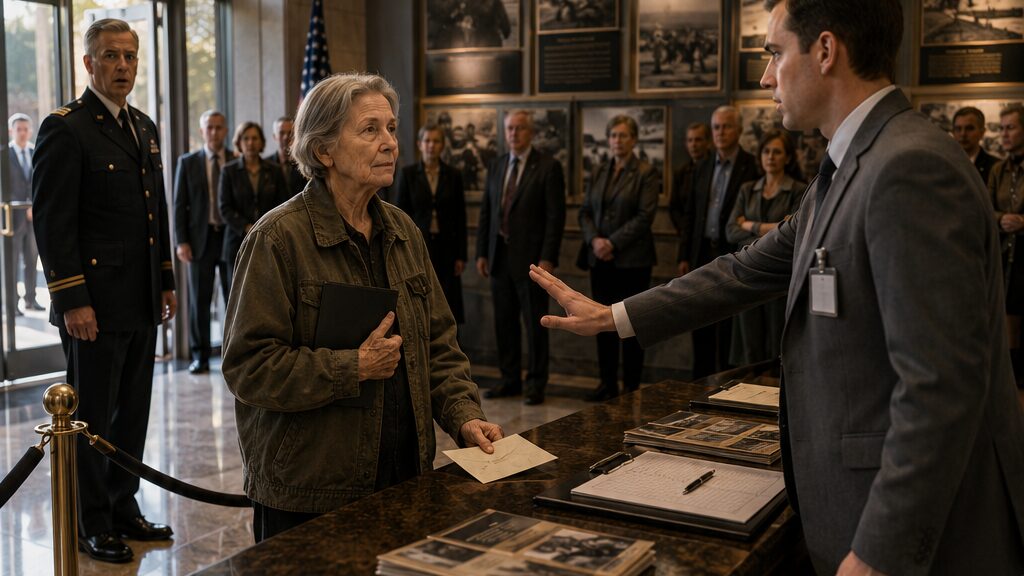
Gary Robinson’s hand came down across the entrance rope just as Linda Hall stepped toward the security desk.
Not hard. Not violent. Just final.
The kind of gesture people used when they had already decided you did not belong.
Linda stopped with one practical black shoe half an inch from the brass stand. The rope trembled slightly between them. Beyond it, the veterans facility lobby opened into a polished corridor where volunteers in navy blazers carried programs, donors stood in quiet clusters, and a long banner stretched above the ceremony doors.
DEDICATION CEREMONY — HONORING SERVICE, SACRIFICE, AND COMMAND LEGACY.
Linda looked at the banner for only a second. Then her eyes moved to the wall beyond the check-in table.
Names carved in brushed metal. Framed photographs under museum lights. A dedication wall she had not seen since it was only a sketch on somebody’s desk and a promise in a folder.
“Ma’am,” Gary said, using the word like a barrier, “this entrance is for honored guests.”
Linda turned back to him.
He was young, clean-shaven, sharp in a pressed gray suit with a facility badge clipped precisely over his breast pocket. His hair looked recently cut. His tie was straight enough to suggest he had checked it several times that morning. A headset curled around one ear, and a tablet lay beside the guest roster as if the whole building depended on how fast he could tap it.
Linda shifted the slim black ID folder against her chest.
“I was invited,” she said.
Her voice was calm enough that Gary blinked, as though he had expected confusion, complaint, or apology.
“Do you have a current pass?”
Linda drew an old cream-colored invitation from the inside pocket of her faded olive jacket. The fold was softened at the corners. She had read it many times and touched it more than that. Gary took it between two fingers.
His gaze flicked over the paper, then over her jacket.
It was clean but worn thin at the cuffs. No rank insignia. No medals. No polished pins. Just an old unit patch, faded until the thread looked almost gray. Her dark trousers were plain, her shoes sensible, and her short gray hair had been tucked neatly behind her ears without any attempt to make it softer than it was.
Gary’s eyes dropped to her shoes, then rose again with a quick professional smile.
“This is for today,” Linda said.
“I can see the date.”
He slid the invitation back across the desk without looking at the roster.
Linda did not pick it up immediately.
“You can check the name again,” she said.
Behind her, someone cleared his throat. A small group of donors had arrived, all careful shoes and subdued perfume and expensive coats. One woman leaned slightly to see what was slowing the line. A man holding a program checked his watch.
Gary noticed them. His shoulders tightened.
“Ma’am, we have a schedule,” he said more softly, which somehow made it colder. “The ceremony starts in twenty minutes. I can’t hold up the VIP entrance for every walk-in with an old paper.”
Linda’s fingers settled on the edge of the desk.
“I am not a walk-in.”
Gary gave a short breath through his nose. He turned the tablet toward himself and tapped once, but his eyes were already moving past her to the waiting donors.
“Name?”
“Linda Hall.”
The words landed between them with no decoration.
Gary typed with quick, impatient fingers. He frowned, tapped again, then looked at the printed roster clipped to a board beside the tablet. His thumb ran down a page.
“Hall, you said?”
“Yes.”
He turned one sheet, then another. His expression sharpened with relief. Not the relief of finding her. The relief of finding proof he had been right.
“I don’t see that name under general admission.”
“I was not told to use general admission.”
“This desk is reserved for invited speakers, command staff, and donor families.”
Linda looked at the invitation, still lying between them. “Yes.”
A quiet laugh came from someone in the line. Not loud enough to be owned by anyone. Loud enough to be heard.
Gary’s ears reddened.
“Ma’am,” he said, now louder, “I’m going to ask you to step aside.”
Linda did not move.
On the wall behind him, a framed photograph caught her eye. A grainy image from decades earlier. A line of officers under a washed-out sky. Too far away to see clearly from where she stood, but close enough for the shape of memory to press against her ribs.
She had come early because she wanted a few minutes alone with that wall. No cameras. No introductions. No formal language. Just the names.
Gary followed her gaze and misunderstood it.
“The exhibit is open to the public after the ceremony,” he said. “You’re welcome to come back then.”
A volunteer at the far doorway whispered into a headset. Someone laughed again, softer this time. The donors shifted around Linda, trying not to appear impatient while making their impatience visible.
Gary leaned closer.
“Are you here with someone?”
“No.”
“Do you have family inside?”
“No.”
“Then I’m not sure who told you to come to this desk.”
Linda folded her invitation slowly, aligning the worn edges with care. The motion steadied her hands. She could have opened the black folder. She could have shown him three forms of proof before his next breath. She could have said a title that would change the temperature in the lobby.
But the first name on the dedication list had belonged to a young man who hated attention so much he once hid behind a transport vehicle to avoid a promotion photo. The second had written home that command was not about being seen. The third had died with a letter in his pocket that asked his family not to let anyone turn him into a slogan.
Linda had promised herself she would not make this day about rank.
“I came because I was invited,” she said.
Gary’s smile disappeared.
“Ma’am, confusion happens at events like this. There’s no shame in that. But we need to keep this area clear.”
The word confusion changed the air.
Linda felt it pass through the line behind her, giving people permission to look at her differently. Less like a woman at a desk. More like a problem the staff was handling.
Her hand tightened once around the black folder, then relaxed.
Gary picked up the invitation before she could tuck it away. “I’ll hold onto this for now.”
Linda’s eyes moved to his hand.
“I would prefer to keep it.”
“And I would prefer not to have the same conversation three times.”
A donor woman looked away. A man in a dark coat pretended to read the banner. The facility lobby, with all its polished stone and reverent lighting, suddenly felt like a room designed to honor memory while making no space for the living.
Linda lifted her chin by a fraction.
“Mr. Robinson,” she said, reading his badge, “checking a name takes less time than making a mistake.”
Gary stiffened.
For the first time, uncertainty flashed across his face. Not because he recognized her. Because she had spoken like someone used to being obeyed without raising her voice.
Then his headset crackled. He pressed two fingers to it.
“Yes, Ms. Thomas. Front desk is fine. Just a minor delay.”
He listened. His eyes flicked to the donors. Then to Linda.
“Understood.”
He dropped his hand from the headset and pointed toward a row of side benches near the exit, where two elderly men and a woman with a walker sat apart from the event traffic.
“Please sit over there,” he said. “Someone will help you after we finish checking in the guests.”
Linda looked at the benches. Then at the ceremony doors. Then at the wall of names she had come to see before the room filled with speeches.
“I am one of the guests,” she said.
Gary stepped around the desk, lowering his voice only enough to pretend he was protecting her dignity.
“Ma’am, please sit over there before you embarrass yourself.”
The line behind her went still.
Linda held his gaze. Her face did not break, but something old and tired moved behind her eyes.
Then she picked up her black folder, pressed it to her chest, and walked toward the bench beside the dedication wall.
Chapter 2: The Bench Beside The Dedication Wall
The younger version of Linda Hall watched over her from the wall without anyone noticing.
The photograph had been cropped at the shoulders and placed high between two panels of engraved names. In it, a woman in field uniform stood among a group of officers, her face younger, sharper, almost severe beneath the brim of a cap. Time, distance, and the museum glass softened the resemblance. Anyone passing quickly would see only history.
Linda sat directly beneath it.
The bench was narrow and too low, designed more for waiting than comfort. She lowered herself carefully, keeping the black folder across her lap with both hands. The old invitation was gone now, still at Gary Robinson’s desk, trapped under his clipboard or in his jacket pocket or wherever young men put things they did not understand but wanted to control.
From the ceremony hall came the muffled rhythm of preparation. A microphone thumped. Chairs scraped. A voice tested the sound system, repeating, “Good morning, ladies and gentlemen,” until the phrase became empty.
Linda looked at the first column of names.
She did not need the plaques to read them. She had known them before metal made them permanent.
A man on the far end of the bench shifted his cane so it did not block her feet. He wore a brown cardigan over a collared shirt, and one sleeve hung looser than the other over a thin wrist. His face had the weathered patience of someone who had waited in many official rooms and expected little from them.
“They put you over here too?” he asked.
Linda turned her head. “It seems so.”
“Frank Jones.” He lifted two fingers from the cane in greeting. “I was told my reservation was ‘not priority seating.’ My knees didn’t argue.”
Linda gave the smallest smile. “Linda Hall.”
Frank nodded as if names mattered, even when desks did not. “You here for someone on the wall?”
Linda looked back at the names.
“Yes.”
Frank waited. When she did not continue, he did not press. That made him easier to sit beside.
Across the lobby, Gary moved with brisk importance, checking in donors and officers with smooth apologies for the earlier delay. His voice changed for them. Warmer. Quicker. He held programs with both hands. He smiled as if courtesy had never cost him anything.
Linda noticed everything. The way he stood straighter when Nicole Thomas crossed the lobby. The way his fingers touched his badge whenever a senior-looking visitor approached. The way he glanced toward the bench to make sure she had stayed where he placed her.
Nicole Thomas moved through the crowd with the controlled speed of someone keeping twenty problems from showing on her face. Navy suit. Tablet. Facility pin. She spoke to donors softly and volunteers sharply. Gary leaned toward her as she passed.
“Front is under control,” he said.
Nicole barely glanced at the bench. “Keep it clean. We need the donor families seated before the officers arrive.”
“Yes, ma’am.”
Keep it clean.
Linda let the words pass without expression.
Her thumb found the lower corner of the black folder. The leather had been replaced once and repaired twice. Inside were documents that no longer mattered to most offices and mattered too much to her. A folded letter. A list in her own handwriting. An old command coin tucked into a clear sleeve because she did not trust her fingers not to drop it.
The folder slipped open a fraction.
Metal caught the light.
Frank’s eyes moved, then moved away politely.
After a moment he said, “That’s a command coin, isn’t it?”
Linda closed the folder with care.
“It was given to me a long time ago.”
“I had one once,” Frank said. “Different kind. Smaller. Lost it moving houses after my wife passed.” He looked toward the wall. “Funny what stays and what doesn’t.”
Linda’s fingers rested on the folder seam.
“Yes.”
Frank leaned back, following her gaze up the dedication panels. “Did you serve?”
Linda did not answer at once.
A full answer would have opened too much. Rank. Years. Decisions. Rooms full of maps. Calls made before dawn. Young faces waiting for orders. A folded flag in the hands of a mother who had not blamed Linda, which somehow made it worse.
At last she said, “I knew some of the names.”
Frank heard what she did not say. His posture changed, not into attention, exactly, but into respect.
“That’s a heavy reason to come.”
Linda looked down at her hands. They looked smaller than she remembered. The veins stood higher. The skin had thinned around the knuckles. Once, those hands had signed orders that moved hundreds of people across oceans. Now they held a folder like a shield.
“I came early,” she said. “I wanted to see the wall before the room filled.”
Frank nodded. “Hard to remember people when everyone’s busy being seen remembering them.”
Linda turned to him then.
There was no bitterness in his voice, only fatigue. It made the sentence sharper.
Before she could answer, Gary appeared in front of them.
“Sir,” he said to Frank, not quite hiding his annoyance, “please don’t interfere with check-in issues.”
Frank looked up. “We’re sitting on a bench.”
“You’re encouraging confusion.”
Linda’s eyes lifted.
Gary looked at her folder. “And ma’am, I need you to keep any personal items closed while you’re in the lobby.”
“It is closed,” Linda said.
“I saw something metallic.”
“A coin.”
“We don’t allow unauthorized display items near ceremonial areas.”
Frank stared at him. “It’s a coin, son.”
Gary’s jaw tightened at son.
“I’m trying to maintain a secure environment.”
Linda could see the effort underneath his crispness now. He was not relaxed. His eyes kept traveling to the ceremony doors, to Nicole, to the donors. He was balancing on a thin wire of his own importance, terrified of being seen falling.
That did not make him less wrong.
Gary held out his hand. “I’ll need the invitation until we sort this out.”
“You already took it,” Linda said.
His face flickered. “Then I’ll keep it at the desk.”
“I would like it returned.”
“When I have confirmation.”
“You have not tried to confirm.”
This time Frank looked at Gary fully. A few people nearby turned their heads.
Gary lowered his voice. “Ma’am, I am not going to debate procedure in the lobby.”
Linda’s gaze stayed steady. “Procedure is usually written down so people do not have to invent it under pressure.”
Frank coughed into his hand, hiding the beginning of a smile.
Gary’s color rose.
He pointed at the black folder. “That kind of souvenir stuff is exactly why we have to be careful. People bring old memorabilia and think it gets them into restricted events.”
The words landed harder than he knew.
Souvenir stuff.
Linda’s hand closed over the folder. In the clear sleeve inside, the coin bore the worn emblem of a command that had cost more than speeches could hold.
Frank pushed himself up an inch with his cane. “You might want to listen to her.”
Gary turned on him. “Sir, stay seated.”
The lobby quieted around them in patches.
Linda stood before Frank could. Slow, controlled, not because she was weak, but because she refused to let anger hurry her body.
“Return my invitation,” she said.
Gary looked toward the desk, then back at her.
“I’ll sort it out later.”
He reached past her, took the folded invitation from where it had been set on the bench beside her folder—she had not even seen him place it there—and slipped it into the inside pocket of his suit jacket.
Linda watched it disappear.
For the first time that morning, she felt the old command voice rise behind her teeth.
She held it back.
Gary took her restraint for surrender.
“Please remain seated,” he said, and walked back toward the desk with her invitation in his pocket.
Chapter 3: The Missing Page In The Guest Roster
“There is no Hall on this list,” Gary said, waving the roster as if paper had settled the matter.
Linda stood on the public side of the security desk, the black folder held flat against her ribs. Frank had come with her despite Gary’s order to stay seated, leaning on his cane a few steps behind as though he had merely decided to inspect the lobby from a different angle.
Gary clipped the roster back onto its board with a sharp metallic snap.
“You asked me to check. I checked.”
Linda looked at the open pages.
“May I see it?”
“No.”
“Why not?”
“Because this is an internal guest control document.”
“It is also the document you are using to deny me entry.”
Gary pressed his lips together. He was aware now of people watching. Not many. Enough. A volunteer paused by the program table. A donor family slowed near the coffee station. Nicole Thomas had vanished into a side office, but her presence seemed to hang over Gary anyway.
He turned the roster slightly, just enough to show Linda the columns.
“There.” His finger tapped one section. “Gonzalez. Hernandez. No Hall.”
Linda did not reach for the paper. She only looked.
The page did exactly what he said. The printed names moved from Gonzalez to Hernandez with no Hall between them.
A small, practical disappointment settled in her chest. Not surprise. She had seen bigger institutions lose more important pages. Orders misfiled. Casualty notifications delayed. Names misspelled on memorial drafts. Systems were made by people, and people grew careless when they thought ceremony could replace attention.
“That page is incomplete,” she said.
Gary let out a humorless laugh. “Of course it is.”
Frank’s cane tapped once.
Linda turned slightly, enough to quiet him without a word.
Gary saw the exchange and mistook it for weakness. “Ma’am, I understand these events can be emotional. But the list is the list. If you were a speaker or honored guest, your name would be here.”
“My invitation says it is.”
“Your invitation is unverified.”
“You have it in your pocket.”
“That is why I know.”
A headset crackled at Gary’s ear. He touched it quickly.
“Yes, Ms. Thomas. Front still covered.” He listened. His eyes shifted to the side office. “No, the donor packets are ready. Yes. I’ll keep it clear.”
Nicole appeared a moment later, moving fast with a stack of cream programs under one arm and a tablet in the other hand. Her face was composed, but her eyes were counting problems. Chairs. Donors. Volunteers. The half-open ceremony doors. Gary. Linda.
“What’s happening?” Nicole asked without stopping fully.
Gary straightened. “Unverified guest. I checked the roster. No match.”
Nicole’s glance brushed over Linda: faded jacket, black folder, steady eyes. She looked not unkind, exactly, but busy in a way that made kindness inconvenient.
“General admission opens after the dedication,” Nicole said.
“I was asked to attend the dedication,” Linda replied.
Nicole’s eyes went to Gary.
“No Hall on the roster,” he said quickly. “I checked.”
Nicole shifted the programs under her arm. One slipped. Gary caught it before it hit the floor, grateful for a useful task.
“Thank you,” she said. Then, lower, to Gary: “Keep the front clean. Donor families are arriving, and Colonel Baker’s office just confirmed he’s five minutes out.”
Gary nodded hard. “Of course.”
Nicole gave Linda a practiced expression. “Ma’am, we do want everyone to feel welcome. But this morning’s program is reserved seating only. If you’ll wait away from the entrance, someone can help you after the ceremony begins.”
Linda looked at the programs in Nicole’s arms. The top one was turned inward. Only the facility seal showed.
“I would like my invitation returned.”
Nicole glanced at Gary again.
“I’ll hold it until we resolve the confusion,” Gary said.
Nicole accepted that too quickly. She was already turning away. “Thank you for your patience.”
It was a dismissal dressed as courtesy.
Linda watched her disappear through the side office door.
Gary exhaled, as if he had survived inspection.
Then he reached for a red stamp on the desk.
Frank stepped closer. “Now what are you doing?”
“Documenting the encounter.”
Gary pulled Linda’s invitation from his pocket and pressed it flat to the desk. The old paper looked strangely vulnerable under his hand.
Linda moved one step forward. “Do not mark that.”
Gary stamped the corner before she finished.
UNVERIFIED.
The red ink bled slightly into the cream paper.
For a moment, Linda did not move.
She had seen stamps like that before. Not the same word. Not the same desk. But the same small violence of bureaucracy pretending ink could define a life. Approved. Denied. Classified. Deceased. Released.
Gary slid the invitation into a clear plastic sleeve and placed it under a clipboard.
“There,” he said. “Now we have a record.”
“You have made one,” Linda said.
“That is my job.”
“No,” she said quietly. “Your job was to check.”
Something in her tone made him hesitate. Then his fear reassembled itself as authority.
He turned to the security guard standing near the ceremony doors. The guard had been trying not to listen.
“Do not admit this guest through the dedication entrance unless Ms. Thomas or I clear it directly.”
The guard looked uncomfortable. “Yes, sir.”
Gary emphasized the point by writing something on a small adhesive note and sticking it to the corner of the roster board. Linda could not read the whole line, but she saw enough.
Unverified elderly female. Monitor.
Frank saw it too. “That’s unnecessary.”
Gary snapped the pen closed. “So is obstructing an event.”
Linda looked past him toward the dedication wall.
The engraved names were visible between shoulders now. Guests had begun moving toward the ceremony doors. Programs opened. Voices hushed into the respectful murmur people used when they wanted to be seen taking something seriously.
In the side office, Nicole’s voice rose briefly through a cracked door.
“No, the command legacy segment stays before the donor remarks. That’s the entire reason the facility approved the dedication language.”
Command legacy.
Linda felt the phrase move through her like a hand pressing on an old bruise.
Gary gathered a stack of programs and began handing them to new arrivals. His smile returned as if nothing had happened.
Frank leaned closer to Linda.
“We should find someone else,” he said. “Someone who’ll actually listen.”
Linda looked at the red stamp on her invitation beneath the clipboard. “They are all listening to the same papers.”
“Papers can be wrong.”
“Yes,” she said. “Often.”
A microphone screeched faintly from inside the hall, then settled.
Through the open ceremony doors came the announcer’s voice, rehearsing into a room not yet full.
“Today we honor the command legacy that made this facility possible.”
Linda’s eyes closed for half a second.
When she opened them, she was no longer looking at Gary. She was looking at the wall of names beyond him, and at the space where one missing page had made a living witness disappear.
Chapter 4: The Names She Never Stopped Carrying
Linda stood close enough to the ceremony doors to hear applause meant for a history she had lived, and still she remained outside.
The sound rolled through the cracked doorway in polite waves. Not loud. Not wild. Controlled applause from people seated in straight rows beneath flags and soft lighting, people holding programs with cream covers and facility seals, people ready to remember what they had been told to remember.
Linda kept her hand on the black folder.
Frank stood beside her near the edge of the dedication wall, his cane planted between his shoes. He had followed without asking permission. Now he watched the security guard at the ceremony doors, then Gary at the desk, then Linda.
“You could fix this,” Frank said quietly.
Linda looked at the engraved names.
“I know.”
“That makes it worse.”
She did not answer.
Inside the hall, Nicole Thomas’s voice came through the sound system, warm and practiced.
“Today, this facility renews its promise to honor those whose courage, command discipline, and sacrifice made our work possible.”
Linda’s mouth tightened at discipline.
The word had once meant staying awake for thirty-nine hours because people under her command were still exposed. It meant signing orders with a hand that did not shake until the room emptied. It meant telling a young officer that fear was allowed, panic was not. It meant writing letters when there were no words big enough to carry across a doorstep.
Now it floated through speakers over polished chairs.
Frank looked at the wall. “Which names?”
Linda’s eyes stopped on the fourth panel.
For a moment she thought she would say, All of them. It would be true enough to end the question. But Frank had shown her more courtesy than anyone with authority in the building, and a small truth felt owed.
“Near the bottom,” she said. “The last four in that column.”
Frank leaned forward, squinting.
“You knew them?”
“I sent them.”
The words came out before she could soften them.
Frank did not move.
The lobby noise seemed to pull away from them. Linda heard the hum of the overhead lights, the faint click of Gary’s pen, the sound of a program page turning inside the hall.
Frank straightened slowly. “Into the mission?”
Linda nodded once.
A memory came, as precise and unwanted as a hand on her shoulder: a map table under fluorescent light; a weather officer whispering about a closing window; a young man laughing too loudly as he checked his gear; her own voice saying, “We go before dawn,” because delay would have cost more lives elsewhere.
Command was not the power people imagined. It was choosing which grief would arrive at which door.
Frank’s voice changed. “Were you their officer?”
Linda looked at the photograph above the wall without lifting her chin all the way.
“I was responsible for them.”
“That’s not quite the same answer.”
“No,” she said. “It is the only one I use.”
She opened the black folder just enough to see the folded letter tucked inside its sleeve. The paper had been unfolded and refolded so many times that its creases had begun to soften like cloth. The handwriting belonged to a mother who had written three months after the funeral, not to accuse, not to absolve, but to ask one thing.
Please do not let my son become just another name read quickly in a room.
Linda had carried that sentence longer than any citation.
Frank saw the letter but did not try to read it. “That why you came early?”
“Yes.”
“To see them before everyone else turned them into a ceremony.”
Linda closed the folder.
“To remember them while they were still themselves.”
From the desk, Gary’s voice cut across the lobby.
“Sir? Ma’am?”
Linda turned.
Gary was walking toward them with the security guard at his side. The guard’s expression was apologetic, which did not stop him from coming.
Gary held the roster board against his chest like a shield. A red corner of Linda’s stamped invitation showed beneath the clip.
“You were asked to remain seated away from the ceremony entrance,” he said.
“We are standing near the wall,” Frank replied.
“This corridor needs to stay clear.”
“There’s room for three stretchers and a marching band.”
Gary ignored him. His eyes fixed on Linda.
“Ma’am, I have tried to be patient.”
Linda looked at him for a long second. “Have you?”
Color moved up his neck.
The security guard shifted his weight. “Maybe we can find another place for them to wait.”
“There is no them,” Gary said. “There is an unverified guest creating a disturbance and a gentleman encouraging it.”
Frank’s hand tightened on his cane.
Linda stepped slightly ahead of him. “He has created no disturbance.”
Gary’s gaze dropped to the black folder.
“What is in that?”
“Private papers.”
“If they relate to your attendance, you should have presented them at check-in.”
“I presented my invitation.”
“Which did not verify.”
“Because you stamped it instead of reading it.”
A few people near the wall had stopped pretending not to hear.
Gary noticed. His face hardened into the expression of a man who could not afford to lose in public.
“Open the folder.”
“No.”
“If you are claiming some official connection, then show documentation.”
“I am not claiming anything.”
“That’s the problem.” His voice rose. “You keep implying there’s some special reason we should make an exception, but you won’t provide valid proof.”
Linda felt the old anger then, not hot but clean. It did not belong to pride. It belonged to the four names on the wall, to the invitation marked with red ink, to Frank being spoken over because his body had slowed before his dignity had.
“I asked you to check a name,” she said. “That was not an exception.”
Gary looked toward the ceremony doors. Nicole’s voice continued inside, unaware or unwilling to look out.
The guard spoke low. “Mr. Robinson, maybe Ms. Thomas should handle this.”
Gary’s jaw clenched. “Ms. Thomas told me to keep the front clean.”
Linda looked at him then not as an enemy, but as something more disappointing: a frightened young man using borrowed authority to make other people smaller before anyone noticed he was afraid.
“That phrase seems important to you,” she said.
Gary flinched.
Then he reached toward the black folder.
It was a quick movement, impatient rather than planned, his fingers closing toward the leather edge as if taking the folder would end the conversation.
Linda’s hand came down over it first.
For the first time all morning, her voice lost its softness.
“Do not touch that.”
The words struck the corridor flat.
The security guard stopped moving. Frank turned his head toward her. Gary froze with his hand in the air, close enough that everyone could see he had reached, not she.
Inside the ceremony hall, applause rose again, bright and empty through the doors.
Linda did not look away from Gary.
The folder under her palm held names, letters, and the last pieces of people who had once trusted her to decide when the doors opened and who went through them. She had stayed silent for herself. She would not stay silent while someone reached for them.
Chapter 5: The Photograph Gary Refused To See
“This woman has been told twice she is not cleared for this ceremony,” Gary said, loud enough for the donors near the coffee station to turn.
His hand had dropped from the black folder, but the damage had already spread. The corridor was no longer a private inconvenience. Faces watched from the lobby, from the program table, from the edges of the ceremony doors. A volunteer stood with both hands full of name tags, frozen between tasks.
Linda remained where she was, one hand still resting on the folder.
Frank stood beside her, no longer trying to look harmless.
Gary had retreated three steps toward the desk, putting furniture and procedure back between himself and the moment when he had reached for something that was not his. He held the roster board outward now.
“We have a protocol,” he said. “We have a guest list. We have security requirements. She is not listed.”
A donor man murmured, “Is this necessary?”
Gary heard the doubt and rushed to fill it.
“We are responsible for protecting the dignity of the dedication.”
Linda’s eyes shifted to the wall of names.
Protecting dignity.
The phrase almost tired her more than the insult.
Nicole Thomas came out of the side office with a program open in her hand. Her expression changed when she saw the gathered half-circle.
“What is going on?”
Gary spoke before anyone else could. “The unverified guest refused to remain in the waiting area and declined to present documentation after implying an official connection.”
Frank barked a dry laugh. “That’s a polished way to say you took her invitation and tried to grab her folder.”
Nicole’s eyes snapped to Gary.
“I did not grab anything,” Gary said.
Linda said nothing.
Her silence did not help. She knew that. Silence left room for people like Gary to arrange words around it. But every time she imagined saying the title, imagined the lobby shifting because of it, something inside her resisted.
General was a word other people used when they needed the shape of authority. She heard names instead.
Nicole stepped closer to Linda, lowering her voice into the polished tone of institutional concern.
“Ma’am, I’m sorry this has become uncomfortable. For everyone’s comfort, perhaps it would be best if you stepped outside the lobby until we can resolve this.”
“For everyone’s comfort,” Frank repeated.
Nicole did not look at him.
Linda looked at the ceremony doors, then at Nicole. “You are asking me to leave.”
“Temporarily.”
“While the dedication proceeds.”
Nicole’s mouth tightened. “We have nearly two hundred people seated.”
“And one name missing from a page.”
Gary lifted the roster again. “There is no missing page.”
Frank’s gaze had wandered past them. He was looking not at Gary, not at Nicole, but at the wall behind Linda.
His brow furrowed.
“Hold on,” he said.
No one did.
Gary continued, “The roster goes from Gonzalez to Hernandez. It is alphabetical. There is no Hall.”
“That’s exactly the problem,” Linda said.
Nicole finally took the roster from him. She scanned it quickly. Something uncertain flickered across her face, but before it could settle, Gary pointed.
“See? Nothing.”
Frank moved closer to the dedication wall.
“Ma’am,” he said to Linda, “your jacket.”
Linda glanced at him.
“The cuff,” he said. “That patch.”
Gary made a frustrated sound. “Sir, please don’t start with memorabilia again.”
Frank raised his cane, not as a threat, but as a pointer.
The end of it hovered beneath the archived photograph above Linda’s shoulder.
“Look at the sleeve in the picture.”
The lobby’s attention shifted upward.
At first, it was only a framed old photograph: officers in field uniforms, faces younger than memory, sunlight flattening the background. Then a woman near the program table stepped closer. The security guard did too.
In the image, the younger woman near the center had one sleeve turned slightly toward the camera. On it was a unit patch, dark then, not faded, but the shape remained: the same angled border, the same central emblem worn nearly smooth on Linda’s jacket.
Gary looked, then looked away too quickly.
“That could be any patch,” he said.
Frank’s cane lifted a fraction higher. “Now look at her face.”
Linda felt every eye move between the glass and her body.
The comparison was not easy. Age had narrowed and softened some lines, deepened others. The young commander in the photograph held her jaw with the severity of someone who had not yet learned how much command would take. The elderly woman below her carried the aftermath.
But the eyes had not changed.
Nicole’s program slipped slightly in her hand.
“Gary,” she said softly, “where is the invitation?”
“At the desk.”
“Get it.”
He did not move.
“Gary.”
He went.
Linda kept her gaze on the photograph. She had not known they would use that one. She remembered the day it was taken because no one had wanted to stand still. They had been tired, dirty, and waiting for transport. Someone had said history needs proof, and Linda had answered that history mostly needed better timing.
Now the proof stared down at her from museum glass.
Nicole’s voice lost some of its polish. “Mrs. Hall—”
“Linda,” Linda said.
Nicole swallowed. “Linda. If there has been an administrative mistake, I apologize. But I still need to verify—”
“Yes,” Linda said. “You do.”
The words were not angry. That made Nicole look more ashamed.
Gary returned with the invitation in its plastic sleeve. The red stamp glared from one corner.
Nicole saw it. Her eyes closed briefly.
“You stamped it?”
“It was unverified,” Gary said, but the certainty had thinned.
Nicole pulled the invitation out and read the front. Then the inside. Her fingers paused over something Linda could not see from where she stood.
A man near the ceremony doors whispered, “What does it say?”
Nicole did not answer.
Gary looked from her face to the invitation. “Ms. Thomas?”
Before she could speak, the main entrance opened behind them.
The movement drew the lobby’s attention like a command.
A tall senior officer stepped in, removing one glove as he crossed the threshold. His dress uniform was precise without being showy. A volunteer hurried toward him with a program.
“Colonel Baker,” Nicole said, relief and panic colliding in her voice.
Charles Baker took the program, but his gaze had already moved past her.
He saw the half-circle of people. He saw Gary with the roster. He saw Frank’s cane still angled toward the wall. He saw the elderly woman in the faded olive jacket standing beneath the archived photograph.
He stopped mid-step.
The lobby seemed to hold its breath.
Charles looked from Linda to the photograph and back again. Something changed in his face so quickly it felt private despite the crowd: recognition first, then disbelief, then a kind of grief.
His shoulders squared.
“General Hall?” he said.
The title entered the room quietly.
It did more than raise her. It lowered everything false around her.
Gary’s mouth parted, but no sound came out.
Linda looked at Charles Baker, a man she remembered as younger, nervous, and stubborn enough to survive his own ambition. Now he stood gray at the temples, eyes bright with the shock of seeing a ghost who had simply aged.
Linda did not correct him.
She only held the black folder closer and said, “Charles.”
Chapter 6: The Ceremony Was Waiting For Her
Charles Baker came to attention in the middle of the lobby, and every conversation died around him.
It was not a theatrical salute. It was not sharp enough for cameras or grand enough for speeches. It was a controlled, instinctive straightening of the body before someone whose authority had once mattered not because of title, but because lives had depended on her steadiness.
Linda wished he had not done it.
She also knew why he had.
Gary stared at Charles, then at Linda, then at the photograph on the wall. His face seemed unable to choose an expression and broke into several at once: confusion, alarm, denial, embarrassment.
Nicole held Linda’s invitation in both hands now. The red stamp looked obscene against the cream paper.
“Colonel Baker,” she said carefully, “you know Mrs. Hall?”
Charles turned his head slowly.
“Mrs. Hall?” he repeated.
The correction was not loud. It did not need to be.
Nicole’s face drained.
Charles looked back at Linda. “Ma’am, I was told you’d be escorted in through the east entrance.”
“I came through the front.”
His eyes moved once over the lobby, taking in the bench, the security desk, the half-circle of witnesses, the roster board in Gary’s hands.
“I see that.”
Gary found his voice. “Colonel, there was no Hall on the guest list.”
Charles’s gaze settled on him.
Gary’s fingers tightened around the roster. “I checked. The printed list goes from Gonzalez to Hernandez. I followed procedure.”
Nicole suddenly looked down at the stack of programs in her arm. Her breath caught. She shifted them, pulling out a folded packet from behind the top copies. A loose roster page slid halfway free.
Charles saw it. So did Gary.
Nicole unfolded it with stiff fingers.
Names beginning with Hall filled the top half.
At the center, in bold print, was the line everyone around her now strained to read.
Hall, Linda — Retired General — Guest of Honor.
For a moment, even the overhead lights seemed to hum too loudly.
Gary’s hand loosened. The roster board tipped against the desk and knocked into a stack of programs. One fell open on the polished floor.
The inner page faced upward.
KEYNOTE REMARKS
Retired General Linda Hall
Underneath, in smaller type, was the photograph from the wall. Younger Linda. Same eyes. Same set of the mouth. Same unit patch before time had worn it pale.
No one spoke.
Linda looked at the program on the floor, then at the red stamp on her invitation, then at Gary.
He seemed smaller now, but not because she wanted him small. Because all the borrowed height had gone out of him.
“I didn’t know,” he said.
Linda waited.
His eyes filled with panic. “Ma’am, I didn’t know who you were.”
There it was. The apology before the apology. The defense disguised as regret.
Linda’s hand loosened on the folder.
“No,” she said. “You did not.”
Gary swallowed hard. “I’m sorry, General. I truly am. If I had known—”
“Do not apologize because of who I was.”
The words moved through the lobby with less force than silence but more weight.
Gary stopped.
Linda looked at him steadily. “Apologize because of who you thought I was.”
The security guard lowered his eyes.
Frank let out a slow breath beside her.
Nicole closed the roster page as if folding it could reduce the damage. “General Hall, this is unacceptable. I take full responsibility. We can move you inside immediately. The room is waiting.”
Linda glanced toward the ceremony doors.
Inside, people had begun to sense the delay. A murmur traveled in waves. Someone at the microphone said something away from the speakers. Chairs creaked.
Charles stepped closer, his voice gentler. “Ma’am, they are waiting for you.”
Linda looked at him.
For a second, he was not Colonel Baker in a dress uniform. He was Captain Baker, standing in a field office with a fresh scar along his jaw, arguing that the younger personnel should be moved first because he could still walk. She had ordered him onto the transport anyway. He had hated her for three days and thanked her ten years later.
“You should have confirmed my arrival,” she said.
Charles accepted it without flinching. “Yes, ma’am.”
Nicole looked between them, startled by the quiet rebuke.
Linda turned to her. “This facility prepared a ceremony about command legacy.”
“Yes,” Nicole said.
“And at the front door, an old man with a cane was told not to interfere because he spoke to me.”
Nicole’s eyes moved to Frank.
Frank looked away, uncomfortable with becoming part of the center.
Linda continued, “Others were seated on a bench as if they were clutter waiting to be moved after the important people passed.”
Gary’s face tightened as if struck again, but Linda’s voice did not sharpen.
“If I enter through that door alone now,” she said, “the mistake becomes only about me.”
Nicole’s lips parted, then closed.
Charles understood first. His eyes shifted to Frank, then to the elderly woman with the walker near the bench, then to the two men who had been waiting in silence.
He turned to the security guard. “Open the entrance.”
The guard looked at Nicole.
Nicole nodded quickly. “Open it.”
Gary moved as if to help, then stopped, unsure whether he was allowed to touch anything.
The guard unclipped the rope.
It made a small sound.
Such a small thing, after all that.
Linda stepped aside instead of forward.
Frank frowned. “General—”
“After you,” Linda said.
Frank stared at her.
She held his gaze until he understood that this was not courtesy. It was correction.
He moved first, cane tapping once across the line where Gary’s hand had stopped her. The woman with the walker followed, guided by the security guard now careful with every movement. The two elderly men from the bench came after them, one blinking hard as he passed the desk.
The lobby watched in a silence no one had instructed.
Only then did Linda move.
Charles walked at her side, not ahead of her. Nicole followed with the corrected roster page and the stained invitation. Gary remained near the desk, eyes fixed on the floor where the program still lay open to Linda’s name.
At the ceremony doors, Linda paused.
The hall beyond was full. Faces turned toward her. Some curious, some confused, some already rising because Charles Baker had entered beside her and something in his posture told them to.
Linda opened the black folder.
The first page was not her biography.
It was a list of names, handwritten in blue ink, each line steadier than the last because she had rewritten it until her hand stopped trembling.
Charles saw it and said nothing.
Linda looked at him, then toward the room.
“If I speak,” she said, “I speak their names first.”
Chapter 7: The Speech That Was Not About Rank
Linda stood before a room that was ready to honor her, and she began by refusing the honor.
The applause had started before she reached the podium. People rose because Charles Baker had guided her to the front, because Nicole Thomas had whispered urgently to the event staff, because the open program on every lap now told them what the lobby had learned too late.
Retired General Linda Hall.
Guest of Honor.
Keynote Remarks.
The words followed her up the center aisle like a second body, heavier than the one age had left her.
Linda placed the black folder on the podium and waited until the applause thinned into uncertainty. She did not smile for the cameras near the back. She did not look toward the donors in the front row. She kept one hand on the folder until the room settled enough to hear the small sound of the microphone adjusting.
Charles stood off to one side, not behind her. Nicole remained near the first row with the stained invitation in her hand, folded now but still marked. Gary stood near the rear wall, no longer wearing his headset. He had not sat down.
Frank had been given a chair near the aisle. He held his cane upright between his knees and watched Linda with a gravity that steadied her more than any salute.
Linda opened the folder.
The first page trembled once before her hand made it still.
“I was asked to speak today,” she said, “about command legacy.”
The words came out evenly. She heard the formal version waiting in the room: sacrifice, leadership, duty, courage. She had read enough ceremony drafts in her life to know how easily language could polish pain until it no longer cut anyone.
She looked down at the names.
“I will begin with the people who are not here to correct us if we remember them poorly.”
No one moved.
Linda read the first name.
Then the second.
Then the third.
With each name, she added one detail no plaque could hold. A habit. A promise. A human weight.
One had played cards badly and accused everyone else of cheating. One had kept photos of three nieces inside a field manual. One had written home every Sunday in handwriting so neat it looked printed. One had told Linda, the night before the mission, that his mother would worry less if someone in command looked her in the eye someday and told her he had not been afraid.
Linda paused at that one.
The room blurred at the edges.
The name sat on the page, blue ink over white paper, rewritten by her own hand so many times that it had become both wound and prayer.
For a moment, she could not speak.
The microphone caught her breath.
A chair creaked somewhere in the back. Someone coughed and then stopped quickly. Linda felt the room leaning toward her, eager to help by being silent. It was a strange thing, being surrounded by reverence after being denied basic courtesy at the door. Reverence asked less of people. Courtesy required attention before proof.
Her hand shifted, and the folded letter beneath the list showed its softened crease.
She saw again the mother’s handwriting.
Please do not let my son become just another name read quickly in a room.
Linda placed her palm flat on the page.
“He was afraid,” she said at last. “They all were, at one point or another. So was I. Courage is not the absence of fear. It is what remains when fear is not allowed to make the decision for you.”
She lifted her eyes.
Some faces in the crowd had changed. They were no longer waiting for a decorated story. They were listening to the cost beneath it.
“I have avoided rooms like this for many years,” Linda continued. “Not because the dead should not be honored. They should. But because I have never trusted ceremonies to tell the truth unless someone in the room is willing to carry the weight of it.”
Her gaze moved, without meaning to, toward Gary at the back.
He looked down.
Linda looked away before shame became spectacle.
“This facility exists because people believed memory needed a place. A wall. A hall. A program. A day set aside. Those things matter.” Her fingers touched the folder. “But memory that stays on a wall and never changes how we treat the person in front of us is not memory. It is decoration.”
Nicole’s face tightened. Not in offense. In recognition.
Linda turned one page. Inside the folder were service details, letters, small notes from families, copies of commendations she had never framed, and the list she had promised to carry until someone else could carry it honestly. There was no medal on the podium. No polished display. Only paper, names, and an old woman in a faded jacket.
“This morning,” she said, “I was stopped at the front desk.”
The room went very still.
Charles lowered his eyes.
Linda did not soften the next part. “I was told I was not on the list. I was told to sit aside before I embarrassed myself. A gentleman with a cane was told not to encourage confusion. Other older visitors were kept waiting until someone more important had passed through.”
A faint movement went through the audience, discomfort shifting from chair to chair.
Linda let it move.
“I do not say this because I was owed special treatment. I was not.” She looked at the red-stamped invitation in Nicole’s hand. “I say it because I was given poor treatment before anyone knew whether I was special.”
Gary lifted his head.
This time Linda looked directly at him.
He stood rigid against the rear wall, face pale, hands clasped so tightly in front of him that his knuckles had gone white. He seemed younger than he had at the desk. Less polished. More frightened. It would have been easy to crush him with the room’s attention.
Linda had ordered enough consequences in her life to know the difference between correction and destruction.
“Mr. Robinson,” she said.
Every head turned.
Gary swallowed. “Yes, ma’am.”
Linda rested both hands on the podium.
“What did you see when you looked at me?”
The question crossed the room without anger.
Gary’s mouth opened, but nothing came.
Linda waited.
The silence did what accusation could not. It gave him nowhere to hide except inside the truth.
He looked once toward Nicole, as if training or authority might rescue him. Nicole did not move.
Then Gary looked at Frank. At the woman with the walker. At the open programs in the rows before him. Finally, he looked at Linda.
“I saw someone who would slow things down,” he said, voice rough.
Linda did not nod. She did not rescue him.
Gary’s eyes shone, though no tears fell. “I saw a problem to move.”
The room absorbed the words.
Linda closed the folder halfway, leaving the list of names visible.
“That is where disrespect begins,” she said. “Not when we fail to recognize rank. When we stop recognizing a person.”
No one applauded then.
For once, they seemed to understand that applause was not the correct response.
Chapter 8: The Same Jacket Leaving Through The Front Door
Gary waited by the front desk, no longer behind it.
The ceremony had ended without the clean brightness Nicole Thomas had planned. There had been applause eventually, but it had come late and uneven, after Linda finished the names, after Charles spoke briefly and discarded half his prepared remarks, after Nicole stood before the room and admitted that the facility’s welcome had failed before the ceremony began.
Now the lobby was half-empty.
Programs lay abandoned on chairs. Coffee had gone cold in paper cups. Donors spoke in lower voices than when they arrived. The dedication wall seemed more visible without the crowd pressed before it, the archived photograph above the engraved names catching the afternoon light.
Linda walked out of the hall with the black folder lowered at her side.
Charles offered his arm once. She shook her head once. He accepted it.
Frank came beside her, slower now after the long sitting and standing, his cane tapping in patient rhythm. The woman with the walker had already stopped near the wall to read two names aloud to herself. The security guard stood near the entrance rope, which had not been clipped back into place.
Gary stepped forward, then stopped as if the open space between them had rules he no longer trusted himself to invent.
“General Hall,” he said.
Linda stopped.
The title sat there, polished and insufficient.
Gary’s throat moved. “I owe you an apology.”
“Yes,” Linda said.
He flinched at the plainness of it.
Nicole stood several feet behind him, holding a folder of her own now: notes, corrected procedures, the marked invitation tucked carefully inside a clear sleeve. She looked as if she wanted to intervene and had finally learned not to.
Gary drew a breath.
“I am sorry I didn’t recognize you.”
Linda’s expression did not change, but something in the lobby tightened.
Frank looked down at his cane.
Gary seemed to sense he had stepped wrong again. “I mean— I’m sorry I didn’t know who you were.”
Linda waited.
The waiting made him work.
He looked at the desk where he had stood that morning. The clipboard still lay there. The roster had been corrected, the missing page restored, but the red stamp sat beside it like a small accusation.
Gary turned back.
“No,” he said, more quietly. “That isn’t right.”
Linda’s hand rested on the black folder.
“I’m sorry,” he said, “that I decided what you were before I knew anything about you. I’m sorry I spoke to you like you were an inconvenience. I’m sorry I took your invitation. I’m sorry I marked it like your word was something that had to be contained.”
Linda looked at him for a long moment.
“That is closer,” she said.
Gary let out a breath that almost broke. “I’m sorry I reached for your folder.”
Frank’s eyes lifted.
Linda’s fingers tightened once around the folder’s spine, then eased.
“That folder was not proof for you,” she said. “It was memory for me.”
“I understand.”
“Not yet,” Linda said. “But you may, someday, if you keep trying.”
Gary accepted that without defense.
Then Linda turned slightly toward Frank.
Gary followed her gaze.
His face changed again, not with panic this time but with the harder discomfort of seeing the next required thing.
He stepped toward Frank. “Mr. Jones.”
Frank raised one eyebrow. “You remembered.”
“I checked the seating card after.” Gary’s mouth tightened. “Late.”
Frank waited.
“I’m sorry I told you not to interfere. You were helping someone I should have helped.”
Frank studied him.
Then he said, “I wasn’t helping a general. I was helping a lady on a bench.”
Gary nodded. “Yes, sir.”
He turned next to the two older men still near the program table, then to the woman with the walker by the wall. His apologies were shorter, clumsy, and imperfect, but each one moved him farther from the desk he had used as a shield.
Nicole came forward only after he finished.
“General Hall,” she said, then stopped. “Linda, if I may.”
Linda said nothing, but she did not correct her.
Nicole held out the invitation in its plastic sleeve. The red stamp remained.
“I can have this replaced.”
Linda took it, looked at the mark, and slid it into the black folder.
“No.”
Nicole’s brow furrowed.
“It belongs to today now,” Linda said.
Nicole absorbed that with visible discomfort. “Then today needs to change something.”
“It should.”
“I’ve already removed the separate entrance policy for future ceremonies. Reserved guests will still be guided, but no veteran, family member, or visitor will be treated as clutter while donors pass.” She glanced toward the desk. “And no invitation gets marked or held without review by a supervisor.”
Linda looked at the security guard, who stood listening with his hands folded in front of him.
Nicole followed her gaze. “And staff will be trained to ask before assuming.”
Frank gave a quiet snort. “That one takes longer than training.”
For the first time that day, Linda smiled fully.
It changed her face so briefly that Gary looked startled.
Charles approached from the hall. “The car is ready at the east entrance, ma’am.”
Linda looked toward the corridor leading deeper into the facility, where the private exit waited out of sight. Then she looked toward the front doors, the same doors she had entered through alone.
“No,” she said. “I came this way.”
Charles did not argue.
Nicole stepped aside.
Gary moved to unclasp the rope, then stopped when he realized it was already open.
Linda walked past the desk.
No one blocked her.
The dedication wall ran along her left side, names and photographs held under quiet light. She paused beneath the archived image of her younger self. The woman in the photograph still looked severe, still stood among officers who believed there would be time later to understand what they had survived.
Linda touched the black folder once.
Not the photograph. Not the title printed in the program. The folder.
Inside it were the names she had read, the letter she had kept, the invitation marked by a mistake that would not be hidden. Proof, yes, but not of importance. Proof of burden. Proof of memory. Proof that silence had its place, and so did speech.
Frank stopped beside her. “You all right?”
Linda looked at the younger face behind the glass.
“No,” she said. “But I am standing.”
Frank nodded as if that was the most honest answer available.
Behind them, Gary remained by the desk, watching not like a guard now, but like a man trying to learn what a doorway meant.
Linda walked toward the front entrance in the same faded olive jacket, with the same worn shoes, carrying the same black folder lowered at her side.
The doors opened.
This time, no hand came down to stop her.
The story has ended.