They Ignored The Old Veteran’s Warning Until The Glacier Started Moving At Midnight
Chapter 1: The Crack Nobody Else Heard
The sound came at 11:47 p.m.
Most people at the glacier station never heard it.
John Campbell did.
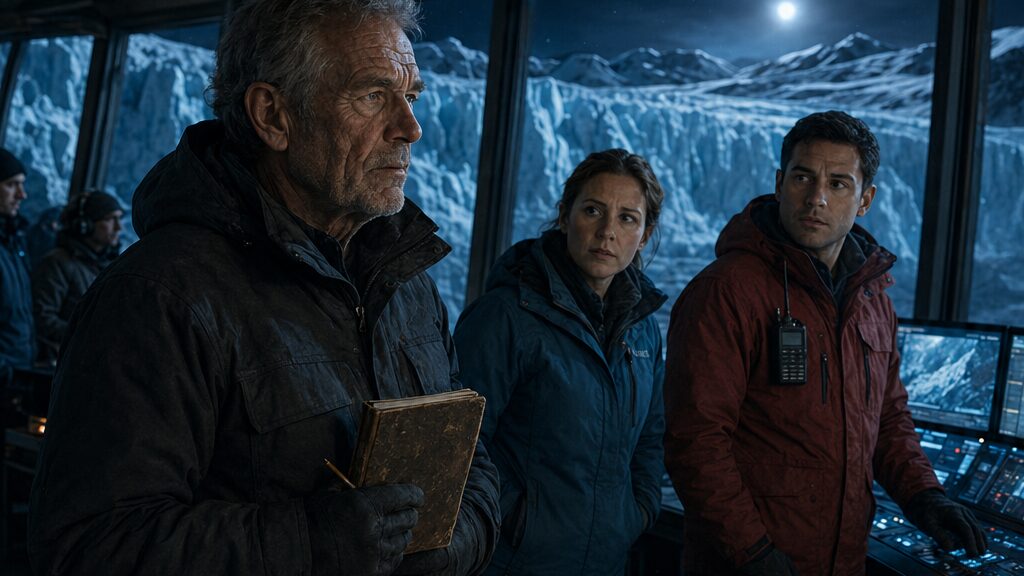
He stopped halfway through writing a note in his weathered notebook and lifted his head toward the darkness beyond the window.
Crack.
Not loud.
Not dramatic.
A thin, sharp report carried through miles of frozen air.
The station generator hummed beneath the floor. Wind pushed against the metal walls. Somewhere down the hallway, a door slammed.
But the crack lingered in John’s ears.
He closed the notebook.
Listened.
Nothing.
A younger man might have dismissed it.
John had spent years learning not to dismiss things.
The glacier spread beyond the station like a frozen ocean trapped in motion. Under moonlight, the immense wall of ice looked almost alive.
He stood slowly, feeling the familiar ache in his knees.
Seventy-two years old.
His body reminded him of that every morning.
And every night.
He pulled on his heavy coat and stepped outside.
The cold struck immediately.
The sky was clear. Stars burned above the mountains.
For a moment, everything appeared perfectly still.
That bothered him.
Glaciers were never still.
Not really.
The station sat less than a mile from the face of the ice wall. Researchers monitored movement, temperature shifts, and seasonal changes.
Computers watched constantly.
Sensors watched constantly.
People trusted them.
John trusted his ears.
He moved toward the observation platform.
Snow crunched beneath his boots.
The glacier loomed ahead, pale under moonlight.
Then he heard it again.
Crack.
His eyes narrowed.
Not random.
Not distant.
Rhythmic.
He pulled out the notebook.
11:49.
Recorded the time.
Waited.
The wind shifted.
Thirty-four seconds later—
Crack.
He wrote again.
A memory surfaced.
Mountain training in Alaska decades earlier.
Listening to snowpacks settle.
Learning which sounds meant safety and which meant danger.
Back then he had been strong enough to carry another man down a mountain.
Now climbing a flight of stairs sometimes irritated his hip.
But the sounds were the same.
The glacier was speaking.
He stayed another ten minutes.
Each crack separated by roughly the same interval.
His stomach tightened.
That was wrong.
Very wrong.
A voice called behind him.
“John?”
He turned.
Melissa Carter approached from the station carrying a flashlight.
“You okay out here?”
“I’m listening.”
She smiled politely.
Most people smiled that way when they didn’t understand what he meant.
“To what?”
“The glacier.”
Melissa glanced toward the ice.
“Anything interesting?”
John opened the notebook.
Showed her the times.
She looked.
Looked again.
“What does it mean?”
“I don’t know yet.”
It wasn’t the answer she expected.
People wanted certainty.
John preferred honesty.
Melissa handed back the notebook.
“The instruments haven’t shown anything unusual.”
“I know.”
“Maybe temperature settling.”
“Maybe.”
But neither of them sounded convinced.
Melissa studied his face.
“You’re worried.”
John looked back toward the glacier.
“Enough to keep listening.”
For several seconds neither spoke.
Then her radio crackled.
Someone needed her inside.
She gave a small wave and disappeared into the station.
John remained.
The next crack came twenty-nine seconds later.
Then another.
And another.
By midnight he had nearly two pages of timestamps.
The pattern reminded him of something he couldn’t quite place.
Not an avalanche.
Not surface settling.
Something older.
Something worse.
He finally returned inside.
The operations room glowed with monitors.
Several station workers watched weather feeds.
A television in the corner displayed local news.
Nobody looked alarmed.
Nobody looked worried.
Alexander Rivera stood near the main console.
At thirty-two, he carried himself with the confidence of someone accustomed to making decisions.
He was good at his job.
John respected that.
Sometimes confidence became its own blindfold.
Alexander noticed him.
“Couldn’t sleep?”
John held up the notebook.
“I’ve been hearing fracture patterns.”
Alexander smiled.
“Out there?”
“Yes.”
“Anything on the monitors?”
“No.”
Alexander gestured toward a wall of screens.
“Everything’s stable.”
John walked closer.
Movement indicators.
Temperature maps.
Pressure readings.
All normal.
At least on paper.
“The sounds aren’t normal,” John said.
Alexander leaned back.
“John, glaciers make noise.”
“Not like this.”
A few workers glanced over.
Alexander kept his voice friendly.
“How long have you been listening?”
“About an hour.”
“And the instruments haven’t picked up anything.”
“No.”
“Then maybe we’re dealing with an unusual acoustic effect.”
John knew the conversation was ending.
Not because Alexander was rude.
Because Alexander believed he already had the answer.
The station trusted data.
John trusted patterns.
Sometimes those things aligned.
Sometimes they didn’t.
He closed the notebook.
“I’m just telling you what I heard.”
Alexander nodded.
“And I appreciate it.”
The phrase sounded sincere.
And final.
John walked away.
Near the door, Amy Jones intercepted him.
The station medic carried a mug of coffee.
“You look frozen.”
“I’ve survived worse.”
“That doesn’t answer the question.”
He smiled faintly.
Amy was one of the few people who spoke to him without treating him like fragile furniture.
She handed him the coffee.
“Drink.”
He obeyed.
The warmth helped.
“What were you arguing about?” she asked.
“No argument.”
“Discussion, then.”
“I heard something.”
Amy looked toward Alexander.
“And he didn’t.”
“Something like that.”
She sighed.
“Happens a lot around here.”
John didn’t answer.
Because she was right.
Age made people patient.
It also made them invisible.
The radio on the operations desk suddenly burst to life.
Urgent voices.
Everyone turned.
A field worker was speaking rapidly.
Static swallowed half the message.
Then a clear sentence emerged.
“…can’t find Larry’s position.”
Silence filled the room.
Alexander stepped forward.
“Repeat that.”
More static.
The transmission returned.
A worker conducting a late inspection route had disappeared beyond the northern ice wall.
Last contact approximately fifteen minutes earlier.
No response since.
The room shifted instantly from routine to crisis.
Monitors changed.
Maps appeared.
People moved.
Alexander began issuing instructions.
Search teams.
Communication checks.
Vehicle preparation.
John stood motionless.
Beyond the northern ice wall.
Exactly where the sounds had come from.
His fingers tightened around the notebook.
Outside, somewhere in the darkness, the glacier released another faint crack.
This time no one else heard it.
Chapter 2: What The Sensors Failed To Notice
The operations center became louder with every passing minute.
Radios chattered.
Maps flickered across screens.
A weather report rolled continuously along one monitor.
The missing worker had not answered any call.
No emergency beacon.
No movement signal.
Nothing.
Alexander stood at the center of it all.
John watched quietly from the back of the room.
Experience had taught him something years ago.
In emergencies, people often became less observant.
Not because they were careless.
Because urgency narrowed vision.
Everyone focused on solving the visible problem.
The hidden problem waited patiently.
Melissa sat at a workstation reviewing terrain data.
John approached.
“What do we know?”
She enlarged a map.
“Last confirmed location here.”
A blinking marker appeared near the northern face.
Close to a steep section of glacier wall.
John studied it.
The same area.
The cracks again echoed faintly in his memory.
Not the sound itself.
The spacing.
The rhythm.
Something about it refused to leave him alone.
Melissa noticed his expression.
“You still thinking about those fracture sounds?”
“Yes.”
She hesitated.
“Show me the notebook.”
John handed it over.
The pages were worn and stained from years of use.
Melissa scanned the timestamps.
Her eyes narrowed.
Then she checked something on her computer.
Then looked back at the notebook.
Again.
“What?”
“I’m not sure.”
John waited.
She continued comparing numbers.
“The intervals aren’t random.”
“I know.”
“No, I mean mathematically.”
She pointed at several entries.
“The timing is tightening.”
John leaned closer.
The pattern suddenly became obvious.
The cracks were occurring slightly faster.
Not enough for most people to notice.
Enough for him to hear.
Enough for Melissa to calculate.
“What causes that?” she asked.
John looked toward the glacier.
“Pressure.”
Before she could respond, Alexander approached.
“Search team leaves in ten minutes.”
Melissa turned.
“I think we should talk about something.”
Alexander glanced between them.
“What?”
She held up the notebook.
John almost wished she hadn’t.
Alexander accepted it politely.
Looked at the pages.
Returned it.
“Okay.”
Melissa blinked.
“That’s it?”
“It’s handwritten observations.”
“They match acceleration patterns.”
“Without instrument confirmation.”
The room fell quiet around them.
Alexander rubbed his forehead.
“I understand why you’re concerned.”
John had heard those words before.
Usually right before someone ignored the concern.
“The missing worker is our priority.”
John spoke carefully.
“They may be connected.”
Alexander’s expression remained calm.
“Based on what?”
“The location.”
“The sounds.”
“The timing.”
Alexander looked at him.
Not dismissively.
Not cruelly.
Just unconvinced.
And that somehow felt worse.
“We have live monitoring systems,” Alexander said.
“If there was major instability, we’d know.”
John nodded slowly.
“You might.”
The younger man sighed.
“John.”
“Alexander.”
For a moment neither moved.
Then Alexander checked his watch.
“We’re moving forward.”
And just like that, the decision was made.
Not through arrogance.
Through certainty.
The most dangerous kind.
John slipped the notebook back into his pocket.
The conversation was over.
Melissa looked frustrated.
John wasn’t.
Being ignored wasn’t new.
He simply wished the glacier cared about confidence as much as people did.
An hour later he stood outside again.
The search convoy’s lights moved across the frozen darkness.
Small points of brightness against endless ice.
The wind had strengthened.
Crack.
John checked his watch.
Wrote the time.
Thirty-one seconds.
Crack.
Another note.
Melissa emerged from the station.
“You still doing that?”
“Yes.”
She stood beside him.
Together they listened.
The next crack arrived.
Her face changed.
“You hear it now?”
“I do.”
They waited.
The next one came sooner.
Not much sooner.
Enough.
Melissa looked back toward the station.
“I need to compare this with older records.”
John nodded.
“That’s what it reminds me of.”
“What?”
For several seconds he searched his memory.
Then found it.
“A glacier collapse I studied after the Army sent us north.”
Melissa stared.
“Collapse?”
“Small at first.”
“How small?”
“Small enough everyone ignored it.”
Neither spoke.
The cold seemed sharper now.
Melissa hurried back inside.
John remained alone.
The ice wall shimmered under moonlight.
Beautiful.
Dangerous.
Patient.
Half an hour later Melissa ran back out.
Actually ran.
Her breath fogged heavily.
“I found it.”
John turned.
“What?”
“Historical records.”
She held a tablet.
“The crack intervals.”
Her voice shook slightly.
“They match a documented instability sequence from twenty-six years ago.”
John felt his stomach drop.
“How close?”
“Too close.”
The words hung in the frozen air.
For the first time that night, neither of them looked toward the station.
They looked toward the glacier.
A deep groan rolled across the ice.
Not loud.
Not yet.
But unmistakable.
The sound of something moving.
Far away.
Hidden.
Alive.
Melissa’s face had gone pale.
“We need Alexander.”
“Yes.”
They hurried inside.
But before they reached the operations room, alarms suddenly sounded across multiple screens.
A technician pointed toward the monitoring display.
Several workers gathered around.
A section of the northern ice wall had shifted.
Only a few inches.
Barely visible.
But enough for the sensors to finally notice.
The room fell silent.
And for the first time all night, the glacier had evidence.
Chapter 3: The Injury On The Frozen Slope
The silence lasted less than five seconds.
Then the room exploded into motion.
Questions.
Orders.
Data requests.
Radio traffic.
Everyone stared at the screens showing the newly detected movement.
Only a few inches.
Yet the change altered everything.
Alexander stepped toward the display.
“How long ago?”
“Within the last twenty minutes.”
“Confidence level?”
“Ninety-six percent.”
Melissa exchanged a glance with John.
The glacier had been warning them for hours.
The instruments had simply arrived late to the conversation.
Alexander noticed the look.
For the first time that night, uncertainty crossed his face.
Not guilt.
Not embarrassment.
Concern.
John respected that.
Concern meant a person was still thinking.
A radio transmission interrupted the room.
A search team reported deteriorating conditions near the northern face.
Visibility decreasing.
Surface cracking increasing.
Still no sign of the missing worker.
Alexander immediately ordered them to maintain position until updated risk assessments were completed.
The team reluctantly agreed.
John listened carefully.
One detail bothered him.
The reported cracking zone extended farther south than expected.
Farther than the sensors indicated.
Farther than the official maps suggested.
Farther than anyone seemed to realize.
He pulled out the notebook again.
Compared the timestamps.
Compared the map.
Then looked toward the door.
“I’m going out.”
Melissa frowned.
“What?”
“I need to check something.”
“You absolutely do not.”
Amy appeared from nowhere.
As medics often did.
“You’ve been awake half the night.”
John zipped his coat.
“And?”
“And you’re seventy-two.”
“There it is.”
Amy rolled her eyes.
“That’s not what I meant.”
“It’s usually what people mean.”
Her expression softened.
“John.”
He regretted the sharpness immediately.
Amy wasn’t the problem.
She cared.
That was different.
“I’m sorry,” he said.
She sighed.
“So am I. Stay alive, okay?”
He offered a small nod.
Then headed outside.
The cold struck harder than before.
Wind drove loose snow across the glacier surface.
His flashlight beam bounced across uneven ice.
The station lights faded behind him.
Ahead stood the enormous frozen wall.
The sounds were easier to hear now.
Crack.
Pause.
Crack.
Like a giant heartbeat.
He followed the edge of a marked safety route.
Years of mountain training guided every step.
Even now.
Especially now.
Age had slowed him.
Not erased him.
He stopped several times to listen.
To observe.
To compare sound and terrain.
Gradually a picture emerged.
The instability wasn’t centered where everyone thought.
It was migrating.
Spreading.
A dangerous pocket of stress was forming beneath a higher ridge.
Exactly above the route rescue teams planned to use.
John stared upward.
The realization settled heavily inside him.
If a team climbed there tomorrow…
The glacier might choose that moment to move.
His radio crackled.
Alexander’s voice.
“John, where are you?”
John answered.
“North approach.”
A pause.
Then frustration.
“Why?”
“Because your route is wrong.”
The silence afterward lasted longer.
“Come back.”
“Not yet.”
“We have professionals handling this.”
John almost laughed.
Professionals.
As though experience expired with retirement papers.
“I’m trying to keep them alive.”
Alexander’s voice softened.
“Then come back and help us do that.”
For a moment John considered it.
Then a sharp sound cut through the night.
Not a crack.
A snap.
The ice beneath his boot shifted.
Instinct reacted before thought.
He jumped sideways.
Too late.
The surface collapsed beneath one leg.
Pain exploded through his knee as he slammed against frozen ground.
The radio flew from his hand.
Snow filled his jacket.
For several seconds he couldn’t breathe.
The world narrowed into pain.
Old pain.
New pain.
The terrible awareness that his body no longer recovered like it once had.
John rolled onto his back.
Looked up at the stars.
Breathing hard.
The glacier groaned above him.
Unmoved by human suffering.
Eventually he pushed himself upright.
His knee protested violently.
Nothing broken.
Probably.
But damaged.
Definitely.
The radio lay several feet away.
He crawled toward it.
Retrieved it.
Alexander was calling his name.
Repeatedly.
John answered.
Static.
Then silence.
He adjusted the antenna.
Nothing.
The signal had died.
He looked toward the station.
Farther away than it should have been.
Then toward the glacier.
Closer than it should have been.
Another crack echoed across the frozen darkness.
Louder now.
Closer.
The notebook remained safely inside his coat.
John opened it.
Wrote one more timestamp.
His handwriting shook slightly from pain.
Then he listened.
Counted.
Waited.
The interval shortened again.
Not much.
Enough.
A terrible certainty settled inside him.
The glacier was accelerating.
And nobody fully understood how fast.
The wind howled across the ice.
Somewhere beyond the wall, a radio transmission suddenly burst through the darkness.
Not his.
Another one.
Faint.
Broken.
Desperate.
Then gone.
John froze.
A worker.
Alive.
Somewhere beyond the ice wall.
He grabbed his radio.
Pressed the transmit button.
“Repeat your position.”
Only static answered.
Then complete silence.
The connection had vanished.
And with it, the only clue they had heard all night.
Chapter 4: The Wall Of Ice Above Them
By the time John reached the station, dawn was still a rumor hiding behind the mountains.
Amy met him at the entrance.
The moment she saw his limp, her expression hardened.
“What happened?”
“Bad footing.”
“Sit down.”
“Amy—”
“Sit.”
He obeyed.
Not because she ordered him.
Because standing suddenly seemed unnecessary.
She examined his knee while he watched snow gather against the windows.
The swelling had already started.
“You should be resting.”
“I know.”
“You aren’t going to.”
“No.”
She wrapped the joint tightly.
Neither pretended the bandage solved anything.
The pain remained.
Just organized.
The operations room beyond the medical area sounded tense.
John could hear raised voices.
Keyboards.
Radios.
Movement.
The crisis had finally become real enough for everyone.
Amy finished.
“You’re lucky.”
“I’ve never liked that word.”
“Why?”
“Usually people say it after something bad happens.”
A reluctant smile crossed her face.
Then it vanished.
“You heard somebody on the radio?”
John nodded.
“Briefly.”
“Do you think it was the missing worker?”
“Yes.”
Amy looked toward the operations room.
“Tell Alexander.”
John stood carefully.
“I intend to.”
When he entered, every screen displayed some version of the same problem.
Maps.
Satellite images.
Pressure models.
Forecasts.
Alexander stood beside Melissa reviewing a proposed rescue route.
John approached quietly.
Melissa noticed him first.
“You look terrible.”
“Thank you.”
She ignored the joke.
Alexander turned.
His eyes dropped immediately to the bandaged knee.
“What happened?”
“The glacier disagreed with me.”
Alexander exhaled slowly.
“You went out there alone.”
“Yes.”
“Why?”
John pointed toward the map.
“Because that route is wrong.”
The room became still.
Alexander folded his arms.
“Show me.”
John moved closer.
The route followed a lower access corridor toward the northern face.
Safe according to current models.
Unsafe according to what John had heard.
He pointed toward a ridge above the planned path.
“Stress is building here.”
Melissa frowned.
“The sensors show movement farther east.”
“The sensors noticed movement after it started.”
Alexander’s jaw tightened.
“And you’re certain?”
“No.”
The answer surprised him.
John continued.
“I’m certain enough to worry.”
The room remained silent.
That was the difference experience sometimes made.
The older he became, the less interested he was in pretending certainty.
Melissa zoomed the map.
Compared elevations.
Historical fracture zones.
Recent movement.
Something shifted in her expression.
“What?”
Alexander asked.
She hesitated.
“The pattern is possible.”
“Possible isn’t enough.”
“No,” Melissa said quietly. “But it’s not impossible either.”
Alexander looked from her to John.
Then back again.
Responsibility sat heavily on his shoulders.
John understood that.
Leadership rarely felt as confident as it appeared.
A rescue volunteer hurried across the room.
“We’ve got another transmission.”
Everyone turned.
Static filled the speakers.
Then a strained voice.
Weak.
Broken.
“…shelter…”
The signal faded.
Returned.
“…upper ice…”
Then vanished completely.
Melissa immediately marked the likely source location.
The room gathered around the map.
The marker appeared far above the planned rescue route.
John stared at it.
His stomach sank.
The worker wasn’t below the unstable ridge.
He was above it.
Alexander saw the same thing.
“Damn.”
The only word anyone spoke.
If the estimate was correct, reaching the worker required crossing terrain no team had prepared for.
The room suddenly felt smaller.
The glacier had changed the rules.
Again.
An hour passed.
Outside, darkness slowly surrendered to a pale blue dawn.
Inside, arguments multiplied.
Different routes.
Different risk assessments.
Different probabilities.
John listened.
The same problem appeared in every proposal.
They all assumed the ridge would remain stable.
He opened his notebook.
Compared old entries.
Then added the newest crack intervals.
The spacing had shortened again.
Melissa looked over his shoulder.
“Still getting faster?”
“Yes.”
Her face tightened.
“You know what bothers me?”
“What?”
“The instruments are finally seeing movement.”
John nodded.
“But not enough.”
“Exactly.”
For a while neither spoke.
The notebook lay open between them.
Pages filled with timestamps.
Nothing dramatic.
Just observations.
The kind most people ignored.
Melissa touched one of the entries.
“You’ve been doing this all night.”
“I’ve been listening all night.”
Alexander approached.
He looked exhausted.
Older than he had a few hours earlier.
Decision-making often did that.
“The helicopter can’t get close enough,” he said.
“The weather’s turning.”
Melissa swore under her breath.
“The ground team?”
“Too slow.”
Silence followed.
Everyone understood what that meant.
The trapped worker might not survive another full day.
John looked at the map.
Then at the ice wall visible through the window.
A massive frozen cliff reaching upward into drifting clouds.
The image triggered an old memory.
Not a battlefield.
A mountain rescue.
A young soldier trapped above a collapsed route.
The details had faded.
One thing hadn’t.
Waiting had nearly killed him.
John closed the notebook.
The sound echoed softly.
Alexander looked up.
“What?”
John met his eyes.
For the first time that night, the younger man didn’t look away immediately.
“The route you’re planning won’t get there in time.”
Alexander didn’t argue.
That alone felt different.
“Then what do you suggest?”
John pointed toward the ice wall.
The direct ascent.
The most difficult path.
The path no one wanted.
“The face.”
Melissa stared.
“You’re serious.”
“Yes.”
Alexander shook his head.
“That’s not a rescue route.”
“No.”
John looked through the window again.
“It isn’t.”
The ice wall gleamed beneath the growing morning light.
Dangerous.
Steep.
Possible.
His knee throbbed.
His back hurt.
His hands weren’t as steady as they used to be.
None of that changed what he knew.
The worker was up there.
The glacier was changing.
Time was disappearing.
John picked up his notebook.
“I’m climbing.”
Nobody spoke.
For a moment the only sound was the distant cracking of ice.
Chapter 5: The Climb Nobody Wanted Him To Make
The objections began immediately.
Amy objected first.
Melissa second.
Gregory, reached by radio from a nearby support camp, objected with language that made several people glance away awkwardly.
Alexander waited until everyone finished.
Then he looked directly at John.
“No.”
John had expected that.
He sat quietly while Amy rechecked the bandage around his knee.
Outside, dawn painted the glacier silver.
Inside, tension stretched through the room like a rope pulled too tight.
Alexander stepped closer.
“You’re injured.”
“Yes.”
“You’re seventy-two.”
“There it is again.”
“This isn’t about age.”
John raised an eyebrow.
Alexander paused.
Then sighed.
“Not entirely.”
The honesty surprised both of them.
John appreciated it.
“I know what you think.”
“What?”
“That I want to prove something.”
Alexander didn’t answer.
Which was answer enough.
John looked toward the window.
The ice wall dominated the horizon.
Beautiful from a distance.
Brutal up close.
“I don’t need to prove anything.”
“Then why do this?”
Because nobody else sees it.
The thought came immediately.
But John didn’t say it.
Instead he opened the notebook.
Turned several pages.
Pointed to the entries.
“The glacier is speeding up.”
Alexander remained silent.
“The worker is above the unstable section.”
Still silent.
“The weather is closing.”
Silence again.
Finally Alexander spoke.
“If you fall, we lose two people instead of one.”
A fair point.
John respected fair points.
The room grew quiet.
Even Amy stopped arguing.
Because the question mattered.
For several moments John simply stared at the notebook.
The worn pages.
The faded cover.
The years trapped inside it.
Then another memory surfaced.
Not from military service.
From afterward.
A rescue he hadn’t made in time.
A man who died because everyone waited for perfect certainty.
John had carried that memory for decades.
Not dramatically.
Quietly.
The way people carried old injuries.
“I can make the climb,” he said.
Gregory’s voice crackled from the radio.
“You’re stubborn.”
“True.”
“You always were.”
“Also true.”
A few tired smiles appeared.
Then disappeared.
Alexander rubbed his eyes.
“What if you’re wrong?”
John looked toward the glacier.
“What if I’m right?”
No one answered.
Because no one could.
An hour later the preparations began.
Not because everyone agreed.
Because nobody had found a better option.
Melissa checked route maps repeatedly.
Amy packed medical supplies.
Alexander reviewed weather forecasts.
John inspected climbing gear.
His movements were slower than they once had been.
He hated that.
Accepted it.
Both things could be true.
When everything was ready, Amy stopped him near the exit.
“You know this is a terrible idea.”
“Yes.”
“You could let younger people do it.”
“I know.”
Her eyes glistened slightly.
Not with fear.
With frustration.
Because she understood exactly why he couldn’t.
Amy handed him a fresh radio battery.
“Then come back.”
John nodded once.
No promises.
Just acknowledgment.
Outside, cold air filled his lungs.
The glacier waited.
Massive.
Silent.
Except it wasn’t silent.
Crack.
He checked his watch automatically.
The habit felt almost comforting now.
The intervals continued shrinking.
Not fast enough to frighten most people.
Fast enough to frighten him.
The climb began gradually.
Snow.
Ice shelves.
Short rises.
The wall looked manageable from below.
It always did.
Halfway up, reality emerged.
The angle steepened.
Wind intensified.
His injured knee complained with every movement.
Several times he stopped.
Not because he wanted to.
Because he had to.
Age demanded negotiations younger bodies never required.
Above him stretched hundreds of feet of ice.
Below him the station had become tiny.
A cluster of lights against endless white.
The radio crackled.
Melissa.
“How’s the route?”
“Steeper than advertised.”
A brief laugh answered.
Then seriousness returned.
“We’ve narrowed the worker’s location.”
John listened carefully.
Coordinates followed.
Higher.
Of course.
Everything important seemed higher lately.
He continued climbing.
The glacier groaned beneath him.
The sound traveled through the ice itself.
A deep vibration.
Ancient.
Unsettling.
John stopped.
Pressed one gloved hand against the frozen wall.
Listened.
Felt.
Crack.
Not from above.
Not below.
Inside.
The glacier wasn’t merely shifting.
It was reorganizing.
The realization chilled him more than the wind.
Hours of pressure building.
Searching for release.
He resumed climbing.
Slowly.
Methodically.
Every movement deliberate.
The way he had taught soldiers decades earlier.
Not speed.
Consistency.
The sky brightened further.
Clouds gathered.
Visibility worsened.
Then he saw something.
A torn piece of bright emergency fabric snagged against ice.
John climbed closer.
Examined it.
Fresh.
Very fresh.
His pulse quickened.
The worker had been here.
Recently.
For the first time all day, hope outweighed uncertainty.
He radioed the station.
Alexander answered.
John reported the discovery.
Silence followed.
Then Alexander said quietly:
“Good work.”
Nothing more.
Nothing dramatic.
Yet the words felt different.
Because they contained something missing before.
Belief.
John continued upward.
The wind intensified.
Snow swirled.
Somewhere above, hidden by drifting clouds, the trapped worker waited.
Then a sound rolled across the glacier.
Louder than any before.
Not a crack.
A fracture.
Deep.
Violent.
Enormous.
The entire ice wall seemed to shudder beneath John’s hands.
And for the first time since the climb began, genuine fear settled into his chest.
Chapter 6: When The Glacier Finally Moved
The vibration traveled through the ice like a living thing.
John froze against the wall.
One gloved hand clung to a rope line.
The other pressed flat against the glacier.
The fracture continued beneath him.
A deep grinding roar.
Then silence.
Not true silence.
The kind that comes after a warning.
His breathing sounded loud inside his hood.
The radio erupted almost immediately.
“John!”
Melissa’s voice.
Sharp.
Urgent.
“We saw movement on the ridge.”
“I felt it.”
“You need to get off that wall.”
John looked up.
Then down.
Neither direction offered a quick escape.
“I’m closer to the top than the bottom.”
A pause.
No argument followed.
Because Melissa knew he was right.
The clouds thickened.
Snow drifted across the ice face.
Visibility narrowed.
John resumed climbing.
Slowly.
Deliberately.
His knee burned.
Every step required concentration.
Every pull demanded more strength than it should have.
The glacier groaned again.
This time he counted instinctively.
One.
Two.
Three.
Crack.
His hand moved automatically.
Notebook.
Timestamp.
The gesture felt absurd halfway up an unstable glacier.
He did it anyway.
The familiar motion settled his thoughts.
The pattern had become part of him.
Observation before action.
Listen before deciding.
A lesson age had reinforced thousands of times.
The radio crackled.
Alexander.
“We’ve got thermal imaging.”
John stopped.
A small burst of static followed.
Then coordinates.
Close.
Very close.
The trapped worker was somewhere above a narrow ice shelf less than two hundred yards away.
Relief came first.
Then concern.
The location sat directly beyond the unstable zone John had been warning about all night.
Of course it did.
He pushed onward.
The climb steepened.
Wind shoved against him.
Several times his injured leg nearly failed.
Each time he stopped.
Adjusted.
Continued.
No heroics.
Only persistence.
The shelf appeared suddenly through blowing snow.
A narrow ledge cut into the glacier face.
Above it stood a fractured ice overhang.
Below it stretched empty air.
John hauled himself onto the shelf and rested briefly.
His chest rose and fell heavily.
The worker had to be nearby.
He studied the terrain.
Then saw movement.
A flash of orange fabric.
Fifty yards away.
Partially hidden by ice.
John’s pulse jumped.
He moved carefully across the shelf.
The worker looked conscious.
Barely.
Curled against the cold.
One leg trapped beneath fallen ice.
When the man noticed John approaching, disbelief crossed his face.
“You came.”
His voice sounded raw.
John knelt beside him.
“Looks that way.”
The worker laughed weakly.
Then winced.
John examined the injury.
Bad.
Not fatal yet.
Time mattered.
The glacier groaned again.
Louder.
The worker heard it too.
Fear entered his eyes.
“What’s that?”
John looked upward.
“The reason we’re leaving now.”
He radioed the station.
Melissa answered.
Then Alexander.
Relief washed through both voices.
John provided their location.
Described the injury.
Requested extraction options.
The response arrived quickly.
None were good.
The weather had deteriorated too much.
No helicopter.
No direct winch.
Ground teams remained hours away.
John listened quietly.
Then looked at the trapped worker.
The decision became obvious.
Not easy.
Just obvious.
“We move him.”
Alexander immediately objected.
The radio filled with reasons.
Risks.
Probabilities.
Warnings.
John let him finish.
Then he spoke.
“The glacier won’t wait.”
Silence answered.
Because everyone finally knew that was true.
Together, John and the worker began the slow movement toward safer terrain.
Pain shot through John’s knee.
The worker could barely assist.
Progress came yard by yard.
The glacier groaned continuously now.
Not separate cracks.
A constant low complaint.
Like immense pressure searching for release.
Halfway across the shelf, John stopped suddenly.
Something felt wrong.
He listened.
Not with his ears alone.
With memory.
With instinct.
With decades spent in dangerous places.
Then he understood.
The sounds had changed.
No longer accelerating.
Combining.
The final stage.
His hand moved to the notebook one last time.
He wrote a final entry.
Closed the cover.
Slipped it away.
Then grabbed the worker’s shoulder.
“We move now.”
The urgency in his voice eliminated all questions.
They pushed forward.
Ten yards.
Twenty.
Thirty.
The shelf trembled.
A deep roar erupted above them.
John looked up.
The ridge was moving.
Not collapsing completely.
Shifting.
Massive blocks of ice breaking free.
The glacier had finally chosen.
“Go!”
The worker stumbled.
John shoved him toward stable ground.
Hard.
Harder than his injured body wanted.
The worker fell clear.
John did not.
The shelf beneath him cracked.
For one terrifying second he felt empty space open below.
Then the safety rope snapped tight.
Pain exploded through his shoulder.
The world spun.
Ice thundered past.
White.
Noise.
Movement.
Then stillness.
Slowly, painfully, John realized he was alive.
The rope had held.
Above him.
Below him.
Around him.
The glacier settled.
The radio screamed with voices.
Melissa.
Amy.
Alexander.
All talking at once.
John closed his eyes briefly.
Exhaustion washed over him.
The worker was safe.
The collapse had happened exactly where he predicted.
And for the first time since this began, nobody questioned what he had heard.
Chapter 7: The One Person Who Finally Listened
Three days later, the glacier looked calm again.
John distrusted calm glaciers.
He sat beside a window in the recovery center overlooking the frozen valley. Morning sunlight reflected off distant ice fields and painted pale patterns across the floor.
His shoulder remained heavily bandaged.
His knee hurt every time he stood.
Amy considered both injuries proof that he should remain indoors.
John considered them evidence that he was still alive.
The argument continued daily.
A knock sounded at the door.
Before he could answer, Gregory stepped inside carrying two paper cups of coffee.
“You look terrible.”
John accepted the coffee.
“You already used that one.”
Gregory sat down.
“Still true.”
For a while neither spoke.
Old friendships often worked that way.
Silence never needed explanation.
Eventually Gregory glanced toward the window.
“The worker made it.”
“I heard.”
“Doctors think he’ll recover.”
John nodded.
Relief had arrived quietly.
Not with celebration.
Not with headlines.
Just a simple fact.
Someone who might have died was alive.
That was enough.
Gregory studied him.
“You know, normal people would be proud.”
“I’m tired.”
“That’s not the same thing.”
John looked down at the notebook resting on the table beside him.
The cover appeared even older than he remembered.
Years of weather.
Years of observations.
Years of writing down things nobody else thought important.
“Maybe,” John said.
Gregory followed his gaze.
“The notebook saved lives.”
“No.”
John gently touched the cover.
“Listening saved lives.”
Gregory smiled faintly.
“You always have to make things difficult.”
“It’s a gift.”
The door opened again.
Amy entered carrying a folder.
The moment she saw Gregory, she pointed toward the coffee.
“Did he already have one?”
“Probably.”
Amy sighed.
“You’re impossible.”
She handed John the folder.
Inside were medical notes and discharge paperwork.
“You can leave tomorrow.”
John looked surprised.
Amy noticed immediately.
“Don’t act like you enjoy being here.”
“I don’t.”
“Good.”
She sat briefly on the edge of the bed.
For several seconds she watched snow drift outside.
Then she spoke quietly.
“When they pulled you off that wall…”
John waited.
“I thought we were too late.”
He didn’t know how to answer.
Some emotions became larger when spoken aloud.
So he simply nodded.
Amy seemed satisfied with that.
She stood.
“Try not to climb any glaciers this week.”
“No promises.”
“That’s what worries me.”
After she left, Gregory laughed.
“She likes you.”
“She’s concerned.”
“Same thing.”
By afternoon the room had grown quiet again.
Gregory had returned to work.
Amy had disappeared into another shift.
The sunlight faded behind gathering clouds.
John opened the notebook.
The final entry remained near the back.
A timestamp.
Nothing dramatic.
Nothing emotional.
Just an observation recorded minutes before the collapse.
He stared at it for a long time.
Years ago, after the failed rescue that still haunted him, he had nearly stopped carrying notebooks altogether.
What was the point?
Observation couldn’t change everything.
Experience couldn’t prevent every tragedy.
Time always won eventually.
But then another rescue happened.
Then another.
Then another.
And he realized something.
The purpose was never certainty.
The purpose was paying attention.
A knock interrupted his thoughts.
He expected Amy.
Maybe Gregory.
Instead Alexander Rivera stepped inside.
For a moment neither man spoke.
Alexander looked uncomfortable.
Not because he wanted to be somewhere else.
Because he had clearly rehearsed this visit and forgotten the script halfway through.
John saved him.
“How’s the station?”
Alexander smiled slightly.
“Busy.”
“I figured.”
The younger man stepped farther into the room.
Snow clung to his boots.
Fatigue lingered beneath his eyes.
The last few days had not been easy on him either.
He noticed the notebook.
“Still carrying that thing.”
“Apparently.”
Alexander nodded.
Then fell silent again.
Finally he took a chair.
The movement alone told John this wasn’t a casual visit.
For several moments Alexander studied the window.
The mountains.
The glacier beyond.
The same glacier that had nearly killed them both.
“I reviewed everything,” he said.
John waited.
“The recordings.”
“The reports.”
“The sensor data.”
Still waiting.
“And your notes.”
A faint smile touched John’s face.
“My notes.”
Alexander looked down briefly.
“When you first warned us, the instruments showed nothing.”
“That’s true.”
“I kept telling myself that mattered.”
John said nothing.
The younger man exhaled slowly.
“I wasn’t ignoring you because I thought you were stupid.”
“I know.”
Alexander looked relieved.
“But I was ignoring you.”
The room became quiet.
Outside, snow drifted across the valley.
Inside, something smaller and more important settled into place.
Not guilt.
Understanding.
“There are reasons people trust data,” John said.
“I know.”
“There are reasons they should.”
Alexander nodded.
“Melissa says the sensors eventually confirmed everything.”
“They did.”
“But not soon enough.”
“No.”
The answer hung between them.
Simple.
Honest.
Complete.
Alexander leaned forward slightly.
“When you were on that wall…”
He stopped.
Started again.
“When you told me the glacier wouldn’t wait.”
John remembered.
The wind.
The ice.
The fear hidden beneath responsibility.
“I finally realized you weren’t arguing with me.”
“No.”
“You were trying to protect people.”
John smiled faintly.
“That was the idea.”
Alexander laughed quietly.
The tension eased.
Not entirely.
Enough.
For a while they talked about practical things.
Repairs.
New monitoring procedures.
Additional safety reviews.
Then Alexander surprised him.
“We’re creating a training program.”
John raised an eyebrow.
“For the station?”
“Yes.”
Alexander looked toward the notebook.
“We want observation logs included.”
John stared.
Not because the idea was dramatic.
Because it wasn’t.
No ceremony.
No award.
No speech.
Just a change.
A useful one.
The kind that might matter years later when someone else heard something unusual and decided to pay attention.
“Good,” John said.
Alexander nodded.
Then he stood.
The conversation seemed finished.
At the door he stopped.
Turned back.
“Would you help us?”
John frowned.
“Help you?”
“Teach.”
The word settled gently into the room.
Not a request for heroics.
Not proof.
Not recognition.
Just trust.
For a moment John looked toward the notebook again.
The worn cover.
The years inside it.
The mistakes.
The lessons.
The observations.
Then he looked at Alexander.
The younger man no longer seemed defensive.
Or dismissive.
Just willing to listen.
And somehow that mattered more than being proven right.
“I could do that,” John said.
Alexander smiled.
A real one this time.
“Good.”
Then he left.
The room grew quiet again.
Outside, the glacier stretched across the horizon.
Ancient.
Unpredictable.
Beautiful.
John picked up the notebook and turned it over in his hands.
After a moment he opened the door and walked slowly down the hallway.
Melissa was working in a small conference room reviewing reports.
She looked up as he entered.
“You should be resting.”
“So I’ve been told.”
He placed the notebook on the table.
Melissa stared.
“What are you doing?”
“You’ll need it.”
Her eyes widened.
“No.”
“Yes.”
“John—”
“You already listen.”
The words stopped her.
For a long moment neither moved.
Then Melissa carefully picked up the notebook.
Not like a trophy.
Like a responsibility.
John nodded once.
Satisfied.
When he stepped back outside, evening light touched the distant glacier.
The wind carried across the frozen valley.
For a second he thought he heard a faint crack somewhere far away.
Maybe he did.
Maybe he imagined it.
Either way, he paused to listen.
Then continued walking.
Not because he had nothing left to teach.
Because he finally knew someone else was listening too.
The story has ended.