The Hospital Administrator Dismissed An Old Man In A Worn Coat Until His Name Appeared On The Wall They Walked Past Every Day
Chapter 1: The Blood On Rachel’s Admission Form
The blood hit the floor before anyone noticed the old man.
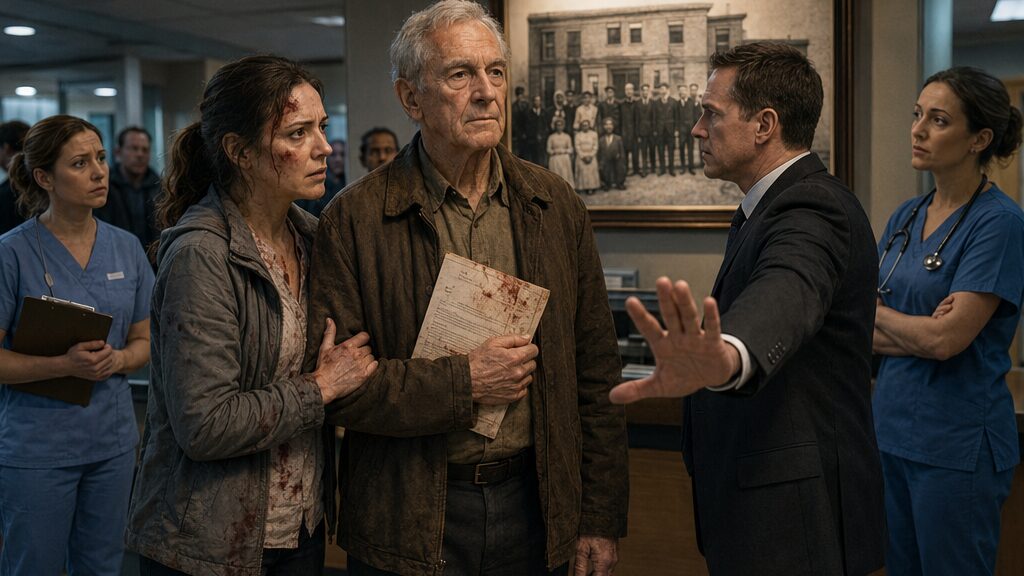
A red drop slid from the corner of the admission form in Rachel Williams’s trembling hand and splashed onto the polished tile beneath the emergency room intake desk.
People were already staring.
Some looked at the blood.
Others looked at Rachel.
The rest looked at the elderly man beside her.
Matthew King stood quietly in a worn brown coat that had seen too many winters. His gray hair was damp from the cold rain outside. One hand rested gently against Rachel’s shoulder while the other gripped a folded umbrella.
Rachel swayed.
“Sir, she needs to sit down,” the intake clerk said.
“I know,” Matthew replied calmly.
His voice carried no urgency despite the situation. That seemed to irritate the clerk more than panic would have.
The emergency department was overflowing.
Paramedics pushed stretchers through automatic doors.
A child cried somewhere down the corridor.
Monitors beeped.
Families argued.
Nurses hurried between rooms.
Everything moved at full speed except Matthew.
Rachel pressed a bloodstained hand against her forehead.
The cut above her eyebrow had reopened during the drive.
“Grandpa…”
“I’m here.”
His answer came instantly.
Always instantly.
The clerk reached for the paperwork.
“What happened?”
Rachel hesitated.
“A fall.”
Matthew glanced at her.
He knew it wasn’t a fall.
But now wasn’t the time.
The clerk barely looked up.
Insurance.
Address.
Emergency contact.
Standard questions.
Then Rachel winced as blood dripped onto the page.
The clerk sighed dramatically.
“We need a clean form.”
A nurse nearby grabbed fresh paperwork.
Rachel looked close to collapsing.
Matthew gently took the stained pages.
“It’s fine,” he said. “Use this one.”
The nurse accepted it.
As she turned, the bottom corner slipped from her fingers.
The form drifted downward.
It landed beside a large framed photograph hanging near the intake counter.
The nurse bent to retrieve it.
Her eyes paused.
The photograph showed a group of officials standing outside the hospital decades earlier.
Black-and-white.
Faded.
Important-looking people.
The nurse looked from the picture to Matthew.
Then back again.
Something about the old man’s face felt familiar.
Before she could think further, someone called her name.
She hurried away.
Rachel’s knees buckled.
Matthew caught her.
Several people finally noticed the amount of blood on her jacket.
A nurse appeared.
“Bring her back.”
Relief flickered across Rachel’s face.
Then another voice interrupted.
“One person only.”
A man in a navy suit approached from the hallway.
Hospital identification hung from his neck.
Kevin Martin.
Operations Administrator.
The badge seemed to arrive before the man did.
Kevin looked exhausted.
Busy.
Impatient.
The expression of someone carrying ten problems and seeing an eleventh.
He glanced at Rachel.
Then at Matthew.
His gaze lingered on the old coat.
The worn shoes.
The umbrella.
The slow posture.
Assessment complete.
“Family member?”
Kevin asked.
“Her grandfather.”
“We need room for staff.”
Matthew nodded.
“I’ll stay nearby.”
Kevin pointed toward the waiting area.
“Then wait there.”
Rachel immediately shook her head.
“No.”
Her voice cracked.
“I want him with me.”
Kevin’s patience thinned.
“Miss, we’ll take care of you.”
Matthew squeezed her shoulder.
“It’s alright.”
“It isn’t.”
Her eyes widened.
For a moment she looked less afraid of her injury than of being separated from him.
Kevin noticed.
Misread it completely.
“She’s upset,” he said. “That’s normal.”
Matthew could have argued.
Instead he helped Rachel onto the wheelchair.
A nurse started pushing her away.
Rachel looked back repeatedly.
Matthew remained where he was.
Still.
Steady.
Like a tree refusing to move during a storm.
The wheelchair disappeared through double doors.
Only then did he sit down.
The waiting room television played muted news.
Nobody paid attention.
Matthew folded his hands.
Waited.
Five minutes.
Ten.
Twenty.
People came and went.
Nobody spoke to him.
At one point Kevin passed again.
The administrator glanced toward him.
Then looked away.
A forgotten old man in a crowded room.
Nothing more.
Matthew had experienced worse waiting rooms.
He had waited for reports from distant battlefields.
Waited through storms.
Through evacuations.
Through funerals.
Hospitals had their own kind of silence.
The dangerous kind.
A nurse approached.
“The doctor wants some information about your granddaughter.”
Matthew stood.
Before he could follow her, Kevin stepped between them.
“We already have staff handling this.”
The nurse blinked.
“He just needs to answer a few questions.”
Kevin frowned.
“We’re trying to keep unnecessary people out of treatment areas.”
The nurse looked uncertain.
Matthew smiled politely.
“It’s alright.”
The nurse hesitated.
Then left.
Kevin exhaled.
Satisfied.
Problem solved.
At least in his mind.
“What room is she in?” Matthew asked.
Kevin barely slowed.
“Staff will update you.”
Then he walked away.
Matthew watched him disappear.
Not angry.
Not offended.
Just disappointed.
Across the room, a little girl stared at him.
He smiled.
She smiled back.
Her mother quickly pulled her closer.
The old man sitting alone must have looked lonely.
An hour passed.
Rain tapped against the windows.
Finally, a doctor emerged.
Carolyn Allen.
She checked a chart.
“Rachel Williams?”
Matthew rose.
“That’s my granddaughter.”
Carolyn looked relieved to find someone.
“She’s stable.”
The tension inside his chest loosened slightly.
“What happened?”
Matthew asked.
Carolyn glanced toward the hallway.
“She won’t tell us much.”
That worried him more than the injury.
Rachel wasn’t secretive by nature.
Something had frightened her.
Carolyn studied him.
“You were the one who brought her?”
“Yes.”
“You’re her grandfather?”
“That’s right.”
Something about his face made her pause.
Not recognition.
Not yet.
Just curiosity.
Before she could continue, Kevin appeared again.
“Doctor, trauma bay three needs you.”
Carolyn nodded.
She looked back at Matthew.
“We’ll speak later.”
Then she hurried away.
Kevin remained.
The administrator glanced toward the treatment wing.
Then toward Matthew.
“You should probably head home.”
Matthew almost laughed.
“My granddaughter is here.”
“We have her information.”
“I’ll stay.”
Kevin crossed his arms.
Hospital authority against quiet persistence.
For several seconds neither moved.
Then Matthew reached into his coat pocket.
Kevin’s expression tightened.
The old man pulled out nothing more dangerous than reading glasses.
He placed them on.
Opened a small book.
And sat back down.
The confrontation ended before it began.
Kevin walked away feeling oddly defeated.
Matthew resumed reading.
Rain continued outside.
The waiting room clock ticked.
Across the lobby, the nurse who had picked up the bloodstained admission form walked past the old photograph again.
This time she stopped.
She looked carefully.
Then toward Matthew.
The resemblance was impossible to ignore now.
Not identical.
Younger.
Stronger.
But unmistakably similar.
Her pulse quickened.
Who was the man in the picture?
And why did the old visitor waiting alone look so much like him?
Chapter 2: The Man Nobody Wanted To Listen To
By midnight, most people in the emergency department had forgotten Matthew King was there.
That suited him.
He preferred being overlooked.
Attention complicated things.
Attention created expectations.
Silence was easier.
The waiting room had emptied slightly.
A few exhausted families slept in chairs.
A television flickered in the corner.
Outside, rain still covered the city in silver reflections.
Matthew closed the book he hadn’t truly been reading.
His eyes kept drifting toward the treatment hallway.
Toward Rachel.
Toward questions she clearly didn’t want to answer.
The double doors opened.
A nurse stepped out.
“Mr. King?”
Matthew stood immediately.
The nurse smiled.
“She wants to see you.”
Relief crossed his face.
Then Kevin Martin appeared once again.
“She’s still under observation.”
The nurse looked confused.
“Doctor Allen approved the visit.”
Kevin glanced at Matthew.
His jaw tightened.
The old man had somehow become a recurring inconvenience.
“We’re limiting visitors tonight.”
“She’s asking specifically for him.”
Kevin lowered his voice.
“We have procedures.”
Matthew remained silent.
The nurse shifted uncomfortably.
“Should I tell Rachel he can’t come?”
Something in Kevin’s expression suggested he hadn’t considered that.
For a moment he looked trapped between policy and optics.
Finally he sighed.
“Five minutes.”
The nurse nodded.
Matthew followed her.
Halfway down the corridor, he passed the framed photograph again.
The same nurse who had noticed it earlier watched him carefully.
He gave her a polite nod.
She stared after him.
The resemblance continued bothering her.
Inside the treatment room, Rachel sat upright in bed.
Bandages covered her forehead.
Bruises darkened one side of her face.
She looked exhausted.
But alive.
That mattered most.
“Hey,” she whispered.
Matthew pulled a chair closer.
“You scared me.”
A weak smile appeared.
“Sorry.”
“No, you’re not.”
She almost laughed.
Almost.
Then her expression collapsed.
The room grew quiet.
“What happened?” Matthew asked gently.
Rachel stared at the blanket.
For several seconds she said nothing.
Then she shook her head.
“Not yet.”
The answer hurt more than refusal.
Because it sounded like fear.
Matthew noticed her hands trembling.
“You don’t have to tell me tonight.”
“They followed me.”
His eyes lifted immediately.
Rachel swallowed.
“I thought I’d lost them.”
The room suddenly felt smaller.
“Who?”
“I don’t know.”
“Police?”
“No.”
She looked toward the door.
“They wanted something.”
“What?”
She closed her eyes.
“I don’t know.”
Matthew wasn’t convinced.
Before he could ask another question, footsteps approached.
The nurse returned.
“Time’s up.”
Rachel grabbed his hand.
“Don’t leave.”
“I’m staying.”
“I mean later.”
Matthew understood.
Fear often spoke indirectly.
“I’ll be here.”
She finally released his hand.
The nurse guided him back into the hallway.
As they walked, she glanced at him again.
“You’ve been here before.”
Matthew smiled slightly.
“Most people have.”
“No.”
She looked uncertain.
“I mean this hospital.”
He paused.
A memory crossed his face.
Gone almost instantly.
“A long time ago.”
The answer somehow created more questions.
Back in the waiting area, Kevin was speaking with security.
The moment he saw Matthew returning, irritation resurfaced.
The administrator approached.
“Sir, how long do you intend to stay?”
“As long as necessary.”
“We have a family waiting room upstairs.”
“I’ll stay here.”
Kevin looked around.
The crowded emergency department wasn’t the image he wanted visitors seeing.
Especially tonight.
The hospital board was holding a major event upstairs the following morning.
Executives were arriving.
Donors were arriving.
Everything needed to look organized.
Controlled.
Professional.
Matthew’s presence somehow felt disruptive despite doing absolutely nothing.
“You’re making things harder than they need to be.”
The words slipped out before Kevin could stop them.
Several nearby visitors looked over.
Matthew remained calm.
“In what way?”
Kevin hesitated.
Because he didn’t actually have an answer.
The old man wasn’t shouting.
Wasn’t demanding anything.
Wasn’t breaking rules.
Yet Kevin felt challenged anyway.
Perhaps because Matthew refused to be intimidated.
Perhaps because patience can sometimes feel like resistance.
“I have responsibilities,” Kevin said.
“So do I.”
The reply was quiet.
Simple.
It landed harder than an argument.
Kevin crossed his arms.
“What responsibility?”
Matthew looked toward Rachel’s room.
“My granddaughter.”
The silence that followed felt uncomfortable.
Kevin eventually walked away.
Not victorious.
Not satisfied.
Just frustrated.
Hours later, Carolyn Allen found Rachel awake.
The doctor reviewed charts before pulling up a chair.
“Your grandfather worries about you.”
Rachel stared toward the window.
“He always does.”
“He seems… calm.”
Rachel smiled faintly.
“That’s because you don’t know him.”
Carolyn leaned back.
“Should I?”
Rachel turned toward her.
For a second Carolyn thought she might finally hear the explanation behind everything.
Instead Rachel asked a different question.
“Do you know why I came to this hospital?”
“No.”
“Because of him.”
Carolyn frowned.
Rachel nodded toward the hallway.
“This place matters to him.”
“Why?”
Rachel looked away.
A strange sadness entered her expression.
“He never talks about it.”
The answer deepened the mystery rather than solving it.
Later that night, upstairs in a quiet administrative office, CEO Charles Nelson finished reviewing preparations for the morning board gathering.
His assistant entered carrying a folder.
“There’s an issue from the emergency department.”
Charles barely looked up.
“What kind?”
The assistant handed him a report.
At the top sat a familiar surname.
King.
Charles froze.
Slowly.
Almost imperceptibly.
Then he opened the file.
Chapter 3: Questions Hidden Behind Old Silence
Rachel woke to the steady rhythm of machines and distant footsteps.
For a moment she forgot where she was.
Then the ache in her ribs reminded her.
Hospital.
Emergency room.
Middle of the night.
The fluorescent lights never fully dimmed.
The world remained suspended between exhaustion and urgency.
She turned her head.
Matthew sat in a chair near the window.
Still awake.
Still wearing the same worn coat.
He appeared to be reading.
But Rachel knew him better.
He was thinking.
That had always been his way.
When other people filled silence with words, Matthew filled it with thought.
“You should sleep,” she said softly.
Without looking up, he answered.
“So should you.”
A small smile touched her lips.
Some things never changed.
When she was eight years old and afraid of thunderstorms, he sat beside her bed exactly like this.
When she was sixteen and terrified before a debate competition, he sat exactly like this.
Now she was twenty-six, injured and frightened for reasons she still hadn’t explained.
And he sat exactly like this.
Steady.
Reliable.
Impossible to move.
Rachel studied him.
Most people saw an elderly man.
A grandfather.
A retiree.
Someone whose important years were behind him.
That image had always amused her.
Nobody knew how much of himself Matthew kept hidden.
Not because he lied.
Because he rarely volunteered anything.
The stories existed.
People simply had to ask.
Most never did.
“Grandpa?”
He lowered the book.
“What is it?”
“You could have told them.”
“Told them what?”
She rolled her eyes.
“You know.”
Matthew looked genuinely puzzled.
“No.”
“Who you are.”
His expression softened immediately.
“There was no reason.”
Rachel laughed once.
A tired laugh.
“They treated you like you didn’t matter.”
He considered that.
Then shrugged.
“They treated me like a visitor.”
“They dismissed you.”
“It happens.”
The answer irritated her.
Because it always sounded so reasonable.
Even when it wasn’t.
Rachel turned toward the ceiling.
“You’re impossible.”
“I’ve been called worse.”
That finally made her smile.
The room fell quiet again.
After a while she asked the question she’d avoided for years.
“Why do you hide it?”
Matthew stared toward the dark window.
The city lights reflected faintly in the glass.
“I don’t hide it.”
“You never talk about it.”
A longer silence followed.
“When people know certain things,” he said carefully, “they stop seeing the person standing in front of them.”
Rachel frowned.
“What does that mean?”
“It means they stop listening.”
The answer sounded backward.
Yet somehow she understood.
People listened differently when they knew power.
They acted differently.
Spoke differently.
Expected different things.
Matthew closed his book.
“There are enough photographs.”
Rachel followed his gaze.
Outside the room, visible through the partially open door, hung one of the hospital’s historical displays.
Old pictures.
Old faces.
Old achievements.
Matthew looked away first.
As if those photographs belonged to someone else.
The door opened.
Carolyn entered carrying a tablet.
She stopped when she noticed both of them awake.
“Sorry.”
“It’s fine,” Rachel said.
Carolyn checked the monitor readings.
Everything looked stable.
Good.
The injuries were serious but not life-threatening.
That wasn’t what concerned her anymore.
The mystery concerned her.
She glanced toward Matthew.
“Can I ask you something?”
“Of course.”
“Have you ever worked here?”
“No.”
The answer came immediately.
Truthful.
Yet somehow incomplete.
Carolyn noticed.
Rachel noticed too.
“What about with the hospital?” Carolyn asked.
Matthew folded his hands.
“A long time ago, I knew some people connected to it.”
There it was again.
An answer that revealed almost nothing.
Carolyn sighed.
She had spent years interviewing patients.
Years reading expressions.
Years detecting avoidance.
Matthew wasn’t hiding something for himself.
He was protecting it.
That felt different.
Before she could continue, her pager sounded.
Another emergency.
She left reluctantly.
The mystery remained.
Hours later, Rachel couldn’t sleep.
Memories kept returning.
The crash.
The men following her.
The fear.
Most of all, the folder hidden in her apartment.
The folder she hadn’t told Matthew about.
A folder filled with papers she’d discovered while helping him organize old boxes.
Historical papers.
Letters.
Official documents.
Records she hadn’t fully understood.
Somebody else apparently had.
And somebody wanted them badly.
She closed her eyes.
Not yet.
She wasn’t ready to tell him.
Across the hospital, Carolyn found herself walking past the emergency department intake area again.
The hallway was quiet.
The historical photograph remained where it always had.
She stopped.
This time she stepped closer.
The image showed hospital officials standing beside military personnel during a major expansion project decades earlier.
One face immediately caught her attention.
A younger man.
Tall.
Confident.
Standing near the center.
The resemblance hit harder now.
Same eyes.
Same jaw.
Same posture.
Not identical.
But close enough to make her pulse quicken.
“No way,” she whispered.
She took a picture with her phone.
Then headed downstairs.
By the time she reached the administrative floor, CEO Charles Nelson’s office was still lit.
Strange for this hour.
She knocked.
“Come in.”
Charles sat behind his desk with several old files spread across the surface.
His expression looked unusually serious.
Carolyn stepped inside.
“I think I found something.”
Charles looked up.
Without speaking, he slid a folder toward her.
The name on the cover immediately caught her attention.
MATTHEW KING.
Carolyn froze.
Slowly she looked up.
Charles already knew.
That much was obvious.
“What is this?” she asked.
The CEO stared at the old file for several seconds.
Then he spoke quietly.
“That’s what I’m trying to understand.”
Outside the office, dawn remained hours away.
Inside, the first pieces of a forgotten history were beginning to surface.
Chapter 4: The Name Beneath The Dusty Plaque
Carolyn Allen had intended to go home three hours earlier.
Instead, she sat across from Charles Nelson beneath the harsh light of his office, staring at a file that looked older than some of the residents working in the hospital.
The folder showed signs of decades of handling. Corners softened by time. Pages yellowed at the edges.
Matthew King.
The name alone meant little.
The contents did not.
Charles removed his glasses and rubbed his eyes.
“I found this after an old board report flagged his surname.”
Carolyn carefully opened the folder.
Inside were photographs.
Correspondence.
Meeting notes.
Historical records.
The first photograph made her sit forward.
It showed the hospital forty years earlier.
Much smaller.
Much older.
Part of the building looked unfinished.
Standing near the center was the younger version of the man sitting downstairs with Rachel.
The resemblance was undeniable.
Carolyn looked up.
“That’s him.”
Charles nodded slowly.
“That’s him.”
Neither spoke for several seconds.
Carolyn turned another page.
A newspaper clipping.
Regional emergency response operation.
Floods.
Evacuations.
Military coordination.
The article mentioned then-General Matthew King.
Carolyn frowned.
General.
She read the line twice.
Then a third time.
“What exactly am I looking at?”
Charles leaned back.
“Honestly? I’m still figuring that out.”
He stood and walked toward a cabinet near the wall.
From the bottom drawer he removed another box.
Dust covered the lid.
“These came from storage last year.”
Carolyn watched him place the box on the desk.
Inside were old hospital records.
Planning documents.
Funding requests.
Disaster recovery reports.
A forgotten chapter of the institution’s history.
Charles opened a binder.
Several pages had markers attached.
“Thirty-seven years ago this hospital nearly closed.”
Carolyn blinked.
“What?”
“Budget collapse. Infrastructure damage. Staff shortages.”
She had never heard this.
Most employees hadn’t.
The modern hospital felt permanent.
Stable.
Successful.
Yet institutions often buried the stories of how close they once came to disappearing.
Charles slid a document across the desk.
At the bottom sat a familiar signature.
Matthew King.
Not as a donor.
Not as a patient.
Not as a visitor.
As the commanding officer overseeing a regional emergency operation.
Carolyn read quietly.
The floods had devastated several counties.
Federal aid moved slowly.
The hospital lacked resources.
Military engineering units had been redirected into the area.
Temporary facilities were established.
Supply routes reopened.
Medical equipment delivered.
The hospital survived.
Without those actions, closure had been considered inevitable.
Carolyn sat back.
The emergency department suddenly felt different.
The hallways.
The rooms.
The waiting area.
Even the photograph.
Everything existed because of decisions made by people nobody remembered.
People like Matthew.
“Does anyone know this?” she asked.
Charles shook his head.
“Not many.”
He turned another page.
There were letters from hospital leaders thanking General King.
Construction reports.
Planning meetings.
One note caught Carolyn’s attention.
A future expansion wing had originally been named after him.
The proposal had never moved forward.
Lost during administrative changes.
Forgotten.
Like everything else.
Carolyn stared at the page.
Downstairs, Kevin Martin was lecturing an exhausted nurse about intake procedures.
Upstairs sat proof that the old man he’d spent all night dismissing had helped save the building itself.
The irony felt almost cruel.
A soft knock interrupted them.
An assistant entered.
“You should see this.”
Charles looked up.
“What is it?”
The assistant handed him a tablet.
A security report.
Charles read silently.
His expression changed.
“Rachel Williams.”
Carolyn straightened.
“What happened?”
The CEO handed her the screen.
Two officers had interviewed Rachel earlier.
Not because of the accident.
Because witnesses reported men following her before she arrived.
The incident was now under review.
Carolyn felt a chill.
Rachel wasn’t simply injured.
She was frightened.
And apparently for good reason.
Charles looked toward the dark window.
“Something else is going on.”
Carolyn nodded.
But her attention returned to the open file.
To the photographs.
To the man sitting quietly downstairs.
The more she learned, the stranger his behavior became.
Why keep all of this hidden?
Why allow people to dismiss him?
Why endure humiliation he could end with a single sentence?
Almost as if reading her thoughts, Charles spoke.
“I met him once.”
Carolyn looked up.
“You did?”
“Years ago.”
His eyes settled on one photograph.
“He refused an award.”
That surprised her.
“Why?”
Charles smiled faintly.
“He said the people who deserved recognition were the nurses who stayed and the engineers who worked through the flood.”
Silence settled over the room.
The answer felt consistent with everything else.
A man who stepped away from recognition.
A man who sat alone in waiting rooms.
A man who never corrected assumptions.
Charles closed the folder.
“We need more.”
Carolyn nodded.
“Archives?”
“Archives.”
An hour later they stood in the basement records room.
Dust floated through narrow beams of light.
Shelves stretched in every direction.
Boxes.
Binders.
Forgotten decades.
Together they searched.
At first the records came slowly.
Then the pattern emerged.
More references.
More reports.
More evidence.
Matthew King’s name appeared again and again.
Always attached to solutions.
Never attached to praise.
Shortly before dawn, Carolyn opened a sealed storage envelope.
Inside lay several original command documents from the emergency operation.
Official orders.
Signatures.
Maps.
Historical records.
She stared at the signature at the bottom.
Matthew King.
There could be no mistake now.
No misunderstanding.
No coincidence.
The old man sitting beside his injured granddaughter wasn’t merely connected to the hospital.
Part of the hospital’s history was connected to him.
Carolyn carefully lifted the final page.
Then stopped breathing for a moment.
Attached to the document was an original dedication proposal.
A recommendation signed by hospital leadership decades earlier.
One sentence stood out.
This institution owes its continued existence to the leadership and sacrifice of General Matthew King.
Carolyn looked up at Charles.
Neither spoke.
The silence said enough.
Downstairs, Matthew still waited.
Unaware that the building itself had begun remembering him.
Chapter 5: The General They Passed Every Day
Kevin Martin slept badly.
Not because of Matthew King.
At least that was what he told himself.
The hospital board meeting began early.
Executives arrived carrying coffee.
Board members reviewed presentations.
Donors gathered near the conference rooms upstairs.
Everything should have felt routine.
Instead, Kevin couldn’t stop thinking about the old man.
The calmness bothered him.
Most difficult visitors argued.
Complained.
Demanded.
Matthew had done none of those things.
Yet somehow Kevin felt judged anyway.
By silence.
By patience.
By the refusal to react.
He entered the boardroom carrying morning reports.
Charles Nelson was already there.
So was Carolyn.
Neither looked rested.
Both looked distracted.
“Morning,” Kevin said.
Nobody answered immediately.
An uncomfortable feeling crept into his stomach.
Charles closed a folder.
“Kevin, sit down.”
The tone surprised him.
Not angry.
Not casual.
Serious.
Kevin obeyed.
Carolyn exchanged a glance with Charles.
Then slid a photograph across the table.
Kevin looked at it.
Old hospital.
Group of officials.
Military officers.
So what?
“Recognize anyone?”
He frowned.
“No.”
Carolyn pointed.
The man in the center.
Kevin leaned closer.
Then froze.
The face looked familiar.
Not immediately.
Then suddenly.
The waiting room.
The old coat.
The umbrella.
The visitor.
Matthew.
“What is this?”
Charles opened another folder.
Inside were reports.
Letters.
Historical records.
Photographs.
Kevin read for several minutes.
The room grew quieter with every page.
The hospital’s survival.
Flood response.
Emergency command.
Infrastructure recovery.
Military coordination.
General Matthew King.
The same name appeared repeatedly.
Again and again.
Again.
His hands slowed.
Eventually he stopped reading.
“No.”
Charles said nothing.
Kevin looked up.
“That can’t be him.”
Carolyn gently pushed forward a second photograph.
Then a third.
Then a fourth.
Different years.
Same face.
Older now.
But unmistakable.
Kevin felt his confidence draining away.
Every interaction from the previous night returned.
Every dismissal.
Every assumption.
Every moment he chose not to listen.
The worst part wasn’t that Matthew had once been important.
The worst part was that none of it had been necessary.
He had treated the old man poorly before knowing anything.
The revelation only exposed it.
Charles spoke quietly.
“He never told anyone.”
Kevin swallowed.
“Why?”
Carolyn almost laughed.
“That’s the question.”
The meeting room door opened.
An assistant stepped inside.
“The visitor is asking about Rachel Williams.”
Kevin closed his eyes briefly.
Visitor.
The word suddenly sounded absurd.
Charles stood.
“Where is he?”
“Emergency observation floor.”
The CEO collected several documents.
Then looked at Kevin.
“Come with me.”
The walk downstairs felt longer than it should.
Staff moved around them.
Patients filled corridors.
The hospital remained busy.
Unaware of the shift happening inside its leadership.
Near Rachel’s room, Matthew sat beside the window exactly where Kevin had left him hours earlier.
Same coat.
Same posture.
Same book.
Rachel slept.
Matthew looked up as they approached.
His expression remained calm.
No suspicion.
No triumph.
Nothing.
Charles stopped.
For several seconds he simply looked at the old man.
Then extended his hand.
“General King.”
The hallway went silent.
A nearby nurse stopped walking.
Another staff member turned.
Matthew stared at the offered hand.
Almost reluctantly.
Then he shook it.
“Good morning.”
Kevin felt every eye move toward him.
Charles smiled.
“I’ve been hoping to meet you again.”
Matthew sighed softly.
“I was hoping not to make a fuss.”
Carolyn smiled despite herself.
That answer somehow confirmed everything.
Charles glanced toward the boardroom floor above.
“There’s an event today.”
Matthew already looked concerned.
“No.”
“We’d like you to attend.”
“No.”
Charles laughed quietly.
“That response sounds familiar.”
For the first time, a hint of amusement touched Matthew’s face.
The CEO looked toward Kevin.
Then back to Matthew.
“We owe you more than a conversation in a hallway.”
Matthew’s eyes drifted toward Rachel.
“She’s what matters.”
Charles followed his gaze.
“We’ll make sure she’s taken care of.”
Silence lingered.
Finally Matthew nodded once.
Not agreement.
Not surrender.
Simply acknowledgment.
As Charles turned away, he left one final sentence behind.
“The board would be honored if you joined us upstairs later.”
Matthew looked down at the book in his hands.
The invitation sat between acceptance and refusal.
And for the first time since arriving, he wasn’t certain which choice was right.
Chapter 6: The Room Falls Silent
The hospital auditorium was designed for celebrations.
Fundraisers.
Awards.
Community events.
That morning it felt unusually formal.
Rows of chairs filled the room.
Board members occupied the front section.
Department leaders gathered near the stage.
Staff lined the walls.
Most expected a routine anniversary presentation.
Few knew otherwise.
Matthew stood outside the auditorium doors wearing the same worn coat.
Rachel stood beside him.
Her injuries looked less severe now.
The bruises remained.
The bandage remained.
But some of the fear had left her eyes.
“You don’t have to do this,” she said.
“I know.”
“Then why are you here?”
Matthew considered the question.
For years he had avoided events like this.
Avoided speeches.
Avoided recognition.
Avoided history.
Perhaps because history carried ghosts with it.
Faces.
Names.
Decisions.
People who never came home.
Recognition always seemed incomplete.
Rachel touched his arm.
“They already found out.”
Matthew smiled faintly.
“Apparently.”
The auditorium doors opened.
Charles appeared.
“Whenever you’re ready.”
Matthew looked inside.
Rows of unfamiliar faces.
A few familiar photographs displayed on presentation screens.
Including one he hadn’t seen in decades.
The flood operation.
The old hospital.
The younger man everyone seemed interested in.
Matthew barely recognized him anymore.
Charles noticed.
“You alright?”
Matthew nodded.
Then entered.
Conversations continued for several seconds.
People glanced toward the elderly visitor.
Few understood why he mattered.
Then Charles stepped onto the stage.
The microphone crackled softly.
The room settled.
“Before today’s scheduled program begins,” Charles said, “there is someone I’d like to acknowledge.”
Matthew immediately regretted coming.
Rachel squeezed his hand.
Charles continued.
“Most of us walk these halls every day without knowing how close this institution once came to disappearing.”
Presentation screens changed.
Historical photographs appeared.
The audience watched.
Curiosity replaced distraction.
Charles spoke about floods.
Infrastructure collapse.
Emergency response.
Community survival.
Slowly the story unfolded.
Not dramatically.
Fact by fact.
Record by record.
Evidence instead of praise.
Matthew appreciated that.
The room listened.
The photographs changed again.
Now showing military personnel working beside hospital staff.
Engineers.
Doctors.
Volunteers.
Nurses.
People carrying equipment through floodwater.
People rebuilding.
People refusing to quit.
Charles paused.
“One of the leaders responsible for coordinating that effort is here today.”
A quiet ripple moved through the audience.
Heads turned.
Searching.
Matthew wished they wouldn’t.
The next image appeared.
A younger version of himself.
The resemblance was impossible to ignore.
The room fell completely silent.
Not applause.
Not excitement.
Recognition.
Understanding.
Staff who had passed him in hallways stared.
Nurses exchanged glances.
Board members leaned forward.
Several people instinctively stood before realizing nobody else had moved yet.
Charles spoke one final sentence.
“General Matthew King helped save this hospital before many of us ever walked through its doors.”
Silence deepened.
Matthew remained seated.
Exactly as he had sat in the waiting room.
Exactly as he had sat beside Rachel.
Nothing about him changed.
Only the room’s understanding changed.
Across the auditorium, Kevin felt his face burn.
Because the truth was now visible to everyone.
Not just the general’s history.
His own behavior.
The contrast between them.
Charles stepped away from the microphone.
The room remained quiet.
Finally he looked toward Matthew.
“Would you join me?”
Slowly, Matthew stood.
Every eye followed him.
Not because of rank.
Because of presence.
Because dignity often becomes visible only after people realize they missed it.
He walked toward the stage.
No dramatic music.
No salute.
No spectacle.
Only footsteps.
When he reached the microphone, Charles offered him prepared remarks.
Matthew declined them.
Then looked out across the room.
At doctors.
Nurses.
Administrators.
Visitors.
People doing difficult work.
People making imperfect decisions.
People trying.
His voice was calm.
“This hospital survived because a lot of people refused to leave.”
The room listened.
“Most of them weren’t generals.”
A few smiles appeared.
Matthew continued.
“The nurses stayed. The engineers stayed. The staff stayed. They deserve more credit than history usually gives them.”
He stopped there.
No speech.
No performance.
Only truth.
The room understood.
Charles stepped forward holding a framed recognition award prepared that morning.
Matthew looked at it.
Then gently shook his head.
The refusal surprised everyone.
“I appreciate the gesture.”
Charles waited.
Matthew glanced toward the audience.
Then toward Rachel.
“Take care of the people who are here now.”
The words landed more heavily than any acceptance speech could have.
Th
Chapter 7: Respect Before Recognition
The auditorium emptied slowly.
People lingered in small groups, speaking more quietly than before.
Several staff members glanced toward Matthew as they passed.
Not staring.
Not gawking.
Simply looking.
Trying to reconcile the old man they had ignored with the history they had just learned.
Matthew preferred the version from yesterday.
The version nobody noticed.
He waited until most of the crowd dispersed before leaving the room.
Rachel walked beside him.
Neither spoke immediately.
The silence felt comfortable.
Outside, sunlight filtered through the hospital’s tall windows.
The storm had passed.
For the first time since arriving, the building seemed calm.
Near the elevators, a nurse approached.
The same nurse who had picked up Rachel’s blood-stained admission form.
She looked nervous.
“General King?”
Matthew smiled faintly.
“Matthew is fine.”
The nurse laughed awkwardly.
“I just wanted to say… I’m glad I wasn’t imagining things.”
Rachel looked confused.
The nurse pointed toward the historical photograph displayed in the nearby hallway.
“I kept thinking I’d seen your face before.”
Matthew followed her gaze.
The photograph no longer looked forgotten.
People had stopped to study it.
Some were reading the plaque beneath it.
Others were taking pictures.
The nurse shook her head.
“I walked past that wall for years.”
“So did I,” Matthew said.
That answer surprised her.
Before she could respond, her pager sounded.
Duty called.
She hurried away.
Rachel watched her go.
“You really mean that, don’t you?”
“What?”
“You don’t want people treating you differently.”
Matthew considered the question.
“People always treat you differently once they think they know who you are.”
Rachel looked toward the photograph.
“Maybe sometimes they finally see who you are.”
Matthew said nothing.
Because part of him feared she might be right.
They reached the main lobby.
The space looked entirely different in daylight.
Families moved through the entrance.
Volunteers guided visitors.
A pianist played softly in one corner.
Life continued.
As it should.
Near the reception desk stood Kevin Martin.
Alone.
Waiting.
The moment he saw Matthew, his shoulders stiffened.
Rachel immediately recognized the expression.
Not fear.
Not exactly.
Something closer to shame.
Kevin took several steps forward.
Then stopped.
The words clearly didn’t come easily.
“Mr. King…”
Matthew waited.
Kevin glanced briefly toward the floor.
The confidence he wore so naturally was gone.
“I owe you an apology.”
Matthew remained silent.
Not forcing the moment.
Not rescuing him from it either.
Kevin swallowed.
“I made assumptions.”
The admission seemed physically painful.
“I thought I knew who you were after looking at you for five seconds.”
Rachel folded her arms.
Part of her wanted to be angry.
Matthew did not.
Kevin continued.
“I kept telling myself I was following procedures.”
His voice lowered.
“But that’s not really what happened.”
Nobody interrupted.
People moved through the lobby around them.
The conversation remained private despite being public.
“I dismissed you before I listened.”
Matthew studied him for a moment.
The younger man looked exhausted.
Not from work.
From self-reflection.
Finally Matthew spoke.
“You weren’t wrong because of what I used to be.”
Kevin looked up.
“You were wrong because you decided what kind of person I was before speaking to me.”
The words landed heavily.
Exactly because they weren’t delivered with anger.
Kevin nodded slowly.
“I know.”
Silence settled between them.
Then Matthew extended his hand.
Not dramatically.
Simply offering closure.
Kevin shook it.
The relief visible in his face surprised even him.
Rachel glanced at her grandfather.
“You make forgiveness look easy.”
Matthew smiled.
“It’s not forgiveness.”
“What is it?”
“An opportunity.”
Kevin heard that.
He looked thoughtful as Matthew and Rachel continued walking.
The lobby doors slid open.
Fresh air entered.
But before they reached the exit, Charles Nelson called after them.
“Matthew.”
Matthew stopped.
Charles approached carrying a thin folder.
No audience.
No ceremony.
Just the two men standing near the hospital entrance.
“I wanted you to have this.”
Matthew accepted the folder.
Inside was a copy of the original dedication proposal Carolyn had found in the archives.
The one never approved.
The one forgotten for decades.
He read the first few lines.
Then quietly closed it.
“I remember this.”
Charles nodded.
“We found a few more records.”
Matthew looked at him.
The CEO smiled.
“There’s something else.”
Charles gestured toward the far side of the lobby.
Workers stood near the historical display wall.
One carefully removed the faded plaque beneath the photograph.
Another carried a replacement.
Matthew frowned.
“What are they doing?”
Charles folded his hands.
“The old plaque listed names incorrectly.”
Matthew already suspected where this was going.
“No.”
Charles laughed softly.
“Actually, yes.”
“It’s unnecessary.”
“It isn’t.”
The workers finished installing the new plaque.
No giant display.
No oversized tribute.
Just accurate history.
Nothing more.
Charles looked toward it.
“We’re also updating orientation materials.”
Matthew sighed.
Of course they were.
The CEO continued.
“New staff should know how the hospital survived.”
Matthew thought about arguing.
Then stopped.
Because this wasn’t about him.
Not entirely.
It was about memory.
About truth.
About people understanding that institutions didn’t appear magically.
Someone always carried the weight before them.
Rachel slipped her arm through his.
“You should let them remember.”
The words echoed something he had spent years avoiding.
Memory.
Recognition.
Legacy.
For a long time he believed those things belonged to the past.
But perhaps the past still carried responsibilities.
Even now.
A movement near the entrance caught Rachel’s attention.
Two police officers entered the lobby.
One approached carefully.
“Miss Williams?”
Rachel stiffened.
Matthew immediately noticed.
The officer lowered his voice.
“We found the men who followed you.”
Relief crossed Rachel’s face.
Then uncertainty.
Matthew waited.
The officer continued.
“They were looking for documents taken from a storage unit.”
Rachel exchanged a glance with her grandfather.
No more secrets.
Not now.
“The papers belonged to him,” she admitted.
The officer nodded.
“We know.”
Matthew looked at her gently.
“The folder?”
Rachel looked embarrassed.
“I found it while helping organize your garage.”
The memory surfaced instantly.
Old boxes.
Old records.
Things he’d forgotten.
Or perhaps intentionally left untouched.
Rachel took a breath.
“I started reading them.”
“And?”
“You never told me any of it.”
Matthew almost smiled.
“Neither did the hospital.”
Even Charles laughed at that.
The tension finally broke.
For the first time since the accident, Rachel looked genuinely relaxed.
The fear that had followed her into the emergency room seemed distant now.
Not gone.
But manageable.
The officer left after taking a few final statements.
Life resumed around them.
Visitors entered.
Patients departed.
Phones rang.
The hospital continued doing what hospitals do.
Eventually Matthew walked toward the historical display.
The new plaque had already been installed.
He studied the photograph.
The younger man staring back looked like a stranger.
Yet not entirely.
Rachel joined him.
“So that’s really you.”
“Apparently.”
“You were handsome.”
Matthew laughed.
A real laugh this time.
The kind she hadn’t heard in years.
Several nearby staff members smiled without understanding the joke.
He looked at the photograph one final time.
Then at the people moving through the lobby.
Nurses.
Patients.
Families.
Administrators.
People carrying burdens nobody else could see.
The same as always.
The same as yesterday.
The same as tomorrow.
The difference was not that they now knew who he was.
The difference was that some of them had learned to look twice before deciding who someone else might be.
For Matthew, that was enough.
He adjusted the collar of his worn coat.
Took Rachel’s arm.
And together they walked toward the doors.
The photograph remained behind.
The lesson moved forward.
The story has ended.