They Laughed at the Old Veteran on the Gravel Until the Fog Revealed His Aim
Chapter 1: The Old Rifle on the Gravel
Brandon Lewis’s boot stopped three inches from Joseph Hall’s rifle case.
Joseph remained on one knee in the gravel, his right hand resting on the case latch. The hand trembled—not violently, but enough to make the brass tab tick against the worn black shell.
“You can’t set that down here,” Brandon said.
Joseph looked first at the boot, then at the man wearing it. Tan tactical jacket. Clean shooting glasses pushed above close-cropped hair. A radio clipped high on the shoulder. Brandon stood with the easy width of someone accustomed to owning whatever space he entered.
“The parking area is behind the shelter,” he added. “Spectators check in at the blue table.”
Joseph lifted the case by its handle and moved it out from beneath Brandon’s boot. “I saw the table.”
“Then you passed it.”
Behind them, volunteers carried target frames through the fog. Metal legs scraped over gravel. Somewhere beyond the low shelter, a staple gun snapped in quick pairs. The distant berm was little more than a dark seam in the white air.
Joseph rose slowly. His left knee protested before it locked. He wore a faded olive field jacket, tan work trousers, and a cap whose brim had gone soft with years. None of it matched the polished equipment arranged beneath the shelter.
Brandon glanced at the case again. “What’s in there?”
“A rifle.”
“I gathered that.”
Joseph waited.
Brandon’s mouth tightened at the silence. “Range is cold until the opening brief. Keep it cased.”
“It is cased.”
For half a second Brandon looked as if he might answer. Then Ashley appeared between two folding tables, moving fast enough to make her volunteer badge slap against her jacket.
“There you are.” She took in Brandon, Joseph, and the space between them. “I’ve been calling.”
“My phone’s in the truck.”
“You said you’d bring it.”
“I said I’d come.”
“That was the part I was worried about.”
Ashley reached for the case, but Joseph shifted it away without thinking. Her hand dropped. The movement was small, though he saw that she noticed.
Brandon looked from one to the other. “You know him?”
“He’s my grandfather.” Ashley lowered her voice. “And he’s our replacement scorer.”
Brandon gave a short laugh, waiting for her to correct herself.
She did not.
“You put him on the roster?”
“We lost a participant last night. The fundraiser requires a full qualification field or the veterans’ group cuts the scholarship match.”
Brandon turned toward Joseph again, now assessing rather than dismissing. His gaze traveled from the soft cap to the trembling hand.
“When did you last shoot a timed public stage?”
Joseph could have answered exactly. Eleven years, four months, and nine days. The last stage had also begun in fog, though not this thick.
“A while.”
“That isn’t an answer.”
“It’s the one I gave.”
Ashley stepped closer. “He only has to post a valid score. He isn’t competing for placement.”
“Everyone on my line competes under the same procedures.”
“Of course.”
Brandon looked past them toward the range office. Katherine Moore stood in the doorway with a clipboard tucked against her chest. She had been watching long enough to understand the disagreement and not long enough, apparently, to end it.
“We brief in ten,” Brandon said. “Don’t open that case until instructed.”
He walked away before Joseph could respond.
Ashley exhaled through her nose. “You could try making this easier.”
“I came.”
“You nearly left the case under his foot.”
“He nearly put his foot on it.”
“That’s not the distinction people are going to remember.”
Joseph watched Brandon join the junior shooters beneath the shelter. The young instructor’s gestures were clean and economical. He pointed to lanes, clocks, first-aid kits, emergency flags. He knew procedure. He knew how to make people look at him.
The problem was not what he knew.
It was what he did not appear to notice.
At the far end of the range, three strips of orange survey cloth had been tied to posts at different distances. The nearest leaned faintly left. The second hung straight. The third, almost swallowed by fog near the berm, flicked right in brief, nervous movements.
One of the target flags had been attached below the crossbar instead of above it. Its cloth twisted in the wake behind the frame, hiding the first turn of the drainage wind.
Joseph looked at Katherine. She was checking names now, head bent over the clipboard.
He said nothing.
Ashley followed his gaze. “What?”
“Nothing.”
“That word has caused more trouble in this family than any other.”
Before Joseph could answer, a teenage boy hurried past carrying an uncased training rifle with the muzzle drifting sideways as he tried to avoid a folding chair.
“Downrange,” Joseph said.
The boy stopped.
Joseph pointed with two fingers. “Muzzle downrange.”
The boy corrected it immediately. “Sorry, sir.”
“Don’t be sorry. Be aware.”
Brandon had heard. He crossed the shelter in six quick strides.
“Andrew,” he said, “rack the rifle and finish setting Lane Two.”
The boy obeyed, cheeks reddening.
Brandon faced Joseph. “I handle instruction.”
“He was turning with the muzzle.”
“It was empty.”
“Empty rifles still point somewhere.”
Several conversations nearby faded. Joseph felt the attention settle on his old jacket and shaking hand.
Brandon smiled without warmth. “Thank you for the reminder.”
Joseph nodded once.
The opening brief began five minutes later. Brandon stood in front of the firing line with a digital wind meter in one hand and a stage timer in the other. He explained commands, cease-fire procedures, scoring standards, and time limits. His delivery was brisk, practiced, and just loud enough to carry beyond the shelter.
“Wind is light from the right,” he said, raising the meter. “Expect minimal horizontal correction. Trust the flags and your instruments. Do not overthink conditions.”
Joseph looked toward the berm.
The nearest strip still leaned left.
The far strip snapped right, vanished, then showed itself again.
He slipped his thumb beneath the first latch of the rifle case. When the line was declared cold and competitors were permitted to prepare, he opened it.
The wooden stock emerged dark and plain against the foam. Its finish had thinned beneath the grip and along the comb. Near the wrist, a shallow groove marked the place where his right hand had settled thousands of times.
Joseph ran his fingers through it.
The tremor continued, but the motion changed. The wood did not stop his hand. It gave the movement a boundary.
Andrew watched from the next bench.
“That thing old?” the boy asked.
“Yes.”
“Still accurate?”
Joseph checked the open action, then looked through the chamber toward daylight. “Depends who’s asking it.”
Andrew almost smiled.
Brandon arrived with Katherine behind him. He held the roster in one hand.
“Joseph Hall,” he read. “You didn’t list a classification, recent match score, or active club certification.”
“Didn’t have one to list.”
“You have corrective lenses?”
“For reading.”
“Any medical condition affecting control?”
Ashley stepped forward. “That’s not something you ask in front of—”
Joseph raised his left hand.
Brandon’s eyes remained on the tremor. “I’m responsible for every firearm on this line.”
“As you should be.”
“Then you understand why I can’t take your word for it.”
The volunteers stopped fastening scorecards. The juniors pretended to check their slings. Even the county safety inspector, standing near the office with a paper cup, had turned toward them.
Katherine’s grip tightened around her clipboard. She studied the open action, the angle of Joseph’s muzzle, the way his ammunition remained sealed and separate on the bench. Something in her face shifted—not recognition exactly, but the beginning of it.
Brandon spoke loudly enough for everyone to hear.
“You’ll pass an immediate handling test before you’re allowed to fire. We’ll conduct it here, under observation. If you fail any step, you leave the firing area.”
Joseph looked toward the distant flag moving against the nearer wind.
Then he looked at Andrew, who was adjusting his sling exactly as Brandon had demonstrated.
“All right,” Joseph said.
Chapter 2: A Safety Test Made Public
Brandon removed the only chair from beside the preparation bench.
He carried it beneath the shelter and set it against the wall before returning to Joseph.
“The qualification course is standing, kneeling, and prone,” he said. “We can’t modify it for uncertain control.”
Joseph looked at the empty place where the chair had been. “I didn’t ask you to.”
“No. But Katherine did.”
Katherine’s expression hardened. “I suggested he be allowed to sit while you reviewed the rifle.”
“And if he can’t remain stable without assistance, that answers the question.”
The county inspector stood several yards away, making no sign that he approved or objected. Donors in matching veterans’ group jackets had begun gathering near the scoring table. A row of junior shooters waited behind the painted red line.
Brandon had chosen his stage well.
Joseph placed the rifle case flat on the bench and opened it fully. He kept the muzzle directed toward the berm as he lifted the rifle free. The bolt remained open. No magazine was inserted.
“State the condition,” Brandon said.
“Unloaded. Action open. Chamber visually and physically verified.”
“Verify it.”
Joseph angled the rifle without crossing anyone with the muzzle. His right hand shook in open air. He brought one finger near the chamber, paused until the tremor eased within its familiar range, and checked.
A whisper passed through the spectators.
Brandon heard it. His shoulders squared.
“Show safe carry.”
Joseph did.
“Transition to kneeling.”
Joseph lowered himself carefully, left foot planted, right knee finding the gravel. Pain rose through the joint. He did not hurry it.
Brandon clicked the timer although no timed test had been announced.
Joseph settled the rifle across his thigh with the action visible.
“Too slow,” Brandon said.
“Was there a time standard?”
“There is now. People are waiting.”
Joseph looked past him. The event scorekeeper was still organizing cards. No stage had been delayed.
Ashley moved toward Katherine, speaking under her breath. Katherine answered without looking away from Joseph. The words did not carry, but the tension in both women did.
Brandon held out his hand. “Rifle.”
Joseph checked the action again before transferring it.
“I watched you clear it,” Brandon said.
“I know.”
Brandon took the rifle, examined the old stock, and worked the bolt. His movements were competent, fast, and increasingly sharp. He shouldered it briefly, tested the trigger with the action open, then lowered it.
“The sling tension is uneven.”
“It’s set for me.”
“The comb is worn.”
“So am I.”
A few spectators smiled. Brandon did not.
He returned the rifle muzzle-first toward the berm, but in his haste he closed the bolt before making a second chamber check.
Joseph accepted the rifle without wrapping his hand around the grip.
“Open it,” he said quietly.
Brandon’s jaw moved. “It was empty.”
“You changed its condition.”
“I cycled an empty action.”
“You changed its condition.”
The words were low enough that only Brandon, Katherine, and the inspector should have heard. But silence carried strangely beneath the metal shelter.
Brandon stared at him.
Then he opened the bolt.
Joseph checked the chamber and received the rifle properly.
For the first time, uncertainty crossed Brandon’s face. It was gone almost at once, replaced by a clipped nod.
“Fine. Continue.”
Joseph completed the remaining handling steps: prone entry, recovery to kneeling, bolt removal, safe placement on the bench. His right hand trembled whenever it floated unsupported. Against the stock, sling, or wood edge of the bench, it narrowed into controlled movement.
The inspector wrote something down.
Brandon saw.
“You passed basic handling,” he announced. “That does not establish match readiness.”
Ashley folded her arms. “You said the test determined whether he could remain.”
“I said failure would remove him. I didn’t say passing guaranteed a preferred lane.”
Joseph already knew what came next.
Brandon pointed toward Lane Six, where the gravel dipped and water darkened the edges of the mat. Beyond it, fog lay thickest over the drainage cut.
“Final position in the order,” Brandon said. “Lane Six.”
Katherine frowned. “That lane was meant to stay open.”
“It’s operational.”
“It has the poorest visibility.”
“Then an experienced shooter should manage it.”
The last word was aimed like a pin.
Joseph closed his rifle case halfway, leaving the stock visible. “Lane Six is fine.”
Ashley turned on him. “You don’t have to keep accepting every—”
“Yes,” he said. “I do.”
Her expression changed.
He had meant that he needed to finish what she had asked. But the sentence had sounded older than the day, and both of them knew it.
Brandon called the juniors to the line. The fundraiser required a minimum number of completed qualification scores before the veterans’ group would release matching money for the scholarship program. Andrew stood first in the junior order. He adjusted his sling high on his arm, copying Brandon’s demonstration.
The strap pulled his shoulder forward.
Joseph watched the boy test his cheek weld, lose it, then force his face down to recover the sight picture.
“Loosen the lower turn,” Joseph said.
Andrew glanced over.
Brandon’s head snapped around. “No coaching from competitors.”
“He’s binding his shoulder.”
“He was fitted this morning.”
Andrew looked between them. “It feels okay.”
Joseph knew the answer for what it was. The boy did not want to become another public problem.
Brandon raised the wind meter. “One-point-eight from the right. Hold a quarter left. You have forty seconds after the command.”
At the firing line, the fog moved lazily left.
Near the berm, the third orange strip flashed right.
Joseph felt the old warning form behind his teeth.
The far wind is crossing opposite.
He could say it. He should say it.
Instead, he told himself Brandon had instruments, flags, authority, and responsibility. Joseph had come to post one score, not resume a life he had spent eleven years leaving behind.
“Shooter ready?” Brandon called.
Andrew swallowed. “Ready.”
“Commence.”
The timer sounded.
Andrew forced the rifle into his shoulder. The sling dragged his elbow inward. He breathed too quickly, corrected too much, then fired before the clock could frighten him further.
The shot rolled through the fog.
Everyone looked toward the electronic display.
Nothing appeared on the scoring paper.
A moment later, the edge sensor marked an impact far to the right, outside the scoring area.
Andrew’s face emptied.
Brandon lowered the meter. “Trigger control.”
Joseph stared at the far orange strip as it snapped hard in the opposite direction.
He had known where the bullet would go.
And he had remained silent.
Chapter 3: Your Meter Is Right Here
Joseph was already prone on the wet gravel when Brandon stepped over the corner of his mat.
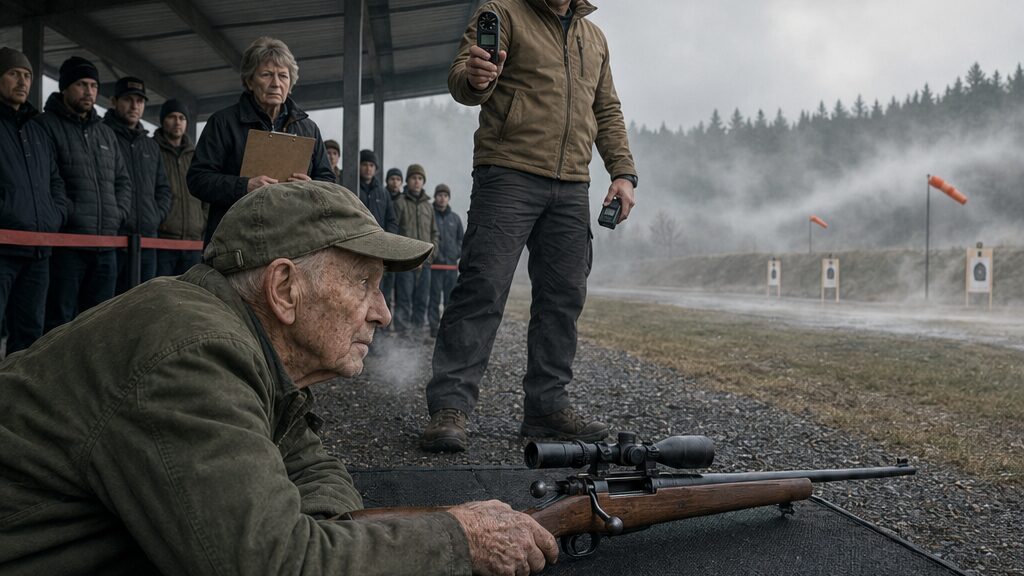
The scoped wooden rifle lay safely downrange, bolt open, its sling loose beside Joseph’s left arm. Fog beaded on the worn stock. His right hand rested in the shallow groove near the grip, trembling against the wood.
Above him, Brandon held the digital wind meter where the watching crowd could see its glowing numbers.
“One-point-six from the right,” Brandon announced. “Same condition Andrew had.”
Andrew stood behind the red line with his failed scorecard folded in both hands.
Joseph looked beyond the meter toward the berm.
The nearest fog moved left across the lane. At two hundred yards it thinned over the drainage cut, dipped, and reappeared traveling the other way. The far orange strip twisted sharply right.
“Not the same condition,” Joseph said.
Brandon smiled down at him. “The reading changed by two-tenths.”
“The number here did.”
“This is where we measure from.”
“This is where you’re standing.”
Several spectators shifted closer. Katherine remained beside the inspector, her clipboard pressed flat against her coat. Ashley stood near Lane Six, looking less angry now than afraid Joseph might retreat into silence again.
Brandon crouched just enough to bring the meter nearer Joseph’s face.
“You delayed registration. You questioned my safety procedure. You coached a junior after being told not to. Now you’re blaming conditions for his mistake.”
“I’m not blaming conditions.”
“You just said my call was wrong.”
“I said it was incomplete.”
Brandon straightened. “The meter is calibrated.”
Joseph pushed himself high enough on one elbow to look past him. “Check the fog at the berm.”
“I don’t need a weather lecture.”
“The drainage cut is carrying the lower air right to left. Above it, the crosswind is returning left to right.”
“You can see all that through fog?”
“The fog is why you can see it.”
A small sound came from one of the older club members—not laughter, but recognition of a point well made.
Brandon heard that too.
He lifted his voice. “People have driven two hours for this fundraiser. We have an inspector watching, donors waiting, and a full field behind schedule because you require twice the preparation time of everyone else.”
Joseph looked at the timer clipped beneath the meter. “How far behind?”
Brandon did not answer.
Katherine did. “Seven minutes.”
“Most of that was the public test,” Ashley said.
Brandon ignored her. “The issue is whether he can complete the stage safely and within standard.”
Joseph lowered his head to the stock, then lifted it again. The rifle remained open.
“What standard?”
“Three shots. Forty seconds. Wind call as briefed.”
“From this lane?”
“Yes.”
“With that target visible only when the fog lifts?”
“You wanted to remain in the event.”
Joseph studied him. Brandon was not pretending to know nothing. His stance, equipment, and earlier handling all showed real training. But he had made the day a referendum on his authority, and now every correction sounded to him like an attack.
Joseph had known men like that.
He had once believed a gentle word could reach them better than a firm one.
“Cold line first,” Joseph said.
Brandon blinked. “It is cold.”
“Then announce it.”
“I’m the range officer.”
“Announce it.”
The county inspector spoke for the first time. “He’s right. Formal challenge, formal procedure.”
Brandon’s face tightened. He turned toward the line.
“Range is cold. All firearms grounded, actions open. No one forward.”
The command moved through the shelter. Bolts opened. Hands lifted away from benches. A volunteer checked each lane.
Joseph sat back on one knee and opened his rifle case wider. The movement cost him. Gravel pressed through his trousers, and a line of pain climbed from his knee into his hip.
The younger men watched him rise as though slowness itself proved Brandon’s case.
Joseph removed three cartridges from their box and placed them in a row. Brass against black foam. He did not load them.
“Fair spotting,” he said. “Paper target with clean backer. No electronic score accepted as final if the systems disagree.”
Brandon gave a humorless laugh. “Planning your excuse?”
“Planning your evidence.”
Katherine looked to the inspector.
“Reasonable,” the inspector said.
A volunteer went forward through the fog and replaced the target and backer. The walk took long enough for murmurs to spread behind the line. Joseph heard fragments.
Used to shoot, maybe.
Army, Ashley said.
Hands are too bad.
That rifle older than Brandon.
He ignored them. At the far berm, the volunteer raised one arm, then returned. The range was cleared.
Brandon loaded his own precision rifle at Lane Five.
Katherine frowned. “What are you doing?”
“Demonstrating the call before Hall shoots. That will settle the condition.”
Joseph looked at him. “Hold a half-minute left if you use the line reading.”
Brandon checked the meter. “A quarter.”
“It will land right edge, low side.”
“You can barely see the frame.”
“I can see what moves around it.”
Brandon went prone. Unlike Joseph, he entered the position quickly and cleanly. He settled behind an expensive synthetic-stock rifle, checked the bubble level, adjusted the bipod, and built his cheek weld with practiced precision.
Joseph watched his breathing.
Brandon was good.
That made what happened next harder for him, not easier.
The timer chirped. Brandon fired.
The electronic display hesitated, then marked the impact on the right side of the target, low of center.
Exactly where Joseph had said.
A silence opened beneath the shelter.
Brandon did not move for a full second. Then he lifted his head and looked at the display.
“Sensor could be offset.”
“The paper won’t be,” Joseph said.
Brandon rose too quickly. “One shot doesn’t establish a pattern.”
“No.”
“Then prove your correction.”
Ashley stepped closer to the line. “He doesn’t owe you—”
Joseph raised a hand.
His tremor was obvious now. A few people stared at it, then at the target.
He looked toward Andrew. The boy still held the folded scorecard.
“This isn’t for him,” Joseph said.
Brandon mistook the words. “Then walk away.”
Joseph looked up at him. “It isn’t for you either.”
For the first time, Brandon had no immediate answer.
Joseph lowered himself onto the mat. He adjusted the sling one notch at a time, not fighting the shaking in his right hand. He placed his left elbow where the gravel offered bone support, drew the stock into his shoulder, and let his right hand settle into the worn groove.
The tremor did not vanish.
It shortened.
His body formed a structure around it.
Brandon stood above him with the meter, its screen still showing the wind at the firing line.
Joseph glanced at it, then at the fog slipping across the distant target.
“Your meter is right here,” he said. “The bullet won’t stay here.”
A volunteer behind the line whispered the sentence to someone who had not heard.
Joseph closed the bolt on the first round.
The world narrowed—not into stillness, but into separate movements. Fog at the line. Grass leaning over the drainage cut. A faint shiver in the target frame. The return wind higher up. His pulse touching the stock. The small predictable arc of the reticle.
He waited through one breath.
Then another.
The timer sounded.
Joseph fired.
He opened the bolt, cycled with controlled pressure, and watched the fog rather than the display.
Second round.
The drainage strip snapped, held, softened.
He changed the correction by less than Brandon could see.
Second shot.
A stronger tremor moved through Joseph’s wrist as he worked the bolt. He paused instead of forcing it. Behind him, the timer continued.
Brandon said, “Eight seconds.”
Joseph did not hurry.
He breathed out until the reticle’s movement reached the bottom of its arc.
Third shot.
The echoes faded into the white air.
Joseph opened the action and removed his hand from the grip.
“Clear,” he said.
Brandon looked at the electronic display.
Only one impact showed near the target’s center-left edge.
His mouth curved—not quite the old smile, but close.
“One hit,” he said.
Joseph pushed himself upright onto one knee, keeping the rifle downrange.
“Maybe.”
The scorekeeper leaned toward the screen. “System logged three impulses.”
“Then two missed the paper,” Brandon said.
Andrew unfolded his failed scorecard and stared through the fog at Joseph’s target.
Katherine looked at the inspector.
The inspector looked at the silent display.
And Joseph, kneeling on the gravel with the old wooden rifle held securely against him, waited for someone to bring the target back.
Chapter 4: The Target That Proved Too Little
Brandon reached the target before anyone else and turned it sideways to the light.
Fog clung to the paper in cold beads. Near the center-left edge, one ragged opening had torn through the scoring ring. Brandon ran a finger around it without touching the paper.
“One hit,” he said.
Katherine stood a few feet behind him with the county inspector and the scorekeeper. Andrew had followed despite being told to remain at the shelter. He stopped at the edge of the target berm, breathing hard from the walk.
“The system logged three impulses,” the scorekeeper said.
“It also logged one impact,” Brandon answered. “Two rounds went outside the paper.”
The inspector looked past the target to the backing board. “Remove the paper carefully.”
Brandon’s hand paused at the top staple.
Joseph had remained at the firing line. Katherine could see him through gaps in the fog, kneeling beside the old rifle with the bolt open. He had not walked forward to claim the shot or argue for it. He had not even looked toward the spectators who had begun whispering behind the red line.
That restraint unsettled her more than triumph would have.
She had seen him wait like that before.
Not on this range as it stood now, with electronic sensors and painted lane numbers, but on the old field that had occupied the same ground twenty-seven years earlier. Back then the drainage cut had been exposed, the shelter little more than corrugated roofing, and Joseph Hall had spent three damp mornings tying cloth strips to fence posts.
The bullet won’t stay where you measure it.
She could not remember whether he had said those exact words. She remembered the meaning.
Brandon pulled the target paper free. The wet sheet curled at once.
“Use something flat,” Katherine said.
The scorekeeper looked around.
At the firing line, Joseph closed his rifle case and carried it toward them. His stride was measured, one leg stiffer than the other. When he arrived, he placed the case across a wooden scoring table and opened the lid.
“Lay it there,” he said.
Brandon hesitated before setting the target on top of the black shell. The paper spread across the case, its ragged opening positioned over the worn outline of the rifle inside.
The inspector bent closer. “Backer.”
A volunteer loosened the cardboard sheet behind the target. Three shallow tears appeared in a vertical line through the fibers, close enough that the paper overlay could have hidden them beneath one enlarged hole.
Andrew stepped nearer. “There.”
Brandon looked at him sharply. “Stay behind the official.”
Andrew pointed without touching. “Three marks. One high, two almost together.”
The inspector aligned the paper over the backer. The torn edges matched.
The scorekeeper let out a breath. “Three rounds.”
No one cheered.
The sound that moved through the small group was quieter: boots shifting, jackets brushing, people adjusting what they believed.
Brandon studied the marks twice. His mouth had lost its curve. “A damaged target isn’t precision measurement.”
“No,” Joseph said. “It isn’t.”
Brandon looked up, surprised by the agreement.
Joseph kept his right hand on the rifle-case lid. The tremor made the target paper quiver faintly beneath his fingers.
“You should take the credit,” Katherine said. “The backer confirms the group.”
“It confirms three holes close together.”
“You called the wind.”
“I called one condition.”
Brandon folded his arms. “And now you’re saying the group doesn’t count?”
“I’m saying proof should carry only the weight it can hold.”
The inspector straightened. “The score counts as a valid three-shot group. But this stage does not continue.”
Katherine felt the meaning before he finished.
“Why?” she asked.
“The electronic record and paper did not agree. The chief instructor issued a public challenge outside the published course. A competitor disputed the official wind briefing. We now have a procedural conflict in front of participants and donors.”
“We can reset the target.”
“This is not a target problem.”
Brandon stepped forward. “I can restart the line under standard conditions.”
The inspector looked at him. “You were one side of the dispute.”
“I’m the chief instructor.”
“That is precisely why the review matters.”
The fog softened the shelter and reduced the waiting crowd to pale shapes. From the range came the metallic click of actions being opened as volunteers reinforced the cold-line order.
Katherine glanced toward the veterans’ group representative. He was speaking quietly with two donors. One checked his watch.
“How long?” she asked.
“Until I review your procedures, instructor qualifications, and the sequence that led to the challenge.”
“The scholarship match requires a completed field today.”
“I know.”
“If we suspend now, we lose the matching money.”
The inspector’s expression did not change. “Then you should have more reason to ensure the result survives scrutiny.”
Brandon looked toward Joseph. “This happened because he wouldn’t follow the brief.”
Joseph closed the rifle case.
Katherine turned on Brandon. “You put him on a separate challenge.”
“Because he questioned the official call in front of the line.”
“And he was right.”
The words left her before she decided to say them.
Silence settled again.
Brandon’s face tightened. “One group does not make him right about procedure.”
“No,” Joseph said. “It doesn’t.”
His refusal to help either side infuriated Katherine. He had always done this—offered the smallest true sentence and made everyone else decide what to do with it.
She looked at the old case, the target paper still lying across it, and saw the shallow groove in the rifle stock through the open edge of the lid.
“Tell them,” she said.
Joseph’s gaze moved to her.
“Tell them how you knew about the drainage wind.”
“That isn’t necessary.”
“It may be the only thing that keeps this event alive.”
“No.”
Ashley had approached from behind the scoring shelter. Katherine saw her before Joseph did.
“Why not?” Katherine asked. “Because you don’t want attention? You already have it.”
Joseph lifted the target paper from his case and handed it to the scorekeeper. “The inspector asked for qualifications and procedures. Give him those.”
“I’m asking about yours.”
His jaw set.
Katherine lowered her voice, though not enough.
“You helped map these lanes. You wrote the first crosswind notes. You taught half the instructors who worked here before Brandon.”
“Katherine.”
“You do not get to stand here and pretend you’re only an old man who wandered onto the gravel.”
Ashley stopped outside the scoring shelter doorway.
Joseph saw her then.
The expression on his face was not shame. It was something more guarded, as if a door he had held shut for years had opened from the wrong side.
Katherine regretted the pressure, but the inspector was waiting and the fundraiser clock continued to run.
She said, more quietly, “Sergeant Hall, I need you to tell me whether this range can reopen safely.”
Ashley’s voice came from the doorway.
“Sergeant?”
Joseph did not turn around.
Chapter 5: The Lesson Joseph Would Not Name
Ashley placed the old logbook on the equipment-room bench hard enough to shake dust from its canvas cover.
“Open it.”
Joseph continued wiping moisture from the rifle stock.
The equipment room beneath the shelter smelled of machine oil, damp wool, and cardboard targets. Above them, footsteps crossed the floor while the suspended event waited for a decision. Every few minutes a muffled voice rose, then fell.
Ashley pushed the book closer.
“Katherine kept it in a locked cabinet. She said you asked her never to display it.”
Joseph ran the cloth along the comb of the stock. Fog had settled into the worn finish, darkening the grain.
“I asked her to dispose of it.”
“She didn’t.”
“That was her choice.”
“And saying nothing was yours.”
Joseph folded the cloth once and cleaned around the sling mount. His right hand shook more after the shooting. The tremor made the cloth catch against the metal.
Ashley opened the book herself.
The pages were filled with compact handwriting, range diagrams, ammunition notes, corrections, and dates spanning years. There were no newspaper clippings, no photographs of Joseph beside trophies, no grand list of accomplishments. Only work.
On one page, a drainage channel had been drawn beneath six firing lanes. Arrows showed wind curling in opposite directions at different elevations.
“You knew exactly what was happening out there,” Ashley said.
“I knew what used to happen.”
“You predicted Brandon’s shot.”
“That does not make every old note current.”
“Stop doing that.”
Joseph looked at her.
“Making every answer smaller than the truth.”
He set the rifle down.
Ashley turned several pages. “You taught here?”
“For a time.”
“Katherine said you trained military shooters before that.”
“For a time.”
“How long?”
“Long enough.”
She laughed once, without humor. “I’m twenty-nine years old. I knew you were in the Army. I knew you hunted before my mother was born. I knew you kept this rifle locked in your den. That is all you ever let anyone know.”
“It was enough.”
“For whom?”
The question held him.
He looked toward the closed door. Through it came the scrape of a bench being moved above them. The day had not stopped because they were arguing beneath it.
“Ashley, the fundraiser needs a decision.”
“So do I.”
“You entered me without asking.”
“I asked.”
“You told me a volunteer dropped out and said you needed help.”
“And you said you’d think about it.”
“I came.”
“That isn’t the same as agreeing.”
“No.”
The admission slowed her anger.
Joseph rested both palms on the bench. His right hand trembled against the wood; his left did not.
“You wanted to pull me back into something,” he said. “You decided it would be good for me.”
Ashley’s eyes lowered. “I thought it might.”
“You were wrong to decide for me.”
“Yes.”
The answer was immediate.
Joseph had prepared himself for defense. Its absence left him with nowhere to place his own.
Ashley touched the logbook. “But you were wrong too.”
She turned to a section marked with a folded paper tab. A name appeared repeatedly in the margin.
Justin Thomas.
Joseph looked away.
The first notes were ordinary: rushed trigger, overcorrects after misses, reluctant to reset position. Later entries became shorter.
Ignored cease-fire clarification.
Handled ammunition before line command.
Argued correction in front of students.
Needs direct review before independent training.
Ashley read the last line twice.
“You kept teaching him?”
“He was talented.”
“That isn’t what I asked.”
Joseph lifted the cloth again, then put it down.
“Justin listened when correction did not cost him pride,” he said. “If others were present, he made a contest of it.”
“So you stopped correcting him?”
“No.”
“You softened it.”
Joseph’s fingers closed around the edge of the bench.
He remembered Justin smiling after a disputed stage, promising he understood. Joseph had taken him aside instead of stopping the class. He had used careful words. Suggested rather than ordered. Preserved the young man’s place in front of others.
Months later, at a private training session Joseph did not attend, Justin and another shooter had ignored a sequence of basic safeguards. No single violation had caused the fatal accident. It had been a chain—small decisions, each made easier by the one before it.
The investigation had not named Joseph.
His own memory had.
“He died?” Ashley asked.
Joseph nodded.
“Because of something you taught?”
“No.”
“Because of something you didn’t?”
“I don’t know.”
She waited.
Joseph looked down at the worn groove in the rifle stock.
“I told myself he would hear a quiet warning better. Maybe I told myself that because a firm one would have caused a scene. I let him leave with room to believe the problem was minor.”
“That doesn’t make the accident yours.”
“It makes the silence mine.”
The room above them went still. Then the loudspeaker clicked, and Katherine announced that the qualification remained suspended pending review.
Ashley closed the logbook halfway. Her anger had changed shape.
“You stopped teaching after that.”
“Yes.”
“You stopped shooting publicly.”
“Yes.”
“And whenever anyone assumed you were just old or slow or confused, you let them.”
“That harmed no one.”
A knock sounded at the door.
Andrew stood there, pale and uncertain.
“I’m sorry,” he said. “Katherine told me to wait upstairs.”
Joseph straightened. “Then wait upstairs.”
The boy did not leave.
“I knew the sling was too tight.”
Ashley glanced at Joseph.
Andrew stared at the floor. “I felt it pulling me off the stock. I didn’t say anything because Brandon laughed at one of the other juniors this morning for asking how to reset his support hand. Said we couldn’t need babysitting at a qualification.”
Joseph’s chest tightened.
“The miss was mine,” Andrew continued. “I fired it. But I knew something was wrong and acted like I didn’t.”
There it was again—not Justin, not the same danger, not the same man. Only the familiar shape of pride passing downward from an instructor to a student.
Joseph had seen the wind.
Andrew had felt the sling.
Both had remained silent.
A second figure appeared behind the boy. The county inspector held a folder beneath one arm. Katherine stood beside him.
“I have a path to reopen,” the inspector said.
Brandon was not with them.
Katherine entered the room. Her gaze moved from the logbook to Joseph’s rifle and then to his face.
“All competitors requalify from the beginning,” she said. “The juniors lose no points from the suspended stage. Brandon may remain as operating instructor, but the restart requires independent supervision from someone whose credentials I can document.”
Joseph said nothing.
Katherine placed a photocopied certificate beside the logbook. It bore Joseph’s name and an expiration date from years earlier, along with records of the military and civilian courses he had once taught.
“The inspector will accept prior qualification with a current practical review,” she said. “You already completed most of it in front of him.”
Ashley stepped back from the bench.
Joseph felt every eye in the room settle on him: his granddaughter, the boy whose shot he could have warned, the owner whose range might lose its funding, and the inspector who wanted a signature.
Katherine slid the supervisor form across the wood.
“If this line reopens today,” she said, “it reopens with you beside Brandon.”
Chapter 6: The Line Could Not Stay Silent
Joseph signed the supervisor form, then drew one line through the title Katherine had written beneath his name.
Senior Marksmanship Instructor.
He left only Independent Safety Supervisor.
Katherine watched the pen move. “The title is accurate.”
“It is unnecessary.”
“The inspector wanted your qualifications documented.”
“They are attached.”
“And the people outside?”
“Need procedures, not a biography.”
The county inspector took the form and examined the change. “Acceptable. The restart will be jointly controlled. Either supervisor may stop the line.”
“Juniors begin again without penalty,” Joseph said.
Brandon stood across the range office with both hands braced on the back of a chair. He had removed his tan jacket, but the outline of the wind meter remained visible in his shirt pocket.
“Their original scores were valid attempts,” he said.
“The stage was suspended,” Joseph replied.
“Because you challenged the procedure.”
“Because the procedure could not survive the challenge.”
Katherine stepped between them before Brandon answered. “The juniors restart. That is the condition.”
Brandon looked at the inspector.
“You can refuse,” the inspector said. “The event remains suspended.”
For a moment Joseph saw the calculation behind Brandon’s anger. It was not only pride.
A folder lay open on the desk beside him. Inside were printed schedules for the range renovation, equipment leases, and a contract renewal bearing Brandon’s name. Red numbers had been written along one margin. Joseph saw enough to understand that the modernization was not merely a job. Brandon had tied his own money to it.
Katherine closed the folder.
“We reopen in fifteen minutes,” she said.
Outside, Joseph placed his wooden-stock rifle in its case and left it beneath the shelter. For the requalification briefing, he chose an unloaded training rifle with a bright chamber flag. He handed it to Andrew only after the boy repeated the condition aloud.
“Build the position without the clock,” Joseph said.
Brandon stood several feet away, checking the restart roster. “They still have time standards.”
“They will use them after they can repeat the position.”
“The course is not a clinic.”
“No. But the first stage failed.”
Brandon’s jaw tightened. “The first stage failed because the line was disrupted.”
Joseph looked at Andrew’s sling. “Loosen the lower turn.”
Andrew did, and his shoulder settled naturally behind the training rifle.
“What changed?” Joseph asked.
“My elbow isn’t being pulled inward.”
“And your cheek?”
“It lands in the same place.”
“Build it again.”
The boy rose and repeated the position. This time his movements were slower at first and faster at the end.
Brandon watched despite himself.
When the juniors moved to dry practice, he approached Joseph near the side of the shelter. The crowd could not hear them over the clack of training bolts and Katherine’s instructions to volunteers.
“You were right about the wind,” Brandon said.
The admission came so quietly Joseph almost doubted it.
Brandon took the meter from his pocket. “The line reading was accurate. The drainage return wasn’t on the model.”
“No.”
“I checked the old range map.”
Joseph waited.
Brandon’s thumb moved across the meter casing. “If I tell the entire group the official briefing was wrong, the inspector writes it as instructor error. Katherine can terminate the contract.”
“That may happen anyway.”
“You think I don’t know that?”
“I think you want me to pretend the correction came after the suspension.”
Brandon looked toward the juniors. “Say we identified a variable during the review. Jointly. We update the hold and move on.”
“That would be partly true.”
“It would keep this place open.”
“And what would Andrew learn?”
“That conditions change.”
“He already learned something else.”
Brandon’s gaze hardened. “You have the luxury of making this moral. I have loans on the new target system. My name is on the insurance improvements. I spent six years getting enough certifications to be taken seriously in rooms full of men who had better schools, better rifles, and fathers who taught them before they could drive.”
Joseph glanced at the meter.
“And now that you’re in the room,” he said, “you decide who else deserves to be taken seriously.”
Brandon looked away.
For one moment he seemed younger than thirty-four. Tired rather than arrogant. Then the public mask returned.
“I’m asking you not to destroy a career over one bad call.”
“I’m offering you a way not to.”
“What way?”
“Give the briefing. State what the meter measured correctly. State what it could not measure. Tell them I recognized the downrange return because I had seen it before.”
“And make you the expert.”
“Make the conditions the expert.”
Brandon gave a small, bitter laugh. “Easy to say when everyone already thinks you’re some hidden legend.”
“They do not know me.”
“They know enough.”
“No. They know three holes.”
The line marshal called that the dry practice was complete.
Brandon slipped the meter into his pocket. “I’ll brief them.”
Joseph watched him walk toward the center of the shelter.
Perhaps the conversation had reached him. Perhaps fear had loosened its grip. Joseph wanted to believe either possibility because belief would allow him to remain beside the line without saying more.
Brandon raised his voice.
“The restart will follow standard course procedure. The earlier interruption resulted from a competitor disputing the official wind call and delaying the stage. We have confirmed the equipment is functioning properly.”
Joseph felt something inside him settle.
Not anger.
Recognition.
Years earlier, Justin had stood before a class after another safety dispute and described the warning as a difference in style. Joseph had allowed the words to stand because correcting him publicly would have embarrassed him.
Compassion without truth had not protected anyone.
Brandon continued. “All shooters will use the posted hold unless conditions visibly—”
“Stop.”
The word was not loud. It did not need to be.
Andrew froze behind the red line. Volunteers turned. Katherine lowered her clipboard.
Brandon stared at Joseph. “We are in briefing.”
“Yes.”
“You agreed to joint supervision.”
“Yes.”
“Then do not interrupt the operating instructor.”
Joseph walked to the center of the shelter with the unloaded training rifle cradled safely across both hands. He removed its chamber flag, showed the empty chamber to Brandon, then replaced the flag before setting the rifle on the bench.
Every movement took time.
No one mistook it for confusion now.
Joseph faced the junior shooters first, not the spectators.
“The meter functioned correctly,” he said. “It measured the air where Mr. Lewis stood.”
Brandon’s face remained still.
Joseph pointed toward the fog beyond the firing line.
“The official briefing was incomplete. I saw that before Andrew fired. I did not say it clearly enough.”
Ashley looked at him from beside the scoring table.
Andrew lifted his head.
Joseph continued. “His miss belongs to the shot he chose to take. The conditions belonged to those of us responsible for describing them. That includes me.”
A murmur moved through the shelter.
Brandon stepped closer. “You are turning a routine correction into a public confession.”
“No,” Joseph said. “I am correcting the briefing.”
He looked downrange, where the far fog bent faintly in the opposite direction.
“No shooter loads until both wind zones are explained. No junior is penalized for the suspended stage. And no one on this line will be mocked for asking to rebuild a position.”
The inspector closed his folder.
Katherine did not speak.
Brandon stood beside Joseph, his authority no longer protected by silence.
Joseph raised one hand toward the cold-line flag.
“The line remains closed,” he said, “until the truth is part of the procedure.”
Chapter 7: The Wind Beyond the Instrument
Joseph held out his hand.
Brandon looked at it, then at the digital wind meter in his own palm.
“Call the firing-line wind,” Joseph said.
The juniors waited behind the red line. The inspector stood near Katherine with the restart form open against his clipboard. Beyond the shelter, fog dragged low across the first hundred yards, then broke into thin white ribbons above the drainage cut.
Brandon did not move.
“You stopped my briefing,” he said.
“I corrected it.”
“In front of everyone.”
“Yes.”
The word offered him no place to hide.
Joseph kept his hand extended. “You are the operating instructor. Make the call.”
Brandon’s expression shifted. He had expected Joseph to take the range from him, perhaps even wanted that now. It would have allowed him to become the victim of an old man’s reputation rather than the owner of his own mistake.
Instead, Joseph was requiring him to remain responsible.
Brandon raised the meter into the air. Its small fan spun.
“One-point-nine miles per hour,” he said. “From three o’clock. Gusting to two-point-four.”
“Correct,” Joseph said.
A murmur passed through the spectators.
Joseph pointed toward the nearest strip of orange cloth. “What does that confirm?”
“Right-to-left movement at the line.”
“And what does it not confirm?”
Brandon looked toward the berm.
The far strip appeared for a moment through the fog, snapping the opposite way.
“It does not confirm the full path.”
“Say what you see.”
Brandon’s jaw tightened. Then he did.
“Return flow beyond the drainage cut. Left to right. Stronger near the target.”
Joseph nodded. “That is the complete briefing.”
He did not smile. He did not look toward the crowd to see whether they understood what had happened. He turned instead to Andrew.
“Bring the training rifle.”
Andrew carried it forward with the chamber flag visible.
Joseph guided him to Lane Two. “Build your position.”
The boy dropped to one knee, adjusted the sling, and placed his elbow. His movements were careful now, almost too careful.
“Do not perform caution,” Joseph said. “Use it.”
Andrew loosened his shoulder.
“Where does the stock meet you?”
“Same place each time.”
“Where is the strain?”
“Lower arm. Not the shoulder.”
“Good. Now look downrange without the scope.”
Andrew squinted into the fog.
“What do you see?”
“Nearest flag moving left.”
“Farther.”
“The grass by the ditch leans toward the berm.”
“Farther.”
Andrew waited.
The target frame shivered, faint but visible.
“The frame’s moving right.”
“Now use the meter.”
Brandon stepped forward and handed it to the boy. Their fingers nearly touched. Andrew looked uncertain, as though accepting it might declare an allegiance.
Joseph said, “A tool does not take sides.”
Andrew checked the reading, returned the meter, and settled behind his rifle.
The line was declared hot.
His first shot appeared near the left edge of the center ring. He breathed, adjusted less than before, and fired again. The second landed closer to center. His third completed a qualifying group.
The display confirmed it.
Andrew remained behind the rifle until Joseph said, “Clear.”
Only then did he open the action.
A smile broke across his face, but Joseph pointed toward the chamber.
“Finish first.”
Andrew removed the magazine, verified the chamber, inserted the flag, and stepped back.
“Now you may be pleased,” Joseph said.
The boy’s smile widened.
The small success loosened something in the shelter. Shoulders lowered. One donor began to clap, then stopped when no one joined him. The quiet suited the moment better.
Brandon studied Andrew’s group. “Good correction after the first round.”
Andrew looked at him. “Thank you.”
The answer was neither forgiveness nor rejection. It was simply proper.
The inspector turned to Joseph. “Your practical review still requires a complete demonstration under current conditions.”
Joseph had known it would.
Ashley stood beside the scoring table, watching his right hand. The tremor had worsened after the earlier string. He could feel it now in his forearm, a fine pulsing that traveled toward the elbow.
Katherine noticed too. “You’ve already established control.”
“The review needs a scored demonstration,” the inspector said. “It can be postponed.”
If postponed, the fundraiser could not resume fully. The matching funds would remain uncertain. Brandon’s contract review would hang over the range. Andrew’s group might count later, or might not.
Joseph opened his case.
The wooden stock lay where he had left it, dark against the foam. His fingers found the worn groove.
He lifted the rifle.
Brandon approached with the meter. “Conditions are changing.”
“They always are.”
“No,” Brandon said. “I mean now.”
The far fog flattened suddenly against the berm. The orange strip snapped straight and held. Grass at the drainage cut bent lower.
A gust pressed cold air under the shelter roof.
The earlier correction was useless.
Joseph looked at Brandon. “Call the line.”
“Three-point-one from the right. Rising.”
“Good.”
He lowered himself onto the mat.
Pain caught in his knee. Andrew took half a step forward, but Joseph shook his head. He had to enter the position himself. That was part of control—not pretending he required no help, but knowing which help would change the test.
He settled the sling around his arm. The stock came into his shoulder. His right hand trembled against the wood.
Brandon crouched beside the lane, meter raised.
Joseph studied the fog.
The return flow had strengthened, but not evenly. It climbed above the drainage cut and struck the target frames at an angle. A low hold would meet less of it than a high one. The bullet’s path would cross both zones before the stronger gust fully developed.
He heard Justin’s voice from years ago, dismissive and bright.
I’ve got it.
Joseph had answered carefully then. Too carefully.
He looked toward the juniors.
“I stopped teaching because a man I trained died after ignoring a series of safety corrections,” he said.
The shelter went still.
Joseph kept his eye on the target.
“I was not present when it happened. I did not cause it. But before that day, I had softened a warning because I did not want to shame him in front of others.”
His reticle moved in a small, predictable arc.
“I called that restraint.”
The gust strengthened.
“It was fear.”
Brandon lowered the meter slightly.
Joseph closed the bolt.
“The first duty of an instructor is not to preserve pride. It is to tell the truth clearly enough that no one can mistake danger for permission.”
He breathed in.
Out.
The timer sounded.
Joseph fired the first round.
The display marked it just left of center.
The fog shifted again. He did not repeat the hold.
Second round.
Closer.
The third cartridge entered the chamber. His right hand shook hard enough that the reticle crossed the entire center ring. He did not fight it. He changed the pressure in his sling, lowered his shoulder, and waited for the movement to shorten.
“Six seconds,” Brandon said.
Not taunting. Informing.
Joseph watched the far strip collapse, then rise.
The return wind weakened for one breath.
He fired.
The third mark appeared between the first two.
The group was tight, centered, and plainly separate enough for no one to dispute the count.
Joseph opened the bolt and cleared the rifle.
No applause came.
The crowd looked first at the target, then at Brandon.
Brandon stared at the display. His face held the same unsettled recognition it had carried at the first target, but something had changed. He was no longer searching for an explanation that would protect him.
“The line reading was right,” Joseph said.
Brandon looked at him.
“The interpretation was wrong.”
After a moment, Brandon nodded.
The inspector examined the group and signed the practical review.
Katherine stepped onto the line. “Joseph, I want you to take over as chief instructor. Effective immediately.”
The offer traveled through the spectators faster than any cheer could have.
Brandon went very still.
Joseph rose onto one knee, the rifle secured against him. He looked at Katherine, then at the juniors, then at Brandon holding the meter at his side.
“No,” he said.
Chapter 8: What the Old Hands Chose to Teach
Joseph returned the instructor badge unsigned.
Katherine looked at it on her desk, then at the blank lesson schedule he placed beside it.
“You refused the position in front of the inspector,” she said. “Now you want classroom hours?”
“One morning a month.”
“That is not enough to run a program.”
“I am not offering to run it.”
Late sunlight pressed weakly through the scoring-shelter windows. The fog had begun to lift from the nearest lanes, though the berm remained pale and distant. Outside, volunteers reset targets while the resumed fundraiser moved through its final stages.
Brandon stood near the door.
He had not left after Joseph refused the job. He had also not spoken since Katherine asked all three of them into the office.
Joseph tapped the blank schedule.
“Fundamentals clinic. Safety, position building, wind observation. No timed qualification during the first session.”
Katherine folded her arms. “Under whose authority?”
“Yours.”
“And who manages the line?”
Joseph looked at Brandon. “The chief instructor.”
Brandon’s eyes narrowed. “You expect me to keep the title after today?”
“I expect Katherine and the inspector to decide that.”
“The inspector recommended a leadership review.”
“Then complete it.”
“You could have taken the position.”
“Yes.”
“Why didn’t you?”
Joseph considered the badge between them.
“Because you made a bad call and then protected it. That does not erase what you know.”
Brandon’s mouth tightened. “It may erase the contract.”
Katherine opened the folder that held his renovation schedules and financial agreements. “The contract stays provisional. You finish the review, revise the junior-training procedure, and work under dual sign-off for public qualifications.”
Brandon looked from her to Joseph. “And he supervises me?”
“No,” Joseph said. “I teach one clinic.”
“That is supervision with a different name.”
“It is only that if you refuse to learn anything.”
The words landed harder than Joseph intended. He saw Brandon absorb them and chose not to soften the truth into something useless.
After a moment, Brandon reached into his pocket and placed the wind meter on the desk.
“I was wrong about the drainage return,” he said.
Joseph waited.
Brandon looked at the badge, not at him. “That isn’t the part I owe you.”
Katherine remained silent.
Brandon lifted his eyes. “I saw your hand shaking and decided a fair evaluation was too much trouble. I made your age the evidence before you touched the rifle.”
Joseph felt Ashley’s presence beyond the open doorway. She had stopped there without entering.
Brandon continued. “Then when you proved the call, I tried to make the equipment the excuse.”
“Yes,” Joseph said.
The answer was not warm. It was not cruel either.
Brandon nodded once. “I’m sorry.”
Joseph looked at the meter on the desk.
“Do better at the next briefing.”
“That’s all?”
“No. But it is where you start.”
Katherine slid a revised policy sheet toward them. Safety concerns involving a participant would be handled privately unless immediate danger required intervention. Any public removal from the line would require a stated procedural basis, not an assumption about age, appearance, or equipment.
Joseph read it twice.
“This should have existed before today,” Katherine said.
“Yes.”
She accepted the answer without defense.
One month later, the fog returned for the first fundamentals clinic.
Only six students stood behind the red line. Andrew was first among them. Ashley had limited registration exactly as Joseph requested and had not added his military title to the notice.
Joseph carried the old rifle case from the parking area himself.
Halfway to the shelter, the tremor strengthened. The case knocked lightly against his leg.
Andrew came toward him. “Want me to take it?”
Joseph nearly said no.
The refusal rose from habit, polished by years until it sounded like dignity.
Then the case struck his knee again.
“Support the front,” he said.
Andrew took one end. They carried it together.
At Lane Two, Joseph opened the case and exposed the wooden-stock rifle. The students leaned closer, drawn less by its appearance now than by the quiet attention around it.
“Today is not about shooting small groups,” Joseph said. “It is about building a position you can repeat and recognizing when you do not understand the conditions.”
He knelt on the gravel. The movement was slower than it had been a month earlier. Andrew lowered himself beside him without being asked.
Joseph showed him the worn groove near the grip.
“My hand goes here because the rifle and I have repeated the same agreement for a long time.”
Andrew placed his hand in the groove.
“Not yours,” Joseph said.
The boy lifted it at once.
“Find where your hand belongs. The mark is evidence of my repetition, not an instruction to copy it.”
Andrew adjusted until his wrist relaxed.
Between them, Brandon’s wind meter rested on the mat.
Brandon stood behind the line with the roster and radio. His tan jacket was the same, but his briefing was not. He asked each student to state the rifle’s condition. He waited through questions without glancing at the clock.
When Joseph’s hand shook too strongly to close the empty rifle case, he stopped pretending not to notice.
“Andrew.”
The boy steadied the lid while Joseph fastened the latch.
No one looked away out of embarrassment. No one rushed to make the moment smaller. The help was given, accepted, and finished.
Katherine watched from the shelter with the revised policy posted behind her.
The fog had thinned near the firing line, revealing the grass at the drainage cut. Farther out, the target frames remained half hidden.
Brandon lifted the meter.
“Line wind is from three o’clock,” he called. “Two-point-two. That tells us what?”
A junior answered, “What the air is doing here.”
“And what doesn’t it tell us?”
Andrew looked toward the distant berm.
The other students followed his gaze.
For several seconds no one spoke. Joseph felt the old urge to answer for them. He let the silence remain—not as avoidance, but as space in which someone else could observe.
Andrew pointed beyond the drainage cut.
“The fog is moving back the other way near the targets.”
Brandon checked the meter, then looked toward Joseph.
He did not open the line.
He waited.
Joseph knelt beside the wooden rifle, one hand resting against the stock, the tremor contained but not hidden. Andrew remained beside him. The meter lay between old wood and young hands, neither enemy nor authority by itself.
Joseph looked downrange once more.
Then he gave Brandon a single nod.
“Range is hot,” Brandon called.
The story has ended.