The Officer Reached for His Red Star Before Learning Whose Names It Carried
Chapter 1: The Patch She Was Certain Did Not Belong
“Remove the patch, sir, or leave the controlled area.”
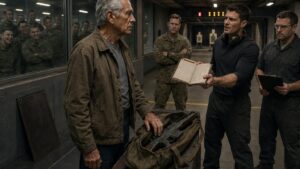
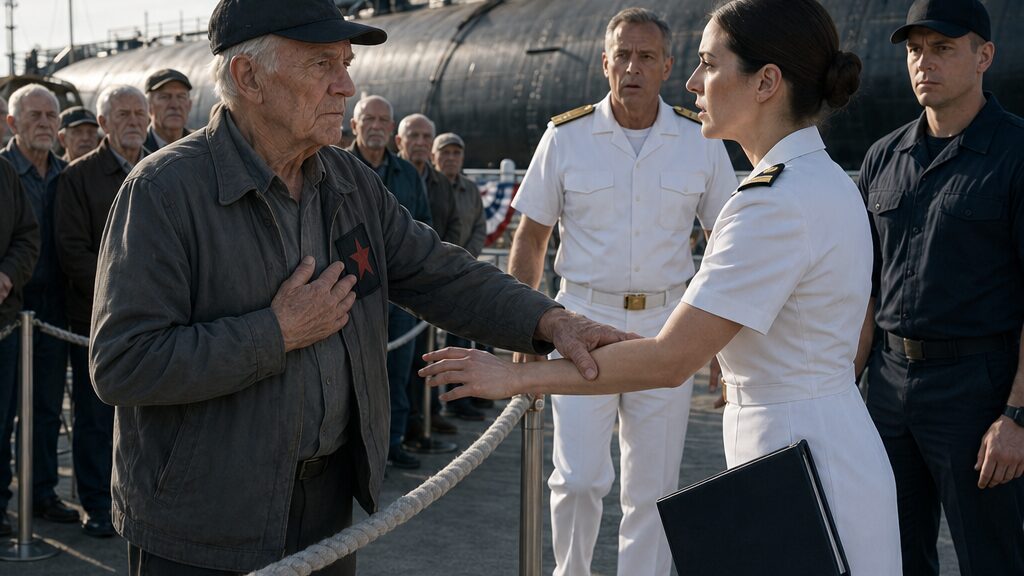
Lieutenant Catherine Wright spoke quietly, but not quietly enough. Three former submariners waiting beyond the rope turned toward Gregory Nelson. One of them looked first at his plain gray jacket, then at the faded black patch sewn above its left pocket.
The red star in its center had one crooked arm.
Gregory rested two scraped fingers over it.
“I’m not removing it.”
Behind Catherine, USS Resolute lay against the pier in the hard morning light, her black hull rising like a wall beyond the folding chairs and blue ceremonial bunting. Sailors moved along the gangway carrying programs, microphone cables, and brass stanchions. Near the platform, the submarine’s bell waited beneath a dark cloth.
Gregory had not come for a chair.
He had come to place a folded casualty card beside that bell before the Navy retired the boat and sealed its history into whatever words were printed in the ceremony program.
Catherine held a thick access folder against her white uniform. She was young enough to be his daughter’s younger sister, though the certainty in her face made her seem older.
“Your name is not on the invited-veterans roster,” she said. “You don’t have a visitor badge, and that symbol is not an authorized Navy insignia.”
“It never was.”
Her eyes sharpened, as though he had confirmed something useful.
“Then you understand the problem.”
Gregory understood more problems than she knew. He understood that the rope line had been moved six feet from where the old service lane used to run. He understood that the fresh gray paint beneath the cleats concealed the yellow emergency stripe once used to keep tender hoses clear. He understood that Resolute’s forward escape trunk had been modified twice since the year men had pounded against it from the inside.
He also understood that explaining any of that would invite the question he had avoided for fifty-two years.
Who were you there?
He tightened his grip on the folded card in his jacket pocket.
“I was told the public could attend.”
“The public viewing area is ashore.” Catherine indicated a row of temporary bleachers beyond the security checkpoint. “This section is for crew families, invited former sailors, and authorized guests.”
“I need two minutes at the bell.”
“You cannot enter the ceremony perimeter without credentials.”
“Then take the card to it.”
Her gaze dropped to his pocket. “What card?”
“That is between me and the bell.”
One of the former submariners beyond the rope gave a low, uncomfortable cough. Gregory recognized the sound. It was the noise men made when they wanted an injustice corrected but preferred someone else to risk the correction.
Catherine glanced at the ceremony chief petty officer stationed several yards away. The chief was supervising a delivery and did not see her look.
“Sir, I’m trying to help you,” she said. “But you’re refusing to identify your connection to this vessel.”
“I didn’t say I had one.”
“You asked to approach its bell.”
“Yes.”
“You’re wearing what appears to be a military-style emblem.”
“It appears to be cloth.”
Her mouth tightened.
Gregory knew he was making her work harder. Some part of him took a grim satisfaction in it, and he disliked himself for that. She had procedures. He had arrived without answering the museum’s letter, without calling the base, without telling Lisa he was coming. He had expected to walk onto a guarded pier carrying half a century of silence and somehow be understood.
That was foolish.
But foolishness did not give her the right to make the star disappear.
Catherine opened the folder and ran one finger down a printed list.
“Gregory Nelson?”
He looked at her.
“I found that name on your driver’s license when security checked you at the outer gate. Is it correct?”
“Yes.”
“No rank listed. No command association. No invitation sponsor.”
“Retired people often travel without commands following them.”
A sailor at the nearby table looked away quickly, hiding the beginning of a smile. Catherine noticed.
The color rose faintly at her throat.
“This ceremony has senior officers, family members, and a live public broadcast,” she said. “We had an access failure on this base three weeks ago. I will not allow another one because someone thinks age excuses incomplete identification.”
Gregory studied her then. Not cruel, he decided. Cornered.
That did not make her right.
A gust from the harbor flattened the fabric of his jacket against his chest. Catherine’s attention returned to the patch. The black field had faded almost charcoal. Its edges were softened by decades of wear. The star had been sewn with thick red thread, the stitches uneven but stubborn.
She leaned closer.
“That was made by hand.”
“Yes.”
“So it has no official standing.”
“Neither does a wedding ring.”
“That comparison is not relevant.”
“It is to the people wearing them.”
Her eyes flicked toward the men watching from inside the rope, then back to him.
“Some symbols cause confusion. That star could be mistaken for a foreign-service emblem, a unit insignia, or a political statement. You may cover it and proceed to the public area, or you may leave the pier.”
Gregory felt the old pressure gathering behind his damaged hearing—the dull compression that came when too many voices, engines, and metal sounds crowded together. A forklift beeped near the supply shed. A halyard slapped a mast. Somewhere inside Resolute, a tool fell and rang against steel.
He touched the star again.
“No.”
Catherine closed the folder.
“Then I’ll have security escort you back.”
The base security sailor approached at her signal. He was broad-shouldered, careful-faced, and young enough to have learned conflict from training rooms rather than from machinery filling with smoke.
“Sir,” the sailor said, “we need you to step away from the access point.”
Gregory did not move.
His gaze had caught on the submarine’s hull.
“There used to be an emergency service hatch below that casing,” he said.
Catherine followed his line of sight. “Sir—”
“Just aft of the forward battery intake. Oval plate. Eight bolts, though the drawing showed ten.”
The security sailor looked toward the submarine.
“That area is plated over,” Catherine said.
“Now it is.”
“How would you know about it?”
Gregory saw the service hatch as it had been: paint blistered, bolts hot enough to score gloves, black water shuddering below the pier. He heard a voice shouting through a face mask, though the name attached to that voice remained locked behind his teeth.
He looked at Catherine.
“I know where it was.”
“That is not an answer.”
“It is the only one you’re getting.”
The ceremony chief had stopped supervising the delivery. He now watched from beside the platform. Two more sailors had turned toward the rope. The scene was no longer private enough for Catherine to soften it and too public for her to let it drift.
She stepped nearer.
“Mr. Nelson, I need to inspect that patch.”
“No.”
“I can inspect it where it is.”
“No.”
“I am not asking you to surrender it.”
“You’re asking after deciding what it means.”
Her composure slipped for the first time.
“I have decided nothing. I am responsible for identifying unauthorized items inside a controlled ceremonial space.”
“I am outside your rope.”
“You are attempting to enter it.”
“To leave a card.”
“Which you will not show me.”
The folded casualty card seemed suddenly heavy against Gregory’s ribs. He had written no message on it. Only a date remained visible on the dry half, along with a water-bled line where four names had once been entered.
Four names.
One of them his.
Three of them not.
Catherine’s gaze returned to the bottom seam of the patch. Wind had lifted a frayed edge, exposing tiny stitches beneath the star. Gregory saw the moment she noticed them.
14–3–74.
Below the date were three cramped initials.
Her expression changed, but only slightly. Suspicion did not leave. It became more focused.
“What are those initials?”
Gregory said nothing.
“Do they identify people?”
His fingers pressed harder over the cloth.
“Mr. Nelson, what does that patch represent?”
He looked past her at the bell platform.
Men had once stood in a compartment where the air itself burned. A corpsman had tied red thread around a split glove because he could not find proper cord. Someone had laughed afterward—too loudly, too long—because three bunks would remain empty.
Gregory had spent fifty-two years refusing to make that day useful to anyone.
“It represents no authority over you,” he said.
“That is not what I asked.”
“It is all you need to know.”
Catherine inhaled slowly. The public affairs officer hurried past behind her, speaking into a headset about the livestream test. A cluster of crew families had begun to gather near the chairs. The deadline pressed visibly into her posture.
“Sir, I’m going to examine the lower stitching. Do not interfere.”
Gregory’s hand dropped from the patch.
For half a second, relief crossed her face.
Then she reached toward him.
Her fingers came within an inch of the uneven red star.
Gregory moved before memory could become thought. He closed his hand around her wrist—not twisting, not pulling, only stopping it where it hung between them.
The security sailor shifted forward.
Gregory released no pressure and raised no voice.
“Ask,” he said, “before you take a man’s dead from him.”
Chapter 2: The Salute That Answered the Wrong Question
“Security, stand down.”
Rear Admiral Andrew Miller’s command cut across the pier before Catherine could pull her wrist free.
Gregory released her at once.
The absence of his hand felt almost as startling as the grip itself. Catherine took one step back, holding her wrist against the folder. He had not hurt her. That fact did little to lessen the humiliation of being stopped in front of sailors, veterans, and the base commander.
Andrew crossed the staging area without hurrying. His white uniform caught the full morning glare. Behind him came the ceremony chief and a public affairs officer whose headset still hung crookedly over one ear.
Catherine forced her shoulders level.
“Admiral, this visitor refused removal from the controlled area and physically interfered with an inspection.”
Andrew did not answer her immediately.
He was staring at Gregory.
Not at the patch.
At his face.
The admiral stopped at regulation distance. For a moment, the noise of preparation continued around them—chairs scraping, lines tapping metal, a diesel cart reversing—but the small circle at the rope seemed to contract into silence.
“Chief Nelson?” Andrew said.
Gregory’s expression did not change.
Catherine felt the first clean break in her certainty.
Andrew raised his right hand and saluted.
He did it without spectacle. No order followed. No one else moved. It was a private military gesture performed in a place that had suddenly become very public.
Gregory gave a small nod.
He did not return the salute.
Catherine lowered the folder. Her wrist no longer mattered.
“You know him, sir?”
Andrew kept his attention on Gregory. “I know his face.”
“That isn’t the same thing,” Gregory said.
His voice remained flat, but Catherine heard the warning inside it.
Andrew lowered his hand.
“No,” he said. “It isn’t.”
He looked older than he had ten seconds before. Catherine had served under him for nine months and had seen him manage accidents, disciplinary hearings, and a congressional visit without once appearing uncertain. Now he seemed to be sorting memory from assumption in real time.
“My first commanding officer kept a photograph in his sea chest,” Andrew said. “Four men beside Resolute’s forward casing after the battery fire. One of them was you.”
Gregory’s gaze drifted toward the submarine.
“Photographs leave out quite a bit.”
Andrew nodded. “He said Chief Nelson went where no one else could.”
“Then he liked simple stories.”
Catherine glanced at the date stitched beneath the patch. The wind lifted the seam again.
14–3–74.
Three initials.
Andrew noticed them too. His expression tightened with recognition, though not understanding.
“You were invited,” he said. “You should have been.”
“I wasn’t.”
“We’ll correct that now.”
Gregory looked at the rope between them. “You don’t know what you’re correcting.”
Andrew’s eyes returned to Catherine.
“Lieutenant, why was Chief Nelson stopped?”
The title struck her harder than the rebuke might have.
“He is not on the invited roster, sir. He arrived without a visitor badge or sponsoring command. The patch is not listed among authorized veteran or unit insignia, and he declined to explain it.”
Andrew looked at Gregory.
“Is that accurate?”
“Mostly.”
Catherine almost objected, then restrained herself.
“What part is not?” Andrew asked.
“She said I was trying to enter the ceremony.” Gregory touched his pocket. “I asked someone to take a card to the bell.”
Andrew’s gaze dropped to the movement.
“For whom?”
Gregory’s face closed.
The admiral waited, but Gregory offered nothing more.
Catherine recognized the pattern now. Every question struck a door he had decided not to open. Her earlier suspicion had not been baseless. That knowledge gave her little comfort.
Andrew turned toward the security sailor. “No escort. Chief Nelson remains.”
“Sir,” Catherine said carefully, “I still need to verify his access status.”
Andrew studied her. He did not dismiss the concern.
“Do it respectfully.”
The word landed where everyone could hear it.
Catherine looked at Gregory’s wrist, then at her own hand. His sentence returned with unwelcome clarity.
Ask before you take a man’s dead from him.
She shifted the folder to her left arm.
“Mr. Nelson,” she said, lowering her voice, “may I see your military identification or discharge documentation?”
His eyes met hers.
It was the first time she had asked him anything without a command hidden inside the phrasing. She could not tell whether he noticed the change or simply considered the request less objectionable.
He reached slowly into the inner pocket of his jacket.
The security sailor tensed.
Catherine shook her head once, telling him not to move.
Gregory removed a worn leather wallet and handed her a retired military identification card. The photograph was recent enough to confirm his identity. The rank line read Chief Petty Officer. The service category was Navy retired.
Catherine checked the name twice.
Gregory Nelson.
She returned the card using both hands.
“Thank you, Chief.”
His fingers closed around it.
“Gregory will do.”
Andrew smiled faintly, but the expression disappeared when Gregory looked at him.
“You said the photograph showed four men beside Resolute,” Gregory said.
“Yes.”
“Did your commanding officer say they served aboard her?”
Andrew hesitated.
“He called them the men who saved her.”
“That wasn’t my question.”
“No,” Andrew admitted. “He didn’t say.”
Gregory put the wallet away.
“I never served aboard Resolute.”
The words altered the scene again.
Catherine heard a murmur from one of the former submariners beyond the rope. Andrew’s brow furrowed.
“You were not part of the crew?”
“No.”
“Temporary assignment?”
“No.”
“Then why were you in the photograph?”
Gregory turned slightly toward the black hull.
“Because someone had a camera after the smoke cleared.”
Catherine felt embarrassment giving way to a more dangerous uncertainty. Andrew’s salute had answered whether Gregory was a veteran. It had not answered why he belonged at this ceremony, what the patch represented, or whether Andrew had mistaken a supporting sailor for a member of Resolute’s crew.
She opened the folder to the historical guest list.
“Chief Nelson, were you attached to another command operating here in March 1974?”
He watched her for a long moment.
“Yes.”
“What command?”
His jaw shifted once.
Before he could decide whether to answer, the naval historian arrived from the display area carrying a tablet and a marked ceremony program. The historian looked irritated at having been summoned and more irritated still by the size of the audience.
“Admiral, Lieutenant,” the historian said. “I checked the retired personnel index and Resolute’s available crew records.”
Andrew gestured toward Gregory. “This is Chief Gregory Nelson.”
The historian looked up sharply.
“Nelson?”
“You know the name?” Catherine asked.
“No. I know it is not in the ship’s personnel database.”
Gregory showed no reaction.
The historian scrolled through the tablet.
“There is a Gregory Nelson with twenty-two years’ Navy service. Machinist’s mate. Advanced to chief. Several repair and diving qualifications. Clean record. But there is no assignment to USS Resolute, no temporary-duty notation aboard her, and no decoration citation tied to the 1974 casualty.”
Andrew’s face hardened. “Records from that period are incomplete.”
“Some are. The ceremony narrative was built from the command history, deck log extracts, casualty report, and surviving crew statements.”
“What about support commands?”
“We included documented participants.”
Gregory’s eyes moved to the program in the historian’s hand.
“Documented where?” he asked.
“In the official file.”
“Which official file?”
“The Resolute command archive.”
A faint bitterness crossed Gregory’s face.
Catherine saw it and understood that the distinction mattered, though she did not yet know why.
The historian looked at the patch.
“And that emblem does not appear in the Navy insignia registry. Red stars have been used in several contexts, none connected to Resolute.”
“It was never registered,” Gregory said.
“Then we cannot treat it as evidence.”
“I didn’t ask you to.”
Andrew stepped closer to the rope. “Chief, tell us the command.”
Gregory’s hand went to the folded card in his pocket but did not remove it.
For a moment, Catherine thought he would leave. She could see the impulse in the angle of his body—the old habit of withdrawing before anyone could turn his memory into an exhibit.
Then he looked at the ceremony platform, where a sailor was testing the microphone.
“USS Marion,” he said.
The historian stopped scrolling.
“The submarine tender?”
Gregory nodded.
Andrew’s eyes shifted toward Resolute.
“Marion was here during the fire.”
“She was beside her.”
The historian searched the tablet again.
“Yes. Tender support is noted, but only generally. Pumping assistance, electrical isolation, medical response.”
Gregory’s gaze sharpened. “Generally.”
Catherine heard the accusation in that single word.
The historian kept reading.
“There is still no red-star unit, no listed rescue detail, and no indication that Chief Nelson entered Resolute.”
Andrew looked from the historian to Gregory. “Could the record be filed under Marion?”
“Possibly. Her records were separated when the tender was decommissioned. But based on what we have here, Chief Nelson has no documented assignment to Resolute and no authorized insignia connected with this ship.”
The rope stirred in the harbor wind.
Catherine looked down at the date beneath the uneven star and wondered whether she had nearly torn at a fraud—or at the only surviving label on something the Navy had misplaced.
Chapter 3: The Name Missing From Every Official List
Catherine placed Gregory’s service summary beside the ceremony roster and turned both pages toward him.
“Neither document supports a claim to this event.”
They sat in the pier operations room, where wide windows overlooked Resolute and the rows of chairs filling below. Gregory remained in his gray jacket. The patch stayed over his heart. The folded casualty card remained in his pocket.
He had been offered coffee and refused it.
Andrew stood near the windows. The naval historian occupied the end of the metal table with a tablet, three archive printouts, and the increasingly strained expression of someone whose records had stopped behaving.
Catherine sat across from Gregory.
She had not apologized.
Not yet.
He suspected she was waiting until she understood exactly what she had done, as if the category of the wrong might determine the amount of regret required.
“You were a crewman aboard Marion,” she said. “That is now confirmed. Marion provided support during Resolute’s battery-compartment fire. But support-command service does not automatically place someone on this submarine’s honored roster.”
“I didn’t ask to be honored.”
“You asked to approach the bell during a controlled ceremony.”
“To leave a card.”
“Without showing it to anyone.”
“Yes.”
Her fingers flattened against the roster.
“Can you understand why that created concern?”
Gregory looked through the window. Sailors were arranging wreaths near the platform. Each ribbon carried the name of a command, association, or crew group.
No ribbon bore Marion’s name.
“Yes,” he said.
The answer appeared to surprise her.
“Then help us resolve it.”
He almost laughed, though nothing about the room invited humor. For decades, people had asked him to help resolve the history. Museum interviewers. Retired officers. A newspaper writer who had sent three letters. Lisa, before she learned that questions made him leave the table.
Each request had sounded reasonable.
Each answer would have required him to decide whose death became public property.
The historian slid a printed timeline toward him.
“This is the account prepared for today’s ceremony. At 0917, smoke was reported in the forward battery compartment. The ship’s damage-control team isolated the ventilation system at 0923, restored emergency access at 0931, and removed the final injured sailor at 0940.”
Gregory did not touch the page.
“That is wrong.”
The historian leaned forward. “Which part?”
“The ventilation isolation happened after the first entry.”
“Our casualty report places it at 0923.”
“Your casualty report was rewritten ashore.”
“On what basis do you say that?”
“Because the vent fan was still pulling when the hatch opened.”
The room went still.
Andrew turned from the window.
“You saw it?”
Gregory’s hearing narrowed around the question. Somewhere below, a forklift engine rose and fell. The sound became the growl of an old blower motor struggling against heat.
He pressed a thumb against the edge of the table until the room returned.
“I know it was running.”
The historian studied him.
“If the fan was active, opening that route could have accelerated the fire.”
“It did.”
“Then the official sequence is materially inaccurate.”
“Yes.”
“How do you know the hatch opened before isolation?”
Gregory looked at the patch reflected faintly in the window. The red star floated over the submarine’s black hull.
“I already answered.”
“No,” Catherine said. “You stated a fact and withheld its source.”
He turned toward her.
“And you mistake a complete form for a complete truth.”
Color touched her face, but she did not retreat into rank.
“That may be so,” she said. “It does not make an unsupported statement usable.”
Andrew lifted a hand before Gregory could answer.
“Chief, if the ceremony account is wrong, tell us enough to stop it.”
Gregory’s gaze went to the clock.
Less than three hours remained before the first guests would be seated.
“You should have stopped it before printing it.”
Andrew accepted the blow without protest.
“Yes.”
The naval historian opened another file.
“Marion’s position is documented. She was moored outboard of the service pier during the fire. Her crew supplied portable breathing apparatus, electrical specialists, pumps, and medical personnel.”
“Names?” Gregory asked.
The historian scrolled.
“Not in this summary.”
“Rescue-party roster?”
“Not attached.”
“Casualty annex?”
“There is a reference to an annex, but the digital file does not contain it.”
Gregory finally looked directly at him.
“What reference?”
The historian rotated the tablet. A scanned index page showed a line beneath the main incident report:
Tender support casualties and rescue detail—see Marion Annex C.
The link beside it led nowhere.
Andrew came to the table.
“Where is Annex C?”
“I don’t know yet.”
Catherine looked at the printed ceremony program.
The historian continued, “When Marion was decommissioned, her engineering and casualty files were transferred through a different records center. If the annex remained classified by originating command rather than incident vessel, it may never have been merged into Resolute’s history.”
“Then the program is incomplete,” Catherine said.
“It is based on the available command record.”
“That was not my question.”
Gregory watched her. Something in her voice had changed. The difference was small, but it was there: she was no longer asking whether he fit the record. She was asking whether the record fit what happened.
The historian picked up the ceremony text.
“The prepared account states that Resolute’s internal damage-control team reopened the forward route and conducted all rescue removals.”
Gregory’s hand closed beneath the table.
All rescue removals.
The phrase was clean, efficient, and false.
He saw red thread pulled through black cloth under a yellow work light. John’s hands had shaken too badly to make equal points on the star. Someone had said crooked was fitting because none of them would walk straight again.
Gregory rose.
Andrew moved toward him. “Chief?”
“I’m leaving.”
Catherine stood as well. “The ceremony account may need correction.”
“Then correct it.”
“With what? You refuse to provide a statement.”
His eyes settled on her.
“You have Marion’s name now.”
“We do not have the rescue detail.”
“You have an annex reference.”
“We do not have the annex.”
“Then find it.”
“The ceremony begins today.”
“That is your deadline, Lieutenant. Not theirs.”
His hand touched the casualty card through the jacket. He had intended to lay it beside the bell and leave before anyone asked why. He had believed the card would be enough—a private act, safely anonymous.
Now he understood what the Navy planned to say aloud.
Resolute’s own crew had done it all.
The omission was not a missing footnote. It was the final version.
Andrew stepped between Gregory and the door, leaving enough distance that it did not feel like a block.
“I remember the photograph,” he said. “Four men. One had his arm bandaged. One was sitting on the casing. My commanding officer wrote a sentence on the back: Marion detail after final entry.”
The historian looked up.
“Do you still have it?”
“No. It passed to his family.”
“Names?”
“None.”
Gregory knew the photograph. He had hated it from the moment the flash went off.
Four survivors were not shown in it.
Only four men who had gone in.
One of them had been carried out and died before sunset. The photograph made them all look alive enough to continue.
Andrew lowered his voice.
“Were you part of that detail?”
Gregory looked at the door.
He could leave. He had done it before. Silence had always offered an exit.
A knock sounded before he reached it.
The operations-room door opened, and Lisa Nelson stood in the corridor holding a large museum envelope against her chest.
Gregory stopped so abruptly that his knee struck the edge of a chair.
Lisa’s dark hair was streaked with gray now. He had noticed it at Christmas and pretended not to. Her visitor badge identified her as a maritime museum conservator. Her expression identified her as his daughter, furious enough to have driven across two counties without calling first.
She looked at the officers, the documents, and the patch on Gregory’s jacket.
Then she raised the envelope.
The museum’s return address was printed in one corner. Across the front, in Gregory’s handwriting, were three words written fifteen years earlier.
RETURN UNOPENED. NO INTERVIEW.
“I found the evidence you refused to let anyone see,” Lisa said. “And this time, Dad, you don’t get to disappear before we open it.”
Chapter 4: The Daughter Who Refused His Honorable Silence
“You were wrong to touch it,” Lisa told Catherine. Then she faced Gregory. “And he was wrong to make everyone guess.”
No one in the operations room answered.
Gregory stood beside the door with one hand resting near the red star. Lisa remained in the corridor, blocking the exit without appearing to. The museum envelope in her arms was bent along one corner from how tightly she held it.
Andrew looked between them.
“You’re Chief Nelson’s daughter?”
“Lisa Nelson. Maritime conservation.”
Her voice carried the crisp neutrality she used with donors who wanted decayed artifacts polished into something attractive.
Gregory knew what came beneath that voice.
“You had no reason to come,” he said.
“I had every reason after the base called the museum asking about an unregistered patch tied to your name.”
Catherine’s expression shifted. “I requested an authentication contact.”
“And the clerk recognized the accession inquiry. We’ve been trying to document my father’s account for twenty years.”
“Fifteen,” Gregory said.
Lisa looked at him. “You ignored us before I made it formal.”
He turned away.
Andrew gestured toward the table. “There’s a conservation room at the base museum. More privacy, proper equipment.”
“I’m not taking it off,” Gregory said.
Lisa’s gaze dropped to the patch.
“No one asked you to.”
The correction struck cleanly because she had chosen the word no one, sparing Catherine nothing.
They crossed the base in silence. Gregory walked beside the windows facing the pier, keeping Resolute in view. The rope barrier had become a thin blue line below. Sailors passed through openings in it with badges clipped to their uniforms. He wondered how many boundaries became reasonable merely because the people inside them printed the rules.
The conservation room smelled of cotton paper, clean metal, and old adhesive. A magnifying lamp stood above a padded worktable. Trays of tools lined one wall. Lisa placed the envelope beneath the lamp but did not open it.
“Jacket first,” she said.
Gregory remained standing.
“We can examine the stitching while you wear it,” she continued. “No removal. No physical contact unless you approve it.”
Catherine stood near the door with her folder closed against her side. She did not object to Lisa’s emphasis.
Gregory sat in the straight-backed chair beside the worktable.
Lisa adjusted the lamp. White light fell across the black cloth, revealing faded salt lines in the weave and tiny repairs around the edges.
She raised one hand toward it, then stopped several inches away.
Gregory watched her fingers.
They were her mother’s fingers—long, careful, always aware of fragile things.
“May I bring the lens closer?” Lisa asked.
He nodded.
She moved the magnifier, not the jacket. The glass enlarged the crooked red stitches until each one looked thick as cordage.
Catherine stepped closer but remained outside arm’s reach.
“The red thread is inconsistent,” she said.
“It was sewn by more than one hand,” Lisa replied.
Gregory looked at her sharply.
She did not look back.
“How can you tell?” Andrew asked.
“Tension changes at each point. The upper arm is tight and regular. The right is loose. This uneven arm was resewn after the cloth tore.” Lisa indicated the star’s lowest point without touching it. “At least three stitch patterns.”
The naval historian leaned over the lamp.
“The backing?”
“Work-clothing twill. Period-consistent, but that proves very little.”
Lisa changed the lens angle. Beneath the lower seam, the date and initials emerged more clearly.
“Thread composition may tell us more.”
She opened a drawer and removed a handheld microscope. Again she paused.
“Dad, may I rest the guide against the jacket below the patch? Not on the stitching.”
Gregory looked at Catherine.
She stood absolutely still.
He gave Lisa another nod.
The guide touched the gray jacket. The microscope display filled with twisted red fibers, wax residue, and small metallic flecks.
Lisa studied them for nearly a minute.
“This is waxed repair thread,” she said. “Cotton core, likely from a general seam-and-canvas kit. The metallic contamination is consistent with machinery spaces.”
“Could it have come from Marion?” Catherine asked.
“It could have come from many Navy repair facilities in the early seventies.”
“So it doesn’t authenticate the story.”
“No,” Lisa said. “It authenticates age, use, and plausible origin. Not ownership. Not meaning.”
Gregory nearly smiled. She had always refused to make evidence say more than it could. As a child, she had once corrected a teacher who called a whale skeleton complete because one rib had been cast in resin. Missing was missing, even when disguised.
Andrew examined the star.
“Who made it?”
Gregory’s throat tightened.
Lisa answered for him.
“Four men aboard Marion began sewing it after the fire. Three of them died from injuries sustained during the rescue.”
The room went motionless.
Gregory stared at her.
“You don’t know that.”
“I know what you told Mom during the fever after your second ear surgery.”
He looked away.
“You were nine.”
“Ten. And you made me promise not to repeat it.”
“You should have kept that promise.”
“I did. For thirty-eight years.”
The words were controlled, but her grip tightened on the microscope.
Catherine glanced at the patch. “The three initials?”
Lisa’s eyes remained on Gregory.
“I assume they are the men who died.”
He said nothing.
The historian asked, “Was this an official rescue detail?”
“No,” Gregory said.
It was the first answer he had given without resistance.
Andrew took a slow breath. “Then what was it?”
“Men available when they were needed.”
“That is not enough for an archival finding,” the historian said, though his tone had softened.
Gregory turned toward him. “It was enough to go through the hatch.”
Lisa switched off the microscope.
“Dad, they need more than fragments.”
“They need their own files.”
“The files are missing.”
“Then that is the Navy’s problem.”
“No. It became ours when you refused every request to fill the gap.”
She pulled a chair opposite him.
“The museum contacted you in 1998, 2003, 2009, and 2011. I wrote the last request myself. You returned it unopened.”
Gregory glanced at the envelope.
“You wanted a recording.”
“I wanted your account.”
“You wanted to put my voice behind glass.”
“I wanted names.”
He stood so quickly the chair legs struck the floor.
Lisa flinched, but she did not back away.
“You think I don’t understand why?” she asked. “You thought speaking would make you the hero because you were the one left alive to speak. So instead you gave everyone nothing.”
“I gave no one what wasn’t theirs.”
“You gave me nothing too.”
The sentence stopped him.
Lisa’s anger did not rise. It narrowed.
“When Mom asked why you could sit all night beside men from the tender but couldn’t tell me where you went, you said there were things families should not carry. When I chose museum work, you called records a poor substitute for memory. When I asked about the hearing loss, you left Thanksgiving dinner.”
Gregory heard the old sounds beneath her voice: a plate set down too hard, his wife calling his name from the kitchen, Lisa’s bedroom door closing upstairs.
“I was protecting you.”
“From what? Knowing you?”
Andrew moved toward the far side of the room, giving them distance without leaving. Catherine lowered her eyes to the closed folder.
Gregory touched the patch.
“I gave the order,” he said.
Lisa waited.
“Three men died after following it. Every person who asked for the story wanted the man who led the rescue. They didn’t want the men who didn’t come home.”
“You never gave them the chance to ask correctly.”
He looked at her.
The truth of it angered him because it carried part of the blame he had assigned entirely to others.
Lisa’s voice softened.
“You thought silence kept you from taking their place. But silence left their places empty.”
The public affairs officer appeared at the door.
“Admiral, the final program lock is in thirty-eight minutes. Livestream rehearsal begins in an hour and twenty.”
Andrew nodded, dismissing the interruption.
Lisa moved the museum envelope beneath the lamp.
“This came back after the 2011 request. The clerk stored it because the paper inside showed water damage. I opened the outer envelope this morning.”
Gregory stared at his own handwriting on the front.
“I told them to destroy it.”
“They don’t destroy potential collection material without review.”
“You had no right.”
“That sounds familiar today.”
Catherine absorbed the blow without speaking.
Lisa slid a conservation knife beneath the sealed flap. The adhesive separated with a dry crackle. Inside lay a folded archival sleeve containing a brown-edged card, its lower half torn away.
Gregory sank back into the chair.
He knew the card before Lisa unfolded it.
USS MARION—CASUALTY AND EMERGENCY DETAIL.
The date remained legible. So did his own name near the upper edge.
Below it, water had blurred several lines into pale blue stains. The card ended where the other names should have been.
The historian bent close.
“This is only half.”
“Yes,” Lisa said.
Andrew looked at Gregory. “Where is the rest?”
His mouth had gone dry.
“I don’t know.”
Lisa studied his face and believed him.
The surviving fragment held the date, the tender, and Gregory’s name. The missing half held the three men he had spent fifty-two years refusing to replace.
Chapter 5: The Promise Gregory Had Remembered Only Halfway
John Perez stepped off the visitor launch with a cane in one hand and a strip of red thread wound around the other.
He saw Gregory waiting beside the pier workshop and did not offer a greeting.
“Why are you still letting the dead disappear to protect yourself?”
The launch engine idled behind him. A deckhand shifted a folded wheelchair toward the rail, but John waved it away and climbed the last step unaided. He was eighty-one, broader than Gregory remembered and slower than he wanted anyone to notice. A dark cap shaded his face. No patch marked his jacket.
Gregory’s eyes fixed on the thread.
“Who called you?”
“Lisa.”
Gregory glanced toward his daughter.
She stood near the workshop door beside Catherine and Andrew, the damaged casualty card secured in a clear sleeve. Catherine’s folder was no longer under her arm. She carried it at her side, as if aware that paper could look like a weapon when held too tightly.
“You should have stayed home,” Gregory said.
John stopped in front of him.
“You’ve been telling me where to stand since 1974. It didn’t work then either.”
The old familiarity hurt more than hostility would have. Gregory had not seen him in seven years. Their last conversation had ended when John suggested a joint oral history and Gregory hung up before hearing the details.
John lifted the red thread.
“Still have yours?”
Gregory touched the star.
“You know I do.”
“I know you wear it. That’s different.”
They entered the pier workshop, where tool cabinets lined the walls and the open bay faced Resolute. A maintenance worker cleared a metal bench for them, then left without asking questions.
Lisa set the archival sleeve on the bench.
John looked down at the card fragment.
“You finally opened it.”
“She did,” Gregory said.
“Good.”
“You sent the other half to the museum?”
“No.”
John reached into the inside pocket of his jacket. His hand shook as he removed a small plastic case wrapped with the same faded red thread. Inside lay the lower half of the casualty card.
Gregory stared at him.
“You had it.”
“All this time.”
“Why?”
“Because you gave it to me.”
“I did not.”
“You did the night Marion left the yard. Said if the card ever surfaced, nobody should see one survivor’s name without seeing the others.”
Memory shifted.
A bunkroom. A ventilation fan ticking overhead. John seated on the deck because his knees would not hold him. Gregory tearing the card along a water-softened crease.
He had remembered the tearing.
Not the handing over.
John placed his fragment beside Lisa’s. The torn fibers aligned.
Four entries formed beneath the heading.
Gregory Nelson.
John Perez.
A third line, partly blurred.
A fourth, reduced to an initial and a dark water stain.
Lisa bent over the card without touching it.
“The sections match.”
The historian, standing beside her, nodded. “Paper, ink spread, tear pattern. It appears genuine, though we’ll need formal testing.”
John unwound the thread from his hand.
“This came from the same repair roll.”
Catherine looked at Gregory’s patch.
“You don’t wear one?”
John gave her a long look. “We made one patch.”
The answer unsettled her.
“I understood it represented all four members of the detail.”
“It does.”
“Then why did Chief Nelson keep it?”
“Because he was the chief. Because his jacket was the only one not cut off him in medical. Because we were twenty-something and exhausted and didn’t think fifty years ahead.”
Gregory touched the uneven star.
John continued, “We each sewed part of it. Thomas made that crooked arm.”
Gregory’s head lifted at the name.
John frowned. “You forgot?”
“No.”
But he had not heard the surname spoken aloud in decades. Hearing it detached from the smoke made it feel suddenly vulnerable.
Catherine stepped closer to the bench.
“Who were the three who died?”
John read from the damaged card.
“Machinist’s Mate Second Class, first name gone here. Initial R.” He moved to the next line. “Hull Technician Baker.”
The surname was clear enough to read.
His finger stopped at the final entry.
Only the ending remained visible beneath the water stain: —mas.
“Thomas,” Gregory said.
The historian entered the names into a blank record form.
“First names?”
John looked at Gregory.
Gregory remained silent.
John’s face hardened.
“You know them.”
“Yes.”
“Say them.”
“Not here.”
“Where, then? In another room nobody enters?”
Gregory turned toward the open bay. Resolute’s dark hull filled the view beyond the pier equipment.
John lowered his voice.
“You gave the order. That’s what this is about.”
Catherine and Andrew exchanged a glance, but neither interrupted.
Gregory’s damaged hearing compressed the workshop sounds. A grinder whined in a distant maintenance bay. For an instant it became the battery-compartment alarm.
“The forward escape route failed,” he said. “Resolute’s men were trapped behind the fire. Marion had breathing sets, cutting gear, and people who knew the service hatch.”
“You knew it,” John said.
“I chose the entry team.”
“You chose the men who volunteered.”
“I chose who went first.”
John leaned on his cane.
“And I went after you told me to remain at the infirmary.”
“You abandoned your post.”
“To carry air bottles into a compartment where you had three men and one working gauge.”
“You were the corpsman.”
“Exactly.”
Gregory’s jaw tightened.
John looked around the workshop, taking in the officers, Lisa, and the historian.
“Three men died. Gregory survived. I survived. Afterward, officers wanted one clean account. One leader, one decision, one reason the boat remained afloat. We said no single survivor would take credit.”
Gregory faced him.
“We said none of us would.”
“No. That is what you needed to hear.”
The words landed harder than Catherine’s hand ever could have.
John tapped the joined card.
“We promised their names would stay together. We promised no medal citation, newspaper story, or command history would separate the chief from the men under him. We did not promise to erase everybody.”
“You said silence was safer.”
“I said silence was safer while the casualty inquiry was open.”
“You refused the interview too.”
“For ten years. Not fifty.”
Gregory looked at the red thread wrapped around the card.
“You never told me you changed your mind.”
“I called. Lisa called. The museum called. You decided every question was theft before anyone finished asking it.”
Gregory’s hand closed over the patch.
“I did not use them.”
“No,” John said. “You used them as a wall.”
Lisa turned away, but not before Gregory saw the pain cross her face.
John’s anger faded, leaving him visibly tired.
“I was afraid too,” he said. “Afraid they’d blame us for opening the hatch before isolation. Afraid they’d discipline me for leaving the infirmary. Afraid somebody would ask whether the men died because we went too soon or because we waited too long.”
The workshop seemed to contract around them.
Gregory had spent years believing John shared his moral certainty. Now he saw something less convenient: John’s silence had begun as fear, then loosened. Gregory’s had hardened into principle because principle was easier to carry than guilt.
The historian pointed to the final damaged line.
“We still cannot verify Thomas’s full name from this card.”
“Bell log,” John said.
Gregory looked at him.
John frowned. “You had us sign the maintenance entry after we repaired the circuit.”
“That was later.”
“Two days.”
“The log belonged to Resolute.”
“Then it may still be aboard.”
Before Gregory could answer, Catherine’s phone vibrated. She stepped outside, spoke briefly, then returned with all color drained from her face.
“Lieutenant?” Andrew asked.
She looked at the annex reference on the historian’s tablet.
“My father was a naval archivist. I asked records to search his old correspondence by incident date.”
Gregory waited.
“In 2008, he filed a formal request for Marion Annex C. He noted that Resolute’s fire history appeared to lack support-casualty documentation.”
Andrew’s eyes narrowed. “What happened to the request?”
“It was closed after Marion’s records transfer office failed to respond.”
“Did he appeal?”
“He died six weeks later.”
Catherine looked toward Resolute, then down at the incomplete names.
“My father taught me that memory becomes trustworthy when it enters the record.” Her voice nearly failed, but she steadied it. “He saw the hole. The system closed his request and kept the hole.”
Chapter 6: The Ceremony Could Continue Only by Staying Wrong
“The livestream cannot be delayed without the admiral’s authorization.”
The public affairs officer stood in the pier command office with a headset around his neck and a countdown sheet in his hand.
Fifty-eight minutes remained.
Through the windows, guests were beginning to pass the rope line. Families found reserved chairs. Former sailors gathered beneath unit banners. On the platform, the printed ceremony programs lay in neat stacks, each carrying the same incomplete account.
Catherine looked at Andrew.
He stood at the head of the table, one hand braced beside the joined casualty card. Gregory sat across from him with John and Lisa. The naval historian had three databases open and no complete surname for Thomas.
Andrew read the clock.
“We proceed on schedule,” he said.
Catherine felt the old relief rise automatically. A decision. A clear chain of command. A problem contained by authority.
Then Andrew continued.
“Chief Nelson receives a front-row seat. I’ll introduce him personally and announce that the archive is under review. We correct the permanent record afterward.”
Gregory did not move.
Catherine knew his answer before he gave it.
“No.”
Andrew’s expression tightened. “Chief, this gives us time to verify the details without turning a decommissioning into a disputed historical hearing.”
“Then don’t introduce me.”
“You deserve recognition.”
“The men deserve accuracy.”
“We cannot rewrite a program in under an hour around evidence that remains incomplete.”
Gregory looked at the stack of printed copies.
“You managed to print the incomplete version.”
Andrew absorbed the criticism.
“This is not an attempt to hide anything.”
“I didn’t say it was.”
“No,” Catherine said. “But continuing unchanged would hide it anyway.”
Everyone looked at her.
She felt the weight of Andrew’s authority, the public affairs officer’s deadline, and the recent access failure still lodged in her service record. An hour earlier, she would have defended the schedule because predictability was how institutions prevented embarrassment.
Now the folder on the table seemed less like proof than a boundary around what the Navy had remembered to ask.
Andrew straightened.
“Lieutenant, what are you proposing?”
“At minimum, remove the current fire narrative from the prepared remarks.”
The public affairs officer shook his head. “That section anchors the historical sequence. The video package is timed around it.”
“Then cut the package.”
“We have families, former crew, and senior leadership already arriving.”
Catherine glanced at Gregory.
“Private courtesy will not correct a public statement.”
Andrew’s gaze sharpened. “You are speaking beyond your assigned role.”
“Yes, sir.”
The admission cost less than she expected.
He turned toward the historian.
“What do we actually know?”
The historian organized the evidence into two columns.
“Confirmed: USS Marion was alongside Resolute on March 14, 1974. Marion personnel provided emergency equipment, repair support, and medical response. Chief Gregory Nelson served aboard Marion and held diving and machinery qualifications. The casualty card fragments appear contemporaneous and identify a four-man emergency detail including Nelson and Perez. The patch is period-consistent and appears handmade from tender repair materials.”
“And unconfirmed?”
“The full identities of two casualties. Exact entry sequence. Whether the four men were officially designated as a rescue detail before or after the event. Chief Nelson’s physical entry aboard Resolute. The relationship between their casualties and the submarine fire.”
John struck the tip of his cane against the floor.
“I was there.”
The historian looked at him. “Your statement is evidence. It is not yet corroborated evidence.”
John’s mouth tightened, but he nodded.
Catherine watched Gregory. He did not defend himself.
Andrew pointed to the screen.
“The annex?”
“We found the transfer path. Marion’s casualty records were archived by tender command, not by incident vessel. Annex C was separated from Resolute’s command history when Marion’s records were moved. There is no indication of deliberate suppression.”
“So this was administrative fragmentation,” Andrew said.
“Most likely.”
Gregory’s eyes lifted.
“Does that make the men less absent?”
“No,” Andrew said.
“Then don’t make the mistake sound harmless because no one intended it.”
Catherine felt the sentence settle across the room. Her reaching hand had not intended desecration. Intent had not changed what Gregory felt when her fingers approached the patch.
The public affairs officer checked the countdown.
“Fifty-one minutes.”
Andrew pushed the front-row pass across the table.
“Chief, take the seat. Let me acknowledge Marion’s support and state that the account remains under review.”
Gregory left the pass untouched.
“You’ll call me the man from the photograph.”
“I’ll call you a retired Navy chief connected to the rescue.”
“Connected how?”
Andrew said nothing.
“You’ll salute the question and postpone the answer,” Gregory said. “That is not correction.”
Lisa looked at her father with something close to pride, though grief still held the edges of it.
Catherine placed her ceremony folder on the table.
She set it beside Gregory’s patch, not between him and the others.
“My father believed official records protected truth from exaggeration,” she said. “I believed the same. That belief is why I treated absence from a roster as evidence that you did not belong.”
Gregory watched her.
“The roster was still my responsibility,” she continued. “The access concern was legitimate. Reaching for your clothing was not.”
No one relieved her of the statement by speaking.
“I was wrong,” she said. “Not because Admiral Miller recognized you. Because you told me not to touch something personal, and I decided procedure mattered more than consent.”
Gregory’s expression did not soften.
Catherine had not expected it to.
She turned to the joined casualty card.
“The archive failed my father’s request. It failed your team. I can’t undo that in an hour. But I can stop using the failure as proof against you.”
Andrew looked through the window at the filling chairs.
“What correction would you accept, Chief?”
Gregory stared at the rope line below. An attendant lifted it for a family, then clipped it shut again.
“I won’t be introduced alone.”
“Agreed.”
“I won’t be called a Resolute crewman.”
“Agreed.”
“No rescue story unless the dead are named.”
The historian tapped the damaged entry.
“We have Baker. We have Thomas as a probable surname. The third appears to begin with R, but the rest is gone.”
John shook his head.
“R was the first initial, not the surname.”
Gregory closed his eyes briefly.
Catherine asked, “Do you remember the full names?”
He did not answer.
John looked at him. “You do.”
“Memory after fifty-two years is not a record.”
“It is better than a blank line.”
“It is not enough for him.” Gregory indicated the historian. “And it should not be.”
Catherine recognized the change. Gregory was no longer hiding behind the demand for perfect evidence. He was refusing to risk naming a dead man incorrectly in public.
“What would be enough?” she asked.
“A second source.”
The historian searched the card again.
“Personnel duty rosters may identify Marion crew assigned to emergency stations, but not before the ceremony.”
Lisa looked toward the submarine.
“Photographs?”
“No names on Andrew’s.”
“Medical intake?”
“Likely filed with the annex.”
The office door opened, and the ceremony chief entered.
“Admiral, rehearsal bell in two minutes.”
Andrew nodded.
A sailor below removed the dark cloth from Resolute’s bell. Its polished surface reflected the platform in a curved blur.
Gregory stood.
“No,” he said.
Catherine thought he was refusing Andrew again.
Then the ceremony chief lifted the striker.
The first note carried through the windows—deep, worn, and slightly flat.
The second should have followed cleanly.
Instead, the bell produced a close double-strike: one clear tone chased by a smaller metallic echo.
Gregory gripped the back of his chair.
The sailor rang it again.
Clear note. Broken echo.
John looked at him.
“What is it?”
Gregory’s face had gone pale.
“That isn’t wear,” he said.
The historian glanced toward the pier. “The bell circuit was damaged during the fire. The striker assembly was repaired afterward.”
“Not the assembly. The signal contact.” Gregory stepped closer to the window. “It doubled whenever the emergency line held current.”
Catherine followed his gaze.
“You recognize the cadence?”
“We used it to tell Marion the compartment route was open.”
The rehearsal bell sounded a third time.
A clean strike, then the faint second note that had waited fifty-two years inside the mechanism.
Gregory touched the red star.
“Resolute’s emergency bell-maintenance log,” he said. “If it was kept with the instrument records, the repair entry will have the detail’s signatures.”
Below them, the ceremony chief raised the striker again, and the submarine answered with the broken signal of the men the printed program had forgotten.
Chapter 7: The Last Name Hidden Inside the Bell Log
“The repair log will be aboard,” Gregory said. “If it survived.”
The ceremony chief glanced at the clock. “Guests are already seated.”
“Then move quickly,” Andrew said.
A base security sailor opened the rope barrier. Gregory stood before the gap without crossing. Resolute’s gangway rose beyond it, narrow and bright under the afternoon sun.
He had approached submarines in dry docks, from tenders, through black water, and once through a service hatch hot enough to blister paint. He had not stepped onto Resolute since March 1974.
Lisa came beside him.
“You don’t have to prove anything by going aboard.”
“That isn’t why.”
“Then why are you shaking?”
Gregory looked down. His right hand trembled against the patch.
“Because steel remembers differently than people do.”
John waited behind them with his cane. He made no attempt to follow.
“You find the names,” he said. “I’ll keep these officers from improving the story while you’re gone.”
Andrew almost smiled, but Gregory did not.
Catherine stood at the rope opening. Earlier she would have raised it and directed him through. Now she held it loosely and waited.
“Do you want to cross, Chief?”
The question gave him an exit.
That made it harder to refuse.
Gregory touched the folded casualty card in his pocket, stepped beneath the rope, and walked toward the gangway.
The first few yards were easy. The pier remained open around him. Wind moved across the water. Men’s voices carried without distortion.
Then his shoe met the metal grating of the gangway.
The sound rose through his leg.
He stopped.
Below, harbor water shifted between the hull and pier. Above, Resolute’s casing blotted out part of the sky. The space seemed to narrow despite being outdoors. His hearing compressed until the guests behind him became a distant murmur.
Lisa placed herself beside him without touching him.
“Dad.”
“I’m moving.”
He took another step.
The grating rang again. His lungs refused a full breath.
Catherine moved ahead, clearing two sailors from the passage. She did not turn the moment into concern. She simply created space.
At the top, Gregory placed one hand on the submarine’s rail.
The steel was cool.
That surprised him.
In memory, every surface aboard Resolute carried heat.
The ceremony chief led them past the bell station toward the access hatch. The bell hung nearby, polished for decommissioning, its striker assembly connected to a small electrical housing.
Gregory paused before it.
The uneven echo had stopped. The bell looked ceremonial now, harmless and clean.
He knew better.
“The maintenance logs are in the historical display case below,” the chief said. “Selected originals were brought aboard for the ceremony.”
They descended through the hatch.
The ladder was steeper than Gregory remembered ladders being. His knee resisted each rung. The air changed first—cooler, metallic, carrying oil, insulation, and the faint stale odor of spaces sealed too long.
Halfway down, someone closed a watertight door farther forward.
The impact passed through the hull.
Gregory lost the next breath entirely.
The ladder beneath his hands became the service hatch. The polished rails became scorched bolt heads. He heard air rushing through an open vent and a man inside a mask shouting that the gauge had failed.
His boot slipped one rung.
Catherine caught the back of his jacket, below the patch.
She released him the instant his footing returned.
“Sorry,” she said.
“For what?”
“Touching you without asking.”
“You kept me from falling.”
“That doesn’t erase the question.”
Gregory looked down at her. The answer cost him effort because his chest still refused to loosen.
“You may steady the jacket if I slip again.”
“Yes, Chief.”
They continued.
The historical display case occupied the crew’s mess, where framed photographs and selected logs had been arranged beneath protective acrylic. Guests would tour the space after the ceremony.
The naval historian unlocked the case.
Inside lay Resolute’s first deck log, her commissioning orders, several patrol charts, and a narrow ledger labeled ELECTRICAL AND AUXILIARY REPAIRS.
Gregory stared at it.
The cover carried a pale crescent where water had once soaked through and dried.
The historian put on gloves.
“We may photograph pages, but the original remains supported.”
“Start on March fourteenth,” Gregory said.
The binding opened with a dry complaint.
Entries marched down the paper in careful Navy script: ventilation checks, battery readings, casualty isolation, temporary lighting. Several pages had been replaced by later copies.
Gregory leaned closer.
“After the fire.”
The historian turned another page.
March 15 contained damage surveys.
March 16 recorded replacement cables and hatch work.
March 17 listed an intermittent fault in the bell signal contact.
The next page held the repair entry.
EMERGENCY BELL CIRCUIT—DOUBLE CONTACT REMAINS AFTER CASUALTY. TEMPORARY REPAIR COMPLETED.
Beneath it were four signatures.
The ink had faded to brown.
The first was Gregory Nelson.
The second was John Perez.
The third read Robert Baker.
The fourth read Samuel Thomas.
Lisa made a small sound behind him.
Gregory placed one finger above the final surname without touching the paper.
“Thomas,” he said.
Not merely Thomas.
Samuel Thomas.
The name opened something memory had kept compressed: Samuel bent beneath a work light, red thread between his teeth, laughing because the star’s last arm leaned lower than the others.
“Leave it,” Samuel had said when Gregory offered to resew it. “That way nobody mistakes us for professionals.”
The historian photographed the page.
“We have the full names.”
Gregory’s finger moved to the completion time.
He felt John’s absence in the cramped compartment.
“That time is wrong.”
Catherine looked at him. “How wrong?”
“The repair was completed after twenty-one hundred.”
The historian checked the next line. “The log was signed at 1740.”
“I entered it early.”
“Why?”
Gregory studied his younger signature.
John had left the infirmary without authorization during the fire. Afterward, a medical officer had demanded an accounting of his absence. If the bell repair placed John on Resolute before the end of his assigned shift, the unauthorized movement would have been documented.
“I changed the completion time so John’s name appeared aboard after his infirmary watch ended.”
Lisa’s face tightened. “You falsified it.”
“Yes.”
Catherine glanced toward the passageway, where the faint sound of the ceremony audience reached them through the hull.
“Was that why the annex became separated?”
“No,” the historian said. “This log entry wouldn’t control the casualty filing.”
Gregory looked again at the names.
“It matters anyway.”
Andrew had joined them at the hatch. He heard the last sentence.
“We can correct the time in the archival note.”
“And record why.”
“That could reopen a disciplinary issue.”
“Against an eighty-one-year-old retired corpsman?”
Andrew held Gregory’s gaze.
“Against the integrity of the account.”
Gregory nodded.
“That is what I’m asking for.”
He had once believed honor meant preserving the best of the dead and burying whatever complicated the survivors. But the wrong time had protected John by bending the same record Gregory now demanded others trust.
His silence had never been pure.
Neither had his loyalty.
Catherine’s radio crackled.
The public affairs officer’s voice came through. “Platform party in position. Opening sequence begins in ninety seconds.”
Andrew turned toward the ladder.
“Stop the prepared history section.”
Catherine pressed the transmit button. “Hold the fire narrative pending revision.”
A burst of static answered.
Then the public affairs officer said, “The master of ceremonies has already started.”
Through the submarine’s internal speaker, a voice carried from the platform above.
“During the battery-compartment emergency of March 14, 1974, Resolute’s own damage-control sailors restored access and brought every surviving member of the crew to safety—”
Gregory closed the log.
The false account had begun before any of them could reach the platform.
Chapter 8: He Named the Dead Before Accepting His Own Name
The master of ceremonies was still reading when Gregory reached the rope opening.
“—a testament to the courage and self-reliance of the officers and crew of USS Resolute—”
Guests sat facing the platform, their printed programs open in their laps. Behind the speaker, the submarine’s black hull reflected sunlight in a hard, narrow band.
Catherine lifted the rope.
She did not wave Gregory through.
“Do you want the microphone?”
He looked at the opening.
For fifty-two years, he had treated silence as the last duty he could perform for three men who had no say in how their deaths were remembered. Now their names existed in the bell log, his own handwriting beside them, along with a lie he had entered to protect the fourth survivor.
The master of ceremonies turned the page.
Gregory stepped under the rope.
“Yes,” he said.
Catherine moved toward the platform. She did not rush dramatically or interrupt with a shouted order. She climbed the side steps, approached the master of ceremonies, and spoke into his ear.
He stopped mid-sentence.
Confusion moved through the chairs.
Andrew crossed to the podium.
“We are pausing the prepared account,” he said. “Evidence recovered today shows that the history printed in your programs is incomplete.”
The audience became still.
Andrew looked toward Gregory but did not call his name.
He simply moved away from the microphone.
The choice remained Gregory’s.
Gregory walked past the front row. Former submariners watched him approach. Some recognized the patch. Most did not. John stood beside Lisa near the families’ section, leaning on his cane. He had chosen no place among the officers.
At the foot of the platform, Gregory stopped.
His hearing tightened around the sound system’s low hum.
Lisa met his eyes.
She did not urge him forward.
Catherine descended one step and held out an open hand, not to touch him, but to offer balance.
Gregory took it.
She helped him onto the platform, then released him.
At the microphone, the chairs seemed to extend farther than they had from below. Cameras faced him. The livestream light glowed red.
He could have begun with his rank. He could have used Andrew’s salute, his years of service, or the authority of the record they had found.
Instead, he unfolded the joined casualty card and placed it on the podium.
“Robert Baker,” he said.
His voice came back through the speakers, older and rougher than the one he heard inside his head.
“Samuel Thomas.”
He paused.
The first damaged entry remained partly blurred on the card, but the bell log and tender roster had supplied what water erased.
“Daniel Wright.”
Catherine’s head lifted at the surname, but she did not move.
Gregory looked toward the families.
“Those three sailors were assigned to USS Marion, the submarine tender moored beside Resolute on March fourteenth, nineteen seventy-four. Their names are not in the account printed today.”
No one turned a page now.
“The forward battery compartment filled with smoke after a ventilation failure and electrical fire. Resolute’s internal route was blocked. Marion carried portable air sets, cutting equipment, and men familiar with the service hatch beneath the casing.”
He kept his hands flat against the podium.
“I was chief of the emergency detail. I selected the entry order.”
The sentence opened the compartment again.
Heat pushed through the hatch. Robert Baker carried the cutting set. Samuel Thomas checked the air bottles. Daniel Wright tightened the strap on Gregory’s mask because Gregory’s hands were occupied.
John left the infirmary and arrived with spare bottles after being ordered to stay behind.
“We opened the hatch before the ventilation system was fully isolated,” Gregory said. “The official timeline says otherwise. The draft increased the fire. It also opened the only route we had to the trapped sailors.”
A child in the family section shifted against a parent. A program slipped to the deck.
“We went in four at a time. Corpsman John Perez joined without authorization because our gauges were failing and men inside needed treatment. He is here today.”
John did not stand taller. He only raised his face.
“Robert Baker suffered injuries during the second entry. Daniel Wright was caught when a cable support failed. Samuel Thomas returned through the hatch after I ordered withdrawal because he heard someone striking the bulkhead.”
Gregory’s voice nearly stopped.
He looked at the uneven red star.
“Samuel found the sailor.”
The audience waited through the silence that followed.
“All three men died after the rescue. John and I survived.”
He had always feared that sentence would sound like a claim.
It sounded instead like what it was: an imbalance no grammar could repair.
“The four of us made this patch aboard Marion. Robert sewed the first point. Daniel did the second. John did the third. I did the fourth. Samuel sewed the last arm after his hands had been bandaged.”
Gregory touched the crooked point.
“That is why it leans.”
Several people lowered their eyes to the image printed on the livestream screen.
“We made one patch. Not four. It was never an official insignia. It did not signify rank, qualification, or a special unit. We promised that none of us would accept credit alone.”
He looked at John.
“For many years, I said the promise meant none of us should speak. John reminded me today that I remembered only the part that allowed me to remain silent.”
John’s eyes glistened, but he gave no nod of absolution.
Gregory continued.
“I believed silence kept the dead from becoming decoration in another man’s story. I did not understand that silence could remove them just as completely.”
Lisa pressed one hand against her mouth.
“The Navy’s archive separated Marion’s casualty annex from Resolute’s command history. No evidence shows that anyone deliberately erased these men. But they were erased all the same.”
Andrew stood behind him, motionless.
Gregory unfolded a second paper: the photograph of the bell log captured minutes earlier.
“There is also an error for which I am responsible. I entered the emergency bell repair as completed several hours before it was. I changed the time to conceal Corpsman Perez’s unauthorized absence from the infirmary.”
A murmur crossed the audience.
John closed his eyes.
“He left because we needed him,” Gregory said. “I believed the false time protected a sailor who had done the right thing for the wrong procedural reason. It also made the record less trustworthy. Any corrected history should include that.”
Andrew stepped toward the microphone when Gregory moved back.
“The Navy will open a formal review of the casualty file, the separated Marion annex, and the bell log alteration,” he said. “The public archive will identify uncertainty where uncertainty remains. It will not use missing records as proof that support personnel were absent.”
He looked at Gregory.
“I will also request review for appropriate commendations.”
Gregory returned to the microphone.
“No.”
Andrew stopped.
“The review may proceed if the families want it,” Gregory said. “But not as the point of this ceremony. Resolute is being retired today. The men who kept her from becoming a grave should enter her history before anyone decides what ribbon belongs to whom.”
Andrew inclined his head.
“Understood.”
There was no ordered salute.
No wave of applause.
A few hands began to move, then stopped when John remained still. The quiet that followed was not empty. Families looked down at the printed account and saw its clean sentences differently.
Catherine approached the microphone.
“My name is Lieutenant Catherine Wright. I supervised access today.”
Gregory watched her.
“This morning, I denied Chief Nelson entry because his name was absent from the ceremony roster and his patch was unofficial. Those facts required verification. They did not justify my attempt to touch or remove something after he told me not to.”
She looked toward the audience, not Gregory.
“I treated incomplete records as complete authority. I was wrong.”
She stepped away without asking for forgiveness.
The ceremony resumed, but not from the printed page.
The historian read the four names from the bell log: Gregory Nelson, John Perez, Robert Baker, Samuel Thomas. Then he added Daniel Wright from Marion’s emergency roster and explained that the detail had changed between entries.
The bell rang once for each of the three dead sailors.
Its faint double echo followed every strike.
Afterward, families approached John and Gregory in small numbers. Some remembered fragments: a father speaking of tender divers, an uncle who woke at night to the sound of ventilation fans, a letter mentioning men from Marion without names.
Gregory accepted no praise. This time, however, he did not leave.
Catherine waited until the platform had cleared. A camera and archival measurement scale rested on a nearby table.
“Chief Nelson?”
He turned.
“May I photograph the reverse stitching of the patch for the correction file?”
Her hands remained at her sides.
“The jacket stays on me.”
“Yes.”
“You photograph it where it is.”
“Yes.”
“The patch does not enter Navy custody.”
“It remains yours.”
Gregory looked toward Lisa. She did not answer for him.
He turned his shoulder slightly toward Catherine.
“You may lift the lower edge. Nothing more.”
Catherine placed one open hand beneath the patch without touching it.
Gregory nodded.
Only then did her fingers make contact.
She lifted the edge carefully while Lisa photographed the reverse stitching. The back showed five sets of thread paths, each point formed differently. Near the crooked arm, almost hidden beneath a repair knot, Samuel had sewn a tiny S.
Catherine lowered the cloth exactly where it had rested.
“Thank you,” she said.
Gregory covered the star with his palm.
This time the gesture did not feel defensive.
Several weeks later, the base archive reading room held a revised incident entry beneath neutral light.
The heading listed both vessels.
USS RESOLUTE BATTERY-COMPARTMENT FIRE—SUPPORTED BY USS MARION EMERGENCY RESCUE DETAIL.
Below it appeared five names: Gregory Nelson, John Perez, Robert Baker, Samuel Thomas, and Daniel Wright, whose assignment changed after the first entry. Each uncertainty was marked. The altered bell-log time was explained. The missing annex remained an open archival action rather than a blank treated as proof.
The patch appeared only in photographs authorized by Gregory. The original remained on his gray jacket.
Catherine stood across the room with Andrew and the naval historian. She did not approach while Gregory and Lisa read the entry.
John sat near the window, red thread looped around the head of his cane.
Lisa reached the final line.
Oral testimony pending from surviving members.
She looked at Gregory.
“We don’t have to record everything today.”
He studied the words.
For years, he had imagined that once he began, other people would seize the story and shape it around whatever made him easiest to honor. But Lisa had left blank spaces where verification remained. She had included his false log entry. She had not polished the crooked star.
“What do you want to know?” he asked.
She considered the question.
“Not the fire. Not yet.”
He waited.
“What happened after you came home?”
Gregory looked at John. Then at the revised names. Then at his daughter, who had spent most of her life living beside a sealed compartment she had not created.
He drew out the chair beside her.
“The first night,” he said, “I could still hear the bell even after they disconnected it.”
Lisa opened a fresh page.
This time, Gregory continued.
The story has ended.