The Old Man With The Canvas Gun Bag Taught The Loudest Shooter Silence
Chapter 1: The Canvas Bag Lands On The Bench
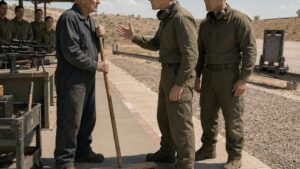
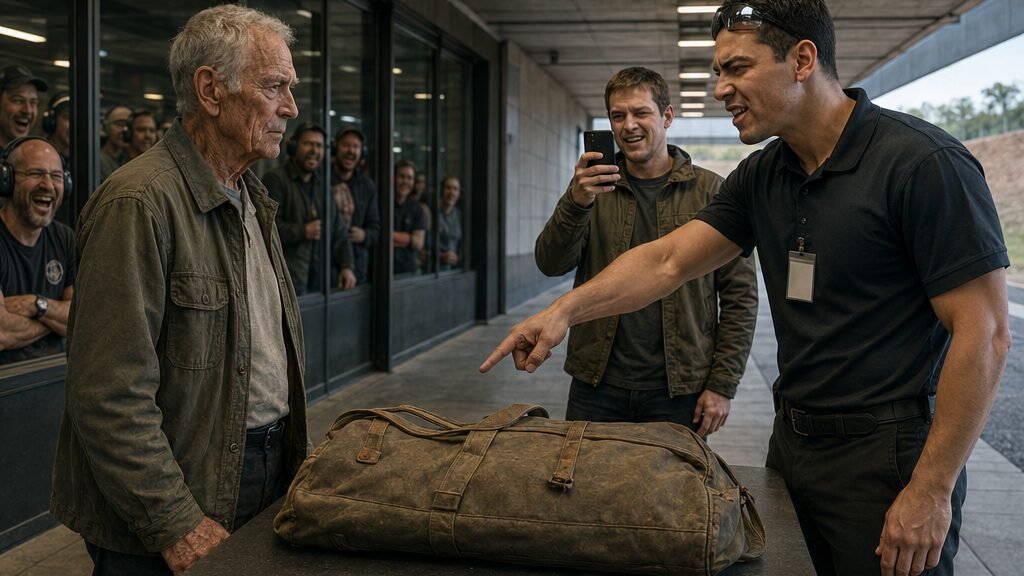
“Hey grandpa,” Brian Garcia called, pointing with two fingers at the faded canvas bag in Robert Harris’s hand, “the bingo hall is two blocks down.”
The bag landed on the shooting bench with a soft, tired thump.
For half a second the long-distance range stayed as still as it was supposed to be. The benches faced the firing lanes in a clean row. The glass behind them separated the spectators from the shooters. Far beyond the covered line, a thousand-yard lane stretched toward a pale square of target board that shimmered in the late-morning heat.
Then laughter cut through the room.
It started with the young man holding the phone. Jerry Thomas had been filming before Robert even reached the bench, his arm up, his grin ready. Two men behind him laughed because Jerry laughed. A woman near the coffee counter covered her mouth, not fast enough to hide it. Even a few shooters at neighboring lanes turned their heads.
Robert did not.
He set the bag down square with the bench edge, the way he had placed every range bag on every bench for more years than Brian had been alive. His hand remained on the canvas for a moment, palm flat, fingers crooked with age but steady.
The bag looked wrong in that room. Everything else gleamed. Carbon fiber cases. Foam-cut hard boxes. Polished optics tucked in molded trays. Range bags with stitched logos and new zippers. Robert’s bag was sun-faded green, patched twice along the side, with one brass buckle darker than the other. The corner near the muzzle end had been sewn by hand in thick black thread.
Brian stepped closer, his red RSO badge clipped high on his chest.
“No, I’m serious,” he said, turning slightly so Jerry’s phone could catch him in profile. “We have a dress code for equipment now? Because that thing looks like it rode here in a trunk since 1982.”
More laughter.
Robert lifted his eyes to Brian’s badge, then to Brian’s face. The young man’s sunglasses were mirrored, though they stood under the shade of the covered firing line. His polo shirt was tucked tight. His beard was shaped too neatly at the jaw. He held a tablet in one hand, but he had not looked at the lane assignment on it once since Robert arrived.
“Name?” Brian asked.
“Robert Harris.”
His voice was low enough that Jerry leaned closer with the phone.
Brian tapped the tablet without looking down. “Member?”
“Guest pass.”
“Oh.” Brian drew the word out. “That explains it.”
Robert heard the shift. Guest, not member. Old, not impressive. Canvas, not polymer. Alone, not part of the laughing cluster that had come in with tripods and branded hats.
He unzipped the small outer pocket of the bag and took out his folded pass. He held it to Brian.
Brian let him hold it there a second too long.
Behind the glass, Karen Moore stood in the doorway of the manager’s office, one hand on the frame, watching. Robert had seen her when he checked in. Polite smile. Fast eyes. The kind of person who measured a room by risk first and revenue second, though today the order seemed uncertain.
Jerry shifted to get her in the background of the shot.
Brian finally took the pass. “You done much long-range shooting, Mr. Harris?”
The “Mr.” landed as another joke.
“Some.”
“Some,” Brian repeated, delighted. “He’s done some.”
The spectators liked that one. Robert let the sound pass him. It scraped, but it did not enter.
He had learned early that anger was expensive. It spent breath, narrowed vision, made hands stupid. A man could talk himself tall and still shrink the moment pressure arrived. A man could also stay quiet and be mistaken for small.
He had been mistaken for many things lately.
At the grocery store when the clerk reached over him to lift the water case without asking. At the hardware store when the boy in the vest explained screw sizes to him twice and louder the second time. At the veterans’ breakfast when younger men thanked him before asking nothing, as if gratitude were a polite way to put him away.
He could have corrected them. Sometimes he almost did.
He never liked what correction pulled out of him.
Brian handed the pass back with two fingers. “Lane four. Thousand-yard side. Assuming your equipment clears.”
Robert folded the pass and slid it away.
Jerry lowered the phone just enough to speak over it. “Ask him what he’s shooting.”
Brian smiled. “Yeah. What did you bring, Mr. Harris? Lever gun? Antique bolt? Something with a wooden stock and a story?”
Robert looked at Jerry’s phone, then at Jerry’s face. Jerry was not laughing because something was funny. He was waiting for a shape he already knew how to sell: old man embarrassed at elite sniper range. He was building the clip in his head before anything had happened.
Robert turned back to the bench.
The range smelled of solvent, coffee, warm rubber mats, and the dry dust that blew in every time someone opened the outer door. Beyond the firing line, steel flags along the lanes moved in slight, uneven twitches. Robert noticed them without intending to. Wind never announced itself honestly at that distance. It revealed itself piece by piece.
So did people.
On the next bench, Laura Perez stood with a rifle case open in front of her and a box of match ammunition beside it. She was young, maybe mid-twenties, wearing new ear protection around her neck and trying not to look like she was listening. She glanced at Robert’s bag, then at Brian, then at Jerry’s phone.
When the men behind Jerry laughed again, her mouth tugged as if she might join them.
Robert saw it and looked away before she had to decide.
Karen remained in the office doorway. Her lips pressed together once. She looked at Brian’s badge, at Jerry’s raised phone, then toward the glass wall where a few visiting members had gathered. Robert watched her make the calculation and dislike herself for it.
She did not step forward.
“Safety briefing is in five,” Brian said loudly. “Try to keep up, sir. We run a professional facility here.”
Robert’s hand was still resting on the canvas bag. The fabric under his palm was rough and familiar. There was a small ridge where the inside lining had been patched after a buckle tore loose years ago. He had meant to replace the bag more than once. Never had. A good thing did not become useless because it stopped looking new.
Brian moved as if to leave, then turned back for the phone. “Actually, before we let you put anything on my line, I’ll need to inspect whatever museum piece you’ve got in there.”
The laughter returned, sharper this time because everyone understood the shape of the next humiliation.
Robert’s fingers curled once on the canvas.
He could leave.
The thought came clean and practical. Fold the pass. Pick up the bag. Walk out past Karen, past Jerry’s little lens, past Brian’s grin. Let the young man have his joke. Let the range keep its noise. There were other places to shoot. Quieter places. Worse benches, better manners.
But then Brian turned his body toward Laura’s lane and said, “This is why we check gear, folks. Confidence is great, nostalgia is not a safety plan.”
Laura looked down at her own rifle case.
Robert saw her shoulders tighten. Not because Brian had insulted him, but because Brian had turned the insult into instruction.
That was different.
Robert drew his hand off the bag. Slowly, he rotated it so the zipper faced him. The old brass pull rested near the stitched corner.
Brian leaned closer.
Jerry lifted the phone higher.
Behind the glass, Karen still did not move.
Robert looked once downrange, past the long strip of earth, past the range flags, toward the hard white square waiting at the far end.
Then he looked at Brian.
“Inspect it,” Robert said.
Brian’s grin widened as if Robert had handed him exactly what he wanted.
Chapter 2: The Scarred Rifle Comes Out Slowly
The zipper opened so slowly that the laughing men grew restless.
It made a dry, dragging sound along the faded canvas, not the clean plastic rasp of newer cases but an old metallic whisper broken by one snag near the middle. Robert stopped there, eased the fabric loose with a thumbnail, and continued without hurry.
“Suspense,” Jerry murmured, still filming. “I like it.”
Brian stood with his arms folded, already wearing the face of a man prepared to be disappointed. His sunglasses hid his eyes, but not the angle of his mouth.
Robert folded back the canvas flap.
The rifle inside did not look like a museum piece.
It looked worse, at first glance, for Brian’s purposes: heavily used, dark, scarred along the buttstock, the metal worn at places touched by hands over long years. There were custom fittings that did not match the clean showroom rifles displayed in framed advertisements along the range wall. Nothing about it looked decorative. Nothing about it looked careless either.
The laughter weakened before it stopped.
Brian leaned over the bag, expecting to find something obviously wrong. His expression shifted once, almost too quick to see.
Jerry moved the phone closer. “What are we looking at?”
“AR platform,” Brian said, recovering. “Old-school build.”
Robert did not correct him.
He lifted the rifle from the bag with both hands, muzzle controlled, action open, chamber visible before anyone asked. The movement was plain. Not dramatic, not fast. Just exact enough to make Laura Perez stop pretending she was busy with her own equipment.
Robert placed the rifle on the bench mat and set a small worn pouch beside it. Then a data book, its corners softened. Then a folded cloth. Each item came out in the same order it had gone in.
Brian glanced at the data book.
“What’s that, your diary?”
Robert opened the cloth and wiped a speck from the rifle’s receiver.
The silence that followed was not respect yet. It was irritation looking for a new joke.
Brian cleared his throat. “You understand this is a private long-distance facility, right? We don’t just let people show up and lob rounds downrange because they watched a movie once.”
“I understand.”
“Thousand yards is not the county fair.”
“No.”
Jerry laughed alone at that, then stopped when no one joined quickly enough.
Brian reached toward the rifle. “I’ll check it.”
Robert’s hand moved first.
He did not grab Brian. He did not slap his hand away. He simply placed two fingers on the bench between Brian’s hand and the rifle.
Brian froze.
For the first time, Robert saw the young man look at his hands instead of his face.
“Action is open,” Robert said. “Chamber is clear. Safety engaged. You may inspect from this side.”
The words were not loud, but they landed cleanly.
Brian’s jaw worked. “I know how to inspect a rifle.”
“I hope so.”
That should have been nothing. Barely a sentence. But Laura looked up at it, and one of the men behind Jerry made a quiet sound through his nose.
Brian heard it.
He took the rifle with more care than he had planned to show. He checked the chamber. Checked the magazine well. Looked along the barrel, then at the optic. His fingers moved competently enough, but there was a small impatience in them, a wish to be done and return to talking.
Robert watched the muzzle. Only the muzzle.
The scar on the buttstock caught Laura’s eye. It was deep, pale-edged, running at a diagonal as if the rifle had once met stone hard enough to remember it.
“Did you drop it?” she asked before she could stop herself.
Brian looked pleased. “Good eye.”
Robert glanced at her. “No.”
Laura waited for more.
None came.
Brian turned the rifle slightly toward the phone. “That’s what I’m talking about. Gear gets old, stories get bigger, and suddenly everyone thinks scratches are credentials.”
Robert’s expression did not change.
But the scar had not been from a drop. It had come from a night when the world had narrowed to dust, noise, and a wall that should not have held. A younger man had been breathing too fast beside him. Robert had slammed the stock against stone to make one jammed piece behave, and after that, the rifle had done what he needed it to do. He had never sanded the scar out.
A mark did not need admiration to remain true.
Brian set the rifle down. “It’ll pass mechanical inspection.”
“How generous,” Jerry said.
Brian smiled again, grateful for the rescue. “Optic’s a little much for someone who says he’s done ‘some’ shooting.”
Robert opened the data book. Inside were careful numbers, old notations, wind calls, dates, range conditions. He turned to a blank page.
Laura saw the handwriting. Tight. Level. Small enough that every line seemed placed with intent. On her own bench, her new notebook lay open with two pages of copied advice from online videos.
Brian tapped the target monitor attached to Robert’s lane. “You sure you can see that far?”
Robert looked downrange.
The target was a white mark at the end of a long shimmer. Between here and there, the air moved in layers. The nearest flag twitched left. The farthest one barely moved. The middle told the truth only when the mirage leaned.
“I can see enough.”
Brian gave Jerry’s phone a look. “At his age, seeing enough might mean seeing the bench.”
A few people laughed, but not all. Laura did not. Karen, still near the office doorway, had come a few steps closer now. Her arms were crossed, and she was no longer watching Jerry. She was watching Brian.
Brian noticed and straightened. “Range safety is my responsibility. I’m not being rude. I’m making sure nobody gets hurt because somebody’s pride outlived their eyesight.”
There it was, Robert thought. The excuse every careless man loved: cruelty dressed as caution.
He closed the data book.
“I came to shoot,” Robert said.
“Then you’ll shoot when I say you shoot.”
Brian’s voice had hardened, but underneath it was something less steady. The rifle had not given him what he needed. It had not been broken. Robert had not fumbled. The old man had not argued. Each missing failure made Brian reach more loudly for control.
Karen stepped closer. “Brian.”
He turned. “I’ve got it.”
Her mouth tightened. “Keep it professional.”
“It is professional.”
Jerry angled the phone between them. Karen saw it and stepped out of frame.
Robert slipped a magazine from the pouch, checked it, and set it on the bench without loading. He felt the old irritation move through him. It would have been easy to make one sentence heavy enough to end this. A unit named. A place named. A qualification. One cold recital of facts that would turn the room’s laughter into embarrassment.
But facts about the past had a way of becoming decorations in other people’s mouths. He had made a promise a long time ago, not at a ceremony, not with anyone watching. A promise to a man who did not get to become old: never make what they had lived through into a costume for authority.
So he said nothing.
Laura was still looking at the rifle.
Brian followed her gaze and disliked what he saw there. Not admiration exactly. Curiosity. Worse, doubt.
“All right,” Brian said. “Lane four. Farthest board. Since you came all this way.”
Jerry let out a low whistle. “Thousand-yard content.”
Robert began returning the cloth to the bag, leaving only what he needed.
Brian lifted one hand toward the farthest lane like a game-show host. “And keep filming,” he told Jerry. “For insurance.”
Robert picked up the rifle and the canvas bag.
At the next bench, Laura’s eyes followed him down the line.
Chapter 3: A Safety Briefing Turns Into A Show
Brian stepped too close behind Robert while speaking to the camera, close enough that his shadow crossed Robert’s rifle and lay there like a hand.
“Now, for anyone watching,” Brian said, voice bright and practiced, “this is what we call controlled supervision. Long-distance shooting is not just lying down and hoping your grandpa stories carry the bullet.”
Jerry snorted behind the phone.
Robert did not load.
He stood at lane four with the rifle resting safely on the bench, muzzle downrange, his data book open beside his left hand. The target monitor blinked at the edge of the bench. Through the glass behind them, several spectators had gathered. Some pretended to examine gear displays. Others made no effort.
Laura had moved two benches down, close enough to see without becoming part of Jerry’s group. Her ear protection was still around her neck. She had not resumed preparing her own rifle.
Brian continued talking. “We’ve had a lot of new interest lately because people see precision shooting online and think it’s all gear. Gear helps. But fundamentals matter. Supervision matters. Standards matter.”
Robert watched the nearest range flag turn, hesitate, and turn back.
Brian was saying true things in a careless place.
That bothered Robert more than the insults.
A lie announced itself. A half-truth dressed properly could do damage for years.
Karen Moore stood just inside the glass door now. She had a tablet tucked under one arm and a phone in her hand. Her eyes moved from Brian to Jerry to the spectators. The range was supposed to feel exclusive, controlled, serious. Instead it had the nervous energy of a show about to go wrong.
“Brian,” she said through the open door, “no filming past the marked line.”
Jerry’s sneaker was already over it.
Brian glanced down. “He’s fine.”
“He’s past the line.”
Jerry took one exaggerated step back, smiling into the phone. “Safety first.”
The men with him laughed. Brian let them.
Robert looked at Brian’s feet.
The young RSO had placed himself almost directly behind Robert’s right shoulder, angled toward the camera instead of the lane. It was not the worst thing Robert had ever seen. Not even close. But at a range like this, with strangers watching and a rifle on the bench, small sloppiness taught faster than careful instruction.
Robert closed the data book.
Brian noticed. “Need help finding the target?”
“No.”
“Need us to bring it closer? Maybe start at fifty yards and work up?”
Robert turned his head slightly. “You’re standing in the wrong place.”
The line went quiet enough that the far ventilation fans became audible.
Brian’s smile thinned. “Excuse me?”
Robert’s eyes moved once to Brian’s boots, then back to the lane. “If you are supervising, stand where you can see the shooter, the action, and the line. Not where the camera sees you.”
Jerry lowered the phone an inch.
Laura looked from Robert to Brian.
Brian’s face flushed high over the beard line. “I appreciate the concern, but I’m the RSO here.”
“I know.”
“I’ve certified more shooters this year than you’ve probably—”
He stopped himself, but not soon enough.
Karen heard it. So did everyone else.
Robert waited. He did not smile. He did not use the opening.
That made Brian angrier.
“We run a modern facility,” Brian said, voice clipped. “Members expect pace. They expect confidence. They don’t pay these fees to watch someone take ten minutes to settle into a bench.”
Robert looked at the empty lane beside him, the spectators behind glass, the phone, the tablet in Karen’s hand, the far white target. Everything had become audience. Even safety.
“Pace is not discipline,” Robert said.
Jerry caught that and whispered, “That’s going in.”
Brian swung a finger toward him without looking. “Keep rolling.”
Karen’s phone buzzed.
She glanced down, and something changed in her face. Not panic. Calculation under pressure. She stepped back from the door, read the message fully, then looked toward the front lobby as if someone might already be arriving.
Brian saw her distraction and took advantage of it.
“Range is hot after my command,” he said, loud enough to reclaim the room. “Mr. Harris here will demonstrate why equipment checks and RSO oversight matter. Everyone behind the glass, eyes and ears.”
A few spectators adjusted their ear protection. Jerry stayed at the edge of the marked boundary, phone up. His friends leaned toward him, trying to fit in the shot.
Robert’s fingers rested near the magazine but did not touch it.
Karen came through the door again. “Brian, one minute.”
He exhaled sharply. “What?”
“Membership review moved up. They’ll be here after lunch.”
Brian’s expression flickered.
Robert saw it: fear, fast and unwelcome.
Not fear of danger. Fear of being seen without shine.
Karen lowered her voice, but the line carried it. “I need this place clean. No incidents. No viral nonsense with our logo in the background.”
Jerry’s phone dipped.
Brian forced a grin. “Then we’re good. This is controlled. Educational.”
Karen looked at Robert for the first time as if he might be more than an inconvenience. “Mr. Harris, are you comfortable proceeding?”
It was the right question, asked late.
Robert could have used it. He could have said no. He could have made the manager take responsibility in front of everyone. He could have turned Brian’s own carelessness back on him before the rifle ever spoke.
Instead, he looked at the lane.
“I’m comfortable with the rifle,” he said.
Karen understood the missing half. Her eyes shifted to Brian.
Brian did too, and his mouth tightened.
“Great,” Brian said. “Then let’s stop holding up the line.”
Robert slid the magazine into place, still not rushing. The metallic click seemed louder than it should have. He settled behind the bench, his body old but economical, each motion stripped of decoration. His cheek found the stock. His breathing changed.
The room changed with it, though some did not know why.
Laura saw it first. The absence of wasted motion. The way his left hand did not hunt for comfort. The way he seemed less like a man aiming at a distant square than a man listening to several quiet things at once.
Brian saw only delay.
“Whenever you’re ready,” he said, then added for Jerry, “assuming that’s today.”
Robert did not fire.
The far flag stirred.
Behind him, someone chuckled, unsure whether the joke was still safe.
Brian leaned closer, anger rising through the polish of his voice. “Send one already.”
Jerry, almost whispering but not enough, said, “This is going to be the funniest clip we’ve had all month.”
Robert’s finger remained still.
For one breath, he considered standing up, clearing the rifle, packing the scarred stock back into the faded canvas bag. It would be clean. It would be quiet. It would keep the past where he had buried it.
Then he heard Laura shift behind him, heard Karen say nothing, heard Brian’s authority filling the space where discipline should have been.
Robert settled his breathing again.
The target waited at one thousand yards.
Chapter 4: The First Shot Changes The Room
Robert shouldered the rifle, and the whole range leaned toward his failure.
It was not a visible lean. No one pressed against the glass. No one stepped over the safety line. But the room gathered itself around the bench, around the old man behind the scarred rifle, around Brian Garcia’s waiting smile.
Robert felt it without looking. Expectation had weight. Mockery did too.
He settled his cheek against the stock and let the target become the only thing that mattered.
The white board sat at the far end of the thousand-yard lane, almost swallowed by distance and heat shimmer. It was a small, stubborn square in a moving world. Around it, the flags spoke in fragments. The closest one tugged left. The middle flags hesitated. The farthest flickered and fell still.
Behind Robert, Jerry Thomas whispered, “Here we go.”
Brian heard him and said loudly, “Shooter on lane four is preparing to fire. Everyone behind glass and ears on.”
He made it sound official. He made everything sound official when a camera was near.
Robert breathed in, breathed out, and waited.
Brian mistook the waiting for confusion. “Target’s the white square at the far end, Mr. Harris. Not the berm. The square.”
Robert’s finger rested outside the trigger guard.
More laughter moved behind the glass, thinner now, hungry but uncertain.
Robert let the breath leave him halfway.
The first shot cracked through the covered line.
It struck so far away that the sound of impact came back late, a faint mechanical confirmation through the target system. The monitor on Robert’s bench blinked and painted a mark.
Robert did not lift his head.
He fired again.
The second shot landed beside the first.
The room’s laughter faltered.
He fired a third.
Brian’s smile changed. It did not vanish. It held too long, like something glued in place.
Robert paused. Not because he needed to. Because the wind had shifted enough to deserve respect.
The range was quiet now except for the fan hum and the slight electronic chirp of the monitor. Even Jerry had stopped whispering. Laura Perez stood with her hands at her sides, her own rifle forgotten behind her.
Robert fired twice more.
The fifth shot ended the first string.
He lifted his head, opened the action, and rested his hands flat on the bench.
No one spoke.
On the monitor, five marks sat close enough together that, from a distance, they looked almost like one ragged dark spot.
Laura took one step forward before catching herself.
Brian moved first. He walked to the monitor with the brisk, annoyed pace of a man approaching a machine he intended to blame.
“That can’t be right,” he said.
Robert said nothing.
Brian tapped the side of the monitor. The screen did not change. He swiped through the lane display, then returned to the target image. The grouping remained there, tight and plain, with no interest in his disbelief.
Jerry angled the phone toward it. “Is that good?”
Nobody laughed.
Brian shot him a look. “It’s a monitor readout. Could be calibration.”
“The shots sounded clean,” Laura said.
Brian turned toward her. “You can tell that from back there?”
Laura’s face colored. “No. I mean—”
“You mean the system gave you a picture and now everyone’s an expert?”
She looked down, but this time not in embarrassment over Robert. In embarrassment over herself, over almost having joined the easy side of the room.
Karen Moore pushed through the glass door and came to the line. Her phone was in her hand again. She glanced at the monitor, then at Robert’s open action, then at Brian.
“Is there a problem with the target system?” she asked.
Brian hesitated. The membership review hung somewhere behind her question. So did Jerry’s phone. So did every laugh he had already invited.
“Could be,” he said. “We’ve had drift before.”
Karen looked at him. “On lane four?”
“All systems need checks.”
Robert picked up his pencil and made a small note in his data book. His hand moved no faster than before. The number he wrote meant something to him and nothing to anyone else.
Brian saw the note and hated it.
“You logging that as verified?” he asked.
Robert closed the book halfway. “I’m logging conditions.”
“You fired five rounds and got a screen result. That’s not the same as confirmed performance.”
“No.”
The agreement left Brian with nowhere to push for half a second.
Jerry filled the gap. “So we should go look at it, right?”
Karen’s eyes flicked toward the downrange retrieval controls. “We don’t need to send anyone downrange. The carrier can bring the target in.”
Brian lifted a hand. “Let’s not make this a production.”
That was rich enough that one of Jerry’s friends coughed to hide a laugh.
Brian heard it and stiffened. The room was turning. Not fully, not kindly, but the shape of the joke had begun to bend away from Robert.
He stepped back toward the firing lane. “Fine. Bring it in.”
Karen operated the retrieval system. Far downrange, the target board shifted. The carrier began its long mechanical return, slow at first, then steady along the track. Everyone watched it as if it were carrying a verdict.
Robert did not.
He removed the magazine, checked the rifle, and laid it safe. His movements stayed exact. That bothered Brian more than triumph would have. A triumphant man could be mocked for ego. A quiet man left no handle.
The target arrived with a soft bump against the frame.
Karen removed it.
The five holes were there, clustered so close that the paper around them had torn into a single dark wound slightly off center.
Not perfect. But disciplined beyond accident.
Laura’s lips parted. “At a thousand yards?”
Brian grabbed the target before Karen could answer. “This doesn’t prove what you think it proves.”
Robert turned his head slightly. “What does it prove?”
The question was calm. It did not challenge. It invited Brian to speak plainly.
Brian looked at the torn paper, then at the spectators, then at Jerry’s camera. His face had lost the polished confidence he wore like part of his uniform. Under it was something younger, more cornered.
“It proves you can shoot a group,” he said. “Once. With us watching a screen and a carrier. Fine.”
Karen’s eyebrows lifted. “Brian.”
“No,” he said quickly. “No, if we’re doing this, we’re doing it clean. Fresh target. Witnessed second string. Same lane, same distance. That way nobody can say there was a prior mark or system issue.”
Jerry perked up at the word “nobody,” sensing the drama returning. “That sounds fair.”
Laura looked at him sharply. “You were laughing five minutes ago.”
Jerry shrugged. “I’m documenting.”
Robert watched Brian hold the target. The young man’s thumb pressed too hard into the paper near the group.
There was fear in him now. Not enough to humble him. Enough to make him dangerous to his own dignity.
Robert could have refused. The first target had answered the first insult. Any serious shooter in the room understood what had happened. Karen understood enough. Laura understood more than she had expected to.
But Brian had used the word clean, as if Robert were the one who had dirtied the line.
Robert had let silence carry him this far. Silence had let Brian entertain the room. Silence had let Jerry turn a safety briefing into a setup. Silence had left Laura standing there, learning in real time how easily authority could become theater.
He looked at the old canvas bag lying open on the bench. The empty sleeve waited there, shaped by the rifle’s years.
A good thing did not become useless because it stopped looking new.
Robert turned back to Brian. “Fresh target, then.”
Brian’s relief came out as a laugh. “Good. Good. That’s what I thought.”
Karen took the damaged target from his hand and held it carefully by the edges. “I’ll witness.”
Brian shook his head. “Everyone will witness.”
He reached for a new white target from the rack and slapped it against the frame harder than necessary. Then he looked at Jerry and pointed at the phone.
“Keep it running,” Brian said. “This time, nobody gets to fake anything.”
Chapter 5: The Grip Correction Brian Did Not Want
Brian reached for Robert’s rifle as if the second target had given him permission to touch whatever he pleased.
Robert’s hand closed around the rifle first.
He did not pull it away. He did not raise his voice. He only turned his head and looked at Brian over the top edge of the bench.
Brian stopped with his fingers still curled in the air.
The pause lasted just long enough for everyone nearby to see who had control of the moment.
“I was going to demonstrate something,” Brian said.
“No.”
The word was small and final.
Brian let out a hard laugh, turning it toward the spectators. “Sensitive about the equipment now?”
Robert checked the chamber again, slow enough that the action itself answered him. Safe. Open. Clear. He rested the rifle back on the mat and kept one hand near it.
“You may speak,” Robert said. “You may not handle.”
Jerry’s phone drifted closer.
Karen Moore noticed. “Behind the mark, Jerry.”
He lowered the phone an inch but did not step back. “Just getting the discussion.”
“It’s not a discussion,” Karen said.
Brian’s eyes flashed toward her. “It’s fine. I’m trying to keep the line controlled.”
Robert looked down at Brian’s right hand. It hung near his belt, fingers flexing. Then he looked at Brian’s stance, at the way the young man planted his authority in his shoulders instead of his feet.
Brian saw him looking and snapped, “Something else you want to critique?”
“No.”
“Then load when instructed.”
Laura Perez, still two benches down, had not moved back to her own lane. She was staring at the fresh target fixed to the retrieval frame.
“Why would a prior mark matter,” she asked quietly, “if the first target came back clean except for his group?”
Brian turned. “Because verification matters.”
“I know. I’m asking how the system could place five false hits that tight.”
The question was not rude. That made it worse.
Brian opened his mouth, then closed it. “Electronic systems can have anomalies.”
“What kind?”
Jerry grinned behind the phone. He liked conflict in any direction as long as it moved.
Brian’s answer came a beat late. “Sensor registration. Carrier vibration. Display lag. There are a lot of things people don’t understand if they haven’t run a line.”
Laura nodded, but her eyes said the answer had not landed cleanly.
Robert saw her do something then. She looked at Brian not as the voice she hoped would approve her, but as a man whose words could be weighed.
That mattered.
Brian felt it too. He faced Robert again. “You see what you’re doing?”
Robert lifted his eyebrows slightly.
“You come in here with the silent routine, let everyone wonder, then act offended when I maintain standards.”
“I am not offended.”
“Could’ve fooled me.”
Robert almost smiled at that, not from amusement. From weariness.
There had always been men who mistook stillness for judgment because they carried their own verdict inside them. Brian was not the first. He would not be the last.
Karen’s phone buzzed again. She checked it, then stepped toward the office door with a tight inhale. “Review group just confirmed. Forty-five minutes.”
Brian’s posture changed at once. “Then we need to wrap this.”
“You started it,” Karen said.
“I supervised it.”
“You performed it.”
The words struck harder because she did not raise her voice.
Jerry’s phone caught Brian’s face before he could arrange it.
Brian pointed at him. “Don’t post anything without clearance.”
Jerry blinked, surprised by the turn. “You told me to keep rolling.”
“For insurance.”
“Right.” Jerry smiled. “Insurance.”
Robert lowered his eyes to the data book. The page from the first string lay open. He had written wind, light, and hold. Nothing about Brian. Nothing about laughter. He had spent a lifetime learning what belonged in the record and what only clouded the hand.
Still, his own silence now felt less clean than it had an hour before.
He remembered a different range, not this polished place with glass and coffee, but a strip of hard earth where young men learned quickly or not at all. He remembered a man beside him, too eager to look brave, too ashamed to admit he did not understand a correction. Robert had seen the mistake forming. He had been tired. He had let another instructor handle it.
The consequence had not been dramatic enough for stories. No grand tragedy. No headline. Just a preventable injury, a ruined hand, and a young man’s face going gray with the knowledge that confidence had lied to him.
After that, Robert had promised himself two things that did not always fit together. He would never wear experience like a medal for applause. And he would never again ignore arrogance when it touched safety.
Today, he had nearly broken the second promise to protect the first.
“Fresh target’s ready,” Karen said.
Brian took the opening. “Good. Mr. Harris, whenever I give the command—”
Jerry interrupted with a laugh. “Hold up. This first clip is already gold.”
Robert looked at him for the first time since the rifle came out.
Jerry was bent over his phone, thumb moving quickly. The screen showed Robert at the bench, edited tight. Brian’s voice carried over the footage: equipment checks and RSO oversight matter. Then Robert’s quiet warning about Brian’s position appeared without the context that Brian had stepped too close. The cut made Robert seem fussy, possibly confused. The first shot was missing. So was the target.
The caption line at the bottom read: OLD GUY GETS CHECKED AT 1,000-YARD RANGE.
Laura saw it over Jerry’s shoulder. “That’s not what happened.”
Jerry kept typing. “It’s a teaser.”
Karen strode toward him. “Do not post that.”
“It’s my footage.”
“It’s my facility.”
Brian looked trapped between anger and opportunity. The clip made him look authoritative. It made Robert look like a problem. It also made the range look active, watched, alive. For one visible second, Brian wanted it to spread.
Robert saw that second.
Karen held out her hand. “Show me.”
Jerry hesitated. Brian said nothing.
That silence decided something for Robert.
Karen took the phone when Jerry finally surrendered it and watched the short edit. Her face hardened as the caption appeared. She looked at Brian. “You knew he was cutting this?”
Brian’s mouth opened. “I can’t control what people—”
“You told him to keep rolling.”
“For insurance,” Jerry said lightly.
Karen ignored him and walked to Robert. She held the phone so he could see the frozen frame: his aged face half turned, Brian bright and centered, the scarred rifle cropped like an accusation on the bench.
“Mr. Harris,” she said, quieter now, “is there anything you want to tell me before this becomes public?”
Chapter 6: The Smiley Face At One Thousand Yards
Robert looked at the misleading frame on Jerry’s phone, then at the fresh white target waiting downrange.
“No phones on the line,” he said.
Brian’s head jerked up. “You don’t set range policy.”
Robert looked at Karen.
For once, she did not look away.
“No phones on the line,” she repeated. “All recording behind glass, behind the marked boundary. Jerry, hand it over or leave now.”
Jerry pulled the phone back against his chest. “That’s not—”
“Now.”
The softness had gone from Karen’s voice. Maybe it had been removed by the membership review. Maybe by the first target. Maybe by the sight of her facility being turned into a lie while her own RSO stood close enough to stop it and chose not to.
Jerry glanced at Brian.
Brian did not help him fast enough.
With a theatrical sigh, Jerry saved the clip and surrendered the phone to Karen. His friends muttered but stepped back with him behind the glass. The spectators shifted, disappointed and alert. Drama without a camera made them uneasy, as if meaning required a lens to prove it had happened.
Robert turned to Brian. “You will stand there.”
He pointed to a place slightly behind and off to the side, where Brian could see the line without crowding it.
Brian stared. “Excuse me?”
“If you are supervising, supervise.”
A flush rose under Brian’s skin. “I don’t take commands from guests.”
Karen’s voice came from behind him. “Today you will.”
The words changed the air more than the first shot had.
Brian turned on her. “Karen, seriously?”
“Seriously.” She held Jerry’s phone in one hand and the first target in the other. “We have a review team arriving in less than an hour. We have a guest being misrepresented on video inside my facility. We have an RSO arguing about basic line control in front of members. Stand where you’re supposed to stand.”
For a moment Brian looked younger than before. The polished edges fell away. What remained was a man who had built himself in other people’s eyes and now felt those eyes pressing back.
He stepped to the place Robert had indicated.
Not far. Just enough.
Laura noticed. So did Jerry behind the glass. So did everyone who had laughed earlier.
Robert did not load yet.
He opened the canvas bag and took out the folded cloth again. The scarred rifle lay on the bench, its worn stock dull under the range lights. He wiped the same place he had wiped before, though there was nothing visible on it now. The gesture slowed the room. It brought everything back to the rifle, the bench, the lane, the target.
Not Brian’s voice. Not Jerry’s caption. Not Karen’s fear of the review.
The work.
Robert opened his data book to the fresh page. He made two small marks, then another. Laura could not read them from where she stood, but she understood now that he was not pretending at mystery. He was recording the world as it changed.
Brian shifted his weight.
Robert glanced at his feet.
Brian stopped.
Karen saw it and looked down to hide the smallest movement at the corner of her mouth.
“Range is hot,” she said.
Brian was supposed to say it. Everyone knew that. The fact that Karen said it instead left his authority standing on the floor between them, cracked but not yet gone.
Robert inserted the magazine.
The sound was small and metallic.
He settled behind the rifle. This time nobody laughed about how long he took. Nobody told him to send one. Nobody whispered about grandpa stories.
The silence had a different texture now. Before, it had waited to devour him. Now it waited to learn whether he had more to say.
Robert did not like performance. Performance wanted applause. Performance wanted a winner and a loser. Performance made men do foolish things with useful tools.
But correction was not performance.
He let his breathing slow.
The far white target wavered in the heat. The wind had not stilled; it never did. It only changed its mind. He watched the flags, but also the shimmer between them, the faint leaning of air over the dirt, the pulse of timing no machine could hand him.
He fired.
The first shot landed high left.
A murmur rose behind the glass.
Brian’s shoulders eased a fraction, hope returning too quickly.
Robert fired again.
The second shot landed high right.
The murmur changed shape.
Brian looked at the monitor, then at Robert, confused. The grouping was not tight. It was separated, deliberate in a way he could not read yet.
Robert fired the third shot.
Low left.
Laura’s hand came slowly to her mouth.
She saw it before Brian did.
Robert paused longer before the fourth. A flag halfway down the lane twisted, flattened, and lifted again. He waited through two breaths. Then he fired.
Low right.
Karen stepped toward the monitor.
The four marks sat like corners around an empty center.
Brian whispered, “What is he doing?”
Robert fired the fifth shot.
It landed near the middle, slightly low. Then another near it. Then another, curving upward. He did not rush, but the space between shots shortened until the rifle seemed less like an explosion and more like punctuation in a sentence only the paper could read.
The spectators behind the glass stopped moving.
Robert’s world narrowed. Target. Breath. Pressure. Sight. Reset. The old scar in the stock touched his shoulder through his shirt, a familiar ridge. There were ghosts in the feel of that rifle, but none stepped forward. He did not invite them. He had brought skill to the bench, not memory for public consumption.
Shot by shot, the shape appeared.
A curve.
Two points.
A ridiculous, impossible face forming at one thousand yards.
It should have been funny. No one laughed.
When the final shot cracked, Robert held position through the follow-through, then opened the action and made the rifle safe.
The monitor showed the target clearly enough for everyone to understand before the carrier ever moved.
A smiley face stared back from the white square.
Not childish. Not careless. Terrible in its control.
Brian took one step toward the monitor, then stopped as if the floor had changed under him.
Karen did not speak. She pressed the retrieval control.
The target began its long journey back.
No one filled the silence. Jerry did not ask for his phone. His friends did not mutter. Laura stood very still, eyes bright with something like shame and wonder tangled together.
Robert removed the magazine, checked the rifle again, and laid it down. His hands were still steady, but something inside him had shifted. Not satisfaction. Not victory.
Relief, maybe. And regret that it had required this much.
The target carrier arrived with a soft mechanical bump.
Karen removed the paper and held it up.
Seen in the room, without screen or distance, the face looked even more impossible. The holes were clean enough to show intention. The smile curved with insulting gentleness. The two eyes were level.
No applause came.
That was good.
Applause would have ruined it.
Robert took the target from Karen. He looked at it only long enough to confirm what he already knew, then turned to Brian.
Brian’s mirrored sunglasses no longer hid him. He had pushed them up onto his head at some point without realizing it. His eyes were fixed on the paper.
Robert walked to him and held it out.
Brian accepted it because there was nothing else to do.
The paper rustled once between his fingers.
Robert looked down at Brian’s hands, then at the way his right wrist bent slightly inward, the way tension lived where control should have been.
“You hold your rifle like a tourist,” Robert said. “Fix your grip.”
Chapter 7: The Range Finally Learns Quiet
Karen took the smiley-face target from Brian’s hands, looked at it once, then turned to Jerry behind the glass.
“Your access badge,” she said.
Jerry blinked as if the words had arrived in the wrong language. “What?”
“Badge. Now.”
The room was still too quiet for anyone to pretend this was a normal range correction. The fans hummed overhead. Somewhere beyond the firing line, the target carrier clicked back into its resting position. Robert stood at lane four with the rifle safe on the bench and the old canvas bag open beside it, waiting without expression while the consequence moved past him toward the people who had invited it.
Jerry forced a laugh. “Come on. We were just filming.”
Karen held out her hand.
His friends looked at him, then at Brian, searching for the person who still had authority. Brian stared at the target in Karen’s other hand. The smiley face had folded slightly at one corner where his fingers had pressed too hard.
Jerry unclipped the visitor badge from his shirt and slapped it into Karen’s palm. “This is ridiculous.”
“No,” Karen said. “Ridiculous was you editing a guest into a lie while standing inside my facility.”
“I didn’t post it.”
“Because I took the phone.”
Jerry’s mouth tightened. “You can’t keep that.”
“I’m keeping it long enough to delete footage taken past the marked line and document why your group is being removed.”
One of Jerry’s friends stepped forward. “You said filming was allowed.”
“Behind glass,” Karen said. “With permission. Not on the line. Not during active supervision. Not while provoking a guest.”
Jerry pointed at Brian. “He told us to keep rolling.”
The words struck the line harder than the rifle shots had. Brian looked up fast.
“I said for insurance,” he snapped.
Jerry laughed once, sharp and ugly. “You said that after you made the bingo hall joke.”
Brian’s face reddened. “Don’t put this on me because your clip got killed.”
“My clip?” Jerry stepped closer to the glass door. “You were feeding it to me.”
Karen raised one hand. “Enough.”
The command worked because it came from someone who finally meant it.
Robert began packing the small items first. Data book. Cloth. Empty magazine. He did not rush, but the movements no longer felt like retreat. Each object returned to its place as if the range were being restored one quiet act at a time.
Laura Perez stood near her bench, her face pale with the burden of having seen too much to stay neutral. Brian noticed her looking and seized on it.
“Laura,” he said, trying to steady his voice. “You were here. You saw them pushing the camera. You saw how fast this got out of hand.”
Laura’s eyes moved to Jerry, then to Karen, then finally to Robert.
Robert did not look at her. He gave her no signal, no request, no protection from the choice.
She swallowed. “I saw Brian encourage it.”
Brian’s head turned slowly. “What?”
Laura’s fingers closed around the edge of her bench. “At first, I thought it was just joking. I almost laughed too.” Her voice shook once, then steadied. “But you kept making it worse. You told him to film. You stood too close. When Mr. Harris told you your position was unsafe, you acted like he was confused.”
Brian stared at her as though betrayal required friendship first. “You don’t know what you’re talking about.”
“Maybe not about everything,” Laura said. “But I know what I saw.”
Karen looked at her for a second, and something in her expression softened. Not gratitude exactly. Recognition. The cost of speaking plainly after silence had become convenient.
Brian saw that too, and the last of his confidence shifted into defense.
“So that’s it?” he said. “Everybody’s suddenly an expert because he drew a face on paper? That doesn’t change protocol. That doesn’t change the fact that I’m responsible for this line.”
“No,” Karen said. “It doesn’t change that you were responsible. That’s the problem.”
Brian’s mouth opened, but no answer came quickly enough.
Karen turned to the small group behind the glass. “Jerry, your group is permanently barred from the firing line and guest access is revoked. You can collect personal property under staff supervision. If any edited footage from today appears online, our attorney will contact you.”
Jerry’s arrogance flared, then faded when he looked around and found no audience willing to laugh. He took one step back. “This place is going to regret treating creators like this.”
Karen’s face did not move. “We’ll survive without that kind of attention.”
The friends behind him began gathering their bags.
Brian let out a breath that was almost relief. Jerry had become the easier target, and for a moment Brian tried to stand on that. “Good. That solves the problem.”
Karen turned on him.
“No. It starts with them. It does not end with them.”
Brian went still.
Karen pointed toward the office. “You are relieved from RSO duty pending review.”
His sunglasses sat crooked on top of his head. Without them over his eyes, he looked exposed. “Karen, don’t do this in front of everyone.”
“You did everything else in front of everyone.”
A few spectators looked away. It was one thing to watch humiliation when it felt like entertainment. It was another to watch consequence arrive without music.
Brian lowered his voice. “The review team is coming. You want them walking into this?”
“I want them walking into a facility that corrects its mistakes before someone else has to.”
“They like the online traffic,” Brian said. “You know they do. Half the new memberships came after Jerry’s last video.”
“I know.” Karen’s answer came too quickly, and with it came the admission Robert had been waiting for someone in the room to make. “And I let that matter too much.”
Brian stared at her.
Karen glanced toward the glass, where Jerry’s group was being guided toward the lobby by a staff member. “There were complaints. Smaller ones. Noise on the line. Filming too close. Guests feeling pushed around. I treated them like personality conflicts because the numbers looked good.”
Brian’s anger changed shape. “So now it’s all on me?”
“No,” Karen said. “Not all. But enough.”
Robert zipped one pocket of the canvas bag.
The sound made Brian look at him.
For the first time all morning, Brian seemed to understand that Robert was not enjoying any of this. That may have made it worse. Revenge would have allowed Brian to hate him cleanly. Robert gave him no such gift.
Karen set the smiley-face target on the bench between them. “Brian, go to the office. Turn in your line keys.”
He looked at the target instead.
The face stared up from the paper, absurd and merciless in its gentleness.
Brian picked it up carefully, as if roughness now might make the holes rearrange themselves into something less final. His thumb hovered near one eye but did not touch.
Laura returned to her bench and began closing her rifle case. She did not look triumphant. She looked like someone who had discovered that belonging to a room could cost more than being laughed at by it.
Robert lifted the scarred rifle and lowered it into the canvas bag.
Brian watched the weapon disappear into the faded fabric. “Why didn’t you just say?”
Robert paused with one hand on the zipper.
Brian’s voice was quieter now, too quiet for the spectators behind glass but clear to Robert, Karen, and Laura.
“Why didn’t you just say who you were?”
Robert looked at him, and the question hung there with the folded target in Brian’s hands.
Chapter 8: The Same Old Bag Leaves First
Brian followed Robert into the parking lot with the smiley-face target folded under one arm.
He did not call after him at first. He let the glass door close behind them, let the range noise shrink into a muffled hum, let the late-afternoon light expose how small the day had become without an audience.
Robert walked toward an old pickup parked near the far end of the lot. The faded canvas bag hung from his right hand, the weight familiar enough that his shoulder adjusted without thought. He had carried it into the building under laughter. He carried it out under silence. The bag had not changed.
Brian had.
“Mr. Harris.”
Robert stopped beside the pickup but did not turn immediately. He set the bag gently on the tailgate, as if even now the rifle deserved better than the day had given it.
Brian stood several feet away, no sunglasses over his eyes, no badge clipped high enough to make him taller. The folded target bent under his fingers.
“I asked you something,” Brian said, but the old edge was gone from it. Habit, not force.
Robert turned.
Brian looked down at the paper. “Why didn’t you just say who you were?”
The question had many answers, most of them useless.
Robert could have named units, years, places the young man would search later and misunderstand. He could have given him a story with enough dust and pain in it to make Brian feel ashamed for reasons that had nothing to do with today. He could have lifted the past like a weapon and watched it strike.
Instead, he rested one hand on the canvas bag.
“Because who I was does not make the line safe today.”
Brian frowned, as if he had expected a title and received a tool he did not know how to hold.
“You know what I mean,” he said. “You could’ve shut me up in ten seconds.”
“Yes.”
That answer hit harder than Brian expected. He looked away toward the low wall at the edge of the parking lot. “Then why let it go that far?”
Robert looked back at the range building. Through the glass, he could see Karen near the front counter, speaking to the staff member who had escorted Jerry’s group out. Laura stood alone by the display wall, her rifle case at her feet, watching without pretending not to.
“I shouldn’t have,” Robert said.
Brian’s head turned. “What?”
“I let it go too far.”
For the first time since the old man had arrived, Brian had no ready expression.
Robert unlatched the canvas bag, checked the rifle one final time by touch, then closed it again. He did not need to do it. He did it because some habits were not for other people.
“There is a kind of silence that keeps a man from showing off,” Robert said. “That kind is useful.” He pulled the zipper halfway, then stopped. “There is another kind that lets the loudest man teach the room badly.”
Brian’s grip tightened on the folded target.
Robert looked at his hands. “Today I used the wrong kind too long.”
The admission did not rescue Brian. It removed the easy story in which Robert was perfect and Brian was only cruel. Brian did not seem grateful for that. He seemed unsettled by it.
“I thought,” Brian said, then stopped.
Robert waited.
Brian tried again. “I thought if I looked like I had control, people would trust the line.”
“People trusted your badge.”
“Same thing.”
“No.”
Brian swallowed. The word had landed exactly where it needed to.
He unfolded the target enough to see one corner of the smile. “You really did that on purpose.”
Robert gave him a dry look.
Brian almost laughed, but shame stopped it. “Right.”
For a moment neither spoke. A car passed on the road beyond the fence. Somewhere inside the building, a door opened and closed.
Brian rubbed the back of his neck. “I worked hard to get that RSO position.”
“I believe you.”
“You say that like it doesn’t matter.”
“It matters.” Robert lifted the canvas bag off the tailgate and set it inside the truck bed. “It is not enough.”
Brian’s face tightened, but he did not argue.
The glass door opened behind them. Karen stepped out, holding Jerry’s phone in one hand and her tablet in the other. Her expression had the tired control of someone who had chosen the hard correction and now had to live with the paperwork.
“Mr. Harris,” she called.
Robert turned.
Karen crossed the lot but stopped at a respectful distance from the truck. “I owe you an apology.”
Robert waited.
“I saw what was happening before I stopped it,” she said. “That’s on me.”
Brian looked down.
Karen continued, “I also wanted to ask whether you’d consider coming back. Privately. Not as a show.” She glanced at the building, then back at him. “Maybe a safety clinic. Or we could put something on the wall about discipline standards. Your target, even. No name if you prefer.”
Robert looked through the glass again. The range beyond it was clean, expensive, and quiet now, but not innocent. Places were like rifles. Maintenance mattered more than polish.
“No wall,” he said.
Karen accepted it, though disappointment flickered. “Understood.”
“No spotlight,” he added.
“Understood.”
Brian looked at him. “Then what do you want?”
Robert closed the truck bed with a firm metallic click. “For him to fix his grip.”
Karen blinked.
Brian looked down at his own hands as if they had betrayed him twice.
Robert stepped toward him. Not close enough to threaten. Close enough to teach if Brian could bear being taught.
“Your wrist breaks inward when you want control,” Robert said. “You muscle the rifle because you don’t trust your position. Then you call the tension discipline.”
Brian stared at him.
Robert pointed once, not touching. “Fix that first. Then fix the attitude that comes from the same place.”
Karen said nothing.
Brian’s face moved through anger, humiliation, resistance, and something smaller. Something that might become understanding later, if he did not cover it too quickly.
“You’re still correcting my grip?” he asked.
“Yes.”
“After all that?”
“That was the first true thing I said to you.”
Brian looked at the target again. The smile seemed less like mockery now and more like a mark left by a standard he had failed to meet.
Robert opened the driver’s door.
Laura had come outside and stopped near the entrance, her rifle case in one hand. She did not approach. She only lifted her chin once, a small gesture of thanks or respect or apology. Robert returned it with the slightest nod.
No applause. No cheering. No phone raised to capture it.
Good.
Brian took one step toward the truck before Robert got in. “Mr. Harris.”
Robert paused.
Brian’s voice was rough. “I don’t know how to fix all of it.”
Robert looked at him for a long second. “Start with the part in your hand.”
Brian looked down at the folded target.
Robert climbed into the truck and shut the door. The engine turned over with a low, uneven sound, old but maintained. He backed out carefully, not hurrying even now.
As he drove toward the exit, the canvas bag rested on the seat beside him, its patched corner facing upward. In the side mirror, Brian stood in the parking lot with the smiley-face target unfolded in both hands, studying it not as proof of his humiliation, but as instruction he had finally become quiet enough to read.
The story has ended.