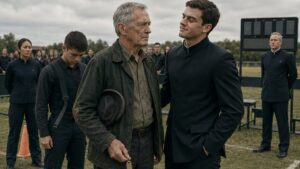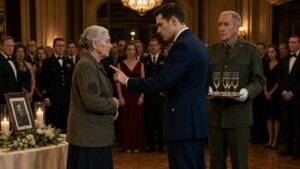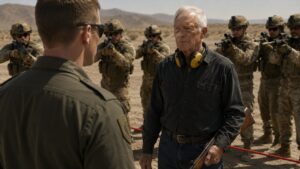
When Jason Refused the Trophy After Silence Won the Entire Range
Chapter 1: The Joke at the Registration Table
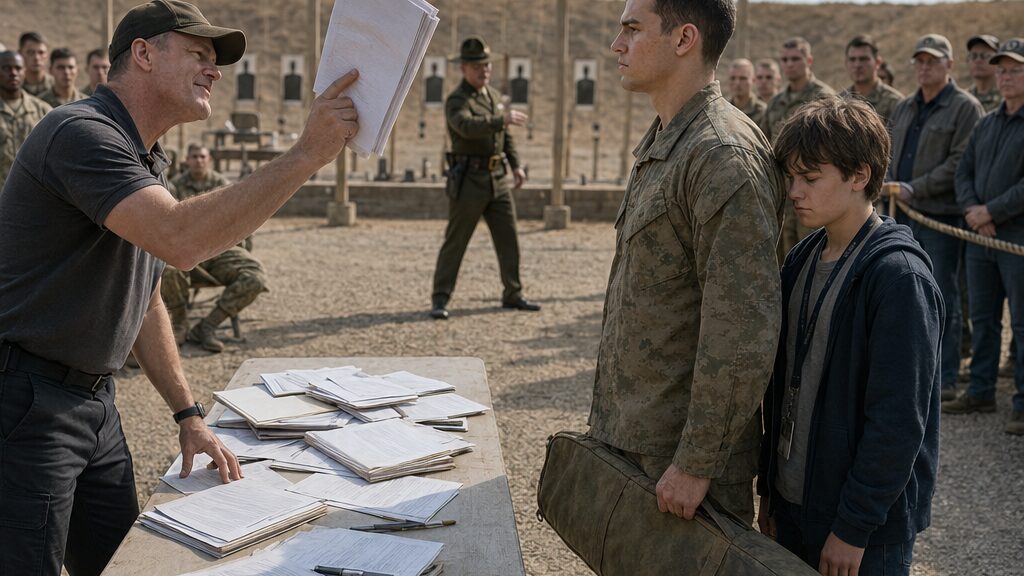
“Need help?” Ronald Thompson asked, lifting the registration packet like it was a surrender flag. “Or should I move the target to five yards for the boot?”
The line at the registration table went quiet for half a second, just long enough for the insult to land, and then the laughter broke loose.
Jason Hall stood with one hand on the strap of the faded rifle case hanging at his side. He did not smile. He did not look down. He did not give Ronald the satisfaction of a flinch. Beside him, Jessica’s shoulders tightened until the youth program lanyard around her neck pulled crooked against her shirt.
Ronald leaned back in the folding chair, pleased with himself. He was broad through the middle, his veteran ball cap worn low, his range polo stretched at the buttons. He had the easy confidence of a man who had found a table, a stack of forms, and an audience.
The family-support recreation range was supposed to feel welcoming. There were banners clipped to the fence, a table with coffee and donated pastries, a sign pointing youth applicants toward orientation, and another sign pointing active-duty personnel toward the marksmanship standard review. Beyond the registration area, steel targets stood in clean rows under the morning light. Soldiers clustered near the staging lanes, too loud, too restless, feeding off every moment that looked like entertainment.
Jessica had been proud when they arrived. Jason had seen it in the way she walked a half-step ahead of him, scanning uniforms and signs, pretending not to be impressed. She had asked twice in the truck whether active-duty soldiers would actually be firing while the youth program watched. Jason had said yes, if the schedule held. She had asked whether he would shoot too. He had said only if they needed him to.
Now she was staring at Ronald as if the whole range had shifted under her feet.
“He’s not a boot,” she said.
Jason’s hand moved before her voice could sharpen further. He rested his palm lightly on her shoulder.
Jessica stopped, but she did not relax.
Ronald noticed the gesture. His grin widened.
“Well, look at that,” he said. “Discipline. Maybe there’s hope.”
A few soldiers near the staging fence laughed again. Not all of them. Some only looked over, curious and uneasy, but the sound was enough. Jessica heard it. Jason knew she heard it because she swallowed and pulled the lanyard straight with a quick, embarrassed motion.
“We’re here for youth orientation,” Jason said. His voice stayed low and even. “And I’m listed for the active-duty review if there’s still room.”
Ronald exaggerated a glance at the packet. “Name?”
“Jason Hall.”
Ronald’s finger moved down the page too slowly.
“Hall,” he repeated. “Jason Hall. Active-duty review.” He looked up. “You bring your own rifle case to community day, Jason?”
“It’s cleared for inspection.”
“Didn’t ask that.”
Jason held his gaze.
The rifle case was old canvas, the green faded toward gray, the corners darkened from years of truck beds, barracks floors, armory benches, and bad weather. It did not look like the sleek cases leaning against the equipment tent. It had no glossy logo, no bright stitching, no expensive shell. Jessica had asked him once why he still used it. He had told her it worked.
Ronald tapped the packet against the table. “You know, most of the active-duty boys already checked in before formation. Early. Squared away. That kind of thing.”
“We were directed to this table.”
“By who?”
“The front gate volunteer.”
Ronald gave a soft whistle and looked toward the soldiers. “Front gate volunteer. That’s official now.”
The laughter came quicker this time.
Jason felt Jessica lean forward, ready to speak again. His hand stayed on her shoulder, not pressing down, just present. She turned her head slightly, eyes bright with anger.
“Don’t,” he said softly.
She stared at him as if he had taken Ronald’s side.
That was the first cut of the morning that reached Jason cleanly.
Ronald flattened the packet and pulled a pen from behind his ear. “All right, let’s see what we can do for you. Youth orientation for little sister, charity exhibition for big brother—”
“Active-duty review,” Jason said.
Ronald’s pen paused. “That right?”
“Yes.”
“Orders?”
Jason removed a folded sheet from his jacket pocket and set it on the table.
Ronald took it with two fingers, as if it might stain him. He looked at it, then at Jason’s sleeve, then back at the paper. Something small changed in his face. Not fear. Not recognition exactly. A tightening. A quick inventory.
Then he covered it with a smirk.
“You people love paperwork until it slows you down,” Ronald said. He slid a clipboard toward Jason. “Fill this out.”
Jason looked at the form.
“I filled that one online.”
“This one’s local.”
Carol Martinez, the family-support coordinator, stood two chairs down checking names against a tablet. She glanced over, her brow lifting as if she might object, but a parent at her end of the table asked about youth program release forms and pulled her attention away.
Jason picked up the pen.
The form asked for information already printed on the sheet Ronald had in his hand. Name. Unit. Emergency contact. Range experience. Acknowledgment of safety briefing. Jessica watched him fill it out. The soldiers watched too, or pretended not to while laughing among themselves.
Ronald waited until Jason reached the bottom before sliding another sheet on top of it.
“And this.”
Jason read the heading. “This is for civilian guests.”
“You’re a guest here today.”
“I’m active-duty.”
“You’re at a community recreation facility,” Ronald said. “Means guest procedures apply.”
Jessica’s voice came out tight. “You’re just making stuff up.”
Ronald turned his attention to her. His smile cooled.
“You planning to join the youth program?” he asked.
Jessica lifted her chin. “Maybe.”
“Then first lesson. Rules feel made up when you don’t know them.”
Jason felt the words hit her harder than the joke had. Her face flushed, not with shame alone, but with the fear that maybe Ronald represented something real, something she had wanted to enter and now did not understand.
Jason took the civilian form.
Ronald seemed almost disappointed that he had not argued.
The line behind them shifted. Someone sighed. A soldier near the fence called out, “Give him crayons next.”
Ronald laughed at that, too loudly.
Jason finished the second form. Ronald took it, examined the signatures, and tapped the table with the pen.
“Missing range sponsor initials.”
“Who signs that?” Jason asked.
“I do.”
Ronald let the answer hang between them. Then he reached for another paper.
Jason kept his breathing even. In through the nose. Hold. Out slow. The old rhythm came without thought. He did not look toward the firing lanes. He did not look at the rifle case. He watched Ronald’s hands.
Those hands moved with theatrical purpose. Slap a form down. Flip a page. Circle an empty box. Straighten the stack. Each sound made the delay feel official.
Carol’s voice rose from the other end. “Active-duty review begins in twenty minutes. All shooters need to be through equipment check before then.”
Jessica looked at Jason.
Ronald heard it too. His eyes flicked toward the firing line, then back. “Better hurry.”
He pushed a final page forward.
Jason read the top line. Recreational Exhibition and Charity Demonstration Participant.
“That’s not my category,” Jason said.
Ronald took the page back with practiced annoyance. “It’s the available slot.”
“I’m not here for exhibition.”
“You’re late.”
“I’m not late. I’ve been at this table.”
The words were still calm, but something in them made Ronald sit forward.
Around them, the laughter thinned. Not stopped, but listened.
Ronald lowered his voice just enough to pretend he was being reasonable. “Listen, son. I’ve run more range days than you’ve had hot breakfasts. You want to shoot today, you take the slot I can give you. You want to stand here proving how special your paperwork is, that’s your choice.”
Jason could have asked for Carol. He could have called over the drill sergeant whose voice was already carrying from the staging lanes. He could have unfolded the orders again and placed his finger under the printed category.
Instead, he looked at Jessica.
She was waiting for him to do something. Not shoot. Not win. Just refuse to be handled.
Jason signed where Ronald pointed.
Something in Jessica’s expression closed.
Ronald took the packet, stacked the pages with a satisfied tap, and pulled a red stamp from beside the cash box. He pressed it onto the top sheet with unnecessary force.
CHARITY EXHIBITION.
The red letters bled slightly at the edges.
Ronald slid the packet across the table and smiled as if he had done Jason a favor.
“There,” he said. “Standard procedure.”
Chapter 2: Papers, Whistles, and a Slipping Platoon
“Quiet on the staging line!”
Drill Sergeant Stephen Campbell’s voice cracked across the range hard enough to turn heads, but the platoon near the firing lanes only settled for a breath before another whistle cut through the air.
Stephen stood with his hands locked behind his back, jaw set, cap brim low over his eyes. He had the posture of a man built from rules, but the morning was leaking through his fingers. Senior observers waited near the review board with clipboards. Parents hovered near the youth program signs. Soldiers shifted, joked, leaned on the railings, and watched the registration table as if Ronald had become part of the scheduled entertainment.
Jason held the stamped packet in one hand.
Jessica stared at the red words.
Charity Exhibition.
“Jason,” she said, quiet enough that only he could hear, “why did you sign that?”
Ronald answered before Jason could.
“Because he wants to shoot.” He stood and stretched, bringing the packet with him. “And because grown-ups understand compromise.”
Jessica’s eyes snapped to him. “You put him in the wrong category.”
“Little sister,” Ronald said, “you don’t even have a program badge yet.”
Jason stepped half a pace between them. Not aggressively. Not enough for anyone to call it a confrontation. Just enough to remove Jessica from Ronald’s direct line.
Ronald noticed. His mouth twitched.
Stephen barked again. “Platoon, if I hear one more sound from that rail, I’ll run this review with half of you standing at attention until lunch.”
A soldier muttered something about lunch. Several others laughed into their hands.
The senior observer turned slightly toward Stephen. The movement was small, but Stephen saw it. Everyone who knew rank saw it. His neck stiffened.
Ronald leaned toward Jason and spoke just loud enough for nearby soldiers to hear. “See that? Can’t even keep them quiet. That’s today’s Army.”
A sharper burst of laughter came from the rail.
Jason felt Jessica flinch. Not from fear. From embarrassment. She had come to see structure, skill, something clean and demanding. Instead, the loudest man at the range was a former servicemember with a red stamp, and the uniformed soldiers were feeding him applause.
Jason looked at his packet again.
Carol Martinez hurried over from the far end of the table with her tablet against her chest. “Mr. Thompson, all active-duty packets should have gone to equipment check by now.”
Ronald gave her an easy smile. “Handling it.”
Carol’s gaze moved to the red stamp. “That’s exhibition.”
“Late arrival.”
Jason spoke before Ronald could take more ground. “We arrived before the youth orientation line opened.”
Carol looked at him, then at Jessica, then back to Ronald. Her expression tightened with the effort of staying pleasant in public.
“Exhibition shooters don’t count toward the review board,” she said.
Ronald shrugged. “Then it’s good he’s not counting on anything.”
Jessica’s face turned toward Jason slowly.
This time, he did not touch her shoulder.
He should have said it plainly at the table. He knew that now. He had treated the insult like weather, something to stand through, but Ronald had not only insulted him. He had changed the paper. Paper could follow a man farther than laughter.
Jason opened the packet and checked each form.
There it was, stamped on the top and circled on the second page: Category C — Recreational / Charity.
His assigned active-duty review number had been crossed out and rewritten in Ronald’s blocky hand.
Jason’s thumb rested on the crossed-out number.
Ronald’s eyes dropped to Jason’s sleeve. More precisely, to the patch near his shoulder.
For the second time that morning, the performance thinned. Ronald’s face did not lose its arrogance, but a flicker passed through it, quick and involuntary. Recognition sharpened into resentment.
“You with that brigade?” Ronald asked.
Jason folded the packet halfway closed. “Yes.”
Ronald let out a small laugh with no humor in it. “Figures.”
Jessica heard the change too. “What does that mean?”
“Means I’ve seen the type,” Ronald said. “Fresh patch, quiet face, thinks everybody’s supposed to move around him.”
Jason looked at him then, really looked.
Ronald had been loud before. This was different. The five-yard joke had been for the crowd. The paperwork had been for control. But the patch had pulled something private from him, something meaner because it was older.
Stephen marched toward the registration table, boots kicking dust from the packed path. “What is the holdup?”
Ronald lifted Jason’s packet before Jason could answer. “Late shooter, incomplete forms, trying to squeeze him in.”
Jason watched the lie form in the air and did nothing for one beat too long.
Stephen turned to him. “Hall?”
“Yes, Drill Sergeant.”
“You listed for review?”
“Yes.”
“Then why aren’t you at equipment check?”
Ronald spread the pages. “Because he came through here like a walk-on. We’re trying to accommodate.”
Jessica stepped forward. “That’s not what happened.”
Stephen’s eyes moved to her. Not unkindly, but sharply enough that she stopped.
Jason felt the heat rise behind his ribs. Not anger exactly. Something closer to disgust, but turned inward. He had spent so many years letting fools exhaust themselves that he had forgotten silence could leave other people alone in the open.
Carol came around the table and took the packet from Ronald’s hand. “Let me verify the timestamp.”
Ronald’s smile stiffened. “Carol, we don’t have time to babysit every form.”
“That’s why I’m verifying it.”
For a moment, Carol’s conflict avoidance cracked. She tapped the tablet, scrolling. Jason saw the glow of the registration list reflected in her glasses.
Stephen turned toward the staging lanes. “Platoon, eyes front!”
This time, they obeyed halfway.
A senior observer stepped closer to the review board. Stephen saw that too. He lowered his voice, but the anger remained.
“Hall, equipment check closes in less than ten minutes.”
“I understand.”
“Do you?”
Jason met his eyes. “Yes.”
Ronald muttered, “Could’ve been done already if he knew how forms worked.”
Several soldiers laughed again.
Jason’s jaw set.
Carol looked up from the tablet. “He checked in at the front gate thirty-eight minutes ago.”
Ronald’s hand moved toward the packet. “Front gate isn’t range registration.”
“No,” Carol said, softer now, aware of all the listening ears. “But it means he wasn’t late to the event.”
Ronald looked around, measuring the crowd. His voice warmed with false patience. “Nobody said he was late to the event. He was late to the proper process. There’s a difference. We maintain standards or we don’t.”
The word standards drew a few approving sounds from the soldiers, the kind men gave when they wanted to belong to the loudest certainty available.
Stephen’s face hardened. Not because he believed Ronald fully, Jason thought, but because the morning was becoming visible in the wrong way. Disorder at the rail. Confusion at the table. Senior observers watching. A young soldier with a charity stamp where a review number should be.
Carol lowered the tablet. “Active-duty review window closes when the firing block starts. Once they’re on the line, I can’t alter category without range authority.”
“Then don’t alter it,” Ronald said.
Jessica looked up at Jason. “Say something.”
Jason looked at the red stamp again.
He could hear the paper slap from minutes earlier. Ronald’s hand. The stamp. The laughter. He had known it was wrong. He had let it stand because arguing with Ronald had felt beneath him, because he did not want Jessica’s morning to become a scene, because part of him still believed endurance was cleaner than objection.
Now Jessica was looking at him as if endurance and surrender had become impossible to tell apart.
“I need the category corrected,” Jason said.
Ronald barked a laugh. “Now he needs it corrected.”
Stephen’s eyes cut to Ronald. “Enough.”
The word landed with more force than his earlier commands. Ronald’s mouth shut, but his face reddened.
Carol gathered the packet. “I can try to correct it at equipment check, but if the firing block starts—”
A whistle blew from the line. Not mocking this time. Official.
The first relay was being called.
Stephen turned sharply toward the sound, then back to Jason.
“You have minutes,” he said.
Jason nodded once and reached for the packet.
Jessica caught his sleeve before he could move. Her grip was small, fierce, and trembling with anger she did not know where to put.
“Is this what soldiers are supposed to act like?” she asked.
Jason had answered questions under pressure before. Coordinates. Counts. Names. Status. Casualties. Requests. He had learned to make his voice work when everything else in him went quiet.
But this question sat differently.
It was not about Ronald. Not only Ronald. It was about Stephen shouting and the platoon laughing and Carol hesitating and Jason signing the wrong form without explaining why. It was about the thing Jessica had hoped to respect and the thing she was seeing.
Jason looked toward the firing line, where the next whistle was already rising.
For once, no clean answer came.
Chapter 3: The Patch Ronald Recognized Too Quickly
“That packet is wrong,” Carol said, and the sentence seemed to frighten her as soon as she heard herself say it.
They stood in the narrow passage between the registration area and the equipment check station, a corridor made from temporary fencing, folding tables, and stacked rifle racks. The noise from the staging lanes pressed in from one side. On the other, an equipment checker was already waving the first relay forward.
Carol held Jason’s packet open against her tablet. The red stamp looked even brighter away from the registration table, like a warning mark.
Jessica stood close to Jason, arms folded tight. She had not repeated her question. That made it worse.
Carol turned a page. “Your active-duty review number is here underneath the correction. Someone crossed it out.”
Ronald arrived before Jason could answer.
“No one crossed anything out,” Ronald said. “I adjusted the packet to match the available category.”
Carol looked up. “You don’t have authority to change review categories after assignment.”
Ronald’s laugh was low and sharp. “Carol, I’ve been helping run these weekends since before half these kids knew which end points downrange.”
“That isn’t the same thing.”
His eyes hardened. For the first time all morning, the charm left him completely.
Jason saw then how thin Ronald’s position really was. He had a chair, a stamp, a veteran cap, and years of being useful enough that no one challenged the edges of his authority. It was not nothing. Men had built whole kingdoms out of less. But it was not command.
Ronald knew it too.
He pointed at Jason’s sleeve. “Ask him how his brigade treats support personnel when the cameras aren’t around.”
Carol blinked. “What?”
Jason did not move.
Ronald’s voice rose slightly. Not loud enough to be called shouting, but loud enough to invite listeners. “I know that patch. I spent time attached to their people years back. You learn quick who thinks they’re the whole Army and who just keeps the wheels turning.”
A soldier lingering near the equipment table turned his head.
Jason kept his eyes on Ronald. “How long were you attached?”
The question was quiet.
Ronald’s face went still.
Jason regretted it as soon as he asked. Not because it was unfair, but because it was precise. He had heard the exaggeration in Ronald’s voice and put a finger near it. That was not restraint. That was a blade kept flat enough to look harmless.
Ronald recovered with a scoff. “Long enough.”
Jessica looked between them, catching the shape of something she did not yet understand.
Carol cleared her throat. “That doesn’t change the packet.”
“It changes attitude,” Ronald said. “He comes in with that silent act, makes everyone else look like the problem, and we’re supposed to bend the schedule around him?”
“I didn’t ask anyone to bend the schedule,” Jason said.
“No. You just stood there like rules were beneath you.”
Jason felt the accusation land too close to a truth. Not Ronald’s truth, but one beside it. He had stood there. He had decided Ronald’s performance was beneath response. He had let the man write over the facts while Jessica watched.
Carol tried to pull the packet back toward her. “I can mark this for correction.”
Ronald put his palm on the paper.
“Carol,” he said, softer now, almost pleading beneath the anger. “If we start changing packets after check-in, every person here who missed a slot will claim special treatment. Senior observers are here. Stephen’s already got a platoon acting like they were raised in a parking lot. You want the family program looking like it can’t run a table?”
There it was. Not just spite. Fear dressed as procedure. Carol heard it. Jason saw her hesitate.
Ronald pressed harder. “I’m protecting the event.”
“You’re protecting yourself,” Jessica said.
The words cut through the corridor.
Ronald looked at her, and for a second his expression flashed with real hurt before it curdled back into contempt. “You don’t know anything about it.”
Jason touched Jessica’s elbow, not to stop her this time, but to steady both of them.
Carol drew a slow breath and slid the packet free from under Ronald’s palm. “The category is wrong. That much is clear. But the firing block is starting.”
At the equipment station, the checker called, “Last review shooters for Relay Two. Gear out.”
Jason set his rifle case on the bench.
The old canvas made a soft, tired sound against the wood.
Jessica’s eyes moved to it. She had seen the case in the hall closet, in the truck, beside Jason’s packed duffel when he came home between assignments. She had never seen him open it at a range with people watching.
Jason unlatched it.
The rifle inside was worn in places that polish could not hide. The receiver held the dull chill of cared-for metal. The buttstock bore old scars under a smooth finish, each mark darkened by oil and time. It was not ornamental. It did not ask to be admired.
Jason laid his fingers on the receiver.
Cold moved into his skin.
For one breath, the corridor and Ronald and the soldiers thinned. He was aware of Jessica beside him, Carol holding the packet, Ronald watching for weakness, but under all of it came another place: dust inside his mouth, a radio clipped with too much noise, a command delayed by half a second because half a second had once seemed like caution.
His hand stilled.
Jessica saw it. He knew because her anger changed shape beside him. It did not vanish. It paused.
Ronald saw something too, but not enough to understand it.
“So he does have a dramatic side,” Ronald said.
Jason closed his hand around the receiver once, then released it.
Carol’s voice softened. “Jason, if I take this to Stephen now, he has to authorize it before your score can count. Without his signature, the system keeps you in exhibition.”
“Then take it,” Jason said.
Ronald stepped sideways, blocking the path. “Stephen has a firing line to run.”
Carol stiffened. “Move.”
The word surprised everyone, including her.
Ronald’s eyes narrowed, but he moved just enough.
Carol passed him with the packet clutched to her chest and hurried toward the line tower.
Jason lifted the rifle from the case. The familiar weight settled into him, not comforting, not cruel. Exact. He checked clear, followed the equipment checker’s instructions, and kept his movements clean enough that the man’s bored expression sharpened.
“Review shooter?” the checker asked.
Jason glanced toward Carol, who was already trying to reach Stephen between commands.
“Yes,” Jason said.
Ronald laughed under his breath. “Not on paper.”
The checker frowned.
Jessica stepped closer to Jason. “Is he right?”
Jason looked at the firing line. Stephen stood near the tower, one ear turned toward Carol, one eye on the relay forming ahead. The senior observers were now close enough to see the confusion. The schedule board clicked forward.
Jason had lost the clean path. He had lost it at the registration table when he signed a lie because arguing seemed uglier than accepting it. Now every correction required someone else’s time, someone else’s authority, someone else’s willingness to step into the mess.
Stephen turned from Carol with the packet in his hand. His face was tight.
“Hall,” he called.
Jason took one step forward.
Stephen held up the packet. “This correction needs range authority. You can shoot under review if you reach the line now. If you miss the command, you miss the block. Move.”
Ronald’s mouth opened, but Stephen’s glare shut it.
Jason picked up the rifle case with one hand and the rifle with the other. Jessica moved with him until the equipment checker held up an arm to keep her behind the marked line.
She stopped there, caught between pride and worry.
Jason looked back once.
Ronald stood behind her, red-faced and silent for the first time all morning. Carol stood near Stephen, still holding the tablet as if it could steady what she had allowed to happen.
The firing line whistle blew again.
“Shooters to position!”
Jason turned toward the lanes.
Behind him, Ronald said, just loud enough to carry, “Better hope charity rules are generous.”
Jason did not answer.
He stepped onto the line with the wrong stamp still wet enough to matter.
Chapter 4: The Receiver Was Colder Than Memory
Jason opened the rifle case on the equipment bench, and the laughter rolled over the firing line before he touched the metal.
It came from behind the marked spectator rope, from the soldiers who had not learned yet when a joke had ended, from the civilians who laughed because uniforms were laughing, from Ronald Thompson standing near the registration corridor with his arms folded as though the whole morning had proved him right.
Jason laid his palm on the receiver.
The cold bit into him instantly.
For a second, the range disappeared around the edges. The chatter thinned into radio static. The smell of gun oil mixed with dust that was not on this range, heat that was not in this morning, a voice asking for confirmation and then asking again because Jason had taken one breath too long. He felt the same old tightening in his hand. Not a shake yet. The beginning of one.
He closed his fingers.
“Hall,” Stephen Campbell called from the line. “Shooter four. Position ready in thirty seconds.”
“Yes, Drill Sergeant.”
Jason lifted the rifle.
Behind him, Jessica stood at the spectator line with both hands hooked through the rope. Her face had changed again. The anger was still there, but it was no longer pointed only at Ronald. It was searching Jason now, trying to find the brother she knew inside the soldier everyone else was measuring.
Carol Martinez hurried past the scoring table with Jason’s packet against her chest. The red stamp flashed between her fingers each time the papers shifted.
Ronald saw it too.
“Don’t forget,” he called, his voice carrying cleanly into the open lane. “If he gets nervous, five yards is still available.”
The line gave him a few scattered laughs. They were weaker than before, but they existed.
Jason set the rifle down on the mat.
Stephen turned sharply toward the sound. “Who said that?”
No one answered.
Ronald lifted both palms as if innocent. “Just keeping morale up.”
Stephen’s eyes locked on him. “Your morale is done.”
That should have been enough. It would have been enough if the morning had been only about Ronald.
But then one of the younger soldiers near the rail whispered something Jason could not make out, and another smothered a laugh. Jessica heard it. Stephen heard it. The senior observer heard it too, or at least saw the movement of it. His pen paused above his clipboard.
Stephen’s face darkened. He turned back to the platoon. “Every one of you standing at that rail better decide right now whether you came to observe standards or embarrass them.”
The soldiers straightened, but not all the way. There was always a difference between obedience and discipline. Jason had learned that difference in places where no one clapped for it.
“Shooter four,” the line safety called. “Confirm ready.”
Jason lowered himself into position.
The mat was warm from the sun and rough beneath his elbows. His left hand found its place. His right settled where it had settled thousands of times before. The rifle was not new, not pretty, not built to impress anyone at a community range. Its scars were plain enough for Jessica to see from behind the rope.
He could feel her watching the rifle, then his hand.
The tremor came once.
Small. Fast. A betrayal no one else would have noticed.
Jessica did.
Her mouth parted slightly, and something like fear entered her face.
Jason saw it in the edge of his vision and almost looked away. Almost hid inside procedure, inside breath, inside that clean private room where only the shot mattered. It would have been easy. Easier than answering the question she had asked him by the staging lane. Easier than explaining that some silence was discipline and some was damage that had learned to stand upright.
He pressed his fingertips more firmly against the receiver.
Cold. Real. Present.
Not there.
Here.
“Jason,” Jessica said.
It was barely his name. The line noise nearly swallowed it.
He looked back.
She did not ask if he was okay. That was what made it worse. She had begun to understand there might not be a simple answer, and she was young enough to resent him for not giving her one anyway.
He gave her the smallest nod.
Not enough. He knew it as soon as he turned back.
The firing lanes stretched out ahead: paper silhouettes, steel plates, scored circles that meant nothing until someone made them mean something. Beyond them, wind moved through the far grass. Behind him, the crowd waited to see whether silence had been weakness, arrogance, fear, or something else.
Jason brought the rifle into his shoulder.
The receiver’s cold had already warmed under his hand. That always happened. Metal took what the body gave it. Memory did too.
His mind tried to offer him the old image.
A road cut pale through dust. A shape near the wall. The radio voice too urgent, too calm. The fraction of a second when he had waited for certainty because certainty was safer for everyone until it was not. Then the crack of someone else’s rifle. Then the shout. Then the silence that followed, thick and permanent.
He had been praised later for discipline. Clean report. Correct decision under unclear conditions. No fault assigned.
No fault did not mean no weight.
“Shooter four,” the line safety said. “Final ready?”
Jason breathed in.
He could still stop. He could step back and make Stephen fight the paperwork first. He could refuse to shoot under a false category. He could explain, finally, that Ronald had turned the morning into something ugly and that Carol had let it happen until the stamp made it official.
But if he stopped now, Jessica would remember the wrong thing. She would remember a bully with forms, a line of soldiers laughing, and her brother walking away without showing her where the line actually stood.
He exhaled.
“Ready.”
Stephen moved behind the line, close enough that his boots entered Jason’s side vision. His voice lowered.
“Hall.”
Jason did not lift his cheek from the stock.
“Yes, Drill Sergeant.”
“Shoot the standard. Nothing else.”
Jason heard what the words did not say. Do not shoot Ronald’s mouth. Do not shoot the crowd. Do not shoot the stamp. Do not shoot the memory. Shoot the standard.
“Yes, Drill Sergeant.”
A whistle sounded from the tower.
The first shooters adjusted. Bolts moved. Magazines seated. The range gathered itself into the brief, brittle silence before command.
Then Ronald’s voice cut across it again.
“You sure that target’s not too far for charity?”
This time the joke entered the official line space.
No one laughed immediately. The words hung there, uglier without the cover of crowd noise.
Stephen turned with murder in his posture, but Jason moved first.
Not toward Ronald. Not toward Stephen. Not toward the crowd.
His right hand went to the bolt.
For the first time all morning, the restraint in him changed shape. It stopped being a wall and became a door he chose to open exactly one inch.
He drove the bolt back and forward with violent precision.
The metallic clack snapped across the range.
It struck the benches, the tower, the target frames, the spectator rope, and came back as silence.
Ronald’s mouth stayed open a second too long.
Jessica’s hands tightened on the rope.
Jason settled behind the rifle and looked downrange.
Chapter 5: Every Target Fell Before Anyone Spoke
The first shot landed before the crowd finished understanding the bolt.
The report cracked through the range, clean and flat. Downrange, the center plate jumped hard, snapped back, and settled. No one cheered. No one even whispered. The silence after the shot was too complete, as if the entire place had taken a breath and forgotten how to release it.
Jason did not look up.
The second shot broke on the next breath.
Then the third.
Each movement was small, exact, almost dull in its efficiency. There was no flourish in him. No anger thrown downrange. The rifle worked because he worked it. The targets answered because they had no pride.
At the rail, Jessica stood frozen.
Stephen Campbell’s eyes moved from Jason to the target board, then to the timing display. He had seen good shooters. He had trained them, corrected them, broken bad habits out of them one inch at a time. What happened on shooter four’s lane made his expression tighten not with surprise alone, but with recognition.
Jason was not catching up.
He was setting a pace.
“Shooter four is clean,” the line safety said, more to himself than anyone else.
Ronald shifted behind the spectator rope. It was the smallest movement, a foot scraping gravel. Jason heard it anyway because the crowd had gone so quiet. The absence of laughter had become its own sound.
Targets changed. Commands followed. Jason moved through each stage without giving the previous shot a place to live. Prone. Kneeling. Transition. Controlled burst of motion. Pause. Breath. Fire.
A plate dropped.
A center punched.
Another.
The senior observer lowered his clipboard slightly.
Beside him, Carol held Jason’s packet so tightly the papers bent at the corner. The red stamp still sat on top, but it no longer looked like authority. It looked like a mistake trying not to be seen.
Stephen stepped closer to the scoring monitor. “Call lane four again.”
“Lane four clean through stage two.”
“Time?”
The line safety gave it.
Stephen did not react outwardly, but his jaw shifted.
One of the soldiers at the rail whispered, “No way.”
Stephen turned his head just enough.
The soldier went still.
Jason heard none of it clearly now. Or he heard all of it and let it pass without sticking. The rifle’s rhythm filled the spaces where thought might have entered. His body knew the work. That was the mercy of hard training. When the mind became crowded, the body could still carry the standard if the standard had been cut deep enough.
But memory rode beneath it.
Not as flash. Not now. The first shot had pushed the old dust away. What remained was the weight of why he had kept the rifle, why the receiver’s cold mattered, why every clean action felt like apology and refusal at once.
He had once believed discipline meant never letting anyone see the wound.
Then Jessica had seen his hand tremble.
That mattered more than Ronald’s voice. More than the senior observer’s pen. More than whether the score counted.
The next command came.
Jason moved.
The shot broke.
At the far end, the target marker lifted a white paddle, then another. Clean. Clean.
A murmur tried to begin behind him and died when Stephen snapped, “Silence on the line.”
This time the silence obeyed.
Carol edged toward Stephen during the reset. “Drill Sergeant Campbell.”
“Not now.”
“It has to be now.”
His eyes stayed on lane four. “What?”
She opened the packet enough for him to see the top sheet. “His category is still exhibition in the registration system. I can correct the event roster, but for the review board—”
“I know what it needs,” Stephen said.
“Your signature.”
Stephen’s eyes flicked toward the senior observer.
Carol lowered her voice. “If he finishes before it’s corrected, Ronald will say it was never official.”
Stephen looked toward Ronald then.
Ronald had stepped back half a pace from the rope. He was no longer smiling. His veteran cap shadowed his eyes, and his arms were folded so tightly his knuckles pressed white against his sleeves. He looked less like a man enjoying a joke now and more like a man watching a door close.
Stephen took the packet.
“Pen.”
Carol handed him one.
Before he could sign, the tower called the next stage.
Stephen hesitated.
Jason saw the movement from the corner of his eye. Not the details. Just the packet. Stephen’s hand. The pause.
The pause was enough to let the old thought in: paperwork could still win.
His finger rested outside the trigger guard. His breath sat halfway.
For the first time since the bolt clack, the world widened. He felt the eyes again. The rope. Jessica. Ronald. The senior observer. The wrong stamp still bright on a page. The possibility that every perfect shot would be put into a separate box and dismissed as entertainment because Jason had let Ronald write the first lie.
“Shooter four,” the line safety called. “Ready?”
Jason did not answer immediately.
Stephen saw the delay and understood the danger of it. Not danger downrange. Danger inside the man behind the rifle.
“Hall,” he said.
Jason’s cheek stayed against the stock.
“Shoot,” Stephen said. “I’ll handle the ink.”
Jason closed his eyes for less than a second.
It was not trust exactly. It was choosing not to fight two battles at once.
“Ready,” he said.
The command came.
The final string began.
This one was faster. The targets came in sequence, forcing transition and recovery, leaving no space for performance. Jason’s world narrowed to front sight, breath, pressure, reset. The rifle’s action cycled like a machine that had learned restraint. Shots snapped out with no wasted motion.
One.
Two.
Three.
Four.
The last target centered and dropped.
For a moment, nothing moved.
Then the electronic board near the tower refreshed.
Lane Four: PERFECT SCORE.
The words were plain. Black on pale screen. No music. No announcement. No trophy lifted into sunlight.
Just the standard, met without argument.
The silence that followed was different from the silence before. Before, the crowd had waited to laugh. Now it had forgotten the arrangement of its own face.
Jessica let go of the rope.
Not all at once. Her fingers opened one by one, like she had been holding more than the boundary line. Her eyes were on Jason, but not with the simple pride she had carried into the range that morning. This was heavier. She had seen the tremor. She had seen the cold hand. She had seen the work after it.
Jason cleared the rifle on command, movements steady, and stepped back from the mat.
Stephen signed the packet against the scoring board with short, hard strokes. Carol exhaled beside him.
The senior observer stepped close enough to read the screen, then looked at Jason.
“Confirmed?” he asked.
The line safety checked the lane record. “Confirmed.”
Stephen handed the signed packet to Carol. “Correct the roster.”
Carol nodded quickly and moved toward the score table.
Ronald moved faster.
He cut across the gravel path before she reached the table, his face flushed, his voice too loud because quiet had become dangerous for him.
“Hold on,” he said. “That score shouldn’t post under review.”
Everyone heard him.
Carol stopped.
Stephen turned slowly.
Ronald pointed at the packet as if it were still his strongest weapon. “He was registered as charity exhibition. That’s what the paperwork says. You can’t just rewrite the rules because he put on a show.”
The word show reached Jason cleanly.
He looked at Ronald then, rifle held safely at his side, muzzle down, chamber cleared, face unreadable.
The crowd waited for him to speak.
Chapter 6: The Trophy Proved Less Than the Silence
Carol set the charity trophy in front of Jason before anyone knew what else to do with their hands.
It was small, plastic, and gold-colored, with a blank plate that had not yet been engraved. A little rifleman figure stood on top, smiling forever at nothing. Beside it lay Jason’s corrected score sheet, Stephen Campbell’s signature cutting across the bottom in dark ink.
The two objects did not belong together.
Jason looked at the trophy, then at the score sheet. Ronald’s protest still seemed to hang over the award table, though he had fallen silent after Stephen stepped between him and Carol.
“Roster is corrected,” Carol said. Her voice was careful. “Your review score stands.”
Stephen stood at her side, arms folded, facing not Jason but the platoon. “And every person wearing a uniform at that rail is going to remember what standards look like when they aren’t being talked about.”
No one laughed.
Jason placed the cleared rifle back in its canvas case. The motion drew more attention than the trophy had. The old fabric folded around the rifle like something private being covered again.
Ronald hovered near the edge of the group, not close enough to be part of the official conversation and not far enough to escape it. His face had lost some color. He kept glancing at the senior observer, then at the score sheet, then at the soldiers who had laughed with him and now would not meet his eyes.
Carol pushed the trophy a little closer. “This was for the exhibition category,” she said, awkwardly. “Before the correction. We can pull a different award later if needed, but for now—”
“I don’t need that,” Jason said.
The words were not sharp. That made them carry farther.
Carol’s hand stopped on the base.
Jessica, standing a few steps behind him, looked from the trophy to her brother. Her face tightened with a new kind of frustration.
“Why not?” she asked.
Jason did not answer immediately.
Ronald gave a short, brittle laugh, trying to find a piece of himself still usable. “Maybe he knows charity hardware doesn’t match the big official performance.”
Stephen’s head turned.
Ronald lifted one shoulder. “What? We’re all acting like this is life or death. It was a community morale event. Supposed to be fun.”
The word fun landed badly.
Several soldiers looked down. Carol’s mouth pressed into a thin line. Even the senior observer’s expression cooled.
Jason zipped the rifle case halfway, then stopped. The receiver was hidden now. The old canvas held its shape around the metal.
Ronald saw the silence and tried again, softer but still reaching for control. “Look, I pushed the category because he came in late through the wrong table. Maybe I joked around. Maybe people are too sensitive now. But if every active-duty guy gets special treatment because he brings his own rifle and a dramatic stare, what are we teaching the kids?”
Jessica stepped forward. “You lied.”
Ronald’s eyes flashed. “I managed a schedule.”
“You called him charity.”
“He signed it.”
The words struck exactly where Jason knew they would.
Jessica turned to him. The hurt in her face was not accusation alone. It was confusion asking why he had helped Ronald make the lie official.
Jason closed the rifle case the rest of the way.
“I did,” he said.
Ronald blinked, surprised by the admission.
Jason looked at Jessica, not the crowd. “I shouldn’t have.”
The simplicity of it took some of the air out of the table.
Carol lowered her eyes to the packet. “He claimed you needed help entering late,” she said quietly. “That was why I didn’t challenge it at first. Ronald said you were uncomfortable with the review category and wanted a casual slot.”
Stephen’s jaw tightened.
Ronald took a step toward her. “Carol.”
She did not look at him. “No. That’s what you said.”
A murmur moved through the nearby soldiers. It was not laughter now. It was the low sound of people rearranging blame.
Ronald’s face flushed again, but beneath the anger there was something smaller and more exposed. “I was trying to keep the event moving.”
“You were trying to keep the room yours,” Stephen said.
Ronald stared at him. For once, he had no immediate line ready.
Stephen picked up the score sheet, checked it once, and handed it to the senior observer. “Score stands. Category corrected. Platoon will form up at the staging line in two minutes.”
The senior observer accepted the sheet with a nod. He did not praise Jason. He did not scold Ronald. The absence of performance felt deliberate.
Stephen faced the soldiers. “Move.”
They moved.
Boots scraped gravel. Chairs shifted. The rail emptied as the platoon gathered into something closer to order. Jason watched them without satisfaction. Shame could straighten backs for a minute. It could not build discipline by itself.
Carol still had her fingers resting near the trophy.
“I’m sorry,” she said, low enough that it belonged to Jason rather than the crowd. “I should have checked sooner.”
Jason nodded once. “You checked.”
It was not forgiveness exactly, but Carol seemed to accept it as all he had to give.
Jessica came closer. “Everyone knows he was wrong now.”
Jason lifted the rifle case by its handle.
“So why won’t you take it?” she asked.
The question was sharper than before. Not childish. Not greedy for applause. She needed the object to mean the morning had been repaired. She needed something visible to carry away from the humiliation at the table, the laughter, the red stamp, the tremor she had seen and did not know where to put.
Jason looked at the little trophy again.
For a moment, he imagined taking it. Jessica would breathe easier. Carol would have a clean ending for the event. Ronald would have to stand there while the man he mocked held proof in his hand. The crowd would understand the shape of the story because the shape would be familiar: insult, victory, award.
It would be simple.
That was why he could not take it.
The trophy had been made for the wrong category, born from the lie he had allowed. If he lifted it now, it would turn the day into Ronald’s frame after all. Charity. Exhibition. Show.
Jason opened his mouth, then stopped.
Jessica saw the stop. Her face changed again, disappointment flickering before he even failed her.
He had done that too many times today. Let silence arrive where she needed a brother.
Behind the award table, past the score board and the folding chairs and the lane markers, a small bronze plaque stood near the path leading out of the range. It was mounted on a plain stone set into the grass, easy to miss unless a person knew to look. Jason had noticed it when they arrived and had kept his eyes away from it ever since.
Now the light caught its edge.
He stared at it longer than he meant to.
Jessica followed his gaze. “What is that?”
Jason’s hand tightened around the rifle case handle.
The crowd was thinning. Stephen was dressing down the platoon near the staging line, voice low now, more dangerous for being controlled. Carol gathered the packet and trophy as if unsure whether to remove either one. Ronald stood alone beside the table, looking smaller without laughter orbiting him.
Jason did not answer Jessica yet.
He stepped away from the award table, past the trophy, past the corrected score sheet, toward the small memorial plaque near the exit path.
Chapter 7: Respect Was Not Something He Asked For
Jason walked away from the award table before anyone could decide whether to follow him.
The trophy remained where Carol had left it, small and bright and useless beside the corrected score sheet. Behind Jason, voices gathered and broke apart in low pieces. Stephen’s command carried over them, clipped and controlled, ordering the platoon into formation. Gravel shifted under boots. A chair scraped. Someone at the table whispered that the youth orientation was moving to the classroom shelter.
Jason kept walking toward the bronze plaque near the range path.
Jessica followed, but not beside him at first. She stayed two steps back, close enough to demand an answer, far enough to show he had not earned it yet.
The memorial stood on a plain stone base, set a little apart from the traffic of the range. There were no flags around it, no fresh wreath, no dramatic display. Just bronze darkened by weather, names engraved in neat rows, and a short line honoring a deployment most visitors probably passed without reading.
Jason stopped in front of it.
The rifle case hung from his right hand. His fingers ached around the handle. He had held it too tightly since leaving the table.
Jessica came up beside him.
For several seconds, neither of them spoke.
Then she read one of the names aloud, softly, and Jason’s grip changed.
It was not the name she said that broke through him. It was the way she said it without knowing what it cost. Carefully. Respectfully. Like names on plaques were already halfway gone unless somebody gave them breath.
“You knew him?” she asked.
Jason looked at the letters.
“Yes.”
The answer was too small for what it carried, but it was an answer. Jessica waited. This time, she did not rush to fill the silence with anger.
Jason shifted the rifle case to his left hand. With his right, he touched the edge of the plaque.
The bronze was cold.
Not as cold as the receiver had been under his palm. Different. The receiver’s cold had asked him to do something exact. This cold asked him to remember without making use of it.
“He was faster than me at almost everything,” Jason said.
Jessica looked at him.
Jason kept his fingers on the plaque. “Not shooting. Not that. But everything else. Packing. Laughing. Making people feel like bad days were temporary.”
The range noise seemed to move farther away. Stephen was still speaking somewhere behind them, but the words no longer entered cleanly.
“What happened?” Jessica asked.
Jason’s eyes stayed on the name.
He could have told it as an incident. That was how reports handled pain. Time, place, conditions, action taken. Clean lines. No room for what stayed behind.
“We were on a road that didn’t look dangerous until it was,” he said. “There was too much noise. Too many voices at once. I waited for one more confirmation.”
Jessica’s breathing changed.
“I was told later I did it right,” Jason said. “Maybe I did. Maybe if I’d moved sooner, something worse would’ve happened. That’s what people said.”
“But you don’t believe them.”
Jason’s fingers slid off the plaque.
“I believe them some days.”
Jessica looked back toward the range, where Ronald stood apart from the others near the award table. He had taken off his cap and was turning it in his hands. Without the cap, without the laughter, he looked older and less certain. Carol was speaking to him quietly, not angrily, but he kept nodding too fast, eyes fixed on the ground.
“He made fun of you,” Jessica said.
“Yes.”
“He lied.”
“Yes.”
“And you just let him stand there.”
Jason turned to her. “I let him get too far.”
That caught her. It was not the answer she had been bracing for.
He looked past her to the registration table. “At first I thought answering him would make the morning smaller. Dirtier. I thought if I stayed quiet, he’d only embarrass himself.”
“But he embarrassed you.”
“He did.”
“And me.”
Jason’s face tightened. “Yes.”
Jessica looked down at the gravel. Her anger had not disappeared, but it no longer had only one target. Some of it had become grief for a version of the morning she had lost.
“I wanted you to say something,” she said.
“I know.”
“Not a big speech. Just something.”
Jason nodded slowly. “I know.”
A movement near the table drew both their eyes.
Ronald had started toward them.
He came only halfway at first, stopped beside the rope, then forced himself forward again. The walk did not suit him. All morning he had moved as if every patch of ground belonged to his story. Now he approached like a man entering someone else’s room.
Jessica stiffened.
Jason did not turn away from the plaque.
Ronald stopped a few feet from them, cap twisted in both hands. Up close, the redness in his face looked less like anger now and more like humiliation with nowhere to go.
“Hall,” he said.
Jason looked at him.
Ronald’s mouth worked once before sound came out. “That was good shooting.”
The sentence lay there, inadequate and obvious.
Jessica’s eyes narrowed.
Ronald seemed to know it too. He looked at the plaque, then away quickly. “I didn’t know you had someone on there.”
Jason said nothing.
Ronald swallowed. “Not that it matters. I mean, not that it excuses—”
His voice stopped.
For a second, Jason saw the thing beneath Ronald’s performance clearly. Not nobility. Not innocence. Just a man who had built himself out of borrowed volume and old resentment, now standing in front of a silence he could not mock without hearing himself.
Ronald looked at Jessica, then at Jason again.
“I was out of line,” he said.
The words were stiff. Forced through pride. But they were words.
Jason waited.
Ronald’s fingers crushed the cap brim. “I should’ve left the paperwork alone.”
That was closer.
Jessica looked at Jason, expecting something. Maybe forgiveness. Maybe anger. Maybe the correction she had wanted all morning.
Jason gave Ronald neither spectacle.
“Yes,” he said. “You should have.”
Ronald flinched as if the quiet answer struck harder than a louder one would have. He nodded once, put the cap back on, then took it off again as if unsure what kind of man he was supposed to be in front of the plaque.
“I’ll talk to Carol,” Ronald said. “About stepping back from the table.”
Jason nodded.
Ronald looked like he wanted to add more, something that might save him in his own eyes. Nothing came. He turned and walked back toward the range, shoulders smaller than they had been.
Jessica watched him go. “That’s it?”
“For him?” Jason asked.
“For you.”
Jason looked at the plaque again. “I don’t need him to understand everything.”
“But don’t you want him to?”
The question reached deeper than Ronald.
Jason thought of the trophy behind them, waiting to turn the morning into an easy shape. He thought of the perfect score on the board, already being discussed in low voices, already becoming a story other people would tell with cleaner edges than it deserved. He thought of the receiver under his palm, cold until his own hand warmed it.
“I used to,” he said.
Jessica was quiet.
Jason crouched and set the rifle case on the ground. He did it carefully, not because it was fragile, but because care was the only ritual he trusted in public. Then he stood and faced his sister fully.
“This morning,” he said, “I thought staying quiet would teach you something.”
“It did.”
He did not look away from that.
Jessica’s expression softened a little, though the hurt stayed. “Not what you wanted.”
“No.”
Behind them, Stephen dismissed the platoon from formation. The soldiers moved differently now, subdued by more than discipline. Some glanced toward Jason and then away. One of them, the one who had whispered by the rail, seemed as if he might come over. Stephen caught his eye and shook his head once. Not now.
Carol lifted the trophy from the table, hesitated, then set it down again. She understood at last that the object was not waiting for Jason. It had been left behind already.
Jessica followed Jason’s gaze back to it. “You really aren’t taking it.”
“No.”
“Because it says charity?”
“Because it was made from the wrong part of the day.”
She considered that, frowning slightly.
Jason picked up the rifle case again. The handle settled into the groove it had worn in his palm.
“I should have told you sooner,” he said. “Silence can be discipline. It can also be hiding. I did both today.”
Jessica looked up at him, and for the first time since Ronald’s joke, she seemed to see both halves at once.
“Then what was the shooting?” she asked.
Jason glanced toward the range, toward the targets now being reset for another relay. Fresh paper. Fresh paint. The morning would continue. It always did.
“The standard,” he said.
“And the trophy?”
“Noise.”
Jessica almost smiled, but not quite. “And Ronald?”
Jason looked at the path where Ronald had gone back to the table, no longer sitting, no longer holding the stamp.
“A warning,” he said.
Jessica absorbed that. Then she stepped closer to the plaque. She touched the bronze with two fingers where Jason had touched it, not over the name, but near it.
“Was he the reason you’re so quiet?” she asked.
Jason breathed in slowly.
“No,” he said. “But he’s one of the reasons I had to learn what quiet costs.”
That answer seemed to satisfy something in her that a fuller story might have overwhelmed. She nodded, then wiped at one eye quickly, annoyed with herself for it.
Jason pretended not to see until she glared at him.
“I saw that,” she said.
“I didn’t say anything.”
This time, her small laugh came out for real, brief and unsteady.
The sound loosened something in Jason’s chest.
They started toward the exit path together. Not with Jessica behind him now, but beside him. As they passed the award table, Carol stood with the packet in one hand and the trophy in the other.
“Jason,” she said.
He stopped.
Carol looked at the trophy, then at him. “Are you sure?”
He did not answer right away. He looked at Jessica instead.
Her eyes moved from the trophy to the rifle case to the plaque behind them. Then she gave the smallest shake of her head.
Jason turned back to Carol. “I’m sure.”
Carol nodded and lowered the trophy. “I’ll make sure the official score is filed correctly.”
“Thank you.”
Stephen stood near the staging line, watching them leave. He did not salute. Jason was not owed theater from him. Instead, Stephen gave one short nod, the kind that asked for nothing and offered enough.
Jason returned it.
At the far edge of the table, Ronald stood with the red stamp in his hand. He looked at it for a long moment, then placed it in the supply box and shut the lid.
Jessica saw that too.
They walked on.
Near the parking area, the sound of the range resumed behind them. Commands. Distant fire. The scrape of reset targets. But the laughter did not return, not in the same way.
Jessica slipped her hands into her pockets. “So what am I supposed to remember from today?”
Jason looked at the open gate ahead, then back once at the plaque, the score table, and the untouched trophy shining in the sun.
He could have said many things. He could have told her about rules and pride, about quiet men and loud ones, about how institutions were made of people and people could fail without destroying the thing they served. He could have told her that skill mattered, but not as much as why a person carried it. He could have told her the name on the plaque and the rest of what happened on that road.
Not today.
Today, one clear sentence would have to be enough.
He placed his hand on her shoulder, the way he had at the registration table. This time, she did not stiffen under it.
“Respect isn’t something you ask for,” he said.
Jessica looked at him, waiting.
Jason gave her the rest, because he owed her that much. “But when silence lets someone else lie, you don’t have to help them.”
She nodded once, slowly.
They crossed through the gate together.
Behind them, the trophy remained on the table, catching light meant for someone else. The corrected score sheet lay weighted beside it. The red stamp stayed shut in its box. Near the path, the small memorial plaque held the names without asking anyone to look.
Jason did not look back again.
The wind moved across the range, soft through the grass, replacing the crowd’s silence with something that did not need an answer.
The story has ended.