They Laughed At The Old Man’s Rifle Until The Desert Target Came Back Silent
Chapter 1: The Old Rifle At The Desert Gate
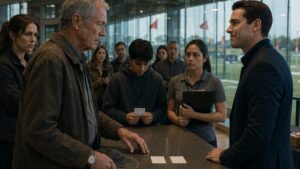
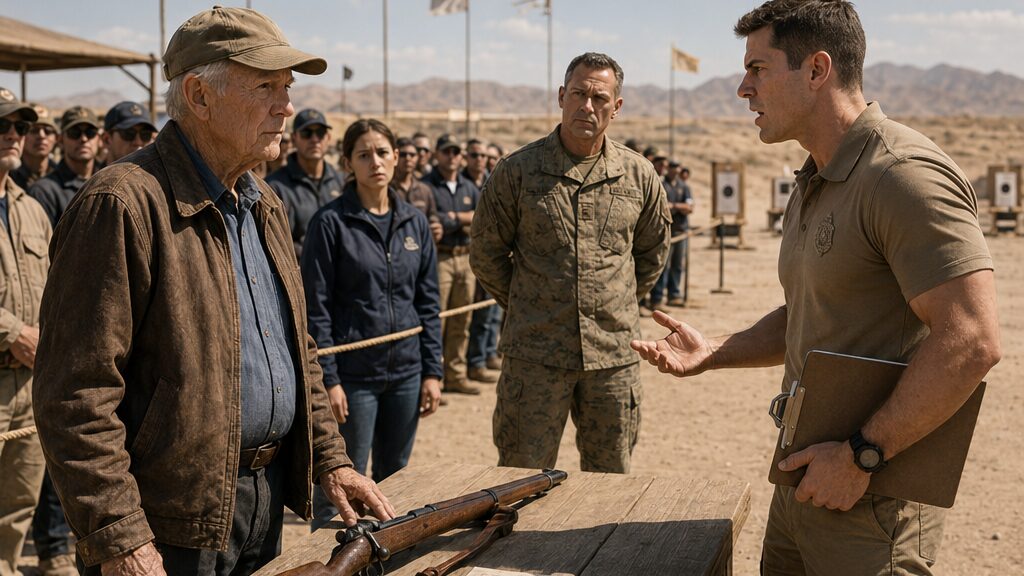
The guard at the desert range lowered his clipboard when he saw the rifle case in Joseph Moore’s hand.
It was not locked in molded plastic. It had no foam padding cut to modern shapes, no company logo, no bright competition stickers. It was long and wooden, darkened by years of sun and oil, with brass corners rubbed dull from being carried by hands that had stopped trying to look strong a long time ago.
Behind Joseph, the morning wind dragged dust across the gravel lot in thin brown sheets. Trucks and military-green utility vehicles sat in uneven rows near the gate. Beyond them, the range opened wide beneath a hard pale sky: firing lanes, target berms, shade canopies, safety tables, tripod rests, flags snapping in restless gusts.
A banner tied between two poles read: DESERT VETERANS CHARITY PRECISION DAY.
Joseph stood under it in a faded blue shirt, dark trousers, worn boots, and an old cap pulled low over his silver hair. His shoulders had narrowed with age, and the walk from the parking lot had put a small tremor in his right hand. He did not hide it. He only shifted the rifle case to his left hand and waited while the guard looked him over.
“You here for the spectators’ area?” the guard asked.
Joseph reached into his shirt pocket and brought out a folded invitation card. It had softened at the creases. The name on it was written in black ink.
The guard took it, frowned, then turned toward the registration table inside the gate. “Instructor Allen?”
A younger man in tan range gear looked up from a group of trainees. He had a clean face, sharp jaw, dark glasses hooked into the collar of his shirt, and a posture that seemed built to be watched. Eric Allen crossed the gravel with quick steps, a clipboard tucked against his ribs.
“What’s the issue?”
The guard handed him the card. Eric read it once, then looked at Joseph’s rifle case.
“You’re Joseph Moore?”
“That’s right.”
Eric’s mouth tightened as if courtesy had become a rule he disliked obeying. “Sir, this is a qualification event. Competitors had to confirm online last week.”
Joseph nodded. “I confirmed by phone.”
“With who?”
“Office.”
“That doesn’t help me.” Eric glanced toward the firing line, where volunteers were pinning fresh paper to targets. “This is a controlled range. Long-distance stages. Timed relays. We’ve got donors, junior shooters, veterans, media people. It’s not a walk-in morning.”
Joseph looked past him at the flags moving across the range. They did not all point the same way. The nearest flag pulled left. Farther down, one lifted and fell as if the air had changed its mind halfway to the berm.
“I can wait,” Joseph said.
Eric gave a short laugh, not loud enough to be called cruel, but loud enough for three trainees near the gate to hear. “Waiting isn’t the problem.”
He tapped the wooden case with the edge of the clipboard. Not hard. Just enough to make the brass corner click.
“That rifle cleared?”
“The case is closed.”
“Sir, I asked if it’s cleared.”
Joseph’s eyes came back to him. They were pale, patient, and not sleepy. “A closed case is treated as containing a firearm until opened at a safety table under command. That was still the rule when I last came here.”
The guard looked down at his boots.
Eric smiled, but the smile had lost some ease. “I know the rules.”
“I expect you do.”
A small silence formed between them. Dust moved through it.
Eric turned the invitation card over. “This card is old.”
“So am I.”
One of the trainees laughed under his breath. Eric did not stop him. He held the card out, not quite giving it back.
“Mr. Moore, I’m going to be straight with you. A lot of folks misunderstand what today is. This isn’t a nostalgia booth. We can’t have someone stepping onto the line with an heirloom he hasn’t fired in twenty years.”
Joseph took the card gently. “Then don’t.”
Eric blinked. “Excuse me?”
“Don’t have someone do that.”
The answer was quiet enough that Eric had to decide whether it was defiance or agreement. His jaw moved once.
A woman in a range vest hurried over from the registration tent, carrying a stack of badges. “Eric, we’re already late on lane assignments.”
“Working on it, Susan.”
Susan Hill glanced at Joseph with the professional smile of someone trying to prevent a problem from becoming visible. “Good morning, sir. Are you with the veterans’ group?”
Joseph held out the card again. “Joseph Moore.”
Susan read the name. She checked her list, then checked it again. “You’re marked as special invitee.”
Eric took a half step closer. “That can mean speaker, guest, donor—”
“I came to shoot,” Joseph said.
He did not raise his voice. That seemed to bother Eric more than if he had.
“You came to shoot,” Eric repeated. His gaze traveled over the faded shirt, the old boots, the tremor that returned when Joseph lowered his hand. “At your age?”
Susan’s eyes flicked toward the trainees.
Joseph slipped the invitation back into his pocket. “If the line is full, I can wait.”
Eric exhaled through his nose. “It’s not about the line being full. It’s about safety.”
That word changed Joseph’s face, though only slightly. Not anger. Not offense. Something older. Attention.
“Safety matters,” Joseph said.
“Good. Then you understand why I’m hesitant.”
Joseph did not answer. He looked toward the firing line again. A junior shooter under one canopy was adjusting a sling while a range assistant watched. At the far end, a target-pull operator checked the return carrier. The wind pressed Joseph’s shirt flat against his chest, then let it go.
Eric followed his gaze and misread the quiet.
“Sir, there’s a spectator shade area by the clubhouse. Coffee, chairs. You’ll be more comfortable there.”
Joseph looked back at him. “I didn’t drive here for coffee.”
The trainees heard that. One lowered his eyes to hide a grin. Another looked openly curious.
Eric’s voice sharpened. “And I didn’t spend six months organizing a live-fire charity event so someone could wander in with a museum piece and make us look careless.”
Joseph’s fingers rested on the rifle case handle. The tremor was visible. So was the care with which he kept the case pointed down, away from legs and feet, as if even closed wood deserved respect.
He could have said many things. His name had once been spoken on this range in a different tone. He had stood under this same desert wind when the shade canopies were canvas and the safety board was painted by hand. He had shouted commands until young men learned to listen with their bones.
But the old habit held.
A rifle does not need a man’s pride to function. Neither does discipline.
So Joseph said nothing.
A vehicle door shut behind them.
The sound was plain, but it changed Eric’s posture. He turned.
William Clark crossed from the parking row with a slow, direct stride. He wore no dark glasses, and the sun had made lines around his eyes. His hair was close-cropped, gray at the temples. People noticed him without being told to.
“Problem at registration?” William asked.
Eric straightened. “No problem, sir. Just sorting a late arrival.”
William’s eyes moved to Joseph.
For one second, the range seemed to drop away from him. The trainees, the banner, the dust, Eric’s clipboard—all of it remained, but William looked as if he had heard a command from thirty years earlier.
Joseph saw recognition arrive and wished it had not come so soon.
William looked at the wooden rifle case. Then at Joseph’s face. Then, more carefully, at the folded edge of the invitation card showing from his pocket.
“Mr. Moore,” William said.
Eric glanced between them. “You know him?”
William did not answer right away.
Joseph gave the smallest nod. “Clark.”
The name landed softly, but William’s throat moved. He looked suddenly younger and more formal, as if some part of him had come to attention without permission.
Susan lowered the badges in her hand. “William?”
Eric’s grip tightened on the clipboard. “Sir, I was explaining the event requirements.”
William kept his eyes on Joseph. “I imagine you were.”
Joseph looked toward the gate. “If there’s trouble, I’ll leave.”
“No,” William said.
It came out too quickly.
Eric’s face changed, first with surprise, then irritation controlled by rank. “Sir?”
William stepped closer, lowering his voice so only those at the gate heard him.
“Let him sign in.”
Chapter 2: The Young Instructor Takes The Loudest Lane
Eric Allen wrote Joseph Moore’s name on the lane sheet harder than necessary.
The pen scratched through the first layer of paper and left a faint groove on the page beneath it. He noticed, stopped, and capped the pen with care because Susan was standing close enough to see. Behind her, the firing line was filling with people who expected him to look like he had everything in hand.
That was the part Eric understood best.
A range was not only steel, dirt, paper, and distance. It was attention. Every line command carried farther if the man giving it looked certain. Every trainee relaxed if the instructor’s posture said nothing could surprise him. Eric had built that certainty piece by piece: the clean range uniform, the clipped voice, the fast corrections, the way donors nodded when he explained wind, optics, breathing, safety.
Then Joseph Moore had arrived with a wooden case like something pulled from a closet after a funeral, and William Clark had looked at him like history had walked through the gate.
Eric did not like history when it arrived unannounced.
“Lane nine,” Susan said, reading over his shoulder.
“Lane nine is open.”
“It’s exposed.”
“All lanes are exposed. It’s a desert.”
She gave him a look. “Eric.”
He lowered his voice. “You heard him. He wants to shoot. Fine. He can shoot. But I’m not moving qualified competitors around because an old invitee showed up with a card nobody explained.”
Susan watched Joseph through the registration tent opening.
The old man stood away from the bustle, not leaning on anything, not asking for help. The rifle case hung at his side. He seemed smaller among the vehicles and canopies than he had at the gate, but not lost. He was watching the flags again.
“He makes you nervous,” Susan said.
Eric laughed once. “He makes me responsible.”
“That’s not the same thing.”
“It is when something goes wrong.”
Nothing in Susan’s expression said she disagreed entirely. The charity event carried more than trophies. Donors had paid for sponsor banners. Local families had come to watch veterans and juniors shoot together. The scholarship table in the clubhouse had a framed photograph turned toward the room. Mistakes today would not stay private.
Eric looked back toward the line.
A young woman in a navy range jacket was standing at lane three with her rifle on the table and her hands clasped too tightly in front of her. Emma Lee. She had passed safety orientation but missed qualification twice during practice week. Not by much. Enough to make her afraid of the third time. Eric had corrected her in front of others that morning after she rushed a breathing cycle and jerked the trigger.
He had not meant to embarrass her. He had meant to sharpen her.
Still, she had gone quiet after that. Too quiet.
Eric told himself quiet was not always harm. Some people needed pressure. Some needed to be reminded that a firing line did not care about feelings.
Joseph Moore was still looking at the flags.
Eric took the lane sheet and stepped out into the sun.
“All right, listen up,” he called.
The conversations around the safety tables fell off. Competitors turned. Veterans in folding chairs looked up from paper cups. A few junior shooters stood straighter.
“We’ll begin with controlled confirmation at one hundred yards, then move to charity precision scoring at three hundred. No firearm is opened away from a safety table. No one approaches the line without command. If I call a cease-fire, hands off and step back. Understood?”
A scattered answer came back.
Eric’s gaze moved over the group and landed on Joseph just long enough to be noticed.
“Understood?” he repeated.
This time the answer was stronger.
Joseph’s mouth did not move, but he inclined his head once.
Eric began reading lane assignments. He placed the regular competitors first, then the veterans paired with juniors, then donor shooters under supervision. He left Joseph for the end. He meant to. It gave people time to see how the day worked. It also let the old man feel the weight of waiting.
When Eric finally called his name, he paused.
“Joseph Moore, lane nine.”
A few heads turned toward the far-right lane. Its canopy had less shade because one corner tie had loosened in the wind. Dust lifted there more often, curling over the bench and skipping toward the berm. It was not unsafe. Eric would never assign an unsafe lane. But it was not kind.
Joseph picked up his case and walked toward it.
He walked slowly, not theatrically. The gravel shifted under his boots. The case did not swing. It stayed close to his leg, controlled by a hand that trembled only when he stopped.
Emma watched him from lane three.
Eric saw her watching and felt a flash of annoyance. She had ignored half his corrections, but the old man’s slow walk held her attention like instruction.
At lane nine, Joseph set the case on the safety table with the muzzle end pointed downrange. He did not open it. He rested both hands on top and waited for the line command.
Eric approached. “You can uncase under supervision.”
Joseph looked at the red range flag. It was still raised.
“Line isn’t open.”
“I’m supervising you.”
“The line isn’t open,” Joseph repeated.
Someone nearby murmured approval. Eric heard it and felt heat rise behind his ears.
He forced a smile. “That’s correct. Thank you for confirming the rule everyone already knows.”
Joseph accepted the jab without expression.
When the command finally came, cases opened along the line in a ripple of latches, zippers, and plastic lids. Joseph’s brass clasps clicked softly. Inside lay an old wooden-stock rifle, clean but plain, the stock worn smooth where a cheek had rested countless times. Beside it was a folded card, yellowed with age, covered in small penciled marks.
Eric leaned closer before he meant to. The marks were not random. Numbers, arrows, short notations. Wind. Distance. Corrections.
“You keep notes?” Eric asked.
“When the air talks.”
One of the veterans behind them chuckled.
Eric picked up the old rifle only after Joseph stepped back and gave permission with a slight open hand. It was lighter than Eric expected, balanced differently than modern precision rifles, almost modest. He checked it with competence, because he was competent, and found it clean, clear, maintained.
That irritated him more than neglect would have.
“Old glass,” Eric said, looking at the optic.
“Old eyes,” Joseph replied.
A few people heard. The chuckle spread.
Eric handed the rifle back. “You’ll need to confirm zero.”
“I expect so.”
“Do you need a support bag? Adjustable rest? Spotter?”
Joseph unfolded the range card and laid it flat under a small stone so the wind would not take it. “A front rest will do.”
“You sure?”
Joseph looked at him then. “I’ll ask if I’m not.”
The answer was polite, but it had a door in it. Closed.
Eric turned away before he said something sharper.
For the next hour, the range ran under his commands. Rifles cracked in controlled rhythm. Brass clicked onto mats. Target carriers moved out and back. Juniors adjusted slings. Veterans corrected grip pressure in low voices. Dust kept finding its way into everything.
Joseph did not shoot.
Because Eric had not called his relay.
The old man stood or sat near lane nine, watching. He watched Emma breathe too fast. He watched a donor lift his head too soon after each shot. He watched one trainee slap the trigger, then blame the scope. He watched the wind worry the flags in opposite directions.
Eric felt that watching from across the line.
It was not accusatory. That made it worse.
When Emma’s second confirmation target came back, her group sat low and right. Not disastrous, but not good. Eric stepped in before anyone else could.
“You’re anticipating recoil,” he said. “Again.”
Emma swallowed. “I thought I held steady.”
“You thought. The paper says otherwise.”
Her cheeks colored. “Yes, sir.”
“You can’t wish rounds into center. Fundamentals don’t care how badly you want them.”
She nodded too many times.
Joseph, two lanes away, lowered his eyes to the old range card.
Eric saw it and thought: there it is. Judgment. Old men loved standing outside responsibility and looking wise.
He walked toward lane nine.
“You all right there, Mr. Moore?”
Joseph looked up.
“You’ve been studying everyone else for a while,” Eric said. “Saving your energy?”
Joseph folded the card once along an old crease. “Saving my turn.”
Eric smiled toward the nearby shooters. “That’s good. Because we’ll need to keep things moving.”
“I don’t take long.”
“No?”
Joseph’s fingers brushed the stock of the rifle, checking nothing, feeling everything. “Not when the rule is clear.”
Eric looked down at the old hand on the old wood. A visible tremor moved through Joseph’s fingers before settling.
The sight of it should have softened him. Instead, under the eyes of trainees, veterans, donors, and William Clark at the far shade canopy, Eric felt his authority being tested by a man who had barely spoken.
He lifted his voice.
“Ladies and gentlemen, we’ll complete the remaining confirmations before lunch. Mr. Moore here will shoot last.”
The range turned toward them.
Joseph did not.
Eric let the silence hang one second longer than needed.
“That way,” he added, “we can give him all the time he needs.”
Chapter 3: The Rule Everyone Forgot To Respect
By midday, Joseph could taste dust on his tongue.
It had been years since he last stood on that range during a full event, but the desert had kept its old habits. Wind came without apology. Sun pressed down on canvas shade and rifle barrels. Voices carried strangely across the open ground, sometimes swallowed by distance, sometimes thrown back sharp from the berms.
Joseph sat behind lane nine with his rifle still resting untouched on the table. He had not complained when Eric placed him last. He had not complained when the shade rope snapped loose and left one corner of the canopy fluttering. He had not complained when three different people glanced at his hands and then away.
Age made people think they were being kind when they looked away from weakness.
Joseph had learned to let them.
Across the line, Emma Lee stood beside her rifle with her shoulders drawn tight. She was trying not to show how badly she wanted to qualify. That kind of want could become a weight. Joseph had seen it bend better shooters than her.
Eric stood behind her, arms folded.
“Again,” he said.
Emma reset her position. Her cheek touched the stock. Her finger rested straight along the guard, not yet on the trigger. Good. Her breathing, though, was already wrong. Too high in the chest. Too much effort.
Joseph watched the red range flag. Still live.
The command came. Emma fired. The shot cracked and rolled into the desert.
She lifted her head too soon.
Eric sighed. “You’re chasing the result before the bullet gets there.”
“I know.”
“If you know, stop doing it.”
The words were not shouted, but they were public. Emma’s mouth tightened. She worked the bolt, then hesitated, embarrassed by her own hesitation.
Joseph looked down at his range card.
Some lessons could not enter through a crowd.
The relay ended. Rifles were cleared. Chambers were shown. Eric called the line cold. Shooters stepped back from the benches. The target-pull operator began moving the carriers.
That was when a donor near lane six turned from his bench with a boxed rifle accessory in hand and his uncased rifle still angled across the table. He was talking to a friend, smiling, distracted by the small audience around his expensive equipment. His hand brushed the rifle. It shifted.
Not much. Enough.
Joseph was moving before anyone shouted.
He did not hurry in a way that looked dramatic. He simply crossed the few steps from lane nine with the steady purpose of a man who had obeyed one rule longer than others had been alive.
“Hands,” he said.
The donor froze, surprised more by the tone than the volume.
Joseph stopped short of touching the rifle. He pointed two fingers toward the bench, not at any person.
“Step back. Let the range officer clear it.”
The donor blinked. “It’s empty.”
Joseph’s eyes did not move from the rifle. “Then it won’t mind being checked.”
The air around lanes five and six tightened.
Eric turned sharply. “What’s going on?”
Joseph kept his hands visible and empty. “Unattended muzzle drift on a cold line.”
The donor’s smile vanished. “I said it’s empty.”
William Clark had started walking from the shade canopy.
Eric arrived first. He looked at the rifle, then the donor, then Joseph. For a fraction of a second, irritation competed with the facts in front of him. The rifle was not pointed at anyone, not directly, but it had shifted away from downrange. On a cold line, with people near the targets, that was enough.
Eric cleared it himself. The chamber was empty.
The donor spread his hands. “See?”
Joseph looked at him, not unkindly. “Safety rules are not written for the times you guessed right.”
No one laughed.
Eric set the rifle properly and turned to the group. “Cold line means step away from firearms. No handling. No exceptions.”
It was the correct command. He gave it cleanly. Still, everyone knew Joseph had seen it first.
The donor muttered an apology. Joseph nodded once and returned to lane nine.
He had almost reached his table when a voice behind him said, “You used to say that before every qualification.”
Joseph stopped.
William stood a few paces away, his face shaded by the brim of his cap. He spoke quietly, but Eric was close enough to hear.
Joseph did not turn right away. “Did I?”
“You said, ‘The rule is there for the day your confidence gets ahead of your eyes.’”
Joseph looked back then.
For a moment, the years thinned between them. William Clark was not the senior officer with gray at his temples, but a young man at a firing line, too proud of a tight group, too quick with his hands, being corrected by a voice that never needed volume to make shame useful.
Joseph looked away first. “Sounds like something an old instructor would repeat too much.”
“No,” William said. “Sounds like something that stayed.”
Eric’s eyes moved from William to Joseph. “Instructor?”
Joseph bent over the table and straightened the folded range card. “Long time ago.”
William did not add more.
That restraint was a kindness, or an accusation. Joseph could not tell which.
The break for lunch came late. People drifted toward the clubhouse and the shade tents. Joseph stayed at lane nine, sitting with his hands folded loosely between his knees. His rifle remained open and safe on the table. The old stock caught a dull line of sun.
Emma approached after several minutes.
She came slowly, as if nearing someone else’s privacy.
“Mr. Moore?”
Joseph looked up. “Yes, ma’am.”
She almost smiled at the formality. “I just wanted to say thank you.”
“I didn’t do anything to you.”
“You stopped him before it became a big thing.”
Joseph glanced toward lane six, where Eric was speaking to the donor. “It was already big. People just don’t notice until noise gets added.”
Emma looked at the rifle. “Are you really shooting today?”
“If they call my name.”
“Eric says lane nine is hard.”
“He’s right.”
Her face tightened. “Then why put you there?”
Joseph considered giving an easy answer. Because young men sometimes confused pressure with proof. Because public control could become a hunger. Because an old man was a convenient place to spend insecurity.
Instead he said, “Maybe he wants to see what the wind is doing.”
Emma looked out at the flags. “I can’t read it.”
“Not all at once.”
“That’s what it feels like. Like everything moves after I decide.”
Joseph picked up the folded range card and opened it halfway. The paper was yellow, the pencil marks faded but exact.
“Start close,” he said. “Dust by your boots. Grass if there is grass. Mirage if the ground is hot. Then the near flag. Then the far one. Never believe only one thing.”
Emma studied the card without touching it. “You wrote all that?”
“Some of it.”
“What does this say?”
Joseph followed her finger to a small note near the margin. “Slow is smooth. Smooth is accurate.”
“My dad says slow is just slow.”
“Sometimes he’s right.”
That surprised her.
Joseph folded the card again. “Slow by itself is nothing. Smooth is the part that matters.”
Emma looked toward Eric. “He makes me rush.”
“Then don’t give him your trigger finger.”
She absorbed that in silence.
A shadow fell across the table.
Eric stood there with his clipboard under one arm. His expression had returned to the polished certainty he wore for crowds, but something sharper lived beneath it now.
“Coaching my shooters, Mr. Moore?”
Emma stepped back. “I asked him a question.”
“I’m sure you did.” Eric looked at Joseph. “We appreciate the safety catch earlier. Truly. But let’s keep instruction inside the staff.”
Joseph nodded. “Your line.”
“That’s right.”
“Then run it.”
The words were calm. They were also the first thing Joseph had said that struck like a challenge.
Eric’s face hardened. “You know, you’ve had a lot of opinions for someone who hasn’t fired a round yet.”
Joseph folded his hands.
The nearby conversations faded. Susan looked over from the registration tent. William stopped beside the water cooler.
Eric turned slightly, making sure the firing line could hear.
“All right. Since everyone seems interested, we’ll settle it clean. After lunch, Mr. Moore takes lane nine for confirmation. No special rest. No extra time. Same range rules as everyone else.”
Joseph said nothing.
Eric leaned closer, voice lower but still public.
“And if that old rifle can’t hold paper, you’ll step off my line without another lesson. Fair?”
Emma’s eyes moved to Joseph.
The old man looked past Eric to the flags lifting in three different directions across the desert. His right hand trembled once against his knee, then stilled.
“The target will tell you,” he said.
Chapter 4: When The Wind Moved Before The Bullet
After lunch, the desert became brighter and less forgiving.
Heat lifted from the range in soft waves that bent the far berm and made the target frames look as if they were breathing. The wind had stopped pretending to be simple. It came first from the left, then rolled low through the dry wash beyond lane nine, then lifted dust in a thin twist behind the three-hundred-yard marker.
Joseph stood beside his table and watched it all without touching the rifle.
Eric Allen made a show of checking the lane himself. He tightened the loose canopy rope, inspected the bench, glanced at the front rest, and looked downrange as if the distance might confirm his judgment.
“All right,” he called. “Clear instructions. Mr. Moore will fire five confirmation rounds at three hundred yards. Standard charity target. Same scoring face as everyone else. No spotter coaching during the string.”
A few people gathered behind the ready line. Veterans came out from the shade with water bottles in hand. Donors drifted closer. Emma stood near lane three but angled herself so she could see Joseph. Susan remained near the registration table, arms folded, pretending to study the schedule. William Clark stood behind the line with his cap low and his hands clasped behind his back.
Joseph heard the small movements behind him. Boots on gravel. A folding chair creaking. Someone whispering that the old man had stopped the safety mistake before lunch. Someone else asking what kind of rifle that was.
He opened the old case.
The rifle lay where he had left it, bolt open, chamber empty, wood dull and clean. Joseph lifted it with both hands, not because it was heavy, but because respect should not weaken with age. He set it on the table with the muzzle downrange and unfolded the yellowed range card.
Eric watched the tremor in Joseph’s right hand.
“You sure you don’t want the one-hundred-yard confirmation first?” he asked loudly. “No shame in starting closer.”
Joseph placed a small stone on the corner of the card. “Three hundred is what you called.”
“That’s what I called for qualified shooters.”
Joseph looked at him.
Eric smiled toward the onlookers. “Just making sure everyone understands the condition.”
The insult landed cleanly. It did not need rough words. Joseph could feel it in the way people shifted, in the little pause after Eric spoke, in Emma’s quick glance at the ground.
He checked the chamber again, though it had already been checked. He checked the muzzle direction. He touched the safety. He adjusted the front rest by less than an inch. Every motion was slow, economical, plain.
Eric misread the slowness because he needed to.
“Take your time,” Eric said. “We’ve got daylight.”
Joseph did not answer. He leaned over the table and studied the card. Then he looked downrange, not at the target first, but at the dust between himself and it.
The near flag leaned left.
The middle flag twitched, sagged, then lifted slightly right.
The far flag barely moved at all, but the shimmer above the berm slid sideways, thin and quick.
Joseph heard a younger shooter whisper, “He can even see that far?”
Eric did not correct it.
Joseph’s right hand rested near the rifle. The tremor was there, a small betrayal of muscle and time. He watched it for a breath. It had embarrassed him once, years earlier, when it first appeared while he was trying to button a cuff. Now it was simply part of the morning’s conditions, like dust and heat.
He waited until the tremor passed through and settled.
“Shooter ready?” Eric asked.
Joseph did not move to the stock yet. “Wind is not full left.”
Eric’s face changed. “Excuse me?”
“You called it full left for the last relay.” Joseph nodded downrange. “It’s quartering near the line and turning past the wash.”
A murmur ran behind the rope.
Eric looked toward the flags, then back at him. “I know how to read my range.”
Joseph nodded once. “Then you saw it.”
That was the first time William moved. Not much. His head lifted as if an old sound had reached him through years of distance.
Eric’s jaw tightened. “Do you want to shoot or teach?”
Joseph settled behind the rifle. “Those should not be opposites.”
He lowered himself carefully, one knee touching the mat, then the other. It took time. No one laughed now, but Joseph knew they watched his age before they watched his method. His left hand adjusted the rest. His shoulder found the stock. His cheek came down to the worn smooth place in the wood that had known him longer than many people on that range had been alive.
The old rifle fit him without welcome or complaint.
He did not place his finger on the trigger.
Not yet.
He breathed once and let the first breath go. The world narrowed to pressure, distance, light, and moving air. Behind him, Eric’s impatience had weight. Emma’s hope had weight. William’s recognition had weight. Joseph let all of it remain behind him.
The target would not care.
“Range is hot,” Eric called. “Shooter may fire when ready.”
Joseph remained still.
A gust pushed dust across the lane from left to right.
The far shimmer slid, stopped, then softened.
He breathed in through his nose, not deep, not shallow. The rifle rose with him. He let half the breath out and held only the quiet left behind.
The first shot cracked.
It was not louder than the others had been all day, but the silence after it felt different. Joseph worked the bolt without hurry. Brass came free and landed on the mat. He did not look up to read faces. He did not reach for the card. He had already read what he needed.
Second breath.
Second shot.
The rhythm was not fast. It was not slow. It had no concern for Eric’s timing or the crowd’s hunger. Each round came after the wind allowed it, and not before.
By the third shot, a veteran behind the rope had stopped drinking from his water bottle.
By the fourth, Emma had both hands pressed together at her waist.
Before the fifth, the wind shifted again. Joseph felt it before the near flag admitted it. The dust at his elbow moved back toward him. The shimmer at the target leaned the other way, barely.
He waited.
Eric let the waiting stretch for three seconds, then five. “Problem, Mr. Moore?”
Joseph’s cheek stayed on the stock. “No.”
“Then send it.”
Joseph did not.
A small sound moved through the spectators. The kind that begins as discomfort and can become mockery if someone gives permission.
Eric stepped closer to the line, careful not to cross where he shouldn’t. “You said you don’t take long.”
Joseph waited.
The near flag snapped once, then fell slack.
He fired.
The fifth shot sounded flat against the desert, then rolled away.
Joseph lifted his head. His finger came off the trigger first. He opened the bolt, showed clear, set the rifle down, and stepped back from the table.
Eric stared at him. “That’s it?”
“Five rounds.”
“You don’t want to check through the glass?”
“No.”
“You don’t want to call your group?”
Joseph picked up the brass one piece at a time and placed it in a small cloth pouch from the case. “The target will come back.”
Someone behind the line whispered, “He didn’t even look.”
Eric removed his cap, wiped his forehead with his forearm, and put the cap back on.
“You held for a wind shift on the last round,” he said.
Joseph closed the pouch. “The wind shifted.”
“You waited too long.”
Joseph folded the range card along its old crease. “Maybe.”
That answer angered Eric more than argument would have. It gave him nothing to push against.
“Cold line,” Eric called.
The target-pull operator stepped from the shaded pit area near the control post and began the return sequence. The carrier at lane nine jolted, then started sliding back along the cable from the distant berm.
At first it was only a pale rectangle trembling in heat.
People leaned without meaning to.
Eric stood with his arms folded, preparing several explanations at once: old target face, lucky string, oversized scoring area, wind overestimated, not enough rounds to prove anything. He had explanations ready because certainty was easier to protect before evidence arrived.
Joseph remained beside the table with his hands resting on the closed edge of the rifle case.
The target carrier rattled closer.
Paper snapped in the wind.
Emma took one step forward before catching herself.
William did not move at all.
The target was close enough now for the black scoring rings to appear. Close enough for the white paper to flutter. Close enough for the first dark mark to become visible near center.
Then the carrier clacked into its stop.
No one spoke.
Eric walked toward it first.
Chapter 5: The Target Came Back Without An Excuse
Emma Lee saw Eric’s face before she saw the target.
That was how she knew.
All morning, Eric had worn expressions the way other men wore gear. Command face. Correction face. Polite donor face. Mildly amused face when Joseph Moore walked through the gate with his old wooden case. Even when he was annoyed, there was a shape to it, a performance held together by certainty.
At lane nine, with the target carrier locked in place, that certainty slipped.
Only for a second.
But Emma saw it.
She stepped closer with the others, stopping behind the safety rope. The paper target snapped once in the wind, then flattened against the backing. Five shots sat near the center in a group so small that at first her eyes tried to make it into fewer holes. One ragged opening, slightly widened at the edge. Not magic. Not a storybook miracle. Something better. Real. Controlled. Undeniable.
A veteran beside her took off his hat.
No one told him to.
Eric leaned toward the paper. He touched nothing, because the range was still under rules and too many people were watching for him to forget them. His eyes moved across the scoring rings, then back to the cluster.
“Target face could’ve shifted,” he said.
The target-pull operator frowned. “It’s clipped tight.”
“Wind dropped on his string.”
A donor behind Emma muttered, “Wind got worse.”
Eric heard it. His neck reddened.
Joseph stood by his table, the rifle open and safe, his hands folded on the old case. He did not look pleased. He did not look vindicated. If anything, he looked tired in a way Emma had not noticed before, as if the shooting had cost him less than being watched.
Eric turned. “Mr. Moore.”
Joseph looked up.
“Good group,” Eric said.
It sounded like praise dragged across gravel.
Joseph nodded. “Rifle still holds.”
“Five rounds don’t settle a match.”
“No.”
“And confirmation isn’t scoring.”
“No.”
Emma wanted Joseph to say more. She wanted him to say what everyone else was thinking. She wanted him to make Eric stand in the silence he had created.
But Joseph only picked up his range card and slid it back into his shirt pocket.
That made the silence heavier.
Susan came from the registration tent with the lane sheet in hand. Her eyes went to the target, and her steps slowed. “That is lane nine?”
The target-pull operator nodded.
Susan looked at Joseph, then at Eric. “That qualifies.”
Eric snapped his gaze to her. “It confirms zero. Qualification scoring comes later.”
“It qualifies him to continue,” Susan said, quieter.
Emma could see the strain in Susan’s face. The event schedule mattered. The donors mattered. The scholarship table mattered. But something else had begun to matter too, something the schedule had no box for.
William Clark stepped forward at last.
He did not go to the target immediately. He went to Joseph.
For a moment, Emma thought he might salute. He did not. Maybe that would have been too much, or not enough. He stopped an arm’s length away.
“I thought I recognized the rifle,” William said.
Joseph’s mouth moved faintly. “Plenty like it.”
“Not with that mark in the stock.”
Emma looked at the rifle. Near the comb, where Joseph’s cheek had rested, a small dark line cut through the worn wood. It looked like an old repair or a scar.
William’s voice lowered, but the crowd had gone so quiet it still carried.
“You made me sand that smooth after I dropped it on the old concrete bench.”
Joseph looked at him then. “You shouldn’t have picked it up before the command.”
William gave a short breath that was almost a laugh and almost something else. “No, sir. I should not have.”
Eric stared at William. “Sir, what is this?”
William turned. The lines around his eyes deepened.
“This is the man who taught the first range cadre here how to teach without killing confidence or safety.”
The words moved across the line like wind over dry grass.
Emma looked at Joseph again. The faded shirt. The old boots. The hand that trembled when empty and steadied when needed. He seemed the same and not the same at all.
Eric’s eyes narrowed. “He was an instructor here?”
“Before the new clubhouse,” William said. “Before the electronic carriers. Before half the rules on that board were printed instead of painted.” He glanced toward Joseph. “Some of them are his words.”
Joseph’s face did not welcome the attention.
“William,” he said softly.
The senior officer heard the warning in it. He stopped there.
But enough had been said.
A veteran near the back whispered, “Moore?”
Another replied, “I heard that name.”
Eric heard it too. Emma watched him fight to keep the ground beneath his own feet. He had not been wrong about safety. He had not been wrong that the event needed order. But he had been wrong about Joseph. Publicly wrong. The kind of wrong that did not bruise the skin but changed how people looked at you.
Eric took refuge in procedure.
“Fine,” he said. “Then he’ll shoot the scoring stage like everyone else.”
Joseph nodded. “If called.”
“If called?” Eric repeated. “You came to shoot.”
“I came for the charity.”
“Then shoot for it.”
Susan looked between them. “Eric, we can keep to the schedule without making this personal.”
“It isn’t personal.” Eric’s answer came too fast. “We have a final precision stage. Top group earns the sponsor prize slot and a donation in their name. If Mr. Moore wants to be on the line, he can be on the line.”
Joseph looked toward the clubhouse.
Through the open doors, Emma could see the scholarship table: a framed photograph, a folded flag in a triangular case, envelopes, a glass jar with donation slips. She had glanced at it earlier but had not stopped. The photograph showed a young trainee in range gear, smiling like the day had not yet taught him anything hard.
Joseph’s gaze rested there longer than expected.
Emma saw William notice.
The paper target snapped again. Everyone looked back at it.
Eric stepped closer to Joseph, voice lower but still edged. “One group doesn’t make you untouchable.”
Joseph’s eyes settled on him. “No one on a firing line is untouchable.”
The answer stole Eric’s next words.
A range staff member removed the target and brought it over on a backing board. People made room as if it were something fragile. Up close, the group looked even smaller. Emma could see where the paper had torn unevenly because more than one round had passed through nearly the same place.
She had spent weeks trying to make her shots stop wandering. Joseph’s target looked like a decision repeated five times.
William stood beside her. “Do you see it?”
Emma nodded. “Yes, sir.”
“What do you see?”
She swallowed, suddenly afraid this was a test. “Center group. Tight. Maybe one edge low.”
“What else?”
She looked again. At first she saw only proof. Then Joseph’s words returned. Dust by your boots. Near flag. Far flag. Never believe only one thing.
“He waited on the fifth,” she said.
William nodded once.
“Why?”
“Ask him.”
Emma looked across to Joseph, but he had stepped away from the target and was wiping the rifle with a plain cloth before placing it back in the case. He moved with care, not ceremony. He seemed less like a man who had won something than a man putting a tool away before talk could damage what it meant.
Eric watched him from a few feet away.
“You know,” Eric said, “the final stage isn’t bench confirmation. It’s position work. Timed. Wind calls. Smaller scoring zone. No room to wait forever.”
Joseph closed the case halfway, leaving it unlatched because the day was not done. “Then don’t wait forever.”
A few people smiled. Not loudly. Not enough to become ridicule. Eric saw it anyway.
His pride made the next choice before his judgment could stop it.
“All right,” Eric called, turning to the gathered shooters. “We’ll make it clean. Final charity stage after reset. Mr. Moore shoots against the top qualifier.”
Susan stiffened. “Eric.”
He kept going. “Same target distance. Same time. Same rules. Since everybody wants the target to tell them, we’ll let it speak twice.”
Emma felt the crowd shift. Interest sharpened into appetite.
Joseph said nothing.
Eric looked directly at him. “Unless that’s too much.”
William’s face hardened. He began to speak, but Joseph lifted one hand slightly.
Not to silence him rudely.
To spare him.
Joseph looked at the old target, then toward Emma, then beyond her to the scholarship photograph in the clubhouse doorway.
“When the line is ready,” he said.
Eric’s smile returned, thin and bright.
“Good,” he said. “Then we’ll see what the old rifle does when it counts.”
Chapter 6: The Final Shot Was Not For Pride
Joseph had not come to the desert to defeat Eric Allen.
That truth remained with him as the final stage was reset and the range staff changed targets downrange. It sat beneath the dry heat, beneath the attention gathering behind the rope, beneath the old ache in his knees from lowering himself behind the rifle.
Pride had brought enough men to firing lines. It had never made them safer.
Joseph stood at the edge of lane nine and watched Susan Hill speak with the sponsor donors near the clubhouse. Her smile was strained now. The event had slipped from schedule into story, and stories made organizers nervous because no one controlled where they ended.
Eric controlled what he could. He checked target faces. He confirmed timing. He explained the final stage to the crowd with crisp authority. Ten minutes earlier, his voice had carried ownership. Now it carried defense.
“Final precision stage,” he announced. “Two shooters. Three rounds each. Three hundred yards. Position supported by front rest only. Time limit ninety seconds per shooter. Highest measured group within scoring ring wins the sponsor prize slot and donation credit.”
A young top qualifier stood two lanes away, adjusting his cap and trying not to look as if he wished he were somewhere else. He was not Eric’s problem. Joseph knew that. The young man had shot well all day and did not deserve to become part of another man’s pride.
Joseph raised his hand.
Eric paused. “Question?”
“Who is the top qualifier?”
Eric gestured to the young shooter. “He is.”
“Then he earned his place.”
“That’s why he’s shooting.”
Joseph looked toward the sponsor table. “Against another qualifier?”
Eric’s mouth tightened. “Against you.”
“I have only confirmed zero.”
The crowd murmured.
Eric stared at him. “You backing out?”
“No.”
“Then what?”
Joseph rested his hand on the old rifle case. “Call the stage properly. If the young man earned top qualifier, do not turn his work into a prop.”
The words were calm, but they struck harder than if Joseph had raised his voice. The young qualifier looked down. Susan closed her eyes briefly, as if Joseph had named what she had been unwilling to.
Eric’s face flushed. “This is a charity event. We can adjust format.”
“Not for pride.”
The range went still.
Eric took a step closer. “You think this is about my pride?”
Joseph did not answer immediately. He looked past him to the safety board near the clubhouse. The printed rules were clean and square, newer than the old range, but some of the phrases still carried old bones.
The rule is there for the day your confidence gets ahead of your eyes.
“I think,” Joseph said, “the line should never be used to settle a feeling.”
William Clark’s gaze dropped, and for a moment Joseph knew he remembered. A younger William, angry after being corrected, wanting one more chance to prove he had not needed correction. Joseph had denied it then too.
Eric looked around and realized the crowd had heard enough to understand without being told.
Susan stepped forward. “We can run the final as scheduled. Top qualifier shoots for score. Mr. Moore may shoot an exhibition string afterward for donation matching.”
Eric shook his head. “That waters it down.”
“It restores the event,” Joseph said.
The young qualifier lifted his eyes, grateful but silent.
Eric’s pride battled him in plain view. Joseph almost pitied him. Almost. Insecurity could make a man loud, but public embarrassment could make him dangerous in smaller ways: careless words, rushed commands, rules bent to save face.
Joseph had seen it before. Once, decades earlier, under this same kind of sun, a trainee had tried to prove he could recover from a bad stage by hurrying through a drill. No one had been hurt, not quite, but the muzzle had swept too far and a young man’s face had gone white at the edge of the line. Joseph had stopped the day cold. The trainee had hated him for six months and thanked him six years later in a letter.
That trainee’s photograph now sat on the scholarship table.
David Hill. Susan’s brother.
Joseph had not come because of Eric. He had come because Susan had mailed an invitation with a short note: We are naming this year’s junior scholarship after David. You probably do not remember me, but he remembered you.
Joseph had remembered both of them.
He looked at Susan. “Your brother used to rush the second shot.”
Susan’s professional composure broke at the edges.
“He wrote that in a letter,” she said. “After he came home.”
Joseph nodded. “He learned not to.”
The crowd did not know what passed between them. It did not need to. Some truths should not be turned into announcements.
Eric’s shoulders lowered a fraction. “David Hill was your trainee?”
“One of many.”
“He talked about an instructor,” Susan said softly. “He never used your first name. Just Moore.”
Joseph touched the folded range card in his pocket. “He gave this back to me before he left the last time. Said he had copied what he needed.”
William looked away toward the berm.
Emma stood near the rope, listening as if the desert itself had changed language.
Joseph took out the range card. The wind tried to lift it immediately, and he held it down with two fingers.
“I will shoot,” he said. “But not against that young man. Let him keep what he earned. If my group is good enough, put the sponsor donation toward Emma Lee’s junior slot.”
Emma’s eyes widened. “Me?”
Joseph did not look at her yet. “If she wants it.”
Eric’s expression shifted. The challenge he had built for humiliation had been taken from him and made into something else. Something harder to attack.
Susan turned to Emma. “You would still have to complete qualification.”
Emma swallowed. “Yes, ma’am.”
Joseph looked at her then. “You will.”
Eric stared at the range card. “Why her?”
Joseph folded it once. “Because she listens after she misses.”
No one had an answer for that.
The final stage resumed in its proper order. The young qualifier shot first. He did well, though nerves opened his group wider than his earlier performance. The crowd gave him respectful quiet, then a small round of applause that faded quickly under Eric’s next command.
Then Joseph stepped to lane nine.
He set the old rifle on the table. He checked the chamber. He checked the muzzle. He waited for the command. No wasted movement. No performance.
Emma stood behind the rope with both hands clenched around the folded range card Joseph had placed in her care.
Before he settled in, he turned slightly toward her.
“Near dust,” he said.
Emma looked down at the ground near lane nine. A thin line of dust moved right.
“Middle flag,” Joseph said.
She looked. “Left.”
“Far shimmer.”
She stared toward the target, eyes narrowing. “Right again.”
Joseph nodded. “So don’t believe only one thing.”
Eric stood behind the command mark, jaw tight, but his voice when he spoke was correct.
“Range is hot. Shooter may fire when ready.”
Joseph lowered himself behind the rifle one final time.
His knees protested. His right hand trembled while he placed it. His breath came shallower than it had in the morning. Age did not vanish because people had learned to respect him. It remained in every joint, every small delay, every careful descent to the mat.
But when his cheek touched the worn place in the stock, something in him settled.
He waited through the first gust.
The crowd waited with him.
He fired.
Worked the bolt.
Waited.
Fired again.
The third round took the longest. The wind near the line lied. The middle flag argued. The far shimmer thinned and bent. Joseph let the time run down until Eric’s hand lifted toward the stopwatch.
Emma whispered, barely audible, “Not yet.”
Joseph heard her.
The dust changed at his boots.
He fired.
The rifle settled back into silence.
Joseph opened the bolt, showed clear, and stepped away. His face revealed nothing, but his hand, when he reached for the case, needed the table for a moment before finding strength.
Emma saw and moved toward him, then stopped because the line was still under command.
Joseph looked at her and gave one small nod.
Do
Chapter 7: The Silence After The Rifle Case Closed
By sunset, the desert range had gone quiet in a way Joseph trusted.
Not empty. Not finished. Quiet.
There were still people moving between the lanes and the clubhouse. Range staff collected target frames. Donors folded chairs. Veterans spoke in low voices near the water cooler, their earlier laughter softened into something more careful. The wind had lost its afternoon edge and now moved over the gravel in long, cooling breaths.
The final target had come back with three holes tight enough to make even Eric Allen stop searching for words.
Joseph had not looked at the crowd when it returned. He had looked at Emma.
She had understood before anyone announced it. Not because she could measure the group better than the range staff, but because she had watched the third shot wait for the wind. She had seen the difference between hesitation and patience. Her face had changed when the paper stopped in front of them, as if someone had opened a door she had been pushing against for months.
The sponsor prize slot went to the young qualifier who had earned it.
The matching donation, after Susan spoke quietly with the sponsors, went toward Emma’s junior entry and the David Hill scholarship fund.
Joseph accepted neither credit nor ceremony.
When someone tried to clap, it came unevenly, unsure of itself, and died quickly because Joseph had already turned back to his table. He opened the old wooden case, wiped the rifle with the plain cloth, checked the chamber once more, and settled the rifle into the fitted hollow worn smooth by years.
Eric stood several steps away.
He had not apologized in front of everyone. Not yet. Joseph had not expected him to. Public pride did not fall cleanly. It came down in pieces, often when no one was watching.
William Clark came to the table as Joseph fastened the first brass latch.
“You’re leaving before the dinner,” William said.
Joseph closed the second latch. “Dinner has speeches.”
“You used to make us sit through them.”
“I was younger and crueler then.”
William smiled faintly, but it did not last. He looked toward the clubhouse, where Susan stood beside the scholarship table holding Joseph’s folded range card in both hands.
“She wants to put that on the safety board,” William said.
Joseph’s hand stilled on the case.
“It’s just an old card.”
“No,” William said. “It isn’t.”
Joseph looked across the range. Lane nine sat in the last orange light, its dust scuffed by boots, its mat still marked where his knees had pressed down. A day could change a place without moving a single post.
“I didn’t come to be put on a wall,” Joseph said.
“I know.”
“Walls make people stop listening. They look, they nod, they move on.”
William was quiet for a moment. “Then tell her where to put it.”
Joseph lifted the case from the table. The weight tugged at his shoulder. He did not hide the effort. The rifle had been lighter in the morning, or he had been.
Susan approached before he could turn away. Emma followed a pace behind her, holding the final target backing board like it might tear if handled carelessly.
“Mr. Moore,” Susan said.
Joseph faced her.
The evening light had taken the organizer’s polish from her face. She looked tired now, and younger because of it. The badge on her vest hung crooked. Dust marked one sleeve.
“I wanted to ask before doing anything with this.” She held out the folded range card. “William said the notes are yours. And David copied from it.”
Joseph did not take it.
“He copied what mattered,” Joseph said.
Susan swallowed. “Then maybe others should too.”
Behind her, in the clubhouse doorway, the safety board was visible. Printed rules. Emergency numbers. Range commands. New plastic, clean letters, official language. Useful, necessary, forgettable.
Joseph glanced at Emma. “What did you learn today?”
Emma looked startled. “Me?”
“You.”
She tightened her grip on the target board. “Don’t rush because someone is watching.”
Joseph waited.
“And don’t believe only one thing,” she added. “Not one flag. Not one miss. Not one person’s opinion.”
Susan’s eyes lowered.
Joseph nodded. “Put it by the safety board. Not above it. Beside it.”
Susan looked down at the card. “Beside it?”
“Rules first,” Joseph said. “Memory beside them.”
She pressed her lips together and nodded.
Eric came toward them then.
He had removed his instructor cap. Without it, he looked younger. The hard line of his confidence had thinned, leaving a man who knew people had seen him clearly and was still deciding what to do with that.
He stopped in front of Joseph.
For a moment, the old irritation flickered in his face. Then he looked at the rifle case, at Emma’s target, at the range card in Susan’s hand.
“Mr. Moore,” he said.
Joseph waited.
Eric’s throat moved. “Cold line means step away from firearms. No handling. No exceptions.”
Joseph’s expression did not change, but William looked down to hide whatever crossed his face.
Eric drew a breath. “I should have said it that clearly before you had to.”
“Yes,” Joseph said.
The word was not cruel. That made it harder to receive.
Eric nodded once. “And I judged you before I checked anything except your age and your case.”
Joseph’s hand rested on the worn handle. “Most people start with what they can see.”
“That doesn’t make it right.”
“No.”
Eric looked toward Emma. “You earned another qualification attempt. Tomorrow morning, if you want it. No crowd.”
Emma glanced at Joseph.
He gave no rescue, no answer for her.
She stood a little straighter. “I want it.”
Eric nodded. “Then we’ll start with wind. Near dust. Middle flag. Far shimmer.”
He said the words carefully, as if returning something borrowed.
Joseph lifted the rifle case. “Good.”
That was all.
But Eric’s shoulders eased as though he had been granted more than he deserved.
The sun touched the top of the berms when Joseph walked toward the parking lot. The gravel shifted under his boots. Behind him, chairs folded, trucks started, voices settled into evening. He did not look back until he reached the gate.
At the clubhouse, Susan pinned the yellowed range card beside the safety board. Not centered. Not framed like a trophy. Just placed where a hand might pause before signing in.
Emma stood on the firing line with Eric a few yards away. Her rifle lay cased on the table, unopened. She was not shooting now. She was watching the flags.
Joseph saw her look down at the dust near her boots.
Then to the middle flag.
Then far out, toward the shimmer fading above the berm.
William came beside Joseph at the gate. “Will you come back?”
Joseph looked at the old rifle case in his hand. The brass corners held the last of the light.
“I don’t know.”
“She’ll ask.”
“Then I’ll have to think of a better answer.”
William smiled. “You never did like easy ones.”
Joseph’s hand trembled on the handle. He let it. The tremor no longer felt like something to defeat. It was only proof that time had touched him and not taken everything.
From the firing line, Emma’s voice carried faintly across the cooling range.
“Slow is smooth,” she said.
Eric answered, quieter but clear.
“Smooth is accurate.”
Joseph stood still until the words reached him fully.
Then he opened the truck door, set the old wooden case carefully across the seat, and closed the door with both hands.
The sound was small.
The silence after it was enough.
The story has ended.