They Mocked The Old Man’s Rifle Until The Desert Target Came Back Silent
Chapter 1: The Old Rifle At The Desert Line
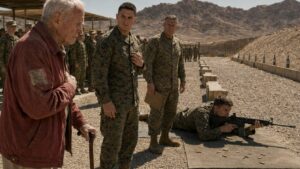
The first man to laugh at Ronald White’s rifle did it before Ronald had even reached the registration table.
It was not a big laugh. Not the kind that rolled across the desert range and demanded an audience. It was smaller than that, sharper, the kind a young man made when he wanted the people beside him to hear it but wanted the old man to wonder if he had heard it correctly.
Ronald heard it.
He kept walking.
The morning sun had already turned the gravel pale and hard. Heat shimmered above the long lanes beyond the firing line, bending the rows of paper targets into wavering rectangles. Dust clung to the tires of parked pickups and the canvas legs of shade tents. A banner snapped loose against a pole near the command table.
VETERANS CHARITY PRECISION MATCH.
The words were red, white, and blue, but the wind had folded the corner over so only VETERANS CHARITY showed clearly.
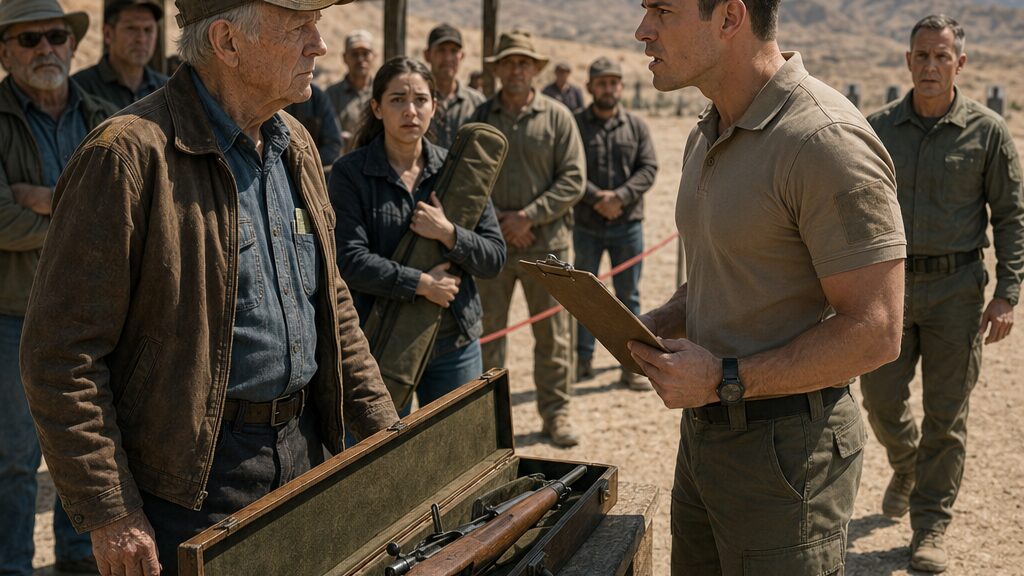
Ronald carried his rifle case in his left hand. The case was wood, darkened by years of oil and handling, its brass latches dulled to the color of old coins. It was not the hard black plastic everyone else seemed to carry now. It did not have stickers or foam cutouts or little compartments for gadgets. It looked like something a man might have brought down from an attic because he could not afford anything newer.
That was what they saw.
Ronald knew that.
His blue shirt had faded along the shoulders. His cap had no logo. The cuff of his right sleeve hung slightly loose around a wrist that looked too thin for the hand below it. When the desert breeze came from the east, his fingers trembled once against the case handle.
He stopped near the registration table and waited while a range volunteer checked names from a clipboard. A line of shooters stood ahead of him: two men in matching competition jerseys, a woman with a spotless gear bag, three junior shooters shifting nervously under the shade. At the far end of the table, a young instructor in a tan uniform was checking rifles, tags, chamber flags, and match cards with the brisk impatience of someone who liked being watched.
Kevin Moore had a voice that carried.
“Next rifle up,” he called. “Make sure it’s cleared, tagged, and modern enough to pass inspection. We’re not running a museum today.”
A couple of men chuckled. Ronald did not lift his eyes.
He slipped two fingers into his shirt pocket and touched the folded edge of his range card. The paper had yellowed at the corners. It had been laminated once, long ago, but the lamination had peeled away along one side. He had nearly left it at home. Then he had stood in his kitchen before sunrise, listening to the old refrigerator hum and the kettle begin its quiet tremble, and he had placed the card in his pocket anyway.
A promise was a promise, even when the man you made it to was gone.
The volunteer looked up. “Name?”
“Ronald White.”
The woman found the page with one finger. “White… White…” She glanced toward Kevin. “I don’t see—”
“I have the old card,” Ronald said.
He laid it gently on the table.
The card looked smaller in the sun. Its ink had softened with age. The corner bore the emblem of the range, not the newer logo printed on the banner, but the old one: crossed rifles above a desert ridge.
The volunteer bent over it. “This is… old.”
“Yes, ma’am.”
Kevin came over before she could say anything else. His boots clicked fast on the packed dirt, and the clipboard in his hand slapped lightly against his thigh.
“What’s the issue?” he asked.
“He has an old registration card,” the volunteer said. “Same range, but I don’t know if it transfers.”
Kevin took one look at the card and then at Ronald. His eyes moved down the faded shirt, the worn trousers, the old boots, and finally the case.
“Sir,” Kevin said, with the kind of politeness that had no respect in it, “this is a precision match. Charity event or not, we’ve got safety standards.”
Ronald nodded. “Good.”
Kevin paused, as if the answer had missed the insult. “Good?”
“Standards are useful.”
The junior shooters nearby turned slightly. One of them, a dark-haired girl with a nervous mouth and a rifle bag held too tightly against her chest, watched Ronald as if she could not decide whether to feel sorry for him or afraid for him.
Kevin tapped the table beside the old range card. “When was the last time you shot here?”
“A while ago.”
“That doesn’t answer the question.”
“No,” Ronald said. “It doesn’t.”
A little smile passed through the men in jerseys.
Kevin’s jaw set. He turned toward the rifle case. “Open that, please.”
Ronald placed the case flat on the inspection table. He moved slowly, not because he was uncertain, but because he had learned long ago that hurry made men careless. He released the first brass latch, then the second. The lid rose with a faint wooden creak.
Inside lay an old wooden-stock rifle, clean, plain, and cared for. Its metal had honest wear but no neglect. There was a cloth folded under the barrel and a chamber flag tucked beside it.
The laughter returned, a little stronger this time.
Kevin leaned in. “You’re planning to compete with that?”
Ronald looked at the rifle, not at Kevin. “That’s why I brought it.”
“Sir, some of these shooters are running glass worth more than a used car. You understand this isn’t a county fair booth?”
“Yes.”
“And you can see the targets?”
Ronald closed his hand around the chamber flag and lifted it first. “Well enough to know nobody touches a trigger before the line is called hot.”
The volunteer’s pen stopped.
Kevin’s eyes narrowed. “I know the rules.”
“I didn’t say you didn’t.”
The wind moved dust across Ronald’s boots. He stood with both hands visible, the open rifle untouched except for the safety flag. He could feel people watching now. That old sensation had not changed: the air turning heavy around a mistake everyone expected you to make.
Kevin picked up the rifle without asking.
Ronald’s right hand moved.
Not fast. Not angry. Just enough.
“Please set it down,” he said.
Kevin looked at him.
Ronald’s voice stayed low. “Action open. Muzzle downrange or in the case. Finger clear. Same as any rifle.”
For one second, Kevin’s hand remained on the stock. Then he set the rifle back into the case with more force than needed.
A few heads turned toward the command tent.
Kevin smiled, but color had risen in his face. “All right. Since we’re giving lessons now.” He lifted Ronald’s card, glanced at it again, and dropped it back on the table. “Mr. White, I’m going to put you on Lane Twelve.”
The volunteer looked up. “Lane Twelve? That’s the far right.”
“Exactly,” Kevin said. “More space. Less distraction. Safer for everybody.”
Ronald knew Lane Twelve. Or at least, he knew what that end of the range had always been. The wind curled strangely there after crossing the low wash beyond the berm. It looked open, but the air did not move straight. The dust told one story near your boots and another story halfway to the target.
He looked past Kevin toward the lane markers.
A younger man might have argued. A proud man might have demanded fairness. A foolish man might have explained what he knew about that ground.
Ronald only picked up his range card and smoothed its bent corner with his thumb.
“Lane Twelve is fine,” he said.
Kevin gave a short laugh. “Good. We’ll keep an eye on you.”
Ronald closed the rifle case. The brass latches clicked like two small decisions.
As he turned away from the registration table, the dark-haired junior shooter stepped back to let him pass. Her eyes dropped to the old case, then rose to his face.
“Good luck, sir,” she said softly.
Ronald touched the brim of his cap.
“Watch the dust,” he said.
She looked confused.
He walked toward the farthest lane, where the wind was already lifting pale ribbons from the desert floor.
Behind him, Kevin’s voice carried again.
“Lane Twelve for the gentleman. For safety.”
This time, more people laughed.
Ronald kept walking, calm as shade moving across stone.
Chapter 2: Kevin Moore Laughed Before The First Shot
By late morning, the range had filled with the restless noise of men and women trying to look calm before they were tested.
Bolts clicked open and closed under supervision. Spotting scopes were adjusted. Gear bags were unzipped and zipped again. Someone under the sponsor tent talked too loudly about wind meters. A target runner drove a cart along the service road behind the berm, raising a trail of dust that drifted and broke apart over the lanes.
Ronald sat on the bench behind Lane Twelve with his rifle case across his knees.
He did not open it yet.
The shooters around him had built small territories out of equipment. Bipods, rests, rangefinders, tablets, ballistic charts, ear protection, gloves, padded mats. Every item had its place and purpose. Ronald respected good tools. He had never trusted a man who mocked equipment just because it was new.
But he trusted breath more.
He trusted the plain test of body, wind, eye, and trigger.
A range volunteer came down the line checking chamber flags. When he reached Ronald, he hesitated, looking from the old case to the number on the lane marker.
“You all set, sir?”
“When the line is called.”
The volunteer nodded and moved on, relieved not to have to say more.
Ronald took the yellowed range card from his pocket. Its surface had warmed against his chest. He held it in both hands and smoothed the center crease with his thumb. The card had not been meant to last this long. Paper had a way of surrendering to time. Men did too, unless they learned what to hold and what to let go.
Down the line, Kevin Moore had gathered the junior shooters near Lane Six.
“Before we begin,” Kevin said, “this event is about safety and fundamentals. I want everyone watching each other. If you see something questionable, say something.”
Ronald looked toward him.
Kevin’s eyes were already on Lane Twelve.
“That includes outdated equipment, poor muzzle control, confusion about commands, or anyone who may not be physically up to the course.”
The girl from registration, Heather Brown, stared at the ground. The other juniors looked where Kevin wanted them to look. So did half the adults.
Ronald folded his card once and placed it back in his pocket.
Kevin walked toward him with the loose confidence of a man approaching a problem he had already named. The clipboard hung from one hand. He stopped just outside the lane boundary.
“Mr. White,” he said, loudly enough for the nearby shooters to hear. “Let’s review the commands before we go hot.”
Ronald stood.
His knees did not straighten quickly. He knew that too. He felt the small delay in his joints and the way Kevin’s eyes caught it. Age made honest movements look like weakness to anyone who had never had to work around pain.
Kevin smiled. “When I call the line hot, what do you do?”
Ronald answered quietly. “Nothing until my rifle is on the bench, pointed downrange, action open, chamber verified, and the command is complete.”
Kevin’s smile thinned.
A veteran spectator behind the line shifted under his hat.
“And if there’s a cease-fire?”
“Finger clear. Safety engaged if applicable. Muzzle downrange. Action open when instructed. Step back from the bench.”
Kevin tapped the clipboard against his own leg. “You memorized the poster.”
“No.”
“No?”
Ronald opened his case.
The old wooden-stock rifle lay still inside, the chamber flag bright against dark metal. Ronald lifted it with both hands and set it gently on the bench, muzzle downrange, action open. He did not sweep the line. He did not fumble. He did not look toward the watching crowd.
Every movement was plain.
Kevin watched with the faint irritation of a man whose accusation had failed to find a place to land.
Then he reached out and tapped the rifle stock with the edge of his clipboard.
“Still,” he said, “this thing has seen better days.”
Ronald’s eyes lowered to the clipboard touching the wood.
The tap was small. Careless. It made no mark. But a rifle did not have to be fancy to deserve respect.
Kevin tapped it again. “You sure you don’t want to rent something from the club? We have rifles that were built this century.”
A few people laughed. One of the jerseyed shooters leaned toward his friend and murmured something Ronald could not hear. The friend grinned.
Ronald looked at Kevin’s clipboard until Kevin stopped tapping.
Then Ronald said, “Please don’t do that.”
“Do what?”
“Touch another man’s rifle like it’s a joke.”
The air changed.
It was not anger in Ronald’s voice. That made it worse for Kevin. Anger could be dismissed. Calm had to be answered.
Kevin glanced around and gave the crowd a little shrug. “I’m just trying to keep everyone safe.”
“Then start there.”
Kevin’s face tightened. “Excuse me?”
Ronald’s hand rested near the open action, not on the trigger, not near the trigger, never near the trigger until it was time. “Safety is not a tone of voice.”
Someone behind the line stopped moving.
Kevin stepped closer. “You questioning my instruction?”
“I’m answering it.”
The range seemed to narrow around the two men. Heat shimmered beyond the target line. Dust moved low over Lane Twelve, first right, then left, then right again after the wash.
Kevin looked out toward the targets as if searching for a way to regain the ground he had lost.
“Fine,” he said. “Since you know so much, tell me the wind call.”
Ronald followed his gaze.
At two hundred yards, the flags near the left lanes leaned gently west. At three hundred, the mirage rose in a slow boil. Near Lane Twelve, dust curled from a dry channel and flattened, then lifted again. The easy answer was one thing. The truthful answer was another.
“Not the same all the way,” Ronald said.
Kevin laughed. “That’s not a call.”
“No.”
“So what is it?”
Ronald looked at the target frame assigned to Lane Twelve. “It will be.”
The men in jerseys laughed again, but this time not everyone joined them.
Kevin’s voice sharpened. “You think you can read it better than the flags?”
Ronald looked at the juniors standing near Lane Six, at Heather Brown holding her rifle bag too tight, at the veteran spectators watching from under the shade, at Donna Hill near the command table pretending not to notice that the event schedule had begun to bend around one argument.
He did not want a contest with Kevin Moore.
That was the truth.
He had buried too many contests already. Too many young men had needed winning more than learning. Too many old men had mistaken pride for memory. Ronald had come because the junior fund needed entries, because the old card in his pocket had arrived with a note six months too late, because there were promises a man kept even when nobody was alive to thank him.
Kevin pointed toward the target. “Well?”
Ronald laid his palm flat on the bench for a moment. His hand trembled lightly before settling.
Kevin saw it.
The young instructor smiled.
“There,” Kevin said, turning half toward the crowd. “That’s what I’m talking about. This course has stress. Timed strings. Wind shifts. We can’t have shaky hands on the line just because someone wants to relive old days.”
Ronald looked at his hand.
It was old. He had no argument against that. The skin was thin over the bones. The knuckles ached before weather changed. Some mornings it took him three tries to button his cuff.
But memory did not live in the skin.
Ronald picked up one cartridge from the small box inside his case. He did not load it. He only held it between finger and thumb and looked at Kevin.
“The target will tell you,” he said.
The words traveled farther than he intended. They passed down the line, quieting little pockets of talk. Heather lifted her head. Donna Hill stopped beside the registration table. Even the jerseyed shooters turned more fully now.
Kevin’s smile remained, but it had become fixed.
Before he could answer, a voice called from near the command tent.
“Who did you say that was?”
The question came from Mark Sanchez.
He stood at the edge of the shade with one hand on the tent pole, his close-cropped hair silvering at the temples, his uniform plain except for the authority in how still he had become. He was not looking at Kevin.
He was looking at Ronald.
Kevin turned. “Sir?”
Mark walked out into the sun.
“His name,” Mark said.
The wind pulled dust across the lane between them.
Kevin glanced at his clipboard. “Ronald White.”
Mark stopped.
For a moment, no one spoke.
Ronald lowered the cartridge back into the box, closed the lid with one finger, and kept his eyes on the target line.
Mark Sanchez removed his sunglasses slowly, as if the morning had just become something from twenty-five years ago.
Chapter 3: The Senior Officer Remembered Too Late
Mark Sanchez remembered Ronald White first by the hands.
Not the face. Not completely. Time had changed that. The man at Lane Twelve had thinner cheeks now, deeper lines beside the mouth, shoulders narrowed by years Mark knew nothing about. The old blue shirt and plain cap did not belong to the memory Mark carried.
But the hands did.
They moved without waste.
Mark had once watched those hands clear rifles in heat so fierce the steel burned through gloves. He had watched them correct a sling by half an inch, adjust a nervous recruit’s elbow, tap two fingers against a wooden stock and say, “You are fighting the rifle. Stop fighting. Listen to it.” He had watched those hands draw diagrams in dust because the classroom board had blown over in the wind.
And now Kevin Moore was standing in front of those hands with a clipboard and a smirk.
Mark walked to the command table and picked up the registration card the volunteer had set aside. The old paper looked fragile in his grip.
Ronald White.
The range emblem at the corner belonged to the years before sponsors, before the new clubhouse, before the concrete pads and electronic check-in. Back then, the desert range had been a harsher place. Fewer signs. Fewer shade tents. More silence. Men learned quickly there, or the wind embarrassed them.
Mark looked toward Lane Twelve.
Ronald had not turned around.
Donna Hill came beside Mark, lowering her voice. “Is something wrong?”
“No,” Mark said.
But his throat had tightened around the word.
Kevin approached with the stiff walk of a man trying to look as if he still controlled the scene. “Sir, I was just handling a safety concern.”
Mark looked at him. “Were you?”
“Yes, sir. Old equipment. Possible confusion about commands. Physical tremor. I put him on Twelve to reduce risk.”
Donna’s eyes flicked toward the far lane. “We can’t have an incident today. Donors are already asking why the schedule’s delayed.”
“There won’t be an incident,” Mark said.
“You know him?” Donna asked.
Mark looked down at the yellowed card again. There were things a man could say that would turn the entire range at once. He could say instructor. He could say record holder. He could say that half the safety rules printed on the laminated boards had come from mornings when Ronald White had stood in this same dust refusing to let young men confuse confidence with control.
He could say too much.
Instead he said, “He trained here.”
Kevin gave a small shrug. “A lot of people trained here.”
Mark turned on him then, and Kevin stopped.
“Not like that,” Mark said.
The words came out more sharply than he meant. A few people under the shade glanced over. Mark lowered the card.
Across the line, Ronald closed his rifle case again. Not fully. Just enough to keep dust from settling inside while he waited. He did not look impatient. That unsettled Mark more than any accusation would have.
The old man had heard enough to know recognition had arrived.
He was refusing it.
Mark walked out toward Lane Twelve. Each step made the distance feel longer. By the time he reached the bench, the noise behind him had faded into the dry rattle of wind against target frames.
“Mr. White,” Mark said.
Ronald looked up then.
For an instant Mark was twenty-four again, sunburned, angry, embarrassed after missing a qualification he had bragged about for three weeks. Ronald had stood beside him that day and said nothing until Mark ran out of excuses. Then he had placed one spent casing in Mark’s palm and told him that the rifle had done exactly what Mark’s body asked it to do.
Not what Mark claimed he asked.
What he asked.
“Mark Sanchez,” Ronald said.
Mark almost smiled. “Yes, sir.”
“Don’t call me sir. I’m retired from being responsible for you.”
That did make Mark smile, though it hurt a little.
Kevin had followed at a distance. Donna stayed closer to the command table, watching donors watch her.
Mark lowered his voice. “I should have known you were coming.”
“I didn’t ask anyone to know.”
“You should have called.”
“I had a card.”
“It’s an old card.”
“It worked at the gate.”
Mark looked at the wooden case. “You planning to shoot the match?”
“If allowed.”
“Allowed?” Mark glanced back at Kevin.
Ronald’s face did not change. “Your instructor has concerns.”
Kevin stepped closer. “Reasonable concerns, sir.”
Ronald looked at Kevin only briefly. “Reasonable concerns are useful when they begin with observation.”
Kevin’s mouth tightened.
Mark felt heat rise in his own face, not from the sun. He should have stepped in sooner. He had heard laughter from the command tent and dismissed it as range noise. He had seen the old case and not looked closely. He had let a man who had shaped his life stand alone under public mockery because the event had banners and donors and a schedule.
“Mr. White,” Mark said, “I can clear this up.”
Ronald’s eyes settled on him.
“No,” Ronald said.
Mark blinked.
Ronald picked up the yellowed card from the bench where the volunteer had returned it and slipped it into his shirt pocket. “You can keep the line safe. You can keep the match fair. You cannot clear up what he said.”
Kevin shifted. “I didn’t say anything that wasn’t about safety.”
Ronald nodded once. “Then safety will be enough.”
Mark understood. Not all at once, but enough.
If he announced Ronald’s history now, Kevin would be embarrassed by authority, not by truth. The crowd would respect Ronald because Mark told them to. That was not the same thing as seeing.
Donna came down the line then, her event badge flashing in the sun. “We need a decision. We’re behind schedule.”
Mark turned toward her. “He shoots.”
Kevin said, “With respect, I recommend a public qualification before he’s allowed into the scored match.”
Donna hesitated. “Is that necessary?”
Kevin’s eyes stayed on Ronald. “If we bend safety because someone used to train here, everybody sees it. If he’s capable, it shouldn’t be a problem.”
There it was.
Not quite a challenge. Not quite an insult. Neat enough to hide behind procedure.
Mark looked at Ronald. “You don’t have to agree to that.”
Ronald opened the rifle case again. “No special treatment.”
Kevin’s confidence returned in small increments. “Good. One qualifying group. Lane Twelve. Everyone behind the line. If he can place five rounds safely on paper, he stays. If not, he’s done for the day.”
Mark’s eyes hardened. “That standard is lower than match qualification.”
“For safety removal,” Kevin said, “it’s enough.”
Ronald lifted the rifle and set it on the bench, muzzle downrange, action open. He placed the chamber flag beside the ammunition box and checked the empty chamber, though everyone could see it was empty.
Then he turned his cap brim slightly against the sun.
“No,” he said.
Kevin frowned. “No?”
“If I qualify,” Ronald said, “I qualify by the same target as everyone else.”
Donna crossed her arms. “That would mean scored conditions.”
“Yes, ma’am.”
“And if you don’t pass?”
Ronald looked downrange, where Lane Twelve shimmered and twisted under the desert wind.
“Then I put the rifle away.”
The quiet after that was not soft. It was tight, expectant.
Kevin looked almost pleased. He lifted his clipboard.
“Fine,” he called loudly enough for the nearby lanes to hear. “Public qualifier on Twelve. Mr. White wants the same target as everyone else.”
The words moved down the line faster than wind.
Shooters stepped back from benches. Juniors turned. Spectators came out from shade. The old record board near the command tent was still half-covered by sponsor banners, its faded names hidden behind bright logos and promises of donated prizes.
Mark noticed Ronald glance at it once.
Only once.
Then the old man lowered himself onto the bench behind Lane Twelve, steadying his rifle with the care of someone setting down a memory that still mattered.
Kevin raised his hand for attention.
“Public qualifier,” he announced. “If Mr. White can’t meet match standard, he leaves the line.”
Ronald did not look at the crowd.
He watched the dust.
Chapter 4: Heather Brown Missed Because She Was Afraid
Heather Brown’s first shot missed so far left that the target runner raised one arm before anyone at the spotting scopes said a word.
The signal was not dramatic. It was only a small motion in the hot distance, a practical wave from a man whose job was to mark paper and keep the match moving. But Heather saw it through the scope at Lane Six, and her face changed as if the whole desert had turned to watch her.
Kevin saw it too.
“What was that?” he called.
Heather kept her cheek near the stock. “I pulled it.”
“You didn’t pull it. You panicked.”
Her shoulders tightened.
Ronald stood behind the marked line at Lane Twelve, rifle safe and open on the bench. He had passed his public qualifier without comment. Five shots, all safely on paper, all inside the standard, though not so tight that the crowd had received the answer it wanted. Kevin had looked almost satisfied, as if Ronald had proven only that an old man could still obey instructions. Mark had looked harder at the target, then at Ronald, but said nothing.
Ronald had said nothing too.
Now the juniors had moved into their practice string before the afternoon match, and the range’s attention had loosened. People returned to water bottles and shade, to checking turrets and pretending they had not been waiting for an old man to fail.
Heather’s second shot snapped into the dry air.
Another miss.
This time Kevin walked straight to her lane.
“Stop,” he said. “Bolt open.”
Heather obeyed too quickly, fingers stiff.
Kevin leaned over her bench, careful not to cross the firing line but close enough that his voice pressed against her. “You’re throwing away your chance. Do you know how many juniors wanted this slot?”
“Yes, sir.”
“Then shoot like it.”
Ronald watched the dust between Lane Six and Lane Twelve. It moved in restless strips, thin and pale over the gravel. The wind had risen since late morning. Not much, but enough to trouble anyone already troubled.
Heather swallowed and tried to settle back behind the rifle.
Kevin pointed toward her target. “Hold where I told you. Don’t overthink it.”
Ronald’s hand went to his shirt pocket. His thumb found the softened edge of the yellowed range card and stopped there.
Don’t overthink it.
He had heard that phrase ruin more young shooters than bad weather ever had. Fear was not cured by telling someone to stop fearing. A tight hand did not open because a louder voice demanded it.
Heather fired again.
The paper marked low.
Kevin exhaled hard. “Heather.”
Her name carried down the line. The juniors beside her looked at their benches. One of the adults under the shade winced.
Ronald stepped back from Lane Twelve and walked slowly behind the line, never crossing where he should not, never entering a shooter’s space without permission. He stopped six feet behind Heather, far enough to be respectful, close enough that she could hear him if she wanted to.
Kevin noticed immediately. “Mr. White, this is a junior lane.”
Ronald nodded. “Yes.”
“Then stay with your own rifle.”
Heather’s face went red.
Ronald looked not at Kevin, but at the girl’s right hand. Her thumb was pressed white against the stock. Her breathing had shortened until the rifle moved with every shallow pull of air.
“She’s chasing the shot,” Ronald said quietly.
Kevin turned. “Excuse me?”
Heather froze.
Ronald kept his hands at his sides. “She missed left, so now she’s trying not to miss left. That makes the rifle louder than the target.”
Kevin laughed once. “The rifle isn’t loud. Her nerves are.”
Heather’s eyes lowered.
Ronald felt something old and unwelcome move in him then. Not anger. Anger was too hot and too easy. This was disappointment, the kind that settled deep. He had seen instructors mistake humiliation for pressure, pressure for training, training for proof of their own authority.
He took one careful step closer, still behind the line. “May I speak to her?”
Kevin’s answer came quick. “No.”
Heather’s fingers trembled against the bolt.
Donna Hill, standing near the command table, turned at the exchange. Mark watched from beside her, his face unreadable.
Ronald looked at Kevin. “Then speak softer.”
Kevin’s eyes hardened. “You don’t run this line.”
“No.”
“You passed a basic qualifier. That doesn’t make you staff.”
“No.”
“So stop interfering.”
Ronald’s gaze moved past Kevin to Heather. “Open your hand.”
Heather blinked.
Kevin snapped, “Do not follow outside instruction.”
Ronald did not raise his voice. “You already opened the bolt. The rifle is safe. Now open your hand.”
Heather looked at Kevin, then at her own fingers. Slowly, she loosened her grip.
The change was small, almost nothing. Her shoulders dropped a fraction.
Ronald said, “Breathe like you’re cooling soup.”
A few people nearby smiled despite themselves. Heather did not. She took one uneven breath.
“Again,” Ronald said.
Kevin stepped toward him. “That’s enough.”
Heather breathed again. Slower this time.
Ronald nodded once. “Good. The rifle does not need you to hold it down. It needs you to stop shaking it.”
Heather’s mouth trembled, but not with tears now. With concentration.
Kevin looked toward Mark. “Are you allowing this?”
Mark’s answer came after a long second. “The line is safe.”
“That’s not what I asked.”
“It’s the answer that matters.”
Kevin’s face flushed.
Ronald did not enjoy that. A smaller man might have. He had not come here to turn Kevin into a spectacle. He had come because the envelope had arrived in his mailbox with a familiar handwriting on it, forwarded twice, late by months. Inside had been a note about the junior fund, a match, a promise made years ago under a shade tarp after a funeral. If the program ever needs a hand, you’ll know before I ask.
Ronald had known too late. But he had come.
Heather settled again behind the rifle.
Ronald watched the mirage beyond her target. “Don’t fight the last shot,” he said. “It’s already gone.”
Kevin folded his arms. “This is not story time.”
Heather fired.
The shot struck paper. Not center. Not perfect. But close enough that the target runner did not wave a miss.
Heather lifted her head with disbelief.
Ronald gave no praise. Praise too soon could shake a shooter as badly as criticism. He only said, “Now do it again without chasing that one either.”
Heather nodded.
Her next shot landed nearer.
The one after that nearer still.
A hush spread in the immediate space around Lane Six. Not the silence of awe. Something quieter and more useful: people paying attention.
Kevin stood rigid, jaw set, watching a girl he had nearly broken begin to find the target again because an old man had told her to breathe like she was cooling soup.
When the practice string ended, Heather opened the bolt, showed clear, and stepped back.
“Thank you,” she said.
Ronald touched the brim of his cap. “You did the work.”
Kevin moved between them before she could say more. “That was unauthorized coaching.”
Heather’s face fell.
Ronald looked at him. “No shot was fired unsafely.”
“That is not the point.”
“It is always the first point.”
Kevin’s clipboard came up against his chest like a shield. “You interfered with official instruction during a match event.”
“Practice string.”
“Under match supervision.”
Ronald nodded. “Then supervise better.”
The words landed harder than he meant them to.
Kevin went still.
Around them, the juniors looked away. Donna took a step forward, concern tightening her mouth. Mark straightened but did not intervene.
Kevin’s voice dropped. “You think because you can quote old rules and talk a nervous kid through three shots, you get to correct me in front of my line?”
Ronald looked at the girl’s target fluttering faintly in the distance.
“No,” he said. “I think fear teaches badly.”
Kevin stared at him for a long moment.
Then he turned toward the command table and called out, loud enough for the range to hear, “I’m filing an interference note. If Mr. White wants to instruct today, he can prove he belongs on the firing line first.”
Ronald felt the range shift again, all eyes returning.
Heather whispered, “Sir, I’m sorry.”
Ronald did not look away from Kevin.
“Don’t be,” he said.
Kevin lifted his clipboard and pointed toward Lane Twelve.
“Afternoon match,” he announced. “No more charity allowances. Same conditions as everybody. Let’s see what the old methods do when the score counts.”
Ronald walked back to his lane with the old ache in his knees and the dry wind in his face.
Behind him, Heather picked up her rifle bag with steadier hands.
Chapter 5: The Wind Shifted While Everyone Watched
By afternoon, the desert had stopped pretending to be still.
The flags near the command tent leaned gently, but out past the two-hundred-yard line the mirage ran sideways in broken sheets. Dust lifted from the wash beyond Lane Twelve, traveled ten feet, dropped, then rose again in a different direction. The wind was not strong enough to frighten a careless shooter. It was worse than that. It was subtle enough to flatter one.
Ronald sat behind his bench and watched it.
Around him, the charity match had taken on the bright, strained mood of an event that had found its unexpected center. People still moved through their routines, still checked scopes, still drank water, still talked under the tents, but their attention drifted back to Lane Twelve as if pulled by a string.
Kevin Moore made sure of it.
He stood near the command area with a microphone he did not need. “Afternoon precision string begins in ten minutes,” he announced. “Top score currently belongs to our club favorite. Conditions are fair, targets verified, and all shooters will be held to the same standard.”
He lowered the microphone, but not his voice.
“Especially those who requested it.”
Ronald opened his rifle case.
The old wooden stock caught the sunlight without shining. The rifle had never been beautiful in the way expensive things were beautiful. Its beauty was in its lack of waste: worn where hands had held it, dark where oil had protected it, plain where fashion had never mattered.
He ran a cloth once along the stock, not because it needed cleaning, but because the movement steadied the memory of other ranges, other mornings, other young voices waiting to be taught something they did not yet know they needed.
Heather stood two lanes away with the juniors, watching him.
Ronald gave no sign that he noticed.
Mark Sanchez came to Lane Twelve as the target runner finished posting fresh paper downrange. “You don’t need to answer Kevin,” he said softly.
Ronald checked the open chamber. “I’m not.”
“He’s making this personal.”
“No. He’s making it public.”
“That’s worse.”
“Sometimes public is where a lesson got lost.”
Mark studied him. “You always did that.”
“What?”
“Made a man walk to the truth instead of carrying him there.”
Ronald set his ammunition box on the bench. “Men don’t value what they’re handed too easily.”
Mark looked toward Kevin, who was laughing with a donor near the shade tent, shoulders squared, confidence rebuilt around attention. “And if he doesn’t learn?”
Ronald picked up one cartridge and set it beside the rifle. “Then the target still will.”
Mark exhaled through his nose, almost a laugh, almost pain. “I should have called you years ago.”
Ronald did not answer.
That was a different target. No rifle could touch it.
Donna Hill approached with a clipboard of her own. Her earlier worry had sharpened into event-manager focus. “Mr. White, I want to be clear. You’re eligible for the match. But if this turns disruptive, I’ll have to stop it.”
Ronald nodded. “That’s your job.”
“I don’t want a scene.”
“You already have one.”
Donna glanced at the spectators gathering beyond the safety line. “I know.”
“Then make it safe.”
She looked at him for a moment, as if surprised by the simplicity of the answer. Then she nodded once and walked back toward the command table.
Kevin called shooters to positions.
Ronald moved slowly to the bench. He placed the rifle downrange, action open, chamber visible. He did not touch the ammunition until the command allowed it. He could feel eyes on his back: curious, doubtful, amused, hopeful. He let them stay there. Attention was only weather if you refused to carry it inside.
The first string began.
Other shooters fired before him. The modern rifles cracked sharply, one after another. Spotters murmured. Adjustments clicked. A man in a competition jersey cursed under his breath after a shot drifted right. Kevin paced behind the line like a coach who wanted credit for every good hit and distance from every bad one.
Ronald waited.
His target stood pale and small beyond the shimmer.
“Lane Twelve,” Kevin called. “You planning to participate?”
Ronald did not look back. “When the wind finishes lying.”
Someone behind the line laughed, then stopped quickly.
Kevin stepped closer. “The wind is the same for everyone.”
Ronald watched dust peel off the wash and fold back toward the berm. “No.”
Kevin’s lips parted, but Mark’s voice came from the command table. “Let the shooter manage his time.”
Kevin turned away, irritated.
Ronald brought the rifle to his shoulder.
The world narrowed, but not to the target. That was the mistake young shooters often made. The target mattered, but so did everything between. Heat. Breath. Pulse. Dust. The tiny pressure of cheek against stock. The difference between holding and forcing. The moment when the body wanted to snatch certainty before certainty had arrived.
His hands trembled once as he settled.
He let them.
Fighting tremor only fed it. Age had given him that lesson with no kindness and no apology. He had learned to wait through the tremor the way a man waited through a gust.
The movement passed.
Ronald breathed in, then out, slow as a door closing.
Kevin’s voice cut across from behind. “Clock is running, Mr. White.”
Ronald’s finger remained clear.
He watched the mirage flatten, lift, then bend left near the berm. A dust ribbon crossed low in front of Lane Twelve, thin and pale, moving not with the flags but against them.
There.
He loaded one round.
The rifle settled into him like an old sentence remembered word for word.
He fired.
The shot cracked across the desert.
Ronald opened the bolt, ejected the casing, and waited.
Nobody could see the target clearly enough from the line. That was part of the cruelty and mercy of distance. It kept proof away until men had finished making fools of themselves.
Kevin looked through a spotting scope. His expression did not change. “On paper.”
A few spectators murmured, disappointed by the plainness of the report.
Ronald loaded again.
He did not chase the first shot. He did not adjust because the crowd expected motion. He watched the same dust ribbon fall apart, watched a second rise farther out, watched sunlight tremble over the target frame.
Second shot.
Bolt open.
Wait.
Third.
The wind shifted harder then, enough that two flags downrange snapped and held. A shooter near Lane Nine muttered and came off his rifle. Kevin smiled slightly, as if conditions had finally agreed to serve him.
Ronald lowered his rifle and sat back.
Kevin pounced on the pause. “Problem?”
“No.”
“You’re stopping?”
“Listening.”
“To what?”
Ronald looked at the empty space between muzzle and target. “The part you can’t hear when you talk.”
The line went quiet enough that the wind itself seemed to step forward.
Kevin’s smile vanished.
Ronald waited longer than anyone expected. Long enough for impatience to ripple through the crowd. Long enough for Donna to check the schedule. Long enough for Mark to fold his arms and stare out at the wash, seeing perhaps for the first time what Ronald had been watching all day.
Then Ronald shifted.
He did not return to the bench.
He lowered himself carefully to one knee beside the firing mat, the old rifle held safely downrange, his movements slow, deliberate, almost ceremonial. The position looked impossible for a man his age until he settled into it, left elbow supported, shoulder relaxed, cheek placed to stock with the lightness of habit.
The desert range seemed to stop around him.
This was the image that would stay with them later: the old man in the faded blue shirt kneeling in the dust at the farthest lane, the wooden rifle steady, the young instructor standing behind him with nothing left to say.
Heather Brown watched without blinking.
Ronald loaded the fourth round.
Breath in.
Breath out.
The wind crossed, thinned, and opened.
He fired.
Before the echo fully died, he worked the bolt, loaded the fifth, and waited one beat more.
The dust ribbon rose again.
This time he did not wait for it to settle. He knew where it was going.
The fifth shot cracked clean and dry.
Ronald opened the bolt, showed clear, and lowered the rifle.
No one spoke.
Kevin bent over the spotting scope. He adjusted it once. Then again.
“Well?” Donna called from the command table.
Kevin did not answer immediately.
Ronald placed the rifle back on the bench, chamber open, muzzle downrange. He set the spent casings in a neat line beside the ammunition box. His hand trembled again, more than before, and he closed it gently until the tremor passed.
Finally Kevin straightened.
“Target retrieval,” he said.
His voice sounded smaller.
The target runner started downrange in the cart.
Everyone watched the little vehicle move through the heat shimmer toward Lane Twelve’s paper.
Ronald sat back and took the yellowed range card from his pocket.
He smoothed the crease with his thumb.
Chapter 6: The Target Came Back Without A Sound
The target runner did not hurry on the way back.
That was the first thing the crowd noticed.
On most strings, he drove the cart briskly along the service road, one hand on the wheel, one elbow loose, paper targets clipped in order beside him. When a shooter had done well, he sometimes raised the target before reaching the line, letting friends cheer early. When someone had scattered shots, he kept the paper low and spared them the long approach of public failure.
This time he drove slowly.
The target from Lane Twelve lay flat across the passenger seat, face down.
Kevin watched him come with the rigid stillness of a man holding a door shut against wind.
Donna moved closer to the retrieval line. Mark stood beside the command table, but his eyes were not on the cart. They were on Ronald, who remained seated behind Lane Twelve with his rifle safe, open, and untouched.
Ronald had not looked through a spotting scope. He had not asked for a report. He had not moved from the bench except to place the old rifle back into its case, leaving the lid open until the target was returned.
Heather Brown stood with the juniors, her hands folded around the strap of her rifle bag.
The cart rolled to a stop.
For a moment, the target runner did not get out.
Then he stepped down, lifted the paper with both hands, and looked once toward Mark as if asking who should receive it.
“Bring it here,” Donna said.
He carried it to the command table.
Kevin reached for it first.
The target runner hesitated, then gave it to Donna.
The paper made a dry snapping sound in the wind as she turned it over.
Nobody cheered.
The silence came instead.
It moved outward from the command table in a widening circle. Donna’s mouth parted slightly. The veteran spectators under the shade leaned forward. One of the jerseyed shooters took off his sunglasses, cleaned them with his shirt, and looked again as if dust had lied to him.
Kevin stared at the target.
Five shots sat in a tight group just off dead center, clustered so closely that from a few steps away the paper seemed to have one ragged hole with smaller bites around its edge. It was not magic. It was not impossible. It was worse for Kevin than impossible because it was real, explainable only by fundamentals he had treated like old stories.
Donna looked up. “Is this Lane Twelve?”
The target runner nodded. “Yes, ma’am.”
Kevin took the paper then. He held it close. “There has to be an overlay issue.”
Mark’s voice was quiet. “There isn’t.”
“You haven’t checked.”
“I’m looking at it.”
Kevin turned the paper slightly, searching for some rescue in the scoring rings. “The target frame could have been misassigned.”
The target runner shook his head. “I posted it myself.”
“Then someone cross-fired.”
No one answered that quickly, because the accusation was serious enough to sour the air.
Ronald stood.
The movement drew more attention than Kevin’s words had. He did not look offended. He did not look victorious. He only closed the lid of his wooden case halfway, then walked toward the command table with his old range card in hand.
“Mr. White,” Mark said, almost warning him.
Ronald stopped beside Kevin, leaving space between them. He looked at the target paper.
“Those are mine,” he said.
Kevin’s face tightened. “You can’t know that.”
Ronald pointed, not touching the paper. “First shot settled there. Second kissed the edge. Third held under the boil. Fourth waited out the false left. Fifth rode the wash.”
The words were plain, not boastful. That made them harder to dismiss.
A man from Lane Nine muttered, “That’s exactly when the flags shifted.”
Kevin looked at him sharply. The man looked away but did not take it back.
Donna set the paper flat on the table and bent closer. “Mark?”
Mark had not moved.
He was staring past the fresh target toward the old record board near the shade tent. Half of it was still covered by sponsor banners, but the wind had loosened one corner. The bright vinyl lifted and fell, lifted and fell, showing strips of faded names underneath.
Mark walked to it.
No one followed at first. Then Donna did. Then the others, as if the whole range had become one body turning toward a forgotten wall.
Mark took hold of the loose banner corner. He looked back once at Ronald.
Ronald gave the smallest shake of his head.
Not yet.
Mark stopped.
That small refusal seemed to cost him.
Kevin saw it. “What is this?”
Ronald slid the yellowed range card onto the command table beside the fresh target. The old emblem on the card matched the faded emblem at the top of the covered board.
Donna looked between them. “This card number…”
Mark came back slowly. “It predates the current system.”
Kevin exhaled, impatient and unsettled. “So he used to shoot here. That doesn’t make this score valid.”
“No,” Ronald said. “The target makes it valid.”
Kevin’s eyes flashed. “You think this is funny?”
“No.”
“You embarrassed my line.”
Ronald looked at him then, fully. “You did that before I fired.”
The words struck Kevin harder than any insult could have. His mouth opened, then closed.
The crowd heard. Ronald wished fewer of them had.
He did not want to crush the young man. Kevin had been arrogant, careless, proud in the way men became proud when they had been praised too often for being right and not enough for learning. But he was not beyond repair. Ronald had seen worse men become good instructors after one honest failure.
Donna’s hand rested near the target. “This grouping beats the standing match record.”
Kevin turned to her. “Unofficial until verified.”
“Of course,” she said. “But visually—”
“Unofficial,” he repeated.
Mark’s patience broke quietly.
“Kevin.”
The young instructor looked at him.
Mark walked back to the record board, gripped the sponsor banner, and pulled it free from the upper hooks. The vinyl dropped with a dusty slap against the support legs.
The old board stood exposed.
Rows of names and dates had faded under sun and time. Some letters were nearly gone. But one line, etched on a small brass strip instead of painted, still held.
R. WHITE — RANGE INSTRUCTOR STANDARD — DESERT WIND COURSE
The date was old enough that some of the junior shooters had not been born when it was posted.
Mark faced the crowd. His voice carried without the microphone.
“When this range opened its precision program, the standards were written by instructors who understood safety before score. Ronald White was one of them.”
Ronald looked down.
Mark continued, but his tone changed, becoming less announcement than confession. “He trained the man who trained me. He trained a lot of men who thought they already knew how to shoot.”
A few veteran spectators removed their caps. Not dramatically. Just quietly, as if the heat had suddenly become less important than respect.
Kevin stared at the brass strip.
His face had lost its color.
Ronald picked up the old card and slipped it back into his shirt pocket. “That’s enough.”
Mark looked at him. “No, sir.”
Ronald’s eyes rose.
Mark corrected himself softly. “No, Ronald. It isn’t.”
For a moment the two men stood inside a history nobody else fully owned.
Then Heather Brown stepped forward from the junior group. She did not speak. She only looked at the fresh target on the table, then at Ronald’s hands.
The same hands Kevin had mocked.
They trembled now. The shooting was done, and the body had remembered its age. Ronald did not hide it. He let the tremor be seen.
Heather looked at those hands without pity.
That mattered more to Ronald than the target.
Donna lifted the match sheet. “Mr. White, pending formal scoring, you’re leading the precision match.”
A murmur moved through the crowd.
“The prize package includes the donor trophy and a grant credit,” Donna continued. “You’ll be called at closing.”
Ronald looked toward the junior lanes, where Heather’s target still fluttered in the wind.
“I didn’t come for the trophy.”
Kevin lowered his clipboard. For once, he did not seem to know what to do with it.
Ronald turned to him. “You know the rules.”
Kevin swallowed.
“Yes.”
“You know the commands.”
“Yes.”
Ronald nodded toward the juniors. “Now learn when your voice is helping and when it’s only loud.”
Kevin looked down.
No one laughed.
That was the mercy in it.
The target paper remained on the table, bright and undeniable in the desert sun. People drifted closer, not cheering, not shouting, only looking. The silence around it felt heavier than applause.
Mark stood beside the exposed record board with one hand still on the fallen sponsor banner.
Donna read the brass strip again.
Kevin read it too.
Then Mark turned toward the crowd and said the part Ronald had not wanted spoken.
“Ronald White trained the man who created the safety standards for this event.”
Ronald closed his rifle case.
The brass latches clicked once, then again.
Chapter 7: Ronald White Left The Prize Behind
By sunset, the desert range looked smaller.
The crowd had thinned. Sponsor tents cast long blue shadows across gravel that still held the day’s heat. Volunteers folded chairs and stacked clipboards into plastic bins. The target frames stood empty downrange, pale rectangles against the low gold light, no longer carrying anyone’s pride.
Ronald sat alone at Lane Twelve, closing his wooden rifle case.
He took his time. Cloth over the stock. Chamber checked though it had been checked twice already. Bolt settled. Brass latches wiped with his thumb before he pressed them down.
Click.
Click.
The sound was quieter than applause and more honest.
Across the range, Donna Hill stood with the donor trophy on the closing table, waiting for him. Mark Sanchez had uncovered the old record board completely. The fallen sponsor banner lay rolled beside it, dust along its bright printed promises.
Kevin Moore stood near the junior lanes, no clipboard in his hands.
That was the first thing Ronald noticed.
The younger man had carried that board all day like a badge. Now it rested on a bench several feet away while Kevin watched Heather Brown pack her rifle bag.
Heather looked different from the girl who had missed left in the morning. Not taller. Not suddenly fearless. Just less folded into herself. She zipped the bag, then glanced toward Ronald as if deciding whether she had permission to approach.
Ronald lifted the rifle case and walked toward the closing table.
The spectators who remained quieted when he came near. A few nodded to him. One veteran touched two fingers to the brim of his cap. Ronald returned the gesture without slowing. Respect was easier to carry when it did not ask to become a performance.
Donna held out the trophy. “Mr. White, the formal score stands.”
Ronald looked at the polished base, the little brass plate waiting for a name.
“It’s a good event,” he said.
Donna seemed unsure what to do with that. “Thank you.”
“Keep it that way.”
Her expression softened. “We almost forgot what it was for.”
Ronald reached into his shirt pocket and drew out the yellowed range card. For a moment, he held it between both hands. The old paper had lived through footlockers, kitchen drawers, moving boxes, and years when he had not wanted to remember the sound of young men asking him how to steady themselves.
He placed the card beside the trophy.
Donna looked down. “Mr. White?”
“The prize credit,” Ronald said. “Put it into the junior fund.”
Heather, standing several feet away, went still.
Donna blinked. “You won it.”
“No. I carried it here.”
Mark watched Ronald carefully. He understood first. He had always understood late, but he did understand.
Ronald looked toward Heather. “She’ll use it better.”
Heather’s mouth opened, but no words came.
Ronald picked up the range card again and walked to her. The old rifle case hung at his side. In the low sun, the worn wood seemed warmer, almost alive.
“You keep chasing what people think of your shot,” he said, “and you’ll never learn what the shot is telling you.”
Heather swallowed. “Yes, sir.”
He held out the card.
She stared at it. “I can’t take that.”
“It isn’t a medal.”
“It’s yours.”
“It was a reminder.” Ronald waited until she took it. “Now it can remind somebody else.”
Heather held the card like it might break. “Of what?”
Ronald looked out toward the range, where the wind had finally softened and the dust lay quiet.
“That quiet is not empty,” he said.
Her fingers closed around the card.
Kevin approached slowly. He stopped a few steps away, not crowding them. His face had lost the sharpness it had worn all morning.
“Mr. White,” he said.
Ronald turned.
Kevin looked at the rifle case, then at Ronald’s hands. He did not look away from the tremor this time.
“I was wrong.”
Ronald waited.
Kevin breathed once, shallowly, then tried again. “Not just about your shooting.”
The range noises continued around them: a chair folding, a truck door closing, the flap of canvas in evening wind.
Ronald nodded. “Then fix what comes after wrong.”
Kevin’s eyes lowered. For a moment, he seemed almost young enough to be one of the juniors.
“Yes, sir.”
Ronald did not correct the sir this time. Not because he wanted it, but because Kevin’s voice had changed enough to mean respect instead of performance.
Mark came beside them with the old sponsor banner rolled under one arm. “The board stays uncovered,” he said.
Donna nodded from the closing table. “It stays uncovered.”
Ronald looked at the brass strip with his name on it. He did not feel triumph. He felt the weight of years and the strange mercy of being allowed to return without needing to stay.
He turned toward the parking lot.
“Ronald,” Mark said.
Ronald stopped.
Mark’s voice lowered. “I should have remembered sooner.”
Ronald looked back at him. “You remembered before the day was over.”
That was all he gave him. It was enough.
The sun dropped behind the low ridge, and the firing line fell into shade. Ronald walked across the gravel with the old case in his hand. His steps were slow, but they did not wander.
Behind him, Kevin’s voice rose at the junior lane.
“Line check,” he called, then stopped himself.
Ronald paused beside his truck.
Kevin started again, quieter this time.
“Chambers open. Muzzles downrange. Take your time. Safety first.”
There was a brief silence.
Then Heather’s voice, clear and steady, answered, “Ready.”
Ronald placed the rifle case on the passenger seat. Before he closed the door, he looked once more at the desert range, at the uncovered board, at the girl holding the yellowed card, at the young instructor learning how not to shout at the wind.
He shut the door gently.
The story has ended.