The Sheriff Pointed a Gun at an Old Man Feeding Birds and Learned Who Really Controlled the County
Chapter 1: The Birds Scattered Before Anyone Else Did
The first sign that something was wrong was not the sheriff.
It was the birds.
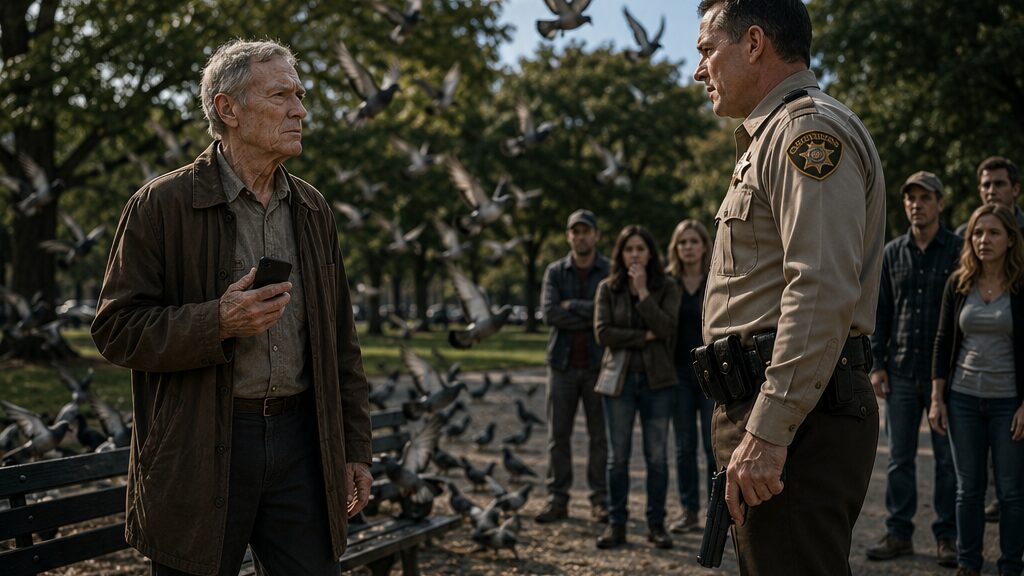
A dozen pigeons had gathered around Richard Roberts’s bench, pecking calmly at scattered crumbs. Then, without warning, they burst upward in a violent rush of wings.
Richard looked up.
People on the walking path were suddenly stepping aside.
Not casually.
Quickly.
Instinctively.
As if they had seen a storm approaching.
A tall man in a sheriff’s uniform was striding across the park.
Jonathan Torres.
Richard had lived in the county for almost three years. He knew the name.
Everybody did.
The sheriff moved through the park without acknowledging anyone. Citizens lowered their eyes. Conversations ended mid-sentence. A maintenance worker abruptly changed direction.
Richard noticed details.
He always had.
It was one reason he had survived decades in rooms where mistakes ruined lives.
Fear had a shape.
And this town wore it openly.
The sheriff was still thirty yards away when a woman carrying groceries stepped off the path and into the grass to avoid crossing his route.
Richard watched her.
Interesting.
Not respect.
Avoidance.
There was a difference.
He dropped another piece of bread for the pigeons that had slowly begun returning.
Retirement was supposed to be simple.
No meetings.
No reports.
No decisions that affected thousands of people.
Just mornings in the park.
Birds.
Coffee.
Silence.
The sheriff approached.
Richard didn’t move.
Not because he was making a point.
He simply didn’t think the man required the entire walkway.
Jonathan Torres stopped.
The silence arrived before his voice.
“What are you doing?”
Richard glanced up.
“Feeding birds.”
The sheriff stared.
“I can see that.”
Richard waited.
Several people nearby pretended not to listen.
Nobody left.
Nobody approached.
They simply froze.
The way people freeze when they’ve seen the same scene before.
The sheriff pointed toward the path.
“You were supposed to move.”
Richard looked behind him.
Then back.
“Was I?”
A few heads turned.
The question itself seemed dangerous.
Jonathan’s jaw tightened.
“Everyone moves.”
Richard folded the empty bread bag.
“I didn’t realize the walkway belonged to you.”
The words were calm.
Polite.
Not sarcastic.
Yet something shifted immediately.
The sheriff’s expression hardened.
For a moment Richard saw something beneath the badge.
Not anger.
Expectation.
The expectation of obedience.
And the irritation that followed when it failed to appear.
“You new here?”
Richard smiled faintly.
“Three years.”
“Then you should know how things work.”
Richard looked around the park.
Children near a fountain.
An elderly couple walking slowly.
The woman with groceries still standing twenty feet away pretending to check her phone.
“Seems like a public park.”
Several nearby faces immediately turned away.
The sheriff took a step closer.
“Maybe you’re getting confused.”
“About what?”
“About who keeps order around here.”
There it was.
Not law.
Ownership.
Richard had heard that tone before.
Different uniforms.
Different countries.
Different offices.
Always the same tone.
The belief that authority existed for itself.
A younger version of Richard would have challenged him.
The older version simply sighed.
“I came here to feed birds.”
Jonathan’s eyes narrowed.
“And I’m telling you to stand up.”
Richard looked at the crumbs around his shoes.
The pigeons had retreated again.
Interesting.
Even they understood pressure.
Slowly, Richard rose from the bench.
The sheriff smiled.
Not because anything had been solved.
Because compliance had finally happened.
Richard recognized the satisfaction immediately.
The man wasn’t enforcing anything.
He was collecting proof that people still feared him.
Jonathan looked around.
Making sure others saw it.
That was important too.
Witnesses.
Power required an audience.
Richard brushed crumbs from his coat.
“Happy now?”
The sheriff’s smile vanished.
Again, there it was.
Richard wasn’t frightened enough.
That was becoming a problem.
“Careful.”
The word carried a warning.
Richard nodded.
Then began gathering the remaining bread pieces.
A woman suddenly appeared near the bench.
Middle-aged.
Nervous.
Trying not to look nervous.
“Sir,” she said quietly to Richard.
“Maybe just go home.”
The sheriff looked at her.
The woman immediately stepped back.
Richard noticed.
Fear again.
Not isolated.
Systemic.
The woman lowered her gaze.
“Sorry.”
She hurried away.
Richard watched her disappear down the path.
Something about that bothered him.
More than the sheriff.
Fear spreading through a community was rarely caused by one bad day.
It took repetition.
Practice.
Memory.
The sheriff folded his arms.
“You’ve got people worried.”
Richard laughed softly.
“I don’t think I’m the one doing that.”
The wrong answer.
Several bystanders visibly winced.
Jonathan took another step closer.
“Maybe I should run your identification.”
“For feeding birds?”
“For being difficult.”
Richard looked directly at him.
Finally.
The sheriff expected discomfort.
Instead he found curiosity.
Richard was studying him.
Measuring him.
The same way he once measured foreign ministers, security chiefs, and executives who thought titles made them important.
Jonathan didn’t like it.
Not at all.
“You think this is funny?”
“No.”
Richard’s voice remained calm.
“I think it’s unnecessary.”
The sheriff’s face darkened.
Nearby, a deputy standing by a patrol vehicle shifted uncomfortably.
He looked away before Richard could meet his eyes.
Another clue.
Not everyone agreed with this.
But nobody stopped it.
That told Richard almost as much as the sheriff’s behavior.
The abuse wasn’t new.
The silence wasn’t either.
Jonathan pointed toward the exit.
“Leave.”
Richard considered it.
He could.
Walk away.
Return tomorrow.
Ignore what he had seen.
It wasn’t his county.
It wasn’t his responsibility.
That had been his philosophy for years.
Retirement meant distance.
Distance meant peace.
Yet the frightened woman lingered in his mind.
And the way people had lowered their eyes.
Richard remained where he was.
For one second.
Then two.
The sheriff’s patience snapped.
“Are you deaf?”
The entire park seemed to stop breathing.
Richard opened his mouth.
But before he could answer, Jonathan’s hand moved.
Fast.
Too fast.
The sheriff grabbed Richard’s shoulder and shoved him backward.
The bench slammed into the back of his legs.
Gasps erupted nearby.
A child cried out.
The pigeons exploded into the sky once more.
Richard caught himself before falling.
Silence followed.
Heavy silence.
The kind that arrives when a line has been crossed.
Jonathan stared at him.
Waiting.
Almost hoping for resistance.
Richard slowly straightened.
The sheriff’s hand drifted toward his belt.
And for the first time that morning, Richard saw something dangerous flicker behind the man’s eyes.
Then Jonathan Torres pulled his sidearm halfway from its holster.
Chapter 2: A Badge Used Like a Weapon
The pistol cleared the holster just enough for everyone to see it.
No more was necessary.
Fear did the rest.
People backed away from the bench.
A father pulled his daughter behind him.
Someone whispered a curse.
Nobody stepped forward.
Richard looked at the weapon.
Then at the sheriff.
Nothing in his expression changed.
That seemed to irritate Jonathan even more.
“You still think this is unnecessary?” the sheriff asked.
Richard glanced at the crowd.
“I think you’re proving my point.”
A ripple moved through the onlookers.
Jonathan noticed.
His face hardened.
The badge on his chest wasn’t enough anymore.
Now he needed submission.
Visible submission.
The kind everyone could witness.
“Get on your knees.”
The park fell silent.
Richard blinked once.
“I beg your pardon?”
“You heard me.”
Several people looked away.
Not because they didn’t want to see.
Because they couldn’t bear seeing it.
The humiliation was the point.
Richard understood that immediately.
The sheriff wanted a lesson taught.
Not to him.
To everyone watching.
Authority survived through examples.
Jonathan pointed toward the ground.
“Now.”
Richard stood still.
For a brief moment neither man moved.
The tension stretched across the park like wire.
Then the sheriff shoved him again.
Harder.
Richard lost balance.
One knee struck the pavement.
A sharp pain shot through his leg.
Gasps erupted.
The birds that had begun returning scattered again.
Richard placed one hand against the concrete.
Not from weakness.
From age.
At seventy-two, recovery required a moment.
Jonathan mistook the pause for defeat.
He smiled.
“There we go.”
The crowd remained silent.
Richard looked up.
Not at the sheriff.
At the faces surrounding them.
Fear.
Shame.
Helplessness.
A familiar combination.
He had seen entire organizations collapse beneath it.
A woman stepped forward.
The same woman who had warned him earlier.
Karen White.
“That’s enough,” she said.
Her voice trembled.
The sheriff turned.
Instantly.
Like a predator spotting movement.
Karen froze.
“You got something to say?”
The question wasn’t loud.
It didn’t need to be.
Karen swallowed.
Richard watched the struggle cross her face.
Fear versus conscience.
Fear had probably won many times before.
But not today.
“He didn’t do anything.”
The sheriff laughed.
Nobody joined him.
“He didn’t move.”
Karen stared.
“That’s not a crime.”
Jonathan took one step toward her.
Karen retreated automatically.
The movement revealed everything.
This wasn’t their first encounter.
Richard noticed it.
So did others.
The sheriff smiled.
A terrible smile.
The smile of someone accustomed to victories.
“Go home, Karen.”
Her face went pale.
Richard filed the information away.
The sheriff knew her name.
Karen lowered her eyes.
Then stepped back.
Not because she agreed.
Because she knew the cost.
That bothered Richard more than the gun.
Communities weren’t destroyed by tyrants alone.
They were destroyed when everyone calculated survival the same way.
Jonathan turned back toward him.
“See?”
Nobody argued.
Nobody challenged him.
He spread his arms slightly.
A king displaying his kingdom.
Richard rose slowly to his feet.
The sheriff’s smile vanished again.
He had wanted submission.
Instead he got composure.
The old man simply wouldn’t break.
“You enjoy this?” Richard asked.
Jonathan frowned.
“What?”
“This.”
He gestured toward the crowd.
“The performance.”
A muscle jumped in the sheriff’s jaw.
Richard had touched something.
Not guilt.
Vanity.
“Order matters.”
Richard nodded.
“It does.”
The agreement surprised him.
For a second Jonathan looked almost relieved.
Then Richard continued.
“But fear isn’t order.”
The relief disappeared.
The sheriff stepped forward so quickly their faces were only inches apart.
“I keep this county running.”
“No,” Richard said quietly.
“You keep people nervous.”
The silence that followed felt dangerous.
Jonathan’s hand tightened around the pistol.
A deputy near the patrol vehicle shifted uneasily.
Another deputy avoided looking directly at the scene.
Interesting.
Even his own people were uncomfortable.
The sheriff noticed too.
That made everything worse.
Because power performed poorly when witnesses stopped believing.
Jonathan suddenly grabbed Richard’s arm.
“You’re under investigation.”
“For what?”
“I’ll decide that later.”
Several nervous laughs escaped the crowd before immediately dying.
Even they understood how absurd it sounded.
Jonathan heard them too.
His face reddened.
Richard almost felt sorry for him.
Almost.
Men like this trapped themselves eventually.
Every act required a larger act.
Every display demanded a stronger display.
Sooner or later they reached a point where retreat felt impossible.
The sheriff was approaching that point.
Fast.
Jonathan yanked Richard closer.
“If I tell you to move, you move.”
The pistol was fully visible now.
Not pointed.
Not yet.
But visible.
Intentional.
Threatening.
Karen looked sick.
Richard met her eyes briefly.
Something changed in her expression.
Confusion.
She had expected anger.
Maybe fear.
Instead she saw calm.
Not brave calm.
Experienced calm.
The kind belonging to someone who had stood in worse places.
The realization unsettled her.
Who was this man?
Jonathan mistook the silence again.
“You finally understand?”
Richard looked at the weapon.
Then back at him.
“No.”
The sheriff stared.
Richard continued.
“I understand you’re making a mistake.”
The words landed differently.
Not as a threat.
As a fact.
Jonathan’s confidence wavered for the first time.
Only briefly.
Then pride rushed in to cover it.
He drew the pistol completely.
Gasps erupted.
The barrel rose.
And stopped against Richard’s temple.
Every sound disappeared.
Even the birds.
For several seconds nobody moved.
Jonathan’s breathing was heavy.
Angry.
Uncontrolled.
Richard’s wasn’t.
That difference became impossible to ignore.
Karen suddenly realized something.
The old man wasn’t being brave.
He wasn’t gambling.
He knew something.
The certainty hit her like cold water.
Jonathan saw it too.
And hated it.
“Touch your pocket,” he said softly, “and you’re done.”
Richard looked directly into his eyes.
Then, very slowly, he reached toward his coat.
Chapter 3: The Call That Changed the Air
The sheriff’s finger tightened slightly against the trigger.
The crowd held its breath.
Richard ignored all of them.
The gun.
The shouting.
The fear.
His hand slipped inside his coat and emerged holding a phone.
Simple.
Black.
Unremarkable.
Jonathan stared.
For a moment he looked uncertain.
As if the script had suddenly changed.
“You think you’re calling a lawyer?”
Richard unlocked the screen.
“No.”
The answer carried no emotion.
That bothered the sheriff more than defiance.
People usually pleaded by this point.
Explained.
Negotiated.
Richard did none of those things.
He simply selected a contact.
Jonathan leaned closer.
Trying to see the screen.
The old man pressed the call button.
One ring.
Two.
Then someone answered.
Richard spoke before the other person could.
“Frank.”
The name meant nothing to most of the crowd.
But not to one of the deputies.
Richard saw the reaction instantly.
A flicker.
Recognition.
Then concern.
Interesting.
“Richard?” came the voice through the speaker.
Calm.
Professional.
Alert.
Richard looked at the pistol still touching his head.
Then spoke the sentence.
“Lock down the county. Nobody at this checkpoint leaves until you get here.”
Silence.
Not confusion.
Not surprise.
Immediate understanding.
“Understood.”
That was all Frank Allen said.
The line disconnected.
Richard lowered the phone.
The sheriff blinked.
Then laughed.
A harsh, forced sound.
“That’s it?”
Nobody joined him.
The deputies were looking at each other now.
The crowd too.
Something had changed.
Not because anyone knew who Richard was.
Because the conversation had felt wrong.
Not like a bluff.
Not like panic.
Like an instruction.
Jonathan sensed it.
His laughter faded.
“Who was that?”
Richard slipped the phone back into his pocket.
“A man who’s about to have a difficult morning.”
The sheriff’s face darkened.
Before he could respond, a radio crackled from one of the deputies.
The deputy listened.
Frowned.
Listened again.
Then looked toward Jonathan.
The sheriff held out his hand impatiently.
“Give me that.”
The deputy hesitated.
Just long enough to be noticed.
Then handed over the radio.
Jonathan pressed the button.
“What?”
Static.
Then a voice.
Urgent.
Not panicked.
Yet.
“All units remain in position until further notice.”
The sheriff frowned.
“What does that mean?”
“No movement orders at this time.”
Jonathan lowered the radio.
Confused.
The crowd exchanged glances.
Richard remained silent.
The birds had not returned.
The park felt strangely empty without them.
A minute passed.
Then another.
The sheriff tried to recover control.
“Congratulations.”
He holstered the weapon.
Barely.
“Now you’re adding interference charges.”
Richard almost smiled.
Almost.
The man still believed this could be managed through intimidation.
A deputy’s phone rang.
Then another.
Then another.
None of them answered immediately.
Each looked at Jonathan first.
Waiting.
The sheriff’s confidence began cracking around the edges.
“What is going on?”
Nobody responded.
Because nobody knew.
Five minutes later the first black SUV arrived.
No lights.
No sirens.
Just a quiet vehicle rolling to a stop beside the park.
Then another.
Then a third.
Every deputy saw them.
Every citizen saw them.
Jonathan saw them.
And suddenly nobody was paying attention to him anymore.
A man stepped out of the lead vehicle.
Tall.
Gray suit.
No badge visible.
No expression.
He surveyed the park once.
Then walked directly toward Richard.
The crowd parted automatically.
Jonathan moved to intercept him.
“Hold it.”
The man stopped.
Slowly turned his head.
The look he gave the sheriff was not hostile.
It was worse.
Dismissive.
“Move.”
Jonathan stared.
“I’m the sheriff.”
The suited man nodded.
“I’m aware.”
Then he continued walking.
Past him.
As if the title meant nothing.
Richard watched Frank Allen approach.
Older than before.
More gray hair.
Same eyes.
Sharp.
Efficient.
Dangerously capable.
Frank stopped beside the bench.
For the first time all morning, emotion crossed his face.
Concern.
“You hurt?”
“I’m fine.”
Frank looked at the sheriff.
Then at the crowd.
Then at the deputies.
His jaw tightened.
Not dramatically.
Just enough.
Richard recognized the sign.
Frank was angry.
Which rarely benefited anyone nearby.
“Richard,” Frank said quietly.
“Do you want this handled?”
The question carried weight.
Not legal weight.
Practical weight.
Richard understood exactly what it meant.
So did Frank.
Richard looked around the park.
At Karen.
At the frightened witnesses.
At the deputies who suddenly seemed unsure whom they served.
Then he looked at Jonathan Torres.
The sheriff’s confidence was evaporating.
But not gone.
Not yet.
He still believed there was an explanation.
A misunderstanding.
A limit.
Richard answered calmly.
“Yes.”
Frank nodded once.
Then turned away.
His phone was already in his hand.
Three more SUVs rolled into the parking lot.
The sheriff’s radio exploded with static.
This time everyone heard it.
A dispatcher’s voice broke through.
Sharp.
Panicked.
Immediate.
“Sheriff Torres, stand down.”
Jonathan froze.
The radio continued.
“Repeat, stand down immediately.”
The sheriff stared at the device.
For the first time all morning, he looked afraid.
Then more vehicles appeared at the far entrance of the park.
And every eye turned toward them.
Chapter 4: The County Stops Moving
Nobody knew who had authority over the sheriff.
That was why the sight of Jonathan Torres standing frozen beside the park bench felt impossible.
The dispatcher kept speaking through the radio.
“Stand down immediately.”
Jonathan grabbed the device.
“Who gave that order?”
The answer came after a pause.
“We received instructions from county emergency coordination.”
“What coordination?”
No response.
Only static.
The sheriff looked around as if someone might explain what was happening.
Nobody did.
The black SUVs continued arriving.
More men and women stepped out.
No uniforms.
No badges displayed.
Yet every movement suggested organization.
Purpose.
One deputy quietly removed his hand from his holster.
Another took two steps away from Jonathan.
The sheriff noticed.
The realization seemed to strike him physically.
Fear was changing direction.
For years it had flowed toward him.
Now it was flowing somewhere else.
Frank Allen glanced at a watch.
“Roadblocks are in place.”
Richard sighed.
“You work too fast.”
Frank almost smiled.
“You called me.”
“Fair point.”
Karen remained near the fountain.
Close enough to hear.
Far enough to leave if she lost her nerve.
She had never seen anything like this.
Nobody in town had.
The sheriff controlled everything.
Or so people believed.
A county commissioner arrived fifteen minutes later.
Then the town manager.
Then two attorneys.
None approached Jonathan first.
Every one of them walked directly to Richard.
Karen watched the sheriff’s face each time.
Confusion slowly became panic.
The commissioner extended a hand.
“Mr. Roberts.”
Richard shook it.
“Good morning.”
The commissioner laughed nervously.
Nobody else seemed amused.
Jonathan pushed through the gathering.
“What is this?”
No one answered immediately.
That was somehow worse.
The commissioner finally turned toward him.
“Perhaps you should cooperate.”
Jonathan stared.
“Cooperate with what?”
Frank handed over a folder.
The commissioner opened it.
His expression changed.
Not dramatically.
Just enough.
Richard recognized the look.
The moment when someone discovers a problem larger than expected.
The commissioner closed the folder.
“We’ll need access to county records.”
Jonathan barked a laugh.
“For what?”
Again, nobody answered directly.
Because the answer wasn’t important yet.
The request itself was.
A sheriff who feared nothing had just been asked for records.
And he didn’t like it.
The deputies exchanged looks.
One of them finally spoke.
Quietly.
“Sir… maybe we should.”
Jonathan rounded on him.
“Maybe we should what?”
The deputy immediately regretted speaking.
But the damage was done.
The challenge existed now.
Small.
Public.
Real.
Richard noticed something else.
The deputy wasn’t afraid of punishment.
Not entirely.
He was afraid of choosing the wrong side.
The atmosphere kept shifting.
Minute by minute.
The commissioner checked his phone.
Then frowned.
“State oversight has been notified.”
Jonathan’s face drained slightly.
That landed.
Finally.
Not because of Richard.
Because bureaucracy was a language he understood.
Oversight meant questions.
Questions meant records.
Records meant risk.
Frank stepped aside to answer a call.
When he returned, his expression had hardened.
“They found three pending complaints that were never processed.”
The commissioner looked surprised.
Only surprised.
Richard wasn’t.
Karen closed her eyes.
She wasn’t surprised either.
Neither were several people standing nearby.
The sheriff saw their reactions.
And understood.
The complaints weren’t news.
People had known.
They simply hadn’t believed anything could be done.
That realization seemed to anger him more than the investigation.
“You think these people are innocent?” he demanded.
Nobody answered.
Jonathan pointed toward the crowd.
“They complain when I enforce rules.”
Still silence.
The sheriff’s voice rose.
“I keep order.”
Richard finally spoke.
“You keep obedience.”
Jonathan spun toward him.
“You don’t know this town.”
The statement carried genuine frustration.
For the first time all morning, Richard heard something honest.
Not justification.
Fear.
Jonathan believed the county would fall apart without him.
That belief explained more than arrogance ever could.
Richard met his gaze.
“Maybe that’s the problem.”
The sheriff looked away first.
The movement lasted less than a second.
But Karen noticed.
So did the deputies.
The commissioner requested access to county databases.
Jonathan refused.
Two attorneys documented the refusal.
The town manager quietly informed him the refusal would also be documented.
The sheriff suddenly seemed surrounded by paperwork.
Not enemies.
Paperwork.
Richard had seen powerful careers end that way.
Not with drama.
With signatures.
The first birds returned shortly before noon.
Only two of them.
They landed near the abandoned bench.
Careful.
Watching.
Karen smiled despite herself.
The park looked different now.
Not safer.
Not yet.
But uncertain.
The old certainty was gone.
Frank’s phone rang again.
This time he listened longer.
Then he turned toward Richard.
“They found financial irregularities.”
The sheriff heard him.
Every muscle in his body tightened.
For the first time all day, nobody was looking at the gun.
Nobody cared.
The weapon had stopped being the story.
A records specialist arrived carrying sealed document cases.
The commissioner signed a transfer form.
Jonathan stared.
“What exactly are you looking for?”
No one answered.
Because they weren’t looking for one thing anymore.
They were looking for everything.
The sheriff finally understood.
And for the first time since entering the park, he looked truly alone.
Chapter 5: The Things Nobody Wanted Examined
The first locked cabinet opened before sunrise the next morning.
By noon, investigators had filled an entire conference room with boxes.
Files covered tables.
Photographs.
Incident reports.
Financial records.
Complaints.
Requests.
Warnings.
Things that had been ignored.
Things that had been buried.
Things nobody wanted examined.
Richard stood near the doorway and watched.
He disliked investigations.
Always had.
People imagined investigations revealed truth.
Usually they revealed people.
The difference mattered.
Karen arrived carrying a paper cup of coffee she never drank.
She stared at the growing piles.
“Was it always this bad?”
Nobody answered immediately.
A records specialist finally looked up.
“Worse.”
The word hung in the room.
Karen looked away.
Richard understood why.
Numbers made suffering feel permanent.
A single story could be dismissed.
A hundred could not.
Frank entered carrying another folder.
“More complaints.”
The specialist accepted it without surprise.
That was becoming the problem.
Nothing surprised anyone anymore.
Patterns were emerging.
Improper fines.
Dismissed reports.
Property disputes mysteriously resolved in favor of certain families.
Businesses pressured into cooperation.
Small abuses.
Repeated for years.
Richard sat quietly.
He recognized the structure.
Corruption rarely arrived as a grand scheme.
It accumulated.
One compromise at a time.
Karen noticed him studying the documents.
“You knew?”
“No.”
She frowned.
“You suspected.”
Richard considered the question.
“Enough to leave.”
Karen stared.
That answer confused her.
“If you suspected, why didn’t you do something?”
Richard looked through the conference-room window.
Outside, people moved quickly between offices.
The county felt awake in a way it hadn’t before.
“I told myself it wasn’t my responsibility.”
Karen didn’t reply.
Because she knew people who had said the same thing.
Maybe she had said it herself.
A records clerk approached carrying another box.
“These were marked for destruction.”
The room became very quiet.
Frank opened the box.
Inside sat dozens of complaints.
Many signed.
Many detailed.
Most never processed.
Karen’s face went pale.
She picked up one document.
Then another.
Then another.
The dates stretched back years.
People had spoken.
The system simply hadn’t listened.
The discovery spread through the building within an hour.
More witnesses appeared.
Not dramatic witnesses.
Ordinary people.
A shop owner.
A former employee.
A retired teacher.
Each carrying a small piece of the same story.
Richard watched them arrive.
One by one.
Fear had kept them silent.
Now uncertainty was doing the opposite.
The truth wasn’t exploding.
It was leaking.
Steadily.
Impossible to stop.
By afternoon, Jonathan Torres sat in a conference room of his own.
Not under arrest.
Not yet.
But isolated.
The sheriff requested meetings.
Most requests went unanswered.
He demanded explanations.
Those arrived in the form of legal notices.
Frank entered Richard’s office carrying a thin folder.
Different from the others.
Personal.
Richard immediately recognized it.
His own file.
“Where did that come from?”
Frank sat down.
“Someone requested background verification.”
Richard sighed.
“Of course they did.”
Karen looked between them.
“What is it?”
Neither man answered immediately.
Frank finally slid the folder across the table.
Karen opened it.
Then stopped.
The first pages contained service records.
Operational assignments.
Oversight authorizations.
Emergency response credentials.
The details were heavily redacted.
But the pattern was obvious.
This wasn’t a retired businessman.
This wasn’t a former consultant.
This was someone who had once operated at levels most people never saw.
Karen slowly looked up.
“You never said.”
“I wasn’t asked.”
The answer irritated her.
More than she expected.
People were losing careers.
Investigations were spreading.
And the old man at the center of everything had spent years pretending to be ordinary.
“You could have stopped this earlier.”
The room became silent.
Frank looked away.
Because he already knew where the conversation was heading.
Richard did too.
Karen stood.
Not angry.
Disappointed.
Which felt worse.
“You knew enough to recognize what was happening.”
Richard said nothing.
Because denying it would be dishonest.
Karen nodded slowly.
“There were people here who thought nobody would ever help them.”
The words landed harder than any accusation.
After she left, Frank closed the door.
Neither man spoke for a while.
Finally Frank broke the silence.
“She’s not wrong.”
Richard laughed once.
Without humor.
“No.”
Frank sat across from him.
“For what it’s worth, I understand why you left.”
Richard looked at the file.
Years compressed into paper.
Decisions.
Operations.
Consequences.
“I understand too.”
Frank frowned.
“Then why do you look miserable?”
Richard closed the folder.
Because for the first time, he wasn’t wondering whether Jonathan Torres had failed the county.
He was wondering whether he had.
The knock on the door interrupted the silence.
A legal investigator entered carrying a stack of documents.
“We found something else.”
Richard looked up.
The investigator placed the papers on the desk.
Property seizures.
Financial transfers.
Records stretching back years.
The investigation was no longer searching for isolated misconduct.
It was uncovering an entire system.
And at the very top of the stack sat a handwritten note requesting oversight years earlier.
A request that had never received an answer.
Richard recognized the date.
It was from shortly after he moved to town.
He stared at it.
Then slowly lowered his eyes.
Chapter 6: The Cost of Looking Away
The handwritten note remained on Richard’s desk long after everyone else left.
It wasn’t dramatic.
No secret message.
No revelation.
Just a request.
A simple appeal for help that had disappeared into silence.
The date bothered him.
Because he remembered that month.
He remembered seeing signs.
Hearing rumors.
Choosing not to ask questions.
The note felt heavier than every investigation file combined.
A knock interrupted his thoughts.
Frank entered without waiting.
“You’ve been staring at that paper for an hour.”
Richard nodded.
“Maybe longer.”
Frank sat down.
“You didn’t cause this.”
Richard almost laughed.
“That’s not the point.”
“No?”
“No.”
The room fell silent.
Frank knew better than to rush him.
They had worked together too long.
Finally Richard spoke.
“I spent most of my life convincing myself intervention solved problems.”
Frank leaned back.
“And?”
“And sometimes it did.”
The answer came slowly.
“And sometimes it created new ones.”
Frank looked toward the window.
He had seen those consequences too.
Operations that achieved objectives while leaving damage behind.
People who paid prices nobody intended.
Richard rubbed his forehead.
“When I retired, I made a promise.”
“What kind of promise?”
“To stop believing every problem required me.”
Frank nodded.
That sounded familiar.
Reasonable even.
Until it wasn’t.
The fixer studied him carefully.
“You went too far.”
Richard smiled faintly.
“That’s what Karen thinks.”
“Karen isn’t wrong either.”
The old man looked away.
Outside, county employees crossed the parking lot carrying boxes of records.
Evidence continued moving.
Consequences continued spreading.
The machine was already in motion.
Yet Richard felt no satisfaction.
Only responsibility.
A phone buzzed.
Frank checked the screen.
His expression changed.
“What?”
“The sheriff.”
Richard waited.
“He’s asking for a meeting.”
That surprised him.
Not because Jonathan wanted one.
Because he had waited this long.
“Does he have a lawyer?”
“Several.”
Richard stood.
His knee still ached from the pavement.
A reminder.
Not of the gun.
Of the moment before it.
The moment when he could have walked away.
“Set it up.”
The meeting occurred that evening.
No reporters.
No officials.
Just two men seated across a plain table.
Jonathan Torres looked older.
Not defeated.
Tired.
The difference mattered.
For several seconds neither spoke.
Finally the sheriff broke the silence.
“You won.”
Richard frowned.
“That’s not what happened.”
Jonathan laughed bitterly.
“Of course it is.”
“No.”
Richard folded his hands.
“You think this is about me.”
The sheriff stared.
“Isn’t it?”
Richard looked at him for a long moment.
Then shook his head.
Jonathan seemed frustrated by that answer.
Perhaps because anger would have been easier.
“You could’ve destroyed me years ago.”
Richard’s expression tightened.
The statement struck closer than Jonathan realized.
“Maybe.”
The sheriff leaned forward.
“Why didn’t you?”
Richard said nothing.
Because he didn’t like the answer.
Jonathan misread the silence.
“You didn’t care.”
The accusation landed harder than expected.
Not because it was entirely true.
Because part of it was.
The sheriff laughed again.
“You know what the funny part is?”
Richard waited.
“I thought I was protecting this place.”
The words carried no arrogance.
Only exhaustion.
Jonathan stared at the table.
“People leave. Businesses fail. Problems pile up.”
He looked up.
“And if nobody takes control, everything falls apart.”
Richard heard the sincerity.
Dangerous sincerity.
The kind that slowly justifies anything.
“You started believing fear was easier.”
Jonathan looked away.
Neither man spoke for several seconds.
Finally the sheriff nodded.
A tiny movement.
Almost invisible.
Yet it felt more honest than anything else he had said.
The meeting ended without agreement.
Without forgiveness.
Without resolution.
But Richard left understanding something important.
Jonathan had not become corrupt overnight.
He had become convinced that control and responsibility were the same thing.
Many people made that mistake.
Some simply had more power than others.
Later that night, Karen found Richard sitting on the same park bench.
The park was empty.
A few birds hopped cautiously near his feet.
Closer than before.
“You met him.”
Richard glanced up.
News traveled quickly.
“Yes.”
Karen sat beside him.
“And?”
“He believes he was helping.”
Karen shook her head.
“That’s ridiculous.”
“Maybe.”
Richard scattered a few crumbs.
The birds hesitated.
Then moved closer.
“Maybe not.”
Karen watched them.
The silence lasted several minutes.
Then she asked the question he had been expecting.
“What happens now?”
Richard looked across the dark park.
For years he had known the answer.
Leave.
Walk away.
Let someone else handle it.
This time felt different.
Because now he understood what that choice cost.
Frank’s vehicle appeared at the edge of the parking lot.
Waiting.
Patient.
A reminder of another life.
Another role.
Another set of responsibilities.
Richard reached into his coat.
Not for a phone.
For a folded sheet of paper.
A prepared statement.
A decision.
Karen noticed immediately.
“What is that?”
Richard unfolded it slowly.
The birds continued eating nearby.
Closer than they had come since the sheriff arrived.
And for the first time in years, Richard knew exactly what he intended to say.
Chapter 7: When the Birds Returned to the Bench
The folded statement remained in Richard’s hand.
Karen stared at it.
Frank waited beside his vehicle without approaching.
The choice belonged to Richard.
That was the uncomfortable truth.
For days, people had assumed the investigation itself was the answer.
That once corruption was exposed, everything would simply correct itself.
Richard knew better.
Systems did not heal because a problem was discovered.
Someone had to decide what happened next.
Karen nodded toward the paper.
“You’re staying.”
It wasn’t a question.
Richard looked down at the statement.
“I haven’t decided yet.”
Karen laughed softly.
For the first time since they met, there was no fear in it.
“Yes, you have.”
A bird landed near his shoe.
Then another.
Neither scattered.
The park felt different now.
Children were playing near the fountain again.
People crossed the paths without glancing over their shoulders.
Small changes.
Easy to miss unless you knew what had existed before.
Richard unfolded the paper.
The statement was brief.
No grand announcements.
No promises to save anyone.
Only a commitment.
An offer to assist the transition process until independent oversight structures were fully established.
Temporary.
Limited.
Responsible.
The kind of language he trusted.
Karen read over his shoulder.
When she finished, she looked disappointed.
“That’s all?”
Richard smiled.
“What were you expecting?”
“A dramatic speech.”
“Then you’ve spent too much time around politicians.”
She laughed again.
This time the sound felt natural.
A few days later, the county released its findings.
The report was hundreds of pages long.
Most citizens never read it.
They didn’t need to.
The results spread quickly enough.
Sheriff Jonathan Torres resigned before formal removal proceedings could begin.
Several employees lost their positions.
Multiple investigations remained active.
The process would continue for months.
Perhaps years.
Accountability moved slowly.
Richard knew that too.
The public often imagined justice as a single moment.
In reality it resembled paperwork.
Signatures.
Audits.
Meetings.
Unpleasant persistence.
Frank remained in town longer than expected.
Long enough to become irritated by it.
One afternoon he found Richard feeding birds again.
The same bench.
The same crumbs.
The same quiet routine.
“You’re wasting your talents.”
Richard didn’t look up.
“I’ve heard that before.”
Frank sat beside him.
The birds immediately moved farther away.
Richard noticed.
“They don’t trust you.”
“They’re smarter than most people.”
Richard laughed.
Frank studied the park.
No fear now.
No deputies watching citizens.
No sudden silence when authority approached.
Normal life.
He understood why Richard valued it.
He simply didn’t understand why Richard chose it.
“The offer is still available.”
Richard knew which offer.
Permanent return.
Consulting authority.
Influence.
Access.
All the doors he had spent years closing.
“No.”
Frank sighed.
“Thought so.”
The answer brought relief neither man admitted.
Because both understood something.
Richard had not activated the old network because he missed power.
He had done it because he could no longer justify silence.
There was a difference.
A week later Karen arrived carrying a stack of community meeting flyers.
The town had organized oversight committees.
Public forums.
Volunteer review boards.
Ordinary people doing unremarkable work.
The kind of work that prevented future problems.
She dropped the flyers beside him.
“We could use help.”
Richard examined one.
“You don’t need me.”
Karen crossed her arms.
“That’s not true.”
“Yes, it is.”
She frowned.
For a moment he thought she might argue.
Instead she sat beside him.
The birds remained.
Another small change.
“Then why are you still here?” she asked.
Richard looked across the park.
At the fountain.
The paths.
The benches.
The people.
Months earlier he would have answered differently.
He would have spoken about retirement.
Peace.
Distance.
Now those answers felt incomplete.
“Because leaving isn’t the same as looking away.”
Karen considered that.
Slowly she nodded.
Understanding arrived not as agreement but as recognition.
The distinction mattered.
The investigation eventually concluded.
The headlines faded.
The news crews left.
The excitement disappeared.
What remained was quieter.
A county forced to rebuild trust.
Citizens learning to speak when something felt wrong.
Officials learning they could be questioned.
Nothing perfect.
Nothing dramatic.
Just better.
One morning several weeks later, Richard returned to the bench carrying a fresh bag of bread.
The park was busy.
Families.
Joggers.
Children.
Noise.
Life.
He sat down and scattered crumbs.
Birds immediately gathered around him.
Dozens of them.
Comfortable.
Unafraid.
The image made him smile.
A shadow crossed the path.
Karen.
She sat beside him without invitation.
Apparently that had become a habit.
“Anything interesting today?”
Richard looked around.
“No.”
She nodded.
“Good.”
For several minutes neither spoke.
The silence felt earned.
Not empty.
Peaceful.
Then Karen handed him a newspaper.
A small article appeared near the bottom of the page.
Another county.
Another abuse-of-authority investigation.
Different names.
Same pattern.
Richard stared at it.
Karen watched carefully.
Testing him.
A challenge hidden inside an ordinary gesture.
He folded the paper.
Set it aside.
Then returned to feeding birds.
Karen smiled.
“That’s it?”
Richard nodded.
“That’s it.”
She laughed.
“I thought you might make a phone call.”
The birds crowded closer.
Richard looked at them.
Then at the newspaper.
Then back at the birds.
“If someone asks for help,” he said quietly, “I’ll answer.”
Karen waited.
“And if they don’t?”
Richard scattered the last crumbs.
The flock surged forward in a blur of wings.
Not frightened.
Not fleeing.
Simply alive.
“Then I’ll let people live their lives.”
Karen leaned back against the bench.
Satisfied.
The birds remained long after the bread was gone.
And for the first time in years, Richard felt no conflict between peace and responsibility.
He understood now that they were never enemies.
One simply required the other.
A child ran past the bench laughing.
The birds barely moved.
Richard watched them settle comfortably around the path.
The park belonged to no one.
Which was exactly how it should be.
The story has ended.