The Young Range Instructor Told the Old Marine to Step Back From the Rifle
Chapter 1: The Rifle on the Rough Wooden Bench
The rifle looked longer than Frank Bennett remembered.
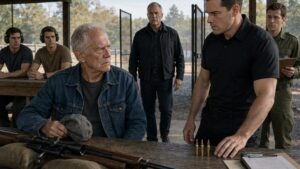
Not heavier. He had carried heavier things when his back was straighter and his knees still trusted him. Not stranger, either. His hands knew the shape of it before his eyes finished taking it in: the stock worn smooth where a cheek had settled year after year, the sling darkened by oil and sun, the scope capped and resting just above the rough grain of the shooting bench.
But lying there under the white morning glare of the desert range, it looked like something from a life people had already packed away for him.
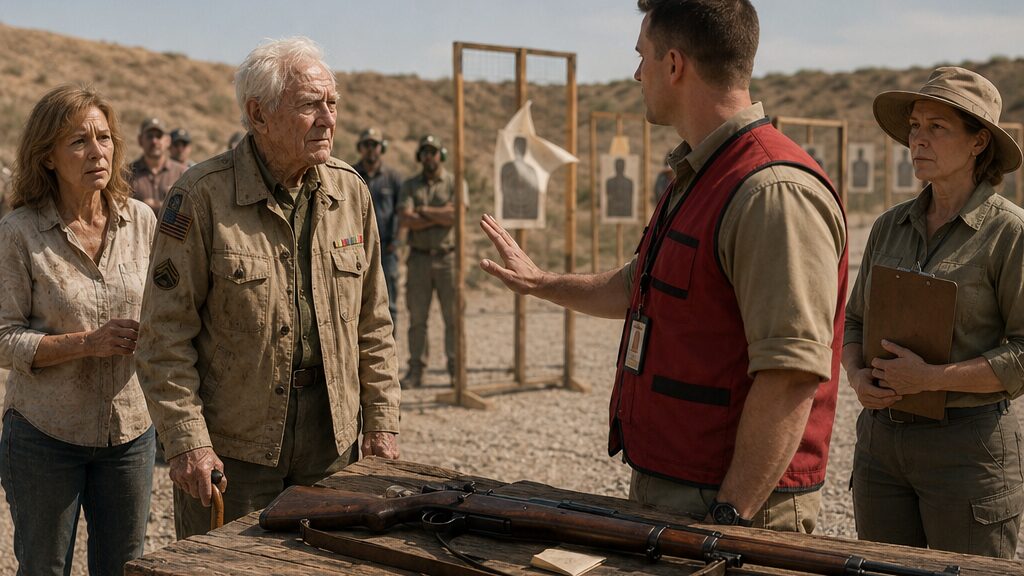
Frank stood beside it with both hands resting on the head of his cane.
The range stretched out ahead of him in clean, dusty lines. Gravel underfoot. Wooden target frames staggered against a pale berm. Paper silhouettes clipped and stapled at measured distances. Beyond the backstop, hills sat low and brown beneath a hard blue sky. A row of numbered lane signs leaned slightly in the heat, each one painted black on white, practical and unpretty.
He liked that about ranges. They told the truth if you let them.
A breeze came across the open ground and lifted the corner of the paper target on Lane 6. Frank watched it flutter, settle, and flutter again. Not strong wind. Mischievous wind. The kind that slipped across low places and lied to men who only looked once.
“Dad?”
Sarah Bennett stood a few feet behind him, one hand shading her eyes. She had dressed for the heat but still looked uncomfortable in it, her pale shirt already catching dust at the hem. She was fifty-two and still made the same small frown when she worried over him, the one she had worn as a girl when he left for weeks and came home thinner than she remembered.
“You okay?” she asked.
Frank took his eyes off the target line. “I’m all right.”
“You’ve been staring.”
“I do that.”
Her mouth pulled to one side. “I know.”
He heard what she did not say. You do that more now. You go quiet in rooms. You look at things nobody else is looking at. You take too long to answer.
He had no defense that would not sound like wounded pride, so he simply nodded and looked back at the rifle.
It belonged in a case more than on display. He had brought it for one round only, one slow, clean, memorial round at the charity qualification event Melissa Cooper hosted every spring. The event raised money for a veterans’ transportation fund. Frank had avoided it for three years, ever since his hip began announcing itself each morning before he did. But this year Sarah had found the old range notice tucked under a magnet on his refrigerator.
“You used to go,” she had said.
“Used to do a lot of things.”
“Maybe that’s not a reason to stop.”
She meant well. She always meant well, and that was part of the trouble. People who loved you could build the smallest fences.
Now she watched the rifle as if it might jump.
“Do you want me to ask someone to help with it?” she said.
“No.”
“I just mean setting up. Not shooting.”
“I know what you mean.”
Sarah quieted. A range volunteer walked past carrying staplers in a plastic bucket. Down the line, a younger shooter laughed too loudly at something his friend said. The sound bounced against the range shelter and died in the open heat.
Frank bent slowly, not because he needed drama, but because his back required negotiation. He opened the side pocket of his old canvas range bag and removed a folded card. The edges had softened from years of being handled. Small numbers and marks filled the inside, some written in pencil, some in ink, some crossed out and written again. Wind. Distance. Light. Ammunition. Corrections. Not secrets. Just memory made portable.
Sarah saw it and smiled faintly. “You still keep that?”
Frank slid the folded card beneath the rifle sling so the breeze would not take it. “Paper doesn’t forget where you put things.”
“Phones do that now.”
“Phones forget as soon as they break.”
She started to answer, then stopped. Frank knew she was trying not to sound like his nurse. That was the mercy and the insult of adulthood: children eventually learned tact, and it made their fear harder to answer.
At the far end of the firing line, Melissa Cooper moved quickly between tables with a clipboard tucked against her ribs. She owned the range now, or at least ran it with the tired authority of someone who had learned ownership mostly meant being responsible for everything that went wrong. She wore a wide-brimmed hat and sunglasses, and the back of her shirt read DESERT RIDGE SAFETY STAFF.
She recognized Frank after a moment and came toward him.
“Mr. Bennett,” she said, extending her hand. “I’m glad you made it.”
Frank shook it. Her grip was firm, businesslike.
“Frank is fine.”
“Frank, then. Sarah told us you might bring your own rifle.” Her eyes went to the bench, polite but alert. “Beautiful piece.”
“It still holds if the man behind it does his part.”
Melissa smiled, but she glanced at his cane. It was fast, almost nothing. Frank had seen men try to hide fear worse than that and fail better.
“We’ve got extra staff today,” she said. “Jason will run your lane when you’re ready. He’s one of our newer instructors, but he’s sharp. Very strict on procedure.”
“That’s good.”
“It’s a busy day, so we’re keeping things tight.”
Frank nodded. “Tight is safe when tight is right.”
Melissa paused as if deciding whether he was making conversation or correction. She chose conversation. “Exactly.”
She moved on to greet a donor near the shade tent.
Sarah stepped beside him again. “That went well.”
“She looked at my cane.”
“She looked at the rifle.”
“She looked at the cane first.”
Sarah sighed. “People look, Dad. It doesn’t always mean something.”
Frank did not argue. He watched Melissa stop beside a young man in a red range vest. The man listened with half his body turned toward the line, nodding before she finished. He was tall, compact, clean around the edges in the way of men who liked gear to say something about them. Tan tactical pants. Close-cropped hair. Sunglasses pushed up on his cap. A plastic credential tapped his chest when he walked.
Jason Miller, Frank guessed.
Jason looked toward him, then toward the rifle, then back to Melissa. His face did not show disrespect. That would have been easier. What it showed was assessment made too quickly.
Frank knew the look. He had worn it himself at twenty-seven.
The line announcement came over a small speaker: shooters checking in for the first qualification relay should move to their assigned lanes. Behind the benches, people gathered their bags and cases. A boy who looked too young to shave but old enough to pretend otherwise unzipped a hard case on Lane 7. His mother watched from the shade, arms folded tight against her middle.
Frank’s lane card said 6.
He rested his cane against the side of the bench and placed both hands flat on the rough wood. The bench had been sanded badly. A splinter rose near the front edge, silvered by weather. He pressed his fingertips beside it and looked past the rifle.
Lane 6’s paper hung straight enough. Lane 7’s paper did not.
Frank narrowed his eyes. The target was square to the world if you trusted the sign. But the backing board behind it sat canted a degree or two, maybe more, enough to make a careful man look again. The staples on the left side pulled tight. The right side bowed. Wind moved the bottom corner differently than it should have.
Small thing.
Small things had a way of waiting until pride stepped over them.
“Dad?” Sarah asked.
Frank did not answer at once.
He looked from Lane 6 to Lane 7, then to the berm, then down at the folded card beneath the sling. The old pencil marks seemed darker in the white light.
Jason Miller approached with a briskness meant to be reassuring.
“Mr. Bennett?” he said.
Frank turned.
Jason’s smile was professional and already fading. “I’ll be your range officer for this relay. Before we start, I need you to keep your hands off the firearm until I clear you.”
Frank glanced at his own hands, still flat on the bench beside the rifle, not on it.
“All right,” he said.
Jason’s eyes moved to the cane, then the rifle, then the old card tucked under the sling.
“Also,” Jason added, “we may want to talk about whether this is the right lane and setup for you today.”
The breeze touched the paper targets again. Lane 7’s corner lifted, twisted, and fell wrong.
Frank kept his voice low.
“Before that,” he said, “you ought to look at your target frame.”
Jason’s smile disappeared completely.
Chapter 2: The Instructor in the Red Vest
Jason Miller did not look at the target frame.
He looked at Frank.
That was the first mistake, and Frank almost forgave him for it. Young men under pressure were trained by their own nerves to look first at the person they thought might become a problem. Jason saw an old man in a beige military jacket, a cane against the bench, one expensive-looking rifle, and a daughter standing nearby with worry written plainly across her mouth. He saw delay. Risk. Liability.
He did not see Lane 7.
“Sir,” Jason said, keeping his voice level enough for spectators to hear and soft enough to pretend privacy, “we’ll handle the range checks.”
Frank nodded once. “I’m sure you did.”
The words had no sharp edge. That made Jason stiffen more than if they had.
Behind him, the morning relay settled into place. Magazines clicked. Cases opened. Someone laughed under the shade canopy, then stopped when Melissa Cooper raised her hand for quiet. The desert held sound strangely. A whispered doubt traveled farther than a shout.
Jason stepped closer to the bench and pointed at the rifle without touching it. “This is a more advanced setup than most people bring to a charity relay. No offense meant, but I need to know you’re comfortable with it before we continue.”
Sarah shifted. “He is.”
Frank did not look at her. “Let him ask.”
Jason’s jaw moved once. “I’m not questioning your background, Mr. Bennett.”
“You don’t know my background.”
“That’s why I’m asking.”
Frank let that sit.
The young man on Lane 7—Brian Reed, according to the name taped to his shooting box—was fitting his ear protection over his head. His rifle was newer, lighter, with a scope Frank did not recognize. Brian checked the chamber twice, careful in the eager way of someone trying to prove he deserved to be there.
Jason followed Frank’s glance and misread it.
“Let’s focus here,” he said. “Your muzzle stays downrange. Finger off trigger until instructed. Action open until I call the line hot. If any of that feels like too much today, there’s no shame in sitting this relay out.”
A few heads turned.
Sarah’s face went red. Melissa, near the center aisle, looked over her clipboard. The volunteer with the stapler bucket slowed, then found a reason to move away.
Frank stood with both hands resting on the bench. The rifle lay between him and Jason like a question neither of them had asked correctly.
“No shame,” Frank repeated.
Jason seemed relieved to have landed on a phrase he thought generous. “Exactly.”
Frank turned his head slightly toward the targets. “Lane 7’s backing board is canted. The paper is stapled against the twist. If he chases those first impacts, he’ll correct into a lie.”
Jason blinked.
“That’s what I was saying,” Frank added.
The instructor’s eyes flicked downrange this time, but only briefly. Too briefly. From where he stood, the distance flattened everything: paper, wood, heat shimmer, berm. He saw a target hanging in a frame. Frank saw the difference between square and almost.
Jason gave a tight smile. “We had volunteers replace those frames yesterday. Staff checked them this morning.”
“Then staff missed one.”
The air around them changed. It was not anger yet. It was the moment before people decided which version of a scene they had entered. Concerned old man. Difficult old man. Embarrassed old man. Experienced old man.
Jason chose.
“Mr. Bennett,” he said, a little louder now, “I appreciate that you’ve been around firearms, but we can’t stop a relay every time someone thinks a target looks funny.”
Frank’s fingers touched the bench. Two fingertips only, pressed lightly into the rough wood near the folded card. He could feel the raised grain and the sun in it.
“Funny is not the word I used.”
Brian on Lane 7 looked over. “Is something wrong?”
Jason turned quickly. “You’re fine. Stay ready.”
Frank watched Brian accept that because Brian wanted to accept it. Everyone wanted the line to be fine. Fine kept schedules moving. Fine let young men fire. Fine let old men be managed.
Sarah stepped closer to Frank. “Dad, maybe we can just—”
“Not yet,” he said quietly.
Her eyes searched his face. He saw the old fear return: not fear of rifles, but fear that he had wandered into a confrontation too large for him.
Jason saw it too.
“Mr. Bennett,” he said, “I’m going to ask you to step back from the rifle.”
There it was.
Not cruelly said. That almost made it worse. Cruelty could be dismissed as defect. This was policy wrapped around assumption. A young man deciding that an old man’s warning was a symptom.
Frank did step back. Slowly. He did not reach for the cane. He did not give Jason the satisfaction of needing it in that second. He moved one half step away from the bench and let the rifle remain untouched in the sun.
The relay had gone quiet enough that the wind sounded louder.
Jason nodded, as if obedience proved him correct. “Thank you.”
Frank looked downrange. “You’re welcome.”
Melissa came over then, clipboard tight against her. “Everything all right?”
Jason answered before Frank could. “We’ve got a concern about Mr. Bennett’s comfort level with the equipment and lane procedure.”
Sarah opened her mouth.
Frank gave the smallest shake of his head.
Melissa’s expression became careful. “Frank, we do have a benchrest lane closer in. Less movement, less walking, easier setup.”
“Easier for whom?” Frank asked.
Melissa glanced at Sarah. “For anyone who wants a simpler relay.”
Frank looked past all of them to Lane 7’s target. The paper lifted again. The wrong corner spoke in the only language it had.
Jason exhaled through his nose. “Sir, with respect, looking downrange and guessing at boards isn’t the same as running a safe line.”
Frank picked up the folded card from beneath the rifle sling. He opened it once, enough for the old marks and numbers to show, then folded it again.
“No,” he said. “Guessing is what you do when you stop looking.”
Jason’s face hardened.
For one second, no one moved.
Then the speaker crackled, saving everyone from deciding what to say next.
“First relay, prepare for safety confirmation.”
Jason turned toward the line, grateful for authority returning to him. He raised one arm.
Frank placed the folded card in the chest pocket of his beige jacket and stepped back another pace. His hip complained. He let it. Pain was honest. It did not pretend to be procedure.
Sarah touched his elbow. “Dad.”
“I’m not angry.”
“I didn’t say you were.”
“You were about to.”
Her fingers tightened, then loosened.
Melissa lowered her voice. “Frank, I don’t want this to be uncomfortable.”
“It already is,” he said.
For the first time, she looked directly at him instead of around him. Something like regret crossed her face, but the schedule called louder.
“Let’s move you to Lane 3 after this relay,” she said. “We’ll make it easy.”
Frank watched Brian settle behind his rifle on Lane 7, careful, trusting, ready.
“Easy,” Frank said, “isn’t always safe.”
Jason called the line hot.
Chapter 3: A Safer Lane for an Old Man
Sarah walked with Frank to the shade tent as if he might disappear between one patch of gravel and the next.
He did not object. The ground was uneven, and his hip had started its dull argument. The cane helped. So did not pretending it didn’t.
Behind them, the first relay began. Shots cracked in uneven rhythm, each one snapping against the berm and rolling back thinly from the hills. Frank heard the difference between calibers without trying. Small rifles, heavier rifles, one man jerking the trigger, another breathing better than his confidence deserved. The sound of a range was not noise to him. It was a room full of men and women telling truths with machines.
Sarah flinched at the third shot.
“You never liked ranges,” he said.
“I never liked watching you at them.”
“That’s different.”
“Not to me.”
They stopped beneath the shade canopy. Folding chairs sat in two uneven rows, most occupied by spouses, parents, donors, and older veterans who had come less to shoot than to be near men who still did. A cooler stood open near the back. Dust clung to the table legs. A paper banner reading HONOR RELAY FUNDRAISER snapped against its zip ties whenever the wind rose.
Sarah guided him toward a chair.
Frank remained standing.
“Dad,” she said softly.
“I’ve sat enough.”
“That’s not true.”
He looked at her.
She pressed her lips together. “Fine. That came out wrong.”
Most things did. That was not the problem. The problem was how often people mistook wrong words for right concern.
She folded her arms and stared toward the firing line. Jason moved behind the shooters in his red vest, alert, controlled, touching no one unless he had to. He was not careless. Frank gave him that. His posture was good. His commands were clear. His eyes moved from muzzle to action to shooter and back again.
But not downrange long enough.
“He embarrassed you,” Sarah said.
“No.”
“He told you to step back in front of everyone.”
“He embarrassed himself.”
The answer sounded harder than Frank meant it to. Sarah looked away.
“I don’t want you getting into it with him,” she said.
“I’m not in anything.”
“You know what I mean.”
“I know what you’re afraid of.”
She gave a small laugh without humor. “Do you?”
Frank watched a shot from Lane 7 land high left. Brian lifted his head from the stock and looked toward Jason. Jason leaned in, said something, and pointed toward the scope turret.
Frank’s jaw tightened.
Sarah followed his gaze. “He’s just helping him.”
“Maybe.”
“Dad.”
Frank finally sat. Not because she had asked. Because his leg wanted the truth.
Sarah sat beside him, leaving one chair between them and then changing her mind, moving closer. The gesture was small and tender, and it hurt him more than Jason’s public correction. Jason had no history with him. Sarah had all of it.
“I shouldn’t have pushed you to come,” she said.
“You didn’t push.”
“I found the flyer. I kept bringing it up. I said it would be good for you.”
“It is good for me.”
She looked toward the rifle still lying on Lane 6’s bench, untouched. “Is it?”
The old rifle looked abandoned from here. A thing left behind by someone who had been moved along.
Frank rested both hands over the cane handle. “You think I came here to prove I can still shoot.”
“I don’t know what you came here for.”
“To remember properly.”
Sarah’s eyes softened, and that almost made him stop.
The shots continued. Lane 7 fired again. This one printed nearer center but not because the problem had gone away. Frank saw it in the pattern and in Brian’s shoulders. The boy was adjusting to a story the paper was telling badly.
Sarah said, “When Mom was alive, she used to tell me not to interrupt you after range days.”
Frank did not answer.
“She said you came home quiet because you were putting things away in your head.”
“Your mother talked too much.”
Sarah smiled despite herself. “She said the same about you, except the opposite.”
He felt the old grief move through him without ceremony. It had learned to travel light.
“I’m not trying to take this from you,” Sarah said.
“I know.”
“I’m trying to understand what part of it still belongs to you and what part is just hurting you.”
A gust crossed the range. The banner cracked against the pole. Downrange, Lane 7’s paper kicked at one corner and settled wrong again.
Frank leaned forward, elbows on knees, eyes on the targets.
Sarah watched him watching.
“That,” she said. “That look. You leave the room when you do that.”
“I’m in the room.”
“Not with me.”
He heard the plea under the complaint.
For years after he retired, people had asked him for stories. They wanted the clean kind: faraway places, funny mistakes, impossible shots, heat, dust, danger made harmless by time. Later they stopped asking. Or maybe he stopped giving. Sarah had been left with fragments and silences, with a father who could fix a screen door but not explain why a slammed cabinet made him stare at the floor.
He turned the folded card over in his pocket with his thumb.
“There was a young man once,” he said.
Sarah grew still.
Frank almost regretted beginning. Words had recoil too.
“On a range?” she asked.
“Yes.”
“What happened?”
Frank watched Jason place a hand on Brian’s bench and talk him through another adjustment. “Somebody saw a small thing and decided it was too small.”
Sarah waited. She had learned at least that from him.
“That’s all?” she asked.
“For now.”
A cease-fire command came over the speaker. Shooters lifted their heads. Actions opened. Rifles were made safe. Jason walked the line, checking chambers. He paused at Lane 7 and frowned at Brian’s target through a spotting scope.
Frank stood.
Sarah stood with him. “Where are you going?”
“To look.”
“Dad, they told you—”
“They told me to step back from my rifle. They didn’t tell me to stop having eyes.”
He moved before she could find the right objection.
Near the firing line, Brian was talking to Jason, his voice low but strained. “I adjusted like you said, but it’s still walking.”
Jason took the spotting scope and looked again. “Could be your hold.”
“I’m trying to keep it steady.”
“I know. We’ll bring it in.”
Frank stopped several paces away, outside the lane boundary. He did not cross a line that was not his to cross. That mattered, even if no one noticed.
Melissa arrived with her clipboard. “Problem?”
“No problem,” Jason said too quickly. “New shooter, just working through corrections.”
Frank looked downrange.
Lane 7’s paper showed a group that should have taught them something. Not random. Not bad nerves. Not yet danger, but danger’s handwriting.
Brian removed his cap and wiped his forehead with his sleeve. He looked younger without it.
Frank said, “Don’t chase that group.”
Jason turned.
His face closed the moment he saw who had spoken. “Mr. Bennett, I need you behind the spectator line.”
Frank remained where he was, exactly behind it. He glanced down at the painted boundary near his shoes, then back at Jason.
“I am.”
A couple of spectators turned. Melissa’s shoulders lifted with the breath of a woman losing control of her schedule.
Sarah caught up and stopped beside Frank, embarrassed and frightened and loyal all at once.
Jason stepped toward them. “We’re moving you to Lane 3 after lunch. It’s already arranged.”
Frank’s eyes stayed on Brian’s target.
“Lane 3 won’t fix Lane 7,” he said.
Brian looked from Frank to Jason. “What does that mean?”
No one answered him.
At the target line, the paper lifted again in the desert wind, twisting on its wrong backing as if trying, patiently, to be seen.
Chapter 4: The Pattern in the Paper Targets
The cease-fire held the range in a silence that felt borrowed.
Shooters stepped back from their benches. Actions stayed open. Orange chamber flags stuck out like small warnings. Jason walked the line with the practiced rhythm of a man trying to make his authority visible again. He checked rifles, nodded once or twice, and spoke to Brian Reed in a low voice before moving on.
Frank waited behind the spectator line.
He did not like waiting when he already knew where to look. That had always been one of his faults. Patience in the field was different from patience under bureaucracy. In the field, patience served the truth. Here, patience often served comfort.
Sarah stood beside him with her arms folded.
“You are going to get us asked to leave,” she said.
“Maybe.”
“Dad.”
He looked at her then, not sharply. “Would leaving make Lane 7 straight?”
Her face tightened because she had no answer that was both honest and soothing.
Melissa came toward them after the last chamber check. Her clipboard hung at her side now instead of against her chest. She looked tired, and the day was not half over.
“Frank,” she said, “I understand you have concerns.”
“I have one concern.”
“About the target frame.”
“Yes.”
Jason, a few paces away, heard and turned back. “We can inspect it at lunch.”
Frank looked downrange. “You have a shooter adjusting off it now.”
Brian stood behind Lane 7 with his cap in his hands. He was trying not to look like the conversation was about him. His mother watched from under the canopy, her fingers touching her throat.
Melissa lowered her voice. “We are not sending anyone downrange while the relay is active.”
“Relay is cold.”
“It is temporarily cold. We still have procedure.”
Frank nodded. “Then use it.”
Jason came fully over. “Mr. Bennett, I already told you we’re aware of your concern.”
“No,” Frank said. “You’re aware I said words.”
A volunteer nearby pretended to organize empty ammo boxes.
Jason’s cheeks colored. “I’m not going to debate this in front of shooters.”
“Good.”
Frank picked up his cane and started along the back of the firing line, staying behind the painted boundary. He moved slowly, partly because he had to, partly because moving slowly made people show their intentions. Jason followed. Melissa followed Jason. Sarah followed all of them, her breath sharp with worry.
At Lane 7, Frank stopped behind Brian’s bench.
The boy’s rifle rested open and safe. Beside it lay a small box of ammunition, a notebook with three rushed entries, and a spotting scope angled toward the paper. Brian had written his first group as if numbers might make uncertainty smaller.
Frank did not touch anything.
“May I look?” he asked.
Brian glanced at Jason.
Jason answered for him. “From behind the line.”
Frank leaned toward the spotting scope without putting his eye to it. He could see enough with his own eyes; the glass only confirmed what the paper had already said. Three shots had walked high-left, two corrections had pulled toward center, and the last impact sat wrong for the adjustment Brian had made. Not wild. Not terrible. Worse than terrible. Plausible.
Plausible mistakes fooled people longest.
“What did you dial after the first group?” Frank asked.
Brian hesitated again.
Jason said, “I’m coaching him.”
“I asked him.”
The quietness in Frank’s voice made Brian answer. “Two clicks right. One down. Then another right after the second group.”
Frank’s thumb moved once over the cane handle. “And the group walked like you expected?”
Brian swallowed. “Sort of.”
“Sort of is where a man gets educated.”
Jason gave a short breath. “This is exactly the problem. He’s a new shooter. We don’t need competing instruction.”
Frank looked at Brian’s notebook. “You don’t have competing instruction. You have a target giving competing information.”
Melissa said, “Frank, explain it plainly.”
He appreciated that. It was the first useful sentence she had given him.
“His paper isn’t square to the frame,” Frank said. “But it’s more than paper. The backing board is sitting off the vertical. Maybe the frame’s foot is twisted. Maybe the right leg isn’t seated. Maybe the volunteer stapled it under tension and the wind is exaggerating it. Whatever the cause, that target is telling him the rifle is moving one way when part of what he’s seeing is the target face shifting against him.”
Jason looked downrange again, longer this time but still not long enough. “That would not create a safety issue.”
“It can create bad corrections.”
“Bad corrections don’t make a range unsafe.”
Frank turned his head, slowly.
Jason heard himself then. He looked away first.
Melissa rubbed the edge of the clipboard with her thumb. “The frames were replaced yesterday after that windstorm.”
Frank said nothing.
She frowned. “We had volunteers out there until almost dark. Jason checked the line this morning.”
Jason straightened. “I did.”
“I believe you,” Frank said.
That seemed to irritate him more. “Then what are you saying?”
“I’m saying morning checks miss what morning light hides.”
The line waited. Somewhere behind them, a cooler lid slammed shut. The sound made Sarah start, and Frank saw her force herself still.
Melissa looked at the target line. “We’ll pause for five minutes and inspect Lane 7.”
Jason turned on her. “That’ll back up the whole relay.”
“It’s five minutes.”
“It makes us look disorganized.”
“It makes us look careful,” Melissa said.
Frank saw the cost of that sentence on her face. She was not choosing him. Not yet. She was choosing the safer embarrassment.
Jason pulled his radio from his vest and called the line cold for inspection. His voice stayed professional, but each word had an edge. Shooters stepped farther back. People began murmuring. The story was already traveling: the old man had stopped the relay because he did not like a target.
Frank did not go forward when Melissa opened the range gate. He waited until Jason looked back.
“You coming?” Jason asked, almost challenging.
Frank glanced at the stretch of gravel between the line and the targets. Too far for pride, not too far for necessity. His hip had already begun to burn from standing.
Sarah touched his sleeve. “You don’t have to.”
“Yes,” he said. “I do.”
He walked with them.
The desert sun pressed on his capless head. Gravel shifted under his shoes. He kept the cane ahead of him and did not hurry. Jason walked faster, then had to stop and wait. Brian trailed behind them until Melissa told him to remain at the line.
At the target frame, the fault looked smaller up close. That was the trouble with certain dangers. They lost drama when you reached them.
Lane 7’s right leg sat in a shallow rut left by the storm wash. The base had twisted just enough that the frame leaned backward and slightly right. The backing board was stapled tight at one corner, bowed at the other. The paper face had been pulled flat by force instead of mounted true.
Jason crouched. He touched the frame, then pushed it lightly. It moved.
Not much.
Enough.
His mouth closed.
Melissa knelt and examined the right leg. “This should have been reset.”
Jason said, “It must have shifted after check.”
Frank did not answer.
Jason glanced up, ready for accusation. Frank gave him none.
“That’s it?” Melissa asked. “That small?”
Frank looked beyond the frame to the berm, then back. “Small is not the same as harmless.”
A gust crossed the range. The target paper flexed and twisted against its bad corner. Seen from here, the movement was plain.
Jason stood. Dust clung to one knee of his pants. “We’ll restaple it and seat the leg.”
Frank looked at Lane 6, then Lane 8. Both stood straighter, but Lane 8’s lower brace had a newer screw and a split in the wood. The volunteers had worked fast after dark. Too fast.
“Check the whole row,” Frank said.
Jason’s face tightened again, but not as much as before. “We’re not rebuilding the range because one frame shifted.”
Frank pointed with his cane toward Lane 8’s brace. “Then check two.”
Melissa followed the cane tip.
For a moment Jason did not move. Then he walked to Lane 8. He crouched. He touched the brace. He pulled his hand back with a splinter between his fingers and a look he tried to hide.
Frank saw Sarah watching from the firing line, one hand at her mouth.
The old card in his pocket pressed against his chest in the heat. He thought of other lines, other targets, other young men waiting for someone older to be right for reasons they could not yet understand.
Melissa stood slowly.
“Jason,” she said, “hold the relay.”
Jason looked at Frank only once before keying his radio.
Chapter 5: The Shot Frank Refused to Take
By the time they returned from the target line, Frank had become the event.
He could feel it without looking directly at anyone. Conversations bent around him. The veterans under the shade watched with narrowed eyes. Younger shooters pretended to adjust gear they had already adjusted. Brian Reed’s mother had moved closer to the firing line, not quite crossing the spectator boundary. Sarah stood alone near the canopy, and the space around her had widened with the awkward respect people give a family member of someone causing trouble.
The relay stayed cold.
Jason’s voice came over the speaker, flatter than before. “We’re extending the safety pause for target-frame inspection. Shooters remain behind the line.”
A few people groaned softly. One man checked his watch. Another muttered something about overkill. Melissa heard and did not respond. She was speaking to two volunteers near Lane 8, pointing toward the target row with her clipboard.
Frank made it back to his bench and rested one hand on the rough wood.
His rifle had not moved.
It lay exactly as he had left it, patient in the sun, bolt open, sling crossing the folded shadow where the old card had been. The empty space beneath the sling looked strange now. He touched his chest pocket to make sure the card was still there.
Sarah came to him. “Are you all right?”
“Yes.”
“You’re sweating.”
“It’s the desert.”
“You’re pale.”
“That’s also the desert.”
“Dad.”
He looked at her. “My hip hurts. I’m tired. I’m not falling apart.”
Her eyes shone, but she blinked it away. “I didn’t say you were.”
“No. You just keep standing close enough to catch me.”
She flinched as if he had been unfair. He had.
Frank let out a slow breath. “I’m sorry.”
Sarah looked toward the target line. “You were right.”
“Not finished yet.”
“What else is there?”
He did not answer because Jason was walking toward them.
The red vest looked brighter now, almost theatrical against the dust and tan. Jason had removed his sunglasses. Without them, he seemed younger. Not a boy, not foolish, but less certain where to put his face.
“Lane 7 and Lane 8 are being reset,” he said.
Frank nodded.
Jason waited, perhaps for Frank to say something that would make it easier to dislike him. Frank did not oblige.
“We’re going to resume with adjusted targets,” Jason continued. “Melissa wants you on Lane 3.”
“No.”
Jason’s posture changed at once. “Mr. Bennett.”
“I came for Lane 6.”
“Lane 6 is fine.”
“I know.”
“Then what is the issue?”
Frank looked down at the rifle. “I won’t fire while the row is unsettled.”
Jason glanced toward the target line. “We just inspected it.”
“You inspected what I pointed at.”
“We found the problem.”
“You found a problem.”
The old irritation rose in Jason’s face. It was quieter now, mixed with embarrassment. “Sir, you cannot keep moving the standard every time we address your concern.”
Frank placed his palm flat on the bench. The wood was hot. A splinter pressed near his lifeline but did not break skin.
“I’m not moving the standard,” he said. “I’m holding it still.”
The words carried farther than he meant them to. People nearby heard. Brian turned. Melissa, across the line, stopped speaking to a volunteer.
Jason lowered his voice. “What do you want?”
“I want a full target-row check before live fire resumes.”
“That is not necessary.”
“Maybe.”
“Maybe?”
Frank finally looked at him. “Necessary is often discovered late.”
Jason’s nostrils flared. “Are you refusing to shoot?”
“Yes.”
Sarah shut her eyes briefly.
Jason gave a short, incredulous laugh. “After all this, you’re refusing?”
“I am.”
“Then why bring that rifle out here?”
The question struck near the place Frank did not show people.
His fingers stayed open against the bench. He could feel the faint tremor in them now, not fear, not exactly age, but the cost of the morning. He did not curl them into a fist. He had learned long ago that men often made fists when they had run out of useful work.
“I brought it because a man asked me to remember him,” Frank said.
Jason’s expression shifted, but he did not speak.
Sarah opened her eyes.
Frank looked downrange, beyond the crooked frames, beyond the berm, into a place that was not this range and still lived inside every range he had ever stood on.
“He was nineteen,” Frank said. “Thought he knew everything a rifle could teach him because he could hit what he aimed at. Good boy. Fast learner. Too proud when men praised him. Too ashamed when they corrected him.”
The line had gone still.
Frank did not raise his voice. He spoke as if to the bench.
“One day, a target rig was wrong. Not dramatic. Not broken in half. Just wrong enough. Somebody noticed. Somebody else said it could wait. The boy trusted the line because the line sounded sure.”
Sarah’s hand came to her mouth.
Frank stopped there. He did not give them the rest in detail. The rest belonged to the boy, to his mother, to men who had written reports and folded flags and learned too late that small things were only small before they happened.
Jason swallowed. “Was that in service?”
Frank lifted his eyes. “It was on a range.”
That was enough.
Melissa approached slowly. She had removed her sunglasses. “Frank.”
He turned to her.
“What do you recommend?” she asked.
Jason stared at her. “Melissa—”
She did not look away from Frank. “What do you recommend?”
Frank took the folded card from his pocket. He opened it against the bench. The old paper tried to curl in the heat. Pencil marks, sight corrections, distances, wind notes, and small symbols lay exposed. Not magic. Not proof. Just the habit of a man who had seen memory fail under pressure.
“Check every frame in the relay row,” Frank said. “Not from here. Hands on wood. Legs seated. Backing square. Staples even. Then run the line.”
A man under the canopy muttered, “For a charity shoot?”
Frank heard him. So did everyone else.
He turned his head. “Especially for one.”
The man looked away.
Jason’s mouth tightened. He was not convinced, not fully. Pride rarely left all at once. But he was listening now despite himself, and listening changed the shape of a man.
Brian stepped forward, still behind the boundary. “I’d like them checked.”
His mother whispered his name, warning and relief together.
Brian looked at Jason. “If he saw it once, I’d rather know.”
That did what Frank’s age could not. Youth asking for caution gave Jason permission to consider it without surrendering to the old man.
Melissa lifted her radio. “All lanes remain cold. Full target-row inspection before we resume.”
A ripple of annoyance moved through the crowd, then died against the firmness in her voice.
Jason stood motionless.
Frank folded the card carefully. His hand slipped once on the crease. Sarah saw. He knew she saw. This time she did not reach for him.
Jason looked at the rifle on the bench. “You really won’t shoot?”
“Not yet.”
“You’re cleared on Lane 6.”
Frank rested the folded card beside the rifle. “Cleared by command is not the same as clear.”
Jason stared at him for a long moment. Then he looked downrange.
The target papers lifted in the wind, one by one, little white flags of uncertain truth.
“Walk it with me,” Frank said.
Jason turned back.
It was not an order. That mattered. It was an offer, and because of that, it was harder to refuse.
Chapter 6: What the Old Card Remembered
Jason opened the gate himself.
This time he did not walk ahead so fast that Frank had to catch up. He matched the older man’s pace without making a show of it. That was the first apology, though neither of them named it.
The gravel between the firing line and the targets seemed longer under the afternoon sun. Frank’s hip had become a hot wire from his lower back down through his thigh. He used the cane carefully, setting it where the ground looked firm. Jason noticed once and looked away before Frank could resent him for noticing.
Melissa sent two volunteers to inspect the far lanes. She stayed behind at the firing line, holding the relay cold and answering questions with a calm she had not possessed an hour earlier. Sarah remained near Lane 6, watching Frank cross the open ground with a face Frank could not read from that distance.
Brian stood near his bench, cap twisting in his hands.
At Lane 7, Jason crouched without being told. He gripped the frame at both sides and moved it gently.
“It shifted under pressure,” he said.
“Yes.”
Jason checked the right leg. “Rut’s deeper than it looked.”
“Usually is.”
The young instructor glanced up, then back at the frame. “You saw that from the line?”
“I saw the paper move wrong.”
“That’s not the same as seeing the rut.”
“No. It told me where to look.”
Jason absorbed that. The wind ran dry fingers over the paper and lifted the lower corner. Now that the frame had been touched, the twist was more obvious. It had been there all morning, waiting for someone to believe it.
Frank took the folded card from his jacket and handed it to Jason.
Jason accepted it with unexpected care.
“What am I looking at?” he asked.
“Old notes.”
“I can see that.”
“Then look older.”
Jason’s mouth almost moved toward a smile. Almost.
He opened the card. The paper had softened along the folds, and sweat from Frank’s palm had darkened one corner. Rows of numbers sat beside short words: cross left, boil, low wash, morning glare, frame flex, verify paper before correction. Some entries were neat. Others had been written in bad weather or worse mood.
Jason read the line twice.
“Verify paper before correction,” he said.
Frank nodded toward Brian’s target. “A shooter trusts what the target tells him. If the target lies, the shooter learns wrong.”
Jason looked over his shoulder at the firing line. “And if the shooter corrects wrong on a bad frame…”
“He may keep correcting until the rifle is no longer the problem.”
Jason’s face changed slowly. He was beginning to follow the path past inconvenience. Past embarrassment. Into consequence.
They moved to Lane 8. The lower brace had split farther when the volunteer touched it. The target still stood, but one leg had loosened enough to rock under a push. Lane 9 was sound. Lane 10 had staples so uneven that the paper buckled across the center, not unsafe but useless for clean scoring.
One by one, the small failures presented themselves. Not catastrophe. Not sabotage. Just fatigue, storm damage, volunteer haste, morning assumption, and a schedule too eager to resume.
Jason used his radio. “Melissa, we’ve got two frames needing reset, one needing restaple, and I want to recheck the rest before we go hot.”
There was a brief pause.
Melissa’s voice came back. “Copy. Line remains cold.”
Jason clipped the radio back to his vest. “I checked them this morning.”
“I know.”
“I walked the row.”
“I believe you.”
“I didn’t push the frames.”
Frank looked at him. “Now you will.”
Jason nodded once. The shame on his face was cleaner now. Useful shame. The kind that might become discipline if a man did not run from it.
They worked down the row. Jason inspected. Frank watched. Sometimes he pointed with the cane. Sometimes he said nothing until Jason found the flaw himself. The volunteers brought a mallet, spare staples, shims, and a level from the range shed. Melissa joined them at Lane 8 and helped hold the frame while a volunteer reset the leg.
No one called it overkill now.
Back at the firing line, the waiting crowd had changed its posture. Annoyance remained in pockets, but curiosity had moved in beside it. The veterans under the shade spoke among themselves in lower voices. Brian’s mother stood with both hands clasped at her chest, eyes fixed on the target row.
Jason handed the folded card back to Frank.
Frank did not take it immediately.
“Keep it until we finish,” he said.
Jason looked down at the card. “I shouldn’t.”
“Why not?”
“It’s yours.”
“It’s paper.”
Jason held it a moment longer, then folded it along its old creases. “It doesn’t feel like paper.”
Frank looked toward Lane 6, where the rifle waited unused on the bench. “Most things don’t, if you know what they cost.”
Jason’s eyes lifted.
Frank saw the question there, the one men always wanted to ask once they realized there was a story beneath a habit. He was grateful Jason did not ask it.
Instead, the younger man said, “I thought you were stalling.”
“I know.”
“I thought maybe you got nervous.”
“I did.”
Jason blinked.
Frank let that truth stand between them.
“I get nervous every time a line goes hot,” Frank said. “If you don’t, you’re not paying attention.”
The wind moved over the berm. A loose sheet of paper from an unused target frame scraped against the dirt until a volunteer pinned it down with his boot.
Jason looked back toward the line. “I was trying to keep control.”
“Control is not the same as command.”
“No?”
“No.”
Frank shifted his weight off his bad hip. “Command listens before it answers.”
Jason took that without defense. It did not make him smaller. Frank was pleased to see it.
When they finished the row, Melissa called everyone back behind the line and gathered the shooters for a reset. She did not hide what had happened. She kept it plain: storm damage had left several frames improperly seated; inspection procedure had been updated immediately; no live fire would resume until all frames were verified by hand before each relay.
Then she turned toward Frank.
“I’ve asked Mr. Bennett to assist with the final check on this relay,” she said.
Frank had not agreed to that.
He looked at her.
Melissa’s expression was steady, but there was apology in it. Not the public kind. The useful kind.
A few people turned toward him. Sarah’s eyes found his. He expected worry. Instead he saw something more painful: she was trying, perhaps for the first time in years, to let him stand where he had chosen to stand.
Jason stepped beside Lane 6. He held out the folded card.
“Sir,” he said, and the word had changed, “will you confirm the line with me?”
Frank took the card.
The rifle lay untouched on the bench, its long barrel pointed safely downrange, its old wood warm with sun. Frank rested his fingers beside it, not on it.
For a moment he could almost hear the young man from years ago laughing at a correction, eager to be done with caution and get back to the pleasure of hitting center.
Frank folded the card once more and slipped it under the rifle sling where it had started.
Then he looked at Jason.
“Start at Lane 1,” he said.
Chapter 7: The Man Who Would Not Fire
The line reopened near sunset.
By then the desert had changed color. The white glare softened into gold along the tops of the target frames. Shadows stretched from the benches toward the gravel path behind them. Heat still lifted from the ground, but the hard edge had gone out of the day, leaving the range quieter than before.
No one hurried now.
That was the first thing Frank noticed.
Jason moved down the firing line with the folded card tucked carefully into the clear pocket behind his credential. He did not display it. He simply kept it where he could glance down and remember. At each lane, he checked actions, benches, shooters, and then looked past them to the targets longer than he had that morning. At Lane 7, he stopped and asked Brian Reed to confirm what he saw before they spoke of corrections.
Brian answered carefully, no longer ashamed of uncertainty.
“Paper’s square,” he said. “Frame’s seated. No twist on the right corner.”
Jason nodded. “Good. Say it before you trust it.”
Frank stood at Lane 6, one hand resting beside his rifle on the rough wooden bench.
The rifle had waited through the day without complaint. Sun had warmed the stock and then left it. Dust had gathered along the edge of the sling. The old wood carried the color of things handled often and never casually. Frank touched it with two fingers, just below the receiver, and felt years rise under his skin.
Sarah stood behind him, outside the line. She did not hover now. She had found a place where she could see him without appearing ready to catch him. That small distance was a gift he did not know how to thank her for.
Melissa approached, hat in hand.
“Frank,” she said, “we’re ready when you are.”
He looked downrange.
Lane 6 stood straight. Lane 7 stood straight. Lane 8, newly reset, wore fresh staples and a brace clamped cleanly against firm ground. The paper targets lifted and settled in the wind, but now they moved like paper, not like warnings.
The line was safe enough.
Safe enough was not perfection. Perfection was what men pretended to require when they wanted never to act. Safe enough meant checked, questioned, corrected, and respected. It meant someone had looked with his hands and not just with his confidence.
Jason came to stand near the bench.
“Lane 6 confirmed,” he said.
Frank nodded.
There was no crowd pressing close, no dramatic hush forced by spectacle. But people were watching. The veterans beneath the shade. Brian and his mother. The volunteers who had reset the frames. Melissa with her clipboard lowered. Sarah with her arms at her sides.
Everyone seemed to believe the moment had come back around to the rifle.
Perhaps it had.
Frank reached for the bolt, then stopped.
The metal was cool now. He remembered the first time his hands had learned to separate wanting to shoot from needing to shoot. He had been young, younger than Jason, proud of what he could do with distance and breath and pressure. Later, when he trained others, he had tried to teach them that the shot began long before the trigger and ended long after the paper tore.
Some listened. Some did not.
The nineteen-year-old had listened most days. That was what had made the other day so cruel. He had not been careless in the easy way. He had been eager. He had trusted the voices around him, and one of those voices had been Frank’s, too late and too soft and too tangled in the chain of command to stop what should have been stopped.
Frank had carried that range with him for decades.
Not because he believed he alone could have saved the boy. That was a young man’s guilt, arrogant in its own way. He had carried it because afterward, he understood that silence could be a kind of permission.
“Sir?” Jason said.
Frank looked at him.
Jason’s voice was low enough not to carry. “You don’t have to shoot for them.”
Frank studied the young man’s face. The red vest, the credential, the clean jaw, the dust on one knee from where he had crouched at Lane 7. He saw pride there still. A man needed some pride to hold responsibility. But it was no longer alone.
“No,” Frank said. “I don’t.”
Jason swallowed, then nodded once.
Frank lifted the rifle from the bench.
The weight came into him with familiar honesty. His shoulder remembered. His cheek remembered. His right hand remembered better than his hip, better than his eyes, better than the world seemed to expect an old man to remember anything. He set the stock into place, not fast, not theatrically. The motion hurt. He let it hurt. Pain could stand beside dignity without stealing it.
Sarah’s breath caught behind him.
Frank opened the action, checked what had already been checked, and closed it without loading.
Jason noticed. “No round?”
“Not yet.”
Frank set the rifle back onto the bench.
A murmur moved along the line, small and uncertain.
Melissa came closer. “Frank?”
He picked up the folded card from beneath the sling. Its edges had taken on a fine line of dust. He brushed it once with his thumb and held it out to Jason.
Jason looked at it but did not take it immediately.
“Keep a copy in the office,” Frank said. “Not because it’s mine. Because the first line still works.”
Jason glanced down at the visible crease.
“Verify paper before correction,” he said.
Frank nodded. “Add it to your checklist in words a twenty-year-old won’t ignore.”
Melissa said, “We will.”
Frank looked at her. “And make them touch the frames.”
“Yes.”
He held the card out farther.
Jason took it.
There was no applause. Frank was grateful for that. Applause would have made the moment belong to everyone else.
Brian stepped forward from Lane 7, careful to remain behind his boundary. “Mr. Bennett?”
Frank turned.
“Thank you,” Brian said.
His mother put a hand on his shoulder, and for once the boy did not shrug it off.
Frank gave him a small nod. “Don’t thank a man for making you wait. Remember why you waited.”
Brian nodded, solemn as a recruit trying not to show it.
Jason held the folded card between both hands. “I owe you an apology.”
Frank looked toward the target line. “You owe the next shooter a better check.”
Jason’s face tightened, not with anger this time. “Yes, sir.”
“And stop saying sir like it fixes things.”
For a second, Jason stared. Then a short laugh escaped him, surprised and embarrassed. A few people nearby smiled, the tension finally loosening without breaking into spectacle.
Sarah came to the bench.
“Are you really not going to shoot?” she asked.
Frank touched the rifle stock once more. “I already did what I came to do.”
She looked at him, confused, then not.
“The memorial round,” she said softly.
He shook his head. “Wasn’t for a sound.”
Behind them, Jason began marking the updated inspection sheet with Melissa. He wrote slowly, as if the letters mattered. At Lane 7, Brian looked through his scope at a target that finally told the truth. The range waited for commands, not impatiently now, but with the sober calm of people who had been reminded what commands were for.
Frank opened the rifle case.
Sarah moved instinctively to help, then paused. “May I?”
He looked at her hand near the case latch.
This morning he might have said no. Not because he did not need help, but because need had begun to feel like surrender. Now the day had worn that foolishness down.
“Yes,” he said.
Together they settled the rifle into the worn lining. Sarah supported the barrel while he guided the stock. She was careful with it, not afraid now, or not only afraid. When the rifle lay in place, Frank took a small cloth from the side pocket and wiped dust from the scope cap.
Sarah watched. “Mom used to say you cleaned things when you didn’t know what to say.”
“Your mother said too much.”
“She was usually right.”
“Usually,” Frank allowed.
Sarah smiled, but her eyes were wet.
“I thought today was about proving you could still do this,” she said.
Frank closed one latch. Sarah closed the other.
“So did I,” he said.
The admission cost him less than he expected. Maybe because it was not the whole truth, only one piece of it. He had wanted to know whether the old motions were still inside him. He had wanted the rifle to answer something age kept asking. But the day had answered differently. It had told him his hands did not need to be steady for his eyes to matter. His shoulder did not need to be strong for his judgment to hold. A man could serve by refusing the wrong moment.
Sarah slipped her hand through his arm.
This time he let her.
They walked away from Lane 6 as Jason’s voice came over the speaker, clear and changed.
“Before we go hot, shooters will visually confirm their target faces and frames. Range staff will verify by hand before each relay. If something looks wrong, say it. We stop and check. Nobody loses points for caution.”
Frank stopped halfway to the shade and turned.
Jason was standing near the firing line with the old card still in his credential pocket. He looked downrange, then back at the shooters, waiting until every head had turned with him.
Not perfect, Frank thought.
But better.
The first shots of the resumed relay cracked across the desert a few minutes later. Brian’s group printed clean and honest. He did not rush to correct. He looked first, breathed, and waited for Jason to look with him.
Frank and Sarah reached the edge of the gravel lot as the sun lowered behind the hills. Melissa called after him, but he only lifted a hand. He did not need another apology. He did not need a photograph by the banner or a speech under the canopy. The range would remember or it would not. Jason might. Brian might. Sarah, walking beside him without pulling him forward or holding him back, already did.
At the truck, Sarah opened the rear door.
Frank slid the rifle case inside. It landed with a soft, final weight.
“You sure you’re okay?” she asked.
He looked back once more.
Jason was at Lane 7, crouched beside Brian’s bench, not touching the shooter’s rifle, not taking over. Just looking downrange with him. The paper moved in the wind and settled true.
Frank rested both hands on his cane.
“No,” he said. “But I’m all right.”
Sarah nodded as if, finally, she understood the difference.
They stood together while the last light touched the target frames, the benches, the red vest, the old dust rising under careful feet. Then Sarah closed the truck door, and Frank let the range fall quiet behind him.
The story has ended.