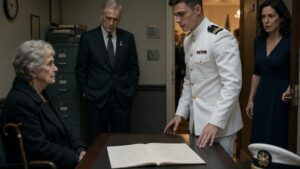
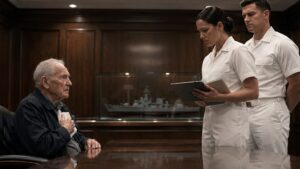
The Name He Waited So Many Years To Say Out Loud
Part I — The Old Man on the Mat
William Hayes was already lying on the training mat when the first young man laughed.
It was not a loud laugh. Not cruel enough for anyone to call it cruel. Just a quick breath through the nose, the kind of laugh young men make when they think the world has put something harmless and ridiculous in front of them.
William heard it anyway.
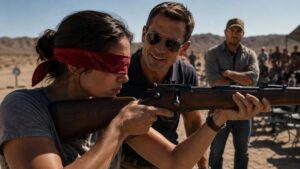
His cheek rested against the worn wooden stock of a rifle older than everyone standing behind him. His left hand, sun-spotted and narrow, curved under the fore-end. His right thumb rested near the safety. The old scope sat slightly crooked above the receiver, its black finish rubbed silver at the edges.
Behind him, two soldiers in clean tactical gear watched him settle into position.
“Man,” one of them said, “that thing belongs in a museum.”
The other gave a short laugh. “Or over a fireplace.”
William did not turn around.
His granddaughter, Emily, stood a few feet away with her base ID clipped to her belt and a smile she did not feel holding her face in place.
“Alexander,” she said gently, trying to make it sound like a warning and a joke at the same time.
The young soldier shrugged. He was athletic, sharp-jawed, confident in the way only twenty-four could be confident. His name tape read MILLER, but everyone on the range called him Alexander. He leaned toward William as if the old man might not hear unless sound was aimed down at him.
“No disrespect, sir,” Alexander said. “Just didn’t know we were doing nostalgia day.”
Jeffrey, the other soldier, looked away too late to hide his grin.
William adjusted the old scope with two fingers.
His elbow trembled.
That was what made Jeffrey laugh again.
Emily felt heat rise in her neck. She had arranged this visit because her grandfather had asked for it. Not begged. William Hayes never begged. He had simply sat at her kitchen table three Sundays ago, both hands wrapped around a mug of coffee he had not drunk, and said, “Can you get me on a range?”
She had thought he meant he wanted to feel useful again.
She had thought a controlled visit might lift some quiet weight from him. She worked logistics at Fort Lawson. She knew the range schedule. She knew which instructors were patient. She knew how to get a harmless request approved as long as nobody made it strange.
Now he had made it strange.
He had arrived with a narrow case wrapped in a faded green cloth. He had refused the modern training rifles offered by the range staff. He had walked slowly but stubbornly to the mat and lowered himself with the care of someone negotiating with bones that remembered different orders than the mind.
And now two young soldiers were laughing over him.
Emily stepped closer. “Grandpa, we don’t have to do this.”
William’s eye stayed near the scope.
“I asked to come,” he said.
His voice was thin, but it did not shake.
Alexander exchanged another look with Jeffrey.
Emily wanted to turn and snap at them. She wanted to tell them he was eighty-one, that his hands hurt on cold mornings, that sometimes he stood in the hallway at night like he had forgotten which house he was in. She wanted to say, Be decent.
Instead she felt something worse.
Embarrassment.
Not at the soldiers. At him.
At the rifle. At the way he had brought the past into her workplace and laid it down on a mat for strangers to judge.
William lifted his head just enough to look back at the range table.
“One round,” he said.
Alexander’s smile faded into disbelief. “Sir, we can’t just hand out live ammo because you brought an antique.”
Emily closed her eyes for half a second.
William did not argue. He pushed himself up slowly and reached for the faded cloth near the case. His fingers unfolded it with a care that made the two soldiers stop smiling for just a moment.
Near the stock, under the curve where a palm would rest, there was a carved notch. Beside it, faint from age and handling, were two initials.
S.H.
Jeffrey noticed them first. “Somebody carve that?”
William covered the initials with his thumb.
“Somebody held it,” he said.
The range went quiet in a way Emily did not understand.
Then a voice behind them said, “What’s the delay?”
Timothy Brennan, the senior range instructor, walked across the gravel with the kind of heavy calm that made young soldiers straighten without thinking. He was broad, bald, and almost always expressionless. Emily had seen him end arguments with a look.
Alexander stood a little taller. “Civilian visitor brought unauthorized equipment, Sergeant. Requesting a live round.”
Timothy’s eyes moved from Alexander to Emily, then down to William.
Then to the rifle.
He stopped.
It was not dramatic. He did not gasp or step back. But something in his face shut down, as if a door inside him had closed before anyone else could see what was behind it.
“Where did you get that?” Timothy asked.
William looked up at him.
For the first time that morning, his eyes seemed fully awake.
“I brought it home,” he said.
Part II — The Initials Under the Hand
No one laughed after that.
The sun was bright above the range, and the wind moved in short, uneven pushes across the open lanes. Downrange, paper targets hung still until a gust snapped their corners. Beyond them, near the far berm, a rusted metal post leaned at an angle, half-buried and forgotten.
Emily had walked past that post a hundred times and never noticed it.
William noticed it immediately.
Timothy crouched beside him, not touching the rifle.
“May I?” he asked.
William hesitated before sliding it toward him.
That hesitation did something to Emily. Her grandfather had let nurses move his body after surgery. He had let her help him into cars. He had let her cut his food once when his fingers cramped too badly to hold a knife.
But he hesitated before letting another man hold the rifle.
Timothy took it with both hands.
The young soldiers saw that too.
He examined the wood, the worn scope mount, the underside of the stock. His thumb paused over a small burned mark near the trigger guard.
Emily saw him swallow.
Alexander shifted his weight. “Sergeant?”
Timothy did not answer him.
He looked at William. “Kestrel?”
The word was unfamiliar to Emily, but it changed her grandfather’s face. Not much. Just a tightening at the corner of his mouth, a brief loss of color.
“Yes,” William said.
Timothy lowered the rifle as if it had become heavier. “I heard about a scout with a wood-stock rifle.”
William’s expression gave nothing away.
“People hear things,” he said.
Emily stared at him. “Grandpa?”
He did not look at her.
Timothy stood. “Range is clear for a controlled single round.”
Alexander blinked. “Sergeant, with respect—”
“With respect,” Timothy said, “you’ll spot.”
Alexander’s jaw closed.
Jeffrey picked up the spotting glass without being told.
Emily stepped close enough that only William could hear her. “You’re not doing this to prove something, are you?”
William looked at the target line. His hands rested on the rifle, but his eyes were farther away than the range.
“I’m not proving anything to them.”
The sentence should have comforted her.
It did not.
Timothy placed one round on the table. Small. Brass. Ordinary. It caught the sunlight for one bright second before William picked it up.
Emily watched his fingers. They trembled again.
Alexander saw it too.
This time he did not laugh, but his face said he was thinking it.
William loaded the round slowly. Every motion looked practiced and difficult at once, like an old song played on damaged keys. He settled back down on the mat. His knees complained; Emily could tell by the way he paused before lowering his chest fully.
“You sure?” she asked.
William’s cheek touched the stock.
The old man returned to the scope.
He took a breath.
Then another.
The seconds stretched.
Alexander glanced toward Timothy, impatient. Jeffrey leaned behind the spotting glass. Emily clasped her hands together so hard her thumbnail pressed a crescent into her palm.
William adjusted the rifle by almost nothing.
His breathing changed.
Not weaker. Stranger.
It came in shallow and controlled, then broke for one quick second, as if something had reached up from the ground and closed around his chest.
Emily nearly stepped forward.
Timothy held out one hand without looking at her.
“Let him work,” he said.
The wind moved again.
William waited.
Alexander looked toward the paper target. “He’s holding too long.”
Timothy’s voice dropped. “Quiet.”
William’s finger moved.
The rifle cracked.
The paper target did not move.
For half a breath, nobody understood.
Then Alexander let out one sharp laugh.
It escaped before he could stop it.
“Did he even hit the board?”
Jeffrey looked through the glass and pressed his lips together, but his shoulders gave him away.
Emily’s face burned.
She wanted the ground to open. She wanted to rewind the morning. She wanted her grandfather back in her kitchen, drinking coffee he did not want, asking for something she could safely refuse.
William did not move.
He stayed behind the rifle as if the shot had not ended.
Timothy lifted the spotting glass from Jeffrey’s hands.
He looked once at the paper.
Then past it.
Further.
His face changed again.
Not surprise this time.
Recognition.
He lowered the glass slowly.
“Mr. Hayes,” he said, though Emily did not know why he used the formal name now. “Why the post?”
Alexander’s smile faltered.
Emily followed Timothy’s gaze. Beyond the target, the rusted metal post stood angled near the berm. A bright mark showed where the round had struck.
William pushed himself up with one hand. His face had gone pale, but his eyes stayed dry.
“Because that’s where the boy would have been,” he said.
No one spoke.
Even the wind seemed to move around the words instead of through them.
Part III — Where the Boy Would Have Been
Timothy took William away from the main line, not far enough to hide, but far enough that the other soldiers had to pretend not to listen.
Emily followed because she was family, and because for the first time in her life she was afraid her grandfather might disappear while standing right in front of her.
Alexander and Jeffrey remained near the spotting table.
They did not joke now.
William sat on a wooden bench beneath a strip of shade. He held the rifle upright between his knees, both hands folded over the barrel, the initials hidden beneath his palm.
Timothy stood before him like a man reporting to someone older than rank.
“My father was in Kestrel,” he said.
William looked at the gravel.
“He still alive?”
“No.”
William nodded once.
“He ever talk about it?”
“Only near the end.” Timothy’s voice stayed controlled, but something behind it had thinned. “He talked about fog. A patrol that wasn’t supposed to be where it was. A radio operator pinned near a marker post. And a scout who made a shot nobody would put in the report.”
Emily felt the morning tilt.
She looked at William.
He was staring at the rifle now, not the range.
“I don’t know what story he told you,” William said.
“He didn’t know your name.”
William closed his eyes.
That seemed to hurt more than if Timothy had said he did.
Emily sat beside him. “Grandpa, what is he talking about?”
For a while, she thought William would not answer.
Then his thumb moved off the initials.
“S.H.,” he said. “Scott Hayes.”
Emily knew the name only as a framed black-and-white photograph in a hallway drawer. Her father had once said Scott was William’s older brother, gone young, and then changed the subject so sharply she learned not to ask again.
“Your brother,” she whispered.
William nodded.
“He was the better shot,” he said.
It was such a small sentence to hold so much grief.
Timothy looked toward the range line. Alexander stood frozen near the table. Jeffrey had removed his sunglasses and held them in one hand.
William saw them watching.
“Let them hear,” he said.
Emily turned to him.
His voice was quiet, but it had changed. It no longer sounded like a frail man explaining himself. It sounded like someone taking an oath apart one word at a time.
“Kestrel was winter,” he said. “Cold that made metal stick to skin. We were nineteen and twenty-three. Too young to understand orders and old enough to die from them.”
No one interrupted.
“We crossed a line we weren’t supposed to cross. Officially, we were never there. A patrol got pinned in fog. Radio boy got separated near a post. Couldn’t move. Couldn’t call. Couldn’t even cry out right, or they’d find him.”
Emily’s mouth went dry.
William rubbed his thumb once over the stock.
“Scott held this rifle. He had the angle. Then he saw me shaking and said, ‘You do it. You always did better when scared.’”
Alexander looked down.
William’s voice grew thinner. “I fired. Hit what I had to hit. The patrol moved. The boy lived. The men behind him lived.”
Timothy did not move.
“But the shot gave away our side of the fog,” William said. “Scott drew attention off me. Long enough for the rest to fall back.”
Emily’s hand went to her mouth.
William did not look at her.
“When the report came, there was no Scott. No scout. No crossing. No boy by the post. It was command coordination. Proper response. Clean language.”
He said “clean” like it was the dirtiest word he knew.
Timothy’s jaw tightened.
“Why did you sign it?” Jeffrey asked quietly.
Alexander gave him a sharp look, but William answered.
“Because I was nineteen,” he said. “Because they put the paper in front of me and told me silence was loyalty. Because I still had my brother’s blood on my sleeve and they told me not to embarrass the Army.”
The words sat in the heat.
Alexander’s face had gone stiff with shame.
William looked at him then.
Not angrily.
Almost kindly, which somehow made it worse.
“Dead boys don’t come back when you embarrass the Army,” he said.
Emily had spent years thinking her grandfather’s silence was emptiness. A blank place. An old man’s habit. The result of time wearing a person down until all the stories became too much effort.
Now she understood.
His silence had not been empty.
It had been full.
Full to the point of choking him.
Part IV — The Name Not in the Record
Timothy asked everyone else to clear the bench area.
No one argued.
Alexander and Jeffrey walked back toward the range line with the careful steps of men who had just discovered the floor was not where they thought it was.
Emily stayed.
William still held the rifle.
Timothy lowered his voice. “There’s a commemoration this afternoon.”
William’s eyes lifted.
“For Kestrel,” Timothy said. “Small event. Training class, base archive staff, a few families. Nothing large.”
William gave the faintest smile, and it held no humor. “They still commemorate it?”
“They commemorate the version they have.”
That landed harder than Emily expected.
William looked past him, toward the rusted post.
Timothy continued, “We can stop here. I can write a note. I can attach your statement privately.”
Emily seized on that. “Yes. That’s enough. Grandpa, you don’t have to stand in front of anyone.”
“I won’t stand,” William said.
She stared at him.
He looked at Timothy. “I want to fire once more.”
Emily’s stomach tightened. “No.”
William turned to her slowly.
She hated how old he looked in that moment. Hated herself for noticing.
“You almost couldn’t breathe,” she said. “You don’t have anything to prove.”
He looked at her for a long moment.
“I know.”
That was the problem. He did know.
Alexander approached then, cap in hand, all his earlier swagger gone. He stopped a respectful distance away.
“Sir,” he said. “I owe you an apology.”
William looked at him.
Alexander swallowed. “I was out of line.”
“Yes,” William said.
The bluntness made Jeffrey glance away.
Alexander nodded once. “Yes, sir.”
William looked back at the range. “Apology accepted.”
The words were correct. They were also not enough, and everyone knew it.
Timothy folded his arms. “If you do this at the commemoration, questions follow. Old reports get challenged. Names come up. Some people won’t like it.”
“I don’t care what they like.”
Emily almost did not recognize his voice.
Timothy studied him. “What do you want?”
William looked down at the initials again.
“I want Scott’s name said correctly once.”
Emily felt something in her chest give way.
Not break.
Give way.
Like a door she had been holding closed from the wrong side.
She sat beside him and lowered her voice. “Why didn’t you tell us?”
William’s fingers moved along the old wood.
“Your grandmother knew some,” he said. “Not all. She said a house can only hold so many ghosts if people keep inviting them to dinner.”
Despite herself, Emily almost smiled.
Then it passed.
“I thought I was protecting the family,” he said. “Then years went by. After enough years, silence starts pretending it’s peace.”
Timothy turned toward the range. “I can set a small steel marker near the berm. Not the paper target. The post line.”
William nodded.
Emily looked at Timothy. “You’re going to let him?”
Timothy’s face remained hard, but his eyes were not.
“He’s not asking permission from me,” he said.
That sentence changed the shape of the afternoon.
William was not a frail visitor anymore. Not a problem to manage. Not Emily’s grandfather making a scene at her workplace.
He was a man returning to the one place where silence had started, and he was deciding how much of it would end.
Part V — The Marker at the Far Berm
By two o’clock, the range had changed.
The morning’s training lanes had been reset for the Kestrel commemoration. A few folding chairs sat beneath a shade canopy. A small group of soldiers gathered near the back, quiet in the way people become quiet when they do not know how much they are allowed to know.
There were no flags beyond the usual ones. No grand platform. No band. No polished performance.
Just heat, gravel, paper targets, modern rifles on tables, and one small steel marker near the far berm.
William walked to the mat carrying the old rifle himself.
Emily walked beside him but did not touch his arm.
That was the first apology.
Alexander and Jeffrey stood with the others. Alexander kept his eyes forward. Jeffrey held his cap against his chest.
Timothy addressed the group briefly. He spoke about historical records, living memory, and the difference between ceremony and truth. He did not explain too much. He did not make William into a legend.
Then he stepped aside.
William lowered himself onto the mat.
It took longer than before.
No one laughed.
That silence was different from the earlier silence. Earlier, the silence had waited for him to fail. Now it gave him room to remain himself.
Emily stood behind the line, her hands open at her sides.
William settled behind the rifle. His cheek found the stock as if the wood had been waiting for him all day.
He tried to breathe.
The first breath caught.
Then the second.
He lowered the rifle.
A ripple of discomfort moved through the watching soldiers. Not mockery. Concern. It was almost worse.
Emily stepped forward before she could stop herself.
“Grandpa—”
William raised one hand.
Not sharply.
Not angrily.
Just enough.
Stop.
Emily stopped.
His hand lowered back to the rifle.
He adjusted the scope. The movement was tiny. His fingers were slow, but they knew where to go. The wind shifted across the range, lifting dust and laying it down again.
Timothy watched the marker through the glass.
Alexander watched William’s hands.
Jeffrey watched the initials beneath William’s palm.
William breathed once more.
This time it held.
For an instant, Emily could not see the old man everyone else saw. She saw only the concentration. The life still present inside the weathered body. The will that age had bent but not erased.
The rifle cracked.
The steel marker rang.
Not loud.
Not dramatic.
A clean, bright note across the range.
No one moved.
William stayed behind the rifle for two full seconds, as if listening for something only he could hear.
Then he pushed himself up.
Timothy came forward and took the rifle when William offered it.
William turned the stock outward.
“Read it,” he said.
Timothy looked at the carved initials.
His voice carried clearly.
“Scott Hayes.”
The name seemed to travel farther than the sound of the marker had.
William looked at the gathered soldiers.
“My brother held that line long enough for a patrol to come home,” he said. “The report left him out.”
He paused.
No one filled the space.
“I helped leave him out,” William said.
Emily’s eyes burned.
William did not look away from the soldiers.
“I was told silence was loyalty. I believed it because I was young, scared, and alive. That is not an excuse. It is only the truth.”
Alexander stared at the ground.
William’s voice softened, but did not weaken.
“Scott Hayes was there. The boy by the post came home because Scott stayed. That is what I came to say.”
That was all.
No speech.
No demand.
No anger large enough for ceremony.
Just the name, finally placed where it should have been.
Timothy held the rifle against his chest for a moment before giving it back.
The movement was careful.
Almost formal.
Part VI — What the Silence Carried Home
Afterward, there was no applause.
That was what Emily remembered most.
No one ruined the moment by trying to make it easier.
Timothy took William’s statement in a small office that smelled like paper, dust, and burnt coffee. He wrote down the details William was willing to give and did not press for the ones he was not.
“I’ll attach it to the Kestrel materials,” Timothy said. “The archive will have his name.”
William sat across from him with the rifle case beside his knee.
“Not just mine saying it?”
“Not just yours.”
William nodded.
That was the closest he came to relief.
Outside, the late sun had turned the range gold and flat. Soldiers were packing equipment. Chairs folded. Tables cleared. The day resumed its ordinary shape, but nobody moved quite the same around William.
Alexander approached near Emily’s car.
He carried the old rifle in both hands.
Not by the strap. Not casually. Both hands under the case, like it was something breakable and still alive.
“Sir,” he said.
William turned.
Alexander held it out.
For one second, Emily saw the morning again: the laugh, the museum joke, the young man leaning over an old one because he thought age had made him small.
Now Alexander could barely meet his eyes.
William took the rifle.
“Thank you,” he said.
Alexander nodded. His throat moved, but he did not add another apology. Maybe he understood that the first one had already been accepted, and that the rest had to be lived differently.
Jeffrey stood a few feet away. When William passed him, he removed his cap.
William noticed.
He gave the smallest nod.
On the drive home, Emily kept both hands on the wheel even though the road was straight.
The rifle case lay across the back seat, wrapped again in the faded green cloth.
For a long time, neither of them spoke.
Fort Lawson disappeared behind them. Then the training fields. Then the flat utility buildings. Then there was only the two-lane road, the low sun, and the sound of tires moving over old asphalt.
Emily finally said, “I was embarrassed.”
William looked out the window.
“I know.”
She tightened her grip on the wheel. “Not because of them. Not really. Because I thought you were hurting yourself for a memory. I thought I was supposed to stop you.”
He said nothing.
Her voice broke, and she hated that it did. “I thought I was protecting you.”
William turned his head slightly.
“You were protecting the man you thought I was.”
That hurt.
It also felt fair.
Emily blinked hard. “I’m sorry.”
The fields moved past them in long brown strips.
William looked down at his hands. They were empty now, resting on his knees, trembling faintly from the effort of the day.
“I was embarrassed too,” he said.
Emily glanced at him.
His eyes stayed on his hands.
“For much longer.”
She did not ask him to explain.
At a red light near the edge of town, he reached back and touched the rifle case with two fingers. Not gripping it. Not clinging.
Just making sure it was there.
When the light changed, Emily drove on.
The sun lowered behind them, and the car filled with a quiet that no longer felt empty.
In the back seat, beneath the old cloth, the rifle carried the same initials it had carried that morning.
But now Emily knew what they meant.
And somewhere behind them, in a base archive that had waited too many years for one missing name, Scott Hayes had finally been placed back into the record.
William did not smile.
He did not look healed.
He simply sat straighter than he had on the way there, with his hand resting near the old case, as if the silence beside him had become lighter by the weight of one spoken name.