What He Brought Into the Room
Part I — The Doorway
Mark Reynolds came home one night early and found another man sitting beside his wife.
The house was warm.
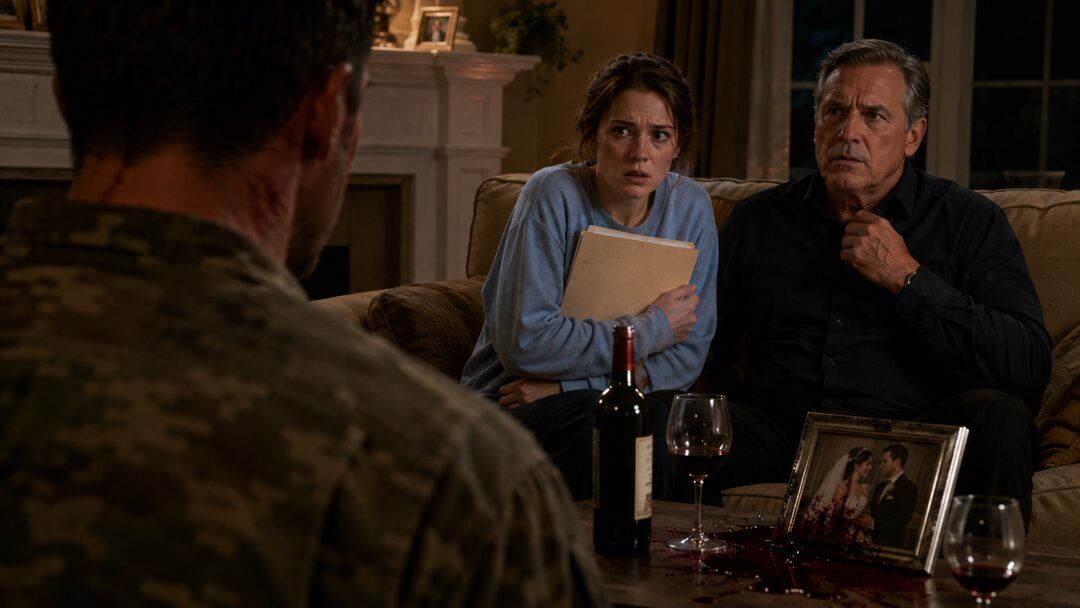
That was the first thing he noticed after the cold porch, after the taxi’s red taillights slid away from the curb, after the key turned too loudly in the front lock. The living room glowed with the soft yellow lamps Emily liked. The fireplace was dark but clean. The gray couch faced the coffee table. Their wedding photo stood on the white mantel, both of them young and sunlit and unaware of all the ways a person could come home changed.
Emily was on the couch in her light blue sweatshirt, bare feet tucked beneath her.
Beside her sat Colonel Robert Hayes.
His former commander.
There was a bottle of red wine on the coffee table. Two glasses. One half full. One touched only enough to leave a faint mark near the rim.
For one second, no one moved.
Mark stood in the doorway in his uniform, his duffel hanging from one hand. Dust still lived in the seams of his sleeves. His boots were dirty. A dark bruise sat under his left eye, purple at the edge, yellowing near the cheekbone. Near his collar, dried red had stiffened the fabric.
Emily’s face opened in terror.
Not surprise.
Terror.
“Mark,” she said, and his name sounded like something she had been warned about.
Robert did not stand right away.
That was what Mark would remember later. Not the wine. Not Emily’s knees turned toward another man. Not the wedding photo watching them from the mantel like a witness with no mouth.
He would remember Robert staying seated one second too long.
Calm. Measured. In control.
Then Robert set his glass down, folded his hands once, and said, “Sergeant Reynolds. Stand down.”
The words crossed the room and changed it.
Mark felt something in him go still.
Not quiet.
Still.
The kind of stillness that came before a door blew inward, before a radio went silent, before a man understood that the order had already been given and no one was coming back for the one left behind.
Emily stood too fast.
“Mark, wait.”
He looked at her then. Really looked.
Her hair was pulled back badly, as if she had done it with shaking hands. Her face was pale. There was a wet shine at the corner of one eye, but she had not been crying the way a guilty woman in a movie cried. She looked worse than guilty.
She looked briefed.
Mark stepped inside and closed the door behind him.
The click sounded final.
Robert’s eyes went to the bruise beneath Mark’s eye. Then to his uniform. Then to the duffel.
“You were not scheduled to be released until tomorrow,” Robert said.
“Released,” Mark repeated.
Emily flinched.
Mark laughed once. It came out wrong. Too bright. Too short.
He dropped the duffel by the door.
“Is that what we’re calling it?”
Emily moved around the coffee table, but not close enough to touch him. Mark saw that too. Every inch mattered now. Every object had chosen a side.
The couch.
The wine.
The folder half-hidden beneath a magazine on the side table.
Robert’s hand resting close to the place where Emily had been sitting.
Mark’s eyes returned to the wine.
“Long night?” he asked.
Emily wrapped her arms around herself. “Nothing happened.”
Mark smiled then, wide and empty.
Robert watched him carefully.
“Nothing happened,” Mark said. “That’s a big sentence for a room like this.”
“Mark, please,” Emily said.
“Why is he in my house?”
Robert stood at last. He was still tall, still neat, still carrying that quiet officer’s weight even in civilian clothes. Dark collared shirt. Gray hair. No uniform, but command had never needed fabric.
“Your wife called me because she was concerned,” Robert said.
“My wife called you.”
“Yes.”
Mark took one step forward.
Emily whispered, “I didn’t know what else to do.”
There it was.
Not a confession.
Worse.
A partnership he had not been invited into.
Mark looked at Robert. “And you came right over.”
Robert held his gaze. “Given your messages from the airbase, I thought it was necessary.”
Mark’s jaw tightened.
Emily looked from one man to the other. “You left me a voicemail. You sounded—”
“Say it.”
She swallowed. “You sounded like you were going to do something.”
Robert’s voice stayed soft. “You were not fit to process what happened.”
Mark’s eyes snapped to him.
“What happened,” he said.
Robert’s expression barely changed.
That was another thing command taught a man: how to bury a body without lowering your eyes.
Part II — The Folder
Mark crossed the room slowly.
Emily backed up half a step.
That hurt more than he expected.
He could have taken a shout. He could have taken the wine. He could have taken Robert’s calm, his careful shirt, his old-man authority sitting in Mark’s living room like it had paid the mortgage.
But Emily moving away from him landed somewhere private.
He stopped beside the coffee table.
The two glasses trembled faintly from the force of his boots on the floorboards.
“Ask me,” Mark said to her.
Emily blinked. “What?”
“Ask me why I’m early.”
She looked at the bruise. “Why are you early?”
Robert said, “Emily.”
Mark turned sharply. “No. Let her ask.”
Robert’s mouth tightened. “This is exactly why I told you we needed a controlled environment.”
Mark looked around the room with exaggerated care.
The couch. The wine. His wife in socks. Robert near her shoulder.
“This is controlled?”
Emily’s voice broke. “I was scared.”
“I know,” Mark said.
And the terrible thing was, he did know.
He had heard her fear in the way she said his name when he entered. He had heard it in the silence before Robert spoke. He had heard it in the voicemail he had left from the airbase, his own voice ragged and strange even to himself.
If Hayes gets to you first, don’t believe him.
He remembered saying it.
He remembered saying it into the phone while two men in clean uniforms stood outside the room waiting for him to sign papers he had not read all the way through.
He remembered the table bolted to the floor.
The pen.
The buzzing light.
The hand on his shoulder before he threw it off.
Then the floor coming fast.
That was where the bruise came from.
Not battle. Not heroism.
A hallway. A restraint. A polished boot near his face. Someone saying, Calm down, Sergeant.
Robert’s voice brought him back.
“Mark, you need help.”
Mark smiled again, but it had no humor now.
“Is that what you were telling her?”
Emily’s eyes went to the side table.
Too quick.
Too small.
Mark followed the glance.
The folder sat beneath a lifestyle magazine Emily never read. Thick. Sealed once, opened now. Government-gray. A black clip holding papers together.
He reached for it.
Robert moved.
“Don’t.”
That single word told Mark everything.
He snatched the folder from the table.
Robert stepped forward. “That is not yours.”
Mark held it up. “It’s got my name on it.”
“Mark,” Emily said, “please just sit down.”
He opened the folder.
The first page was administrative language. Medical review. Transitional recommendation. Voluntary statement. Nondisclosure acknowledgment.
Words built to make surrender sound like paperwork.
Mark flipped one page. Then another.
There was his service number.
His unit.
His arrival time.
A paragraph describing “acute stress response and unreliable recall.”
He laughed again, softer now.
“Unreliable.”
Robert said, “You have been through an extreme event. No one is denying that.”
Mark looked up. “You’ve been denying it since the ground team called in.”
Emily’s face changed.
Just a flicker.
Mark saw it.
He lowered the folder.
“You told her.”
Robert said nothing.
Emily pressed a hand to her mouth.
Mark’s voice dropped. “What did he tell you?”
Emily whispered, “That Daniel didn’t make it.”
The room narrowed.
The lamps. The couch. The wine. Robert’s controlled breathing.
Everything collapsed into one name.
Daniel.
Mark could see him for half a second, not as a memory but as an interruption.
Daniel Price sitting in the back of a transport, one knee bouncing, scratching at a cheap lighter with his thumbnail. Daniel saying, If I ever start sounding like them, punch me in the mouth. Daniel grinning like the world was still something you could argue with and win.
Mark looked at Emily.
“When?”
She looked smaller than she had when he entered. “This afternoon.”
“This afternoon,” he repeated.
“I didn’t know before that.”
“But he did.”
Robert’s face hardened. “You are not going to do this here.”
Mark’s hand tightened around the folder. “Where should I do it? In the room with the bolted table? In the hallway where your people put me on the floor?”
Emily stared at him.
That landed.
Good, Mark thought. Bad, Mark thought.
He could no longer tell the difference.
Emily took a step toward him. “They did that to you?”
Robert said, “He became combative.”
Mark turned on him. “I refused to sign.”
“You assaulted an officer.”
“You put a lie in front of me and called it recovery.”
Robert’s calm thinned for the first time.
Emily looked at the folder in Mark’s hand, then at Robert.
“What was he supposed to sign?”
Robert did not answer fast enough.
Mark did.
“A statement saying Daniel died during the retreat. Enemy fire. Chaotic conditions. No recoverable position.” He tapped the folder against his palm. “Clean words. Clean enough to drink with.”
Emily’s eyes filled.
Robert’s jaw shifted. “That was the operational summary.”
Mark stepped closer.
“No,” he said. “That was the story.”
Part III — The Name No One Said
Robert looked at Emily, not Mark.
That was his mistake.
“Emily,” he said, “you need to understand that your husband is carrying enormous guilt.”
Mark almost laughed.
There it was.
The perfect sentence.
Soft enough to sound compassionate. Sharp enough to cut the truth away from the man telling it.
Robert continued, “Guilt distorts memory. It makes patterns where there are none. He lost a friend and now he needs someone to blame.”
Mark opened the folder again and found the page.
He knew it would be there. Not because Robert wanted it seen, but because men like Robert trusted language too much. They believed if a thing was named carefully enough, it stopped being real.
Mark ran his finger down the page.
Then he found it.
Daniel Price.
His name appeared in a paragraph so dry it seemed impossible that it had ever belonged to a person who laughed too loud, cheated at cards badly, and carried a photo of his mother in a waterproof sleeve because he said she deserved better than his memory.
Mark touched the name.
“Say it,” he told Robert.
Robert was silent.
“Say his name.”
Emily’s eyes moved between them.
Robert exhaled through his nose. “This is not productive.”
Mark’s voice rose. “Say his name.”
“Daniel Price,” Robert said at last.
Too clean.
Too late.
Mark’s chest tightened so hard he thought his ribs might crack.
The memory came in flashes because that was the only way it came now.
Dust against his teeth.
A radio call breaking apart.
Daniel’s voice saying, There are families in there.
Robert’s voice over comms: Maintain movement.
Daniel again: They’re using them as cover.
A pause.
Then the order.
Not shouted. Not panicked. Worse.
Decided.
Proceed to extraction.
Mark had turned back. He had taken two steps. Maybe three. Someone grabbed his vest. Someone screamed that the window was gone. The world became sound and dust and the taste of metal.
Then Daniel’s voice stopped.
That was the part Mark could not survive.
Not Daniel dying.
The stop.
Emily was crying now, silently.
Robert saw it and moved toward her. “This is what I was trying to avoid.”
Mark cut him off. “No. You were trying to get here first.”
Robert’s eyes sharpened.
Mark held up the folder. “You came with this. You sat beside my wife. You poured wine. You told her I was damaged before I could tell her what you did.”
Emily whispered, “I poured it.”
Mark looked at her.
She wiped her cheek with the heel of her hand. “The wine. I poured it. I thought if everything looked normal, maybe I could stay calm.”
That should have softened him.
It did, somewhere deep.
But the deeper place was full of Daniel’s silence.
“You called him,” Mark said.
Emily nodded once.
“After my voicemail?”
“Yes.”
“The one where I said not to believe him?”
Her face folded. “That’s why I called.”
Mark stared at her.
Emily reached for the back of a chair as if she needed something to hold. “You sounded like you were disappearing. You were breathing like you couldn’t get air. You said he would come. You said not to believe him. Then you hung up and didn’t answer again.”
Robert said quietly, “She did what any frightened spouse would do.”
Mark’s eyes stayed on Emily.
“And when he got here?”
Emily looked at Robert, then back at Mark.
“He said you were confused.”
Mark nodded slowly.
There it was.
The second abandonment.
Not in a field. Not under orders. In his own living room, with his wife’s hands wrapped around a glass of red wine while another man explained him to her.
Emily said, “I didn’t know what was true.”
“You knew me.”
The line struck her harder than if he had shouted.
She closed her eyes.
Robert stepped in. “That is unfair.”
Mark turned.
“No,” he said. “Unfair is leaving a man because he refused to pretend civilians weren’t there.”
Robert’s face changed.
It was small. Almost nothing.
But Mark saw it.
Emily saw it too.
Robert said, “The mission was a legal extraction under collapsing conditions. Daniel broke formation.”
“Daniel saw what your partners were doing.”
“Our allied contacts were holding a perimeter.”
“They were using families as bait.”
Emily made a sound. Not a word. A small, wounded intake of breath.
Robert’s voice hardened. “You do not understand the full strategic context.”
Mark stepped closer. “I understood Daniel screaming over the radio.”
“Daniel compromised the team.”
“Daniel told the truth.”
“Daniel disobeyed.”
Mark’s hand shook around the folder.
There it was. Not grief. Not regret.
Judgment.
Robert had not avoided saying Daniel’s name because it hurt.
He had avoided it because Daniel had become, in his mind, a problem that solved itself.
Emily looked at Robert as if the man beside her had moved into different light.
“You said he died during retreat,” she whispered.
Robert’s gaze stayed on Mark. “He did.”
Mark shook his head.
“No. He was alive when you gave the order.”
The room went quiet.
The kind of quiet that did not mean peace.
The kind that meant something had finally entered and could not be sent back out.
Part IV — The Trap
Robert’s composure returned, but it returned colder.
He straightened his sleeves.
“Hand me the folder, Sergeant.”
Emily looked at him sharply.
Sergeant.
Not Mark.
Not even Reynolds.
A rank.
A handle.
A way to make a man smaller.
Mark almost smiled.
“You still think we’re there.”
Robert’s eyes did not leave his. “You are in no condition to possess classified materials.”
“You brought them into my house.”
“I brought documents to help your wife make informed decisions.”
Mark moved toward him. “About my discharge.”
Robert did not retreat. “About your care.”
“About my silence.”
Robert’s face tightened.
Emily stepped between them before Mark reached him. Her hands came up, not touching either man.
“Stop,” she said.
Mark looked down at her.
She was trembling. He had seen her cry before. He had seen her furious, tired, laughing in the kitchen with flour on her cheek, asleep on the couch with one hand tucked under her face. He had never seen her like this.
Afraid of him.
It gutted him.
Robert saw that too.
“Emily,” Robert said, “step away from him.”
Mark’s eyes lifted.
There it was again.
Command.
In the walls Mark had painted with Emily the summer after they moved in. On the rug she had chosen because she said gray hid everything. Under the mantel where their wedding photo stood in its silver frame, a younger Mark smiling like a man who believed coming home was a simple thing.
Emily did not step away.
Robert’s voice lowered. “Mark, think very carefully about what happens next.”
Mark looked at him. “I have been thinking about what happens next for thirty-six hours.”
“No,” Robert said. “You have been spiraling. There’s a difference.”
Emily turned her head. “Colonel—”
“Emily, please let me handle this.”
Mark laughed under his breath.
It was not funny. None of it was funny.
But Robert had just made the mistake men like him always made. He mistook being obeyed for being right.
Mark looked at Emily.
“Did he tell you I hit someone at the airbase?”
She hesitated.
That was answer enough.
Robert said, “You struck a captain.”
“I shoved him after he pushed my head onto a table.”
Emily’s face went white.
Mark touched the bruise under his eye with two fingers. “This isn’t from the mission.”
Robert’s eyes flicked toward the mark.
Mark continued, “This is from refusing to sign.”
Emily whispered, “Why didn’t you tell me?”
“I tried.”
The words left him before he could stop them.
They were not loud.
That made them worse.
Emily took them in like a slap.
Robert used the opening. “You see? He believes everyone has betrayed him. That is exactly the pattern I described.”
Mark turned slowly toward him.
The room seemed to shrink.
Robert’s voice became almost gentle. “If you attack me in front of your wife, no one will care what you think you remember.”
Emily’s breath caught.
Mark stared.
Robert had said the quiet part plainly now.
Maybe he was tired. Maybe he trusted his power too much. Maybe he thought Mark was already too far gone to understand strategy.
But Mark understood.
He understood perfectly.
The wine. The folder. Emily’s fear. Robert’s calm. The language of care wrapped around a cage.
If Mark exploded, Robert won.
If Mark put his hands on him, the story wrote itself.
Unstable sergeant returns home. Finds senior officer assisting concerned spouse. Becomes violent. Prior claims unreliable.
Mark could see the report before anyone typed it.
Emily saw something too. Her body turned, not much, but enough. She was no longer standing between Robert and Mark to protect Robert.
She was standing between Robert and the lie.
“Robert,” she said quietly, “why would you say that?”
For the first time, Robert looked annoyed with her.
“Because it is true.”
“No,” Emily said. “You said no one would care what he remembered.”
Robert’s eyes narrowed. “That is not what I meant.”
Mark gave a low, humorless breath. “It’s always what you mean.”
Robert reached for the folder.
Mark jerked it back.
Robert’s hand closed on air.
The move was small.
The insult was not.
Something flashed across Robert’s face, ugly and brief.
“Enough,” he snapped. “You will hand that over now.”
Mark stepped into him.
Emily grabbed Mark’s sleeve. “Please.”
Her voice split on the word.
Mark looked down at her hand on his uniform.
For half a second, another hand was there.
Daniel’s.
Clutching his vest.
Not pulling him back.
Pushing him forward.
Tell them, man.
Mark heard it so clearly he almost turned.
Robert reached again.
Mark shoved the folder into Emily’s hands.
“Read the line,” he said.
Emily stared at him.
“Read it.”
Robert moved fast then.
Too fast.
He grabbed for the folder, and Mark caught him by the collar with both fists.
The sound Emily made tore through the room.
Part V — The Line in the Room
Mark yanked Robert up so hard the older man’s chair leg struck the coffee table.
The wine bottle tipped.
One glass fell sideways.
Red spread across the wood in a sudden dark sheet, running between the coasters, soaking the corner of the folder, slipping toward the edge. A splash hit the silver frame on the mantel shelf below where Emily had moved it earlier to dust and never put it back quite right.
Emily screamed his name and grabbed his arm.
“Mark!”
Robert’s face was inches from his.
For one wild second, Mark wanted to break something.
Not bone, exactly.
Not even Robert.
He wanted to break the calm. The paperwork. The voice on the radio. The sentence that had turned Daniel from a man into an operational loss. He wanted to break every room where someone like Robert could sit across from someone like Emily and say care when he meant control.
Robert’s hands clutched Mark’s wrists.
“There,” Robert hissed, low enough that only Mark could hear. “There he is.”
The words landed clean.
Mark froze.
Emily was crying openly now, pulling at his sleeve.
“Please,” she said. “Please don’t.”
Robert’s eyes held his, almost satisfied beneath the fear.
He had been waiting for this.
Mark’s grip tightened.
Daniel.
He saw dust.
He saw the transport.
He saw Daniel’s lighter fall from his hand and spin once on the floor.
He saw himself obeying long enough to live.
That was the part no one in the room could save him from.
Robert had given the order.
But Mark had moved.
He had moved with the unit.
He had left Daniel’s voice behind him in the radio noise.
That truth had teeth.
It had been eating him since.
Mark opened his mouth, and the first sound that came out was not a word. It was raw. Animal. Too old to belong to language.
Emily sobbed.
Robert’s smile flickered.
Then Mark forced the word through.
“Daniel.”
Robert blinked.
Mark slammed him back, not into the wall, not down, but toward the mantel.
Toward the silver-framed photo now streaked with red.
“Look,” Mark said.
Robert resisted.
Mark shook him once. “Look at it.”
Robert’s eyes went to the photo.
In it, Mark wore a suit that did not fit right. Emily held white flowers. They were laughing at something outside the frame. Mark remembered the photographer telling them to turn their heads. He remembered Emily whispering, Don’t you dare cry before I do.
He had believed then that love meant being known before you had to explain.
Mark’s voice came out hoarse.
“You don’t get to give orders in my house.”
Robert’s face shifted.
Not fear now.
Recognition.
Emily stopped pulling.
The whole room seemed to hold its breath.
Mark felt the shape of the choice inside his hands.
He could strike him.
He could become the last piece Robert needed.
He could make Emily’s fear make sense.
He could make Daniel’s name disappear under his own rage.
Robert whispered, “Let go.”
It was not an order this time.
That was why Mark did.
He released Robert’s collar.
Robert stumbled back, one hand flying to his throat. His shirt was twisted. His face had lost color. For the first time since Mark entered, he looked like a man in a room, not a rank wearing skin.
Emily stood between them, holding the folder against her chest. Red wine had soaked one corner and touched her fingers.
Mark backed away.
His hands shook badly.
Robert adjusted his collar. The movement was automatic, almost pitiful.
“You have no idea what you’re doing,” he said.
Emily looked at him.
“Yes,” she said. “He does.”
Robert turned to her.
That wounded him more than Mark’s hands had.
Emily opened the folder with shaking fingers. She looked down at the line Mark had shown her.
Mark did not need to see it again.
He knew the words.
Subject displayed oppositional fixation regarding casualty designation of SPC Daniel Price.
Oppositional fixation.
That was what they called remembering.
Emily read it twice.
Then she looked at Robert.
“You wrote this before you came here.”
Robert said, “I prepared it because I knew tonight would be difficult.”
“You prepared it before hearing him.”
Robert’s silence answered.
Mark leaned one hand on the back of the couch. He felt suddenly hollow. The rage had not left. It had simply lost its legs.
Emily took her phone from the couch cushion.
Robert said, “Emily, do not do anything impulsive.”
She looked at him with a face Mark had never seen before.
Not brave.
Not healed.
Just finished taking instructions.
“Don’t tell me how to listen to my husband,” she said.
Robert’s jaw worked once.
Emily looked at Mark. “Daniel’s mother. Do you have her number?”
Mark stared at her.
For a moment he could not understand the question.
Then he did.
His throat closed.
“Yes,” he said.
Robert stepped toward her. “This would be a serious mistake.”
Emily did not move back.
“Then leave before I make it.”
Robert looked from Emily to Mark, measuring the room again, looking for the old arrangement.
It was gone.
Not repaired.
Gone.
He picked up his coat from the arm of the couch. His hand was not quite steady.
At the doorway, he turned.
“Nothing you say tonight changes what happened.”
Mark looked at him.
“No,” he said. “But it changes who has to carry it alone.”
Robert left.
The door closed softly behind him.
That softness almost hurt more than a slam.
Part VI — What Stayed
For a while, neither Mark nor Emily spoke.
The living room looked worse in the quiet.
The wine had reached the edge of the coffee table and dripped slowly onto the rug. One glass lay on its side. The folder sagged in Emily’s hands, stained at the corner. Their wedding photo sat crooked on the mantel, red marked across the silver frame and the lower edge of Emily’s white dress in the picture.
Mark wanted to fix it.
He wanted to leave.
He wanted to sleep for a year.
Emily held the phone but did not dial.
“I’m sorry,” she said.
Mark looked at her.
The words were too small for the room.
She seemed to know it.
“I know that doesn’t reach far enough.”
He said nothing.
She wiped her face with her sleeve, then held the phone out.
“Tell me the number.”
Mark gave it to her from memory.
Of course he knew it. Daniel had made him memorize it three weeks into deployment after a bad roadside scare.
If I don’t get home, don’t let some captain with clean boots call her first.
Mark had thrown a packet of crackers at him and told him to shut up.
Daniel had laughed.
Now Emily typed the number.
Her thumb hovered.
“Do you want me to leave the room?” she asked.
Mark looked at the wine on the table.
At the folder.
At the doorway Robert had walked through.
At his wife, who had doubted him and was still standing there.
“No,” he said.
Emily pressed call and put it on speaker.
The ringing seemed impossible. Too ordinary. A small electronic sound crossing distance, entering some other quiet room where a woman might be folding laundry or watching television or sitting with a grief the official words had already failed.
A woman answered on the fourth ring.
“Hello?”
Mark closed his eyes.
For one second, he was back in the transport with Daniel’s knee bouncing against his.
Say something stupid, man, Daniel had told him once. You get too serious, people start thinking you’re in charge.
“Mrs. Price,” Mark said.
Silence.
Then: “Who is this?”
His voice almost failed.
“It’s Mark Reynolds.”
Another silence.
Not empty.
Full.
Emily stood very still.
Mrs. Price’s voice changed when she spoke again. “Mark.”
That was all.
His name.
Not Sergeant. Not witness. Not unstable. Not useful. Not a problem.
Just Mark.
He gripped the back of the couch until his knuckles paled.
“I should have called sooner,” he said.
On the other end, Daniel’s mother breathed in sharply.
Mark looked at Emily.
She was crying again, but quietly now, with the phone held between them like a small, fragile bridge.
Mark forced himself to continue.
“They didn’t tell you all of it.”
Emily closed her eyes.
Mark said Daniel’s name.
Not as a shout this time.
Not as a weapon.
As a person.
“Daniel was alive when I last heard him,” Mark said. “He was trying to tell the truth about what he saw.”
Mrs. Price made a sound so soft it barely came through the speaker.
Mark did not explain everything. Not then. Not in a rush. Not like a report. He gave her what he could without turning Daniel into another document.
He told her Daniel had not been afraid to speak.
He told her Daniel had been right.
He told her Daniel had not been forgotten.
When he finished, the house felt colder.
Mrs. Price did not thank him. He was grateful for that. Thanks would have been unbearable.
She only said, “I knew my boy wouldn’t just run.”
Mark covered his mouth with one hand.
Emily lowered the phone slightly, but did not end the call until Mrs. Price did.
When the line went dead, the silence that followed was different from the one Robert had left behind.
Not peaceful.
But honest.
Emily set the phone on the couch.
“I believed him because he was calm,” she said.
Mark looked at her.
She did not defend it. That mattered.
“I wanted someone calm to be telling the truth,” she said. “I was so tired of being scared.”
Mark nodded once.
He understood that too.
He hated that he understood.
Emily’s hands twisted together. “I don’t expect you to forgive me tonight.”
“Good,” Mark said.
She flinched, but she accepted it.
He looked toward the mantel.
The wedding photo still sat crooked.
After a moment, he walked to the coffee table and picked up a napkin. His hands were shaking so hard the paper trembled.
Emily started to move.
He shook his head.
She stopped.
Mark wiped the wine from the silver frame first. Slowly. Carefully. The red came away from the metal, then smeared across the napkin. He cleaned the glass over their younger faces until he could see them again.
The photo looked almost normal.
The table did not.
The wood had taken the color in.
He rubbed harder, but the mark only spread thinner, deeper, harder to deny.
Behind him, Emily whispered, “Mark.”
He did not turn.
Not yet.
He held the stained napkin in one hand and the frame in the other. In the photo, Emily was laughing. Mark was looking at her instead of the camera.
He remembered that man.
He did not know if that man was gone, or waiting, or simply someone he could no longer pretend to be.
Emily stayed where she was.
That was something.
She did not reach for him. She did not ask for comfort. She did not fill the room with promises the room was too damaged to hold.
Mark set the photo back on the mantel.
Straight this time.
Then he stood there with his shaking hands at his sides while the house settled around him, while the stain remained on the table, while the name Daniel Price stayed spoken in the air between them.
For the first time since he came through the door, no one gave an order.
And no one looked away.