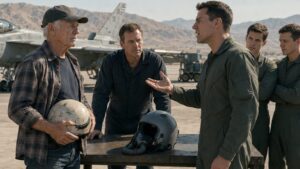
They Laughed at the Old Mechanic’s Logbook Until the Engine Whispered the Same Warning
Chapter 1: The Old Book on the Workbench
The engine coughed once, settled, and then whispered the wrong rhythm.
Thomas Miller heard it under the clean roar, behind the bright chatter of the gauges, beneath the younger voices calling out numbers as if numbers were the whole truth. A soft hitch came through the hangar floor and climbed into the bones of his knees.
Not a bang. Not a grind. Nothing dramatic enough to make a man turn pale.
Just three uneven pulses after throttle rise, then a smooth return.
Thomas stopped wiping the wrench in his hand.
Across the bay, the relief aircraft sat under the morning lights with its panels open and its belly streaked from last night’s rain. The storm system had rolled inland before dawn, leaving the coast gray and wet and busy. Emergency pallets waited near the loading zone: water, medical boxes, tarps, portable radios. A relief coordinator had already been through twice, asking when the aircraft would be cleared.
The young technician under the wing gave a thumbs-up.
“Run-up steady,” he called.
Thomas did not move.
The sound had already gone, swallowed by the fans and voices and the flat metallic echo of the corrugated hangar. But his fingers had tightened around the wrench until the rag bunched inside his palm.
He turned his head slightly and listened the way he had been taught to listen before screens became bright enough to make men stop trusting their ears. Through the left engine’s vibration, through the rolling cart beside him, through the rain ticking off the roof seam.
There.
Not in the engine itself.
Below it.
A shiver where the frame should have held steady.
Thomas set the wrench down on the rough wooden workbench. The bench had been patched three times, maybe four, and one corner sagged where oil had soaked into the grain for years. On it lay his battered maintenance logbook, thick with tabs, tape, fingerprints, and pages that had curled from damp air. The cover had once been dark blue. Now it was almost black at the edges, softened by use.
He wiped his thumb before touching it. It did not help much. Grease had lived in his hands too long.
“Mr. Miller, you good?” the young technician asked.
Thomas looked up.
The technician had a headset around his neck and a tablet balanced in one hand. He was not unkind, not exactly. He had the quick face of someone trying to finish one task while already thinking about the next. His eyes flicked to Thomas’s logbook and away again.
“Bring it down two percent and hold,” Thomas said.
The technician blinked. “We already cleared idle response.”
“Not idle.” Thomas kept his voice level. “Load transition.”
The technician glanced toward the cockpit. “It’s within spec.”
“I didn’t say it wasn’t.”
That made the young man smile a little, as if Thomas had proven the point against himself. “Then what are we chasing?”
Thomas placed three fingers on the logbook but did not open it yet. He could feel the torn ridge of the cover under his index finger. “A sound.”
The technician’s smile faded into something more careful. Not respect. Not yet. More like the caution people used with old men who might slow a room down.
“A sound,” he repeated.
Thomas heard the words land poorly. A sound was not a reading. A sound was not a signed report. A sound was what an old man complained about when the world had moved on without asking permission.
The cockpit window opened. Another crewman leaned out. “We holding or shutting down?”
“Hold,” Thomas said, louder.
The technician looked over his shoulder toward the office glass at the side of the hangar. Brandon White was already coming out.
Brandon moved fast when someone threatened his schedule. Pressed green uniform, sleeves perfect, boots clean enough to catch light from the hangar door. He was in his early thirties, clean-shaven, hard around the mouth in a way Thomas recognized from men who had been given authority before they had learned how heavy it was.
“What’s the issue?” Brandon asked.
Thomas did not answer immediately. The engine was still speaking, and he did not want to miss the small thing inside the loud thing.
Brandon’s eyes narrowed. “Mr. Miller?”
“Mount transfer,” Thomas said.
The technician stared at him. “The mount sensors are green.”
“Not sensors. Transfer. The vibration is walking somewhere it shouldn’t.”
Brandon looked toward the tablet. “Numbers?”
“Don’t have them.”
“Fault code?”
“No.”
“Temperature spike?”
“No.”
Brandon exhaled through his nose, short and controlled. “Then what do you have?”
Thomas opened the logbook. The pages resisted, swollen near the binding. He turned past years of dates, part numbers, careful arrows, old notations written when his hand had been steadier. He was not looking for proof yet. He was looking for memory’s doorway.
The young technician shifted his weight. Someone near the loading pallets laughed softly at something unrelated, but the sound pricked the air.
Thomas found a page marked with a strip of yellowed tape. His thumb rested over an oil stain shaped like a dark thumbprint.
“Same rhythm,” he said.
Brandon did not step closer. “Same as what?”
Thomas looked across the hangar at the aircraft. Its left side trembled in the wash of its own power. The relief markings on its cargo pallets looked too clean for the weather waiting inland.
“Bring it down,” Thomas said.
Brandon’s expression hardened. “We’re forty minutes behind.”
“Bring it down.”
The young technician lowered his voice. “Sir, diagnostics say—”
“I heard the diagnostics.” Thomas closed the logbook halfway, not enough to lose the page. “I also heard the aircraft.”
Brandon’s gaze moved from Thomas’s lined face to the grease on his sleeves, then to the book under his hand. The look lasted less than a second, but Thomas felt it cleanly. He had been measured and placed: old civilian hand, part-time, slow with paper, useful for sweeping corners of memory but not for delaying a relief flight.
“Shut down,” Brandon ordered at last, and the words came out like a penalty. “Ten minutes. Mr. Miller, bring that book.”
The engines wound down. The hangar seemed to empty itself of air as the roar died. In the sudden quiet, Thomas heard rainwater drip from the roof into a bucket near the wall.
Brandon pointed toward the workbench.
“If you’re going to slow down the whole bay,” he said, “we’re going to see exactly what you think that logbook knows.”
Thomas slid the rag between the pages to hold his place. Then he lifted the book with both hands, careful not because it was fragile, but because some things deserved not to be grabbed.
Chapter 2: The Officer Who Put His Hand Down
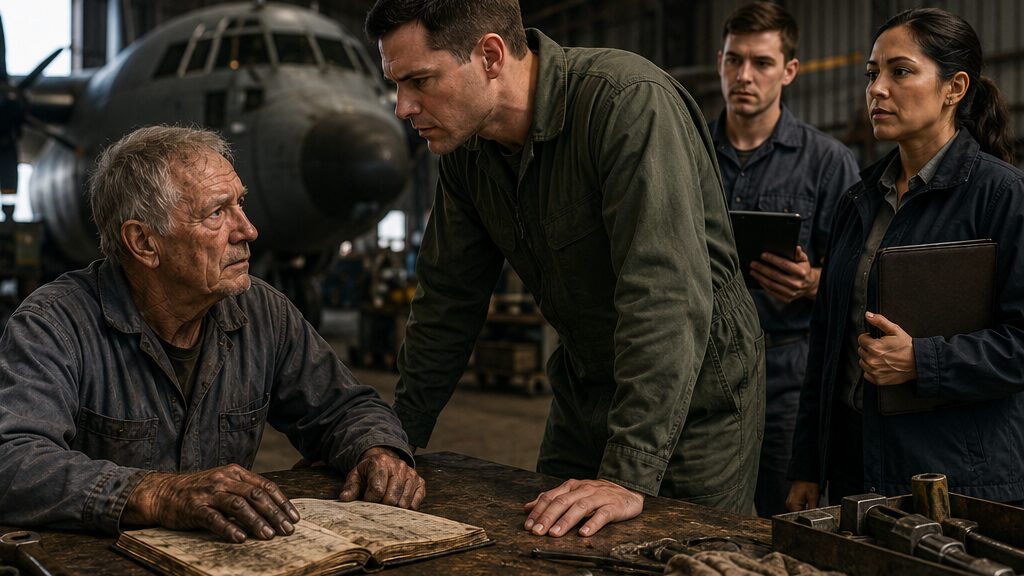
By the time Thomas reached the workbench, three people had already gathered around it as if the book were an inconvenience that needed witnesses.
The young technician stood with the tablet tucked against his ribs. One of the maintenance trainees leaned near a tool cart, pretending not to listen while listening to everything. Brandon stood on the opposite side of the bench, close enough that Thomas had to lower himself onto the stool instead of standing shoulder to shoulder with him.
The stool complained under Thomas’s weight. His left knee had been stiff since the weather changed. He folded one hand over the logbook and waited for the small ache to settle before opening the cover.
Brandon looked at the wall clock. “We have an aircraft scheduled for relief cargo, a safety inspector on the way, and a crew waiting on clearance. So let’s make this direct.”
Thomas nodded once.
The younger man’s impatience did not surprise him. What surprised him was how familiar the room felt. The hard lights. The metal walls. The smell of oil and wet canvas. Men waiting to see whether the old one had something worth hearing.
He opened to the marked page.
Brandon tapped the technician’s tablet. “The diagnostic sweep shows no critical fault. Mount sensors are within tolerance. Vibration levels are within tolerance. Temperature and pressure are within tolerance.”
Thomas kept his eyes on the page. “Within tolerance does not mean unchanged.”
The trainee near the cart looked down quickly, hiding a smile.
Brandon noticed. His jaw tightened, not at the trainee, but at the delay. “Mr. Miller, this isn’t about old habits. We can’t ground an aircraft because something reminded you of something.”
Thomas moved his three fingers to the margin. The nail of his middle finger had a black crescent of grease beneath it. He had scrubbed it the night before and again before dawn. Some marks did not leave.
“I’m not grounding it,” Thomas said. “I’m asking you to look beneath the left forward mount under load.”
“We looked at the mount.”
“You looked at the mount sitting still.”
Brandon leaned forward. “And the system looked at it running.”
“The system looked where the sensors are.”
The words landed harder than Thomas meant them to. He saw Brandon’s eyes sharpen, not with understanding, but with offense.
The young officer reached across the bench and placed his hand on the open logbook.
Not fully over the page. Not quite. His palm covered the lower corner, flattening one warped edge. The gesture was small enough to deny and large enough to claim the space.
Thomas did not move his own hand away.
For one second, their hands shared the book: Brandon’s clean, square, and tense; Thomas’s older, scarred, and stained dark at the knuckles.
“Current report matters more,” Brandon said, “than a notebook older than half the crew.”
No one laughed loudly. That was worse. The silence held the shape of laughter without the courage of it.
Thomas looked at Brandon’s hand. The skin was smooth across the knuckles. No old burns. No crescent scars from safety wire. Not yet. There was still time for that hand to learn without losing too much.
“Probably does,” Thomas said.
Brandon blinked. He had expected argument.
Thomas slid one finger, slowly, until it touched the margin above Brandon’s thumb. “But the aircraft doesn’t know how old the note is.”
The young technician’s eyes shifted from the tablet to the page.
The note was written in a narrow hand that had once belonged to Thomas in another decade. The ink had browned slightly. Beside a string of numbers and letters, three dots sat in a triangle, followed by a short line:
three-pulse shiver on warm transfer — inspect forward mount seat, not sensor bracket
Brandon stared at it, then looked back at Thomas. “That could mean anything.”
“It means I heard it before.”
“On this model?”
“Close enough.”
“That’s not an answer.”
“It’s the start of one.”
Brandon lifted his hand from the page, but not because he had softened. He took the tablet from the technician and turned it toward Thomas. “Here’s an answer. Current data. Current aircraft. Current crew. Nothing red, nothing amber. Your page is not tied to this tail number.”
Thomas studied the graph. He could read it well enough. He was not against screens. Screens told a kind of truth. He had learned long ago that trouble often lived between truths, hiding in the space where one instrument stopped listening and another had not begun.
“Scroll back to throttle rise,” he said.
The technician did it before Brandon could refuse.
Thomas leaned closer. The lights above the bench brightened the silver in his hair and caught the fine tremor in his left hand. He tucked that hand into his lap. With his right, he pointed without touching the screen.
“There.”
The line barely twitched.
Brandon frowned despite himself.
Thomas said, “That’s when I heard the third pulse.”
The technician looked from the screen to the page. “It’s still inside tolerance.”
“Yes.”
“So why does it matter?”
Thomas looked at him then. The question was honest, and that made it worth answering.
“Because the first two pulses belong to the engine taking load. The third one doesn’t. It answers late.”
The trainee stopped pretending not to listen.
Brandon’s confidence did not fall apart. It tightened. “That’s a poetic way to describe a machine.”
“It’s a practical way.”
“Practical would be a measurable fault.”
Thomas closed the logbook gently. “Practical is finding it before it becomes measurable from the wrong place.”
The bay door groaned as wind pushed rain against it. For a moment the hangar seemed to hold its breath around the old book.
Then a woman’s voice came from behind them.
“Which one of you is delaying my clearance file?”
Thomas turned.
Michelle Rivera stood just inside the hangar, rain speckled across the shoulders of her dark jacket, a hard case in one hand and a folder tucked beneath her arm. She looked at the group, then at the logbook under Thomas’s hand.
Brandon straightened at once. “Ms. Rivera. We’re reviewing a concern.”
“I can see that.” Her eyes settled on Thomas, not dismissive, not warm. Measuring. “Who wrote the original note?”
Thomas rested three fingers on the cover.
“I did,” he said.
Michelle’s gaze dropped to the battered binding, then returned to his face.
“When?” she asked.
Thomas did not answer quickly enough, and Brandon noticed.
Chapter 3: A Margin Note Nobody Wanted
The records room had no windows and always smelled faintly of cardboard, copier heat, and old dust pretending to be order.
Thomas stood just inside the door while the records clerk pulled file boxes from a rolling shelf. Brandon remained near the threshold with his arms folded, as if distance could keep him from being part of the delay. Michelle worked at the narrow counter, her folder open, Thomas’s logbook placed beside it like an object admitted into evidence but not yet trusted.
“Let’s stay exact,” Michelle said. “You wrote the note. You believe it corresponds to a current vibration pattern. You cannot yet tie it to this aircraft’s maintenance history.”
Thomas nodded.
Brandon gave a small, humorless breath. “That’s the problem.”
Michelle did not look at him. “That’s the question.”
Thomas appreciated the distinction. Small as it was, it made room for air.
The clerk set a gray box on the counter and lifted the lid. “Current tail number records, last seven years. Anything older is probably in archived storage or scanned under legacy designation.”
“Legacy designation,” Thomas repeated.
The phrase loosened something in his memory. Not enough to see the whole shape, but enough to feel its edge. Aircraft changed numbers. Parts moved. Frames were rebuilt, reassigned, renamed by people who believed a new label made an old thing new.
Michelle turned a page in the logbook with two fingers. She did not grab or flatten it. That, too, Thomas noticed.
“This code in the margin,” she said. “F-M-S?”
“Forward mount seat.”
“And these three dots?”
Thomas paused. “Sound pattern.”
Brandon shifted. “Sound pattern is not an approved notation.”
“No,” Thomas said. “It’s mine.”
“Exactly.”
Michelle lifted her eyes. “Let him finish.”
The words were mild, but Brandon stopped.
Thomas looked at the three dots on the old page. They were not decorative. He had made them fast that day, with a pen that skipped in the cold. Three pulses. The kind of mark a man made when he wanted his future self to remember what the official line might smooth away.
“It means the vibration came in three beats,” Thomas said. “Two expected under load. One delayed. Slight. Low.”
“Low where?” Michelle asked.
“Through the frame. Not the instrument panel.”
“And you connected it to the forward mount seat?”
“I did after inspection.”
Brandon’s arms tightened. “But this note doesn’t say what aircraft.”
Thomas touched the top of the page. “It used to.”
Michelle leaned closer.
The upper corner had been torn long ago, not cleanly. A piece the size of a thumbnail was missing where a number had once continued across the margin. The paper there had darkened from oil and age. Thomas remembered catching that page on a toolbox latch years after retiring, cursing under his breath, taping what he could. He had not thought the missing corner mattered anymore.
A man learned, if he lived long enough, that the things he thought were finished sometimes returned without asking.
The clerk flipped through another folder. “There are several mount replacement bulletins, but I don’t see that notation.”
“You won’t,” Thomas said.
Brandon looked ready to respond, but Michelle beat him to it. “Why not?”
Thomas kept his fingers still. “Because we didn’t call it that at first.”
“What did you call it?”
He closed his eyes briefly. The old hangar in his mind was brighter than this one, louder, full of younger faces and colder coffee. He saw a panel number chalked wrong. A supervisor’s hand waving him off. A plane sitting under lights while everyone worked around the thing none of them had time to name.
“Seat creep,” he said.
The clerk stopped flipping. “Seat creep?”
Thomas opened his eyes. “That’s what we called it before the bulletin language changed.”
Michelle wrote it down. “Forward mount seat creep.”
Brandon came closer despite himself. “Are you saying this aircraft has a known legacy issue?”
“I’m saying something in it is behaving like one.”
“Based on a torn note?”
“Based on a sound, a graph twitch, and a torn note.”
“That’s not enough.”
Thomas looked at him. “Then help make it enough.”
For the first time that morning, Brandon had no immediate reply.
Michelle turned toward the clerk. “Search archived maintenance bulletins for forward mount seat creep. Also cross-reference legacy designation changes on this airframe series.”
The clerk made a face. “That could take time.”
Brandon checked the clock mounted above the door. “We don’t have time.”
The words were not cruel. That was what made them dangerous. They sounded reasonable. The aircraft was needed. Roads inland were still blocked. Somewhere beyond the coast, people were waiting on water and medicine. Thomas knew that. He knew delay had weight.
But so did clearance.
Michelle slid the logbook slightly toward Thomas. “Mr. Miller, how long ago did you make this note?”
Thomas ran his thumb along the softened cover. “Decades.”
“During service?”
“Yes.”
Brandon’s eyes flicked to him with new attention. Not respect, exactly. A recalculation.
Thomas disliked that almost as much as dismissal. He did not want the past dragged into the room like a credential. The note mattered because it was accurate or it did not. His service did not turn paper into proof.
Michelle seemed to understand part of that. She did not ask what rank he had held or where he had served. She asked, “Was there a formal incident tied to it?”
The records room went quieter than it had been.
Thomas looked at the torn corner of the page. His throat tightened, but his face stayed still.
“There was a review,” he said.
Brandon’s voice lowered. “A mishap review?”
Thomas did not answer.
The clerk, perhaps grateful for something to do, typed quickly at the terminal beside the shelves. The machine hummed, clicked, stalled, then returned a line of results. The clerk leaned closer.
“I may have something,” the clerk said. “Old file series. Not under current tail records. It’s flagged as removed from active archive.”
Michelle straightened. “Removed where?”
The clerk read the screen again, slower this time.
“Transferred after mishap review,” the clerk said. “Restricted storage reference only.”
Brandon looked from the terminal to Thomas.
Thomas kept his hand on the logbook, but the old page beneath it suddenly felt too thin to hold what was coming back.
Chapter 4: Within Tolerance Does Not Mean Safe
By early afternoon, the hangar had become too bright.
The rain outside had thinned into a pale mist, and the open bay doors threw a flat silver light across the concrete. It made every toolbox, cable, and boot print look sharper than it was. The aircraft waited in the middle of it all with its panels secured again, as if nothing beneath the skin had ever questioned its readiness.
Thomas stood beside the workbench with his logbook closed.
The restricted file had not come quickly. Nothing old and important ever did. Michelle had made three calls, waited through two transfers, and finally received permission to request the archived reference. Permission was not the same as access. The actual file, the clerk said, might take hours to locate.
Hours were what the hangar did not have.
So Brandon ordered a second inspection.
Not angrily. That would have been easier for Thomas to stand against. Brandon issued it in the clean voice of procedure, with Michelle watching and the base supervisor passing through every few minutes to ask whether the delay was still justified.
“Full diagnostic repeat,” Brandon said. “Mount sensor sweep, thermal scan, vibration trace at idle, climb simulation, and load transition.”
The young technician glanced once at Thomas, then looked down at the tablet. “Yes, sir.”
Thomas did not object. He wanted the test. He wanted the aircraft to prove him wrong so completely that the old hitch in his chest could loosen. A man did not carry warnings because he enjoyed being right. He carried them because the cost of being wrong in silence was higher than embarrassment.
The engine started again.
Sound rolled through the hangar, struck the metal walls, and returned in layers. Thomas closed his eyes for half a breath, then opened them before anyone mistook listening for confusion.
Brandon stood near the diagnostic station with the technician. Michelle remained a few steps behind them, folder tucked beneath one arm, gaze moving between the live readings and Thomas’s face.
“Idle stable,” the technician called.
Thomas listened.
“Temperature normal.”
The engine note rose.
“Vibration inside green band.”
Thomas felt the first pulse through the soles of his boots. Expected. A settling of force through frame and mount.
Second pulse. Also expected.
Then smoothness.
No third.
His fingers curled once at his side. Relief should have come. Instead there was a thin unsettled space where the missing sound had been. Machines, like men, sometimes behaved well when everyone watched them.
“Hold at transition,” Brandon said.
The engine held. The graph moved cleanly across the tablet screen. No twitch. No hesitation. No late answer.
The young technician looked openly at Thomas now. Not cruelly. Worse again: sympathetically.
“Still green,” he said.
Brandon waited a moment longer, as if giving the aircraft one more chance to betray either him or Thomas. It did neither.
“Bring it down,” he ordered.
The engine wound low, then quieted. The hangar filled with ordinary sounds: rolling wheels, a dropped socket, somebody coughing near the pallets. Thomas kept his eyes on the aircraft.
The base supervisor approached from the office side. “Are we cleared?”
Brandon looked at Michelle.
Michelle did not look pleased, only precise. “The repeated diagnostic test shows no actionable fault. The archived file is still pending. I can’t hold clearance on a handwritten note alone.”
The words were fair. Thomas knew that. Fairness could still be insufficient.
The base supervisor turned to Brandon. “Then move it forward. Relief wants departure before dark.”
Brandon nodded. “We’ll finish documentation.”
The young technician unplugged a lead from the diagnostic port. As he passed the bench, he murmured to one of the trainees, not softly enough, “Guess the old girl had stage fright.”
The trainee smiled despite trying not to.
Thomas bent over the workbench as if he had not heard. He opened the logbook to the marked page. The paper lay there, stubborn and thin, the old note waiting without defending itself.
Within tolerance.
He had heard those words often in his life. Sometimes they meant safe. Sometimes they meant the numbers had not yet learned where to look.
He took a pencil from the cracked mug near the bench and wrote nothing. The tip hovered above the margin.
His hand trembled.
He set the pencil down.
Brandon came to the opposite side of the bench. He did not put his hand on the book this time. That small restraint did not escape Thomas.
“Mr. Miller,” Brandon said, “I’m not trying to embarrass you.”
Thomas looked up. “No.”
“I ordered the second run. We checked what you asked us to check.”
“You checked what the procedure allows you to see easily.”
Brandon’s mouth tightened. “That’s not a small thing.”
“I didn’t say it was.”
“Then help me understand what you want me to do with this.” Brandon gestured toward the aircraft. “Ground a relief plane because of a sound that didn’t repeat?”
Thomas looked beyond him to the pallets. Blue tarps. White boxes. A child’s handwriting on one cardboard side, probably from a volunteer group: HOLD DRY.
“No,” Thomas said.
Brandon seemed surprised.
Thomas closed the logbook halfway. “I want you to know what you’re accepting.”
“That’s what clearance is.”
“No. Clearance is a signature. Acceptance is what follows you after.”
For a moment Brandon’s face changed. Not much. A flicker, as if the words had landed somewhere under the uniform. Then the flight crew called him from the other side of the bay, and the flicker disappeared.
“I’ll note your concern in the file,” Brandon said.
Thomas gave a slow nod. “That’s something.”
But after Brandon walked away, Thomas stayed at the bench. The hangar moved around him, returning to speed. Panels were checked. Cargo straps counted. The young technician laughed more freely now. Michelle took a call near the records room door, her voice low and controlled.
Thomas touched the margin note.
three-pulse shiver on warm transfer
Warm transfer.
The second test had not been warm the right way. They had repeated the run too soon after shutdown, before the frame had settled through a full heat soak, before the cargo load pressed the aircraft into its working posture. The sound had not vanished. It had been waiting for conditions.
His heartbeat slowed.
He turned the page back, then forward again. Dates. Numbers. Old shorthand. A younger version of his own hand trying to leave enough behind for a future that had now found him.
The engine crew began a cargo-load balance check. A forklift carried a pallet toward the aircraft. Weight entered the frame little by little, not as motion, but as promise.
Thomas did not speak yet.
He waited.
The forklift backed away. Straps tightened. A crewman climbed down. Somewhere under the aircraft, metal accepted burden.
The faint sound came through the floor.
Three pulses.
Softer than before.
Thomas’s hand went still.
He picked up the pencil and placed three small dots beside the old margin note.
Chapter 5: The Sound Beneath the Metal
Evening settled in the hangar without turning the lights softer.
The sky beyond the bay doors had become a dull sheet of pewter, and the last of the rainwater ran in narrow lines along the concrete outside. Most of the crew had gone to the ready room or the office side, where phones kept ringing and the relief coordinator kept asking for a departure time that no one could give with comfort.
Thomas remained at the workbench.
His logbook lay open beneath the yellow overhead lamp. The three new pencil dots sat beside the old ink dots, small and plain. A man looking at them without history would see nothing but hesitation marks.
Frank Thompson came from the supply cage carrying two paper cups of coffee. He moved with the careful shuffle of a man who knew every uneven patch of the hangar floor and had survived them all by respecting them.
“You’re making enemies again,” Frank said.
Thomas accepted the cup. “Didn’t know I had stopped.”
Frank eased himself onto an overturned crate near the bench. His hair was thin and white under his cap, and his supply jacket hung loose from shoulders that had once been broad. He looked toward the aircraft, then back at the book.
“They’re saying the second test cleared.”
“It did.”
“Then go home.”
Thomas took a slow drink. The coffee was bad in the familiar way. Burnt, thin, necessary.
Frank watched him. “I mean it.”
“I know.”
“No, you don’t. You think standing here quiet makes it less of a fight.” Frank nodded toward the office glass. Brandon’s outline moved behind it, speaking with Michelle and the base supervisor. “That one already decided you’re a problem. Maybe not a fool. But a problem. Men his age don’t like problems with gray hair.”
Thomas looked down at his hands. The grease had settled into the creases around his knuckles. Under the bright lamp, they looked older than he felt in his mind.
“Aircraft doesn’t care about my hair.”
“That aircraft won’t defend you when they put the delay on paper.”
Thomas said nothing.
Frank leaned closer, lowering his voice. “Tom, you put in your years. More than most. You don’t owe these boys your hide.”
Thomas’s thumb moved once over the edge of the page.
The name came to him before the memory did, and he wished it had not.
A young crew chief from long ago, standing under a wing with a pencil behind one ear. Laughing at something Thomas had said. Not a dramatic memory. That was the cruelty of it. The dead did not always return in heroic poses. Sometimes they came back holding coffee, asking if a rattle sounded funny to you too.
Thomas closed his eyes for a moment.
Frank saw enough. He looked away first.
“You’re thinking about back then,” Frank said.
Thomas opened his eyes. “Don’t.”
“I didn’t say a name.”
“You don’t have to.”
The hangar hummed around them. Somewhere a printer spat out paper. A wrench clinked against a tray. The ordinary world continued with its ordinary sounds, which was what made memory so unreasonable. It waited inside normal things.
Frank held his coffee between both hands. “They ignored you?”
Thomas kept his gaze on the logbook. “Not exactly.”
“Then what?”
“I didn’t push hard enough.”
Frank sighed. “That’s not the same.”
“It was to the man who didn’t come home.”
The words were quiet. They surprised Thomas by leaving him at all.
Frank stayed still.
Thomas had never told the whole story, and he did not tell it now. He saw pieces: the old aircraft, the cold morning, the same delayed pulse beneath the engine note. He had written it up. He had mentioned it twice. A supervisor had said they would check after the next run. The schedule had tightened. The aircraft had gone out. The formal review later used words like sequence, contributing factors, insufficient evidence. Thomas had read every word until the words lost shape.
No one had blamed him.
That had not helped.
He looked at the new pencil dots. “I learned after that. If a machine talks twice, you answer before it has to shout.”
Frank rubbed one hand over his mouth. “And if they still don’t listen?”
“Then at least I won’t have to remember staying polite.”
That made Frank study him more closely. “You think politeness is what happened?”
Thomas did not answer.
A door opened on the office side. Brandon stepped out, folder in hand. Michelle followed, still on the phone. The base supervisor headed toward the aircraft with the expression of a man being squeezed by clocks.
Frank stood slowly. “I’m not telling you to stop caring. I’m telling you not to let them make you prove you were ever worth listening to.”
Thomas looked up then. “That’s not what this is.”
“Isn’t it?”
For the first time that day, irritation moved through Thomas sharply enough to show. “No.”
Frank held his gaze.
Thomas drew a breath and let the irritation pass before it became pride. “If I wanted to prove something, I’d tell stories. I’d make them stand here while I dug up old names. I’d ask them to respect what they didn’t live through.” He touched the logbook. “I’m asking them to inspect a bracket.”
Frank’s face softened.
The distinction mattered. It had to matter.
From the aircraft came the slap of a cargo strap being tightened. The sound carried across the hangar, and beneath it, so faint another man might have folded it into imagination, came that delayed answering shiver.
Thomas turned his head.
Frank heard nothing, but he saw Thomas hear.
“Again?” he asked.
Thomas stood. His knee caught, and he had to grip the bench before it steadied. Frank reached out, then stopped himself. Thomas noticed and was grateful.
He took the flashlight from the bench drawer. The rubber casing had cracks at the end where it had been dropped years before. He picked up the logbook with his other hand, then thought better of it and left the book open under the lamp.
No. The next answer would be beneath the metal, not on the page.
The hangar had thinned out enough that his footsteps sounded separate from the other work. He crossed toward the aircraft while Brandon spoke with the base supervisor near the nose. The young technician saw Thomas coming and frowned.
“Mr. Miller, we’re in load check now.”
“I know.”
“We’re not running another sound test.”
Thomas clicked on the flashlight. “Don’t need one.”
He lowered himself carefully near the left forward underside, one hand on the frame, feeling his way down more than kneeling. His joints objected. He let them. Pain was information too, just not the kind anyone else needed.
The flashlight beam moved across bolts, brackets, paint, shadow. He did not hurry. Hurrying made eyes greedy and stupid.
Behind him, Brandon called, “Mr. Miller.”
Thomas did not answer yet.
He angled the beam deeper, toward the mount seat where the structure met load and memory. For a moment there was nothing but clean metal and approved inspection marks.
Then the light caught a line no wider than a thread.
A fresh rub mark.
Not rust. Not old wear. Bright at the edge, newly polished by movement that should not have been there.
Thomas’s breath left him slowly.
He raised one hand, palm down, not dramatic, not triumphant. Just enough to stop the nearest technician from stepping closer.
“Get Brandon,” he said.
The young technician swallowed. “Sir?”
Thomas kept the beam steady on the mark.
“Now.”
Chapter 6: The Bracket No One Checked
Brandon arrived with the expression of a man prepared to shut down nonsense and found Thomas under the aircraft with a flashlight fixed on something too small to dismiss from a distance.
“What are you doing under there?” Brandon asked.
Thomas did not look back. “Looking where the sound went.”
“We have procedures for underside inspection.”
“Yes.”
“You are not assigned to this phase.”
“No.”
The answers were too calm to give Brandon a clean place to strike. He crouched near the edge of the work area, careful not to put his uniform knee into the streak of damp tracked in from outside.
The young technician hovered behind him. Michelle had ended her call and was crossing the hangar fast, hard case in hand.
Thomas shifted the flashlight half an inch. “There.”
Brandon leaned closer despite himself. “Where?”
“Forward mount seat. Lower edge. See the bright line?”
The technician bent, then adjusted the work light. At first his face showed impatience. Then concentration. Then discomfort.
“I see a rub,” he said.
Brandon looked at him sharply. “Fresh?”
The technician hesitated. “Looks fresh.”
Thomas pushed himself back from beneath the aircraft with more effort than he wanted anyone to see. His shoulder struck the floor creeper beside him. He paused before standing, letting the pain in his knee settle into something he could control.
Brandon stood first. “A rub mark doesn’t establish unsafe condition.”
“No,” Thomas said. “It establishes movement.”
“Everything moves.”
“Not there.”
Michelle arrived beside them. “Show me.”
The technician pointed. Michelle crouched and used her own light. She did not speak for several seconds. That silence did more to change the air than any argument Thomas had made.
“Document it,” she said.
Brandon turned to the technician. “Photos. Measurement. Compare to last inspection set.”
The technician moved quickly now, no smile left in him.
Thomas walked back toward the workbench for the logbook. His body wanted to limp; he refused to make a performance of hiding it. By the time he returned, Brandon had gloves on and Michelle was reading from her tablet.
“Last underside visual showed no abnormal rub at that location,” she said. “Timestamp yesterday, before cargo staging.”
Brandon looked at Thomas. “You said mount seat creep.”
Thomas opened the logbook to the marked page and held it out, not as victory, not as accusation. “That was the old name.”
Michelle compared the page to the photographed mark. “The note says inspect the forward mount seat, not the sensor bracket.”
Brandon’s face tightened.
The sensor bracket was clean, accessible, easy to photograph, and exactly where the earlier inspection had spent most of its attention. Thomas had seen the pattern before: a procedure written after a problem had been named, then slowly simplified by repetition until everyone checked the part that proved the checklist had been followed.
Not the part that carried the load.
“We inspected the sensor bracket because that’s the fault-report path,” Brandon said.
“I know.”
“You didn’t say the sensor bracket was wrong earlier.”
“I said the vibration was walking somewhere it shouldn’t.”
“That is not the same thing as identifying an inspection miss.”
Thomas looked at him. “No. It’s what comes before it.”
Michelle stood. “We need a maintenance hold until this is evaluated.”
Brandon turned toward her. “A hold will push departure past the relief window.”
“A failed mount sequence would do worse.”
The base supervisor had joined them now. His eyes moved from Michelle to Brandon to Thomas. “Are we calling this aircraft down?”
No one answered at once.
The hangar seemed suddenly larger, every light brighter, every small sound sharper. Thomas could hear a strap creak near the cargo bay. He could hear rainwater dripping somewhere near the open door. He could hear Brandon’s breathing, controlled but not easy.
Brandon looked at the rub mark again. “We don’t know it’s the same issue.”
Thomas said, “No.”
“We don’t know it will progress.”
“No.”
“We don’t know the archived file will support your note.”
“No.”
The base supervisor spread his hands. “Then what do we know?”
Thomas rested three fingers on the open page. He did not intend to do it. The gesture simply came to him, as natural as checking wind before stepping onto a deck.
“We know the aircraft made a delayed third pulse under load transition,” he said. “We know the current sensor path did not catch it as a fault. We know there is fresh movement where there was none yesterday. We know an old maintenance note points to that same location after the same kind of sound.”
Brandon listened. His face did not soften, but it stopped resisting every word.
Thomas closed the logbook halfway. “That is enough to look before you sign.”
The young technician stood very still.
The base supervisor turned to Brandon. “Your call.”
There it was. Not Thomas’s rank, not his age, not his years, not the old note alone. Brandon’s call. Authority returning to the hand that had tried to press the book flat that morning.
For a moment Thomas almost pitied him.
The easy choice had been taken away. What remained would cost something either way.
Brandon looked at Michelle. “If we hold, how long?”
“Long enough to remove the panel assembly and inspect the mount seat properly,” Michelle said. “If the bracket is clean, we document Mr. Miller’s concern and clear after review. If not…”
She did not finish.
Brandon looked toward the cargo pallets. The relief coordinator stood beyond them with a phone to one ear, watching. The flight crew waited near the nose. Everyone needed an answer, and every answer had a shadow.
Then Brandon turned to Thomas.
“How certain are you?”
It was the first time he had asked without trying to win the question.
Thomas could have said very. He could have let the old wound speak louder than the evidence. He could have turned certainty into a weapon.
Instead he looked back at the aircraft.
“Certain enough to stay,” he said. “Not certain enough to stop checking.”
Brandon absorbed that.
“Pull the panel,” he said.
The young technician moved at once.
The hangar shifted from argument into work. Tools came out. A rolling light was brought under the wing. Michelle began documenting the hold, her voice low as she called it in. The base supervisor was already explaining the delay to someone who did not want to hear it.
Thomas stayed near the workbench because his knee had begun to pulse. He would not be useful underfoot. Not yet.
Brandon came to him with a clipboard.
“If this comes back clean,” Brandon said, “the delay gets documented under your initiated concern.”
Thomas nodded. “It should.”
Brandon seemed thrown by the lack of protest. “That means your name.”
“I know what my name is.”
The words were not sharp, but Brandon looked down.
Michelle approached with the formal hold sheet. Her pen hovered over the line.
“Mr. Miller,” she said, “if you’re wrong, this delay will be attached to your name in the review.”
Thomas looked at the old logbook, still open under the hangar light, the new pencil dots beside the old ink ones.
Then he took the pen.
Chapter 7: The Delay That Saved the Flight
By morning, the hangar had stopped pretending it was only a hangar.
It had become a waiting room, a courtroom, a loading dock, and a clock all at once. The relief pallets sat under fresh plastic near the bay doors. The flight crew moved in quiet, efficient lines. The base supervisor kept one phone pressed to his ear and one eye on the aircraft. Outside, the storm had moved inland, leaving sunlight caught in shallow puddles across the tarmac.
Thomas sat at the workbench with his logbook open and his signature already drying on the maintenance hold.
No one had told him to sit. His knee had decided for him.
The left forward panel assembly had come off before dawn. The removed bolts lay in a tray lined with a shop rag. The young technician had been under the aircraft twice, then again with Michelle watching, then again with Brandon holding the light himself. Every time they came back out, the room seemed to grow quieter.
A fresh rub mark was one thing.
A hidden crack was another.
They had not found the crack yet, not cleanly. Not enough to call the matter settled. A shadow line had appeared near the mount seat, but shadow lines could be paint stress, grime, angle, wishful thinking. Michelle had ordered a dye check and closer inspection before sunrise. The dye had gone on pink and bright, almost childish against the serious metal.
Now they waited for the truth to climb out.
Brandon stood at the aircraft’s side, reading from the inspection sheet. His face looked older than it had the morning before. Not aged, exactly. Weightened. The clean certainty had worn thin around his eyes.
Michelle came from beneath the frame with gloves on and a small inspection mirror in her hand. She did not speak immediately. She looked first at the base supervisor, then at Brandon.
“There’s propagation,” she said.
The word crossed the hangar without needing volume.
Brandon’s hand tightened around the clipboard. “Location?”
“Lower edge of the forward mount seat. Starting where Mr. Miller indicated movement.”
The young technician stared at the floor.
Thomas did not move. He looked at the open logbook instead. The old ink dots, the new pencil dots. One set from a younger hand, one from an older one. The page had carried both without complaint.
The base supervisor stepped closer. “Is the aircraft unsafe?”
Michelle chose her words carefully. “Under current static condition, it has not failed. Under relief-load vibration and flight stress, continued operation would be unacceptable without corrective maintenance.”
Unacceptable. A clean word. A word people could write down.
Thomas had known uglier words.
The base supervisor turned away and spoke into his phone, voice low and strained. The relief coordinator stood near the pallets, her expression falling as she listened to the new departure estimate. No one cheered. No one applauded. The discovery had saved them from one danger by handing them another: delay, reroute, explanation, responsibility.
Brandon looked across the bay at Thomas.
For a moment, Thomas thought the younger man might come to the bench with an apology. He hoped he would not. Not yet. Too early apologies often served the person giving them more than the person receiving them.
Instead Brandon walked to the workbench and stopped on the opposite side.
“Show me the sequence again,” he said.
Thomas looked up.
Brandon did not reach over the book. He waited.
That waiting changed the shape of the bench.
Thomas turned the logbook slightly so the younger man could see. The binding rasped against the wood. His fingers found the old page by habit, though it was already open. Brandon leaned in, but not over him. Beside them, Michelle stepped closer with her folder, listening without interrupting.
Thomas touched the first dot. “Initial load transfer.”
Then the second. “Expected frame response.”
Then the third, old ink nearly swallowed by oil stain. “Delayed answer. That’s the one that doesn’t belong.”
Brandon studied the page. “And the bracket?”
“Not the first failure. The first messenger.”
The young technician had drifted near enough to hear. His tablet hung forgotten at his side.
Thomas looked toward the aircraft. “The sensor bracket tells you what the mounted sensor feels. But if the seat starts walking before the sensor reads outside range, you get a clean report from a dirty movement.”
Michelle wrote that down, then stopped, perhaps deciding the sentence belonged in speech more than paperwork.
Brandon turned a page carefully. Not fast. Not impatient. His thumb avoided the torn corner as if the paper could bruise.
“When you wrote this,” he said, “you already knew where to look?”
“No.”
That answer seemed to surprise him.
Thomas watched a mechanic wheel a replacement support assembly across the floor. “I knew something was wrong. Then I learned where wrong had hidden.”
Brandon lowered his eyes to the page again. “And today?”
“Same lesson. Older student.”
The corner of Michelle’s mouth moved, barely.
The base supervisor returned. “We have another aircraft being prepped at the inland staging field. These pallets will be split and rerouted. This one stays down until corrected and signed.”
Brandon nodded. “Understood.”
The base supervisor looked at Thomas, then at the logbook. For one uncomfortable second Thomas felt the room preparing to make him into something larger than he was. A symbol. A lesson. A convenient old man for everyone else’s conscience.
But the supervisor only said, “Good catch,” and moved on.
That was enough.
Brandon remained at the bench. His hand rested near the book now, palm down on the wood, not touching the cover.
“I should have held the panel after the first concern,” he said.
Thomas closed the logbook halfway. “You ordered the second run.”
“I also dismissed what I didn’t understand.”
Thomas looked at him, measuring whether the statement was true enough to need an answer.
“You were under pressure,” Thomas said.
“That’s not an excuse.”
“No. But it is a condition.”
Brandon absorbed that quietly.
Michelle came beside them. “We still need the formal sequence in the hold report. Mr. Miller, can you walk us through it from sound to mark to mount?”
Thomas almost said the report had enough now. The crack had done what his words could not. The matter was proven.
Then he saw the young technician watching, face tight with embarrassment and something like hunger. He saw Brandon holding the clipboard without defensiveness. He saw Michelle waiting with her pen, not to challenge the old note, but to preserve it correctly.
Thomas placed three fingers on the page.
“Start with the engine warm,” he said. “Not hot. Warm enough that the frame has already moved once and settled. Then load it. Don’t watch the loudest line first. Watch the small delay after the expected response.”
The young technician stepped closer. “The third pulse.”
Thomas nodded. “If you hear it, don’t chase the sound forward. It isn’t where it speaks. It’s where it answers.”
Brandon turned toward the aircraft. “And the mount would worsen under cargo load.”
“Likely.”
“Not certain?”
Thomas looked at him. “Certainty comes late in maintenance. Usually after damage.”
The words settled.
Under the aircraft, a mechanic called out. The cracked piece had been freed enough for inspection. Brandon, Michelle, and the young technician crossed the floor first. Thomas rose more slowly. His knee objected, but Frank appeared beside the bench and offered no hand, only walked near enough that Thomas could use the space between them without anyone noticing.
The removed bracket came out under the light.
The crack was not dramatic. A thin, creeping line starting exactly where the rub mark had brightened the edge. Small enough to be missed. Clear enough now to quiet everyone who saw it.
Brandon looked back across the hangar.
Thomas did not smile.
He only listened to the silence after the discovery and found, for the first time that day, that nothing inside it was shouting.
Chapter 8: When the Young Man Finally Listened
The workbench looked different after someone cleared space on it.
Not new. Never that. Its stains remained, its scars, the dark half-moon burn near the vise, the uneven leg shimmed with folded cardboard. But the useless clutter had been moved aside. The cracked mug of pencils sat upright. The tray of old fasteners had been pushed to the back. Thomas’s logbook rested in the center under the yellow lamp, as if the bench had finally admitted what it had been holding all along.
Thomas stood beside it while the repaired aircraft waited beyond the hangar doors for a later departure window. The relief pallets had already gone out by other means. No one liked the delay, but the tone in the hangar had changed from blame to work. Corrective maintenance had its own mercy. It gave people something useful to do with fear.
Frank came by once and set down fresh coffee without comment.
Thomas did not drink it right away.
The young technician approached first. He held the tablet in both hands, which made him look younger than he had the day before.
“Mr. Miller,” he said.
Thomas looked up.
The technician’s throat moved. “I logged the sensor-path note like Ms. Rivera asked. Added a cross-reference to mount seat inspection under load transition.”
“Good.”
“And I added the three-pulse check to the maintenance comments. Not as a replacement for procedure,” he added quickly. “As an observation cue.”
Thomas let that sit a moment. “Observation belongs beside procedure. Not under it. Not above it.”
The technician nodded as if he would remember the exact wording.
He hesitated, then said, “I shouldn’t have joked.”
Thomas looked at the old page. “No.”
The technician flushed.
Thomas closed the logbook gently. “But you heard it the last time.”
The young man looked up.
“That matters more,” Thomas said.
The technician nodded once and stepped away, carrying the tablet as if it weighed more than before.
Michelle arrived with a printed copy of the hold report and the final corrective maintenance entry. She placed it beside the logbook but did not cover it.
“I included your sequence,” she said. “Sound, graph twitch, rub mark, mount-seat crack. The archived file came through after the fact. It supports the terminology change.”
Thomas touched the corner of the report. “After the fact is still useful.”
“It also confirms an old mishap review,” Michelle said carefully.
Thomas kept his eyes on the paper.
She did not ask for the story. For that, he respected her.
“The report doesn’t name you as a cause of delay,” she continued. “It names you as the originator of the concern.”
“Those are close cousins.”
“Not in my wording.”
Thomas looked at her then. Her expression remained professional, but there was a human steadiness beneath it.
“Thank you,” he said.
Michelle nodded. “Thank you for staying with the concern.”
She left the report on the bench and walked back toward the office.
The hangar settled into late-day noise. Tools returned to drawers. The replacement assembly was checked twice. The flight crew moved through their revised schedule with tired faces and no complaint. Outside, a strip of clear sky opened low over the tarmac, the kind of evening light that made wet concrete shine.
Brandon came last.
He carried something small in one hand: a roll of black binding tape from the supply cage. Frank had likely given it to him. Frank was standing near the shelves pretending to count inventory.
Brandon stopped at the workbench.
“May I?” he asked.
Thomas followed his gaze to the logbook.
Yesterday, Brandon’s hand had come down on it like a ruling. Now he waited to be invited.
Thomas slid the book toward him.
Brandon picked it up with both hands. He noticed the torn binding, the cracked spine, the place where old tape had given up near the marked page.
“I can fix this edge,” Brandon said. “Not all of it. Enough to keep the page from tearing farther.”
Thomas looked at the younger man’s clean fingers holding the old cover carefully.
“Books like that don’t get fixed all at once,” Thomas said.
“No, sir.”
The sir arrived softly, almost accidentally. Thomas heard it, and Brandon seemed to hear himself say it. Neither of them corrected it. Neither made it bigger than it needed to be.
Brandon set the logbook down and began aligning the tape along the spine. His first attempt wrinkled. He pulled it back slowly, not tearing the paper, and tried again.
Thomas watched without helping.
After a while Brandon said, “I thought authority meant not letting uncertainty slow the room.”
Thomas looked out toward the aircraft. “Sometimes it does.”
Brandon smoothed the tape with his thumb. “And sometimes?”
“Sometimes it means admitting the room is moving too fast.”
Brandon nodded. He finished the repair and left the logbook on the bench between them.
“I’d like you to show the trainees that inspection habit,” he said. “The listening part. The load-transition part. How to tell the difference between a noise and a warning.”
Thomas almost refused. The old instinct rose: do not become a display, do not let them turn hard-earned memory into a little performance for younger people who wanted a simple lesson. Then he saw the two trainees near the tool cart, trying not to stare. He saw the young technician standing beside them with his tablet ready, not smiling now.
Thomas placed three fingers on the repaired spine.
“Only if it goes beside the formal check,” he said.
“It will.”
“And only if they learn what it can’t tell them too.”
Brandon looked at him. “What can’t it tell them?”
Thomas opened the book to the marked page. “It can’t tell them they’re right. It can only tell them to keep looking.”
Brandon took that in slowly. “That’s enough.”
“No,” Thomas said. “But it’s honest.”
The aircraft rolled out near sunset.
Its repaired mount had been signed, inspected, and inspected again. It would not carry the original relief load now; the schedule had changed, as schedules always did after truth interrupted them. But it would fly a support leg before nightfall, and it would do so without the small hidden movement beneath its skin.
The crew climbed aboard. The hangar doors stood open. Evening air moved in, smelling of rain, fuel, and wet grass beyond the concrete.
Thomas stood just inside the doorway with his coffee cooling in one hand. Brandon stood a few feet away, not crowding him. Frank lingered farther back, half in shadow, watching the aircraft more than the men.
The engines turned.
The sound rose, filled the bay, pressed against Thomas’s ribs. He listened past the roar, past memory, past the place where fear sometimes dressed itself as wisdom.
First pulse.
Second.
No third.
The aircraft taxied slowly into the fading light.
No one clapped. No one saluted. No one called Thomas a hero.
Brandon opened the logbook beside him, careful of the repaired spine, and held a pencil over the margin.
“What do we mark for this one?” he asked.
Thomas looked at the departing aircraft until it became only sound and shape against the evening.
Then he reached over and drew three small dots, crossed by one clean check mark.
“Listened,” he said.
Brandon wrote the word beneath it.
Thomas let the younger man hold the book a moment longer. The engine note faded across the tarmac, steady all the way out.
The story has