They Ignored the Old Navy Mechanic Until His Wrench Found the Failure Their Tablet Missed
Chapter 1: The Frayed Line No One Wanted Him To Touch
The line twitched when the aircraft was supposed to be dead.
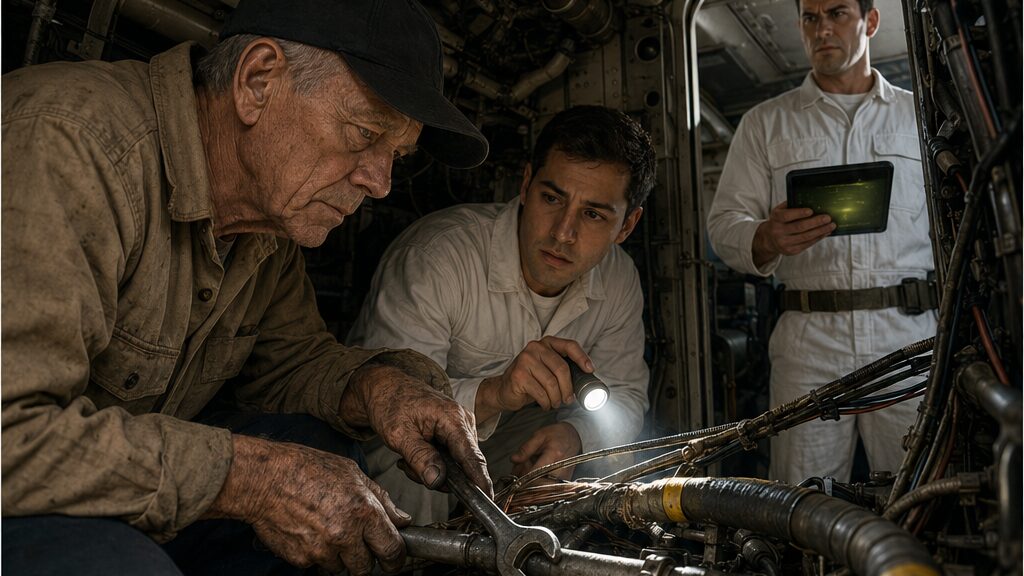
Richard Hall saw it from the left side of the auxiliary compartment, where the pipes crowded close enough to scrape the back of his hand and the smell of old hydraulic fluid lived in every seam. The transport aircraft sat quiet around him, a gray-bellied machine with its access panels open and its insides exposed under white maintenance lights. No engine noise. No powered vibration. No reason for that yellow-banded pressure hose to tremble against the wire bundle beside it.
But it did.
Once. Then again.
Richard stopped breathing for half a second. He was seventy-three years old, stiff in both knees, with one shoulder that complained whenever he reached above chest height. His tan work shirt had dark crescents at the collar from the heat inside the compartment, and his hands carried the permanent shadow of grease no soap ever fully removed. He had been told more than once that his eyes were still good “for a man his age,” which was the sort of compliment people gave when they had already made up their mind about the rest of him.
He shifted closer to the hose.
“Hold the light there,” he said.
Scott Ramirez angled the flashlight toward the panel, but not quite where Richard meant. The bright circle jumped across a clean bracket, a bundle clamp, the painted edge of a control box.
“No,” Richard said, still quiet. “Lower. Right where that wire disappears behind the line.”
Scott hesitated. He was young, maybe late twenties, with clean white coveralls still creased at the sleeves. His eyes flicked toward Brandon Wright before the flashlight moved.
Brandon stood in the narrow opening behind them, tablet in one hand, stylus tucked between two fingers. He had the posture of someone accustomed to being obeyed quickly: shoulders squared, jaw tight, attention divided between the screen and the older man crouched in the compartment.
“The fault is on the pressure transducer,” Brandon said. “We already isolated it.”
Richard did not answer. He pulled his old wrench from the side pocket of his work pants. The wrench had lost most of its shine years ago. Its handle was worn smooth where his thumb rested. He set the open end lightly against the pipe bracket, not to turn anything, just to listen through metal.
Scott watched him as if he were using a divining rod.
The vibration came up through the wrench as a dull uneven tick.
Richard closed his fingers around the handle. There it was. Not a steady pulse. Not pump rhythm. Something rubbing under slack, catching only when the line shifted against the bracket.
“That transducer’s telling you what it sees downstream,” Richard said. “This is upstream.”
Brandon’s mouth tightened. “The tablet says the upstream harness is green.”
“The tablet doesn’t feel rub.”
“It reads load, resistance, pressure variance, temperature spread—”
“It doesn’t feel rub,” Richard repeated.
The compartment seemed to shrink around the words.
Behind Brandon, two background crew members paused beside a rolling cart. One pretended to check a tray of couplings. The other looked into the bay with the careful curiosity of someone who sensed an argument coming and wanted no part of it.
Brandon stepped closer, ducking under the access frame. He was not rude in the loud way. That would have been easier for Richard. Brandon’s voice stayed controlled, professional, edged with impatience.
“Richard, I appreciate the concern. But we have a demonstration in forty-eight hours, a safety inspector coming through after lunch, and a system that just gave us one clean diagnostic path. We can’t tear open a harness because you heard something.”
Richard let the wrench rest against the pipe. “I didn’t hear it.”
Scott’s flashlight lowered a fraction.
“I felt it,” Richard said.
Brandon looked at the wrench, then at Richard’s face. For a moment there was nothing openly disrespectful in his expression, only disbelief dressed up as efficiency.
“That’s not a valid test.”
“No,” Richard said. “It’s a warning.”
The yellow-banded hose twitched again. Scott’s light caught it this time. The hose moved so slightly it could have been mistaken for a shadow, but the wire bundle beside it moved after, not with it. A delayed shiver. A rub point hidden under the bend.
Richard pointed with two fingers. “There. That clamp’s set too proud. The harness is riding the hose when the bracket loads. You run full power, that insulation will heat.”
Brandon glanced at the tablet. “Temperature is normal.”
“Right now.”
“The system isn’t under load.”
“That’s why I’m telling you before it is.”
Brandon exhaled through his nose. He tapped the tablet twice, pulled up a schematic, and turned it slightly as if the screen itself could settle the matter. Blue lines, green indicators, a yellow caution code already categorized as a transducer calibration mismatch.
“Look,” Brandon said. “This aircraft is old, but the diagnostic package isn’t. It flags harness degradation. It flags temperature drift. It flags pressure anomalies. What it does not flag is a mystery vibration from a dead line.”
Richard looked at the schematic. He recognized the clean confidence of it. Systems reduced to colors. Green meant sleep easy. Yellow meant schedule the proper fix. Red meant hurry and blame someone later.
He had trusted a clean gauge once.
A sound moved through his memory, not loud, just a quick metallic chatter before a young sailor turned his head and asked if anyone else heard that.
Richard blinked it away.
“The sensor’s past the bend,” he said. “You won’t see it until the damage moves forward.”
Brandon’s stylus stopped. “Damage?”
Richard did not raise his voice. “That wire bundle has already lost jacket.”
Scott shifted the light lower. Under the bend, where the hose crossed near the harness, a narrow gray mark showed through dust and grime. Not much. A thumbprint of wear. Enough.
Brandon leaned in, saw it, and frowned. “That could be old.”
“It is old.”
“Then it’s already been inspected.”
“Or missed.”
The bay seemed to go still, except for the faint hum of overhead lights and the distant clank of another crew moving equipment across the hangar floor. Outside the aircraft, someone laughed at something unrelated. Inside the compartment, no one smiled.
Brandon straightened too fast and hit his shoulder against the access frame. He hid the wince well.
“We’re not stopping the work order on a rub mark,” he said.
Richard lifted the wrench off the pipe. His fingers ached from holding it steady. “I’m not asking you to stop the aircraft. I’m asking you to open that wrap and look before you run load.”
“That requires supervisor approval.”
“Then get it.”
Brandon’s eyes sharpened. “You’re not assigned as lead on this system.”
“No.”
“You’re on general maintenance support.”
“That’s right.”
“And right now, support means helping us clear the bay, not creating a second fault tree.”
Richard looked past him to the tablet screen still glowing green and yellow. Then he looked at Scott’s flashlight, which had drifted back upward, away from the hidden mark.
He had spent enough years around machines to know that sometimes the first danger was not the broken part. It was the room deciding it did not want to see the broken part.
“Brandon,” he said, “if you run that under full draw—”
Brandon cut him off, not shouting, but firm enough that everyone nearby heard.
“Step out of the compartment, Richard.”
Scott lowered his eyes.
One of the crew members behind the cart rolled it away, wheels squeaking softly over the polished floor.
Richard stayed where he was for one breath longer than he should have. He could feel his bad knee starting to tremble. The compartment was too tight for pride and too small for anger. He tucked the wrench back into his pocket, pressed his palm once against the pipe bracket, and backed carefully out through the access frame.
Brandon moved aside just enough to let him pass.
“I’ll document the rub mark,” Brandon said, already looking at the tablet again. “We’ll address it if the fault repeats.”
Richard stood on the hangar floor. The morning light through the high doors cut bright lines across the concrete. He could see the aircraft’s open panel from where he stood, could see Scott’s flashlight beam returning to the transducer housing, could see Brandon’s thumb moving across the screen.
Then, inside the compartment, the yellow-banded hose twitched against the wire bundle one more time.
No one else was looking.
Chapter 2: The Tablet Passed What His Hands Still Felt
By late morning, Richard was counting washers in the parts cage.
A plastic bin sat in front of him, half full of stainless flat washers that stuck cold and slick against his fingertips. A printed inventory sheet lay to his left. Each row had a part number, a quantity, and a square for initials. It was work that needed doing. Richard had never believed any honest task was beneath him. But there were ways to move a man without saying he was in the way, and Timothy Allen knew most of them.
“Just until Brandon clears the calibration issue,” Timothy had said, standing near the maintenance office doorway with his coffee cooling in one hand. “Keep things smooth today, Richard. We’ve got enough eyes on this aircraft already.”
Richard had nodded once.
Smooth. That was the word people used when they did not want a wrinkle telling the truth.
Now he sat under fluorescent lights that made every metal shelf look tired. Boxes of seals, clamps, cotter pins, bushings, and labeled bags lined the cage in neat rows. Through the wire mesh, he could see a slice of the bay: the aircraft’s landing gear, a rolling diagnostic station, Brandon’s white coveralls moving from one station to another with tablet in hand.
Richard counted twenty washers, moved them into a smaller bin, marked the sheet, and started again.
His hands still felt the pipe.
The uneven tick had stayed in the bones of his fingers the way some sounds stayed in the ear. He pressed his thumb against the base of his index finger, testing the memory of it. Not pump chatter. Not normal bleed-off. It had been a catch and release, a rub under restrained movement. Metal bracket. Hose swelling slightly when the system came alive. Harness too close. Insulation wearing where no screen would care until the damage had already traveled.
A parts clerk walked past the cage, glanced in, and gave him an awkward half-smile.
“Keeping you busy, Mr. Hall?”
“Trying to,” Richard said.
The clerk moved on.
He had been called Chief for twenty-two years, then Richard for a while, then Mr. Hall after his beard went white. He did not miss the title as much as people assumed. Titles could make a man lazy if he leaned on them too hard. What he missed was simpler: when he pointed at a line and said it was wrong, someone at least looked.
From the maintenance office, Brandon’s voice carried through the open door.
“Transducer mismatch cleared after recalibration. No associated thermal anomalies. I’m logging it as sensor drift pending verification run.”
Timothy answered, lower and harder to hear. “Will it affect tomorrow’s inspection?”
“No. We’ll run a standard load test in the morning. If it stays clean, we’re good for demonstration.”
Richard set a washer in the wrong pile.
He noticed immediately, moved it back, and put down the pencil before he snapped it.
In his locker, behind a folded rain jacket and a spare pair of gloves, he kept the old wrench wrapped in a blue cloth. He had taken it out that morning because the aircraft had the smell of old maintenance in it, the kind that told him manuals had been updated more often than the machine had been touched. The wrench was nothing special to anyone else. Nine-sixteenths on one end, five-eighths on the other, Navy-issue once, though the marking had worn nearly smooth.
He had used it to tighten fittings in hangars that no longer existed. He had used it as a pry, a tapper, a pointer, and once as a handle to pull himself up when smoke filled a compartment and the deck pitched under him. He had used it to teach young sailors that a machine told the truth in more than one language.
He stood, slowly enough that his knee would not betray him, and left the bin of washers on the table.
The locker room smelled of canvas, boot rubber, and old coffee. Richard opened his locker and pulled the cloth-wrapped wrench from the shelf. For a second, he only held it.
On the inside of the locker door, tucked behind a magnet, was a faded photograph Janet had printed for him years ago. Richard and Janet on a pier, both squinting in sunlight, her hand tucked through his arm. She had written on the bottom edge in black marker: Come home before the machines keep you.
He had laughed when she gave it to him.
He did not laugh now.
He wrapped the wrench again and placed it back on the shelf, but not deep. Close enough to reach.
When he returned to the parts cage, Brandon was standing outside the mesh with the tablet tucked under one arm.
“Richard,” he said.
There was no anger in his voice now. That almost made it worse.
“Yes?”
“I logged the rub mark. We’ll inspect it during the next scheduled access if the fault repeats.”
Richard looked at him through the wire. “And if it doesn’t repeat until load?”
“The reset passed.”
“That wasn’t load.”
“It was enough to clear the active fault.”
“No,” Richard said. “It was enough to clear the screen.”
Brandon’s jaw moved once. He seemed to be measuring his response, trying to keep it professional.
“I know you’ve worked around older systems,” he said. “I respect that. But we can’t run maintenance off hunches.”
Richard held his eyes for a moment.
“In the Navy,” Richard said, “we had a rule before the new packages came in. If the line talks different after shutdown, you find out why before restart.”
Brandon’s expression softened only slightly, mostly from impatience settling into something like pity.
“This isn’t the Navy anymore.”
“No,” Richard said. “But it’s still a machine.”
A quiet passed between them. Brandon adjusted the tablet under his arm.
“Timothy wants you on inventory for the rest of the day,” he said. “We need a clean chain on the demonstration prep.”
Richard nodded.
Brandon looked relieved, as if the nod meant agreement. “Thanks.”
When he walked away, the tablet woke under his arm, throwing a pale blue light against his sleeve.
Richard sat back down and picked up the pencil. The washers waited in patient little circles, each one with a hole in the middle and no opinion about the men counting them.
He initialed the next line.
For nearly an hour, he said nothing. He counted, sorted, checked bins, and corrected two mislabeled bags of clamps. He drank water from a paper cup that softened at the rim. He watched the maintenance bay through the wire mesh and did not interrupt when Brandon and Scott rolled the diagnostic station away from the aircraft.
Then, near noon, Scott appeared at the end of the aisle.
He had removed one glove and held it in his other hand. Without the flashlight, he looked younger. Uncertain. The confidence of the white coveralls did not sit on him the way it sat on Brandon.
“Mr. Hall?”
Richard kept his pencil on the page. “Scott.”
Scott glanced back toward the bay. “Can I ask you something?”
“You can.”
Scott stepped closer to the cage but did not open the gate. “What did you hear in that pipe?”
Richard looked at him then.
The young man corrected himself quickly. “I mean—what did you feel?”
Richard let the pencil rest across the inventory sheet.
For a moment, all he could hear was the old uneven tick still living in his hand.
Chapter 3: The Sound Before the Warning Light
Richard did not answer Scott inside the parts cage.
He looked through the mesh toward the maintenance office, where Brandon and Timothy stood over a schedule board with colored magnets marking each step before the demonstration. Inspection. Verification run. Safety walk-through. Public system display. Everything had a square, a time, and a person assigned to carry it cleanly into the next box.
Scott followed Richard’s gaze.
“I’m not trying to start anything,” Scott said.
“Then don’t start it where everyone can hear.”
Richard stood and closed the inventory sheet. His knee made him pause before the first step, but he did not touch the shelf for balance. He opened the cage gate, walked past Scott, and headed toward the break area at the side of the hangar.
The break area was nothing more than a row of vending machines, a microwave, and three scarred tables under a wall clock that always seemed five minutes slow. A few crew members looked up as Richard entered, then returned to their food. Scott waited until Richard chose the table farthest from the vending machines before sitting across from him.
Richard folded his hands on the table. “You ever hold a wrench against a live bracket?”
“No.”
“Good. Don’t, unless you know what can bite.”
Scott nodded, serious.
Richard studied him. Scott had the look of a man still deciding what kind of worker he wanted to become. Eager, careful, afraid of looking foolish. Richard had trained sailors like that. Some turned cautious in the right way. Some mistook caution for silence and carried it too long.
“What I felt wasn’t a sound,” Richard said. “Not exactly. It was rhythm out of place.”
Scott frowned. “Like vibration?”
“Everything vibrates. That’s the first mistake. Men say, ‘It’s just vibration,’ and then they stop listening. A pump has rhythm. A line under pressure has rhythm. Loose hardware has rhythm. Rub has a break in it.”
Scott looked down at his bare hand as if expecting to find the explanation there.
Richard took a plastic stir stick from the center of the table and tapped it once against the metal napkin holder. Tick. Tick. Tick. Then he dragged it lightly against the edge and let it catch twice. Tick. Catch. Tick. Catch.
Scott’s eyes lifted.
“That,” Richard said. “Not that exact sound. That behavior.”
“The tablet didn’t show upstream wear.”
“The tablet showed what its sensors were placed to see.”
“So Brandon’s not wrong?”
Richard shook his head. “No.”
That surprised Scott more than if Richard had complained.
“Then what is he?”
“In a hurry.”
Scott leaned back. His gaze drifted toward the bay, where Brandon was moving with Timothy between the diagnostic cart and the aircraft. “He’s good at this.”
“I know.”
“He’s not trying to disrespect you.”
Richard let that sit. He had no interest in making Brandon a villain just because the young man had made the oldest mistake in maintenance: believing the cleanest answer because it fit the day’s schedule.
“Disrespect doesn’t always announce itself,” Richard said. “Sometimes it just decides you’re background noise.”
Scott looked uncomfortable. “I should’ve kept the light where you said.”
“You did after a while.”
“After I looked at him first.”
Richard said nothing.
Scott rubbed his thumb over the seam of his glove. “I’m new enough that I still don’t know when I’m allowed to be sure.”
“Nobody’s allowed to be sure all the time.”
“Brandon seems sure.”
“Brandon is responsible. That can look the same from a distance.”
The wall clock clicked over the hour. A crew member opened the microwave, releasing the smell of reheated noodles. The ordinary noise of the break area filled the pause between them.
Scott stood first. “Can you show me? Not touching anything live. Just where to look.”
Richard hesitated.
He had already been told to step away. A wiser old man might have finished the washers, gone home, and let the work order carry its own weight. But the memory of the hose twitching would not leave him. Neither would Scott’s question.
Richard rose. “Bring your flashlight.”
They approached the aircraft from the exterior side, away from the open access platform where Brandon had been working. The panel Richard wanted was still open, though the compartment itself had been cleared and tagged for morning verification. No power. No movement. No excuse for anyone to call it interference if all they did was look.
Scott switched on the flashlight.
“Not straight on,” Richard said. “Across it.”
Scott angled the beam shallowly across the hose, and the hidden surfaces changed. The clean-looking bundle gained texture. Dust lifted into ridges. A small gray rub mark appeared at the underside of the bend, thin as a pencil shaving.
Scott drew in a breath.
“See it?” Richard asked.
“I saw it earlier. I just didn’t—” Scott stopped.
“Didn’t know what it meant.”
“Yeah.”
Richard pointed, not touching. “Hose expands under draw. Not much. Enough. Harness shifts because that clamp is proud by maybe an eighth. Could’ve been installed that way. Could’ve walked that way over time. The sensor reading downstream won’t care until the jacket opens or heat moves far enough along the line.”
Scott shifted the flashlight again. “Why would the reset pass?”
“Because reset asks the system a small question.”
“And load asks a bigger one.”
Richard glanced at him. “That’s right.”
Scott’s face changed. Not fear exactly. Recognition beginning before permission.
“Should I tell Brandon?”
Richard looked at the open compartment. The rub mark sat in the flashlight beam, small and unimpressive, exactly the sort of thing a man could be punished for making too much of if he was wrong.
“You should ask him to look across it with the light,” Richard said. “Don’t tell him I sent you.”
Scott almost smiled. “He’ll know.”
“Then don’t lie.”
The flashlight beam trembled slightly as Scott adjusted his grip. “Where did you learn that? The wrench thing.”
Richard’s hand moved toward his pocket before he remembered the wrench was still wrapped in cloth in his locker.
“A long time ago,” he said.
“In the Navy?”
Richard looked into the compartment, and for one instant the maintenance bay changed. The clean concrete became deck plating. The overhead lights became red emergency glow. A younger voice asked if anyone else heard that chatter. Someone older said the gauge was clean. Richard, not yet old, not yet careful enough, looked at the gauge and let the sound pass into the machinery.
He felt the old shame rise, quiet and exact.
Scott waited.
Richard stepped back from the panel. “Machines talk before they complain,” he said. “That’s all you need for now.”
It was not an answer, and Scott knew it. But he nodded anyway.
By midafternoon, Brandon ran the reset verification. Richard stood across the bay with a stack of inventory tags in his hand, far enough away that no one could accuse him of hovering. The auxiliary system cycled. Fans spooled. The tablet stayed green. Brandon watched the screen, then looked toward Timothy and gave a small satisfied nod.
The crew relaxed in pieces. Shoulders lowered. Someone made a joke near the tool cart. Timothy moved a magnet on the schedule board.
Scott stood near the aircraft with the flashlight clipped to his belt, his eyes not on the tablet but on the access panel.
Richard turned to go back to the parts cage.
Then, under the settling hum of the bay, he heard it.
Not loud. Not steady.
Tick. Catch. Tick.
From across the hangar, through voices and rolling carts and the clean victory of a passed reset, the old rhythm found him again.
Chapter 4: The Old Report Richard Never Filed Away
Janet Hall knew something was wrong before Richard set his keys in the bowl.
She was at his kitchen table with a stack of mail sorted into three piles, her sleeves pushed up, her reading glasses resting on top of her head. She came by twice a week under the excuse of helping him keep bills straight, though both of them knew he had balanced maintenance logs under worse lighting than his apartment lamp and could manage an electric bill without supervision.
The apartment was small and clean in the careful way of a man who did not own more than he could maintain. One bedroom. One kitchen window facing the parking lot. A couch that sagged on the left cushion. A square table with two chairs, one of which Janet had claimed years ago without asking. On the wall above the sink, a clock ticked louder than it needed to.
Richard closed the door behind him.
Janet looked up. “You’re late.”
“Had inventory.”
“You hate inventory.”
“Didn’t say I enjoyed it.”
He hung his cap on the hook by the door and stood there a second too long. His shoulder ached from reaching into bins. His knees had stiffened on the drive home. But it was his hand that bothered him most, the hand that had held the wrench against the pipe. It still seemed to remember what the rest of the bay had dismissed.
Janet saw him flex his fingers.
“Sit down,” she said.
“I’m all right.”
“That wasn’t what I said.”
He almost smiled. Almost. He crossed to the sink, washed his hands, and watched gray water curl into the drain. Grease lived in the creases near his nails no matter how hard he scrubbed. When he turned, Janet had already moved one of the mail piles aside and set a plate in front of the empty chair. Sandwich cut in half. Pickle spear. A glass of water.
“You eat yet?”
“At work.”
“That means no.”
He sat because arguing took more energy than obeying. Janet eased into the chair across from him and watched while he took the first bite.
For a few minutes, the apartment held only ordinary sounds: the refrigerator’s low rattle, the clock, a car passing outside, paper shifting under Janet’s hand. Richard chewed, swallowed, drank. He could feel her waiting. She had inherited her mother’s patience and his habit of using silence as a tool.
Finally she said, “Who upset you?”
“No one.”
“Then what did the aircraft do?”
Richard looked at her.
Janet tapped one finger on the mail. “You get quiet over people. You get still over machines.”
He set the sandwich down.
“There’s a line in the auxiliary compartment,” he said. “Pressure hose riding a wire bundle. Not much. Enough.”
“And they didn’t listen?”
He stared at the plate. “They listened to the screen.”
Janet leaned back. “Richard.”
“It passed reset.”
“But you don’t believe it.”
“It passed a small question.”
She folded her arms. “And now you’re going to carry the big question around all night until it eats a hole through your chest.”
He did not answer.
Janet’s expression softened, but her voice stayed firm. “You’re seventy-three.”
“I remember.”
“You work part-time because you said you wanted to keep your hands busy. Not because the whole base falls apart if you aren’t there.”
He picked up the pickle spear and put it down again.
“That aircraft is running full load tomorrow,” he said.
“Did you tell them what you saw?”
“Yes.”
“Did you tell them twice?”
“Yes.”
“Then maybe you’ve done what you can.”
The clock ticked across the room.
Richard’s eyes moved to the cabinet above the refrigerator. Janet noticed. She always noticed too much.
“What’s up there?” she asked.
“Nothing.”
“Dad.”
He pushed back his chair and stood. It took him a moment to reach the cabinet because the top hinge stuck and the door needed to be lifted before it opened. Inside, behind a flashlight, two old manuals, and a tin of screws he had never found a use for, was a flat metal box.
Janet said nothing as he carried it to the table.
The box had once held stationery. Now it held things Richard had not thrown away and did not display. A folded commendation letter. A photograph of a maintenance crew in faded Navy coveralls. An old cloth patch. A notebook with a cracked black cover. And beneath that, sealed in a plastic sleeve, a copy of a report.
Janet’s face changed when she saw it.
“I thought you got rid of that.”
“No.”
“You told me you did.”
“I said I put it away.”
“That is not the same thing.”
Richard sat again, slower this time. He slid the report out of the sleeve. The paper had yellowed around the edges. His own name appeared halfway down the first page, not as the man responsible, not as the officer in charge, just as one of several maintenance personnel interviewed after the incident.
He did not need to read the words. He knew where every sentence sat.
Auxiliary pressure fluctuation.
No abnormal gauge reading observed prior to restart.
Minor vibration reported but not replicated.
Heat damage discovered post-incident.
One sailor injured during emergency access.
Janet looked away first. “You were young.”
“I was thirty-one.”
“You were told the gauge was clean.”
“I heard it anyway.”
Her hand tightened around the edge of the table. “You were not in command.”
“No.”
“And you have spent forty years acting like that makes it worse.”
Richard looked at the report.
In memory, the compartment was hotter than any place had a right to be. The ship rolled beneath them, and everyone wanted the aircraft moved, cleared, ready. A young sailor stood beside him, eager enough to make mistakes and proud enough to hide nerves. The line had made a faint chatter when it should have gone quiet. Richard had turned his head. The superior beside him had checked the gauge and said, “Clean. Move on.”
So Richard had moved on.
Minutes later, the chatter became a scream.
The young sailor lived. That mattered. He went home with scars and a limp and a face Richard had never been able to forget. There had been an investigation, recommendations, revised inspection language, a dozen signatures, and not one sentence that said Richard Hall had failed. The paper had absolved him in every official way.
The paper had never learned how to sleep in his chest.
Janet reached across the table and put her fingers on the report, not covering it, just touching the corner. “Is it the same?”
“Close enough.”
“That isn’t an answer.”
“It’s never the same,” he said. “That’s how it gets you.”
She closed her eyes for a moment. When she opened them, she looked tired in a way that made him feel older than any mirror did.
“What do you want to do?”
“Go back.”
“Tonight?”
“No. They’ll lock the bay down after shift change.”
“You know that because you already thought about it.”
He said nothing.
Janet drew a breath. “If you go in tomorrow and push this, will they listen?”
“Maybe.”
“And if they don’t?”
He folded the report along its old crease. “Then I’ll have said it standing where they can’t pretend I didn’t.”
Janet looked at him for a long time.
“I don’t want you chasing ghosts,” she said.
“I’m not.”
“You are sometimes.”
He accepted that because it was true enough to hurt.
She softened then. “I’m not asking you to be quiet. I know better. I’m asking you to come home after. Not just drive your body back here. Come home.”
Richard slid the report back into the sleeve, but the old notebook stayed on the table. Its cracked cover had softened from years of handling. He opened it without thinking, turning past old part numbers, sketches of brackets, pressure notes written in shorthand only he could read.
Near the back, a folded diagram caught under his thumb.
He paused.
Janet watched his face. “What?”
Richard opened the diagram and flattened it under his palm. It was not the same aircraft, not exactly. An older variant. Different routing, different panel shape, different sensor package. But the line path was close enough to make the room narrow around him.
The sensor sat downstream of the bend.
Upstream, just before the bracket, he had circled a blind spot in pencil decades ago.
Janet leaned closer. “Is that it?”
Richard ran one finger over the faded circle.
“No,” he said quietly. “But it’s the same mistake wearing a different uniform.”
Chapter 5: A Clean Screen and a Burning Smell
The next morning, the bay smelled of polish, coffee, and hurry.
Public demonstration signs had been stacked near the hangar doors. A row of folding chairs waited under plastic wrap. The old transport aircraft stood at the center of the floor with its access panels open on one side, looking less like a machine under repair than an exhibit being prepared to behave. Maintenance carts had been squared away. Loose rags were gone. Even the yellow safety lines on the concrete seemed brighter.
Richard arrived before seven with the folded diagram in his shirt pocket and the old wrench in his pants pocket, wrapped in the blue cloth.
No one asked why he had come early. Men his age were expected to arrive early, as if sleep itself had given up on them.
Scott was already near the aircraft, checking the flashlight batteries. When he saw Richard, his eyes dropped briefly to the pocket where the wrench made a slight weight in the fabric.
“Morning, Mr. Hall.”
“Scott.”
Brandon stood at the diagnostic station, reviewing the tablet with a stylus tucked behind his ear. His coveralls were immaculate again, cuffs clean, hair still damp from a shower. He looked rested in a way Richard envied.
Timothy Allen walked in carrying a clipboard and wearing the expression of a man who had slept badly but decided to blame the schedule. He clapped once, sharp enough to make two crew members look up.
“Full-load prep in fifteen. Safety inspector walkthrough at thirteen hundred. Demonstration dry run at sixteen hundred. Let’s keep the floor clean and the chatter useful.”
His gaze swept past Richard, paused, then moved on.
Richard took his assigned position near a rolling parts cart. Not the aircraft. Not the diagnostic station. Close enough to be useful, far enough to be invisible if everyone wanted him that way.
Brandon initiated the pre-run check. The tablet chimed softly. Green boxes appeared one after another. Scott stood by the access panel with the flashlight clipped to his belt, not in his hand. He kept looking at the panel anyway.
“Auxiliary power link established,” Brandon said.
A crew member repeated it from the external panel.
“Pressure transducer recalibrated.”
“Confirmed.”
“Thermal spread normal.”
“Confirmed.”
Timothy checked the clipboard. “Proceed to load simulation.”
Richard felt the first vibration through the floor before he heard it. The aircraft seemed to wake in layers: a low electrical hum, a fan spool, a tremor through the open panels. The sound was familiar enough that it could have been comforting if not for the place in it that did not belong.
He did not move.
The tablet stayed clean.
Brandon watched the screen with professional focus. “Load at twenty percent.”
The aircraft answered with a deeper hum.
Richard’s hand went to his pocket. His fingers found the cloth around the wrench but did not pull it free.
“Thirty percent,” Brandon said.
Scott had turned slightly toward the access panel.
Richard watched the yellow-banded hose through the opening. At low draw, it had looked still. At thirty, it lifted almost imperceptibly, swelling against restraint, then settling back. The wire bundle beside it answered late.
Tick. Catch.
He heard it through the bay noise now because he knew where to stand.
“Forty percent.”
Timothy stepped closer to Brandon’s station. “Screen?”
“Clean.”
Richard walked two steps toward the aircraft.
A background crew member glanced at him, then away.
“Fifty percent.”
The hose shifted again. A tiny movement. Not enough for an alarm. Enough for a man who had felt the old rhythm under his hand.
Scott unclipped the flashlight but did not switch it on.
Brandon looked up. “Scott?”
“Just checking sightline.”
“Keep clear of the access until we finish the run.”
Scott froze.
Richard kept walking.
Timothy noticed this time. “Richard, we need you off the active side.”
Richard stopped just outside the marked line. “You need to pause the run.”
Brandon’s eyes left the tablet. “Not again.”
“Pause the run.”
“The system is clean.”
“Your screen is clean.”
Brandon’s face flushed, not from shame yet, but from the pressure of being challenged in front of the crew. “We discussed this.”
“No,” Richard said. “You decided it.”
The bay changed around them. Tools paused. A cart wheel stopped squeaking. Timothy lowered his clipboard.
“Richard,” Timothy said, “this is not the time.”
“That’s exactly what it is.”
Brandon turned the tablet so Richard could see it from where he stood. “Thermal is normal. Pressure is stable. Resistance is in range. The sensor drift is gone.”
Richard pointed to the access panel. “And the rub is under load now.”
“Based on what?”
Richard pulled the folded diagram from his pocket. “Based on routing. Based on sensor placement. Based on the hose moving against that harness before the sensor ever knows there’s damage.”
Brandon glanced at the paper, barely. “That’s not this aircraft.”
“It’s the same line path.”
“It’s an older variant.”
“Machines inherit mistakes.”
Timothy stepped between them slightly. “Enough. We are at fifty percent with no fault. Brandon, continue to sixty and hold.”
Scott looked at Richard.
Richard held the diagram in one hand, the other still resting against the wrench in his pocket. He felt suddenly, painfully aware of his age. The thinness of his skin. The tremor that sometimes came into his fingers when he was tired. The way men heard a raised voice from an old mouth and called it confusion before they called it urgency.
He saw Janet’s kitchen table. The report. The old sentence: minor vibration reported but not replicated.
He crossed the yellow line.
“Richard,” Timothy snapped.
Richard did not rush. He walked to the emergency pause station beside the maintenance cart and put his palm over the red-guarded switch.
Brandon’s voice sharpened. “Do not touch that.”
Richard looked at him across the bay. “Then pause it from there.”
For two seconds, no one moved.
The aircraft hummed. The load held. The line inside the compartment twitched and caught.
Brandon’s hand hovered over the tablet. Pride, responsibility, fear of looking foolish—Richard saw them flicker across his face in quick succession.
Then Timothy said, “Continue.”
Richard flipped the guard and pressed the emergency pause.
The bay dropped into an abrupt mechanical hush.
The silence that followed had weight.
Brandon stared at him. “You just broke protocol.”
“No,” Richard said. “I used it.”
Timothy’s face had gone flat. “You’d better have more than an old diagram.”
Before Richard could answer, Scott spoke.
“I saw the rub mark yesterday.”
Brandon turned. “What?”
Scott swallowed. “With the light across it. Not straight on. There’s wear under the bend.”
“You inspected without authorization?”
“No, I looked.”
Timothy muttered something under his breath and motioned to the access panel. “Open it. Look fast. If there’s nothing, this delay goes in the report.”
Scott switched on the flashlight.
The beam entered the compartment thin and white. Richard did not move in first. He let Scott crouch, let Brandon come beside him, let Timothy stand behind them with the clipboard pressed against his thigh.
For a moment, all Richard could see was their backs.
Then a smell reached him.
Not smoke yet.
Heated insulation had a sharp, dirty sweetness, different from oil, different from dust on a lamp. It carried the past with it so suddenly his stomach tightened.
Scott said, very softly, “Brandon.”
Richard stepped closer despite Timothy’s hand lifting to stop him.
Inside the access panel, from the place where the yellow-banded hose crossed the wire bundle, a thin thread of gray smoke curled upward and disappeared into the flashlight beam.
Chapter 6: When Scott Finally Turned the Light
For one heartbeat, everyone waited for the tablet to accuse the machine.
It did not.
The screen in Brandon’s hand stayed green across the upper row, yellow only where the paused run had interrupted the sequence. No red block. No alarm tone. No flashing warning that would make the decision easy.
The smoke curled again, thin as breath.
Richard moved first. Not fast. Fast was for younger knees and panic. He moved with the economy of a man who had worked in spaces where every unnecessary motion cost skin.
“Power is paused,” he said. “Isolate the auxiliary feed.”
Brandon blinked at him.
“Now,” Richard said.
The word was not loud, but it cut cleanly through the bay.
Brandon looked down at the tablet, then to the external panel. “Aux feed isolation,” he called.
A crew member moved.
Richard crouched at the access opening and pulled the old wrench from his pocket, unwrapping it from the blue cloth. Scott shifted aside automatically, then caught himself and held the flashlight steady.
“Across the bend,” Richard said.
Scott angled the beam.
The compartment changed under the slanted light. What had looked like a dusty curve became a map of pressure and neglect: a polished rub line on the hose, a gray-white scuff on the wire bundle, one clamp sitting proud enough to force the two parts into each other whenever the hose expanded. The smoke came from beneath the wire jacket where the insulation had thinned and heated under load.
Brandon crouched opposite Richard, tablet still in his left hand. “Thermal sensor should’ve caught that.”
“No,” Richard said. “Sensor’s downstream.”
Brandon’s jaw tightened. “Show me.”
Richard held the wrench by the closed end and used the open jaw only as a pointer. He did not touch the damaged wire.
“Here’s your bend. Here’s the clamp. Harness rides under this lip. When load comes up, hose expands against the bundle. Damage starts here.” He moved the wrench tip two inches along the route. “Your sensor reads past this branch. By the time heat travels there, the jacket’s already opened or the line has arced.”
Brandon looked from the wrench to the tablet schematic. “That’s not how this revision is routed.”
“It is when the clamp walks.”
“It was inspected after installation.”
“Maybe it was right then.”
Scott lowered his head to see beneath the bend. “The clamp bolt’s backed out.”
Richard glanced. Scott had seen it now—the small shadow gap under the clamp foot, the slight angle no straight installation drawing would show.
“Quarter turn, maybe less,” Richard said. “Enough.”
Timothy stood behind them, voice tight. “Do we have active heat?”
“Residual,” Richard said. “Do not restart.”
Brandon’s thumb moved across the tablet, pulling up a deeper diagnostic page. “I need actual confirmation before I write up a full stop.”
Richard turned his head slowly. “You have smoke.”
“I have a paused load test with a visible heat event. I need to classify it correctly.”
“Classify it after you keep it from getting worse.”
Scott looked between them, then took one careful step deeper onto the platform. “I can get the inspection mirror.”
“Get it,” Richard said.
Brandon did not object.
That was the first change.
Scott returned with the mirror and a smaller beam light. Richard’s hands wanted to reach in and do the work themselves, but he held back. His fingers were steady, though his breathing was not. The compartment, the smell, the young man beside him waiting for instruction—it all pressed against a sealed place in him.
He saw another young man’s glove reaching into another compartment. He heard the superior’s voice, smooth with certainty. Clean gauge. Move on.
Richard swallowed.
“Scott,” he said, “mirror under the harness. Don’t lift the line.”
Scott obeyed. The mirror flashed once, caught glare, then steadied. A dark crescent appeared on the underside of the wire bundle.
Brandon leaned close.
His face changed.
Not dramatically. No collapse, no grand expression. Just the smallest loss of certainty around the eyes.
“That’s through the outer jacket,” he said.
Richard nodded. “Not conductor yet, if we’re lucky.”
Timothy stepped closer. “Can we repair before the inspector?”
Brandon did not answer right away. That was the second change.
He looked at the tablet, then at the actual line, then at Richard’s wrench held still as a boundary marker near the damaged spot.
“No,” Brandon said finally. “Not properly. We need to open the wrap, inspect the run, replace the damaged section, reset the clamp, and document the routing shift.”
Timothy’s mouth tightened. “The demonstration—”
“Stops,” Brandon said.
Richard looked at him then.
Brandon did not look back. He was still staring into the compartment, but his voice had changed from defensive to exact. “It stops until this is cleared.”
The bay remained quiet. Not admiring. Not ashamed. Just recalibrating.
Timothy exhaled and turned away, already lifting his phone. “I’ll call the inspector.”
The crew began moving with purpose now. Barrier cones came out. A tag was placed at the access point. Someone brought a better work light. The tablet was no longer the center of the bay; it was one tool among many, lying on the cart while Brandon pulled gloves on and Scott kept the flashlight steady.
Richard shifted his weight off his bad knee.
Brandon noticed. “You need a chair?”
“No.”
The answer came too quickly.
Brandon accepted it without comment, which Richard appreciated more than he expected. Pity had a sound. This was not that.
They worked the inspection step by step. Brandon read the procedure. Scott held the light. Richard showed where the harness could be supported without stressing the damaged section. He corrected only when he had to.
“Not there,” he said once, as Scott reached toward the hose. “You’ll hide the gap.”
Scott adjusted.
“Like this?”
“Better.”
Brandon used a probe to check clearance. The clamp shifted under light pressure.
He went still. “That should not move.”
“No,” Richard said.
Brandon’s eyes remained on the part. “That was the tick.”
“Part of it.”
“What was the rest?”
Richard set the wrench against the bracket, gently. The metal carried the cooling system’s residual tremor into his palm. He lifted it away and offered the handle toward Brandon.
Brandon hesitated.
“Don’t press hard,” Richard said. “You’re not forcing an answer out of it.”
Slowly, Brandon took the wrench.
For the first time all morning, the tablet was not in his hand.
He placed the wrench against the bracket where Richard indicated. At first his expression said he felt nothing. Then Scott adjusted the hose a fraction without lifting it, and the loose clamp answered through the metal: not a sound exactly, but a tiny broken pulse.
Brandon’s eyes moved to Richard.
Richard did not say, I told you.
He had imagined saying it more times than he liked to admit, in more rooms than this one, to faces long gone from his life. The words never sounded as satisfying in reality as anger promised they would. They did not repair burned insulation. They did not unscar a sailor’s arm. They did not make a young technician better at his work.
“Rub has a break in it,” Richard said.
Brandon looked back at the bracket. “And the sensor was never going to flag it at reset.”
“Not until the damage moved.”
Scott’s flashlight stayed perfectly still.
The safety inspector arrived earlier than expected, called in by Timothy with the kind of urgency that made people walk fast without running. He listened while Brandon explained the paused test, the smoke, the routing shift, the loose clamp, and the downstream sensor blind spot.
He did not ask Richard for a speech. He only asked, “Who identified the initial rub?”
Brandon paused.
The bay seemed to hold its breath around that small opening.
Brandon turned, not all the way, just enough.
“Richard did,” he said. “Yesterday.”
The inspector wrote it down.
Richard looked at the floor.
Something inside him loosened, but not cleanly. Recognition did not erase the old report. It did not restore the younger sailor or absolve the thirty-one-year-old man who had heard a warning and let a clean gauge quiet him. But it did something smaller and perhaps more useful.
It made the present different.
The damaged harness was secured for removal. The hose was supported. The clamp was tagged. Timothy finished his call and announced, with visible pain, that the demonstration would be delayed.
No one applauded.
No one needed to.
When the immediate rush settled, Brandon stood beside the access panel with Richard’s wrench still in his hand. He looked down at it as if noticing its weight for the first time, then held it out.
Richard took it back.
Brandon’s face was tired now. Younger than it had looked that morning.
“I was trying to keep the process clean,” he said.
“I know.”
“I thought you were guessing.”
“I know that too.”
Brandon nodded once, absorbing the mercy of not being made to say more than he could manage in front of everyone.
Then he looked toward the open compartment, where Scott’s flashlight still illuminated the rubbed-through line.
“Show me where to look,” Brandon said.
Chapter 7: The Lesson Was Not in the Tablet
The next morning, the aircraft looked smaller.
Not physically. Its wings still stretched across the maintenance bay, its belly still hung over the concrete with the same patient weight, and the open auxiliary panel still exposed enough wire, hose, pipe, and bracket to keep a crew busy for hours. But the hurry had gone out of the room. The folding chairs near the hangar doors had been stacked again. The demonstration signs leaned facedown against a wall. The public would not be coming that day.
The aircraft had stopped being an exhibit.
It was a machine again.
Richard stood beside the parts cart with his hands in the pockets of his tan work pants. His wrench rested in the right pocket, bare now, no cloth around it. The blue cloth lay folded in his locker. He had put the wrench away wrapped for years as if it were something fragile, then carried it unwrapped that morning because tools were not meant to be treated like relics.
Scott was already inside the access platform, one knee braced on a pad, flashlight held low across the repaired route. The damaged harness section had been removed the night before. The yellow-banded hose had been supported clear of the bundle. The proud clamp had been reseated, torqued, marked, and photographed from three angles for the report. New wrap covered the repaired wire run, clean enough to look almost out of place among the older fittings.
Brandon stood at the diagnostic station with the tablet in one hand and a paper checklist clipped to a board in the other.
That was new.
Richard noticed the paper before Brandon said anything. It had been printed from the maintenance procedure, but one line near the lower third had been written in by hand. Brandon’s handwriting was compact and square, the letters pressed hard into the page.
Cross-light physical inspection at bend before load verification. Check hose expansion clearance and harness rub under bracket.
No one pointed it out to Richard. No one made a presentation of it. The handwritten line simply existed there, black ink beside the printed steps, as practical as a washer in the right bin.
Timothy Allen passed behind the diagnostic station with his phone pressed to his ear, explaining for the second time that the delay was precautionary, documented, and appropriate. His voice still carried the strain of a schedule broken in public, but not the resistance of a man fighting the truth.
Brandon lowered the tablet when Richard approached.
“Morning,” he said.
“Morning.”
Scott looked over his shoulder. “We’re ready for the clearance check.”
Brandon glanced at Richard, then at the access panel. “If you’re willing.”
There it was: not an order, not a performance, not the careful tone people used when they feared an old man might crumble if spoken to directly. Just an opening.
Richard stepped onto the platform. His knee objected. He let it. Scott shifted as if to offer a hand, caught himself, then moved the flashlight instead.
Good, Richard thought.
The beam cut shallow across the hose, just as he had shown him. Under that angle, the compartment gave up its secrets honestly. The new clamp sat flat. The hose held its clearance. The wire bundle no longer hid under the bend. No gray scuff. No polished rub. No dirty crescent waiting to heat.
Richard pulled the wrench from his pocket and held it out to Scott.
Scott stared at it. “Me?”
“Bracket,” Richard said.
Scott took the wrench with more care than the tool deserved and set it lightly where Richard indicated. His grip was too stiff.
“Don’t choke it,” Richard said. “If your hand is louder than the machine, you won’t feel anything.”
Scott loosened his fingers.
Brandon watched from just outside the access frame, tablet dimmed at his side.
The auxiliary system came alive at low power. The aircraft hummed through its frame. Scott kept the wrench against the bracket, waiting too hard at first, then settling. Richard watched the young man’s face more than the line.
A good mechanic learned not to search only for danger. Searching only for danger made a man imagine it everywhere. First he had to learn normal.
Scott’s brow slowly eased.
“That’s steady,” he said.
Richard nodded. “That’s steady.”
Brandon marked the checklist.
They increased load in steps. Twenty percent. Thirty. Forty. Each time, Scott cross-lit the bend, checked the clearance, then held the wrench to the bracket. Each time, Brandon read the tablet, then waited for Scott’s physical confirmation before marking the next line.
At fifty percent, Scott looked back at Richard.
“You want to check?”
Richard held out his hand for the wrench.
Scott gave it to him.
The handle sat in Richard’s palm as it always had, worn smooth where years had shaped it. He placed it against the bracket and felt the hum travel through metal into bone. Not perfect. No old aircraft was perfect. The vibration had the layered roughness of age and use, but the broken catch was gone.
For a moment, the sound beneath his hand was not merely the aircraft. It was a room decades behind him quieting at last. Not erased. Never erased. But no longer repeating itself in front of him while he stood silent.
He lifted the wrench.
“Clean,” he said.
Brandon wrote it down.
No one cheered. A crew member rolled a cart past. The safety inspector signed a form near Timothy. Somewhere outside, a truck backed up with three faint warning beeps. The world continued without ceremony, and Richard was grateful for it.
Later, near the maintenance office, Brandon found him by the schedule board.
“I added the cross-light step to the local checklist,” Brandon said. “Timothy approved it for this airframe. Safety wants it noted for similar routing.”
Richard looked through the office window at the bay. Scott was showing one of the other crew members how to angle the flashlight across the bend instead of straight into it.
“You did that,” Richard said.
“You showed us why.”
Richard did not correct the pronoun. Us was a better word than me.
Brandon shifted the tablet from one hand to the other. “Yesterday, when you stopped the run, I thought you were trying to prove me wrong.”
“I was trying to keep the wire from burning.”
“I know that now.”
Richard waited.
Brandon looked down, then back up. “I don’t want to become the guy who only believes what’s easy to document.”
“Then don’t.”
A small, tired smile touched Brandon’s mouth and left. “That simple?”
“No.”
Brandon accepted that too.
At midday, Janet called while Richard was outside the hangar near a concrete barrier, eating half a sandwich from wax paper. He looked at her name on the phone for three rings before answering.
“You alive?” she asked.
“Most of me.”
“Did they listen?”
Richard watched Scott inside the bay, holding the flashlight low while another technician leaned in to see. Brandon stood behind them, tablet tucked under one arm, not in front of his face.
“Some.”
Janet was quiet long enough to understand the answer beneath the answer. “Did you come home last night?”
“I drove to the apartment.”
“Dad.”
He looked down at the sandwich. “I came home enough to sleep.”
“That counts for today.”
He almost smiled. “Generous.”
“Don’t get used to it.”
A gull moved high over the hangar roof, its cry thin against the wind. Richard leaned against the barrier and felt the sun warm the back of his hand.
“I found the line,” he said.
“I figured.”
“They changed the checklist.”
“That sounds like listening.”
“It’s a start.”
“And you?”
He watched the bay doors. “I’m starting too.”
Janet did not answer right away. When she did, her voice was softer. “Bring yourself to dinner tonight. Not just the part that fixes things.”
Richard folded the wax paper around the uneaten crust. “I’ll try.”
“Try hard.”
“Yes, ma’am.”
After the call, he stayed outside a minute longer.
By late afternoon, the repaired system had passed its load verification. The demonstration would be rescheduled. The aircraft would not fly for show that week, and nobody in the bay spoke of that as failure anymore. The report listed sensor placement, clamp movement, harness wear, heat event, corrective action. It also listed initial physical indication identified prior to load test.
Richard read that line once and closed the folder.
Near shift’s end, Scott approached with the wrench held carefully in both hands. Richard had left it on the cart after the final check.
“Almost forgot this,” Scott said.
Richard took it, then turned it in his palm. “You didn’t.”
Scott’s ears reddened. “No.”
Richard held the wrench out again.
Scott blinked. “Mr. Hall?”
“Feel that bracket one more time.”
“The system’s already cleared.”
“I know.”
Scott took the wrench and stepped to the access panel. Brandon, passing nearby, slowed but did not interrupt. Scott set the wrench against the pipe bracket. The aircraft hummed faintly in standby, a steady vibration running through the repaired route.
Scott closed his eyes for half a second.
Richard watched him listen.
Then Scott opened his eyes and handed the wrench back. “Clean.”
Richard nodded. “Now you know the difference.”
He slipped the wrench into his pocket.
The bay lights clicked into their evening setting, softer over the gray aircraft, kinder to the old paint and scarred panels. Timothy’s office door closed. Brandon gathered the tablet and the marked checklist, placing the paper on top this time. Scott packed the flashlight into its charger with the lens facing outward, ready for morning.
Richard climbed once more onto the access platform after the others had stepped away.
No one asked him why.
He leaned into the auxiliary compartment and placed the wrench lightly against the pipe. The clean hum came through the metal, steady and ordinary. No catch. No hidden rub. No small warning being smothered under the comfort of a green screen.
He stood there until his hand was satisfied.
Then he put the wrench in his pocket, stepped down carefully, and walked toward the hangar doors before anyone could make a speech.
The story has ended.