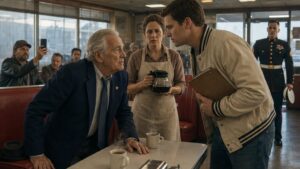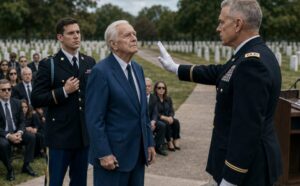
The Old Man at the Gate Carried a Card No Soldier Was Ready to Read
Chapter 1: The Card That Stopped the Gate
Donald Bennett reached the outer checkpoint just after the morning fog had lifted off the road.
The base looked smaller than he remembered.
That was the first thought that troubled him. Not that the fence was newer, or that the guard shack had been replaced by a low concrete building with tinted windows, or that cameras watched the lanes from black domes above the gate. He had expected all that. Forty years could turn any place into a stranger.
But the road itself seemed narrower. The flagpole beyond the gate seemed closer to the ground. Even the line of young soldiers moving in and out of the security office looked too young to belong to the same world he had left behind.
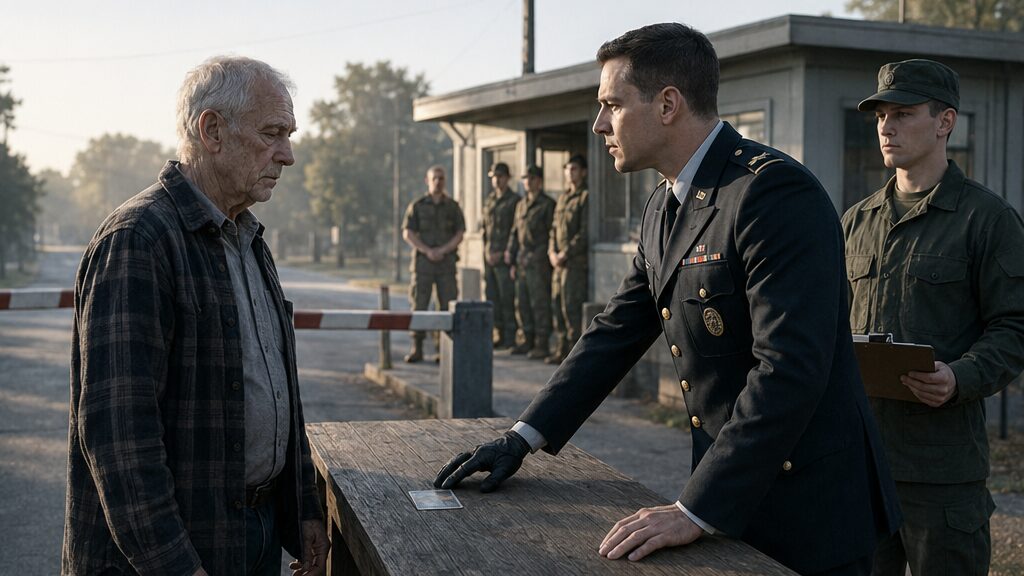
Donald stood at the pedestrian table beside the vehicle lane and waited for someone to notice him.
He had dressed carefully that morning. A gray shirt buttoned to the throat. A dark plaid overshirt, brushed twice with his palm before leaving home. Clean trousers. Old brown shoes with the soles repaired more than once. Nothing that asked for attention. Nothing that announced where he had been.
The card was in his shirt pocket.
He felt its flat edge against his chest each time he breathed.
A young gate sentry glanced at him, then at the line of cars, then back at Donald with the brisk impatience of a man taught to keep things moving.
“Morning, sir. Do you have a current visitor pass?”
Donald reached into his pocket. His fingers were stiff in the morning chill, and for a moment the card caught on the seam. He worked it free without hurrying. Hurrying made people watch your hands.
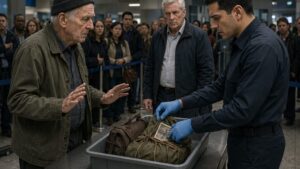
He placed the card on the weathered wooden inspection table.
The sentry stared at it.
It was laminated, but the laminate had clouded at the corners. One edge had split, leaving a thin white crescent where plastic had lifted from paper. The seal in the upper left corner was faded enough to seem more like a bruise than an emblem. Donald’s name was still readable. BENNETT, DONALD. Beneath it, smaller lettering ran across a pale stripe that had once been red.
The sentry did not pick it up.
“Sir,” he said carefully, “this isn’t a current credential.”
“No,” Donald said.
The sentry waited for more.
Donald looked past him through the gate. Beyond the barrier, men and women in dress uniforms crossed the pavement toward a building with temporary banners near the entrance. A ceremony banner moved in the breeze. He could not read it from where he stood, but he knew why it was there.
The old depot grounds were being rededicated.
He had read the announcement three times before folding it into the drawer beside his bed. He had nearly thrown it away. Then he had taken out the card.
The sentry shifted his weight. “Do you have a driver’s license? Invitation? Anything from public affairs?”
Donald laid his driver’s license beside the card. His hand hovered there a moment, two fingers resting near the laminated corner.
The sentry picked up the license first, then looked at the old card again. “I’m going to need my officer.”
Donald nodded once.
A car idled behind the pedestrian barrier. Someone inside laughed at something on a phone. A truck in the far lane gave a short, irritated honk before a second guard waved it forward. Donald kept his eyes on the table.
The wood was scarred with old marks. Newer than the base he remembered, but already worn by years of elbows, clipboards, keys, and impatient hands. His card looked almost foolish lying there, a thing from another country.
The young sentry stepped into the security office. Through the glass, Donald saw him speak to someone taller, someone in a dark dress uniform. The officer turned his head toward the table.
Donald looked down.
He had told himself, all the way from the bus stop, that nobody would remember. He had told himself that would be all right. The important thing was to get through the gate, find the ceremony office, and hand over the folded note inside his inner pocket. If they would not let him in, he would ask someone to deliver it. If they refused that, he would mail it. If no one believed him, he would go home.
There were ways to leave quietly. He had learned them.
The door opened.
The officer who came out was young enough to have been Donald’s grandson. Tall, squared shoulders, polished shoes, jaw set in the expression of a man who had already been given more small problems that morning than he wanted. His nameplate read CARTER.
“Good morning,” the officer said. Not unkindly, but not warmly. “I’m Lieutenant Joshua Carter. What seems to be the issue?”
Donald lifted his eyes. “I was told this gate would have a record.”
Joshua glanced at the sentry, then at the card. “By whom?”
Donald did not answer right away. The name that came to him belonged to a man long dead, a man who had once slapped the top of a jeep and yelled over smoke, Keep that pass, Bennett. If anybody asks later, that gate owes you.
Instead, Donald said, “It was a long time ago.”
Joshua’s expression tightened, not with anger, but with procedure. “Sir, this credential is decades out of date. It can’t be used for access.”
“I understand.”
“Are you here for the rededication ceremony?”
“Yes.”
“Were you invited?”
Donald thought of the notice clipped from the county paper, the folded note, and the handwriting that had faded but not vanished. “Not in the way you mean.”
Behind Joshua, two young soldiers slowed near the office door. They watched openly for a second before pretending not to. Donald saw their eyes drop to his shoes, his overshirt, the old card. He knew the look. It was not cruelty. It was calculation. Old man at the gate. No current pass. Ceremony day. Possible confusion. Possible problem.
Joshua picked up the card.
Donald’s hand moved without permission, then stopped.
The officer noticed. “Is there something on here I should be careful with?”
Donald withdrew his hand. “It’s old.”
Joshua turned the card over. The back had a strip of writing, half-faded, half-smeared from years in a wallet. He looked for a barcode that did not exist.
“We can’t scan this,” Joshua said.
“No.”
“And it isn’t in the current access system.”
“I expect not.”
The sentry gave the smallest exhale, the sound of a morning being delayed.
Joshua set the card down, but not exactly where it had been. Donald noticed. He moved it back without looking as though he were correcting a picture frame.
“Sir,” Joshua said, “I need you to step aside until we can determine whether you’re authorized to be here.”
Donald nodded again.
He had imagined this moment differently, though he had tried not to. He had imagined an older guard, perhaps, someone who remembered the old depot, someone who might look at the stripe on the card and say, Wait here, Mr. Bennett. We’ll call inside. He had not imagined standing under cameras while young men watched him become an obstruction.
A gust of wind came across the lane and lifted the corner of the old card.
Donald placed two fingers on it.
Joshua watched the gesture.
For the first time, his attention seemed to leave the problem and settle on the man in front of him. “Mr. Bennett,” he said, reading the name from the card, “how did you get this?”
Donald’s fingers remained on the laminate.
“The gate gave it to me,” he said.
Joshua’s eyes narrowed slightly. “The gate?”
Donald looked beyond the barrier, toward the part of the base where the old depot had stood, where a column of smoke had once covered the moon and men had shouted names into the dark.
“Yes,” Donald said. “That gate.”
The young soldiers near the office had stopped pretending not to watch.
Joshua picked up the card again, more slowly this time. “This says emergency access.”
Donald said nothing.
The officer turned it toward the light.
“What emergency?”
Donald’s throat tightened. He had not come to explain it in the open air. He had not come to tell a boy in polished shoes what the ground had smelled like that night.
“I was told the record would say,” he said.
Joshua looked from the card to Donald’s face.
Then he looked back at the faded stripe, and the morning around them seemed to quiet by one degree.
Chapter 2: The Officer Who Read the Wrong Line First
Joshua Carter had learned to read documents before he read faces.
That was not something he would have said aloud, but he knew it about himself. At a checkpoint, a face could perform anything: confusion, confidence, insult, innocence. A document either matched or it did not. A name either cleared or it failed. A credential either belonged to the present system or belonged to the category of things that made a gate slow down.
Donald Bennett’s card belonged to no category Joshua trusted.
It was too old to be active, too official-looking to be fake, and too damaged to dismiss without asking more questions. The seal in the corner was from the installation’s older name, before two reorganizations and one base realignment. The emergency stripe looked like something from a binder in a records room, not something a civilian should be carrying in his shirt pocket on ceremony day.
Joshua turned the card in his gloved hand.
The old man’s eyes followed it, not anxiously, exactly. Carefully. As if the card could bruise.
“Mr. Bennett,” Joshua said, “were you stationed here?”
Donald’s answer came after a pause. “For a while.”
“What unit?”
Donald looked at the soldiers behind Joshua. They were young, both of them. One had a clipboard tucked under his arm. The other held a radio against his shoulder. Their faces had changed from boredom to curiosity.
Joshua felt a flicker of irritation at them. Not because they were doing anything wrong, but because Donald had become a scene.
“Inside,” Joshua said to the sentry. “Pull legacy access by surname. Bennett, Donald.”
The sentry hesitated. “Sir, legacy access is—”
“I know what it is. Pull it.”
The sentry disappeared into the office.
Donald remained beside the wooden table. He had not asked to sit. He had not complained. He had not raised his voice. His hands rested near the card only when Joshua set it down, as if their proper place was not at his sides but beside that piece of cloudy laminate.
Joshua studied the front again.
BENNETT, DONALD.
Beneath the name, half buried under scratches, was a line of text he had skimmed past the first time because the format was unfamiliar.
EAST DEPOT EMERGENCY LOGISTICS ACCESS.
The words did not belong to the present base map. The east depot was a ceremonial reference now, a name being revived for speeches and ribbon cutting. The actual warehouses had been torn down before Joshua enlisted.
He looked at the date.
His thumb stopped.
The year printed beside the stripe matched the year of the old depot fire.
Joshua knew the fire in the way officers knew local history when preparing for a public event. A training accident. Fuel storage complications. Night evacuation. Several injuries. One fatality. The rededication ceremony was meant to mark the rebuilt ground and honor the personnel who had kept the damage from spreading to family housing.
He had read the briefing packet at midnight, drinking coffee from a paper cup. The names had been in an appendix. He remembered a handful. He did not remember Bennett.
“Sir?” the sentry called from inside. “There’s no current access. Legacy search is returning partial.”
Joshua did not look away from Donald. “Partial what?”
“Service number fragment. No active profile.”
Andrew Miller, the security supervisor, would say that was enough to deny entry. Joshua could hear him already. Partial records were not records. Ceremony days drew confused retirees, angry relatives, people with old grievances, people who believed the military owed them one more open door.
Joshua had believed the same thing five minutes ago.
Donald’s face did not change at the word partial, but his fingers tightened once against the edge of the table.
Joshua saw it.
He set the card down carefully, this time aligned with the grain of the wood.
“Mr. Bennett,” he said, “do you know why the system would show only a fragment?”
Donald looked at the card instead of him. “Systems change.”
“That isn’t an answer.”
“No.”
The radio on the younger soldier’s shoulder hissed. A vehicle rolled through the lane. Somewhere behind the gate, a band tested a few notes, brass rising and falling awkwardly before stopping.
Joshua lowered his voice. “Were you involved in the east depot incident?”
Donald’s expression shuttered, but not fast enough.
There it was. Not proof. Not a confession. A flinch so small Joshua almost missed it. The old man’s gaze moved, not to the ceremony building, but to the stretch of road between the gate and the interior curve. As if something had once come through there fast.
“Sir,” Joshua said again, and the word felt different in his mouth this time. Less automatic. “Were you here that night?”
Donald breathed in through his nose. “I was on duty.”
The two soldiers behind Joshua went still.
Joshua wished they would leave. He also knew, suddenly, that he did not want Donald to be alone with this question.
“What was your role?”
Donald looked up at him. His eyes were pale and tired, but not weak.
“My role,” he said, “was to keep the gate from closing.”
It was not the answer Joshua expected. It sounded too plain to carry the weight that came with it.
“The gate?”
Donald gave one small nod. “People were coming out. Trucks going in. Ambulances after that. Somebody had to keep the road open.”
Joshua looked down at the card again. Emergency logistics access. East depot. Gate.
The briefing packet had said: Rapid gate control prevented secondary casualties.
It had sounded like a line written by a committee.
Joshua looked at Donald’s hands. Rough, spotted, veins raised under thin skin. One knuckle was bent badly, maybe arthritis, maybe an old break. The hands did not tremble until Donald pulled them back from the card and folded them in front of himself.
The sentry returned to the doorway. “Sir, Supervisor Miller wants to know if we need assistance.”
Joshua knew what that meant. Do you have a problem at the gate? Do you want him removed before guests arrive?
Donald heard it too. His shoulders lowered a fraction, as if he had expected the words.
“I can leave,” Donald said.
It was the first thing he had said quickly.
Joshua looked at him. “You came for the ceremony.”
“I came to deliver something.”
“To whom?”
Donald touched the inside of his overshirt, just below the heart, then let his hand fall. The motion was small, but Joshua saw the shape of folded paper beneath the fabric.
“That’s not for the gate,” Donald said.
Joshua understood then that he had read the wrong line first. He had read expiration before name, procedure before history, inconvenience before purpose.
He took off his right glove.
The air was cool against his bare hand. He picked up the card between thumb and forefinger, careful not to bend the split corner, and held it out.
Donald did not take it immediately.
“Mr. Bennett,” Joshua said, and the young soldiers behind him straightened at the change in his voice, “I need to ask a few more questions. But I’m going to ask them inside, seated, and with your permission.”
Donald stared at the card.
Joshua stepped closer, not crowding him now. He placed his free hand lightly on Donald’s shoulder, not as control, not as escort, but as a warning to the others that this man was no longer to be treated like a delay in the lane.
Donald’s eyes lowered.
For a second Joshua thought the old man might pull away. Instead Donald stood very still, the way some men stood when touched by a memory rather than a hand.
The sentry in the doorway stopped moving.
The two soldiers said nothing.
Joshua kept his voice low. “Were you here the night the east depot burned?”
Donald’s mouth tightened. He looked past Joshua, through the open gate, toward the road inside.
“Yes,” he said.
Joshua waited.
Donald took the card from his hand.
“And I wasn’t the only one.”
Chapter 3: A Name Missing From the File
The security office smelled of floor wax, coffee, and new electronics.
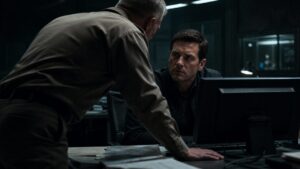
Donald sat where Joshua asked him to sit, in a plastic chair beside a gray desk with two monitors and a printer that clicked to itself every few seconds. The room was not large, but it was crowded with systems: badge readers, cameras, radios, laminated instructions, emergency contact lists, a wall clock that ticked louder than it needed to. Everything had a label. Everything had a code.
The old card lay on the desk between Donald and the modern keyboard.
It looked even older indoors.
Joshua had offered water. Donald had accepted it, then held the bottle unopened in both hands. The plastic crackled softly beneath his fingers.
Through the office window he could see the gate. Cars moved through steadily now. The young sentry had returned to his lane. The two soldiers who had watched outside were gone, or had been sent away. That was better. Donald had never liked being watched when there was nothing useful for a person to do.
Joshua stood at the desk, speaking quietly into a phone.
“No, I’m not clearing him yet,” he said. “I’m saying the legacy return is not empty. Yes. Donald Bennett. East depot emergency logistics. The card is physical. I’m looking at it.”
A pause.
Joshua glanced at Donald, then turned his back slightly, as if that made the conversation less public.
“No, sir. He is not causing a disturbance.”
Another pause, longer this time.
Donald looked down at the water bottle.
He had been good at waiting once. In motor pools. On loading docks. Beside idling trucks with headlights covered. Outside offices where men with cleaner hands decided whether a thing was urgent enough to move. Waiting required a man to put his mind somewhere else.
That was harder now.
His mind kept returning to the folded note inside his overshirt. Not heavy. Barely anything. Paper, creased soft at the edges, sealed inside a small envelope gone yellow. Still, it pulled at him like weight.
Joshua hung up.
“Supervisor Miller wants records involved,” he said. “That may take some time.”
Donald nodded.
“If you have somewhere you need to be—”
“I came here.”
Joshua accepted that.
He sat across from Donald and pulled the keyboard closer. “I’m going to ask you a few basic questions so we can match the fragment properly.”
Donald looked at the card. “You won’t find much.”
“Why do you say that?”
“Because people were busy afterward.”
Joshua typed something, then stopped. “Busy?”
Donald turned the unopened bottle once between his palms. “Cleaning. Rebuilding. Sending letters. Writing reports that had to sound complete.”
Joshua did not answer.
A woman entered a few minutes later carrying a thin folder and a tablet against her chest. She was in civilian clothes, dark slacks and a pale blouse, with a badge clipped at her waist. She paused when she saw Donald, then gave Joshua a look that mixed curiosity with caution.
“Lieutenant Carter?”
“Yes. Catherine Reed?”
“Records administration.” She set the folder down but did not open it. “You found a legacy credential?”
Joshua gestured to the card.
Catherine leaned over it. She did not touch it at first. Donald noticed and, against his own intention, liked her better for that.
“I’ve seen this format in scanned archives,” she said. “Not in person.” She looked at Donald. “May I?”
Donald slid the card toward her.
She picked it up by the edges. Her eyes moved across the front, then the back. “Where has this been stored?”
“In a drawer,” Donald said.
“For how long?”
“Long enough.”
Joshua watched Catherine’s face. “Can you verify it?”
“I can verify whether the template matches. Whether the individual credential was issued will depend on what survived the archive transfer.” She sat at the second terminal and began typing. “The east depot files are incomplete.”
Donald almost smiled at that, but there was no humor in it.
Catherine noticed. “You knew that?”
“I guessed.”
The printer clicked, hummed, and pushed out a page. Joshua took it, read, and passed it to Catherine. Donald saw his own name on the paper, but only in pieces. BENNETT, DON. A service number missing its middle digits. A duty assignment cut off after LOG. No photograph.
Partial.
That was the word for what remained when a life passed through enough hands.
Catherine typed again, slower now. “There’s a restricted incident cross-reference. Same year. East depot emergency response. Most of the file is digitized, but some attachments are listed as physical only.”
Joshua said, “Can we access them?”
“Not from here.”
“Where?”
“Archive room in the administrative building.” Catherine hesitated. “The ceremony is in that building.”
Donald’s hands tightened around the bottle.
Joshua saw it. “Is that a problem, Mr. Bennett?”
“No.”
But Catherine was watching him now too.
The room settled into a silence made of machines. Camera screens flickered above the desk. On one monitor, Donald could see himself from a high corner angle: an old man in a plastic chair, shoulders slightly bent, holding a water bottle as if he had forgotten what it was for.
He looked smaller than he felt inside.
Joshua leaned forward. “Mr. Bennett, earlier you said you came to deliver something. Is it connected to the east depot incident?”
Donald set the water bottle on the floor.
He reached into his overshirt and took out the envelope.
It was folded inside another piece of paper, then tucked into a clear sleeve that had yellowed at the edges. He had done that years ago after noticing the original paper beginning to soften along its creases. He laid it on the desk beside the card.
Catherine’s expression changed, but she did not reach for it.
Joshua looked from the envelope to Donald. “What is that?”
“A note.”
“From whom?”
Donald rubbed his thumb along the side of his index finger. “A boy who didn’t get old.”
The words entered the room quietly and stayed there.
Catherine sat back.
Joshua did not speak for several seconds. When he did, his voice had lost all of its checkpoint edge. “Was he stationed here?”
Donald nodded.
“Was he part of the incident?”
Donald looked at the envelope. “He was part of why more people walked out than should have.”
Catherine opened the folder she had brought, though Donald sensed she no longer expected it to be enough. “Do you know his name?”
Donald did. He had known it in darkness, in smoke, in the rattle of stretchers, in the shout of a young man who kept going back when everyone else had been ordered away. He had known it on nights when the house was quiet and his own breath sounded too loud.
But saying it here, in an office with cameras and printers and people waiting to decide whether he belonged, felt like handing over the last unbroken thing.
“Is his family here today?” Donald asked.
Joshua glanced at Catherine.
Catherine said, “Several families were invited. The ceremony list includes relatives connected to the depot fire.”
Donald closed his eyes briefly.
He had not known whether she would come. The notice had said families, survivors, personnel. It had not printed every name. He had told himself that if she was not there, he would leave the note with the chaplain. If the chaplain was not there, he would leave it with records. If records would not take it, he would carry it home again.
Joshua said, “Mr. Bennett, whose family are you trying to find?”
Donald opened his eyes.
Before he could answer, Catherine’s tablet chimed. She looked down, frowned, and then turned the screen toward Joshua.
“I found the incident index,” she said. “There’s a casualty attachment, but the name field is damaged in the scan. It shows rank only. Private. Last name missing. First name missing. Cross-reference says handwritten night log retained.”
Joshua read over her shoulder. “Where’s the original?”
“Archive room,” Catherine said. “Boxed under restricted historical incident materials.”
Donald stared at the card beside the envelope.
The gate had not remembered everything.
Maybe that was why he had come.
Catherine lowered her voice. “Mr. Bennett, if you know the missing name, the original log may confirm it.”
Donald placed his hand over the envelope, not hiding it, only keeping it still.
Joshua waited. This time, he did not rush the silence.
Outside, through the window, the flag moved in the pale afternoon wind.
Donald looked at the young officer, then at the records woman, then back at the card that had stopped him at the gate.
“I know his name,” he said.
The printer clicked again, as if the room had decided to answer.
Chapter 4: The Ceremony Was Not Why He Came
Catherine Reed had spent twelve years teaching herself not to trust memory without paper.
Memory made people certain. Paper made them careful.
At the base, careful mattered. A wrong spelling on a dependent form could delay medical access. A missing date on a release could turn a simple request into three weeks of calls. An old incident file, especially one connected to a public ceremony, could not be adjusted because a man with tired eyes said he remembered a name.
Still, Catherine carried Donald Bennett’s card differently than she carried ordinary documents.
She placed it inside a clear evidence sleeve before they left the security office, though no one had asked her to. The plastic sleeve made the faded stripe easier to see. East Depot Emergency Logistics Access. She kept glancing at it as they moved down the corridor toward the administrative building, Joshua walking on Donald’s left, close enough to assist but not close enough to steer.
Donald did not lean on anyone.
The ceremony hall stood at the far end of the building. Staff moved in and out with programs, flags, boxes of bottled water, and framed photographs wrapped in cloth. A brass quintet warmed up somewhere behind a closed door. Notes rose, failed, began again.
Donald’s face changed at the sound, but not enough for most people to notice.
Catherine noticed.
“You don’t have to go near the hall yet,” she said.
Donald looked at her. “I wasn’t going to.”
Joshua glanced over, but did not speak.
Catherine led them into the records office, a narrow room lined with cabinets and two locked interior doors. She set the tablet on her desk and signed into the archive system. The old card lay beside the keyboard. The envelope lay beside the card. Donald placed it there himself, then rested one hand over it as if the paper might be embarrassed by fluorescent light.
“I need to understand what you want entered,” Catherine said. “Not for the official correction yet. Just so I know what I’m looking for.”
Donald’s thumb moved along the envelope’s edge.
“There was a private at the gate road,” he said. “Young. Too young to have learned how to be scared properly.”
Joshua’s eyes lowered at that, perhaps because he was young too.
“He ran stretchers,” Donald continued. “Then he ran people who couldn’t walk. Then he ran names back and forth when the radios went bad.” He stopped. “The last time I saw him, he had soot all across his face except where sweat had cut through.”
Catherine did not type. Not yet.
“What was his name?” she asked.
Donald swallowed. “Private Harris.”
Joshua lifted his head.
Catherine waited. “First name?”
Donald did not answer.
The pause was not forgetfulness. Catherine knew forgetfulness. It wandered. This stayed locked.
Donald looked toward the hallway, where footsteps passed and ceremony voices rose in fragments.
“I came to give this to his widow,” he said, touching the envelope. “If she came.”
Catherine kept her voice low. “The family list includes a Gold Star widow connected to the depot fire. The public program doesn’t show full family details.”
Donald closed his eyes for a moment, then opened them. “Then she came.”
Joshua shifted slightly. “You know her?”
“No.”
“But you have a note for her?”
Donald nodded.
“From Private Harris?”
Donald’s hand tightened. “He gave it to me because I was by the gate. Said if mail got mixed up, I was to see it left with somebody who would know. Then the road filled again. Afterward there were reports. Trucks. Questions. Men going to hospitals. I kept thinking someone would ask for it.”
“No one did?” Catherine asked.
Donald shook his head.
“So why not send it later?”
The question was gentle, but Donald looked at her as if she had opened a door without knocking.
Catherine regretted it immediately. “I’m sorry.”
“No,” Donald said. “It’s fair.”
He drew the envelope back toward himself, then pushed it away again. A man making himself release something by inches.
“I tried once,” he said. “The address was wrong by then. Then I heard she’d moved. Then I told myself she’d already been given the official things, and maybe an old note would do more harm than good.” His mouth tightened. “After that, it got easier to be ashamed than to be useful.”
No one spoke.
On Catherine’s desk, the old card and the envelope lay side by side. Proof of access. Proof of delay.
A sharp knock came at the open door.
Andrew Miller filled the doorway before anyone invited him in. He was broad, close-cropped, and dressed in the kind of civilian security attire that still looked military by habit. His eyes went first to Joshua, then to Donald, then to the sleeve holding the card.
“Lieutenant Carter,” Andrew said, “I asked for a status update twenty minutes ago.”
Joshua stood straighter. “We have a partial legacy verification and possible connection to the east depot incident.”
“Possible.”
“Yes, sir.”
Andrew stepped inside. “The ceremony begins in less than two hours. We have families arriving, media at the south entrance, and command staff asking why there’s a checkpoint delay attached to an unverified credential.”
Donald reached for the envelope.
Joshua saw the movement. “Mr. Bennett is not a security issue.”
Andrew’s expression did not change. “Everyone is a security issue until cleared.”
Catherine said, “The card format is authentic.”
“Authentic to when?”
“To the year of the incident.”
“That doesn’t grant access today.”
“No,” Catherine said. “But it may identify him as a witness to an incomplete casualty record.”
Andrew looked at Donald directly for the first time. “Sir, do you have official documentation proving you are connected to today’s ceremony?”
Donald picked up the envelope and held it flat between both hands. “No.”
“Then until Records verifies otherwise, you’ll need to wait outside the restricted area.”
Joshua said, “He’s already inside.”
“Then we’ll escort him back to the public lot.”
The words were not cruel. Catherine almost wished they were. Cruelty could be challenged. This was only policy spoken by a man who believed pressure made policy cleaner.
Donald rose before Joshua could answer.
Catherine stood too. “Mr. Bennett, wait.”
Donald slipped the envelope back into his overshirt, then took the card from the sleeve with care. The plastic crackled in his hands.
“I didn’t come to interrupt anybody’s ceremony,” he said.
“You’re not interrupting,” Joshua said.
Donald looked at him kindly, which somehow made Joshua seem younger. “Son, I stopped a gate once. I know what a delay looks like.”
Andrew stepped back from the doorway, leaving space for him to pass.
Catherine felt anger move through her, quick and useless. Not because Andrew was entirely wrong. Because he was not entirely wrong, and still the room had become smaller around an old man who had come to give away a piece of paper he had carried for decades.
Donald paused at the threshold. “If Mrs. Harris is here,” he said, “please don’t trouble her. Not unless you know.”
Catherine looked down at her tablet. The archive request form blinked on the screen.
Physical incident materials. East depot emergency. Handwritten night log.
She had not submitted it yet.
Joshua’s voice was quiet. “What first name should we look for?”
Donald stood with his back to them.
The hallway noise rolled around him: brass notes, program pages, radios, shoes.
“Jack,” he said.
Then he walked toward the exit with the old card in his hand.
Chapter 5: The Man They Almost Walked Past
Joshua caught up to Donald halfway down the administrative corridor.
He did not call out at first. Something in the old man’s back stopped him. Donald walked slowly, but not uncertainly, the card held against his palm, shoulders set as though he were moving into weather. People passed him carrying ceremony items and did not look twice.
That was what struck Joshua hardest.
They did not look twice.
A coordinator with a headset stepped around Donald without slowing. A pair of soldiers in dress uniforms split to pass on either side of him, still talking about chair counts. A photographer checked a lens and moved backward into Donald’s path, then corrected at the last second with a distracted apology that did not reach his eyes.
Donald made room for each of them.
Joshua had watched men clear space for rank all morning. A colonel entered a hallway and bodies adjusted. A senior civilian appeared with a folder and voices dropped. But Donald Bennett, who had kept a gate open when the depot burned, moved through the same hallway like furniture people were careful not to bump.
“Mr. Bennett,” Joshua said.
Donald stopped.
He turned, not surprised. “Lieutenant.”
“You don’t have to leave yet.”
“I believe your supervisor said otherwise.”
Joshua glanced toward the records office. Andrew remained in the doorway, watching them from a distance. Catherine stood behind him, tablet in hand, her mouth set.
“He said you needed verification,” Joshua said. “That is not the same thing.”
Donald’s eyes held a trace of tired amusement. “It often feels the same from this side of the desk.”
Joshua had no answer for that.
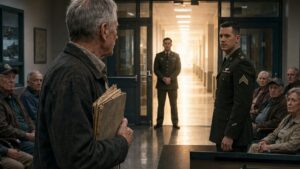
A group of visitors entered from the far door, escorted by the base chaplain. Older men and women, some using canes, some wearing small lapel pins, some holding folded programs. Family members. Survivors. The ceremony had begun gathering itself into people.
Donald stepped closer to the wall to let them pass.
One woman in a dark blue coat moved slower than the rest. She held her program with both hands. Her hair was white, pinned neatly, and beside her walked a younger relative who bent now and then to say something near her ear. The woman’s eyes traveled over the hallway, not searching exactly, but bracing.
Donald watched her for only a second before lowering his gaze.
Joshua saw the change.
“That’s her?” he asked quietly.
Donald did not respond.
The woman passed without seeing him. The edge of her program brushed Donald’s sleeve. She murmured an apology and continued with the group.
Donald remained still long after she had gone.
Joshua looked toward the ceremony doors, then back at him. “Mrs. Harris?”
Donald folded the old card into his palm. “You should go do your job.”
“This is my job.”
“No,” Donald said. “Your job is to keep people safe. Not to dig through an old man’s pocket because he waited too long.”
Joshua felt the sentence land where it was meant to hurt. Not as accusation. As warning.
He lowered his voice. “Why did you wait?”
Donald looked down the hallway after the woman in blue. “Because I thought if I carried it long enough, I’d know when it would do more good than harm.”
“And now?”
“Now I’m not sure I was waiting for her.”
Joshua understood enough not to ask who.
Behind them, Andrew approached with controlled steps. “Lieutenant Carter.”
Joshua turned. “Sir.”
“I need you back at the checkpoint.”
“Yes, sir. In a moment.”
“Not in a moment.”
The hallway seemed to narrow. Donald’s eyes moved from one man to the other, and Joshua saw him prepare to disappear again. To make this easier for everyone else.
Andrew held out his hand, not to Donald but toward Joshua. “The card.”
Donald’s fingers closed.
Joshua stepped half a pace forward. It was not much. Enough.
“Mr. Bennett will keep his property,” Joshua said.
Andrew looked at him sharply. “That item may be relevant to verification.”
“Then we can ask to see it. We don’t take it from him.”
The words surprised Joshua even as he said them.
Andrew’s jaw worked once. “Lieutenant, this is not the time for sentiment.”
“No, sir,” Joshua said. “It’s the time for accuracy.”
Donald looked at him then.
Not gratitude. Not yet. Something more difficult: concern. As if Joshua had placed himself in the road for a man who had not asked anyone to stand there.
Catherine came down the hall quickly, tablet hugged to her side. “I submitted the archive request,” she said. “Physical log retrieval should take twenty minutes if the archive room is staffed.”
Andrew turned on her. “You submitted it without authorization?”
“As records administrator for historical materials connected to today’s ceremony, I have authorization to retrieve a file. Not amend it. Retrieve it.”
The distinction held. Barely.
Andrew looked from Catherine to Joshua, then to Donald. His expression was not villainous, Joshua thought. Only strained by an event that had to run cleanly and an old piece of plastic that had made clean impossible.
“Fine,” Andrew said. “He waits in the public lobby. Not near the ceremony hall. If the log doesn’t verify his claim, he leaves before the press arrives.”
Donald spoke before Joshua could. “I’ll leave now.”
“No,” Joshua said.
Donald’s eyes hardened slightly. “Lieutenant.”
Joshua heard the warning in it. Do not make me a cause. Do not use me to prove something about yourself.
He adjusted.
“Please wait,” Joshua said. “Not because I order you to. Because that note may belong to someone inside.”
Donald’s grip on the card loosened.
Catherine added, “And because if the record is wrong, it was wrong before you walked in. Leaving won’t make it less wrong.”
Donald looked toward the ceremony doors again. The woman in the blue coat had disappeared inside. The brass quintet had found its notes now. A steady hymn-like line drifted through the wall.
He slipped the card back into his pocket.
“All right,” he said. “The lobby.”
Andrew gave a short nod, already turning away. “Carter, five minutes.”
“Yes, sir.”
But when Andrew left, Joshua did not immediately return to the gate. He walked with Donald and Catherine to the public lobby, where chairs lined the wall and a framed photograph of the old depot hung beside a display case.
Donald stopped in front of the photograph.
The image showed the depot before the fire: low warehouses, service roads, gate lights, the curve of pavement leading out toward the road.
Joshua stood beside him.
Donald lifted one hand, not touching the glass, and pointed to a narrow strip at the bottom corner of the photograph.
“There,” he said.
Joshua leaned closer. It was just a gate in the picture. A small one. Open.
“That’s where you were?”
Donald’s hand fell.
“That’s where Jack Harris turned around,” he said.
Catherine’s tablet chimed before Joshua could ask what that meant.
She read the message, and her face changed.
“The archive room found the box,” she said. “They’re bringing out the handwritten log.”
Donald closed his eyes.
Joshua knew then that the old man was not afraid the record would prove him wrong.
He was afraid it would prove him right.
Chapter 6: The Night the Gate Stayed Open
The archive room was colder than Donald expected.
He had imagined dust, though he knew better. Modern records were kept in climate-controlled order, in gray boxes with printed labels, on shelves that rolled when a handle was turned. No dust. No cracked windows. No forgotten stacks leaning in corners.
Still, when Catherine led him inside, the past seemed to have been waiting there.
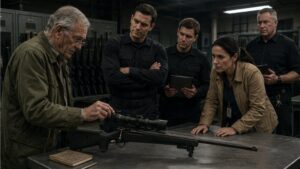
A records clerk had placed the box on a long table beneath a lamp. Catherine signed a form, showed her badge, and opened the lid with both hands. Joshua stood near the door, not blocking it. Andrew had not come. Donald was grateful for that.
Inside were folders with typed labels. Incident Summary. Equipment Loss. Medical Transport. Communications Failure. Gate Operations.
Catherine paused over that one.
Donald looked away.
“You don’t have to do this in here,” Joshua said.
Donald gave a small laugh without humor. “That’s what people say when the room is already built around the thing.”
Catherine looked up.
“Open it,” Donald said.
She did.
The first pages were typed reports. Carbon copies, edges soft, official language pressed flat over disorder. Donald saw phrases without wanting to.
Visibility reduced.
Secondary traffic control established.
Civilian personnel evacuated.
One fatality confirmed.
His stomach tightened.
Catherine turned carefully until she reached a thinner packet. The paper was different, lined and yellowing. Handwritten columns. Times. Vehicle numbers. Names. Short notes written by more than one hand.
Donald knew it before she said anything.
“That’s the night log.”
Joshua moved closer.
Catherine adjusted the lamp. “Some of this is hard to read.”
“It was hard to write,” Donald said.
The words came out before he could stop them.
The room waited.
Donald reached for the edge of the table, not for balance, but because he needed something that belonged to now. Smooth wood under old fingers. Cold air in his lungs. Joshua’s polished shoes at the edge of his sight. Catherine’s careful hands.
He was not there.
He was there.
The night had smelled of fuel and wet canvas before it smelled of fire. Donald remembered that first, because it had fooled them. Men thought fire smelled like flame. Sometimes it smelled like rain on equipment and something sharp leaking where it should not.
He had been at the outer gate because a truck clutch had failed in the lane and somebody needed to keep movement from tangling. He was not the highest ranking man there. Not the bravest. Not the one in the stories that should have been told. He had a flashlight, a clipboard, and a voice that still carried then.
When the first alarm went, the gate wanted to become a knot. Trucks in. Trucks out. Men shouting for keys. A driver trying to reverse where there was no room. Donald had climbed onto the running board of a stalled vehicle and yelled until people cursed him and obeyed.
Keep this side open.
Ambulances through first.
No, not that road.
Move.
Move now.
The gate lights had cut through smoke in pale cones. Faces appeared, vanished, appeared again. He remembered hands more than faces. Hands on stretchers. Hands over mouths. Hands reaching for tailgates. Hands lifting men by belts and shoulders.
And then there was Jack Harris.
The boy had been nineteen or twenty, though to Donald now everyone that young looked unfinished. Back then Donald had thought of him as green but steady. Harris had run messages when radios failed. He had come through the gate three times with names shouted into Donald’s ear.
Warehouse two clear.
Three men still at fuel shed.
Need another ambulance.
The fourth time, Harris came carrying a man twice his size with another soldier helping under the legs. He had soot across his face and a strip of blood on his temple. Donald grabbed his sleeve as he passed.
“You’re done,” Donald had shouted.
Harris shook him off. “There’s one more.”
“Who?”
“Don’t know. I heard him.”
Donald remembered the anger that had risen in him. The clean, useful anger of command. “You go back in, you block the road for the next crew.”
Harris had stared at him, breathing hard.
Then he had shoved a folded envelope into Donald’s vest pocket.
“If mail gets crossed,” he said, “make sure somebody knows.”
Donald had caught his wrist. “Private.”
Harris pulled free. “Keep the gate open.”
Then he turned around.
Donald had told himself, for years, that he had only obeyed the larger need. Gate open. Ambulances through. No more bodies trapped by a clogged road. He had told himself that running after Harris would have made two fools instead of one. He had told himself the boy had been under orders from someone else.
None of that changed the shape of Harris turning away.
Catherine’s voice brought him back.
“Here,” she said.
Donald opened his eyes.
Her finger hovered above a line in the handwritten log. She did not touch the paper. Joshua leaned in.
The entry was smeared, but legible enough under the lamp.
2317 — Pvt. J. Harris through east gate with injured civilian. Returned inside after reporting one remaining.
The next line had been written by another hand.
2329 — Bennett maintained gate clearance for ambulance convoy. Harris unaccounted.
Donald sat down without remembering deciding to.
Joshua moved, but stopped before touching him.
Catherine turned another page. “There’s an addendum.”
“No,” Donald said.
His voice sounded strange.
Catherine froze.
Donald looked at the table, at the paper, at the thin line where a man had been reduced to unaccounted. “Not yet.”
The room seemed to tilt quietly.
Joshua pulled out the chair beside Donald but did not sit. “Mr. Bennett.”
Donald looked at him.
“I need to ask you something,” Joshua said. “Not for the file. For me.”
Donald waited.
“When I saw you at the gate, you could have said all of this.”
“No.”
“You could have said enough.”
Donald’s eyes moved to the old card, resting beside the open folder. “If a man has to spend the dead to buy his way through a gate, he’s already lost something.”
Joshua looked down.
The sentence settled into him. Donald could see it working past training, past procedure, past the young officer’s wish to repair quickly what had been mishandled.
Catherine sat across from Donald and folded her hands. “The ceremony program names the emergency responders by category. Fire crew. Medical. Security. Logistics. It names the one fatality from the official casualty record, but not this entry.”
“Because he was unaccounted when they wrote it,” Donald said. “Then accounted somewhere else. Then filed under the wrong attachment.”
“You know that?”
Donald nodded. “I saw the letter later. Not the family letter. Internal routing. Harris’s name went with a transport list. Mine stayed with the gate log. Someone wrote the summary as if the road cleared itself.”
Catherine’s face tightened. “Do you have that routing letter?”
“No.”
“Then the handwritten log helps, but amendment before the ceremony may still be difficult.”
Donald looked at the envelope. “I didn’t come for amendment.”
Joshua said, “You came for Mrs. Harris.”
Donald nodded once.
“And for his name,” Catherine said.
Donald did not deny it.
Catherine turned the page despite his earlier protest, but slowly enough that he could stop her. He did not.
The addendum was shorter than the others.
Gate operations credited to Sgt. D. Bennett for maintaining evacuation route under hazardous conditions.
No mention of Harris.
No mention of turning back.
No mention of the envelope.
Donald stared at his own name in the old ink.
There it was, the thing he had not come to collect. Credit, preserved in a box, clean enough to satisfy people who liked ceremonies. His name had survived where Jack’s had thinned.
Joshua read it too.
His shoulders changed. Not stiffening. Settling. As if the respect he had begun to feel at the checkpoint had found weight beneath it.
Donald hated that part of himself that wanted to look away from the credit and still could not.
“I kept the road open,” he said. “That’s true.”
No one interrupted.
“But he went back down it.”
Catherine closed her eyes briefly. When she opened them, she reached for a blank archive request sheet and wrote carefully.
“What are you doing?” Joshua asked.
“Requesting permission to bring this log to the ceremony coordinator before remarks are finalized.”
“Can they change them this late?”
“Not the printed programs,” she said. “But spoken remarks can be corrected.”
Donald looked up sharply. “No speeches.”
Catherine held his gaze. “No speeches. A name.”
Joshua nodded. “A name is not a speech.”
Donald rubbed both hands over his knees. They were shaking now. He let them. There was no point hiding it in a room that had already seen too much.
From the hallway outside came the low murmur of arriving guests. Chairs scraping. Someone testing a microphone. The ceremony moving forward with or without the truth.
Donald picked up the old card.
For decades it had felt like proof he had once belonged somewhere. Then like evidence against him. Then like a stone he carried because putting it down would mean admitting he had failed at the only delivery left to make.
Under the archive lamp, it looked like what it was: a pass issued in smoke and noise, kept alive by a man who had not known how to forgive himself.
He placed it beside Jack Harris’s name in the log.
“Then say his name before mine,” Donald said. “If they have to say anything, say his first.”
Chapter 7: Say His Name Before Mine
By the time Donald reached the rededication hall, the seats were nearly full.
He had not meant to enter through the side door. He had not meant to enter at all, not after the archive room. But Catherine walked ahead with the folder held flat against her chest, and Joshua walked beside him with Donald’s old card in a clear sleeve, and somehow the hallway carried them forward.
The hall had once been a training room. Donald could tell by the shape of it, even though it had been dressed for ceremony. Flags stood near the front. Rows of chairs faced a small platform. A table held framed photographs of the old east depot: warehouses, trucks, men in work uniforms, a gate lit by floodlights. The largest photograph showed the rebuilt grounds under a blue sky, as if the land itself had agreed to look peaceful for the occasion.
Donald stopped just inside the side door.
The sound of people settling into chairs moved over him like low water. Programs opened. Shoes shifted. Someone coughed. A child whispered and was hushed. Near the front, the woman in the blue coat sat with her hands folded around a program.
Mrs. Harris.
Donald knew it without being told.
She was smaller than he had imagined over the years. That surprised him. In his mind, she had become part of the note itself, something fragile but impossibly heavy. Seeing her as a person, with white hair pinned neatly and a tissue tucked into one sleeve, made his shame sharpen into something more useful.
Fear, maybe.
Catherine turned back. “You can wait here,” she whispered. “I’ll speak with the coordinator.”
Donald touched the envelope inside his overshirt. “No.”
Joshua looked at him.
Donald kept his eyes on the front row. “If this is going to happen, I don’t want it carried across the room like a correction slip.”
Catherine nodded once. “Then we’ll ask for a pause before remarks.”
“No speeches,” Donald said.
“No speeches,” Joshua answered.
The ceremony coordinator near the stage looked alarmed when Catherine approached with the folder. At first she shook her head. Then Catherine opened the folder and showed her the handwritten log. The coordinator’s expression changed from irritation to worry, then to a careful stillness. She looked toward Donald, then toward Joshua, then toward the front row.
Andrew Miller stood near the back wall, arms folded. He saw Donald and straightened. For one second Donald thought the supervisor would cross the room and remove him anyway. Instead Andrew remained where he was, jaw tight, watching.
The base commander stepped to the podium.
The room quieted.
Donald had spent many years avoiding rooms like this. Ceremony had always felt too clean to him. Men arranged in rows. Words polished until no smoke clung to them. Time marked with plaques and programs. He did not hate ceremony. He understood why people needed it. But he had never trusted it to hold the part of memory that came with noise, confusion, fear, and the smell of fuel under rain.
The commander began with welcome remarks. Donald heard only pieces.
“Families…”
“Service…”
“Those who acted when called…”
Beside him, Joshua stood very still. The old card remained in the clear sleeve in his hand.
Donald glanced at it.
Joshua noticed and held it out.
Not casually. Not the way he had first lifted it from the wooden table at the checkpoint. He held it with both hands, the clear sleeve supported at the bottom, as if returning something breakable to its owner.
Donald took it.
For a moment neither man spoke.
Then Joshua bent his head slightly and said, not loud enough for the room, “Mr. Bennett.”
It was not a salute. Not yet. It was better than the first “sir” at the gate. It had weight now. It meant, I know there is more here than I can see.
Donald slipped the card into his shirt pocket.
The commander stopped speaking when the coordinator came to his side. She leaned close and murmured something. Catherine stood behind her with the folder. The commander looked down at the paper Catherine offered. His face altered with the practiced discipline of a man who understood that ceremony sometimes had to make room for truth.
He turned back to the microphone.
“Ladies and gentlemen,” he said, “before we continue, we have been given information from the original incident log that requires a correction to today’s remarks.”
A rustle moved through the room.
Donald did not move.
The commander looked toward Catherine, who looked toward Donald.
Joshua leaned closer. “Do you want me to stand with you?”
Donald shook his head.
He stepped into the aisle.
At once, eyes turned toward him. Not all at once, not dramatically. A few first, then more. An old man in plain clothes walking from the side of a military ceremony drew attention by not belonging to the picture.
His shoes sounded too loud.
He stopped halfway between the side door and the front row. That was as far as he could make himself go. The commander waited.
Catherine brought the folder to him. “You don’t have to read it,” she whispered.
“I know.”
Donald touched the edge of the handwritten log inside the folder. He did not lift it. He could not have read from it if he tried. The lines were already inside him.
He faced the room.
He found Mrs. Harris in the front row. Her eyes were on him now. Not frightened. Not welcoming. Waiting.
Donald took the envelope from his overshirt.
His fingers, which had held steady on the table and the archive folder, trembled now. He let them.
“My name is Donald Bennett,” he said.
The microphone was still at the podium; his voice did not fill the hall. That helped. The people closest leaned in, and those farther back grew quiet enough to hear.
“I was at the east gate the night the depot burned.”
Mrs. Harris’s hands tightened around her program.
Donald looked down at the envelope. The paper sleeve had softened over the years. He had carried it through moves, through hospital visits, through birthdays he had stopped celebrating loudly, through mornings when he opened the drawer and closed it again.
“There was a private there,” he said. “Private Jack Harris.”
A sound came from the front row. Small, not quite a sob.
Donald kept his eyes on the envelope.
“He carried people through that gate. He carried messages when the radios weren’t working. He went back when he believed someone was still inside. The record did not hold his name where it should have.”
The commander lowered his head.
Joshua, near the side door, stood straighter.
Donald’s throat ached, but the next words had waited too long to be protected by silence.
“If any name is spoken for that night,” he said, “say his before mine.”
No one moved.
Then Mrs. Harris stood.
The younger relative beside her reached for her arm, but she shook her head once, gently. She stepped into the aisle, holding the back of one chair for balance.
Donald met her halfway.
The envelope lay between them in his hand.
“I should have brought this sooner,” he said.
Mrs. Harris looked at the envelope, then at him. Her eyes were wet, but steady. “Is it from Jack?”
Donald nodded.
Her hand rose, stopped, then continued. She took the envelope from him as if accepting something warm.
“I was afraid it would hurt you,” Donald said.
Mrs. Harris looked down at the faded paper. “It will.”
Donald closed his eyes.
“But it already did,” she said quietly. “Not having it.”
He opened his eyes.
Around them, the room remained silent. Not the empty silence of confusion. The held silence of people allowing a moment not to be rushed.
Mrs. Harris touched the envelope to her chest.
“Thank you for keeping it,” she said.
Donald could not answer.
The commander returned to the microphone, but he did not resume the printed remarks. His voice was lower now.
“We will correct today’s spoken record,” he said. “And we will begin the formal process to correct the historical file.”
He looked toward Donald.
Donald shook his head once, almost imperceptibly.
The commander understood enough. He turned toward Mrs. Harris instead.
“Private Jack Harris,” he said, “will be named here today.”
The room rose, slowly, not in applause, not with cheers. Chairs scraped softly. Service members stood straight. Civilians followed because they felt the weight before they understood the etiquette.
Joshua did not salute. Not then. He simply stood where Donald could see him, one hand at his side, the other holding his removed glove.
Donald looked at Mrs. Harris, at the envelope she held, at the room that had become too full of memory to feel ceremonial.
For the first time that day, he let himself breathe without counting how long it took.
Chapter 8: The Gate Remembered Him Differently
Evening came quietly to the base.
By the time Donald walked back toward the checkpoint, the ceremony hall had emptied into small groups and low voices. People lingered near the display photographs. Some stopped Catherine to ask about the corrected record. Others spoke to Mrs. Harris, though most did so carefully, as if they had learned from the day that not every silence needed filling.
Donald had stayed longer than he intended.
He had not opened Jack’s note. Mrs. Harris had not asked him to. She held it unopened through the corrected remarks, both hands folded over it, her eyes on the floor when Jack’s name was spoken. Afterward she had thanked Donald again, not in front of everyone, but near the side door where the hall noise thinned. She did not ask him why he had waited so long. For that kindness, he nearly lost the composure he had managed to keep.
Catherine told him the handwritten log would be copied, preserved, and attached to the correction request. She did not promise how fast the process would move. Donald respected her for that. Promises made too quickly had a way of turning into another kind of paperwork.
Andrew Miller approached before Donald left the building.
The supervisor stood with his hands at his sides, no folder, no radio, no official posture strong enough to hide his discomfort.
“Mr. Bennett,” Andrew said.
Donald waited.
“I was focused on keeping the event controlled.”
“Yes,” Donald said.
Andrew accepted the answer as the limited mercy it was. “I should have made room for verification without making you feel removed.”
Donald looked toward the front doors, where the last light had turned amber on the glass. “A gate is supposed to control what comes through. It can forget there are people attached.”
Andrew’s face tightened. “I’ll remember that.”
Donald did not say he forgave him. Forgiveness was not a coin to hand out because someone asked properly. But he nodded once, and Andrew stepped aside.
Joshua was waiting outside.
He had changed back into his right glove but held Donald’s card in his bare left hand. The clear sleeve had been replaced with a small rigid holder from the records office, open at the top, protecting the split laminate without sealing it away.
“I thought you had that,” Donald said.
“You left it with Catherine after the ceremony.”
Donald frowned, then touched his shirt pocket. Empty.
It startled him more than it should have. The card had been against his chest for so many years that its absence felt like a missed heartbeat.
Joshua held it out. “She asked me to return it.”
Donald took it, then looked at the holder. “This new?”
“Yes.”
“Looks official.”
“It isn’t,” Joshua said. “Just careful.”
Donald’s mouth moved in the shadow of a smile.
They walked together toward the checkpoint. Neither spoke for a while. The road inside the base curved under fresh lights. Donald recognized almost nothing and then, all at once, recognized the angle of the pavement near the outer lane. The old photograph had shown it. His memory supplied the smoke, but the evening did not. The evening smelled of cut grass and cooling asphalt.
At the gate, the young sentry from the morning stood in the pedestrian lane. When he saw Donald, he straightened so abruptly that Donald almost felt sorry for him.
“Mr. Bennett,” the sentry said.
Not sir. Not old man. Not problem.
Donald stopped at the same wooden table where the day had begun. The surface was still scarred. The wind still came across the lane in small restless pushes. Cars still rolled through under watchful cameras. The world had not transformed. That was comforting.
Joshua set a clipboard on the table.
Donald looked at it.
“What’s this?”
“Temporary legacy-credential log,” Joshua said. “Until Records and Security create something better.”
Donald raised an eyebrow. “You made a new form in one afternoon?”
“No,” Joshua said. “I made a sheet of paper that says we don’t take old documents out of old hands before we know what they are.”
The sentry looked down, chastened but attentive.
Donald placed the card on the table.
For a moment all three men looked at it.
In the morning, it had stopped the gate. Now it seemed to hold it open without force.
Joshua did not pick it up immediately. “Permission?”
Donald looked at him.
Joshua waited.
Donald nodded.
Only then did Joshua lift the card. He read the name, the faded stripe, the old seal. Not because he needed to, Donald knew. Because the act mattered.
“Donald Bennett,” Joshua said, writing by hand. “Legacy east depot emergency logistics credential. Verified pending historical records correction.”
The pen moved across the page.
Donald listened to the scratch of it.
A radio hissed at the sentry’s shoulder. The flag rope tapped softly against the pole beyond the gate. Somewhere far inside the base, chairs were being stacked after the ceremony.
Joshua returned the card with both hands.
Donald slid it back into his shirt pocket, but not as quickly as before. The card no longer felt like something he had to hide from weather, clerks, or time. It was still old. It was still cracked. It still did not scan.
But it had done its work.
“Lieutenant,” Donald said.
Joshua stood straighter. “Mr. Bennett.”
“You did more than the gate required.”
Joshua looked through the barrier toward the road beyond. “I did less than I should have at first.”
“Yes,” Donald said.
The answer was plain, not punishing. Joshua accepted it.
Then Donald added, “But you listened before the day was over. Some men don’t.”
The young officer’s face changed slightly. A thing released, or settled. He removed his glove again, not with ceremony, just with care, and offered his hand.
Donald shook it.
Joshua’s grip was firm. Donald’s was thinner than it had once been, but steady enough.
The sentry stood silent, watching in the way young men watch when they understand they are being taught without anyone calling it a lesson.
Donald turned toward the outer road.
“Do you need a ride to the bus stop?” Joshua asked.
“No.”
“It’s getting dark.”
“I’ve walked in worse.”
Joshua almost smiled. “I believe that.”
Donald took a few steps, then stopped.
Beyond the gate, outside the fence, the world waited without knowing what had changed inside him. Traffic passed on the main road. A bird moved along the top of the chain-link fence and lifted off. The air had cooled, and the card rested lightly against his chest.
He looked back once.
Joshua and the sentry remained at the table. Andrew stood near the security office door, speaking to Catherine, who held the folder against her side. They were not applauding him. Not saluting in a row. Not turning him into a story clean enough to fit on a plaque.
They were working.
That was better.
Donald touched the card through his shirt, feeling the straight edge under cloth. For years it had been the thing he carried because he had failed to deliver something else. Now the note was gone. Jack’s name had been spoken. The gate had written Donald down by hand.
He stepped onto the road outside the base.
Behind him, Joshua’s voice carried softly to the sentry.
“Ask before you take it,” he said. “Always ask.”
Donald kept walking.
The evening opened ahead of him, ordinary and wide.
The story has ended.