The Judge Told the Old Veteran to Sit Down Until One Blue Ribbon Changed the Room
Chapter 1: The Judge Asked Why the Old Man Would Not Answer
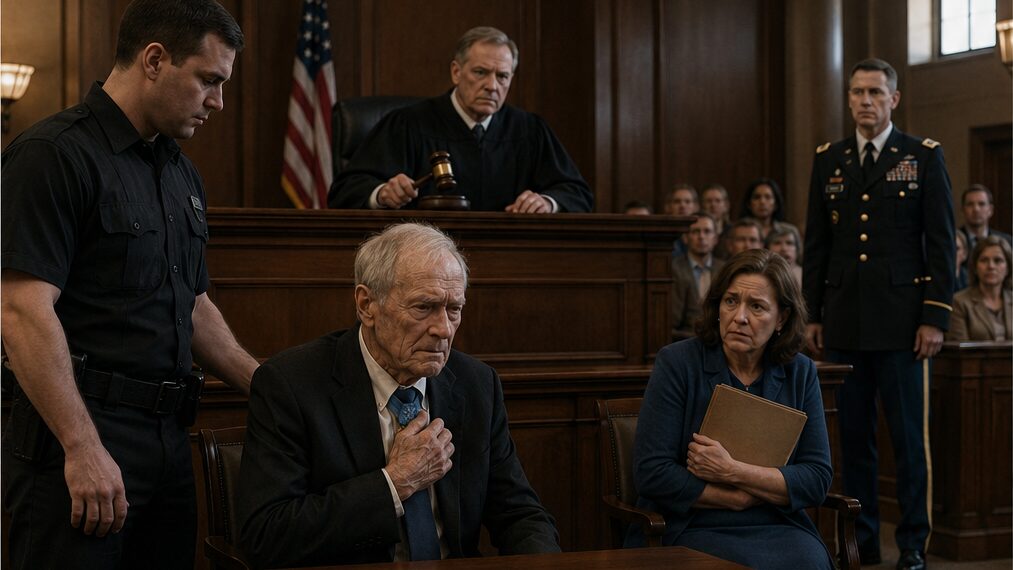
The gavel came down before John Clark had finished opening his mouth.
Not hard enough to crack the wood, but sharp enough that the sound jumped through his chest and found the place beneath his tie where the faded blue ribbon rested against his shirt.
“Mr. Clark,” Judge Steven Moore said from the bench, his voice already tired of him, “this court has asked you a direct question three times.”
John kept one hand over the ribbon. The silk had worn thin at the edges. The knot no longer sat straight. Under his palm, it felt less like cloth than a pulse he had been carrying too long.
The courtroom was warmer than it should have been for a Monday morning. Dark wood panels rose behind the judge, making the whole room feel boxed and polished and unforgiving. A flag stood in the corner. Spectators sat in two quiet rows, pretending not to stare. Somewhere behind John, a chair leg scraped the floor, then stopped.
He knew the question.
He knew every word of it.
Did he understand that his daughter, Sarah Clark, had petitioned for limited guardianship over his property, finances, and records due to concerns regarding his ability to manage his affairs?
He understood.
That was the trouble.
“Mr. Clark,” Judge Moore said again, leaning forward now, robe bunching at the elbows. “Do you understand what is being asked of this court?”
John’s tongue touched the roof of his mouth. It had gone dry. He looked down at the table in front of him: two folders, a glass of water he had not touched, a stack of forms clipped together with Sarah’s careful signature on the top page. His name appeared again and again, typed in full, as if the court needed to pin him in place.
John Edward Clark.
Respondent.
The word sat on the paper like a mistake.
Beside him, Jonathan Scott, the bailiff, shifted closer. John could see the black shine of his shoes near the leg of the table. A hand came down on the wooden rail beside John’s chair, not touching him, but close enough that the warning was clear.
“Sir,” Jonathan said under his breath, “you need to answer the judge.”
John lifted his eyes. Jonathan was not cruel-looking. That made it harder. He was young enough to believe firmness and respect were the same thing, broad-shouldered in his uniform, jaw set as if order were something he could hold in his hands. He looked at John the way people looked at a box left in the wrong hallway.
“I asked,” John said, and his voice came out lower than he intended, “to finish one sentence.”
Judge Moore heard him. So did the room. The court reporter’s fingers paused, then resumed.
“You were given time,” the judge said.
“No, sir,” John said.
The judge’s eyebrows rose.
Sarah made a small sound from the petitioner’s table. Not quite a gasp. Not quite his name. John did not look at her. He knew how she was sitting: shoulders stiff, purse tucked against her chair leg, lips pressed together because she had promised herself she would not cry in court. She had worn the blue dress he used to tell her looked professional. She had probably chosen it because she wanted today to look careful, not cruel.
That was Sarah. She could organize heartbreak into labeled folders.
Judge Moore looked down at the papers before him. “Mr. Clark, this is not a conversation at the kitchen table. This is a hearing. Your daughter has presented evidence that bills have gone unpaid, appointments have been missed, and important records have been removed from your home without explanation. The court-appointed evaluator has concerns. If you cannot answer simple questions, you make this very difficult.”
John’s fingers pressed lightly into the ribbon through his shirt.
Removed from your home.
The phrase turned inside him.
Not removed. Searched for. Carried out. Returned. Hidden again. Not because he had forgotten where they belonged, but because he remembered too well.
Donna Anderson sat two places down from Sarah, glasses low on her nose, a folder open before her. She did not look unkind either. She looked practiced. John had met people like her at hospitals, offices, counters, intake desks. They made soft voices into locked doors.
Sarah finally turned toward him. “Dad,” she whispered, though the room was quiet enough that everyone heard. “Just tell him you understand.”
John looked at her then.
She was fifty-two, but he still saw the girl who used to stand on his boots while he walked her across the kitchen, one hand balanced on his belt buckle, laughing because she thought he was a giant. That was before her mother died. Before John learned that silence could become a room another person got trapped inside.
Sarah’s eyes pleaded with him. She thought this was mercy. He could see it in the way her fingers clutched a tissue she had not used. She thought if the judge took over the house records, the bank notices, the appointments, the locked drawer in the back bedroom, then John would stop disappearing for hours and coming home with mud on his shoes and no explanation.
She thought he was slipping away.
Maybe he was.
But not in the way she feared.
“I understand,” John said.
Judge Moore sat back slightly. “Then answer the question fully. Do you object to your daughter being granted limited authority to manage your home, financial accounts, and personal records?”
John took a breath. His hand still covered the ribbon.
The courtroom watched him take it.
He hated that more than the judge’s voice. He hated the soft, collective patience of people waiting for an old man to fail in public. He hated the way everyone leaned inward without moving. He had seen men wait like that around a radio when names came through static. He had seen a room learn to fear a pause.
“I object,” he said.
Sarah closed her eyes.
Judge Moore’s jaw tightened. “On what basis?”
John looked at the blue tie lying flat against his shirt. Sarah had picked it out years ago for a veterans luncheon he had left early. She had never asked why. He had never told her that men with clean medals and steady stories made him feel like a thief.
“Because there are records,” John said slowly, “that do not belong to me alone.”
Donna Anderson wrote something. The scratch of her pen was small but exact.
Judge Moore waited a beat. “What records?”
John’s palm hardened over the ribbon.
Jonathan Scott leaned closer. “Sir.”
John turned his head a fraction. The bailiff’s face was near enough that John could smell coffee on his breath.
“Please don’t crowd me,” John said.
Jonathan blinked, surprised less by the words than by how quietly they had been spoken.
“Mr. Clark,” Judge Moore said, sharper now, “you are not being crowded. You are being asked to comply with court procedure.”
John held the judge’s gaze. “Procedure doesn’t need to stand over my shoulder.”
A murmur moved through the benches.
The gavel struck again.
“That is enough,” Judge Moore said. “You will answer the question, or I will consider your refusal in my ruling.”
Sarah turned fully now. “Dad, please.”
John heard the crack in her voice and nearly gave up.
He could have done it. He could have let Sarah take the keys. Let Donna take the drawer. Let the judge sign the paper. Let everyone call it safety. He was tired enough. Some mornings, bending to tie his shoes felt like negotiating with a body that no longer took orders. The house had become too quiet. The mail too heavy. The past too organized and too lost at the same time.
But there was a folded notice in his coat pocket from a veterans service office. There was a name he had not said aloud in fourteen years. There was an error in an old file that had followed a dead man’s family like a shadow. And somewhere in the county archive, unless another clerk had misfiled it again, there was a record that would explain why John had been leaving home before dawn.
He was not hiding because he did not understand.
He was hiding because the truth had weight.
“Your Honor,” John said, “I can explain.”
“Then do so.”
“I need—”
“You need to answer now.”
John swallowed. The ribbon shifted under his hand.
Jonathan’s palm touched the back of John’s chair. A slight pressure. An instruction without words.
Something cold moved through John then. Not fear. Not anger exactly. An old clarity. The kind that arrived when noise narrowed and a man learned which command he would not obey.
“I asked,” John said, “to finish one sentence.”
Judge Moore stood halfway from his chair. “Mr. Clark, you will not direct this courtroom.”
The gavel lifted again.
Behind John, at the rear of the courtroom, the door opened.
It was not loud. Just the soft pull of hinges and a narrow spill of hallway light across the floor. But the sound cut through the room more cleanly than the gavel.
John did not turn at first.
Judge Moore’s eyes moved past him.
Jonathan’s hand left the chair.
The spectators shifted.
John saw the change before he saw the man who caused it. The judge’s mouth stopped forming its next word. Donna’s pen paused above her report. Sarah turned, confused. Even the clerk near the wall looked up from the docket.
Only then did John look over his shoulder.
A uniformed Army officer stood just inside the door, one hand still near the handle, his dress jacket dark and pressed, his posture straight enough to make the air around him seem disciplined. His eyes moved once across the room, took in the bench, the bailiff, the petitioner’s table, the old man seated low under everyone’s impatience.
Then his gaze dropped to John’s hand.
To the faded blue ribbon beneath it.
And the officer stopped as if the floor had ended beneath his shoes.
Chapter 2: The Officer Saw the Ribbon Before Anyone Heard the Name
Andrew Harris had entered courtrooms before, but never into a silence shaped like accusation.
He had come to the county courthouse for a veterans outreach matter scheduled after the morning docket. His appointment was supposed to be with the clerk, not the judge. A deputy in the hall had pointed him to the wrong door, then apologized, then said he could wait inside until the guardianship hearing concluded if he stayed quiet.
Andrew had opened the door expecting paperwork.
Instead he saw an elderly man pressed small by polished wood and official patience.
He saw the judge standing over the bench with a gavel in hand. He saw the bailiff too close to the old man’s chair. He saw a woman at the front table with her hands twisted around a tissue. He saw spectators arranged in rows, holding their breath around someone else’s humiliation.
Then he saw the ribbon.
Not the bright kind issued for ceremony, not the fresh blue of a dress uniform display. This one had faded at the fold, softened by years of touch. It lay half-hidden under the old man’s hand, the way a person covers a wound when he does not want help.
Andrew’s eyes narrowed.
There were ribbons that looked similar to people who did not know the difference. There were commemorative pieces, association ribbons, replicas sold in shadow boxes and gift shops. But there were habits a man could not counterfeit: the way the old man did not display it, did not straighten it for attention, did not glance around to see who noticed. He held it like something entrusted.
Judge Moore cleared his throat.
“Colonel Harris,” the clerk said softly from the side of the room, recognition catching up with protocol.
Andrew did not answer her at first. His gaze had moved from the ribbon to the old man’s face.
John Clark.
The name was in the docket call sheet the deputy had mentioned in the hallway. Andrew had heard it and felt nothing then. Clark was common. John was common. Old names filled old files.
But now the name reached backward.
Clark.
Blue ribbon.
County archive matter.
An incident report flagged for correction.
Andrew felt the pieces touch.
“Colonel?” Judge Moore said, irritation returning now that surprise had passed. “This court is in session.”
Andrew took one step forward, then stopped. He was aware of the uniform on his shoulders, the medals on his chest, the way a uniform could bend a civilian room whether a man meant it to or not. He had no right to storm into another man’s hearing and make theater of respect. That was not respect.
He looked to the bench. “Your Honor, I apologize for the interruption.”
“Then wait outside.”
Andrew’s eyes returned to John. The old man had not turned fully. He sat with his shoulders slightly bowed, one hand still over the ribbon, his face lined and pale under the courtroom lights. But his eyes were steady. Tired, yes. Guarded. Not vacant.
Not confused.
Andrew lowered his voice. “May I approach?”
Judge Moore frowned. “For what purpose?”
Andrew did not look away from John. “To address Mr. Clark.”
A stir moved through the room.
John’s fingers tightened once over the ribbon.
Judge Moore glanced at the court file. “Mr. Clark is the respondent in this matter, not a witness in your business with the court.”
“No, Your Honor,” Andrew said. “He is not my business.”
The sentence landed strangely, and Andrew heard it too late. He corrected himself.
“He is someone whose name I have seen in a service record.”
The word service changed the air. Not dramatically. No one gasped. No one stood. But the spectators became less comfortable in their curiosity. Sarah looked from Andrew to her father, then down at the ribbon, as if seeing it for the first time in years.
Judge Moore’s eyes sharpened. “Colonel Harris, this is a guardianship hearing. Unless you have evidence relevant to capacity, your statement can wait.”
Andrew’s mouth closed.
The judge was right. That was the trouble. Recognition was not evidence. Respect was not a legal argument. A salute did not pay bills, retrieve records, or prove a man could manage a household.
Still, there was a man seated at counsel table being crowded by assumptions. Procedure could wait long enough to breathe.
Andrew turned slightly toward John.
“Mr. Clark,” he said.
John’s jaw moved, but no sound came.
Andrew took another step, then stopped again, several feet away. He did not want to loom. He did not want to take the space that had already been taken from the old man.
“Permission to approach, sir?”
The last word was quiet.
It was not courtroom language. It did not belong to the bench, the docket, the petition, or the evaluator’s report. It belonged to another order of recognition, one that did not require the room to understand.
John looked at him then.
For one moment Andrew thought the old man would refuse. There was something like warning in his face. Not pride. Not exactly. More like pain held upright.
Then John gave the smallest nod.
Andrew crossed the remaining space. Jonathan Scott stepped back, though no one had told him to. Andrew noticed. John noticed too.
Andrew stopped beside the table. Up close, the ribbon was more worn than he had thought. Its fabric had been repaired near the clasp with thread too dark for it, a practical mend done by an unsteady hand.
“Sir,” Andrew said, barely above a murmur, “is that yours?”
John looked down. His fingers moved, revealing only a sliver more of the ribbon.
“No,” he said.
The answer unsettled Andrew more than yes would have.
Judge Moore leaned forward. “Mr. Clark, what does that mean?”
John did not answer the judge. He looked at Andrew instead.
Andrew understood enough not to ask again.
He straightened.
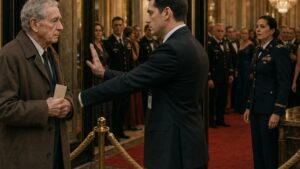
Not sharply. Not theatrically. No heel strike. No turn to the audience. He simply brought himself into alignment before the old man, raised his right hand, and saluted.
The courtroom went completely still.
No one clapped. No one spoke. The salute was too quiet for that. It was not a performance for the benches. It was a line drawn around the old man’s chair, a boundary saying that whoever John Clark was, whatever the court thought it saw, he had once carried something that required care.
John did not return the salute.
His hand went back over the ribbon, but now it trembled. His eyes lowered, not in embarrassment at being honored, but in something heavier. Shame, Andrew thought. Or grief. Or the old anger of a man praised for surviving what someone else did not.
Sarah covered her mouth with her hand.
Jonathan Scott looked down at the rail where his palm had been.
Judge Moore set the gavel on the bench.
After several seconds, Andrew lowered his salute.
“Thank you,” he said to John.
John’s eyes closed briefly.
“Don’t,” John whispered.
The word was so soft Andrew almost missed it.
“Sir?”
John opened his eyes. “Not yet.”
Andrew held still.
That was when he knew the ribbon was not the story. It was the door.
Judge Moore’s voice returned, quieter but guarded. “Colonel Harris, I will ask you plainly. Does this recognition bear on the matter before the court?”
Andrew turned to him. “Potentially.”
“Potentially is not enough.”
“No, Your Honor.”
“Do you have documentation?”
Andrew hesitated. He had seen references. A pending correction. A file request connected to John Clark’s name and a service incident from decades before. He had not brought the record into this room. He had not expected the man attached to it to be seated under a guardianship petition with his daughter pleading and a judge losing patience.
“I may be able to obtain documentation,” Andrew said.
Judge Moore’s expression hardened again, though not as fully as before. “This court cannot suspend judgment because of a gesture.”
The word gesture struck the room wrong.
Andrew saw Jonathan Scott flinch at it, just a little.
John looked up then. His voice, when it came, was rough but clear.
“He’s right.”
Sarah turned. “Dad—”
John did not look at her.
“He’s right,” John repeated. “A salute doesn’t answer the question.”
Judge Moore studied him.
John lifted his hand from the ribbon and placed it flat on the table. The ribbon lay exposed now, faded and plain, smaller than the silence around it.
“I still object,” John said. “But I don’t object because of that.”
He nodded once toward the ribbon.
Andrew felt the old man close the door again, not in refusal, but in discipline.
Judge Moore sat back. “Then we will proceed properly.”
Donna Anderson adjusted her glasses and looked at John differently. Not kindly. Not yet. But differently.
Judge Moore turned a page in the file. “Given the interruption and the possibility of supplemental documentation, this hearing will be continued until Friday morning. In the meantime, Mr. Clark, you are ordered not to remove or destroy any records relevant to this matter. Ms. Anderson may update her report. Colonel Harris, if you have relevant documentation, you may provide it through proper channels.”
Sarah’s shoulders dropped as if the continuance had both saved and wounded her.
John said nothing.
Judge Moore lifted the gavel, then paused. His eyes moved to the ribbon and away.
“This court is adjourned until Friday.”
The gavel came down softer than before.
People began to move, but no one moved easily.
Andrew stepped back from John’s table. Jonathan Scott stood clear of the chair. Sarah rose, uncertain whether to go to her father or wait for permission from a room that had never needed permission to take from him.
John slowly gathered the folders in front of him, his fingers careful at the edges. He left the glass of water untouched.
As Andrew turned to let him pass, John stopped beside him.
“Colonel,” he said.
Andrew straightened, but did not salute again.
John looked at the floor between them. “Find the record if you want. But don’t read it out loud unless I ask you to.”
Andrew studied the old man’s face.
“Yes, sir,” he said.
John nodded once and walked toward the aisle.
Behind him, Judge Moore remained on the bench, staring down at the file as if the papers had become less complete than they were a minute ago.
Chapter 3: Sarah Thought Protection Meant Taking the Keys Away
Sarah Clark had imagined many versions of the hearing, but none in which a uniformed colonel saluted her father before lunch.
She stood in the courthouse hallway with her purse strap twisted around her wrist, watching John move toward the records office as if the building belonged to anyone but him. He walked slowly, one hand near the inside of his suit jacket, the other holding the folder the judge had returned. People stepped aside for him now, but not completely. They gave him the awkward half-space reserved for strangers after a public scene.
That bothered Sarah more than she wanted to admit.
Before the salute, she had wanted the court to see what she saw: the unpaid electric bill, the bank notice folded under the toaster, the appointment card for a doctor he had missed twice, the mud on the floorboard of his old car at dawn. After the salute, she was afraid the court had seen something else and forgotten all of it.
“Dad,” she called.
John stopped but did not turn immediately.
The hallway smelled of floor wax and old paper. A clerk pushed a cart past them, wheels squeaking under stacked files. Somewhere down the corridor, a metal detector beeped and a deputy said, “Empty your pockets, please.”
John finally turned. “Sarah.”
Not honey. Not sweetheart. Sarah. The name he used when he wanted a conversation to stand up straight.
She crossed to him. “Why didn’t you tell me?”
His face gave away nothing. That made anger easier.
“Tell you what?” he asked.
“That a colonel knows you. That there are records. That this”—she glanced at his chest, where the ribbon had disappeared beneath his jacket—“meant something.”
John looked toward the records office door. “It always meant something.”
The words stung because they were true.
Sarah lowered her voice. “You know what I mean.”
“No,” he said gently. “I don’t think you know what you mean.”
Her fingers tightened around the purse strap. “I mean I have been trying to help you while you disappear and hide papers and refuse to answer simple questions. I mean I found shutoff notices in your kitchen drawer. I mean you drove two counties over and didn’t tell anyone where you were. I mean you scared me.”
That last sentence broke loose before she could dress it up.
John’s eyes changed. Not much. Just enough that Sarah knew he had heard the daughter beneath the petitioner.
“I didn’t mean to scare you,” he said.
“But you did.”
“I know.”
The apology did not fix anything. It made her more tired.
Donna Anderson emerged from the courtroom carrying her folder against her chest. She paused when she saw them, then approached with the cautious expression of someone entering a family argument by professional necessity.
“Mr. Clark,” she said. “Ms. Clark.”
Sarah stepped back automatically, as if caught doing something wrong.
Donna looked at John. “Given what occurred in the courtroom, I’ll be updating my notes. But I need to be clear. Service history, even distinguished service, does not by itself address the concerns in my evaluation.”
“I know,” John said.
Sarah looked at him. He sounded almost relieved.
Donna continued, “The court will still need an explanation for the missing records, unpaid bills, and your refusal to cooperate with the home visit.”
John’s mouth tightened. “I didn’t refuse.”
“You asked me to leave after twelve minutes.”
“You opened the wrong drawer.”
Donna blinked once. Sarah closed her eyes.
“Dad,” she said.
John’s hand moved toward his chest, then stopped before touching the ribbon.
Donna’s tone stayed level. “That drawer is part of the home environment I was asked to evaluate.”
“No,” John said. “It isn’t.”
Sarah felt heat rise in her face. “This is exactly what I’m talking about. You say things like that and expect everyone to understand.”
John looked at her for a long moment. The hallway noise moved around them, dull and distant.
“There are papers in that room,” he said, “that belong to a dead man’s family.”
Sarah’s anger faltered.
Donna became very still. “A dead man from your service?”
John did not answer.
Sarah waited. She had waited in hospitals, at kitchen tables, outside the bathroom door after her mother died, in the driveway while John sat in his truck with both hands on the wheel and no engine running. Waiting was part of loving him. So was guessing. She was tired of both.
“Who?” she asked.
John looked past her, toward the records office.
“I’m trying to find the corrected report,” he said.
“What report?”
“The one that should have been filed.”
Sarah stared at him. “Is that why you missed your cardiology appointment?”
John looked down.
“Dad.”
“I was in the archive.”
“Your appointment was at ten.”
“The archive clerk had a window at nine-thirty. If I missed it, I had to wait another week.”
Sarah gave a short, humorless laugh. “So you chose a file over your heart.”
John’s eyes lifted. “No.”
The answer came too quickly, too sharply. Donna noticed. Sarah did too.
John softened his voice. “No, Sarah. I chose a promise.”
The hallway seemed to narrow around that word.
Donna shifted her folder. “Mr. Clark, promises can matter. But the court will need specifics.”
John gave her a look that was not hostile, but closed. “Friday, then.”
Donna nodded slowly. “If by Friday you cannot provide a clear reason for your actions, my recommendation will remain limited guardianship. Possibly temporary, but still significant.”
Sarah did not like the small relief she felt. Temporary. Limited. Legal words that made taking someone’s keys sound like placing a blanket over their shoulders.
John heard it anyway. He always heard what she wished he would miss.
“You think that’s protection,” he said.
Sarah swallowed. “I think protection is making sure you don’t lose the house because you’re chasing ghosts through county files.”
Something in his face tightened.
The moment she said ghosts, she wanted the word back.
John did not rebuke her. That was worse. He only nodded once, as if she had confirmed something he had suspected.
The records office door opened, and a clerk leaned out. “Mr. Clark? I can give you ten minutes before the lunch closure.”
John turned toward the voice.
Sarah reached for him, then stopped short of his sleeve. She did not know when touching her own father had become something she had to consider first.
“Let me come with you,” she said.
“No.”
“Why?”
“Because you’ll ask me to explain before I have the paper.”
“Maybe I need you to explain before I sign away any more of my life trying to keep yours from falling apart.”
John looked back at her then.
There was hurt in his eyes, but not surprise. He had expected this from her. Maybe he believed he deserved it. That thought made Sarah angrier than his silence had.
Donna spoke quietly. “Ms. Clark, I’ll need to speak with you before Friday as well.”
Sarah did not answer her.
John adjusted the folder under his arm. The ribbon remained hidden under his jacket now, but Sarah could feel its presence as surely as if it glowed through the cloth.
“Dad,” she said, softer. “Did Mom know?”
For the first time all morning, John looked unsteady.
Not confused. Not frail.
Caught.
The records clerk called again. “Mr. Clark?”
John turned away before Sarah could read his face fully.
“She knew enough,” he said.
Then he walked into the records office and let the door close behind him.
Sarah stood in the hallway, Donna Anderson beside her, both of them facing the same blank door.
After a long moment, Donna opened her folder and slid a form halfway out.
“Unless your father provides a clear explanation,” she said, “I will recommend limited guardianship.”
Sarah looked at the form.
The words were neat. Practical. Almost merciful.
On the other side of the door, her father was chasing a promise through old paper.
Sarah took the form but did not sign it.
not yet.
Chapter 4: The Report Called His Silence a Symptom
By Tuesday morning, John Clark’s kitchen table had become a battlefield of paper.
Not the loud kind. Not the kind men remembered in stories because there had been shouting and smoke and someone’s hand gripping theirs too hard. This one was quiet. White envelopes. Yellowed forms. A county notice with a red line across the top. An old cardboard folder softened at the spine from being opened and closed too many times.
The faded blue ribbon lay at the center of it all.
John had removed it from around his neck before sunrise and placed it on the table beside the court papers. Without the weight against his chest, he felt wrongly dressed, as if he had walked outside without shoes.
He poured coffee and forgot to drink it.
On the table, Donna Anderson’s preliminary evaluation sat open to the page where she had written her conclusions in measured language.
Respondent presents as guarded, emotionally withdrawn, and resistant to reasonable inquiry.
John read the line twice.
Then the next.
Respondent’s refusal to explain recent removals of personal records may indicate confusion, paranoia, or impaired judgment.
He set the paper down carefully.
Paranoia.
He knew the word. He had heard worse words in cleaner offices. He had learned long ago that a professional sentence could remove a man’s dignity without ever raising its voice.
He looked toward the hallway.
The back bedroom door stood closed. Behind it, in the lower drawer of an old dresser, were documents he had not wanted Sarah to see. Not because they were shameful in the way she imagined. There were no gambling slips, no secret debts, no letters from some woman. Just brittle paper, service copies, faded photographs, a map folded into quarters, and three letters still bound with a rubber band gone dry and cracked.
One of those letters was addressed to a family John had never visited.
He had written it three times and mailed none of them.
A truck passed outside, rattling the kitchen window. John reached for the blue ribbon and stopped before touching it.
“No,” he said into the empty room.
The word had no one to command but himself.
He put on his coat instead.
The courthouse archive desk opened at nine. John arrived at nine-twenty because his knee locked halfway down the porch steps and because he had to sit in the car three minutes before going in. The county building looked different when he came alone. Monday’s courtroom had been full of eyes. Tuesday’s archive floor had the stillness of a place where the past was stored but not honored.
A clerk behind glass recognized him. Her expression changed slightly when she saw his name on the request slip.
“Mr. Clark,” she said, “we pulled the military liaison packet you asked about, but it’s incomplete.”
“It was incomplete last week.”
“I know.”
“And the week before.”
She lowered her voice. “I checked the index. There’s a cross-reference to a veterans service office transfer. It may have gone there when the county digitized old records.”
John closed his fingers around the edge of the counter. “May have?”
“I’m sorry.”
He nodded. He had learned not to punish clerks for systems they did not build.
The clerk slid a photocopied sheet through the slot. “This is what we have.”
John took it. The copy was poor, gray at the edges, but one line near the bottom remained readable.
Incident file correction pending.
Beneath that: Clark, John E. / witness classification disputed.
And below that, partly blurred: surviving party statement unavailable.
John stared until the words began to swim.
Surviving party.
That was what they had called him because paperwork preferred clean categories. Surviving party. Reporting party. Witness. Respondent.
Never the man who had carried a body halfway to a landing zone before being ordered to leave him because two living men were bleeding out behind a wall of broken stone.
The clerk said something, but the sound went thin.
John folded the photocopy and placed it inside his coat.
At the veterans service office, a clerk with tired eyes and a stack of phone messages told him the transfer file was locked pending review.
“Colonel Harris called ahead,” she said. “He asked us to flag anything connected to your name.”
John felt heat rise in his neck. “I didn’t ask him to do that.”
“No, sir.”
“I didn’t ask for help.”
The clerk’s face softened. “Sometimes help gets filed before permission.”
John almost smiled. Almost.
Instead he asked for the original transfer log.
She disappeared into a back room and returned with a narrow ledger scanned onto thick paper. She set it down in front of him and pointed.
“There. One packet moved from county archive to federal liaison, then partially returned. The corrected report was never attached.”
John read the date.
Fourteen years ago.
The year his wife was still alive, still sitting across from him at breakfast, still reaching across the table when his hands shook too hard around the coffee cup.
She had known enough.
Not everything. Enough.
On Wednesday, Sarah came to the house and let herself in with the key he had not yet asked her to return.
John was in the back bedroom, sitting on the edge of the bed with the lower dresser drawer open. The blue ribbon lay across his knee. He heard the front door, the pause, the familiar rhythm of her shoes.
“Dad?”
“In here.”
She appeared in the doorway and stopped.
The room was neat except for the papers. Sarah’s eyes moved over them: service forms, county copies, old envelopes, the corner of a photograph John turned face down before she could see it fully.
Her face tightened. “You said you wouldn’t remove records.”
“I didn’t.”
“You’re hiding them.”
“I’m sorting them.”
“That sounds different only to you.”
John looked down at the ribbon. “Maybe.”
She stepped inside. “Donna called me. She said if you can’t give specifics by Friday, she’ll recommend the court step in.”
“I heard her.”
“Then why are you making it harder?”
He breathed out slowly. “Because easy isn’t always right.”
Sarah folded her arms, but the gesture was weaker than usual. “Is this about the man you mentioned?”
John’s thumb moved over the ribbon’s worn edge.
“There was a soldier,” he said.
Sarah did not move.
John kept his eyes on the cloth. “He was younger than I was. Not much. Enough. We were in a place we weren’t supposed to talk about much afterward, attached to a unit that moved people out when roads closed and command maps stopped matching the ground.”
Sarah sat carefully in the chair near the dresser. She seemed afraid sudden movement might make him stop.
“His name?” she asked.
John closed his eyes.
The name came to him with a face, dust in the eyebrows, a grin too quick for the place they were in. It came with the smell of hot metal and wet cloth and a voice saying, Tell them I stayed because somebody had to.
John opened his eyes.
“Not yet,” he said.
Sarah’s face fell.
He hated himself for that.
“I can’t give you part of him like gossip,” John said. “Not in pieces.”
“I’m not asking for gossip. I’m asking why my father would rather let a judge take his life apart than tell me what he’s doing.”
John folded the ribbon once. “Because if I tell it wrong, Sarah, someone else pays for it.”
She looked at him for a long time.
Then, quieter, “You think I won’t understand.”
“No,” he said. “I think you’ll try too hard to.”
That hurt her. He saw it land, saw her turn her face slightly away.
“I’m your daughter,” she said.
“I know.”
“Then let me be.”
The room held the sentence after she finished it.
John wanted to tell her everything then. Not the service record version. The real version. The checkpoint that became a trap. The children inside a storage room. The order to withdraw. The private refusal that saved nine people and left one soldier’s name tangled in a mistake. The blue ribbon passed into John’s hand by a man who should have been the one wearing it.
But Sarah had come looking for proof of competence, and that story, once opened, did not fit inside a competence hearing. It filled rooms. It changed families. It disturbed graves.
He handed her one paper instead.
She took it. “What is this?”
“A copy from the archive.”
Her eyes scanned it. “Incident file correction pending.”
“That correction should have been done years ago.”
“Why wasn’t it?”
John looked at the face-down photograph.
“Because I stopped pushing.”
“Why?”
“Your mother got sick.”
Sarah’s mouth parted slightly.
“And after she died,” he said, “I couldn’t walk into another office and ask them to dig up another man’s last day. So I put it away.”
Sarah looked down at the paper again. “Then why now?”
John’s hand closed over the ribbon.
“Because the family wrote to the veterans office,” he said. “They’re trying to correct his marker before his sister dies. The old mistake is still there.”
Sarah’s anger changed shape. It did not disappear. It became less certain where to stand.
“You could have told me that,” she said.
“I should have.”
“Yes.”
“I know.”
Her eyes shone, but she did not cry. “You missed your doctor appointment for this.”
“I did.”
“That was foolish.”
“Yes.”
“And frightening.”
John looked at her. “Yes.”
The admission seemed to take some fight out of her.
On Thursday, a letter arrived by hand from the court. Donna Anderson’s updated note was attached to a procedural order requiring John to appear Friday morning with any supporting documentation. The language was polite. Firm. Final enough to make the kitchen seem smaller.
John placed it beside the ribbon and the photocopy.
He was still standing there when a knock came at the front door.
Not Sarah’s knock. Not the neighbor’s. Official. Two firm taps, a pause, one more.
John opened the door.
Jonathan Scott stood on the porch in his bailiff’s jacket, a folded notice in one hand. He looked less certain outside the courthouse. Without the rail and the bench and the rules around him, he seemed younger.
“Mr. Clark,” he said.
John looked at the notice.
Jonathan held it out, then stopped himself before pushing it forward.
“The court asked me to deliver this,” he said. “It orders your appearance Friday at nine.”
John took the paper.
Jonathan’s eyes flicked once to John’s chest. The ribbon was not there. It lay behind him on the kitchen table.
“I understand,” John said.
Jonathan nodded but did not leave.
John waited.
The bailiff shifted his weight. “Sir,” he said, awkwardly, “about Monday.”
John kept his hand on the edge of the door.
Jonathan swallowed. “I stood too close.”
John looked at him then.
“Yes,” he said.
Jonathan accepted it without defense. That was new.
“I’ll see you Friday,” the bailiff said.
John nodded.
As Jonathan walked back down the steps, John looked over his shoulder at the blue ribbon lying among the papers.
Being believed, he thought, might cost him the promise.
Being silent might cost him everything else.
Chapter 5: The Bailiff Finally Asked Before Touching the Ribbon
Jonathan Scott saw John Clark before the metal detector did.
The old man stood just inside the courthouse entrance on Friday morning, hat in one hand, folded papers in the other, the faded blue ribbon once again resting against his shirt. The ribbon looked smaller under the fluorescent lights, less like an honor and more like something that had survived a drawer, a storm, and too many fingers.
The security line had already begun to stack behind him.
A man with a briefcase sighed. A woman checked her phone. A deputy at the scanner waved a plastic tray toward the counter.
“Keys, wallet, belt, anything metal,” the deputy said.
John looked at the tray.
Jonathan stepped from beside the wall before anyone else could speak.
“I’ll handle this,” he said.
The deputy glanced at him, surprised, then moved back.
Jonathan heard his own voice in the open lobby and felt the Monday courtroom return: his hand on the back of John’s chair, the old man saying, Please don’t crowd me, Judge Moore insisting procedure did not stand over his shoulder. At the time, Jonathan had been certain he was simply doing his job.
Now he wondered how often people used that sentence to avoid noticing where they had put their hands.
John looked up at him. “Mr. Scott.”
“Mr. Clark.”
The formality felt earned and uncomfortable.
Jonathan gestured to the tray, then stopped. He kept his hand low, away from John’s chest. “The scanner may pick up the clasp.”
John’s fingers went to the ribbon.
The line behind them shifted again. Someone muttered about being late.
Jonathan turned his head slightly. “There’s another station open.”
There was not.
The man with the briefcase looked at him, then looked away.
Jonathan faced John again. “May I?”
The words came out quieter than he intended.
John studied him.
For a moment Jonathan thought the old man might say no, and he would have to decide whether to follow policy or the strange weight of a lesson he had not asked to learn.
But John untied the ribbon himself.
His hands were steady at first. Then the knot caught. Not badly. Just enough that the ribbon twisted under his thumb. Jonathan did not reach in. He waited.
John freed it and held it out.
Jonathan placed both hands under it, palms open, letting John lower the ribbon into them rather than taking it.
The cloth weighed almost nothing.
That was what startled him.
On Monday, that ribbon had changed an entire courtroom, and now it lay across his hands like something a child might have folded from worn silk. A strip of blue fabric. Darkened at one edge. Repaired near the clasp.
Jonathan placed it alone in the tray, away from John’s keys, away from the coins and pen and folded reading glasses.
“Thank you,” John said.
Jonathan looked at him. “No, sir.”
John’s eyes held his for a moment, then moved to the scanner.
The machine gave no alarm.
At the far end of the belt, Jonathan lifted the tray before anyone else touched it. He carried it to the counter and set it down in front of John.
The old man reached for the ribbon, then paused.
“You don’t have to do all that,” he said.
Jonathan kept his voice low. “I should have done less Monday.”
John did not answer right away. He threaded the ribbon back beneath his collar, his fingers careful with the knot. When it settled against his chest, he placed his hand over it once and let it fall.
“That’s not nothing,” John said.
Jonathan had no reply for that.
They walked together toward the courtroom corridor. Not side by side exactly. Jonathan kept half a pace behind, partly from habit, partly from intention. Ahead of them, Sarah Clark stood near the wall with Donna Anderson. Sarah held a folder against her chest, her hair pinned neatly, her face not nearly as composed as she wanted it to be. Donna was reading from her own file, expression guarded.
Colonel Andrew Harris waited near the courtroom door in dress uniform. He had no audience around him, no dramatic entrance this time. He stood quietly with a sealed folder under one arm.
When John approached, Andrew straightened but did not salute.
Jonathan noticed that too.
“Mr. Clark,” Andrew said.
“Colonel.”
“I have something.”
John’s eyes went to the folder.
Andrew kept it tucked under his arm. “The missing record. Or what remains of it. The veterans office found the transfer copy. It includes the correction request and two attached statements.”
Sarah took one step forward. “Statements from who?”
John’s face closed.
Andrew looked to him, not Sarah. “I have not shared the contents.”
Donna Anderson’s eyes sharpened. “If it is relevant to today’s hearing, it should be entered properly.”
“It will be,” Andrew said. “If Mr. Clark permits it.”
That word moved through Jonathan as strongly as any command.
Permits.
John looked at the sealed folder for several seconds.
Then he said, “Not yet.”
Sarah’s shoulders tightened. “Dad—”
“Not until I say what happened.”
Andrew gave a small nod. “Understood.”
Donna closed her folder halfway. “Mr. Clark, the court will expect clarity.”
John turned to her. “It will get the truth.”
“Those are not always the same thing,” Donna said.
“No,” John said. “They are not.”
The courtroom doors opened, and the clerk looked out. “Clark matter.”
Sarah reached for John’s sleeve this time. Her fingers touched the fabric lightly and waited there, as if asking whether they were allowed.
John looked down at her hand.
She withdrew it, embarrassed.
He surprised her by offering his arm.
Only for the few steps into the courtroom. Only enough that she knew he had noticed. Sarah took it without speaking.
Jonathan followed them in.
The room looked the same as Monday and not the same at all. The bench was still high. The flag still stood in the corner. The spectator rows still held people waiting for someone else’s trouble to become understandable. Judge Moore sat above them with the same file open, the same gavel within reach.
But Jonathan saw the room now from behind John’s shoulder.
He saw how low the respondent’s chair sat compared with the bench. He saw how far the table was from the water pitcher. He saw that the microphone angled too high for a seated old man unless he leaned forward until his back curved.
He had never noticed that before.
John took his seat. Sarah sat behind and slightly to his left. Donna took her place at the table. Andrew remained in the back row unless called.
Jonathan moved toward his usual position beside the rail, then stopped. On Monday, he had stood close enough for John to smell his coffee. Today he stepped back until there was space between his hands and the chair.
Judge Moore noticed.
His gaze moved from Jonathan to John to the ribbon.
“Good morning,” the judge said.
His voice was still formal. Still controlled. But it did not strike the wood before it reached them.
“This matter was continued,” he said, “to allow for supplemental information and clarification from Mr. Clark.”
John rested his papers on the table.
Judge Moore looked directly at him. “Mr. Clark, do you understand why we are here today?”
John adjusted the microphone. It squealed softly, and the court clerk winced.
Jonathan stepped forward by instinct, then stopped himself.
John fixed it without help.
“Yes, Your Honor,” he said.
The voice was not loud, but it carried.
Judge Moore nodded. “Then we will proceed carefully.”
Sarah glanced at her father.
John’s hand went to the ribbon once, then dropped to the folder in front of him.
Jonathan stood near the rail with his hands folded before him, far enough away that the old man had room to breathe.
For the first time since Monday, John Clark looked less like a man surrounded.
He looked like a man deciding where to begin.
Chapter 6: John Chose the Truth That Did Not Save Him
John Clark had imagined telling the truth in many rooms.
Never this one.
In his mind, the truth belonged to smaller places: the kitchen after midnight, his wife’s side of the bed after she died, the driver’s seat of his car outside the veterans service office, the back pew of a church during a funeral he had not entered. It did not belong under fluorescent courtroom lights, arranged between microphones and exhibit stickers, while a judge watched over reading glasses and a court reporter waited to make every word permanent.
Yet the ribbon lay beneath his fingers, and the sealed folder rested near Andrew Harris in the back row, and Sarah sat close enough that John could hear when she stopped breathing between his sentences.
Judge Moore folded his hands on the bench.
“Mr. Clark,” he said, “you may explain why you object to the proposed guardianship and why certain records have been removed or withheld.”
John looked at the judge. “I object to losing my voice because I used it poorly.”
A small movement passed over Donna Anderson’s face.
Judge Moore waited.
John looked down at his papers. He had written notes the night before in large block letters so his eyes would not betray him. The first line said: Do not start with the ribbon.
He started with the ribbon anyway.
“This belonged to a man who did not come home the way he should have,” John said.
Sarah’s hand tightened around the edge of her folder.
John untied the ribbon slowly. No one moved to help him. That was the first mercy of the morning. The knot came loose, and the fabric slid into his palm, soft from decades of being touched. He placed it on the table between the court papers and his own shaking hands.
It looked smaller there.
Less capable of explaining anything.
“I wore it Monday because I was afraid I wouldn’t say his name if I didn’t feel the weight of it.”
Judge Moore leaned slightly forward, not in impatience now, but to hear.
John kept his eyes on the ribbon. “Years ago, I was part of a rescue detail attached to an Army unit during an evacuation. The official record says I was a witness to the loss of a soldier during withdrawal. That record is wrong.”
The courtroom was silent except for the court reporter.
John heard the old sounds under the new ones: rotor blades somewhere beyond smoke, a radio cutting out, boots sliding on stone dust. He let them come only close enough to light the path, not close enough to take him.
“There were civilians trapped near a storage building,” he said. “Children. Two elderly women. A local interpreter. We had orders to clear the road and leave before the second shelling. A young soldier stayed back because the last child wouldn’t move. I went after him.”
Andrew Harris lowered his head slightly.
Sarah did not move at all.
“The report later said he broke position without authorization and delayed the withdrawal. It said I witnessed it. It made him sound reckless.”
John’s voice grew rough. He paused and took water. The glass clicked against his teeth.
Judge Moore did not hurry him.
“That was not what happened,” John said. “He stayed because somebody had to keep the children quiet until we could get them through the back wall. He gave his own vest to the interpreter. When the wall came down, he was pinned.”
John looked at the ribbon.
“He asked me to take the last boy out first.”
Sarah covered her mouth with one hand.
John did not look at her. If he did, he might stop.
“I went back. I did. I want that clear.” He pressed his palm flat to the table. “I went back. But by then two others were bleeding near the road, and command was calling final extraction. I had one arm that still worked right and three men shouting different orders. He was alive when I left him.”
No one in the room breathed loudly enough to be heard.
John closed his eyes for one second.
“He gave me the ribbon before I moved. Not as a medal. Not for honor. He said if anyone tried to make it look like he ran off or disobeyed for nothing, I was to tell them he stayed because someone had to.”
His hand hovered over the ribbon but did not touch it.
“I promised.”
Judge Moore’s face had changed. Not softened exactly. Stripped.
John continued before pity could enter the room and make him angry.
“When the first report came through, it was wrong. I challenged it. Then a correction started. Then the file moved between offices. Then years passed. His family was told enough to bury him, not enough to clean his name. His sister has been trying to correct the marker before she dies. I found out through the veterans office.”
Donna Anderson looked at the papers in front of her. “Mr. Clark, why did you not explain this during the evaluation?”
John turned to her. “Because you opened the drawer where his letters were.”
Donna’s eyes lowered briefly.
“I don’t say that to shame you,” John said. “You were doing your job. But I had kept those letters out of other hands for a long time. Some were written to his family and never sent. Some were from my wife, telling me to finish what I started. I couldn’t have a stranger treat them as evidence of whether I knew what day it was.”
Donna absorbed that without defending herself.
Sarah’s voice came small from behind him. “You could have told me.”
John turned enough to see her.
“Yes,” he said.
That was all. No excuse. No explanation hiding inside another explanation.
Sarah’s eyes filled.
John faced the bench again. “I missed bills. I missed an appointment. I drove when I should have asked for help. That is true. My daughter was not wrong to be frightened. Ms. Anderson was not wrong to be concerned. Your Honor was not wrong to ask for answers.”
He stopped. His fingers curled once on the table.
“But I am not confused about my house. I am not confused about my records. I am not hiding papers because I think the world is after me. I am trying to correct a record that should have been corrected when my hands were steadier and my wife was alive to make me do it.”
The faintest sound moved through the spectators, not applause, not even a murmur. More like a collective recognition that the old man was not asking to be admired.
Judge Moore looked toward Andrew. “Colonel Harris.”
Andrew rose. “Yes, Your Honor.”
“You have documentation?”
“I do.”
“Approach.”
Andrew came forward with the sealed folder. Before opening it, he looked at John. “Sir?”
John nodded.
Only then did Andrew break the seal.
He handed copies to the clerk, Donna, the county attorney, and the judge. He kept one page aside until the judge looked at him.
“This packet includes a transfer log, the pending correction request, and two statements. One statement is from Mr. Clark. One is from another surviving member of the rescue detail, now deceased. Both contradict the original classification.”
Judge Moore read in silence.
John watched his eyes move over the page. It was a strange feeling, seeing the old day enter the court through clean copies. Paper made everything look smaller. Neater. Survivable.
Judge Moore looked up. “Mr. Clark, this explains the records. It does not fully explain why you resisted assistance with financial matters.”
“No,” John said. “It doesn’t.”
Sarah looked startled.
John turned slightly toward her. “I resisted because I was ashamed.”
She shook her head once, a tiny movement.
“I did not want my daughter to know I could still keep a promise from forty years ago and forget the electric bill on the counter.” His mouth tightened. “That is not noble. That is pride.”
Sarah’s face broke then, but quietly.
John looked back to the judge. “I need help. I do not need to be handled. There is a difference.”
Judge Moore said nothing.
John picked up the ribbon.
“I am asking this court to judge what I can do now, not what I once did. Not because of this.” He held the ribbon just high enough to be seen. “This does not make me competent. It does not make me honest today. It does not pay a bill or keep a doctor’s appointment.”
He laid it back down.
“But the reason I was silent was not incapacity. It was a promise, and fear, and too much pride. Those are human failings. They are not proof that I no longer own my own life.”
Donna Anderson closed her folder.
The sound was soft, but everyone heard it.
“Your Honor,” she said, “I would like to revise my recommendation.”
Sarah drew in a breath.
Judge Moore looked at Donna, then at John.
For a moment, the courtroom waited not for the judge, but for the old man who had finally finished the sentence no one let him finish Monday.
Chapter 7: The Room Waited Until the Veteran Finished Speaking
Donna Anderson did not stand when she asked to revise her recommendation.
She remained seated, both hands resting on the closed folder, as if the simple act of shutting it had changed its weight. John watched her from the respondent’s table and felt the old instinct to distrust mercy that arrived too quickly. He had spent too many years watching rooms change after one document surfaced, one uniform entered, one name caught a person’s attention. People could become gentle for a minute and still go back to taking over when the minute passed.
Judge Moore looked down from the bench. “Ms. Anderson, be specific.”
Donna opened the folder again, but only halfway. “My original recommendation was for limited guardianship over property, finances, and personal records. Based on Mr. Clark’s testimony, the supplemental documents, and his explanation for the withheld records, I no longer believe the personal records component is appropriate.”
Sarah let out a breath behind John.
Donna continued, “I do still have concerns about missed bills and medical appointments. Those concerns are real. But I believe they can be addressed through a less restrictive arrangement, provided Mr. Clark agrees to structured assistance.”
Judge Moore turned to John. “Mr. Clark?”
John’s hand rested near the blue ribbon on the table. He did not pick it up yet.
“What kind of assistance?” he asked.
The question sounded simple. It changed Sarah’s face.
All week, other people had spoken around that word. Assistance. Protection. Oversight. Authority. Each one had come dressed like help and carrying a key. This was the first time John had asked for the shape of it.
Donna glanced at Sarah, then back to John. “A bill-payment review with your daughter present only by your consent. Medical appointment reminders. A written plan for record storage. No removal of private service documents without your permission unless ordered by the court.”
Judge Moore looked at Sarah. “Ms. Clark, your petition requested broader authority.”
Sarah stood slowly.
John did not turn around. He watched her reflection instead in the dark shine of the table: a blue dress, pale hands, a woman holding herself together by habit.
“I did,” she said.
Her voice trembled, but it did not break.
Judge Moore waited.
Sarah looked at her father’s back. “I thought if I could get control of the accounts and the records, I could stop being afraid every time he didn’t answer the phone.”
John closed his eyes.
There it was. Not the house. Not the files. Not the old drawer.
Fear.
Sarah stepped closer to the table, but not too close. She had learned that by Friday morning. Or maybe he had finally taught it in a way she could hear.
“I thought I was protecting him,” she said. “Some of that was true. Some of it was me not knowing what else to do.”
Judge Moore’s gaze softened only enough to become human. “Do you wish to amend your request?”
Sarah looked at Donna, then at the sealed copies, then at the ribbon on the table.
“Yes,” she said. “I withdraw the request for authority over his personal records. And over the house, except for emergency contact access if he agrees.”
John turned then.
Sarah met his eyes. “If you agree.”
The courtroom held still around those three words.
John had expected anger from her. He had expected tears. He had even expected, somewhere deep inside, that she would be relieved to have a judge do the hard thing for her. He had not expected permission to return through his daughter’s mouth like something fragile and new.
Judge Moore looked back to John. “Mr. Clark, do you agree to a limited support plan for bill management and medical appointments?”
John looked at the ribbon.
The cloth had lain between court papers long enough to look misplaced. It did not belong on exhibits. It did not belong under fluorescent light. It belonged close to the chest because that was where he could keep the promise without making other people kneel before it.
“I agree to help,” John said. “Not control.”
Judge Moore nodded. “The order will reflect that distinction.”
The court reporter’s fingers moved quickly.
John listened to the words being made official and felt no victory rise in him. Victory was too loud a thing. What came instead was a loosening, small and almost painful, as if a band around his ribs had been cut but his body had not yet learned to breathe past it.
Judge Moore removed his glasses and set them beside the file.
“Mr. Clark,” he said.
John looked up.
The judge’s voice lowered. “On Monday, I moved this hearing too quickly.”
A murmur threatened at the back of the room, but one glance from Jonathan Scott stopped it.
Judge Moore continued, “The court was right to ask for answers. It was not right to mistake your pace for refusal before allowing you room to answer.”
John sat very still.
This was not an apology built for applause. It was procedural. Limited. Almost stiff. But it landed cleaner because of that. Judge Moore was not trying to become a different man in one sentence. He was changing what he had done.
“Thank you, Your Honor,” John said.
Jonathan stood near the rail, hands folded before him, farther back than he needed to be. When John shifted to reach for the ribbon, Jonathan moved by instinct as if to assist, then stopped before the movement became intrusion.
John saw it.
So did Jonathan.
The bailiff’s face colored faintly, but he did not look away.
John picked up the ribbon himself. His fingers found the worn fold, the dark repair near the clasp, the old softness made by years of being carried instead of displayed. He looped it back beneath his collar. The knot took time. No one hurried him.
The room waited.
Even Judge Moore waited.
When the ribbon settled against John’s shirt, he placed one hand over it. Not to hide it now. Not to shield it from the court. Only to feel that it was there.
Andrew Harris remained in the back row. He had not spoken since handing over the documents. He had not saluted again. John was grateful for that. One salute had opened the door. A second might have turned the room into something else.
Judge Moore gave the final order. The guardianship petition would be modified. Sarah would assist by consent. Donna would file a revised recommendation. The veterans service office record would be handled separately, with John’s permission required before private letters were disclosed beyond the correction process.
The gavel came down.
Softly.
Court ended not with triumph, but with chairs shifting, papers being gathered, people remembering they had coats and phones and errands waiting beyond someone else’s life. Spectators filed out in low voices. The county attorney spoke briefly with Donna. The clerk collected copies.
John remained seated for a moment.
Sarah came around the table and stopped beside him.
“Dad,” she said.
He looked up.
She did not reach for his arm this time. She held out his hat.
He took it, but did not stand yet.
“I didn’t want your house,” she said.
“I know.”
“No,” she said, and her mouth tightened. “I need to say it right. I was afraid I was losing you, and I tried to make that fear look like paperwork.”
John looked at the hat in his hands. Its brim was worn shiny where his fingers always found it.
“I made silence look like strength,” he said. “It wasn’t always.”
Sarah sat beside him in the empty chair.
For a little while, neither of them moved.
Across the room, Jonathan Scott unlocked the gate in the rail. He opened it and stepped back, leaving space. The gesture was small. No one else would have made much of it.
John did.
When he rose, Sarah did not take his arm. She walked beside him, slow enough for his knee, close enough for his pride.
At the aisle, Andrew Harris stood.
John stopped before him.
Andrew held himself straight, but his hands remained at his sides. “The veterans office will proceed only with your approval,” he said. “The correction may take time.”
“Most things worth doing do,” John said.
Andrew nodded. “The family will know he stayed.”
John looked at him sharply.
Andrew’s voice stayed low. “Only that. Unless you choose more.”
John let the sentence settle.
The family will know he stayed.
For forty years, the promise had been too large to carry and too private to put down. Now it had become a sentence that did not betray the dead man, did not clean the old day too neatly, did not ask John to be heroic for surviving it.
He nodded once.
“Good,” he said.
Outside, the courthouse steps were bright with afternoon sun. The air had warmed, and traffic moved along the street with ordinary impatience. A delivery driver crossed the sidewalk with a stack of boxes. A woman guided a child around a puddle near the curb. Life had not paused for the court’s order, and John was glad of that.
Sarah stood beside him at the top step.
“You have a doctor’s appointment Monday,” she said carefully.
“I know.”
“Do you want me to drive you?”
John looked at the courthouse lawn, where the flag moved against a pale sky.
He thought about saying no. The old answer rose automatically, shaped by habit, pride, and the fear that accepting one ride meant surrendering every road after it.
Then he looked at his daughter.
“Ask me Sunday,” he said.
Sarah smiled, but only a little, as if she did not want to frighten the answer away. “Okay.”
They descended the steps together.
Halfway down, John paused. Not because he needed to, though his knee complained. He turned back toward the courthouse doors. Through the glass, he could see Jonathan speaking with a deputy near the security station. Jonathan noticed him and gave a small nod.
Not a salute.
Better.
John touched the ribbon once through his shirt.
Sarah noticed but did not ask.
At the sidewalk, she walked to the passenger side of her car, then stopped. “Dad?”
He looked over.
“What kind of help do you want with the bills?”
The question was plain. No courtroom. No petition. No folder.
John took his time answering.
“Sit at the kitchen table,” he said. “Bring coffee. Don’t open drawers unless I ask.”
Sarah nodded. “I can do that.”
He opened the car door himself.
Before getting in, he looked once more at the courthouse: the high windows, the dark doors, the flag, the place that had almost mistaken his silence for absence. He had not left it victorious. He had left it heard.
That was enough for one day.
John lowered himself into the seat, the blue ribbon resting quietly against his chest, and Sarah closed the door gently after asking with her eyes.
The story has ended.