They Laughed When the Old Pilot Touched the Helmet, Then the Same Warning Returned
Chapter 1: The Mark Beneath the Clean Helmet
Tyler Adams laughed once, sharp enough for the two junior aircrew members beside him to hear.
“You want us to cancel the demonstration because your antique helmet looks familiar?”
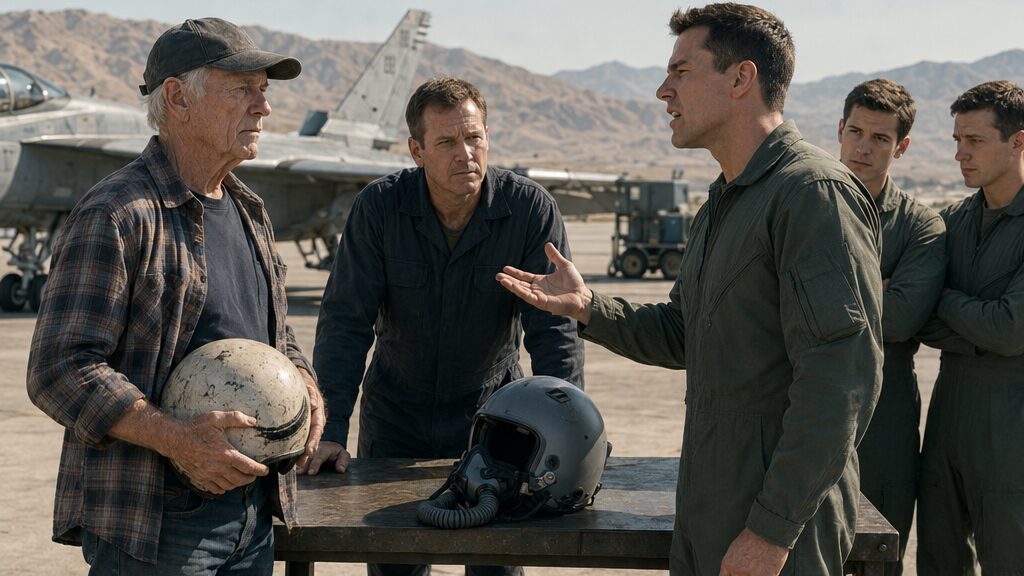
Gregory Moore stood at the edge of the flight-equipment staging area with the old white helmet balanced in both hands. Beyond Tyler, heat shimmer bent the parked aircraft at the knees. Ground carts rolled between painted lines. A maintenance vehicle idled near the hangar, its diesel vibration carrying through the concrete.
Gregory looked at Tyler’s clean gray helmet resting on the folding table.
“No,” he said. “I want you to look beneath the coupling.”
Tyler’s smile thinned. He wore an olive flight suit, sleeves neat, patches squared, survival vest already fitted for the afternoon demonstration. The briefing had stopped around them. Gregory could feel the silence spreading from one person to another.
Janet Lewis stood several paces away with the empty display case they had brought from the archive. Her expression warned Gregory not to push too hard.
He had heard that warning from her before.
Tyler picked up his helmet by the crown. “This was inspected at oh-six-thirty.”
“Then another look won’t hurt it.”
“We use pressure diagnostics now.”
“So did we.”
A junior airman glanced down, hiding something that might have been a smile.
Tyler heard it in the movement. His jaw tightened. “What exactly do you think you see?”
Gregory shifted the old helmet to his left hand. His right hand trembled beside his thigh. It had done that since winter, most noticeably when he was tired or watched. He waited until the tremor eased, then extended two fingers toward Tyler’s equipment.
“May I?”
Tyler hesitated before setting the helmet down.
Gregory did not touch it immediately. He lowered his head until the rim caught the light. There it was: a pale crescent where the oxygen-hose coupling entered beneath the shell, no wider than a thumbnail. The surface had been polished by movement, not scratched by handling.
He turned his own helmet sideways.
Its white shell had yellowed with age. Chips along the crown exposed darker material underneath. Near the oxygen port, a scorched groove curved beneath the rim like a blackened smile.
Gregory placed the two helmets side by side.
“Different equipment,” Tyler said.
“Yes.”
“Different coupling.”
“Yes.”
“Different retention assembly.”
Gregory nodded. “The mark is still in the same place.”
That quieted the aircrew more effectively than argument.
He fitted one finger under the rim of the old helmet and another beneath the new one. The scorched groove on his helmet aligned with the clean crescent on Tyler’s. Old damage beside new wear. One black, one nearly invisible.
Matthew Hall came out of the equipment shop, wiping his hands on a cloth. At forty-four, he had the careful expression of a man who preferred problems to arrive on forms.
“What’s held up?” he asked.
Tyler gestured toward Gregory without looking at him. “Mr. Moore believes this coupling is walking.”
Matthew leaned over the table. “It passed rotational tolerance.”
“Under load?” Gregory asked.
“Static and pressure.”
“Not what I asked.”
Matthew looked at him then, more directly than Tyler had. “What kind of load?”
“Vibration, hose tension, head movement. Together.”
Tyler exhaled. “Old-flight-line thinking. Find a mark, build a story around it.”
The words were loud enough to carry.
Gregory felt every face turn toward him, then away. He had once stood in rooms where a single sentence from him could ground an aircraft. Now he wore a faded plaid shirt, jeans, and a visitor badge printed in letters too small for him to read without glasses.
The old helmet rested beneath his hand.
He could have told Tyler who had signed its inspection record. He could have named the test program, the altitude, the airspeed at separation. He could have explained why the scorch stopped where it did.
Instead, he rotated the modern coupling a quarter turn.
“Listen,” he told Matthew.
Gregory pressed the hose upward against the rim and rolled the helmet slightly, imitating the angle of a pilot checking over his shoulder.
A small click sounded inside the fitting.
Then another.
Matthew’s eyes narrowed.
Tyler’s expression did not change. “Mechanical detents.”
“The first one is,” Gregory said.
“And the second?”
“I don’t know yet.”
That answer unsettled Tyler more than certainty would have.
Matthew took the helmet and repeated the movement. One click. He changed his grip, pressed harder, tilted the shell.
Click. Click.
A junior aircrew member leaned closer.
Tyler folded his arms. “Pressure cart.”
Matthew carried the helmet inside the open bay. Gregory followed, slower than the others. His right boot caught the lip of the threshold, and Tyler reached instinctively toward his elbow.
Gregory steadied himself before Tyler touched him.
The pressure cart hissed as Matthew connected the hose and sealed the mask against a test head. Numbers climbed on the display. The technician beside him watched for fluctuation.
Gregory watched the coupling.
“Rotate it,” he said.
Matthew did.
“Put tension on the hose.”
Matthew pulled downward while the equipment technician tilted the test head.
The seal held.
Matthew increased pressure, then decreased it. He worked the coupling through every permitted angle. The graph remained flat.
Tyler stood where Gregory could see him without turning.
“Again,” Gregory said.
They repeated the sequence.
Nothing moved. No second click. No pressure drop.
The equipment technician removed the line. “Within limits.”
Tyler’s shoulders loosened. He did not smile this time, which Gregory almost respected.
“You saw wear,” Tyler said. “That was worth checking. But we checked it.”
“You checked it standing still.”
“The helmet will be connected to an aircraft system monitored in real time.”
Gregory looked from the clean coupling to the old black groove. For one disorienting moment, the modern equipment shop disappeared. He heard wind beating against a canopy and a voice through static saying the mask felt loose only when he turned left.
He put one hand on the table until the memory passed.
Tyler saw the movement. “Are you all right?”
“I’m seventy-six. That question has too many possible answers.”
One of the junior airmen laughed before catching himself.
The tension broke slightly, but not enough.
Gregory took a pencil from beside the inspection log. With Matthew’s permission given only by silence, he drew a tiny line across the fixed collar and the rotating coupling.
“Mark where it is now,” Gregory said. “Check it after the run.”
Tyler looked at the pencil line. “You’re assuming it moves.”
“I’m asking you not to assume it doesn’t.”
The operations commander appeared at the far end of the bay and lifted a hand toward Tyler. The gesture meant the schedule had already begun to slip.
Tyler removed the release form from a clipboard.
For a second, Gregory believed he might delay the run. Tyler read the pressure-test result, looked once at Matthew, then signed his name.
“Return it to staging,” he said. “Ground run in forty minutes.”
Matthew took the helmet.
As Tyler walked away, Gregory remained beside the table with the old white shell beneath his palm. His two fingers had gone steady again.
Outside, a turbine began to turn.
Chapter 2: A Test That Proved Too Little
Matthew found the pencil mark after Gregory had left the staging table.
It was barely visible, a gray line no thicker than an eyelash crossing from the stationary collar to the coupling. He rubbed it once with his thumb. The graphite smudged at the edge but held.
“You planning to leave that?” the equipment technician asked.
Matthew lowered his hand. “For now.”
He carried the helmet into the shop and placed it beneath the inspection lamp. Modern flight gear was designed to expose defects to people who knew where to look: date codes, locking tabs, seal wear, hose stiffness, connector play. Matthew had spent twenty-two years learning not to distrust a procedure simply because a more dramatic explanation had entered the room.
He had also spent two months recovering from an inspection error that had grounded six aircraft unnecessarily.
No one had been hurt. Nothing had failed. But the base operations commander had remembered the delay, the canceled sortie hours, and the maintenance review that followed. Matthew remembered the commander’s sentence even more clearly.
Judgment is useful when it is disciplined.
He rotated Tyler’s coupling to the pencil line. It settled cleanly.
The shop door opened. Gregory came in carrying the battered helmet against his ribs. Janet followed, speaking under her breath.
“You did not have to make it a confrontation.”
“I pointed at a mark.”
“You pointed at it during his briefing.”
“That’s where the helmet was.”
Matthew pretended to study the inspection record.
Janet saw him. “Chief Hall, I apologize. Mr. Moore has never developed a reliable sense of ceremony.”
“I had one,” Gregory said. “I retired it.”
Matthew looked between the helmets. “Can you show me exactly what failed on yours?”
Gregory set the old helmet down but kept one hand on it.
“The hose loaded against the rim. The coupling shifted. Seal started pulsing when the aircraft vibrated.”
“This connector can’t travel the same way.” Matthew turned Tyler’s helmet and indicated a locking shoulder inside the assembly. “The old design had a wider rotational path. This one bottoms out here.”
Gregory bent nearer. The inspection light emphasized every line in his face.
Matthew moved the coupling until metal met metal. “Even if the collar walks, the secondary lock holds.”
Gregory studied it for several seconds. “You’re right about the part.”
Tyler entered from the corridor in time to hear him.
“So we’re done,” he said.
“I didn’t say that.”
Tyler leaned against the doorframe. “The failure you described can’t happen on this assembly.”
“Not in the same way.”
“That distinction matters.”
“It does.”
Matthew sensed the ground shifting between them. Gregory had enough pride to resist correction, yet he had accepted it without argument. That should have helped. Instead, his refusal to abandon the warning made him appear less reasonable.
Janet stepped toward Tyler. “You should understand that this isn’t some helmet he picked up at a surplus sale. He was wearing it when he—”
“Janet.”
Gregory’s voice was quiet, but it stopped her.
Tyler looked at the old shell again. “When he what?”
“It isn’t relevant to your inspection,” Gregory said.
“Then why bring it onto my line?”
“I brought it for the archive.”
Janet’s mouth tightened.
Tyler straightened. “And happened to diagnose flight equipment while you were here.”
Gregory lifted the old helmet. Beneath the rim, the scorched groove looked deeper under the white inspection light.
“I happened to see a mark.”
“That’s not an answer.”
“It’s the one I have.”
The operations commander called Matthew’s desk phone. Matthew answered, already knowing the question.
“Yes, sir. The assembly passed the cart.”
He listened.
“No, sir. I have not issued a grounding action.”
Another pause.
“Yes, sir. I understand the schedule.”
When he hung up, Tyler watched him.
“Well?”
Matthew considered the pencil line. Considered Gregory’s double click. Considered the commander’s warning about disciplined judgment.
“I can request another inspection,” Matthew said. “But to delay the run now, I have to formally ground the equipment. That means documenting a suspected defect I have not reproduced.”
Tyler nodded. “Which you don’t have.”
Matthew disliked the relief in Tyler’s voice because it matched his own.
“Not yet.”
Gregory moved toward the door.
Janet followed him into the corridor, but Matthew could still hear them.
“You let him reduce this to a technical argument,” she said.
“It is a technical argument.”
“No. Not entirely.”
“It has to be, if I’m asking them to stop a flight.”
Janet lowered her voice, though not enough. “Then tell him where that helmet came from.”
Gregory stopped.
Matthew stepped into the corridor. Tyler remained behind him.
Janet faced the younger pilot. “It was his ejection helmet.”
Gregory turned sharply. “That’s enough.”
The color had left Tyler’s expression, but skepticism remained. “Combat?”
“Test flight,” Janet said.
“Janet.”
She looked at Gregory with something older than anger. “You brought the truth here in a box and still expect everyone to guess which part matters.”
Gregory’s hand tightened around the helmet rim.
Tyler glanced at the black groove. “Was the oxygen system involved?”
Gregory did not answer.
That silence did more damage than any wrong technical claim.
Tyler looked at Matthew. “Have the helmet delivered to staging when you’re satisfied.”
He walked away.
Gregory waited until Tyler was gone, then told Janet, “You had no right.”
“And you had no intention of giving anyone enough reason to listen.”
“I gave them the mark.”
“You gave them half a warning.”
Gregory’s hand began to tremble. He shifted the helmet to hide it.
Matthew saw anyway.
For a moment, he understood Tyler’s position too clearly. Gregory had recognized something real. He had also wrapped it in secrecy, memory, and an object damaged decades ago. No maintenance chief could ground modern equipment on that alone.
Matthew returned to the shop and performed the full inspection a second time. Seal integrity. Lock engagement. Hose retention. Connector torque. Every reading remained inside limits.
He signed the equipment back into service.
Twenty minutes later, the aircraft crew requested an engine-on systems check before the formal ground run. Tyler’s helmet went out to the line and returned after six minutes, warm from the cockpit and carrying the faint smell of rubber and jet fuel.
Matthew placed it beneath the lamp.
He almost began another checklist before noticing the graphite.
The two halves of Gregory’s pencil line no longer met.
The mark on the coupling sat less than an eighth of an inch to the left.
Matthew touched it with one finger, then reached for the telephone.
Chapter 3: The Flight He Never Discussed
Elizabeth found Ryan Garcia’s name beneath the helmet liner before Gregory could stop her.
She had lifted the worn padding only to check for mold. Instead, faded blue ink appeared along the inner shell, the letters cramped into a space meant to remain unseen.
RYAN GARCIA.
Elizabeth held the liner back with one hand. “I thought this was yours.”
Gregory stood across the archive table beneath a row of fluorescent lights. The room smelled of cardboard, dust, and the foam used to protect old instruments. Janet had gone to locate the intake forms, leaving father and daughter alone with the helmet and the empty display case.
“It is mine,” he said.
“Then why is his name inside it?”
Gregory reached for the liner. Elizabeth did not release it.
She had his eyes, though she used them differently. Where Gregory’s gaze withdrew under pressure, hers stayed fixed until something gave way.
“Who was Ryan Garcia?”
“You know who he was.”
“I know he flew with you. I know he died. That is everything you ever said.”
Gregory eased the helmet from her hands and lowered the padding carefully. The blue letters disappeared.
Ryan had written his name there during a week of shared equipment after a supply delay. Gregory had complained that Ryan lost everything he touched. Ryan had answered by labeling Gregory’s helmet.
The joke had lasted forty-eight years.
“He was my wingman,” Gregory said.
“That word has done a lot of work in this family.”
The accusation landed without volume.
Through the narrow archive window, Gregory could see part of the tarmac. Tyler’s aircraft sat beyond the service road, surrounded by carts and moving figures. Somewhere outside, Matthew was deciding whether a shifted pencil mark outweighed a passing pressure test.
Elizabeth placed both hands on the table. “You told me you were donating this because you were finished carrying it.”
“I said the archive had asked for it.”
“That isn’t the same thing.”
“No.”
“You drove six hours with a helmet you won’t explain, interrupted a flight briefing, and nearly fell stepping into the equipment shop.”
“I did not nearly fall.”
“You caught yourself on a table.”
“The table survived.”
She looked away, lips pressed together.
Gregory traced the scorched groove beneath the rim with his thumb. The shell was cool now. In sunlight, the damage looked violent. Indoors, it appeared almost deliberate, a curved black mark placed there to guide his hand.
Janet returned holding a thin folder. She took one look at Elizabeth and stopped.
“She found the name,” Gregory said.
Janet set down the folder. “Maybe it was time.”
“Everyone seems certain of that except me.”
Elizabeth pointed at the helmet. “Did this happen when Ryan died?”
Gregory stared at the groove.
“No,” he said. “Not exactly.”
Janet pulled out a chair, but Gregory remained standing.
“The test involved two aircraft,” he said. “Different profiles, same equipment changes. Ryan launched first. I went later.”
Elizabeth’s voice softened despite herself. “And you ejected.”
“Yes.”
“What happened to him?”
“He didn’t return.”
“That is not what I asked.”
Gregory looked toward the window again. A tow tractor crossed his limited view and vanished.
“The official finding listed control-system damage following an unrelated component failure. Loss of orientation. High workload. Several things happening too close together.”
“And the oxygen system?”
Gregory’s thumb stopped over the groove.
“Ryan said his mask seal pulsed when he turned his head.”
Janet’s face changed. She had read the reports. She had not heard that.
“When?” she asked.
“Before launch.”
Elizabeth pulled out the chair opposite him. “Sit down.”
“I’m fine.”
“Dad.”
He sat because refusing would make the room about his legs instead of Ryan.
“He noticed the same kind of mark?” Janet asked.
“A mark near the hose entry. Not identical.”
“Did maintenance inspect it?”
“They checked the seal. It passed.”
The fluorescent fixture above them gave a faint electrical buzz. Gregory remembered another room with harsher light, Ryan holding a mask in one hand and making the hose pulse with the other.
Like it’s breathing, Ryan had said.
Gregory had told him to stop being dramatic.
Elizabeth watched his face. “You knew something was wrong.”
“I knew something was unusual.”
“That sounds like a sentence written for an investigation.”
“It was unusual. That is what I knew.”
“Did you tell anyone?”
Gregory’s jaw tightened.
Janet opened the folder but did not look down. “The report says oxygen equipment was not causal.”
“It wasn’t listed as causal.”
“That isn’t the same answer.”
He heard his own methods being used against him: exact words, narrow claims, nothing offered beyond what could be defended.
“The system did not bring his aircraft down,” Gregory said. “That much is true.”
Elizabeth leaned toward him. “Then why is his name still inside your helmet?”
Gregory looked at her.
She had been seven when he returned from the investigation. Old enough to know that her father was home. Too young to understand why he began spending evenings in the garage with equipment he never used again.
“He wrote it there before the flight,” Gregory said.
“And you left it?”
“Yes.”
“For almost fifty years?”
“Yes.”
Elizabeth sat back. Hurt moved across her face, not because of Ryan’s name, but because Gregory had answered so little with so much finality.
“You kept this like it belonged to both of you.”
He wanted to deny it. The denial would have been technically defensible. The helmet had been issued to Gregory. The fittings were sized for him. The damage came from his ejection, not Ryan’s loss.
Yet Ryan’s handwriting remained beneath the liner because Gregory had never once tried to remove it.
Janet closed the folder. “You said the official cause was unrelated. You did not say the irregularity meant nothing.”
“It may have meant nothing.”
“But you don’t believe that,” Elizabeth said.
Gregory’s right hand began to shake against the tabletop. He covered it with his left.
“Memory isn’t evidence,” he said. “Not after this long. A man can repeat one moment until it fits whatever guilt he brings to it.”
Elizabeth stood. “There. That word.”
Gregory looked up.
“Guilt,” she said. “You finally said it.”
“I did not say it was justified.”
“You didn’t have to. You built half our house around it.”
The sentence opened something neither of them had intended to touch.
Elizabeth’s voice remained level. “Mom used to ask you to put the helmet in storage. You said equipment had to be accessible. I thought that meant you might fly again. Later I understood you were checking it. Every few months. Same two fingers. Same place.”
Janet moved toward the door, but Gregory stopped her with a glance. Leaving would make the moment easier. He no longer trusted easy moments.
Elizabeth continued. “You were home, but part of you kept standing beside whatever happened to Ryan. And now you’re doing it again. You point to a mark, refuse to explain why, and expect everyone else to understand the danger you won’t name.”
“I told them what I observed.”
“You gave them enough to doubt you and not enough to trust you.”
Gregory rose too quickly. The room tilted, then steadied.
“You think telling a story makes a mechanical fact more true?”
“No. I think hiding behind the fact lets you avoid telling the story.”
The telephone on the archive desk rang.
All three of them looked at it.
Janet answered. “Archive office.”
She listened, then held the receiver toward Gregory.
“Matthew Hall.”
Gregory took it.
Matthew did not bother with a greeting. “The pencil mark moved.”
Gregory gripped the receiver harder.
“How far?”
“About an eighth of an inch after the engine-on check. Static test still passes.”
“Was the hose routed high or low across the vest?”
“I don’t know.”
“Find out.”
“I need more than that. When your old seal pulsed, exactly where was the hose, and which way was your head turned?”
Gregory closed his eyes.
He could see Ryan in the equipment room, hose drawn across his chest, helmet turned left as he looked toward the imaginary rear quarter. Gregory had remembered the mark. He had remembered the complaint.
He had not told anyone what happened after.
“Mr. Moore?” Matthew said.
Gregory opened his eyes. Elizabeth stood opposite him, waiting.
“The hose was loaded from below,” Gregory said. “He turned left against the pull.”
Matthew went silent.
Then he asked, “He?”
Gregory looked down at the old white helmet and the name hidden beneath its liner.
“Yes,” he said. “And there is something about that inspection I left out.”
Chapter 4: The Pattern That Needed Movement
“I was wrong about the part,” Gregory said as he entered the equipment shop. “I may not be wrong about the pattern.”
Matthew still held the telephone receiver. The shifted pencil mark lay beneath the inspection lamp between them, one gray line broken into two.
“You said there was something you left out,” Matthew replied.
“There is.”
“Does it affect the test?”
“It affects why I recognized the movement. It does not tell us what moved this coupling.”
Matthew set down the receiver. He wanted the omitted fact. He also wanted Tyler’s helmet off his responsibility ledger before the operations commander called again.
“Then give me what helps now.”
Gregory placed his old helmet beside the modern one. Janet and Elizabeth remained outside the shop door, visible through the glass but far enough away to let him work.
“The old assembly shifted when the hose pulled upward from below,” Gregory said. “Not straight down. The pilot had to turn left while the shell was vibrating.”
“You keep saying pilot.”
“Because the first time I saw it, Ryan was wearing the equipment.”
Matthew looked up, but Gregory had already reached for the modern hose.
“Can we reproduce the angle?”
Matthew brought over an adjustable test head mounted on a metal post. The equipment technician secured Tyler’s helmet while Matthew routed the oxygen hose across a weighted vest. Gregory watched closely.
“Too low,” he said.
Matthew moved the line.
“Now it is too free.”
“It has to move.”
“It has to pull.”
Matthew clipped the hose to the vest restraint and turned the test head left. The coupling rotated smoothly until it met the locking shoulder.
Nothing happened.
Gregory put two fingers beneath the rim.
His hand trembled before contact. Once his fingers found the fitting, the tremor disappeared.
“Hold the head there,” he said. “Now lift the hose until it presses against the shell.”
Matthew pulled upward. The technician watched the pressure graph.
The line remained flat.
Matthew released the hose. “No movement.”
“You are missing vibration.”
“We don’t shake flight equipment during the standard seal check.”
“That may be why the standard check did not find it.”
The statement irritated Matthew because it was both obvious and unfair. Procedures were built around known failure modes. No inspection could imitate every condition of flight.
He wheeled over a compact vibration platform used for testing mounted electronics.
“This isn’t approved for a helmet assembly,” he said.
“Neither is guessing.”
Matthew looked toward the corridor. If the operations commander found an uncertified rig connected to active flight equipment, the consequences would not be theoretical.
He lowered his voice. “I can lose authority over this shop.”
Gregory met his gaze. “Then don’t do it.”
Matthew had expected pressure. The absence of it unsettled him.
“You came back here because you want the run stopped.”
“I came back because the mark moved.”
“And now you’re telling me to let it go?”
“I’m telling you the decision is yours. That is what authority means.”
Matthew stared at him. He remembered the previous inspection error, the grounded aircraft, the commander asking why he had trusted an instinct over a clean result. For months afterward, Matthew had required his technicians to document even obvious judgments before acting on them.
Discipline, he had told them, meant proving what you believed.
He secured the test head to the vibration platform.
“Low setting,” he told the technician. “No more than thirty seconds.”
The platform hummed. The modern helmet quivered almost imperceptibly. Matthew applied tension to the hose while Gregory turned the test head left.
Click.
The first sound was clear.
Matthew lifted the hose another inch.
Click.
The pressure trace dipped.
Only for a fraction of a second. A shallow notch in the otherwise level line.
The technician leaned toward the screen. “There.”
Matthew released the hose. The pressure recovered immediately.
Gregory stepped back rather than closer.
“Run it again,” Matthew said.
They reset the coupling to the pencil line. Matthew repeated the exact sequence: vibration, leftward rotation, upward hose load.
One click.
No second click.
The graph stayed flat.
He changed the tension. Nothing.
Again. Still nothing.
The brief dip might have come from the test head shifting against the mask seal. The vibration platform was not designed for the setup. Their result proved no more than Gregory’s original observation had.
Matthew rubbed his forehead. “I can’t ground equipment on one unrepeatable fluctuation from an improvised rig.”
“You shouldn’t.”
Matthew looked at Gregory sharply.
Gregory pointed to the modern connector. “My old coupling could release rotational pressure into the seal. This one cannot. You showed me that.”
“But it moved.”
“Yes.”
“And the pressure dipped.”
“Once.”
“You believe it matters.”
“I believe the pattern deserves an explanation.”
“That is not the same as saying the equipment is unsafe.”
“No.”
Matthew had spent the morning waiting for Gregory to claim certainty. Now the old man’s restraint made the result harder to dismiss.
“What did you think failed?” Matthew asked.
“The locking shoulder.”
“And now?”
“I don’t know. It could be routing. It could be tolerance between two parts that each pass inspection. It could be the test rig.”
“Or nothing.”
“Yes.”
The shop door opened.
Tyler entered with his gloves tucked beneath one arm. The operations commander stood farther down the corridor, talking to a ground supervisor and checking his watch.
Tyler took in the vibration platform, weighted vest, cables, and his helmet clamped to the test head.
“What is this?”
“A supplemental test,” Matthew said.
“Approved by whom?”
“No one.”
Tyler’s face hardened. “You connected my flight equipment to an uncertified vibration table?”
“At low amplitude.”
“That isn’t an answer.”
Matthew moved between Tyler and the rig. “The coupling shifted during the systems check. We reproduced a momentary pressure dip.”
“Reproduced?”
“Once.”
Tyler looked at the graph. “And after that?”
“We could not repeat it.”
Tyler turned to Gregory. “This was your idea.”
Gregory stood beside the battered helmet, not attempting to hide behind Matthew.
“The combined load was,” he said.
Tyler unfastened the modern helmet from the test head. “You have altered the hose routing and subjected it to a nonstandard test. Any result is contaminated.”
“That is possible,” Gregory said.
Tyler paused, perhaps expecting resistance.
Matthew pointed to the broken pencil line. “It moved before this test. During the engine-on check.”
“How much?”
“An eighth of an inch.”
“Within permitted rotation?”
“Yes.”
“Seal held?”
“Yes.”
“Pressure cart?”
“Passed.”
Tyler lifted the helmet and examined the pencil mark. “Then we have cosmetic movement inside tolerance and one pressure fluctuation you cannot repeat.”
“We have an unexplained indication,” Matthew said.
“We have a demonstration window that closes in less than two hours.”
The career pressure in Tyler’s voice was no longer hidden. Visiting cadets were already arriving. The base operations commander had scheduled senior observers for the afternoon. If Tyler delayed without a documented fault, the decision would follow him into every review that mattered.
Gregory understood that look. He had worn it.
“Tyler,” he said, “a clean test does not make the question foolish.”
“And an old accident does not make every similar mark dangerous.”
“No.”
Tyler stepped nearer. “Then tell me plainly. Would you ground this helmet?”
Matthew waited.
Gregory looked at the modern coupling, then at the scorched groove beneath his own helmet. He could have said yes and placed the moral weight on Tyler. He could have said no and escaped responsibility if nothing happened.
“I would not fly it until I understood why it moved,” he said.
“That is not the formal question.”
“It is the honest answer.”
Tyler’s mouth tightened. “The formal answer determines whether I fly.”
“No. You determine that.”
For several seconds, the only sound was the cooling fan on the vibration platform.
Tyler placed the helmet beneath his arm.
“I will prove the seal stable during the ground run,” he said. “Then we stop building a failure around a pencil line.”
Matthew reached for the helmet. “Give me ten minutes.”
“You had the morning.”
Tyler stepped around him and walked out.
Through the open door, the operations commander signaled toward the aircraft.
Gregory watched Tyler cross the bright concrete carrying the helmet with the broken line. He did not call after him.
Matthew turned on Gregory. “You could have told him to stop.”
“I did.”
“No. You gave him a choice.”
“It is his equipment. His flight. His authority.”
“And if he chooses wrong?”
Gregory rested two fingers against the scorched groove.
“Then someone must be willing to say so before the choice becomes consequence.”
Chapter 5: The Second Before Pride Became Consequence
The second click came while Tyler was turning his head toward the left wing.
It sounded small inside the helmet, almost delicate.
Click.
Click.
Then the oxygen indicator flickered amber.
Tyler froze with one hand on the throttle. The aircraft remained secured in the ground-test area, engine running at controlled power, crew chief visible beyond the canopy. Nothing else changed. The mask stayed tight. Air continued flowing.
The amber light vanished.
“Operations, Adams,” Tyler said.
His voice sounded normal in his own ears.
“Go ahead.”
“Momentary oxygen indication. Recovered.”
The reply came quickly. “Sensor fluctuation?”
“Unknown.”
Tyler looked toward the control vehicle parked beyond the safety line. Through its windshield, he could make out Matthew standing beside the console and Gregory farther back, both watching the aircraft.
The coupling pressed against Tyler’s shoulder restraint. He lifted his right hand and touched the pencil line.
The two halves no longer met.
“Adams, confirm stable pressure,” operations said.
Tyler checked the display. Green. Stable. The mask seal felt secure.
“Pressure stable.”
“Proceed when ready.”
The words released him from one decision and placed him inside another.
He could continue the ground run. The system had recovered instantly. Aircraft sensors produced transient indications. Every pilot learned to distinguish a fault from noise, and every demonstration pilot learned that hesitation could create its own danger.
He could also stop.
Beyond the canopy, the visiting cadets stood behind a barrier. Senior observers waited near the hangar. The afternoon flight would determine whether Tyler kept acting flight-lead status or returned to the rotation.
He turned his head left again.
No click.
He moved slowly to the right.
Nothing.
He pulled gently against the hose.
The indicator remained green.
“Likely transient,” he said.
Operations answered, “Copy. Continue profile.”
Tyler advanced the throttle.
The engine note deepened. Vibration rose through the seat and into the helmet. He felt the hose shift against his vest.
One click.
His pulse moved ahead of his training.
Then came the pressure sensation Gregory had described—not a loss of air, but a quick pulse against the mask, as if the seal had taken one breath of its own.
The indicator flickered.
Tyler brought the throttle back.
“Abort ground run.”
Silence filled the radio for half a second.
Operations asked, “Confirm abort?”
“Affirmative. Oxygen fluctuation under vibration and head movement.”
The crew chief signaled. Ground personnel moved in. Tyler followed shutdown procedure one item at a time, resisting the urge to tear off the helmet before the engine stopped.
When the canopy opened, desert air struck his face around the mask.
Matthew reached the ladder first.
“Leave everything positioned,” he called. “Don’t rotate the coupling.”
Tyler kept his hands away from it.
Gregory stood behind Matthew. He did not look triumphant. He looked frightened in a way Tyler had not seen that morning.
The technician photographed the hose routing before disconnecting anything. Matthew marked the collar again and removed the helmet as one assembly.
Only then did Tyler climb down.
The operations commander met him on the concrete.
“What did you have?”
“Two pressure indications and one felt fluctuation.”
“Loss of supply?”
“No, sir.”
“Seal break?”
“Not confirmed.”
“Could it have been the sensor?”
“Yes, sir.”
The commander looked toward the waiting observers. “You canceled the run on an unconfirmed indication.”
Tyler felt heat beneath his flight suit.
“I aborted because the indication repeated under the condition Mr. Moore identified.”
The commander’s eyes shifted to Gregory.
For the first time that day, Tyler saw how easily the old man could become a convenient explanation. The visitor had interfered. Maintenance had improvised a test. Tyler had been distracted by an anecdote.
All of those statements contained enough truth to be useful.
Matthew carried the helmet toward the control vehicle. “We need the recorded data.”
The commander followed him. “I want a preliminary determination in thirty minutes.”
Tyler remained beside the aircraft.
Gregory approached slowly.
“You heard it,” Gregory said.
Tyler removed his gloves. “Two clicks.”
“And the pulse?”
“Yes.”
Gregory nodded once.
“That doesn’t mean you were right about the mechanism,” Tyler said.
“No.”
The absence of victory angered Tyler more than gloating would have.
“You could say it.”
“Say what?”
“That I should have listened.”
“You should have investigated.”
“I did.”
“After you signed the release.”
Tyler looked toward the cadets being led away from the barrier. “You wanted the flight stopped.”
“I wanted the movement explained.”
“That is easy to say when you aren’t the one whose career depends on the schedule.”
Gregory’s expression tightened. “You think I never flew under a schedule?”
“I think you arrived with a damaged helmet and half a story, then expected everyone to treat your memory like a technical order.”
The words struck. Gregory looked away toward the equipment shop.
Tyler regretted them and did not withdraw them.
“You were right that something moved,” he continued. “But you refused to tell us why you were so certain. You left Matthew to choose between procedure and your reputation.”
“I did not offer a reputation.”
“Janet did. You let her.”
Gregory’s hand trembled beside his leg.
Tyler saw it and hated that he noticed. He did not want pity to enter the argument and soften either of them.
“I aborted,” Tyler said. “That has consequences. If this turns out to be a sensor fault, it will still be my decision.”
“Yes.”
“Would you have continued?”
Gregory looked at him.
“Today?” Tyler asked. “In my place?”
“No.”
“Because of the mark?”
“Because the mark moved, the indication appeared under the predicted load, and the cause remained unknown.”
“That is three facts. You had one fact this morning.”
“I had a pattern.”
“And something you still haven’t told us.”
Before Gregory could answer, Matthew called them into the control vehicle.
The data appeared on two screens. The oxygen-pressure trace showed a brief drop during the second throttle increase. A separate sensor-voltage trace dipped at nearly the same moment.
The equipment technician pointed at the display. “Could be the pressure transmitter.”
Matthew enlarged the graph. “The signal disturbance begins before the reported mask pulse.”
“So the sensor failed,” the operations commander said.
“Possibly.”
Tyler felt the room tilt toward relief.
The commander looked at him. “If the supply pressure remained stable and the indication came from instrumentation, the abort was conservative but understandable.”
Conservative. The word would fit neatly into a report. It would protect the demonstration schedule once a replacement sensor was installed.
Matthew shook his head. “We also have physical movement at the coupling.”
“Inside tolerance.”
“Yes.”
“Then isolate the sensor.”
Gregory stood outside the circle around the screens. His old helmet rested on a bench behind him.
Tyler watched Matthew compare the traces again.
“What about the felt pulse?” Tyler asked.
“A pilot can perceive pressure change after seeing a warning,” the commander said. “Expectation influences sensation.”
Tyler looked at Gregory.
That explanation could apply to the old man as easily as to him. Memory influenced sensation. Guilt influenced patterns. A man carrying an ejection helmet for half a century might see danger before it existed.
The commander ordered the helmet quarantined and the demonstration postponed until the sensor was replaced. Then he turned to Tyler.
“You will provide a written statement.”
“Yes, sir.”
“And Mr. Moore will not participate in further testing.”
Gregory did not object.
The commander left the vehicle to address the observers.
Matthew began disconnecting data modules. “I want the coupling examined before anyone replaces the sensor.”
“You heard him,” the technician said.
“I heard him say isolate the sensor. That does not prohibit inspection.”
Tyler looked at Gregory. “Why were you certain?”
“I wasn’t.”
“You came onto the line as if you were.”
“I came onto the line because I had once seen the same pattern and decided uncertainty was not enough reason to insist.”
Matthew stopped working.
Gregory lifted the battered helmet and set it on the console. The scorched groove faced the screens.
The operations commander returned with two members of the inquiry team. “We will take statements now.”
One of them looked toward Tyler. “Captain Adams authorized the equipment release?”
“I did,” Tyler said.
The other opened a notebook. “After being advised of a possible defect?”
Tyler felt every answer narrow around him.
Before he could speak, Gregory stepped closer to the table.
“Before you call him reckless,” he said, “you need to know I once made the same choice and let another man fly.”
Chapter 6: The Warning Gregory Chose Not to Give
“Remove that from the packet before I begin.”
Gregory pointed to the photocopy of his safety commendation clipped behind the old accident report.
The inquiry officer looked at Janet. She had assembled the historical documents at their request and now sat near the closed debrief-room door.
“It is relevant to your qualifications,” the officer said.
“It is relevant to the version of me people prefer.”
The room had no windows. Under the fluorescent lights, the two helmet photographs on the screen appeared almost identical: the scorched crescent beneath Gregory’s old rim and the faint polished mark beside Tyler’s coupling.
Tyler sat across the table in a clean uniform, no flight gear, his written statement unopened before him. Matthew occupied the chair beside the equipment technician. Elizabeth sat against the wall, present at Gregory’s request but saying nothing.
The officer removed the commendation and placed it facedown.
“Proceed.”
Gregory rested both hands on the table. His right hand trembled until he put two fingers against the edge of the old helmet.
“Ryan Garcia reported a pulsing mask seal before launch,” he said. “He demonstrated it by loading the hose from below and turning his head left.”
“Was maintenance notified?”
“Yes.”
“What did they find?”
“The seal passed a static pressure check. The coupling showed wear but remained inside tolerance.”
The inquiry officer glanced at the old report. “That is documented.”
“Not all of it.”
Gregory could hear Ryan’s voice with greater clarity than anything said in the room.
Like it’s breathing.
Gregory had taken the helmet from him, repeated the movement, and heard the second click. He had seen the black rub beginning beneath the rim.
“What is missing?” the officer asked.
“I told the maintenance supervisor the movement should be tested under vibration.”
Matthew looked down.
“What was the response?”
“That no approved procedure required it. The aircraft had already been delayed twice. The test window was closing.”
“And then?”
“Ryan asked me if I was grounding him.”
Tyler’s eyes remained fixed on Gregory.
“What did you say?” the officer asked.
Gregory tightened his fingers against the helmet.
“I said I did not have enough evidence.”
The room stayed silent.
“He flew,” Gregory continued. “During the profile, he reported workload problems and difficulty maintaining orientation. His oxygen indication fluctuated once. Then the aircraft suffered the control-system failure listed in the report.”
“Did the oxygen equipment cause the loss?”
“No evidence established that.”
“Do you believe it did?”
Gregory looked at the two photographs.
“I believe it may have added one more problem at the moment he could least afford one. I cannot prove that. I could not prove it then.”
Elizabeth shifted against the wall.
The inquiry officer turned a page. “Your own ejection occurred later that day.”
“Yes. My aircraft developed a separate control anomaly during the follow-on test. The coupling moved when I turned under vibration. The seal pulsed. I corrected the hose position before the primary emergency.”
“And the scorch damage?”
“From the ejection sequence.”
“So your helmet survived an incident unrelated to Captain Garcia’s loss.”
“The ejection was unrelated. The mark was not.”
The officer studied him. “Why was your verbal objection absent from the historical report?”
Gregory felt Janet’s gaze.
“The report contains no lie,” he said. “It records the inspection, the passing pressure test, and the known causes of the accident.”
“That was not the question.”
“No.”
Gregory lowered his eyes to the black groove.
“It omits the moment I stopped arguing.”
The admission did not feel like release. It felt small and late.
“I had been the one who noticed the pattern,” he said. “I was also the safety officer. When the supervisor said there was no basis to ground the equipment, I could have elevated the objection. I could have delayed the launch. I could have made everyone angry and been wrong.”
“Why didn’t you?”
“Because Ryan wanted to fly. Because the schedule mattered. Because I did not want to be the man who stopped a major test over something I could not reproduce.”
Tyler’s hand moved toward his written statement.
Gregory looked at him. “Those reasons sounded responsible at the time.”
The words settled between them.
The inquiry officer asked, “Did you conceal this from investigators?”
“No. They asked what failed. I answered what we knew. They asked whether the oxygen system caused the accident. I said there was no proof.”
“You never volunteered that you had considered stopping the launch.”
“No.”
“Why?”
Gregory could have blamed the narrow questions. He could have said the investigators were focused on the control system or that memory had sharpened the moment only afterward.
Instead, he said, “Because I was relieved the report did not require me to describe my silence.”
Elizabeth closed her eyes.
Janet looked at the facedown commendation.
Gregory continued before either could speak. “I kept the helmet because Ryan had written his name inside it. I told myself that was remembrance. For years, I checked the groove as if I might discover a fact that changed what I had done.”
His right hand trembled again.
“The fact never changed.”
The inquiry officer turned toward Matthew. “What does current testing show?”
Matthew connected a tablet to the room display. A new graph appeared.
“We reproduced a pressure fluctuation under combined vibration, leftward helmet rotation, and upward hose loading. The effect is intermittent.”
The technician added, “The modern coupling does not fail by the mechanism Mr. Moore initially proposed.”
Tyler looked toward Gregory.
Matthew enlarged a photograph of the disassembled connector. “There is tolerance stacking between the rotating collar and the hose-routing restraint. Each component passes individually. Under a specific angle, the hose can transfer load to the connector and disturb the seal.”
“Is the sensor also defective?” the officer asked.
“It shows a voltage anomaly. We have not determined whether that caused or merely exaggerated the cockpit indication.”
“So Mr. Moore was partly wrong.”
Gregory answered before Matthew could. “Yes.”
The officer seemed surprised.
“I believed the locking shoulder was slipping,” Gregory said. “It was not. I recognized the movement and the conditions. I did not know the mechanism.”
“Then your warning was not technically complete.”
“No warning is improved by pretending it knows more than it does.”
The officer looked at Tyler. “Captain Adams, do you believe Mr. Moore’s intervention influenced your perception during the ground run?”
Tyler glanced at the old helmet, then the photograph of the modern connector.
“It may have,” he said. “That does not change the pressure trace or the shifted mark.”
“You authorized the run after the concern was raised.”
“I did.”
“Why?”
“Because the standard tests passed. Because the suspected mechanism did not fit the current assembly. Because the demonstration mattered to my evaluation.”
The last answer changed the room.
The officer stopped writing. “Your evaluation?”
“I wanted permanent flight-lead status. I believed a delay based on an unofficial observation would make me look indecisive.”
The operations commander, seated at the far end, shifted in his chair.
Tyler continued. “I also believed Mr. Moore was allowing an old accident to shape his judgment.”
“Do you still believe that?”
“Yes.”
Gregory looked at him.
Tyler held his gaze. “I also believe that did not make the observation wrong.”
Something in Gregory’s chest loosened—not forgiveness, not relief, but recognition without simplification.
The officer closed the historical report. “Our preliminary finding will state that the modern event involved multiple unresolved factors. Mr. Moore’s precise failure theory was not confirmed.”
The operations commander nodded. It was the kind of sentence an institution could use to contain embarrassment.
Matthew leaned forward. “His observation led us to the combined-condition test.”
“That will be included.”
“How?”
The officer’s expression hardened slightly. “Accurately.”
Gregory knew that word. He had hidden inside it for decades.
“Then include the part where I was wrong,” he said. “Include the part where Matthew found the mechanism. Include the fact that Tyler aborted before the condition became an emergency.”
Janet looked at him. “And Ryan?”
Gregory turned toward the old helmet.
“Include that we do not know whether the irregularity changed his outcome.”
Elizabeth opened her eyes.
Gregory’s voice lowered. “But include that uncertainty was used as permission not to act.”
The operations commander said, “Historical speculation does not belong in a present-day maintenance report.”
“No,” Gregory replied. “It belongs in the lesson.”
The inquiry officer gathered the photographs. “That is outside the scope of this review.”
Tyler slid his written statement across the table.
“Then add this to the scope.”
The officer opened it.
Tyler’s signature appeared beneath a concise account of the morning: Gregory’s warning, the public dismissal, Matthew’s request for additional time, Tyler’s decision to proceed, and the cockpit indication.
At the bottom was a second request.
The demonstration should remain suspended until the coupling, hose routing, and sensor were evaluated together. Tyler accepted responsibility for overriding the unresolved concern.
The operations commander read over the officer’s shoulder.
“You understand this may affect your flight-lead review.”
“Yes, sir.”
“You aborted safely. There is no need to characterize your earlier decision beyond the technical facts.”
Tyler looked at Gregory, then back at the commander.
“The earlier decision is one of the technical facts.”
No one applauded. No one spoke for several seconds.
The officer placed Tyler’s statement on top of the facedown commendation.
The difficult truth had entered the record. Whether it remained there would be the next decision.
Chapter 7: What the Helmet Was Finally For
Gregory removed the display card before anyone could stop him.
THE PILOT WHOSE EXPERIENCE SAVED THE MISSION, it read beneath his name.
He pulled the card from its clear holder, folded it once, and placed it facedown on the classroom table.
Janet stared at the empty holder. “That took me three revisions.”
“It needs a fourth.”
Three weeks had passed since the aborted ground run. The flight-equipment classroom smelled of fresh marker ink, canvas straps, and the rubber seals of six helmets arranged in a row. Beyond the half-open hangar door, mechanics moved around the aircraft with the ordinary concentration of people whose work had resumed.
The demonstration had not.
The final review sat on the table beside Gregory’s battered white helmet. Its conclusion was less dramatic than the story already circulating around the base. A dimensional tolerance in the rotating collar, combined with the angle of the hose restraint and sustained vibration, could produce intermittent seal disturbance. A voltage irregularity in the pressure sensor had amplified the cockpit warning.
No single part had failed completely.
Every part had passed its individual inspection.
Matthew had found the mechanism by testing the components together.
Gregory had recognized the pattern before anyone knew what to call it.
Janet picked up the folded card. “What should it say?”
“The truth.”
“That is not usually short enough for a display label.”
Tyler stood near the back of the room in his flight suit, arms loose at his sides. His flight-lead review had been postponed, not denied. He had spent the past three weeks helping Matthew reconstruct every stage of the ground run.
Matthew entered carrying the modern helmet and placed it beside Gregory’s.
The pencil line was still visible.
“You left it,” Gregory said.
Matthew nodded. “The investigators wanted it preserved.”
“Good.”
“It also makes the lesson easier.”
Six young aircrew members took their seats. None of them laughed when Gregory approached the table. That bothered him more than laughter had.
They were waiting for the old pilot to reveal the answer.
He looked at Tyler. “You told them what this class was?”
“Pattern recognition under incomplete information.”
“That sounds expensive.”
“It was the approved title.”
Gregory turned to Matthew. “You teach the mechanism.”
Matthew blinked. “They came to hear you.”
“They came to learn why the coupling moved. You proved that.”
“I proved it because you saw the mark.”
“And I guessed the wrong part.”
A few aircrew members shifted in their chairs.
Gregory placed the old helmet beside the modern one, aligning the rims as he had on the tarmac. The scorched groove met the faint crescent of polished wear.
“This is where I begin,” he said. “It is not where the answer ends.”
Matthew stepped forward.
He demonstrated the hose route across the vest, then showed how an acceptable amount of movement in the collar became significant only when the pilot turned left against an upward pull. A digital display behind him traced the pressure response.
The graph stayed flat during the first test.
One of the aircrew members looked confused. “So it passed?”
“It passed that condition,” Matthew said.
He increased the vibration and adjusted the hose restraint.
The pressure trace dipped.
No one spoke.
Matthew reset the equipment. “Every component was inside its individual limit. The problem appeared in the relationship between them.”
Gregory watched the aircrew study the screen. Three weeks earlier, he would have felt vindicated. Now the word seemed too clean.
Tyler lifted the modern helmet.
“What did Mr. Moore do that morning?” he asked.
A young pilot answered, “He identified the rub mark.”
“He also predicted the coupling would move,” another said.
Tyler looked toward Gregory.
Gregory shook his head. “I predicted more than I knew.”
The room quieted.
“I believed the locking shoulder was slipping,” he continued. “It was not. I remembered an older assembly and carried that mechanism into a newer one.”
“But you were right about the danger,” someone said.
“I was right that the movement mattered. Matthew was right about how to test it. Tyler was right that modern equipment could not be judged as though it were forty years old.”
Tyler looked down at the helmet in his hands.
“And Tyler was wrong to use those facts as a reason to stop asking,” Gregory said.
The younger pilot accepted the sentence without flinching.
“So were you,” Elizabeth said from the doorway.
Gregory turned.
She stood beside Janet holding the empty transport case. She had arrived without announcing herself, perhaps expecting him to object if given the chance.
The aircrew looked between them.
Gregory almost asked her to wait outside. The old impulse rose quickly: keep family separate, keep the private failure contained, keep the lesson technical.
Then he saw Ryan’s name in his mind beneath the liner.
“Yes,” he said. “So was I.”
He lifted the old helmet.
“My wingman noticed a similar pattern before a test flight many years ago. We inspected what procedure told us to inspect. It passed. I raised a concern, then withdrew it because I could not prove the failure.”
He did not give them the whole accident report. They did not need the details to understand the choice.
“My wingman died during that test sequence. The oxygen equipment was not established as the cause. It may not have changed the outcome at all.”
He ran his thumb along the scorched groove.
“For a long time, I treated uncertainty as the reason I had been helpless. That was easier than admitting I had made a decision.”
The classroom remained still.
Gregory looked at the young faces.
“Experience does not mean you know the answer before everyone else. Sometimes it means you recognize the question that cost you something the first time.”
He set down the helmet.
Tyler placed the modern one beside it. “What should we ask when an observation does not fit the checklist?”
Gregory glanced at Matthew.
Matthew answered, “What condition have we not reproduced?”
Tyler looked at the class. “And after that?”
A junior aircrew member studied the two helmets. “What pattern are we missing?”
Gregory felt no surge of pride. Only the quiet sense of something being placed where other hands could reach it.
The class moved to the equipment benches. Each aircrew member performed the ordinary inspection first: connector lock, seal condition, hose routing, pressure reading. Then Matthew had them mark the collar and repeat the two-finger check under controlled movement.
Old habit beside digital measurement.
Neither replacing the other.
Janet returned the folded display card to Gregory. “Fourth revision.”
He opened it.
The new card was handwritten.
A flight helmet used by Gregory Moore during a test-flight emergency. Its wear pattern later helped aircrew investigate a modern equipment irregularity. The helmet is retained as a reminder that observation, procedure, and the courage to question must work together.
Below that, Janet had added one final line.
Ryan Garcia’s name remains beneath the liner at Gregory Moore’s request.
Gregory read it twice.
“No mention of saving the mission,” Janet said.
“There was no mission to save.”
“There was a decision.”
He handed the card back. “Keep this version.”
Tyler approached after the others had left the benches.
“The commander approved the pattern-recognition module,” he said. “Quarterly, not ceremonial.”
“Good.”
“He wants your name attached.”
“No.”
Tyler almost smiled. “I expected that.”
“Attach Matthew’s shop.”
“Already did.”
“And include your statement.”
Tyler’s expression changed. “The part about overriding the concern?”
“That is the useful part.”
“It may follow me for a while.”
“It should.”
Tyler nodded slowly. “My flight-lead review resumes next month.”
Gregory waited.
“I don’t know how it will go.”
“Neither do I.”
Tyler looked at him. “That all you have?”
“It is the truth.”
This time, Tyler did smile.
Elizabeth set the empty transport case on the table.
“Are you ready?” she asked.
Gregory looked at the battered helmet.
For decades, it had occupied a shelf in his garage where he could see it whenever he entered. He had told himself it belonged near tools because it was equipment. In truth, he had kept it within reach so the past could continue assigning him his punishment.
Now the helmet stood beneath classroom lights, no longer his alone.
He lifted the liner one last time.
Ryan Garcia’s faded name remained inside.
Gregory pressed the padding back into place and set the helmet beside the display card.
“Yes,” he said.
Elizabeth closed the empty case.
They walked through the quiet hangar together. Near the door, Gregory’s boot caught slightly against a seam in the concrete. Elizabeth reached toward his arm, then stopped short, allowing him the choice.
Gregory placed his hand on her shoulder.
Not because he was falling.
Because he no longer needed to pretend he would never need support.
Outside, the flight line stretched beneath the late sun. Behind them, the old helmet remained beside the new one, the two crescent marks aligned for the next person willing to look closely.
Elizabeth carried the empty case.
Gregory walked beside her with both hands free.
The story has ended.