The Old Navy Mechanic Touched One Steel Column And Heard What Every Officer Missed
Chapter 1: The Old Man Heard The Ship Before Anyone Spoke
Frank Bennett came aboard before the inspection team, before the white uniforms, before the dockyard office lights warmed to full brightness. He crossed the brow with a paper cup of black coffee in one hand and a canvas tool roll tucked under his arm, moving with the careful economy of a man who had learned long ago that ships punished hurry.
The destroyer sat against the pier under a gray morning sky, power lines and hoses running from shore like veins. Her hull had been repainted where the yard crew could reach, but the engine room still carried the smell no paint could cover: hot oil, old steel, salt trapped in corners, insulation dust, solvent, and yesterday’s sweat.
Frank signed the visitor log with fingers that had thickened around wrenches fifty years earlier. The young watchstander looked at his badge, then at his face.
“Dockyard mechanical support?”
“That’s what the badge says.”
The watchstander gave a polite smile. Not rude. Worse than rude, Frank thought. Automatic. The kind of smile people gave when they had already put you in a harmless category.
Frank touched the brim of his dark cap and descended.
The ladder down to the machinery spaces was steeper than it had seemed when he was twenty. He took it one hand at a time, boots finding each tread by memory more than sight. At the bottom, the air changed. It got warmer and closer. Sound thickened. The ship was not fully awake yet, but she was breathing through fans and auxiliary pumps, humming through piping, ticking through cooling metal.
He paused at the lower landing and listened.
Most men heard noise in an engine room. Frank heard layers.
Ventilation first, high and restless. Then seawater service, low and steady. A faint chatter from a valve that ought to be replaced but could wait. A bearing fan with a tired belt. Nothing dangerous. Nothing urgent.
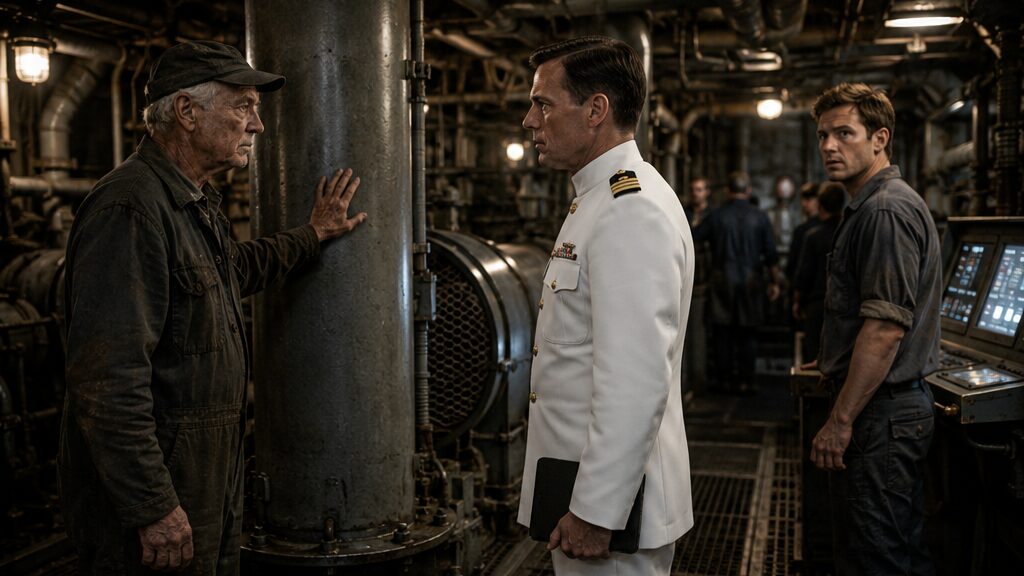
He walked forward along the grated passageway, one hand grazing the rail. To his left, a thick steel column rose from deck to overhead near a run of pipe and a guarded shaft-line casing. In the old days, nobody had called it anything special. It was a stanchion, a frame member, part of the ship’s bones. To Frank, it was a listening post.
He stopped beside it.
For a moment he only stood there, shoulders bent slightly under the low overhead, cup cooling in his hand. A younger civilian mechanic at the far end of the space glanced over and looked away. Frank set the coffee on a flat ledge, unrolled his tools, and laid them out with a ritual neatness: flashlight, small mirror, grease pencil, rag, folding ruler, old brass feeler gauge. He had newer tools in his locker at the yard. He carried the old ones because they still fit his hand.
Then he placed his palm flat against the steel column.
The ship answered.
At first there was only the expected tremor, a steady machine pulse carried through the frame. Frank closed his eyes. He did not press hard. Too much pressure turned feeling into wishful thinking. Let the steel tell you. Do not force it.
There.
A second pulse arrived late, faint enough that a hurried hand would miss it. It came through the column after the pump beat, not with it. A delayed shiver, short and sour, as if something down the line had answered out of time.
Frank opened his eyes.
He shifted his hand higher on the column. The shiver came again. Not every cycle. Not loud. Not yet.
He bent and looked toward the shaft-line casing. The guarded housing sat clean under inspection lights, its paint fresh enough to shine. Around it, the ship seemed orderly. Hoses clipped. Labels straight. No puddles. No visible heat shimmer. No smell of scorched oil.
That was what made him uneasy.
A bad problem that looked bad was honest. A bad problem that looked clean was waiting for permission.
“Mr. Bennett?”
The younger mechanic had come closer. He wore a yard shirt with his sleeves rolled carefully, like a man trying not to look new. His name patch read Michael Reed.
Frank removed his hand from the column. The faint tremor remained in his palm after contact, like a word he had almost heard.
“You assigned to me?” Frank asked.
“For the morning, yes, sir.”
“Don’t call me sir. I worked for a living.”
Michael smiled, uncertain whether it was a joke.
Frank picked up his coffee and took a small swallow. It had already gone bitter. “Who spun the auxiliary lube system last night?”
“Night crew. I can pull the log.”
“Pull it.”
Michael hesitated. “Something wrong?”
Frank looked back at the column. The question was too large for the evidence in his hand.
“Maybe nothing.”
Michael glanced at the steel, then at the clean equipment. “Readings were green at turnover.”
“Green readings are good,” Frank said.
“But?”
Frank wiped his hand slowly on the rag, though it was not dirty. “But ships have lied in green ink before.”
The young mechanic watched him, waiting for more. Frank did not give it. He crouched beside the casing and checked the floor plates, the bolts, the edges where vibration sometimes loosened dust before it loosened metal. His knees complained. He ignored them. Pain was old weather; you worked through weather until it became storm.
Under the casing, near a seam, he found a faint crescent of rubbed paint on a bracket edge. Not fresh enough to shout. Fresh enough to remember.
He took the pocket notebook from inside his work jacket.
It was small, black, and softened at the corners. The elastic band had lost most of its snap. Inside were years of dates, temperatures, valve numbers, bearing notes, names of ships, half-legible warnings, and small drawings that meant more to him than photographs. He did not keep it because he distrusted computers. He kept it because writing made a man slow down enough to notice what he was claiming.
On a clean line he wrote:
Aux system low idle. Frame pulse late through column. Check under load.
Michael leaned just enough to see but not enough to seem nosy.
“You write everything down?”
“Only what I don’t want to lie about later.”
A voice sounded from the upper grating. “Inspection team comes through at zero eight hundred.”
Frank looked up. A dockyard worker in a hard hat gave the warning and moved on.
The machinery space began to fill with people after that. Footsteps on grating. Radios. Clipboards. Laughter from men who had slept poorly and wanted no one to know. The ship’s quiet breathing disappeared beneath human urgency.
Frank stayed beside the column.
Twice more, as the auxiliaries cycled, he placed his palm on the steel. Twice more the late pulse came, then vanished under other noise. He asked Michael for the previous night’s log and read it under the light.
“Anything?” Michael asked.
“Temperature rise on the aft bearing during flush.”
“It says within tolerance.”
“Yes.”
Frank tapped the page once. “Within tolerance isn’t the same as normal.”
Michael looked toward the shaft casing again. “Should I flag it?”
Frank heard the caution in the question. Not fear exactly. Career awareness. A young man with rent, maybe a family, maybe not enough seniority to make trouble.
“Not yet,” Frank said. “First we check.”
He regretted it as soon as he said it.
Not because it was wrong. Because there had been another day, decades earlier, when he had told himself the same thing. Not yet. First we check. Then a senior chief had laughed and said the noise was nothing, and Frank had let the laugh carry more authority than his own ears.
He shut the memory down before it took shape.
A ship did not care what a man regretted. It cared what he did next.
At five minutes before eight, Frank stood again with his hand on the steel column. Around him, the engine room shone in its inspection posture. Wiped rails. Secured tools. Men standing straighter than they worked. Michael held the log under one arm, watching him with quiet curiosity.
The late tremor came once more.
Frank looked toward the passage where the inspection party would arrive. He could already hear polished shoes above, moving in a rhythm different from work boots.
He opened the notebook and wrote beneath the first line:
late through frame.
Then he underlined it once, not hard enough to tear the page, but hard enough that the paper held the mark.
Chapter 2: The White Uniform Wanted Clean Numbers
Lieutenant Commander Jonathan Carter entered the engine room as if the ship had been arranged to receive him.
He was not tall, but he carried himself with the clean vertical certainty of a man used to narrow passageways opening before him. His white uniform looked almost unnatural against the gray steel and dark machinery. The overhead light caught the edges of his shoulder boards, the polished shine of his shoes, the silver clip of the tablet tucked beneath his arm.
Behind him came two inspection personnel, a bridge watch officer, and Barbara Collins from dockyard operations. Barbara wore a navy-blue yard jacket and carried three days of missed sleep around her eyes. She spotted Frank first and gave him the brief nod of someone who knew his value but could not afford complications.
Frank returned the nod.
Jonathan stopped at the main control station. “Morning. Let’s keep this tight. We have a command brief at eleven and a readiness review at sixteen hundred.”
The engine-room crew tightened around him, not physically, but in attention. Even the ventilation seemed to flatten.
Barbara opened a folder. “Auxiliary systems spun up overnight. Minor pump imbalance noted and corrected. No red-line readings.”
“Good.” Jonathan looked at the tablet. “Main concern?”
“None from yard operations.”
Frank did not move. The column was behind his right shoulder. He could feel, without touching it, where the late pulse lived.
Michael stood two steps back, holding the night log.
Jonathan’s eyes came to Frank. They paused on the cap, the worn jacket, the hands. “Mr. Bennett.”
Frank had never met him before, but officers always learned names before inspections. It saved time and gave the shape of respect without the burden of trust.
“Commander,” Frank said.
“I understand you’re supporting the mechanical sign-off.”
“I’m looking at the shaft-line area.”
Jonathan’s gaze flicked to Barbara. “Is there an open discrepancy?”
Barbara’s mouth tightened slightly. “Not officially.”
Frank said, “There’s a late frame pulse on low idle. It showed with the auxiliary lube cycle. I want to see it under load before this gets closed.”
The engine room did not go silent. It was too loud for that. But the men nearby stopped shifting.
Jonathan looked down at his tablet, thumb moving once. “I’m not seeing that in the vibration report.”
“No.”
“Temperature?”
“Within tolerance.”
“Oil pressure?”
“Within tolerance.”
“Visual inspection?”
Frank glanced toward the rubbed paint under the bracket. “Not clean enough for me.”
Jonathan waited for a further technical explanation, the kind that could be entered into a form and routed through authority. Frank had one, but it was not yet a complete one. It was a pattern made of touch, timing, memory, and a mark no wider than a thumbnail.
Barbara stepped in. “Frank’s asking for a loaded check before final clearance.”
Jonathan’s face stayed composed. “We’re already scheduled for a controlled run this evening.”
“That may be too late to find it,” Frank said.
The words came out more sharply than he intended.
Jonathan turned fully toward him. “Too late for what?”
Frank held his gaze. “For the easy fix.”
A younger sailor near the control panel looked down. Michael did not.
Jonathan walked toward the shaft-line casing, stopping beside the thick steel column. He scanned the area, then checked the tablet again.
“Mr. Bennett, with respect, I need more than feel.”
Frank felt the old irritation rise, dry and familiar. With respect usually meant the respect had ended.
“You need evidence,” he said. “So do I.”
“Then give me evidence.”
“I’m telling you where to look.”
Jonathan’s eyes narrowed a fraction. “And I’m telling you we have instruments looking there.”
Frank almost answered too quickly. He caught himself. Anger made old men easy to dismiss. He reached into his jacket, removed the notebook, and opened it to the morning’s entry.
Michael shifted as if he wanted to step closer.
Jonathan glanced at the page, then back at Frank. He did not mock it. That almost made the dismissal worse.
“You keep handwritten vibration notes?”
“Yes.”
“Against calibrated sensors?”
“Alongside them.”
Barbara rubbed the bridge of her nose. “Commander, Frank’s been on these systems longer than—”
Jonathan lifted one hand, not rude, but final. “I’m not questioning his experience. I’m questioning whether we delay a ship on an unverified impression.”
Frank closed the notebook.
The word impression hung between them like steam.
Michael cleared his throat. “Sir, I can pull last night’s raw trend data and compare—”
Jonathan’s eyes moved to him. “Do that. But unless the data supports a discrepancy, we proceed with the planned pump adjustment verification.”
Michael nodded, but his face changed. Not defiance. Disappointment, maybe. Or relief that a decision had been made by someone else.
Frank looked at the column. He thought of all the men he had known who trusted decisions because decisions had rank attached. Some of them had lived. Some had not.
Jonathan stepped closer to the shaft-line casing, careful not to touch anything. “What exactly do you think is happening?”
“The pulse arrives late through the frame.”
“That is not a failure mode.”
“It’s a clue.”
“To what?”
Frank looked past him to the guarded housing. “Shaft-line bearing beginning to misbehave under intermittent load. Could be alignment stress. Could be oil film breaking at transition. Could be nothing if we catch it now.”
“And if the sensors show nothing?”
“Then we find out why.”
Jonathan exhaled through his nose. His patience was disciplined, but not endless. “Mr. Bennett, I have a ship that needs to return to duty. I have readings in tolerance, a documented pump correction, and a yard supervisor telling me there is no official discrepancy.”
Barbara’s jaw moved, but she said nothing.
Frank heard the trap in the wording. It was not malicious. It was procedural. No official discrepancy. That phrase had buried more truth than lies ever had.
He placed his hand on the steel column again.
Jonathan watched the gesture.
For three seconds, Frank listened. The ship hummed. Pumps turned. Somewhere above them, a hatch shut with a hollow steel clap. Then the late tremor came, small and wrong.
Frank opened his eyes. “There.”
Jonathan did not touch the column. “Mr. Bennett.”
“Put your hand here.”
“I’m not trained to interpret vibration by hand.”
“No. You’re trained to command men who are.”
The younger sailor at the control panel went very still.
Barbara said softly, “Frank.”
The warning in her voice was not for Jonathan. It was for him.
Frank removed his hand. He could feel his own pulse now, which made further listening useless. “Sorry.”
Jonathan’s face had cooled. “No offense taken.”
That meant some had been.
He turned to the inspection clerk. “Log current status. Pump adjustment verification remains on schedule. Raw trend comparison requested. No delay at this time.”
The clerk typed.
No delay at this time. The phrase entered the system more easily than Frank’s warning ever could.
Jonathan looked at Frank again. “You’ll have your evening run data.”
“If the problem waits that long.”
“The ship is not getting underway. It will be controlled.”
Frank nodded once. He had no argument left that would not sound like fear.
As the inspection group moved forward, Barbara lingered beside him. Her voice dropped.
“You know what today costs if we hold them?”
Frank looked at her. “Less than tomorrow if we don’t.”
She held his eyes long enough to show she had heard him, then followed Jonathan.
Michael remained. The log was still tucked beneath his arm.
“What did you feel?” he asked.
Frank looked at him sharply. Most people asked what he thought. Michael had asked the better question.
Frank took the young man’s hand, guided it to the column, and placed it flat against the steel.
“Don’t push,” Frank said. “Let it come to you.”
Michael stood awkwardly at first, then settled. His brow tightened.
“I feel the pump.”
“Everybody feels the pump.”
Another few seconds passed.
Michael’s eyes flicked toward Frank. “There was something after.”
Frank nodded.
“It’s faint.”
“Important things usually start faint.”
From the far end of the passage, Jonathan’s voice carried back through the machinery space, crisp and controlled, already moving the inspection along.
Michael pulled his hand away slowly.
Frank picked up his notebook and slid it inside his jacket. “Don’t make more of it than we know.”
“But don’t ignore it?”
Frank looked at the steel column, then at the clean casing beyond it.
“No,” he said. “Don’t ignore it.”
Chapter 3: Frank Stepped Out From Behind The Column
By late morning, the engine room had stopped pretending to be quiet.
The inspection team had opened panels, checked tags, verified readings, and asked questions that sent crewmen moving in short, efficient bursts. The main control station glowed with stable numbers. The pump adjustment had been entered, witnessed, initialed, and entered again. Men who had been tense at eight were beginning to relax into the comfortable boredom of a problem that had not appeared on command.
Frank hated that kind of comfort.
He stood near the steel column with his cap pushed back and his notebook open in one hand. Michael was at the data terminal, pulling raw trend lines under the eye of an inspection clerk who seemed annoyed by anything not already formatted.
“Mr. Bennett,” Jonathan called from near the pump skid. “A word.”
Frank tucked the notebook away and crossed the grating. The commander held his tablet at his side. Barbara stood nearby with her arms folded, looking from one man to the other as if calculating which delay she could survive.
Jonathan kept his voice level. “We found the imbalance. The pump coupling was slightly out. It’s been corrected.”
“That pump was talking,” Frank said. “But it wasn’t the one I was listening to.”
The inspection clerk glanced up.
Jonathan’s mouth tightened. “The vibration profile improved after the adjustment.”
“On the pump.”
“That was the discrepancy.”
“That was the loudest discrepancy.”
The commander looked toward the crew. Frank saw the moment he decided the conversation had become dangerous—not mechanically, but socially. Authority did not mind questions until questions had witnesses.
“Step over here,” Jonathan said.
They moved toward the thick column, half screened from the others by a vertical run of pipe. It was almost the same position where Frank had stood at dawn, half hidden behind steel, listening before anyone else cared to hear.
Jonathan spoke quietly. “You need to understand what you’re doing.”
“I do.”
“You’re asking me to challenge a clean inspection trail based on a sensation no one has verified.”
“Michael felt it.”
“Michael is not the approving authority.”
“No,” Frank said. “He’s just the one young enough that you might believe him later.”
Jonathan’s eyes hardened. “Careful.”
Frank looked away first. Not because he was afraid, but because he had come too close to making this about pride.
The steel column hummed beside him.
Jonathan continued, lower now. “I respect your service. I respect your years in machinery spaces. But this ship cannot be held every time an experienced man has a bad feeling.”
Frank lifted his hand and placed it flat against the column.
Jonathan stopped speaking.
The engine room moved around them: fans, pumps, voices, a tool set down too hard, water rushing somewhere through pipe. Beneath all of it, the old shiver came through steel, delayed and thin.
Frank kept his hand there.
“Mr. Bennett,” Jonathan said, “step away from the equipment.”
Frank did not move.
Barbara’s head turned.
Michael looked up from the terminal.
The words had not been shouted, but they carried. Men nearby paused because men always heard the tone of command before they heard the sentence.
Jonathan stepped closer. “That wasn’t a suggestion.”
Frank removed his hand from the column and let it fall at his side. His fingers tingled.
“You think I’m touching it because I miss being young,” he said.
The commander said nothing.
“You think this is sentiment. Old machinist. Old ship. Old habits.”
“I think you are too close to this to separate memory from current evidence.”
Frank nodded slowly. It was a fairer answer than he had expected. That made it harder to hate.
He reached into his jacket, took out the notebook, and held it open—not toward Jonathan, but toward himself. He looked at the line he had written that morning. Late through frame.
“My memory has made mistakes,” he said. “That’s why I write things down before men in clean shirts tell me what I meant to hear.”
Jonathan’s face flushed faintly.
Barbara said, “Frank, that’s enough.”
But it was not.
Frank stepped out from behind the column.
It was not a dramatic movement. He did not lunge, did not raise his voice, did not perform for the room. He simply moved into the open passage where everyone could see the old jacket, the dark cap, the lined face, the hand still curled from touching steel.
The commander turned with him, and suddenly they were standing nearly chest to chest in the narrow space.
Frank pointed—not at Jonathan, but past him, toward the shaft-line casing.
“That pump was early,” he said. “The frame answered late. If it was coupling imbalance, the column would carry it with the pump. It doesn’t. It comes after, like the load is traveling downline and finding resistance before the bearing film catches up.”
Jonathan’s eyes held his. “The bearing temperature is normal.”
“For now.”
“Oil pressure is normal.”
“For now.”
“The alignment was checked in yard.”
“Cold.”
Jonathan blinked once.
Frank lowered his hand. “You run her under transition load and watch aft bearing temperature against frame pulse timing. Not average temperature. Rise rate. First ninety seconds after load change.”
Michael had left the terminal. He stood five yards away, listening openly now.
The inspection clerk had stopped typing.
Jonathan looked toward Barbara. “Is there a basis to run that check before this evening?”
Barbara hesitated. Frank saw her weighing cost, procedure, schedule, reputation, and the weary fact that Frank was usually right just often enough to be inconvenient.
“There’s no planned slot,” she said. “We would have to request it.”
Jonathan turned back to Frank. “And if I request it and we find nothing?”
“Then I’ll sign your clean sheet myself.”
“You don’t have signing authority.”
A small laugh escaped someone near the control station and died quickly.
Frank looked down at his own hands. They were not steady in the way they had been steady at twenty-five. The knuckles had swollen; the nails were ridged; the skin carried scars that no longer had stories attached because there were too many of them.
“No,” he said. “I don’t.”
That should have ended it.
But the late pulse came again through the deck, so faint he felt it in the soles of his boots before he knew he had felt it. The ship spoke softly. Men argued loudly. That had always been the problem.
Frank looked back at Jonathan.
“I had signing authority once in everything but ink,” he said. “I heard a sound like this and let a man with more rank tell me it was nothing. He had clean numbers too.”
The room shifted around that sentence.
Jonathan’s expression changed, not softened exactly, but sharpened by something like caution. “What happened?”
Frank almost answered. The memory rose with its smell: hot bearing metal, white smoke, a sailor’s glove left on the deck, someone yelling for a corpsman. He swallowed it down.
“Not today,” he said.
It was enough and not enough.
Jonathan studied him. “You’re asking me to delay based on an unfinished story.”
“I’m asking you to check a machine before the machine finishes it for us.”
Barbara stepped closer. “Commander, we can compare raw trend data now and decide if an additional load check is warranted.”
Jonathan did not look away from Frank. “We already decided that.”
“No,” Frank said. “You decided whether my warning fit your schedule.”
The words landed harder than he meant them to.
Jonathan’s jaw tightened. “Mr. Bennett, you are here as civilian support. You will not speak to me as if I’m gambling with my crew.”
For the first time, Frank’s voice rose.
“Then stop gambling with the one part of the ship that doesn’t care how clean your tablet looks.”
Silence fell in pieces.
The ventilation still whined. A pump still turned. Somewhere aft, a wrench clinked against deck plate. But the men in the passage had stopped pretending not to listen.
Frank felt the heat in his face and hated it. Anger made him look old in the way they expected old men to look: brittle, emotional, trapped in yesterday.
So he took one breath and backed down half a step.
“I’m not asking you to believe me because I’m old,” he said. “I’m asking you not to dismiss me because I am.”
Jonathan’s posture changed. Not surrender. Not agreement. Just the smallest shift, as if the sentence had found a seam in him.
Michael spoke from beside the terminal. “Sir, I found a small rise in aft bearing temperature during last night’s flush. It stayed within tolerance, but the rise rate changed right after load transition.”
Jonathan turned. “How much?”
“Not much.”
“That is not an answer.”
Michael swallowed. “Enough that I’d like someone better than me to look at it.”
Frank looked at the young man. Michael did not look away.
Barbara stepped in quickly, sensing the moment before it vanished. “We can flag it for evening run emphasis. No full delay yet. Add a specific watch on aft bearing rise rate and frame vibration.”
Jonathan looked from Barbara to Michael to Frank.
The commander’s face closed again, but not completely. He picked up his tablet and entered something with his thumb.
“Fine,” he said. “Specific watch during the controlled run. No schedule change unless readings justify it.”
Frank felt no victory. Only the shape of a door opened too little.
“That may not be enough.”
“It is what you have,” Jonathan said.
He turned to the clerk. “Record pump adjustment verified. Add note for evening run: monitor aft bearing temperature rise during transition load. No delay at this time.”
The clerk typed the words.
No delay at this time.
Again the system accepted the smallest version of the truth.
The inspection party began moving, conversation restarting around them in lowered voices. Barbara exhaled and rubbed her forehead. Michael stayed where he was, pale but standing straighter.
Jonathan paused before leaving the compartment.
“Mr. Bennett,” he said, “if you’re wrong, you will have created concern where none was needed.”
Frank put his notebook back inside his jacket.
“And if I’m right,” he said, “concern is the cheapest thing we’ll spend today.”
Jonathan held his gaze for one more second, then walked away.
Frank returned to the steel column. He did not touch it at first. He only stood beside it, feeling the engine room resume its motion around him. Men glanced once and then looked away. The old category had changed, but not enough. Trouble. Difficult. Maybe useful. Maybe unstable.
He placed his palm against the steel.
The late tremor came after the pump beat, faint and patient.
Frank closed his eyes.
“Still there?” Michael asked softly.
Frank opened the notebook to the morning page. Under late through frame, he added three words.
Ignored. Watch under load.
Chapter 4: The Ship Passed The Test That Frank Feared
By early afternoon, the pump sounded better.
That was the worst part.
Frank stood at the edge of the machinery space while a yard mechanic locked the coupling guard back into place. The corrected pump ran smoother now, its chatter softened into a clean, obedient rhythm. On the control station screen, the vibration line that had annoyed everyone dipped back toward the neat middle band where supervisors liked to see it.
The inspection clerk looked pleased.
Jonathan Carter looked vindicated without allowing himself the indulgence of showing it.
Barbara Collins looked relieved.
Frank looked at the steel column.
No one asked him to touch it.
The pump had been the obvious problem. It had complained loudly enough for instruments, loudly enough for work orders, loudly enough for men who trusted dashboards. Once corrected, the room seemed to let out its breath. Even Michael, standing beside the terminal with the raw trend data still open, had the troubled look of a man watching evidence turn away from him.
Jonathan came down from the control station platform and stopped near Barbara. “Run it again.”
The mechanic gave a thumbs-up. The pump cycled. The digital readings steadied. A small cheer did not rise, because the Navy did not cheer over pumps, but Frank could feel the same release move through the room.
Barbara marked something on her folder. “That clears the open pump item.”
Jonathan nodded. “Maintain the evening run watch as noted.”
His voice carried just far enough for Frank to hear. Not dismissive. Not apologetic. Procedural.
Frank hated that too.
A man could fight open contempt. Procedure was fog. You walked into it and lost your shape.
Michael came over with the printed trend sheet folded in his hand. “The rise rate I found is still there.”
Frank took the sheet and studied it. The numbers were small, polite, unimpressive. A half-degree change stretched across a time interval that would not alarm anyone whose attention had been trained toward limits instead of behavior.
“Still there,” Frank said.
“But not worse.”
“No.”
Michael shifted his weight. “Maybe the pump was throwing everything off.”
“Maybe.”
The young man watched him. “You don’t think so.”
Frank folded the paper once along its existing crease and handed it back. “Thinking isn’t worth much until the machine agrees.”
At the far end of the space, Jonathan spoke with the bridge watch officer. His tablet glowed in one hand. He had the look of a man managing layers: schedule, reports, crew confidence, dockyard coordination, command expectations. Frank had known officers like him. Some good, some vain, most carrying more pressure than the men under them guessed.
That was why Frank had tried not to dislike him.
It would have been easier if Jonathan were careless. He was not. He asked questions. He checked readings. He kept his voice under control. He did everything a responsible officer could do, except listen to the part of the ship that had not yet learned to speak in numbers large enough for him.
Barbara walked over after the pump verification closed.
“You look like a man at a funeral,” she said.
“Pump sounds nice.”
“That’s not a funeral.”
“Sometimes the choir sings before the burial.”
She gave him a tired look. “Frank.”
He rubbed at the back of his hand, where the column’s vibration seemed to remain under the skin. “You got the raw trend note entered?”
“Yes.”
“With wording?”
“With enough wording.”
“Barbara.”
She lowered the folder. “I wrote: monitor aft bearing temperature rise during transition load. Correlate with frame vibration if observed.”
Frank gave a small nod. “That’ll do.”
“It has to. I can’t hold them on more than that.”
“I know.”
Her expression softened in a way he did not want. “You’ve been here since before dawn. Go topside. Eat something. Sit down.”
“I sat down last Tuesday.”
“This isn’t funny.”
“No.”
She studied him. “Is this about the ship, or is this about something old?”
Frank looked at the pump skid, the fresh marks on the coupling bolts, the clean guard. For a second he saw another engine room laid over this one, older lights, older paint, a younger version of himself standing with a rag in his hand and a warning trapped behind his teeth.
“It can be both,” he said.
Barbara did not press. That was one reason he had worked with her as long as he had.
She tucked the folder under her arm. “The commander isn’t your enemy.”
“I didn’t say he was.”
“You talk like he is.”
Frank looked toward Jonathan. The officer laughed briefly at something the bridge watch officer said, then returned at once to his tablet. Nothing lazy in him. Nothing cruel.
“No,” Frank said. “He’s a man with clean numbers.”
Barbara sighed. “Sometimes clean numbers are clean because the problem got fixed.”
“And sometimes clean numbers are clean because you’re asking the wrong question.”
Her radio chirped before she could answer. She turned away to respond, already pulled back into the day’s machinery of schedules and signatures.
Frank went to the column.
He waited until no one was watching closely. That was foolish, and he knew it. If he believed what he believed, he should not care how the gesture looked. But he was tired of eyes. Tired of being measured as a stubborn old man. Tired of anger sitting behind his ribs like a hot bearing.
He placed his palm on the steel.
The pump’s cleaner rhythm came through first. Better. Smoother. Honest enough. Frank closed his eyes and waited past it.
Nothing.
He held still.
Only the pump. Fans. A valve click. Footsteps. A cough.
No late pulse.
His eyes opened.
For a moment the absence was worse than the shiver had been. He moved his hand higher, then lower. He shifted his stance to feel through the soles of his boots. Still nothing he could separate from the corrected pump and the room’s ordinary noise.
He stepped back.
The ship had gone quiet where he needed it to speak.
Michael had seen him. He tried to pretend he had not, which made it kinder and more painful.
Frank returned to the workbench and opened his notebook. He looked at the morning lines.
Aux system low idle. Frame pulse late through column. Check under load.
late through frame.
Ignored. Watch under load.
The words looked dramatic in afternoon light. Too dramatic. Like something written by a man who wanted to be right.
He almost crossed out the last line.
Instead he closed the notebook and slid it away.
The hours that followed moved in clean administrative pieces. The inspection team cleared compartments. The pump item closed. The readiness run plan held. Men ate sandwiches standing up. Someone spilled coffee near the lower ladder and wiped it with the embarrassed intensity of a sailor who knew a clean deck mattered more when officers were aboard.
Frank took half a sandwich because Barbara put it in his hand. He tasted mustard and nothing else.
At sixteen hundred, Jonathan gathered the key personnel near the control station. Frank stood at the edge of the group, not invited exactly, not excluded either.
“Evening run remains controlled,” Jonathan said. “We will step through load transitions and observe all flagged items. Aft bearing temperature rise gets specific attention. If anything moves out of tolerance, we stop and assess.”
Frank heard the careful phrasing. Out of tolerance. The ship still had to misbehave loudly enough to matter.
Jonathan looked briefly toward him. “Frame vibration will be noted if observed.”
Frank held the look and gave no reply.
The group dispersed.
Michael stayed behind. “You think it’ll show?”
Frank watched a sailor check a gauge and tap the glass with one finger. “I hope not.”
Michael frowned. “But if it doesn’t—”
“If it doesn’t, we learn I made noise over a pump.”
“You don’t believe that.”
Frank picked up his tool roll. “Belief is for church. Machines require patience.”
The young man smiled faintly. “You always talk like that?”
“Only when I’m tired.”
Michael hesitated, then said, “Commander Carter asked for the raw trend printout.”
Frank looked up.
“After the meeting,” Michael said. “He didn’t say much. Just asked me to send it to his tablet.”
Frank absorbed that quietly. It was not recognition. Not yet. But perhaps it was not nothing.
“Good,” he said.
As evening pressed against the ship, the engine room shifted again. Work lights cast harder shadows. The air grew warmer with systems coming ready. Men took stations with less conversation. The coming run gathered itself in the metal around them.
Frank stood near the column as the auxiliaries cycled down and reset.
Then, in the small gap between one sound and the next, he felt it through the deck.
Not through his hand this time.
Through his boots.
A faint, late tremor.
There and gone.
His body recognized it before his mind allowed certainty. He turned his head toward the shaft-line casing.
The pump was quiet now.
The tremor had not been the pump.
Frank reached for his notebook and opened to the marked page. His hand was steady until he touched the pencil to paper.
Returned at spin-down.
He stared at the words.
Above him, someone called that the evening run would begin in thirty minutes.
Frank closed the notebook and looked across the compartment at Jonathan Carter, who stood under the inspection lights with his tablet in hand, clean and composed and still not yet afraid.
Chapter 5: The Sound Came Back Under Load
Michael Reed had learned early in the yard that the safest place for a young mechanic was near the work and away from the argument.
He liked machines for that reason. Machines did not care if a man was new. They did not ask whether he had spoken in the right tone to the right officer. They accepted careful hands, punished careless ones, and left the rest alone.
People were harder.
By evening, Michael had watched Frank Bennett become the most uncomfortable kind of problem: possibly wrong in public, possibly right too soon.
The engine room was hotter now. The controlled run had not yet reached anything dramatic, but the ship had come alive in layers. Pumps deepened. Fans sharpened. Gauges trembled. Voices grew shorter. Men who had joked through lunch now answered in clipped phrases that sounded more like the ship itself.
Michael stood at the data terminal with the raw trend display split into three windows: pump vibration, aft bearing temperature, shaft-line load. Jonathan Carter had ordered the view himself. That had surprised Michael. The commander stood two stations away, watching the same numbers on his tablet with an expression that revealed nothing.
Frank was near the steel column.
Not leaning on it. Not performing. Just near enough that if he extended one arm, his palm would find the place worn slightly dull from his own repeated touch.
The bridge watch officer’s voice came through the speaker. “Transition to next load step in thirty seconds.”
Jonathan answered into the handset. “Engine room acknowledges. Maintain controlled rate.”
Barbara Collins stood with her folder hugged to her chest, as if she could hold the schedule together by force.
Michael glanced at the aft bearing temperature. Stable. The pump vibration stayed improved. Everything looked ordinary.
“Ten seconds,” the bridge watch officer said.
Frank turned his head slightly.
Michael noticed because he had been watching him more than the screen. The old man’s face did not change much, but something in his posture gathered. Not fear. Readiness.
The load shifted.
Sound changed first. The machinery note thickened, a deeper tone moving through the deck plates and rails. The numbers rose as expected. Michael’s eyes moved between lines. Pump vibration normal. Bearing temperature normal. Shaft load increasing within planned curve.
Then Frank placed his palm on the column.
Michael looked back at the screen.
Nothing.
The aft bearing temperature rose one tenth of a degree. Normal.
Two tenths. Normal.
The bridge reported steady.
Jonathan’s jaw relaxed almost imperceptibly.
Then Michael saw the rise rate change.
It was not enough to trigger a warning. It was not even enough to look alarming unless a person had spent the whole day staring at the shape of that line. The temperature still lived comfortably inside tolerance, but the curve had bent. Not upward like failure. Just differently. A quiet impatience in the numbers.
Michael leaned closer.
“See something?” the inspection clerk asked.
“Maybe.”
The clerk gave him the look men gave when maybe threatened paperwork.
At the column, Frank’s fingers spread slightly against the steel.
Michael remembered the old man guiding his hand that morning. Don’t push. Let it come to you.
He looked at Jonathan. The commander was reading his tablet, expression controlled. If Michael spoke and it was nothing, he would become part of Frank’s embarrassment. The young mechanic who got drawn into an old man’s superstition. The one who complicated a clean run.
The temperature line rose another tenth.
Still normal.
Michael removed his headset and stepped away from the terminal.
The inspection clerk said, “Where are you going?”
Michael did not answer. He crossed the grating to the column, aware of Barbara watching him now, aware of Jonathan looking up.
Frank did not turn as Michael approached. “Don’t follow me into trouble unless you brought your own boots.”
Michael almost smiled. His mouth was too dry.
“Move your hand,” he said.
Frank looked at him then. Something like approval passed across his face, but he moved aside without a word.
Michael placed his palm flat against the steel column.
At first, the vibration was too large to understand. Under load, the whole frame seemed full of motion. He felt the main rhythm, the pump, the low body of the ship working. His fingers wanted to press harder. He stopped himself.
Don’t push.
He breathed out and waited.
There.
A faint strike after the main pulse. Not a sound exactly. A delayed arrival. It felt like tapping a table and hearing a second tap through the floor.
Michael’s eyes widened before he could control them.
Frank saw it. “Count it.”
Michael swallowed. “After transition.”
“How long?”
“I don’t know.”
“Then count.”
The bridge reported, “Holding load.”
Michael kept his hand in place. Main pulse. Delay. Main pulse. Delay. Not every cycle, but often enough now that his skin began to expect it.
“One and a half seconds after the heavier pulse,” he said.
Frank nodded. “Late through frame.”
Behind them, Jonathan’s voice cut in. “Mr. Reed.”
Michael pulled his hand off the column as if caught doing something childish.
Jonathan walked toward them. “Return to your station.”
Michael looked at Frank, then back at the commander. His heart beat hard enough to confuse every vibration in the room.
“Sir,” he said, “I felt it.”
The engine room seemed to sharpen around the sentence.
Jonathan stopped. “Felt what?”
“The delayed pulse Mr. Bennett described.”
“Can you correlate it to the display?”
Michael looked back at the terminal. The warning light was dark. The numbers remained legal. That was the awful word in his mind: legal. Everything dangerous had paperwork proving it was not yet dangerous.
“Aft bearing temperature rise rate changed at transition,” he said. “Still within tolerance.”
Jonathan’s expression did not move. “How much?”
“Small.”
“Define small.”
Michael hated the heat in his face. “Small enough to ignore if we weren’t looking for it.”
Frank said nothing.
That silence pressed harder than any help would have. Michael understood then that Frank was letting the words belong to him. Not feeding him, not using him as proof. Making him stand or step back.
Barbara came closer. “Commander, we can hold the load and watch trend.”
Jonathan glanced toward the control station. “Recommendation?”
The inspection clerk said, too quickly, “No alarm condition.”
Jonathan did not look at him. “I asked for recommendation, not alarm status.”
The clerk flushed.
Frank’s eyes remained on the shaft-line casing. Michael saw his right hand close once, open again. The old man was holding himself still.
Jonathan lifted the handset. “Bridge, engine room. Maintain current load for additional observation. Do not advance to next step until cleared.”
The speaker crackled. “Bridge acknowledges. Holding.”
A quiet shift passed through the compartment. It was not belief, but it was delay, and delay was the first kind of mercy a machine ever got.
Michael returned to the terminal. He put the headset back on. The temperature line had flattened slightly, then crept again. He adjusted the scale, zooming into the first ninety seconds after transition the way Frank had told Jonathan to do.
There it was.
Not a spike. Not a failure. A pattern.
Rise, hesitation, rise.
Like the bearing was catching, recovering, catching again.
Michael captured the screen and sent it to Jonathan’s tablet.
The commander studied it. “Mr. Bennett.”
Frank did not move from the column. “Commander.”
“Could this be residual from the pump correction?”
“Yes.”
Michael looked at him, surprised.
Frank continued, “Could be sensor drift. Could be oil temperature. Could be a dozen polite explanations.”
Jonathan’s eyes narrowed. “But you don’t think so.”
“I think the ship is giving us the same answer in three languages.”
“Temperature, frame vibration, and?”
Frank lifted his hand from the column. “Timing.”
The word hung there, plain and heavy.
The bridge watch officer called through the speaker. “Engine room, bridge. Request status for next load step.”
Jonathan looked toward Barbara. Barbara looked toward the schedule board clipped beside the control station. Michael watched both of them see the same thing: if they stopped now, the report would become difficult. If they continued and nothing happened, Frank would be finished in this room. If they continued and something did happen, the ship might pay for their pride.
Jonathan keyed the handset. “Bridge, hold current load. Engine room assessing.”
The answer came back with a slight edge. “Copy. Holding.”
Then the warning light flickered.
It was amber, low on the panel, there for less than a second.
Aft bearing temp deviation.
Gone before the clerk could even reach for the acknowledgement button.
Everyone saw it.
No one spoke.
The temperature was still within tolerance.
The light remained dark.
Michael’s palms were damp. He looked at Frank, expecting alarm, satisfaction, something. The old man only looked tired.
Jonathan walked to the terminal and stared at the trace. “Did it log?”
The clerk checked. “Momentary deviation. Cleared.”
Barbara whispered, “That’s enough to stop.”
Jonathan heard her. Everyone did.
Frank did not say a word.
That was what made Michael afraid.
The man who had fought all morning had gone quiet now that the ship had begun to confirm him. He stood beside the column, listening, as if the argument with people no longer mattered at all.
Jonathan lifted the handset again.
Before he spoke, a deeper tremor ran through the deck.
Not loud. Not violent. But different enough that even men who had mocked nothing all day looked down at their boots.
The steel column gave a short, sour shudder.
Michael felt it from six feet away.
Frank closed his eyes once.
Then he opened them and looked straight at Jonathan Carter.
Chapter 6: The Bearing Did Not Fail All At Once
Frank had always hated the phrase sudden failure.
Men used it after the fact because it made them feel innocent. Sudden failure sounded like lightning, like an act of God, like no hand could have prevented it and no ear could have heard it coming.
In machinery spaces, almost nothing failed suddenly.
It whispered first.
The sour shudder passed through the deck and vanished into the larger hum of the ship. Around Frank, the room waited for someone with authority to name it.
Jonathan Carter still held the handset.
The bridge called again. “Engine room, confirm status.”
Jonathan’s eyes remained on Frank. “Mr. Bennett?”
That was all he said, but the room changed around it.
Not full trust. Not surrender. A question placed where dismissal had been.
Frank stepped away from the column. His right knee stiffened, and for one embarrassing half-second he had to steady himself on the rail. He saw the inspection clerk notice. He saw Jonathan notice. He ignored both.
“Reduce load ten percent,” Frank said. “Slow. Do not chop it.”
Jonathan lifted the handset. “Bridge, engine room. Reduce load ten percent at controlled rate. Do not step down abruptly.”
The bridge watch officer answered, “Confirm reason?”
Jonathan looked at the amber light, now dark, and the temperature trace still inside its legal border.
“Mechanical assessment in progress,” he said.
Frank moved to the terminal. Michael slid out of his chair without being asked.
“Keep the trend zoomed,” Frank said.
Michael nodded.
The line had begun to climb again, gently, almost politely. Frank watched the timing. The bearing was not overheating in a clean, obvious way. It was resisting under load, recovering, resisting again. Oil film, alignment, maybe a high spot under thermal growth. Something that could be nursed down if respected, or driven into damage if challenged.
“Handheld temp gun,” Frank said.
A mechanic grabbed one from the tool station.
“Not the shiny casing,” Frank said. “Shoot the base near the aft bracket. Same spot each time.”
The mechanic looked to Jonathan. Jonathan gave one nod.
That look to the officer cost them one second. Frank felt it like grit in his teeth.
The bridge began easing load down. The machinery note softened by degrees. The deck pulse changed, but the late strike remained.
Michael watched the terminal. “Temperature’s still rising.”
“How much?”
“Three tenths since hold.”
“Rise rate?”
“Slowing. No—wait.” Michael leaned closer. “It hesitated.”
Frank nodded. “She’s catching oil again.”
The mechanic with the temp gun called out the reading.
Frank compared it to the display and felt the old, cold clarity settle into him. The sensor was not lying. It was averaging. The heat was localizing before the system admitted it.
“Again,” Frank said.
Another reading. Higher at the bracket.
Jonathan heard it and came closer. “Recommendation?”
Frank glanced at him. The word landed differently this time. Not challenge. Not courtroom demand. Recommendation.
“Hold reduction. Start auxiliary lube pressure check. Prepare to secure if bracket temp rises another two degrees or if the late frame pulse sharpens.”
Barbara was already writing. “I’ll notify yard control.”
“Not notify,” Frank said. “Get them ready.”
She looked up.
He hated the fear that moved through her face, because it meant she believed him now.
Jonathan spoke into the handset with measured calm. “Bridge, maintain reduced load. Engine room is conducting lube pressure verification and localized temperature checks. Stand by for possible secure.”
The bridge acknowledged. This time no one asked why.
For three minutes, the ship became a room of numbers, hands, and breath.
Michael called rise rates. The mechanic shot temperatures. Barbara relayed to yard control. Jonathan repeated orders without ornament. Frank moved between the terminal, the column, and the casing with the slow precision of a man measuring a storm by smell.
The late vibration weakened, then returned sharper.
Frank placed his palm against the column.
There it was: not just late now, but edged. A faint knock hiding under the pulse.
Memory opened before he could stop it.
Another ship. Another engine room. He was twenty-six, maybe twenty-seven, with black hair under his cover and arms strong enough to haul a pump motor without thinking. He had heard a knock after load change and mentioned it to a senior chief who had been busy, irritated, certain.
You hear ghosts, Bennett.
Frank had laughed because the others laughed. Later, the bearing seized hard enough to throw heat and smoke into the space. A young sailor had burned both hands trying to secure a valve no one should have had to touch in that condition. He lived. He never came back to machinery duty.
Frank had written nothing down that day.
For years, that had been the part that stayed sharpest. Not the smoke. Not the yelling. The blank space where a note should have been.
“Frank.”
Michael’s voice pulled him back.
The temperature had jumped.
Still not catastrophic. Still not red. But no longer polite.
Jonathan saw it. “Secure?”
Frank listened to the column. The knock came once, twice, then softened as load held.
“Not full secure yet,” Frank said. “If you cut too fast, you’ll change load through the problem and maybe make it bite. Step down controlled. Bring auxiliary lube up first.”
The inspection clerk blurted, “Procedure says if bearing temperature deviates—”
Frank turned to him. “Procedure assumes the sensor knows before the metal does.”
The clerk shut his mouth.
Jonathan did not rebuke Frank this time. He keyed the handset. “Bridge, engine room. Begin controlled step-down. Bring auxiliary lube pressure up before crossing next transition. Confirm.”
The bridge confirmed.
Frank nodded once, but his eyes stayed on the line. “Michael, watch the first ninety seconds.”
“I am.”
“No. Watch the shape, not the number.”
Michael swallowed. “Yes.”
The load began dropping.
The machinery sound thinned. The steel frame answered. For a few seconds, the late knock sharpened so distinctly that even Jonathan turned toward the column. Frank held up one hand, not to stop anyone, but to keep the room from reacting too fast.
“Let her come down,” he said.
The bearing temperature rose another tenth.
Michael’s voice tightened. “Still rising.”
“Wait.”
Another tenth.
Barbara whispered something into her radio.
Then the line flattened.
Michael did not speak. He seemed afraid that naming it would break it.
“Again with the temp gun,” Frank said.
The mechanic called out the reading. Still high. Not climbing.
Frank released a breath he had not known he was holding. Around him, others did the same in smaller ways.
Jonathan stepped close enough that only Frank could hear. “How close?”
Frank looked at the casing. “Close enough that if you’d advanced to the next load step, you’d be writing a different report tonight.”
Jonathan absorbed that without defense. His face looked older than it had in the morning.
The bridge completed the step-down. Auxiliary lube pressure held. The late knock softened back into a shiver, then into something almost ordinary. Almost.
“Secure from run,” Frank said.
Jonathan did not hesitate. “Bridge, engine room. Secure from run. Maintain auxiliary lube and cooling. Do not restart without mechanical clearance.”
The order moved through the ship.
As systems wound down, the engine room filled with the strange tenderness of machinery spared from harm. Pumps slowed. Fans still screamed overhead. Heat lingered. Men looked at one another with the embarrassed relief of people who had come nearer to danger than their pride wanted to admit.
The amber warning light stayed off.
That would matter in the report. Frank knew it already. There would be no dramatic red alarm, no seized shaft, no smoke. The proof would be a pattern, a local temperature reading, a note about rise rate, and a roomful of men who had felt something through the deck.
That had to be enough.
Barbara came to the terminal. “Yard control has a bearing inspection team ready.”
“Tell them aft bracket first,” Frank said. “Check oil feed, alignment under thermal growth, and contact pattern. Don’t let them polish the symptom.”
She nodded and made the call.
Michael was still staring at the trend. “It never went out of tolerance.”
“No,” Frank said.
“But it was wrong.”
“Yes.”
Michael looked at him then, and Frank saw the young man cross some invisible line. Not into worship. That would have disgusted him. Into understanding.
Jonathan approached with the tablet lowered at his side.
The room watched by pretending not to.
“Mr. Bennett,” he said, “I owe you an apology.”
Frank rubbed the base of his thumb. The old scars there had gone pale under pressure. “No, you don’t.”
Jonathan looked surprised.
“You owe the ship a proper inspection,” Frank said. “And your crew a report that says what happened before the numbers looked ugly.”
The commander held his gaze. Then he nodded.
“You’ll help write it?”
“I’ll tell Barbara. She writes better than me.”
“That is not what I asked.”
Frank almost smiled. Almost.
His legs felt weak now that the danger had eased. He reached for the rail without thinking, and Jonathan saw that too. This time the officer did not look away in embarrassment or pity. He simply shifted half a step, not offering an arm, just making room.
It was a small courtesy. The kind that let a man remain standing on his own.
Frank accepted it by not refusing it.
The bearing inspection team arrived twenty minutes later with cases, lights, gauges, and the brisk seriousness of men called in after a near miss. They opened panels. Checked feed lines. Measured heat. Marked the aft bracket. One of them found discoloration near a contact edge and called for another light.
Frank stood back.
He did not need to be first to see everything anymore.
Barbara came over with her folder. “They found uneven contact.”
“Bad?”
“Early.”
“Early is good.”
She gave him a look. “You scared ten years off me.”
“I tried to do it this morning. Would’ve saved you the evening.”
She shook her head, but not angrily.
Across the compartment, Jonathan spoke with the inspection team. He listened more than he talked. Michael stood beside him, pointing once to the trend display, then toward the column. The commander followed the gesture.
Frank watched Michael place his hand briefly on the steel as he explained.
Not pushing.
Letting it come.
Frank looked down before anyone could see what that did to him.
His notebook was still in his jacket. He took it out and opened to the marked page. Beneath Returned at spin-down, he wrote:
Under load: confirmed by trend, temp, frame.
He paused, pencil tip resting on paper.
Then he added one more line.
Spoke this time.
Chapter 7: No One Applauded In The Engine Room
By morning, the ship was quiet in a way Frank trusted.
Not dead quiet. No ship was ever dead unless she had been abandoned. Fans still moved air through the machinery spaces. A small pump hummed somewhere aft. Water ran through pipes with the soft insistence of a building rain. But the hard working note had gone, and with it the late shiver that had followed Frank from dawn to night like a warning no one else wanted to claim.
He came down the ladder slowly, one hand on the rail, coffee in the other. His knees had punished him overnight for every trip across the grating, every crouch near the casing, every stubborn minute spent standing when a smarter old man would have sat. He had slept three hours in a chair in the dockyard office with his cap over his eyes and his jacket folded under one shoulder.
When he woke, his first thought was not of the ship.
It was of the sailor from years before, the one with burned hands.
Frank had not dreamed the smoke this time. He had dreamed a blank page.
Now he stood at the lower landing and looked into the engine room. Panels had been removed from the aft shaft-line area. Work lights stood on tripods, throwing white circles across open metal. A bearing inspection team moved carefully around the casing, quieter now that urgency had given way to proof.
Michael Reed was already there.
He had one hand on the steel column.
Frank stopped on the bottom rung.
Michael did not see him at first. The young mechanic stood with his head slightly bowed, fingers spread flat against the steel, eyes half closed in concentration. He was not posing. He was listening. He held still long enough to let the ship’s ordinary sounds separate from one another.
Then he opened his eyes, embarrassed to find Frank watching.
“Morning,” Michael said, dropping his hand.
Frank stepped off the ladder. “Don’t stop on my account.”
Michael looked at the column. “It’s different.”
“It ought to be.”
“No late pulse.”
“Good.”
Michael nodded, but there was disappointment mixed with relief, as if part of him had wanted the lesson to keep speaking.
Frank walked to the column and set his coffee on the same ledge where it had gone bitter the morning before. He placed his hand against the steel. The contact was cool at first, then warm under his palm. The ship’s small motions came through: fans, distant pump, water. Nothing late. Nothing sharp.
He removed his hand.
For the first time since dawn yesterday, the steel let him go cleanly.
Barbara Collins came down from the control station with a folder under one arm and a pencil stuck through her hair. Her eyes looked worse than yesterday, but her step had regained its bite.
“They opened the bearing housing,” she said.
Frank waited.
“Uneven contact pattern at the aft edge. Oil feed restriction starting at the transition point. Thermal growth was pushing it just enough under load to make trouble.” She handed him a printed photograph from the inspection team.
Frank took it and studied the exposed surface under the harsh light. The mark was there, small but clear if a person knew what he was seeing. Not disaster. Not yet. A warning caught before it became damage.
“Early,” he said.
Barbara leaned against the rail. “That word is doing a lot of work today.”
“It’s the best word you get around machinery.”
“The commander wants you at the review.”
“No.”
She blinked. “Frank.”
“I’ll give you the notes.”
“He asked for you.”
“He can read.”
Barbara’s mouth tightened, but not with anger. “This isn’t about reading.”
Frank handed back the photograph. “If I stand in a room while people explain how the old man saved the day, I’m going to say something that makes everyone regret inviting me.”
“No one said saved the day.”
“Good. Don’t start.”
Barbara looked past him toward the opened casing. Her voice softened. “You did save them from a bad night.”
“Machine gave a warning. Michael saw the trend. Jonathan held the load. You got the team ready.”
“And you spoke.”
Frank looked away.
That was the part he did not know how to hold when someone put it in words. Speaking had not felt noble. It had felt like dragging an old wound across a steel deck. It had felt like anger and fear and pride tangled so tightly he could not tell which one had moved his mouth.
Barbara touched the edge of his notebook where it showed from his jacket pocket. “Make sure the report has your first observation.”
“It will.”
“No, Frank. Not buried as a supporting note. First observation.”
He looked at her then.
She met his eyes without pity. “If a man notices something before the instruments make it easy, the record ought to say so.”
Across the room, Jonathan Carter descended from the upper grating. He was not in yesterday’s spotless inspection posture now. His white uniform had been replaced by darker working khakis, sleeves creased but less ceremonial, shoes still polished because some habits survived any compartment. He paused to speak with the inspection team, listened to their explanation, then crossed toward Frank.
The room watched without appearing to.
Frank hated that, but less than yesterday.
Jonathan stopped beside the steel column. For a few seconds neither man spoke. The column stood between them and slightly behind, ordinary again, as if it had not carried the whole argument through its frame.
“Mr. Bennett,” Jonathan said.
“Commander.”
Jonathan held a folder in one hand. “The inspection confirms your assessment.”
Frank nodded once.
“I should have ordered the additional load check earlier.”
“Yes.”
Barbara glanced at Frank sharply.
Jonathan accepted it without flinching. “I should have.”
Frank looked at the open casing. “You had clean readings.”
“I had a warning from someone qualified to give one.”
That landed differently than apology. Frank felt it and had no quick answer.
Jonathan continued, “I treated your method as if it were nostalgia.”
“It looks that way from outside.”
“I didn’t ask enough to see it from inside.”
Frank rubbed the side of his thumb where the column had pressed into scar tissue all day. “Most people don’t.”
The commander looked toward Michael, who had gone very still near the terminal. “Mr. Reed said you taught him how to feel the delay.”
“I showed him where to put his hand.”
“That isn’t the same thing.”
“No,” Frank said. “It isn’t.”
Jonathan held out the folder. “I’d like your notes attached to the report. In your wording.”
Frank took the folder but did not open it. “My wording isn’t always fit for command review.”
“I’m not asking for decoration.”
Frank looked at him then and saw the effort behind the man’s composure. Not shame performed for witnesses. Something quieter. A disciplined man making himself stand in the place where he had been wrong.
It was harder to resent him now.
“I’ll write it plain,” Frank said.
“That’s what I’m asking.”
For a moment, the engine room did what engine rooms did best: it filled the space where men could not.
Then Jonathan took one step closer to the column and placed his palm against it.
The gesture was awkward. He pressed too hard.
Frank sighed.
Jonathan glanced at him. “Wrong?”
“Too much hand.”
Michael looked down fast to hide a smile.
Frank reached out before thinking and adjusted Jonathan’s wrist angle with two fingers. Not roughly. Not gently either. “You push like you’re trying to make it confess. Don’t. Let the steel do the talking.”
Jonathan held still.
The commander’s face changed by small degrees as he began to separate fan from pump, pump from water, water from frame. Frank watched the moment he understood that the method was not magic and not sentiment. It was patience trained into the body.
Jonathan removed his hand. “I don’t feel much.”
“Good.”
“That’s good?”
“Today it is.”
The answer sat between them, and this time no one rushed to fill it.
The inspection team called Barbara over. She left with the folder photograph, already issuing instructions. The clerk passed by with a tablet and did not meet Frank’s eyes. A mechanic carried a case of gauges toward the ladder. Work resumed, but differently. Frank could feel the glances change. They no longer slid over him as old background. They paused, considered, moved on.
He did not like being watched.
But he liked being erased less.
Michael came over with Frank’s notebook in his hand. “You left this by the terminal.”
Frank reached for it, then noticed the young man’s hesitation.
“What?”
Michael held it out halfway. “Can I write something?”
Frank stared at him.
“It’s your notebook,” Michael said quickly. “I just thought—never mind.”
Frank should have taken it back. The notebook was not a guest book. It had sweat in its binding and years in its pages. It held mistakes, temperatures, names of ships gone to scrap, reminders to check valves on vessels no longer afloat. It held the shape of a life spent listening before speaking.
He looked at Michael’s hand, then at the steel column.
“What would you write?”
Michael swallowed. “Aft bearing confirmed. No late frame pulse after secure and inspection.”
Frank waited.
“And maybe…” Michael looked embarrassed. “Maybe, listen before trusting clean numbers.”
Frank almost told him that was too pretty. Too neat. Too close to a lesson a man would put on a poster. But Michael’s face was serious, and the engine room around them was still alive because someone young had chosen to put his hand on steel instead of hiding behind a screen.
Frank opened the notebook to the current page and handed it over with the pencil.
“Write small,” he said. “Paper costs money.”
Michael smiled, then bent over the page with careful concentration. His handwriting was neater than Frank’s. Slower too. He wrote the bearing note first. Then, after a pause, the second sentence.
Frank read it upside down.
Listen before clean numbers.
Not exactly what Michael had said.
Better.
Michael handed it back. “Is that okay?”
Frank looked at the page for a long moment. Beneath his own line—Spoke this time—the young man’s words sat like a continuation he had not known the notebook needed.
“It’ll do,” Frank said.
Michael seemed to understand that this was more than permission.
Jonathan had moved to the opened casing, speaking quietly with the inspection team. Barbara stood nearby, making sure the corrective work was documented in language no one could sand smooth later. The ship would not leave on the original schedule. There would be complaints, forms, explanations, rescheduling. Men who had not stood in the engine room would ask why the delay had been necessary when no alarm had gone red.
Frank did not envy Jonathan that conversation.
But when the commander looked back across the machinery space, he did not look trapped by it. He looked responsible for it.
That was something.
Frank tucked the notebook into his jacket and picked up his coffee. Cold again. He drank it anyway.
“You heading out?” Michael asked.
“Soon.”
“You coming back for the post-repair run?”
Frank looked at the column. It stood plain and scuffed under the work lights. Yesterday it had held a warning. Today it held only the ship’s ordinary breath.
“If Barbara asks.”
“She will.”
“Then I’ll complain and come.”
Michael nodded as if this were good news.
Frank took one last slow walk to the shaft-line casing. He did not need to inspect what the team had already opened. He only wanted to see the place where the hidden trouble had shown itself. The uneven contact mark was small. Anyone wanting drama would have been disappointed by it. No broken metal. No smoke. No heroic wreckage. Just a narrow sign caught early enough to matter.
That was the shape of most good work, Frank thought. If you did it right, people had trouble seeing what you prevented.
Jonathan joined him there.
“No one upstairs will understand how close it was,” the commander said quietly.
“Some will.”
“Most won’t.”
Frank nodded. “Then write it for the ones who might have to choose next time.”
Jonathan looked at him. “You make that sound simple.”
“It isn’t.”
“No.”
They stood side by side, looking at the exposed bearing. Not friends. Not exactly. But no longer on opposite sides of the same ship.
After a while, Jonathan said, “You told me yesterday you heard a sound like this once and let a man with more rank tell you it was nothing.”
Frank’s hand tightened around the coffee cup.
“You don’t have to tell me the rest,” Jonathan said.
“Good.”
“I just wanted you to know I heard that too.”
Frank did not answer.
The old memory did not leave him. It had not been solved by one good night, one corrected bearing, one officer who listened late instead of never. The sailor’s burned hands remained. The blank page remained. But the notebook in Frank’s jacket had a new line now, written by someone who had not been alive when Frank first learned how expensive silence could be.
That did not erase the old thing.
It gave it somewhere to rest.
Frank stepped back from the casing. His knee stiffened again, and this time Michael, passing behind him with a tool case, slowed just enough to be available without offering help.
Frank noticed.
He also noticed that no one made a show of not noticing.
He walked to the steel column one final time and placed his palm against it.
The ship hummed quietly.
No late tremor. No hidden knock. No warning disguised as nuisance.
For once, the steel had nothing urgent to say.
Frank lifted his hand away.
“Machines talk softly before they scream,” he said.
Michael, standing close enough to hear, looked at the column and then at the notebook pocket in Frank’s jacket.
“I’ll remember that.”
Frank put on his cap. “Don’t remember it. Use it.”
He climbed the ladder slowly, one step at a time, leaving the engine room behind him not as a place that had finally proved him right, but as a place where men had finally listened soon enough.
No one applauded.
The ship did not need applause.
She only needed to keep breathing.
The story has ended.