The Old Mechanic Everyone Ignored Wrote One Note That Saved The Hangar From Shame
Chapter 1: The Old Man At The Workbench
The hangar woke before the sun did.
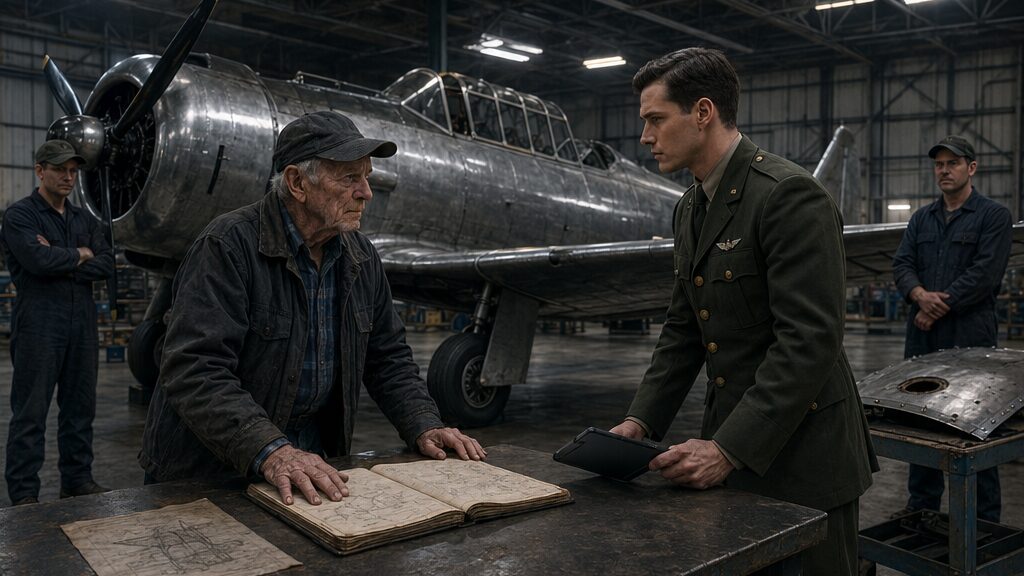
Long strips of white light hummed overhead, slow to warm, throwing pale bars across the concrete floor and the belly of the aircraft parked in Bay Three. The cold came up through Steven Bennett’s boots before it reached his knees. It always did. At seventy-two, he had learned the order in which mornings entered a body: first the soles, then the joints, then the hands.
He sat at the rough workbench with his coat still buttoned and his cap pulled low. A mug of coffee cooled beside a tray of cotter pins. Three wrenches lay in a row, wiped clean the night before and set by size, because a tool out of place was a question waiting to become a mistake.
Across the bay, two younger technicians moved under the left wing with tablets clipped to their wrists. One of them laughed at something the other said. The sound bounced off corrugated metal and came back thinner.
Steven did not mind laughter in a hangar. A silent hangar was worse. Silence meant nobody trusted the machine, nobody trusted one another, or somebody had heard something they did not know how to name.
He opened the worn notebook with his left hand. The spine had cracked years ago, and the brown cover had softened at the corners until it held the curve of his palm. He no longer remembered when he had stopped calling it a logbook and started treating it like a second memory. Some pages held torque values, some held sketches of line routes, some held dates he did not like to revisit. Between two pages near the back, a small photograph of Carolyn rested face down.
He did not turn it over.
Not yet.
The aircraft in Bay Three was an old ceremonial trainer the base had restored for the weekend flyover. Polished aluminum skin. Navy markings repainted bright enough to please visitors. Seats reupholstered. Panels shined. A machine made presentable for people who would stand outside the fence and shade their eyes while it crossed the morning sky.
Steven had worked on aircraft that came home dirty, aircraft that came home limping, aircraft that came home missing pieces and men. This one looked too clean to make him comfortable.
A young technician called from beneath the fuselage, “Hydraulic pressure stable.”
Another answered, “Copy. Reading clean.”
The engine was not running, only the test cart and auxiliary pump. Still, the aircraft had a sound to it. Every machine did. A living rhythm of current, fluid, metal, air, vibration. Steven had spent more years listening to that language than listening to music.
He turned a page in the notebook without looking down.
There it was again.
Not loud. Not even enough to make the nearest technician lift his head.
Tick.
A pause.
Tick-tick.
Then nothing.
Steven’s fingers stopped on the page.
He waited.
The pump whined steady. The lights hummed. A wrench clinked in a tray. Somewhere near the rear of the hangar, a cart wheel squealed once and settled.
Then it came again.
Tick.
Tick-tick.
A thin traveling sound, too clean to be a loose panel, too irregular to be the pump itself. It crossed through metal like a message sent from one place and received somewhere else.
Steven closed his eyes.
“You all hearing that?” he asked.
The technician nearest the wing looked over his shoulder. He was young enough to still have smooth skin above the collar of his coveralls. “Hearing what, Mr. Bennett?”
“Run the pressure cycle again.”
“We just did.”
“Again.”
The second technician glanced toward the tablet and shrugged. “System says green.”
Steven opened his eyes. The aircraft sat still, bright under the hangar lights, obedient to every display that said it was fine.
He pushed himself up from the chair. His right knee resisted, then allowed him. He did not hurry. Hurrying made people watch the limp instead of the reason. He crossed to the left side of the aircraft and stood beneath the wing, head tilted, one hand resting on the workbench edge for balance.
The younger technician raised his eyebrows. Not disrespectful exactly, but close enough to make no difference.
“You want us to cycle it again?” he asked.
“I want you to listen when you do.”
The technician smiled a little, then looked back at the tablet. “Yes, sir.”
Steven ignored the smile. He had learned long ago that irritation spent strength faster than age did.
The pump cycled. The hydraulic line pulsed. The aircraft gave its usual small shiver. Then, faintly, the sound returned.
Tick.
Tick-tick.
The nearest technician frowned, but only because he saw Steven listening.
“It’s probably the pump mount,” the technician said. “They flagged minor vibration last week.”
“No,” Steven said.
The word came out softer than he intended.
The technician waited, but only for a second. “Pressure’s holding.”
“I didn’t say it wasn’t.”
“Then what’s the issue?”
Steven looked along the underside, past polished brackets and fresh paint, toward the section where the line disappeared behind a panel that had been removed and replaced too many times during restoration.
The issue was not visible. That was what bothered him.
Things you could see usually wanted to be fixed. Things hiding in plain sound wanted to be believed first.
A door rolled open at the far end of the hangar, bringing in a rectangle of gray morning. Cold air moved across the floor. Boots struck concrete in a clean rhythm.
Jacob Carter entered with a folder under one arm and his uniform jacket sharp at the shoulders. He had the posture of a man who believed posture solved half of leadership. Behind him walked Brandon Miller, civilian jacket zipped to his chin, phone already in hand.
Jacob did not come directly to Steven. He stopped by the inspection table, spoke to the technicians, checked a form, and looked toward the aircraft as if the aircraft were the thing that might disappoint him.
Brandon saw Steven standing under the wing and gave a tight little nod.
“Morning, Steve.”
Steven hated being called Steve by men who only used the name when they wanted him manageable.
“Morning.”
Jacob turned then. His eyes landed first on Steven’s cap, then on his work shirt, then on the notebook lying open at the workbench. Something in his face settled into politeness.
“Mr. Bennett,” he said. “You’re in early.”
“Hangar was open.”
“We appreciate your dedication.” Jacob said it the way people thanked a memorial plaque.
Steven looked back at the underside of the wing. “You need to cycle the left hydraulic system again.”
Jacob’s expression did not change. “We just reviewed the readings.”
“I heard something.”
The young officer glanced at the technicians. One of them looked at the tablet as if hoping it would answer for him.
“What kind of something?” Jacob asked.
“A traveling tick. Not from the pump.”
Brandon slid his phone into his pocket. “We’ve had vibration notes on that pump mount. It’s already logged.”
Steven shook his head once. “Not the pump.”
Jacob’s gaze went briefly to the workbench, to the notebook, then back to Steven. “The aircraft is scheduled for final inspection at noon. Ceremony rehearsal is at sixteen hundred. We cannot chase every noise on a restored frame.”
The word chase touched something in Steven’s chest, but he kept his face still.
“You don’t chase a sound,” he said. “You follow it.”
The hangar quieted by one degree. Not enough for anyone to admit it. Enough for Steven to notice.
Jacob stepped closer. “And where does this one lead?”
Steven looked at the panel behind the line. “Not sure yet.”
That was the honest answer. It was also the wrong answer to give a man holding a schedule.
Jacob nodded slowly. “Then document it. We will proceed according to current readings.”
Brandon added, “Let the crew finish their checklist.”
The technicians turned back to their tablets with the relief of men excused from an old man’s concern.
Steven walked back to the bench. His knee complained harder this time. He sat down, pulled the notebook toward him, and uncapped the pen clipped to the cover. The page in front of him already held a half-faded sketch from another aircraft, another year, another sound he had not written enough about when it mattered.
He listened as the pump cycled once more across the bay.
Tick.
Tick-tick.
Everyone else kept moving.
Steven wrote one line beneath the date.
Not the pump.
Chapter 2: The Officer Who Trusted The Screen
By ten that morning, Bay Three had become a place for clean uniforms.
The restoration crew had swept the floor twice. The yellow extension cords were coiled tight against the wall. The inspection table held three tablets, two binders, a sign-off clipboard, and a row of pens nobody would use because all the forms had gone digital. Someone had even wiped the oil shadow from the corner of Steven’s workbench, though not well enough to erase the dark crescent where his coffee mug had sat for years.
Steven noticed that first.
Men who cared about appearance before inspection always wiped the wrong things.
He sat where he had been sitting since sunrise, the notebook open, his hands flat on either side of it. Across the bay, the old aircraft gleamed under the lights. Its restored paint made it look younger than it was. Steven knew better. Paint did not change what metal remembered.
Jacob Carter stood near the nose with a tablet in one hand. He had removed his uniform jacket and rolled neither sleeve, though the hangar had warmed. Two technicians waited nearby. Brandon Miller hovered at the edge of the group, pretending not to hover.
“Auxiliary hydraulic system cycle complete,” one technician said.
“Leak check?” Jacob asked.
“Clean.”
“Pressure variation?”
“Within limits.”
“Pump vibration?”
The technician tapped the screen. “Same as prior note. Minor. No fault code.”
Jacob nodded. “Then the visible discrepancy is closed after mount inspection.”
Steven’s hand tightened against the notebook cover.
“No,” he said.
It was not a loud word, but it carried because every other sound had stopped.
Jacob turned, not quickly. “Mr. Bennett?”
“The discrepancy isn’t closed.”
Brandon sighed through his nose. “Steven.”
Steven rose. He did it slowly, hating that slowness gave other men time to prepare patience. He lifted the notebook and carried it toward the inspection table.
“I asked them to cycle the system again. Same sound. Same interval.”
Jacob set down the tablet. “We reviewed that.”
“You reviewed what the screen gave you.”
Jacob’s face changed at that. Not anger yet. Warning. “Our readings are not guesswork.”
“Neither are my ears.”
One of the younger technicians looked down.
Brandon stepped in, voice low. “Let’s keep this professional.”
Steven placed the notebook on the inspection table. The cover made a soft slap against the metal surface. He opened it not to the fresh note from that morning, but to a page near the middle where the paper had gone yellow-gray from age and handling. The corner bore an old oil stain in the shape of a thumb. A hand-drawn line route crossed the page in black ink, annotated with small arrows, dates, and two bracket marks.
Jacob glanced down.
Steven could see him trying not to look too interested.
“This is not the same aircraft,” Jacob said.
“No.”
“Then we need to be careful about transferring old assumptions.”
Steven nodded once. “That’s right.”
The answer seemed to surprise him.
Steven touched the page with one finger. “That’s why I’m not talking about the pump. I’m talking about where the sound travels after pressure loads the line.”
Jacob folded his arms. “The line has been inspected.”
“Visually.”
“By certified personnel.”
“I didn’t say they weren’t certified.”
“But you are saying they missed something.”
Steven looked at the aircraft instead of Jacob. The left wing cast a long shadow on the floor. Beneath it, the hydraulic line curved behind a support panel, clean and ordinary.
“I’m saying the sound is wrong.”
There was a moment when Jacob might have asked the right question. Steven saw it pass through him. Curiosity, almost. Then the hangar office door opened and the base commander’s aide appeared to ask if the aircraft would be ready for the afternoon rehearsal.
Jacob’s jaw set.
“Yes,” Jacob called back. “We’re on track.”
The aide disappeared.
Steven did not move his finger from the notebook page.
Jacob lowered his voice. “Mr. Bennett, with respect, we cannot ground an aircraft because a retired mechanic hears a noise no one else can identify.”
“With respect,” Steven said, and felt how thin the words were, “you shouldn’t clear one because a tablet doesn’t know what to call it.”
The technicians stared at the floor now. Brandon rubbed a hand over his mouth. Somewhere behind them, the pump cart clicked as it cooled.
Jacob stepped closer to the table. Standing, he had a full head over Steven. Seated at the bench, Steven had looked smaller. Here, with the notebook between them, he felt every inch of his age but none of the need to apologize for it.
“Let me be direct,” Jacob said. “You were brought on for restoration familiarity, not final airworthiness authority.”
“I know what I was brought on for.”
“Then you also know where that authority ends.”
Steven looked up at him. The young officer’s face was controlled, but there was strain beneath it. Schedule strain. Reputation strain. The strain of a man who had been handed a public event and told nothing could go wrong.
Steven understood that kind of pressure. Understanding did not make it safer.
“Authority ends where risk begins,” he said.
Jacob stared at him.
Brandon gave a short, humorless laugh. “That sounds nice, Steven, but we need specifics.”
Steven tapped the notebook page twice.
“Here.”
The sound of his fingernail on paper was small, but every eye followed it.
“This route passes under a support bracket before it reaches the actuator. When pressure cycles, a weak bracket can send sound back through the line. Makes men think pump, mount, housing, anything up front. But the sound starts aft of where they’re looking.”
Jacob leaned over the notebook despite himself. The posture matched the one Steven had seen too many times: a man drawn toward something while still resenting being drawn.
“This page is from when?” Jacob asked.
“Nineteen ninety-five.”
“That was thirty years ago.”
“Twenty-nine.”
Jacob looked at him. “That does not strengthen your case.”
“No,” Steven said. “The sound does.”
The younger technician closest to the table shifted. “Sir, we could pull that panel again.”
Jacob did not look at him. “We already pulled it yesterday.”
“Not under pressure,” Steven said.
The technician’s eyes moved from Jacob to Steven and back again.
Brandon’s voice sharpened. “We are not opening a closed panel based on a handwritten note from 1995.”
Steven felt the room tilt, not physically, but in the old familiar way it did when people chose the easier sentence over the harder truth. He withdrew his finger from the page and let his hand rest flat beside it.
Jacob straightened.
“Log the concern,” he said. “Attach it as advisory, not grounding.”
Steven’s throat tightened, but his voice stayed calm. “Advisory means you can ignore it.”
“It means it will be considered.”
“No,” Steven said. “It means it will be filed where no one has to hear it.”
The words came too close to anger. He stopped there.
Jacob picked up his tablet. “We proceed with final inspection.”
The decision fell through the hangar like a tool dropped from height.
The technicians returned to the aircraft. Brandon gathered the clipboard and walked away without looking at Steven. Jacob remained at the table a second longer. His eyes touched the notebook once more, lingering on the oil-darkened corner, the hand-drawn line, the firm old lettering.
“What happened in 1995?” he asked quietly.
Steven closed the notebook.
“Nothing you’re ready to put on a schedule.”
Jacob’s face hardened again, as if he regretted asking.
“Clear the inspection area,” he said.
Steven carried the notebook back to the workbench. He sat down carefully, set it in front of him, and laid both hands on the cover.
Across the bay, the aircraft waited beneath its bright paint.
At noon, Jacob Carter ordered it cleared for final inspection.
Chapter 3: The Note Nobody Filed
The records office had no smell left in it.
That was what bothered Steven most. A real records room used to smell like paper, dust, machine oil carried in on sleeves, and the faint acid tang of old folders aging in metal cabinets. This room smelled of carpet glue, printer heat, and lemon disinfectant. The walls were white. The cabinets were half empty. The important things, according to the base, now lived inside a server no one in the hangar could touch.
Kathleen Harris sat behind the front desk with a cardigan over her uniform blouse and reading glasses low on her nose. She looked up when Steven stepped inside.
“If you’re here to complain about the coffee machine again, it still burns everything,” she said.
Steven removed his cap. “Not here for coffee.”
“That sounds serious.”
“It is.”
Kathleen leaned back. Her gaze went to the notebook under his arm before it returned to his face. She had worked logistics long enough to understand that men rarely carried paper into a records office unless they had lost an argument somewhere else.
“What are you looking for?” she asked.
“Old maintenance bulletin. Hydraulic line bracket fatigue. Trainer restoration program. Might’ve been archived before the system changeover.”
“What year?”
“Nineteen ninety-five. Maybe ninety-six by the time they wrote it up.”
Kathleen took off her glasses and set them down. “Steven.”
“I know.”
“That’s before two database migrations, one contractor handoff, and the flood in Building C.”
“I know that too.”
She studied him a moment. Kathleen was not young, but she was not old enough for people to dismiss her outright, which gave her a narrow view into both worlds. She had seen officers speak past enlisted men, contractors speak past clerks, and young technicians speak past anything that did not come with a search bar.
“Is this about Bay Three?” she asked.
“Yes.”
“Jacob Carter already requested the active maintenance packet. There’s no open bulletin attached.”
“That’s why I’m here.”
Kathleen sighed and rolled her chair toward the keyboard. “You understand that if it isn’t digitized, it may as well be in a cave.”
“A cave would keep paper better.”
She gave him a look over the glasses, then typed.
Steven stood beside the desk and watched the search fields populate. Aircraft designation. Hydraulic. Bracket. Fatigue. Advisory. Restoration. Legacy fleet. Each term returned either nothing or too much. The system was skilled at burying simple questions under hundreds of irrelevant answers.
Kathleen clicked through files. “There’s pump vibration. Seal replacement. Actuator inspection. Nothing on bracket fatigue.”
“Try line resonance.”
She typed.
Nothing.
“Try support travel.”
She typed again.
A list appeared, then dissolved into unrelated supply memos.
Kathleen frowned. “Where did you get that phrase?”
Steven opened the notebook. He had marked the page with a torn strip from an old parts envelope. The hand-drawn route looked smaller under office light, less certain, almost embarrassing. He turned the notebook so she could read the margin.
Kathleen leaned closer. “‘Support travel after cycle load.’ That your writing?”
“Yes.”
“You always wrote like you were mad at the paper.”
“I wanted it to remember.”
Her fingers hovered above the keys. “Steven, what exactly are you trying to prove?”
He almost answered with the technical facts. The route. The sound. The panel. The bracket. They were safer than the truth.
Instead he looked through the interior window toward the hangar beyond. From here he could see only a slice of Bay Three, a bright section of aircraft skin and the movement of men in clean coveralls.
“I’m trying to keep them from trusting a quiet failure.”
Kathleen did not answer right away.
Then she typed again, slower this time.
“Support travel,” she murmured. “Cycle load. Legacy hydraulic.”
The system returned a maintenance archive index.
Not the bulletin itself. Just an index line. Most of the fields were blank, corrupted by conversion. But one old storage code remained.
Kathleen’s eyebrows drew together. “That’s odd.”
Steven felt his pulse change. “What?”
“This index says hard copy retained. Box transfer. No scan available.”
“Where?”
She clicked the entry. A warning box appeared. She dismissed it. Another field opened with a location code.
“Temporary storage,” she said. “Which means somebody meant to scan it and never did.”
“Building?”
Kathleen looked at him over the monitor. “You’re not going to like this.”
“I already don’t.”
“Old supply cage annex. Back of Hangar Two.”
Steven closed the notebook.
The old supply cage annex was where paper went when nobody wanted to throw it away in front of someone who remembered why it mattered.
Kathleen printed the index line. The printer woke with a reluctant grinding sound and pushed out one sheet. She handed it to Steven.
“This doesn’t prove your warning,” she said.
“I didn’t ask it to.”
“What do you need it to do?”
“Prove the warning existed.”
Kathleen held on to the paper a second longer than necessary. “Jacob won’t like being challenged with a ghost file.”
“He doesn’t have to like it.”
“No. But you may have to work with him after.”
Steven took the sheet. “Maybe.”
She softened then. “Brandon told people you were getting worked up.”
Steven looked at the page rather than her face. “Did he?”
“He said you were mixing old incidents with current inspection.”
“That what you think?”
Kathleen pushed her glasses back on. “I think men under pressure call memory confusion when they don’t want it to be evidence.”
The words landed quietly. Steven folded the index sheet once and slid it into the notebook.
“Thank you.”
“I didn’t do anything yet.”
“You looked.”
The old supply cage annex sat beyond Hangar Two, behind a rolling gate that stuck halfway unless lifted from the bottom. Kathleen came with him because she had the keys and because, Steven suspected, she wanted to see whether his ghost file had bones.
The annex smelled better than the records office.
Dust. Cardboard. Rust. Old paper. Mouse traps. Forgotten metal.
Rows of boxes leaned on industrial shelves marked with fading labels. Some had contractor names crossed out and replaced by newer ones. Some had dates written in black marker. Some had no labels at all, only the sagging posture of things spared by indecision.
Kathleen checked the printed code. “Shelf D, upper row.”
Steven looked up.
Of course it was upper row.
Kathleen saw his face. “Don’t even think about climbing.”
“I wasn’t.”
“You were measuring the shelf with your pride.”
He almost smiled.
She dragged over a rolling step ladder and climbed two steps before he could object. After shifting three boxes, she found one with a torn white label.
“Legacy Hydraulic Advisories,” she read. “Partial. Water exposure.”
Steven’s mouth went dry.
She lowered the box carefully. It landed on the floor with a soft cardboard sigh. The lid had been taped, cut, and taped again. Kathleen pulled it open.
Inside were folders warped slightly from old damp. Some pages had curled edges. Some labels were unreadable. Steven knelt, though his knee disliked the bargain, and began sorting with two fingers.
Pump. Seal. Reservoir. Actuator. Line pressure.
Then he saw it.
Not a full title. Only an abbreviation.
HYD SUP TRVL / BRKT NOTE
The handwriting on the folder was not his. But the abbreviation was the same one from his notebook.
Kathleen crouched beside him.
“Is that it?”
Steven did not answer at first. His finger rested on the folder tab, and for a moment he was not in the annex. He was standing in another hangar with younger hands, hearing the same faint pattern move through metal while a superior told him not to slow the line.
Kathleen’s voice gentled. “Steven?”
He slid the folder free.
The pages inside were thin and stained. The top sheet had lost part of its header, but the diagram remained: a hydraulic line route, a support bracket, a warning about transmitted vibration under pressure load.
Kathleen exhaled.
“Well,” she said. “That’s not nothing.”
Steven stared at the diagram. His own notebook suddenly felt heavy under his arm.
“No,” he said. “It never was.”
Chapter 4: The Sound From Twenty-Nine Years Ago
By evening, the hangar had emptied into echoes.
The final inspection team had taken its forms and confident voices somewhere else. The technicians had rolled the test cart against the wall. Brandon had gone to a meeting with the base commander’s aide, carrying the smooth expression of a man preparing to explain away inconvenience. Jacob Carter had left last, his tablet tucked under his arm, his steps brisk, his face unreadable.
Steven stayed.
He told himself it was because someone ought to put the tools back where they belonged. Then because the notebook needed updating. Then because his truck took a while to warm in cold weather and there was no sense rushing outside.
All of it was true enough to be useless.
The aircraft sat beneath the lights, bright and patient. With the hangar doors shut, every little sound became larger: the tick of cooling metal, the low shift of cables in the rafters, the far-off groan of a pipe behind the wall. Steven sat at the workbench and opened the folder Kathleen had helped him find.
The old advisory had dried into waves. Water stains had blurred one corner, but the diagram remained clear. It was not the same aircraft. Jacob had been right about that much. It was an older variant, a different frame, a line routed by hands that had long since retired or died. But the mechanical habit was the same. Pressure, vibration, support, fatigue. Metal did not care what year a man wrote on the form.
Steven laid his notebook beside the advisory. His old drawing and the official diagram looked like two memories of the same mistake.
He turned the page.
The photograph of Carolyn slipped loose and landed face up on the bench.
She was younger in the picture than he felt in his bones, standing beside a pickup with her hair blown across one cheek, smiling at whoever had held the camera. Steven had taken it before a summer cookout, before she got sick, before hospitals taught him how long a hallway could feel.
He picked up the photograph by the edges.
“You’d tell me I’m making a face,” he said.
The hangar gave him nothing back.
Carolyn had never understood aircraft the way he did, but she understood when men were lying to themselves. Late in their marriage, when his hands had started to shake after long workdays and he began pretending it was cold, she had set a cup of tea beside him and said, “Steven, silence is not the same thing as peace.”
He had argued, naturally. He was good at arguing when he had no defense.
Now he looked at the old advisory and heard another hangar, another night.
Nineteen ninety-five had smelled of rain and hot insulation. He had been forty-three, still broad in the shoulders, still quick up a ladder, still able to work twelve hours and drive home like his body had not noticed. The aircraft then had come in with a pressure complaint that would not repeat when watched. One pilot mentioned a vibration in the pedals. A younger mechanic heard nothing. Steven had heard the traveling tick during the second cycle.
He had said so.
Not loudly. Not enough.
A senior chief had been leaning on the schedule, and the squadron was already behind. The pump had been replaced. The readings had settled. A visible leak had been cleaned. The senior chief said they would monitor it after the next run. Steven remembered the exact phrase because men used it when they wanted time to do the work that should have already been done.
We’ll keep an eye on it.
The aircraft had not fallen out of the sky. That would have made the story cleaner and crueler. It had failed during taxi after a training run, hard enough to injure a crewman and tear up the gear assembly, hard enough to leave Steven standing in the wash of emergency lights while rainwater ran down the back of his neck.
The crewman’s name was not written in the notebook.
Steven had never written it there.
He had written diagrams. Failure routes. Inspection notes. A bracket mark circled three times. Words stripped of shame because shame had no place in a maintenance record.
Should have grounded it.
He turned to that page now. The ink had faded, but it had not forgiven him.
A sound came from the hangar floor.
Tick.
Steven looked up sharply.
For one breath he was younger. For one breath the old hangar and the present one sat over each other like two transparencies held to the light.
Then he saw the test cart settling against its wheel chock.
Nothing more.
He set Carolyn’s photograph back inside the notebook but did not close it.
“I said something today,” he told her picture. “More than last time.”
The words should have comforted him. They did not. Saying something was not the same as stopping something. A warning filed as advisory was just a quiet way for everyone to keep walking.
He looked across the bay at the aircraft. In the morning, visitors would arrive. Flags would be set near the viewing area. Men would speak about service and memory. A restored machine would lift over a crowd while people clapped for what they believed had been preserved.
Steven pressed the heel of his hand against his knee until the ache sharpened. He welcomed it. Pain that belonged to the present was easier than the kind that rose from paper.
The office door clicked open.
Kathleen stepped into the hangar with her coat over one arm. “Thought I’d find you here.”
Steven slid the photograph back farther between the pages. “Thought you went home.”
“I did. Then I remembered the annex key was still in my pocket.” She held it up, then looked at the open advisory. “You read through it?”
“Enough.”
“Does it match?”
“Not exactly.”
“That means yes with conditions.”
He nearly smiled. “It means enough to pull the panel under pressure.”
Kathleen came closer but did not sit. She had the good manners of someone who knew when a man had been alone with the wrong memory.
“Jacob asked records for confirmation,” she said.
Steven looked up.
“He didn’t say why. Just asked whether the bulletin you found was legitimate.”
“What did you tell him?”
“That paper existed before most of our current shortcuts did.”
Steven looked back at the advisory. “That won’t make him stop clearance.”
“No.”
The hangar lights buzzed faintly overhead.
Kathleen’s voice softened. “What happened, Steven?”
He moved one finger along the old line drawing. He could have refused. For years refusal had been the one thing nobody could take from him. But the question did not come with curiosity only. It came with care, and that was harder to turn away.
“I heard it once before,” he said. “I let another man tell me it wasn’t enough.”
Kathleen waited.
“Was somebody hurt?”
Steven did not answer quickly. The name rose in him, but he kept it where it had lived for twenty-nine years. Not forgotten. Not offered.
“Yes.”
Kathleen looked toward the aircraft.
“And now?”
“Now everybody has better screens,” Steven said. “Same hurry.”
She stood beside him in silence.
After a while, she said, “What are you going to do?”
Steven closed the advisory folder and slipped it under his notebook. His hand rested on the cover, on the place where Carolyn’s photograph made the pages rise slightly.
“I don’t know yet.”
Kathleen gave a small nod, as if she respected the answer more than a brave lie.
When she left, Steven remained at the bench. The hangar settled around him. He uncapped his pen and turned to the page he had started that morning.
Under Not the pump, he added three words, pressing hard enough that the pen scored the paper.
Should have grounded it.
Chapter 5: The Inspection That Almost Passed
The morning of the flyover arrived polished and cold.
By seven, flags stood outside the hangar doors. Folding chairs lined the viewing area beyond the safety rope. A public affairs crew moved with cameras and cables, careful to keep the aircraft framed from its best angle. The base commander’s aide checked a printed schedule against a phone. Somewhere outside, a brass ensemble tested a few uncertain notes that broke apart in the wind.
Inside Bay Three, everything had been arranged to look inevitable.
The aircraft gleamed. The inspection table was clean. The tablets were charged. The sign-off screen waited with empty boxes, each one ready to turn green.
Steven arrived before the first formal briefing. He wore the same blue plaid work shirt under his jacket, the same dark cap, the same boots with one lace replaced by a thinner cord. He carried the notebook under his arm and the old advisory folded inside it. He did not carry anger. Anger would make him easier to dismiss.
Brandon met him near the tool lockers.
“You need to let this go this morning,” he said, without greeting.
Steven hung his coat on the peg.
Brandon glanced toward the inspection table, then lowered his voice. “The commander’s people are already asking why there was a records pull last night. Jacob is irritated. The crew is irritated. I’m irritated.”
“That makes a full set.”
“This isn’t funny.”
“No.”
Brandon stepped closer. “You made your note. It’s attached. If they choose to proceed, that’s above us.”
Steven looked at him. “Above us doesn’t mean away from us.”
“Don’t do that.”
“Do what?”
“Turn this into some moral test.” Brandon rubbed his forehead. “We have a contract review next month. Half the reason you’re still on this crew is because I told them your restoration knowledge was worth the accommodation.”
Steven took that in quietly. Worth the accommodation. The phrase had a soft surface and a hard center.
“My age is not a favor you grant me,” he said.
Brandon looked away first. “I’m saying don’t force them to decide you’re a liability.”
Across the hangar, Jacob Carter entered with the inspection team. His uniform was immaculate, his face composed. He had slept, or he had learned how not to show that he had not. He greeted the safety officer, exchanged a word with the commander’s aide, then walked to the aircraft without looking at Steven.
The test began.
Steven did not interfere. He stood near his workbench while the technicians checked visible lines, fittings, reservoirs, pressure response, actuator movement, and pump readings. Every step returned clean. The tablets approved what they were asked to approve. The safety officer asked twice about the prior vibration note. The pump mount inspection was cited. The replacement fasteners were shown. The visible issue was closed.
Then came the pressure cycle.
Steven turned his head before the sound arrived.
The pump whined. The line loaded. The aircraft shifted in that small way machines did when fluid carried force through hidden spaces.
Tick.
A pause.
Tick-tick.
Steven saw one technician glance up. Not enough to speak. Enough to prove the sound existed outside Steven’s memory.
Jacob saw the glance too.
“Reading?” Jacob asked.
“Stable,” the technician answered.
“Cycle again.”
They did.
Tick.
Tick-tick.
The safety officer frowned. “Was that present before?”
“Minor vibration associated with pump mount,” Jacob said.
Steven picked up his notebook.
Brandon, standing near him, whispered, “Don’t.”
The word was not a command. It was fear.
Steven walked to the inspection table.
Conversation thinned around him. Jacob’s eyes moved to the notebook, then to Steven’s face. The safety officer watched with professional caution. The commander’s aide checked the time.
Steven placed the notebook on the table, not loudly. He set the old advisory beside it.
“I am requesting a pressure-loaded inspection of the aft support bracket on the left hydraulic line before final clearance.”
Jacob’s face tightened. “The concern has been logged.”
“Advisory is not enough.”
The commander’s aide stepped closer. “Is there an active fault?”
“No fault code,” Jacob said.
Steven did not look at the aide. “A fault code is not the only reason to inspect a part.”
The safety officer picked up the advisory. “Where did this come from?”
“Archives,” Kathleen said from behind them.
Steven had not heard her arrive. She stood near the records cart, holding a folder against her chest.
Jacob gave her a sharp look. “This is an old advisory on a different variant.”
“Yes,” Steven said. “Different variant. Similar route. Same sound under load.”
Brandon put one hand on the table. “Steven, you are not the clearance authority.”
“No.”
“Then step back.”
Steven looked at Brandon’s hand. It rested inches from the notebook, broad and tense and embarrassed by him.
Something inside Steven became very still.
For years he had mistaken restraint for quietness. Restraint was not quietness. It was the discipline to use the exact force required, no more and no less.
He opened the notebook to the old page, then to the fresh one. The words he had written the night before stood dark beneath the date.
Not the pump.
Should have grounded it.
Jacob read them before Steven could cover the second line. His expression flickered.
Steven turned to the safety officer. “There is an old safety hold provision for unresolved transmitted vibration during pressure cycling on restored or legacy hydraulic routes.”
The safety officer’s eyebrows rose. “That provision is rarely used.”
“Rarely needed.”
Jacob set his tablet down. “Mr. Bennett—”
Steven continued, voice even. “I am invoking it as the mechanic who logged the discrepancy and supplied supporting advisory material.”
“You don’t have current sign-off authority,” Jacob said.
“No. But I have discrepancy originator standing until a safety officer clears the unresolved condition.”
The hangar went quiet enough for the brass notes outside to drift faintly through the wall.
The safety officer looked at Jacob. “He’s correct.”
Brandon closed his eyes for half a second.
The commander’s aide checked the schedule again, as if the paper might change out of sympathy.
Jacob’s jaw worked once. “You’re asking us to delay a public veterans’ flyover over a sound that may still be pump vibration.”
“No,” Steven said. “I’m asking you not to put men in a machine you haven’t finished listening to.”
The words did not rise. They did not need to.
Jacob looked toward the aircraft. Then at the technicians. Then at the safety officer, who had not moved.
“How long to pull the panel and cycle under load?” Jacob asked.
One technician answered carefully. “If we start now, forty minutes to expose and rig. More if access hardware fights us.”
The commander’s aide made a quiet, unhappy sound.
Brandon said, “We’ll miss rehearsal.”
Steven waited for someone to say that mattered more.
Jacob picked up the tablet, looked at the green boxes waiting to be approved, then turned the screen face down on the table.
“Pull the panel,” he said.
Nobody moved for a second.
Then the hangar broke into action.
Tools came out. The inspection team shifted position. The safety officer began a new log entry. Brandon stepped away to make a call he clearly did not want to make. Kathleen stayed by the records cart, her eyes on Steven.
Jacob came closer.
“If this is nothing,” he said quietly, “you understand what you’ve done.”
Steven looked past him to the aircraft’s left side, where the technician was already kneeling with a driver.
“Yes.”
“And if it is something?”
Steven lifted the notebook from the table and held it against his chest.
“Then we listen sooner next time.”
The first panel screw broke loose with a sharp metallic crack. Steven turned toward the sound, every nerve in him awake.
Chapter 6: Not The Pump, The Bracket
The panel did not come away cleanly.
Two screws backed out with little complaint. The third stuck, its head half-rounded from some older removal, and the technician muttered under his breath as the driver slipped. The delay spread through the hangar like heat. Outside, visitors were beginning to arrive. Their voices came faintly through the doors, cheerful and unaware.
Jacob stood with his arms folded, watching the work.
Steven stood beside the workbench, close enough to see, far enough not to crowd. His knee hurt from standing, but he did not sit. Sitting would make men think the fight had gone out of him now that the order had been given. It had not. The hardest part of being believed was that belief carried its own burden. Once others listened, you had to be right for the right reasons.
The technician switched bits. “Head’s stripping.”
Steven said, “Use hand pressure. Not speed.”
The technician paused. Jacob looked over.
Steven did not step forward until the technician glanced at him. Permission, reluctant but real.
He crossed the bay. “Seat it deep. Put your shoulder behind it. Slow quarter-turn.”
The technician did as told. The screw gave with a dry snap.
Nobody commented.
The panel came free at last, exposing a shadowed section behind the line route. At first glance there was nothing dramatic. No leak. No broken metal hanging loose. No stain spreading like proof. Just a hydraulic line curving through its supports, clean fittings, fresh inspection marks, and a bracket half-hidden behind a cable run.
Jacob crouched with a flashlight. “I don’t see a crack.”
“You won’t from there,” Steven said.
The safety officer moved beside him. “Where do you want the light?”
Steven opened the notebook on the workbench and turned it toward the aircraft. The old page, the official advisory, and the exposed line formed a triangle of paper and metal. He pointed to the hand-drawn bracket mark, then to the aircraft.
“There. But don’t look at the face. Look where the load transfers into the bend.”
Jacob adjusted the flashlight. The beam slid over metal.
“Cycle pressure,” Steven said.
The safety officer looked to Jacob.
Jacob hesitated only a second. “Cycle it.”
The pump started.
Under the open panel, the line tightened with pressure. The bracket did not move enough for a young eye to notice. Steven watched the shadow beside it.
Tick.
Tick-tick.
“There,” he said.
“I heard it,” the technician whispered.
Jacob’s flashlight beam froze.
Steven pointed, but did not touch. “Not the pump. The bracket.”
The safety officer leaned in. “I need eyes.”
“Mirror,” Steven said.
One of the technicians fetched a small inspection mirror. His hands were quick now, no trace of earlier amusement. He gave it to Jacob first out of habit. Jacob looked at it, then held it toward Steven.
Steven accepted it.
His fingers were not as steady as they had once been. He hated that the tremor showed more when people watched. He braced his wrist lightly against the aircraft frame, angled the mirror behind the bracket, and nodded to the technician holding the light.
“Lower. No, lower. Let it glance across, not straight in.”
The beam shifted.
For a moment, still nothing.
Then the mirror caught a hairline shadow where shadow should not have been, a thin dark crescent at the base of the bracket, almost hidden beneath paint and grime.
The safety officer inhaled through his teeth.
Jacob moved closer. “Is that surface paint?”
Steven lowered the mirror and handed it to him. “You tell me.”
Jacob took it. His face was tight with concentration now, not resistance. He angled the mirror the way Steven had done. The hangar waited around him.
The pump whined. The line loaded.
Tick.
The bracket shifted less than the width of a fingernail, but the mirror betrayed it. The dark crescent opened and closed like an eye.
Jacob went still.
The safety officer said, “Stop cycle.”
The pump wound down.
No one spoke.
Steven stepped back, suddenly aware of how tired he was. The proof was there, and with it came no triumph. Only the old, sick relief of arriving before harm instead of after.
The safety officer straightened. “Aircraft is grounded pending structural inspection and bracket replacement.”
The commander’s aide, pale now, spoke into a phone and turned away.
Brandon stood near the inspection table with both hands on his hips, staring at the exposed section as if it had personally betrayed him.
Jacob remained crouched longer than necessary. When he stood, he did not look at Steven immediately. He looked at the notebook, open on the bench, the old advisory beside it. Then he looked back at the bracket.
“How did you hear that?” he asked.
Steven closed the notebook halfway, then stopped. The question deserved more than a clever answer and less than a confession.
“Same way you learn any machine,” he said. “You listen to it when it’s healthy. Then you remember when it isn’t.”
Jacob swallowed. “You said this happened before.”
Steven’s thumb rested on the edge of the page with the 1995 drawing. “I said I heard it before.”
“What happened?”
The hangar had become smaller. Even Brandon looked up. Kathleen stood motionless by the records cart. The technicians pretended to examine tools, but none of them were moving.
Steven looked at the exposed bracket. The crack was so small. That was what anger never understood. It expected danger to arrive large enough to justify fear. Most danger came as a detail asking not to be dismissed.
“A man got hurt,” Steven said. “Because I let someone tell me almost the same sound wasn’t enough.”
Jacob’s expression changed. Not pity. Steven would have hated pity. Something heavier. Recognition, perhaps, of the weight behind another man’s certainty.
“I’m sorry,” Jacob said.
Steven shook his head once. “Don’t spend sorry on me. Spend time on the aircraft.”
The safety officer began issuing instructions. The bracket would need imaging, replacement, full route inspection, and review of adjacent supports. The flyover would be canceled or reassigned. The ceremony outside would have to continue without the polished machine everyone had planned to admire.
Brandon came to Steven last.
For a moment, he looked like a man searching for a sentence that could save his pride and finding none.
“You protected the contract,” Steven said before Brandon could speak.
Brandon blinked. “What?”
“You think I damaged it. I didn’t.”
Brandon looked toward the grounded aircraft. The truth of that would take longer than the moment allowed.
“I shouldn’t have said what I said,” Brandon muttered.
“No.”
The bluntness made Brandon wince, but Steven had no interest in dressing it up.
Kathleen approached with the old advisory folder. “Safety officer wants this copied into the active file.”
Steven nodded. “Give him the official one.”
“And your notebook?”
Steven’s hand closed over the cover.
“No.”
Jacob, who had been speaking quietly with the technician, turned at the word.
Steven felt all their eyes. He understood the hunger of systems. Once a private thing proved useful, the system wanted to own it.
“This is mine,” he said. “It has more than maintenance in it.”
Kathleen’s gaze softened. “A copy of the relevant pages, then?”
Steven looked down at the notebook. The oil-darkened corner. The firm handwriting. The page beneath it where Carolyn’s photograph rested unseen. The line he had written the night before.
Should have grounded it.
He opened to the diagram and tore out nothing. Instead, he laid the notebook flat.
“You can copy this page,” he said. “And the note from today.”
Kathleen gave a small nod, understanding the boundary.
Jacob stepped beside him, not too close.
“Mr. Bennett,” he said.
Steven waited.
Jacob looked toward the exposed bracket, then at the notebook. His voice was lower now. The command edge had gone out of it.
“Show me where you heard it.”
Steven studied him for a breath. The young officer’s posture was still straight, but no longer stiff. His face carried the discomfort of a man learning in public. That was not nothing. A lesser man would have hidden behind the safety officer’s decision and let the paperwork speak.
Steven picked up the flashlight and handed it to him.
“Not from where you were standing,” he said. “Come under the wing.”
Jacob followed.
Steven moved slowly, because his knee allowed no other way. This time no one rushed him, and no one looked away as if his slowness embarrassed them. Under the wing, he pointed first to the pump, then along the line, then to the bracket, then back to the workbench where the notebook lay open.
“The sound fools you because it travels clean,” Steven said. “You hear it up front and blame what’s loudest. But the loudest part isn’t always the guilty one.”
Jacob held the flashlight steady.
Outside, the brass ensemble began the anthem rehearsal. The notes came through the hangar wall, muted and solemn.
Steven touched the line route in the air without touching the aircraft.
“Listen before the screen speaks,” he said.
Jacob did not answer at once.
Then he nodded. “Again.”
Steven glanced at him.
“Show me again,” Jacob said.
So Steven did.
Chapter 7: The Page He Left Behind
The ceremony went on without the aircraft.
Outside, the flags still moved in the wind. The brass ensemble played with the solemn confidence of men who knew the song mattered more than the missing flyover. The base commander adjusted his remarks, spoke of preservation, vigilance, and the responsibility carried by those who maintained what others trusted. He did not mention Steven by name. Steven was grateful for that.
Inside the hangar, the old trainer sat with its panel open and its bright skin interrupted by exposed truth.
By late afternoon, the inspection team had finished photographing the bracket. The crack was small but deep enough to change every voice in the room. Once magnified on a screen, it became obvious in the way all overlooked things become obvious after somebody has paid the price of seeing them first.
Brandon stood near the inspection table, speaking quietly with the safety officer. His shoulders had lost their earlier stiffness. The contractor supervisor looked older than he had that morning, not from age, but from the kind of day that takes a man’s certainty and hands him back something less comfortable.
Kathleen copied the official advisory, Steven’s fresh note, and the diagram page from his notebook. She handled the notebook carefully, as if it were not fragile but private. Steven noticed and said nothing.
Jacob remained under the wing with one of the younger technicians. They had already removed the faulty bracket and marked adjacent supports for inspection. Jacob held the flashlight now, not as a symbol, not as a favor, simply because the technician needed both hands.
Steven watched from the workbench.
His knee had stiffened badly after the morning. He had finally sat, not because the work was done, but because a man did not prove dignity by punishing bone. The notebook lay open before him. Carolyn’s photograph sat beside it, face up for the first time all day.
The younger technician glanced toward Steven. “Mr. Bennett?”
Steven lifted his eyes.
“When the bracket flexed,” the technician said, “the sound came forward through the line because the pump housing amplified it?”
Steven looked at Jacob.
Jacob did not answer for him.
“That’s part of it,” Steven said. “But don’t think of it as amplification first. Think of it as a path. Metal carries what touches it. Pressure loads the line, weak support shifts, sound travels to where your ear expects trouble.”
The technician nodded slowly. “So we blamed the loudest place.”
“Most people do.”
Jacob looked across the wing shadow then. He understood the sentence had not only been about aircraft.
Brandon came over after the safety officer left. He stopped at the end of the workbench, where he had stood so many times before with schedules, forms, and requests disguised as courtesy.
“Steven,” he said.
Steven waited.
Brandon looked at the open notebook, then at Carolyn’s photograph, and had the good sense to look away from the photograph quickly. “The contract office is calling this a successful safety intervention.”
“That what it was?”
“That’s what they’re calling it.”
Steven gave a small nod. “Good enough for them.”
Brandon rubbed one hand across the back of his neck. “It’s not good enough from me.”
The hangar sounds filled the space between them: tape pulled from a roll, a toolbox drawer closing, the muted wind pressing against the doors.
“I was wrong,” Brandon said.
Steven closed the notebook halfway, leaving his finger inside to hold the page. “About the bracket?”
“About you.”
That made Steven look up.
Brandon’s face was plain with discomfort. Not performative. Not polished. The words seemed to have cost him, which made them worth more.
“I treated you like keeping you here was some kind of courtesy,” Brandon said. “It wasn’t. I forgot that.”
Steven studied him for a moment. “Don’t make me into a lesson you can finish by dinner.”
Brandon’s mouth tightened, then he nodded. “Fair.”
“I’m still slow on ladders.”
“I know.”
“My hands shake if I work too long in the cold.”
“I know that too.”
“I miss things.”
Brandon did not rush to deny it. That was the first decent answer he gave.
“So do I,” he said.
Steven looked down at the notebook. The old page from 1995 lay beneath his thumb, softened by years of being turned and not forgiven.
“Then we write them down,” Steven said.
Kathleen returned with a folder of copies. She placed them beside the notebook. “Official file gets these. Safety office gets these. Training archive gets a redacted copy if you approve.”
Steven raised an eyebrow. “Redacted?”
“I assumed you didn’t want every margin note copied.” Her gaze flicked gently toward the place where Carolyn’s photograph had been.
Steven touched the edge of the picture. “Good assumption.”
Jacob crossed the bay as the afternoon light began to dull against the high windows. He had rolled his sleeves at last. There was a narrow streak of grease across his wrist, which made him look less like a man posing beside maintenance and more like one who had entered it.
He stopped opposite Steven at the bench.
“Mr. Bennett,” he said, then paused. “Steven, if that’s all right.”
Steven considered him. “Depends what comes after it.”
Jacob accepted that. He set the flashlight on the bench, parallel to the wrenches, careful without making a show of it.
“I’d like to use your notes for a training session,” he said. “Not all of them. What you’re willing to share. The route diagrams, the sound notes, the old advisory cross-reference.”
Steven looked at the flashlight. It was not his, but Jacob had placed it like a borrowed tool returned clean.
“You want the notes because I was right today,” Steven said.
“Yes.”
“That’s not enough.”
Jacob’s face tightened, but he did not retreat. “Then what would be enough?”
Steven turned the notebook toward himself and flipped past the 1995 page, past sketches, dates, corrections, failures, fixes that had worked, fixes that had not, reminders to check what pride said was fine. He stopped at a blank page near the back.
“Training can’t be about an old man being right,” he said. “That’ll teach them to wait for an old man. Wrong lesson.”
Jacob leaned one hand on the bench, not over Steven now, but beside the book.
“What should it teach?”
Steven picked up his pen. His fingers trembled slightly. He let them. The tremor no longer felt like evidence against him.
“That a machine doesn’t care who hears it first,” he said. “And rank doesn’t make a sound less true.”
Jacob looked down. “I earned that.”
“You did.”
A brief silence passed. Then Steven added, “You also grounded the aircraft.”
“After you forced the hold.”
“After you listened.”
Jacob met his eyes.
The distinction settled there, small but solid.
Kathleen smiled faintly from the records cart and pretended to organize folders. Brandon turned away toward the inspection table, giving the moment privacy in the only way a hangar could.
Steven wrote at the top of the blank page:
Listen before the screen speaks.
He tore no page out. Instead, he opened the copier folder Kathleen had brought and slid the blank-page note on top, then tapped it once with the pen.
“Put that first,” he said.
Jacob read it. Something in his face eased and tightened at the same time.
“Yes, sir.”
Steven almost corrected him. Then he decided not to.
The next morning, Bay Three looked less ceremonial and more honest. The flags outside had been taken down. The chairs were folded. The aircraft remained open and unfinished, surrounded by tools, inspection tags, and bright work lamps.
Steven arrived to find three younger technicians gathered at his workbench. For a moment, old instinct made his shoulders tense. Men around another man’s bench could mean carelessness. But they were not touching his tools. They were looking at the copied page in a clear sleeve.
Listen before the screen speaks.
Jacob stood with them. He was not lecturing. He was holding the old advisory copy and asking the technician from the day before where he would inspect first.
The technician pointed, hesitated, then shifted his finger away from the pump toward the route behind the bracket.
Jacob nodded. “Why?”
The technician glanced at Steven.
Steven hung his coat slowly on the peg.
“Don’t look at me,” he said. “Listen to the machine.”
The young man turned back to the aircraft, embarrassed but smiling a little.
Kathleen came in later with a small archival binder. Not fancy. Just black covers, clear sleeves, and a label printed in plain type: Legacy Notes — Hydraulic Route Training. She placed it on the corner of Steven’s bench without asking to move anything.
“Copies only,” she said.
Steven touched the binder with two fingers. “Original stays with me.”
“Original stays with you.”
He opened his notebook and slipped Carolyn’s photograph back between the pages. Before closing it, he looked at her smile one more time.
Silence is not the same thing as peace.
No, he thought. And being heard was not the same thing as being finished.
Jacob approached as the crew moved toward the aircraft. “We’re starting with pressure routing basics at ten hundred. If your knee’s up to it, I’d like you there.”
Steven capped his pen. “My knee has no authority over my ears.”
Jacob smiled, small and careful. “I’ll take that as yes.”
Steven stood. It took him a second longer than he wanted, but no one looked impatient. Jacob did not offer an arm. Steven appreciated that more than help would have pleased him.
At the workbench, he left the copied note in its sleeve, weighted by the flashlight Jacob had returned. Then he tucked the worn notebook under his arm.
The hangar lights hummed overhead. A wrench clicked into place. Somewhere beneath the open wing, a young technician asked for quiet before cycling the system.
Steven walked toward the aircraft, slow but steady.
This time, everyone listened before the machine spoke.
The story has ended.