The Old Janitor Held His Mop While The Officer Questioned The Life He Never Saw
Chapter 1: The Officer Stopped The Old Man In The Hallway
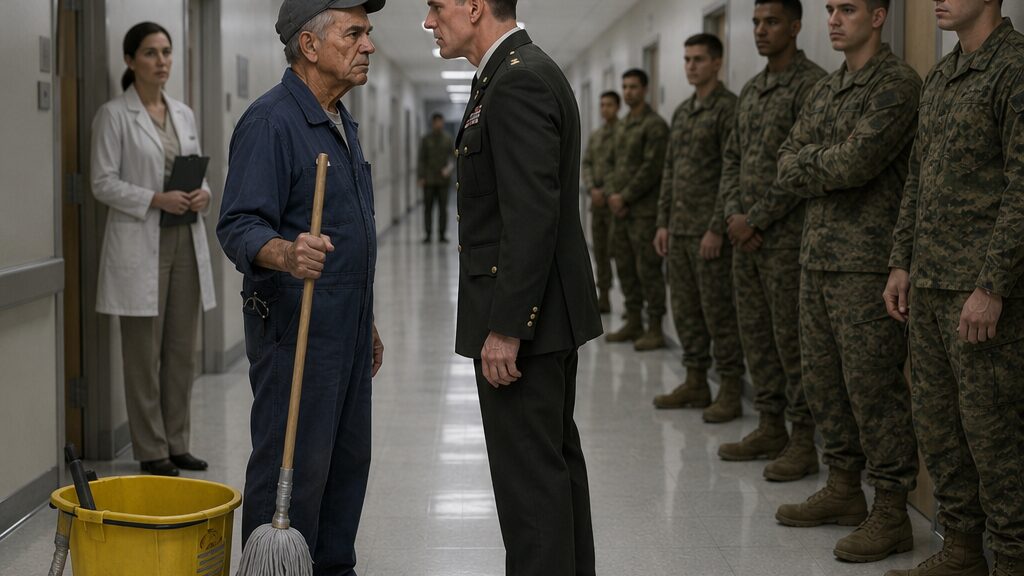
The yellow bucket was six inches inside the red line when the officer stopped walking.
Samuel Torres saw it before the young man spoke. He saw the polished black shoes halt on the waxed tile, saw the crease in the trouser leg sharpen as the officer turned, saw the reflection of silver ceiling lights bend around the thin film of water Samuel had just mopped away. The hallway went quiet in the way military hallways did not usually go quiet. Boots slowed. Voices folded down. A rolling cart stopped somewhere behind him.
Samuel kept one hand on the mop handle.
The bucket was yellow plastic with a wringer that squeaked if pushed too hard. A strip of gray tape crossed the handle where it had cracked the winter before. On the side, someone had written MAINT-3 in black marker, but years of disinfectant had rubbed the letters pale. Beside it stood a caution sign, folded open like a warning nobody read until they wanted someone to blame.
The officer was young enough to still look carved by his uniform. Dress jacket perfect. Ribbons straight. Chin clean. Shoulders squared as if the corridor itself had fallen out of formation.
“You,” the officer said.
Samuel lifted his eyes.
The man’s nameplate read HALL. The face above it was tight with a kind of pressure Samuel knew, though the young man did not know Samuel knew it. Inspection week made everybody move as if the building were a body and a superior officer might press any spot to see if it hurt.
“Yes, sir,” Samuel said.
A few trainees had gathered near the wall, still holding binders against their chests. One of them had a trauma kit slung badly over one shoulder. A civilian nurse educator stood farther down the hall, halfway between leaving and deciding whether she had heard enough to stay.
Officer Hall pointed—not at Samuel’s face, but at the bucket.
“Is that yours?”
Samuel glanced down as though there might be another yellow bucket beside him.
“Yes, sir.”
“This corridor is restricted until inspection walkthrough.”
Samuel looked past him to the double doors near the end of the hall. Simulation Wing B. Trauma labs to the left. Evacuation classroom beyond the frosted glass. The inspection route had been posted on the board at 0600, but the floor had been scuffed at 0615 by a gurney with one locking wheel dragging rubber from the elevator to the junction.
The floor had needed clearing.
“I’m almost finished,” Samuel said.
“That wasn’t my question.”
The officer stepped closer. Not close enough to touch. Close enough that the trainees could feel the space tighten.
Samuel did not move back. He had learned long ago that stepping back from a man who wanted a reaction usually made him want another.
Officer Hall’s eyes flicked to Samuel’s cap, his plain blue uniform, his old hands around the mop. The glance was quick but complete, like an inventory. Old man. Cleaner. Obstruction. Problem.
“You need to move like you understand where you are,” Hall said.
The words did not rise. That made them worse. A shout might have scattered into the hallway and died there. This stayed neat and professional, dressed in authority.
One trainee looked away.
Samuel felt the mop handle beneath his palm, smooth in the middle from years of use. He felt the small ache in his right thumb where the joint did not close as it used to. He smelled bleach, floor polish, and the faint rubber scent of new boots. Somewhere behind Hall, an elevator opened and shut without anyone stepping out.
He could have said many things.
He could have said he had known where he was before Hall had learned to lace boots. He could have said this building’s evacuation corridors were marked wrong on the third-floor map. He could have said a body on a stretcher needed thirty-six inches clear and a frightened medic needed more than that.
Instead, Samuel bent slowly, took the bucket handle, and shifted it six inches outside the red line.
The wheels clicked once.
Then he set the mop upright beside it, bristles clean, handle straight.
“Floor’s clear, sir,” he said.
A flush moved at the edge of Hall’s jaw. Perhaps he heard obedience. Perhaps he heard something else.
“See that it stays that way.”
“Yes, sir.”
The officer turned slightly, not fully dismissing him, as if leaving Samuel there would be a favor. The trainees began breathing again. Boots resumed. A binder snapped shut. The nurse educator down the hall watched Samuel longer than the others did.
A young trainee near the wall shifted too fast and dropped the trauma kit from his shoulder. It hit the floor with a hard plastic clatter. Gauze packs slid out. A tourniquet skidded across the tile and stopped near Samuel’s boot, twisted through its windlass strap.
The trainee crouched, embarrassed. “Sorry.”
Samuel looked down.
He should have let the boy pick it up. That was what invisibility required: do only the job printed on the badge, touch only what belonged to maintenance, never reveal that your hands remembered anything not listed in the contract.
But the strap lay wrong. The windlass had slipped through the retaining clip. In a drill, it would cost seconds. In a real hallway, seconds widened.
Samuel stooped with care, picked up the tourniquet by its band, and reset the windlass in one clean motion. He laid it on top of the kit, not inside, parallel to the edge where a hand could find it without looking.
“Don’t bury that,” he said quietly. “Not under soft goods. Hard tools high. Bleeding won’t wait for neat.”
The trainee stared at him.
Samuel picked up his mop again.
Officer Hall had turned back.
For a moment, the young officer’s face lost its certainty. The nurse educator’s eyes narrowed, not in suspicion but recognition of a motion too practiced to be guessed. The trainee mumbled thanks. Samuel gave a small nod and pushed the mop forward, drawing the last damp crescent from the polished floor.
“Maintenance,” Hall said, as if the word itself could put Samuel back where he belonged.
Samuel stopped.
“Sir?”
“Who told you to handle training equipment?”
“No one.”
“Then don’t.”
The trainee’s ears reddened. The nurse educator took one step forward, then stopped. Samuel saw the choice in her body and spared her from making it.
“Yes, sir,” he said.
He guided the mop toward the wall, slow enough not to splash, steady enough that no one could call it trembling. His face remained calm. That, he had learned, irritated men who mistook calm for defiance.
Hall turned to the trainees. “Simulation room in five. Keep the corridor clean.”
The group moved.
Samuel waited until their boots had passed, then looked at the floor. The tile held no trace of the moment except a faint drying line where his mop had paused. That was the mercy of polished floors. They accepted whatever fell, then gave back a shine if someone stayed long enough to work.
He pushed the bucket along the baseboard.
Near the double doors, two workers were installing a brushed metal plaque beside Simulation Wing B. One held it level while the other marked holes with a pencil. Blue tape framed the wall. The plaque was covered in protective paper, but one corner had peeled loose.
Samuel did not mean to read it.
He saw enough.
DEDICATION CEREMONY — FRIDAY
EVACUATION MEDICAL TRAINING ROOM
IN MEMORY OF—
The rest disappeared beneath the worker’s hand.
The mop handle pressed against Samuel’s palm.
For a second, the hallway was not white tile and fluorescent light. It was dust, canvas, shouted coordinates, and a floor that would not stay clear no matter how many times he yelled for space. A young man’s hand slid in his. Blood made everything difficult to hold.
“Sir?” one of the workers said. “Need to get through?”
Samuel looked at the plaque. Then at the clean strip of floor beneath it.
“No,” he said.
He turned the bucket around without crossing the red line.
Chapter 2: The Bucket Was Moved But The Complaint Remained
By Monday afternoon, the bucket had been cleaned twice and the complaint had already traveled farther than Samuel had.
It reached the maintenance office in a printed sheet with a clipped tone and no signature visible to the man it concerned. Timothy Lewis held the page under the buzzing light above his desk, reading it once, then again, as if the words might soften if he gave them another chance.
Samuel stood by the supply shelves.
The maintenance office was too small for bad news. Every sound pressed close: the hum of the vending machine outside, the drip from the utility sink, the rattle of hangers where extra blue uniforms waited for bodies that would never fit them quite right. The air smelled of detergent powder and old cardboard.
Timothy rubbed his forehead with two fingers.
“It says you interfered with inspection movement.”
Samuel looked at the floor between them. The tile there was cracked at one corner. He had mentioned it twice on repair slips. Not urgent, they had said.
“I moved the bucket.”
“It says you were inside a restricted corridor after prep notice.”
“The floor was marked.”
“Sam.”
Timothy only used the shortened name when he wanted to sound kind while doing something unkind. He was not a bad man. He was tired in the practical way supervisors became tired after years of making small compromises with bigger offices. His shirt collar curled at one edge. His wedding band had scratched the paper where he held it.
“You know how this week is,” Timothy said. “Visitors, command staff, donor people, family guests for the ceremony. They want everything smooth.”
Samuel nodded.
“I kept it smooth.”
Timothy glanced up at him.
Samuel did not say more.
The page made a small sound when Timothy set it down. “Officer Hall thinks you challenged him in front of trainees.”
“I answered him.”
“He said you handled a training item.”
“A dropped tourniquet.”
“Training item,” Timothy repeated, not because he believed the distinction mattered, but because the page did. “You can’t do that.”
Samuel folded his hands in front of him. The right thumb ached again. He pressed it lightly with his left hand until it settled.
Timothy’s voice lowered. “I know you were probably helping.”
Samuel looked up.
“That’s not what I need in writing,” Timothy said. “I need this not to grow legs.”
Outside the office window, a pair of trainees passed with a rolling mannequin covered in a blue sheet. The mannequin’s plastic arm hung loose, fingers tapping the side rail with each bump. Samuel watched it go by.
Timothy followed his gaze, then looked away.
“I’m moving you off the main corridor for the rest of the week,” he said.
Samuel felt the words land somewhere behind his ribs.
“Night shift only?”
“You already work nights.”
“I work early turnover on training mornings.”
“Not this week.”
“The trauma rooms need—”
“They’ll get done.”
Samuel almost smiled at that. Not from humor. From the small, old sorrow of people who believed rooms prepared themselves if the schedule said they were prepared.
Timothy leaned back. The chair squeaked. “Look, I’m not trying to punish you. But if an officer files another complaint, the contractor gets pulled into it. Then I get pulled into it. Then they ask why I’ve got a seventy-four-year-old man in restricted corridors during inspection week.”
Samuel let the number pass between them. Seventy-four. It had a way of becoming an argument in other people’s mouths.
“You want me in storage,” Samuel said.
“I want you away from the people looking for problems.”
“That’s storage.”
Timothy’s face tightened, then eased with regret. “For three days.”
Samuel nodded once.
He had been moved before. From field to aid station. From aid station to evacuation truck. From active duty to stateside training. From uniform to civilian clothes. From names people called out in urgency to a badge that said CUSTODIAL SERVICES. Each move had been explained as temporary by someone with a form.
Timothy softened his voice. “You okay with that?”
Samuel picked up the yellow bucket handle.
“Yes.”
The bucket’s wheels rattled as he took it to the utility sink. He rinsed the wringer carefully, though it was already clean. He wiped the gray tape around the handle with a cloth until the tape darkened, then lightened as it dried. His hands moved without hurry.
Timothy watched him.
“You don’t have to take everything quiet,” he said.
Samuel twisted water from the cloth. “Most things don’t get better because I make them loud.”
“That officer was out of line?”
Samuel paused.
The office held its breath.
“He had a line to keep,” Samuel said. “He saw mine in the wrong place.”
Timothy looked at the complaint again, dissatisfied by an answer that protected the man who had written it. “That’s generous.”
“No,” Samuel said. “It’s accurate.”
He rolled the bucket to the closet and set it beneath the shelf where mop heads hung in a row like tired gray hair. The maintenance closet opened into the back corridor behind Simulation Wing B. It was narrow, windowless, and useful. Samuel had always liked useful spaces. They did not ask to be admired.
When Timothy returned to his desk, Samuel took the early turnover checklist from the clipboard. He did not have to. He had been removed from the corridor. But his eyes went down the list by habit.
Trauma Room Two: restock gloves.
Trauma Room Three: clean drain channel.
Simulation Corridor: check spill station.
Evacuation Training Room: prep for Friday dedication.
His finger stopped on the last line.
Timothy noticed. “Leave that one.”
Samuel clipped the paper back.
“I heard you,” he said.
The afternoon thinned into the kind of institutional quiet that came before training drills. Samuel worked the storage corridor, then the scrub sinks, then the back hall where nobody important walked unless something had gone wrong. At 1500, he passed the open door to Trauma Room Three and saw Karen Martin inside with two trainees, arranging supplies on a metal cart.
She was in her forties, with reading glasses pushed up on her head and a pen tucked behind one ear. Her voice had the clean firmness of someone who had repeated the same instruction to too many nervous hands.
“No, not there,” she told a trainee. “Airway drawer is top left. Circulation is below it.”
The trainee moved a stack of packets.
Samuel slowed.
The cart label was wrong.
Not dramatically wrong. Not the kind of wrong that made people gasp. The top drawer had a laminated AIRWAY tag, but inside were pressure dressings and hemostatic gauze. The second drawer held airway adjuncts under a CIRCULATION label. In a classroom, it would become confusion. In a timed drill, embarrassment. In a hallway with a real body, danger.
Samuel stood at the door.
He could keep walking. He should keep walking.
Karen looked over. “Samuel?”
He lifted a hand toward the cart. “Label’s switched.”
The trainee froze, packet still in hand.
Karen turned to the drawers, opened them both, and went still.
“Well,” she said softly.
Samuel stepped only as far as the threshold. “Top drawer should open clean. Don’t stack soft packs near the hinge. They catch.”
Karen looked from the cart to him. “How did you see that from the hallway?”
Samuel’s eyes stayed on the cart. “Hinge shadow.”
“Hinge shadow?”
“When it doesn’t close flush, something’s crowding it.”
The trainee adjusted the drawer.
Samuel nodded once. “Keep the floor clear under the stretcher path too. You’ve got a cord across it.”
The trainee looked down and quickly moved the cord.
Karen took one slow breath. “Thank you.”
Samuel stepped back.
He had already said too much.
Behind him, from the far end of the corridor, dress shoes struck tile with a measured sound. Officer Hall had stopped near the corner. His face revealed nothing, but his eyes moved from Karen to the cart, then to Samuel standing just outside a room he had been told to avoid.
Karen still held the mislabeled drawer open.
Samuel turned away before anyone could ask him to explain.
Chapter 3: The Janitor Knew Where The Blood Would Go
Karen Martin had taught enough young medics to know the difference between memorized confidence and real calm.
Memorized confidence was loud. It announced itself in acronyms, checklists, and jokes made too quickly. Real calm showed up in the hands. It did not waste motion. It did not ask the room for permission. It knew what mattered before the room did.
On Tuesday morning, she saw it again from Samuel Torres.
The trauma simulation room had been reset for an inspection drill. White walls. One observation window. One training mannequin on a stretcher. One wall clock with a red second hand. Two rolling carts. Three trainees pretending not to be nervous. A tablet on the counter would record their time, their sequence, their errors, and later, if the day went badly, their excuses.
Karen stood near the head of the stretcher with her clipboard. Officer Hall stood by the observation window, arms behind his back. His uniform was less ceremonial than the day before but just as precise. His face carried the tight focus of a man determined not to be surprised again.
Samuel was not supposed to be in the room.
He was outside in the corridor, visible through the open door, changing the liner in a waste bin near the wall. His yellow bucket sat beside him, parked squarely out of the traffic lane. A wet floor sign stood beyond it, angled toward the junction.
Karen noticed the sign because it was not where most maintenance workers would have put it. It was not near the damp patch. It was near the empty lane a stretcher would need if the room had to be cleared fast.
“Begin,” Karen said.
The first trainee moved to the mannequin’s side. “Massive bleeding check.”
The second reached for gloves, dropped one, grabbed another. The third opened the cart and hesitated.
Karen kept her face still.
They were good students. That was the problem. Good students often learned a room as it had been arranged for them. When the room changed, their minds spent precious seconds objecting.
The third trainee pulled open the drawer marked circulation and found airway supplies.
He blinked.
“Keep moving,” Hall said.
His voice did not help.
The first trainee called out, “No visible bleed.”
The second reached for the blood-pressure cuff and knocked a stack of gauze packs onto the floor. One slid beneath the stretcher. Another landed underfoot. The third trainee found the pressure dressings in the upper drawer, but in pulling them free, he dragged out a roll of tape that dropped and rolled across the room.
Karen wrote one mark on her clipboard.
Hall shifted.
The second trainee stepped backward, caught his heel on the tape roll, and grabbed the stretcher rail. The stretcher jerked sideways. Its wheel struck the metal leg of a stool someone had left too close to the path.
The sound cracked through the room.
Nobody moved for half a second.
Then Samuel’s voice came from the doorway.
“Freeze the bed.”
The words were quiet. Not shouted. The kind of quiet that made bodies obey before pride could interfere.
The trainee locked his hands on the rail.
Samuel stood at the threshold with a full trash liner tied in one hand. He did not cross into the room. His eyes moved once: stool, cord, gauze, drawer, trainee positions, stretcher wheels.
Karen saw the map form in his face.
“Left wheel is fouled,” he said. “Don’t pull. Lift the stool back with your foot. You—blue gloves—clear the tape. Not under the bed. Toward the wall. Keep the floor clear.”
The trainee in blue gloves looked at Karen.
Karen said, “Do it.”
Hall turned sharply toward her.
The trainee moved the tape. The stool scraped back. The stretcher settled.
Samuel looked at the third trainee. “Hard tools high. Soft goods low. If you have to look twice, the cart is wrong.”
The trainee swallowed. “Yes, sir.”
Samuel’s face changed at the word sir, but only a little. A faint closing of the eyes. A door not shut loudly, only firmly.
“I’m not your instructor,” he said.
“No,” Karen said, still looking at him. “But you’re correct.”
Hall stepped forward. “Mr. Torres, you were told yesterday not to handle training operations.”
Samuel looked at him. “I didn’t handle them.”
“You directed trainees during a drill.”
“I kept one from falling.”
“That is not your role.”
A trainee still held the stretcher rail with white knuckles. The room smelled faintly of vinyl, disinfectant, and the coffee someone had carried in despite the sign on the door.
Samuel lowered the trash liner to the floor beside his leg. “No, sir.”
The answer was agreement, not surrender. Karen heard the difference.
Hall’s mouth tightened. “Then return to your assigned duties.”
Samuel nodded. He picked up the trash liner and moved back into the corridor. Before leaving, he nudged the wet floor sign two inches farther from the stretcher path with the side of his shoe.
The motion was almost invisible.
Karen saw it.
The drill resumed, but the room had changed. The trainees were quieter. Not ashamed exactly, but aware that the room itself had been speaking and they had not known how to listen. The trainee in blue gloves cleared the path twice before touching the cart again.
When the sequence ended, the tablet showed a failing time.
Hall took the clipboard from Karen and looked at the marks.
“Run it again,” he said.
Karen folded her arms. “They need five minutes to reset.”
“They need discipline.”
“They need the cart arranged correctly and the floor clear.”
Hall looked through the doorway where Samuel had gone. “This is becoming a pattern.”
“Yes,” Karen said.
He looked back at her.
She did not soften it. “It is.”
The trainees stepped away from the mannequin, pretending not to listen.
Karen lowered her voice. “Yesterday he saw a tourniquet packed wrong. Today he saw a blocked stretcher path from the hallway. That is not luck.”
“It is interference.”
“It prevented an injury.”
“It undermined the drill.”
“The drill was already undermined by the room.”
Hall’s eyes sharpened. “Are you suggesting maintenance staff should be evaluating medical trainees?”
“No. I’m suggesting we should ask why maintenance staff knows what our trainees are missing.”
He handed the clipboard back.
Karen expected anger. Instead, for a moment, she saw something more brittle in him. Fear perhaps. Not of Samuel. Of disorder. Of being seen standing in a room where the person with the least authority had understood the emergency first.
Hall looked toward the corridor again.
Samuel was farther down now, pushing the yellow bucket toward the utility closet. His back was slightly bent, but his line through the hallway was exact. He kept to the side without hugging the wall. He left enough room for two people to pass, or one stretcher moving fast.
Karen watched him stop at a scuff mark near the junction. He set the mop head down, drew it once across the tile, and cleared the dark streak before anyone else saw it.
“Who trained him?” she said, mostly to herself.
Hall heard.
His answer came too quickly. “That isn’t the question.”
But Karen could tell by the way he looked at the old man that it had become the only one.
Chapter 4: Justin Wanted A Report Before He Wanted The Truth
By Wednesday morning, Justin Hall had written the first sentence of the report three times and deleted it three times.
Maintenance employee Samuel Torres interfered with—
He stopped there.
Interfered was clean. It sounded official. It turned the old man’s quiet voice in the trauma room into a procedural issue. It turned the trainee’s near fall into a staffing boundary. It turned Justin’s own hesitation into command judgment.
He typed it again.
Maintenance employee Samuel Torres interfered with a scheduled trauma simulation exercise after prior verbal correction.
The words sat on the screen, flat and usable.
Justin leaned back in his chair.
His office had no window, only a framed photograph of the training center from twenty years earlier, before the new wing had been built and before the hallways had been polished bright enough to reflect every mistake. A stack of inspection binders occupied the left side of his desk. Ceremony folders occupied the right. Between them, his coffee had gone cold in a paper cup with the lid pressed too hard into the rim.
He had been given one week to prepare the center for command visitors, civilian families, donor representatives, medical instructors, and a dedication ceremony nobody had bothered to explain until he arrived. The base commander expected smooth execution. The training staff expected not to be disrupted. Facilities expected not to be blamed. Trainees expected to be nervous and forgiven.
Justin had no room for an elderly janitor who appeared in doorways and made everyone else look unprepared.
He read the sentence again.
Prior verbal correction.
It was accurate. It was also incomplete in a way that bothered him.
The old man had not argued. That was the problem. Men who argued could be placed. Men who raised their voices could be disciplined. Men who slunk away could be forgotten. Samuel Torres did none of that. He accepted correction like a man taking weather into account.
Justin opened Samuel’s employee record from the facilities roster. The file was thin.
TORRES, SAMUEL
Custodial Services — Night / Early Turnover
Contracted Staff
Start Date: twelve years prior
Notes: reliable; no safety violations; authorized access to utility corridors and training prep areas as assigned.
No veteran preference box. No prior service visible. No emergency medical certification. Nothing that explained a tourniquet reset, a stretcher-path correction, or the way trainees had obeyed his quiet voice before Justin’s.
Justin closed the file harder than he meant to.
A knock sounded.
“Come.”
Karen Martin stepped in with a folder under one arm. Her expression suggested she had decided not to wait for an invitation.
“If this is about yesterday,” Justin said, “I’m handling it.”
“That’s why I’m here.”
He looked at the folder. “Is that your drill evaluation?”
“Yes.”
“You can leave it with admin.”
“I can.” She set it on his desk. “I also added a note.”
Justin did not touch it. “About the trainee error?”
“About the room error.”
“The trainees failed to adapt.”
“The cart was mislabeled. The stool was in the stretcher path. The tape roll went underfoot because the room reset was rushed.”
“Maintenance reset that room.”
Karen’s eyes held his. “Facilities reset furniture and floors. Training staff resets medical layout. We signed off on the cart.”
Justin looked away first, annoyed that she had made fairness inconvenient.
She continued, quieter. “Samuel saw the hazard before any of us said it out loud.”
“That does not give him authority to enter instruction.”
“He didn’t enter. He stood at the door.”
“And directed trainees.”
“He prevented one from going down.”
Justin picked up a pen, then set it down. “You think I don’t know that?”
Karen’s posture shifted. The argument she had prepared seemed to lose its edge.
“I think you know it,” she said. “I’m not sure you know what to do with it.”
Justin said nothing.
Karen looked around his office, at the binders, the folders, the cold coffee. “You’re under pressure. I understand that. But if the only person seeing the room clearly is the old man with the trash liner, maybe the problem isn’t him.”
“He was corrected Monday and repeated the behavior Tuesday.”
“Maybe because the danger repeated.”
Justin stood. The chair rolled back and struck the wall softly.
“Ms. Martin, I am not writing up an officer, an instructor, and three trainees because a custodian has good instincts.”
“I’m not asking you to.”
“What are you asking?”
“Ask him why.”
The room became still.
Justin almost laughed. Not because it was funny, but because asking Samuel Torres why felt like surrendering a piece of authority he had only recently been trusted to hold.
Instead he said, “Thank you for the report.”
Karen did not move.
“Officer Hall,” she said, “he is not trying to embarrass you.”
Justin’s jaw tightened. “He has managed it anyway.”
Her face softened, and that made it worse. “Then don’t make that the center of the story.”
After she left, Justin remained standing.
The report draft waited on his screen. He saved it without sending.
At noon, he walked the corridor himself.
Simulation Wing B was busier than it had been Monday. Workers adjusted the plaque near the double doors. Trainees carried folded blankets and cases of training supplies. Maintenance staff moved along the walls with quiet efficiency, careful not to interrupt the inspection team’s route. Samuel was nowhere in the main corridor.
Justin found him in the back utility passage beside the maintenance closet.
The closet door was open. Mops hung from a metal rack. Chemical bottles lined the shelves, labels facing out. The yellow bucket sat under the lowest shelf, its handle wiped clean, gray tape smoothed flat against the crack. Samuel was replacing a mop head, twisting the old one loose with careful, practiced pressure.
In the narrow space, without trainees watching, the old man looked smaller. Not weak. Simply less protected by the story Justin had built around him.
“Mr. Torres.”
Samuel turned. “Officer Hall.”
Justin stepped into the doorway but not across the threshold. The closet smelled of disinfectant and damp cotton.
“I need to ask you about yesterday.”
Samuel set the mop head into a bin. “Yes, sir.”
“You were instructed not to handle training equipment.”
“I did not handle equipment yesterday.”
“You directed movement.”
“Yes.”
“Why?”
Samuel looked past him toward the corridor. “The wheel was fouled.”
“I know what happened. I’m asking why you involved yourself.”
The old man’s hands rested lightly on the mop handle. For a moment, Justin thought he would finally explain. The corridor hummed beyond them. A cart rattled somewhere out of sight.
Then Samuel said, “Someone could have fallen.”
“That’s all?”
“That was enough.”
Justin felt heat rise in his neck. “You understand that if every staff member steps into drills based on personal judgment, the training environment breaks down.”
Samuel nodded. “Yes.”
“You understand chain of command.”
A silence followed that was too long to be ignorance.
“Yes,” Samuel said.
“Then you understand why I need a written statement.”
Samuel looked at him then. Not sharply. Not with resentment. With a tired clarity that made Justin feel for one second like the younger man in the room.
“What do you need it to say?”
“The truth.”
Samuel’s thumb moved once along the mop handle, over the place where the wood had worn smooth.
“The floor was blocked,” he said. “I told them to clear it.”
“And why did you know how?”
Samuel lowered his eyes.
There it was. The door. Justin could feel it. Karen’s question waiting behind it. Who trained him?
Samuel did not open it.
“Old buildings teach you,” he said.
Justin almost pushed harder. The words rose: That is not an answer. But something in Samuel’s stillness stopped him—not fear, not defiance, but refusal shaped by long use.
“Fine,” Justin said. “I’ll expect your written statement by end of shift.”
Samuel nodded.
Justin turned to leave, then paused.
In the closet, the mop stood upright against the rack, straight as a staff. The old cotton head had been removed, leaving the handle bare at the bottom. For a strange second, Justin saw not a weapon, not a symbol, but a tool worn by grip and repetition. Something held because work required holding it.
He stepped back into the corridor.
That evening, after the building emptied into its late-day echo, Justin went to the records room for the dedication files. He told himself he was looking for ceremony background. The base commander had asked him to verify the order of speakers, family acknowledgments, and historical summary. It was responsible to check.
The records room was cold, lit by motion sensors that clicked on in sections as he walked. Boxes marked TRAINING DOCTRINE lined one wall. Older files sat in gray cabinets that resisted opening. Justin found the dedication folder in a banker’s box beneath a stack of evacuation drill manuals.
Inside were printed remarks, a guest list, a diagram of the old training wing, and a photocopied incident summary from years ago. The original text had faded in places. Several names were redacted in thick black lines.
He scanned the first page.
Mass casualty evacuation training protocol revised following after-action review.
His eyes moved down.
Field medic actions credited with preserving casualty flow during corridor obstruction and secondary equipment failure.
Justin turned the page.
A name appeared near the bottom, partly obscured by a bad copy and a redaction mark that had not covered enough.
S. Torres.
Justin stood alone in the cold records room, the paper trembling slightly in his hand before he made himself hold it still.
Chapter 5: The Name On The Old Page Was Almost Gone
On Thursday morning, Samuel found the old wing unlocked.
That was the first mistake.
The second was the smell.
Not strong. Not even unpleasant. A faint mixture of dust, old rubber, floor wax, and metal from drains that had not been flushed in years. Most people would have walked in and smelled only an unused room. Samuel stood at the threshold with the yellow bucket behind him and felt his hand close around the mop handle until the joint in his thumb complained.
The evacuation training wing had been sealed off after the new simulation rooms opened. Its corridor was narrower than the main hall, the ceiling lower, the tiles duller. A row of hooks still lined one wall where training stretchers had once hung. Blue tape marked the floor in faded lanes. At the far end, beneath a covered observation window, an old drain sat dark in the tile.
Samuel had not entered this hall in five years.
He had cleaned outside it. He had dusted the door. He had replaced the trash can near the junction and changed the lightbulb above the exit sign. But he had not crossed the threshold.
Now the door stood open because ceremony workers had been moving chairs through it, using the old wing as a staging path to the dedication room. Someone had left a paper cup on the floor. Someone else had tracked mud near the drain.
Samuel looked down the hall.
“Not today,” he said under his breath.
But his hand moved to the bucket.
The wheels made a small, uneven rattle as he crossed into the old wing. The sound went ahead of him and came back thinner. He set the bucket near the drain and dipped the mop. Water darkened the cotton. When he pressed it into the wringer, the squeak carried too far.
He worked from the wall inward, leaving a dry lane wide enough for passage.
Always a lane.
The memory did not arrive all at once. It never did. It came in pieces his body recognized before his mind allowed names.
A stretcher wheel catching.
A voice calling for space.
A young man saying, “Doc?” as if the word could keep him there.
Samuel’s own voice, younger and harsher, cutting through smoke and dust: Keep the floor clear.
He stopped mopping.
The drain sat beside his boot. Years ago, in a training reconstruction of a place far from this building, they had designed the drain to carry fake blood and water away during drills. Samuel had stood over it in uniform, telling instructors the angle was wrong. Casualty flow would jam at the corner. Equipment would bunch. A medic would kneel where a stretcher needed to roll.
They had listened then.
People listened when the uniform matched the knowledge.
A sound behind him broke the memory.
Officer Hall stood in the doorway with a folder in his left hand.
Samuel looked at the folder before he looked at Justin’s face.
“Mr. Torres,” Justin said.
Samuel dipped the mop back into the bucket. “This wing needs drying before they bring chairs through.”
“It was supposed to remain closed.”
“It was open.”
Justin stepped inside. His shoes crossed the old blue tape.
Samuel saw him notice the lane Samuel had left dry.
“I found a file,” Justin said.
Samuel wrung the mop slowly. “There are many files here.”
“This one has your name in it.”
The wringer squeaked. Samuel released the handle.
Justin came no closer. Perhaps he had learned something about distance. Perhaps the room made him cautious.
“It refers to a mass casualty evacuation protocol,” Justin said. “Field medic actions. Corridor obstruction. Equipment failure.”
Samuel moved the mop across the tile.
“Does that sound familiar?” Justin asked.
“Yes.”
Justin waited.
Samuel finished the stroke, turned the mop, and pulled the water toward the drain.
“Were you that medic?”
The question did not strike loudly. It settled, heavy and exact.
Samuel leaned the mop against the bucket.
The old wing held them both in its dim light. Dust hung near the window. The paper cup lay against the wall like a small white flag.
“I was one of them,” Samuel said.
Justin looked down at the folder. “The report credits S. Torres with preserving casualty flow.”
Samuel’s mouth tightened at the phrase. Preserving casualty flow. Words made for binders. Clean enough to file. Wide enough to hide faces.
“Reports like tidy lines,” he said.
“What happened?”
Samuel took the paper cup from the floor, crushed it gently, and dropped it into the bucket’s side caddy.
“People got hurt.”
Justin’s patience thinned. “I understand that.”
“No,” Samuel said, not unkindly. “You understand the sentence.”
The officer looked at him then with anger beginning and shame underneath it. “You could have told me.”
Samuel wiped a muddy streak near the drain. “Monday?”
“Yes.”
“In the hallway?”
Justin said nothing.
“In front of trainees?” Samuel continued. “While you were reminding me where I was?”
The words were quiet. That made them harder to meet.
Justin looked away first.
Samuel regretted saying even that much. Not because it was untrue. Because truth, once placed in a room, required care.
He rinsed the mop.
“I didn’t know,” Justin said.
Samuel pressed the mop into the wringer. “Most people don’t.”
“That file should have been in your personnel record.”
“No.”
“You served.”
“Yes.”
“You were a medic.”
“Yes.”
“Why is none of that listed?”
Samuel looked toward the covered observation window. The glass reflected him dimly: gray cap, blue uniform, old shoulders, mop handle. No rank. No unit. No young man calling him Doc.
“Because I’m not here as that man.”
Justin opened the folder again. “The dedication tomorrow is for the evacuation training room. This protocol—your protocol—is part of what they’re honoring.”
Samuel picked up the mop. “Then they have what they need.”
“They don’t know you’re here.”
“That’s not an accident.”
Justin’s brow tightened. “You avoided it?”
Samuel worked the mop in a controlled line around the drain. “I kept the hallway clean.”
“That isn’t an answer.”
“It is the one I have.”
A chair scraped in the corridor beyond the doorway. Ceremony workers passed, laughing softly about something unrelated. The sound disappeared toward the main wing.
Justin lowered his voice. “There’s a guest coming tomorrow. Janet Hill.”
Samuel’s hand stopped.
The mop head rested on the tile, water spreading beneath it.
Justin saw the change. “You know the name.”
Samuel did not answer.
“She’s listed as family representative for one of the soldiers connected to the original evacuation case.”
Samuel closed his eyes briefly.
Not enough for Justin to call it emotion. Enough for the old wing to change temperature.
“Hill,” Justin said. “Was he—”
“Don’t.”
The word came out before Samuel shaped it for politeness.
Justin went still.
Samuel opened his eyes. The drain blurred, then cleared.
“I’m sorry,” he said.
But Justin did not look offended. He looked, for the first time, uncertain in a useful way.
Samuel set the mop back in the bucket. He could feel the old wing pressing on him, asking for payment. Memory had always been a debt collector with patient hands.
He saw the young soldier again—not as the report had held him, not as a casualty, not as a number in a corridor-flow analysis. He saw dirt on one cheek, lashes pale with dust, lips cracked from breathing too fast. He saw the hand that would not stop reaching even after Samuel had both palms busy trying to keep pressure where pressure no longer mattered.
“His wife is coming?” Samuel asked.
“Yes.”
“Does she know I work here?”
“I don’t think so.”
Samuel nodded.
Justin closed the folder. “She should.”
“No.”
“Mr. Torres—”
“No.”
This time the refusal filled the corridor.
Justin absorbed it.
“Why?”
Samuel looked at him. “Because grief is not a ceremony tool.”
Justin’s face shifted. The folder lowered to his side.
Samuel pulled the bucket back from the drain. Its wheels clicked over a seam in the tile.
“I was told to stay out of the main corridor,” Samuel said. “I’ll finish here and leave before the chairs come through.”
“That’s not what I’m asking.”
“I know.”
He pushed the bucket toward the doorway. Justin stepped aside. The movement was automatic, but Samuel noticed it. For the first time, the young officer moved not to command space, but to give it.
At the threshold, Samuel paused.
“Officer Hall.”
“Yes?”
“Reports leave out the ones who don’t come home.”
Justin looked down at the folder in his hand.
Samuel continued into the main corridor before the old wing could take anything else from him.
By late afternoon, the dedication room had begun to take shape. Rows of chairs faced a covered plaque. A small podium stood near the front. Ceremony programs lay stacked on a table by the door. Samuel did not enter. He worked the side hall, emptying bins that were barely full and checking floors that did not need him.
Near 1630, the security guard at the front desk opened the main door for a woman with a dark coat, silver hair, and a careful way of carrying herself. She held a small envelope in both hands, not because it was heavy, but because it mattered.
Justin was in the lobby when she arrived.
Samuel saw him greet her.
The woman smiled politely, gave her name, and looked past him toward the corridor as if entering a place she had visited many times in thought but never in life.
“Janet Hill,” the guard said, checking the list.
The bucket handle slipped a little in Samuel’s palm.
He caught it before it made a sound.
Chapter 6: The Widow Asked Who Kept The Hallway Clean
On Friday morning, Samuel polished the hallway outside the dedication room before anyone asked him to.
He arrived while the building still belonged to machines: ventilation whispering through ceiling vents, exit signs glowing red, ice maker dropping cubes in the break room, automatic doors sighing open for nobody. The yellow bucket rolled beside him with its familiar uneven wheel. The mop handle rested against his shoulder as he walked.
The ceremony would begin at two.
By nine, flowers had appeared near the podium. By ten, chairs had been straightened twice. By eleven, the hallway smelled faintly of coffee, floor wax, and the paper of fresh programs. Samuel worked the edges, the corners, the places people noticed only when they were wrong.
He kept the bucket outside the dedication-room doorway, tucked near the wall but not hidden. He told himself it was because the floor near the threshold might need a final pass.
He did not look at the covered plaque.
Karen found him near the side corridor, wringing out the mop.
“Samuel.”
He nodded. “Ms. Martin.”
“You don’t have to do this section. Facilities already signed it off.”
“Facilities misses corners when there are flowers.”
She looked at the doorway, then back at him. “Officer Hall spoke to me yesterday.”
Samuel’s hands remained steady on the wringer.
“He found a file,” she said.
“So he said.”
Karen came closer, lowering her voice though no one was near. “I didn’t ask him for details.”
Samuel gave a faint nod of thanks.
“I did ask him not to turn you into a surprise.”
His eyes lifted then.
Karen held his look. “People like ceremonies because everything is arranged. Grief does not arrange itself that way.”
Samuel looked back at the bucket. “No.”
“Janet Hill is here.”
“I saw her.”
“She asked about the training wing this morning. She wanted to see the old corridor before the ceremony.”
Samuel’s grip changed.
Karen noticed. She always noticed too much and made too little show of it.
“I can take her myself,” she said. “Or tell her it isn’t accessible.”
Samuel looked down the side corridor. The old wing door was closed now. A sign had been placed on it: STAFF ONLY. As if memory cared about signs.
“What does she want?” he asked.
“To understand where the doctrine came from. Where the evacuation lessons were built.”
Samuel breathed through his nose once. “The doctrine came from men not having enough room to die properly.”
Karen did not flinch. That was one reason he had come to trust her in small ways.
“She doesn’t need that sentence,” he said.
“No,” Karen said. “Maybe she needs the person who knows why the sentence exists.”
Before Samuel could answer, footsteps approached from the dedication room. Justin appeared in the doorway, folder tucked under one arm. He stopped when he saw them together.
His posture was different from Monday. Still straight. Still controlled. But the sharpness had been filed down by something he had read and not known how to unread.
“Mr. Torres,” he said.
Samuel waited.
“Mrs. Hill asked whether any staff member from the early evacuation training program was still here.”
Karen looked at Justin, warning in her eyes.
Justin accepted the warning without resentment. “I told her I would ask.”
Samuel dried his hands on a folded towel from his cart.
“Ask what?”
“If you’d be willing to speak with her privately.”
Samuel looked into the dedication room. Janet Hill stood near the front row, holding the small envelope he had seen Thursday. She was looking at the covered plaque, not touching it. Her shoulders had the stillness of someone who had practiced public composure for years and still found it expensive.
Samuel looked away.
“I don’t have anything good to give her.”
Justin’s voice lowered. “Maybe she didn’t come for good.”
Samuel almost hated him for that. Not because it was cruel. Because it was close.
Karen stepped aside. “It can be in the side corridor. No audience.”
Samuel rested his hand on the mop handle.
The wood was warm from his palm.
“All right,” he said.
Janet Hill did not recognize him when she first saw him up close. Samuel was grateful for the few seconds before she did not know what to do with him.
Karen introduced them simply.
“Mrs. Hill, this is Samuel Torres. He has worked in the center for many years.”
Janet extended her hand. Her grip was light but direct.
“Mr. Torres.”
“Ma’am.”
Her eyes moved once over his blue uniform, his cap, the mop beside him. Not dismissing. Placing. Trying to understand why she had been brought to a janitor when she had asked about old medical training.
Justin stood several feet away. Karen remained nearer the doorway but said nothing.
Janet looked toward the dedication room. “They tell me this new room is based on lessons from the old evacuation program.”
“Yes, ma’am.”
“Were you here then?”
Samuel’s hand tightened on the mop handle.
“In a way.”
Janet studied him. Something in the answer made her look again, more carefully this time. At his face. His eyes. The controlled way he stood.
“My husband’s name was connected to that program,” she said.
“Yes, ma’am.”
“You knew that before I said it.”
Samuel looked at the floor.
“Yes.”
The hallway sounds seemed to move farther away: a chair being dragged, a coffee urn lid closing, someone laughing too softly and stopping.
Janet held the envelope against her coat.
“Did you know him?”
Samuel did not answer quickly. He could have hidden inside the technical truth. He could have said he knew many wounded men, not all by name. He could have said the reports were unclear. He could have let her keep whatever picture had brought her safely to this building.
Instead, he said, “I knew his voice.”
Janet’s eyes changed.
Samuel kept going before courage became pride and pride spoiled it.
“It was loud where we were. Hard to hear names. Hard to hear orders sometimes. But I knew his voice because he kept asking if the others got out.”
Janet’s mouth trembled once. She pressed it still.
“He would,” she said.
Samuel nodded.
Justin looked down.
Janet opened the envelope with careful fingers. Inside was an old photograph, folded at one corner. She did not hand it over yet. She looked at it first, as if asking permission from the man inside.
“He was twenty-three,” she said.
Samuel did not look at the photograph. Not yet.
“I’m sorry,” he said.
People had said those words to Janet for decades. Samuel could hear the history of them in the silence that followed. Most apologies arrived from people who had not been there. Samuel’s came from too close.
She looked at him. “Were you with him?”
Samuel’s thumb moved along the mop handle, finding the worn smooth place.
“Yes.”
“Did he suffer?”
Karen’s eyes closed briefly.
Justin looked as though he wanted to step away and could not.
Samuel did not give Janet the kind lie. He did not give her the full truth either. Full truth could be another kind of cruelty when handed over without mercy.
“He was afraid,” Samuel said. “But he was not alone.”
Janet’s face folded, then held.
Samuel swallowed. “I had his hand.”
The envelope bent slightly in her fingers.
For a long time, no one spoke.
Then Janet looked at the mop, at Samuel’s hand resting on it, at the yellow bucket near the doorway.
“You work here,” she said.
“Yes, ma’am.”
“All this time?”
“Twelve years in this building.”
“And before that?”
Samuel gave a small breath. “Other floors. Other places.”
She understood enough not to ask for the whole map.
Her gaze moved toward the dedication room. “Yesterday, I asked one of the staff who kept the hallway so clean. It seemed like a foolish thing to ask. But I noticed it. The way the path was open. The way nothing crowded the doorway.”
Samuel said nothing.
Janet looked back at him. “Was that you?”
“Yes, ma’am.”
“Why?”
The question was soft. It still found the wound.
Samuel looked toward the open dedication-room door. He could see the front row, the podium, the covered plaque. He could see, beyond it, another corridor in another year, where every blocked inch had mattered.
“When stretchers come through,” he said, “people think the important work is on the stretcher. Sometimes it is. Sometimes the work is making sure nothing stops it.”
Janet’s eyes filled. She did not wipe them.
“Did you save him?” she asked.
The question was not accusation. That made it harder.
Samuel’s hand slid down the mop handle until it rested at his side.
“No.”
Janet nodded once, as if she had known and still needed him to say it.
“I tried,” he said.
“I know.”
He looked at her then.
She unfolded the photograph and turned it toward him.
The young soldier in the picture stood in sunlight, one arm around Janet when they were both nearly children. He was grinning at something outside the frame. Samuel saw the face with dust on it, then the face in sunlight, then both at once until the hallway blurred.
Janet stepped closer and held the photograph where he could see it without taking it.
“He wrote once,” she said, “that the medic with them was the calmest man he had ever seen. He said, ‘If I ever get scared, I’m standing near Torres.’”
Samuel closed his eyes.
The name, in that voice, after all these years, was almost more than he could keep standing under.
Justin turned away, not far, just enough to give the moment privacy.
Karen wiped at one eye and pretended to adjust her glasses.
Samuel opened his eyes.
“I wasn’t calm,” he said.
Janet gave him a small, broken smile. “Maybe calm is what fear looks like when it decides to help anyway.”
The hallway
Chapter 7: Samuel Cleared The Floor One Last Time
By Friday afternoon, the hallway outside the dedication room had filled with people who did not know where to stand.
They came in dress uniforms and dark coats, in polished shoes and careful voices, carrying programs they folded and unfolded while waiting for someone else to tell them the order of things. A few family members stood near the wall beneath framed photographs of training classes. Trainees gathered by the opposite corridor, straight-backed and restless. The base commander spoke with a civilian guest near the podium. Karen moved between the door and the front row, checking chairs without appearing to check them.
Samuel stood twenty feet from the entrance with his yellow bucket beside the wall.
He had told himself he was there because somebody had spilled coffee near the water station. That had been true ten minutes ago. The coffee was gone now. The floor was dry. The mop head had been rinsed and wrung until it gave back nothing but clean water.
Still, he remained.
The dedication room door stood open. Inside, the covered plaque waited on the wall, the cloth over it held by two neat strips of tape. Rows of chairs faced the podium. The first row had been left partly empty for family representatives. Janet Hill sat at the aisle seat, the small envelope resting in her lap.
Once, she turned and looked into the hallway.
She did not wave. She did not summon him. She only held his gaze for a moment and then looked away, leaving the choice where it belonged.
Samuel’s hand rested on the bucket handle.
Across the corridor, Justin Hall watched him.
The young officer had spent the last hour doing what officers did before ceremonies: directing guests, answering questions, smoothing delays, keeping the visible machinery of respect from jamming. But each time his path crossed Samuel’s, he slowed. Not enough for others to notice. Enough for Samuel to notice.
A trainee approached the dedication room carrying a stack of extra programs. In turning sideways to avoid two guests, he nearly clipped the yellow bucket with his boot. Samuel reached for the handle to pull it farther in.
Justin stepped forward first.
“Hold on,” he told the trainee.
The trainee stopped at once.
Justin bent, took the bucket by the taped handle, and moved it gently closer to the wall. Not with irritation. Not with the swift disgust of a man clearing clutter. He placed it carefully, making sure the wheels faced outward so it could be moved again without scraping the baseboard.
Then he looked at the trainee.
“Keep this path open,” he said.
“Yes, sir.”
“For the guests?” the trainee asked.
Justin glanced once at Samuel.
“For anyone who needs it.”
The trainee nodded and moved on.
Samuel kept his eyes on the bucket. The tape around the handle had lifted slightly at one edge. He pressed it flat with his thumb.
Justin came to stand beside him, not blocking him this time.
“The commander wants to mention the original report,” Justin said.
Samuel looked toward the room.
“Not your name,” Justin added. “I told him you declined.”
“You told him?”
“Yes.”
“Did he ask why?”
“Yes.”
“What did you say?”
Justin folded his hands behind his back. “I said some service is not ours to display.”
Samuel looked at him then.
The officer’s face still carried discipline, but not the hard shell Samuel had met Monday. Something in him had been corrected without being broken.
“That was well said,” Samuel replied.
Justin accepted the words with a small nod that looked more painful than praise should have.
“Mr. Torres,” he said, “Monday morning, I spoke to you in front of trainees in a way I had no right to.”
Samuel looked back at the open doorway. “You had rank.”
“That isn’t the same thing.”
“No.”
Justin breathed in. “I thought I was protecting standards.”
“You were protecting pressure.”
The young man’s mouth tightened, not in offense but recognition. “Yes.”
The room began to settle. The base commander moved toward the podium. A hush spread outward, softening the hallway. Karen came to the doorway and looked at Samuel. Her question was silent.
Samuel picked up the mop.
Justin’s hand moved slightly, as if he feared Samuel was leaving.
But Samuel only turned the mop and set it upright beside the bucket, bristles down, handle straight. He adjusted the caution sign, folded it closed, and tucked it against the wall.
Then he stepped toward the dedication room.
No one announced him.
That was better.
Justin moved ahead, not leading him, not presenting him, only clearing the small knot of people near the threshold.
“Excuse me,” Justin said quietly. “Please keep the doorway open.”
The guests shifted. A trainee took half a step back. Karen held the door with one hand.
Samuel crossed into the room.
Janet saw him first. She rose a little from her chair, then stopped when Samuel gave the smallest shake of his head. She sat again, but her face changed. The envelope in her lap rested beneath both her hands.
Samuel did not take a seat in the front. He stood near the side wall, half in shadow from the open door, close enough to hear, far enough not to become the ceremony.
Justin stood across from him near the opposite wall.
The base commander began with formal thanks. He spoke of training, preparedness, sacrifice, families, lessons preserved, and duty carried forward. His voice was practiced and respectful. Samuel let the words pass over him without trying to catch each one.
Then the commander turned toward the covered plaque.
“This room is dedicated to those whose experience shaped how we teach emergency care today,” he said. “Some lessons were written in manuals. Some were carried by people who chose, again and again, to make space for others to live.”
Samuel’s throat tightened.
The commander did not look at him. Justin had done that much right.
The cloth came down from the plaque.
People leaned forward. The room held its breath for the small reveal expected of rooms like this.
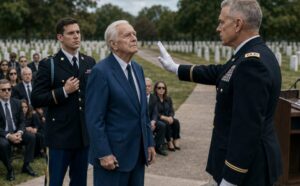
The plaque bore no grand decoration. No raised eagle, no polished flags, no shining list of ranks. Only a simple inscription for the evacuation medical training room and those whose names, known and unknown, had shaped its purpose.
Samuel read until the letters blurred.
Janet rose when invited, carrying the envelope. She did not give a speech. She stepped to the podium, unfolded the old photograph, and laid it on the table beside the programs.
“My husband wrote in one letter,” she said, “that courage was not always the person running into view. Sometimes it was the person making sure the way stayed open.”
Her voice thinned, but did not break.
“I came here thinking I would see a room named for a past I had lost. This morning, I learned that some people have been keeping that past with more care than I knew.”
She looked toward the side wall.
Not long. Not enough to turn heads dramatically. But enough.
Samuel lowered his eyes.
Janet stepped away from the podium.
The ceremony continued. A few people spoke. A trainee demonstration followed, brief and polished. This time the cart drawers were labeled correctly. The stretcher path remained clear. When one young medic reached for supplies, his hand went first to the hard tools placed high and visible.
Samuel noticed. So did Karen.
Near the end, the base commander invited everyone to stay for refreshments. Chairs scraped. Voices rose gently. Guests moved toward the hallway.
Samuel stepped back before the first row reached him. The old reflex returned: clear the path, do not block the flow, let people pass.
Justin crossed the room and reached the doorway before him.
For a moment, they stood where they had stood Monday, one in uniform, one in blue work clothes, a hallway between them and a room full of witnesses.
This time Justin stepped aside first.
“Mr. Torres,” he said, quietly but clearly.
Several trainees heard. A few guests turned, not understanding.
Justin did not salute. He did not announce. He did not make Samuel into a lesson against his will.
He only held the space open.
Samuel looked at the young officer, then walked through the doorway.
In the hall, the yellow bucket waited beside the wall. Someone had moved a chair too close to it during the ceremony. Samuel reached for the chair.
Justin reached at the same time.
They both stopped.
Samuel let go.
Justin moved the chair back into line, leaving the corridor open.
“Thank you,” Samuel said.
Justin’s voice was low. “No, sir. Thank you.”
The sir landed differently now. Not as habit. Not as correction. Samuel did not rebuke it.
Janet came out a moment later. She held the envelope against her coat. She did not ask him to stay. She did not ask for more of the past than he had already given.
“I’m glad you were in the room,” she said.
Samuel nodded. “I’m glad he was remembered.”
“He was,” she said. “And not only on the plaque.”
She touched his sleeve once, lightly, then joined the other guests.
Karen paused beside Samuel after Janet left. “The floor held up.”
Samuel looked at her.
She smiled faintly. “Because somebody kept it clear.”
He looked away, but not before she saw the small softness around his eyes.
When the room emptied, Samuel returned to work.
There was no dramatic ending to it. No line of people waiting to apologize. No sudden change in the building’s schedule. Chairs still had to be stacked. Coffee had spilled near the refreshment table. A napkin had been left under the first row. The hallway collected marks from every shoe that crossed it.
Samuel rolled the yellow bucket to the doorway and dipped the mop.
Justin remained near the trainees, speaking quietly to the one who had nearly clipped the bucket earlier. Samuel did not mean to listen, but the hallway carried sound cleanly.
“You see this lane?” Justin asked.
“Yes, sir.”
“It stays open. Always. Not because inspection wants it. Not because it looks neat.”
The trainee looked down the corridor.
Justin glanced toward Samuel, then back at the young medic. “Because someday somebody may need those six inches before anyone has time to ask.”
The trainee nodded more slowly this time.
Samuel pressed the mop to the floor and drew it back in one smooth line. Water gathered the dust, the shoe marks, the trace of the day. He guided it toward the edge, away from the path.
The building did not feel lighter. Not exactly. Grief did not lift because a plaque was uncovered or because a young officer learned to step aside. The dead remained dead. The old wing remained down the hall. Samuel’s hands still remembered what they had failed to hold.
But the corridor was clear.
For now, that was honest work.
He rinsed the mop, wrung it once, and set it upright beside the bucket.
Behind him, Justin’s voice reached the trainee again, quieter than before.
“Keep the floor clear.”
Samuel stood still for a moment, one hand resting on the taped yellow handle.
Then he nodded to no one in particular and went back to the hallway.
The story has ended.