The Quiet Man Beside the Lake Knew What Everyone Else Had Forgotten
Part I — The Man on the Mat
“Sir, you don’t have to prove anything today.”
Michael said it softly, with the practiced kindness of a man trying not to embarrass someone in public.
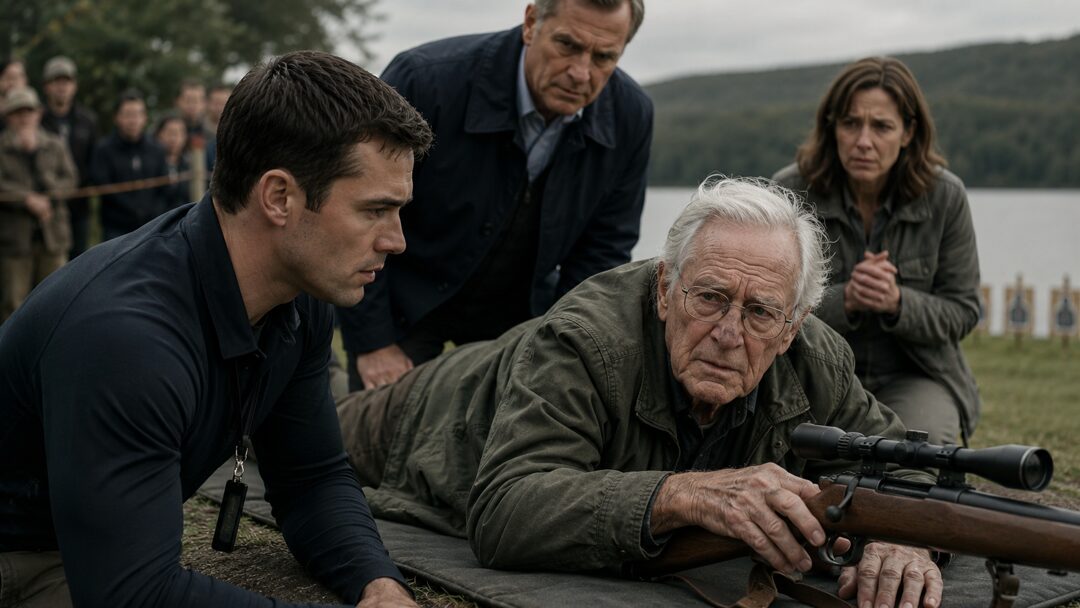
The old man was already lying face-down on the shooting mat, cheek pressed against the worn wooden stock of a scoped rifle that looked older than half the people watching. His white hair lifted in the breeze coming off the lake. His glasses sat low on his nose. His hands, thin and veined, rested near the rifle with a trembling patience that made Michael want to step in before this became difficult for everyone.
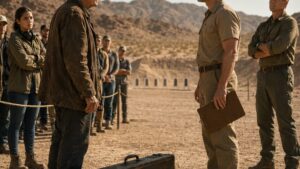
Behind the safety rope, donors in pressed shirts and sunglasses murmured over paper cups of coffee. A few younger guardsmen stood with their arms folded, trying not to stare. Someone’s phone was already raised.
The old man said nothing.
Michael crouched beside him, clean sleeves pulled tight over his forearms, range badge clipped square to his chest. He had been assigned to supervise the veteran guests for the charity event, which mostly meant keeping people comfortable, safe, and away from humiliation.
Especially men like this.
Seventy-six, according to the registration card. Prior service. Invited by family. No active qualification on file. Brought personal equipment.
Michael glanced at the battered rifle case lying open beside the mat. The foam inside was yellowing. The hinges were scuffed. The rifle itself had scratches along the stock and a scope with dull edges, as if it had spent years being carried through weather rather than displayed in a cabinet.
“Mr. Gregory,” Michael said, keeping his voice pleasant, “we’ve got newer demonstration rifles ready. Better optics. Lighter recoil. Easier to work with.”
The old man blinked once behind his glasses.
His daughter, Amy, stood a few steps back with one hand folded over the other. She wore a gray jacket, practical shoes, and the expression of someone who had spent the morning deciding whether this was a bad idea.
“He insisted on bringing that one,” she said.
There was no apology in her voice. Only exhaustion.
Michael looked back at the old man. “This is just for fun, sir. Nobody’s scoring anything serious.”
The old man’s hand moved to the rifle stock. The trembling stopped the moment his fingers touched the wood.
“This one knows me,” he said.
The words were quiet enough that Michael almost missed them.
A small silence opened around the mat.
Michael smiled because that was what he did when older guests said things that needed patience more than response. “I understand. Sentimental value.”
The old man did not correct him.
That somehow made it worse.
The range stretched out before them in neat lanes, the targets posted downrange against a long berm. Beyond the far side of the range, the lake moved under a pale sky, bright and restless. A flag near the target line snapped, then sagged, then snapped again. Wind had been giving everyone trouble all morning.
The charity event was meant to be easy. A public open house. A few invited veterans. Some demonstrations. A speech from Colonel Brian Hayes about service, remembrance, community, and the new youth training facility donors had paid to refurbish.
It was not meant to include a very old man lying behind an old rifle while half the room held its breath in advance of his failure.
Michael lowered himself closer to the mat.
“Okay,” he said. “Let’s take this slow. Don’t worry about the center. Just breathe. Nice and easy.”
The old man’s eye remained on the scope.
“Relax your grip,” Michael added. “Don’t fight the rifle.”
One of the young guardsmen behind them looked away, lips pressed together. Another pretended to check his watch while clearly watching everything.
Amy noticed. Her jaw tightened.
Michael saw that too, and felt a flicker of irritation. Not at her. Not even at the old man.
At the situation.
He was trying to help. That was all. He had seen older veterans push themselves past what their bodies could comfortably do, especially in front of a crowd. Pride could get dangerous on a range. Memory could get dangerous too.
“Sir,” he said, “no one here is expecting perfection.”
The old man finally turned his head slightly.
His eyes were pale, steady, and much clearer than Michael expected.
“That so?” he asked.
Michael’s smile almost faltered.
Before he could answer, the ceasefire horn sounded from the control table. The next round of demonstration shooters began preparing. Farther down the line, a young guardsman settled in behind a sleek modern rifle. The announcer made a cheerful comment about the wind coming off the lake and how everyone should be generous with applause.
The old man looked forward again.
Michael leaned near his ear. “We’ll let the others go first. You can watch the conditions.”
The old man’s mouth moved almost like a smile.
“I’ve been watching,” he said.
Part II — The Rifle That Knew Him
The first shooter missed the center by a hand’s width.
It was not a bad group. Five neat holes, high and right, respectable under the wind. The crowd applauded anyway. The young guardsman stood with a sheepish grin while Michael clapped once and called, “Good control. Wind’s pushing harder than it looks.”
The second shooter overcorrected. His rounds spread farther left, one dropping low enough that a few spectators made sympathetic sounds.
Michael used it as a teaching moment.
“See?” he told Gregory, voice low and encouraging. “Conditions are tricky even for trained hands. If your first one drifts, don’t let it bother you.”
Gregory rested his cheek against the stock and said nothing.
On the mat beside him lay a single tarnished brass cartridge. Not one from the event table. Not one of the fresh rows in the plastic box. This one looked older, duller, touched too often. Gregory had taken it from his jacket pocket and set it there as carefully as a man setting down a ring.
Michael had noticed, of course.
Range instructors noticed objects. Hands. Muzzles. Breath. Carelessness. Distraction.
This was different.
The old man’s attention kept returning to that piece of brass between movements, not sentimental exactly, not nervous either. More like checking whether someone was still present.
Amy came closer during the reset.
“Dad,” she said quietly.
Gregory did not move.
“You okay?”
A pause.
“Fine.”
“You don’t have to finish.”
Michael appreciated that she said it. Coming from family, it might land better.
Gregory shifted his right hand and touched the stock again. “I came to finish.”
Amy looked at Michael then, and he saw what he had missed before.
She was not only worried he would embarrass himself.
She was worried he would remember something.
Colonel Brian Hayes approached from behind the rope with a donor at his side. The colonel’s uniform looked sharp enough to hold a crease through a storm. His smile was polished, but his eyes were already measuring the scene.
“Everything all right here?” Brian asked.
“Yes, sir,” Michael said, rising halfway.
Brian glanced at Gregory, then at the old rifle. The donor beside him, a broad man with a red face and expensive sunglasses, lowered his voice in a way that made it carry.
“Is he part of the demonstration?”
“Veteran guest,” Brian replied.
The donor’s mouth formed an understanding little “ah,” the kind people made around fragile things.
Michael saw Amy hear it.
Gregory did not react.
That was becoming the strangest part. He did not react to being doubted, managed, softened, pitied, or nearly discussed in the third person. He kept his attention downrange, where the flag snapped and relaxed in uneven rhythm.
Michael crouched again.
“Mr. Gregory, when you’re ready, I’ll talk you through it.”
The old man’s left hand slid under the rifle in a small, precise correction. His body looked frail everywhere except where it connected to the rifle. There, it made a shape Michael knew, though he could not have said why it bothered him.
It was not the shape of a hobbyist.
It was not even the shape of a man remembering a hobby.
Michael said, “You’ll want to control the trigger slowly. Don’t slap it. Just steady pressure straight back.”
Gregory’s finger remained outside the guard.
Michael felt heat climb his neck.
Of course the old man knew that much. He was prior service. Michael had not meant to insult him.
“Sorry,” Michael said, too quickly. “Just standard instruction.”
“No harm,” Gregory said.
That was worse too.
Somewhere behind them, a phone camera clicked into video mode.
The announcer called the next participant forward. The range fell into its official rhythm again: commands, confirmations, wind, fire, applause. The lake flashed beyond the target line as if nothing on land mattered.
Gregory’s gaze stayed fixed beyond the scope, not through it yet, but past it.
Amy folded her arms tighter.
Michael tried to soften his voice. “Your daughter seems concerned.”
“She has practice.”
“With range days?”
“With me.”
The answer landed flat, without self-pity.
For the first time that morning, Michael did not know what to say.
He looked at Gregory’s hands. Away from the rifle, they trembled faintly. On the rifle, they steadied. Not perfectly. Not youthfully. But with a kind of obedience Michael had never taught anyone because he had never needed to.
The old man breathed in.
The wind moved over the grass.
Gregory closed his eyes for one second.
Then he opened them and whispered, not to Michael, not to Amy, perhaps not even to himself, “Not yet.”
Michael felt, with sudden discomfort, that he had been standing in a room where someone else was praying and had mistaken it for a lesson.
Part III — The Sound of the Water
When Gregory’s turn came, Michael made one last mistake.
He leaned close and began, “All right, sir. Remember, slow press. Let the shot surprise—”
“Son.”
The word did not come sharp.
It did not need to.
Michael stopped.
Gregory kept looking through the scope. “I need to hear the water.”
For three seconds, nobody nearby moved.
Michael heard the range in layers: the paper targets flicking in the wind, the flag rope tapping its pole, the low murmur of spectators, the far slap of lake water against the stones below the berm.
He had been talking over all of it.
“Clear the lane,” Gregory said.
Again, quiet. Again, not rude.
Michael shifted back.
The old man’s face changed by almost nothing, but the whole scene changed with it. His cheek rested against the stock. His shoulder settled. His breath became thin and measured. The rifle no longer looked heavy. It looked returned.
Michael glanced over his shoulder.
Brian was watching, still smiling, but the smile had lost its ease. The donor beside him whispered something. A few younger guardsmen had stopped pretending not to stare.
Amy had gone very still.
The firing command came down the line, but Gregory did not fire.
The other lanes cracked one by one. Reports echoed across the water. Paper jumped. Brass scattered. Applause came in uneven bursts.
Gregory waited.
Michael almost spoke again. Habit rose in him like a reflex. He wanted to fill the silence, to manage it, to make the old man less exposed inside it.
But the words stayed behind his teeth.
The flag near the targets lifted hard left, then dropped.
Gregory still waited.
The lake made a small sound against the rocks.
His finger moved.
Then the ceasefire horn cut through the range before he fired.
Michael exhaled before he could stop himself. “We’ll reset.”
Gregory lifted his cheek from the stock.
He did not look frustrated.
He looked as if time belonged to someone else and he had learned long ago not to argue with it.
During the pause, Michael took the registration clipboard back toward the range house. He told himself he needed to verify the guest list for the next round. Really, he needed a moment away from the old man’s silence.
The range house smelled like coffee, old wood, and laminated safety posters.
Near the entrance hung a memorial plaque he had passed a hundred times without reading closely. Names, dates, a short inscription. The kind of thing people respected from a distance.
His eyes caught one word first.
Gregory.
Then another.
Line.
The plaque read: In honor of the Gregory Line, whose vigilance protected those who could not see the crossing.
Below it were names. Some weathered from age. One of them was Anthony Gregory.
Michael frowned.
Same last name. Maybe a brother. Maybe a father.
He scanned the smaller framed photo beside it. Four men in faded field gear stood near a line of scrub trees and pale sky. Younger faces. Leaner faces. One of them had Gregory’s eyes.
Not similar eyes.
The same eyes.
Michael leaned closer.
The caption beneath the photo was short: Gregory and Anthony, observation team, northern border rotation.
Not brothers, then. Not according to the rest of the note, which named Anthony as his spotter.
His spotter.
Michael felt something cold open under his ribs.
He looked back through the window toward the range, where Gregory lay on the mat in his faded green jacket while people waited for him to either perform or fail.
Michael had told him not to worry about hitting the center.
He had told him to relax his grip.
He had told him no one expected perfection.
When Michael returned, he did not crouch as close.
Amy looked at him once and seemed to understand that he had seen the plaque.
“You didn’t know,” she said.
Michael shook his head.
“Most don’t,” she said.
“Was Anthony his brother?”
“No.”
She watched her father. Her voice lowered.
“He came back with my dad’s notebook in his pocket. My dad came back with his cartridge.”
Michael looked toward the tarnished brass on the mat.
Amy’s face stayed composed, but something behind it had tired years ago.
“He never talks about it,” she said. “Not really. Just keeps that thing in his jacket like it’s a key to a door he won’t open.”
Downrange, the targets were reset.
Brian called from the rope, “Michael, let’s keep this moving.”
Michael turned.
The colonel’s eyes flicked toward Gregory, then toward the crowd.
The meaning was clear: protect the event.
Michael looked back at the old man on the mat.
For the first time all morning, he wondered whether the event was what needed protecting.
Part IV — The One That Drifted
When the range went hot again, Gregory finally fired.
The sound cracked clean across the water.
The target jerked.
Through the spotting scope, Michael saw the hole appear outside the center, low and left.
Not wild. Not unsafe. But unmistakably off.
A soft wave of sympathy moved through the spectators. It was worse than laughter. Laughter would have been cruel enough to answer. Sympathy made everyone feel generous while still being wrong.
The donor murmured, “That’s all right.”
Someone clapped once.
Amy closed her eyes.
Michael felt his stomach sink. Not because the old man had missed. Because part of him, the smaller and uglier part, relaxed.
Maybe he had been right after all.
Maybe the plaque had made him imagine ghosts where there were only old hands and a hard wind.
He leaned closer, careful now. “Sir, we can stop there if you want. No shame in—”
Gregory did not look away from the target.
“Had to know where today was,” he said.
Michael froze.
The old man made no adjustment to the scope. He did not ask where the round landed. He did not frown. He did not blush or apologize or explain.
He simply breathed.
Brian stepped inside the rope.
“Michael,” he said in a low voice, “a word.”
Michael stood reluctantly.
The colonel walked him several steps away, just far enough that the crowd could not hear but Amy probably could.
“This is getting uncomfortable,” Brian said.
“He wants to continue.”
“He is a guest. A respected one. We don’t let respected guests turn themselves into spectacle.”
Michael looked toward Gregory. The old man was resting one hand beside the tarnished cartridge. His fingers trembled again, small and visible.
Then he placed the same hand on the rifle.
The trembling stopped.
Brian followed Michael’s gaze and misread it.
“You see it too,” he said. “Help him finish gracefully.”
The phrase lodged in Michael’s throat.
Finish gracefully.
It sounded kind. It sounded responsible. It sounded exactly like everything Michael had been doing since Gregory lowered himself onto the mat.
And all at once Michael hated it.
The donor drifted closer, no longer pretending not to listen. “No need to make a thing of it. Let the old fellow have his moment and move on.”
Michael had never disobeyed Brian in public.
There were ways rank lived inside a person even when no one raised their voice. There were ways a young instructor learned to read a colonel’s silence as command. Michael felt all of that. He felt the eyes on him. He felt the event schedule, the donors, the polished speeches, the clean order of the day.
Then he saw Gregory lift his head from the rifle and look at him.
Not pleading.
Not challenging.
Just waiting.
It was the first time all morning Michael understood that waiting could be an act of trust.
He walked back to the mat.
Amy stepped closer. “Are you stopping him?”
Michael crouched beside Gregory, slower than before.
“No,” he said.
The word surprised him with its own weight.
Brian’s face tightened behind him.
Michael leaned near Gregory, not over him this time. “Range is yours when you’re ready, sir.”
Gregory looked at him.
There was no gratitude in his face, not exactly. Gratitude would have made Michael feel forgiven too quickly.
Instead, Gregory gave him something harder to hold.
He gave him the truth of being seen changing.
Michael removed his own hand from the edge of the mat, as if even that small claim to control had become too much.
Gregory lowered himself behind the scope.
This time Michael did not tell him how to breathe.
He listened.
The flag moved.
The grass bent.
The water touched stone.
The old man’s finger found its place.
Part V — What the Target Said
Gregory fired once.
Then he waited so long several people thought he was done.
The lake moved in bright flashes behind the target line. A gull crossed low over the water. Farther down the row, a younger guardsman shifted his weight and was silenced by another with a hand on his sleeve.
Gregory fired again.
Michael watched the old man, not the target.
That was the strange thing. He no longer needed to see where the rounds were landing to know something was happening. It was in the stillness between each movement. It was in the way Gregory’s body became smaller and larger at once: frail enough to break, exact enough to command the air around him.
The old man was not slow because he was weak.
He was slow because he had stopped wasting anything.
A third round.
A pause.
A fourth.
The crowd did not clap now.
Even the people who did not understand had begun to feel that applause would be the wrong sound.
Michael heard Amy breathing behind him. He heard Brian’s polished shoes shift on the gravel. He heard the brass settle on the mat, each small clink somehow louder than the last.
Gregory fired the final round.
Then he lifted his cheek from the rifle and sat back with the careful stiffness of an old body returning from a place it had learned too well.
No one moved.
The range officer called ceasefire.
Two young guardsmen went downrange to retrieve the targets. They walked quickly at first, then slower as they neared Gregory’s lane. One of them looked back before touching the paper.
Michael knew then.
Still, knowing did not prepare him.
The target came back clipped to a board, fluttering slightly in the lake wind.
The first hole sat low and left, clean and lonely.
The rest were clustered at the center so tightly they looked less like separate impacts than a single dark thought pressed through the paper.
The young guardsman carrying it had lost all expression.
He handed it to Michael.
Michael stared.
All morning he had been teaching people to make respectable groups. All morning the wind had pushed trained hands off course. All morning he had watched modern optics, polished rifles, fresh confidence, and careful instruction produce almost.
Gregory had produced silence.
Then this.
Behind the rope, the crowd finally reacted. A few gasps. A low murmur. Then applause, uncertain at first, rising too fast, as if people were relieved to have a sound they knew how to make.
Brian did not clap.
Amy put one hand over her mouth.
Gregory looked at the target only long enough to confirm what he already knew.
Michael turned toward him, the paper board in both hands.
“I’m sorry,” he said.
The words came out smaller than he expected.
Gregory looked up.
Michael tried again. “I talked to you like you needed saving from yourself.”
The applause faded unevenly.
Gregory’s face did not soften into a smile. He did not rescue Michael from the discomfort. He let him stand inside it.
Then he said, “You saw an old man. Happens.”
It was not absolution.
It was worse, and kinder.
Michael swallowed.
“I should have seen more.”
Gregory’s gaze drifted past him, toward the range house.
“No,” he said. “You should have listened sooner.”
The line hit Michael with a precision no target could show.
Amy stepped onto the mat and crouched beside her father. For a second, she looked like she wanted to touch his shoulder but did not know whether the place he had gone to make those shots had room for her hand.
Gregory solved it for her.
He reached out and covered her fingers with his.
She closed her eyes again, but this time not from fear.
Brian approached slowly. The donor stayed behind him now, stripped of commentary.
“Mr. Gregory,” Brian said, voice lower than before, “that was extraordinary.”
Gregory’s hand remained over Amy’s.
“No,” he said. “It was due.”
The colonel had no prepared expression for that.
Michael looked down at the target again. The lonely first mark no longer looked like a mistake. It looked like a question answered before anyone else understood the question.
Had to know where today was.
Not where yesterday had been. Not where memory wanted the wind to come from. Today.
Gregory motioned toward the paper.
“Don’t put it with the prizes,” he said.
Michael followed his gaze to the range house window, where the memorial plaque hung in shadow.
“Where do you want it?”
Gregory’s voice was steady.
“Under Anthony’s name.”
Amy looked at him then, sharply, as if he had spoken a name inside a room where it had lived for years but never been invited to sit down.
“Dad,” she whispered.
Gregory did not turn away from the plaque.
“He spotted that line better than I ever did,” he said.
No one asked what line.
No one asked what happened.
The story was there, but not for the crowd. Not for applause. Not for the donor newsletter. Not for a polished speech about legacy.
It was in the cartridge on the mat.
It was in Amy’s face.
It was in the old rifle and the lake wind and the space between one careful round and the next.
Michael carried the target himself.
Part VI — Below the Names
The plaque was smaller up close.
Michael had passed it for years while thinking he respected it. That was the trick of things mounted on walls. They made reverence easy and attention optional.
Now he stood beneath it with the target in his hands and felt the difference.
Amy helped Gregory across the gravel. He moved slowly without the rifle. His body had returned to its age. His hands trembled again. The crowd watched him differently now, but that did not make walking easier.
Brian followed at a distance. The donor did not come inside.
Inside the range house, the afternoon light fell across the names. Anthony Gregory’s was near the middle, worn slightly at the edge where someone had touched it over the years.
Michael wondered how many times Gregory had stood there alone.
He did not ask.
Amy read the name silently. Her mouth tightened, then loosened, like something old inside her had shifted but not disappeared.
Gregory held out the tarnished brass cartridge.
For one second Michael thought he was giving it to him.
Instead, Gregory pressed it into Amy’s palm.
She looked down at it.
“I don’t know what to do with this,” she said.
Gregory’s face changed just enough to hurt.
“Neither did I.”
That was all.
No confession. No detailed memory. No clean explanation for the years of silence, the distance at dinners, the birthdays where he had smiled like a man listening from another room. Nothing that would make Amy’s childhood suddenly simple. Nothing that would let Michael turn the moment into a lesson.
Just a father giving his daughter an object he had carried too long.
Amy closed her fingers around it.
Michael pinned the target beneath the plaque.
The paper hung there plainly. One mark low and left. The rest gathered at the center.
Not a trophy.
Not a record.
Not even proof anymore.
A message.
Brian stood behind them, cap in hand now. He looked at the plaque, then at Gregory, and whatever speech he had been preparing died before it reached his mouth.
The old man studied the target for a long moment.
Michael waited for him to say something about Anthony, about the border, about the day that had followed him home. But Gregory only nodded once, almost imperceptibly, as if someone had answered from far away.
Then he turned to Michael.
“You teach them?” he asked.
Michael glanced toward the range outside, where the younger guardsmen were gathered around the empty mats.
“Yes, sir.”
Gregory’s eyes held his.
“Teach them to be quiet first.”
Michael nodded.
It felt like an order. It felt like a gift.
Outside, the applause had ended. The event had moved on because events always did. Someone would still give a speech. Someone would still thank the donors. Someone would still call the day a success.
But inside the range house, three people stood before a target that had changed the size of the room.
Amy slipped the cartridge into her jacket pocket.
Gregory noticed.
For the first time all afternoon, his mouth almost smiled.
Not happiness. Not release.
Something smaller and more honest.
A little less carrying.
When they stepped back outside, the lake wind moved through the grass and lifted the edge of the target behind the glass. Michael heard the paper whisper against the wall.
Gregory paused at the doorway.
He did not look at the crowd.
He did not look at the rifle.
He looked once toward the water.
Then he let Amy take his arm, and together they walked away slowly, leaving the target beneath the names, where anyone passing through would have to stop close enough to see what everyone else had almost missed.