The Star He Carried Quietly Through the Airport That Morning
Part I — The Question in His Hand
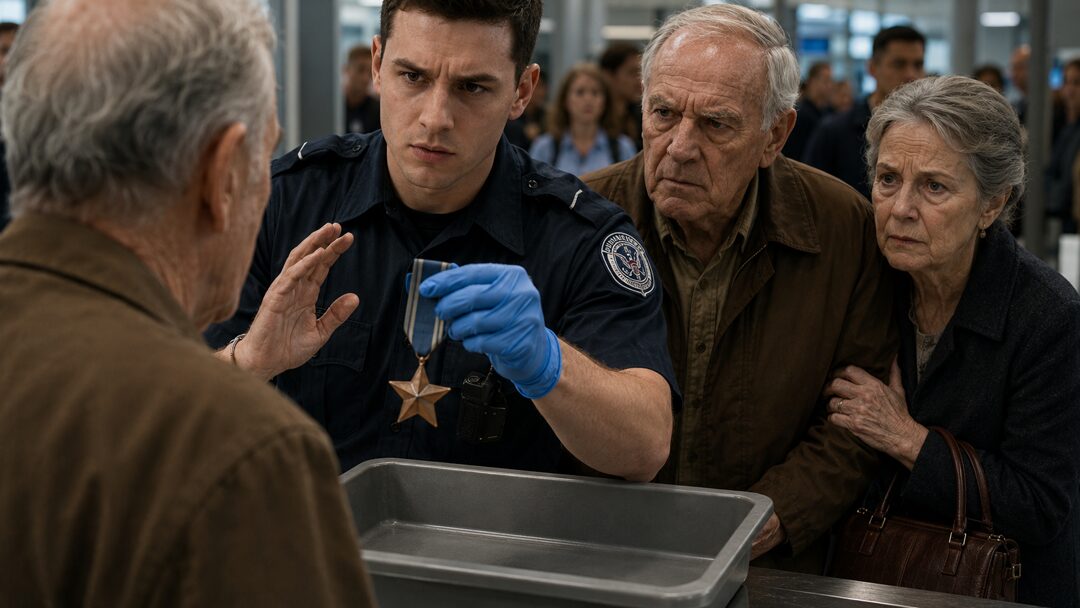
Justin held the bronze star by its faded ribbon and asked, “Sir, is there something inside this?”
The old man went still.
Not nervous. Not confused. Still.
The kind of stillness that made the whole checkpoint seem louder around him: bins scraping forward, shoes dropping into trays, a child crying near the metal detector, someone behind him sighing hard enough to be heard.
The woman beside him reached for his sleeve.
“George,” she said softly.
George did not look at her. His eyes stayed on the medal swinging from Justin’s gloved fingers.
It was a beautiful thing, even under the airport lights. A five-pointed bronze star, darkened at the edges, hanging from a ribbon faded by time. It did not look expensive. It looked handled. Protected. Carried through years instead of displayed behind glass.
Justin turned it slightly.
The old man’s jaw tightened.
“Sir,” Justin repeated, keeping his voice even, “I asked if there’s something inside this.”
“No,” George said.
The answer came too quickly.
Justin looked down at the star again. There was a seam around its edge. Not a crack. Not damage. A deliberate line, thin as a fingernail, running along the bronze like the medal had once been made to open.
The line behind George shifted.
A man in a business jacket muttered, “Come on.”
Pamela, the woman beside George, turned her head just enough to let the man see her face. She was small, silver-haired, and neat in a dark traveling coat. But there was nothing small in her eyes.
The man looked away.
Justin placed the medal over the gray inspection tray.
George stepped forward.
Another officer lifted a hand. “Sir, stay behind the line.”
George stopped.
The command did something to him. His shoulders straightened before his knees could obey. For one brief second, the old man looked less like a tired passenger and more like someone who had once answered orders in places no airport camera had ever seen.
Then the second passed.
He became elderly again.
Thin hands. Weathered face. Careful breathing.
Pamela touched his arm. “Please,” she said to Justin. “It’s his.”
Justin hated how many people were watching now.
He had been on the job long enough to know the dangerous moments did not always look dramatic. Sometimes they came wrapped in politeness. Sometimes they came from an old man with watery eyes and a medal that had no business opening.
“Ma’am, I understand,” Justin said. “But if an item appears modified, I have to inspect it.”
“It is not modified,” George said.
Justin picked up the star.
The ribbon trembled, though his own hand was steady.
“Then you won’t mind me checking.”
George’s voice lowered. “Do not open it.”
The line went quieter.
Not silent. Airports never went silent. But the people nearest them stopped pretending not to listen.
Justin felt heat rise under his collar. He was twenty-seven, clipped and clean in his uniform, and he knew exactly how he looked to older men like this. Young. Procedural. Temporary. Someone whose authority came from a badge and a laminated rule sheet.
He also knew the cameras were above him.
He knew his supervisor was somewhere down at Lane Three.
He knew the business jacket man had his phone angled just a little too high.
“Sir,” Justin said, more formally now, “refusing inspection may delay your screening.”
George stared at the star.
Pamela’s fingers tightened around the handle of her handbag.
“George,” she whispered again.
But this time her voice did not say calm down.
It said don’t run.
Part II — The Seam Around the Star
Justin carried the medal to the inspection table and set it beneath the light.
The tray held George’s wallet, Pamela’s folded scarf, a pair of worn leather shoes, and the small black presentation case the medal had come from. The case had a velvet lining, crushed in the shape of the star. There was no plaque inside. No certificate. No written explanation.
Just the empty space where the medal had rested.
Justin turned the star over.
The seam was clearer on the back.
He pressed lightly at one edge.
George said, “No.”
The single word cut through the checkpoint noise.
Justin paused.
Pamela closed her eyes for one second.
The old man’s voice had changed. It no longer belonged to a passenger asking for dignity. It belonged to a man refusing an order he already knew would cost him.
Justin felt the shift and mistook it for guilt.
“What’s inside it?” he asked.
George looked at him then.
For the first time, Justin saw that the old man was not afraid of getting in trouble.
He was afraid of remembering.
But Justin did not know what to do with that kind of fear. Procedure gave names to objects, substances, threats, compartments. It did not give him a box to check for grief.
Pamela stepped closer to the line. “Officer, please. That was given to him a long time ago.”
“That doesn’t answer my question.”
“No,” she said, her voice sharpening. “It answers the question you should have asked.”
A few people shifted. Someone made a low sound, half sympathy, half impatience.
Justin kept his expression flat.
The first lesson they had drilled into him was simple: hesitation looked like weakness. And weakness at a checkpoint spread fast. One passenger argued, then another. One exception became expectation.
He had seen officers get mocked for being too gentle. He had seen travelers test every edge of authority. He had promised himself he would never look unsure.
Now this old man had told him not to open something that looked built to open.
Justin worked a gloved thumb along the seam.
George’s breathing grew audible.
Pamela said, “George, look at me.”
He did not.
The star was heavier than Justin expected. Its bronze casing had a slight give near the top point. The hinge, if that was what it was, had stiffened with age.
“This may take a moment,” Justin said, mostly to the people behind them.
“Then get a supervisor,” Pamela said.
“I’ve called one.”
“You called one after you decided.”
Justin looked up.
Her face was composed, but not calm. There was anger there, yes, but beneath it was something more dangerous. Recognition. As if she had watched men in uniforms make decisions too quickly before.
Justin’s thumb found the narrow opening.
George stepped forward again.
“Sir,” the second officer warned.
George stopped at the line, but his hands lifted slightly. Not reaching. Not pleading.
Almost surrendering.
“Don’t,” he said.
Justin should have waited.
Later, that would be the sentence that returned to him the most.
Not the policy. Not the crowd. Not the visible seam.
Just that.
He should have waited.
Instead, the man in the business jacket sighed again, louder this time. “We’re all going to miss flights because of a souvenir?”
The word souvenir hit Pamela first.
Her face changed.
George’s face did not. He had gone somewhere inward, somewhere Justin could not follow.
Justin felt the eyes around him. The camera above. The phone to his right. The pressure to become the kind of officer who did not bend because someone used a sad voice.
He pressed the star between both thumbs.
The bronze casing shifted.
Pamela said, “Stop.”
The seam opened with a small dry sound.
Then the medal came apart.
Part III — What Fell Into the Tray
It did not break loudly.
That made it worse.
There was no dramatic crack, no sharp snap that made people jump. Just a tired separation, like something old had finally given up.
One half of the bronze star slipped from Justin’s hand and struck the plastic tray.
A folded photograph slid out after it.
Then a small tarnished piece of metal.
Then a strip of faded cloth, tan and dark at the edges, soft with age.
The objects landed beside George’s wallet.
For a moment no one moved.
Justin stared down.
He had expected nothing, or something mechanical, or something that justified the suspicion his body had already committed to.
Not a photograph.
Not the corner of a dog tag.
Not a strip of cloth folded as carefully as a prayer.
George lowered his eyes.
He did not shout. He did not reach across the table. He did not accuse Justin. His silence was worse than any anger would have been.
It looked like shame.
Pamela stepped over the line.
The second officer started to speak, then stopped when he saw her face.
She looked at Justin’s badge.
“Justin,” she said.
Not Officer. Not sir.
Justin swallowed.
“You had no right.”
The businessman lowered his phone.
Justin wanted to say the words that would protect him.
Item appeared modified.
Passenger refused inspection.
Concealed materials discovered.
Supervisor notified.
Every phrase was true enough to stand behind.
None of them fit what was lying in the tray.
George’s hand moved slowly toward the photograph. His fingers shook so badly he could not unfold it.
Pamela did it for him.
She smoothed it with both hands on the edge of the tray.
Three young men looked up from the faded paper.
They stood shoulder to shoulder in desert fatigues, squinting in bright sun. The man on the left was unmistakably George, fifty years younger, face narrow, posture hard, eyes already older than they should have been.
The man in the middle had his arm thrown around George’s shoulder.
The third was smiling as if someone had said something right before the picture was taken.
Justin looked at the torn piece of metal.
Only part of the name remained.
ERIC.
His chest tightened.
“My father served under a Captain Eric,” Justin said before he could stop himself.
George’s eyes lifted.
Pamela’s did too.
Justin regretted the words instantly. They sounded like a claim. Like he had found a way to enter something he had just damaged.
George reached for the fragment. His thumb passed over the letters.
“He wasn’t a captain,” George said.
His voice was quiet enough that Justin had to lean in.
Pamela answered for him. “He was our son.”
The line behind them disappeared.
Not physically. People were still there. Bags still waited. Shoes still sat in bins. The airport still moved around them with brutal indifference.
But for Justin, everything narrowed to the tray.
George, Pamela, the open medal, the photograph, the fragment.
Our son.
Justin looked down again.
The young man in the center of the photo had George’s jaw and Pamela’s eyes.
“He was twenty-four,” Pamela said.
George closed his hand around the dog tag piece.
Pamela’s voice remained controlled. That control made every word worse.
“That medal was given to George after the operation he came home from. The one Eric didn’t.”
Justin said nothing.
There was no correct sentence.
“I’m sorry” was too small.
“I didn’t know” was useless.
“I was following procedure” was suddenly obscene.
George folded the photograph once, then stopped. The crease no longer matched. His fingers could not make the paper return to what it had been.
Pamela took it from him gently.
“You see?” she said to Justin. “Some things don’t open cleanly.”
Justin looked at the broken star.
One half lay face down. The other caught the ceiling light and made the bronze look almost warm.
The seam had not hidden danger.
It had hidden a life George had not been able to carry anywhere else.
Part IV — The Flight They Almost Missed
A supervisor arrived with quick steps and a radio clipped to her shoulder.
“What’s going on?”
Justin straightened.
The old instinct came back. Report. Contain. Clarify. Limit damage.
He opened his mouth.
George spoke first.
“We’re done.”
Pamela turned toward him. “No.”
George gathered the broken star pieces with stiff fingers. “We’re going home.”
“George.”
He did not look at her. “I said we’re going home.”
Their boarding passes lay near the tray, half tucked under Pamela’s scarf. Justin saw the destination printed there. Denver. Boarding in twenty-three minutes.
Pamela saw him see it.
She lifted her chin.
“We are going to meet our granddaughter,” she said.
George’s hand closed over the medal case.
Justin kept still.
Pamela did not look away from her husband. “You promised.”
His face tightened.
“Not like this.”
“There was never going to be a good way.”
“Pamela.”
“No.” Her voice did not rise, but people heard it. “No, you don’t get to use this as your reason.”
George’s eyes flashed. “He broke it.”
“Yes,” she said. “He did.”
Justin felt the words land.
Pamela turned, and for one second her anger found him again.
Then she looked back at George.
“But you sealed it,” she said. “You sealed him in there and called it keeping him safe.”
George flinched.
The supervisor glanced at Justin. “Do we need to retain the item?”
The question cut through everything.
Justin saw George’s shoulders fold inward.
Retain the item.
The phrase turned the medal into property again. A thing to bag, document, move through a system.
Pamela stepped between the tray and the supervisor. “No.”
“Ma’am,” the supervisor said, not unkindly, “if concealed contents were discovered—”
“They were not concealed for your reasons.”
Justin heard the tremor then.
Pamela’s control was still there, but it had begun to crack at the edges. She looked suddenly older. Not weak. Just tired of having to translate grief into language strangers would accept.
George took the black presentation case and closed it over the broken pieces.
The click was soft.
Final.
“We’re going home,” he repeated.
Pamela stared at the case.
Then she said the line that made Justin’s stomach drop.
“No. We did not come this far for you to bury Eric twice.”
No one moved.
George’s face emptied.
Justin did not know much about marriage, not the kind that lasted fifty years and survived rooms full of things never said. But he understood, in that instant, that Pamela had not only been angry at him.
She had been angry for decades.
At silence.
At medals.
At folded photographs hidden inside bronze.
At the way love could become a locked box if no one forced it open.
George looked down at the case.
“Our granddaughter doesn’t want this,” he said.
“She asked for him.”
“She asked for a story.”
“She asked for the truth.”
“I don’t know how to give that.”
Pamela’s voice softened, but it did not weaken. “Then start by showing up.”
The boarding announcement for Denver crackled overhead.
Justin looked toward the gates.
Twenty minutes now, maybe less.
The supervisor asked, “Officer, did you force the item open?”
Every part of Justin’s training sharpened.
There were careful ways to answer.
He could say the item presented an unusual seam.
He could say the passenger refused to clarify.
He could say he used standard inspection pressure and the casing failed.
All true.
All incomplete.
He looked at George.
The old man held the closed case like it weighed more than luggage, more than bronze, more than any object should.
Justin thought of his father’s old stories, the ones that always ended before they got too human. Men reduced to ranks. Places reduced to dates. Courage reduced to plaques.
He had grown up around the language of service and still failed to recognize what it looked like when it trembled in an old man’s hands.
“Yes,” Justin said.
The supervisor turned to him.
Justin kept his voice steady. “He told me not to open it. I opened it anyway.”
Pamela looked at him.
George did not.
The supervisor’s face shifted, just slightly. “Why?”
Justin looked at the medal case.
“Because I thought being certain was the same as being careful.”
No one said anything.
Then the supervisor exhaled. “We still need to clear the contents.”
“I’ll document it,” Justin said. “But it’s personal memorial material. No threat indicators. I’m requesting immediate clearance and passenger assistance to the gate.”
The supervisor studied him.
Justin knew what she heard underneath the words.
I caused the delay.
I caused the damage.
I am not handing this off like paperwork.
Finally, she nodded once. “Make it fast.”
Part V — The Open Case
Justin did not touch the medal until George allowed it.
And George did not allow it at first.
He held the case against his chest and looked at Justin with a coldness that made apology feel childish.
“I’m sorry,” Justin said anyway.
George answered, “That doesn’t fix it.”
“No, sir.”
“It doesn’t give you the right to feel better.”
Justin took the hit because it was true.
“No, sir.”
Pamela watched them both.
Her face had changed again. Less anger now. More exhaustion. More fear. The flight was close. The gate was far enough to matter. George was still deciding whether to disappear into the safety of refusal.
Justin placed a clear evidence sleeve on the table, then stopped.
He did not open it.
He did not reach.
“May I?” he asked.
George’s hands tightened.
Pamela looked at her husband.
The old man opened the case.
Inside, the broken star lay in two uneven halves. The ribbon had twisted under one point. The photograph rested beside it, partly folded. The dog tag fragment sat on top of the faded cloth.
Justin picked up one bronze piece with both hands, slowly, as if it could feel insult.
He placed it into the case.
Then the other.
Then he arranged the ribbon so it did not cover the photograph.
Not evidence.
Not contraband.
Remains.
George watched every movement.
Justin reached for the lid.
“Don’t close it,” George said.
Justin froze.
George’s eyes were on the photograph.
For a moment, the checkpoint noise faded again.
Pamela’s hand moved to her mouth, but she did not speak.
George swallowed.
“He hated pictures,” he said.
No one moved.
It was the first memory he had offered.
Not a mission. Not a date. Not a heroic sentence.
Just a small, useless, living thing.
“He said every photo made him look like he was waiting for bad news.” George’s mouth moved like it wanted to become a smile and could not remember how. “Pamela said that was because he never stood still long enough to be loved properly.”
Pamela laughed once.
It broke almost immediately.
George looked at her then.
Something passed between them that Justin had no right to witness, but had caused them to reveal.
Pamela touched the edge of the case. “Emma should hear that.”
George stared at the open medal.
“I don’t know what she thinks I am.”
“She thinks you’re the man who never came.”
The words were gentle.
That made them crueler.
George nodded once, barely.
Justin slid the clear sleeve under the case instead of over the contents. He wrote the damage note fast, his handwriting sharper than usual.
Passenger personal item damaged during inspection. Item cleared. Escort requested.
The supervisor signed it.
Justin handed the paper to Pamela, not George. He was not sure why, except that she seemed like the one still carrying them all forward.
Pamela folded it and put it in her handbag.
“Gate B twelve,” Justin said. “I’ll take you.”
George looked at him. “We can walk.”
“I know.”
“Then why?”
Justin did not reach for the luggage. He did not soften his voice into pity.
“Because I delayed you.”
George studied him.
Then he picked up the open case.
The medal pieces shifted slightly but did not fall.
They moved through the checkpoint with Justin ahead of them, clearing a path. People looked. Of course they looked. People always looked after the worst part had already happened.
The man in the business jacket stepped aside.
His phone was gone.
Pamela walked beside George, one hand near his elbow but not holding it. She let him carry the case himself.
Halfway down the corridor, George slowed.
Justin turned.
George had stopped near the window overlooking the runway. Morning light spread across the glass. Planes moved in the distance, indifferent and graceful.
George looked down at the photograph.
“He was supposed to come home first,” he said.
Pamela closed her eyes.
Justin did not ask who.
He knew.
George continued walking.
Part VI — What Remained Open
They reached Gate B twelve as boarding began.
The line had already formed. Passengers scanned phones, adjusted backpacks, checked watches. A gate agent called group numbers with the bright practiced voice of someone moving lives along a schedule.
George and Pamela stood just outside the line.
For a second, Justin thought George might still turn back.
The open case rested in his hands. The broken star caught the light differently now. It no longer looked like a ruined medal. It looked like something interrupted in the middle of telling the truth.
Pamela’s phone buzzed.
She looked down.
Her face changed.
“Emma,” she said.
George did not move.
Pamela turned the screen toward him.
The message was short.
I’m here when you land. No rush. Just come.
George read it twice.
His hand tightened around the case.
Justin looked away, giving them the smallest privacy an airport allowed.
The supervisor’s signed note was still in Pamela’s handbag. The evidence sleeve remained folded beneath the case. The damage had been documented. The item had been cleared.
None of that mattered as much as the fact that George was still holding it open.
“Officer.”
Justin turned back.
George had unfolded the photograph.
His fingers were steadier now, though not steady.
He held it out.
Justin hesitated.
Then he took it.
The paper was soft from years of being hidden and touched in secret. Three young men squinted into sunlight. On the back, in faded handwriting, were three first names.
George tapped each one.
“George,” he said.
Justin looked at the young face on the left.
“Paul.”
The smiling man on the right.
Then George’s finger rested on the center.
“Eric.”
The name did not come out cleanly. It came out like something carried too long in the mouth.
Justin read the names again.
George took the photograph back.
He did not smile.
He did not forgive.
He did not offer the mercy Justin wanted and had not earned.
Instead, he said, “Learn their names before you touch what they left behind.”
Justin felt the sentence enter him and stay.
“Yes, sir,” he said.
Pamela slipped her arm through George’s.
The gate agent scanned their boarding passes. George had to shift the case to do it, and for one breath the broken medal tilted dangerously.
Justin stepped forward.
Then stopped himself.
George steadied it on his own.
Pamela noticed.
So did Justin.
So did George.
The old man looked down at the open case, at the bronze halves, the ribbon, the cloth, the fragment, the photograph that no longer fit neatly inside the place built to hide it.
Then he walked forward.
Pamela went with him.
At the jet bridge entrance, she looked back once.
Not with gratitude exactly.
Not with anger exactly.
With recognition, maybe. The kind that did not erase what had happened, but allowed the next thing to happen anyway.
Justin stood at the gate until they disappeared down the corridor.
Around him, the airport continued.
Shoes in bins.
Voices over speakers.
Hands lifting bags.
People rushing toward places they believed mattered more than the delay in front of them.
Justin looked at his gloves.
For the first time all morning, they seemed too clean.
On the plane, George sat by the window with the tray table down before takeoff, though Pamela told him twice he would have to put it up.
He opened the case between them.
The medal remained broken.
The photograph remained visible.
Pamela rested her hand beside it, not on it.
George looked at Eric’s face for a long time.
Then, carefully, he turned the photograph so that when Emma saw it, her father would be facing her first.
The case stayed open all the way until the flight attendant came by.
And even then, George did not close it.
He only held it in both hands, broken star and all, as the plane began to move toward the sky.