The Name Inside the Red Jacket Changed How the Room Remembered Him
Part I — The Hand on the Jacket
“Take it off.”
The words cut through the dining hall harder than the chair legs scraping quiet behind them.
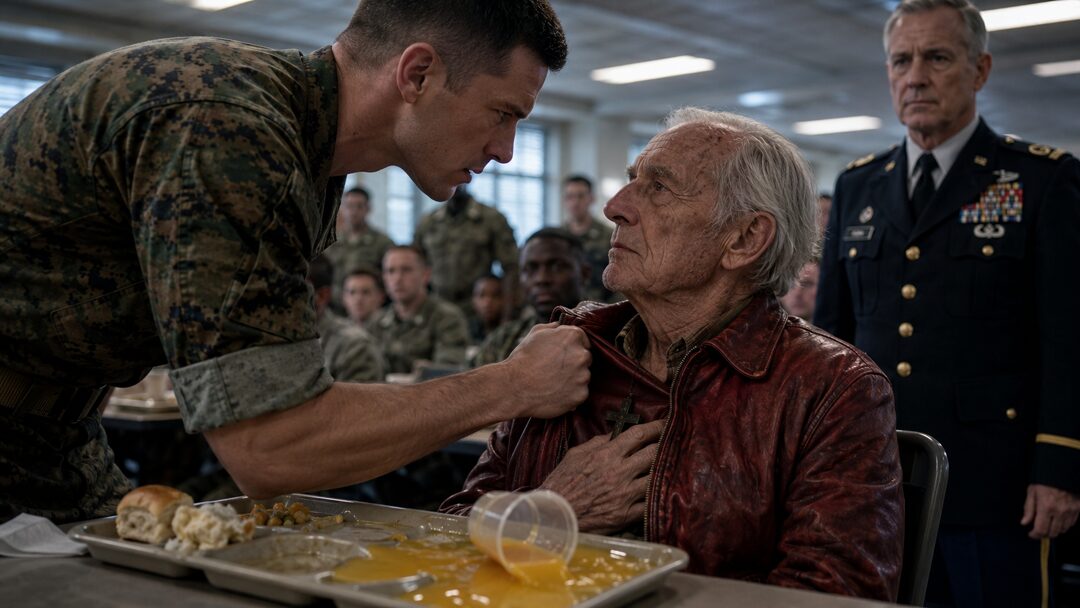
Sergeant Ryan had one fist clenched in the front of an old man’s red leather jacket. His knuckles pressed against a small dark cross pinned just inside the lining, half-hidden like something that had never been meant for display.
The old man sat alone with a tray of eggs, two slices of toast, and a plastic cup of orange juice.
The cup tipped when Ryan grabbed him.
Orange spread across the tray, ran under the toast, and began dripping over the metal edge onto the floor.
Nobody moved.
Not the privates at the nearest table.
Not the cooks behind the serving line.
Not Major Thomas, who stood ten feet away in his formal dress uniform, gray-haired and still, watching as if the whole room had become a test no one had studied for.
Ryan leaned closer.
“I said take it off.”
The old man looked up at him.
He was thin, maybe late seventies, with white stubble along his jaw and a face that had been weathered by more than age. His red jacket was cracked at the elbows and darkened at the seams. His boots were old, but polished with care. His fingers trembled slightly around the edge of the tray.
But his eyes did not tremble.
He did not beg.
He did not flinch.
He did not explain.
That was what made Ryan angrier.
“You hear me?” Ryan said. “You don’t walk into this dining hall wearing something you didn’t earn.”
The old man’s left hand moved slowly to the place where Ryan’s fist had bunched the leather.
“Your hand,” he said, voice low and dry, “is on something you don’t understand.”
A few soldiers looked down at their trays.
One private swallowed without chewing.
Ryan felt the room watching him, and because he felt it, he hardened.
That was what he did when people watched. He became sharper. Cleaner. More certain. He had built a career on certainty.
At twenty-seven, Ryan was the sergeant who could spot an unfastened strap across a motor pool. The sergeant who remembered every regulation number and every lapse in discipline. The sergeant who never let sentiment interfere with standards.
He had seen men buy medals online.
He had seen civilians wear old unit patches as fashion.
He had seen gray-haired strangers wrap themselves in stories they had no right to touch.
And now this man, in this cafeteria, on this base, during a memorial week, sat wearing a service cross like it was an old souvenir.
Ryan lowered his voice.
“Name. Unit. Proof.”
The old man blinked once.
“Frank.”
Ryan waited.
“That’s it?”
“That’s what people call me.”
“Unit.”
Frank looked past Ryan for a second, not at the room, not at Major Thomas, but somewhere much farther away.
“I was invited.”
Ryan gave a short laugh. It sounded ugly in the silence.
“Invited.”
The orange juice reached the corner of the table and began to fall in slow drops. Tick. Tick. Tick. Onto Ryan’s polished boot.
Frank glanced at it once.
Ryan did not.
The stain spread between them.
“You come in here,” Ryan said, “wearing that jacket, wearing that cross, sitting among people who actually served, and I’m supposed to accept ‘I was invited’?”
Frank’s lips moved almost into a smile, but it died before it became one.
“No,” he said. “You’re supposed to let go.”
The room got colder.
Ryan’s grip tightened.
Major Thomas shifted one step forward.
Not enough to stop him.
Just enough to let everyone know he could.
Ryan saw him from the corner of his eye and waited for the order. It did not come.
That bothered him.
Major Thomas knew protocol. He knew discipline. He knew what stolen honor did to a room full of young soldiers who still believed the uniform meant something sacred.
So why was he silent?
Ryan looked back at Frank.
“Stand up.”
Frank did not move at first.
Ryan thought he was refusing.
Then the old man put both hands on the table and pushed himself upward. His right knee buckled. Not badly. Just enough. Just enough that the table shook and the plastic fork slid through the orange juice.
Ryan caught his arm.
For one breath, it almost looked like help.
Then Ryan said, “Don’t make it dramatic.”
A sharp sound came from one of the tables. A young private, barely old enough to need a razor, whispered, “Sergeant…”
Ryan turned his head.
“Stay out of it.”
The private went still.
That was the moment the whole dining hall understood something had changed. This was no longer a correction. It was no longer even an accusation.
It had become a public corner Ryan could not back out of without losing face.
Frank slowly sat back down.
His hands returned to the tray.
Orange juice touched his sleeve.
He looked at Ryan’s fist again.
“Boy,” Frank said quietly, “there are things a man wears because he wants people to see them. And there are things he wears because he can’t set them down.”
Ryan’s jaw tightened.
“Don’t call me boy.”
Frank nodded, almost politely.
“Then don’t act like one.”
A breath went through the dining hall.
Ryan felt heat climb his neck.
Major Thomas finally spoke.
His voice carried without effort.
“Sergeant Ryan.”
Ryan straightened, but did not release the jacket.
“Sir.”
“Are you certain?”
Ryan looked at the old man. The red jacket. The hidden cross. The trembling fingers. The refusal to answer like a man with nothing to hide.
“Yes, sir.”
Major Thomas took another step.
“Certain enough to make this official?”
The question sat in the air like a door locking.
Ryan knew he had one last chance to step back. He knew it, and the knowing made him feel watched, judged, challenged.
His father would never have stepped back.
That thought came before he could stop it.
His father, Matthew, who had kept one framed photograph of his unit on the dresser and never told the story behind it. Matthew, who woke at night choking on a name Ryan had never understood. Matthew, who polished old shoes until the leather shone and taught Ryan, “A uniform is only worth what a man refuses to cheapen.”
Ryan did not know much about his father’s service.
But he knew what respect looked like.
Or he thought he did.
“Yes, sir,” Ryan said. “I am.”
Major Thomas looked at Frank.
“May I speak?”
Frank’s face changed.
Not fear.
Weariness.
“No.”
Ryan almost smiled. “Convenient.”
Frank ignored him.
Major Thomas did not.
“Frank,” the major said, softer now, “not for you.”
Frank’s fingers curled around the tray.
Major Thomas waited.
Then he said, “For the men who didn’t come home.”
The dining hall shifted without moving.
Even Ryan felt it.
Some sentences did not belong to ordinary arguments.
Frank closed his eyes.
When he opened them, he did not look at Ryan.
He looked at the orange juice spreading across the table, as if even that small mess had become one more thing he had failed to stop.
Then, with slow hands, he opened the red jacket.
Part II — The Names Under the Lining
At first, Ryan thought the inside of the jacket was dirty.
Then the marks became letters.
Names.
Dozens of them.
Some had been written directly onto the leather in faded black marker. Some had been stitched in uneven thread. Some were barely visible beneath the worn lining, half-lost in age and sweat and creases.
Each name had a date beside it.
Frank held the jacket open without pride.
There was no flourish, no performance, no silent demand for apology.
He simply revealed what he had been carrying.
The dining hall leaned toward him without meaning to.
Ryan’s hand fell away from the leather.
He stared.
The first names meant nothing to him.
Larry. Matthew. Thomas. Ryan.
Common names. Ordinary names. Names that could belong to anybody.
Then his eyes stopped.
Matthew.
The letters were faded, but the shape of them struck him before his mind understood why.
Matthew. M.
A date followed it.
Ryan felt his mouth go dry.
Many men were named Matthew.
Many men had last names beginning with M.
Many men served.
Many men survived.
His father was not a story in an old stranger’s jacket.
He could not be.
Ryan heard himself say, “That doesn’t prove anything.”
Nobody answered.
He said it again, because the second time sounded weaker.
“That doesn’t prove anything.”
Frank looked at him then.
Really looked.
His eyes moved over Ryan’s face like he was measuring a distance that had taken decades to cross. The tight jaw. The brow. The way Ryan stood too straight when he was afraid of bending.
Frank’s expression altered.
Only slightly.
But Ryan saw it.
“You’re Matthew’s boy,” Frank said.
The room became too small.
Ryan stepped back once, and his boot stuck faintly to the floor.
“My father was no one’s charity case.”
He did not know why those were the words that came out. Maybe because he had spent his whole life defending a man who had never asked to be defended. Maybe because Matthew had hated pity more than pain. Maybe because the word “boy” had cut him open in front of everyone.
Frank did not rise to the anger.
“No,” he said. “He was brave.”
Ryan’s chest loosened for half a second.
Then Frank added, “That was the problem.”
Ryan stared at him.
Major Thomas moved to the side of the table, close enough now that every soldier in the room knew his silence had ended.
He did not speak to Ryan first.
He spoke to Frank.
“Only what needs to be said.”
Frank gave a tired nod.
Major Thomas faced the dining hall.
“What happened under Operation North Lantern was classified for years,” he said. “Most of the young men and women in this room have never heard the name. That does not mean it was small.”
Ryan’s pulse beat behind his ears.
Operation North Lantern.
He had heard those words once.
Not in a briefing.
Not in a history class.
In the hallway outside his parents’ bedroom when he was thirteen, standing barefoot in the dark while his father sat on the edge of the bed shaking and his mother whispered, “Matthew, you’re home. You’re home.”
His father had said one word over and over.
Not clearly.
Not fully.
Ryan had thought it was a place.
Or a code.
Or a nightmare sound.
He had never asked.
Children learn which doors not to open.
Major Thomas continued.
“A convoy was separated during an evacuation. Communications failed. The men left in the drainage route were cut off. Extraction was ordered.”
Frank’s jaw tightened.
Thomas kept his voice level.
“Frank was a medic then. He was ordered out with the last group.”
Frank looked down.
“He refused.”
The word moved through the room without anyone repeating it.
“He went back,” Major Thomas said. “Not once. Not twice. He pulled seven wounded men through a drainage culvert before the route collapsed.”
Ryan’s eyes went to the jacket again.
Seven.
Seven names.
He found Matthew’s.
He could not look away.
“One of those men,” Major Thomas said, “was Matthew.”
The dining hall might have vanished.
Ryan saw instead an old photo on his father’s dresser. Young men with sunburned faces and forced smiles. His father standing at the edge, thinner than Ryan remembered him, one hand tucked inside his jacket.
He saw the St. Michael medal his father kept in a drawer, wrapped in a handkerchief, the metal worn smooth from years of fingers moving over it.
He heard his father’s voice on the worst nights.
Not a place.
Not a code.
A name.
Frank.
But Major Thomas was not finished.
He had begun to sound like a man presenting honor.
Frank cut him off.
“I didn’t save seven.”
Every head turned.
The old man’s voice was quiet, but it broke the ceremony before it could form.
Major Thomas stopped.
Frank stared at the wet table.
“I carried seven out,” he said. “I left three.”
No one breathed.
Ryan looked at the jacket again.
The other names.
The ones with dates he had not read.
The ones written darker, deeper, as if the hand had pressed harder.
Frank’s fingers closed over the lining.
“Don’t make it clean,” he said.
The words were not aimed only at Major Thomas.
They were aimed at the room.
At the uniforms.
At the memorial week banners hanging near the entrance.
At every young face ready to turn pain into a lesson because lessons were easier to carry than grief.
Ryan felt something collapse inside him, but it was not sympathy yet.
It was certainty.
He had been certain this man was a fraud.
Certain the cross was stolen.
Certain the jacket was costume.
Certain his own anger was righteous because it wore the shape of respect.
Now the old man in front of him was not defending himself.
He was defending the dead from being softened.
Frank closed the jacket.
Ryan’s hand twitched as if it wanted to salute.
He lifted it halfway.
Frank saw.
“Don’t.”
Ryan froze.
Frank looked at the half-raised hand.
“Don’t salute what you don’t understand.”
That landed harder than a reprimand.
Ryan’s hand dropped.
Major Thomas turned slightly to the room.
“Everyone stays seated.”
A few soldiers who had begun to shift upward sank back down.
The major’s face was calm, but his voice allowed no misunderstanding.
“This is not a performance.”
Ryan stood in the sticky orange juice.
His uniform was spotless.
His boots were not.
Part III — What the Room Had to Sit With
There were punishments Ryan understood.
Extra duty.
A report.
A formal reprimand.
A commander’s office.
A signature under a statement that would follow him longer than most men followed their own conscience.
He understood all of that.
He did not understand standing there with every eye avoiding him because looking away had become the only mercy the room knew how to give.
Frank reached for his toast.
It bent in his fingers, soaked at the corner. He set it back down.
Ryan saw the orange juice on the old man’s sleeve where his own hand had shaken the table.
He saw the tiny dark cross pinned inside the jacket, no longer hidden by accident but protected by habit.
He saw the names.
Matthew. M.
His father’s name should not have been there.
That was the thought Ryan kept having, stupid and childish and useless.
His father’s name belonged in a family Bible, on old mail, on the brass plate under a photograph at home.
Not inside a stranger’s jacket.
Not among men who did not come home.
Not beside a date Ryan had never been brave enough to ask about.
Major Thomas stood at Ryan’s side now, not rescuing him from the silence.
Ryan wished the major would yell.
Yelling would have given the room shape again.
Instead, Major Thomas said, “Sergeant.”
Ryan looked at him.
“Clean it.”
For one second, Ryan almost misunderstood.
Then he saw the napkins floating near the edge of Frank’s tray.
A lesser man might have heard insult in the order.
Ryan heard mercy.
His knees bent before he had decided to bend them.
He knelt beside the table.
No one spoke.
The floor was cold through the fabric at his knee. Orange juice had run under the table leg and pooled near Frank’s boot. Ryan picked up the first napkin. It tore in his hand. He grabbed another.
He wiped the table first.
The tray.
The fork.
The edge where the juice kept collecting.
He worked carefully, with the same attention he used on inspections, except this time no one could mistake precision for pride.
Frank watched him.
Not kindly.
Not cruelly.
Just watched.
Ryan cleaned the floor next. The juice had made a bright smear against the gray tile. His own boot prints cut through it.
The room was so quiet he could hear the napkin rasp under his hand.
He had grabbed the jacket in front of everyone.
So he cleaned the spill in front of everyone.
That was the only math that mattered.
When he was done, he stayed kneeling longer than he needed to.
His throat worked once.
“My father used to wake up saying a name,” Ryan said.
Frank did not move.
Ryan kept his eyes on the floor.
“I thought it was a place.”
The old man’s fingers tightened on the edge of the tray.
Ryan looked up.
Frank’s face had gone still in a way that made him look suddenly younger and older at once.
“What name?” Frank asked.
Ryan swallowed.
“Frank.”
The old man looked away.
Not far.
Just to the window, where afternoon light fell across the dining hall floor in pale rectangles.
His jaw tightened once.
That was all.
But that small movement did something no speech could have done. It showed the room the weight he had been holding upright for decades.
Ryan reached into the breast pocket of his uniform.
His fingers found the small wrapped shape there.
He had carried it for three years.
Not every day.
Not always.
But today, because memorial week made old things rise, and because his father had once told him, in one of the few clear moments near the end, “If you ever find the man from the water tunnel, give this back.”
Ryan had asked, “What man?”
Matthew had closed his eyes.
“The one who wouldn’t leave.”
Then he had slept.
And a month later, he was gone.
Ryan had kept the medal because there was nowhere to send it. He had told himself that wearing it close on ceremonial days honored his father.
Now he understood it had been waiting for someone else.
He unwrapped the handkerchief.
The St. Michael medal lay in his palm, rubbed almost smooth. The edges were soft from years of a thumb passing over them in the dark.
Ryan placed it beside Frank’s tray.
“He wanted this returned if anyone ever found you.”
Frank stared at the medal.
For a long time, he did not touch it.
The dining hall seemed to hold itself still around that little piece of metal.
When Frank finally reached for it, his hand trembled worse than before.
Then, halfway there, it steadied.
He picked it up between two fingers.
Turned it once.
Closed it in his palm.
“He remembered?” Frank asked.
Ryan nodded.
The first tear fell before he could stop it, and he hated that it fell in uniform, in public, in front of recruits who had seen him bark men twice his size into silence.
But the hatred passed quickly.
There was no room left for vanity.
“He never told the story,” Ryan said. “Not really. But he remembered.”
Frank lowered his eyes.
“I thought they forgot.”
Ryan shook his head.
“No.”
Frank’s mouth moved once, as if he had almost answered.
Then he set the St. Michael medal beside the service cross inside his jacket.
Not on the table.
Not on display.
Beside the cross.
Beside the names.
Where it belonged.
Part IV — The Name He Had Been Saying
Major Thomas pulled out the chair across from Frank and looked at Ryan.
The order was silent.
Sit.
Ryan did.
It felt stranger than kneeling.
Standing had let him pretend he was still a sergeant in control of a room. Kneeling had given him a task. Sitting across from Frank gave him nothing to hide behind.
Frank adjusted his tray.
The eggs had gone cold. The toast was ruined at one end. The orange juice cup lay empty on its side.
Ryan reached for it, then stopped.
Frank saw.
After a moment, he slid a clean napkin toward Ryan.
Not forgiveness.
Not absolution.
A shared task.
Ryan took it.
Major Thomas remained standing, hands folded behind his back.
“Frank,” he said, “you don’t have to attend the ceremony.”
Frank looked toward the hallway where the memorial gathering waited beyond the dining hall doors. Ryan had seen the program earlier that morning. Names printed cleanly on thick paper. Chairs arranged. A small stage. A flag. A microphone.
Everything orderly.
Everything easier than this.
“I know,” Frank said.
“You can leave now.”
Frank held the medal in his closed fist.
“Been leaving for a long time.”
Major Thomas’s expression changed, just slightly.
Frank looked at Ryan.
“I won’t sit on the stage.”
“No one will ask you to,” Thomas said.
“You were going to.”
The major did not deny it.
Ryan saw then that Major Thomas’s restraint had not been perfect mercy. He had brought Frank here to be honored, yes. But also to make him visible. To place him where the institution could finally point and say: we remember.
But Frank had not wanted to be pointed at.
Thomas lowered his head once.
“I was wrong about the shape of it.”
Frank accepted that with silence.
Ryan looked down at his hands.
They were clean now, but he could still smell citrus.
He said, “Sir.”
Major Thomas looked at him.
Ryan’s voice was rough. “I’ll make a statement.”
“You will.”
“And take whatever follows.”
“You will.”
Ryan nodded.
The certainty in those words should have frightened him. It did not. Consequence, at least, had edges. He could hold it.
What he could not hold was the old man across from him.
Frank picked up the damp toast.
Ryan almost told him not to eat it. Almost offered to get him another tray.
But he had already taken enough from the man’s morning.
Frank bit into the toast like it was just toast.
The room slowly remembered how to breathe.
A fork touched a plate.
Someone coughed.
A chair moved.
The dining hall did not return to normal, not exactly. It returned to motion, which was different. Everyone had witnessed something they did not know where to put.
Ryan kept his eyes on the table.
Finally, he asked, “What was he like?”
Frank chewed.
Swallowed.
For a moment Ryan thought he would not answer.
Then Frank said, “Your father?”
Ryan nodded.
Frank looked at the medal in his palm, then at the jacket lining as if the answer might be written there too.
“He sang when he was scared.”
Ryan almost laughed.
It came out broken.
“My father?”
“Badly,” Frank said.
The private at the next table let out something like a breath and a laugh at once, then covered it fast.
Frank’s eyes did not leave Ryan.
“Old church songs. Half the words wrong. Kept singing even when I told him to save his breath.”
Ryan pressed both hands flat on the table.
His father had never sung at home.
Not once.
Ryan tried to imagine it: Matthew young, frightened, wounded, singing badly in a drainage route while a medic dragged him toward air.
It should have felt impossible.
Instead it felt like a missing room had opened inside a house he thought he knew.
“What did he say?” Ryan asked.
Frank’s face tightened.
“Mostly nonsense. Pain does that.”
Ryan nodded, disappointed and ashamed of being disappointed.
Then Frank added, “But near the end, before we reached the outer wall, he grabbed my sleeve and said, ‘Tell my boy I tried to be brave.’”
Ryan stopped breathing.
The room blurred at the edges.
“He had a son?” Ryan whispered.
Frank nodded.
“He said you were small.”
Ryan had no memory of his father before the nightmares. No memory of the man before silence became part of the furniture in their home.
He had believed, for years, that Matthew’s distance meant judgment.
Maybe his father looked at him and saw everything he had nearly missed.
Maybe love had been there, trapped under things no one had taught him how to say.
Ryan wiped his face quickly with the heel of his hand.
Frank pretended not to see.
That mercy cut deeper than attention would have.
Part V — Not on the Stage
The memorial hall was only twenty steps from the dining room, but Frank walked as if every step asked him a question.
Major Thomas walked on one side.
Ryan on the other.
Not behind him.
Not in front.
Beside him.
The hallway walls held framed photographs: ceremonies, promotions, clean rows of faces, flags folded into triangles behind glass. The kind of memory an institution knew how to keep.
Frank carried another kind inside his jacket.
At the entrance to the memorial room, a young officer saw them and straightened.
“Major, they’re ready.”
Thomas nodded.
Then he turned to Frank.
“No stage.”
Frank looked through the doorway.
Rows of chairs. A podium. A large memorial wall at the back with names engraved under soft light. A table with flowers. Programs stacked neatly near the entrance.
He stayed where he was.
Ryan thought he might turn away.
Instead, Frank said, “I’ll stand at the wall.”
Thomas nodded again.
“Then we stand at the wall.”
The ceremony changed because of that.
No one announced it.
No one explained why the honored guest did not take the front chair reserved for him.
Major Thomas simply stepped to the podium and spoke briefly about memory, duty, and the danger of making clean stories out of unfinished lives. He did not tell all of Operation North Lantern. He did not give the room tactics. He did not turn the dead into examples.
He said only what needed saying.
At the back of the room, Frank stood before the memorial wall.
Ryan stood beside him, hands clasped in front, eyes forward.
When the names were read, Frank’s lips moved silently with three of them before the speaker said them aloud.
Ryan noticed.
He did not ask.
Some things were not his to touch.
Afterward, people approached Frank one by one. Not too many. Major Thomas made sure of that with a look.
A few thanked him.
Frank nodded.
One young private started to salute, then stopped halfway and lowered his hand. Frank saw and gave the smallest nod of approval.
Ryan looked at the floor.
He knew that lesson had cost more than he could repay.
When the room thinned, Major Thomas went to speak with the chaplain.
Ryan and Frank remained at the wall.
The names were engraved in lines so neat they almost hid the violence of absence.
Frank placed his hand flat against the lower corner of the wall.
Not on one name.
Near several.
Ryan waited.
Frank said, “Your father wanted to go back for them.”
Ryan’s throat tightened.
“He could barely stand,” Frank continued. “Still tried to fight me when I pulled him the other way.”
“That sounds like him,” Ryan said.
Frank looked at him.
“You got that part.”
Ryan did not know whether it was praise or warning.
Maybe both.
“I’m sorry,” Ryan said.
It was too small.
He knew that before it left his mouth.
Frank kept his hand on the wall.
“For what part?”
Ryan looked at the red jacket. The service cross. The place inside where the St. Michael medal now rested beside it.
“All of it,” he said.
Frank was quiet long enough that Ryan understood he would not be released quickly.
Good, he thought.
He did not deserve quick.
Finally, Frank said, “Be sorry for the part you did. Don’t borrow the rest. It’s heavy.”
Ryan nodded.
That was the closest thing to forgiveness he received.
It was enough to stand under.
Major Thomas returned.
“Frank,” he said, “car’s ready whenever you are.”
Frank looked at the wall a little longer.
Then he turned, but not toward the exit.
Toward Ryan.
“You ever hear him sing?”
Ryan shook his head.
Frank’s mouth twitched.
“Lucky you.”
Ryan laughed once, and this time it stayed almost whole.
Frank walked toward the doorway.
At the threshold, he paused and looked back at the memorial wall. His hand moved inside the red jacket, touching the cross, the medal, maybe the names.
Then he stepped into the hallway.
Ryan followed, not because he had been ordered to, but because Frank had not told him not to.
They walked slowly.
Outside the dining hall, the floor still smelled faintly of orange where the spill had been cleaned.
Ryan glanced at the spot.
Frank noticed.
“Sticky stuff,” the old man said.
Ryan looked at him, unsure if he was allowed to smile.
Frank did not smile, but his eyes softened by a fraction.
“Comes up if you stay with it.”
They continued down the hall together.
Not as equals. Not yet.
Not as family. Not exactly.
But not as the man standing over and the man forced to look up.
At the end of the corridor, sunlight came through the glass doors and spread across the floor in quiet squares.
Frank stepped into it first.
Ryan slowed to match him.