The Number She Kept
Part I — The Question at the Table
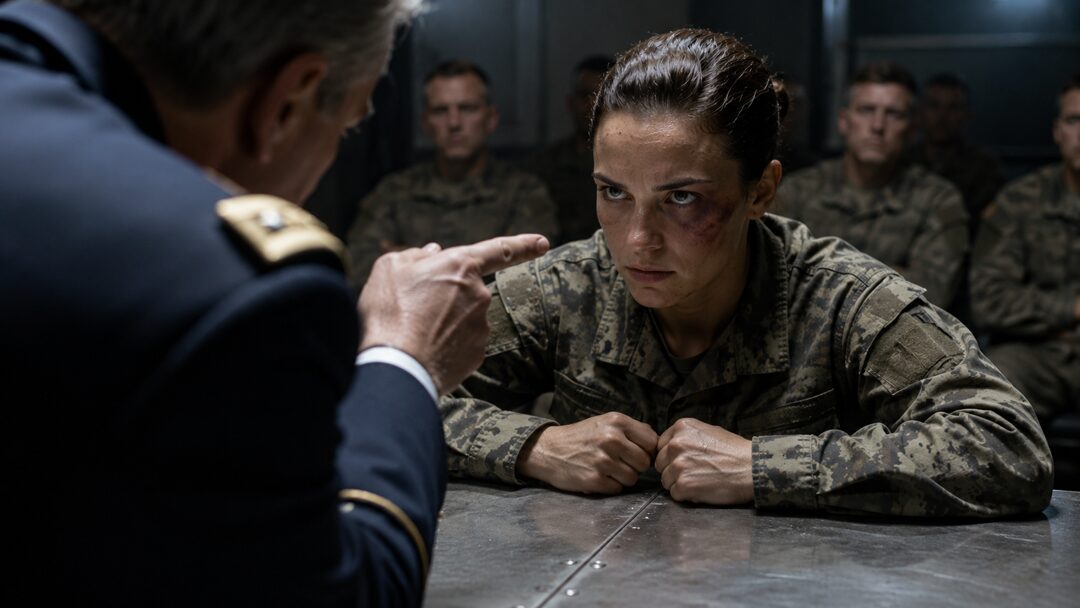
Colonel Richard Hayes pointed at Sergeant Emily Carter’s face as if the bruise on her cheek were evidence.
“What’s your count, Sergeant?”
The ready-room went still.
Not quiet. Still.
Quiet was normal in military rooms. Quiet meant discipline, waiting, orders not yet given. Still was different. Still meant every man in the rows behind Emily had stopped breathing at the same time.
Emily sat at the far side of the metal table with both hands locked on the edge. Her sleeves were rolled down. Her combat uniform was clean. Too clean, Hayes would probably say. No polished stack of decorations. No bright proof pinned where men like him wanted proof to live.
Only the bruise.
It curved beneath her left eye, yellow at the edges, purple in the center. She had not covered it.
Hayes leaned closer.
He wore a dark-blue dress uniform so crisp it seemed armored. Stars. Gold. Ribbons in perfect rows. A career displayed like a wall no one was supposed to question.
Emily looked straight at him.
“Sir,” she said, “I’m here for the review.”
Hayes smiled.
It was not a happy smile. It was the smile of a man who had already decided where the room would land.
“Yes,” he said. “And I’m reviewing.”
Behind Emily, two dozen soldiers sat in orderly rows beneath harsh overhead lights. Their boots lined up. Their hands stayed still on their knees. Their eyes moved only when they thought no one would notice.
Major Daniel Brooks sat in the front row.
Emily had not looked at him since she entered.
She did not need to.
She knew his posture. Straight back. Pilot wings. Chest full of visible ribbons. A man whose uniform told a story people were allowed to hear.
Hayes pulled back and let his gaze travel deliberately over Emily’s chest.
His smile widened.
“She’s not even decorated.”
A few men shifted.
No one laughed.
That bothered Hayes. Emily could tell.
He wanted laughter. Not because he needed it, but because rooms obeyed faster when shame became entertainment.
He turned halfway toward the platoon.
“Look at her. Bare as a training wall. Yet I’m told Sergeant Carter is the standard we’re supposed to study now.”
Emily’s fingers tightened on the table.
Not enough for anyone to notice.
Hayes noticed anyway.
“Careful,” he said softly. “You’ll dent government property.”
The room held its silence.
Emily looked past his shoulder at the blank wall.
Not at Daniel.
Not at the door.
Not at the folder space in front of Hayes, where there should have been nothing.
She had spent three years learning how not to react when people touched the edge of Red Lantern.
A word.
A date.
A bad joke.
A hallway that smelled too sharply of smoke.
A count spoken by someone who did not know what counting could become.
Hayes tapped one finger on the table.
“One?” he asked.
Emily did not move.
He tilted his head.
“Maybe two?”
That was when Daniel Brooks’s hand tightened on his knee.
Tiny movement.
Almost invisible.
But Emily saw it reflected in the polished edge of the metal table.
Hayes saw something too.
His eyes sharpened.
There it is, Emily thought.
Fear.
Not hers.
His.
Part II — No Decorations
The review had not started as a spectacle.
At least, that was what the notice had said.
Closed readiness review. Personnel performance inquiry. After-action clarification.
Three phrases that meant the same thing when command wanted them to: somebody was going to be made smaller in a room with witnesses.
Emily had arrived ten minutes early. She always arrived early. It gave her time to find exits, measure faces, and remind herself that a room with lights and chairs was not a corridor full of smoke.
Hayes had arrived late.
That was deliberate too.
He wanted the soldiers seated first. Wanted Emily placed alone at the table. Wanted himself entering like judgment.
He walked in with two officers behind him, dismissed them with a hand gesture, then looked at Emily’s bruise.
Not her eyes.
The bruise.
“Rough week, Sergeant?”
She had said nothing.
“Or is that part of the presentation?”
Still nothing.
That was when he moved the chair away from his side of the table and chose to stand. Of course he did. Standing made him taller. Standing made her seated. Standing made the room understand the shape of the moment before any words were spoken.
Now he paced in front of the table.
“You were assigned as response lead during yesterday’s extraction exercise.”
“Yes, sir.”
“And when sequence command changed, you deviated.”
Emily’s eyes flicked to the file in front of him.
It was not the right file.
Too thin.
Too clean.
“Yes, sir.”
Hayes stopped.
“You admit it?”
“I adjusted to conditions on the ground.”
He barked a laugh.
“There it is.”
He turned toward the platoon again.
“Conditions on the ground. That phrase has excused more sloppy judgment than cowardice ever could.”
Emily felt the word land.
Cowardice.
The room absorbed it like a slap no one wanted to acknowledge.
Daniel’s jaw tightened.
Hayes kept going.
“Command gives sequence for a reason. Clocks exist for a reason. Orders exist for a reason.”
Emily looked at him then.
One second too long.
He leaned into it.
“Something to add?”
The answer was in her mouth.
A clock only matters if it was built by someone who can see the room.
But that was Red Lantern language.
That was sealed language.
That was the kind of sentence that got pulled apart by men in clean offices and turned into misconduct if it came from the wrong mouth.
“No, sir.”
Hayes smiled again.
“There. We’re learning.”
The men behind her stayed silent.
Emily knew what that silence looked like from the front. To Hayes, it looked like obedience. To Emily, it looked like strain.
There were men in this room who knew fragments.
Not the whole thing. Nobody knew the whole thing. Red Lantern had been divided afterward like a body no one wanted to identify. Command logs went one way. Medical evacuation records went another. Witness statements went behind sealed doors. Comm failures became technical summaries. Delayed orders became timeline anomalies.
And Emily became a sergeant with no story on her uniform.
Hayes placed both palms on the table and lowered his voice.
“Let me be very clear, Sergeant. This command cannot have junior personnel improvising because they believe their instincts outrank operational discipline.”
Junior personnel.
Emily had led teams through corridors Hayes had only seen as blue lines on a screen.
But he knew that.
That was the point.
He needed her to be junior today.
He needed her to be small.
He needed the room to remember his ribbons before anyone remembered her silence.
“Answer the original question,” Hayes said. “What’s your count?”
Emily’s throat moved once.
“You know my record.”
“I know what I’m allowed to know.”
That was the first true thing he had said.
Emily looked down at her hands.
Her knuckles had gone pale.
She loosened them one finger at a time.
Hayes watched.
“You don’t get to hide behind classification and then ask for trust,” he said.
Emily’s eyes lifted.
“I didn’t ask for trust.”
“No. You ask for exception.”
“I ask for accuracy.”
That landed harder than she meant it to.
Hayes’s smile thinned.
“Accuracy?”
“Yes, sir.”
He bent toward her again.
“Then accurately tell this room why a sergeant with no visible commendation, no public record of distinction, and a documented tendency to disregard command timing should be treated as anything other than a liability.”
The bruise on Emily’s cheek pulsed with heat.
For a moment, she was back in the corridor.
Not all of it.
Just the sound.
Numbers shouted because names took too long.
Fifty-nine.
Sixty.
Sixty-one.
A hand dragging against concrete.
Someone coughing her rank wrong.
A voice in her headset: Withdraw now. Timeline closed.
A clock in red numbers.
A clock that did not know people were still inside.
Emily blinked once.
The room returned.
Hayes was waiting.
So were the men.
And every kind of silence has a shelf life.
Part III — The Folder at the Door
The door opened before Emily answered.
Every head turned except Hayes’s.
He closed his eyes briefly, as if interruption itself were an insult.
Captain Sarah Grant stepped into the room with a sealed gray folder held against her chest.
She did not rush.
That was the first thing Emily noticed.
Grant moved like a woman carrying something that could not be dropped, misplaced, or explained away. Her sleeves were precise. Her face was unreadable. The folder had no visible title, only a dark bar across the top where the text had been obscured.
Hayes turned slowly.
“Captain Grant.”
“Colonel.”
“This is a closed review.”
“Yes, sir.”
“Then close the door from the other side.”
Grant did close the door.
But she stayed inside.
Emily’s pulse changed.
Hayes felt it. He glanced back at her, then at the folder.
“What is that?”
“Supplemental authority.”
“For what?”
“For reopening the performance question under restricted record review.”
The words moved through the room like cold air.
Hayes straightened.
“Who authorized that?”
Grant laid the folder on the table.
She did not slide it toward him.
Not yet.
“Above both of us.”
The room shifted without moving.
Hayes looked at the folder as if it had insulted him.
Emily recognized the seal.
She had seen it twice.
Once on the order that told her not to speak about Red Lantern.
Once on the condolence packet that never used the word mistake.
Her stomach tightened.
Hayes’s voice lowered.
“Captain, you are out of sequence.”
“No, sir,” Grant said. “The previous sequence was incomplete.”
That was when Daniel Brooks looked up fully.
Not at Grant.
At Emily.
She felt it like a hand on her back.
She still did not turn around.
Hayes placed one finger on the folder.
“You understand where you are?”
“Yes, sir.”
“You understand who you’re interrupting?”
Grant’s face did not change.
“Yes, sir.”
Emily almost admired her for that.
Almost.
Then Grant looked at Emily, and the room got smaller.
“Sergeant Carter,” she said, “this file concerns Operation Red Lantern.”
No one spoke.
Not because they all knew it.
Because the name sounded like something they were not supposed to know.
Hayes’s hand remained on the folder.
Emily’s body remembered before her mind did.
Red light in the smoke.
Boots slipping on wet concrete.
A door jammed halfway open.
A young man shouting, “How many left?”
Someone answering, “Too many.”
Her own voice saying, “Keep moving.”
Then Hayes on the line, far away, clean and furious.
Timeline closed. Withdraw.
Emily had looked at the stairwell then.
At the people still coming through it.
At the clock.
And she had stopped obeying.
Hayes removed his hand from the folder.
“Red Lantern is not relevant to yesterday’s exercise.”
Grant looked at him.
“It became relevant when you used the same timing standard to question Sergeant Carter’s judgment.”
Hayes laughed once.
Short. Dry.
“You’re building a shrine out of a classified mess.”
Emily looked at him.
There it was again.
Fear, dressed as contempt.
Grant opened the folder.
The room seemed to lean toward the paper.
Most of the page was blacked out.
Names vanished under thick bars. Locations gone. Units reduced to blank lines and coded fragments.
But numbers survived.
Numbers often did.
Grant read silently first.
Her eyes moved once, twice, then stopped.
Hayes said, “Captain.”
Grant did not look up.
Emily could hear her own heartbeat.
Hayes said it again, sharper.
“Captain.”
Grant closed the folder halfway.
Not fully.
Halfway meant the contents were still alive.
“Sergeant Carter,” she said, “before I read any portion of this record aloud, do you understand you are permitted to clarify your actions within the limits stated here?”
Emily understood exactly what that meant.
A door had opened.
Not wide.
Not kindly.
But enough.
Hayes turned on her.
“Don’t mistake permission for vindication.”
Emily looked at the folder.
Then at Hayes.
Then at the rows behind her, reflected faintly in the table’s dull metal.
Daniel Brooks was standing halfway out of his chair.
He caught himself and sat back down.
Too late.
Hayes saw it.
His face changed.
The room had begun to leave him.
Part IV — Seventy-Three
Hayes did what men like him did when power started slipping.
He got louder.
“Enough,” he said.
Grant paused.
Hayes pointed at Emily again.
“No more theater. No sealed-folder games. No dramatic pauses.”
His finger hovered inches from Emily’s face.
She did not flinch.
“You want accuracy?” he said. “Then give us accuracy.”
Emily felt the bruise beneath her eye.
Not pain exactly.
Pressure.
Hayes smiled for the room.
“Your count, Sergeant. One? Maybe two?”
Daniel Brooks closed his eyes.
Emily saw it in the table reflection.
That was the moment something inside her unclenched.
Not anger.
Anger had been there for years.
This was different.
A kind of tiredness reached its end.
Emily lifted her eyes to Hayes.
“Seventy-three.”
The room did not understand at first.
Not fully.
It understood enough to freeze.
Hayes’s mouth stayed slightly open, still shaped around the insult he had planned next.
Behind Emily, one chair scraped the floor.
Daniel Brooks had stood.
This time, he did not sit back down.
Hayes turned toward him.
“Major Brooks.”
Daniel’s face was pale.
His hands were at his sides.
He looked at Emily like the room had disappeared and only the corridor remained.
“I was forty-nine,” he said.
The words were quiet.
But every man heard them.
Hayes stared at him.
“What?”
Daniel’s eyes stayed on Emily.
“I was number forty-nine.”
The ready-room changed.
Not loudly.
No gasp. No dramatic swell. No sudden speech from the back row.
Just a change in gravity.
Emily’s number had moved from her mouth into the bodies behind her.
Hayes looked from Daniel to Emily to Grant’s folder.
“No,” he said.
It was not denial of the number.
It was denial of the room.
Grant opened the folder fully now.
“Redacted personnel evacuation summary,” she said. Her voice was controlled, but not flat. “Seventy-three recovered from interior position after official withdrawal timeline expired.”
Hayes snapped, “That file does not authorize—”
Grant kept reading.
“Recovery attributed to unauthorized hold order initiated by noncommissioned officer on site.”
Emily’s hands loosened on the table.
The paper edge trembled slightly in Grant’s grip.
Hayes looked at the platoon.
The platoon did not give him back what he wanted.
Not obedience.
Not laughter.
Not even uncertainty.
Just faces. Watching him.
Grant turned another page.
“Multiple witness statements identify Sergeant Carter as the individual who maintained corridor access until evacuation completion.”
Hayes slammed his palm on the table.
Enough force to make the folder jump.
“Those statements were sealed for operational reasons.”
Emily stood.
The motion was simple.
Chair back. Boots under her. Spine straight.
The room pulled in one breath.
Hayes looked relieved for a fraction of a second, as if standing meant she might finally lose control and give him something easier to punish.
She did not.
“Seventy-three is not what you think it is,” Emily said.
Her voice was steady.
That made it worse.
Hayes’s face hardened.
“Then explain it.”
Emily looked at Daniel first.
Only briefly.
Then at the other men behind him. Men who knew nothing. Men who knew fragments. Men who had laughed in other rooms at other women because rank taught them where to aim their doubt. Men who were now watching a number become a door.
Emily turned back to Hayes.
“Seventy-three came home because I stopped obeying a bad clock.”
No one moved.
The sentence stayed there.
A bad clock.
Not a heroic speech. Not an accusation polished for court. Just the truth reduced to something too plain to dodge.
Hayes’s jaw worked.
“You disobeyed a withdrawal order.”
“Yes.”
The answer struck harder than denial would have.
“You admit that?”
“Yes.”
“And you expect this room to celebrate it?”
“No.”
That stopped him.
Emily took one breath.
“I expect this room to understand why the order was wrong.”
Hayes’s voice dropped.
“You were not in command.”
“I was on the ground.”
“The command post had the full picture.”
Emily’s eyes did not leave his.
“No, sir. It had the clean picture.”
Daniel Brooks stepped forward.
“Colonel.”
Hayes turned on him.
“Sit down.”
Daniel did not.
That was the second crack.
The first had been the number.
This one was obedience refusing to hide inside protocol.
“I came through that corridor,” Daniel said. “So did Lieutenant Mark Stevens. So did medics from two teams. So did people who were not on your final extraction clock.”
Hayes’s face drained slowly.
Daniel’s voice shook once, then steadied.
“She stayed.”
Emily looked at the table.
Two words.
She stayed.
Three years of sealed files had never said it that plainly.
Grant closed the folder.
The sound was soft.
Final.
Hayes stood very still.
His authority had not vanished. His rank remained. The stars were still on his shoulders. The ribbons still caught the light.
But the room no longer belonged to him.
That was the thing about power.
Sometimes it did not leave through a door.
Sometimes it simply stopped being believed.
Part V — Names
Afterward, the room emptied carefully.
No one rushed.
That would have looked too much like escape.
The platoon filed out in silence. Some men looked at Emily. Some did not know how. One young corporal swallowed hard as he passed, as if apology had reached his throat and died there because no version of it was big enough.
Hayes left before most of them.
He did not slam the door.
That would have admitted defeat.
He gathered his folder, adjusted his sleeve, and walked out with his chin held at the precise angle of a man trying to carry a room he had already lost.
Emily watched him go.
She felt no triumph.
That surprised her less than it would have years ago.
Triumph was for people who got something back.
This was different.
This was a lock opening on a room full of smoke.
Captain Grant remained by the table.
Daniel Brooks remained by the door.
Emily sat again because her knees had started to feel less certain than her voice.
For a moment, no one spoke.
Grant placed the sealed folder in front of Emily.
Not too close.
Close enough.
“I can start the correction process,” Grant said.
Emily looked at the folder.
“Correction.”
Grant heard the edge in it and accepted it.
“The public record. Awards review. Witness testimony. Command review.”
Emily almost smiled.
Not because it was funny.
Because it was small.
All those clean phrases lining up politely after years of silence.
“Will that help them?” Emily asked.
Grant’s expression shifted.
“The seventy-three?”
Emily nodded.
“Some families were never told who pulled them out,” she said. “Some were told the timeline worked as designed.”
Grant looked down.
“No,” Emily said quietly. “It didn’t.”
Daniel moved by the door.
Emily looked at him then.
Fully.
He seemed older than the last time she had allowed herself to remember his face. The front-row polish remained: pilot wings, ribbons, controlled posture. But his eyes were back in the corridor.
“I tried to speak,” he said.
Emily did not answer.
The words could mean many things.
I tried after.
I tried through channels.
I tried enough to sleep at night.
I tried, but not enough to change anything.
Daniel seemed to know that.
He looked away first.
“I should have done more.”
Emily could have forgiven him.
That would have been kind.
It would also have been too easy.
So she said nothing.
Grant opened a notebook with no visible markings.
“What do you want requested first?”
Emily looked at the table.
At the place where Hayes’s finger had pointed.
At the dent his palm had not made.
At her own hands, finally open.
“Names,” she said.
Grant waited.
Emily’s voice stayed level.
“Where classification allows, unseal their names for their families. Not mine first. Theirs.”
Grant nodded once.
“I’ll make that the first request.”
Emily believed she would.
She did not yet believe it would be enough.
Both things could be true.
Daniel stepped away from the door as Emily rose.
He did not block her path.
He stood beside it.
Then, quietly, he saluted.
Not sharp enough for ceremony.
Not grand enough for performance.
Just a man acknowledging what he should have acknowledged before a room made him brave.
Emily looked at him.
The bruise on her cheek ached.
Somewhere in her mind, a number clicked forward, not like a score, not like a medal, not like a story anyone should cheer.
Forty-nine.
Alive.
Standing in front of her.
She returned the salute.
Briefly.
Then she let her hand fall.
Grant opened the door.
The hallway outside was brighter than the ready-room. Too bright at first. Emily stepped into it and paused, letting her eyes adjust.
Behind her, the table remained.
The folder remained.
The room where Hayes had asked for a number remained.
But the number had changed.
It no longer belonged to his question.
It belonged to the people who came home, the ones who waited for names, and the woman who had finally stopped letting silence carry all of it alone.
Emily walked down the hall without looking back.
No one called after her.
No one needed to.