Permission at Dawn
Part I — The Line in the Fog
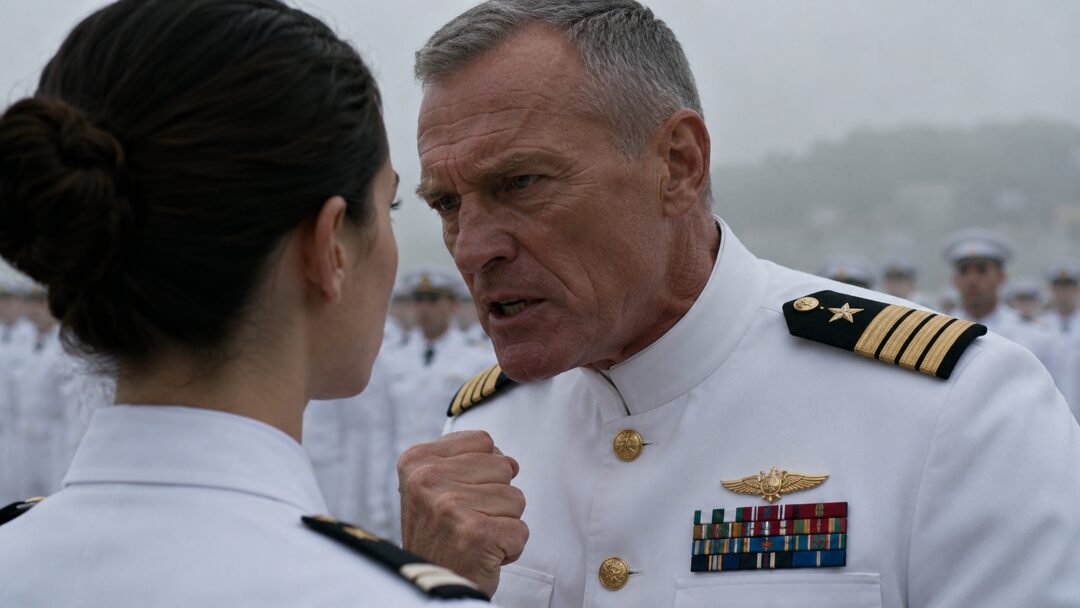
“You don’t belong here.”
Commander Robert Hale said it quietly enough that the rear ranks might not hear every word.
But the front row heard.
So did Lieutenant Sarah Mitchell.
So did the fog.
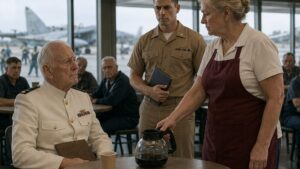
It hung low over the parade ground that morning, softening the palm trees beyond the fence and turning two hundred white uniforms into pale, silent shapes. The base looked almost peaceful from a distance. Up close, it was a room with no walls, and every person in it had been trained not to react.
Hale stood inches from Sarah’s face.
He was broad-shouldered, gray-haired, decorated, and perfectly still except for the fist held near his mouth. Gold on his shoulders. Ribbons on his chest. Years of command in the lines beside his eyes.
Sarah kept her chin level.
Her hair was pulled into a tight bun. Her shirt was crisp. Her black tie sat straight. If her pulse had moved into her throat, she did not let him see it.
Hale’s eyes narrowed.
“Is that all you’ve got?”
She did not answer.
That was what broke his control.
His hand came fast.
The strike snapped her head to the side. Pain flashed white across her mouth. The parade ground blurred for half a second. Somewhere behind her, someone inhaled and swallowed it before it became sound.
Sarah tasted iron.
She turned back slowly.
Hale’s fist was still raised, but the anger in his face had shifted. Not guilt. Not regret. Something closer to surprise.
He had expected her to step back.
She stepped into attention.
Blood gathered at her lower lip. It slipped down her chin in one warm line. Sarah lifted her right hand and gave him a clean salute.
Not shaky.
Not theatrical.
Perfect.
The kind drilled into muscle until the body could perform it even when pride was being cut open in public.
Hale stared at her.
For the first time that morning, he had no line ready.
Sarah lowered her hand only when protocol allowed.
Then she said, clear enough for the first three rows to hear, “Request permission to prove you wrong, sir.”
The fog carried the words.
No one moved.
Hale’s jaw tightened.
The radio officer standing near the edge of the formation stepped forward, pale beneath his cap. He had been waiting for Hale to finish the inspection. Now he looked as if the message in his hand had become heavier with every second.
“Commander,” he said. “Operations just confirmed Lantern Break.”
Hale did not look away from Sarah.
That was when she understood something worse than his anger.
He had been waiting for a reason to remove her.
Now he had found a way to keep her where failure could do it for him.
“Lieutenant Mitchell,” Hale said, voice flat. “You want to prove something?”
Sarah stood with blood drying on her chin.
“Yes, sir.”
“Report to operations. You’ll attach to command support for Lantern Break.”
A murmur almost passed through the formation, but discipline smothered it.
Hale leaned close again. This time his voice dropped so only Sarah could hear.
“One mistake,” he said, “and you will spend the rest of your career remembering this morning as the last time anyone mistook nerve for ability.”
Sarah’s mouth hurt too much to answer cleanly.
So she did not answer at all.
She saluted again.
Then she turned and walked through the fog, leaving the silent ranks behind her.
Only when she reached the edge of the parade ground did she remove a plain white handkerchief from her pocket and press it to her lip.
It came away marked.
Sarah folded it once.
Then again.
She placed it inside her jacket like evidence no court would ever allow.
Part II — The Room That Would Not Listen
The operations room was already alive when Sarah entered.
Screens glowed against the dim walls. Maps filled the central table. Voices moved fast and low. No one looked up at first, which Sarah preferred.
Then Captain James Walker saw her mouth.
His eyes went to the split in her lip, then to the folded handkerchief visible inside her jacket, then back to her face.
He said nothing.
That bothered her more than if he had stared.
Silence could be kindness.
It could also be permission.
Commander Hale entered behind her and the room straightened around him.
“Lantern Break,” he said. “Nine embassy staff trapped in Port Evren. One Navy medic missing from the humanitarian detail. Ceasefire window closes at 0200. Walker leads the field team. Extraction point is the east quay.”
He tapped the old harbor map on the table.
“Fast in. Fast out. No improvisation.”
Sarah stepped close enough to see the route.
Not too close.
Hale noticed anyway.
“Lieutenant Mitchell will observe intercept flow,” he said. “She is not command authority.”
The sentence landed exactly where he aimed it.
A young communications officer glanced at Sarah, then away.
Walker leaned over the table, sleeves rolled, face already carrying the fatigue of a man who had spent too many nights trusting maps drawn by people far from doors that did not open.
“What do we know about the missing medic?” he asked.
“Petty Officer Emily Carter,” said the communications officer. “Last confirmed with the embassy convoy before it split. No visual contact since seventeen hundred.”
“Alive?”
“Unknown.”
Hale answered before anyone else could soften it.
“We do not build plans on hope.”
Sarah looked at the intercept board.
Short radio bursts. Repeated intervals. Two channels. One official, one crude and unstable, likely captured or improvised. Most of the traffic had been labeled noise.
Noise was where people hid when no one believed they had anything left to say.
She stepped toward the board.
Hale did not turn.
“Lieutenant.”
Sarah stopped.
He kept his eyes on Walker. “Your station is there.”
There meant the edge of the room.
Not the table.
Not the route.
Not the decision.
Sarah moved to the assigned console. Her lip throbbed each time she swallowed. She opened the intercept log and began again from the first timestamp.
Walker’s team launched at 2130.
By 2142, they were moving through the western service road toward the harbor.
By 2151, Sarah had stopped hearing the room.
She saw the pattern before she had permission to see it.
Three bursts. Gap. Two bursts. Longer gap. Then a carrier tone on the second channel, always ninety seconds after command transmitted route confirmation.
She checked again.
Then again.
There are moments when certainty does not feel like confidence.
It feels like a door locking behind you.
Sarah stood.
“Commander Hale.”
Every face near her tightened.
Hale looked over slowly. “What?”
“The east quay route may be compromised.”
The room seemed to lose half its air.
Hale’s expression did not change, but something cold entered his eyes.
“Based on what?”
“Repeating response bursts following our route transmissions. The timing is too consistent to be incidental.”
“Enemy chatter often responds to movement.”
“Not before movement, sir.”
Walker looked up from the live feed.
Sarah continued, faster now because she knew interruption was coming. “They answer after command confirms, not after Walker moves. Someone is anticipating the route.”
Hale stared at her.
Then he gave a short, humorless breath.
“You were assigned to observe, Lieutenant. Not dramatize.”
Sarah felt every person in the room decide whether or not to look at her.
She kept her voice even.
“Sir, if we proceed to the east quay, we may be sending them into a prepared corridor.”
“And if we alter route based on your anxiety, we may scatter a clean operation into a city we do not control.”
“It is not anxiety.”
His eyes dropped to her mouth.
Then back up.
“No,” he said. “Of course not. It is importance. You were given a stage this morning, and now everything looks like a chance to perform.”
Walker’s jaw shifted, but he stayed silent.
Sarah looked at him once.
Just once.
He looked back, then down at the map.
Hale turned away from her.
“Proceed as planned.”
Walker’s voice came through the speaker, calm but distant. “Copy. Continuing to east quay.”
Sarah sat back down.
Her hands did not shake.
That felt like victory to someone watching.
Inside, it felt like standing behind glass while a door closed on people still breathing.
Part III — Noise
At 2226, Walker asked for a private channel.
Hale allowed it.
Sarah did not expect him to include her.
He did.
“Mitchell,” Walker said through the headset. “Tell me how certain you are.”
Hale’s head turned.
Sarah chose each word like it might cost someone a life.
“Certain enough to recommend route review. Not certain enough to claim source identity.”
“That isn’t an answer.”
“It is the honest one.”
A pause.
Then Walker said, “Honesty is expensive out here.”
Sarah looked at Hale.
He was watching her now, fully.
“I know,” she said.
Walker cut back to open channel.
The next twenty minutes moved with the cruelty of clocks.
Sarah kept tracking the bursts. They did not stop. They adapted. Each time command confirmed Walker’s progress, the pattern shifted just enough to look accidental to anyone who wanted it to be.
At 2254, Walker reached the east quay.
The camera feed shook as his team entered the low warehouse beside the water. Empty crates. Torn plastic. Old nets. No embassy staff. No medic.
Then a petty officer crouched beside a drainpipe.
“Captain,” he said. “You need to see this.”
The image swung down.
A small cloth patch lay on the concrete.
White background. Red cross. Navy issue.
Emily Carter’s medic patch.
Walker did not touch it at first.
No one in operations spoke.
Then he said, very softly, “This wasn’t dropped.”
Sarah closed her eyes for one second.
Not relief.
Never relief.
Being right too late is its own punishment.
Hale stepped toward the speaker. “Walker, continue the planned sweep. Check the interior rooms and move to secondary.”
Sarah stood.
“Sir, the patch is a lure.”
Hale did not turn. “Sit down.”
“The route is a lure. The patch confirms it.”
“Lieutenant.”
“They knew we’d reach that point. They wanted us to find something personal enough to keep us moving in the same direction.”
Hale turned then.
His face was controlled, but his voice cut lower.
“You have no authority here.”
“No, sir.”
“Then stop speaking as if lives become safer when you do.”
That struck harder than the parade ground.
Because there were lives now.
Names.
Breath.
A missing medic who had torn off part of herself and left it where Americans would find it.
Walker’s voice came through.
“Commander, recommend we hold for updated route assessment.”
Hale’s eyes stayed on Sarah.
“Denied. You have sixteen minutes before the window narrows. Move.”
Another pause.
Walker said, “Copy.”
Sarah sat.
The chair felt like a verdict.
A few minutes later, while Hale moved to the far console to speak with the regional liaison, Walker’s voice came quietly into Sarah’s headset.
“Mitchell. Off command. Say it plainly.”
She stared at the intercept screen.
“The bursts aren’t only responses. They’re markers.”
“From who?”
“I don’t know yet.”
“What do you know?”
Sarah’s throat tightened.
She hated that question because it allowed no hiding.
“I know we are being shown one path while someone is trying to tell us another.”
Walker breathed once. “Can you find it?”
Sarah looked at the columns of noise.
At the timings.
At the second channel.
At the gaps everyone else had stepped over because gaps looked like nothing.
“Yes,” she said.
The answer scared her.
Walker heard it.
“Then find it fast.”
Part IV — The Old Loss
Hale returned before Sarah had the pattern solved.
He stood behind her long enough that she could feel his shadow before she heard him.
“You think he trusts you now?” he asked.
Sarah kept working. “I think he wants to bring his people home.”
“That is not the same thing.”
“No, sir.”
The bursts repeated again.
Three. Gap. Two. Gap. One. Tone.
Sarah mapped them against the harbor grid.
Nothing.
She reversed the timing.
Still nothing.
Hale said, “Seven years ago, a junior officer told me a route was wrong.”
Her fingers slowed.
The room around them blurred, not because it had disappeared, but because every person in it knew Hale had begun speaking from somewhere he did not usually open.
“He was bright,” Hale said. “Certain. Everyone liked him. He believed the safest plan was the one that accounted for people command had not accounted for.”
Sarah said nothing.
“He changed course without authorization. Took eight men into a street that looked clear on paper and generous in theory.”
Hale’s voice did not break.
That almost made it worse.
“Only two came back.”
Sarah looked at him.
His face remained hard, but his eyes were fixed on the map as if the old street might appear there if he stared long enough.
“I do not mistake restraint for cruelty,” he said. “I know exactly what deviation costs.”
Sarah felt the ache in her lip when she answered.
“And I know what obedience can hide.”
His gaze snapped to her.
For a second, the room became the parade ground again.
Fog. Silence. The line between rank and person.
Then a burst came through Sarah’s headset.
Different.
Not louder.
Not clearer.
Just wrong in a new way.
She turned back to the screen.
Three. Gap. Two. Gap. One. Tone.
Then four seconds of static.
Then a woman’s voice, cut into pieces.
“Lantern… north… seven… repeat… not quay…”
The room froze.
The communications officer shouted, “Signal spike on channel two.”
Sarah’s fingers flew.
North seven.
Not a street. Not a building.
A harbor grid.
She pulled the old map closer, then the newer satellite overlay beside it. The grid labels had changed after the occupation. North Seven was no longer a quay section.
It was the old customs house.
Near the harbor.
Far from the planned route.
Sarah whispered, “Emily.”
Hale heard.
“So the medic is alive,” he said.
“No,” Sarah said. “She’s guiding us.”
The next signal arrived broken almost beyond meaning.
Children crying in the background.
A man coughing.
Then Emily Carter’s voice, scraped thin by exhaustion.
“Civilians… lower room… no lights… they followed me… because I said…”
Static ate the rest.
Walker came on hard. “Command, say again. Did we get Carter?”
Sarah leaned toward the mic.
Hale lifted one hand.
A warning.
Sarah stopped.
Hale spoke first. “Walker, Carter appears to be alive at the customs house. New objective: recover medic only. Repeat, recover Carter only and withdraw.”
Sarah turned to him.
The sentence had split the room in half.
“Sir,” she said, “there are civilians with her.”
“Our authorization is embassy personnel and American service member recovery.”
“She led them there.”
Hale’s face hardened. “Then she exceeded her mission.”
Sarah heard her own breath.
She thought of Emily Carter somewhere in the dark, hands pressed over someone else’s wound, wearing a uniform that had become a promise to people who did not understand the limits of orders.
“You can’t make her uniform mean protection,” Sarah said, “and then punish people for believing it.”
Hale stepped close.
“Do not confuse compassion with command judgment.”
Sarah met his eyes.
“Do not confuse control with command.”
No one moved.
Hale looked at the communications officer. “Cut her access.”
The officer hesitated.
That hesitation was small.
It changed everything.
Walker’s voice filled the room again.
“Command, I have movement east and south. Need route correction now.”
Hale reached for the mic.
Sarah saw the pattern at last.
North Seven had not been the destination. It was the anchor.
The bursts after each transmission were not random responses.
They were distances.
Emily had been moving the rescue route one piece at a time through the only language she had left.
Sarah reached across the console and opened the command channel before anyone stopped her.
“Walker, this is Mitchell. Break east route. Move north by service canal, two blocks, then west through the covered market. Customs house lower entry is accessible from the drainage court. Avoid main doors. They’re drawing you there.”
Hale’s voice cut in. “Lieutenant, stand down.”
Sarah did not raise her voice.
“Captain Walker, my assessment is on record. I accept responsibility for route deviation.”
Hale reached for the switch.
Then Emily Carter’s voice came through again.
So weak the room almost missed it.
“They came because I wore your flag.”
The words landed harder than any order.
Walker did not ask Hale again.
“Mitchell,” he said. “Guide me.”
Part V — The Door Under the Stairs
After that, the room belonged to seconds.
Sarah gave Walker the route in pieces. Short instructions. No drama. No explanation.
“Hold at canal corner.”
“Two hostiles moving past market arch.”
“Wait for the engine noise.”
“Go now.”
Hale stood three feet away, silent enough to frighten everyone.
He could have removed her.
He could have ordered communications to cut the line.
He could have ended her career before sunrise.
Instead he watched the map with the expression of a man seeing two different nights at once.
Walker’s team reached the customs house at 0121.
The feed showed cracked stone, hanging wires, a stairwell half-choked with debris. Somewhere below, people were trying not to make sound.
A young sailor found the lower entry behind a collapsed service door.
“Captain,” he whispered. “We’ve got them.”
The camera dipped.
Emily Carter appeared in the frame like someone assembled out of will.
Short blond hair dark with sweat. Sleeve torn. One hand wrapped around a bandage pressed to a civilian’s shoulder. Her face had the flat, bright look of a person who had been awake too long because closing her eyes would make her responsible for what happened next.
Behind her were people crouched in the dark.
Old men.
Two embassy staff.
A woman holding a boy against her chest.
No one spoke when Walker entered.
Then Emily saw the flag patch on his shoulder.
Her mouth trembled once.
Only once.
“I told them you’d come,” she said.
Walker looked back at his men.
He understood then what Sarah had understood from a room away.
This was no longer only a retrieval.
It was a reckoning.
“Command,” Walker said. “We have Carter, embassy personnel, and twelve civilians. Request extraction modification.”
Hale answered immediately. “Denied. Recover authorized personnel and withdraw.”
Sarah turned.
“Hale—”
“Commander,” he snapped.
“Commander,” she said, “if we leave them, the mission succeeds on paper and fails everywhere that matters.”
His face changed.
Not soft.
Not kind.
Wounded.
“You think I don’t know what failure looks like?”
“I think you’ve been staring at one version of it so long you can’t see another.”
The room went still.
On the feed, movement flashed beyond the customs house windows.
Walker’s team was out of time.
Hale closed his eyes for half a second.
When he opened them, the old hardness was back.
“Walker,” he said, “extract Carter and embassy staff. That is an order.”
Walker did not answer.
On screen, Emily Carter heard enough from his radio to understand.
She looked at the civilians behind her.
Then she looked at Walker.
“If you make me walk out without them,” she said, “you’ll have to carry me.”
It was not a threat.
It was worse.
It was a fact.
Walker looked into the camera.
Not at Hale.
At Sarah.
She knew what he was asking.
Not permission.
Not certainty.
Something harder.
Whether he could live with the cost of trusting her.
Sarah leaned into the channel.
“Captain, service corridor west leads to the drainage court. Move the civilians in two groups. Use the embassy staff between them so the front and rear both have trained personnel. You will lose speed, but you will avoid the main approach.”
Hale said nothing.
Walker held her gaze through the shaking feed.
Then he nodded once.
“Moving.”
The next thirteen minutes were not heroic.
They were ugly, cramped, and almost silent.
A civilian stumbled. Emily pulled him up with a sound that was half breath, half refusal. One of Walker’s sailors held a narrow corridor while the others moved through. The feed shook. Orders broke into fragments. Someone cursed. Someone prayed.
Sarah tracked the signal markers until they dissolved beneath interference.
Then there was only Walker’s voice.
“Court is blocked.”
Sarah searched the map.
No time.
No clean route.
No perfect answer.
She saw it then: an old maintenance passage marked on the outdated harbor map everyone had dismissed, sealed on the new overlay but not collapsed if the drainage flow still registered.
“South wall,” she said. “Utility door behind stacked crates.”
Walker’s breath came hard. “Confirmed?”
Sarah looked at the map.
At the signal.
At the time.
At Hale.
“No,” she said. “Probable.”
Walker gave a bitter laugh under his breath.
“Honesty is still expensive.”
“Yes,” Sarah said. “But it is all I have.”
A crash came through the channel.
Then gunfire somewhere distant enough to be unseen but close enough to shorten every breath in the room.
Walker shouted, “Found it!”
The feed jerked into darkness.
For six seconds, no one heard anything but static.
Then Emily’s voice, faint.
“Go, go, go.”
A sailor screamed.
The sound cut off.
Sarah’s hands went cold.
Hale gripped the back of a chair so hard his knuckles whitened.
Walker came back on the line, voice raw.
“Moving through passage. One down. Continuing.”
No one asked who.
Not yet.
Some questions had to wait until after survival.
At 0158, the extraction craft confirmed contact.
At 0203, the ceasefire window closed.
At 0211, Walker reported all remaining personnel aboard.
Emily Carter was alive.
So were the civilians.
So were the embassy staff.
One sailor was not.
His name came through ten minutes later.
Seaman First Class Daniel Price.
Twenty-two years old.
Held the corridor long enough for the last group to pass.
The operations room did not cheer.
No one even exhaled loudly.
Victory, Sarah learned that night, could enter a room and still leave a chair empty.
Part VI — What Remained
Dawn returned the fog to the parade ground.
It looked almost the same.
That felt insulting.
The same palm trees blurred in the same gray light. The same rows formed in silence. The same damp air settled on white uniforms and polished shoes.
But nothing was the same.
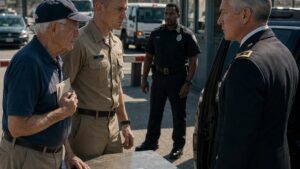
Captain Walker stood near the front with his left arm bound tight against his ribs. Emily Carter stood beside the medical transport, refusing to sit until the last civilian had been counted twice. Her face was gray with exhaustion. Her hands were clean now, and somehow that made them look more haunted.
Sarah stood where she had stood the morning before.
Her lip had swollen.
She had not covered it.
Commander Hale walked toward her without his cap.
The missing cap made him look older.
Not weaker.
Just less shielded.
He stopped in front of her.
Two hundred people watched again.
Sarah braced herself, not because she expected another blow, but because recognition could be its own kind of pain when it arrived late.
Hale reached into his jacket.
For one wild second, Sarah did not understand.
Then she saw the folded handkerchief.
Her handkerchief.
White once.
Marked now.
She must have dropped it in operations sometime after Walker found the utility door. She had not even noticed.
Hale held it out.
Sarah took it.
Their fingers did not touch.
He looked at the cloth, then at her.
There were a dozen things he could have said.
I was wrong.
I am sorry.
You saved them.
You cost us one.
You were right.
None of them came.
Maybe none of them would have been enough.
Hale straightened.
Then, in front of the formation, he raised his hand and saluted her first.
The parade ground seemed to stop breathing.
Sarah did not move right away.
Not out of defiance.
Because for one second, she was twenty-eight years old, exhausted, split-lipped, and standing inside a moment she had wanted before she understood what it would cost.
Then she returned the salute.
Hale held his.
His voice was quiet, but this time the fog did not swallow it.
“Permission granted.”
Sarah lowered her hand.
She could have smiled.
She did not.
Across the parade ground, Emily Carter watched from beside the transport. Walker stood with one arm bound and his face turned toward the gray horizon. Somewhere a young sailor’s name was being written into a report his family had not yet received.
Sarah folded the handkerchief once.
Then again.
She placed it back inside her jacket.
Not hidden.
Carried.
Hale stepped aside.
The path behind him opened into the fog.
Sarah walked forward.
No one told her she belonged.
No one needed to.