The Morning He Finally Let the Room See His Sleeve
Part I — The Hand on the Table
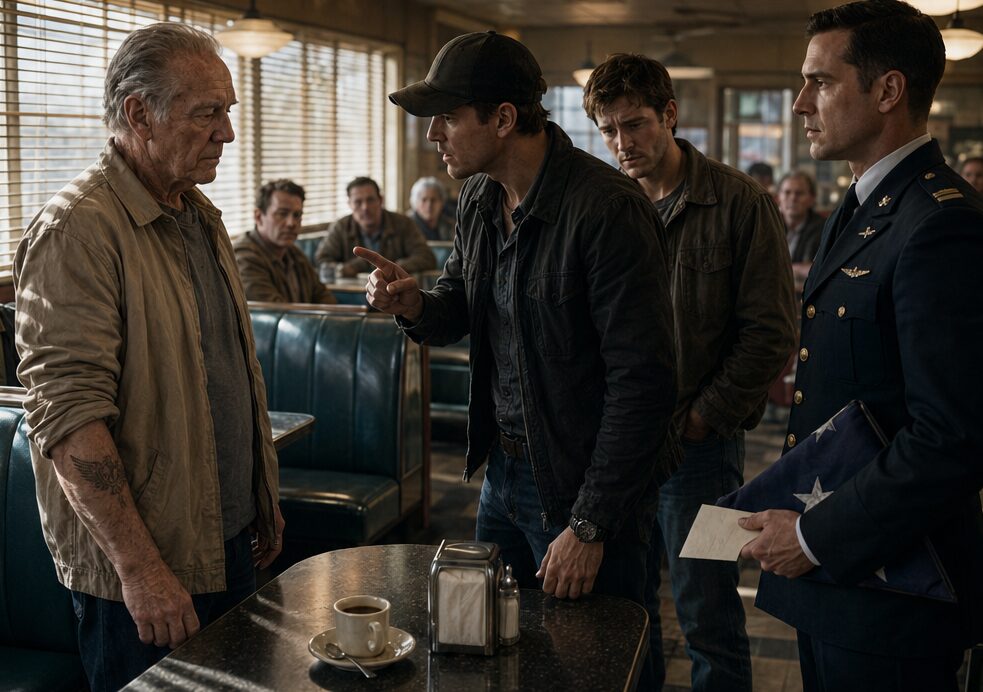
The young man touched Jerry’s forearm before he asked permission, two fingers landing on the faded design like he had found a price tag.
Jerry stopped stirring his coffee.
The spoon rested against the inside of the cup, halfway through a circle. His hand stayed there, thin and steady in the way old hands sometimes are when they have learned to hide the tremor until they are alone.
The young man leaned closer.
“Where’d you get that?” he asked. “Flea market?”
His friend laughed once, not because it was funny, but because he had been waiting to be told what kind of moment this was.
Jerry looked at the fingers on his skin.
The tattoo had faded from dark blue to a tired gray. Two wings, a small staff, a number almost blurred under the years. Most people never noticed it. Or if they did, they looked away, the way strangers looked away from canes and hearing aids and wedding rings on widowed hands.
But Justin noticed everything that could be used.
He wore a county baseball cap pulled low, a heavy watch that clicked when he moved, and the restless grin of someone used to making a room adjust around him. He had broad shoulders, a loud voice, and the confidence of a man whose father’s name opened doors before he touched the handle.
Jerry did not pull away fast enough.
Justin tapped the tattoo again.
“Come on,” he said. “You trying to impress somebody?”
Jerry slid his sleeve down.
Justin caught the motion and smiled wider.
“Oh, now he’s shy.”
Across from him, Stephen shifted his weight. He was younger or maybe just softer around the eyes. He had followed Justin in from the parking lot, still carrying the smell of cold air and engine grease on his jacket. He looked at Jerry, then at the few people turning in their booths.
“Leave him alone,” Stephen muttered, but without force.
That kind of mercy never reached the person it was meant for.
Catherine, the waitress, stood near the counter with the coffee pot in her hand. She had worked mornings at Miller’s Diner for twenty-three years and had poured Jerry coffee nearly every Tuesday for eleven of them. She knew he took it black. She knew he always sat in the third booth from the window. She knew he folded his napkin before he left, even if he had only used it once.
She also knew Justin’s father.
That was why her first step toward the booth was small.
“Everything all right over there?” she asked.
Justin did not look at her.
“Just asking a question.”
Jerry’s coffee had gone lukewarm. Outside, morning light cut through the blinds in pale stripes, laying bars across the table, the cup, his sleeve.
He had come in because the courthouse bell would ring at noon.
He had come in because his house was too quiet.
He had come in because, on some mornings, if he sat in the diner and listened to plates clatter and men argue about roadwork, he could almost believe the past belonged to another man.
Justin dragged a chair from the next table and turned it backward.
Then he sat across from Jerry without asking.
“Let me see it again,” he said.
Jerry’s eyes lifted.
They were pale, not weak. That was the first thing Stephen noticed.
But Justin had already mistaken quiet for permission.
“My brother’s in the service,” Justin said, loud enough for the booth behind them. “Real guys don’t sit around showing off old ink.”
Jerry’s thumb moved once against the spoon.
A small sound came from the cup.
Ceramic against metal.
Catherine heard it. She did not know why it made her chest tighten, only that Jerry had never made noise with his coffee before.
“Son,” Jerry said, “finish your breakfast.”
Justin’s grin sharpened.
“That supposed to scare me?”
“No.”
“Then answer the question.”
Jerry looked down at his sleeve as if the cloth had become too thin to hold anything back.
Justin leaned over the table.
“What unit?”
The diner went quieter.
Not silent yet. Just quieter in that cowardly way public rooms become quiet when everyone wants to hear but no one wants to be responsible for hearing.
Jerry took one breath.
“Forty-second medical evacuation.”
Justin stared at him, then laughed.
“That’s it?”
Jerry said nothing.
“That’s your big answer? You know how many fakes say stuff like that? Vague old unit, no details, no names.” Justin pointed at the sleeve. “That right there is why actual people don’t get respect.”
The words landed harder than the fingers had.
Jerry had heard worse in louder places. He had heard men beg. He had heard prayers turn into coughing. He had heard a voice on a radio repeat the same call sign until the sound stopped meaning language and became only need.
Still, this hurt in a place he had tried to let go numb.
Not because Justin mattered.
Because the accusation found an old door.
Stephen looked at Jerry’s hand.
The spoon had turned in his fingers, handle pressed against the inside of his palm.
“Justin,” Stephen said, quieter now. “Maybe don’t.”
But Justin was watching the room watch him.
He liked the way attention gathered.
He liked being the one who decided what a stranger was worth.
Jerry stirred his coffee once.
Then again.
Too slowly.
Catherine took another step.
Jerry gave her the smallest shake of his head.
Don’t.
It was not pride. It was warning.
Justin saw the look and misread that too.
“Oh, so everybody knows something except me?” he said. “Go ahead, old man. Tell us.”
Jerry set the spoon against the rim.
“You don’t want that story with your breakfast.”
For one second, even Justin had no answer.
Then he leaned back and smiled like he had just won.
“That’s what I thought.”
Part II — The Spoon
The worst part was not the laughter.
Jerry had learned, long ago, that laughter could be survived. Men laughed before orders. Men laughed after close calls. Men laughed at bad coffee, bad weather, bad luck, bad fear. Sometimes they laughed because the alternative would split them open.
No, the worst part was the room pretending it was not a room.
A man at the counter bent over his eggs.
A woman in a red sweater stared into her phone without moving her thumb.
Two truckers stopped talking but kept their heads turned toward the window, as if the parking lot had suddenly become fascinating.
Catherine stood with the coffee pot cooling in her hand.
Jerry did not blame them exactly.
People told themselves a thousand little stories to stay out of things.
Not my table.
Not my son.
Not my place.
He had told himself stories too.
Not my fault.
No room left.
No way back in.
Justin drummed his fingers on the table.
“So what happened?” he asked. “You forget?”
Jerry kept his face still.
A strip of light from the blinds crossed Justin’s cap, then his mouth, then the hand he had placed on Jerry’s side of the table.
Too close.
Jerry looked at that hand.
Not yet, he told himself.
He was in a diner.
The cup was coffee.
The floor was tile.
The red on the napkin dispenser was a logo, not dust.
The heat was from the kitchen.
The voice in front of him belonged to a young fool with clean skin and no right to the names in Jerry’s head.
Justin snapped his fingers once.
Jerry blinked.
“There he is,” Justin said. “See? Nothing.”
A sound moved through the room. Not laughter. Not quite. A shared discomfort that had no spine.
Stephen stood straighter.
“Man, stop.”
Justin glanced back. “What?”
“I said stop. He’s not doing anything.”
“That’s the point.” Justin faced Jerry again. “People like this let everybody assume things. Put a symbol on your arm, sit in public, wait for respect.”
Jerry’s fingers closed around the spoon.
A helicopter door jammed halfway open.
A boot slipping in red dust.
Someone yelling for water.
A young man’s hand gripping Jerry’s sleeve so hard the fabric tore.
Jerry let go of the spoon.
His hand looked strange on the table. Older than he expected. Veins raised. Knuckles uneven. A scar near the thumb Catherine had noticed years ago and never asked about.
Justin saw the scar and smiled.
“What, you going to do something?”
Jerry pushed the cup aside.
Then he stood.
It took longer than he wanted. His knees objected. His back pulled. The booth seat held him a half second too long, as if old age itself had fingers in his coat.
But when he was upright, the diner changed.
Not much.
Enough.
Justin had to tilt his head up.
Jerry was not tall anymore. Maybe he never had been as tall as memory made him. But there was a line through his spine now, a steadiness that did not belong to the trembling hand or the beige jacket or the thin hair combed back from his forehead.
He looked at Justin’s hand.
“Take it off the table.”
Justin blinked. “Excuse me?”
“You heard me.”
Justin laughed, but it came out thinner.
“My father is—”
“I didn’t ask about your father.”
That line reached places the others had not.
Stephen looked down.
Catherine’s mouth parted, almost a smile, almost a prayer.
Justin’s face changed color.
“You think because you’re old nobody can say anything to you?”
“No,” Jerry said. “I think because you’re loud, people let you.”
The room breathed in.
Justin pushed the chair back and stood too.
Now they were close. Too close for the booth, too close for Catherine, too close for Stephen, who lifted one hand as if he might step between them and then did not.
Jerry could smell Justin’s mint gum.
Justin could smell coffee and wool and the faint medicinal soap that clung to Jerry’s jacket.
For the first time, Justin seemed to understand that the old man was not afraid in the way he wanted him to be.
That made him angrier.
“You didn’t answer me,” Justin said. “You got proof?”
Jerry’s eyes moved to the tattoo beneath the sleeve.
The proof was under his skin.
The proof was in a box at the top of his closet, wrapped in a towel he had not unfolded in years.
The proof was in three names he still spoke when the house got too quiet.
The proof was in a letter he had never received, from a man he did not know had lived long enough to write one.
But Jerry said none of that.
He only said, “Some things don’t become truer because a boy demands them.”
Justin stepped forward.
Then the bell over the diner door rang.
Part III — The Man at the Door
The man who entered wore a dark formal uniform and carried his cap under his arm.
At first, the room seemed embarrassed by him.
Not afraid. Embarrassed.
As if everyone had been caught doing something small in front of someone dressed for something larger.
He paused just inside the door, letting it swing shut behind him. He was in his early forties, clean-shaven, broad through the shoulders, with polished shoes and a face that had learned discipline before grief could claim too much of it.
His eyes moved once across the diner.
Catherine straightened.
Justin noticed the uniform and immediately reached for it like a rope.
“Sir,” he said, putting weight into the word. “You might want to hear this.”
The man looked at him.
Justin pointed toward Jerry.
“I think we’ve got someone pretending to be something he’s not.”
Stephen closed his eyes briefly.
Catherine whispered, “Justin.”
The uniformed man did not move quickly. That was the first thing Jerry noticed. He took in the chair turned backward, the customers looking down, Catherine’s pale knuckles around the coffee pot, Justin’s pleased expression, Stephen’s shame.
Then his gaze fell to Jerry’s sleeve.
The sleeve had ridden up when Jerry stood.
The faded wings showed again.
The man’s expression did not change all at once.
It tightened.
Then stilled.
His eyes moved from the tattoo to Jerry’s face.
Then to the inside edge of Jerry’s old field jacket, where the lining had folded back enough to show the stitched name that had survived washing, storage, and four decades of being almost forgotten.
REED had been the old name.
But the story no longer carried it.
In this room, the stitched letters read: Jerry Cole.
Jerry saw the man read them.
He felt the past turn its head.
The man stepped closer.
“What’s your name, sir?”
Jerry almost said, No one you came looking for.
Instead he answered, “Jerry Cole.”
The man’s breath changed.
Not loudly.
Just enough.
Justin saw it and frowned.
“You know him?”
The man did not answer Justin.
His eyes stayed on Jerry, and something formal in him softened into something personal.
“My name is Brandon Grant,” he said. “My father was Stephen Grant.”
Jerry heard the surname first.
Then the first name.
Then nothing in the diner stayed where it was.
The booth became too narrow.
The air became too hot.
A radio voice cracked through static.
Grant is still inside.
No time.
Grant is still inside.
Jerry looked at the tabletop.
His coffee sat untouched. The spoon lay beside it, shining under the fluorescent light like an accusation.
Brandon took one more step.
“Were you with the forty-second medical evacuation unit?”
Justin’s face shifted. He looked from Brandon to Jerry, trying to find the angle, the mistake, the way back to being in charge.
Jerry said, “A long time ago.”
Brandon swallowed.
“Were you at Night Bridge?”
The words did not belong in a diner.
They belonged to smoke, heat, rotor wash, shouted orders, a hill that would not stop shaking, a sky too low to hold any mercy.
The room heard a name.
Jerry heard men.
He closed his eyes for one second.
When he opened them, Justin was staring at him as if the old man had become a door and something was standing on the other side.
“That was a long time ago,” Jerry repeated.
Brandon’s voice lowered.
“Not in my family.”
No one moved.
Even the kitchen seemed to pause behind the pass-through window.
Brandon reached into the inside pocket of his jacket. Slowly, carefully, as if the motion required permission from the room and from the dead.
He took out a folded letter.
The paper was worn at the creases, handled many times but preserved with care.
“I came into town for the memorial at noon,” Brandon said. “I was going to read this there.”
Jerry’s throat tightened.
He did not want the letter.
He wanted the diner back as it had been ten minutes earlier, with Catherine refilling coffee and Justin still only a nuisance and the tattoo safely half-covered by cloth.
Brandon unfolded the paper.
Justin laughed once, but nobody joined him.
“Come on,” Justin said. “You don’t know that’s him. Maybe your dad heard some story. Maybe—”
Brandon looked at him.
“Step away from the table.”
It was not loud.
It did not need to be.
Justin stepped back.
Not far enough to be humble.
Far enough to obey.
Brandon looked down at the letter again.
“My father wrote this six months before he passed,” he said.
Jerry’s hand found the edge of the table.
“He wrote about the man who pulled him out after the order came to leave. He wrote that the medic carried his life out in both hands and left part of himself behind.”
The diner went completely silent.
Jerry did not breathe right.
Brandon’s voice held, but barely.
“He named you.”
The spoon slipped from the saucer and struck the table.
The sound was small.
Jerry heard it like metal in a burning doorway.
Part IV — The Name in the Letter
For forty years, Jerry had believed the living moved on because that was what the living had to do.
He had imagined Stephen Grant grown older somewhere, maybe with a limp, maybe with children, maybe with a wife who learned which nights not to ask questions. He had imagined him forgetting the face of the medic who dragged him out half-conscious, because forgetting was also a kind of mercy.
He had not imagined a letter.
He had not imagined being named.
Brandon held the paper but did not offer it yet.
Maybe he sensed Jerry could not take it.
“My father said he remembered your hands,” Brandon said. “He said everything else was smoke, but he remembered your hands.”
Jerry looked down.
His hands were on the table.
Old hands.
Hands Justin had thought might shake from weakness.
Hands that had pressed gauze into places no one should have to touch. Hands that had counted breaths by feel. Hands that had once held Stephen Grant’s jaw open while yelling at him not to go quiet.
“Don’t,” Jerry said.
Brandon stopped.
“Don’t make this clean.”
The words came out rougher than he intended.
Catherine’s eyes filled, but she did not move.
Justin stood near the aisle, his cap low, his mouth tight. He still wanted a defense. Not because he believed it anymore, but because shame looks for exits.
Jerry looked at Brandon.
“There were three of them in that transport,” he said. “Your father was nearest the door.”
Brandon’s face did not change, but the letter trembled slightly.
“The order had already come,” Jerry continued. “Last lift. No more passes. Fire was coming down the ridge. Door jammed halfway open. I could hear two others.”
His voice stopped.
Nobody pushed him.
That helped.
He took another breath.
“One asked for water. One kept saying his mother’s name. Your father wasn’t speaking by then.”
Brandon looked at the floor.
Jerry could see the boy in him now, the son beneath the officer. Not young in age, but young in the way grief makes people when they finally stand near the source of a family story.
“I got him out,” Jerry said. “I didn’t get them.”
A chair creaked somewhere.
Jerry looked toward the window.
The blinds cut the morning into pieces.
“I was ordered to leave,” he said. “I didn’t. Then I was ordered again. By the time they pulled me onto the aircraft, I still had a glove caught in the door.”
The memory rose bright and useless.
A torn glove.
A hand he had not reached.
The aircraft lifting.
The sound below them disappearing into distance before it disappeared from his head.
Brandon did not speak immediately.
That was the first honor he gave Jerry.
Not the uniform. Not the letter. The silence.
Justin shifted.
“I didn’t know,” he said.
The words were not apology yet.
They were a shield.
Jerry turned to him.
“That was the problem,” he said. “You didn’t know, and you still decided.”
Justin’s face tightened as if slapped.
Stephen looked at Jerry with something worse than pity and better than guilt. He looked as if he had just discovered the shape of his own cowardice.
“I’m sorry,” Stephen said quietly.
Justin shot him a look.
Stephen did not take it back.
Brandon folded the letter along its old creases.
“My father spent the rest of his life trying to be worthy of the minutes you gave him,” he said.
Jerry shut his eyes.
That line did what praise never could.
It did not polish the past.
It did not call the dead necessary.
It did not say everything happened for a reason, the cruelest sentence people offer when they have run out of courage.
It simply placed weight on the other side of the scale.
Stephen Grant had lived.
Not merely survived. Lived.
Had a son.
Wrote a letter.
Carried a name.
Jerry opened his eyes.
“What did he do?” he asked.
Brandon’s mouth moved, almost a smile and not quite.
“He taught history.”
A sound left Jerry that might have been a laugh if it had known how.
“Did he?”
“Thirty-one years. Terrible handwriting. Couldn’t cook. Remembered every birthday. Told me once that a man can owe his life without spending it in debt.”
Jerry looked at the letter again.
There it was.
The life he had imagined as a question had answered from the other side.
Justin rubbed the back of his neck.
The room no longer belonged to him.
That was clear now.
He had entered as a judge and become evidence.
Brandon stepped closer, letter still in hand.
“I’ve wanted to meet you my whole life,” he said.
Jerry’s first instinct was to refuse the sentence.
To wave it off.
To say Brandon had met the wrong version of him, that the man he wanted had been left somewhere under red dust, younger and faster and impossible to recover.
Instead, Jerry looked at the tattoo.
For years he had treated it like a locked door.
For years he had kept his sleeve low, not because he was ashamed of serving, but because he was afraid someone would thank him and expect the thanks to land cleanly.
Now the cloth covered half the wings.
Half memory.
Half hiding.
Brandon straightened.
His right hand shifted slightly, preparing.
Jerry saw it.
“No,” Jerry said.
Brandon froze.
Jerry’s voice softened.
“Not yet.”
Part V — The Sleeve
The diner waited in a silence that no longer felt empty.
Jerry reached for the spoon.
For a moment, everyone watched his hand close around it again.
Justin’s eyes flickered.
Maybe he still expected anger.
Maybe some part of him wanted anger. Anger would make the old man easier to understand. Anger would let Justin become brave again.
But Jerry did not lift the spoon like a threat.
He placed it carefully beside the cup.
A small decision.
A complete one.
The tremor in his fingers remained, but it no longer ruled him.
Then Jerry took his sleeve between finger and thumb and rolled it up.
Not quickly.
Not dramatically.
He folded the cloth once, then again, until the entire tattoo showed.
The faded wings.
The staff.
The number.
The old lines blurred by years but not gone.
Catherine put one hand over her mouth.
Jerry looked at Brandon.
“Your father owed me nothing,” he said. “But I’m glad he lived.”
Brandon’s face broke then, not much, but enough for the room to see the cost of discipline.
He lifted his hand in salute.
This time, Jerry did not stop him.
The room held its breath.
The salute was not a performance. There was no music, no applause, no speech waiting behind it. Just a man in uniform honoring an old man in a diner, and an old man allowing it even though it hurt.
Jerry stood still.
For a moment, he was twenty-eight and seventy-eight at once.
He was on a hillside in heat and noise.
He was in a diner with cold coffee.
He was carrying Stephen Grant.
He was leaving two voices behind.
He was being seen.
Slowly, Jerry raised his own hand.
His salute was not perfect. His shoulder had stiffened years ago, and his fingers did not close as cleanly as they once had.
But Brandon’s eyes changed when he saw it.
Because perfection was not the point.
Recognition was.
Jerry held the salute for one breath.
Then two.
Then lowered his hand.
Brandon lowered his.
No one clapped.
Thank God, Jerry thought.
Applause would have ruined it.
Justin stood near the aisle, smaller than he had been when he walked in. He looked at Jerry, then at the tattoo, then at the floor.
“I really didn’t know,” he said.
Jerry did not rescue him from it.
“No,” he said. “You didn’t.”
Justin waited, maybe for forgiveness, maybe for instruction, maybe for the old man to turn the moment into a lesson he could carry out neatly.
Jerry gave him none of that.
Some lessons had to stay uncomfortable long enough to work.
Justin picked up his cap from where he had set it on the next booth.
He looked once at Brandon, then at Catherine, then at no one.
When he left, the bell over the door rang too brightly.
Stephen stayed.
He swallowed hard.
“I should’ve stopped him,” he said.
Jerry looked at him for a long moment.
“Yes,” he said.
Stephen nodded as if the word had weight.
“I’m sorry.”
Jerry studied him.
This apology was not a shield. It had nowhere to hide.
So Jerry gave him a nod.
Not absolution.
Not punishment.
A beginning.
Stephen left more quietly than Justin had.
The diner did not return to normal after that.
Normal was too thin a word for what had been broken open.
A fork touched a plate. Someone sniffed. The kitchen fan hummed. Morning continued because morning was merciless that way.
Catherine came to the table.
Her eyes were red, but she did not cry. Jerry was grateful.
She turned his cup over, poured fresh coffee, and set the pot back against her apron.
Then she took the check from the edge of the table and placed it face down.
“It’s taken care of,” she said.
Jerry looked at the check.
Then at her.
“You don’t have to do that.”
“I know.”
Her voice almost failed, but she steadied it.
“I should’ve stepped in sooner.”
Jerry looked toward the door where Justin had gone.
“Yes,” he said again, but gently this time.
Catherine accepted it.
That mattered too.
Brandon still held the letter.
After a moment, he placed it on the table, not pushing it toward Jerry, just setting it where Jerry could choose.
“My father would have wanted you to have this,” he said.
Jerry stared at the folded paper.
There were objects a man could pick up and objects that picked up the man.
This was the second kind.
He touched the edge of it with one finger.
Not taking it yet.
Just admitting it was real.
Brandon looked toward the window, then back at him.
“The memorial starts at noon,” he said. “At the courthouse.”
Jerry almost said no.
The word was familiar. It had served him for years.
No to reunions.
No to interviews.
No to ceremonies.
No to hands on his shoulder.
No to flags folded too neatly around stories that were not neat at all.
But the letter sat on the table.
And beneath his rolled sleeve, the tattoo remained uncovered.
Jerry thought of two voices in smoke.
Then of Stephen Grant teaching history with terrible handwriting.
He thought of a son standing in a diner, carrying gratitude that had outlived the man who first owed it.
He looked through the blinds at the courthouse clock down the street.
“I suppose,” Jerry said, “I owe some names a visit.”
Part VI — What Remained
Brandon did not rush him.
That became the second honor.
He sat across from Jerry where Justin had been, but he did not fill the space the same way. He did not lean in. He did not demand. He rested his cap on the seat beside him and let the diner breathe around them.
Jerry drank his coffee.
It was hot this time.
Catherine moved from table to table with unusual care, as if every cup might break if set down too hard. No one spoke loudly. Even the men at the counter kept their voices low.
The letter stayed folded between Jerry and Brandon.
After a while, Jerry picked it up.
The paper felt softer than he expected.
He did not open it.
Not there.
Not with syrup bottles and salt shakers and strangers pretending not to look.
He slipped it inside his jacket.
Brandon saw and said nothing.
That was the third honor.
Jerry touched his sleeve, then stopped himself before pulling it down.
For most of his life after the evacuation, hiding had seemed like respect. If he kept the tattoo covered, he did not have to explain who had lived and who had not. If he avoided ceremonies, no one could turn the worst day of his life into a clean paragraph. If he sat alone, no one could ask him to be proud of a choice that still woke him some nights.
But silence had not protected the dead from being forgotten.
It had only left Jerry alone with them.
He looked at Catherine.
She was wiping a clean section of counter that did not need wiping. When she felt his gaze, she turned.
“Would you mind calling me a cab at eleven-thirty?” he asked.
Her face changed.
“Of course.”
Brandon looked down at his hands.
“My father used to say he got extra years,” he said. “Not borrowed. Given.”
Jerry listened.
“He said given years had to be lived carefully.”
The words settled without forcing anything.
Jerry nodded once.
Outside, a truck pulled away from the curb. Sunlight moved higher against the blinds. The stripes on the table shifted off the cup and onto Jerry’s uncovered forearm.
For the first time in years, he let them stay there.
He did not feel healed.
That would have been too easy, and almost insulting.
The two men from the transport were still gone. The order was still given. The door was still jammed. The aircraft still lifted with Jerry inside it and voices below it.
But Stephen Grant had lived.
Brandon was here.
The letter was in Jerry’s jacket.
And the room had seen his sleeve without owning his story.
At eleven-thirty, Catherine came back with her coat over one arm.
“I’m driving you,” she said.
Jerry looked at her.
“You have tables.”
“Donna can cover them.”
From behind the counter, another waitress raised a hand without looking up. “Already covered.”
Jerry almost argued.
Then he saw Catherine’s face and decided not every kindness needed to be resisted.
Brandon stood when Jerry did.
This time, getting out of the booth still hurt. His knees still complained. His back still took its moment.
But no one mistook the slowness for weakness.
At the door, Jerry paused.
The diner watched him openly now.
That was uncomfortable.
It was also different from being watched as a spectacle.
Brandon opened the door.
Catherine stepped out first.
Cold air entered, clean and sharp.
Jerry followed, his sleeve still rolled, the folded letter resting against his heart.
The bell above the door rang once.
Not brightly this time.
Gently.
As if the morning had learned how to lower its voice.