They Ordered the Old Veteran Away from the Empty Chair He Had Kept for Fifty Years
Chapter 1: The Empty Chair Was Facing the Wrong Road
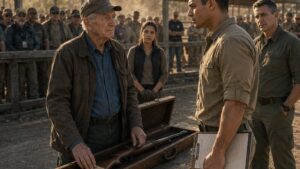
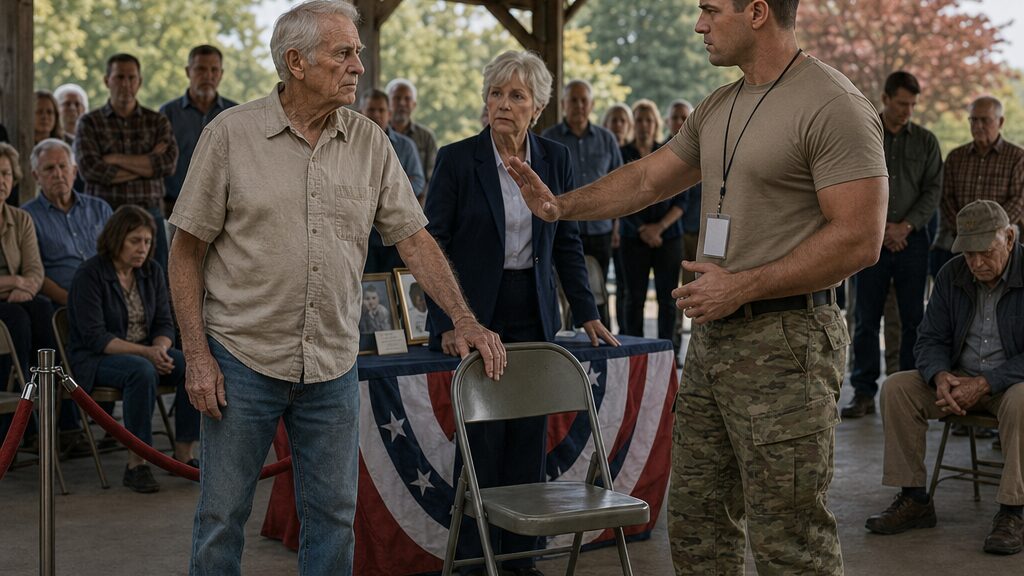
Eric Rivera had one leg over the red rope when the young sergeant shouted.
“Sir. Stop right there.”
The word struck harder than the volume. Not because it was rude. Because it was meant to freeze him in place.
Eric lowered his work shoe onto the pavilion floor anyway.
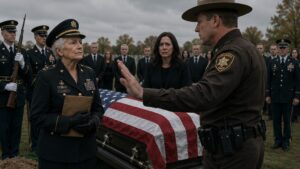
The memorial table stood beneath red, white, and blue bunting, its cloth lifting slightly whenever wind crossed the open eastern side of the structure. Framed photographs, printed service cards, and battery candles had been arranged in a careful line. At the far end sat a gray metal folding chair.
It faced west.
Eric had noticed that from the parking lot.
He placed one hand on its cold backrest and turned it ninety degrees.
The chair legs scraped across the concrete. Conversations behind him stopped.
The sergeant reached him in three long strides. He was broad through the shoulders, perhaps thirty, wearing a tan military shirt tucked sharply into camouflage trousers. A laminated event badge hung against his chest.
“What are you doing?” he asked.
Eric bent to align the rear leg with a faint chalk mark near the table. His fingers did not close as easily as they once had. The chair shifted half an inch too far. He corrected it.
“Sir, step away from the display.”
Eric straightened slowly.
The sergeant’s name tape read HILL.
Beyond him, people under the pavilion watched over paper cups and folded programs. One of the committee volunteers held a roll of tape without moving. An older veteran near the front row had removed his cap, though the opening prayer had not begun.
Eric put his right hand into the pocket of his faded jeans. His thumb found the small steel hinge pin he had carried there since before Sergeant Hill had been born.
“This area is restricted,” Hill said. “You crossed a marked boundary.”
“The chair was wrong.”
“The chair was set by the committee.”
“They set it wrong.”
Hill glanced toward the table, then back at Eric’s beige short-sleeved shirt and worn work shoes. His eyes paused at Eric’s empty chest, where there were no pins, ribbons, badges, or printed name tag.
“Are you with one of the veteran groups?”
Eric looked past him toward the eastern opening. Beyond the pavilion lay a strip of grass, a service road, and a row of maple trees planted long after the field hospital had disappeared.
“No.”
“Are you family?”
Eric’s thumb rolled the hinge pin against the lining of his pocket.
“No.”
“Then you need to come back behind the rope.”
Eric reached for the place card in front of the chair.
Hill caught his wrist.
A few people inhaled at once.
The sergeant released him almost immediately, but the heat of the grip remained. Eric looked at the younger man’s hand, then at his face.
Hill’s jaw tightened. “Do not touch the display.”
The card read:
JACOB MOORE
FELL IN ACTION AT THIS LOCATION
MAY 28, 1971
Eric had read the same words the previous year from outside the pavilion, after everyone had gone home. He had written twice to the committee after that. The first letter received a form response. The second received an invitation to be recognized at this year’s ceremony.
He had answered neither.
Now he lifted the card.
Hill stepped between Eric and the table.
“That’s enough.”
A woman with silver hair and a navy blazer approached from the front row. Eric recognized Jessica Davis from the photograph printed on the committee letters.
“What’s happening?” she asked.
“This gentleman entered the restricted area and started moving the display,” Hill said.
Jessica looked at Eric. “Sir, the ceremony begins in six minutes.”
“That card isn’t true.”
Her expression changed only slightly. “The information came from the county archive.”
“It is still not true.”
“We can discuss corrections after the ceremony.”
“You printed it last year.”
Jessica glanced toward the watching guests. Her voice dropped. “Please step outside with Sergeant Hill.”
Eric looked at the chair. Wind from the east moved the bunting but not the heavy card in his hand.
Hill extended his arm toward the rope. “Let’s go.”
Eric did not move.
The young man’s posture squared, his confidence returning now that the organizer had confirmed his authority.
“Do you have identification?” Hill asked.
Eric looked at him.
“Military identification. Veterans card. Anything showing you have a legitimate connection to this event?”
“No.”
A murmur passed through the pavilion.
Hill’s face hardened, though something uneasy moved behind his eyes. “Did you actually serve, sir?”
The question entered the open air and seemed to remain there.
Eric heard a paper program fold in someone’s hands. He saw Jessica look away for one second, toward the podium, as if the schedule might rescue her from what had just been said.
He could have answered.
He could have given his unit, his dates, the names of the men whose blood had dried beneath his fingernails. He could have described the smell of wet canvas and iodine, or the sound a young soldier made when he tried not to cry for his daughter.
Instead, Eric returned the printed card to the table.
He moved the chair’s rear leg another fraction until it covered the chalk mark exactly.
Then he looked at Mark Hill.
“You have the chair facing the wrong direction,” he said. “He was carried out toward the east road.”
Mark’s mouth opened, but no reply came.
Eric nodded toward the card. “And he did not fall here.”
For the first time, the sergeant looked past Eric to the eastern side of the pavilion. The service road was plainly visible through the trees.
“How would you know that?” he asked.
Eric kept his hand in his pocket.
Jessica stepped closer. “Mr.—”
“Rivera.”
“Mr. Rivera, we cannot delay the program.”
“You already delayed him fifty years.”
Jessica’s face tightened. “Sergeant, please escort Mr. Rivera outside.”
Mark hesitated.
It was brief, but Eric saw it. The younger man’s certainty had acquired a crack.
Then Mark gestured toward the rope.
Eric stepped over it without assistance. The crowd parted, though no one spoke to him. He walked between two rows of folding chairs with Mark half a pace behind him. At the edge of the pavilion, the older veteran who had removed his cap met Eric’s eyes, then lowered his own.
Eric did not look back until he reached the grass.
Jessica was already calling people to their seats. A volunteer straightened the bunting. Mark stood at the pavilion entrance, watching Eric with his arms lowered now, his shoulders no longer rigid.
The opening prayer began.
Eric walked toward the parking lot.
Behind him, Mark returned to the memorial table to put Jacob Moore’s card back in line.
Only then did he notice it was not the committee’s printed card.
Eric had left a smaller card beneath it, written in a careful, unsteady hand.
JACOB MOORE
He left this field alive.
Chapter 2: The Complaint Made His Silence Official
The barred-entry notice arrived before noon the next day, folded once inside a county envelope.
Eric opened it at the kitchen table with the same pocketknife he used for utility bills. The letter informed him that, pending review of an incident involving unauthorized access, alteration of memorial materials, and refusal to comply with event security, he was prohibited from attending the remainder of the weekend’s remembrance activities.
His name appeared three times.
Jacob’s did not appear once.
Eric read the notice, folded it along its original crease, and set it beside six unopened envelopes from the county remembrance committee.
The oldest was four years old.
Each had come after one of his letters correcting Jacob’s record. Each carried some variation of the same invitation: attend the ceremony, provide his service history, allow the committee to recognize his contribution.
The committee had always seemed willing to discuss Eric Rivera.
It had shown less interest in changing one sentence about Jacob Moore.
Eric emptied his pocket onto the table. Two quarters, a brass house key, and the steel hinge pin landed beside the notice. The pin was dark at one end and bright where his thumb had worn it smooth.
He wrapped the notice around it.
For several minutes he sat without moving. The refrigerator motor clicked off. In the quiet, he could hear a lawn mower two houses away and the faint rasp of his own breathing.
He had spent fifty years believing silence was the one thing he could still give Jacob without spoiling it.
Now silence had become an official record.
By nine the next morning, Eric was seated across from the county veterans-service clerk beneath fluorescent lights that made every paper look older.
The clerk had read the incident report twice.
“Sergeant Hill says you refused to identify yourself.”
“I gave my name.”
“He means your status.”
“That was not the question on the table.”
The clerk looked over his glasses. “You altered a memorial display.”
“I corrected it.”
“That is not the same thing procedurally.”
“No,” Eric said. “It rarely is.”
The clerk leaned back. He was old enough to know better than to argue with Eric’s tone, but young enough to continue trying.
“If you provide your discharge papers, I can verify your service and attach the verification to the review.”
“My service is not under review.”
“According to this complaint, your right to enter the restricted area is.”
“I do not need a right to make a false date true.”
The clerk exhaled and turned to his computer. “Jacob Moore.”
Eric’s hand closed around the hinge pin inside the folded notice.
Keys clicked.
The clerk frowned at the screen. “Army. Casualty date May twenty-eighth, nineteen seventy-one.”
“That is the date he died.”
“It says he fell in action at the temporary aid location.”
“It says the location associated with the action.”
“The memorial committee used the archive summary.”
“The summary is wrong.”
The clerk rotated the monitor slightly, though Eric did not need to see it.
“Mr. Rivera, the record shows the injury report and the death report under the same operation. That may be why the wording was simplified.”
“Simplified.”
“I’m not defending it.”
“You just did.”
The clerk removed his glasses. “Then help me correct it.”
Eric looked toward the filing cabinets along the wall. Metal labels. Black handles. Rows of lives reduced to dates and categories that fit inside drawers.
“I sent letters.”
“The committee invited you to meet.”
“They invited me to sit on a stage.”
“Because you said you were there.”
“I said Jacob was not dead when he left.”
“And you never explained how you knew.”
Eric unfolded the barred-entry notice. He placed the hinge pin in the center, then refolded the paper over it as though covering something sharp.
The clerk watched him.
“You knew him personally,” he said.
Eric did not answer.
The clerk returned to the computer and opened another record. “There’s an evacuation log referenced here, but it’s not digitized. Let me check the microfilm index.”
He disappeared through a back door.
Eric remained alone at the desk. On the wall hung a framed message thanking veterans for their sacrifices. Beneath it sat a plastic cup filled with miniature flags.
After several minutes, the clerk returned carrying a photocopy.
“The aid-station admission was May twenty-sixth,” he said. “The transfer notation is early on the twenty-seventh.”
Eric looked at the page.
The copy was faint, but the typed line remained legible:
MOORE, J. — STABILIZED — TRANSFERRED EAST ROUTE 0410
The clerk tapped the date. “Two days before the casualty date.”
“Yes.”
“So your correction about the road—”
“Was not a guess.”
“You were at the aid station?”
Eric looked at the clerk long enough for the answer to become unnecessary.
The clerk sat down more carefully than before. “Were you medical personnel?”
Eric slid the photocopy back across the desk. “The record is enough.”
“It proves the memorial wording is misleading. It doesn’t establish your authority to alter the display.”
“Truth should have authority.”
“Not in county procedure.”
The words were not cruel. That made them harder to dismiss.
The clerk opened a paper file and read from a form. “For a public memorial amendment, the committee needs either archival certification or approval from next of kin.”
“Archival certification takes how long?”
“Months, perhaps longer.”
“The chair will be gone by then.”
“Then you need the family.”
Eric looked down at the folded notice in his hands.
The clerk studied him. “You know who the next of kin is.”
Eric’s silence answered again.
The clerk searched the record. “Daughter. Rachel Lewis.”
The name did not surprise Eric. The surname did.
He had known her as Rachel Moore, six years old in a school photograph Jacob carried inside a clear plastic sleeve. Missing one front tooth. Hair tied unevenly on both sides. A red crayon mark across the corner where Jacob had traced her face with his thumb.
The clerk wrote an address on a yellow slip.
“She still lives in the county,” he said. “Mailing address is current as of last year. I cannot give you anything beyond what’s publicly listed.”
Eric stared at the numbers.
He did not need the street name to know the address.
It was the same one written on the envelope inside his bedroom drawer, beneath his discharge papers and the packet of committee invitations. The same house Jacob had described while bleeding through a field dressing. The same address Eric had copied onto three sheets of stationery over fifty years and never used.
The clerk pushed the slip closer.
“Mr. Rivera, if she confirms your account, the committee will have to reconsider.”
Eric took the paper.
The hinge pin pressed through the folded notice into his palm.
He had spent half a century telling himself he had protected Rachel from one terrible afternoon.
The unchanged address told him she had been waiting in the same place all along.
Chapter 3: Jacob’s Daughter Did Not Thank Him
Rachel Lewis opened the door holding a photocopy of Eric’s trespass notice.
She did not ask who he was.
“You’re the man from the pavilion.”
Eric stood one step below the porch, his beige shirt replaced by a pale blue one ironed badly across the sleeves. He held no flowers, no folder, no proof of service. Only the yellow address slip, folded into a square between two fingers.
“Yes.”
Rachel looked past him toward the curb, perhaps expecting a reporter or committee representative to emerge from a parked car.
“You came alone?”
“Yes.”
“That makes one of us.”
She lifted the photocopy. Someone had circled the phrase unauthorized alteration in blue ink.
“The reporter who sent this asked whether I knew you,” she said. “He also asked if my father’s memorial had been tampered with by a man falsely claiming to be a veteran.”
“I did not claim anything.”
“No. Apparently you wouldn’t answer.”
Eric looked at the paper but did not reach for it.
Rachel was fifty-six, close to the age Jacob would have been when memory first began changing him from a young father into a family legend. She had his narrow eyes, though hers did not soften when she studied Eric.
“The card was wrong,” he said.
“You crossed a rope, moved a chair, and replaced my father’s name card in front of a crowd.”
“I kept his name.”
“You removed everything else.”
“Everything else was inaccurate.”
Rachel stepped onto the porch. “Then tell me the accurate version.”
Eric heard a clock chiming inside the house.
“He left the field alive.”
“You wrote that much.”
“He was taken east to an evacuation station.”
“How do you know?”
Eric looked toward the road. Two children rode bicycles past the neighboring yard, their wheels clicking over a crack in the sidewalk.
“I was there.”
The hardness in Rachel’s face shifted but did not disappear.
“At the battle?”
“At the aid station.”
“Doing what?”
“Working.”
“That is not an answer.”
“It is the answer I came to give about the memorial.”
“You came to my house after fifty years to correct a direction?”
Eric folded the yellow slip once more, though it was already too small.
Rachel opened the screen door. “Come inside.”
Her living room was orderly without being decorative. Family photographs occupied one shelf. On another sat a wooden box bearing Jacob’s name and service dates. The official date of death had been burned into the lid.
Rachel pointed to an armchair but remained standing until Eric sat.
On the coffee table lay a large envelope, several photocopied documents, and a black-and-white photograph.
Eric saw Jacob before he saw anything else.
Jacob was seated backward on a field chair, his arms folded across its backrest, grinning at whoever held the camera. Canvas tents rose behind him. The morning sun struck the right side of his face.
The chair faced east.
Eric’s hand moved toward his pocket.
Rachel noticed.
“You recognize it.”
“Yes.”
“That photograph was with his effects. I spent yesterday looking through everything after the reporter called.”
She sat opposite him and placed the trespass notice on the table.
“Do you know how many people have told me stories about my father?”
Eric said nothing.
“Men who remembered his jokes. Men who remembered him fixing a radio. A committee member once told me he died instantly and therefore did not suffer. She said it like she was giving me a gift.”
Rachel touched the wooden box with one finger.
“My mother said he loved us. My grandmother said he loved the Army more. The county says he fell at the aid location on May twenty-eighth. Now you appear and say he left alive.”
“He did.”
“For how long?”
Eric’s throat tightened.
“Two days.”
Rachel’s hand stopped on the box.
“No.”
“He was admitted on the twenty-sixth. Transferred early on the twenty-seventh. He died on the twenty-eighth.”
She stared at him as if stillness could force him to retract the dates.
“The Army told my mother he died during the action.”
“The action covered more than one place.”
“That is not what she believed.”
“No.”
“And you knew.”
“Yes.”
The word changed the room.
Rachel stood and went to the window. Her shoulders rose once, then settled.
“Were you with him when he was transferred?”
“Yes.”
“Was he conscious?”
Eric looked at the photograph.
“Sometimes.”
She turned. “Did he speak?”
“Yes.”
The question that followed took longer to arrive.
“About me?”
Eric’s thumb pressed the hinge pin through his pocket.
“He knew your name.”
“That was not what I asked.”
“He spoke about you.”
Rachel crossed the room to the envelope. She removed a page whose fold lines had nearly separated.
“This was never mailed,” she said. “It was in his effects. The first page is ordinary. He asks about school. Says he is sorry he missed my birthday. The second page stops in the middle.”
She handed it to Eric.
The handwriting slanted harder toward the bottom.
Eric read only three words before returning it.
Rivera says that—
Rachel watched his face. “Your name appears twice in the margin. Once as Rivera. Once as ‘Doc R.’”
Eric placed both hands on his knees.
“You were his medic,” she said.
“I was one of them.”
“But you were there when he spoke.”
“Yes.”
“And you never came here.”
The accusation carried no volume. It needed none.
Eric looked toward the hallway. On the wall hung a newer family portrait: Rachel, an adult son, and a woman who might have been her mother before age bent her shoulders. Life had continued inside the address he had kept folded in a drawer.
“I wrote letters,” he said.
“How many did you send?”
Eric did not answer.
Rachel gave a short, disbelieving breath. “None.”
“I thought—”
“No. Do not tell me what you thought until you tell me why your thoughts mattered more than what he asked.”
Eric raised his eyes.
She had already understood there had been a request.
Perhaps Jacob’s unfinished letter had told her. Perhaps Eric’s silence had.
“The committee needs your authorization to correct the memorial,” he said.
Rachel stared at him.
Then she laughed once, without humor.
“You came here for a signature.”
“To correct his record.”
“You came here because a young soldier embarrassed you in public, and now the county needs my name on a form.”
“That is not why.”
“Then why today?”
Eric had no answer that did not condemn him.
Rachel took the photograph from the table and held it between them.
“My father was alive for two days. He spoke about me. You carried that knowledge for fifty years. And I am supposed to be grateful because you finally turned a chair?”
Eric stood slowly.
“I am not asking for gratitude.”
“What are you asking for?”
He looked at Jacob’s grin, frozen before pain had changed the shape of his mouth.
“The wording should be true.”
Rachel lowered the photograph.
“So should you.”
She moved to the door but did not open it. Instead, she returned to the envelope and removed another sheet. This one was smaller, written on both sides, with a dark stain in one corner.
“There is a line on the back,” she said. “I always thought it was a note to himself.”
Her voice had lost its sharpness, which made Eric want the sharpness back.
Rachel read aloud.
“If Rivera reaches you, believe what he says even if he cannot forgive himself.”
Eric’s hand closed around the hinge pin.
Rachel folded the page carefully.
“He expected you to come,” she said.
The clock in the hallway marked another minute.
Eric looked at the front door, then at the address he had carried for half a century and finally entered.
Rachel waited.
This time, silence no longer felt like dignity.
It felt like the promise breaking again.
Chapter 4: The Man He Saved Still Died
Eric took the hinge pin from his pocket and placed it on Rachel’s coffee table.
The small piece of steel rolled toward the unfinished letter. Rachel stopped it with one finger.
“It came loose beneath your father’s weight,” Eric said.
She looked from the pin to him. “When?”
“The morning they moved him.”
“From the field hospital?”
“It was an aid station. Canvas roof. Mud floor when it rained. Dust when it didn’t.”
Rachel remained standing. The screen door behind Eric had not fully latched, and each breath of wind nudged it against the frame with a soft wooden knock.
He had heard that sound while walking up her steps. Now it fell into the pauses between them like someone asking to be admitted.
Rachel picked up the hinge pin.
“This is why you turned the chair?”
“It was part of it.”
“What is the rest?”
Eric lowered himself into the armchair again. His knees resisted the movement, forcing him to grip the wooden arms. Rachel noticed, but she did not offer help.
That, at least, he appreciated.
“Your father came in during the night,” he said. “There were six men before him and more behind. We had two medics, one doctor, and not enough light.”
Rachel sat opposite him.
Eric kept his eyes on the pin in her palm.
“Jacob had a wound below the ribs. There was blood in places it shouldn’t have been. He was awake when we cut away his shirt.”
“Was he in pain?”
“Yes.”
She absorbed the answer without blinking. “Did he know how bad it was?”
“Not at first.”
“You did.”
“We suspected.”
Rachel closed her fingers around the pin. “And you told him he would live.”
Eric looked up.
Her expression told him she had not guessed. She had read it in the way he avoided the unfinished sentence.
“Yes.”
“Were you lying?”
“We were working.”
“That was not my question.”
Eric heard rain in a memory that had held no rain.
Canvas snapping overhead. A lantern swinging from a nail. Jacob’s hand searching along the edge of the cot until it found Eric’s sleeve.
Doc. Tell me straight.
Eric had pressed harder against the dressing and said, You are getting out of here.
The words had come because Jacob needed them, because the evacuation truck was due, because men sometimes followed the shape of another person’s certainty when their own had failed.
Because Eric had needed them too.
“I did not know,” he said.
Rachel leaned back. “But you were afraid.”
“Yes.”
“And you promised anyway.”
“Yes.”
The screen door knocked again.
Eric continued before she could ask him to stop.
“His pulse steadied near dawn. The bleeding slowed enough to move him. We had an old folding chair because the stretcher frame had cracked. We tied him to it so he would not slide.”
Rachel opened her hand and stared at the pin.
“The hinge kept slipping,” Eric said. “I pushed this through one side to hold it. It came free when we lifted him into the truck.”
“You kept it.”
“I found it in the mud afterward.”
“For fifty years.”
“Yes.”
Rachel turned the pin between her fingers. One side remained dark and pitted. The other had been polished by decades in Eric’s pocket.
“Was he conscious when they drove away?”
“Yes.”
“What did he say?”
Eric’s shoulders tightened.
Rachel saw it. “Not what you told him. What did he say?”
“He asked which road they were taking.”
“The east road.”
“Yes.”
“That was in his letter.”
Eric looked at the unfinished page on the table.
Rachel unfolded it and followed the faded lines with her finger.
“He wrote that the road east looked like home in the morning,” she said. “I never understood what he meant.”
“He could see the light through the rear opening of the truck.”
“You were with him?”
“For the first part.”
Her hand stopped.
“You went with him.”
“I was assigned to the transfer because the driver had another wounded man and no medical attendant.”
“Then you did not just treat him at the aid station.”
“No.”
“You were the last person from his unit with him.”
Eric looked at the family photographs rather than at Rachel.
The road had bucked beneath the tires. Jacob’s chair had been secured against the side panel, facing backward toward the open canvas flap. Every rut made his breath catch. Eric had kept one hand against the dressing and the other around Jacob’s wrist.
The truck stopped at a transfer point before continuing to the surgical station. Eric was ordered back with the vehicle carrying supplies and two men who had been cleared to return to duty.
Jacob remained on the chair.
“Was he still alive when you left?” Rachel asked.
“Yes.”
“Still speaking?”
“Yes.”
“About me?”
Eric’s mouth had gone dry.
Rachel leaned forward. “You said he knew my name. You said he spoke about me. Those are careful little answers. I am asking what he said.”
“He had your letters.”
“All of them?”
“In a plastic sleeve inside his shirt.”
Rachel looked toward the wooden box on the shelf. “They returned seven.”
“There were more.”
“More?”
“He said he had kept every one.”
Her face changed—not softened, but opened around an older injury.
“My grandmother told me he stopped writing because he wanted a different life.”
“He stopped answering.”
“That sounds the same to a child.”
“It was not the same to him.”
“Then what was it?”
Eric pressed his palms against his knees.
“He was ashamed.”
“Of what?”
“Leaving angry. Missing birthdays. Letting each unanswered letter make the next answer harder.”
Rachel stared at him. “You know that because he told you.”
“Yes.”
“And still you did not come.”
Eric bowed his head.
The hinge pin clicked against the table as Rachel set it down.
“You have spent all afternoon describing roads, wounds, chairs, times,” she said. “You can tell me the exact hour they transferred him. You can tell me which way the truck faced. But every time we reach the thing he wanted you to say, you stop.”
Eric’s eyes remained on the floor.
“I did not want to use him.”
Rachel stood. “Use him for what?”
“To make myself easier to forgive.”
“That was not your decision.”
“No.”
“You decided silence was honorable because it cost you something.”
Eric looked up.
Her voice remained level. “But it cost me too.”
He could find no defense that did not prove her right.
Rachel took Jacob’s photograph from the table and returned it to the envelope.
“I waited for my father until I was old enough to understand what death meant,” she said. “Then I waited for an explanation. My mother waited until she stopped asking. You turned your guilt into a private memorial and called that respect.”
Eric rose, slower than before.
“I am sorry.”
“For which part?”
He had no answer large enough.
Rachel closed the envelope. “The committee called this morning.”
Eric’s hand stopped halfway to his pocket.
“They want to remove the chair,” she said. “They called it an unverified addition to the display. They said the disagreement has made it inappropriate.”
“When?”
“Before the next gathering.”
Eric looked at the hinge pin lying alone on the table.
The chair had once held Jacob upright when his own body could not. For fifty years, Eric had imagined keeping it empty was a form of loyalty.
Now the space itself was being erased.
Rachel picked up the pin and held it out to him.
He did not take it.
“What did he ask you to tell me?” she said.
Eric stared at the small steel piece between them.
The words were there. He had heard them in dreams, in appliance motors, in hospital corridors, in the scrape of every folding chair he had ever opened.
But the screen door knocked once more, and Eric reached only for the pin.
Rachel let him take it.
When he stepped onto the porch, she spoke behind him.
“If you stay silent now, there will not even be an empty chair left to protect.”
Chapter 5: Mark Hill Found the Part He Wanted to Ignore
The empty chair stood behind wire mesh with Eric Rivera’s handwritten card still taped beneath the seat.
Mark found it in the pavilion storage room three days after the confrontation.
A maintenance worker had rolled the chairs into tall stacks, but Jacob Moore’s had been separated and locked inside the equipment cage beside broken podiums and boxes of plastic flags. Its gray legs were folded. The seat faced the wall.
Mark crouched and reached through the mesh.
The edge of the card brushed his fingertips.
HE LEFT THIS FIELD ALIVE.
He had told himself Eric might have written it that morning. A prepared line from a man expecting conflict. A way to draw attention.
But the paper was creased and softened, as though it had been carried for years.
Mark straightened and saw pale marks on the concrete outside the cage.
Chalk.
One line ran parallel to the pavilion’s eastern edge. Another formed the corner where the chair’s rear leg had stood.
He followed them with his eyes toward the open side of the pavilion and the service road beyond the trees.
The maintenance worker waited near the door.
“Who put those there?” Mark asked.
“The old fellow.”
“On Memorial Day?”
The worker shook his head. “Before.”
“How long before?”
“He’s come around some mornings the last few years. Never during an event. Just measured from that post to the road and left.”
“You let him into the restricted area?”
“There wasn’t a rope up.”
Mark looked back at the cage.
“Did he ever sit in the chair?”
The worker frowned. “Never saw him sit anywhere.”
In the event office, Jessica Davis had arranged folders across a long table. Mark placed the handwritten card beside her laptop.
“You knew he had been here before.”
Jessica glanced at it. “I knew someone had asked questions about the Moore entry.”
“Someone?”
“Eric Rivera wrote the committee.”
“How many times?”
She opened a folder, hesitated, then turned it toward him.
Four letters. Two additional envelopes containing nearly identical corrections. Each asked that Jacob Moore’s record be amended to show he survived removal from the original aid site.
None requested recognition for Eric.
Attached to the oldest letter was a committee response inviting him to appear as an honored participant.
Eric’s handwritten reply consisted of one sentence.
Put Jacob’s name where you planned to put mine.
Mark read it twice.
“He declined?”
“Every time.”
“Then why was his name not on our known-attendee list?”
“Because he never confirmed attendance.”
“You could have told me he had contacted you.”
Jessica closed the folder. “You did not ask before you confronted him.”
The words landed cleanly.
Mark looked toward the office window. Through it he could see the pavilion, empty except for the bunting still hanging from the memorial table.
“You authorized me to remove him.”
“I authorized you to keep the ceremony on schedule.”
“That is not the same thing.”
“No,” Jessica said. “It is not.”
Mark had spent the past three days replaying the moment when he asked Eric if he had actually served. Each time, he remembered a different face in the crowd. Some had looked embarrassed for Eric. Others had looked pleased that someone was enforcing standards.
Mark knew those standards mattered.
The previous summer, he had welcomed a man into a military-family fundraiser after the man claimed service in a unit he had never joined. Photographs spread online before anyone checked. The local news called the event careless. Mark’s supervisor called him trusting in the tone people used when they meant incompetent.
He had promised himself he would never again be the uniform standing beside a lie.
At the pavilion, he had seen Eric cross a rope, ignore an order, move a chair, and refuse every question meant to establish who he was.
Mark had mistaken the pattern for proof.
“My supervisor wants a revised incident statement,” he said.
Jessica’s hands went still. “That is sensible.”
“He wants me to call it a mutual misunderstanding.”
“That may be the least damaging language.”
“For whom?”
“For the event. For Mr. Rivera. For you.”
“Mr. Rivera did not misunderstand me.”
Jessica looked tired rather than defensive. “We still do not have confirmation of his account.”
“We have the evacuation log.”
“It establishes that Jacob Moore left the site alive. It does not establish Eric’s relationship to him.”
“He knew the route.”
“He may have read a record.”
“He knew before the clerk found it.”
Jessica stacked the letters. “You are trying to turn uncertainty into innocence because you feel guilty.”
“And you are trying to turn what happened into uncertainty because you do not.”
Her expression tightened.
Mark immediately regretted the sentence, but not enough to withdraw it.
Jessica closed the folder. “There is a committee meeting at the end of the week. Until Rachel Lewis approves a correction, Jacob Moore’s display will be removed.”
“Removed?”
“The chair was never formally authorized. The card is disputed. Keeping either in place invites more conflict.”
“So the solution is to erase the thing he came to correct.”
“The solution is to pause a display until facts are verified.”
Mark looked through the window again.
From this angle, the pavilion floor showed a clean rectangle where the empty chair had stood. Dust had gathered around its legs during the weekend, leaving its shape behind after removal.
“What happens to Rivera’s complaint?” he asked.
“He has not filed one.”
“Ours against him.”
Jessica said nothing.
Mark returned to his barracks room that evening with copies of Eric’s letters inside his bag.
His supervisor called at eight.
“Keep the addendum simple,” the man said. “State that the subject’s intentions were unclear and that both parties acted under incomplete information.”
Mark sat at the edge of his bed.
“I knew his intentions were unclear.”
“Then write that.”
“I accused him anyway.”
“You were enforcing a boundary.”
“I asked whether he actually served in front of a pavilion full of people.”
A pause followed.
“You are not required to confess to poor phrasing.”
“It was not phrasing.”
“Sergeant Hill, public events are messy. Do not damage your record trying to make a moral example out of yourself.”
Mark looked at Eric’s first letter.
Put Jacob’s name where you planned to put mine.
He remembered the old man’s wrist in his hand and the controlled look Eric gave him after Mark released it. Not fear. Not even anger.
Measurement.
As if Eric had spent a lifetime learning how much pressure a person could bear before something important gave way.
“I understand,” Mark said.
After the call, he opened the incident report on his laptop.
The recommended wording waited in the blank addendum:
Both parties acted under incomplete information, resulting in a mutual misunderstanding.
Mark deleted it.
He wrote for twenty minutes, removing every sentence that explained his fear of fraud, the event schedule, Eric’s refusal to cooperate, or the pressure of the watching crowd. Those facts belonged in the report, but none belonged where responsibility should have been.
When he finished, the statement was shorter than he expected.
He attached it to an email addressed to Jessica and copied his supervisor.
At the bottom he wrote:
I accused Mr. Rivera publicly. The correction must also be public.
He pressed send before fear could revise it.
Chapter 6: A Private Apology Could Not Repair a Public Wound
Eric noticed the chair was gone before Jessica finished welcoming him.
The pavilion looked wider without it. The bunting remained fixed to the memorial table, the photographs stood in their rows, and Jacob’s space had become a clean rectangle on the concrete floor.
Eric stopped just inside the rope.
Jessica followed his gaze. “It has been placed in storage temporarily.”
“Behind a lock.”
Her eyes narrowed slightly. “You have spoken with Sergeant Hill?”
“No.”
“Then how do you know?”
“People lock away what they plan not to see.”
Mark stood near the far end of the table in a plain tan shirt without his event badge. His hands were clasped behind him, but the stance no longer looked authoritative. It looked practiced.
Jessica gestured toward a folding table where three chairs had been arranged for the committee meeting.
“We should sit.”
Eric remained where he was.
A breeze crossed the eastern opening. Without the empty chair to interrupt it, the bunting moved in one continuous wave.
Jessica opened a folder.
“The committee is prepared to rescind the remainder of your exclusion notice,” she said. “We will also remove any reference to suspected fraudulent representation from the incident file.”
“I never represented myself as anything.”
“That is why we are removing it.”
“It should not have been written.”
“No,” Mark said. “It should not.”
Jessica glanced at him before continuing. “We would like to invite you to participate in a corrected ceremony. Your name can be added to the program, along with your service history, once verified.”
Eric looked at the clean patch on the floor.
“My name is not the error.”
“We understand that Jacob Moore’s entry may require revision.”
“May?”
“The archive contains conflicting descriptions.”
“You knew that before the ceremony.”
Jessica’s fingers paused on the folder.
Mark shifted his weight.
Eric saw the answer before she gave it.
“There were inconsistencies,” Jessica said. “The county summary listed the operation location and casualty date. The transfer notation was not part of the public record we normally use.”
“So you chose the shorter version.”
“We chose the clearest available version.”
“It was clear because you removed the part that complicated it.”
Jessica closed the folder with care. “Mr. Rivera, these events include hundreds of records. We have volunteers, limited archival access, family requests, and public expectations. We cannot reconstruct every movement of every serviceman.”
“You reconstructed enough to print where he died.”
“I am not defending the wording.”
“You printed it twice.”
Silence settled across the pavilion.
A volunteer in the parking area dragged a box across gravel. The rough sound carried through the open wall and stopped.
Jessica lowered her voice. “We are offering a solution.”
“You are offering me a place in the program.”
“And a private apology from Sergeant Hill.”
Mark stepped away from the table.
“It should not be private,” he said.
Jessica’s expression hardened. “We discussed this.”
“You discussed it.”
Mark faced Eric directly.
The younger man’s eyes lowered for one moment, as they had after Eric corrected the road. This time he raised them again.
“I saw you cross the boundary,” Mark said. “I saw you move the chair and refuse to identify your connection. I had reasons to stop you.”
Eric waited.
“I did not have a reason to humiliate you,” Mark continued. “I chose to make the question public because I wanted the people watching to see me take control. I asked whether you served before I investigated. Then I kept going after you gave me information that should have made me slow down.”
Jessica started to speak, but Mark did not look at her.
“I was wrong,” he said.
The words were not polished. That made them usable.
Eric studied him.
Mark’s shoulders remained squared, though not in challenge now. He was holding himself still under the consequences of his own statement.
“You wrote that down?” Eric asked.
“Yes.”
“Without calling it a misunderstanding?”
“Yes.”
“That is the first honorable thing anyone has done about that morning.”
Relief crossed Mark’s face.
Eric did not let it remain.
“It does not fix the card.”
“No,” Mark said. “It doesn’t.”
“It does not return the chair.”
“No.”
“It does not answer why the committee found it easier to doubt an old man than to check one date.”
Mark’s jaw tightened, but he nodded.
Jessica rose. “No one is asking you to pretend the matter is resolved.”
“You offered to rescind a ban and print my name. That is exactly what you asked.”
She gathered the papers into one stack. “Then tell us what you want.”
Eric looked at Jacob’s empty space.
He had spent decades imagining the answer. Correct the record. Turn the chair east. Leave Jacob’s name where people would see it.
Now Rachel’s voice stood between those wants and the right to claim them.
The wording should be true.
So should you.
“I want his daughter to decide,” Eric said.
Jessica’s posture changed. “Rachel Lewis has not submitted written authorization.”
“She should not have to sign whatever we hand her because we made a mistake.”
“Without her approval, we cannot conduct a corrected ceremony.”
“Then there should be no ceremony.”
Jessica stared at him. “You came here to restore the display.”
“I came here thinking it belonged to me to restore.”
Mark glanced toward the pavilion entrance.
Jessica followed his gaze.
Rachel stood just outside the rope.
She held Jacob’s unfinished letter in one hand and the black-and-white photograph in the other. Her face gave no indication how long she had been listening.
Eric’s right hand went to his pocket.
The hinge pin was there, warm from his palm.
Rachel stepped across the rope without asking permission.
No one stopped her.
She walked to the clean rectangle where the chair had stood and looked down at it. Then she placed Jacob’s photograph on the memorial table, facing east.
“I have not signed the authorization,” she said.
Jessica began, “Mrs. Lewis—”
“I heard.”
Rachel unfolded the letter.
The paper trembled once, then steadied between her hands.
She looked at Eric.
“You said the record should be true.”
“Yes.”
“And you said I should decide.”
“Yes.”
“Then I am deciding that no one puts that chair back until you finish what he tried to write.”
Eric felt Mark and Jessica become still behind him.
Rachel held out the unfinished page. Near the bottom, Jacob’s sentence ended where the pencil had torn through the paper:
Rivera says that—
The empty space after the dash looked wider than the clean rectangle on the pavilion floor.
Rachel did not offer Eric forgiveness, privacy, or a way around it.
“Finish the sentence,” she said.
Chapter 7: He Finally Told the Truth Without Asking Forgiveness
Eric found his name printed beneath the title of the revised program.
ERIC RIVERA
ARMY COMBAT MEDIC AND HONORED WITNESS
He stood at the pavilion entrance with a borrowed pen in his hand while guests took their seats. Then he drew one firm line through the entire description.
Jessica saw him do it.
“We have already printed them,” she said.
“You can leave the ink.”
“We wanted people to understand why you are speaking.”
“They will understand after I speak.”
Before she could object, Eric placed the program on the registration table and walked toward the memorial display.
The empty chair had returned.
Mark carried one side. Rachel carried the other.
They did not ask Eric where it belonged. Rachel guided the front legs toward the chalk marks, and Mark adjusted the back until the chair faced the pavilion’s eastern opening. Morning light lay across the metal seat.
Eric kept his hands at his sides.
For fifty years, he had imagined himself returning the chair alone. In those private scenes, no one questioned him. No one demanded proof. Jacob’s daughter was always a child who accepted the message exactly as he delivered it.
Reality had given Rachel gray at her temples, an unfinished letter in her hand, and the right to refuse every version Eric had rehearsed.
She looked at him after the chair was set.
“Is that where it was?”
“Yes.”
“Then leave it.”
The ceremony was smaller than the Memorial Day gathering. Jessica had called it a correction rather than a second memorial. Only those connected to Jacob’s display had been invited, along with several people who had witnessed Eric’s removal.
The older veteran from the first ceremony sat in the second row. He held his cap in both hands. The two volunteers stood near the table instead of behind the rope.
There was no rope now.
Mark had removed it before anyone arrived.
He approached the microphone first. His supervisor stood near the back, arms folded, expression unreadable.
Mark placed one hand on the podium.
“At the previous ceremony, I publicly questioned Mr. Rivera’s service and his right to approach this display,” he said. “I did so without completing the verification I was responsible for completing.”
The pavilion remained quiet.
“I had reasons to stop someone from entering a restricted area. I did not have a reason to speak to him as though age, clothing, or silence proved dishonesty. I made that choice. It was wrong.”
He looked at Eric directly.
“I am correcting it in the same place where I made it.”
Mark stepped away without waiting for a response.
No one applauded.
Eric was grateful for that.
Jessica read the archival amendment next. Jacob Moore had been wounded on May twenty-sixth, stabilized at a temporary aid station, transferred by the eastern route on May twenty-seventh, and pronounced dead at the surgical station on May twenty-eighth.
The correction was factual.
It was also incomplete.
When Jessica called Eric forward, his knees resisted the first step. He placed one hand briefly on the edge of a regular folding chair, steadied himself, and continued.
The microphone stood too high. Mark moved toward it, then stopped and waited.
Eric lowered it himself.
From the podium, he could see the empty chair beyond the table, facing the road. Rachel stood beside it with Jacob’s unfinished letter folded against her palm.
Eric took the hinge pin from his pocket and set it on the podium.
Its small metallic click carried through the pavilion.
“Jacob Moore left the field alive,” Eric said. “That part is now in the record.”
He looked at Rachel.
“The rest was never the county’s to decide.”
She did not nod. She did not rescue him from the next words.
Eric gripped the sides of the podium.
“Jacob kept every letter his daughter sent him. He carried them inside his shirt in a plastic sleeve. Some were stained. Some were torn at the folds. He knew which one had the picture of the school play. He knew which one asked why he had missed another birthday.”
Rachel lowered her eyes to the unfinished letter.
“He did not answer the last letters,” Eric continued. “Not because he forgot her. Not because he wanted another life. He was ashamed.”
The word seemed too small for fifty years.
“He left home angry. Then he missed things he could not replace. Each time he waited to write, the next letter became harder. He believed an apology had to explain everything before it could be sent. So he sent nothing.”
Eric’s fingers tightened.
“He was wrong.”
Rachel raised her head.
“He told me he had made silence look like indifference. He said that if he came home, he would tell her himself. If he did not, he asked me to tell her that he had kept every letter, that he intended to return, and that his failure to answer was shame—not lack of love.”
A breeze moved the bunting. The empty chair did not move.
“That is what he asked me to bring home,” Eric said.
He paused.
The easiest thing would have been to stop there. Jacob’s request had been delivered. The memorial had been corrected. The audience would have understood Eric as the faithful medic who had carried a promise across half a century.
That version was not true enough.
“When Jacob asked whether he would live,” Eric said, “I told him yes.”
Rachel’s face tightened.
“I had reasons. His pulse was stronger. The truck was coming. He needed to keep fighting. But I had seen enough to be afraid the answer was no.”
Eric looked toward the road beyond the pavilion.
“My last words to him were that he would make it home.”
The hinge pin gleamed between his hands.
“He did not.”
No one shifted in the chairs.
“For years I told myself I could not come here because I had lied to a dying man. I told myself speaking about him would turn his death into a story about me. That sounded like humility.”
Eric looked at Rachel again.
“It was also fear.”
Her expression remained guarded, but she did not look away.
“I kept his message because delivering it meant admitting that I could not save him and that the comfort I gave him might not have been true. I made my guilt private and called that respect. Rachel paid for that decision. Her mother paid for it. Jacob’s memory paid for it.”
Eric released the podium.
“I failed him after the war.”
A murmur rose somewhere in the back and disappeared.
Eric had expected the admission to empty him. Instead it left the burden exactly where it belonged: visible, limited, no longer disguised as devotion.
“I am not asking his daughter to forgive me,” he said. “I am not asking this committee to honor me. I am asking that Jacob be remembered as he was. A soldier. A father. A frightened young man who loved his daughter and did not know how to repair what he had damaged.”
He picked up the hinge pin.
“The rest is Rachel’s.”
Eric stepped away from the microphone.
Mark moved as though to offer an arm, but Eric shook his head once. The young sergeant stopped.
Rachel approached the memorial table.
The committee’s corrected card read:
JACOB MOORE
UNITED STATES ARMY
WOUNDED MAY 26, 1971
DIED MAY 28, 1971
She read it in silence.
Then she removed it.
Jessica opened her mouth but did not speak.
Rachel unfolded a card of her own and placed it before the empty chair.
The handwriting was dark and square.
JACOB MOORE—
FATHER, SOLDIER, FRIGHTENED MAN,
AND LOVED MAN.
Rachel adjusted the card until it faced east with the chair.
Only then did she look at Eric.
She did not smile.
But she left a space beside her at the table.
Chapter 8: The Chair Remained Empty by Her Choice
Mark touched the back of Jacob’s chair and asked, “Should we bring it over for you?”
Eric looked at the metal seat, bright in the afternoon light.
The corrected gathering had ended. Most guests had left without approaching him. A few paused near the memorial table, read Rachel’s card, and moved on quietly.
The chair remained where she had placed it, facing east.
“That is not my decision,” Eric said.
Mark’s hand dropped from the backrest.
Rachel was gathering her father’s letters into their envelope. She had heard the question.
“The chair stays empty,” she said.
Jessica stood nearby with a folder pressed against her side. “For future ceremonies as well?”
Rachel looked at the memorial display.
“Yes.”
Jessica took out a pen.
Rachel stopped her. “Not because no one knows who belongs there.”
Jessica waited.
“It stays empty because no one replaces him,” Rachel said. “Not Eric. Not another veteran. Not anyone the committee thinks will make the picture easier to understand.”
Jessica lowered the pen.
Rachel touched the backrest with two fingers.
“He was forgotten in some ways,” she said. “In others, people remembered a cleaner man than he was. The chair should not pretend either version is complete.”
Mark nodded. “Then it stays.”
The certainty in his voice was different now. It did not claim authority. It accepted instruction.
He folded the red rope that had once marked the memorial boundary and carried it toward the storage room. When he returned, he brought two ordinary chairs and placed them several feet from Jacob’s.
One for Rachel.
One for Eric.
No one called either seat an honor.
Eric sat beside her.
His knees accepted the chair with relief. Rachel remained standing for several moments, reading the card once more, before taking the seat next to him.
Across the pavilion, Jessica spoke with the two volunteers. They removed the signs that read AUTHORIZED PARTICIPANTS ONLY and replaced them with a plain notice asking visitors not to handle photographs without family permission.
The memorial table remained protected by care rather than distance.
Mark carried a clipboard between the photographs, checking names against new forms. Beside each entry were spaces for family contact, disputed history, and pending archival review.
He paused at Jacob’s form.
“What should I write under display status?” he asked.
Rachel considered.
“Living review.”
Mark wrote it down without asking what it meant.
Eric watched the pen move.
The old impulse rose in him—to correct the angle of the page, to explain the east road again, to ensure every detail remained safe in his hands.
He let the impulse pass.
Rachel closed the envelope of letters.
“One conversation does not repair fifty years,” she said.
“I know.”
“I am still angry.”
“You should be.”
“I do not need permission.”
“No.”
She studied him, perhaps looking for resistance.
Eric gave her none.
“My son wants to meet you,” she said. “He thinks you knew his grandfather better than anyone.”
“I knew him for eleven months.”
“That may be more than we had.”
Eric looked at Jacob’s photograph. The young man sat backward on the field chair, smiling toward a future he had assumed would wait for him.
“I knew him when he was tired,” Eric said. “And when he cheated at cards.”
Rachel’s mouth moved at one corner.
“He cheated?”
“Poorly.”
“My grandmother said he could not lie.”
“He could. He just could not remember which lie he told.”
The almost-smile disappeared, but not because Rachel rejected the story. She was placing it somewhere new.
“There are things I want to ask,” she said.
“I will answer what I can.”
“And when you cannot?”
“I will say I cannot.”
“No careful little answers?”
Eric looked down at his hands.
“I will try.”
Rachel held his gaze. “Will you come next week?”
The question was quiet enough that he nearly mistook it for kindness without conditions.
It was not.
It was a test of whether he could return when there was no public accusation to correct, no committee decision to influence, and no promise left to hide behind.
“Yes,” he said.
“Thursday. Three o’clock.”
“I will be there.”
She placed the envelope in her bag.
Mark approached after the memorial materials had been secured. He stood in front of Eric without the rigid posture from their first meeting.
“My supervisor accepted the revised report,” he said.
Eric waited.
“There will be a formal review of my conduct.”
“You expected otherwise?”
“No.”
Mark looked toward the empty chair. “I thought admitting it would make me feel finished with it.”
“It should not.”
“No.”
“You put your hand on a stranger because he did not answer fast enough.”
Mark’s face tightened. “I know.”
“Knowing later does not change what your certainty did then.”
“I know that too.”
Eric studied him.
The younger man did not lower his eyes.
That was not defiance. It was the beginning of being able to remain present where shame had once made him retreat.
“Then use it,” Eric said.
Mark nodded once.
Several weeks later, Eric sat on Rachel’s porch with the hinge pin resting in his palm.
He had returned each Thursday.
The first week, Rachel asked about Jacob’s jokes. The second, she asked whether he had been afraid before the injury. Eric told her yes. The third, she brought out the wooden box and allowed him to hold the plastic sleeve that had carried her childhood letters.
Some questions had answers.
Others reached places where memory had worn through.
Rachel never thanked him for coming. Eric stopped needing her to.
That afternoon, an old gray folding chair stood open near the porch steps. Rachel had found it in the pavilion storage room after Jessica approved its release for repair. It was not the field chair from the war. That one had disappeared long ago.
It was the memorial chair—the one Eric had turned east, the one Mark had locked away, the one Rachel had chosen to leave empty.
One hinge dragged when the chair opened.
Eric held out the steel pin.
“This belongs with you.”
Rachel looked at his hand but did not take it.
“It came from my father’s chair.”
“The first one.”
“You carried it.”
“For too long.”
She sat beside him. “Are you giving it to me because you think that finishes something?”
Eric considered lying, then did not.
“Maybe.”
Rachel took the pin, rolled it between her fingers, and pressed it back into his palm.
“No.”
He closed his hand around it.
She pointed toward the memorial chair. On the porch rail lay a small hammer, a wire brush, and a jar of machine oil.
“We should use it to repair that hinge,” she said.
“It is not the right size.”
“You repaired appliances for forty years.”
“Appliances have manuals.”
“My father did not.”
“No.”
“Neither do you.”
Eric looked at the chair.
Its seat was empty. One leg stood slightly crooked against the porch boards. It would need to be taken apart, cleaned, measured, and fitted with something stronger than memory.
“Before next year,” Rachel said.
Eric rose and carried the tools down the steps. Rachel lifted the other side of the chair.
Together they turned it toward the afternoon light.
The story has ended.