The Old Pilot Brought a Broken Helmet to the Airfield, and the Young Officer Finally Asked Why
Chapter 1: The Old Man at the Restricted Line
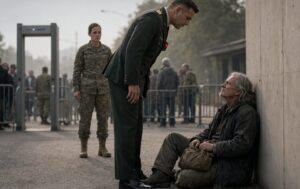
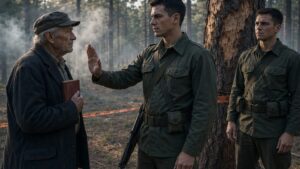
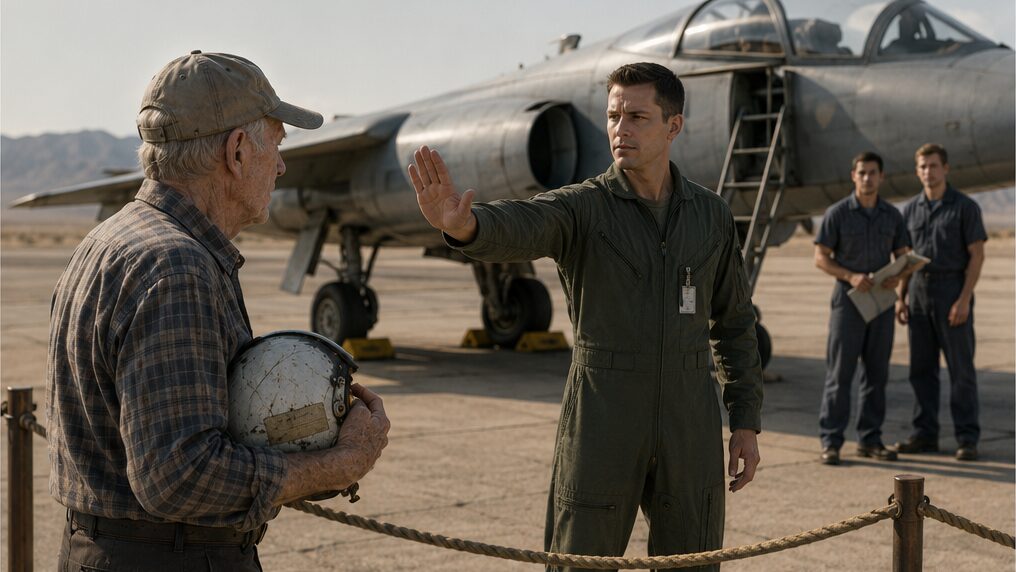
The young officer’s hand came up before Richard Walker could take the last three steps toward the aircraft.
It was not a hard stop. Not dramatic. Just a palm held out at chest height, clean and decisive, the way a man stopped a delivery driver from entering the wrong gate or a child from wandering past a rope.
“Sir, this area is restricted.”
Richard stopped with the battered white helmet held against his ribs.
Behind the officer, the aircraft sat under the desert morning like something pulled from a memory and polished for strangers. Its fuselage caught the sun in flat bright panels. Maintenance ladders leaned against it. Yellow wheel chocks held it still. A strip of red fabric fluttered from one intake cover, snapping in the dry wind. Beyond it, heat already shimmered above the runway.
Richard had known airfields that smelled of rain on metal, burned hydraulic fluid, wet canvas, and fear. This one smelled of dust, jet fuel, coffee from a folding table, and new paint.
The officer in front of him wore a green flight suit with creases still sharp enough to look inspected. He was young in the way men looked young when they had not yet learned that procedure could be both necessary and cruel. His name tape read WHITE. His eyes moved from Richard’s faded cap to his plaid shirt, then down to the helmet.
Not to the helmet as a thing.
To it as a problem.
“I’m only going there,” Richard said, nodding toward the aircraft’s left side.
His voice came out thinner than it had in the car. The desert air took some of it.
The officer glanced back. Two junior airmen near the wheel assembly paused over a checklist. One of them looked quickly away. The other kept watching. A memorial-flight coordinator in sunglasses moved along the rope line farther off, speaking into a radio.
“You’ll need to return to the visitor area,” the officer said. “The ceremony seating is on the other side of the hangar.”
“I don’t need a seat.”
“Sir, the flight line isn’t open.”
“I need three minutes.”
The officer’s face tightened with the controlled patience Richard had seen in nurses, clerks, gate attendants, young people who had been trained to remain polite while moving the old and confused out of the way.
“With respect,” the officer said, though the words carried no weight yet, “everyone needs authorization out here.”
Richard looked past him again.
The aircraft’s skin was cleaner than it should have been. Fresh gray. Fresh stencil. But the curve below the cockpit had not changed. The maintenance crews could repaint a machine, replace panels, polish glass, buff out age. They could not change where the left step sat under the canopy, or the angle at which a man had to turn his shoulder to climb down fast with his hands full.
His left thumb found the burned rim of the helmet.
The helmet had once been white. Now it was the color of old bone and smoke. A blackened crescent scarred one side above the cracked visor bracket. A strip of yellowing tape lay across a faint marking, pressed there so long ago that the adhesive had dried into the surface. Richard’s fingers rested over the tape without quite covering it.
The officer saw the movement.
“Is that part of the display?” he asked.
“No.”
“Then I’ll need you to keep it away from the aircraft.”
Richard said nothing.
A small group of visitors had gathered near the rope line. Veterans in ball caps. A woman with a program folded in both hands. A child standing on tiptoe. None of them were close enough to hear everything, but close enough to see the old man being stopped. Richard felt their attention like sun on the back of his neck.
He had thought, foolishly, that if he came early enough he could avoid this. Before the speeches. Before the chairs filled. Before names got printed and read and settled into the day like there had never been any missing piece.
Nicole had said she would park and find him after checking in. She had wanted to walk with him. He had said he could manage the distance.
He could manage the distance.
It was the stopping he had not accounted for.
“Sir?” the officer said.
Richard looked at him.
The officer’s jaw worked once. He was not cruel. That was almost worse. Cruelty gave a man something to stand against. This was efficiency. This was a clean young man doing exactly what the morning required.
“You can give the item to the display staff,” the officer said. “They’ll tag it properly.”
The helmet shifted against Richard’s shirt.
“Item,” Richard repeated.
The officer heard the correction in it, though Richard had not raised his voice.
“I don’t mean any disrespect,” he said.
Most people did not.
Richard stepped slightly to the side to see the aircraft past him. The officer moved with him, blocking the line again.
One of the junior airmen lowered his clipboard. The wind pushed dust along the concrete in thin pale sheets. Somewhere beyond the hangar, a loudspeaker crackled, then went quiet.
Richard’s chest felt tight, but not from walking. He had brought the helmet wrapped in an old towel in the back seat. He had unwrapped it only after passing the outer gate, where a guard had waved him through with a visitor badge and a look at his driver’s license. No one at that gate had asked why his hands trembled while he lifted the helmet.
Now the helmet sat bare in the light.
“Sir, I need you to step back,” the officer said.
Richard lowered his gaze to the officer’s boots, then to his own. Old brown shoes, polished badly by habit. Dust already on the toes. He could remember black boots on steel, water in the seams, a voice laughing through an oxygen mask. He could remember a hand slapping the top of this very helmet before a morning flight and saying, Don’t let them scratch it, Walker. My wife thinks I look better in it.
He could remember carrying it when the man who owned it could no longer lift his head.
Three minutes, Richard thought.
Not for himself. Not even for the past.
For a name that had been left in a drawer.
“I’ll stand here,” Richard said. “But I won’t take it back to the car.”
The officer inhaled through his nose.
“That’s not an option.”
A vehicle moved slowly along the far service road. The tires hissed over concrete seams. The memorial-flight coordinator glanced over now, attention sharpening. The two junior airmen had fully stopped working.
Richard hated that most of all. The watching.
He had spent half a life learning how not to draw eyes. To sit at the back. To leave reunions before men drank too much and became brave with memory. To fold letters into boxes. To tell Nicole’s mother that some stories belonged to people who were not there to approve the telling.
But the aircraft stood there with its clean paint and open ladder, and the program tables beyond the hangar were already stacked with names.
Almost all the names.
The officer took a step closer.
“Let me see the helmet,” he said.
Richard’s grip tightened.
“It’s old,” the officer added, softening his tone in the wrong place. “I understand it may be important to you. But we can’t have unauthorized objects placed on or near the aircraft.”
Richard looked at the young man’s face. There was no malice in it. No smirk. No mockery. Only a kind of institutional hurry, dressed as concern.
“You understand it may be important,” Richard said.
The officer’s expression flickered.
“Sir—”
“No.”
It was a small word, but it stopped the air between them.
The officer looked past him toward the rope line, perhaps checking whether someone else had heard. Richard could feel the old reflex in the young man: maintain control, keep calm, move the problem along.
Richard had taught men like him once. Not this one, but the type. Good posture. Good hands. Too much trust in the printed sheet. He had liked them, most of the time. The ones who believed if they mastered the rule, they had mastered the situation.
The officer reached out.
Not roughly. Not grabbing. Just a hand moving toward the helmet, fingers open, intending to take charge of it.
Richard drew the helmet back half an inch.
The movement was so slight the junior airmen might have missed it. Joseph White did not.
Richard’s thumb slid off the old tape, exposing just the corner of the faded mark beneath. A letter, half-buried. Smoke-darkened. Not enough to read fully. Enough to suggest it had once meant something to someone who had written it by hand.
The officer’s hand remained suspended.
Richard met his eyes and spoke quietly.
“Ask before you move it.”
Chapter 2: The Call Sign Under the Tape
Joseph White had been corrected by senior officers, instructors, maintenance chiefs, and once by a weather technician who turned out to be right about crosswinds. He knew how to take correction. He knew how to keep his face still.
But the old man’s sentence landed differently.
Ask before you move it.
Not don’t touch it. Not that’s mine. Not do you know who I am.
Ask.
Joseph held his hand in the air for half a second too long, then lowered it.
The old man did not look triumphant. If anything, he looked tired of having said even that much.
Joseph glanced at the helmet again. Up close, it did not look like a souvenir someone had bought online or pulled from a garage display. The surface had the uneven wear of use, the kind no prop department ever got quite right. Sweat-darkened padding showed near the ear cup. The visor bracket had been repaired with two mismatched screws. The burn along the rim was not decorative. It had eaten into the shell.
And under the old tape, partly revealed by the man’s shifting thumb, was a faded block of letters.
Joseph could make out only two.
H and A.
Or maybe M and A.
Dust crossed the concrete between them.
“Sir,” Joseph said, and this time he heard the word before it left him. It was still procedural, but quieter. “May I look at the helmet?”
The old man studied him. His eyes were pale, not weak. The sort of pale that came from sun and years of not sleeping when other people did.
“You can look,” he said. “Not hold.”
Joseph nodded once.
He bent slightly, careful not to crowd him. The two junior airmen near the aircraft had turned fully now. Joseph felt their attention and disliked that he had helped create a scene. The memorial flight was already behind schedule. The commander wanted clean movement, clean optics, no surprises. Public affairs had been nervous about civilians close to the aircraft. The old man had slipped past the normal flow because his visitor badge had been clipped low and half-hidden by the helmet.
Joseph should have moved him back immediately.
Instead, he looked closer.
The tape was brittle, ambered with age. Beneath it, more letters ran along the helmet’s curve. Not printed in the modern stencil style used on current gear. Hand-painted, or nearly so. The old man had covered most of it with his hand, whether by habit or protection Joseph could not tell.
On the side of the aircraft, below the cockpit, a restoration marking had been preserved beneath the new paint: a small black call sign panel, ceremonial now, copied from old photographs. Joseph had seen it on the briefing sheet that morning. It had seemed like heritage detail. Something for the veterans’ group and the base historian.
He looked from the helmet to the aircraft.
The letters did not match exactly, not from what he could see.
But they felt close enough to disturb him.
“What did you say your name was?” Joseph asked.
“I didn’t.”
Joseph accepted that.
“May I have your name?”
The old man looked at the aircraft instead of at him.
“Richard Walker.”
Joseph waited for recognition to come. It did not. Walker was common. The memorial packet had many names in it, most from crews older than Joseph’s parents. Some names belonged to men present today. Some belonged to men whose families would sit in the front row.
Richard Walker had not been marked on Joseph’s security sheet.
“Are you here with the veterans’ group?” Joseph asked.
“No.”
“With family?”
“My granddaughter parked the car.”
Joseph’s eyes moved to the visitor badge clipped to the man’s shirt pocket. It had turned sideways, hiding part of the printed text. “You checked in through the outer gate?”
Richard nodded.
“You weren’t cleared for the restricted line.”
“I know.”
The admission should have made the matter simple.
Joseph gestured toward the temporary security tent. “Then we need to step over there.”
Richard did not move.
“I’m not leaving the aircraft.”
“You’re not at the aircraft, sir. You’re at the line.”
For the first time, something like pain crossed the old man’s face. It came and went quickly, as if trained out of him.
Joseph regretted the sentence before he knew why.
The memorial-flight coordinator approached from the rope line, sunglasses reflecting the white helmet as a small warped oval. “Lieutenant, problem?”
“No, ma’am,” Joseph said automatically.
The coordinator looked at Richard. “Sir, the guest area opens in twenty minutes. We can help you find seating.”
Richard’s mouth tightened.
Joseph lifted a hand slightly. “I’m handling it.”
The coordinator hesitated, then backed off half a step, not gone but no longer entering the moment.
Joseph turned to one of the junior airmen. “Bring me the memorial packet from the tent.”
The airman moved quickly, grateful for an instruction.
Richard watched the aircraft.
Joseph watched Richard.
The packet arrived in a black binder with tabs and laminated pages. Joseph opened it to the heritage section, found the call sign panel reproduction, and held it at an angle against the glare. The aircraft’s commemorative marking read HAWK-17.
He looked again at the helmet.
“Sir,” Joseph said, “the marking under the tape. Is it HAWK?”
Richard’s fingers closed over the letters.
The refusal was answer enough.
Joseph felt the morning tilt.
He lowered his voice. “Were you assigned to this aircraft?”
Richard gave a faint shake of his head. “Not this one.”
Joseph glanced at the restored machine. “Then—”
“They rebuilt her from parts and photographs,” Richard said. “The old one didn’t leave much behind.”
The words did not arrive like explanation. They arrived like something that had been kept sealed and had cracked by accident.
The junior airman with the binder looked down.
Joseph turned another page. Crew histories. Restoration notes. Memorial names. A paragraph about a late-night training emergency decades ago. Fire on approach. Forced landing beyond the old range road. Two survivors. One fatality. One incomplete personnel transfer record pending review.
Pending review.
The phrase had survived in the document because no one had cared enough to remove it.
Joseph scanned the names.
Richard Walker was not in the paragraph.
He checked the front index. Nothing.
“Your name isn’t here,” Joseph said before he could soften it.
Richard’s gaze stayed on the aircraft. “No.”
Joseph looked at the helmet again. “But the call sign is.”
The old man did not answer.
The coordinator’s radio crackled. She turned away, murmuring. A vehicle horn sounded once near the hangar. The airfield kept moving around them, indifferent and exact.
Joseph closed the binder halfway.
His first instinct was still procedure. Verify identity. Secure the object. Move the civilian away. Prevent disruption. The old man could be mistaken. The helmet could be from a collector. The story could be half-remembered, conflated, altered by age.
But the way Richard Walker held the helmet did not look like possession.
It looked like duty.
Joseph turned to the junior airman. “Find Emily Roberts in records. Tell her I need confirmation on a historical call sign tied to HAWK-17 and any associated personnel named Richard Walker.”
The airman nodded and hurried off.
The coordinator faced him again. “Lieutenant, we’re not delaying for an unverified—”
“We’re verifying,” Joseph said.
The words came out sharper than he intended.
Richard looked at him then. Not grateful. Not relieved. Simply measuring whether this change meant anything.
Joseph lifted the binder slightly. “There may be a records issue.”
“There is,” Richard said.
Joseph waited.
Richard’s thumb moved back over the tape.
“That’s all I came to say.”
Before Joseph could answer, the junior airman returned at a jog, phone pressed against his ear. His face had changed.
“Lieutenant,” he said, lowering the phone. “Ms. Roberts says the call sign belonged to a crew listed as incomplete.”
Joseph felt every sound around him thin out.
“Incomplete how?”
The airman swallowed.
“She said the last page is missing.”
Chapter 3: The Record That Stopped Before Dawn
Emily Roberts had learned that old records did not like being rushed.
Paper tore. Ink blurred. Folders hid under wrong dates because someone forty years earlier had hated filing or had been too tired to care. Digitized scans failed where the original page had folded. Half the archive was order pretending to be memory.
Still, when the junior airman called from the flight line and said HAWK-17, her hand stopped over the keyboard.
“That’s today’s aircraft,” he said.
“I know what it is.”
“There’s an older gentleman out here with a helmet. Lieutenant White wants confirmation.”
Emily looked toward the narrow window above her desk. From the records room, the airfield was only a strip of brightness and the tail of the memorial aircraft beyond the hangar edge. She had spent three weeks assembling the ceremony packet. Restoration history. Selected crew photographs. Approved names. Public-safe language. Nothing too disputed, nothing too raw, nothing that could turn a memorial flight into an argument.
HAWK-17 had been troublesome from the beginning.
Not because it lacked records.
Because it had too many broken ones.
“What name?” she asked.
The airman answered, “Richard Walker.”
Emily typed it into the archive search.
No result.
She changed the date range.
No result.
She tried Walker, R.
Three unrelated maintenance entries.
Outside the records room, a cart rattled by, carrying bottled water and folded programs. The public affairs assistant had been in twice already, asking if the historical display board could be moved closer to the veterans’ seating. Emily had said yes to keep from saying that the display board was incomplete in a way she had not been able to fix.
She opened the scanned incident file again.
HAWK-17 Emergency Landing, Range Sector North. Aircraft loss, partial recovery. Crew manifest attached. Supplemental witness report pending. One fatality confirmed before 0600. Two personnel transported. Administrative note: transfer record incomplete.
The file ended there, as if dawn had arrived and everyone had decided the rest could wait.
Emily leaned closer to the screen.
No Richard Walker.
No clean crew list beyond the first page.
She stood and crossed to the locked cabinet where the unscanned folders sat in acid-free boxes. They were not supposed to be handled on ceremony day unless necessary. She decided necessity had just walked onto the flight line holding a helmet.
The HAWK-17 box was heavier than she expected. She placed it on the table and opened it carefully. The smell rose at once: paper, dust, old cardboard, a faint sourness of heat-damaged glue. Inside were photographs, maintenance summaries, copy orders, handwritten labels from at least three different decades.
She found the crew packet under a divider marked RANGE INCIDENTS.
The first page matched the digital scan.
The second page was a carbon copy so faint she had to angle it toward the desk lamp. Names. Initials. Partial service numbers. One line crossed out. One added in darker pencil.
WALKER, R. — detached instructor, temporary assignment.
Emily sat down slowly.
Temporary assignment. That was why the main search had missed him.
She turned the page.
The third sheet had been torn from a report pad, not an official form. It carried a time stamp, a clipped corner, and handwriting tight enough to suggest the writer had been cold, angry, or afraid of running out of room.
Smoke visible from south ridge. Recovery reached aircraft at 0318. Lt. Walker located outside fuselage with—
The sentence continued onto a crease. Emily flattened the page gently.
—with second helmet and injured crewman. Repeatedly stated, “He was breathing when I pulled him clear.” Medical transfer delayed by terrain and fire risk.
Emily stopped reading.
The records room seemed too quiet.
She had built the ceremony packet around aircraft preservation, training legacy, and the modern flight demonstration. She had included the approved fatality name from the database. She had not included uncertainty. Ceremonies did not like uncertainty. They wanted clean phrases and complete lines.
But this note did not feel uncertain.
It felt abandoned.
A knock came at the open door. Joseph White stood in the hallway, still in flight suit, binder tucked under one arm. Behind him, the elderly man waited without entering. He held the helmet in both hands. Beside him stood a woman Emily guessed was family, though she had not seen her at check-in.
Nicole Brown’s expression was tight with worry and embarrassment. Her hand hovered near Richard’s elbow without touching it, as if she had tried and learned not to.
“Ms. Roberts,” Joseph said. “Do you have anything?”
Emily looked at Richard first.
The old man’s eyes had gone to the box on the table. Not to her. Not to Joseph. To the box.
“Yes,” she said. “But I need a minute.”
Joseph stepped inside. “The ceremony schedule is moving.”
“I said I need a minute.”
He blinked. The tone surprised him. It surprised Emily too.
She turned the torn report so he could read without touching it. Joseph leaned down. His face changed by degrees, not dramatically. First focus. Then confusion. Then the small stillness of a man realizing the problem in front of him had become older and larger than his authority.
“Walker,” he said under his breath.
Richard remained in the hallway.
Emily glanced at him. “Mr. Walker, would you like to sit?”
“No.”
“There’s a chair.”
“I see it.”
Nicole exhaled softly. “Grandpa.”
Richard did not move.
Emily understood then that the chair was not the problem. The room was. The files. The way strangers leaned over the edge of his life and asked whether he wanted water.
She took the plain wooden chair beside the table and moved a stack of folders off it. “For the helmet,” she said.
Richard looked at her.
For a moment no one spoke.
Then he stepped inside just far enough to set the helmet on the chair. He did it with both hands, slowly, as though lowering something sleeping. He did not place it on the table with the records. He did not place it at his feet. When he straightened, his fingers remained near the rim for a second longer than necessary.
Emily noticed Joseph notice.
That, she thought, was how recognition started. Not with a salute. With someone finally seeing what care looked like.
Nicole stood in the doorway, arms folded now. “What is this about?” she asked. “He won’t tell me anything. He barely told me where we were going until this morning.”
Richard looked at the floor.
Joseph opened his mouth, then closed it. For once, procedure had not given him a sentence.
Emily turned back to the box. “The public packet has an incomplete record,” she said carefully. “Your grandfather’s name appears in a temporary assignment note connected to the HAWK-17 incident.”
Nicole’s eyes moved to Richard. “You said you trained pilots.”
“I did.”
“You didn’t say this.”
Richard’s jaw worked once. “No.”
Emily continued sorting. There had to be more. A witness report. A medical transfer. Something with the missing name cleanly written. The ceremony could not be amended on a torn note alone, not officially. But the note had opened a door the archive had left shut.
She found a small envelope stuck between two maintenance summaries. No label on the outside. Inside was a photograph, cracked along one corner. Three men in flight gear stood beside the old aircraft, not the restored one. One of them was younger Richard Walker. Emily recognized him only by the eyes. Another man held a white helmet under one arm.
The same helmet, before fire and age.
On the back, in pencil, were three names. One had faded badly. One was Richard Walker. The third was only partly legible, the surname smeared by moisture or oil.
Joseph saw her trying to read it. “Can you enhance that?”
“Maybe later. Not in fifteen minutes.”
Richard’s hand tightened on the back of the chair.
Emily searched the envelope again. There was one more scrap folded twice. She opened it and found handwriting different from the report, hurried and uneven.
Tell Walker he carried him out. Record should show it. He was not alone when he died.
Emily felt her throat close before she could stop it.
Joseph read over her shoulder. He did not speak.
Nicole stepped closer. “What does that mean?”
Richard reached for the helmet, then stopped himself before touching it. He looked older than he had at the door, and somehow less fragile.
Emily placed the scrap beside the torn report.
There, in the dry records room while the memorial aircraft waited in the sun, the archive finally said what the ceremony had not.
Walker carried him out.
Chapter 4: The Granddaughter Who Thought It Was Over
Nicole Brown found her grandfather standing in a records-room doorway with a helmet on a chair and strangers reading pieces of his life from a box.
For a moment, she wanted to take the box, close it, and carry him away.
That was the shape her worry usually took: keys in hand, car nearby, exit route clear. She had learned it after her mother died and Richard began forgetting meals but never appointments, ignoring doctor calls but polishing old shoes before dawn, refusing help until help had to become argument. He could still climb stairs if he took them slowly. He could still drive short distances when the roads were familiar. He could still become stone when someone asked him a direct question about anything that hurt.
But this was not the pharmacy counter or a crowded clinic hallway.
This was an airfield full of uniforms, sun, loudspeakers, and a restored aircraft that seemed to have pulled him toward it like gravity.
“Grandpa,” she said softly.
Richard did not turn.
Emily Roberts stood at the records table, one hand resting near the torn report without touching it. Joseph White stood beside her, his face caught somewhere between duty and apology. On the chair, the white helmet looked wrong in the clean room. Too burned, too human, too much like a thing that had been brought indoors only because someone outside had finally noticed it could not be left on concrete.
Nicole stepped closer. “We should go sit down somewhere.”
Richard’s eyes moved to the helmet.
“You’ve been on your feet too long,” she said. “It’s hot. You didn’t eat breakfast.”
“I ate.”
“You had coffee.”
“That counts at my age.”
The old answer came out dry, almost ordinary, and for one second Nicole nearly smiled. Then she saw his hand. It was open at his side, fingers flexing once, as if they wanted to close around the helmet and would not until allowed.
Allowed by whom, she did not know.
Joseph cleared his throat. “Ms. Brown, we’re trying to confirm some historical records.”
Nicole turned to him. She had seen his type all morning: young, controlled, professional, eyes moving from schedule to badge to boundary line. She did not dislike him. She disliked the way he looked at her grandfather now, as if Richard had become more complicated in front of him.
“He came here for the memorial,” Nicole said. “That’s all. He doesn’t need to be questioned.”
Richard finally looked at her. “Nicole.”
The quiet warning stopped her faster than a raised voice would have.
She lowered her own. “You didn’t tell me any of this.”
“No.”
“You told me it was a flight ceremony.”
“It is.”
“You told me you wanted to see the plane.”
“I do.”
She looked at the helmet. “You didn’t tell me you were bringing that.”
Richard’s gaze followed hers. The burn mark along the rim looked darker under the room’s fluorescent light. She remembered seeing the helmet once as a child, high on a closet shelf behind folded blankets. She had asked if it was his. He had said no and closed the door. Later her mother told her not to bother him about old Navy things.
Old Navy things. That was how the family had named the sealed places in him.
“Why bring it now?” Nicole asked.
Richard did not answer.
A radio sounded from Joseph’s belt. He stepped into the hall to respond. Emily closed the folder halfway, giving them a kind of privacy that was not privacy at all.
Nicole moved nearer to Richard. “You scared me when I came back from parking and you weren’t at check-in.”
“I knew where I was going.”
“That’s not the point.”
“It was to me.”
She swallowed the reply that rose first. It was the same reply she used at appointments, grocery stores, family dinners: You can’t just decide things without telling anyone. You’re not twenty-five anymore. People worry.
The words would have been true.
They would also have been too small for the room.
Through the doorway she could see the bright slice of the hangar corridor. Men and women moved past with programs and radios. Outside, a voice over the loudspeaker tested a microphone, counting once, twice, then apologizing for feedback. The ceremony was still assembling itself, trying to become smooth.
Nicole looked back at her grandfather’s profile. The lines around his mouth seemed carved deeper than they had been that morning.
“Were you in that crash?” she asked.
Richard’s shoulders lifted almost imperceptibly with a breath.
“That’s what they’re trying to decide,” he said.
“No. I’m asking you.”
Emily lowered her eyes to the folder.
Richard looked toward the chair. “I was there.”
Nicole waited.
He did not continue.
She rubbed both hands over her arms though the room was warm. “You never said that.”
“There are many things I never said.”
“That doesn’t make it all right.”
“No.”
The answer unsettled her. He did not defend himself. He did not apologize either. He simply stood inside the truth of it like a man too tired to pretend it was anything else.
Joseph returned to the doorway. “The memorial coordinator wants everyone moved to the staging area in fifteen minutes.”
Richard nodded once, as if the ceremony had nothing to do with him.
Nicole stepped between him and the hall. “We don’t have to stay.”
His eyes met hers.
“You think I came because I wanted to watch an airplane pass over a crowd.”
“I think you came because something here hurts you,” she said. “And I think you’ve spent most of my life deciding that meant no one else was allowed to know what happened.”
A flicker crossed his face. Not anger. Not quite shame.
Emily quietly gathered the loose notes into a protective sleeve. Joseph watched, saying nothing.
Richard’s hand moved to the back of the chair. He did not touch the helmet yet. He touched the wood.
“When your grandmother was alive,” he said, “she knew where it was.”
“The helmet?”
He nodded.
“She asked once if I wanted it in a display case. I told her no. She said then don’t keep it like a ghost.”
Nicole’s eyes stung, unexpectedly and inconveniently. “So you kept it in a closet instead.”
“For a while.”
“And then?”
“I moved it when your mother started cleaning the house.”
Nicole almost laughed, but it came out brittle. “So everyone was protecting everyone from an object nobody explained.”
Richard looked at the helmet. “It was easier when it stayed quiet.”
“Easier for who?”
He did not answer.
The loudspeaker outside crackled again. A practiced voice welcomed early guests and asked all attendees to proceed toward the shaded seating area. Joseph glanced toward the sound, then back at Richard.
“Mr. Walker,” Joseph said, more carefully than before, “if you want to remain near the aircraft, I’ll need authorization from the commander. The records may help, but—”
Richard gave a small nod. “Procedure.”
Joseph accepted the word like a reprimand he had earned.
Nicole saw the helmet’s cracked visor bracket catch the light. She remembered her grandfather teaching her to tie a fishing knot with the same patience he used to peel apples. She remembered him sitting silent through fireworks. She remembered every time the family had called him stubborn when maybe he had been somewhere none of them could see.
She reached toward the helmet.
Richard’s hand moved faster than she expected.
Not grabbing her. Not even touching her. Just there, between her hand and the chair.
Nicole froze.
He looked at his own hand as if it had acted before he meant it to. Slowly, he lowered it.
“I’m sorry,” he said.
That frightened her more than the motion.
“You never let anyone carry it,” she said.
“No.”
“Not even me?”
His eyes softened then, and for a moment he looked like the man who had walked her to school after her father left, who had fixed her bicycle chain in the driveway and pretended not to see when she cried from frustration.
“Especially not you.”
“Why?”
Richard turned the helmet a few degrees on the chair, careful not to scrape the burned rim. Beneath the old tape, the faded call sign showed just enough to be readable now.
HAWK-17.
His thumb rested beside it, not covering it.
Nicole whispered, “Was it yours?”
Richard shook his head.
His voice, when it came, was low enough that Emily and Joseph both went still to hear it.
“It was never my helmet.”
Chapter 5: The Maintenance Chief Recognizes the Damage
David Mitchell had spent thirty years around aircraft and did not trust stories until metal agreed with them.
People remembered badly. Men exaggerated after reunions. Families polished grief into something easier to carry. Ceremony staff turned maintenance history into language fit for brochures. But metal kept its own record. Heat bent it. Stress marked it. Repairs left witness behind in rivet lines, replacement plates, mismatched fasteners, scars under paint.
So when Lieutenant Joseph White brought the old man into the maintenance bay with a helmet in both hands and an archive clerk behind him carrying a folder like it might break, David looked first at the object.
Not the man.
The helmet was placed on a clean rolling cart, after Richard Walker gave a small nod that made Joseph stop before touching it. David noticed that. He noticed the way the lieutenant’s hand waited in midair until permission came. That was new from young officers. Usually they believed permission came with rank.
David wiped his hands on a rag and leaned closer.
The bay smelled of lubricant, warm rubber, and desert dust that found its way into every seam no matter how often crews swept. The memorial aircraft sat half in shade, ladder open, panels secured for display. She was not the original machine, not exactly. A restoration built from surviving components, training airframe parts, and patient reconstruction. But David had made sure she honored the old lines. He had argued for paint accuracy, panel shape, even the old call sign marking some administrators wanted left off because it complicated the story.
Complicated usually meant real.
“What am I looking at?” he asked.
Joseph said, “Potential artifact from the original HAWK-17 incident.”
David glanced at him. “Potential.”
Emily Roberts stepped forward. “We have a temporary assignment note connecting Mr. Walker to the recovery. We also found a handwritten report saying he carried someone out.”
David looked at Richard then.
The old man wore a faded cap, plaid shirt, old shoes dusted at the toes. His face gave nothing away except fatigue. David had seen that face on men at reunions who stood at the edge of hangars and refused chairs.
“What do you want from the aircraft?” David asked.
Nicole Brown stiffened beside Richard, as if ready to object to the bluntness.
Richard did not seem offended.
“Left step,” he said.
David waited.
“Three minutes,” Richard added.
Joseph shifted. “He wants to place the helmet there before the memorial flight.”
David looked back at the helmet. The burn pattern had taken one side unevenly. Not surface scorching. Real heat exposure, directional, with smoke staining into the seam near the visor bracket. He bent closer and saw an old repair along the ear cup. Two screws, wrong head pattern for any standard refurbishing. Field repair, maybe. Or post-incident salvage.
“May I turn it?” David asked.
Richard’s eyes moved to Joseph, then back to David. Something in his face eased by a fraction.
“Yes.”
David used both hands. He did not lift it high. He turned it just enough to examine the inside rim. The padding had collapsed in places. One strap was cut, not worn through. He had expected age. He had not expected the smell that rose when the helmet shifted, faint after all these years but there: old smoke trapped in fabric.
He set it down exactly where it had been.
“This wasn’t display damage,” David said.
“No,” Richard said.
“Cockpit fire?”
Richard’s jaw tightened.
David pointed to the cracked bracket. “This took heat from the left side and impact after. See the deformation? Someone hit hard or pulled hard.”
No one spoke.
David moved to the aircraft and climbed two steps up the ladder, looking toward the cockpit line. “Original HAWK model had an oxygen line routed differently than this restoration. Fire in that corner would’ve trapped a pilot if the release jammed.”
Richard looked up.
David saw it immediately: not surprise, recognition.
“You know that,” David said.
Richard’s hand rested on the cart beside the helmet. “The release jammed.”
Joseph’s eyes moved between them.
David came down one step. “That detail isn’t in the public packet.”
“It wouldn’t be.”
“Why not?”
“Because the report was written by men who weren’t in the cockpit.”
David held Richard’s gaze for a long moment.
It was not challenge now. It was measurement. The old man did not reach for authority, did not offer rank, did not say listen to me because I was there. He simply stood beside the helmet as if he had already said too much.
David came down from the ladder and walked to the aircraft’s left side. “Show me what you remember.”
Nicole spoke quickly. “He shouldn’t climb.”
“I’m not asking him to climb.”
Richard moved slowly toward the aircraft. Joseph stepped aside before he had to be asked. That, too, David noticed.
At the left step, Richard stopped. His eyes traveled along the fuselage, then to the ladder, then to a small restored panel seam below the cockpit.
“Not there,” he said.
David frowned. “What?”
“The auxiliary release. You placed it too high.”
David’s back straightened. “We restored it from photographs.”
“The photograph was after recovery. Panel was bent upward by then.”
David looked at the seam.
The restoration team had argued over that panel for two days. The clearest photograph showed it at the angle used now. Another, grainier image suggested something different, but it had been dismissed as lens distortion.
Richard lifted one hand, not touching the aircraft. His finger hovered several inches below the seam.
“It sat here. Low enough to catch with two fingers if your left arm still worked.”
The bay seemed to hold its breath.
David walked to a tool cabinet, pulled open a drawer, and removed the laminated restoration photograph. He carried it back and held it beside the panel. Then he remembered the grainy alternate image stored in the maintenance binder. He snapped his fingers at a junior airman.
“Binder. Bottom shelf. Red spine.”
The airman moved.
Richard remained with his hand lowered now, eyes on the aircraft skin.
David spread both photographs on a workbench. Joseph and Emily leaned in. Nicole stayed beside Richard.
The grainy image was poor, shot at an angle under harsh light. David had looked at it a dozen times and seen little. Now, with Richard’s description in his head, the shadow under the cockpit changed. Not distortion. A lower fitting. The auxiliary release.
David felt a slow embarrassment rise under his collar.
Not because they had restored a panel slightly wrong. Restorations held compromises.
Because a man had been standing outside with the missing answer in his hands and they had nearly sent him back to visitor seating.
David turned to Richard. “You pulled that release?”
Richard looked at the helmet. “Tried.”
“Tried?”
“It didn’t open far enough.”
David did not ask the next question. Not yet.
Richard’s left hand closed once, then opened. “So I went in another way.”
Nicole whispered, “Grandpa.”
Richard’s face did not change, but David saw something move behind it. Heat. Smoke. A body half-turned in a cockpit. A young man judging the distance between flame and time.
Joseph swallowed. “Mr. Walker, the report says you carried someone out.”
Richard said nothing.
David picked up the helmet again, with Richard’s permission given in a small nod. He looked at the cut strap, the burned rim, the cracked bracket. What had seemed like damage now became sequence.
Helmet removed under pressure. Strap cut. Fire left side. Impact after extraction. Carried away from wreckage.
“Who wore it?” David asked.
Richard’s eyes lowered.
Nicole touched his sleeve, very lightly.
David expected him to retreat into silence. Instead Richard reached out and rested two fingers on the yellowed tape covering the call sign.
“He did.”
No name. Not yet.
David set the helmet back onto the cart with more care than he had used picking it up. The aircraft behind him, polished for ceremony, seemed suddenly less finished.
The public version had been too clean. The restoration had been too clean. Even the memorial flight, with its programs and timed passes, had become too clean.
David looked at Joseph.
“Sir,” he said quietly, because Joseph still outranked him in the day’s chain even if the moment had shifted, “this man knew the aircraft before we inherited it.”
Chapter 6: The Name Missing From the Program
Richard Walker had not come to the airfield to hear his own name.
That was what made the printed program hard to hold.
The paper was thick, cream-colored, folded with care. On the front, the restored aircraft climbed in a clean blue sky, photographed from an angle that made it look lighter than it was. Inside were paragraphs about training legacy, courage, restoration, dedication. Names appeared in bold beneath the heading Honored Crew and Personnel.
Richard stood at the edge of the ceremony staging area while chairs filled under the shade canopy. Visitors fanned themselves with programs. Veterans adjusted caps. A public affairs assistant hurried along the front row, checking reserved signs. The desert sun had begun its slow drop, but the heat remained in the concrete, rising through the soles of Richard’s shoes.
He read the list once.
Then again.
The missing name did not appear.
Of course it did not. If it had, he would have had no reason to bring the helmet.
Joseph White stood several feet away, speaking in a low voice with the memorial-flight coordinator. Emily Roberts had gone back to the records room to make copies. David Mitchell remained near the aircraft, arms folded, eyes moving between the machine and the staging area as if both had become unstable.
Nicole stood beside Richard.
She had been quiet since the maintenance bay.
At first, her silence had felt angry. Then hurt. Now it seemed like she had run out of ways to ask questions without breaking something.
Richard folded the program along its original crease.
Nicole looked at it. “Is his name supposed to be there?”
“Yes.”
“What was his name?”
Richard’s thumb pressed the fold.
The name sat behind his teeth like a piece of metal.
A man could carry another man through fire, sit beside him under a black sky, feel breath rattle and stop, hear a promise pulled out of him before dawn, and still fail at the simplest part: saying the name when it mattered.
“Grandpa,” Nicole said.
He looked toward the aircraft.
In memory, it was not restored. It was broken open under stars, one wing angled wrong, smoke crawling low across desert scrub. The helmet had been white then except for soot beginning to gather along the rim. The man who wore it had laughed that morning over terrible coffee and complained that the sun made every aircraft look guilty.
Richard had told him to quit talking and finish the preflight.
That was the last ordinary sentence between them.
Now, across the staging area, the base commander arrived with two staff members. The commander’s uniform was immaculate. His expression held the practiced gravity of public service. He paused to shake hands with two older veterans, then accepted a program from the public affairs assistant.
Joseph approached him. They spoke briefly. Joseph gestured toward Richard, not pointing exactly. The commander glanced over.
Richard had seen that glance before.
Assessment first. Age, clothing, disruption potential. Then recalculation based on what Joseph was saying.
The commander came toward them.
“Mr. Walker,” he said.
Richard waited.
“I understand there are some questions about the historical record.”
“There’s a name missing.”
The commander held the program at his side. “Lieutenant White has briefed me that records found today suggest additional context. We take that seriously.”
Richard nodded. The phrase additional context had the soft weight of a blanket thrown over a body.
Nicole’s eyes sharpened. “It’s not context if someone was left out.”
The commander looked at her, then back to Richard. “I don’t mean to minimize it. But the ceremony begins shortly. Formal corrections require verification through the historical office.”
Emily arrived before Richard could answer. She carried a folder against her chest, breathing a little hard from crossing the hangar.
“I made copies,” she said. “Temporary assignment note. Recovery report fragment. Photograph. Handwritten message.”
The commander accepted the folder but did not open it immediately. “Ms. Roberts, are these sufficient for public amendment?”
“For official permanent amendment? No, sir. Not alone.” Emily’s voice tightened. “For acknowledging that the printed program is incomplete? Yes.”
A gust of hot wind lifted the corner of Richard’s program.
The loudspeaker clicked. Someone tested the microphone again. The memorial-flight coordinator looked toward them from the front, worry plain now. Time was pressing on everyone.
The commander opened the folder at last. His eyes moved over the copies. He did not react much, but Richard saw the moment he reached the handwritten note. His mouth settled into a line.
“Who is the missing crewman?” the commander asked.
Richard looked down at the helmet tucked in the crook of his arm.
The name was not on the program. Not on the display board. Not in the speech waiting on the podium.
For years, Richard had told himself the omission belonged to the Navy, to lost paperwork, to the confusion of that night, to transfer records and command changes and men who moved on before dawn had finished with the dead. But the truth was less clean.
He had let the silence remain because speaking meant returning.
It meant seeing the man’s face not as a photograph but as weight in his arms.
“His first name was not the one he used,” Richard said.
Nicole turned to him.
Richard’s voice stayed low. “He hated it. Said only his mother called him that when he was in trouble.”
The commander waited.
Richard swallowed.
“I knew him as Hawk.”
Joseph looked up from the folder. “The call sign?”
Richard nodded once. “It started as a joke. Stuck to him before command could stop it.”
“What was his recorded name?” Emily asked gently.
Richard unfolded the program again, though there was nothing there to find.
“His surname was Adams.”
The name came rougher than he expected. Not loud. Rough.
Nicole’s hand went to her mouth, then lowered.
Richard continued before he could stop himself. “He was attached late. Temporary transfer, same as me. They had us moving between training crews. The original manifest didn’t catch up. After the crash, they filed him under the wrong unit. Then under pending transfer. Then nowhere anyone would read aloud.”
The commander looked at Emily.
She nodded. “The smeared photograph shows a surname ending in Adams. The first name is damaged.”
Richard’s thumb moved over the program’s blank space. “He asked me not to let them say he was alone.”
No one spoke.
The crowd under the canopy shifted, unaware of the small court forming at the edge of the staging area. A child laughed somewhere near the water table. The sound felt indecent, then merciful.
Nicole’s voice came thin. “You carried him out.”
Richard closed his eyes for half a second.
“He was breathing when I got him clear.”
The sentence had lived in him for decades, unchanged. Not a defense. Not a plea. A report to a world that had stopped taking notes too soon.
“He died before dawn,” Richard said. “Before the second transport reached us.”
Nicole took a small step closer but did not touch him.
Richard looked at the commander. “I’m not asking for a seat. I’m not asking anyone to put my name in front of people. I’m asking you not to fly that aircraft over a list that leaves him out.”
The commander looked toward the chairs, the podium, the aircraft beyond the staging area.
“Mr. Walker,” he said carefully, “the printed programs can’t be changed in the next few minutes.”
Richard nodded.
“But the spoken remarks can,” Emily said.
The commander’s gaze moved to her.
Joseph stood straighter. “Sir, we can hold the flight sequence briefly.”
The memorial-flight coordinator, close enough now to hear, shook her head. “We have a window.”
David’s voice came from behind them. “Windows can move five minutes.”
The coordinator looked at him. “Not always.”
“This one can.”
The commander lifted a hand, quieting them without force. He looked at Richard again.
“If I acknowledge an incomplete record publicly,” he said, “I need to do it responsibly.”
Richard looked back at him. “Then do it responsibly.”
The commander’s expression shifted, not offended, not soft. Struck, perhaps, by the fact that the old man in front of him did not want drama. He wanted accuracy with a soul in it.
“I can say new information has come to light,” the commander said. “I can say the historical office will review the record. I can say a crewman known by the call sign Hawk will be included in today’s remembrance pending formal confirmation.”
Richard’s fingers tightened around the program.
It was not enough.
It was more than he had arrived with.
Nicole whispered, “Grandpa?”
Richard looked toward the aircraft’s left step. Three minutes. That had been the small request he thought he could manage. Place the helmet. Say nothing. Leave before anyone found a way to make him stand in front.
Now the missing name was half in the air, fragile and temporary, dependent on men with schedules and microphones.
The commander followed his gaze.
“The helmet,” Richard said. “It goes beside the aircraft before the flight.”
The commander hesitated.
Joseph spoke before he could. “Sir, I’ll escort him.”
The coordinator checked her watch with visible pain.
The commander closed the folder.
“I’ll allow it after the opening remarks.”
Richard shook his head.
The movement was small, but everyone saw it.
“Before,” he said. “He goes before me.”
The commander’s face closed again into command. “Mr. Walker, the ceremony cannot be changed this late.”
Chapter 7: Ask Before You Move It
Joseph White had heard commanders say no before.
Sometimes no meant impossible. Sometimes it meant inconvenient. Sometimes it meant a man in authority had reached the edge of what the day had prepared him to handle and mistaken that edge for a rule.
This no sounded like the third kind.
The commander stood with the folder in one hand and the memorial program in the other. Behind him, the shaded seats were nearly full. The loudspeaker hummed with low feedback. The memorial-flight coordinator kept looking from her watch to the aircraft and back again, as if time itself might file a complaint.
Richard Walker held the helmet against his ribs.
He did not argue. He did not raise his voice. He did not turn the moment into a demand for himself.
That made the refusal worse.
Joseph looked at him and saw, all at once, the first hour of the morning from the other side: his own palm lifted, his own words clean and correct, the old man’s body stopped three steps from the aircraft. He had thought he was protecting the flight line. Maybe he had been. But he had also protected a printed program from the man who knew where it was wrong.
“Sir,” Joseph said.
The commander’s eyes shifted to him.
Joseph felt every regulation he knew stack itself behind his teeth. Security. Schedule. Chain of command. Public ceremony. Authorized movement. Aircraft safety. He could justify silence with all of them.
He could also see the helmet.
The burned crescent. The cracked bracket. The tape over HAWK-17. The thing Richard had carried through the morning without letting it become spectacle.
“Sir,” Joseph repeated, quieter, “we can hold the sequence five minutes.”
The coordinator said, “Lieutenant—”
Joseph did not look at her. “We can.”
The commander studied him. “On what grounds?”
Joseph glanced toward the aircraft. David Mitchell stood near the left step, arms still folded, the maintenance bay behind him open to the heat. He gave no signal. He did not need to.
“Safety and historical verification,” Joseph said. “The aircraft is not moving. The flyover window has margin. The crowd can be told we’re making a brief adjustment.”
The coordinator’s mouth tightened. “A brief adjustment that nobody planned.”
“No, ma’am,” Joseph said. “Nobody planned it.”
That landed harder than he expected.
The commander looked back at Richard. “Mr. Walker, if I allow this, I need to know exactly what you intend to do.”
Richard’s thumb moved over the helmet rim. He looked past all of them to the aircraft.
“Place it on the left step,” he said. “Say his name. Step back.”
“That’s all?”
Richard’s eyes returned to him. “That’s enough.”
Nicole Brown stood close to her grandfather, one hand at her side, the other gripping her own folded program until the paper bent. She looked as if she wanted to support him and stop him in the same breath.
The commander opened the folder again. He read the note once more, though Joseph knew by now the words had already done their work.
Walker carried him out.
The commander closed the folder.
“Lieutenant White,” he said, “escort Mr. Walker to the aircraft. Chief Mitchell, remain with them. Ms. Roberts, stay near the podium. I’ll need that name as clearly as we have it.”
Emily nodded quickly. “Yes, sir.”
Richard did not move.
The commander looked at him. “Mr. Walker?”
Richard’s face had gone very still.
Joseph understood then that permission was not the same as ease. The old man had fought for the door to open. Now he had to walk through it.
Nicole leaned toward him. “Grandpa?”
He took one breath. Then another.
“I’m all right,” he said.
It sounded like an old report, not a present fact.
Joseph stepped beside him, not in front. The difference felt small and enormous. The crowd turned as they crossed the staging area toward the aircraft line. Murmurs passed under the canopy. The coordinator moved to the microphone and asked guests for patience while a brief addition was made to the remembrance.
A brief addition.
Joseph felt the phrase bite.
Richard walked slowly but without help. The helmet stayed in his hands. Nicole followed two paces behind, as if afraid that touching him would either steady him or break him.
At the restricted line, Joseph stopped.
Earlier he had stood here like a gate.
Now he lifted the rope himself.
Richard looked at it, then at Joseph.
Joseph kept his voice low. “Sir.”
Richard passed under.
The aircraft waited in the lowering sun. Its restored skin glowed dull silver-gray, every rivet catching a small bead of light. Wind moved dust along the concrete. The red fabric tag at the intake snapped once, sharp as a flag in miniature.
David met them near the left step.
He did not speak. He only moved a tool cart farther away, clearing the space.
Richard stopped before the ladder. The helmet shifted in his hands. For the first time all day, Joseph saw the weight of it. Not physical weight. The other kind. The kind that aged a man in silence.
Joseph moved to take the helmet, then stopped himself.
His hands stayed open in front of him.
Richard noticed.
So did Nicole. So did David.
Joseph lowered his voice until only those closest could hear. “Mr. Walker, may I help you place it?”
Richard looked at his hands.
A long second passed.
“Yes,” he said. “Underneath. Not by the rim.”
Joseph slid his palms under the helmet exactly as told. The shell was lighter than he expected and more fragile. He felt the roughness near the burn mark without touching it directly. Richard did not let go at once. For a moment, both men held it.
Joseph waited.
Richard released.
The trust of it hurt.
Together, with Richard guiding and Joseph supporting, they placed the helmet on the aircraft’s left step. Not high. Not theatrical. Just there, where a pilot’s boot might have rested before climbing into the cockpit. The white shell looked small against the aircraft, damaged and stubborn and finally where it had been trying to go all morning.
The crowd had gone quiet.
Richard kept one hand near the helmet but did not touch it. His eyes fixed on the taped call sign.
The commander’s voice came over the loudspeaker, lower than before.
“Ladies and gentlemen, before today’s memorial flight, new information has come to our attention regarding the crew history connected to HAWK-17. We are beginning a formal review immediately. But today, in this place, we will not allow an incomplete record to become an incomplete remembrance.”
Joseph looked toward Richard.
The old man’s jaw tightened.
The commander continued. “We remember those recorded in our program. And we also remember a crewman known to his fellow aviators as Hawk Adams, whose service and final hours are now being restored to this history.”
A wind moved across the airfield.
Richard’s fingers curled.
Nicole’s breath broke softly behind him.
Joseph expected Richard to lower his head, or step back, or close himself against the sound. Instead Richard lifted his face toward the aircraft, toward the cockpit line, toward the place where smoke and heat and a jammed release had lived longer in him than most people knew.
His lips moved.
At first Joseph thought he was praying.
Then he heard the name.
“Hawk Adams.”
The words were not loud enough for the crowd. They were not meant for the crowd.
Richard said the name again, steadier.
“Hawk Adams.”
Nicole moved beside him, not touching yet. Her face was wet, but she made no sound.
Joseph stood a step behind Richard and felt the shape of his own morning collapse. He had thought respect meant keeping the ceremony clean. He had thought honoring veterans meant managing the space around them, seating them properly, speaking to them politely, thanking them at the right time.
But the old man had not needed thanks.
He had needed someone to stop moving the helmet without asking.
The commander finished the amended remarks. No applause followed. Perhaps the crowd sensed it would be wrong. Perhaps the silence itself had been instructed by the moment.
Richard leaned forward slightly, one hand moving toward the aircraft step, then stopping short of the helmet.
Joseph saw the tremor in his fingers.
“Sir,” he said quietly. “Do you need a moment?”
Richard looked at him. There was no command in Joseph’s voice now. No effort to manage.
Only the question.
Richard nodded once.
David stepped back. Nicole stayed.
The memorial aircraft, polished and rebuilt, held the broken helmet on its step while the desert sun dropped behind the hangar roof. For a few moments, there was no ceremony, no schedule, no public version. Only an old pilot, a missing name, and the young officer who had finally learned to wait.
Then Richard straightened.
He looked at Joseph.
“Now,” he said, “you can fly.”
Chapter 8: The Helmet Beside the Aircraft
After sunset, the airfield lost its hard edges.
The crowd had thinned to small knots of people near the hangar, speaking in low voices or not at all. Chairs sat uneven under the canopy. Programs lay folded on seats, held down by water bottles against the wind. The memorial aircraft had completed its part in the evening without spectacle: engines turning, lights steady, one restrained pass, then stillness again on the concrete.
Richard Walker remained beside the aircraft after most others had gone.
No one asked him to move.
That was the first change.
The helmet rested on a clean cloth David Mitchell had brought from the maintenance bay and placed on the left step after asking Richard if it was all right. The cloth was plain white, folded once. Richard had almost refused it. Then he had seen David wait, cloth in both hands, not assuming, not arranging, not improving the moment for him.
Richard had nodded.
Now the helmet sat there, its burned rim dark against the fading metal. The old tape over HAWK-17 had lifted slightly at one edge in the heat, showing more of the letters than morning had allowed.
Nicole stood beside Richard with her arms folded against the cooling wind.
She had not tried to take the helmet. She had not tried to take his elbow. Every so often, her shoulder brushed his, and that was enough.
Across the aircraft line, Emily Roberts spoke with the base commander near a folding table. The temporary memorial record lay open between them. Emily had written the addition by hand first, because the printer in the records room had jammed and because, she said, a temporary correction should still look cared for. The commander had signed beneath it, not as final proof, but as a promise that the review would begin before the day ended.
Hawk Adams.
Known call sign: Hawk.
Pending formal archival correction.
Remembered today.
Richard had read the temporary sheet once. He had not asked to hold it longer.
Paper could be lost. He knew that better than anyone.
But tonight the name had been spoken into open air.
Joseph White approached from the hangar with the helmet in his hands.
Richard turned before Nicole did. For a second his body went rigid, the old reflex flaring before his face could hide it. Then he saw how Joseph carried it.
Both hands. Underneath. Not by the rim.
Joseph stopped a few feet away.
“Mr. Walker,” he said, “Chief Mitchell asked me to bring it back after he checked the step for heat. May I return it to you?”
Richard looked at the helmet, then at the young officer.
This was the second change.
Joseph could have carried the object correctly and still failed the moment. Instead he stood there asking, with dust on his boots and the day’s certainty gone from his face.
Richard held out his hands.
Joseph placed the helmet into them carefully.
For a brief instant, neither man let go. Not because Joseph held on, but because Richard’s grip faltered. Nicole shifted closer, then stopped herself.
Richard found the weight again.
“Thank you,” he said.
Joseph’s throat moved. “No, sir.”
The answer could have become too much. A speech. An apology shaped for his own relief. Joseph did not let it.
He stepped back.
Richard looked at the aircraft. “You handled her well.”
Joseph followed his gaze. “The aircraft?”
“The day.”
Joseph’s face changed, just slightly.
“I nearly didn’t.”
“Yes.”
The honesty hung between them without cruelty.
Nicole looked down, a small smile appearing through what remained of her tears. Richard had never been generous with unnecessary comfort. When he gave approval, it usually came with a dent in it somewhere.
Joseph accepted the dent.
“I’m sorry for how I stopped you this morning,” he said.
Richard’s thumb moved over the helmet’s side. “You were doing your job.”
“I was doing part of it.”
Richard looked at him.
Joseph stood straighter, not the stiffness from before, but something quieter. “I forgot the rest.”
Richard did not absolve him. He did not need to. He looked instead toward the temporary memorial table where Emily was sliding the signed sheet into a protective sleeve.
“Remember that,” he said.
Joseph nodded. “I will.”
David came down from the aircraft ladder, wiping his hands with a rag. “Panel correction will take paperwork,” he said, as if continuing a conversation from hours earlier. “But we’ll mark the restoration notes tonight.”
Richard glanced at the aircraft’s left side. “It sat lower.”
“I know,” David said. “You told me.”
That was the third change.
Not we’ll check. Not if verified. Not maybe.
You told me.
Richard absorbed it quietly.
Nicole stepped toward Emily when the clerk approached with the protected record. Emily held it out, then hesitated and looked to Richard.
“Would you like your granddaughter to have a copy?” she asked.
Richard turned to Nicole.
For years, his silence had been a locked room in the family house. Nicole had grown up around its door, sometimes angry at it, sometimes afraid of what might be inside, sometimes convinced nothing good could come from opening it. Now she stood with her hands open, not reaching until asked.
Richard gave a small nod.
Nicole took the copy from Emily.
She read the handwritten addition once, slowly. When she reached the name, her lips formed it without sound.
Hawk Adams.
Richard watched her read. He had imagined this moment as exposure, as something stripped from him under fluorescent lights or ceremony pressure. Instead it felt quieter and more difficult. Not shame leaving. Nothing so easy. More like a weight changing hands without becoming lighter.
Nicole looked up. “Will you tell me about him?”
Richard’s first answer rose from habit.
Not now. Not here. Some other time. It was a long time ago.
He had used those phrases like sandbags for half a century.
Behind Nicole, the aircraft stood with its ladder still open. The step where the helmet had rested was empty now, but not meaningless. The day had not fixed the past. It had not returned the man whose name had finally been spoken. It had not make Richard young, or whole, or free of the dawn he carried.
But the record had a mark in it now.
And Nicole was still standing beside him.
Richard looked down at the helmet. He saw the white shell before the fire. Saw Hawk grinning with it under one arm. Saw coffee steam in desert cold. Saw a hand reaching out of smoke. Saw his own younger fingers cutting the strap because the buckle would not release. Saw stars above the wreckage. Saw the first gray line of morning and heard the promise he had not known would take the rest of his life to keep.
“He was loud,” Richard said.
Nicole laughed once, softly, surprised by the answer.
Richard’s mouth moved almost into a smile. “Not all the time. Just when quiet would have served him better.”
Joseph listened without stepping closer.
David folded his rag and tucked it into his pocket.
Emily lowered her eyes, giving the story room.
Richard continued, still looking at the helmet. “He sang badly. Knew he sang badly. Did it anyway. Said fear hated music.”
Nicole stood very still.
“He called everyone by the wrong name until they corrected him twice. After that he never forgot. He wrote letters on paper so thin you could see yesterday through it. He complained about every cup of coffee on every base and drank all of it.”
The wind moved gently across the line.
Richard touched the burned rim with one finger.
“And he was breathing when I pulled him clear.”
Nicole took his free hand then.
This time, he let her.
No one saluted. No one applauded. The base lights came on one row at a time, small white points against the deepening blue. Somewhere near the hangar, a cart rolled over a seam in the concrete. The sound faded.
Joseph looked at the helmet, then at Richard. “What was he like in the air?”
Richard’s hand tightened around Nicole’s.
For the first time that day, the question did not feel like a demand for proof.
It felt like a place to begin.
Richard looked toward the dark shape of the aircraft and held the old helmet close, not to hide it now, but because he was ready to carry it differently.
“He trusted the machine,” he said. “But he trusted people more.”
Then he stood with his granddaughter beside him, the young officer listening, and the corrected name waiting in the record behind them.
The story has ended.