The Officer Who Forced an Old Man Into the Dirt Outside a Highway Diner and Realized Too Late Who He Had Humiliated
Chapter 1: The Fine That Was Never Real
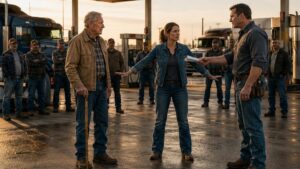
The citation landed on the table beside George Thompson’s coffee with enough force to splash the dark liquid over the rim.
George looked down at the paper.
Then he looked up at the young officer standing over him.
The diner had gone quiet.
Not completely silent. The coffee machine still hissed behind the counter. Silverware still clinked somewhere near the back. But enough people had stopped talking to notice what was happening.
“You parked in a restricted emergency access zone,” the officer said.
George glanced through the window.
His aging pickup truck sat exactly where Sarah Martinez had directed him to park ten minutes earlier.
“No, I didn’t.”
The officer folded his arms.
“That’s the violation.”
George picked up the citation.
The ink was still wet.
That struck him first.
Not the accusation.
The fresh ink.
The officer had written it only moments ago.
“Interesting,” George said quietly.
The officer’s jaw tightened.
“What?”
George pointed toward the truck.
“There isn’t an emergency access zone out there.”
The officer didn’t even bother looking.
“I determine that.”
A few customers exchanged glances.
Sarah wiped down the counter while pretending not to listen.
George looked back at the paper.
The fine amount was unusual.
Not impossible.
Just unusual.
Two hundred dollars.
Cash preferred.
No payment instructions.
No court information.
No administrative reference number.
Just a signature.
Officer Dennis Baker.
George set the paper down.
“I won’t be paying that.”
Dennis smiled.
Not because he found anything amusing.
Because he had expected exactly that answer.
“Most people don’t at first.”
George took a sip of coffee.
The officer remained standing over him.
Waiting.
The silence stretched.
Finally Dennis leaned forward.
“Let’s make this easy.”
George said nothing.
“You pay the fine.”
Still nothing.
“And everybody goes home happy.”
George studied the young man’s face.
Not anger.
Not yet.
Something else.
Need.
The need to be obeyed.
The need to win.
George had seen that look before.
Far too many times.
Different uniforms.
Different countries.
Same expression.
People often confused authority with strength.
The dangerous ones confused authority with fear.
“I think we’re finished here,” George said.
Dennis tapped the citation.
“We’re finished when I say we’re finished.”
Across the room Sarah’s shoulders stiffened.
George noticed.
Interesting.
The officer wasn’t surprising her.
That meant this wasn’t the first time.
George folded the paper carefully.
Not aggressively.
Not disrespectfully.
Just carefully.
Then he slid it back across the table.
“No.”
Dennis laughed once.
Short.
Sharp.
“You don’t understand how this works.”
George looked out the window again.
The highway beyond the diner shimmered beneath the morning sun.
Travelers came through every day.
Most never stayed long.
Easy targets.
Easy pressure.
Easy money.
A familiar system.
The officer reached down and grabbed the citation.
“You think I’m bluffing?”
“I think you’re making a mistake.”
The smile vanished.
Dennis leaned closer.
“Old man, you don’t get to tell me what mistakes look like.”
Near the register, Sarah accidentally dropped a spoon.
The sound cracked through the room.
Everyone looked.
Then everyone looked away again.
George recognized that reaction too.
People avoiding involvement.
People calculating risk.
People deciding silence was safer.
Dennis straightened.
“License.”
George handed it over.
The officer glanced at it.
His eyes narrowed.
“You from around here?”
“No.”
“Passing through?”
“Yes.”
Dennis nodded slowly.
Exactly the answer he wanted.
No local connections.
No complaints.
No consequences.
He slipped the license into his pocket.
George noticed.
“So now you’re keeping it?”
Dennis ignored the question.
“You can get it back after the fine is paid.”
Sarah finally spoke.
“Officer, that’s not—”
Dennis turned toward her immediately.
The look he gave her was enough.
She stopped.
George watched the exchange carefully.
Not fear.
Habit.
This had happened before.
The realization settled quietly into place.
The fine wasn’t the story.
The system was.
Dennis returned his attention to George.
“You have ten minutes.”
“For what?”
“To become cooperative.”
George almost smiled.
Almost.
Instead he reached into his coat pocket.
His fingers brushed against a battered black phone.
Old.
Scratched.
Heavy.
He left it where it was.
Not yet.
He withdrew his hand.
Dennis noticed the motion.
His eyes followed it briefly.
Then dismissed it.
Just an old phone.
Nothing important.
George looked at the young officer.
“Ten minutes won’t change anything.”
The answer irritated Dennis more than outright defiance would have.
No anger.
No pleading.
No fear.
Nothing.
The officer grabbed the citation pad from his belt.
As he flipped through the pages, Sarah saw something that made her stomach tighten.
The violation code had changed.
Dennis had crossed out one number.
Written another.
Then altered the amount.
Two hundred became three hundred.
Just like that.
She looked away quickly.
Dennis tore off a fresh copy.
“New amount.”
George glanced at it.
“Why?”
“Administrative adjustment.”
A few people laughed nervously.
Dennis stared until they stopped.
George examined the paper.
The altered numbers.
The fresh handwriting.
The sloppy correction.
Then he placed the second citation beside the first.
“You changed the violation.”
Dennis said nothing.
“You also changed the amount.”
Still nothing.
“You forgot to change the date.”
For the first time uncertainty flickered across Dennis’s face.
Only for a second.
Then it vanished.
George slid both citations across the table.
Side by side.
Visible.
Obvious.
The contradiction sat there for everyone to see.
Sarah stared at them.
A truck driver nearby stared too.
Nobody spoke.
But the room had changed.
A tiny shift.
Not support.
Not yet.
Doubt.
Dennis felt it immediately.
And he hated it.
His voice hardened.
“Outside.”
George looked up.
“What?”
“You heard me.”
The officer stepped back.
“Take your truck keys and get outside.”
The room became completely silent.
George remained seated for several seconds.
Then he slowly stood.
Picked up his coffee.
Set it down again.
Left a few bills beside the plate.
And walked toward the door.
Dennis followed.
The moment they stepped into the sunlight, the officer pointed toward the parking lot.
“Keep moving.”
George looked at him calmly.
And for the first time, Dennis felt a small, uncomfortable question forming in the back of his mind.
Why wasn’t this old man afraid?
Chapter 2: Dirt Beside the Highway
By the time George reached the parking lot, people had already started watching through the diner windows.
Nobody wanted to miss whatever happened next.
Dennis seemed to know it.
His stride changed.
His shoulders squared.
His voice became louder.
Everything became performance.
“Stand over there.”
George stopped beside his truck.
The gravel crunched beneath his boots.
“Why?”
“Because I told you to.”
The answer came instantly.
Too instantly.
Dennis wasn’t responding anymore.
He was asserting.
Testing.
Pushing.
George had seen young men do this before when they feared losing control.
The officer still had George’s license.
Still had the fake citations.
But somehow that wasn’t enough.
The crowd’s uncertainty inside the diner had damaged something.
Authority depended on perception.
And Dennis could feel perception slipping.
He stepped closer.
“Last chance.”
“For what?”
“Pay the fine.”
George looked toward the diner windows.
Faces stared back.
Some curious.
Some nervous.
Some embarrassed.
Then he looked at Dennis.
“No.”
The answer landed harder than shouting would have.
Dennis’s face reddened.
“Why?”
George shrugged slightly.
“Because it’s not real.”
A truck rumbled down the highway nearby.
The sound faded.
Silence returned.
Dennis pointed toward the ground.
“You think you’re smart.”
“No.”
“You think you’re better than me.”
George shook his head.
“I don’t know you.”
The statement hit a nerve.
Dennis moved closer.
Too close.
The smell of coffee and aftershave lingered between them.
“You know exactly what I am.”
George studied him.
For a moment he saw something beneath the arrogance.
Not confidence.
Fear.
Fear disguised as aggression.
Fear of looking weak.
Fear of losing face.
The realization didn’t make Dennis less responsible.
But it made him understandable.
And somehow that was worse.
“I know what you’re doing,” George said quietly.
Dennis’s eyes narrowed.
“What does that mean?”
“It means you’ve done this before.”
The officer’s expression froze.
Just long enough.
There it was.
Confirmation.
Then anger flooded in to cover it.
“You want to make accusations?”
“No.”
“Because I can make things very difficult.”
George sighed.
The conversation had crossed a line.
Not legally.
Emotionally.
There would be no easy exit now.
Inside the diner Sarah stood near the window gripping a dish towel.
She wanted to walk outside.
She wanted to say something.
But she remembered the last complaint.
The last business owner who had challenged Dennis.
The inspections.
The parking citations.
The constant harassment afterward.
Fear had a long memory.
Outside, Dennis reached toward George’s shoulder.
Not violently.
Not yet.
A warning touch.
George stepped back.
The movement changed everything.
Dennis interpreted it as resistance.
The crowd interpreted it as escalation.
George realized it immediately.
A mistake.
A small one.
But enough.
The battered black phone rested inside his coat pocket.
His hand moved toward it instinctively.
Then stopped.
Not yet.
He had spent years avoiding exactly this.
Years.
Power was addictive.
Authority was easier than persuasion.
He had promised himself he would not become a man who solved every problem with influence.
So he lowered his hand.
And gave Dennis one more chance.
“You should walk away.”
The officer laughed.
“You threatening me?”
“No.”
“Then what was that?”
George looked toward the highway.
“I’ve seen where this road ends.”
Dennis mistook the meaning completely.
His face hardened.
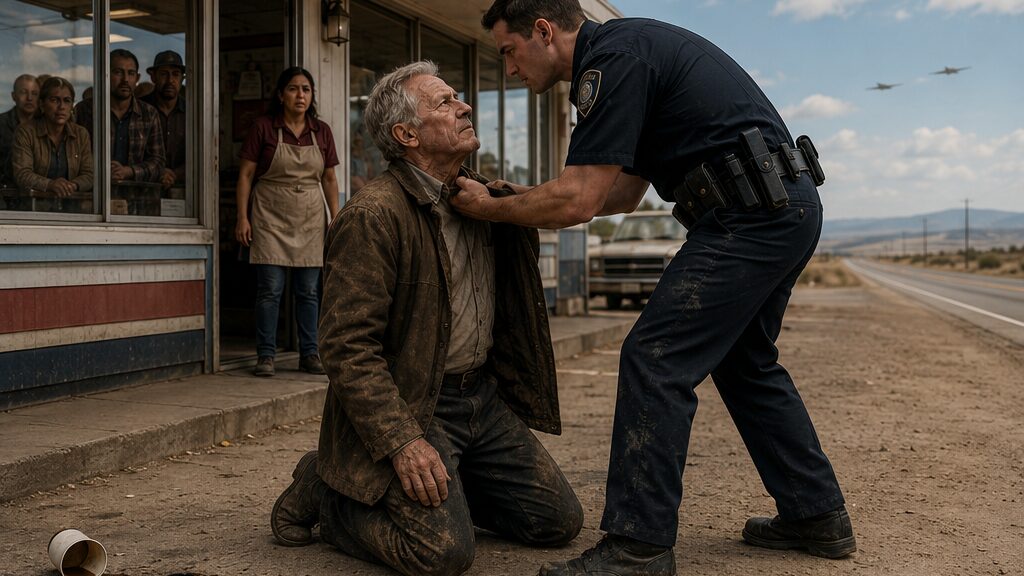
“Get on your knees.”
Several people inside the diner gasped.
George blinked once.
Nothing more.
“What?”
“You heard me.”
Dennis pointed toward the dirt beside the parking lot.
“If you’re going to challenge an officer, you’re going to learn some respect.”
Sarah’s stomach dropped.
This had gone far beyond a fake fine.
Even Dennis knew it.
And yet he kept going.
Because backing down now would mean admitting everyone had seen the truth.
George stood perfectly still.
“You don’t want to do this.”
Dennis grabbed his arm.
Hard.
The crowd reacted instantly.
A murmur spread through the diner.
Someone pulled out a phone.
Another customer looked away.
George didn’t resist.
That should have ended it.
Instead it emboldened Dennis.
The officer twisted his arm.
Forced him downward.
And shoved.
George hit the dirt on one knee.
Dust exploded around him.
Coffee-colored soil stained his trousers.
For a moment nobody moved.
Nobody spoke.
The image hung there.
An old man kneeling beside the highway.
A police officer towering over him.
Sarah felt something shift inside the diner.
Not fear this time.
Disgust.
The truck driver near the window shook his head.
A couple stood up.
The room was turning.
Dennis didn’t notice.
He was too focused on winning.
George looked down at the dirt.
Then at the officer.
No anger.
No panic.
Only disappointment.
That expression unsettled Dennis more than rage would have.
“What?” he snapped.
George slowly rose back to his feet.
Dust clung to his knees.
His coat.
His hands.
Dennis stepped forward again.
Ready to shove him back down.
Then stopped.
Because George was looking directly at him.
Calm.
Unmoving.
Certain.
For the first time that certainty felt dangerous.
Not physically.
Something else.
Something Dennis couldn’t identify.
George brushed dirt from one sleeve.
Then spoke quietly.
“I’d like my phone.”
Dennis frowned.
“Your what?”
“My phone.”
The officer stared.
Behind him, inside the diner, people pressed closer to the windows.
Nobody understood why the request felt important.
Not yet.
Dennis laughed.
Relief flickered through him.
Just a phone.
An old man calling for help.
Nothing more.
“Fine.”
He reached into George’s coat pocket.
Pulled out the battered black device.
And dropped it into George’s hand.
George looked at the screen.
The display glowed softly.
Dennis suddenly felt the same uncomfortable question returning.
Only stronger.
George’s thumb hovered over a single contact.
Then he looked up.
Not at the crowd.
Not at the diner.
Not at the highway.
At Dennis.
And that frightened the officer more than anything that had happened so far.
Chapter 3: A Number Spoken Once
The parking lot had become so quiet that the buzz of a distant power line seemed loud.
George held the phone in one hand.
Dust still clung to his trousers.
Dennis crossed his arms.
Trying to project confidence.
Trying to convince himself he still controlled the situation.
“Go ahead,” he said.
“Call whoever you want.”
George studied the screen.
The contact list contained very few names.
Most people would have expected hundreds.
There was only a small handful.
The result of years spent disappearing from public life.
He pressed one entry.
The phone rang once.
Then stopped.
Someone had answered immediately.
George lifted the phone to his ear.
“Sir.”
The voice was crisp.
Alert.
Awake before speaking.
Not the voice of someone interrupted.
The voice of someone always prepared.
George looked at Dennis.
Then at the badge pinned to the officer’s chest.
“Badge 4402.”
The words were calm.
Nothing more.
No anger.
No explanation.
No demand.
Dennis smirked.
At first.
Then George spoke again.
“Erase him from the system.”
Silence followed.
Not confusion.
Not hesitation.
Silence of comprehension.
Then the voice answered.
“Understood, sir.”
The line disconnected.
George lowered the phone.
That was all.
No dramatic speech.
No threat.
No argument.
Nothing.
Dennis stared.
Waiting.
Several seconds passed.
Nothing happened.
Relief flooded through him.
The crowd had expected something.
The old man had expected something.
And nothing had happened.
Dennis laughed.
“There it is?”
George slipped the phone back into his coat.
“Yes.”
“That was your big move?”
George said nothing.
The officer looked around at the onlookers.
His confidence began returning.
“You hear that?”
Nobody responded.
“He thinks a phone call changes reality.”
A few people exchanged uncertain glances.
Even Sarah looked confused.
The call had been too short.
Too ordinary.
George remained standing quietly.
The calmness was becoming unbearable.
Dennis took a step closer.
Then another.
He wanted a reaction.
Any reaction.
Fear.
Anger.
Embarrassment.
Anything.
Instead George simply watched him.
As if waiting.
As if time itself was on his side.
Then Dennis noticed something.
A name.
For only a moment.
The phone screen had not fully darkened before George pocketed it.
The contact remained visible.
Brian Robinson.
The name tugged at something.
Not recognition.
Memory.
A headline.
A television interview.
A photograph.
Dennis frowned.
Before he could place it, a distant sound drifted across the highway.
A low thumping rhythm.
Faint.
Almost hidden beneath the wind.
George heard it.
Sarah heard it.
The truck driver heard it.
Everyone turned instinctively toward the horizon.
Dennis did too.
The sound came again.
Slightly louder.
A steady pulse.
Rotors.
The color drained slowly from Dennis’s face.
Far beyond the highway, tiny dark shapes appeared against the sky.
And for the first time since issuing the fake citation, Officer Dennis Baker realized something might be terribly wrong.
Chapter 4: The Weight of Old Authority
The helicopters arrived faster than Dennis thought possible.
They appeared over the highway ridge in a disciplined formation, low enough for everyone in the diner parking lot to feel the vibration through the ground.
Nobody spoke.
The rotors did all the talking.
Dust swirled across the parking lot.
The same dirt that had stained George’s knees now lifted into the air around them.
Dennis stared upward.
His confidence collapsed in stages.
First confusion.
Then concern.
Then something much worse.
The lead helicopter descended into a nearby field beyond the diner.
Not directly onto the highway.
Not dramatically.
Precisely.
Professionally.
As though the location had already been mapped before anyone arrived.
George watched without visible reaction.
That unnerved Dennis more than the aircraft themselves.
A convoy of dark vehicles followed minutes later.
The speed of their arrival was impossible to ignore.
Inside the diner, customers crowded the windows.
Sarah stepped outside for the first time since the confrontation began.
Nobody tried to stop her.
Nobody wanted to.
The situation no longer belonged to any of them.
Several uniformed personnel exited the vehicles.
They moved with purpose but not panic.
One of them approached George directly.
The officer stopped several feet away.
Then stood at attention.
Dennis felt his stomach drop.
The younger man spoke first.
“Mr. Thompson.”
George nodded.
“Thank you for coming.”
The officer glanced briefly toward Dennis.
Only briefly.
Yet that glance carried more weight than any accusation.
“We have transportation available if needed.”
George shook his head.
“My truck still works.”
“Understood.”
No one addressed Dennis.
No one asked his version of events.
No one even looked interested.
That frightened him.
He had expected confrontation.
Questions.
Arguments.
Something.
Instead he felt invisible.
And invisible people rarely controlled outcomes.
A second vehicle arrived.
The door opened.
A tall man stepped out.
Silver hair.
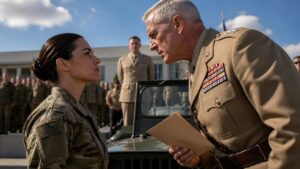
Pressed uniform.
Four stars.
The crowd recognized the rank even if they didn’t understand its significance.
Dennis certainly understood.
His legs suddenly felt weak.
The man walked directly toward George.
No hesitation.
No uncertainty.
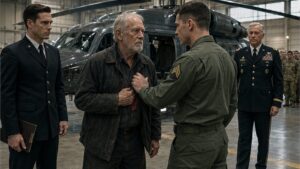
Then he stopped and extended his hand.
“Sir.”
George shook it.
“Brian.”
The use of the first name felt strangely intimate.
Not disrespectful.
Familiar.
Old.
The kind of familiarity earned over decades.
Brian Robinson looked at the dirt still clinging to George’s coat.
His expression hardened.
Not dramatically.
Quietly.
The way steel hardens when cooled.
“Are you injured?”
“No.”
Brian nodded once.
Then looked toward Dennis.
The officer wished he hadn’t.
The general’s gaze held no anger.
That made it worse.
Anger could be argued with.
This felt like assessment.
Evaluation.
A conclusion already forming.
Dennis finally found his voice.
“Sir, I can explain.”
Brian ignored him.
Instead he looked at George.
“Would you like to tell me what happened?”
George could have ended Dennis with a few sentences.
Everyone knew it.
Even Dennis.
Instead George surprised them.
“No.”
Brian raised an eyebrow.
George brushed dust from his sleeve.
“There are witnesses.”
The answer seemed simple.
Yet Sarah understood immediately.
George wasn’t interested in power protecting him.
He wanted facts.
Brian understood too.
He turned toward the diner.
“Let’s collect statements.”
The process began immediately.
Not chaos.
Procedure.
Several personnel moved through the diner speaking with customers individually.
Separately.
Comparing accounts.
Documenting details.
Dennis watched his options disappear one by one.
At first he considered lying.
Then he noticed something.
Nobody’s story was being led.
Nobody was being coached.
They were simply being asked what they saw.
And what they saw had happened in public.
The realization settled heavily onto his shoulders.
Hours passed.
The parking lot became an unofficial command area.
Not because George demanded it.
Because the situation required it.
Sarah eventually approached George while investigators worked.
“I should have said something earlier.”
George looked at her.
“You weren’t responsible for his choices.”
“No.”
She glanced toward Dennis.
“But I knew.”
The admission seemed difficult.
George nodded.
That answer alone encouraged her to continue.
“He’d done things before.”
George remained silent.
“He wasn’t always like this.”
That surprised him.
Sarah followed his expression.
“When he first came here, he was polite.”
She folded her arms.
“Nervous, actually.”
George listened.
“He wanted everyone to respect him.”
“What changed?”
Sarah looked toward the highway.
“I think he started believing respect and fear were the same thing.”
George said nothing for several seconds.
Then quietly replied, “Many people make that mistake.”
Later that afternoon, Brian found George standing beside his truck.
The battered black phone rested in his hand.
Not active.
Just present.
“You could have called years ago.”
George smiled faintly.
“You sound like my wife.”
Brian laughed once.
Then the humor faded.
“There have been complaints.”
George looked at him.
“About Dennis?”
“About more than Dennis.”
The answer lingered.
George felt something unpleasant settle into place.
The problem was larger than one officer.
Larger than one parking lot.
Larger than one humiliation.
Brian seemed to read his thoughts.
“We’ve been seeing patterns.”
George stared at the phone.
A tool.
Nothing more.
Nothing less.
For years he had avoided using it.
Avoided making calls.
Avoided opening doors that remained available to him.
Partly out of principle.
Partly out of fear.
Fear of becoming dependent on authority.
Fear of becoming the kind of man who solved every problem through rank.
But standing in that parking lot, watching investigators collect statements from frightened witnesses, another possibility emerged.
Maybe silence carried consequences too.
By evening, an official notice arrived.
Dennis watched as one investigator reviewed the document.
Then handed it to Brian.
The general read it.
Signed it.
And looked directly at the young officer.
For the first time all day.
“Dennis Baker.”
The officer swallowed.
“The inquiry is now official.”
Chapter 5: The Cost of Looking Away
Dennis asked to speak with George before sunrise.
The request traveled through three different people before reaching him.
George almost declined.
Then changed his mind.
The meeting took place behind the diner near an empty loading area.
No audience.
No investigators.
No generals.
Just two men standing beside stacked supply crates.
Dennis looked exhausted.
His uniform was wrinkled.
His eyes red.
The confidence that had fueled him yesterday was gone.
“I wanted to explain.”
George leaned against the side of his truck.
“Then explain.”
Dennis opened his mouth.
Closed it again.
For several seconds he struggled to begin.
Finally he said, “I didn’t think it would go this far.”
George nodded slightly.
The answer was honest.
Incomplete.
But honest.
“You thought I’d pay.”
“Most people do.”
The admission hung between them.
Dennis looked away.
“I know how that sounds.”
“How does it sound?”
The officer laughed bitterly.
“Like exactly what it is.”
George remained silent.
The silence forced Dennis to keep talking.
“I was trying to get noticed.”
George frowned.
“By taking money from travelers?”
“No.”
Dennis rubbed his face.
“By producing results.”
“What results?”
“Stops. Citations. Activity.”
Now George understood.
Not justification.
Context.
Different things.
Dennis continued.
“Every evaluation talked about initiative.”
He stared at the ground.
“Every supervisor wanted numbers.”
“You chose shortcuts.”
The officer nodded.
“At first.”
The words came easier now.
“Then it became normal.”
George watched him carefully.
The young man wasn’t seeking sympathy.
He was trying to understand his own decisions.
That mattered.
Not enough to erase responsibility.
But enough to matter.
“Fear becomes habit quickly,” George said.
Dennis looked up.
“You knew?”
George almost smiled.
“I’ve spent my life around organizations.”
That answer seemed to surprise him.
Not because of what it revealed.
Because of what it didn’t.
George still refused to talk about himself.
Even now.
A vehicle approached from the temporary command area.
The conversation ended.
Not because anyone ordered it.
Because both men understood it had reached its limit.
Before leaving, Dennis asked a final question.
“Why didn’t you call sooner?”
George looked toward the diner.
Toward the parking lot.
Toward the dirt where he had been forced to kneel.
“I kept hoping you would stop.”
Dennis lowered his eyes.
The answer hurt more than anger would have.
Later that morning, Sarah delivered coffee to a group of investigators reviewing reports.
Most of the customers from the previous day had already left statements.
Patterns emerged quickly.
Small patterns.
Repeated patterns.
Too many to ignore.
Several travelers described unusual citations.
Others described intimidation.
One described paying cash simply to avoid trouble.
The amounts differed.
The methods differed.
The behavior did not.
Sarah read enough to feel sick.
Dennis hadn’t invented the system.
But he had embraced it.
George sat alone near the diner entrance.
The battered black phone rested on the table beside him.
For years he had viewed the device as a last resort.
A line he preferred not to cross.
Now he wondered whether he had misunderstood something.
A person could abuse power.
But a person could also abandon responsibility.
The distinction suddenly felt important.
Brian arrived carrying a folder.
His expression told George everything.
The investigation was growing.
“It’s worse than we thought.”
George gestured toward the chair opposite him.
Brian sat.
“We found prior warnings.”
“Against Dennis?”
“Yes.”
George looked away.
The answer troubled him more than expected.
Warnings meant opportunities.
Chances to correct behavior before damage spread.
“What happened?”
Brian opened the folder.
“Recommendations.”
“Nothing else?”
Brian shook his head.
“People hoped the problem would solve itself.”
George almost laughed.
Not because it was amusing.
Because it sounded familiar.
Too familiar.
Hope replacing action.
Avoidance disguised as patience.
The same mistake he had been making.
The realization sat heavily in his chest.
By afternoon another report arrived.
Then another.
Each one expanded the picture.
What began as one officer’s misconduct now looked like a culture of tolerated shortcuts.
Not widespread corruption.
Not some grand conspiracy.
Something more believable.
People looking away.
People postponing action.
People choosing convenience.
George recognized the pattern instantly.
Institutions rarely failed all at once.
They failed through accumulated neglect.
Late that evening Brian found him standing alone beside the field where the helicopters had landed.
“The findings are almost complete.”
George nodded.
Brian hesitated.
Then asked quietly, “What do you want me to do?”
The question lingered.
Not because Brian lacked authority.
Because he respected George enough to ask.
George looked toward the dark highway.
Headlights drifted past in the distance.
Travelers moving forward.
Trusting systems they rarely thought about.
Trusting people they would never meet.
Finally he answered.
“Do your job.”
Brian studied him.
“Even if it’s harsh?”
George thought about Dennis.
About Sarah.
About the witnesses.
About himself.
Then he looked at the dirt still visible near the parking lot.
A small stain remained where yesterday’s humiliation had happened.
The dirt had been swept.
The memory had not.
“If the consequences are earned,” George said, “they aren’t harsh.”
Brian nodded slowly.
The decision had been made.
And for the first time, George understood that refusing to interfere was not the same thing as refusing responsibility.
The official findings would arrive in the morning.
And when they did, no one would be able to pretend the problem belonged only to one frightened young officer.
Chapter 6: Erase Him From the System
The findings arrived just after breakfast.
A thick folder was carried into the diner by an investigator who looked as though he had not slept.
Neither had most of the people involved.
The parking lot was quieter now.
The helicopters were gone.
Most of the temporary personnel had already left.
Only those necessary to complete the process remained.
George sat at the same booth where the first citation had landed beside his coffee.
The seat across from him was empty.
The battered black phone rested near the sugar dispenser.
Unused.
Silent.
Sarah brought him a fresh cup.
“This one’s on the house.”
George smiled faintly.
“You’ll go out of business if you keep doing that.”
“I think I’ll survive.”
For the first time since they met, she looked relaxed.
Not happy.
Just lighter.
As if a pressure she had lived beside for years had finally moved elsewhere.
Brian entered carrying the folder.
The room quieted.
Not because anyone ordered silence.
Because people understood something important was ending.
He stopped beside George’s table.
“The report is complete.”
George nodded toward the seat.
Brian sat.
For several moments neither man opened the folder.
Neither seemed eager to rush.
Finally Brian slid the document across the table.
George glanced at the first page.
Then the next.
Then another.
Witness statements.
Internal reviews.
Prior complaints.
Ignored recommendations.
Missed opportunities.
Nothing sensational.
Nothing dramatic.
Just a chain of small decisions.
One person looking away.
Then another.
Then another.
The kind of failure that rarely made headlines but slowly poisoned trust.
George closed the folder.
“How many?”
Brian understood the question.
“Five formal complaints.”
George looked up.
“And nobody acted?”
“Not enough.”
The answer carried its own shame.
Brian had not been responsible for the local department.
Still, institutions reflected everyone connected to them.
George leaned back.
For years he had believed stepping away from authority was the safest choice.
Retire.
Remain private.
Avoid influence.
Let younger people lead.
Most of the time that had been correct.
But reading the report forced him to confront something uncomfortable.
Abandoning responsibility and avoiding power were not the same thing.
A person could refuse authority for good reasons.
A person could also use that refusal as an excuse.
The distinction mattered.
Across the room the door opened.
Dennis entered.
No uniform.
No badge.
No weapon.
Just a plain shirt and exhausted eyes.
Several customers immediately recognized him.
The atmosphere shifted.
Not hostile.
Awkward.
Dennis noticed.
He noticed everything now.
He walked slowly toward George’s booth.
Stopped several feet away.
“May I?”
George glanced at the empty chair.
“Sit.”
Dennis lowered himself into it.
His hands trembled slightly.
For a moment nobody spoke.
Then Dennis looked at the folder.
“They told me the findings.”
George waited.
The younger man swallowed.
“I kept hoping there would be some mistake.”
“There wasn’t.”
“No.”
Dennis stared at the table.
“I know that now.”
The honesty sounded painful.
Because it was.
George studied him carefully.
The arrogance was gone.
The excuses too.
Only the consequences remained.
“What happens next?” Dennis asked.
Brian answered before George could.
“You’re being removed from service.”
Dennis nodded once.
As though he had rehearsed hearing those words.
“Anything else?”
“There will be additional review.”
The younger man looked down.
Not surprised.
Not shocked.
Just defeated.
Silence settled again.
Eventually Dennis looked toward George.
“Can I ask you something?”
George nodded.
“When you made that call…”
He stopped.
Searching for the right words.
“Were you angry?”
The question surprised everyone.
Even Brian.
George thought about it honestly.
Then shook his head.
“No.”
Dennis frowned.
“I forced you into the dirt.”
“Yes.”
“I took your license.”
“Yes.”
“I tried to make you pay.”
“Yes.”
The younger man looked genuinely confused.
“Then why weren’t you angry?”
George folded his hands.
Because the answer mattered.
Not just to Dennis.
To himself.
“I was disappointed.”
The words landed harder than accusation.
Dennis stared.
George continued.
“I spent most of my life teaching people that authority exists to serve others.”
He glanced toward the window.
Toward the parking lot where everything had started.
“When someone forgets that, people get hurt.”
Dennis lowered his eyes.
The truth seemed almost unbearable.
Not because it was cruel.
Because it wasn’t.
Cruelty would have been easier.
The conversation ended there.
Nothing more needed saying.
Dennis stood.
For a moment it seemed he wanted to add something.
An apology.
An explanation.
A defense.
Instead he simply nodded.
Then walked toward the door.
Halfway there he stopped.
Turned back.
“Why didn’t you destroy me?”
George looked at him.
The question hung in the air.
Because everyone knew he probably could have.
A different man might have.
George glanced at the black phone resting on the table.
The object that had changed everything.
Then back at Dennis.
“My job wasn’t to destroy you.”
The younger man waited.
“It was to stop you.”
Dennis stood motionless.
Then slowly nodded.
A few seconds later he left.
The door closed behind him.
Nobody followed.
Outside, he crossed the parking lot alone.
Past the place where George had knelt.
Past the place where the helicopters had landed.
Past the consequences he could no longer escape.
Inside the diner, Brian watched him go.
“You gave him more grace than I expected.”
George looked down at the folder.
“No.”
Brian raised an eyebrow.
“No?”
George closed the report.
“Grace would have been pretending this never happened.”
The general considered that.
Then smiled slightly.
“You haven’t changed.”
George laughed softly.
“I hope that’s not true.”
Because some things had changed.
They needed to.
A few hours later the remaining investigators packed their equipment.
Vehicles departed.
The temporary command area disappeared.
The field beyond the diner returned to being an empty field.
Life moved forward.
By late afternoon only George remained.
He carried his coffee outside and stood beside his truck.
The dirt stain on his trousers was nearly gone.
Almost.
Not completely.
He looked at it for a long moment.
A reminder.
Not of humiliation.
Of responsibility.
Sarah stepped outside carrying a small paper bag.
“For the road.”
George accepted it.
“Thank you.”
She hesitated.
Then asked the question she had been holding for two days.
“Who are you, really?”
George smiled.
Not because he wanted to avoid the answer.
Because the answer no longer seemed important.
“Just a traveler.”
Sarah laughed.
Neither of them believed it.
Still, she let it stand.
Some stories did not require every detail.
They shook hands.
Then George climbed into his truck.
The engine started on the second attempt.
The familiar sound filled the quiet parking lot.
Before leaving, he glanced once more at the diner.
At the people inside.
At the ordinary place where something important had happened.
Then he reached into his pocket.
The battered black phone rested in his hand.
For years he had treated it as a burden.
A symbol of influence he preferred not to use.
Now he understood it differently.
Authority itself was not the danger.
The danger was forgetting why it existed.
He placed the phone back into his pocket.
Shifted the truck into gear.
And drove toward the highway.
Behind him, the diner grew smaller.
Ahead of him, the road stretched toward the horizon.
For the first time in a very long while, George felt certain he had done the right thing.
The story has ended.